Officials: Nuclear Plant Employees Failed to Check for Fires
Officials: Nuclear Plant Employees Failed to Check for Fires https://www.fireengineering.com/2020/03/22/485749/officials-nuclear-plant-employees-failed-to-check-for-fires/ 3.22.20 HARTSVILLE, S.C. (AP) — Employees at a South Carolina nuclear plant failed to check for fires when making rounds and then falsified log books, federal officials said.The violations of policy happened in 2017 at Duke Energy’s Robinson Nuclear Plant near Hartsville, The Nuclear Regulatory Commission said in a statement.
The employees were supposed to check two emergency diesel generating rooms for fire each hour, but didn’t perform their duties while reporting they made rounds in log books, the agency said.
Duke Energy agreed to retrain employees about the importance of the fire checks not only at the Robinson plant, but also at the utility’s other five nuclear facilities.
Politicians exploit false conspiracy theory that the coronavirus is a bioweapon
Why do politicians keep breathing life into the false conspiracy theory that the coronavirus is a bioweapon? https://thebulletin.org/2020/03/why-do-politicians-keep-breathing-life-into-the-false-conspiracy-theory-that-the-coronavirus-is-a-bioweapon/?utm_source=Newsletter&utm_medium=Email&utm_campaign=Newsletter03192020&utm_content=DisruptiveTech_PoliticiansConpiracyCoronavirus_03132020#
By Matt Field, John Krzyzaniak, March 19, 2020 Editor’s note: Don’t miss our special report, produced in collaboration with The New Yorker magazine, on the questionable safety of biological laboratories, “Hot Zone in the heartland?”
You’ve probably heard the rumor: The new coronavirus is a bioweapon. Some malicious country—perhaps the United States, maybe China, depending on who’s talking or tweeting—purposefully unleashed the virus that causes Covid-19 on the world. You might have also heard that the idea was widely dismissed by disease and defense experts. A good bioweapon, some note, wouldn’t spread as easily and indiscriminately as the new coronavirus does. But for political opportunists and conspiracy theorists, the rising number of Covid-19 infections, the growing ranks of the dead, and the mass disruptions to the daily rhythms of life have created fertile conspiratorial ground.
The Covid-19 bioweapon conspiracy theory has not only failed to be debunked; it even seems to be getting a second wind, and prominent politicians from countries around the world are embracing it. “For a while, it seemed the pushback on the bioweapons narrative from the Washington Post and Foreign Policy was effective,” biodefense researcher Filippa Lentzos said. “But in recent days, the narrative seems to be coming back with a vengeance.” Current and former government officials, including former Iranian president Mahmoud Ahmadinejad, Chinese Foreign Ministry spokesman Lijian Zhao, and US Sen. Tom Cotton of Arkansas have given credence to some version of the theory in the last month.
In the United States, Cotton isn’t fully letting up on his suggestion last month that the virus was a Chinese military creation. In a Fox News interview in February, he appeared to suggest just that, before walking back the idea, sort of. (In a series of tweets, he said the bioweapon theory was just one of several hypotheses.) Bioweapon or not, Cotton still believes someone is responsible for the pandemic, someone Chinese. In a statement Thursday announcing that he’d be temporarily closing his Senate office, he called the virus the “Wuhan coronavirus” five times, vowing, “We will hold accountable those who inflicted it on the world.” In a later clarifying tweet, he said that, yes, he meant China.
A March 12 article in Britain’s Express tabloid added fuel to fire, reporting that University of Illinois law professor Francis Boyle, who helped draft the legislation that implemented the Biological Weapons Convention in the United States, had identified a “smoking gun” that showed the coronavirus was a bioweapon leaked from a Chinese research lab near Wuhan, the city where the outbreak originated. Boyle reportedly based his theory on a paper on ScienceDirect that noted a “gain-of-function” in the virus that makes it better than other coronaviruses at spreading among humans. But as the Express itself notes in a correction, the research paper Boyle cited does not speculate on what caused the gain-of-function in the virus. “It was therefore incorrect when our article claimed ‘the paper suggested Covid-19 has been tampered with,’” the correction notes.
That didn’t stop Manish Tewari, a prominent Indian parliamentarian and spokesperson for the Indian National Congress, the country’s leading opposition party, from re-tweeting the Express article to his more than 380,000 followers, adding his own highly charged twist: the disease outbreak is a terrorist act.
“CoronaVirus is a bioweapon that went [rogue] or that was made to go [rogue]. It is an act of terror,” Tewari tweeted on March 12. “International investigation conducted either under auspices of ICJ or ICC is necessary to unearth the truth & bring focus back on eradicating Biological Weapons.”
Lentzos worries that the parade of prominent figures promoting the bioweapons conspiracy theory could weaken the global taboo against possessing bioweapons—making biological weapon research appear to be widespread. “It’s being pushed at senior political levels, most prominently from Iran, but also from Russia and to some extents China,” she said. “It’s important we call this out. We can’t afford to have it seem like states have bioweapons and are getting away with it, or even that states would want to pursue these sorts of weapons. It significantly degrades the taboo against biological weapons.”
In early March, Iran had over 3,500 confirmed cases spanning all 31 of its provinces, and Iranian officials began jumping on the bioweapons conspiracy bandwagon. Hossein Salami, the commander of Iran’s Revolutionary Guard said that the Covid-19 outbreak was “perhaps a bioterror attack” carried out by the United States. The following day, a conservative Iranian lawmaker repeated the claim, telling an Iranian state-run news outlet that the virus had been intentionally spread throughout Iran and China and proposing an independent bioterror defense organization.
Mahmoud Ahmadinejad, the former Iranian president who seems unable to resist a good opportunity to propagate falsehoods (even Al-Qaida once asked him to stop making things up), also got in on the coronavirus conspiracy action. In an open letter to the UN secretary-general, he wrote that it was clear that the virus was “produced in laboratories … by the warfare stock houses of biologic war belonging to world hegemonic powers.”
Naturally, it didn’t take long for these conspiracies to percolate to the top. On March 12, Iran’s supreme leader issued an edict endorsing the idea that “this incident might be a biological attack” and creating a “health and treatment headquarters” within the armed forces to help control the spread of the virus.
The Chinese government, meanwhile, the bogymen in Cotton’s telling, has at least one prominent conspiracy-monger in its ranks. On March 12, Zhao, China’s foreign ministry spokesperson, demanded answers from the US government by tweeting, “It might be US army who brought the epidemic to Wuhan.”
The new coronavirus is thought to have jumped from animals to people, but researchers still haven’t pinned down which species to blame. The pangolin, an ant-eating animal prized for its meat and scales in China, is one candidate, according to an article in Nature. But scientists haven’t found a close-enough genetic match between viruses found in pangolins and those found in humans to reach a definitive conclusion
And so the source of Covid-19 remains ambiguous, and, like a certain US senator from Arkansas, conspiracy theories thrive on ambiguity.
“We ought to be transparent with the American people about all this,” Cotton said last month to defend his controversial musings. “Maybe some of these so-called experts think they know better. I don’t. And they really don’t either.”
Joe Biden, Bernie Sanders, on climate and nuclear power
 Georgia’s Presidential Primary: Biden And Sanders
 On Climate WABE
Sanders and Biden agree that the U.S. should re-commit to the Paris Climate Agreement, the international accord that President Donald Trump is pulling the country out of. They also say the U.S. should be a world leader on climate change. And they have pledged to reject donations from the fossil fuel industry.
Both say that we need to make sure workers from, say, the coal industry, and their communities, aren’t left behind in a transition to cleaner energy sources.
They want to make big investments in infrastructure and in research and technology; they want to help get more electric vehicles on the roads, and improve railroads and public transit.
Timeline and Spending
Biden says he’d spend $1.7 trillion over the next ten years. Sanders proposes to spend almost ten times that amount, $16.3 trillion.
On the schedule side, Biden’s goal is net-zero greenhouse gas emissions by 2050.
Different Tactics
Both candidates have extensive plans, and we’re not getting all the details in here. But here are some of the tactics where they begin to diverge.
Part of what Biden wants to invest in is carbon capture technology, to basically suck carbon dioxide out of the air and store it to help counteract emissions.
Biden wants to regulate natural gas much more strictly, and to ban new oil and gas leases on federal lands. And he’d encourage renewable energy development in those places.
Sanders wants to basically remake the country’s electric system.
He wants to expand government-run power authorities and have them generate electricity from renewable sources, to eventually drive coal- and gas-fired power plants out of business.
Beyond the regulations Biden is calling for on natural gas, Sanders wants to flat out ban fracking. He also wants to ban imports and exports of fossil fuels.
And Sanders calls carbon capture technology, which Biden supports, a false solution.
While Sanders is against all of it, Biden supports research on a new generation of smaller, cheaper nuclear reactors. And he doesn’t rule out continuing to use the existing ones. https://www.wabe.org/georgias-presidential-primary-sanders-and-biden-on-climate/
Military use: that is clearly the reason for developing Small Nuclear Reactors
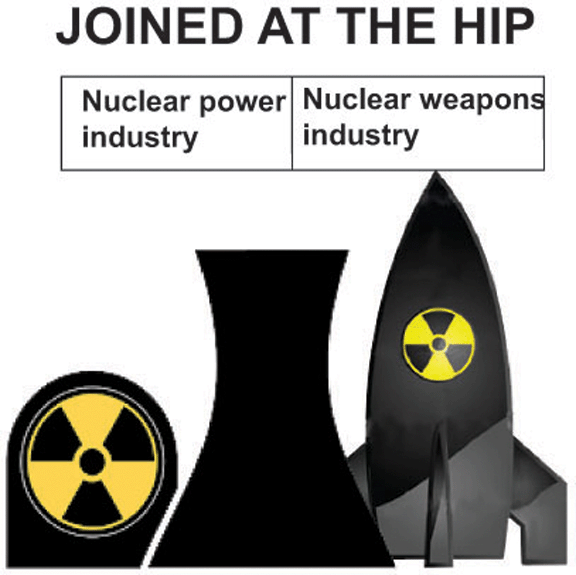 If the testing goes well, a commercially developed, Nuclear Regulatory Commission licensed reactor will be demonstrated on a “permanent domestic military installation.
The department awarded contracts to BWX Technologies, Inc. of Virginia, for $13.5 million; Westinghouse Government Services of Washington, D.C. for $11.9 million; and X-energy, LLC of Maryland, for $14.3 million, to begin a two-year engineering design competition for a small nuclear microreactor designed to potentially be forward deployed with forces outside the continental United States.
The combined $39.7 million in contracts are from “Project Pele,” a project run through the Strategic Capabilities Office (SCO), located within the department’s research and engineering side. The prototype is looking at a 1-5 megawatt (MWe) power range. The Department of Energy has been supporting the project at its Idaho National Laboratory.
Pele “involves the development of a safe, mobile and advanced nuclear microreactor to support a variety of Department of Defense missions such as generating power for remote operating bases,” said Lt. Col. Robert Carver, a department spokesman. “After a two-year design-maturation period, one of the companies funded to begin design work may be selected to build and demonstrate a prototype.”…….
A second effort is being run through the office of the undersecretary of acquisition and sustainment. That effort, ordered in the 2019 National Defense Authorization Act, involves a pilot program aiming to demonstrate the efficacy of a small nuclear reactor, in the 2-10 MWe range, with initial testing at a Department of Energy site in roughly the 2023 timeframe.
If the testing goes well, a commercially developed, Nuclear Regulatory Commission licensed reactor will be demonstrated on a “permanent domestic military installation by 2027,” according to DoD spokesman Lt. Col. Mike Andrews. “If the full demonstration proves to be a cost effective energy resilience alternative, NRC-licensed [reactors] will provide an additional option for generating power provided to DoD through power purchase agreements.”…….
According to Dr. Jonathan Cobb, a spokesman for the World Nuclear Association, small nuclear reactors come in three flavors. The first, small modular reactors, sit in the 20-300 MWe range and are approaching the point they will appear on market.
The second category sits from 10-100 megawatts, and have been used in transports such as icebreakers. According to Cobb, a pair of 32 MWe reactors, based on icebreaker technology, are being used aboard the Akademik Lomonosov, a Russian “floating power plant.”
The third category, covering what the Pentagon appears most interested in, is a category known as microreactors. The challenge, Cobb said, is that this group is the furthest behind technologically, with demonstrations of commercial systems targeted for “the second half of the 2020s,” putting them in the “ballpark” of what DoD is looking for with its A&S effort……
Edwin Lyman, director of the Nuclear Safety Project at the Union of Concerned Scientists, has concerns about the availability of fuel to power a proliferation of small nuclear reactors. He noted, “there are no clear plans for manufacturing the quantity of high-assay low enriched uranium, much less the production of high-quality TRISO [TRi-structural ISOtropic particle] fuel, that would be able to meet timelines this decade.”……
Lord, for her part, would not rule out working with foreign allies on the nuclear program in some way, saying “We always talk with our partners and allies about collaboration. We have many umbrella vehicles, if you will, to do that, particularly with [National Technology and Industrial Base] countries — U.K., Canada, Australia. We have a little bit of an easy button there for working back and forth with technical information.”… https://www.defensenews.com/smr/nuclear-arsenal/2020/03/09/pentagon-to-award-mobile-nuclear-reactor-contracts-this-week/?fbclid=IwAR2MTkRUDqIkruQHY0RivblBzoSY6gubpl8gkWDUDhedVwZEGstJhHYLb6U#.XmawxEl-aJ0.facebook
Nuclear waste dumping for the beautiful landscape of the Northwoods?
 Nuclear Waste In The Northwoods https://www.wxpr.org/post/nuclear-waste-northwoods#stream/0 Nuclear Waste In The Northwoods https://www.wxpr.org/post/nuclear-waste-northwoods#stream/0
By GARY ENTZ 18 Mar 20, The issue of nuclear waste generated by power plants in the United States always seems to be somebody else’s problem. In this week’s Northwoods Moment in History, Gary Entz reminds us how it wasn’t so long ago that it could have been a problem for the Northwoods and could be again in the future.
The beautiful landscape of the Northwoods along with its pristine lakes and streams is something that most people would not associate with a nuclear waste dump. Yet not so long ago that is exactly what the United States Department of Energy had in mind for the region. What was once known as Atomic Power grew out of the atomic weapons research programs of World War II and the Cold War. The first fission reactor capable of generating electricity came online in 1951 and the first commercial reactor to generate electricity for the public market came online in 1957. By March of 1979, when the accident at Three Mile Island occurred, there were over eighty nuclear reactors that either were or had been in operation in the U.S. with nearly sixty more under construction. Wisconsin had three of those reactors, located at Point Beach, Kewaunee, and La Crosse. Nuclear power is touted as being clean energy because it has zero emissions; that is, the steam rising from a nuclear cooling tower is just that, water steam. However, fuel rods are usually swapped out every 18 to 24 months. Spent fuel rods remain dangerously radioactive for 10,000 years or longer and must be safely stored. Unused nuclear fuel rods typically spend 7 to 10 years in a pool of water to cool down and are then stored in dry casks either at the power plant site or in a spent fuel storage installation. Today there eighty sites across dozens of states where nearly 80,000 metric tons of nuclear waste from America’s power plants and military installations is stored. This is where the Northwoods comes in. By the late 1970s, the Department of Energy wanted a centralized location where all the nation’s nuclear waste could be stored and monitored. In the 1980s, the DOE ranked Wisconsin’s Wolf River Batholith as number two of the top three options for a high-level nuclear waste repository. The Batholith is a 1,000 square mile watershed that extends over seven counties, including Langlade, Shawano, Waupaca, Menominee, Portage, Marathon and Oconto counties, and the land of three tribes, the Stockbridge-Munsee, Menominee and Ho-Chunk. This area was selected due to its stable granite geology and lack of earthquakes. The proposed sixteen square mile facility was dangerously close to popular waterways. If the radioactive materials leaked, then contaminated water could flow into the Wolf River, the Fox River, and on to Lake Winnebago and Lake Michigan. The people of the Northwoods and all of Wisconsin were overwhelmingly opposed to becoming a nuclear dump for the DOE. In a 1983 statewide referendum, 89 percent voted for a moratorium on nuclear power and a waste disposal site in Wisconsin. Because of the licensing issues at Yucca Mountain, Nevada, the DOE has been looking for different options, and in 2008 the Wolf River Batholith was again listed as a leading alternative. In 2015, when the state legislature voted to overturn the 1983 moratorium on nuclear power, it also inadvertently lifted to moratorium on a nuclear waste dump. |
|
Democrats may not support Trump’s new W93 nuclear weapons program
|
Political Battle Brewing Over New Nuclear Program, National Defense
3/17/2020, By Jon Harper The Trump administration’s proposal to begin work on a new nuclear warhead program to modernize the nation’s aging stockpile is expected to be hotly contested.For fiscal year 2021, President Donald Trump requested $28.9 billion for the Pentagon’s nuclear enterprise. He requested an additional $15.6 billion for efforts by the National Nuclear Security Administration, which manages the stockpile, including $53 million for NNSA work on a new warhead, dubbed the W93.
The Pentagon’s budget blueprint includes $480 million for work on the weapon system over the future years defense program, with $32 million slated for 2021. The W93 is intended for the Navy’s submarine-launched ballistic missiles, according to senior defense officials. There are currently two families of warheads for the sea-based leg of the triad: the W76 and the W88. “Both of these systems are growing old, and so now we must start thinking about a warhead that will replace one of those two when it’s time for those systems to retire,” a senior defense official told reporters during a background briefing. “These things take a long time. There’s a seven-stage process by which we start to develop a warhead.”…….. The Department of Energy has estimated that the program will cost about $10.9 billion in 2019 dollars. Hans Kristensen, director of the Nuclear Information Project at the Federation of American Scientists, said the $10.9 billion estimate is “low-balling it.” A new fuze is also needed, he noted in an email. “New fuzes are expensive.” Other components could increase the price tag. “The W88 uses the Mk5 [reentry body] but the W93 will likely use a new Mk7, which will add to the cost projection,” Kristensen said. “A W93 using Mk7 obviously will be more expensive than the standard life-extension programs.”….. Nuclear modernization programs, especially those related to warheads, have put Republicans and Democrats at loggerheads in the past. “This will be, I predict, the probably most contentious issue in this year’s defense authorization bill about modernizing the stockpile,” House Armed Services Committee Ranking Member Rep. Mac Thornberry, R-Texas, said during recent remarks at the Brookings Institution. “There is a temptation to say, ‘Oh, it’s worked pretty well so far. Why do we need to mess with it and spend all this money?’” Thornberry said the nuclear arsenal needs to be modernized. However, Democrats may not go along with the W93 plans. “Congressional leadership has yet to receive the military requirement or justification for another new nuclear warhead,” a spokesperson for HASC Democrats said in an email. “As recently as July 2019, the Department of Energy projected it would begin work on this warhead in 2023. Work on this new warhead will add billions of dollars to an already strained nuclear modernization plan.”…… https://www.nationaldefensemagazine.org/articles/2020/3/17/political-battle-brewing-over-new-nuclear-program |
|
Nuclear-powered submarines – fraught with legal and political problems

|
The Complex Policy Questions Raised by Nuclear Energy’s Role in the Future of Warfare, Just Security by Alex Gilbert, Morgan Bazilian and Julia Nesheiwat, March 16, 2020 The United States military, as well as other militaries around the world, are racing to develop high-energy weapons—lasers, high-powered microwaves, and electromagnetic rail guns—in order to compete with near-peer competitors on the next generation of military technologies. But the electricity to power these systems will need to derive from somewhere, and so military planners are eyeing a new generation of energy-dense nuclear reactors, despite potential policy and legal challenges to doing so…….. The Army is considering mobile nuclear power plants, in part to drive high-energy weapons, an idea one retired three-star hailed as a potential logistics revolution. And should the U.S. build space-based lasers for missile defense, nuclear energy may be the only way to provide the needed megawatts. All this raises key policy concerns in relation to international law, rules of engagement, and the laws of warfare. Basing, or even deploying, nuclear reactors in the territorial waters or land of an overseas ally requires the permission of the host government, which may be averse to expanding nuclear power as in the case of major bases like Yokosuka, Japan. Diego Garcia, an island in the Indian Ocean, provides another challenging case as the ongoing territorial dispute between the United Kingdom and Mauritius threatens the U.S. base there, and a nuclear plant would only complicate the existing dispute. The U.S. Navy already faces constraints on where their nuclear-powered ships can visit. Floating nuclear power plants, like those developed by Russia and China, face similar concerns if they transit foreign waters or, in the case of the South China Sea, are stationed in disputed territories. Similarly, mobile reactors, like those considered by the U.S. Army, would likely be transported by air, requiring permission of all overflight countries. Beyond basing, a critical question is whether the U.S. military would own and operate these new reactors, as the Navy currently does, or whether they would pursue commercial alternatives, as the Army is considering. The U.S. Army report on mobile reactors noted that, with either government or commercial ownership, there are concerns about international rules and licensing that present potential barriers to deployment. In some cases, potential host countries do not even have nuclear regulatory agencies. Further, commercial ownership raises liability concerns, both in the case of a military incident or an accident. International nuclear liability treaties are not well harmonized between the U.S. and most of its allies, especially when it comes to the unique concerns of transportable reactors. Using nuclear power for high-energy weapons also creates targeting dilemmas for the U.S. and foreign militaries. High-energy weapons and their support infrastructure, including reactors, may be initial targets in a conflict. The social, environmental, and reputational impacts of damaging a nuclear reactor, particularly on a country’s home territory, or with effects on a third country, could lead to conflict escalation and international condemnation……. Nuclear-powered laser satellites could aggravate concerns about nuclear arms controls as such systems could be used for anti-ballistic missile or anti-satellite applications. While the Outer Space Treaty prohibits weapons of mass destruction in orbit, it does not prohibit other types of weaponry. During the Cold War, Soviet military space reactors raised calls for bans on space nuclear power, particularly after one accidentally crashed in Canada. Recent calls for space arms control have been unsuccessful. As with terrestrial nuclear-powered lasers, the unique role of laser satellites would make them early targets in any major power conflict, leading to risks of collateral damage from radioactive and dangerous space debris, as occurred after the accidental 2009 collision involving a decommissioned Soviet nuclear satellite.. The article below is not about Australia, but it is about small nuclear reactors. Everybody knows, (just quietly) that Australia won’t be getting small nuclear reactors for providing electricity. The real aim is for nuclear-powered submarines. So this article, about the legal and political problems of nuclear reactors for Defence is applicable to Australia, too
The Complex Policy Questions Raised by Nuclear Energy’s Role in the Future of Warfare, Just Security by Alex Gilbert, Morgan Bazilian and Julia Nesheiwat, March 16, 2020 The United States military, as well as other militaries around the world, are racing to develop high-energy weapons—lasers, high-powered microwaves, and electromagnetic rail guns—in order to compete with near-peer competitors on the next generation of military technologies. But the electricity to power these systems will need to derive from somewhere, and so military planners are eyeing a new generation of energy-dense nuclear reactors, despite potential policy and legal challenges to doing so…….. The Army is considering mobile nuclear power plants, in part to drive high-energy weapons, an idea one retired three-star hailed as a potential logistics revolution. And should the U.S. build space-based lasers for missile defense, nuclear energy may be the only way to provide the needed megawatts.
All this raises key policy concerns in relation to international law, rules of engagement, and the laws of warfare.
Basing, or even deploying, nuclear reactors in the territorial waters or land of an overseas ally requires the permission of the host government, which may be averse to expanding nuclear power as in the case of major bases like Yokosuka, Japan. Diego Garcia, an island in the Indian Ocean, provides another challenging case as the ongoing territorial dispute between the United Kingdom and Mauritius threatens the U.S. base there, and a nuclear plant would only complicate the existing dispute.
The U.S. Navy already faces constraints on where their nuclear-powered ships can visit. Floating nuclear power plants, like those developed by Russia and China, face similar concerns if they transit foreign waters or, in the case of the South China Sea, are stationed in disputed territories. Similarly, mobile reactors, like those considered by the U.S. Army, would likely be transported by air, requiring permission of all overflight countries.
Beyond basing, a critical question is whether the U.S. military would own and operate these new reactors, as the Navy currently does, or whether they would pursue commercial alternatives, as the Army is considering. The U.S. Army report on mobile reactors noted that, with either government or commercial ownership, there are concerns about international rules and licensing that present potential barriers to deployment. In some cases, potential host countries do not even have nuclear regulatory agencies. Further, commercial ownership raises liability concerns, both in the case of a military incident or an accident. International nuclear liability treaties are not well harmonized between the U.S. and most of its allies, especially when it comes to the unique concerns of transportable reactors.
Using nuclear power for high-energy weapons also creates targeting dilemmas for the U.S. and foreign militaries. High-energy weapons and their support infrastructure, including reactors, may be initial targets in a conflict. The social, environmental, and reputational impacts of damaging a nuclear reactor, particularly on a country’s home territory, or with effects on a third country, could lead to conflict escalation and international condemnation…….
Nuclear-powered laser satellites could aggravate concerns about nuclear arms controls as such systems could be used for anti-ballistic missile or anti-satellite applications. While the Outer Space Treaty prohibits weapons of mass destruction in orbit, it does not prohibit other types of weaponry. During the Cold War, Soviet military space reactors raised calls for bans on space nuclear power, particularly after one accidentally crashed in Canada. Recent calls for space arms control have been unsuccessful. As with terrestrial nuclear-powered lasers, the unique role of laser satellites would make them early targets in any major power conflict, leading to risks of collateral damage from radioactive and dangerous space debris, as occurred after the accidental 2009 collision involving a decommissioned Soviet nuclear satellite…. …… https://www.justsecurity.org/69056/the-complex-policy-questions-raised-by-nuclear-energys-role-in-the-future-of-warfare/
|
|
“Military Intelligence?” 30,000 U.S. soldiers to Corona-infested Europe for “war games”

|
U.S. Army invades virus plagued Europe, http://space4peace.blogspot.com/2020/03/us-army-invades-virus-plagued-europe.html BRUCE K. GAGNON BRUNSWICK, MAINE, UNITED STATES
In the midst of a staggering virus epidemic that has shut much of Europe down, the insane and arrogant United States is presently sending 30,000 Army troops throughout Europe for war games.As the soldiers emerged from their transport planes they shook the hands of US and European military officials welcoming them to the hot bed of corona-virus.
|
|
Wake up world -to the climate emergency – Naomi Klein’s new book “On Fire”
 To avoid climate catastrophe, it’s going to take a revolution of the mind,
As we approach a turning point in our civilization’s journey, author Naomi Klein has been sounding the alarm about how to shift the current paradigm and loosen our deadly chokehold on the living world. Fast Company, BY ANNA LENZER, 15 Mar 20,
Antarctica just hit 65 degrees, the highest temperature it’s ever recorded, and a sea in Siberia is “boiling” with methane. Major parts of the U.S. drinking water supply are contaminated with “forever chemicals”—so called because they virtually never degrade—that are linked to cancers and liver damage, among other health problems. Climate models used to forecast warming are running red-hot and giving us far less time than we thought to turn things around. And last July was the hottest month in the 140 years that records have been kept, the 415th consecutive month with temperatures above the 20th-century average.
There’s a growing sense that we’re approaching a turning point in our civilization’s journey, in which the path diverges between two extremes—a re-flourishing garden planet and a bleak, burning wasteland of increasingly rationed resources. We’re pushing on dominoes that could fall into a runaway series of irreversible tipping points and feedback loops that will leave us to do emergency triage and run rescue-salvage missions on a dying and incinerated planet for the rest of our days. Peak Life is in sight, possibly already behind us, and our current trajectory is about to fling us off the cliff.
The UN is raising the alarm that the mass extinction of plant and animal species—which has already decimated large swaths of the planet—risks collapsing into a catastrophic point of no return, and that halting this destruction of the web of life (along with our food and water security) requires an unprecedented transformation of civilization beginning immediately.
A series of global summits through the end of this year is intended to kick off  this paradigmatic shift and to loosen our deadly chokehold on the living world.
A few days before the UN’s Climate Action Summit in New York last fall, author Naomi Klein launched her latest broadside against the forces of inertia with the now best-selling On Fire: The (Burning) Case for a Green New Deal, a book designed to inspire a blueprint for the United States’ reemergence as a global climate leader………https://www.fastcompany.com/90475368/to-avoid-climate-catastrophe-its-going-to-take-a-revolution-of-the-mind
A ruse to save the nuclear industry? Dangerous, expensive portable mini-reactors
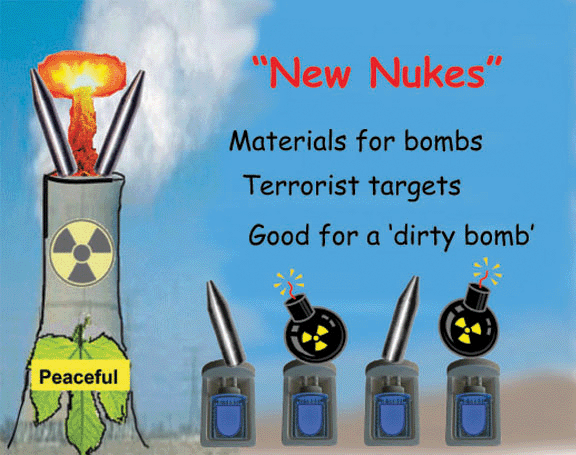
|
Pentagon invented the internet: This time portable Micro Nuclear reactors, https://www.globalvillagespace.com/pentagon-invented-the-internet-this-time-portable-micro-nuclear-reactors/ 12 Mar 20, There’s no shortage of hefty defense deals awarded by the US Department of Defense, but the $40 million contract for micro-reactors definitely stands out, as it hides safety risks and raises doubts over its economic efficiency.The nuclear device that the DoD strategists want must have the capability to be safely and rapidly transported by road, rail, sea or air (sic!) as well as swiftly set up and shut down. The project split between three companies — BWX Technologies, Westinghouse Government Services and X-energy — calls for a “safe, mobile and advanced nuclear micro-reactor.” The safety part sounds particularly soothing, but how would it look on the ground? What if those miniature reactors, when moved by land, become targets of high-profile terrorist attacks? And will it prove to be a real alternative (which means cheaper price, of course) to conventional energy sources? The more reactors — the greater the danger“Any nuclear reactor attracts terrorists,” Andrey Ozharovsky, nuclear scientist, program expert at the Russian Social Ecological Union, told RT. “It doesn’t matter if it’s located at a nuclear power plant [or inside a portable device]… if you remember, the terrorists planned directing one of the planes at a nuclear plant during 9/11.” The logic here is simple, he pointed out: “the more reactors are out there — the greater the danger.” If the US builds hundreds, or even dozens of such devices, it’ll be really hard for them to properly defend them all. Another vital safety issue is the reliability of the nuclear micro-reactors. Interestingly enough, the US military had already experimented with them back in the 1950s and 1960s — and it ended in a tragedy. Several portable reactors were built and setup in Greenland and Panama, but one of them blew up in 1961, killing three operators. The Army Nuclear Power Program was shut down shortly after that. “There were eight US micro-reactors and one of them exploded. That’s how safe they are,” Ozharovsky said, adding that the Pentagon’s idea of bringing them back will “likely create more risks instead of solving any problems.” Micro-reactors yet to prove their economic efficiencyBut even if the portable reactors will be shielded from the perils of the battlefield and operate without failure, what’s the Pentagon’s rationale behind bringing the radioactive fuel to their military bases? For decades, the army had been successfully running on gasoline, diesel and fuel oil; when going off-grid, it would switch to generators and high-power accumulators. “The main problem has nothing related to safety,” Anton Khlopkov, director of Energy and Security Center and member of Russian Security Council’s Scientific Council argued. Micro-reactors must prove their viability from the economic point of view since such plants always have alternatives It is yet to be proven that micro-reactors won’t be “many times more” expensive than other conventional sources of energy. Electricity produced by such devices should be at least comparable in cost to the one produced by diesel generators, he said. Some kind of a soap bubbleIf micro-reactors are such a questionable solution, why is the Pentagon pushing for their development? The answer isn’t lying on the surface, but it isn’t buried too deep. “They work against the trends,” Ozharovsky suggested. And those trends are that the world is giving up on the use of civilian nuclear energy due to being too expensive. Washington may be trying to “support the US the nuclear industry that’s dying out with the use of the military budget; sponsor their research and development — which is an expensive thing.” RT with additional input by GVS News Desk At last – someone recognises the bleeding obvious – thank you! To keep the nuclear industry alive there MUST be new nuclear reactors built. With no willing private investment available, then it must be the tax-payer who coughs up. Especially in USA, it seems that the only respectable use of tax-payer money is in that most sacred of cows – defence. |
|
Canisters for high level nuclear wastes likely to corrode faster than expected
 Corrosion poses risk in nuclear waste storage https://frontline.thehindu.com/science-and-technology/article30913130.ece March 13, 2020 The materials the United States and other countries plan to use to store high-level nuclear waste are likely to degrade faster than previously thought because of the way those materials interact, new research from Ohio State University shows.
The findings, published in a recent issue of “Nature Materials”, show that corrosion of nuclear waste storage materials accelerates because of changes in the chemistry of the nuclear waste solution and the way the materials interact with one another. “This indicates that the current models may not be sufficient to keep this waste safely stored,” Xiaolei Guo, lead author of the study was quoted in the news release issued by the university.
The team’s research focussed on storage materials for high-level nuclear waste that is highly radioactive. While some types of the waste have half-lives of about 30 years, others like plutonium have a half-life that can be tens of thousands of years.
With no long-term viable nuclear waste disposal mechanism yet in operation, in most sites nuclear waste is stored near the plants where it is produced. While countries around the world have debated the best way to deal with nuclear waste, only Finland has started construction of a long-term repository for high-level nuclear waste.
In general, proposals involve mixing nuclear waste with other materials to form glass or ceramics and then encasing those pieces of glass or ceramics, now radioactive, inside metallic canisters. The canisters are buried deep underground in a repository to isolate it.
Researchers found that when exposed to an aqueous environment, glass and ceramics interact with stainless steel to accelerate corrosion, especially of the glass and ceramic materials holding nuclear waste. The study measured the difference between accelerated corrosion and natural corrosion of the storage materials. “In the real-life scenario, the glass or ceramic waste forms would be in close contact with stainless steel canisters. Under specific conditions, the corrosion of stainless steel will go crazy,” he said. “It creates a super-aggressive environment that can corrode surrounding materials.”
To analyse corrosion, the research team pressed glass or ceramic “waste forms” (the shapes into which nuclear waste is encapsulated) against stainless steel and immersed them in solutions for up to 30 days, under conditions that simulate those under Yucca Mountain, the proposed nuclear waste repository in the U.S.
Those experiments showed that when glass and stainless steel were pressed against one another, stainless steel corrosion was “severe” and “localised”. The researchers also noted cracks and enhanced corrosion on the parts of the glass that had been in contact with stainless steel.
Part of the problem lies in the Periodic Table. Stainless steel is made primarily of iron mixed with other elements, including nickel and chromium. Iron has a chemical affinity for silicon, which is a key element of glass.
The experiments also showed that when ceramics, another potential holder for nuclear waste, were pressed against stainless steel under conditions that mimicked those beneath Yucca Mountain, the ceramics and stainless steel corroded in a “severe localised” way.
Angst in Nevada over law designating Yucca Mt for a national repository.
 CORTEZ MASTO PRESSES DOE SECRETARY ON PLAN TO SEEK YUCCA ALTERNATIVES Lincoln County Central | Mar 13, 2020 By Humberto Sanchez, The Nevada Independent
Energy Secretary Dan Brouillette sought to reassure Sen. Catherine Cortez Masto on Tuesday that the Department of Energy plans to seek alternatives to storing nuclear waste at Yucca Mountain, but he stopped short of backing an effort to change the law designating the site for a national repository.
At a Senate Energy and Natural Resources Committee hearing Tuesday on the DOE budget, Cortez Masto, who opposes the project, asked Brouillette what DOE would do if Congress provided funds for the Yucca project in the current fiscal year.
‘We will follow the law, obviously, but it’s our intent to look for alternatives to Yucca Mountain,” Brouillette said. “It’s our intent to begin a process, and that’s why we’ve requested $27.5 million in the budget, to do a few things.” ……
Cortez Masto also pressed Brouillette about whether he would support a repeal of the 1987 law that designated the Yucca the spot for the nation to bury its nuclear waste. …..
At a House hearing last week, Brouillette said the administration currently has no plans to change the law even though it would be needed to implement storing waste at temporary sites, which is something DOE has said it could explore……
After seeking funds for the project in his first three budgets, President Donald Trump reversed course in the fiscal 2021 budget blueprint and in a tweet last month said he heard Nevadans on the issue of Yucca. Most Nevada lawmakers and business interest groups oppose the project’s proposed site, which is located about 90 miles from Las Vegas.
Following the release of the budget, Gov. Steve Sisolak, who was in Washington for the annual National Governors Association winter meeting, hand-delivered a letter to the White House calling on Trump to pledge to veto legislation that would advance the Yucca project and “undermine the State’s legal standing or consent requirements.”
The White House has not yet responded according to Sisolak’s office……..
Trump’s decision on Yucca also comes as he looks to win Nevada in his 2020 re-election bid. He lost the state to Hillary Clinton in 2016 by two points.
After the hearing, Murkowski said she welcomed the president’s budget request dropping funds for Yucca because it would allow Congress to focus on advancing legislation to authorize temporary nuclear waste storage rather than expending energy on the Gordian knot that is Yucca.
“We think we have an opportunity to move on our interim waste bill,” Murkowski said. “I always thought that was a path that we needed to pursue as well. And so I think this gives us an opportunity and an opening.”
The energy secretary also said that DOE remains on track for removing the half metric-ton of weapons-grade plutonium the agency secretly shipped to the Nevada National Security Site (NNSS) from the Savannah River site in South Carolina.
In April, Cortez Masto struck a deal with then-Energy Secretary Rick Perry to remove the plutonium beginning in 2021 and getting all of it out by 2026. The DOE disclosed in January 2019 as part of a lawsuit filed by the state to prevent any plutonium shipment—after talks with DOE yielded no resolution—that it had already shipped the plutonium. ……. https://lccentral.com/2020/03/13/cortez-masto-presses-doe-secretary-on-plan-to-seek-yucca-alternatives/
In southern Nevada, some form of advanced B61-12 testing is underway
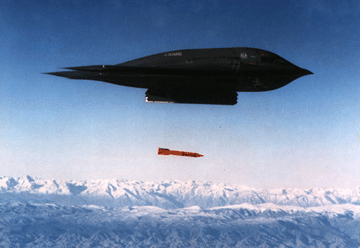 F-15E Strike Eagle Spotted Flying With An Inert B61-12 Nuclear Bomb Out Of Nellis AFB https://www.thedrive.com/the-war-zone/32585/f-15e-strike-eagle-spotted-flying-with-an-inert-b61-12-nuclear-bomb-out-of-nellis-afb
The precision-guided upgrade of the B61 tactical nuclear bomb has had a troubled and very expensive past. BY TYLER ROGOWAYMARCH 14, 2020, Exercise Red Flag is underway with the U.S. and some of its tightest allies fighting a mock air war over the Nevada Test and Training Range (NTTR)
In southern Nevada. Either in conjunction with the exercise or independent of it, there is a lot of testing currently going on over the same area. Case in point, this test F-15E Strike Eagle assigned to Eglin Air Force Base carrying an inert version of America’s newest variant of its long-running B61 series of nuclear bombs, the precision-guided B61-12.
The jet was snapped by aviation photographer Kris Trajano on Tuesday, March 10th, 2020. The F-15E was followed by a pair of F-16s that were landing just before the first Red Flag launch of the day. It isn’t uncommon for various test, training, and tactics development missions to be executed in the space between the two daily Red Flag mass launches and recoveries. Still, it is interesting to see the B61-12 hanging on an F-15E coming into Nellis. Much of the test and evaluation work for the USAF’s nuclear weapons delivery systems occurs on the Tonopah Test Range in the northern reaches of the NTTR. Nearby Tonopah Test Range Airport also supports those activities under certain circumstances.
It isn’t clear why the F-15E is carrying the weapon into Nellis. It appears to be a full-up guided round, but an inert one that lacks a nuclear warhead for testing purposes. The aircraft could be set to run another drop test on the Tonopah Test Range, or it’s possible, but less likely, that deployment of the weapon could be folded into an upcoming Red Flag mission. America’s NATO allies Germany, Italy, and Spain are the only foreign players taking part in this Red Flag, so an operational test of the weapon that will be the lynchpin of the Alliance’s nuclear deterrent in Europe would make some sense, especially this late in its development. It’s not unheard of for B61 deployment tactics development and training to occur out of Nellis, either.
As for the B61-12 program, which is seen as an essential upgrade to the Air Force’s only tactical nuclear gravity bomb, it has been mired in cost overruns and other issues. All said, the bombs will be worth over twice their weight in gold, literally, once they are operational. The F-15E, along with the F-16 and B-2, are the Air Force’s delivery systems for this weapon.
The Air Force’s F-35As will acquire this capability in the future, as well. The 412th Test Wing at Edwards noted that it “advanced strategic capabilities [for the F-35] like Dual-Capable Aircraft” in a round-up of its accomplishments during 2019. “Dual-capable” in this context refers to the ability to carry both conventional and nuclear weapons. In 2017, Military.com had reported that the B61-12 might be integrated into the F-35A as early as 2020, but when The War Zone reached out to the 412th Test Wing for an update earlier this year, the unit’s public affairs office said it could not “provide a response at this time due to operational security reasons.”
The updated B61-12’s ability to make precision strikes greatly increases its versatility, regardless of the plane carrying it, and the ways in which it could be employed during an actual nuclear strike. You can read all about the weapon and its developmental state here and here. Once the B61-12 is fully operational, it will be forward-deployed, including to Europe, where some of America’s NATO partners could be tasked with delivering a portion of the weapons during an all-out conflict.
The unit’s public affairs office said it could not “provide a response at this time due to operational security reasons.”
Clearly, some form of advanced B61-12 testing is underway out of Nellis. Hopefully, this will involve ironing out some of the weapon’s kinks so that it can be made operational. Regardless, it’s always interesting seeing a tactical fighter carrying a weapon type that is intended to be far more destructive than anything else in the jet’s air-to-ground arsenal.
It’s fascinating just how much destructive power can be packed inside the B61’s svelte, 700-pound frame. The B61-12 has a so-called “dial-a-yield” warhead with various settings, the highest of which is a 50 kiloton yield. This is a little over twice the power of the Fat Man bomb, a substantially larger weapon overall, which the United States dropped on Nagasaki at the end of World War II.
Pentagon’s latest scam for tax-payers’ money; dangerous, costly portable nuclear reactors

Pentagon hands out contracts for PORTABLE nuclear reactors… yet  another gold vein for cash-savvy military? https://www.rt.com/news/482942-us-military-nuclear-microreactor/ 13 Mar, 2020 There’s no shortage of hefty defense deals awarded by the US Department of Defense, but the $40 million contract for micro-reactors definitely stands out, as it hides safety risks and raises doubts over its economic efficiency.
The nuclear device that the DoD strategists want must have the capability to be safely and rapidly transported by road, rail, sea or air (sic!) as well as swiftly set up and shut down. The project split between three companies — BWX Technologies, Westinghouse Government Services and X-energy — calls for a “safe, mobile and advanced nuclear micro-reactor.”
The safety part sounds particularly soothing, but how would it look on the ground? What if those miniature reactors, when moved by land, become targets of high-profile terrorist attacks? And will it prove to be a real alternative (which means cheaper price, of course) to conventional energy sources?
‘The more reactors — the greater the danger’
“Any nuclear reactor attracts terrorists,” Andrey Ozharovsky, nuclear scientist, program expert at the Russian Social Ecological Union, told RT. “It doesn’t matter if it’s located at a nuclear power plant [or inside a portable device]… if you remember, the terrorists planned directing one of the planes at a nuclear plant during 9/11.”
The logic here is simple, he pointed out: “the more reactors are out there — the greater the danger.” If the US builds hundreds, or even dozens of such devices, it’ll be really hard for them to properly defend them all.
Another vital safety issue is the reliability of the nuclear micro-reactors. Interestingly enough, the US military had already experimented with them back in the 1950s and 1960s — and it ended in a tragedy.
Several portable reactors were built and setup in Greenland and Panama, but one of them blew up in 1961, killing three operators. The Army Nuclear Power Program was shut down shortly after that.
“There were eight US micro-reactors and one of them exploded. That’s how safe they are,” Ozharovsky said, adding that the Pentagon’s idea of bringing them back will “likely create more risks instead of solving any problems.”
‘Micro-reactors yet to prove their economic efficiency’
But even if the portable reactors will be shielded from the perils of the battlefield and operate without failure, what’s the Pentagon’s rationale behind bringing the radioactive fuel to their military bases? For decades, the army had been successfully running on gasoline, diesel and fuel oil; when going off-grid, it would switch to generators and high-power accumulators.
“The main problem has nothing related to safety,” Anton Khlopkov, director of Energy and Security Center and member of Russian Security Council’s Scientific Council argued.
Micro-reactors must prove their viability from the economic point of view, since such plants always have alternatives.
It is yet to be proven that micro-reactors won’t be “many times more” expensive than other conventional sources of energy. Electricity produced by such devices should be at least comparable in cost to the one produced by diesel generators, he said.
‘Some kind of a soap bubble’
If micro-reactors are such a questionable solution, why is the Pentagon pushing for their development? The answer isn’t lying on the surface, but it isn’t buried too deep.
“They work against the trends,” Ozharovsky suggested. And those trends are that the world is giving up on the use of civilian nuclear energy due to being too expensive.
Washington may be trying to “support the US the nuclear industry that’s dying out with the use of the military budget; sponsor their research and development — which is an expensive thing.”
Ozharovsky didn’t rule out the possibility that the whole thing “is some kind of a soap bubble.” The research will be made, some prototypes may even be put together, but no actual mini-reactors will be ordered by the Pentagon, he said.
The DoD’s was never shy to spend the US taxpayer dollars: its F-35 program was worth a whopping $1.4 trillion in procurement and operating costs over its lifetime, while Pentagon also acquired such items of prime necessity as… $640 toilet seats and $7,600 coffee makers. The micro-reactors may well become another entry in this wasteful list.
Steps to nowhere on nuclear disarmament – USA’s “Creating an Environment for Nuclear Disarmament” (CEND)

The Virus of Nuclear Proliferation https://www.commondreams.org/views/2020/03/12/virus-nuclear-proliferation, March 12, 2020, by In Depths News
Rather than addressing the promising path forward provided by the new Treaty for the Prohibition of Nuclear Weapons to finally ban the bomb, the U.S. launched a new initiative, by Alice Slater
Ironically, it is not nearly so well-reported, that the 50-year old NPT is threatening the world with an even worse illness then the new terrifying coronavirus.
The NPT’s critical requirement that the nuclear armed states, which signed the treaty in 1970, must make “good faith efforts” for nuclear disarmament is virtually moribund as nations are developing new nuclear weapons, some characterized as more “usable” and destroying treaties that contributed to a more stable environment.
These include the 1972 Anti-Ballistic Missile Treaty which the U.S. negotiated with USSR and walked out of in 2002, and its repeated rejections of offers from Russia and China to negotiate a treaty to keep weapons out of space, and from Russia to ban cyberwar, all of which would contribute to “strategic stability” which would enable the fulfillment of the NPT’s nuclear disarmament promise.
Further, this year the U.S. withdrew from the Intermediate Nuclear Force agreement it made with Russia in 1987, left the nuclear deal it had negotiated with Iran as well, and just announced it would not meet with Russia to discuss a renewal of the Strategic Arms Control Treaty (START), due to expire this year, which limits nuclear warheads and missiles.
It also created a whole new branch of its military, the Department of Space, which was formerly housed in the U.S. Airforce. And in an obvious breach of “good faith” [i] ,this February the US staged a “limited” nuclear battle against Russia in a war game!
It cannot be denied that the NPT contributes to even more burgeoning nuclear proliferation by extending its misbegotten “inalienable right” to “peaceful” nuclear power, currently promoting this lethal technology to Saudi Arabia, UAE, Belarus, Bangladesh and Turkey which are all constructing their first nuclear power plants — expanding the keys to the bomb factory in more and more countries, while almost all of the current nuclear weapons states have new nuclear weapons under development.
The U.S., for example, is planning to spend over a trillion dollars over the next 10 years and is working with the UK to replace Britain’s Trident nuclear warheads.
Rather than addressing the promising path forward provided by the new Treaty for the Prohibition of Nuclear Weapons to finally ban the bomb, the U.S. launched a new initiative, Creating an Environment for Nuclear Disarmament (CEND), to develop yet another set of possible new steps to comply with its 50 year old “good faith” promises for nuclear disarmament.
At a recent meeting in Stockholm with fifteen of its allies, new measures were announced for nuclear disarmament now being described as “stepping stones”, having graduated from various commitments over the years for “steps” and “an unequivocal commitment” to those steps, since the NPT was extended in 1970, indefinitely and unconditionally.
These new “stepping stones” bring to mind M.G. Escher’s stunning drawing of a series of steps to nowhere with people endlessly trudging up a staircase, never to reach their destination!
1 This Month

of the week– Nuclear Reactor Information Task Force

14 May – online event From Bombs to Data Centres: the Face of Nuclear Colonialism
To see nuclear-related stories in greater depth and intensity – go to https://nuclearinformation.wordpress.com
-
Archives
- May 2026 (102)
- April 2026 (356)
- March 2026 (251)
- February 2026 (268)
- January 2026 (308)
- December 2025 (358)
- November 2025 (359)
- October 2025 (376)
- September 2025 (257)
- August 2025 (319)
- July 2025 (230)
- June 2025 (348)
-
Categories
- 1
- 1 NUCLEAR ISSUES
- business and costs
- climate change
- culture and arts
- ENERGY
- environment
- health
- history
- indigenous issues
- Legal
- marketing of nuclear
- media
- opposition to nuclear
- PERSONAL STORIES
- politics
- politics international
- Religion and ethics
- safety
- secrets,lies and civil liberties
- spinbuster
- technology
- Uranium
- wastes
- weapons and war
- Women
- 2 WORLD
- ACTION
- AFRICA
- Atrocities
- AUSTRALIA
- Christina's notes
- Christina's themes
- culture and arts
- Events
- Fuk 2022
- Fuk 2023
- Fukushima 2017
- Fukushima 2018
- fukushima 2019
- Fukushima 2020
- Fukushima 2021
- general
- global warming
- Humour (God we need it)
- Nuclear
- RARE EARTHS
- Reference
- resources – print
- Resources -audiovicual
- Weekly Newsletter
- World
- World Nuclear
- YouTube
-
RSS
Entries RSS
Comments RSS
 nuclear-news