An American nuclear reactor flooded by an extreme rainfall event – during the pandemic
COVID Infects World Nuclear Plants May 27, 2020, by Radio Ecoshock
“………AN AMERICAN REACTOR FLOODED BY AN EXTREME RAINFALL EVENT – DURING THE PANDEMIC
Grant Smith mentioned the climate threat to nuclear installations. We have a case of that right now. The American mid-West has experience record-setting extreme rainfall events. The City of Chicago just had it wettest May, for the third year in a row. All that rain burst two dams in Michigan, flooding out the city of Midland, population 42,000. It also flooded the Dow Chemical plant that has produced noxious chemicals for years, including Agent Orange. The company acknowledges their chemicals have leaked out over the years. It has been declared a Superfund site, among the worst in the country requiring federal cleanup funds. There are chemicals lining the river, now being stirred up by the flood, and washing down into Lake Michigan.
What is less reported is the Dow nuclear reactor at that flooded site. It is a smaller research reactor built in the 1960’s, called a TRIGA 1 model. The reactor is sunk down into the ground. It doesn’t have cooling rods, but depends on convection for water cooling. Although the reactor was not operating at the time of the flood in late May, the design suggest it probably still had nuclear materials inside. Are they now leaking out into the river and Lake Michigan. So far, the company says “no”. With no federal oversight reporting we can rely on, you just have to take the word of Dow Chemical that this reactor is perfectly safe during this extreme rainfall event. Nothing to worry about here, they say. Beyond nearly 400 very large nuclear power plants in the United States, there are thousands of smaller reactors scattered around the country, at Universities, military bases, and private companies. Who is keeping track of those as climate change and a pandemic come knocking at the door?
Here is that unusual event report to the NRC about the Dow Chemical reactor in Michigan. For those who want to dive deeper, here is a description of that Triga Mark I reactor……… https://www.ecoshock.org/2020/05/covid-infects-world-nuclear-plants.html
Deep boreholes for nuclear waste disposal?
 I’d find this more convincing if it were not so closely tied to the push for “new nukes” I’d find this more convincing if it were not so closely tied to the push for “new nukes”
Industry to Explore Decentralized Nuclear Waste Disposal. Power Mag
May 31, 2020 by Sonal Patel Efforts to explore whether it is feasible to permanently dispose of high-level nuclear waste in deep horizontal boreholes under next-generation nuclear reactor sites got a boost in late April as nuclear waste technology firm Deep Isolation signed its first contract with industry. Under the contract with independent nonprofit organization Electric Power Research Institute (EPRI), the Berkeley, California–based company will team with EPRI researchers, Southern Co., the Nuclear Energy Institute (NEI), Auburn University, and nuclear waste management consultancy J Kessler and Associates to assess how Deep Isolation’s horizontal borehole disposal solution could contribute to siting of advanced nuclear energy systems. Specifically, the team plans to explore physical site characteristics, disposal operations, safety performance analysis, and regulatory and licensing considerations. …….https://www.powermag.com/industry-to-explore-decentralized-nuclear-waste-disposal/ |
|
Now with the pandemic, it is a free-for-all for the nuclear operators
COVID Infects World Nuclear Plants, May 27, 2020, by Alex Smith, Radio Ecoshock, “……….During this pandemic, the nuclear industry is another disaster not just waiting to happen, but already dancing with it. Some reactors have been shut down due to the pandemic. But most atomic companies demanded to stay open.
They call themselves essential services, despite a glut of electricity priced well below what the nuclear industry can match. In many countries, taxpayers are paying billions for mal-investments in nuclear power. In America, the private operators and their investors demanded the federal government top up user bills in order to compete with electricity from cheap wind and natural gas. They want safety regulations cut back, inspections and rules developed after major nuclear accidents to be relaxed.
In America, the Trump Administration is ready to help. Three of the 5 commissioners of the Nuclear Regulatory Commission were nominated by President Trump. Along with other environmental protection rules, the Trump Administration has been dropping safety requirements at nuclear plants. Now with the pandemic, it is a free-for-all for the nuclear operators – as they struggle to avoid painful bankruptcies across the nation.
In just one small example, the former on-site nuclear plant inspectors, found in all nuclear power plants by law, are now making their “inspections” over the phone. There is fear of massive absenteeism of nuclear employees as the pandemic infects workers and their families or contacts. In Georgia, 120 nuclear plant workers had to quarantine. American companies admit they have plans to keep emergency staff, thousands of them, at the reactors in a 24/7 lock down, sleeping on cots. But they won’t say if that is already happening or where. During this pandemic, a nuclear reactor in the United States is sunk down in ground flooded in Michigan. You probably did not hear about that. We will ask big questions about nuclear safety during the pandemic with our guest Grant Smith, Senior Energy Policy Advisor with EWG, the Environmental Working Group.
But it is not just America. The international scene is just as scary. Many companies said they had pandemic plans, but few did, or no plan on this scale. A few reactors in the UK and France were closed down because they could not be operated safely during a pandemic. Almost all the rest stay on, full power, despite workers getting infected, and essential supply chains in doubt. The Russian state atomic company Rosatom brags “Nuclear Is Not Afraid of COVID-19”. Construction on the first nuclear power plant in impoverished Bangladesh is continuing, they say, even though a few hundred Russian nuclear construction experts were called home during the pandemic. I guess it is up to the Bangladeshis to build it completely safely. Rosatom reports construction of new reactors in Egypt and Turkey continues through the pandemic.
Russian nuclear operators have been infected with this virus. Probably every country with a reactor or nuclear weapon has these infections and risks, without reporting it. What could go wrong? I summarize carefully worded reports that explain so much. A nuclear accident during a pandemic would be a dire twist in history. Maybe with a bit of sunlight and public voice, we can avoid that?
The industry reports terrorists threatened to attack nuclear facilities during this plague. Experts point to spikes in attempts to hack nuclear control systems, even while some reactor employees work from home computers. I hope they are not using Windows 10 with botched and hackable updates.. In all countries, from Finland to Canada to Australia, the problems or policies meant to cope with nuclear-sized risks during this pandemic are shrouded in secrecy.
A watchdog group reports major decisions approved by the U.S. Nuclear Regulatory Commission require, by law, public consultation and information. The pandemic has excused all that, the brakes are off, the deregulators are not regulating. The NRC claims it rules the operation of nuclear plants, but not worker health. The NRC has not provided a public plan for nuclear plants during COVID-19. Other national governments are distracted. They are already politically and financially enmeshed in the nuclear game. That leaves safety up to nuclear plant owners and investors, the unseen wealthy and their CEOs, the ones already facing oblivion as dangerous aging reactors shut down one after another, and wind power blows them away.
I’m Alex Smith. This is Radio Ecoshock. Before I cover the convergence of a pandemic, climate change, and grave nuclear risks in many countries, let’s start out with our guest in America. …… https://www.ecoshock.org/2020/05/covid-infects-world-nuclear-plants.html
The soaring costs of Trump’s nuclear weapons’ spending – the new arms race
 Trump Boosts Nuclear Weapons Spending, Fueling a New
  Arms Race, Jon Letman, Truthout, – 31 May 2020, Spending by the world’s nine nuclear nations climbed to nearly $73 billion in 2019, nearly half of it by the United States alone. At the same time, the Trump administration has prioritized nuclear weapons in its defense budget while abandoning nuclear treaties, fumbling negotiations and confounding allies. The administration’s lack of coherent goals, strategies or polices have increased nuclear dangers, leaving the U.S. “blundering toward nuclear chaos with potentially disastrous consequences.” Those are the findings of two separate reports published in May that examine nuclear spending and strategy under Trump.
The findings of the reports lay bare the soaring costs and dangers of the Trump administration’s pursuit of more nuclear pits; the fast tracking of a new generation of intercontinental ballistic missiles; and the deployment of new, low-yield submarine-launched nuclear weapons. In May, The Washington Post reported that Trump officials are in ongoing discussions about resuming explosive nuclear weapons testing.
The first report, titled “Enough is Enough: Global Nuclear Weapons Spending 2019,” published by the International Campaign to Abolish Nuclear Weapons (ICAN), is a densely-packed 12-page snapshot of how the world’s nuclear-armed nations collectively spent $72.9 billion on nuclear weapons last year, an increase of more than $7 billion over 2018. That worked out to almost $200 million per day in 2019.
Among the nine nations that collectively (but very unevenly) possess over 13,000 nuclear weapons, in 2019 four countries (Russia, China, France and India) increased nuclear spending modestly, three remained flat (the U.K., North Korea and Israel), and one cut spending slightly (Pakistan). Only the United States sharply increased nuclear expenditures over the previous year, from $29.6 billion to $35.4 billion.
According to Alicia Sanders-Zakre, ICAN policy and research coordinator and lead author of the report, the modernization of existing weapons and the expansion of arsenals is likely to drive further increases on nuclear spending in coming years……..
Sanders-Zakre calculated that total nuclear spending among the U.S., France and U.K. in a single year could cover all their respective shortfalls in “ICU beds, annual salaries for doctors and nurses, and ventilators … and [they would] still have just enormous amounts of money left over.”……
“Blundering Toward Nuclear Chaos”
A second report, “Blundering Toward Nuclear Chaos: The Trump Administration After Three Years,” published by the American Nuclear Policy Initiative (ANPI), an independent project of Global Zero, takes a sweeping look at how the U.S. is navigating the complex nuclear landscape under the undisciplined and unpredictable rule of Donald Trump.
Calling for broad changes, the report’s authors present a disturbing triptych of instability, inexperience and incompetence, making a powerful case for the urgent need to correct and redirect the U.S.’s approach to nuclear weapons policy. …….
The authors also closely examine how Trump has played a disruptive — even destructive — role in dismantling international agreements and nuclear treaties, most notably the Joint Comprehensive Plan of Action or Iran nuclear deal, the Intermediate-Range Nuclear Forces Treaty, while acting in a manner that runs counter to arms control and nonproliferation………
This comes as Trump has vowed to cut financial support for the Centers for Disease Control and Prevention and stop funding for the World Health Organization, even as Trump’s special presidential envoy for arms control recently said the U.S. was prepared to “spend China and Russian into oblivion” in order to win a new arms race.
Under Trump, nuclear spending and tensions are sharply increasing, but U.S. allies are anxious and uncertain and adversaries are antagonized. At a time when more than 100,000 Americans have been killed by a virus that can’t be stopped with a bomb, both the ICAN and ANPI reports illustrate how Trump’s unrestrained embrace of nuclear weapons is not making a U.S. that is safer, only a U.S. that is alone…… https://truthout.org/articles/trump-boosts-nuclear-weapons-spending-fueling-a-new-arms-race/?eType=EmailBlastContent&eId=830d2f87-01bf-4442-abdf-acad5127c85e
PANDEMIC STRIKES NUCLEAR WORKERS IN AMERICA
|
COVID Infects World Nuclear Plants, May 27, 2020, by Alex Smith, Radio Ecoshock,”………..PANDEMIC STRIKES NUCLEAR WORKERS IN AMERICA – GRANT SMITHAmerican nuclear plant workers are being overworked, some crowded in conditions ripe for spread of the Coronavirus. By late April, multiple reactors reported employees infected with COVID-19. The Trump version of the Nuclear Regulatory Commission reacted to the crisis by dropping key safety rules and inspections. Grant Smith is Senior Energy Policy Advisor for EWG, the Environmental Working Group, headquartered in Washington D.C…….
With offices and factories closed down, there is a glut of electricity in the United States. Reactors have shut down during other emergencies. These old units down should at least power down during this pandemic, when workers are showing up sick with a dangerous communicable disease. The industry claims they are under a sustained cyber-attack during the pandemic. Some of their computer systems use decades old technology that cannot be accessed from the Internet, so I suppose that is a safety feature. But what happens when hundreds or thousands of workers are asked to work from home computers? We are also concerned about communities near reactors. Workers are going back to their families and communities. The industry admits they have backup plans to keep workers on site 24/7 – providing them with cots and pre-packaged food. Now that America has over a million and a half cases, over 100,000 confirmed COVID-19 deaths, has that emergency plan been implemented anywhere? The nuclear industry has announced they will not say what plants have staff quarantined inside. There are American-designed nuclear reactors all over the world. Four General Electric Mark I reactors blew up at Fukushima Japan following the tsunami in 2011. But now most Americans were flown home during the pandemic. This disease raise worries about other U.S.-type reactors in other countries. If America experiences a second or third wave of disease, worse than this first one, and this pandemic drags on for months or even a couple of years, can the nuclear power industry hold out? Can they just keep training replacements for their sick and dying workers? I know the American public doesn’t really want to hear about anything nuclear. It’s complex and scary to think about. We feel there is nothing we can do about it. The nuclear industry is happy with that, content to run reactors in the shadows, or even in secret. We aren’t handling the pandemic well, we are failing to stop horrible climate change. Can we revive a movement to shut nuclear down and using safe green energy instead?….. https://www.ecoshock.org/2020/05/covid-infects-world-nuclear-plants.html |
|
Trump’s ominous creation of the U.S. Space Force – for the purposes of war
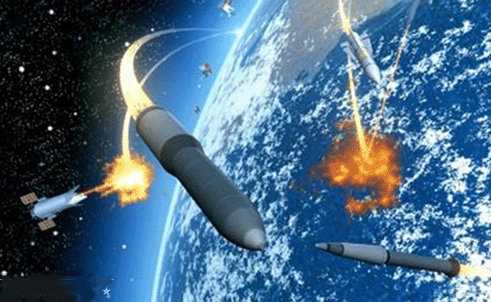
How much will it cost? The vast costs will be shouldered by taxpayers, likely by slashing funding for essential social needs. The aerospace industry has suggested defunding “entitlement programs” to pay for “everything space.” That would likely include cutting Social Security, Medicare, and Medicaid among other social and welfare programs. In his proposed fiscal year 2021 budget, Trump is recommending $15.4 billion for the Space Force. The Space Force, if it is allowed to continue, will clearly be a multi-billion dollar annual affair.
Who will profit?
Raytheon is emerging as a major beneficiary of Space Force work. Perhaps not uncoincidentally, Mark Esper, Trump’s U.S. Secretary of Defense at the time the Space Force was announced, is a former lobbyist for the corporation. Other major contractors for the Space Force will be Northrop Grumman, Boeing and Lockheed-Martin, the world’s biggest military contractor.
Space Force is no laughing matter, May 31, 2020 by beyondnuclearinternational
What started as “a joke” his now deadly serious; and just plain deadly Continue reading
Here’s a supremely unaffordable nuclear fantasy – reactors on the moon and Mars
 NASA Wants to Go Nuclear on the Moon and Mars for Astronaut Settlement, SciTech Daily By AMERICAN CHEMICAL SOCIETY MAY 31, 2020 m It might sound like science fiction, but scientists are preparing to build colonies on the moon and, eventually, Mars. With NASA planning its next human mission to the moon in 2024, researchers are looking for options to power settlements on the lunar surface. According to a new article in Chemical & Engineering News, the weekly newsmagazine of the American Chemical Society, nuclear fission reactors have emerged as top candidates to generate electricity in space.
Nuclear industry brazenly exploiting Pandemic to get tax-payer funding
 The Nuclear Industry at the Feeding Trough https://www.the-american-interest.com/2020/05/15/the-nuclear-industry-at-the-feeding-trough/ VICTOR GILINSKY & HENRY SOKOLSKI, 15 May, 20
The nuclear lobby is playing the national security card in trying to justify Federal handouts. It’s a con.
We are getting used to brazen coronavirus claims for federal largess, but it’s hard to beat the claims coming from the nuclear industry. Even before the pandemic hit, it had for the most part given up competing for new power plant sales in the domestic and international energy marketplace and instead was wrapping itself in the flag and declaring itself essential to U.S. national security, and therefore deserving of generous federal support.
This approach has the full backing of the Trump Energy Department, and has been dutifully rolled out as part of the broader scramble for federal relief funds unleashed by the coronavirus crisis. As Energy Secretary Danny Ray Brouillette made clear to radio talk show host Hugh Hewitt in an April 28 interview:
We’ve lost our leadership both on the technology side and on the market side… to the Russians and the Chinese. And why does that matter? Well, obviously it matters, because we are, we were the world leader not only in the development of nuclear technology, but in the export of this technology around the world. And we lost that, and it leads to a national defense issue.
And, indeed, DOE’s web site announces: “Nuclear power is intrinsically tied to National Security.” Among the ways DOE plans to restore American nuclear energy leadership are “minimizing commercial fleet fiscal vulnerabilities [DOE-speak for subsidizing],” and “leveling the playing field against state-owned enterprises.”
The implication is that other countries are not competing fairly, as if they snuck around us to jump the line. Now, to cope with this, we have to sweeten the deals we offer to get the sales. And as a thriving nuclear sector is supposedly a necessary condition for gaining foreign sales, we have to prop up domestic nuclear plants, too.
If nothing else, there is a stunning lack of self-awareness in this view. Yes, the United States pioneered the light water reactor technology used around the world. But, as a result of U.S. business decisions, in part reflecting the unfavorable economics of nuclear power in the United States but also poor management, we effectively no longer have any reactor manufacturers.
Combustion Engineering, a company with 28,000 employees, a pressurized water reactor manufacturer, sold itself in 1989 to the European firm ABB Asea Brown Boveri Ltd. The great Westinghouse firm, once the world leader on pressurized water reactors, blundered financially into becoming a subsidiary of the CBS Corporation. In 1995, CBS sold it to British Nuclear Fuels Limited. BNFL in turn sold Westinghouse nuclear activities to Toshiba in 2006.
Westinghouse, by then a shell of its former self, performed so miserably in constructing the last large reactors to be built in the United States in South Carolina and Georgia that it went bankrupt and almost took Toshiba down, too. The South Carolina owners canceled their two plants, and the remaining two in Georgia will cost nearly $30 billion, double the original contract price. After this experience, it is hard to see any future sales of large reactors in the United States.
General Electric used to build boiling water reactors, but it only offers sales abroad as a junior partner to Japan’s Hitachi Corporation. Its reputation is anyway tarnished because it designed the plants that failed during the 2011 Fukushima accident. In short, U.S. nuclear plant manufacturing capabilities are much diminished, and the domestic market just isn’t there. And it isn’t there because nuclear economics are extremely unfavorable.
Currently, the US still has 95 power reactors online, supplying a bit less than 20 percent of America’s electrical demand. They are on average 39 years old. Only two plants, the ones in Georgia, are now under construction and they are expected to be the last large ones to be built for some time.
That hasn’t fazed the nuclear faithful both in and out of government. They still think, as their predecessors thought sixty years ago, that nuclear power is the technology of the future. They paint a picture of our putative arch-enemies, Russia and China, selling nuclear power plants and locking up nuclear relationships with numerous states, including important friendly states such as Saudi Arabia and Turkey, relationships that will last for the rest of the century. We will be frozen out and will thereby lose influence throughout the world. But it’s still not too late if we follow the advice of the Energy Department, the nuclear industry, and a gaggle of consultants looking to cash in.
What is it we have to do? The battles in Washington turn on so-called agreements for cooperation with potential customers that are prerequisites for sales of major reactors and components. The main issue concerns whether we will accept customers that also want to acquire acquires auxiliary facilities that can be used to produce plutonium and highly enriched uranium, the fuels that are also the explosives used in nuclear weapons. The only position consistent with non-proliferation, halting the spread of nuclear weapons, is “no.”
But the nuclear enthusiasts say that’s too strict, that others have more accommodating terms, and that if we sell with looser terms, we’ll have more influence. They have their eye especially on Saudi Arabia, a country that at one point said, implausibly, it was going to build 16 nuclear power plants. They don’t seem to pay attention to the other thing the Saudis said—the crown prince’s statement that if Iran was going to get a bomb, he was going to get one, too, and fast.
It’s not just the Trump crowd that opposes tightening security rules over nuclear exports (in the name, they say, of security). President Obama’s Energy Secretary, Ernest Moniz, has been arguing that subsidizing domestic nuclear power and encouraging nuclear sales without especially tight security restrictions—restrictions that go by the rubric of “gold standard”—are in the interests of U.S. nuclear security, and even support the deterrence value of our nuclear weapons.
All this is a bit much. Do we really think that Russia, with a GNP below that of Italy, is capable of freezing us out of the world? Does it have the financial capacity to offer generous terms on many projects? Will they ever be completed?
Nuclear power is just one U.S. export technology, and not exactly the most promising. For example, the U.S. exported $136 billion in aircraft last year; U.S. nuclear exports for the same period could only be measured in millions of dollars. China is building a comparatively large number of nuclear plants but nuclear power supplies less than five percent of its electrical demand and is only projected to account for seven percent by 2040. Any large accident will turn this program off.
There are many more exciting technologies to share with others. We don’t have to sell out our nonproliferation policies. If anything, we should be strengthening them, and convincing Russia and China to conform to them, as well.
As for the DOE and industry sales pitch, we should see it for what it is: a con to get at the federal trough. May 15, 2020
Ontario’s nuclear re-build postponed due to pandemic
Pandemic leads to moratorium on Ontario’s nuclear re-build programs, https://www.cleanairalliance.org/pan/ 29 May 20, In response to the Covid-19 pandemic, on March 25th Bruce Power suspended work on the re-building of its Unit 6 nuclear reactor. One day later, Ontario Power Generation (OPG) announced that it will not proceed with the re-building of its Unit 3 nuclear reactor at this time.
Bruce Power’s and OPG’s actions provide Premier Ford with the opportunity to reconsider whether it makes sense to continue with the previous Government’s high-cost plan to re-build 10 aging nuclear reactors and to continue to subsidize our electricity rates to the tune of $5.6 billion per year.
By investing in energy efficiency instead we can keep our lights on at less than one-quarter of the price of nuclear power and create good jobs in every community in Ontario.
In New York State, giant utility Consolidated Edison announced on May 18th that it is tripling its energy efficiency budget. Ontario should too. According to Consolidated Edison’s Chairman and CEO, John McAvoy: “I believe one of the keys to rebuilding our communities and boosting the economy is maintaining our focus on clean energy. We’re building tomorrow’s grid so that it stands up to climate change and so it can integrate renewable energy sources like solar and wind.”
Please email Premier Ford here and tell him you support getting Ontario back to work by launching an energy retrofit program for our homes and businesses that will also lower our electricity bills.
“grave challenge to global peace and security” – Nuclear watchdog on potential U.S. nuclear test
 Nuclear watchdog says any US test would be ‘grave challenge to peace’
Lassina Zerbo, head of body monitoring test ban treaty, responds to White House discussions about potential first US test for 28 years, Guardian, Julian Borger in Washington, Fri 29 May 2020 The head of the international watchdog monitoring nuclear tests has warned that a US return to testing being contemplated by the Trump administration would present a “grave challenge to global peace and security”.
The idea was shelved for the time being, but appears not to have been rejected outright. Drew Walter, acting deputy assistant secretary of defence for nuclear matters, said this week that an underground nuclear test could be carried out within months “if the president directed”.
Arms control advocates said that the fact such a step was contemplated was disturbing, as it would be likely to lead to a return to nuclear testing by the world’s other nuclear weapons powers, and the demise of the 1996 Comprehensive Nuclear-Test-Ban treaty (CTBT)……
The US signed the CTBT in 1996 but the Senate voted against ratifying it. The treaty has been signed and ratified by 168 states but it will not come into force until the US, China, Israel and Egypt have ratified it, and it is signed and ratified by India, Pakistan and North Korea.
Meanwhile, the US has observed a voluntary moratorium on tests, as have the UK, France, Russia and China, and the CTBTO preparatory commission was established to set up a network of 300 seismic, hydroacoustic, infrasound and radionuclide sensors around the world, that helped identify nuclear tests by India, Pakistan and North Korea.
Zerbo noted that the US is the biggest financial contributor to the CTBTO and its verification regime.
Over the past year, the US has accused Russia and China of secretly conducting very low-yield tests, an accusation that both countries have denied, and for which the US has yet to provide evidence.
“The CTBTO’s international monitoring system [IMS] has been operating as normal and has not detected any unusual event,” Zerbo said. The IMS, complemented by the national technical means of the states signatories themselves, provides full confidence that the system can detect nuclear test explosions according to the provisions of the treaty.”
He added that the only way to remove all doubts was to bring the CTBT into force.
“At that point, the provisions for on-site inspections would come into effect, allowing for on-site visits at short notice if requested by any state party.” https://www.theguardian.com/world/2020/may/28/nuclear-watchdog-us-underground-test-challenge-to-peace
Opposition in Canada to nuclear waste dump on agricultural land
Opposition gathering to nuclear fuel disposal vault in South Bruce, The Sun Times, 29 May 20
|
NWMO’s other preferred site is also in Ontario, in the Ignace area, northwest of Lake Superior, and feasibility studies are underway for both sites.It would take 10 years to undertake the environmental regulatory approval process. Plans call for construction to begin in 2033 and take about 10 years, with operation starting in 2043, according to the NWMO. South Bruce Mayor Bob Buckle said in January it seemed to him there was little opposition to the project, but that has changed. At an online South Bruce council meeting Tuesday, Teeswater-area beef and sheep farmer Michelle Stein spoke on behalf of a citizen’s group, Nuclear Tanks, No Thanks, which loosely formed in February. Her farm is next to one purchased by NWMO for the project northwest of Teeswater, part of the parcel of land where metal-encased spent fuel rods could be buried for thousands of years. She told council “there’s way too many risks involved with this project and they need to have a referendum to let the community decide. Like we have over 1,500 signatures that were collected before COVID,” before the virus stopped door-knocking, she said by phone Thursday. “Council just it seemed turned to ignore us and do their own thing.” She noted Buckle was elected with 1,380 votes. The group has an information website www.protectsouthbruce-nodgr.org, which includes an online petition with some 1,800 signatures, which prior to the pandemic was intended for people who aren’t local to sign……. Becky Smith, a NWMO spokeswoman said “We’re a farming community. I don’t understand why they’d want to turn us into a mining community, and then bury the world’s most radioactive waste underneath our water table,” A four-week comment period opened Wednesday and ends June 30 about whether a draft report accurately summarizes public concerns and wishes expressed during workshops held between December and February…….. n January, SON held a community vote which turned down a separate nuclear waste vault proposal, for lower- and mid-level nuclear waste, championed by Ontario Power Generation. It was to be built in Bruce County too, near the Bruce Power nuclear plant close to Kincardine. Saugeen First Nation Chief Lester Anoquot said Wednesday he has a letter from NWMO confirming the high-level nuclear waste vault requires First Nation consent. “We’re continuing dialogue. It’s kind of difficult right now, working remotely,” given the COVID-19 pandemic, he said. “It will probably go to a community vote again for acceptance or not. I think the process will mirror the one that was just conducted with the last DGR (deep geological repository) proposal.” The site falls within Saugeen Ojibway Nation’s traditional territory and its support is required for the project to proceed, Belfadhel has said.https://www.owensoundsuntimes.com/news/local-news/opposition-gathering-to-nuclear-fuel-disposal-vault-in-south-bruce |
|

Huge task of carting 770-ton nuclear reactor from Southern California to Utah
The train carrying a decommissioned nuclear reactor vessel from Southern California is passing through Las Vegas on Thursday afternoon.
The vessel from the San Onofre Nuclear Generating Station is headed for a burial ground in Utah. It will be transferred starting either Friday or Saturday at Apex Industrial Park, according to Nevada Department of Transportation spokesman Tony Illia.
Cranes will be used to lift the heaviest load to ever travel a Nevada road onto a 45-axle, 180-tire trailer. It will take a couple of weeks to complete the transfer.
4 tractors to push and pull, The 300-foot-long shipment will consist of two tractors to pull and another two tractors to push the over 1.5-million pound load.
It will travel at 5 to 10 mph on the highway for the 400-mile trip to Clive, Utah, where it will be buried at EnergySolutions, the contractor that is dismantling the plant.
NDOT has to issue an overdimensional permit, which won’t occur until 24 hours before hitting the highway, Illia said.
Nevada State Patrol troopers will escort the shipment to the Utah border……… https://www.reviewjournal.com/local/local-las-vegas/downtown/2-weeks-needed-to-switch-770-ton-nuclear-reactor-from-train-to-truck-2037931/
Resuming Nuclear Testing a Slap in the Face to Survivors
Resuming Nuclear Testing a Slap in the Face to Survivors HTTPS://ALLTHINGSNUCLEAR.ORG/GUEST-COMMENTARY/RESUMING-NUCLEAR-TESTING-A-SLAP-IN-THE-FACE-TO-SURVIVORS LILLY ADAMS , UCS | MAY 26, 2020, The news that the Trump administration is considering resuming nuclear weapons testing is morally abhorrent. The current US moratorium on nuclear testing was put in place for many reasons, but we must not forget one crucial reason: In conducting explosive nuclear tests, the US government killed thousands of innocent people and sickened untold thousands more.
The very suggestion of resuming nuclear testing is shocking and a slap in the face to testing survivors who have spent decades watching their loved ones pass away—survivors like Sandra Walsh, of Salt Lake City, who grew up in Parowan in southern Utah, which received high levels of fallout from the Nevada Test Site.
“My family and I are Downwinders,” said Walsh. “I have had thyroid cancer and I have lost three of my children, three little girls, a mother should die before her children. My family, three sisters and my mom and dad all have had cancer. I have helped over 5000 downwinders get the help they need from the government. That is just a small amount of the people that have been affected by the bomb testing. My hope is that it will never happen again.”
Millions of Americans exposed to radioactive fallout
By treaty, the United States is barred from conducting above-ground nuclear tests, the type that created the mushroom clouds that regularly spread radiation across much of the country in the 1950s and 1960s. But underground testing has its own deadly risks, as well as severe environmental and health consequences. In fact the second most fallout-intensive nuclear weapons test in the continental US was an underground test in Nevada, exposing millions of Americans to radioactive fallout as far away as Iowa and Illinois. Another test—one that was intended to be fully contained underground—accidentally released 80,000 curies of radioactive iodine-131 into the atmosphere.
In addition, any resumption of explosive testing could quickly lead other nuclear weapons states to resume testing as well, further accelerating the arms race that is already building around the world. The kind of nuclear posturing we are seeing today led to massive above-ground testing and resulting deaths during the Cold War. We should do everything possible to avoid heading down this path again.
To do this, we must understand the history and the consequences of testing. The United States conducted over 1,000 nuclear weapons tests between 1945 and 1992, and 216 of them were above ground. The US conducted far more tests than any other country, with Russia conducting just over 700 tests and China only 45.
The scope of death and illnesses that resulted from this testing is hard to quantify, but it was devastating no matter how you look at it. A 1997 study from National Cancer Institute, which only examined thyroid cancers that may have resulted from exposure to I-131 estimated that up to 75,000 cancers could be connected to the testing. That study did not look at other illnesses that might have resulted from exposure to additional radioactive contaminants.
Meanwhile, in 2008, Arjun Makhijani, President of the Institute for Energy and Environmental Research, estimated deaths from nuclear testing at around 200,000. A recent study from the University of Arizona put the number higher, at 340,000 to 460,000 likely deaths. A study from International Physicians for the Prevention of Nuclear War estimated that ultimately, global cancer deaths from nuclear testing could reach 2.4 million.
Radioactive fallout from nuclear weapons testing spread across the United States, including Arizona, Colorado, Idaho, Montana, Nevada, New Mexico, Utah and Guam. In 1953, radiochemistry students in Troy, New York, 2,500 miles from the Nevada Test Site, measured radiation levels many times above normal, which were later connected to a nuclear weapons test in Nevada two days earlier. In the Marshall Islands, the US tested 67 nuclear weapons. The total explosive yield of those tests is equal to one Hiroshima-sized bomb detonated every single day for 20 years. The Defense Threat Reduction Agency admits that in the course of nuclear weapons testing, 550,000 military service members were exposed to radiation.
Seventy-five years after the first above-ground nuclear weapons test, the victims of nuclear weapons testing are in many cases still fighting for basic recognition of harm, as well as compensation for their often staggering health concerns. Downwinders of tests and uranium workers are fighting for equitable compensation through the Radiation Exposure Compensation Act, which currently has gaping holes in coverage and is set to expire in 2022.
Nuclear test survivors still owed billions
Tona Henderson, head of Idaho Downwinders, which has been fighting since 2004 for compensation for downwinders in Idaho, stated:
“It is unbelievable that anyone would think it was alright to start nuclear testing again! The government has not even compensated the Downwinders from the first 100 tests. We don’t need to kill and maim our own citizens again. On Memorial weekend we honored our fallen soldiers. Downwinders have suffered losses through no fault of their own, yet there will be no parades or flag draped coffins for us. Would you do these tests if your children or grandchildren were in the fallout path?”
Largely because of the impact of nuclear testing, Marshallese people living in the United States were promised Medicaid under an agreement called the Compact of Free Association, but this was stripped from them in 1996. In addition, the US owes billions of dollars to the Marshall Islands for unpaid health and environmental claims due to testing.
Shamanda Hanerg, Lani Kramer, Desmond Doulatram with REACH-MI, a non-profit in the Marshall Islands focused on their nuclear legacy, shared the following statement in response to the news:
“With outstanding human rights claims, one should pay no surprise as to why the Marshall Islands has been aggressive in the international scene in climate change and nuclear disarmament.
Our grandparents and parents suffered tremendously from the horrific effects of the nuclear testing (by the U.S. Government) on our beautiful islands. That was 74 years ago. We haven’t returned to our home, our ancestral heritage, because our land is contaminated by the many toxins and poisons we can’t even pronounce. Some of our islands were vaporized instantly from the nuclear testing.
We suffered severe burns from being in the direct fallout of the bombs. We continue to have miscarriages, still births, birth defects, various cancers, genetic disorders, and many more illnesses.
The enormity of the devastation of damages done by the nuclear testing is unfathomable, unthinkable, and inhumane. The mass destruction of the bombs on our islands have left us nuclear nomads…emotionally, mentally, and physically scarred forever.
More than ever we need to be emboldened and united in our quest to fight for justice and nuclear disarmament. For the U.S. Government to even consider continuing with nuclear testing would be an injustice to the People of the Marshall Islands.”
As a country, we have so much work left to do to right the wrongs of nuclear testing. It is unconscionable that the Trump administration is now considering resuming testing while these people are still fighting for justice.
Heavy problems in transporting dead nuclear reactor, especially in hot weather

When it does arrive, the 770-ton nuclear reactor vessel will be unloaded from the world’s largest rail car at Apex Industrial Park to be trucked north on eastern Nevada roads before eventually being buried at Clive, Utah, about 75 miles west of Salt Lake City.
But before that leg of the journey, Nevada needs to shore up some drainage structures along the undisclosed route to Wendover, Utah.
“We anticipate that the vessel will get shipped to Apex sometime in early June,” Department of Transportation spokesman Tony Illia said in an email Tuesday. “However, the drainage structures along the transport route through Southern Nevada need reinforcing in order to handle the load. The structures would get crushed like a soda can because the load is so heavy.”
The company hired to deliver the reactor to Utah is Emmert International, which is among the world’s biggest movers of heavy equipment. Workers plan to use heavy-duty hydraulic jacks to support the culverts when the vehicle hauling the reactor passes over, Illia said.
“It would be, by far, the biggest object ever moved on a road in the state,” he said. “Our people have been scratching their heads for months to figure out a route that could work.”………
Security will be making the trip as well.
Any asphalt or road surface could buckle under the 1.5 million-plus pounds of the reactor, plus a shipping skid that adds 7 tons to the total. Making such a shipment during warmer months is a bigger issue than it would be in colder weather…….. https://www.reviewjournal.com/local/decommissioned-nuclear-reactor-will-be-heavy-load-for-nevada-roads-2036202/
Nuclear deregulation threatens workers at Pennsylvania plants and nationwide
|
Nuclear deregulation threatens workers at Pennsylvania plants and nationwide https://www.inquirer.com/opinion/commentary/nuclear-plants-coronavirus-regulatory-commission-pennsylvania-20200526.html May 26, 2020 ,Paul Gunter and Linda Pentz Gunter, For the Inquirer Workers at nuclear power plants, just like everywhere else, are falling ill with the highly contagious Covid-19. Pennsylvania’s Susquehanna and Limerick power plants are among those that have so far identified infections among their staff, with incidences soaring at some plants.
One might hope that, at a time of such crisis, the nuclear power industry and its regulator would take every possible step to ensure the health and safety of nuclear workers and their families, as well as the surrounding communities where they live. Unfortunately, the opposite is happening. Instead, the U.S. Nuclear Regulatory Commission (NRC) is relaxing nuclear power plant safety inspections and maintenance while allowing essential staff, including control room operators, security forces and fire brigades, to work longer and exhausting shifts. The extended permitted hours — up to 86-hour work weeks for two weeks straight — are justified, the NRC says, due to absenteeism, workers in quarantine, and Centers for Disease Control (CDC) guidelines for the Covid-19 pandemic, which recommend social distancing, necessitating fewer staff on site. Yet at the same time, the NRC is allowing nuclear power plants to proceed with refueling operations, which can bring in as many as 1,800 workers from across the country. While the nuclear industry was among those in the energy sector demanding priority testing for Covid-19, it is not clear whether testing for the coronavirus was conducted on workers before they arrived at the plants, given the scale of the outbreaks. More recent positive cases have been discovered through testing, with some tests conducted by workers’ personal physicians. The Limerick nuclear power plant in Pennsylvania, which has now completed refueling, saw a level of overcrowding during refueling that alarmed workers. They described sitting “elbow to elbow” in canteens and computer labs, terrified that the coronavirus would rapidly spread among them. One told the Pottsdown Mercury he was “in a constant state of paranoia.” Such a “wildfire” spread of Infection became a reality at the Fermi 2 reactor in Michigan, which was forced to halt refueling. Close to 200 workers tested positive for Covid-19 at the Vogtle nuclear power plant in Georgia, where work has not been stopped, although the workforce has been cut back. Asking workers to put in exhausting shifts not only weakens their immune systems, making them more susceptible to the coronavirus, but could also lead to fatigue-driven errors. Investigators found that sleep deprivation played a part in the March 1979 nuclear accident at the Three Mile Island reactor near Harrisburg. Compounding these risks is the request by reactor operators to postpone inspections of critical safety components, such as steam generators and reactor emergency core cooling systems, for an additional 18 months. The NRC is now allowing for these delays. But skipping over essential safety checks could come at a high price. Steam generators are critical to power operations and reactor safety. The reactors’ harsh operational environment places extreme stresses on the heat transfer component, causing tube degradation from vibration, heat, radiation, corrosion, and cracking that must be guarded against through routine inspection and maintenance. Arguing for a reduction in nuclear power plant staff to avoid unnecessary contact might sound reasonable if it were not contradicted by the overcrowding brought on by the influx of large refueling crews. This suggests that the shared priority of the nuclear industry and its captured regulator is production, putting financial interests ahead of the wellbeing and safety of workers and surrounding communities. Mandatory testing of refueling crews and maintenance crews could prioritize both production and safety agendas. Overextending exhausted workers could be also avoided by allowing reactors closed for refueling to delay restart and remain shuttered, especially given that electricity demand has fallen with most of the country in lockdown. Instead, those stay-at-home workers could supplement the crews at operating plants, ensuring worker safety and site security and reducing the likelihood of an accident due to exhaustion or human error. The prospect of a serious nuclear power accident under the current pandemic conditions would set up an impossible choice for entire communities surrounding the affected reactor, already sheltering in place from the viral threat: whether to evacuate with potentially tens of thousands of others, or stay, instead risking radiation exposure. The disastrous flooding last week in Michigan, necessitating mass evacuations, has now given us a preview of this conundrum, without the added danger of radiation exposure. Japan faced such a confluence of crises in March 2011, when the country was struck with an earthquake and tsunami, followed by widespread radiation contamination from the Fukushima nuclear meltdowns. This resulted in rescue attempts of some survivors of the tsunami and earthquake being abandoned due to the high levels of radioactivity in areas too contaminated for first responders to enter. Now is not a time to increase the likelihood of a serious nuclear accident here at home. Instead, the NRC should be taking this opportunity to fulfill its stated mandate of “protecting the people and environment,” rather than bowing to the craven financial interests of the nuclear power industry.
Paul Gunter is Director of the Reactor Oversight Project at Beyond Nuclear, a national non-profit anti-nuclear watchdog organization based in Takoma Park, Maryland. Linda Pentz Gunter is Beyond Nuclear’s international specialist and edits and writes for its online magazine, Beyond Nuclear International. |
|
1 This Month

of the week– Nuclear Reactor Information Task Force

14 May – online event From Bombs to Data Centres: the Face of Nuclear Colonialism
To see nuclear-related stories in greater depth and intensity – go to https://nuclearinformation.wordpress.com
-
Archives
- May 2026 (102)
- April 2026 (356)
- March 2026 (251)
- February 2026 (268)
- January 2026 (308)
- December 2025 (358)
- November 2025 (359)
- October 2025 (376)
- September 2025 (257)
- August 2025 (319)
- July 2025 (230)
- June 2025 (348)
-
Categories
- 1
- 1 NUCLEAR ISSUES
- business and costs
- climate change
- culture and arts
- ENERGY
- environment
- health
- history
- indigenous issues
- Legal
- marketing of nuclear
- media
- opposition to nuclear
- PERSONAL STORIES
- politics
- politics international
- Religion and ethics
- safety
- secrets,lies and civil liberties
- spinbuster
- technology
- Uranium
- wastes
- weapons and war
- Women
- 2 WORLD
- ACTION
- AFRICA
- Atrocities
- AUSTRALIA
- Christina's notes
- Christina's themes
- culture and arts
- Events
- Fuk 2022
- Fuk 2023
- Fukushima 2017
- Fukushima 2018
- fukushima 2019
- Fukushima 2020
- Fukushima 2021
- general
- global warming
- Humour (God we need it)
- Nuclear
- RARE EARTHS
- Reference
- resources – print
- Resources -audiovicual
- Weekly Newsletter
- World
- World Nuclear
- YouTube
-
RSS
Entries RSS
Comments RSS
 nuclear-news