Many $billions for U.S. Air Force’s new nuclear weapons
 The Air Force Is Getting Ready To Receive New
  Nuclear Weapons, National Interest, David Axe, 5 June 20, Here’s What You Need To Remember: Now the command is in the beginning of a modernization effort costing tens of billions of dollars. New B-21 stealth bombers are slated to supplant the B-1s and B-2s starting in the mid-2020s. The Ground-Based Strategic Deterrent rocket, a replacement for the 1960s-vintage Minuteman, is in development.
The U.S. Air Force’s nuclear command says it’s about to undergo a major reorganization as it prepares to field new bombs, missiles, bombers and rockets.
Air Force Global Strike Command stood up in 2009 as the successor to Strategic Air Command, which maintained around-the-clock nuclear alerts during the Cold War.
Today the command’s 34,000 personnel oversee 20 B-2 stealth bombers, 76 B-52 bombers and 450 Minuteman III intercontinental ballistic missiles together capable of delivering thousands of nuclear warheads.
It also operates 62 B-1 bombers that do not have a nuclear mission.
AFGSC’s forces comprise the aerial and ground “legs” of the United States’s atomic triad, which also includes the U.S. Navy’s submarine-launched Trident ballistic missiles.
The command’s forces are capable of extinguishing essentially all life on Earth within a matter of hours.
Accidents and misbehavior marred AFGSC’s early years. In 2014 ICBM crews got caught cheating on tests. In 2018 security forces at Minot Air Force Base, home to a portion of the Minuteman fleet, lost track of some of their weapons. The suicide rate is high in the atomic force.
Now the command is in the beginning of a modernization effort costing tens of billions of dollars. New B-21 stealth bombers are slated to supplant the B-1s and B-2s starting in the mid-2020s. The Ground-Based Strategic Deterrent rocket, a replacement for the 1960s-vintage Minuteman, is in development.
The new Long-Range Stand-Off Weapon, a nuclear-tipped cruise missile, will replace the B-52’s current nuclear cruise missiles. The bomber fleet is getting a refurbished model of its main atomic gravity bomb, the B-61. The missile wings’ security forces are swapping out their five-decade-old UH-1 helicopters for new MH-139s……….https://news.yahoo.com/air-force-getting-ready-receive-060000340.html
Trump wants a nuclear test – adding to the sickness of the world
Trump apparently wants a nuclear test. It could be bad for your health. https://thebulletin.org/2020/06/trump-apparently-wants-a-nuclear-test-it-could-be-bad-for-your-health/#Sara Z. Kutchesfahani
June 5, 2020 In recent weeks, the Trump administration reportedly discussed the possibility of doing something the United States has not done since 1992: resuming explosive testing of nuclear weapons. Since the creation of the nuclear bomb, at least eight nations have detonated 2,056 nuclear test explosions at test sites around the world. Ten years ago, Japanese artist Isao Hashimoto created an informative but scary time-lapse map depicting all of these explosions. In it, each nation gets a flashing dot on the map whenever it detonates a nuclear weapon, with a running tally kept on the top and bottom bars of the screen.
While the story begins in 1945 with the first ever nuclear weapon test (code-named Trinity), the real action comes in 1962, when there were 178 tests globally, more than in any other year. Not only is the rapid rate alarming, but where they happened—mainly on the lands of indigenous people—is also shocking.
A US resumption of nuclear tests would send a bad signal to other countries and prompt them to test and create their own nuclear weapons. Moreover, innocent bystanders could be exposed to the radioactive fallout from a nuclear explosion. Tens of thousands of people have been afflicted by leukemia, thyroid cancer, miscarriages, and severe birth defects as a result of past nuclear testing in the United States alone.
Half of the 2,056 nuclear tests were conducted by one country alone: the United States. Yes, that’s right: the total number of US-conducted tests stands at 1,030, which is more than the number of tests done by the other seven nuclear testing countries combined. Most of the explosions took place at the height of the Cold War in a series of tit-for-tat exchanges between the United States and the Soviet Union.
Even before the banner year of 1962, nuclear testing was already out of control. In 1954, the United States carried out Castle Bravo, the most powerful US nuclear weapon test (and its first thermonuclear weapon, also known as an H-bomb). The 1961 Soviet Tsar Bomba (“King of Bombs”) detonation, though, remains the most powerful human-made explosion in history. Tsar Bomba created an explosion equivalent to 50 megatons of TNT. Let’s pause for a moment for a mathematical intermission to put this yield into perspective.
1 ton = 1,000 kilograms, or 2,200 pounds of explosives
1 kiloton = 1,000 tons, or about 2,200,000 pounds
1 megaton = 1,000,000 tons, or about 2,200,000,000 pounds
The biggest conventional bomb in the US arsenal = 11 tons of TNT
Little Boy (Hiroshima) = 16 kilotons of TNT
Fat Man (Nagasaki) = 20 kilotons of TNT
Castle Bravo = 15 megatons of TNT (roughly 1,000 times more powerful than the Little Boy bomb)
Tsar Bomba = 50 megatons of TNT (roughly 10 times the total explosive power unleashed in all of World War Two, including both the Little Boy and Fat Man bombs that destroyed Hiroshima and Nagasaki)
Each and every above-ground nuclear explosion spread radioactive materials throughout the atmosphere. Once the Partial Nuclear Test Ban Treaty took effect in 1963, many of the tests moved underground, but those still sometimes leaked radioactive materials into the atmosphere. The overall effect was the contamination of the air and soil where people live and work—some of which is still around today.
While testing continued throughout the Cold War, it came to a gradual halt by 1992, such that by 1993, negotiations for a Comprehensive Nuclear Test Ban Treaty began. The Comprehensive Test Ban Treaty is an international treaty banning all nuclear explosions for both civilian and military purposes, in all environments, but it has yet to enter into force. Although the United States has not ratified the treaty, it and all other nuclear weapon states (apart from North Korea), have honored the test ban. Perhaps maybe until now.
Why should the average person care about all this? Well, because there was and is an enormous human cost of nuclear weapons testing. If you go back and watch the Hashimoto video, you’ll notice none of the 1,030 US tests were conducted anywhere near Washington, DC. Likewise, none of the Soviet, French, or British tests were carried out around Moscow, Paris, or London. Instead, the explosions took place mainly on the lands of indigenous people, such as in the Marshall Islands, or in some cases, in the country’s own backyard, such as in New Mexico, Colorado, and Nevada.
Nuclear testing ignores the voices of those who are tangibly affected by it. The human cost of nuclear weapons testing, from environmental contamination to the exploitation of powerless communities, has largely been overlooked. When the United Sates opened a nuclear testing site near Las Vegas, the people who lived downwind of the test site were assured that only a safe level of radiation could reach them. Yet, sheep started getting sick. They had burns on their faces and lips and blisters on their bodies. Ewes miscarried. Many lambs were born deformed or too weak to nurse. Around 20,000 sheep in total—a quarter of the herds in southern Utah and Nevada—died.
If that was the effect on sheep, imagine the effect on humans. Cancers associated with radiation exposure (including leukemia and thyroid cancer) were all too common. Women suffered from miscarriages. Those who didn’t miscarry gave birth to babies with severe birth defects, some of which were so severe that the infants didn’t look human. In 1990, US Congress created the Radiation Exposure Compensation Act to help rectify these injustices. To date, over 36,000 people have claimed benefits from the fund, giving a sense of the scale of the harm. But this is a lower limit. An independent study has estimated that radiation from testing caused more than 340,000 excess American deaths between 1951 and 1973.
The harms are not just a thing of the past: Utah “downwinders” are still suffering and dying as a result of health effects from nuclear tests conducted upwind in Nevada decades ago. One such downwinder is Mary Dickson, who has seen friends and family die of cancer, and has even had her own battles with it. In 2007, she wrote Exposed—an unpublished screenplay based on a true story about her sister, a fellow downwinder, and her deteriorating health due to the effects of the above-ground nuclear tests.
I’ve had the privilege of reading Exposed, and it is superb. Dickson pieces together the historical nuclear nuggets in such a compelling way that it not only deserves a thorough and careful read, but also a viewing, with tissues at hand. It is extremely powerful and personal, so much that anyone reading or watching it would be outraged by the Trump administration’s latest proclamations to resume nuclear testing. (The Players Club in New York had planned to stage a reading of the play in May 2020 on the sidelines of the Nuclear Non-Proliferation Treaty Review Conference, but unfortunately these plans were put on hold due to the coronavirus pandemic.) One of the most dramatic lines of the play reads, “The hardest thing is not the dying. It’s that the dead are so easily forgotten. We’re fighting for all of them. So their lives will serve as a warning. So it won’t happen again.”
Beyond Nuclear Files Federal Lawsuit Challenging High-Level Radioactive Waste Dump
 Beyond Nuclear Files Federal Lawsuit Challenging High-Level Radioactive Waste Dump for Entire Inventory of U.S. “Spent” Reactor Fuel, Common Dreams, 5 June 20 Beyond Nuclear Files Federal Lawsuit Challenging High-Level Radioactive Waste Dump for Entire Inventory of U.S. “Spent” Reactor Fuel, Common Dreams, 5 June 20
Petitioner charges the Nuclear Regulatory Commission knowingly violated U.S. Nuclear Waste Policy Act and up-ended settled law prohibiting transfer of ownership of spent fuel to the federal government until a permanent underground repository is ready to receive it. WASHINGTON – Today the non-profit organization Beyond Nuclear filed an appeal with the U.S. Court of Appeals for the District of Columbia Circuit requesting review of an April 23, 2020 order and an October 29, 2018 order by the U.S. Nuclear Regulatory Commission (NRC), rejecting challenges to Holtec International/Eddy-Lea Energy Alliance’s application to build a massive “consolidated interim storage facility” (CISF) for nuclear waste in southeastern New Mexico. Holtec proposes to store as much as 173,000 metric tons of highly radioactive irradiated or “spent” nuclear fuel – more than twice the amount of spent fuel currently stored at U.S. nuclear power reactors – in shallowly buried containers on the site. But according to Beyond Nuclear’s petition, the NRC’s orders “violated the Nuclear Waste Policy Act and the Administrative Procedure Act by refusing to dismiss an administrative proceeding that contemplated issuance of a license permitting federal ownership of used reactor fuel at a commercial fuel storage facility.” Since it contemplates that the federal government would become the owner of the spent fuel during transportation to and storage at its CISF, Holtec’s license application should have been dismissed at the outset, Beyond Nuclear’s appeal argues. Holtec has made no secret of the fact that it expects the federal government will take title to the waste, which would clear the way for it to be stored at its CISF, and this is indeed the point of building the facility. But that would directly violate the 1982 Nuclear Waste Policy Act (NWPA), which prohibits federal government ownership of spent fuel unless and until a permanent underground repository is up and running. No such repository has been licensed in the U.S. The U.S. Department of Energy’s (DOE) most recent estimate for the opening of a geologic repository is the year 2048 at the earliest. In its April 23 decision, in which the NRC rejected challenges to the license application, the four NRC Commissioners admitted that the NWPA would indeed be violated if title to spent fuel were transferred to the federal government so it could be stored at the Holtec facility. But they refused to remove the license provision in the application which contemplates federal ownership of the spent fuel. Instead, they ruled that approving Holtec’s application in itself would not involve NRC in a violation of federal law, and that therefore they could go forward with approving the application, despite its illegal provision. According to the NRC’s decision, “the license itself would not violate the NWPA by transferring the title to the fuel, nor would it authorize Holtec or [the U.S. Department of Energy] to enter into storage contracts.” (page 7). The NRC Commissioners also noted with approval that “Holtec hopes that Congress will amend the law in the future.” (page 7). “This NRC decision flagrantly violates the federal Administrative Procedure Act (APA), which prohibits an agency from acting contrary to the law as issued by Congress and signed by the President,” said Mindy Goldstein, an attorney for Beyond Nuclear. “The Commission lacks a legal or logical basis for its rationale that it may issue a license with an illegal provision, in the hopes that Holtec or the Department of Energy won’t complete the illegal activity it authorized. The buck must stop with the NRC.” “Our claim is simple,” said attorney Diane Curran, another member of Beyond Nuclear’s legal team. “The NRC is not above the law, nor does it stand apart from it.”……… “When Congress passed the Nuclear Waste Policy Act and refused to allow nuclear reactor licensees to transfer ownership of their irradiated reactor fuel to the DOE until a permanent repository was up and running, it acted wisely,” said Kevin Kamps, radioactive waste specialist for Beyond Nuclear. “It understood that spent fuel remains hazardous for millions of years, and that the only safe long-term strategy for safeguarding irradiated reactor fuel is to place it in a permanent repository for deep geologic isolation from the living environment. Today, the NWPA remains the public’s best protection against a so-called ‘interim’ storage facility becoming a de facto permanent, national, surface dump for radioactive waste. But if we ignore it or jettison the law, communities like southeastern New Mexico can be railroaded by the nuclear industry and its friends in government, and forced to accept mountains of forever deadly high-level radioactive waste other states are eager to offload.” In addition to impacting New Mexico, shipping the waste to the CISF site would also endanger 43 other states plus the District of Columbia, because it would entail hauling 10,000 high risk, high-level radioactive waste shipments on their roads, rails, and waterways, posing risks of radioactive release all along the way………. “When Congress passed the Nuclear Waste Policy Act and refused to allow nuclear reactor licensees to transfer ownership of their irradiated reactor fuel to the DOE until a permanent repository was up and running, it acted wisely,” said Kevin Kamps, radioactive waste specialist for Beyond Nuclear. “It understood that spent fuel remains hazardous for millions of years, and that the only safe long-term strategy for safeguarding irradiated reactor fuel is to place it in a permanent repository for deep geologic isolation from the living environment. Today, the NWPA remains the public’s best protection against a so-called ‘interim’ storage facility becoming a de facto permanent, national, surface dump for radioactive waste. But if we ignore it or jettison the law, communities like southeastern New Mexico can be railroaded by the nuclear industry and its friends in government, and forced to accept mountains of forever deadly high-level radioactive waste other states are eager to offload.” In addition to impacting New Mexico, shipping the waste to the CISF site would also endanger 43 other states plus the District of Columbia, because it would entail hauling 10,000 high risk, high-level radioactive waste shipments on their roads, rails, and waterways, posing risks of radioactive release all along the way. Besides threatening public health and safety, evading federal law to license CISF facilities would also impact the public financially. Transferring title and liability for spent fuel from the nuclear utilities that generated it to DOE would mean that federal taxpayers would have to pay for its so-called “interim” storage, to the tune of many billions of dollars. That’s on top of the many billions ratepayers and taxpayers have already paid to fund a permanent geologic repository that hasn’t yet materialized. https://www.commondreams.org/newswire/2020/06/04/beyond-nuclear-files-federal-lawsuit-challenging-high-level-radioactive-waste?utm_campaign=shareaholic&utm_medium=referral&utm_source=twitter |
|
Radioactive waste imported from Estonia for iconic Bears Ears, Utah?

Radioactive Waste May Be Dumped Near Bears Ears—Public Comments Requested https://www.adventure-journal.com/2020/06/radioactive-waste-may-be-dumped-near-bears-ears-public-comments-requested/ BY JUSTIN HOUSMAN | JUNE 3, 2020
|
There is a metals plant in the Eastern European nation of Estonia that generates a surplus of uranium-laced waste, as much as 660 tons per year. A uranium mill near Bears Ears National Monument, in southeastern Utah, has applied to the state of Utah to accept the waste which they can process for the uranium. The waste that process generates will be stored on-site at the White Mesa facility, which is about five miles from the Ute Mountain Ute Tribe’s White Mesa reservation. Locals are concerned. Groundwater accessed by the reservation has been contaminated for years. The tribe worries it’s because of the uranium mill, the state argues it has nothing to do with it. “I think it would be the tribe’s preference that the facility shut down,” said Scott Clow, environmental programs director for the tribe. “But that’s a big ask there. “The mill has been there for 38 years now, and that’s a pretty short window of time compared to how long the tribe was there before and how long the tribe is going to be there after the mill, and all of that contamination. “The mill has already become the cheapest alternative for disposal of low-level radioactive waste in North America. Now, it appears that it may become a destination for the materials from around the globe. That is disconcerting and dangerous,” he said. A company called Energy Fuels Resources owns the White Mesa Mill. Andrew Wheeler, currently the head of the EPA, worked as a lobbyist for Energy Fuels Resources in years past, and helped successfully lobby the Trump administration to shrink the size of the Bears Ears monument to allow for more uranium mining possibilities, arguing it was in the national interest to do so. Estonia limits how much of the radioactive material the metals processing plant can store, out of safety concerns, which is why the plant is looking for a place to ship the waste tailings. The White Mesa Mill is the only mill in the country capable of extracting the uranium from the Estonian tailings. The Utah Department of Environmental Quality has asked for public comment before final approval of the shipments can proceed. The original deadline for comment was June 5, but it has recently been extended until July 10. You can email your comment to this address: dwmrcpublic@utah.gov. Instructions for commenting can be found here, in the public notice about the project. |
|
Emergency preparedness at San Onofre Nuclear Plant – agreement approved
|
Southern California Edison and five local government agencies announced that they will continue their longstanding collaborative emergency preparedness activities related to SONGS. The five jurisdictions are the counties of Orange and San Diego, and the cities of San Clemente, Dana Point, and San Juan Capistrano. The county boards of supervisors and city councils approved the new agreement at their respective meetings on June 2. Senator Bates, Orange County Sheriff Don Barnes, and Southern California Edison Vice President and Chief Nuclear Officer Doug Bauder issued the following statements regarding the agreement: Senator Bates: The agreement will provide the five local jurisdictions more than $12.6 million for the eight-year deconstruction period of SONGS through 2029, and more than $9.9 million for the 20-year period through 2049, by which time spent nuclear fuel could potentially be removed from SONGS. Senator Bates authored Senate Bill 465 in 2019 that would have made it clear that local governments will continue to receive funding for costs incurred as a result of carrying out activities that ensure the safety and welfare of the communities surrounding SONGS. The full Senate and the Assembly Governmental Organization Committee both unanimously passed SB 465. In discussions with stakeholders, Senator Bates agreed to hold her bill to see if a voluntary agreement could be reached and ratified, which occurred this week. She has long advocated for the federal government to move SONGS’ nuclear waste to a safe and secure location that is far from communities as possible. SONGS sits near an active fault line, adjacent to the heavily-trafficked Interstate 5 and the Pacific Ocean, and sandwiched between densely-populated Orange and San Diego counties. Senator Bates previously served on the San Onofre Community Engagement Panel (CEP) when she was an Orange County Supervisor. She worked with her fellow panelists to address the issues raised by the continued storage of SONGS’ waste on-site. She also authored Senate Joint Resolution 23 in 2016 that urged Congress to pass the Interim Consolidated Storage Act of 2016 (House Resolution 4745). The Act would have paired a region that is volunteering to host an interim waste storage facility with communities around the country that have nuclear waste demanding a better storage solution. http://www.oc-breeze.com/2020/06/05/182927_agreement-approved-to-protect-emergency-preparedness-at-san-onofre-nuclear-plant/ |
|

U.S. Nuclear Regulatory Commission will run environmental study BEFORE relicensing South Carolina nuclear fuel plant
After public outcry, feds will conduct extensive study of SC nuclear fuel plant The State BY SAMMY FRETWELL JUNE 05, 2020 , Following state concerns about previously unknown pollution at an atomic fuel plant near Columbia, the U.S. Nuclear Regulatory Commission announced Friday that it will conduct an extensive environmental study of the Westinghouse fuel factory.
Conducting a detailed study is expected to delay by a year any decision on a new license for the plant while the agency looks into problems that have surfaced in recent years.
The plant has polluted groundwater, some of which has only been discovered since 2018, and neighbors have raised concerns about safety and water contamination.
The NRC’s decision marks the first time the agency has ever conducted a full environmental impact statement before deciding if a nuclear fuel fabrication plant should be relicensed, NRC spokesman Roger Hannah said. The plant’s owner, Westinghouse, wants a new 40-year-operating license for the plant, built in 1969.
“In March 2020, the NRC received new data collected by Westinghouse during ongoing site investigations,’’ the agency said in a news release Friday afternoon. “Based on the NRC’s independent evaluation of the new data .
… the NRC decided it could no longer conclude that renewal of the license would result in a finding of no significant impact’’ to the environment.
The Westinghouse plant, which employs more than 1,000 people, is one of only three nuclear fuel factories of its kind in the United States. The plant makes fuel rods for the nation’s atomic energy plants. Plants in North Carolina and Washington state also make nuclear fuel.
Tom Clements, a nuclear safety watchdog in Columbia, said it appears that the NRC listened to concerns by the public and state regulators.
“That is very encouraging to hear,’’ said Clements, who said the full study is needed. “It took a clamor from the public before they would do the right thing. I’m glad they have finally done this.’’
The S.C. Department of Health and Environmental Control called for a full environmental impact statement after finding rising pollution levels in ponds on the site.. …… https://www.thestate.com/news/local/environment/article243310956.html
Beyond Nuclear files petition to be heard in U.S. Court of Appeals
IN BRIEF: Watchdog petitions D.C. Circuit for a voice in nuclear waste battle, https://www.reuters.com/article/usa-energy-lawsuit/in-brief-watchdog-petitions-dc-circuit-for-a-voice-in-nuclear-waste-battle-idUSL1N2DI1PH, Sebastien Malo 5 June 20
A nuclear watchdog has petitioned a federal appeals court to review the Nuclear Regulatory Commission’s (NRC) refusal to hear its opposition to the licensing of a proposed Holtec International “interim” facility to store commercial nuclear reactor waste in southeastern New Mexico.
Beyond Nuclear filed the petition on Thursday in the U.S. Court of Appeals for the D.C. Circuit, seeking the court’s review of the NRC’s denial in 2018 and 2020 of its request for a hearing over the storage plan on grounds it would violate the Nuclear Waste Policy Act (NWPA) and the Administrative Procedure Act.
To read the full story on Westlaw Practitioner Insights, click here: bit.ly/2ALiCzH
Nuclear Detection Helicopter Flies Mission Around Washington D.C. Amid Unrest
|
Nuclear Detection Helicopter Flies Mission Around Washington D.C. Amid Unrest The Drive 3 June 20, Reports of curious aerial activity over and around Washington, D.C. continue to emerge amid the response in the nation’s capital to protests and riots stemming from the police killing of Minneapolis resident George Floyd last week. E Earlier today, a Department of Energy helicopter equipped with a specialized system to measure and map radiation levels flew a route around the greater D.C. area. It’s unclear if this flight was somehow related to the ongoing protests or if it was just a routine survey………The complete system’s primary job is to figure out the extent and severity of the spread of radiation after some sort of nuclear or radiological incident. This could be something like radiation leaks from a nuclear power plant or waste disposal facility following a natural or man-made disaster. It could also be the spread of radiation from a terrorist attack involving a dirty bomb or an accident involving an actual nuclear weapon. There’s been no such incident in Washington, D.C., but NNSA does send the AMS-equipped helicopters to conduct mapping surveys of background radiation ahead of significant public events, such as presidential visits or Super Bowls. The helicopters then fly additional patrols of the area afterward to monitor for any concerning changes. …….
A dirty bomb could be especially devastating if detonated in the midst of a large public gathering, such as a massive protest. Mass panic from such an attack could also lead to significant casualties simply from people fleeing the epicenter. The appearance of the Department of Energy Bell 412 over Washington, D.C. came after President Donald Trump announced new increased security measures to stem protests and rioting in the capital. This is exactly the kind of decision that could result in a “security bubble” getting established, which might then prompt NNSA to conduct an AMS survey mission as Associated Administrator Tilden had explained. It’s also possible that this flight is unrelated in any way to current events. NNSA does deploy AMS-equipped helicopters and aircraft to conduct routine radiation surveys to collect baseline data in major cities. As with surveys conducted in relation to public events, this provides a picture of what the normal, naturally-occurring radiation levels look like across a certain area to help identify worrisome abnormalities in the future. The Department of Energy has conducted at least one such survey of Washington, D.C., in 2013…….
The NNSA public affairs office has responded to our queries and says that the flight by N411DE around Washington, D.C. yesterday was a routine flight following maintenance on the helicopter. The full statement is provided below: ….. https://www.thedrive.com/the-war-zone/33817/nuke-sniffing-helicopter-flies-around-washington-amid-protests
|
|
U.S. taxpayers bearing the crushing cost of nuclear waste
 The Crushing Cost Of Nuclear Waste Is Weighing On Taxpayers, Oil Price,
 By Haley Zaremba – Jun 19, 2019 The Maine Yankee nuclear power plant hasn’t produced a single watt of energy in more than two decades, but it cost U.S. taxpayers about $35 million this year.” So begins a powerful report this week about the crushing cost of nuclear waste storage by the Los Angeles Times……..In the United States, where the nuclear industry is ailing, this is particularly bad news. More plants are shutting down than are going online, and many of the nuclear plants that are continuing to function are able to do so in large part thanks to government subsidies at the state level, which is to say, even more taxpayer dollars.
The Trump administration, for its part, has made efforts to combat the rising prices of nuclear waste storage–albeit extremely controversial ones. Just this month, “in a move that will roll back safety standards that have been observed for decades” says not-for-profit news organization Truthout, “the Trump administration reportedly has plans to reclassify nuclear waste previously listed as “high-level” radioactive to a lower level, in the interest of saving money and time when disposing of the material.”
While this may be a quick fix for the massive amounts of money flowing out of taxpayer pockets and into the nuclear energy industry, it’s certainly not a sustainable solution for what could easily become a national health crisis if mismanaged. ……https://oilprice.com/Alternative-Energy/Nuclear-Power/The-Crushing-Cost-Of-Nuclear-Waste-Is-Weighing-On-Taxpayers.html
Confidential documents stolen, hacked from US nuclear missile contractor
Hackers steal secrets from US nuclear missile contractor
Cyber extortionists have stolen sensitive data from a company which supports the US Minuteman III nuclear deterrent. Sky News, Alexander MartinTechnology reporter @AlexMartin Wednesday 3 June 2020 UK Hackers have stolen confidential documents from a US military contractor which provides critical support for the country’s Minuteman III nuclear deterrent, Sky News has learnt.
After gaining access to Westech International’s computer network, the criminals encrypted the company’s machines and began to leak documents online to pressure the company to pay extortion.
It is unclear if the documents stolen by the criminals include military classified information, but files which have already been leaked online suggest the hackers had access to extremely sensitive data, including payroll and emails.
There are also concerns that Russian-speaking operators behind the attack could attempt to monetise their haul by selling information about the nuclear deterrent on to a hostile state.
Court documents in the US allege that Russian cyber criminals with a financial motivation have collaborated with the intelligence services in order to steal classified government documents.
A spokesperson for Westech confirmed to Sky News that the company had been hacked and its computers encrypted, and that investigations to identify what data the criminals had managed to steal were ongoing.
The company is involved with the nuclear deterrent as a sub-contractor for Northrup Grumman, providing engineering and maintenance support for the Minuteman III intercontinental ballistic missiles.
Minuteman III is the land-based component of the US nuclear deterrent, stored in hundreds of protected underground launch facilities operated by the US Air Force.
Each ICBM is capable of delivering multiple thermonuclear warheads further than 6,000 miles, or the distance between London and Buenos Aires.
Brett Callow, a researcher for Emsisoft which specialises in tackling ransomware incidents, told Sky News: “This is not the first incident in which a contractor has leaked data and, unless action is taken, it will not be the last.
“The information exposed in these incidents could potentially be of interest to other nation states and present a risk to both national security and to the safety of service personnel.
“Even if a company pays the ransom, there is no guarantee that the criminals will destroy the stolen data, especially if it has a high market value.
“They may still sell it to other governments or trade it with other criminal enterprises,” Mr Callow warned, adding that another criminal group operating under the same model is offering interested parties the opportunity to bid for its stolen data…….. https://news.sky.com/story/hackers-steal-secrets-from-us-nuclear-missile-contractor-11999442
Anxieties over the risks of spent nuclear fuel storage at San Onofre
|
Used Nuclear Fuel Storage at San Onofre Raises Concerns Over Plant’s Vulnerability, Voice of OC By HOSAM ELATTAR 3 June 20 The Orange County Board of Supervisors Tuesday approved a memorandum of understanding with Southern California Edison to provide the county over $10 million in financial support for emergency preparedness at the San Onofre Nuclear Generating station.Supervisor Lisa Bartlett, who made the motion in support of approving the memorandum, said if there is an incident at the plant it could cost the county a lot of money to address the emergency and the sum agreed to would only cover notifying communities of an incident.
Donna Boston, Orange County director of emergency management, said there is a provision in the agreement that would allow the county to bill Southern California Edison for any excess spending if an emergency response is needed. “We’re not getting but a pittance when you consider what it’s going to take on an emergency preparedness basis, whether it’s evacuation of cities, or if we’ve got nuclear fuel that’s leaking out into the atmosphere or the communities,” Bartlett said. The supervisors’ action comes on the heels of a virtual meeting held last week by the San Onofre Community Engagement Panel about the plant’s vulnerability. The panel made up of local officials and community members advises the plant’s operators on the dismantling of the plant and meets at least four times a year. The plant at San Onofre was retired in June 2013 after uproar from the public and local officials over a radiation leak in 2012. Since then the used nuclear fuel that’s been cooling in wet pools is being converted to dried storage and is kept at the plant. About nine of the 73 canisters of used fuel have yet to be transferred to dry storage but the process is expected to be completed by mid-summer. “We’re moving the spent fuel rods out of the cooling pools and into the dry cask storage, which is safer, but you’re still going to have all of those spent fuel rods in the dry cask storage that are above ground, which concerns me,” said Bartlett……… Some members of the public felt the virtual meeting had an inadequate discussion of the worst case scenario at San Onofre. “There is no plan for when one of these canisters does fail,” said Kalene Walker during the public comment portion of the presentation at last week’s virtual meeting. “There’s so many issues regarding this system. I’m into prevention. Emergency response is super important and appreciated. But I don’t want to be anywhere near when one of these canisters goes off.” Bartlett said Tuesday that canisters have cracked before. “If we have a terrorist attack or something else occurs, we could be in a world of hurt until we get those canisters completely moved off site somewhere else,” Bartlett said…….. https://voiceofoc.org/2020/06/used-nuclear-fuel-storage-at-san-onofre-raises-concerns-over-plants-vulnerability/ |
|
|
Exhumed AREVA – now “Framatome” acquires BWX Technologies’ US nuclear services business
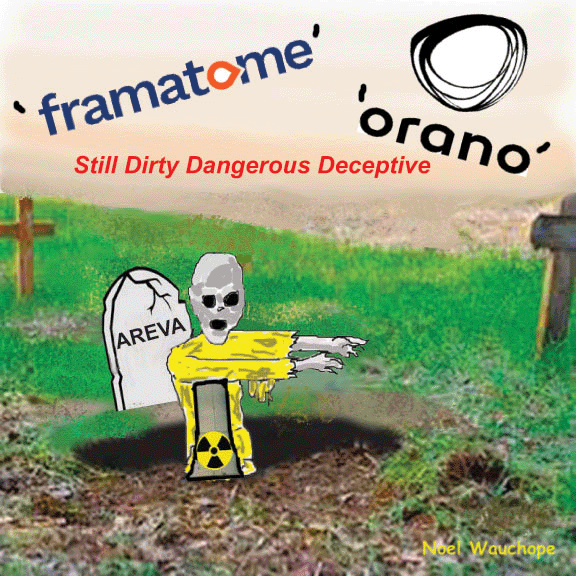 Framatome acquires BWX Technologies’ US nuclear services business 3 June 2020 3 June 2020 Framatome has completed its acquisition of BWX Technologies’ US commercial nuclear services business. With this transaction, Framatome expands its portfolio of equipment and tooling for nuclear power plant inspections and maintenance, a statement said. …..https://www.neimagazine.com/news/newsframatome-acquires-bwx-technologies-us-nuclear-services-business-7954409
An American nuclear reactor flooded by an extreme rainfall event – during the pandemic
COVID Infects World Nuclear Plants May 27, 2020, by Radio Ecoshock
“………AN AMERICAN REACTOR FLOODED BY AN EXTREME RAINFALL EVENT – DURING THE PANDEMIC
Grant Smith mentioned the climate threat to nuclear installations. We have a case of that right now. The American mid-West has experience record-setting extreme rainfall events. The City of Chicago just had it wettest May, for the third year in a row. All that rain burst two dams in Michigan, flooding out the city of Midland, population 42,000. It also flooded the Dow Chemical plant that has produced noxious chemicals for years, including Agent Orange. The company acknowledges their chemicals have leaked out over the years. It has been declared a Superfund site, among the worst in the country requiring federal cleanup funds. There are chemicals lining the river, now being stirred up by the flood, and washing down into Lake Michigan.
What is less reported is the Dow nuclear reactor at that flooded site. It is a smaller research reactor built in the 1960’s, called a TRIGA 1 model. The reactor is sunk down into the ground. It doesn’t have cooling rods, but depends on convection for water cooling. Although the reactor was not operating at the time of the flood in late May, the design suggest it probably still had nuclear materials inside. Are they now leaking out into the river and Lake Michigan. So far, the company says “no”. With no federal oversight reporting we can rely on, you just have to take the word of Dow Chemical that this reactor is perfectly safe during this extreme rainfall event. Nothing to worry about here, they say. Beyond nearly 400 very large nuclear power plants in the United States, there are thousands of smaller reactors scattered around the country, at Universities, military bases, and private companies. Who is keeping track of those as climate change and a pandemic come knocking at the door?
Here is that unusual event report to the NRC about the Dow Chemical reactor in Michigan. For those who want to dive deeper, here is a description of that Triga Mark I reactor……… https://www.ecoshock.org/2020/05/covid-infects-world-nuclear-plants.html
Deep boreholes for nuclear waste disposal?
 I’d find this more convincing if it were not so closely tied to the push for “new nukes” I’d find this more convincing if it were not so closely tied to the push for “new nukes”
Industry to Explore Decentralized Nuclear Waste Disposal. Power Mag
May 31, 2020 by Sonal Patel Efforts to explore whether it is feasible to permanently dispose of high-level nuclear waste in deep horizontal boreholes under next-generation nuclear reactor sites got a boost in late April as nuclear waste technology firm Deep Isolation signed its first contract with industry. Under the contract with independent nonprofit organization Electric Power Research Institute (EPRI), the Berkeley, California–based company will team with EPRI researchers, Southern Co., the Nuclear Energy Institute (NEI), Auburn University, and nuclear waste management consultancy J Kessler and Associates to assess how Deep Isolation’s horizontal borehole disposal solution could contribute to siting of advanced nuclear energy systems. Specifically, the team plans to explore physical site characteristics, disposal operations, safety performance analysis, and regulatory and licensing considerations. …….https://www.powermag.com/industry-to-explore-decentralized-nuclear-waste-disposal/ |
|
Now with the pandemic, it is a free-for-all for the nuclear operators
COVID Infects World Nuclear Plants, May 27, 2020, by Alex Smith, Radio Ecoshock, “……….During this pandemic, the nuclear industry is another disaster not just waiting to happen, but already dancing with it. Some reactors have been shut down due to the pandemic. But most atomic companies demanded to stay open.
They call themselves essential services, despite a glut of electricity priced well below what the nuclear industry can match. In many countries, taxpayers are paying billions for mal-investments in nuclear power. In America, the private operators and their investors demanded the federal government top up user bills in order to compete with electricity from cheap wind and natural gas. They want safety regulations cut back, inspections and rules developed after major nuclear accidents to be relaxed.
In America, the Trump Administration is ready to help. Three of the 5 commissioners of the Nuclear Regulatory Commission were nominated by President Trump. Along with other environmental protection rules, the Trump Administration has been dropping safety requirements at nuclear plants. Now with the pandemic, it is a free-for-all for the nuclear operators – as they struggle to avoid painful bankruptcies across the nation.
In just one small example, the former on-site nuclear plant inspectors, found in all nuclear power plants by law, are now making their “inspections” over the phone. There is fear of massive absenteeism of nuclear employees as the pandemic infects workers and their families or contacts. In Georgia, 120 nuclear plant workers had to quarantine. American companies admit they have plans to keep emergency staff, thousands of them, at the reactors in a 24/7 lock down, sleeping on cots. But they won’t say if that is already happening or where. During this pandemic, a nuclear reactor in the United States is sunk down in ground flooded in Michigan. You probably did not hear about that. We will ask big questions about nuclear safety during the pandemic with our guest Grant Smith, Senior Energy Policy Advisor with EWG, the Environmental Working Group.
But it is not just America. The international scene is just as scary. Many companies said they had pandemic plans, but few did, or no plan on this scale. A few reactors in the UK and France were closed down because they could not be operated safely during a pandemic. Almost all the rest stay on, full power, despite workers getting infected, and essential supply chains in doubt. The Russian state atomic company Rosatom brags “Nuclear Is Not Afraid of COVID-19”. Construction on the first nuclear power plant in impoverished Bangladesh is continuing, they say, even though a few hundred Russian nuclear construction experts were called home during the pandemic. I guess it is up to the Bangladeshis to build it completely safely. Rosatom reports construction of new reactors in Egypt and Turkey continues through the pandemic.
Russian nuclear operators have been infected with this virus. Probably every country with a reactor or nuclear weapon has these infections and risks, without reporting it. What could go wrong? I summarize carefully worded reports that explain so much. A nuclear accident during a pandemic would be a dire twist in history. Maybe with a bit of sunlight and public voice, we can avoid that?
The industry reports terrorists threatened to attack nuclear facilities during this plague. Experts point to spikes in attempts to hack nuclear control systems, even while some reactor employees work from home computers. I hope they are not using Windows 10 with botched and hackable updates.. In all countries, from Finland to Canada to Australia, the problems or policies meant to cope with nuclear-sized risks during this pandemic are shrouded in secrecy.
A watchdog group reports major decisions approved by the U.S. Nuclear Regulatory Commission require, by law, public consultation and information. The pandemic has excused all that, the brakes are off, the deregulators are not regulating. The NRC claims it rules the operation of nuclear plants, but not worker health. The NRC has not provided a public plan for nuclear plants during COVID-19. Other national governments are distracted. They are already politically and financially enmeshed in the nuclear game. That leaves safety up to nuclear plant owners and investors, the unseen wealthy and their CEOs, the ones already facing oblivion as dangerous aging reactors shut down one after another, and wind power blows them away.
I’m Alex Smith. This is Radio Ecoshock. Before I cover the convergence of a pandemic, climate change, and grave nuclear risks in many countries, let’s start out with our guest in America. …… https://www.ecoshock.org/2020/05/covid-infects-world-nuclear-plants.html
1 This Month

of the week– Nuclear Reactor Information Task Force

14 May – online event From Bombs to Data Centres: the Face of Nuclear Colonialism
To see nuclear-related stories in greater depth and intensity – go to https://nuclearinformation.wordpress.com
-
Archives
- May 2026 (97)
- April 2026 (356)
- March 2026 (251)
- February 2026 (268)
- January 2026 (308)
- December 2025 (358)
- November 2025 (359)
- October 2025 (376)
- September 2025 (257)
- August 2025 (319)
- July 2025 (230)
- June 2025 (348)
-
Categories
- 1
- 1 NUCLEAR ISSUES
- business and costs
- climate change
- culture and arts
- ENERGY
- environment
- health
- history
- indigenous issues
- Legal
- marketing of nuclear
- media
- opposition to nuclear
- PERSONAL STORIES
- politics
- politics international
- Religion and ethics
- safety
- secrets,lies and civil liberties
- spinbuster
- technology
- Uranium
- wastes
- weapons and war
- Women
- 2 WORLD
- ACTION
- AFRICA
- Atrocities
- AUSTRALIA
- Christina's notes
- Christina's themes
- culture and arts
- Events
- Fuk 2022
- Fuk 2023
- Fukushima 2017
- Fukushima 2018
- fukushima 2019
- Fukushima 2020
- Fukushima 2021
- general
- global warming
- Humour (God we need it)
- Nuclear
- RARE EARTHS
- Reference
- resources – print
- Resources -audiovicual
- Weekly Newsletter
- World
- World Nuclear
- YouTube
-
RSS
Entries RSS
Comments RSS
 nuclear-news