A mock B61-12 nuclear bomb dropped for the first time.

Christina Macpherson’s websites & blogs
n.b This will be illegal under international law, as of January 22
By Greg Waldron27 November 2020 The Lockheed Martin F-35A has operated a flight test involving the dropping of a mock B61-12 nuclear bomb.The work took place at the Tonopah Test Range, and was conducted by Sandia National Laboratories. It was the first in a series of tests to assess the type’s ability to drop the weapon.
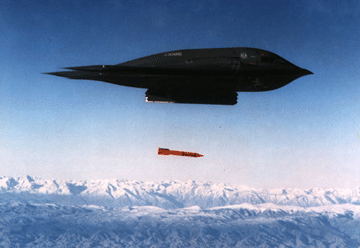
The aircraft, travelling faster than the speed of sound, dropped the inert weapon from 10,500ft. The weapon hit the designated target area 42s later.
“We’re showing the B61-12’s larger compatibility and broader versatility for the country’s nuclear deterrent, and we’re doing it in the world of Covid-19,” says Sandia executive Steven Samuels.
“We’re not slowing down. We’re still moving forward with the B61-12 compatibility activities on different platforms.”
This was the first time a B61-12 was dropped from the internal weapons bay of a fighter. It was also the first time the weapon was released at a speed greater than Mach 1.
The work follows other tests involving the Boeing F-15E Strike Eagle and Northrop Grumman B-2 Spirit stealth bomber.
Sandia designs and produces non-nuclear components for the USA’s nuclear stock pile.
“The latest test is a critical piece in the F-35A and B61-12 programme,” adds Samuels. “Aboard the newest fighter, the B61-12 provides a strong piece of the overall nuclear deterrence strategy for our country and our allies.”
Beware the “madness of militarism” – Biden likely to appoint war-loving Michèle Flournoy as Defense Secretary
 Hey Joe, Where You Going With That Pentagon in Your Hands? https://www.commondreams.org/views/2020/11/23/hey-joe-where-you-going-pentagon-your-hands
The pernicious and lucrative aspects of military madness are personified in the favorite to be Biden’s Defense Secretary. by Norman Solomon,
Warning and petitioning Biden to dissuade him from a Flournoy nomination probably have scant chances of success. But if Biden puts her name forward, activists should quickly launch an all-out effort to block Senate confirmation.
As the Biden administration takes office, progressives have an opportunity to affirm and amplify the position that Martin Luther King Jr. boldly articulated when he insisted that “I never intend to adjust myself to the madness of militarism.” In the present day, the pernicious and lucrative aspects of that madness are personified in the favorite to be Biden’s Defense Secretary.
Days ago, the Project On Government Oversight (POGO) published a detailed analysis under the headline “Should Michèle Flournoy Be Secretary of Defense?” The well-documented answer: No.
Citing “extensive defense industry ties,” POGO provided an overview of Flournoy’s revolving-door career. When she wasn’t oiling the war machine in the Clinton and Obama administrations, Flournoy was profiteering from servicing that machine:
- “In 2002 she went from positions in the Pentagon and the National Defense University to the mainstream but hawkish Center for Strategic and International Studies, which is largely funded by industry and Pentagon contributions.”
- “Five years later, she co-founded the second-most heavily contractor-funded think tank in Washington, the highly influential Center for a New American Security. That became a stepping stone to her role as under secretary of defense for policy in the Obama administration.”
- “From there she rotated to the Boston Consulting Group, after which the firm’s military contracts expanded from $1.6 million to $32 million in three years. She also joined the board of Booz Allen Hamilton, a consulting firm laden with defense contracts. In 2017 she co-founded WestExec Advisors, helping defense corporations market their products to the Pentagon and other agencies.”
Running parallel to Flournoy’s financial conflicts of interest was her long record of advocacy for military conflicts.
“Flournoy was widely considered to have been one of Obama’s more hawkish advisers and helped mastermind the escalation of the disastrous war in Afghanistan,” Arwa Mahdawi pointed out in a Nov. 21 Guardian piece. “She has called for increased defense spending, arguing in a 2017 Washington Post op-ed that Trump was ‘right to raise the need for more defense dollars.’ She has complained that Obama didn’t use military force enough, particularly in Syria. She supported the wars in Iraq and Libya. . .”
The president-elect is hardly in a position to hold such a record against prospective appointees. He has never fully acknowledged, much less renounced, his own roles in advocating for disastrous U.S. wars — most notably and tragically, the war in Iraq.
Biden hasn’t gotten his story straight or come clean about supporting the U.S.-led invasion of Iraq in 2003. His specious claims that he didn’t really support the invasion have been gross misrepresentations of the historical record. Actually, Biden was the Democrat in the Senate who exerted the most leverage in support of the Iraq invasion, and he did so with public enthusiasm.
The foreseeable dangers of picking Flournoy to run the Pentagon are compounded by Biden’s selection of Antony Blinken to be Secretary of State. It was Blinken who, 18 years ago, served as staff director for the Senate Foreign Relations Committee while its chairman, Joe Biden, oversaw the pivotal and badly skewed two-day hearing in summer 2002 that greased the congressional skids for approving an invasion of Iraq.
Blinken, along with Flournoy, co-founded WestExec Advisors, which the Washington Post’s breaking-news coverage of the Blinken nomination gingerly described as “a political strategy firm.” It was a nice euphemism, in contrast to how POGO describes the WestExec Advisors mission — “helping defense corporations market their products to the Pentagon and other agencies.” The term “war profiteering” would be even more apt.
If past behavior is the best predictor of future behavior, there are ample reasons for apprehension about the top of the military and foreign-policy team that Biden has begun to install for his presidency. But realism should not lead to fatalism or passivity.
Extricating the United States from the grip of the military-industrial complex will require massive and sustained organizing. With that goal in mind, a grassroots campaign to prevent Michèle Flournoy from becoming Secretary of Defense would be wise.
Canada’s environmental groups join to oppose experimental Small Nuclear Reactors (SMRs)
 Canadian environmental groups oppose experimental small modular nuclear reactors, https://blackburnnews.com/midwestern-ontario/midwestern-ontario-news/2020/11/24/canadian-environmental-groups-oppose-experimental-small-modular-nuclear-reactors/ By Janice MacKay November 24, 2020 A number of groups have joined together to ask the federal government to halt its plans to fund experimental new small modular nuclear reactors (SMRs).
The Federal Government is preparing to launch the federal government’s SMR ” Action Plan” within weeks.
The SMR Action Plan is expected to include a strategy to fund and support the development of experimental nuclear reactors by private sector companies, the majority based in the US and UK.
In a media release, dozens of organizations from coast to coast have called the proposed new nuclear reactors a dirty, dangerous distraction from tackling climate change. They include Greenpeace Canada, Friends of the Earth Canada, Ralliement contre la pollution radioactive, Équiterre, the Coalition for Responsible Energy Development in New Brunswick, the Canadian Coalition for Nuclear Responsibility and Northwatch..
The Bloc Québécois, the NDP and the Green Party all oppose the government’s “small” modular nuclear reactor plan.
On November 13, Monique Pauze from the Bloc Québécois stated: “The Bloc Québécois denounces the intention of Ottawa to invest in nuclear energy to the benefit, once again, of the Ontario industrial sector, instead of financing the transition towards clean electricity. The Bloc calls for the abandonment of the anticipated deployment of small modular nuclear reactors. The Federal government is leading Canada towards a wall by betting on nuclear energy that is absolutely not clean.”
NDP natural resources critic Richard Cannings said in a statement: “Many Canadians have concerns about impacts of nuclear energy. When it comes to energy generation there are better ways forward. We have options that are cheaper and safer and will be available quicker. I think we should be supporting the development of energy storage solutions to help roll out renewables like solar and wind on a larger scale instead.”
On November 10, all three Green Party of Canada caucus members issued a statement and signed a letter to Minister O’Regan and Minister Navdeep Bains saying that: “Small nuclear reactors (SMRs) have no place in any plan to mitigate climate change when cleaner and cheaper alternatives already exist. The federal government must stop funding the nuclear industry and instead redirect investments towards smarter solutions. Nuclear fails on many grounds, including on the economics.”
Prof. Susan O’Donnell from the Coalition for Responsible Energy Development in New Brunswick said: “Building new nuclear reactors does not belong in a climate action plan. Leading researchers have shown that investing in renewable energy is the best path to net zero and that adding nuclear energy to the mix actually hinders rather than helps.”
Shawn-Patrick Stensil, Director of Programs at Greenpeace Canada, said: “The Liberal government is throwing good money after bad. Hypothetical new nuclear power technologies have been promising to be the next big thing for the last forty years, but in spite of massive public subsidies, that prospect has never panned out.”
The release pointed out the proposed reactors are still on the drawing board and will take a decade or more to develop. If built, their power will cost ten times more than wind or solar energy. The most advanced SMR project to date in the US has already doubled its estimated cost – from $3B to over $6B.
The federal government announced its first SMR grant of $20 million to Terrestrial Energy on October 15.
The environmental groups said they are shocked that the government is funding new nuclear energy development with no parliamentary review, while trying to avoid public scrutiny and debate. They called the consultation process leading to date on the SMR Action Plan a sham. Individuals and groups could only comment on the plan if they first signed on to a statement of principles supporting SMR technologies. They say nuclear power and uranium mining will always be dirty and dangerous. Radioactive waste will have to be kept out of the environment for tens of thousands of years, and there is no known means of achieving that.
President Joe Biden will have just 16 days from Inauguration Day to rescue the New START Treaty
 Biden May Have 16 Days to Stave Off a Nuclear Arms Race, Preserving the New START treaty with Russia will be one of his earliest missions, Bloomberg, By Peter Coy , 25 Nov 20,
If New START is allowed to expire, a nuclear arms race could break out. Retired Navy Admiral James Stavridis, the former supreme allied commander of NATO, wrote in a Bloomberg Opinion column on Oct. 30, that a stop to New START would allow both sides to deploy more nukes of current designs as well as make more advanced systems, “all of which would be very destabilizing.”
Some pressure, right? For insight into what Biden and his team will do, I interviewed Jon Wolfsthal, who served from 2014 to 2017 as a special assistant to President Barack Obama and as senior director for arms control and nonproliferation at the National Security Council. He was also a senior adviser to Vice President Biden on nuclear security and nonproliferation from 2009 to 2012.
Some pressure, right? For insight into what Biden and his team will do, I interviewed Jon Wolfsthal, who served from 2014 to 2017 as a special assistant to President Barack Obama and as senior director for arms control and nonproliferation at the National Security Council. He was also a senior adviser to Vice President Biden on nuclear security and nonproliferation from 2009 to 2012.
Wolfsthal says he’s optimistic about Biden’s chances of staving off a fresh nuclear arms race……….
Biden and his team will have a long list of nuclear weapons problems to deal with, including the rapid growth of China’s
………… Wolfsthal says New START, which went into effect in 2011, is flawed but shouldn’t be left to expire, because
Nuclear arms control doesn’t get as much attention as other priorities for Biden’s first 100 days, but nothing is more
Danger to San Onofre nuclear waste, from ocean’s king tides
 Annual High Tide Spurs Concerns About Future Safety of San Onofre Nuclear Waste Stock Near South OC, Voice of OC, By BRANDON PHO November 23, 2020, Annual High Tide Spurs Concerns About Future Safety of San Onofre Nuclear Waste Stock Near South OC, Voice of OC, By BRANDON PHO November 23, 2020, They’re called king tides:Ocean waves that grow especially tall a few times during the year, rumbling against the California coast and offering a glimpse into future sea level rise and a reshaping shoreline, according to state coastal regulators.
Those tides rolled up to San Onofre last weekend, where a sea wall stands to protect what nearby communities fear is a man-made disaster in waiting: the decommissioned but still radioactive San Onofre Nuclear Generating Station (SONGS). The following week, local officials and activists convened a set of dueling community forums that well capture the ongoing dispute over what exact risk the nuclear waste sitting at SONGS poses to all life within the area joining Orange and San Diego counties. The debate centers on the integrity of SONGS’ nuclear waste storage system, which has been criticized as prone to failure and an ecological and human health hazard. One Nov. 19 forum hosted by nuclear watchdogs saw some of their fears echoed back to them by Dr. Ian Fairlie, a radiation biologist in London who once headed the Secretariat of the UK Government’s CERRIE committee on internal radiation risks……. Members of the public laid out those concerns at an Aug. 20 panel meeting, and the comments can be read here. ……. environmentalists are looking at sea level rise’s impacts on coastlines well into 2100. Edison had previously argued studies into that time frame aren’t necessary……… There’s deep disagreement about what to do with the leftover nuclear waste, all 1,800 metric tons of which are in dry storage and embedded in concrete. The spent fuel contains radioactive isotopes like Cesium-137, the amount of which critics say is comparable to levels released during the Chernobyl disaster of 1986.……… The contention between watchdogs and Edison is the type of dry storage the company chose. Critics say the company has cheaped out through more cost-efficient, but less safe, thin-walled HOLTEC canisters, feared to be more prone to cracking and corrosion from conditions like the plant’s salty seaside locale. Instead, watchdogs have called for the use of thicker casks they say would better stave off the risk of failure and exposure. Fairlie at the Nov. 19 forum, hosted by the Samuel Lawrence Foundation and local nuclear safety groups, said the current canisters in use by Edison are “not very good – they are cheap … 5/8ths of an inch thick, prone to cracking.” They’re “designed to be temporary and they’re not really robust from external attack in my view,” he said, adding “it would be much, much, much better” for the spent fuel to be stored in a thicker cask — “Unlikely to be subject to cracks.” The only problem? “They’re very expensive.” ……… https://voiceofoc.org/2020/11/annual-high-tide-spurs-concerns-about-future-safety-of-san-onofre-nuclear-waste-stock-near-south-oc/ |
|
Waste Isolation Pilot Plant – building of ventilation shaft is halted, due to Covid-19 and planning problems
 WIPP: New Mexico regulators halt utility shaft project, cite COVID-19, planning problems, Adrian Hedden, Carlsbad Current-Argus, 25 Nov 20, Construction of a $100 million utility shaft at the Waste Isolation Pilot Plant could be halted after the New Mexico Environment Department denied a request to extend state authorization to build the shaft, citing missed deadlines in the planning of the project and the continued spread in COVID-19 cases at the facility.
The shaft, part of an almost $300 million rebuild of WIPP’s ventilation system, along with a series of fans and filter buildings known as the Safety Significant Confinement Ventilation System (SSCVS), was intended to improve airflow in the WIPP underground and allow for waste emplacement and mining to occur simultaneously along with future expansions of the nuclear waste repository……….
Spike in COVID-19 at WIPP could put workers in danger
NMED also cited a recent rise in COVID-19 cases at WIPP, as the pandemic continued to spread in record-breaking numbers across New Mexico, and the agency’s responsibility to ensure human health is not put at risk by activities under the TA, requesting a plan for COVID-19 mitigation at the facility. https://www.currentargus.com/story/news/local/2020/11/24/wipp-utility-shaft-halted-new-mexico-cites-covid-planning-problems/6397790002/
NRC approves financially dodgy sale of Indian Point Nuclear Station to Holtec
 Sale of NYC-Area Nuclear Power Plant Gets Federal Approval, https://www.nbcnewyork.com/news/local/sale-of-nyc-area-nuclear-power-plant-gets-federal-approval/2742312/, 23 Nov 20, After the plant shuts down in the spring, the current operator plans to transfer its license to another company to dismantle the reactors and clean up the site along the Hudson River by 2033.
The Nuclear Regulatory Commission has approved sale of the Indian Point nuclear power plant to a dismantling company without granting requests by lawmakers and environmental groups for public hearings.
The NRC announced Monday that it has signed off on its staff’s recommendation last week to approve Entergy Corp.’s sale of the plant north of New York City to New Jersey-based Holtec International. After the plant shuts down in the spring, Entergy plans to transfer its license to Holtec to dismantle the reactors and clean up the site along the Hudson River by 2033.
The NRC agreed to rescind or modify the transfer after it decides whether to grant New York state and the environmental group Riverkeeper’s requests for hearings about their concerns regarding the sale. New York Attorney General Letitia James has called the Holtec deal “very risky,” questioning Holtec’s financing and experience.
During a Zoom conference Friday organized by the Hudson River Sloop Clearwater environmental group, Assistant New York Attorney General Joshua Tallent said he would like to see money for spent radioactive fuel management set aside in a supplemental fund until the decommissioning is done to reduce the chance that taxpayers are stuck with the tab for cost overruns.
Former CEO of failed V.C. Summer nuclear project pleads guilty to fraud charges
 Former SCANA CEO pleads guilty to fraud charges for failed nuclear power project, https://abcnews4.com/news/local/former-scana-ceo-pleads-guilty-to-fraud-charges-for-failed-nuclear-power-project by Tony Fortier-Bensen, Wednesday, November 25th 2020 COLUMBIA, SC (WCIV)
The former chief executive officer of SCANA pleaded guilty on Tuesday to fraud charges for the failed V.C. Summer project in Fairfield County.
Kevin Marsh pleaded guilty to one count of conspiracy and one count of obtaining false property by false pretenses, according to a plea agreement.
The agreement also said that Marsh would serve 18 to 36 months and has agreed to pay $5 million in restitution.
In June, retired SCANA chief operating officer Steve Byrne entered a guilty plea for his actions in relation to the failed nuclear power plant.
The U.S Attorney’s office alleges Byrne and Marsh conspired with other SCANA executives to deceive state and federal government overseers, stock holders and power customers in order to keep funding coming in to build two nuclear reactors at the V.C. Summer Nuclear Station.
The expansion project cost Santee-Cooper and the defunct South Carolina Electric & Gas over $9 billion before the two entities abandoned the project in July 2017.
In addition, Marsh agreed to waive indictment and arraignment and work with authorities to provide further information on the failed project.
Under the plea agreement, Marsh could be sentenced to serve 18 to 36 months in prison. Marsh has also agreed to pay $5 million in restitution.
Ontario could get clean renewable energy from neighbouring provinces, with no need for nuclear power
 With nuclear power plants approaching end of life, what’s next in Ontario? Barrie Today, Peter Bursztyn 25 Nov 20, ‘Two decades is just enough time for major new electricity generation projects to go through the planning and permitting process, get built, and come on line,’ says reader With nuclear power plants approaching end of life, what’s next in Ontario? Barrie Today, Peter Bursztyn 25 Nov 20, ‘Two decades is just enough time for major new electricity generation projects to go through the planning and permitting process, get built, and come on line,’ says reader
……. When Hydro Quebec’s grand James Bay hydroelectricity project was built, many of the dams were constructed with space to accept more turbine units than are now installed.
In other words, these dams spill a great deal of water which could instead flow through a turbine to generate power. Taken as a whole, James Bay is one of the world’s largest power generation projects. Its capacity is 15,527 megawatts, the equivalent of 16 nuclear power plants. In 1971, when the project began, the Canadian government tried to persuade Quebec to choose nuclear power instead. With hindsight, Quebec was wise to choose hydroelectricity. Ontario, which did not have similar hydroelectric resources, built Unfortunately, we found nuclear to be a costly method of producing electricity; expensive enough that much of the debt incurred to build Ontario’s nuclear “fleet” still remains on the province’s books a half-century on. We never managed to pay it off……. our fleet of nuclear power plants is coming to the end of its design life. Over the coming two decades, most of our nuclear fleet will begin to wink out. We know that we cannot replace them with new nuclear units; they are simply too costly. The last Liberal government called for tenders to build nuclear plants, but insisted the bidders had to be responsible for cost over-runs. As a result, two of the three potential builders dropped out. The third offered to build, but refused to accept responsibility for cost escalation. The nuclear plan was quietly dropped……….. Ontario cannot generate enough renewable, carbon-free electricity to replace our current nuclear output within our own borders. (It is worth saying that nuclear power is not renewable.) Fortunately, our neighbouring provinces — Manitoba and Quebec — have the potential to generate considerably more than they currently use. Many of Quebec’s already completed dams have space in their turbine halls for more units. Quebec could “drop in” about 13,000 MW of generation. This is roughly equal to Ontario’s nuclear capacity, and not all of our nuclear units are running at any one time. Quebec has also surveyed other potential hydroelectric sites, both to the south and to the north of the James Bay project. More hydroelectric power could be exploited in northeast Quebec. Our western neighbour, Manitoba, has a number of sites with hydroelectric generation potential on the Nelson River near major existing power stations. There is also untapped potential hydroelectric power available to the southeast of Lake Winnipeg, even closer to Ontario. ………. Although the wind doesn’t blow continuously, expanding wind generation would reduce the amount of electricity Alberta needs to purchase from B.C. Since hydro power can be ramped up very rapidly, it would also reduce or even eliminate the need for gas-fired generation to meet demand peaks. Of course, the same applies to Ontario. We are a country blessed with a great deal of hydroelectric potential. Inexpensive, carbon-free electricity generation is within our grasp. All it needs is vision and leadership. https://www.barrietoday.com/letters-to-the-editor/letter-with-nuclear-power-plants-approaching-end-of-life-whats-next-in-ontario-2902273 |
|
Trump administration pulls out of Open Skies treaty with Russia,
|
Trump administration pulls out of Open Skies treaty with Russia, THe Hill, BY DOMINICK MASTRANGELO – 11/22/20 The Trump administration has officially withdrawn from the Open Skies treaty, six months after starting the process to leave.“On May 22, 2020, the United States exercised its right pursuant to paragraph 2 of Article XV of the Treaty on Open Skies by providing notice to the Treaty Depositaries and to all States Parties of its decision to withdraw from the Treaty, effective six months from the notification date,” State Department deputy spokesman Cale Brown said in a statement.
“Six months having elapsed, the U.S. withdrawal took effect on November 22, 2020, and the United States is no longer a State Party to the Treaty on Open Skies,” Brown added. The post-Cold War agreement was struck to allow nations to conduct flyovers of other allies in an attempt to collect military data and other intelligence on neighboring foreign enemies. In a statement issued on Sunday, Sen. Bob Menendez (D-N.J.) called the administration’s withdrawal “reckless” and encouraged President-elect Joe Biden‘s administration to rejoin the pact once he is inaugurated. ………. https://thehill.com/homenews/administration/527056-us-withdraws-from-open-skies-treaty-with-russia |
|
Influence of weapons makers on U.S. policy, whether a Democrat or Republican administration
 A Washington Echo Chamber for a New Cold War, Reader Supported News, By Cassandra Stimpson and Holly Zhang, TomDispatch, 20 November 20
 ar: what is it good for? Apparently, in Washington’s world of think tanks, the answer is: the bottom line.
In fact, as the Biden presidency approaches, an era of great-power competition between the United States and China is already taken for granted inside the Washington Beltway. Much less well known are the financial incentives that lurk behind so many of the voices clamoring for an ever-more-militarized response to China in the Pacific. We’re talking about groups that carefully avoid the problems such an approach will provoke when it comes to the real security of the United States or the planet. A new cold war is likely to be dangerous and costly in an America gripped by a pandemic, its infrastructure weakened, and so many of its citizens in dire economic straits. Still, for foreign lobbyists, Pentagon contractors, and Washington’s many influential think tanks, a “rising China” means only one thing: rising profits.
Defense contractors and foreign governments are spending millions of dollars annually funding establishment think tanks (sometimes in secret) in ways that will help set the foreign-policy agenda in the Biden years. In doing so, they gain a distinctly unfair advantage when it comes to influencing that policy, especially which future tools of war this country should invest in and how it should use them.
Not surprisingly, many of the top think-tank recipients of foreign funding are also top recipients of funding from this country’s major weapons makers. The result: an ecosystem in which those giant outfits and some of the countries that will use their weaponry now play major roles in bankrolling the creation of the very rationales for those future sales. It’s a remarkably closed system that works like a dream if you happen to be a giant weapons firm or a major think tank. Right now, that system is helping accelerate the further militarization of the whole Indo-Pacific region.
In the Pacific, Japan finds itself facing an increasingly tough set of choices when it comes to its most significant military alliance (with the United States) and its most important economic partnership (with China). A growing U.S. presence in the region aimed at counterbalancing China will allow Japan to remain officially neutral, even as it reaps the benefits of both partnerships.
To walk that tightrope (along with the defense contractors that will benefit financially from the further militarization of the region), Japan spends heavily to influence thinking in Washington. Recent reports from the Center for International Policy’s Foreign Influence Initiative (FITI), where the authors of this piece work, reveal just how countries like Japan and giant arms firms like Lockheed Martin and Boeing functionally purchase an inside track on a think-tank market that’s hard at work creating future foreign-policy options for this country’s elite.
How to Make a Think Tank Think
Take the prominent think tank the Center for Strategic and International Studies (CSIS), which houses programs focused on the “China threat” and East Asian “security.” Its Asia Maritime Transparency Initiative, which gets funding from the governments of Japan and the Philippines, welcomes contributions “from all governments in Asia, as well as corporate and foundation support.”
Unsurprisingly, the program also paints a picture of Japan as central “to preserving the liberal international order” in the face of the dangers of an “increasingly assertive China.” It also highlights that country’s role as Washington’s maritime security partner in the region. There’s no question that Japan is indeed an important ally of Washington. Still, positioning its government as a lynchpin in the international peace (or war) process seems a dubious proposition at best.
CSIS is anything but alone when it comes to the moneyed interests pushing Washington to invest ever more in what now passes for “security” in the Pacific region. A FITI report on Japanese operations in the U.S., for instance, reveals at least 3,209 lobbying activities in 2019 alone, as various lobbyists hired by that country and registered under the Foreign Agents Registration Act targeted both Congress and think tanks like CSIS on behalf of the Japanese government. Such firms, in fact, raked in more than $30 million from that government last year alone. From 2014 to 2019, Japan was also the largest East Asian donor to the top 50 most influential U.S. think tanks. The results of such investments have been obvious when it comes to both the products of those think tanks and congressional policies.
Think-tank recipients of Japanese funding are numerous and, because that country is such a staunch ally of Washington, its government can be more open about its activities than is typical. Projects like the Carnegie Endowment for International Peace’s “China Risk and China Opportunity for the U.S.-Japan Alliance,” funded by the Japanese Ministry of Foreign Affairs, are now the norm inside the Beltway. You won’t be surprised to learn that the think-tank scholars working on such projects almost inevitably end up highlighting Japan’s integral role in countering “the China threat” in the influential studies they produce. That threat itself, of course, is rarely questioned. Instead, its dangers and the need to confront them are invariably reinforced.
Another Carnegie Endowment study, “Bolstering the Alliance Amid China’s Military Resurgence,” is typical in that regard. It’s filled with warnings about China’s growing military power — never mind that, in 2019, the United States spent nearly triple what China did on its military, according to the Stockholm International Peace Research Institute. Like so many similarly funded projects inside the Beltway, this one recommended further growth in military cooperation between the U.S. and Japan. Important as well, it claimed, was developing “the capability to wage combined multidomain joint operations” which “would require accelerating operational response times to enhance firepower.”
The Carnegie project lists its funding and, as it turns out, that foundation has taken in at least $825,000 from Japan and approximately the same amount from defense contractors and U.S. government sources over the past six years. And Carnegie’s recommendations recently came to fruition when the Trump administration announced the second-largest sale of U.S. weaponry to Japan, worth more than $23 billion worth.
If the Japanese government has a stake in funding such think tanks to get what it wants, so does the defense industry. The top 50 think tanks have received more than $1 billion from the U.S. government and defense contractors over those same six years. Such contractors alone lobby Congress to the tune of more than $20 million each election cycle. Combine such sums with Japanese funding (not to speak of the money spent by other governments that desire policy influence in Washington) and you have a confluence of interests that propels U.S. military expenditures and the sale of weapons globally on a mind-boggling scale.
A Defense Build-Up Is the Order of the Day
An April 2020 report on the “Future of US-Japan Defense Collaboration” by the Atlantic Council’s Scowcroft Center for Strategy and Security offers a typical example of how such pro-militarization interests are promoted. That report, produced in partnership with the Japanese embassy, begins with the premise that “the United States and Japan must accelerate and intensify their long-standing military and defense-focused coordination and collaboration.”
Specifically, it urges the United States to “take measures to incentivize Japan to work with Lockheed Martin on the F-2 replacement program,” known as the F-3. (The F-2 Support Fighter is the jet Lockheed developed and produced in partnership with Mitsubishi Heavy Industries for the Japanese Defense Forces.) While the report does acknowledge its partnership with the embassy of Japan, it fails to acknowledge that Lockheed donated three quarters of a million dollars to the influential Atlantic Council between 2014 and 2019 and that Japan generally prefers to produce its own military equipment domestically.
The Atlantic Council report continues to recommend the F-3 as the proper replacement for the F-2, “despite political challenges, technology-transfer concerns,” and “frustration from all parties” involved. This recommendation comes at a time when Japan has increasingly sought to develop its own defense industry. Generally speaking, no matter the Japanese embassy’s support for the Atlantic Council, that country’s military is eager to develop a new stealth fighter of its own without the help of either Lockheed Martin or Boeing. While both companies wish to stay involved in the behemoth project, the Atlantic Council specifically advocates only for Lockheed, which just happens to have contributed more than three times what Boeing did to that think tank’s coffers.
A 2019 report by the Hudson Institute on the Japan-U.S. alliance echoed similar sentiments, outlining a security context in which Japan and the United States should focus continually on deterring “aggression by China.” To do so, the report suggested, American-made ground-launched missiles (GCLMs) were one of several potential weapons Japan would need in order to prepare a robust “defense” strategy against China. Notably, the first American GCLM test since the United States withdrew from the Cold War era Intermediate-Range Nuclear Forces Treaty in 2019 used a Lockheed Martin Mark 41 Launch System and Raytheon’s Tomahawk Land Attack Cruise Missile. The Hudson Institute had not only received at least $270,000 from Japan between 2014 and 2018, but also a minimum of $100,000 from Lockheed Martin.
In 2020, CSIS organized an unofficial working group for industry professionals and government officials that it called the CSIS Alliance Interoperability Series to discuss the development of the future F-3 fighter jet. While Japanese and American defense contractors fight for the revenue that will come from its production, the think tank claims that American, Japanese, and Australian industry representatives and officials will “consider the political-military and technical issues that the F-3 debate raises.” Such working groups are far from rare and offer think tanks incredible access to key decision-makers who often happen to be their benefactors as well.
All told, between 2014 and 2019, CSIS received at least $5 million from the U.S. government and Pentagon contractors, including at least $400,000 from Lockheed Martin and more than $200,000 from Boeing. In this fashion, a privileged think-tank elite has cajoled its way into the inner circles of policy formation (and it matters little whether we’re talking about the Trump administration or the future Biden one). Think about it for a moment: possibly the most crucial relationship on the planet between what looks like a rising and a falling great power (in a world that desperately needs their cooperation) is being significantly influenced by experts and officials invested in the industry guaranteed to militarize that very relationship and create a twenty-first-century version of the Cold War.
Any administration, in other words, lives in something like an echo chamber that continually affirms the need for a yet greater defense build-up led by those who would gain most from it.
Profiting from Great Power Competition……. https://readersupportednews.org/opinion2/277-75/66316-a-washington-echo-chamber-for-a-new-cold-war
Slowly moving lawsuit on the health impacts of a national nuclear laboratory
 BNL lawsuit and the impacts of national nuclear laboratory
Brookhaven National Laboratory “continues to show almost no regard for its neighbors…Is this any way for a government-funded agency to treat its neighbors?” Nation of Change, By Karl Grossman, November 20, 2020
BNL after negotiations agreed to settlements of approximately $600,000 for the first two groups of plaintiffs, each with about 18 persons. However, last month a settlement was not agreed to involving the final group of 18 plaintiffs, and New York State Supreme Court Justice Joseph Farneti ordered that a trial be scheduled.
It accuses BNL of “failure to observe accepted relevant industry standards in the use, storage and disposal of hazardous and toxic substances” and says BNL itself had been “improperly located” by the U.S. Atomic Energy Commission “on top of an underground aquifer which supplies drinking water to a large number of persons.”
Lead attorneys are A. Craig Purcell of Smithtown, Long Island who is a former president of the Suffolk County Bar Association, and Richard J. Lippes, whose Buffalo, New York law firm successfully represented residents of the Love Canal neighborhood near Niagara Falls, severely polluted by the Hooker Chemical Co.
The lawsuit’s title is Osarczuk, et. al, vs. Associated Universities. Barbara Osarczuk had lived in North Shirley, just outside the BNL boundaries, for 28 years and attributed her thyroid and breast cancer to BNL.
A book on radioactive pollution from BNL causing health impacts to residents of Shirley was published in 2008. Welcome to Shirley: A Memoir from an Atomic Town was authored by Kelly McMasters of Hofstra University, who grew up in Shirley. The book was the basis of the 2012 TV documentary Atomic States of America.
As Professor McMasters has related in an interview: “I do believe there was a watershed moment in 1960, after the first radioactive leaks occurred, that the federal government or the scientists themselves should have realized that Shirley was the fastest growing town in the county, with a population that doubled within ten years, and that the middle of one of the largest sole-source drinking water aquifers in the country was not the best place for a nuclear laboratory.” http://www.smithmag.net/memoirville/2008/05/11/interview-kelly-mcmasters-welcome-to-shirley-a-memoir-from-an-atomic-town/
Purcell declares that the lawsuit, “now, nearly 25 years later…has still not been resolved despite Judge Farneti’s urging that the interests of justice would be better served by a fair and final resolution.” BNL and its lawyers “continue to nickel and dime their neighbors to this very day.” He charges that BNL “continues to show almost no regard for its neighbors…Is this any way for a government-funded agency to treat its neighbors?” https://www.nationofchange.org/2020/11/20/bnl-lawsuit-and-the-impacts-of-national-nuclear-laboratory/?fbclid=IwAR0Q0RKD6eJuJL4jNn19c-afztaMbdVNA2btXEzW16z0My0KtQW6TiWPKJY
How a nuclear weapons officer came to support the Treaty Prohibiting Nuclear Weapons
If Reagan were still alive, he would be taking a leadership role, along with Pope Francis, in trying to get other nations, especially those with nuclear weapons to ratify the TPNW.
 How I Came to Support the Treaty Prohibiting Nuclear Weapons, https://www.justsecurity.org/73430/how-i-came-to-support-the-treaty-prohibiting-nuclear-weapons/, by Lawrence Korb, November 19, 2020 About three years ago, in November 2017, I was honored to be one of about a 100 people invited by the Vatican to an international symposium, “Prospects for a World Free of Nuclear Weapons and for Integral Disarmament.” It was the first global gathering conducted after 120 nations at the United Nations approved the Treaty on the Prohibition of Nuclear Weapons (TPNW).This treaty, which is the first legally binding international agreement to comprehensively prohibit nuclear weapons, was adopted by the U.N. on July 7, 2017, and needed 50 countries to ratify it in order for it to come into force. The purpose for the treaty was to get world leaders and citizens to consider nuclear weapons as immoral and illegal as chemical and biological weapons, whose use the U.N had previously prohibited. How I Came to Support the Treaty Prohibiting Nuclear Weapons, https://www.justsecurity.org/73430/how-i-came-to-support-the-treaty-prohibiting-nuclear-weapons/, by Lawrence Korb, November 19, 2020 About three years ago, in November 2017, I was honored to be one of about a 100 people invited by the Vatican to an international symposium, “Prospects for a World Free of Nuclear Weapons and for Integral Disarmament.” It was the first global gathering conducted after 120 nations at the United Nations approved the Treaty on the Prohibition of Nuclear Weapons (TPNW).This treaty, which is the first legally binding international agreement to comprehensively prohibit nuclear weapons, was adopted by the U.N. on July 7, 2017, and needed 50 countries to ratify it in order for it to come into force. The purpose for the treaty was to get world leaders and citizens to consider nuclear weapons as immoral and illegal as chemical and biological weapons, whose use the U.N had previously prohibited.
Pope Francis himself was very invested in the issue. He gave the keynote address in which he condemned not only the threat of their use, but also the possession of nuclear weapons and warned that nuclear deterrence policies offered a false sense of security. He also personally thanked each of the attendees individually. The majority of those attending the conference, especially those who had personal experience with these weapons, including survivors of nuclear attacks, found it hard to believe that the majority of nations would not move in the direction of ratifying and implementing the treaty. However, approximately three years later, and in spite of opposition by several major powers, including the United States, that is exactly what happened,. Earlier this year, on Oct. 24, Honduras became the 50th nation, of the 85 who had signed the treaty, to ratify it. This brought the treaty to the legal threshold required for TPNW to enter into force. As a result, on January 22, 2021, some 75 years after nuclear weapons were first used, TPNW will become international law and prohibit participating nations from developing, possessing, testing, using or threatening to use nuclear weapons, or allow them to be stationed on their territory or assist others to do so. While this is a step in the right direction, there is much more work to be done. None of the nine nuclear States, including the United States, have signed the treaty, let alone ratified it. The United States not only did not sign the treaty, but the Trump administration actually sent a letter to other governments that have signed or ratified it urging them to reverse their decision for making what they labeled a strategic error. Moreover, the United States has still not ratified the Comprehensive Nuclear Test Ban Treaty (CTBT) passed about 15 years ago. The U.S. position on this issue is not surprising. For too long, too many people in the U.S. military, in government, and in the general public have not fully contemplated how disastrous using these weapons was and could be. I saw this myself in and outside of government. Growing up in New York City in the 1950s, I and my fellow classmates routinely participated in duck-and-cover drills to prepare us for a nuclear attack, but did not think much about them. These drills were so routine that they did not appear to be any more important than our physical education classes in the gym. I joined the Navy in the summer of 1962 and was halfway through Officer Candidate School (OCS) when the Cuban Missile Crisis occurred. Although we now know how close the United States came to actually having a nuclear exchange with the former Soviet Union, the seriousness of the crisis did not appear to register on me or my fellow servicemembers. After getting my commission and wings in 1963, I was undergoing training in San Diego to get ready to join Patrol Squadron One.who carried out maritime patrol, anti-submarine warfare, and other responsibilities. A speaker at one of our sessions was Navy Admiral Frederick Ashworth, who was the atomic weaponeer onboard the B-29 carrying the Batman nuclear weapon in 1945. According to the admiral, the crew of the B-29 had to have a visual sighting of the target before dropping it. But when the B-29 Superfortress went to its first target, Kokuna, it was shrouded in clouds and haze, so they diverted to Nagasaki, the backup target. When they arrived there, this city was also covered in clouds. Since they had to drop the bomb by 11 a.m. or abort the mission, the situation raised concerns among the crew. None of them wanted to return to their base still carrying the bomb or drop it under these conditions. However, during his talk, the admiral jokingly claimed that just before 11 a.m. the heavens opened up and they had enough visual sighting to enable them to drop the bomb on the intended target. Unfortunately, neither myself, nor my colleagues, showed much concern about the admiral speaking so cavalierly about dropping a nuclear weapon in the wrong place on such a large city. When I got to my squadron, I was assigned as the nuclear weapons duty officer for my crew and routinely had to supervise loading dummy, or inert, nuclear weapons on our plane. My squadron mates and I never thought much about it. Moreover, we were never told where the real bombs were or what our targets might be. Nor did we seem to care. When my squadron deployed to Iwakuni, Japan, in 1964, I decided to visit Hiroshima but could not get any of my squadron mates to come along. Seeing that city even 19 years after the bombing was overwhelming. I followed it up with a visit to Nagasaki, where I discovered that despite what the admiral had said, the bomb did not come anywhere close to its intended target. In fact, it exploded almost on top of a Catholic church, about two miles from where it was supposed to hit. During my time serving in the Reagan administration, I came to realize that the only nuclear strategy we had was massive retaliation, which would have made the attacks on Hiroshima and Nagasaki seem almost trivial. But my admiration for President Ronald Reagan on this issue grew when I realized that his often-mocked Strategic Defense Initiative (SDI or Star Wars), was an attempt by him not to have to rely on massive retaliation to respond to a Soviet nuclear attack, even if it involved a small number of weapons. In fact, the president decided that he needed SDI during the 1980 presidential campaign when he discovered that the only option a president had to even a small nuclear attack was Mutually Assured Destruction (MAD). My admiration for him on this issue was further enhanced when he and Mikhail Gorbachev, the former leader of the Soviet Union, almost agreed to get rid of all nuclear weapons at their conference in Reykjavík, Iceland, a position that was openly criticized by many members of the nuclear priesthood, the group of strategists in government who actually contemplate how best to use nuclear weapons. They did agree to the elimination of all intermediate range nuclear weapons and laid the foundation for the Strategic Arms Reduction Treaty (START). In many ways Reagan was actually following in the footsteps of some of his predecessors, going back to President Dwight Eisenhower. Unfortunately, our current president does not seem to realize how disastrous a nuclear bomb attack can be. Not only is he tearing up all of our nuclear agreements but he reportedly contemplated restarting nuclear testing. Too bad he’s never visited Hiroshima or Nagasaki. If Reagan was still alive, he would be taking a leadership role, along with Pope Francis, in trying to get other nations, especially those with nuclear weapons to ratify the TPNW. And, at a minimum, to get the United States back into the arms control agreements from which the Trump administration has withdrawn, something President-elect Joe Biden has pledged to do. Like the framers of TPNW, Reagan believed, and said publicly, that a nuclear war cannot be won and must never be fought. The world needs to listen to the words of Reagan and the Pope in order to accelerate progress toward eliminating nuclear weapons. |
|
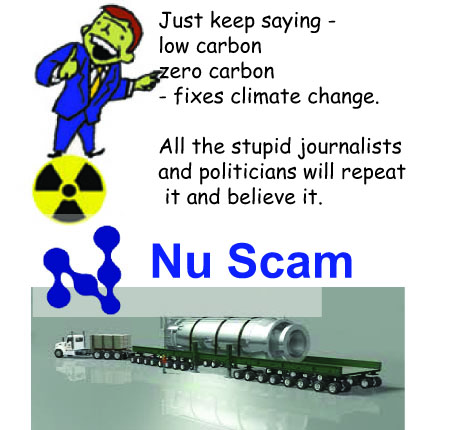
Concerns in Utah cities about costs and safety of NuScam’s small nuclear reactor scheme
|
Following the withdrawal of seven Utah cities from the Carbon Free Power Project before the October deadline, the Southern Utah cities have passed resolutions to cap financial obligation for the first phase of licensing…….. Not all are completely sold on the safety of this power plant. Scott Williams, the executive director of Healthy Environment Alliance of Utah, told St. George News that one of the major issues with this project has to do with the lack of transparency, as UAMPS is exempt from the Open and Public Meetings Act. “We don’t get minutes. We don’t get agendas.” he said……. The next off-ramp for cities to withdraw will be near the end of the 2021 or early 2022 after the next licensing phase. UAMPS has also talked about possibly downsizing the project from 12 modules to four or six modules……. Environmentally devastating’ When it comes to potential environmental impacts, Williams said the number one problem is highly radioactive waste. “We’ve been building nuclear reactors around the country since the 60s, and all of that highly radioactive fuel is just sitting at those power plants with nowhere to go.”….. “We just think we shouldn’t generate anymore high-level nuclear waste until we have a safe, environmentally responsible way to deal with it.” Second to this, he said, is the whole process of creating nuclear fuel. All of the stages – mining, milling and enrichment – present health hazards to people. “Southeastern Utah is full of abandoned uranium mines that create radioactive exposure to the populations down there, and they’re not being cleaned up,” he said, adding that these mines are almost all in San Juan County. “The entire Navajo Nation is full of them. In fact, we’re just putting a map together; There’s hundreds of them on the Navajo Reservation.” Much of the mine tailings were put near Moab, he added, and for some 40 years they have been in the process of moving these tailings away from the Colorado River up to a place near Interstate 70, which has cost billions of dollars of taxpayers’ money. This project, the Moab Uranium Mill Tailings Remedial Action Project, is being administered by the U.S. Department of Energy and is about 68% complete with efforts to move 16 million tons of uranium tailings from the banks of the Colorado River to a permanent disposal site 32 miles north, near Crescent Junction. The final possible implication of the project, Williams said, would be in the case of an accident at the facility, which would be “environmentally devastating.” “UAMPS and NuScale say this plant is meltdown-proof, but they’ve never actually built one of these modules before, so it’s all theoretical at this point.” So if not nuclear, what’s the best option? Aside from wind, solar and hydro (that’s already established), he said there is new technology coming to the scene that will be here before this power plant is finished. This technology includes utility-scale or home-based battery storage for intermittent power sources. Investing in energy efficiency is also integral, as well as making use of wasted power through grid integration. But what it really comes down to, he said, is a shift in public perception. “A lot of the people who are proponents of this nuclear plant are still thinking about energy the way we’ve been producing it in the past, and they say, ‘Battery storage will never be economically competitive.’ But they said that about solar 10 years ago, and it’s become cheaper faster than any of them could have predicted.”https://www.stgeorgeutah.com/news/archive/2020/11/21/asd-environmentally-devastating-or-really-really-safe-southern-utah-cities-set-financial-caps-for-nuclear-power-project/#.X7rBxGgzbIU |
30 more years for Wisconson’s old nuclear power station? Is this a good idea?
NextEra Energy has submitted an application to the Nuclear Regulatory Commission seeking to add 20 years to the licenses for the Point Beach Nuclear plant in Two Rivers, according to a document filed with state regulators…….
Hundreds of casks of nuclear waste are being stored at sites across Wisconsin and neighboring states, costing taxpayers millions of dollars as the federal government struggles to open a permanent storage facility.
Under the agreement, the utility is paying $52.66 per megawatt-hour this year, about 1.8 times the average wholesale price for electricity in the Midwest, according to data from the Energy Information Administration. By 2023, the cost rises to $122.45 per megawatt hour……
Point Beach is the only one of Wisconsin’s three nuclear power plants still in operation.
Decommissioning is nearly complete at the La Crosse Boiling Water Reactor, a 50-megawatt demonstrator plant built by the federal government in 1967 and shut down in 1987. The 1,772-megawatt Kewaunee Power Station was shut down in 2013. Decommissioning is scheduled to begin in 2069, according to the NRC.
As of April, there were 50 dry casks of radioactive waste being stored at Point Beach until the federal government can develop a permanent storage plan. https://journaltimes.com/news/state-and-regional/wisconsins-nuclear-power-plant-operator-seeks-30-more-years/article_da04bd52-ca1b-5401-92a7-d860ab058602.html
1 This Month

of the week– Nuclear Reactor Information Task Force

14 May – online event From Bombs to Data Centres: the Face of Nuclear Colonialism
To see nuclear-related stories in greater depth and intensity – go to https://nuclearinformation.wordpress.com
-
Archives
- May 2026 (82)
- April 2026 (356)
- March 2026 (251)
- February 2026 (268)
- January 2026 (308)
- December 2025 (358)
- November 2025 (359)
- October 2025 (376)
- September 2025 (257)
- August 2025 (319)
- July 2025 (230)
- June 2025 (348)
-
Categories
- 1
- 1 NUCLEAR ISSUES
- business and costs
- climate change
- culture and arts
- ENERGY
- environment
- health
- history
- indigenous issues
- Legal
- marketing of nuclear
- media
- opposition to nuclear
- PERSONAL STORIES
- politics
- politics international
- Religion and ethics
- safety
- secrets,lies and civil liberties
- spinbuster
- technology
- Uranium
- wastes
- weapons and war
- Women
- 2 WORLD
- ACTION
- AFRICA
- Atrocities
- AUSTRALIA
- Christina's notes
- Christina's themes
- culture and arts
- Events
- Fuk 2022
- Fuk 2023
- Fukushima 2017
- Fukushima 2018
- fukushima 2019
- Fukushima 2020
- Fukushima 2021
- general
- global warming
- Humour (God we need it)
- Nuclear
- RARE EARTHS
- Reference
- resources – print
- Resources -audiovicual
- Weekly Newsletter
- World
- World Nuclear
- YouTube
-
RSS
Entries RSS
Comments RSS
 nuclear-news