Why the US wastes $billions on nuclear weapons it doesn’t need
 Why the US wastes billions on nuclear weapons it doesn’t need https://responsiblestatecraft.org/2021/01/06/why-the-us-wastes-billions-on-nuclear-weapons-it-doesnt-need/?__cf_chl_captcha_tk__=8e1f6ced7fb78c22d8ac3d4037ffcf46f77449be-1614929046-0-AZABHKV4aYtUa0Prc0Aghu6GdOuAqNKkLcImI5jaNYOawX3Kv1wTCS89zeyDWczWumlm-Idy9-J8PvA8khsD8YLXkgdQyN6C3WAdWw
None of this is true. As Randy Newman sang years ago, it’s money that matters. Contracts, not strategy, drive America’s nuclear force posture.
Strategy was never the sole determinant of America’s nuclear arsenal, but in the early decades of the Cold War, however flawed, it was arguably the major driver. No longer. It is now a thin veneer of justification for a collection of legacy systems and new programs promoted for financial and political profit. The entire process is guided by an army of lobbyists. “The defense sector employed 775 lobbyists and shelled out more than $126 million to influence Congress in 2018,” reports John Carl Baker from the Ploughshares Fund,
The path to a saner nuclear strategy, therefore, goes through the budget, not the other way around. Time spent debating alternative postures will be wasted if not joined by equal or greater efforts to shrink the budgets that fuel current and future weapons plans.
The evidence is everywhere. In the midst of a raging pandemic and economic collapse, Congress last month passed a $740.5 billion Pentagon budget that lavishes almost $70 billion on nuclear weapons and related programs, with little debate and few changes to Donald Trump’s request.
The Strategic Forces Subcommittee of the House Armed Services Committee, for example, held just three hearings last year and only called government witnesses. It then approved Trump’s budget in full. Major challenges to Trump’s policies and budgets were like pebbles thrown at a closed window: noticed but ignored.
It was similar in the Senate. The testimony of the head of the Strategic Command before the Senate Armed Services Committee provides an example of the vapid justification offered for the dozens of different weapon types and scores of options for thermonuclear war that Congress approved.
“Our deterrent underwrites every U.S. military operation around the world and is the foundation and backstop of our national defense,” Gen. Charles Richmond said, arguing that the United States needs to maintain “a credible [nuclear] deterrent” that “requires us to modernize and recapitalize our strategic forces to ensure our Nation has the capability to deter any actor, at any level.”
That was pretty much it for strategy. Thin gruel, but enough to get his budget approved — and keep a river of money flowing through Washington. The modest $88 billion “modernization” program that President Barack Obama authorized in 2010, as a bridge to the major nuclear reductions he wanted, has metastasized into a $2 trillion plan to replace every Cold War submarine, bomber, missile, and warhead with an entirely new generation of the deadliest weapons ever invented. Obama’s cuts died, but the contracts continued.
This plan will keep thousands of weapons deployed until near the end of this century — and, thus, lucrative deals for Lockheed Martin, Raytheon Technologies, Northrop Grumman, Boeing, and General Dynamics, the big five contractors that dominate military and nuclear policy.
They sell nuclear weapons like Kellogg’s sells cereal. It’s not a question of whether we need the product; they just need to convince us to buy it.
They do this in three ways. The first is a pitch that relies on product differentiation, a way to sell essentially the same goods in a variety of shapes, sizes, and packaging. You like shredded wheat? Then maybe you’d like it frosted, or bite-sized, or both. Thus, the familiar triad of bombers, land-based missiles, and submarines is now supplemented by cruise missiles launched from air and sea, a growing variety of ranges and yields, and a new campaign for nuclear hypersonic missiles and weapons in space.
The second is control of the market. These firms dominate in ways that Kellogg’s could only dream of doing. Corporations have thoroughly penetrated the military services generating the weapons requirements through decades of revolving doors and increasing dependence on contractors for core analysis, communication, and even administrative functions. The same is true of the civilian departments that purchase and oversee the weapons development and productions programs.
The Project On Government Oversight, for example, documented at least 380 high-ranking Department of Defense officials and military officers who went to work for weapons contractors. “The truth is,” says Senator Elizabeth Warren, “our existing laws are far too weak to effectively limit the undue influence of giant military contractors at the Department of Defense.”
The third is to do what Facebook and Amazon do so well: eliminate the competition. Contractors have basically absorbed or bought off institutional threats to their programs. In the late 1970s and early 1980s, when the American public and politicians engaged more fully in nuclear strategy, the contractors learned how to game the system. They backed groups and politicians who promoted bogus threats, like a “window of vulnerability” that would allow the Soviet Union to win a nuclear war with a devastating first strike. But the real genius was to place sub-contracts for their biggest, most controversial systems like the MX missile or the B-1 bomber in most or even all of the 435 congressional districts.
The jobs and revenues of these contracts and bases quickly dominated the decision-making processes in these states, They were supplemented by generous campaign contributions that — were they given to a judge and not a congressperson — would be grounds for recusal. Coupled with the fear establishment Democrats have for appearing “weak” on national security, this system of contracts, contributions, and campaigns has effectively gutted meaningful congressional oversight.
Contractors over the past few decades have also constrained the formerly independent analytical establishment. Just as the fossil fuel industry muted criticism of climate change and established alternative experts, when the Cold War ended and bipartisan movements to eliminate nuclear weapons arose, weapons firms flooded think tanks and universities with grants, compromising their independence.
Over just the past five years, at least $1 billion in U.S. government and defense contractor funding went to the top fifty think tanks in America. The key funders from the government, according to a report from the Center for International Policy, “were the Office of the Secretary of Defense, the Air Force, the Army, the Department of Homeland Security, and the State Department.” The defense contractors contributing the most were Northrop Grumman, Raytheon, Boeing, Lockheed Martin and Airbus.
It worked. Once sources for alternative military budgets and exposés, it is rare to find a major think tank report today that is critical of military spending or, even more rare, a specific weapons program. Institutes that benefit from this largess now churn out reports and events favorable to increased military budgets and “great power competition.” This last argument works perfectly for most centrist politicians and analysts. It has just the right amount of fear and nationalism to provide sound bites on television or the campaign trail.
This lavish funding has created a new generation of advocates for super-sizing the arsenal. While there are some brilliant analysts at the large institutes who are truly independent and do not take contractor funding, it is hard to name a significant nuclear weapons proponent who has not benefited directly or indirectly from corporate or government funding. Experts are not asked to disclose these personal or institutional conflicts of interest in their articles or quotes.
This should not be a cause for despair, but for recalibration.
It could start with a simple step every journalist could take: Disclose conflicts of interest in your sources. If an expert won’t disclose their funding, don’t quote them. In Washington, this is practically a death sentence.
It could come from the research institutes themselves: Reaffirm your independence. Decline donations from weapons firms and military departments. If that is too hard, disclose all such grants up front in your reports. We need the intellectual rigor of alternative analysis, but it must be truly independent — and complete the analysis by including the material factors shaping the current posture, not just the stated strategic justifications.
President Joe Biden could assert his power by cutting the nuclear budget and not rubber-stamping Trump’s weapons. “By acting swiftly to cancel or suspend these programs, and to cut the overall Pentagon budget accordingly, Biden will create considerable leverage for negotiations with Congress,” I wrote recently for The American Prospect. “He will arrive at a much better deal by starting at zero and negotiating up rather than by trimming the programs and negotiating down.”
Finally, the independent non-government groups that represent the last, truly independent organizations promoting a saner nuclear policy must recognize a simple fact of life: No alternative nuclear posture or clever op-ed will impact policy, no matter how brilliant. The only strategy that can succeed is to focus on the money. That means teaming up with those fighting to redefine what makes and keeps us safe, who advocate for increased funding to combat climate change, to battle the pandemic, to improve health care, and to address social inequities. They need the funds that are currently locked up in obsolete and dangerous weapons programs.
By linking up, by making cuts to the Pentagon budget part of the strategy of these groups (and by reimaging national security to include these issues), it may be possible to forge a broad united front that is more powerful than the contractors. It can identify alternative revenue streams for states and districts, shame Congress into restoring investigations and oversight, press journalists to disclose conflicts of interest of the experts they quote, convince experts that their work is not complete if it does not factor money into their analysis, and pressure the government to spend taxpayer money on programs that improve our lives, not threaten them.
And if this is too long a list to remember, just hum a little Randy Newman.
Montana legislatures to review the law restricting nuclear developments
At the same time the House was reviewing a bill sponsored by Rep. Derek Skees, R-Kalispell, to remove restrictions on nuclear development, the Senate was at work on Senate Joint Resolution 3, which directs the state to study advanced nuclear reactors. The resolution appears well-positioned to pass — halfway through the session, SJ 3 has garnered unanimous support in the Senate.
Sponsor Terry Gauthier, R-Helena, becomes audibly excited discussing the measure. He said he sees modern nuclear technology as a way for Montana to send electrons to the energy-thirsty markets of the Pacific Northwest by tying into the high-voltage transmission lines leading out of Colstrip……..
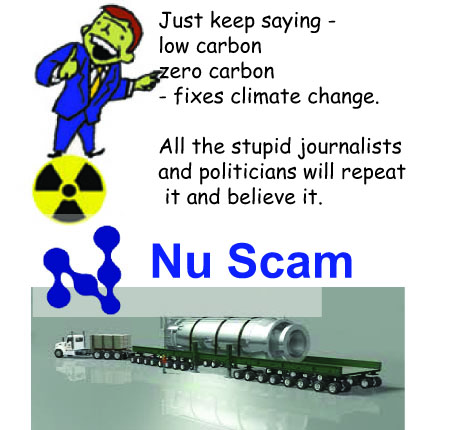 Gauthier is particularly interested in a company called NuScale, based in Portland, Ore., that’s garnered more than $1.3 billion from the federal government to advance its small modular reactor, or SMR, design. It’s the only company that’s received approval from the federal Nuclear Regulatory Commission for that type of design — a significant milestone on the journey to market……….
Much of the debate about the environmental impact associated with nuclear energy is focused on what to do with the spent fuel. Some kinds of nuclear fuel can remain radioactive for hundreds or thousands of years. The U.S. has yet to arrive at a long-term solution for re-using or storing spent fuel, creating a contentious political issue that’s spanned decades.
As is the case with larger-scale traditional nuclear plants, spent fuel from SMRs remains a “significant issue,” according to Darby.
NuScale’s plan is to store used fuel underwater in a stainless-steel lined concrete pool located onsite for at least five years. They say the pool is designed to withstand “a variety of severe natural and human made phenomena” like earthquakes and aircraft impacts. After the five-year period when the used fuel is both hottest and most radioactive has elapsed, it’s moved to a stainless-steel canister surrounded with concrete that’s designed to contain the radioactivity.
The United States doesn’t have a permanent underground repository for high-level nuclear waste, so those concrete containment vessels generally remain on-site or near the plant they came from. A 33-year-old effort to create such a long-term storage repository northwest of Las Vegas is still subject to heated debate. ……….
Another question hanging over nuclear energy development is the price of building a new plant. It’s not uncommon for new construction costs to exceed $1 billion. Concerns about cost increases led several cities that had committed to participate in NuScale’s demonstration plant in Idaho Falls to pull out of the multi-billion-dollar project last year.
NuScale told Montana Free Press that once production is rolling on their product, it anticipates the facility construction cost to be about $2,850 per kilowatt of producing capacity for its largest, 12-module iteration. For comparison, new construction of a natural gas plant averaged about $837 per kilowatt of capacity in 2018, and wind plants clocked in at $1,382, according to the U.S. Energy Information Administration.
Brad Molnar, a Republican senator from Laurel, told MTFP that cost will be an important consideration as the state plots its energy future. He said the study Gauthier is spearheading should involve the Public Service Commission, because it doesn’t make sense to conduct the study without landing on a cost-per-megawatt estimate.
Gauthier knows that nuclear is by no means the least expensive energy source, particularly if calculations are based on a strict dollars-and-cents equation…….
It’s not yet clear if Montana’s 1978 law requiring voter approval before a nuclear energy plant can be built in the state will still be on the books next year. The Legislature is still deciding the fate of HB 273, which would strike that law and remove nuclear projects from the purview of the Major Facility Siting Act.
Sen. Molnar has been asked if he’d carry HB 273 when it’s heard in the Senate, but he said he has reservations about the measure.
“By and large, I’m really hesitant to overturn a [voter] initiative,” he said, adding that the order of operations seems a little off to him.
“First you do the study, then you take action,” he said. “You don’t take action and then do the study.”
As of March 4, both HB 273 and SJ 3 have been transmitted to the Senate and House, respectively, for review. Hearing dates before those chambers’ energy committees have not been set. https://montanafreepress.org/2021/03/04/nuclear-on-the-radar-part-ii/
Biden’s first budget should reduce excessive expenditure on nuclear weaponry
|
Biden’s first budget should reduce nuclear excess, Defense News, By: Kingston Reif, 5 Mar 21, As the Biden administration begins crafting its defense budget submission for fiscal 2022, the debate about how it should handle the U.S. nuclear arsenal is heating up.
Proponents of the Trump administration’s approach, which fanned the flames of a burgeoning arms race, are warning any deviations will lead to disaster. President Joe Biden, however, appears to have a different view. During the campaign, he said the United States “does not need new nuclear weapons” and that his “administration will work to maintain a strong, credible deterrent while reducing our reliance and excessive expenditure on nuclear weapons.” Biden is right. Current U.S. nuclear weapons policies exceed what is necessary for a credible nuclear deterrent, and their financial costs are taking a growing toll. Biden should use his forthcoming budget to steer the country in a safer and more affordable direction. In addition to continuing legacy plans to replace the nuclear triad and its associated warheads, the Trump administration pursued new types of weapons and more bomb-making infrastructure. It also expanded the circumstances in which President Donald Trump would consider using nuclear weapons. Worse still, the administration put New START — the sole remaining agreement verifiably limiting the size of the U.S. and Russian nuclear arsenals — on the brink of expiration. Mindful of the danger he inherited, Biden quickly and wisely agreed with Russian President Vladimir Putin to extend New START by five years. Trump’s FY21 budget request of $44.5 billion to sustain and upgrade the nuclear arsenal was a 19 percent increase over the previous year. Over the next several decades, spending is likely to top $1.5 trillion. Russian and Chinese nuclear advances and aggressive behavior might seem to justify such investments. But the spending plans pose a major threat to security priorities more relevant to countering Moscow and Beijing and assuring allies. A long-foreseen budget reckoning has arrived.
An early reassessment of the Trump administration’s dubious proposal to double the number of more usable low-yield nuclear options is more than justified. In particular, the Biden administration should provide no funding to begin development of a new nuclear-armed, sea-launched cruise missile. The weapon, which is projected to cost at least $9 billion over the next decade, is a redundant and costly hedge on a hedge. But the mini-review should go further and hit pause on other controversial programs, pending the outcome of a more comprehensive policy review later this year. For example, the administration should freeze funding for the Air Force’s program to build a new land-based intercontinental ballistic missile system at the current-year level. It should also set the budget for the National Nuclear Security Administration at the level projected for FY22 as of the FY20 budget request……………. https://www.defensenews.com/opinion/commentary/2021/03/04/bidens-first-budget-should-reduce-nuclear-excess/ |
|
Nuclear power bailout Bill to be eliminated by Ohio law-makers
 Ohio Senate passes proposal to eliminate nuclear bailout at heart of House Bill 6 Ohio Senate passes proposal to eliminate nuclear bailout at heart of House Bill 6
https://www.cincinnati.com/story/news/politics/2021/03/03/ohio-senate-eliminate-nuclear-bailout-heart-house-bill-6/6892339002/ Jessie Balmert, Cincinnati Enquirer
COLUMBUS – Ohio lawmakers unanimously passed a proposal to eliminate a controversial $1 billion bailout for nuclear plants – with the apparent blessing of the company that owns them.On Wednesday, the Ohio Senate passed Senate Bill 44, 32-0, which would eliminate subsidies for two nuclear plants in northern Ohio tacked onto Ohioans’ electric bills. The bailout is a key component of House Bill 6, which was at the heart of a federal bribery investigation. Former Ohio House Speaker Larry Householder, R-Glenford, and four others were accused of participating in a nearly $61 million scheme to elect Householder as leader of the House, pass House Bill 6 and defend it against a ballot initiative to block the law. In the seven months since their arrests, Ohio lawmakers have done little to change the underlying law, which also subsidized coal plants, eliminated incentives for renewable energy and energy efficiency and guaranteed profits for Akron-based FirstEnergy Corp. “We need to use this as a learning opportunity,” said Sen. Rob McColley, R-Napoleon, of House Bill 6. “This is something that will undo what I feel is an awful lot of damage that has been done not just to our institution but to the state of Ohio.” Senate Bill 44 would eliminate the subsidies for the Perry and Davis-Besse plants owned by Energy Harbor, which was previously called FirstEnergy Solutions. Energy Harbor now says it doesn’t need those fees, which were slated to be added to Ohioans’ electric bills through 2027. A change from federal utility regulators in late 2019 effectively penalizes companies that accept state subsidies when those companies sell their power. Energy Harbor also expects it can compete with natural gas under Democratic President Joe Biden’s policies, lawmakers said. Sen. Michael Rulli, R-Salem, said Energy Harbor appears to have benefitted from its bankruptcy proceedings, too. Fees on Ohioans’ electric bills never took effect because lawsuits brought by Ohio Attorney General Dave Yost, Cincinnati and Columbus blocked them. The bill keeps $20 million in subsidies for solar companies, which would drop the monthly fee from 85 cents to 10 cents for residential customers and from $2,400 to $242 for industrial customers. Sen. Sandra Williams, D-Cleveland, offered an amendment to put utility shutoffs on hold during the COVID-19 emergency, but it was rejected. Sen. Matt Dolan, R-Chagrin Falls, said Ohio recently authorized $50 million for help with utility bills and he would work with Gov. Mike DeWine’s administration to ensure it gets to the people who need it. One lesson Senate President Matt Huffman, R-Lima, said he’s learned from House Bill 6 is Ohio lawmakers aren’t all experts on energy policy and should leave some decisions to the Public Utilities Commission of Ohio. “These complex issues regarding utilities should be decided by the public utilities commission and not, from time to time, with legislation,” Huffman said. “It’s sort of a cautionary tale to a lot of complex issues.” The Ohio Senate recently passed Senate Bill 10, which eliminates the decoupling provision from state law and refunds about $17 million collected from customers before the court ruling. FirstEnergy could still seek that benefit from state utility regulators. Both bills would need approval from the Ohio House of Representatives and Gov. Mike DeWine to become law. Going forward, Huffman said Ohio lawmakers could do more to limit the influence of dark money in politics. “We have to find a way to minimize it, but so much of that is controlled by the federal government,” he said. |
|
Public Service Enterprise Group trying to force ratepayers to act as guarantors for nuclear power debts
 Obligating ratepayers to act as guarantors…
…. they seek to leverage the subsidies as a means to obligate ratepayers to act as guarantors of the plants’ profitability,
It is noteworthy that PSEG never offered to return any stranded-cost payments to ratepayers and now has the temerity to argue that this $3 billion wealth transfer should not be considered in determining whether the nuclear plants require further subsidization.
Despite the efforts of PSEG and Exelon to ignore precedent and establish their preferred regulatory structure, the fact remains that the BPU and Legislature removed precisely these types of costs and risks from ratepayer responsibility long ago.
|
Ratepayers held up their side of nuclear deal. PSEG must do the same https://www.njspotlight.com/2021/03/nj-board-public-utilities-must-decide-massive-nuclear-subsidies-pseg-drumbeat-no-justification-responsibility-costs-risks/ STEVEN S. GOLDENBERG | MARCH 3, 2021
There is no justification for PSEG’s effort ‘to require ratepayers to assume responsibility for the costs and risks associated with the continued operation’ of its nuclear plants
With the issue regarding the propriety of nuclear subsidies — known as Zero Emission Certificates or ZECs — again before the Board of Public Utilities, the predictable PSEG-inspired public drumbeat supporting its nuclear plants has begun. News outlets, including NJ Spotlight News, have recently featured articles and editorials that tout the benefits the nuclear plants confer on the state, and are intended to gin up support for extending the current $300 million annual ratepayer subsidies. Continue reading
|
Ohio Senate votes unanimously to repeal nuclear plant bailout
 Ohio Senate votes to repeal nuclear plant bailout, Toledo Blade https://www.toledoblade.com/local/politics/2021/03/03/ohio-senate-votes-to-repeal-nuclear-plant-bailout/stories/20210303112, JIM PROVANCE
COLUMBUS — Making its biggest statement yet in the wake of a $61 million Statehouse bribery scandal, the Ohio Senate voted unanimously Wednesday to kill a controversial $1 billion bailout of two northern Ohio nuclear power plants.
The chamber, however, kept the portion of the now tainted House Bill 6 passed in 2019 that provides $20 million a year to support qualifying utility-scale solar projects.
If the House of Representatives agrees, the bill would remove provisions of the law requiring electricity customers to pay $150 million a year in surcharges to support operation of the Davis-Besse nuclear power plant near Oak Harbor and the Perry plant east of Cleveland. Together, the two plants along Lake Erie directly employ about 1,400 people.
“This is something that will undo what I feel is an awful lot of damage that has been done, not just to our institution but to the state of Ohio,” he said.The decision to end the nuclear credits was made easier by the decision of the plants’ owner, Energy Harbor, to forgo the money after federal rules were changed to penalize providers in the competitive electricity marketplace if they accept state subsidies.
Two individuals and a nonprofit corporation involved in the bribery scheme have already pleaded guilty to federal racketeering charges. Charges are still pending against three others, including former Ohio House Speaker Larry Householder (R., Glenford), in connection with the scheme to hide the flow of cash from Akron-based FirstEnergy Corp. and related entities.
The money was used to help elect representatives loyal to Mr. Householder, help elect him speaker, and then enact the nuclear bailout sought by what was then a FirstEnergy subsidiary but is now the independent Energy Harbor.
The Senate’s move Wednesday does not undo provisions of House Bill 6 that roll back and then eliminate prior statutory mandates that utilities produce more of their power from renewable sources and reduce energy consumption overall.
There also are competing bills, including one that passed the Senate and is now in the House that would repeal House Bill 6 provisions that would have locked in FirstEnergy Corp. profits regardless of what happened in the electricity marketplace. FirstEnergy has already agreed not to take advantage of that provision this year.
The House also has its own bill pending to repeal the nuclear and revenue guarantee provisions.
Senate President Matt Huffman (R., Lima) said no agreement has been reached with the House as to which vehicle legislation will be sent to Gov. Mike DeWine’s desk.
“I was part of the discussion in the last month or so of the last General Assembly, and in general conversations with Speaker [Bob] Cupp at that time, about things that collectively the House and Senate could get enough votes to pass,” he said. “Those are the first two things that we have done….
“I think those things are supported by a significant majority,” Mr. Huffman said. “You can see they were passed unanimously out of the Senate, so we can deal with those two significant problems of House Bill 6…. It certainly doesn’t mean it’s the end of the discussion regarding those things.”
With the initial passage of House Bill 6, the plants’ owner, then FirstEnergy Solutions, proceeded with refueling Davis-Besse, clearing a potential major hurdle in the plant’s continued operation.
The Trump personality cult is still a threat
CPAC Showed That Trump’s Personality Cult Is Still Alive — and Still a Threat, https://truthout.org/articles/cpac-showed-that-trumps-personality-cult-is-still-alive-and-still-a-threat/?eType=EmailBlastContent&eId=30eb7938-c44f-478d-a80d-5562c3d8b80a, Sasha Abramsky, 1 Mar 21,
In the classic 1950 movie Sunset Boulevard, Gloria Swanson plays the has-been Hollywood diva, Norma Desmond, desperate for adoration, utterly infatuated with the spotlight. One of its most famous lines — “Alright, Mr. DeMille, I’m ready for my close up” — captures the unseemly spectacle of someone far past their sell-by date who refuses to accept their fall from stardom.
“You see,” the has-been actress utters with undistilled terror, “This is my life. It always will be. There’s nothing else. Just us and the camera — and those wonderful people out there in the dark.”
When Donald Trump stepped up to the podium at the CPAC event in Orlando, Florida, this weekend, it was, unsurprisingly, both a ghastly and incredibly tired remake of Sunset Boulevard, a reprise of yesterday’s news, of the former president’s greatest hits, from a man who cannot imagine a world without himself at the center.
During a bizarre CPAC presentation, Trump named all the Republicans who had crossed him and threatened to destroy their careers. He asked his audience — plaintively — whether they missed him yet. He claimed he had won the last election and would, if he so chose, win again in 2024. To this last point, his cult-like audience — which had already paraded through the conference center, in imitation of strong-men idolatrous cults in locales such as North Korea, a golden bust of the disgraced ex-president — responded, on cue, and overwhelming evidence to the contrary notwithstanding, “You won! You won! You won!”
Trump, in gilded retirement at Mar-a-Lago not only refuses to accept that Joe Biden won last year’s election, but he also hasn’t even remotely begun to consider the possibility that the GOP might ever be anything other than a vehicle for the enrichment of the Trump family. He has, these past months, teased the possibility of starting a third party; at the CPAC event, however, he scotched those rumors, instead urging GOP members to donate to political action committees controlled by Trump himself, along with members of his inner circle.
That decision wasn’t exactly a surprise; after all, most of the GOP is still in lockstep with Trumpism, convinced the election was stolen, and, as January 6th fades into the past, more than willing to forgive and forget the ex-president’s incitement to deadly violence. In the past couple weeks, House Minority Leader Kevin McCarthy traveled to Mar-a-Lago to pay an obsequious homage to the man whom, back in January, he had screamed at during a profanity-laden phone call at the height of the Capitol siege. So, too, did GOP whip Steve Scalise, make a kiss-the-ring visit to the exiled president.
Mitch McConnell, who bared just a touch of courage after the Senate impeachment vote by saying on the Senate floor that there was no doubt that Trump was responsible for the events of January 6th, followed up with an astounding public display of gorging himself on humble pie.
That decision wasn’t exactly a surprise; after all, most of the GOP is still in lockstep with Trumpism, convinced the election was stolen, and, as January 6th fades into the past, more than willing to forgive and forget the ex-president’s incitement to deadly violence. In the past couple weeks, House Minority Leader Kevin McCarthy traveled to Mar-a-Lago to pay an obsequious homage to the man whom, back in January, he had screamed at during a profanity-laden phone call at the height of the Capitol siege. So, too, did GOP whip Steve Scalise, make a kiss-the-ring visit to the exiled president.
Mitch McConnell, who bared just a touch of courage after the Senate impeachment vote by saying on the Senate floor that there was no doubt that Trump was responsible for the events of January 6th, followed up with an astounding public display of gorging himself on humble pie.
Meanwhile, state GOP chapters around the country are busily censuring GOP congressmembers and senators who voted to impeach or convict Trump. And GOP-controlled legislatures are pushing through legislation aimed to prevent the sort of non-existent “fraud” that Trump still claims cost him the last election. Of course, since the fraud wasn’t real, what this means in practice is a vast effort to contract the electorate and to make it harder for people of color, the poor and students to cast ballots in coming elections.
The ungodly CPAC display this past four days made two things absolutely clear. The first is that CPAC, and by extension most of the GOP, is nothing more or less than a personality cult; the values that have traditionally animated conservative movements in the U.S. have, now, been entirely subjugated to the allure of Trumpism. The second is that Trump’s financial interests — which are all he really cares about at this point — clearly lie not in putting his own dollars on the line by building up a third party, but in milking the GOP faithful for all he can, as quickly as he can, before his myriad legal woes catch up to him.
Toward the end of Sunset Boulevard, Desmond shoots an ex-lover as he attempts to walk out on her. In a bizarre twist, the dead man then narrates his posthumous understanding of how this will all end. He imagines the headlines that will accompany the announcement of his murder. “Forgotten star, a slayer, aging actress, yesterday’s glamor queen.” Instead, as Desmond is perp-walked down her palace steps, the cameras keep clicking, and the diva remains, even in delusional disgrace, the star of her own show.
Having failed to deal Trump a political death-blow in the Senate during the impeachment trial, the GOP is now stuck with its very own Norma Desmond. Trump is always ready for his close-up, because without the sound of the adoring claque, he is nothing.
Washington State and others want to overturn Trump rule that weakens Hanford nuclear waste rule
|
The state of Washington and other groups are asking the Biden administration to overturn a Trump administration rule that would allow the federal government to potentially clean up the Hanford nuclear reservation to less stringent standards. A letter sent Friday to Jennifer Granholm, just a day after she was confirmed as energy secretary, was signed by leaders of Washington state, the Yakama Nation, the Natural Resources Defense Council, Hanford Challenge and Columbia Riverkeeper. They call the Department of Energy’s decision in 2019 to allow the reclassification of some Hanford site and other radioactive waste “a matter of extraordinary concern.” The new DOE rule, which was adopted to relax the interpretation of what is defined as high level radioactive waste, “lays the groundwork for the Department to abandon significant amounts of radioactive waste in Washington state precipitously close to the Columbia River,” the letter said. It would create a long-term risk of harm to the residents of the Pacific Northwest and the natural resources critical to the region, it said. However, some Tri-Cities area interests have supported the revised interpretation of high level radioactive waste, saying it could save billions of dollars in environmental cleanup money across the nation, making more money available for some of the most pressing environmental cleanup at the Hanford nuclear reservation. ……. DOE’s new policy allows the agency to reclassify radioactive waste if it determines it does not exceed certain radionuclide concentrations for low level waste or does not need to be disposed of in a deep geological repository, such as the one proposed at Yucca Mountain, Nev. Previously, high level waste could be reclassified, but under a more involved process that relies on the Nuclear Regulatory Commission. Hanford watchdogs have said that giving DOE authority to reclassify high level waste could lead to grouting waste inside Hanford’s underground tanks, rather than retrieving the waste and properly treating it for disposal. DOE began building the $17 billion vitrification plant in 2002 to turn some, but not all, of the tank waste into a stable glass form for disposal. Turning some of the excess waste into a concrete-like grout for disposal rather than glassifying it has been proposed. The Washington state Department of Ecology has maintained that any treatment of tank waste must produce a waste form that is “as good as glass” to protect the environment and prevent contaminants from leaching into the soil and reaching groundwater. Those who signed the Friday letter agree that “trying to change Hanford’s high level tank waste to low-level waste through the stroke of a pen is no solution, and this Trump-era rule has to go,” said Tom Carpenter, executive director of Seattle-based Hanford Challenge, which advocates for Hanford workers. The new interpretation of high level waste gives DOE unilateral authority to redefine high level radioactive waste with no opportunity for input, oversight or consent by state regulators or the public, the letter said. “And it fails to hold the Department and the federal government accountable for adequately cleaning up the legacy waste that is left over from the establishment of the United States’ nuclear arsenal,” the letter said. The new interpretation of the definition of nuclear waste conflicts with a Biden administration order that agencies should follow science, improve public health and protect the environment, the letter said. Those signing the letter on behalf of Washington state include Attorney General Bob Ferguson and the director of the Department of Ecology, Laura Watson. ‘Trump-era rule has to go’ https://www.bigcountrynewsconnection.com/news/state/washington/state-wants-biden-to-overturn-trump-rule-on-hanford-nuclear-waste/article_16f7fd90-5857-57ce-a113-b43fa388a7d3.html |
|

Michigan Attorney General wants review of nuclear plant license transfer to Holtec
 an energy company to seek more review before it undertakes a license transfer that could cost Michiganders money and safety.AG Nessel is petitioning the Nuclear Regulatory Commission to look more closely into a case involving a license transfer request for the Palisades Nuclear Plant and Big Rock Point Independent Spent Fuel Storage Installation, which are both currently owned by Entergy Co.
Nessel is requesting a hearing for the transfer of control of the licenses to those facilities from Entergy to Holtec International.
Earlier this month, Entergy and Holtec filed an application asking for the approval of the transfer of control of the licenses. Entergy plans to retire the Palisades Nuclear Plant in 2022.
A trust fund of about $550 million was established with ratepayer funds to decommission the Palisades. Not only does Holtec want to use that fund to decommission the Palisades but also to handle the site restoration and fuel management cost.
Attorney General Nessel filed her petition and request to further review this license transfer application.
In her petition, Nessel said that she supports safe decommissioning, site restoration and fuel management at Palisades, but she’s concerned that Holtec does not have the financial qualifications to complete a risk-intensive project.
The petition demonstrates that Holtec has underestimated the costs for actual decommissioning, thus threatening the health and safety of Michigan residents, according to Michigan AG Dana Nessel. The petition also questions Holtec’s exemption request to use the decommissioning funds for site restoration and nuclear fuel management without providing evidence of other funding sources.
“Protecting the environment, the health and the pocketbooks of Michigan residents are part of my responsibilities as attorney general,” said Nessel in a press release. “My concern is that by seriously underestimating the cost of decommissioning, site restoration and nuclear fuel management, coupled with a lack of appropriate financial assurances, Holtec endangers our environment and health, and potentially leaves our residents to bear the costs of proper clean-up.”
Palisades Nuclear Power Plant is located in Covert Township and the Big Rock Point facility is located in Hayes Township both on the shores of Lake Michigan.
Biden’s illegal bombing of Iranian-backed militias in Syria jeopardises nuclear negotiations
|
Biden “Illegally” Bombs Iranian-Backed Militias in Syria, Jeopardizing Nuclear Talks with Tehran, DEMOCRACY NOW, MARCH 01, 2021 The Biden administration is facing intense criticism from U.S. progressives after carrying out airstrikes on eastern Syria said to be targeting Iranian-backed militia groups. The London-based Syrian Observatory for Human Rights reports at least 22 people died. The Pentagon called the assault a response to recent rocket attacks on U.S. forces in northern Iraq. Those attacks came more than a year after Iraq’s parliament voted to expel U.S. troops — an order ignored by both the Trump and Biden administrations.
“Very quickly the Biden administration is falling into the same old patterns of before, of responding to this and that without having a clear strategy that actually would extract us from these various conflicts and actually pave the way for much more productive diplomacy,” says Trita Parsi, executive vice president of the Quincy Institute. We also speak with California Congressmember Ro Khanna, who says President Biden’s recent airstrikes in Syria lacked legal authority. “This is not an ambiguous case. The administration’s actions are clearly illegal under the United States’ law and under international law,” says Khanna.
|
|
USA’s continuing nuclear waste debacle blamed on government contractors
 Steven Chu Blames Government Contractors For Ongoing Nuclear Waste Debacle, https://www.forbes.com/sites/jeffmcmahon/2021/02/28/steven-chu-blames-government-contractors-for-ongoing-nuclear-waste-debacle/?sh=4ec11b8131eb Steven Chu Blames Government Contractors For Ongoing Nuclear Waste Debacle, https://www.forbes.com/sites/jeffmcmahon/2021/02/28/steven-chu-blames-government-contractors-for-ongoing-nuclear-waste-debacle/?sh=4ec11b8131ebJeff McMahonSenior ContributorThe United States continues to struggle with legacy military nuclear waste, former Energy Secretary Steven Chu said, because the contractors making billions from it have opposed a better solution. “If you had a small R&D program that could find a much better, cost-effective way of doing it wouldn’t it be worth it?” Chu asked during a Stanford University webinar last month. “Okay, $6 billion—What’s a good R&D program? Ten percent? Five percent? “It was being nibbled down to $100,000,” he said of his effort to fund R&D during his tenure as Obama’s first energy secretary. “It’s like in the third or fourth decimal place because the contractors who had these huge grants didn’t want better ways, and they just wanted the billion per year coming to the State of Washington, going into Tennessee, going to South Carolina, literally, because it greased the economy.” Chu doesn’t identify the contractors by name, but major contractors in those states include Bechtel, managing the Hanford Nuclear Site in Washington; UCOR, managing cleanup at the Oak Ridge Reservation in Tennessee; and Areva, which absorbed the company that during Chu’s tenure pursued the Mixed Oxide Fuel Fabrication Facility (MFFF) designed to process waste in South Carolina. Bechtel, Areva and UCOR’s parent company, Amentum—have extensive lobbying activities recorded in disclosure forms. I was able to reach representatives from Bechtel and Areva, but they were unable to offer comment on the weekend.
Chu is a professor of physics and molecular and cellular physiology at Stanford University and was president in 2020 of the American Association for the Advancement of Science. He won the 1997 Nobel Prize in physics and is credited by President Obama with designing on a napkin the technology that capped the Deepwater Horizon oil spill. |
|
|
Lawsuit to prevent dangerous dismantling of San Onofre nuclear power station

Lawsuit looks to block dismantlement of Southern California’s San Onofre nuclear plant, Herald Mail Media Rob Nikolewski The San Diego Union-Tribune (TNS) 26 Feb 21, SAN DIEGO — An advocacy group based in Del Mar is taking the California Coastal Commission to court, looking to stop the dismantlement work underway at the now-shuttered San Onofre Nuclear Generating Station.
Officials with the Samuel Lawrence Foundation say the commission should not have granted a permit to Southern California Edison, the majority owner of the plant, to take down buildings and infrastructure at the plant.
“We felt compelled to file this lawsuit because the Coastal Commission really didn’t do what they are supposed to do as an agency to protect the public interest, to protect the environment and the coast,” said Chelsi Sparti, Samuel Lawrence Foundation associate director.
The nine-page suit has been filed in Los Angeles County Superior Court and assigned to Judge Mitchell L. Beckloff. An opposition brief from the Coastal Commission is expected to be filed in May and a trial is anticipated to begin in late June………
Among the issues Edison critics had with the permit centered on the planned demolition of two spent storage pools. Highly radioactive fuel rods were placed into the 40-feet-deep pools to be cooled before they being put into stainless steel canisters and then slowly moved to a “dry storage” facility at the north end of the plant.
Edison says the pools are not necessary now that all the canisters have been transferred to the dry storage facility but the Samuel Lawrence Foundation says the pools should remain in case something goes wrong.
“We need the ability to replace storage canisters as they degrade from age or damage,” foundation President Bart Ziegler said in a statement. “The only available facility is the spent fuel pool and the Coastal Commission is permitting the utility to destroy it.”

The storage pools have not yet been demolished.
The utility complied and last July, the commission approved the program on a 10-0 vote.
Starting in 2024, Edison agrees to inspect two spent fuel storage canisters every five years and inspect a test canister every 2 1/2 years. The program also calls for Edison to apply a metallic overlay on canisters, using robotic devices, in case canisters get scratched.
The permit, which lasts 20 years, includes a special condition that allows the commission by 2035 to revisit whether the storage site should be moved to another location in case of rising sea levels, earthquake risks, potential canister damage or other scenarios.
Despite the added measures, Coastal Commission members reluctantly approved the permit, saying their options were limited because the federal government has never opened a site where waste from commercial nuclear plants can be sent. About 80,000 metric tons of spent fuel has piled up at 121 sites in 35 states…….
The lawsuit says the commission’s decision violates the Coastal Act and “maximizes risk to life and property and threatens geologic stability along the bluffs” along the beach at San Onofre. The plant sits on an 85-acre chunk of Marine Corps Base Camp Pendleton owned by the Department of the Navy, overlooking the Pacific to its west and Interstate 5 to its east. https://www.heraldmailmedia.com/news/nation/lawsuit-looks-to-block-dismantlement-of-southern-californias-san-onofre-nuclear-plant/article_e7b541ce-cfc4-5cb9-a923-cbb8263e728e.html
Jennifer Granholm. new leader of USA’s Department of Energy gives clearly pro nuclear answers


26 Feb 21, Don Hancock of Southwest Research Information Center (SRIC) in Albuquerque, NM, has extracted Granholm’s answers to questions from U.S. Senators on nuclear weapons, nuclear power, and radioactive waste, during her confirmation to become President Biden’s Energy Secretary.
Jennifer Granholm becomes U.S. Energy Secretary: the nuclear lobby is pleased, but not certain
Granholm becomes US energy secretary, WNN 26 February 2021 Jennifer Granholm has been sworn as the 16th US secretary of energy. ….. Maria Korsnick, president and CEO of the US Nuclear Energy Institute, said Granholm will play a pivotal role…….
Judi Greenwald, executive director of the Nuclear Innovation Alliance, said the think tank is looking forward to working with Granholm and her team on the development, demonstration and deployment of the advanced nuclear reactors …
Granholm made no mention of nuclear power……in the article, nor in a video address released to coincide with the swearing-in…… https://www.world-nuclear-news.org/Articles/Granholm-becomes-US-Energy-Secretary
Yakama Nation, state of Washington and environmental groups call on Jennifer Granholm to reconsider nuclear waste rule

|
Coalition Calls on DOE to Reconsider Nuclear Waste Rule February 26, 2021 WASHINGTON – The Yakama Nation, state of Washington and environmental groups joined together in an unprecedented request to the Department of Energy today that it rescind a harmful Trump-era regulation that could allow millions of gallons of radioactive waste to be abandoned at the Hanford Site.
Remediating and removing this toxic waste, which is a legacy of the early U.S. nuclear bomb program, is essential to protecting the Yakama people – and millions more who live downstream along the Columbia River basin. “This rule lays the groundwork for the Department to abandon significant amounts of radioactive waste in Washington state precipitously close to the Columbia River, which is the lifeblood of the Pacific Northwest,” the letter says. This creates “a long-term risk of harm to the residents of the Pacific Northwest and the natural resources critical to the region.” The Energy department’s 2019 so-called “interpretative rule” ignores the science that underpins the Nuclear Waste Policy Act, and gives the department unilateral authority to redefine dangerous high-level radioactive waste as something else – with no opportunity for input, oversight, or consent by state regulators or the public. The letter was sent to Energy Secretary Jennifer Granholm and signed by: The State of Washington Department of Ecology, Washington Attorney General’s Office, Confederated Tribes and Bands of the Yakama Nation, NRDC (Natural Resources Defense Council), Hanford Challenge, and Columbia Riverkeeper. “This rule lays the groundwork for the Department to abandon significant amounts of radioactive waste in Washington state precipitously close to the Columbia River, which is the lifeblood of the Pacific Northwest,” the letter says. This creates “a long-term risk of harm to the residents of the Pacific Northwest and the natural resources critical to the region.” The Energy department’s 2019 so-called “interpretative rule” ignores the science that underpins the Nuclear Waste Policy Act, and gives the department unilateral authority to redefine dangerous high-level radioactive waste as something else – with no opportunity for input, oversight, or consent by state regulators or the public. The letter was sent to Energy Secretary Jennifer Granholm and signed by: The State of Washington Department of Ecology, Washington Attorney General’s Office, Confederated Tribes and Bands of the Yakama Nation, NRDC (Natural Resources Defense Council), Hanford Challenge, and Columbia Riverkeeper. |
|
-
Archives
- May 2026 (62)
- April 2026 (356)
- March 2026 (251)
- February 2026 (268)
- January 2026 (308)
- December 2025 (358)
- November 2025 (359)
- October 2025 (376)
- September 2025 (257)
- August 2025 (319)
- July 2025 (230)
- June 2025 (348)
-
Categories
- 1
- 1 NUCLEAR ISSUES
- business and costs
- climate change
- culture and arts
- ENERGY
- environment
- health
- history
- indigenous issues
- Legal
- marketing of nuclear
- media
- opposition to nuclear
- PERSONAL STORIES
- politics
- politics international
- Religion and ethics
- safety
- secrets,lies and civil liberties
- spinbuster
- technology
- Uranium
- wastes
- weapons and war
- Women
- 2 WORLD
- ACTION
- AFRICA
- Atrocities
- AUSTRALIA
- Christina's notes
- Christina's themes
- culture and arts
- Events
- Fuk 2022
- Fuk 2023
- Fukushima 2017
- Fukushima 2018
- fukushima 2019
- Fukushima 2020
- Fukushima 2021
- general
- global warming
- Humour (God we need it)
- Nuclear
- RARE EARTHS
- Reference
- resources – print
- Resources -audiovicual
- Weekly Newsletter
- World
- World Nuclear
- YouTube
-
RSS
Entries RSS
Comments RSS
 nuclear-news