Washington’s nuclear industry a costly failure for ratepayers. Now they’re about to fail again, with small nuclear reactors
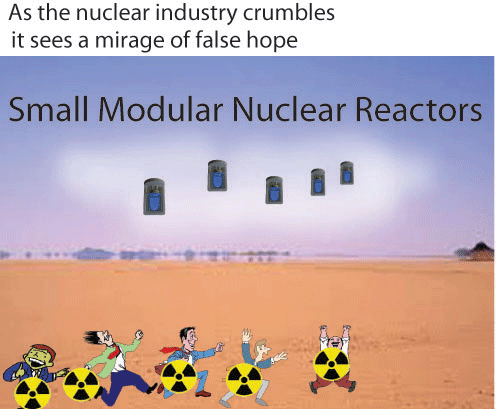
Advanced Nuclear Dreaming in Washington State, CounterPunch, PATRICK MAZZA 19 Apr 21……………..The WPPSS default was part of the first wave of nuclear failures in the U.S. In the wake of the 1979 Three Mile Island accident, approximately 100 proposed nuclear plants were cancelled. Recent years have seen a second round of failures. The Energy Policy Act of 2005 put $25 billion in nuclear subsidies on the table. That jumpstarted all of four nuclear reactors, two each in Georgia and South Carolina. The only way Wall Street would touch the projects was to make ratepayers carry the risk by paying for “work in progress” before the first watt is delivered. South Carolina ratepayers won’t even see that. Cost overruns killed the project there in 2017 after $9 billion was thrown away, setting up a political and court fight over whether ratepayers will continue to be soaked. The last two standing, Georgia’s Vogtle plants, were to have cost $14 billion and come on line in 2016-17. Now costs have doubled to $28 billion and scheduled completion this year and next is considered unlikely.
IS THE SMR A SOLUTION?
SMRs are the nuclear industry’s answer to avoid such failures in the future. Instead of being custom-built and individually licensed, SMRs are intended to cut costs by licensing a single design manufactured at a plant and sent for final assembly to their operating site. Smaller than the 1,000-megawatt-plus plants with which we’re familiar, SMRs are 100 MW or less, and designed with safety features to prevent meltdowns such as experienced at Japan’s Fukushima plant in 2011. Though there are questions about that, as covered below.
X-energy’s proposed plant is 80 MW. The Washington partnership envisions clustering four to make a 320-MW complex, with costs estimated at $2.4 billion. Half is to come from the U.S. Department of Energy’s Advanced Reactor Demonstration Program (ARDP), and half from private investors, apparently leaving ratepayers out of the picture this time.
ARDP in 2020 made two $80 million grants to advanced nuclear reactor developers, one to X-energy, and the other to TerraPower, a venture in which Bill Gates has invested. The latter, slated to be 345 MW, aims at eventual scales as large as today’s plants, so it is not an SMR. The TerraPower liquid-sodium cooled reactor concept has its own set of issues. Liquid-sodium reactors have suffered operating difficulties and fires, and pose potential weapons proliferation hazards. The Raven will look at TerraPower in a future post……..
ROCKY ROAD TO MASS PRODUCTION
“The road to such mass manufacturing will be rocky,” Makhijani and M.V. Ramana write in a recent article, “Why Small Modular Reactors Won’t Help Counter the Climate Crisis.” “Even with optimistic assumptions about how quickly manufacturers could learn to improve production efficiency and lower cost, thousands of SMRs, which will all be higher priced in comparison to large reactors, would have to be manufactured for the price per kilowatt for an SMR to be comparable to that of a large reactor.”
That sets up “a chicken-and-egg economic problem,” they write. “Without the factories, SMRs can never hope to achieve the theoretical cost reductions that are at the heart of the strategy to compensate for the lack of economies of scale. But without the cost reductions, there will not be the large number of orders to stimulate the investments needed to set up the supply chain in the first place.”
That is leaving aside the prospect of a design defect being discovered after many SMRs have been deployed. In the 1990s, multiple Westinghouse-built reactors suffered common steam generator problems, resulting in lawsuits. “If an error in a mass-manufactured reactor were to result in safety problems, the whole lot might have to be recalled, as was the case with the Boeing 737 Max and 787 Dreamliner jetliners,” Makhijani and Ramana write. “But how does one recall a radioactive reactor? What will happen to an electricity system that relies on factory-made identical reactors that need to be recalled?”
The economic hurdles of SMRs posed by its competitors are overwhelming.
“Lazard, a Wall Street financial advisory firm, estimates the cost of utility-scale solar and wind to be about $40 per megawatt-hour,” Makhijani and Ramana write. “The corresponding figure for nuclear is four times as high, about $160 per MWh – a difference that is more than enough to use complementary technologies, such as demand response and storage, to compensate for the intermittency of solar and wind.”
While costs for competitors declines, nuclear costs continue to escalate. Cost for a proposed Idaho project by NuScale, another SMR developer, has doubled from an estimated $3 billion in 2015 to $6.1 billion in 2020 “long before any concrete has been poured,” Makhijani and Ramana note………. https://www.counterpunch.org/2021/04/19/advanced-nuclear-dreaming-in-washington-state/
70 years later, ionising radiation from nuclear bomb tests still found in U.S. honey

Nuclear fallout is showing up in U.S. honey, decades after bomb tests, Science Nikk Ogasa Apr. 20, 2021
Fallout from nuclear bomb tests in the 1950s and ’60s is showing up in U.S. honey, according to a new study. Although the levels of radioactivity aren’t dangerous, they may have been much higher in the 1970s and ’80s, researchers say.
“It’s really quite incredible,” says Daniel Richter, a soil scientist at Duke University not involved with the work. The study, he says, shows that the fallout “is still out there and disguising itself as a major nutrient.”
In the wake of World War II, the United States, the former Soviet Union, and other countries detonated hundreds of nuclear warheads in aboveground tests. The bombs ejected radiocesium—a radioactive form of the element cesium—into the upper atmosphere, and winds dispersed it around the world before it fell out of the skies in microscopic particles. The spread wasn’t uniform, however. For example, far more fallout dusted the U.S. east coast, thanks to regional wind and rainfall patterns.
Radiocesium is soluble in water, and plants can mistake it for potassium, a vital nutrient that shares similar chemical properties. To see whether plants continue to take up this nuclear contaminant, James Kaste, a geologist at the College of William & Mary in Williamsburg, Virginia, gave his undergraduate students an assignment: Bring back local foods from their spring break destinations to test for radiocesium.
One student returned with honey from Raleigh, North Carolina. To Kaste’s surprise, it contained cesium levels 100 times higher than the rest of the collected foods. He wondered whether eastern U.S. bees gathering nectar from plants and turning it into honey were concentrating radiocesium from the bomb tests.
So Kaste and his colleagues—including one of his undergrads—collected 122 samples of locally produced, raw honey from across the eastern United States and tested them for radiocesium. They detected it in 68 of the samples, at levels above 0.03 becquerels per kilogram—roughly 870,000 radiocesium atoms per tablespoon. The highest levels of radioactivity occurred in a Florida sample—19.1 becquerels per kilogram.
The findings, reported last month in Nature Communications, reveal that, thousands of kilometers from the nearest bomb site and more than 50 years after the bombs fell, radioactive fallout is still cycling through plants and animals………
The findings raise questions about how cesium has impacted bees over the past half-century, says Justin Richardson, a biogeochemist at the University of Massachusetts, Amherst. “They’re getting wiped out from pesticides, but there are other lesser known toxic impacts from humans, like fallout, that can affect their survival.”
After the Chernobyl nuclear disaster in 1986, scientists showed radiation levels nearby could hamper the reproduction of bumble bee colonies. But those levels were 1000 times higher than the modern levels reported here, notes Nick Beresford, a radioecologist at the U.K. Centre for Ecology & Hydrology.
So even though the new study shouldn’t raise any alarm bells over today’s honey, understanding how nuclear contaminants move around is still vital for gauging the health of our ecosystems and our agriculture, says Thure Cerling, a geologist at the University of Utah. “We need to pay attention to these things.” https://www.sciencemag.org/news/2021/04/nuclear-fallout-showing-us-honey-decades-after-bomb-tests
Alaska to increase its radiation testing of seafood..

A Decade After Fukushima Nuclear Disaster, Alaska Expands Seafood Monitoring High North News, Apr 21 2021
State environmental regulators announced Monday they’re expanding radiation testing of commercially harvested Alaska seafood using a gamma radiation detector at a state laboratory in Anchorage, according to APM.
A devastating earthquake and tsunami off the coast of Japan in 2011 crippled the Fukushima Dai-ichi nuclear plant, which released radioactive material into the air and ocean…….. https://www.highnorthnews.com/en/decade-after-fukushima-nuclear-disaster-alaska-expands-seafood-monitoring
Overdue Shutdown of the Indian Point Nuclear Plant
Overdue Shutdown of the Indian Point Nuclear Plant
Environmental groups write that gains in energy efficiency and renewable power exceed the plant’s annual output.
“Nuclear Plant’s Shutdown Means More Fossil Fuel in New York”(news article, April 13):
New York State is making good on its promise to replace the aging, unsafe Indian Point nuclear plant with clean energy. Gains in energy efficiency and renewable power over the last decade already exceed the plant’s total annual output, with much more to come.
We can expect year-to-year changes given fluctuations in energy demand and prices. But the overall trend in New York is clear: Clean energy is here to stay, and emissions reductions are on track to reach the state’s ambitious climate goals.
Closing this dangerous plant is overdue. Over the years Indian Point has experienced reactor structure problems with the potential for structural failure, as well as leaks, fires and unplanned shutdowns.
For the 20 million people who live within 50 miles of it, Indian Point’s long-planned closure ends a risky chapter. Paul GallayKit Kennedy
Mr. Gallay is president of Riverkeeper and Ms. Kennedy is senior director, climate and clean energy program, at the Natural Resources Defense Council. https://www.nytimes.com/2021/04/21/opinion/letters/indian-point-nuclear.html
The $2.5Billion-a-year effort to stabilise the Hanford reservation’s dangerous nuclear wastes

Nuclear waste structures in Washington state are stabilized, https://apnews.com/article/environment-and-nature-business-government-and-politics-washington-nuclear-waste-14e29e8923c62bf5835f33e1b649000c RICHLAND, Wash. (AP) — The U.S. Department of Energy has confirmed that two underground structures at the decommissioned Hanford nuclear reservation in Washington state have been stabilized after they were deemed at risk of collapsing and spreading radioactive contamination into the air.
“With this work completed, Hanford has ensured the stability of these structures and reduced risks to workers and the environment,” department spokesperson Geoff Tyree said.
The partial collapse of a tunnel storing nuclear waste the nuclear reservation in 2017 prompted a federal study which concluded last year that a large settling tank and two trenches where plutonium-contaminated liquids were poured into the ground for disposal posed a high risk of collapse and contamination, Tri-City Herald reported Tuesday.
The Hanford reservation produced plutonium for nuclear weapons during the Cold War and World War II, leaving 56 million gallons (212 million litres) of radioactive waste in underground tanks. The largest of the three underground structures, which operated from 1955 to 1962, was estimated to be contaminated with 105 pounds (48 kilograms) of plutonium.
Scott Sax, president of Hanford contractor Central Plateau Cleanup Co., told employees that the three underground structures identified in the study were filled with concrete-like grout to prevent them from collapsing.
The work was done by White Shield Inc. of Pasco under a contract originally valued at about $4 million.
Sax also said that at least one of the trenches was buried deep enough to prevent nuclear waste from releasing into the air in the event of a collapse.
“Routine monitoring will continue to ensure all three structures remain stable,” Sax said, at least until further environmental cleanup action is taken.
Final cleanup plans for the structures have not yet been made as the Energy Department focuses on other high-priority projects, including capsules of radioactive waste that are at risk of releasing contamination in the event of a severe earthquake.
About $2.5 billion a year is being spent to stabilize and clean up waste and contamination left at the 580-square-mile (1,500-square-kilometer) site in Richland, Washington about 200 miles (322 kilometers) southeast of Seattle, officials said.
USA’s Defense Secretary Lloyd Austin – a ”soldier’s soldier” and a useful purchaser for Raytheon’s military merchandise
Austin’s personal history and connection to the military and Raytheon mark him as a fitting Pentagon chief in an era of destructive militarism and creeping fascism in the U.S.
When civilians no longer control the key institutions of government and war industries ensure the perpetuation of endless wars from which they make obscene profits, the political system can no longer be defined as a democracy.

Defense Secretary Lloyd Austin—Former Member of Raytheon Board of Directors—Has Awarded Over $2.36 Billion in Contracts to Raytheon Since His Confirmation in January, Covert Action Magazine By Jeremy Kuzmarov – April 19, 2021 he Pentagon has awarded the defense giant Raytheon Technologies over $2.36 billion in government contracts since Secretary of Defense Lloyd Austin III’s confirmation on January 22nd.
Austin was on Raytheon’s board of directors prior to his confirmation.
Austin at the time had made a commitment to resign from Raytheon’s board and recuse himself from all matters concerning Raytheon for four years and agreed to divest from his financial holdings in the company, amounting to between $500,000 and $1.7 million in stock.
These initiatives, however, have not prevented Austin from using his position to bolster Raytheon’s fortunes. Nor those of other defense contractors on whose board he has sat such as Booz Allen Hamilton, the world’s “most profitable spy organization,” according to Bloomberg News, and Pine Island Capital, a private equity firm that invests in military industry.[1]
At Austin’s nomination hearing, Senator Elizabeth Warren (D-MA) questioned him about his ties to Raytheon—whose headquarters are based in Warren’s home district (Waltham, Massachusetts).
A year earlier, Warren had proposed legal changes to strengthen ethics at the Defense Department by blocking the revolving door between the Pentagon and giant defense contractors like Raytheon, including by prohibiting big defense contractors from hiring former Pentagon officials for four years after they leave government.
Warren paradoxically voted to confirm Austin’s appointment as Defense Secretary—even though he embodies the danger of the revolving door.
Mark Pocan (D-WI), who with Barbara Lee wrote a letter in November 2020 to President-elect Joe Biden requesting that he nominate a Secretary of Defense with no previous ties to weapons manufacturers, stated that “American national security should not be defined by the bottom lines of Boeing, General Dynamics and Raytheon.”
With men like Austin at the helm, however, it is very clearly being defined in this way…………….
Phyllis Bennis of the Institute for Policy Studies, a left-wing think-tank, told The Intercept that since “Raytheon manufactures the bomb components that are used in Yemen, [General Austin] bears a direct responsibility [for war crimes and civilian deaths]. He was making money as a board member of this company that is directly responsible for the death and destruction there.”
William Hartung, the director of the arms and security project for the Center for International Policy, said that “picking Austin was tantamount to making the position of Secretary of Defense the Secretary of Defense contractors.”
Raytheon’s 2021 Pentagon Contracts
Fitting with Hartung’s assessment, Raytheon has benefitted from multi-million-dollar government contracts on a near-daily basis since Austin has taken charge at the Pentagon.
On February 1st, the company secured a whopping $290,704,534 government contract to produce equipment for depot maintenance facilities and services in support of the F-35 Lightning II, which military analyst Pierre Sprey characterized as “overweight and dangerous.”……………….
Promoting More War
Though Austin claims to have recused himself from decisions involving Raytheon, the Pentagon under his direction is providing his old company with huge contracts on a daily basis that is bolstering its profits and stock price.
Austin furthermore has used his new bully pulpit to advocate for yet greater levels of military spending—to the benefit of Raytheon.
On February 25th, for example, on a visit to the U.S.S. Nimitz, Austin emphasized the need for U.S. warships throughout the globe to deter security threats—from China to Iran. A week later on a tour of Southeast Asia with Secretary of State Antony Blinken, Austin warned about China again and the North Korean nuclear threat and pledged that the U.S. would maintain a robust military presence in the Indo-Pacific.
He further cautioned North Korea that the United States, following military exercises with South Korea, was “ready to fight tonight.”
When fighting resumed in Eastern Ukraine in early April, Austin assured Ukraine’s Defense Minister Andrii Taran of the “U.S. commitment to building the capacity of Ukraine’s forces to defend more effectively against [supposed] Russian aggression”–which was demonstrated by a recent $125 million military aid package–and took to Twitter to reaffirm the U.S.’s “unwavering support for Ukraine’s sovereignty, territorial integrity, and Euro-Atlantic aspirations.”
…………A Soldier’s Soldier
Besides his connection to Raytheon, Austin’s appointment as Pentagon chief was controversial because he had not been retired from the military for the requisite seven years and required a legal waiver.
Traditionally, the role of Defense Secretary is supposed to be a civilian position, ensuring the U.S.’s military apparatus is led not by a warfighter, but a policymaker. That requirement is laid out in the National Security Act of 1947 that established the Defense Department.
Heralded as a “soldier’s soldier” who would endure hardships with his troops, the 6’4” tall Austin graduated from West Point in 1975, and led infantry troops in the capture of Baghdad during the 2003 Operation Iraqi Freedom.
After a stint commanding the 10th Mountain Division in Afghanistan, Austin was appointed as chief of staff of the U.S. Central Command at McDill Air Force Base in Tampa, Florida, a high-tech command post where military officers could watch live imagery on plasma screens and order air-strikes through the Pentagon’s secure internet server.
Groomed for high military command by Admiral Mike Mullen, Chairman of the Joint Chiefs of Staff from 2007 to 2011, Austin was appointed as Commanding General of U.S. forces in Iraq in 2010, and Commander of the U.S. Central Command (CENTCOM), which is responsible for all military operations in the Middle East, by President Obama in 2013.
In this latter capacity, Austin drafted a war plan—approved by Obama—that allowed the U.S. military for the first time to directly provide ammunition and weapons to Syrian opposition forces, who included Islamic jihadists.
President Obama also endorsed General Austin’s idea to increase the air campaign on Islamic State of Iraq and the Levant (ISIS) from Incirlik Air Base in Turkey. The result was an increase in civilian deaths. Journalists Anand Gopal and Azmat Khat determined that one in five of the 27,500 coalition air strikes in the 2nd Iraq War resulted in at least one civilian death, more than 31 times the number that was publicly acknowledged
Austin’s personal history and connection to the military and Raytheon mark him as a fitting Pentagon chief in an era of destructive militarism and creeping fascism in the U.S.
When civilians no longer control the key institutions of government and war industries ensure the perpetuation of endless wars from which they make obscene profits, the political system can no longer be defined as a democracy. https://covertactionmagazine.com/2021/04/19/defense-secretary-lloyd-austin-former-member-of-raytheon-board-of-directors-has-awarded-over-2-36-billion-in-contracts-to-raytheon-since-his-confirmation-in-january/
Bill Gates and 28 other billionaires pushing their small nuclear reactors, on the pretext that they’re ”clean”
Billionaires leading push for nuclear reactors in Canadian mining

By Joyce Nelson, Rabble, April 19 2021https://rabble.ca/news/2021/04/billionaires-leading-push-nuclear-reactors-canadian-miningThis is part two of a two-part series on small modular reactors.
In January 2019, Gordon Edwards, president of the Canadian Coalition for Nuclear Responsibility, warned that the Trudeau government has a “desire to build small modular nuclear reactors [SMRs] all over Canada, especially in the North, to support the accelerated exploitation of natural resources.” Edwards included an excerpt from Nuclear Energy Insider, published January 16, 2019, which stated: “Canada’s large mining sector is seen as a key early market for SMR plants as operators look to reduce carbon emissions and costs.”
That “early market” for small modular reactors has been cleverly targeted by a key lobby group. As I wrote for Watershed Sentinel, Bill Gates and 28 other billionaires and “high-net-worth” individuals launched the Breakthrough Energy Coalition at the 2015 Paris climate talks to lobby for small nuclear reactor development as “clean technology” in dozens of countries, including Canada.
This billionaires’ nuclear club has been working closely for years with Natural Resources Canada in the push for small modular reactors, especially for use in off-grid mining………………….
With Gates and his billionaires’ nuclear club backing KoBold, it’s likely that their off-grid mining projects would welcome government financing for small modular reactors.
When asked about the situation, Mining Watch Canada’s Jamie Kneen told me by email:
“On the one hand, the mining industry faces so much risk in the markets that it’s unlikely to add to that risk by jumping on an unproven technology [like SMRs]. On the other hand, the mining industry is used to leaving masses of toxic waste behind for others to deal with — and getting away with it — so it’d be a perfect fit.”
Three political parties are fully against small modular reactors: the NDP, the Bloc Québécois, and the Green Party — worth remembering if the federal budget causes an election.
This is part one of a two-part series on small modular reactors. Read part one here.
Freelance writer Joyce Nelson is the author of seven books. She can be reached via www.joycenelson.ca
https://rabble.ca/news/2021/04/billionaires-leading-push-nuclear-reactors-canadian-mining
How weapons maker Raytheon determines U.S. foreign policy decisions

Defense Secretary Lloyd Austin—Former Member of Raytheon Board of Directors—Has Awarded Over $2.36 Billion in Contracts to Raytheon Since His Confirmation in January, Covert Action Magazine By Jeremy Kuzmarov – April 19, 2021
”…………… One of the Raytheon company founders, Vannevar Bush, became president of the Massachusetts Institute of Technology (MIT) and chairman of the U.S. Office of Scientific Research and Development (OSRD) during World War II, which initiated the Manhattan Project that led to the development of the atomic bomb.
In 2003, Raytheon put out a press release bragging that half of all air-to-ground precision guided missiles (PGMs) used by coalition forces in Operation Iraqi Freedom were made by Raytheon.
…………….On February 25th, for example, on a visit to the U.S.S. Nimitz, Austin emphasized the need for U.S. warships throughout the globe to deter security threats—from China to Iran. A week later on a tour of Southeast Asia with Secretary of State Antony Blinken, Austin warned about China again and the North Korean nuclear threat and pledged that the U.S. would maintain a robust military presence in the Indo-Pacific.
He further cautioned North Korea that the United States, following military exercises with South Korea, was “ready to fight tonight.”
When fighting resumed in Eastern Ukraine in early April, Austin assured Ukraine’s Defense Minister Andrii Taran of the “U.S. commitment to building the capacity of Ukraine’s forces to defend more effectively against [supposed] Russian aggression”–which was demonstrated by a recent $125 million military aid package–and took to Twitter to reaffirm the U.S.’s “unwavering support for Ukraine’s sovereignty, territorial integrity, and Euro-Atlantic aspirations.”
The latter implied the joining of the European Union (EU) and North Atlantic Treaty Organization (NATO), which would inevitably escalate conflict between the world’s two major nuclear-armed powers (the U.S. and Russia).
On April 13th, Austin announced that the United States would increase its military presence in Germany by about 500 personnel and was scuttling plans introduced by President Donald Trump for a large troop reduction in Europe.
Austin meanwhile in Tel Aviv affirmed the U.S. “ironclad commitment” to Israel, which receives a record $3.8 billion in U.S. military aid each year, and on a visit to Afghanistan stated that the Biden administration wanted to see a “responsible end” to the Afghan war, but that the “level of violence must decrease” for “fruitful diplomacy” to have a chance.
These comments and many others were music to the ears of Raytheon, which gave $506,424 in donations to Biden’s presidential campaign.
…………….Raytheon was also the first major defense contractor to sell weapons to Saudi Arabia, selling the kingdom over 1,000 cluster bombs designed to maximize civilian casualties between 1970 and 1995. The company further hired members of the Saudi Royal Family as consultants, and opened a branch in Riyadh in 2017.
After the Yemen war began in 2015, Raytheon, according to an analysis by The New York Times, booked more than $3 billion in new bomb sales to the Saudis, causing its stock prices to increase from about $108 to more than $180 per share.
In 2019, Raytheon sold an estimated $8 billion in weapons to Saudi Arabia and the United Arab Emirates, which are centrally involved in the war in Yemen.

After an October 2016 Saudi airstrike on a funeral home in Sana’a that killed 140 people and wounded 500 more, human rights workers discovered a bomb shard bearing the identification number of Raytheon.[2] It was one of at least 12 attacks on civilians that human rights groups tied to Raytheon’s ordnance during the first two years of the war.
In order to secure the lucrative Saudi deals, Raytheon took advantage of federal loopholes by sending former State Department officials to lobby their former colleagues, and later benefitted by having their former top lobbyist, Mark Esper, appointed as Defense Secretary in June 2019 in a precursor to General Austin’s hiring.………..
Defense Secretary Lloyd Austin—Former Member of Raytheon Board of Directors—Has Awarded Over $2.36 Billion in Contracts to Raytheon Since His Confirmation in January
Trudeau government’s extraordinary push for small nuclear reactors – tax breaks, no environmental assessment …
Budget may reveal extent of federal support for risky new nuclear reactors. Rabble.Ca Joyce Nelson 15 Apr 21, Across Canada, environmentalists and First Nations will be closely watching the April 19 release of the federal budget to see just how far the Trudeau Liberals will go in their push for small modular reactors (SMRs).
In September 2020, Canada’s Minister of Natural Resources Seamus O’Regan endorsed SMRs and stated that there is “no pathway to net zero [carbon emissions] without nuclear,” which prompted David Suzuki to famously tell the CBC: “I want to puke.”
Apparently, many share that feeling.
More than 100 Indigenous and civil society groups across Canada are now opposed to the new nuclear reactors, which are being pushed by the federal government and four provinces — Saskatchewan, Ontario, New Brunswick and Alberta — as so-called “clean energy” and a supposed solution to climate change.
These governments argue that the reactors would be the replacement for diesel in remote communities and for use in off-grid mining, tar-sands development, heavy industry, and as exportable expertise in a global market.
But opponents call SMRs “dirty, dangerous and distracting” from real climate solutions.
Even before the budget, the Trudeau Liberals have already taken several steps to advance development of the reactors, especially for use in off-grid mining.
Steps towards small reactors
The feds endorsed the March 2019 Canadian Minerals and Metals Plan, drawn up by federal, provincial and territorial governments. That plan urges governments to “accelerate efforts to develop and adopt clean energy sources, especially for northern, remote and isolated communities that rely on diesel” and “continue to study the feasibility of small modular reactors in mining operations, as well as the potential market for this technology.”
Then, in September 2020, Canada and the U.S. agreed to collaborate on the financing and production of rare-earth and other key metals, which are necessary for a wide range of products including batteries, solar panels, electric vehicles, AI, and weaponry.
After the December 2020 release of the “SMR Action Plan,” the federal government also decided that there would be no environmental impact assessments for small modular reactors, and that tax incentives should be given for this so-called “clean technology.”
The recent mandate letter to Finance Minister Chrystia Freeland directs her to “cut tax rates by 50 per cent for companies that develop and manufacture zero-emission technology” in order to “make Canada a world leader in clean technology.”
As rabble.ca noted, “[t]he Canadian Nuclear Safety Commission (CNSC) has just given a green light to the preferred industry solution for disposal of nuclear reactors — entomb and abandon them in place, also known as ‘in-situ decommissioning.’ This paves the way for the introduction of a new generation of ‘small modular’ nuclear reactors or SMRs.”
While this would be a disaster for the environment and nearby communities, it would be a boon for the nuclear industry and the off-grid mining sector, which would not have to deal with the fallout and repercussions of such nuclear waste once a mining project is finished.
Important policy change
On December 7, 2020 the Hill Times published an open letter to Treasury Board from more than 100 women leaders across Canada, stating:
“We urge you to say ‘no’ to the nuclear industry that is asking for billions of dollars in taxpayer funds to subsidize a dangerous, highly polluting and expensive technology that we don’t need. Instead, put money into renewable, energy efficiency and energy conservation.”………….. https://rabble.ca/news/2021/04/budget-may-reveal-extent-federal-support-risky-new-nuclear-reactors
In Ontario, opponents of nuclear waste disposal join forces
Opponents of nuclear waste disposal join forces https://www.tbnewswatch.com/local-news/opponents-of-nuclear-waste-disposal-join-forces-3644864 ‘Ignace should not get to decide’ whether to accept a storage site, a spokesperson says.
By: Gary Rinne 19 Apr 21, KENORA, Ont. — Thirty thousand households and businesses in Northwestern Ontario are receiving postcards from a group of organizations opposed to nuclear waste disposal in Northwestern Ontario.
We the Nuclear Free North calls itself an alliance of Indigenous and non-Indigenous volunteers and organizations who believe the risks of transporting and burying nuclear waste are too high.
It’s delivering information cards outlining its concerns to residents living between Upsala and the Manitoba border.
The Nuclear Waste Management Organization has identified the Revell Lake area, about 35 kilometres from Ignace, as a candidate site for an underground repository, and is continuing to conduct studies in the area.
NWMO is also still looking at a site in Bruce County in southern Ontario.
We the Nuclear Free North says it has launched a website to provide information about the project from sources that are independent of the nuclear power companies that generate and own Canada’s nuclear waste.
It says NWMO is proposing to send multiple truckloads of highly radioactive waste to its selected site “every day for at least 40 years.”
Spokesperson Fred Melanson, who served on Ear Falls council when that community was being studied for nuclear waste disposal, said “This is not the kind of development the people of Northwestern Ontario want. Burying nuclear waste is a high-risk experiment.”
Although NWMO has developed a working relationship with the Township of Ignace during the study process, Environment North representative Dodie LeGassick said “This is not an issue for one community. It is an issue for the entire region.”
LeGassick said “Ignace should not get to decide whether 22,000 trucks hauling radioactive waste drive through Nipigon and through Shuniah Township and all of the other many communities along the route.”
On its website, the alliance – which includes Environment North and Northwatch – also notes that the United Nations Declaration on the Rights of Indigenous Peoples requires that states “take effective measures to ensure that no storage or disposal of hazardous materials shall take place in the lands or territories of indigenous peoples without their free, prior and informed consent.”
Peter White, an elder with Grand Council Treaty # 3’s Ki’ieshgitabaaning Cultural and Healing Lodge said “The lives of our children and future generations are too precious to be used as a nuclear experiment and should not have this burden put on their shoulders.”
NWMO intends to make a final decision on the location of the underground storage site in 2023.
Sexual harrassment: reUSA’s National Nuclear Security Administration could improve prevention and response efforts in its nuclear security forces.
Sexual Harassment:NNSA Could Improve Prevention and Response Efforts in Its Nuclear Security Forces, Government Accountability Office GAO-21-307 Apr 19, 2021. Sexual harassment is harmful to employees and negatively affects workplaces. Reports of sexual harassment have been rare in the nuclear security forces at the National Nuclear Security Administration, but research shows those experiencing harassment are unlikely to report it.
NNSA and its security contractors may have limited information on the prevalence of harassment within their forces. The degree to which the agency and its contractors follow recommended practices to prevent and respond to harassment varies.
We made 5 recommendations that include proven approaches for preventing and responding to sexual harassment………… https://www.gao.gov/products/gao-21-307
US backs Japan’s Fukushima plans despite S Korea’s concerns
US backs Japan’s Fukushima plans despite S Korea’s concerns
Seoul fails to gain US support against Japan’s decision to release contaminated water from Fukushima nuclear plant. Aljazeera, 18 Apr 2021
US climate envoy John Kerry has reaffirmed Washington’s confidence in Japan’s decision to release contaminated water from its crippled Fukushima nuclear plant into the sea despite concerns raised by South Korea.
Kerry arrived in Seoul on Saturday to discuss international efforts to tackle global warming, on a trip that included a stop in China ahead of President Joe Biden’s virtual summit with world leaders on climate change this month.
South Korean Foreign Minister Chung Eui-yong sought to rally support behind the country’s protest against the Fukushima plan at a dinner meeting with Kerry.
Under the plan, more than one million tonnes of water will be discharged from the plant wrecked by an earthquake and tsunami in 2011 into the nearby sea off Japan’s east coast.
Seoul strongly rebuked the decision, with the foreign ministry summoning the Japanese ambassador and President Moon Jae-in ordering officials to explore petitioning an international court.
“Minister Chung conveyed our government and people’s serious concerns about Japan’s decision, and asked the US side to take interest and cooperate so that Japan will provide information in a more transparent and speedy manner,” the ministry said in a statement.
But Kerry, at a media roundtable on Sunday, said Tokyo had made the decision in a transparent manner and will continue following due procedures.
“The US is confident that the government of Japan is in very full consultations with the IAEA,” he said, referring to the International Atomic Energy Agency…….. The former US secretary of state added that Washington would closely monitor Japan’s implementation “like every country, to make certain there is no public health threat”…….. https://www.aljazeera.com/news/2021/4/18/s-korea-us-show-differences-over-japans-fukushima-plans
PNM Resources to replace its Palo Verde nuclear energy with 100% solar and battery
Sierra Club 16th April 2021, After announcing it would drop one of its leases in the Palo Verde Nuclear plant last year, this month PNM proposed replacing the energy with 100% solar and battery. In support of its proposal, PNM cited the Energy Transition Act’s requirements and the Public Regulation Commission’s decision last year to choose a 100% solar/storage proposalrather PNM’s favored gas-inclusive replacement scenario for San Juan Generating Station coal. The replacement proposal will need to be approved by the commission. In selecting carbon emission-free generation to replace Palo Verde, PNM states in testimony it has taken into consideration “the state’s energy transition policies and long-term mandate for a carbon emission-free generation portfolio.” While we have yet to delve into all of the details of PNM’s application, this is very encouraging and we look forward to supporting PNM’s request for prompt approval of replacement resources. https://www.krwg.org/post/pnm-cites-eta-proposing-100-solar-and-storage-replace-nuclear |
A new plan for disposing of nuclear waste at USA’s Waste Isolation Pilot Plant
Carlsbad Current Argus 14th April 2021, A plan to build two new areas to dispose of nuclear waste began taking
shape at the Waste Isolation Pilot Plant after the U.S. Department of Energy published a report on the feasibility of adding an 11th and 12th waste panel to the underground nuclear waste repository.
At WIPP, low-level transuranic (TRU) waste made up of equipment and materials radiated during nuclear activities is permanently emplaced in an underground salt deposit more than 2,000 feet underground. In its original design, WIPP was planned to have eight panels for such disposal, but much of that space wasrestricted and abandoned following an accidental radiological release in2014 that contaminated parts of the underground and led to a three-year
pause of WIPP’s emplacement operations.
Ratepayer advocate calls on New Jersey Supreme Court to reverse decision allowing subsidy to nuclear power
Nuclear subsidy gets new challenge, NJ Spotlight TOM JOHNSON, ENERGY/ENVIRONMENT WRITER | APRIL 14, 2021 | ENERGY & ENVIRONMENT, NJ ratepayer advocate asks Supreme Court to consider decision on $300 million subsidy. Regulators are poised to add more,
New Jersey Rate Counsel Director Stefanie Brand is asking the New Jersey Supreme Court to reverse last month’s appellate court decision upholding the award of hundreds of millions in ratepayer subsidies to the state’s nuclear power plants.
In a notice of a petition for certification, the Division of Rate Counsel argued the lower court erred when it upheld the New Jersey Board of Public Utilities’ decision in 2019 to approve $300 million in new surcharges on customers’ gas and electric bills. Without the subsidies, Public Service Enterprise Group, whose subsidiary operates three nuclear units in South Jersey, has threatened to close the plants because they are no longer profitable.
If the high court decides to review the case, it could result in the justices taking up the case at roughly the same time as the BPU, which is scheduled to decide whether the plants — Hope Creek, Salem I and Salem II — qualify for additional subsidies from ratepayers for another three years. The BPU is expected to rule on those applications on April 27. The first subsidy added about $70 a year to what residential customers pay for electricity……… https://www.njspotlight.com/2021/04/nj-rate-counsel-director-stefanie-brand-seeks-supreme-court-reversal-300-million-nuclear-subsidy-pseg/
-
Archives
- May 2026 (62)
- April 2026 (356)
- March 2026 (251)
- February 2026 (268)
- January 2026 (308)
- December 2025 (358)
- November 2025 (359)
- October 2025 (376)
- September 2025 (257)
- August 2025 (319)
- July 2025 (230)
- June 2025 (348)
-
Categories
- 1
- 1 NUCLEAR ISSUES
- business and costs
- climate change
- culture and arts
- ENERGY
- environment
- health
- history
- indigenous issues
- Legal
- marketing of nuclear
- media
- opposition to nuclear
- PERSONAL STORIES
- politics
- politics international
- Religion and ethics
- safety
- secrets,lies and civil liberties
- spinbuster
- technology
- Uranium
- wastes
- weapons and war
- Women
- 2 WORLD
- ACTION
- AFRICA
- Atrocities
- AUSTRALIA
- Christina's notes
- Christina's themes
- culture and arts
- Events
- Fuk 2022
- Fuk 2023
- Fukushima 2017
- Fukushima 2018
- fukushima 2019
- Fukushima 2020
- Fukushima 2021
- general
- global warming
- Humour (God we need it)
- Nuclear
- RARE EARTHS
- Reference
- resources – print
- Resources -audiovicual
- Weekly Newsletter
- World
- World Nuclear
- YouTube
-
RSS
Entries RSS
Comments RSS
 nuclear-news