The experts respond to Trump’s proposal to “start testing our Nuclear Weapons on an equal basis”

even if China was to up the number of its warheads dramatically, that would still amount to less than a third of what the United States and Russia each already have.
By Dan Drollette Jr | October 30, 2025, https://thebulletin.org/2025/10/the-experts-respond-to-trumps-proposal-to-start-testing-our-nuclear-weapons-on-an-equal-basis/
President Donald Trump wrote on Truth Social, his social media site, that he had instructed the Department of War (formerly the Defense Department) to return to “nuclear testing” — although it’s unclear whether he was referring to testing a nuclear delivery system or testing a nuclear explosive device. Those are two very different things that Trump seems to be confused about.
In the words of prominent nuclear weapons expert Hans Kristensen of the Federation of American Scientists (who is one of the lead authors of the “Nuclear Notebook” column, published regularly in the Bulletin of the Atomic Scientists): “It’s hard to know what he means. As usual, he’s unclear, all over the map, and wrong.” Kristensen then goes into detail, debunking a series of Trump’s assertions in his social media post. For instance, Trump’s initial claim that “[t]he United States has more Nuclear Weapons than any other country. This was accomplished, including a complete update and renovation of existing weapons, during my First Term in office…” is simply false.
As Kristensen points out, Russia has more nuclear weapons than the United States. And Trump’s assertion about a “a complete update and renovation of existing weapons” is also flatly wrong. In Kristensen’s words, “The nuke modernization program currently underway was initiated by Obama, Trump didn’t finish it, and it will continue for another two decades.”
Kristensen then proceeds for eight linked posts to correct or clarify the many other misstatements made by the president in Trump’s Truth Social post. For example, even if China was to up the number of its warheads dramatically, that would still amount to less than a third of what the United States and Russia each already have.
And as Kristensen notes, the US already tests its missiles (without nuclear payloads) to ensure that they can launch safely and correctly: “If by testing he [Trump] means nuclear explosive testing, that would be reckless, probably not possible for 18 months, would cost money that Congress would have to approve, and it would certainly trigger Russian and Chinese and likely also India/Pakistan nuclear tests. Unlike the US, all these countries would have much to gain by restarting test testing. There have been occasional rumors that Russia/China may have conducted very small-yield tests, I’m not aware of any reports that they have conducted significant nuclear test explosions.”
The process of resuming testing would be nowhere near as swift as Trump suggests; the White House would have to direct the US Energy Department to order our national nuclear laboratories to start preparing for a nuclear warhead test. And since the United States doesn’t currently have a nuclear weapons test explosion program, Congress would have to appropriate the money.
Furthermore, Kristensen notes “[i]t would be expensive and take time: a simple explosion is 6-10 months, a fully instrumented test in 24-36 months, and a test to develop a new nuclear warhead is about 60 months.”
Just in case Trump is indeed talking about testing a nuclear explosive device, it’s probably a good time to look back at the Bulletin’s March 2024 issue, “A return to nuclear testing?”, which lays out the many negative impacts of nuclear testing. In that issue, veteran national security reporter Walter Pincus explains exactly what those who live in a place chosen for testing experience in “The horrors of nuclear weapons testing.” People today seem to have forgotten—if they ever knew—what a single nuclear weapon can do. The inhabitants of the Marshall Islands, whose home was turned into a nuclear proving ground, have certainly never forgotten.
Beyond that, the reasons for preserving a ban on nuclear tests are many—even though Russia, China, and the United States have been keeping their test sites ready for a potential resumption of full-scale tests of explosive devices, just in case. Eminent researcher Pavel Podvig delves into this in detail in his Bulletin essay, “Preserving the nuclear test ban after Russia revoked its CTBT ratification.”
And one thing that seems to get overlooked is that the United States has benefited from a test ban as much as anyone else. Consequently, bringing the Comprehensive Nuclear Test Ban Treaty into force would lock in an American advantage in nuclear knowledge and expertise and hinder other states from developing more sophisticated nuclear arms, as Stanford University expert Steven Pifer notes in “The logic for US ratification of the Comprehensive Nuclear Test Ban Treaty.”
Members of Congress object to plutonium giveaway

October 26, 2025, https://beyondnuclear.org/senators-object-to-plutonium-giveaway/
On December 31, the Trump White House will start revealing which lucky startup companies will receive free plutonium needed for their new reactor fuel. Trump will give away between 20-25 tons, according to reports, going against US energy policy that has long avoided the transfer of nuclear weapons-usable materials into the commercial sector. One likely recipient is Oklo, on whose board Trump’s present energy secretary, Chris Wright, once sat, raising serious conflict of interest issues.
Several Members of Congress have already written to Trump expressing their concerns. In the letter sent by Senator Ed Markey and Reps. Don Beyer and John Garamendi, all Democrats, they pointed out that dishing out plutonium “to private industry for commercial energy use,” crossed a line that “goes against long-standing, bipartisan US nuclear security policy. It raises serious weapons proliferation concerns, makes little economic sense, and may adversely affect the nation’s defense posture.” They also pointed out that the amount of plutonium Trump is preparing to move into the commercial sector “is enough for at least 2,000 nuclear bombs.”
And they also took care to remind Trump that “commercial nuclear energy does not require separated plutonium, and today there is no global demand for plutonium to make civilian nuclear reactor fuel. Nuclear power reactors instead rely on uranium fuel, which is safer and cheaper to process.”
Golden Dome funding lags as industry partners line up

By John T. Seward – The Washington Times – Tuesday, October 28, 2025
The head of President Trump’s Golden Dome missile defense program gave a classified briefing to the Senate Armed Services Committee last week that described the secretive architecture of the project, The Washington Times has learned.
U.S. Space Force Gen. Michael A. Guetlein, who was tapped earlier this year by Mr. Trump to lead the design of Golden Dome, told committee members about key target dates for the project’s delivery.
Gen. Guetlein also outlined how the project will integrate missile detection capabilities and early warning systems, said two sources familiar with the briefing who spoke on the condition of anonymity to discuss aspects of the classified meeting.
Sen. Dan Sullivan, Alaska Republican and a member of the Armed Services Committee, confirmed the meeting to The Times but declined to comment on specifics because of the classified nature of the planned Golden Dome architecture.
Mr. Sullivan, who is routinely involved with the military’s missile defense programs because of his state’s strategic geographic location, said he was impressed with Gen. Guetlein’s presentation.
“He just has a really good sense of how he wants to layer it and put it together,” the senator said. “He’s got a plan, you know, it’s got like 30-day, 60-day, 120-day, and I thought it was good.”
Speculation about the specific architecture of the Golden Dome is rampant among defense industry insiders. So is unease over the status of some $24.5 billion in funding that Congress approved this year for the missile shield’s development.
Multiple sources have told The Times that none of the money has been allocated for contracts and that White House Office of Management and Budget is holding the funds.
Some defense strategy analysts say Congress’ approval of the money was unprecedented.
The initial $24.5 billion was included in the passage of H.R. 1, the One Big Beautiful Bill Act, in July. At the time, Mr. Trump touted the money as an initial down payment for the Golden Dome.
“Congress pre-appropriated $24.5 billion without a program plan, scheduled requirements — nothing,” said Todd Harrison, a senior fellow at the American Enterprise Institute.
“Never have we seen that much money appropriated in advance of a program actually starting,” Mr. Harrison said during a virtual panel discussion last week.
The discussion, hosted by the Center for New American Security, was titled: “Stuck in the Cul-de-Sac: How U.S. Defense Spending Prioritizes Innovation over Deterrence.”
Mr. Harrison said the Pentagon and the Trump administration have not publicly defined Golden Dome’s capability goals.
Analysts estimate the missile shield will be a multidecade program costing hundreds of billions of dollars for space-based and other futuristic missile defense capabilities that will continue to evolve technically over time.
Under the One Big Beautiful Bill Act, initial funding was made available for the next four years, with spending flexibility baked into the law that could make congressional oversight difficult.
There is consensus among many in the national security community that Golden Dome is urgently needed amid rising nuclear and ballistic missile threats from U.S. adversaries, most notably Russia, China, North Korea and Iran.
Mr. Harrison said the potential exists for the systems involved in the project to be focused on every threat, from small drones fulfilling a counter small uncrewed systems (C-sUAS) role to protecting against things “like a strategic nuclear strike from Russia or China, or both of them simultaneously, or a rogue missile from North Korea.”
Such concerns didn’t stop the initial funding for Golden Dome from being approved by law, a situation that has drawn criticism from some Democrats on the Senate Armed Services Committee.
The committee’s ranking Democrat, Sen. Jack Reed of Rhode Island, has called the $24.5 billion for Golden Dome a “slush fund” and said the Trump administration may try to use the funds however it sees fit.
“We’re still waiting for really detailed plans,” Mr. Reed said. “It’s such a comprehensive program, but there’s nothing there yet. What is the priority?”………………………………… https://www.washingtontimes.com/news/2025/oct/28/golden-dome-funding-lags-industry-partners-line/
Bechtel boss urges US government to share risk of nuclear build-out

The construction group that rescued the last big US nuclear energy project
from bankruptcy has called on Washington to share the risk of cost overruns to deliver Donald Trump’s “American nuclear renaissance”.
Bechtel president Craig Albert told the Financial Times industry could deliver on the president’s executive orders to start work on developing 10
large-scale nuclear reactors by 2030. But government and the private sector would need to work together to overcome financing hurdles linked to risks of cost overruns and delays.
“The advice we’ve been giving the government is . .there is overrun risk, and no one company can take it all because they’d be betting their company,” he said in an interview.
“The government has provided very good tax incentives that improve the
rate of return, but that doesn’t address overrun risk, that just improves
the rate of return. So, I do think the government will have a role to
play.”
FT 28th Oct 2025. https://www.ft.com/content/74d1f5f0-a255-4e63-8ffa-86a9cdf663df
The Next Nuclear Renaissance?

Will a new wave of nuclear power projects deliver the safe and economical electricity that proponents have long predicted?
CATO Institute, Fall 2025, By Steve Thomas
Over the past decade, there has been a growing interest in building new nuclear power stations, particularly among policymakers. This comes some two decades after a previously forecast “nuclear renaissance” petered out, having produced few orders, all of which went badly wrong.
This article reviews the previous renaissance: What was promised, what was delivered, and why it failed. It then considers the current claims of a new renaissance led by Small Modular Reactors, forthcoming “Generation IV” designs, new large reactors, and extending the lifetime of existing nuclear plants. Despite the need for clean generation, the growing demand for electricity to power new technologies and global development, and claims of nuclear generation breakthroughs that are either here or soon will be, this new renaissance appears destined for the same failure as the previous ones.
The Last Renaissance
Around the start of this century, there was a great deal of publicity about a new generation of reactors: so-called Generation III+ designs. These would evolve from the existing dominant “Gen III” designs—Pressurized Water Reactors (PWRs) and Boiling Water Reactors (BWRs), collectively known as Light Water Reactors (LWRs)—rather than be radical new designs. There was no clear definition of the characteristics that would qualify a design as Gen III+ rather than just Gen III LWRs. However, Gen III+ was said to incorporate safety advances that would mitigate the risks of incidents like the 1979 partial meltdown at Three Mile Island (a Gen II design) and the 1986 Chernobyl meltdown (a Soviet design that used Gen I/II technology). Three Gen III+ designs received the most publicity: the Westinghouse AP1000 (Advanced Passive), the Areva EPR (European Pressurized Water Reactor), and the General Electric ESBWR (Economic Simplified Boiling Water Reactor).
The narrative was that Gen III designs had become too complex and difficult to build because designers were retrofitting safety features to avoid another Three Mile Island. Gen III+ supposedly went back to the drawing board, rationalizing existing systems and incorporating new safety features, thereby supposedly yielding a cheaper and easier-to-build design. A particular feature of these designs was the use of “passive safety” systems. In an accident situation, these did not require an engineered safety system to be activated by human operators and were not dependent on external sources of power; instead, the reactor would avoid a serious accident by employing natural processes such as convection cooling. These had an intuitive appeal, and a common assumption was that because they were not mechanical systems, they would be cheaper, and because they involved natural processes, they would never fail. Neither assumption is correct.
Another major safety feature resulting from the Chernobyl disaster was a system that, if the core was melting down, prevented the molten core from burning into the surrounding ground and contaminating it. A common approach was a “core-catcher” (already used in a few early reactors) that would be placed underneath the reactor. An alternative, often used for smaller reactors, was a system to flood the core with so much water that it would halt the meltdown.
After the September 11, 2001, terrorist attacks, designers attempted to further increase safety by strengthening the reactor shell so it could withstand an aircraft or missile impact. The core-melt and aircraft protection features inevitably tended to increase the size and complexity of the Gen III+ designs.
Nuclear advocates also claimed that the large cost and time overruns of previous plants were caused in part by the high proportion of work carried out on site. To combat this and the additional complexity noted above, designers vowed to rely more on factory-made modules that could be delivered by truck, reducing sitework mostly to “bolting together” the pieces. In practice, there was significant variability between the Gen III+ designs, with the AP1000 and ESBWR relying much more on passive safety and modular construction than the EPR.
What sold these designs to policymakers were some extraordinary claims about construction costs and times. It was claimed that their cost (excluding finance charges; so-called “overnight cost”) would be around $1,500–$2,000 per kilowatt (kW), meaning a large, 1,000-megawatt (MW) reactor would cost $1.5–$2 billion. Construction time would be no more than 48 months. While there were few existing nuclear projects then to compare the new designs with, these projected costs and times were far below the levels then being achieved with existing designs.
These claims convinced the US government, under President George W. Bush, and the UK government, under Prime Minister Tony Blair, to launch large reactor construction programs. As those countries were two of the pioneering users of nuclear power, this appeared to be a strategically important victory for the nuclear industry.
US / In 2002, President Bush announced his Nuclear 2010 program, so-called because it was expected the first reactor under the program would come online in 2010. It was assumed the new nuclear designs would be competitive with other forms of generation,………………………………………..
In states with regulated electricity markets, utilities were concerned that regulators might not allow them to recover their costs from consumers if there were time and cost overruns. Most of the other projects were abandoned on these grounds, leaving only two to enter the construction stage: a two-reactor project to join an existing reactor at the V.C. Summer plant in South Carolina, and a two-reactor project to join two existing reactors at the A.W. Vogtle project in Georgia. All four new reactors would be Westinghouse AP1000s.
In those two states, regulators gave clear signals that the utilities would be allowed to recover all their costs. The state governments broke with regulatory practice by passing legislation allowing the utilities to raise rates and start recovering their costs from the date of the investment decision, not the date when the reactors entered service…………………………………………….
Consumers started paying for the reactors in 2009–2010, even though construction didn’t start until 2013. By 2015, both projects were in bad shape, way over time and budget. Westinghouse, then owned by Toshiba of Japan, was required to offer fixed-price terms to complete the projects. Those prices soon proved far too low, and in March 2017 Westinghouse filed for Chapter 11 bankruptcy protection. The whole of Toshiba was reportedly at risk as a result. In August 2017, the V.C. Summer project was abandoned. The A.W. Vogtle project continued, and the first reactor was completed in July 2023 with the second unit following in April 2024, six or seven years behind schedule and at more than double the forecasted cost. There are now no proposals for additional large reactor projects in the United States.
UK / In 2003, a UK Energy White Paper (DTI 2003) concluded there was no case for nuclear power because renewables and energy efficiency measures were cheaper. According to the report, “the current economics of nuclear power make it an unattractive option for new generating capacity and there are also important issues for nuclear waste to be resolved.” Only three years later and despite the lack of evidence that nuclear had become cheaper or that renewables and energy efficiency had become more expensive, Blair reversed the government’s position, claiming nuclear power was “back on the agenda with a vengeance.”
As with the US program, the assumption was that the new designs would be competitive. A key promise that made the program politically acceptable was there would be no public subsidies. Politicians—even those who were favorable to nuclear—were aware that previous UK nuclear projects had gone badly and the costs of this had fallen on taxpayers and electricity consumers. The energy minister told a Parliamentary Select Committee:
There will be no subsidies, direct or indirect. We are not in the business of subsidizing nuclear energy. No cheques will be written; there will be no sweetheart deals.
This promise of no subsidies remained government policy until 2015, despite it being clear long before then that new nuclear projects were only going forward in anticipation of large public subsidies……………………………………………………………
Three consortia were created, each led by some of the largest European utilities………………………………………………….. As early as 2007, the consortium led by EDF established a leading presence, with the CEO of EDF Energy, Vincent de Rivaz, notoriously claiming that Christmas turkeys in the UK would be cooked using power from the Hinkley Point C EPR in 2017. In 2010, the UK energy secretary still claimed Hinkley would begin generating no later than 2018.
The Final Investment Decision (FID) for Hinkley was not taken until October 2016, when it was expected the two reactors would be completed by October 2025 at an overnight cost of £18 billion (in 2015 pounds sterling, equivalent to $35 billion in today’s dollars). ……………………………………………..In January 2024, EDF issued a new cost and time update—its fifth—with completion now expected to be as late as 2032 at a cost of £35 billion (in 2015 pounds sterling, equivalent to $68.7 billion in today’s dollars). As a result, EDF wrote off €12.9 billion ($14 billion) of its investment in Hinkley Point C in 2023. By 2018, EDF recognized the error it made in accepting the risk of fixing the power price, and it abandoned plans for an EPR station at Sizewell using the Hinkley C financial model. In July 2025, an FID was taken on the Sizewell C project using a different financial model and completion is not expected before 2040.
The effect of the 2011 Fukushima, Japan, nuclear plant disaster, where a tsunami resulted in meltdowns in three reactors, combined with the effect of competition in wholesale and retail markets in electricity meant that European utilities could not justify to their shareholders the building of new reactors. The Horizon and Nugen consortia were sold to reactor vendors Westinghouse and Hitachi–GE, respectively. Those firms did not have the financial strength to take significant ownership stakes in the reactors, but they saw this as an opportunity to sell their reactors on the assumption that investors could later be found. Westinghouse (then planning three AP1000s for the Moorside site) filed for Chapter 11 bankruptcy protection in 2017. Hitachi–GE abandoned its two projects (four ABWRs, two each at Wylfa and Oldbury) in 2019 when it became clear that, despite the UK government offering to take a 30 percent stake in the reactors and to provide all the finance, other investors were not forthcoming.
Lessons learned / Thus ended the last nuclear renaissance. Its failure does not determine the outcome of the present attempt, but there are some important lessons that will shape the outcome this time:
- While governments have always had to play a facilitating role in nuclear power projects, such as providing facilities to deal with the radioactive waste, they were centrally involved in the 2000 renaissance. This trend has continued, and governments are now offering to provide finance, take ownership stakes, offer publicly funded subsidies, and impose power purchase agreements that will insulate the reactors from competitive wholesale electricity markets.
- Forecasts of construction costs and times made by the nuclear industry must be treated with extreme skepticism. The claim that the new designs would be so cheap they would be able to compete with the cheapest generation option then available—natural gas generation—proved so wide of the mark that other claimed characteristics, such as supplying base-load power and offering low-carbon generation, are now given as the prime justifications for the substantial extra cost of nuclear power over its alternatives.
- The technical characteristics claimed to give advantages to the Gen III+ designs (such as factory-manufactured modules and passive safety) have not been effective in controlling construction times and costs.
- The large reactor designs now on offer are the same ones that were offered previously. No fundamentally new designs have started development this century. It is hard to see why these designs that have failed by large margins to meet expectations will now be so much less problematic……………………………………………… https://www.cato.org/regulation/fall-2025/next-nuclear-renaissance#small-modular-reactors
It’s Not a Ballroom. It’s a Bunker.

The billionaires have gone bunkers. …..every action indicates that they’re not just preparing for collapse, they’re betting on it, they’re driving it. They want it to happen. We’re already crossing tipping points, like the loss of the coral reefs. Things we predicted for the 2040s are happening now.

Trump serves as the figurehead of a deeply paranoid technocratic network who sees the world collapsing, because they collapsed it. They plan to wage wars from their cyberbunkers, at home and abroad.
And there’s a reason.
Jessica Wildfire, Sentinel Intelligence, October 27 2025
The Trump administration has torn down the East Wing to build a new ballroom. Despite all the noise, everyone seems to be overlooking a simple fact.
As a piece in The Hill mentions in passing, the east wing hides a bunker. Roosevelt built the bunker during WWII, after Pearl Harbor, and he used the east wing specifically to cover it up. The bunker has served as an emergency operations center ever since. They don’t care what sits on top of it. That’s an afterthought.
Traditionally, the First Lady uses it.
Tiny corners of the internet are whispering that the demolition has nothing to do with a ballroom. It has everything to do with upgrading the bunker. Since they’re hardening the bunker, they might as well build Trump the ballroom of his dreams, the perfect place to run crypto schemes and host corrupt dictators.
Trump’s niece Mary, a vocal critic, has confirmed that the regime is simply using the ballroom as a cover for new bunker plans. Sources have also informed CBS News that the bunker upgrades will definitely happen during the ballroom’s construction. You can read about all of that here.
So, there you go.
If you don’t believe in conspiracies: When Roosevelt’s administration was building the first bunker, they also lied to the public about it. They said they were renovating the east wing to put in a museum. They knew they were fibbing.
The president technically has more than one bunker. There’s the first one built by Roosevelt’s administration, and a second one under the north lawn, and potentially a whole network of subterranean tunnels and command centers throughout D.C., stretching all the way into the Virginia mountains. They run hundreds of feet deep. The second one, under the White House Lawn, contains its own air supply.
It also has a food and water cache.
The media frequently primes the public to salivate over plush bunkers while dismissing the motivations for them as “paranoia.” Meanwhile, actuaries have warned world leaders that current estimates of the climate crisis are deeply misleading. In reality, 3C of global warming will drop the global GDP by 50 percent and kill billions. As a report by The Guardian summarizes: “At 3C or more of heating by 2050, there could be more than 4 billion deaths, significant sociopolitical fragmentation worldwide, failure of states (with resulting rapid, enduring, and significant loss of capital), and extinction events.” That’s right, 3C of warming equals 4 billion deaths. Climate research increasingly points at 3-4C of warming as the new likely scenario. In practical terms, we’ve already crossed the 1.5C threshold, a decade earlier than expected.
We’ll likely breach 2C by the end of the decade, and by then things will look bad enough that life will look and feel like collapse. It won’t be theoretical or hypothetical anymore. It’s going to be a lived experience for many of us.
That’s why they’re building bunkers.
It’s not exactly surprising that someone like Trump would want an upgraded bunker where he plans to spend more time hanging out as the world falls apart. Everyone from Sam Altman to Mark Zuckerberg are doing it. Zuckerberg has reportedly spent $300 million on his bunker, which just happens to match the amount Trump has raised to pay for his bunker, ahem, I mean, his ballroom.
They’re not just making the Spartan bomb shelters of yore.
They’re installing premium sanctuaries. Their demands have spawned an entire industry that builds luxury bunkers. These bunker companies are building their clients everything from underground sports car garages and swimming pools to movie theaters and virtual golf courses. They’re building fabrication workshops. They’re building arsenals. They’re building drone hatches. As one bunker builder puts it, “The scale and complexity of these environments have expanded dramatically, evolving far beyond survivalist shelters into fully integrated, high-comfort retreats.”
Will Trump’s bunker have a virtual golf course?
I wouldn’t doubt it.
The press casts doubt on the Trump regime’s timeline, saying there’s almost no chance they’ll actually finish before he leaves office. Of course, they’re basing that on what’s “normal.” Nothing normal is happening under this administration. As we’ve seen, when the super rich put their minds to it, they can accomplish almost anything with a swiftness that leaves everyone’s jaws on the floor.
For example:
Elon Musk’s AI company partnered with Nvidia to build the Colossus supercomputer near Memphis. It took them about four months, after estimates said it would take years. Experts consider it a superhuman feat. Now look at the speed they’re attacking the “ballroom” with. They’ve already completely torn down the old east wing. They’re not wasting any time on this thing, are they?
Consider who’s paying for it.
From The Guardian:
Donors for the proposed ballroom include a slew of major tech companies, including Apple, Amazon, Meta, Microsoft and Google. Defense contractors and communications companies have also pitched in, including Lockheed Martin, Palantir, T-Mobile and Comcast.
These corporations have accumulated $350 million for construction. The biggest tech companies in the world are paying hundreds of millions for… a ballroom? Defense contractors are chipping in?
No, I don’t think so…
Companies like Palantir don’t dabble in ballrooms. They’re in the business of building mass surveillance software, artificial intelligence suites, and drones. In fact, the U.S. military recently signed a $10 billion contract with Palantir for new toys. They’ve signed contracts with several big tech companies, including Google, Meta, and OpenAI. Even Amazon is quietly starting partnerships with the defense industry.
As we recently noted here, Silicon Valley has taken a hard military turn over the last year. The Trump administration has even created a “technical innovation unit” that’s recruiting CEOs and project managers from the same major tech companies that are funding the east wing construction. Tech investment in military tech has spiked 33 percent. They’re clearly preparing for all kinds of wars, especially urban ones.
Of course, Mary Trump makes the big mistake of dismissing the bunker as yet another sign of a fragile ego, and not a dark omen.
It’s a dark omen.
You don’t spend hundreds of millions on a structure with a bunker underneath it simply because you’re a paranoid loon with a big ego. Big military tech companies certainly don’t foot the bill for it. Don’t get me wrong, Trump is definitely a paranoid loon with a big ego. So is Peter Thiel and Russell Vought. But these aren’t the paranoid loons of ten years ago. They’re the paranoid loons of the 2020s, the ones who understand the depths of the climate crisis, the ones who lived through a pandemic, the ones watching the collapse take shape and all of the civil unrest it’s inspiring.
These bunkers have become their own perverse status symbols, with super rich families trying to top each other in terms of luxury and spectacle. Some families have built bunkers with moats, with underground race tracks for their kids, inside bamboo forests, and I suspect one or two have theme parks and shopping malls. The Kardashians tried to build a bunker with an underground spa.
Trump’s bunker tells us something.
They know.
As we’ve discussed here, the super rich and their political puppets are fully aware of what’s going on with the climate crisis. Big tech companies have largely dropped their climate pledges. So have the big banks and investment firms. They’re all going full steam ahead with coal and gas, and they’re rebooting nuclear plants, too. They’re doing it to power their AI fantasies, because they desperately want to replace people with robots while starving us and unleashing a pandora’s box of diseases. They know what’s in the latest climate reports. They know “there’s no future.” They sell hope to the masses, while quietly preparing for the end of the world. The mainstream media, and the Mary Trumps of the world, write them off as paranoid.
It’s so much worse than that.
The billionaires have gone bunkers. As we document here every week, every action indicates that they’re not just preparing for collapse, they’re betting on it, they’re driving it. They want it to happen. We’re already crossing tipping points, like the loss of the coral reefs. Things we predicted for the 2040s are happening now.
What else?
Consider what’s going on in South America…………………………………….
Trump serves as the figurehead of a deeply paranoid technocratic network who sees the world collapsing, because they collapsed it. They plan to wage wars from their cyberbunkers, at home and abroad.
You may have also seen stories that Trump is contemplating a third term. Yes, we already know it’s unconstitutional. But this Trump, often called “Trump 2.0,” has even less regard for the constitution than he did in 2020.
Everything they’ve done so far indicates that they’re planning to seize control of elections by 2026, and certainly by 2028. By then, it won’t matter what’s constitutional. The Thiels and Voughts will run Trump as long as they can, until he literally keels over dead, either in office or at one of his rallies, and then they’ll replace him with Vance. By then, they’ll have a firm grip on blue cities and polling places. If Trump never gets to enjoy his ballroom bunker, I’m sure Vance will use it.
So, if you were planning to take over the government, invade major cities, preside over a deep recession, nurture new pandemics, start wars with other countries for their resources, and potentially invade Canada, all while the planet’s climate breaks down into a chaotic mix of droughts, dust storms, heat waves, and hurricanes that ultimately collapse the GDP by 50 percent and kill billions of people….
Wouldn’t you want a cool new bunker?
US Deploying Aircraft Carrier Strike Group Near Venezuela as Regime Change Push Heats Up
by Dave DeCamp | October 26, 2025 , https://news.antiwar.com/2025/10/26/us-deploying-aircraft-carrier-strike-group-near-venezuela-as-regime-change-push-heats-up/
The US military is deploying an aircraft carrier to the waters near South America as the Trump administration continues its military buildup in the Caribbean and its push toward war with Venezuela.
Sean Parnell, a US War Department spokesman, wrote on X on Friday that the USS Gerald Ford and its strike group, which includes five destroyers, will be heading to US Southern Command’s area of responsibility to “bolster US capacity to detect, monitor, and disrupt illicit actors and activities that compromise the safety and prosperity of the United States homeland and our security in the Western Hemisphere.”
The Gerald Ford has been deployed in the Mediterranean Sea, and according to a ship tracker, it is currently off the coast of Croatia in the Adriatic Sea. According to USNI News, it would take the aircraft carrier at least a week to reach SOUTHCOM’s area of responsibility from Croatia.
The deployment of the aircraft carrier and accompanying warships will mark a significant escalation of US military power in the region amid reports that the US is soon planning to bomb Venezuela with the goal of ousting President Nicolas Maduro.
The US has been stepping up the military pressure on Venezuela by flying bombers near its coast and continuing its bombing campaign against alleged drug boats in the region. A US Navy destroyer, the USS Gravely, has also arrived in Trinidad and Tobago for joint exercises near the coast of Venezuela.
Also on Friday, War Secretary Pete Hegseth announced the 10th US airstrike against a boat that he claimed was carrying drugs. The Pentagon has provided no evidence to back up its claims about what the boats it has been bombing are carrying, and has also not provided any information about the identities of the people it has been killing, who are labelled as “narco-terrorists” to justify their extrajudicial execution.
Hegseth said the latest boat strike targeted a vessel in the Caribbean and killed six “narco-terrorists,” bringing the total number of people extrajudicially executed by the US military in the region since September 2 to 43, according to numbers released by the Trump administration. “If you are a narco-terrorist smuggling drugs in our hemisphere, we will treat you like we treat Al-Qaeda. Day or NIGHT, we will map your networks, track your people, hunt you down, and kill you,” the US war chief said.
President Trump and his top officials have framed the bombing campaign and push toward war with Venezuela as a response to the large number of overdose deaths in the US, but the deaths are primarily caused by Fentanyl and other opioids, which do not come from Venezuela. A US official has told Drop Site News that US intelligence has assessed that little to no of the fentanyl trafficked to the United States is being produced in Venezuela.
Trump officials have also been claiming that the boats they are targeting are attempting to carry drugs to the US, but the official speaking to Drop Site said many of the boats targeted for strikes do not even have the requisite gasoline or motor capacity to reach US waters.
Israel and US Scorn ICJ Ruling Against Starving Civilians as Method of Warfare

The World Court says Israel has a duty as the occupying power to cooperate with UN relief efforts, not impede them.
By Marjorie Cohn , Truthout. October 24, 2025
World Court) told Israel what seems obvious to any reasonable person — that it cannot starve civilians as a method of warfare. But Israel does not act in accordance with international law, as evidenced by its two-year campaign of genocide against the Palestinian people in Gaza, during which it has killed over 68,000 Gazans (more likely 680,000, UN Special Rapporteur Francesca Albanese said on September 15).
In its 71-page advisory opinion, issued on October 22, the ICJ reiterated that Israel is illegally occupying the Gaza Strip. The court unanimously held that as the occupying power, Israel has obligations under international humanitarian law to ensure that the population of the Occupied Palestinian Territory, including Gaza, has essential supplies of everyday life, including water, food, shelter, clothing, bedding, and fuel, as well as medical equipment and services. The court also held that Israel must respect and protect all medical and relief personnel and facilities.
The ICJ ruled 10-1 in its advisory opinion that Israel has an obligation to facilitate humanitarian relief by the United Nations Relief and Works Agency for Palestine Refugees in the Near East (UNRWA) and other international organizations and third states, and must refrain from impeding that relief.
And the court unanimously held that Israel must respect the prohibition on deportation and forcible transfer in the Occupied Palestinian Territory, and the right of the Palestinian prisoners held in Israel to be visited by the International Committee of the Red Cross. The court noted that transfer is forcible not just when it is achieved by physical force, but also when people have no choice but to leave because the occupying power has inflicted conditions of life that are intolerable.
The ICJ rejected Israel’s bogus defense that its national security trumped its obligations under international humanitarian law, saying that the protection of security interests is not a “free-standing exception” allowing a state to violate its international humanitarian law obligations………………………………………………………………………….
Impacts of ICJ Advisory Opinions
Although advisory opinions of the ICJ are nonbinding, they carry great moral, political, and diplomatic weight with third states. On July 19, 2024, the ICJ held that Israel’s occupation of Palestinian territory is illegal and all states have an obligation not to recognize as legal the situation arising from the unlawful presence of Israel in the Occupied Palestinian Territory, and not to render aid or assistance in maintaining that situation. As a result of that ruling (and domestic pressure), several states have now recognized Palestine as an independent state…………………………………………………………………………………………………………….
The Israeli Foreign Ministry said that it “categorically rejects” the ICJ’s October 22 advisory opinion, stating that the court ignored the “extensive evidence” Israel provided of what it claimed was UNRWA’s “infiltration” by Hamas and UNRWA’s complicity in terrorist activities. “This is yet another political attempt to impose political measures against Israel under the guise of ‘International Law,’” the ministry alleged.
Likewise, the U.S. State Department called the advisory opinion “corrupt,” claiming that it “unfairly bashes Israel and gives UNRWA a free pass for its deep entanglement with and material support for Hamas terrorism.”………………………………………………………………………………………………………………………………………………………………………………………………….
The Current Situation
Before the October 10 ceasefire deal between Israel and Hamas took effect, UN-supported global experts warned that over 640,000 Palestinians were facing catastrophic levels of food insecurity and that there was an “entirely man-made” famine in Gaza City.
Since the ceasefire began, Israel has started allowing some aid into Gaza, but nowhere near enough to meet its legal obligations and assist the starving Gazans. The UN World Food Program is getting about 750 tons of food aid into Gaza daily, still far below its target of 2,000 tons per day. Although the ceasefire agreement requires 600 trucks per day of food and other humanitarian supplies, only 263 trucks entered Gaza on October 20, and 281 trucks entered Gaza on October 22, less than half of the agreed-upon number.
The Gaza Humanitarian Foundation has suspended operations, as it runs out of money and faces leadership problems and logistical obstacles to a resumption of its work.
Meanwhile, the ICJ is considering the merits of South Africa’s case against Israel that alleges Israel breached the Genocide Convention. Arrest warrants for Israeli Prime Minister Benjamin Netanyahu and former Defense Minister Yoav Gallant for war crimes and crimes against humanity — for intentionally and knowingly depriving the civilian population in Gaza of objects indispensable to their survival and intentionally directing an attack against a civilian population — are pending in the International Criminal Court.
During the past two years, millions of people globally have demonstrated in solidarity with the Palestinian people, and the Boycott, Divestment, Sanctions movement has achieved widespread popular support.
The new advisory opinion issued by the ICJ will continue to shame Israel in the eyes of the world. https://truthout.org/articles/israel-and-us-scorn-icj-ruling-against-starving-civilians-as-method-of-warfare/
South Carolina’s state utility says private firm set to restart abandoned $9 billion nuclear project.
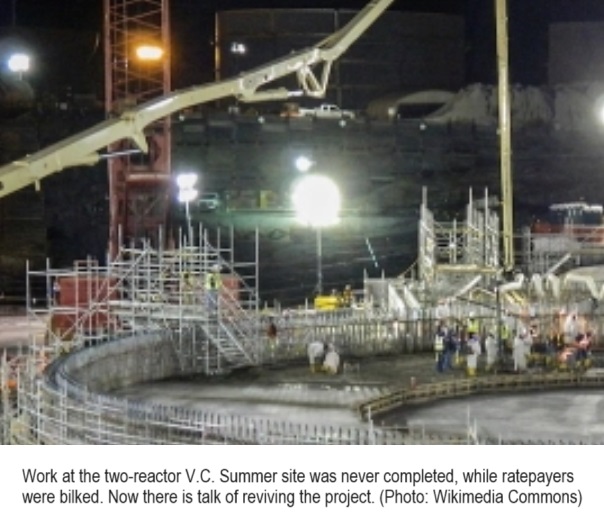
After eight years in the elements, all the equipment and the structure of the plant, which was less than halfway finished, will need to be carefully inspected before it can be used. The permits to build and the licenses to operate the nuclear plants will need to be renewed, likely starting from scratch.
The permits to build and the licenses to operate the nuclear plants will need to be renewed, likely starting from scratch,
the agreement appears to let Brookfield walk away if it decide it’s not feasible.
By ASSOCIATED PRESS, 25 October 2025, https://www.dailymail.co.uk/wires/ap/article-15225007/South-Carolinas-state-utility-says-private-firm-set-restart-abandoned-9-billion-nuclear-project.html
COLUMBIA, S.C. (AP) – South Carolina’s state-owned utility is looking to a private company to revive a project to build two nuclear power plants that was abandoned eight years ago, losing more than $9 billion without generating a watt of power.
Santee Cooper’s board agreed Friday to start six weeks of negotiations with Brookfield Asset Management that they hope will lead to a deal that lets the private company build the nuclear plants at the V.C. Summer site near Jenkinsville at their own risk to generate power that they could mostly sell to whom they want, such as energy-gobbling data centers.
Santee Cooper said Brookfield preliminarily agreed to provide the utility with some of the power generated. But that and probably thousands of other details will have to be negotiated. In a twist, Brookfield took over the assets of Westinghouse Electric Co., which had to declare bankruptcy because of difficulties building new nuclear reactors.
Utility officials said the agreement gives hope the state can get something out of a debacle that led to four executives going to prison or home confinement for lying to regulators, shareholders, ratepayers and investigators and left millions of people paying for decades for a project that never produced electricity.
“The risk to the ratepayer is nil. The risk to the taxpayer is nil,” Santee Cooper Board Chairman Peter McCoy said.
There are still too many hurdles for the project to get past to consider this a win right now, said Tom Clements, executive director of the nuclear watchdog group Savannah River Site Watch.
After eight years in the elements, all the equipment and the structure of the plant, which was less than halfway finished, will need to be carefully inspected before it can be used. The permits to build and the licenses to operate the nuclear plants will need to be renewed, likely starting from scratch, Clements said.
“I still believe that the cost, technical and regulatory hurdles are too big to lead to completion of the project,” Clements said, adding the agreement appears to let Brookfield walk away if it decide it’s not feasible.
Santee Cooper heard from 70 bidders and received 15 formal proposals to restart construction of the reactors. Interest in the project has grown as power demand in the U.S. surges with the increase in data centers as artificial intelligence technology develops.
Santee Cooper executives credited President Donald Trump’s executive order in May calling for the U.S. to quadruple the amount of power generated by nuclear plants over the next 25 years for opening the door to the potential agreement.
“You have placed South Carolina in the epicenter of the resurgence of nuclear power in the United States,” Santee Cooper CEO Jimmy Staton said.
Santee Cooper was the minority partner with what was then South Carolina Electric and Gas when construction on the two new nuclear plants started in 2013 at the V.C. Summer site – about 25 miles (40 kilometers) northeast of Columbia – where SCE&G was already operating a reactor.
The project needed to be finished in seven years to get tax credits to keep the project’s cost from overwhelming the utilities, but it ended up behind schedule almost immediately.
Executives lied about the problems to keep money coming in. Taxpayers and ratepayers ended up on the hook because of a state law that allowed the utilities to charge for costs before any power was generated.
Two nuclear reactors built in a similar way in Georgia went $17 billion over budget before they were fully operational in 2023.
Bannon Says Trump Will Run for an Illegal 3rd Term Because ‘He’s a Vehicle of Divine Providence’

Journalist Mehdi Hasan said Trump and his allies “plan to overturn the Constitution and democracy. They’re not hiding it. They’re bragging about it.”
Stephen Prager, Oct 24, 2025, https://www.commondreams.org/news/bannon-trump-third-term-plan
In a frightening interview, one of President Donald Trump’s top allies said there is a “plan” for the president to remain in power after 2028, despite constitutional limits.
Speaking to a pair of interviewers at The Economist, Steve Bannon—Trump’s former chief strategist and one of the most influential voices in the MAGA movement—described a third Trump term as a divinely ordained fait accompli that people must simply accept.
“Well, he’s gonna get a third term, so Trump ‘28,” Bannon said. “Trump is gonna be president in 2028, and people ought to just get accommodated with that.”
Asked about the 22nd Amendment of the US Constitution, which plainly forbids a president from serving more than two terms in office, Bannon proclaimed that “there are many different alternatives” to get around it.
“At the appropriate time, we’ll lay out what the plan is,” he said. “But there’s a plan. And President Trump will be president in ’28.”
Bannon continued: “We have to finish what we started… I know this will drive you guys crazy, but [Trump] is a vehicle of divine providence. He’s an instrument. He’s very imperfect. He’s not churchy. But he is an instrument of divine will.”
“We need him for at least one more term,” Bannon reiterated, “and he’ll get that in ‘28.”
In recent days, Trump has increasingly signaled his intent to run for a third term, selling “Trump 2028” merchandise on his website and displaying it in the Oval Office during negotiations with Democrats over the government shutdown.
His recent demolition of the White House’s East Wing to build a luxury ballroom has also raised alarms that Trump increasingly views himself as its permanent resident rather than a temporary steward.
Bannon was adamant that Trump would not only serve a third term, but that his staying in office would be “by the will of the American people.”
This assumption is out of line with what polls would seem to predict: Trump’s support recently hit a new low in his second term, with just 37% of voters approving of his job performance in the latest Associated Press-NORC Center for Public Affairs Research poll, compared to 61% who disapprove.
Bannon’s comments came days after the New York Times reported that Trump’s handpicked election officials have called for him to declare a “national emergency” ahead of the 2026 midterm election, which they say would allow him to assert more control over election laws and impose new rules on state and local elections without approval from Congress.
Max Flugrath of the voting rights group Fair Fight Action, who warned earlier this week of Trump’s plans to “hijack” the next elections, said that by pushing for a third term for the president, “Bannon is basically saying, ’Let’s light the Constitution on fire.‘”
Author and activist Jim Stewartson noted that Bannon “uses the same alchemy as [House Speaker] Mike Johnson and [Defense Secretary] Pete Hegseth to rationalize destroying the Constitution: ’spiritual war.‘”
Johnson has argued that the US government “must be biblically sanctioned” and that the Founders’ idea of the separation of church and state was “a misnomer.” Hegseth, meanwhile, has endorsed a video of a far-right pastor discussing the need to repeal the 19th Amendment, which enshrined the right of women to vote.
Some pointed out that Bannon often manages to create a stir in the media by saying provocative things and claiming to have privileged knowledge about the machinations of Trump’s inner circle. It’s not the first time Bannon has raised the possibility of a third Trump term.
“A question that I’ve never seen fully resolved is to what degree Bannon is just trying to get attention as a media figure and to what degree he’s actually clued in to what’s going on in the White House,” said HeatMap News correspondent Matthew Zeitlin.
However, Bannon was in the know about Trump’s plot to overturn the 2020 election well before it happened. Days before the vote, he was recorded telling right-wing allies that “What Trump’s gonna do is just declare victory… He’s gonna declare victory. But that doesn’t mean he’s a winner. He’s just gonna say he’s a winner.”
Others said that Bannon’s prognosis about a third Trump term is gravely serious, especially given Trump’s other actions during his second term.
“I would love to be wrong, but they keep saying this in public,” said writer John DiLillo. “He’s selling Trump 2028 merch. He’s massively remodeling the White House as if it were his personal residence. I don’t really see why the idea shouldn’t be taken seriously just because it’s ’unconstitutional.‘”
Mehdi Hasan, founder of the media outlet Zeteo, meanwhile, said: “They’re literally shouting it out loud! Their plan to overturn the Constitution and democracy. They’re not hiding it. They’re bragging about it. And the media are just ignoring it, or worse, normalizing it; the biggest story perhaps in modern American history.”
Pentagon orders USS Gerald R. Ford into Caribbean, first carrier sent to region
Yahoo News, Nicholas Slayton, Sat, October 25, 2025
The Pentagon ordered the Gerald R. Ford Carrier Strike Group to sail to the Caribbean, adding one of the Navy’s largest and most potent formations to the major U.S. build-up in the region. The new deployment will add the aircraft carrier’s more than 70 aircraft and multiple destroyers to the array of firepower already sent to the region for a mission the White House insists is aimed at drug traffickers.
Pentagon spokesperson Sean Parnell confirmed the deployment in a statement, saying the strike group would be “in support of the President’s directive to dismantle Transnational Criminal Organizations (TCOs) and counter narco-terrorism.”
Carrier Strike Group 12 includes the USS Gerald R. Ford, the destroyers USS Bainbridge and USS Mahan and Carrier Air Wing 8. Their arrival makes this fall’s buildup one of the largest deployments of naval power since the start of the Red Sea conflict in late 2023. The strike group’s air contingent includes four squadrons of F/A-18 fighters and one squadron of E/A-18G strike fighters.
Word of the deployment came shortly after Defense Secretary Pete Hegseth announced another airstrike on a civilian vessel in the Caribbean. Hegseth said the strike killed six on board, a tally which would bring the death toll in U.S. strikes on boats in the region to 43 since September, according to White House figures.
Hegseth accused the crew of being members of the gang Tren de Aragua, a group the administration has often linked to the boats with little public evidence. It was the 10th strike in total, and the third one in as many days.
Governments and media in the region have reported that those killed or wounded in U.S. strikes have included citizens from Colombia, Ecuador, and Trinidad and Tobago. At least two sailors have been rescued by U.S. forces after surviving strikes on their boats, including an Ecuadorian man who was released days later when authorities in his country said there was no evidence of a crime to charge him with.
Earlier this year, the Trump administration designated several gangs and drug cartels as “foreign terrorist organizations,” and accused the Venezuelan government of collaborating with them. The White House has advised Congress that the U.S. is in an “armed conflict” with these gangs, but no Congressional authorization for the use of force has been given……………………………………………………. https://www.yahoo.com/news/articles/pentagon-orders-uss-gerald-r-183731366.html?guccounter=1&guce_referrer=aHR0cHM6Ly93d3cuc290dC5uZXQv&guce_referrer_sig=AQAAAC-xq4OFcery8IiSv68w1zrTr-PmRrn6IBwmoiNxApl6bQszSfDGY6O51M4yAGAU1O90WYXwK-DRaUu0nfau6ncVUnxrYVkwer67gcsHqDulCR8Y2h3pG0HD-S1OJ9NpV1QqBFkaKO0mADBLxw3mgTmEliwGClbGebBO1lPCO-bZ
Stabilizing the U.S.-China Rivalry.

| RAND think tank, famous for its influential policy papers which have shaped US-Russian relations, has released an eye-opening call for a change of course on China. This comes by way of the latest Trump-China escalations which, it appears, have greatly worried insiders of the ‘deep state’ system; enough so that for once they have begun swallowing their pride and envisioning a calmer, more placating approach toward China so as not to upset the global status quo too much. |
Michael J. Mazarr, Amanda Kerrigan, Benjamin Lenain, Oct 14, 2025, https://www.rand.org/pubs/research_reports/RRA4107-1.html?utm_source=substack&utm_medium=email
The geopolitical rivalry between the United States and China embodies risks of outright military conflict, economic warfare, and political subversion, as well as the danger that tensions between the world’s two leading powers will destroy the potential for achieving a global consensus on such issues as climate and artificial intelligence. Moderating this rivalry therefore emerges as a critical goal, both for the United States and China and for the wider world.
The authors of this report propose that, even in the context of intense competition, it might be possible to find limited mechanisms of stabilization across several specific issue areas. They offer specific recommendations both for general stabilization of the rivalry and for three issue areas: Taiwan, the South China Sea, and competition in science and technology.
Key Findings
Several broad principles can guide efforts to stabilize intense rivalries
- Each side accepts that some degree of modus vivendi must necessarily be part of the relationship.
- Each side accepts the essential political legitimacy of the other.
- In specific issue areas, especially those disputed by the two sides, each side works to develop sets of shared rules, norms, institutions, and other tools that create lasting conditions of a stable modus vivendi within that domain over a specific period (such as three to five years).
- Each side practices restraint in the development of capabilities explicitly designed to undermine the deterrent and defensive capabilities of the other in ways that would create an existential risk to its homeland.
Each side accepts some essential list of characteristics of a shared vision of organizing principles for world politics that can provide at least a baseline for an agreed status quo.- There are mechanisms and institutions in place — from long-term personal ties to physical communication links to agreed norms and rules of engagement for crises and risky situations — that help provide a moderating or return-to-stable-equilibrium function.
Recommendations
Six broad-based initiatives can help moderate the intensity of the U.S.-China rivalry
- Clarify U.S. objectives in the rivalry with language that explicitly rejects absolute versions of victory and accepts the legitimacy of the Chinese Communist Party.
- Reestablish several trusted lines of communication between senior officials.
- Improve crisis-management practices, links, and agreements between the two sides.
- Seek specific new agreements — a combination of formal public accords and private understandings — to limit the U.S.-China cyber competition.
Declare mutual acceptance of strategic nuclear deterrence and a willingness to forswear technologies and doctrines that would place the other side’s nuclear deterrent at risk.- Seek modest cooperative ventures on issues of shared interest or humanitarian concern.
More-specific strategies should guide efforts to stabilize the issues of Taiwan, the South China Sea, and competition in science and technology
- Stabilizing the Taiwan issue should focus on creating the maximum incentive for Beijing to pursue gradual approaches toward unification.
- For the South China Sea, combine deterrence of military escalation with intensified multilateral and bilateral diplomacy to create a medium-term route to a peaceful solution as the default international process and expectation.
- In the U.S.-China science and technology rivalry, manage the worst aspects of emerging technologies for mutual security and the condition of the rivalry, and step back from the most extreme versions of efforts to undermine the other side’s progress.
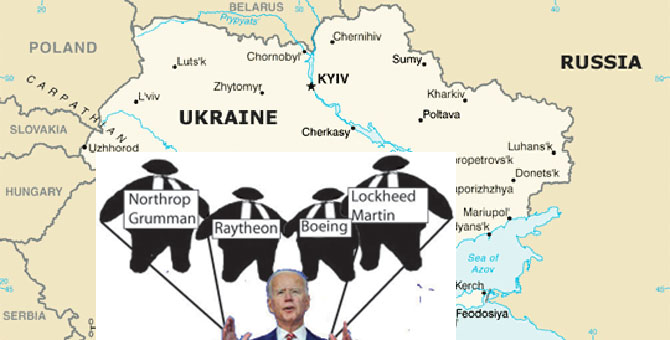
Biden hands off Ukraine war to Trump…who now owns it.
Walt Zlotow, West Suburban Peace Coalition, Glen Ellyn IL, 25 Oct 25
President Biden provoked the Russian invasion of Ukraine for 13 months with reckless NATO expansion before Russia said ‘enough’ and pushed back violently. Biden then spent his last 37 months pouring over $150 billion in military aid which proved worthless in achieving Ukrainian victory. All it did was prolong Ukraine’s suffering with hundreds of thousands dead and wounded in a shattered country.
2024 candidate Trump called out this senseless stupidity for what is was, Biden’s war that Trump wouldn’t have provoked had he won in 2020. He further boasted he’d end it on first day of second term.
Tho Trump largely stopped the direct funding that Biden kept squandering till his last sorrowful day, he’s still selling weapons to the European dead-enders UK, France, Germany and others to gift Ukraine. One day Trump says Ukraine should quit without return of a single lost square mile; next day he claims Ukraine can retrieve it all. One day he ponders sending Ukraine Tomahawk missiles likely to provoke nuclear war; next day he tells Ukraine President Zelensky, who flew 4,867 miles to beg for them…’Faggedaboudit.’
Trump’s got bigger war fish to fry than the lost cause of Ukraine. He’s still supporting Israel’s genocidal ethnic cleansing of Gaza, his fake ceasefire notwithstanding. He’s getting ready to bomb Venezuela, not content with just blasting small, unarmed Venezuelan boats to smithereens. He may be planning another round of air strikes on Iran in his quest at regime change and destabilization there.
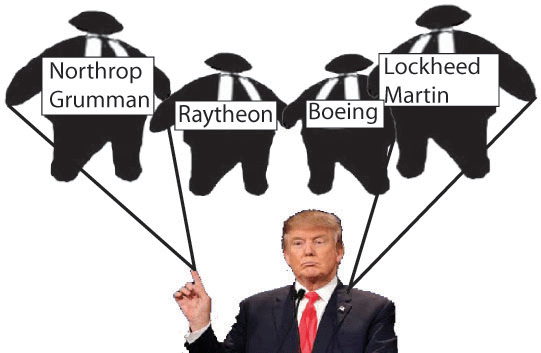
Ukraine will collapse on Trump’ watch. Biden never wavered in support of a war impossible to win. Trump, however, wavered in his boast he would end Biden’s war, allowing it to continue incurring hundreds of thousands more casualties and more lost Ukrainian territory. By so doing, history will record Trump’s ownership of America’s failed proxy war to weaken Russia at the end, as surely as it records Biden’s ownership at the beginning.
Pentagon Creates New Legion of PR Toadies

Malcolm Ferguson (New Republic, 10/22/25): “It should alarm every American that the defense secretary is making an effort to fill the press corps with people who will never hold him accountable.”
Ari Paul, October 24, 2025, https://fair.org/home/pentagon-creates-new-legion-of-pr-toadies/
When the Pentagon announced that reporters would only be credentialed if they pledged not to report on documents not expressly released by official press handlers, free press advocates, including FAIR (9/23/25), denounced the directive as an assault on the First Amendment.
The impact of this rule cannot be understated—any reporter agreeing to such terms is essentially a deputized public relations lackey.
Many journalists, thankfully, displayed solidarity with each other and the idea of a free press when they resisted the state’s new censorship efforts. “Dozens of reporters turned in access badges and exited the Pentagon…rather than agree to government-imposed restrictions on their work,” reported the AP (10/15/25).
CNN’s Brian Stelter (10/15/25) reported:
A flyer with the words “journalism is not a crime” appeared Tuesday on the wall outside the “Correspondents’ Corridor” where journalists operate at the Pentagon. It was a silent protest of Defense Secretary Pete Hegseth’s new policy that severely restricts press access.
The policy criminalizes routine reporting, according to media lawyers and advocates, so news outlets are refusing to abide by it. Instead, they are giving up their access to the building, while vowing to continue thoroughly covering Hegseth and the military from outside the Pentagon’s five walls.
Reuters (10/15/25) noted that it and at least 30 other outlets refused to sign the pledge, citing the others:
Associated Press, Bloomberg News, the New York Times, the Wall Street Journal, the Washington Post, CNN, Fox News, CBS, NBC, ABC, NPR, Axios, Politico, the Guardian, the Atlantic, The Hill, Newsmax, Breaking Defense and Task & Purpose.
Good on these outlets for showing some spine against an administration for whom anti-media bellicosity has been a central feature of its authoritarian impulse. It’s a sign that perhaps at least some of them can toughen up against the administration’s threats against democratic and constitutional order. Even some outlets on the right–Murdoch properties Fox News and Wall Street Journal, and Christopher Ruddy’s Newsmax–declined to be part of Hegseth’s captive news corps.
‘The new Pentagon press corps’
However, the Pentagon is touting the success of its draconian order. “Today, the Department of War is announcing the next generation of the Pentagon press corps,” Pentagon spokesperson Sean Parnell announced on X (10/22/25):
Over 60 journalists, representing a broad spectrum of new media outlets and independent journalists, have signed the Pentagon’s media access policy and will be joining the new Pentagon press corps….
New media outlets and independent journalists have created the formula to circumvent the lies of the mainstream media and get real news directly to the American people. Their reach and impact collectively are far more effective and balanced than the self-righteous media who chose to self-deport from the Pentagon. Americans have largely abandoned digesting their news through the lens of activists who masquerade as journalists in the mainstream media. We look forward to beginning a fresh relationship with members of the new Pentagon press corps.
In fact, this “broad spectrum” of outlets represents the fringes of the right, including One America Network, Epoch Times, Gateway Pundit, Human Events, LindellTV, Frontlines and the National Pulse (New York Times, 10/22/25).
These outlets are old and new. Human Events shaped its worldview in early Cold War nationalism. Frontlines is a project of the late Charlie Kirk’s Turning Point USA. LindellTV is the brainchild of MyPillow CEO and 2020 election denialist Mike Lindell (Guardian, 5/4/25; BBC, 6/19/25).
The Times quoted LindellTV bragging about its elevation into the halls of power in twisted, Orwellian speak: “We are officially part of the new Pentagon press corps, this is a major win for free speech and real journalism.”
The Gateway Pundit blog has been around since 2004, long enough to have pushed birther conspiracy theories before it promoted 2020 stolen election theories. National Pulse (slogan: “radically independent”) is more recent, founded and edited by a former chief advisor to British far-right leader Nigel Farage.
One America Network, which FAIR founder Jeff Cohen observed “makes Fox News sound like Democracy Now!,” was founded in 2013 so that AT&T could add a second right-wing network to its DirecTV platform (FAIR.org, 10/15/21). Epoch Times is affiliated with China’s Falun Gong movement, and comes to its Trumpy politics through Chinese anti-Communism.
Conspiracy outlet InfoWars—famous for losing a $1.4 billion defamation judgement for falsely stating the Sandy Hook Elementary School shooting was faked (Reuters, 10/14/25), as well as something about chemicals turning frogs gay (InfoWars, 8/28/24)—is also reportedly in the revamped press pool. “Breanna Morello is responsible for covering the Pentagon on behalf of Infowars and will do so from outside of DC,” the Hill (10/23/25) reported.
‘Maximum lethality
This new directive didn’t come about in a vacuum; the Pentagon is closing its doors to the press, and by extension the rest of the public, at a time of ramping up violence off the coasts of South America (AP, 10/22/25) and elsewhere. Hegseth couldn’t have been clearer in his recent speech to the military’s top officers when he said the Pentagon’s only mission was “warfighting, preparing for war and preparing to win, unrelenting and uncompromising in that pursuit,” highlighting a focus on “common sense, maximum lethality and authority for warfighters.”
President Donald Trump, despite his claims of ending wars (CNN, 10/17/25), is certainly acting like he wants more war in the future, a crucial development for the public. “Trump Beats the Drums of War for Direct Action in Venezuela,” rang a headline in the Washington Post (10/22/25), with the subhead:
The administration has surged warships, planes and troops to the Caribbean for drug interdiction. Some see the ultimate goal as toppling Venezuelan President Nicolás Maduro.
The Trump administration has already carried out attacks on Iran (Axios, 6/22/25) and Yemen (BBC, 4/18/25). And the administration “continues to expand troop deployments to US cities, escalating a campaign to assert military power at home with little precedent in US history” (Bloomberg, 10/6/25).
The Economist (10/23/25) warned that the Trump administration, which has invoked cartel violence to justify the president’s lethal hostility toward Venezuela (Center for Strategic and International Studies, 10/3/25), was turning the War on Drugs into a full-scale, international military campaign with little restraint. The magazine said:
Past presidents have also stretched their powers to wage wars and even to start them. Indeed, Mr. Trump is gesturing at precedents they set. But “this administration is going further, and going further with less public, detailed defense of what they’re doing,” says Peter Feaver, a political scientist at Duke University. “I think the biggest difference is that Congress is not holding this administration to account in the way that they did even to Trump 1.0, let alone to Biden and to Bush.”
Just because Mr. Trump has labeled some migrants and even leftist opponents as “terrorists” does not mean he will use the armed forces against them. But right now, it’s not clear what, besides his own inclinations, might prevent him.
This new loyalty pledge has now chipped away at another restraint: the press. It is true, as many FAIR readers know, that the Pentagon has sold wars to the public through the establishment media without these draconian credentialing pledges (Extra!, 1–2/90, 11–12/90, 7–8/99; FAIR.org, 3/19/07). However, what we are likely to see now is an army of meme-obsessed, MAGA sycophants posing as independent journalists obediently copy-and-pasting Pentagon press releases into articles, selling an imperialist agenda to the president’s right-wing, nationalist base. That’s chilling news for those of us living here, and for any country that might sit in the crosshairs of the Trump administration’s imperial ambitions.
There is some hope that military reporters will continue to do their jobs and receive information from the inside via channels that exist outside the actual walls of the Pentagon. Atlantic correspondent Nancy Youseff (10/15/25), one of the recently departed from the official pool, said “mid-level troops have been reaching out to me, unsolicited, and promising that they would keep providing journalists with information” in order to “uphold the values embedded in the Constitution.”
If legacy publications are truly horrified by these developments, they will get more creative in their methods of reporting when it comes to the Pentagon’s advances. That can result in more critical and less obedient coverage of the war machine, which would be a good thing, for once.
Trump says he will inform Congress of plans to strike land-based cartel targets in Venezuela

CLG News, Oct 24, 2025. https://legitgov.substack.com/p/trump-says-he-will-inform-congress?utm_source=post-email-title&publication_id=3203936&post_id=176990365&utm_campaign=email-post-title&isFreemail=true&r=1ise1&triedRedirect=true&utm_medium=email
Trump says he will inform Congress of plans to strike land-based cartel targets in Venezuela | 23 Oct 2023 | President Trump said Thursday he will inform Congress of his plans to attack land-based cartel targets in Venezuela as he looks to expand his thus-far seaborne military campaign.
“We’re going to go [to Congress]. I don’t see any loss in going — no reason not to,” Trump told reporters at a White House event touting a federal crackdown that’s arrested roughly 3,200 alleged drug cartel members over the past month. “You know they will always complain, ‘Oh, we should have gone.’ So we’re going to definitely,”
Trump said. Trump has threatened land-based strikes for weeks after the administration on Sept. 2 began targeting vessels smuggling drugs off the Caribbean coast of Venezuela. “I don’t think we’re going to necessarily ask for a declaration of war. I think we’re just going to kill people that are bringing drugs into our country. Okay? We’re going to kill them, you know, they’re going to be like dead, okay?” Trump said.
Trump announces military strike kills narcoterrorists, destroys drug submarine | 18 Oct 2025 | President Donald Trump said Saturday that a U.S. military strike destroyed a “very large drug-carrying submarine” in the Caribbean this week, killing two suspected narcoterrorists and capturing two others alive, while releasing video of the strike.
In a statement posted to Truth Social, Trump said the vessel was carrying mostly “fentanyl and other narcotics” toward the U.S. on a “well known narcotrafficking transit route.” He claimed the interdiction prevented as many as 25,000 American overdose deaths.
“It was my great honor to destroy a very large DRUG-CARRYING SUBMARINE,” Trump wrote. “U.S. Intelligence confirmed this vessel was loaded up with mostly Fentanyl… There were four known narcoterrorists on board. Two of the terrorists were killed. The two surviving terrorists are being returned to their Countries of origin, Ecuador and Colombia, for detention and prosecution.”
-
Archives
- February 2026 (211)
- January 2026 (308)
- December 2025 (358)
- November 2025 (359)
- October 2025 (376)
- September 2025 (258)
- August 2025 (319)
- July 2025 (230)
- June 2025 (348)
- May 2025 (261)
- April 2025 (305)
- March 2025 (319)
-
Categories
- 1
- 1 NUCLEAR ISSUES
- business and costs
- climate change
- culture and arts
- ENERGY
- environment
- health
- history
- indigenous issues
- Legal
- marketing of nuclear
- media
- opposition to nuclear
- PERSONAL STORIES
- politics
- politics international
- Religion and ethics
- safety
- secrets,lies and civil liberties
- spinbuster
- technology
- Uranium
- wastes
- weapons and war
- Women
- 2 WORLD
- ACTION
- AFRICA
- Atrocities
- AUSTRALIA
- Christina's notes
- Christina's themes
- culture and arts
- Events
- Fuk 2022
- Fuk 2023
- Fukushima 2017
- Fukushima 2018
- fukushima 2019
- Fukushima 2020
- Fukushima 2021
- general
- global warming
- Humour (God we need it)
- Nuclear
- RARE EARTHS
- Reference
- resources – print
- Resources -audiovicual
- Weekly Newsletter
- World
- World Nuclear
- YouTube
-
RSS
Entries RSS
Comments RSS
 nuclear-news