Beleagured Vogtle nuclear project delayed yet again
Southern Co.’s beleaguered Vogtle nuclear project is getting pushed back
again after the company discovered documentation issues that will delay
completion by as much as six months, prompting a $920 million charge.
The Unit 3 reactor may not go into service until March 2023 and Unit 4 may not
be complete until the end of next year, Chief Executive Officer Thomas
Fanning said in an interview Thursday. The delays are yet another setback
for the only nuclear plant under construction in the U.S.
The Vogtle project in Georgia is now about seven years behind schedule and costs have
doubled. The project will be the first new nuclear units built in the
country in the last three decades.
Bloomberg 17th Feb 2022
USA’s Department of Energy (DOE) will give $6 Billion in a program to to stop uneconomic nuclear reactors from closing down

DOE to offer $6B to keep struggling nuclear reactors online, Utility Dive Feb. 16, 2022 By Jason Plautz
Dive Brief:
- The Department of Energy (DOE) will spend $6 billion on a program designed to keep nuclear power plants from closing, according to a notice of intent published last week.
- The department’s Civil Nuclear Credit Program is backed by funding from the bipartisan Infrastructure Investment and Jobs Act signed into law in November. The program will allow owners and operators of commercial U.S. nuclear reactors to competitively bid on credits to help continue their operations amid economic hardship.
…………. The Notice of Intent and Request for Information released by the DOE Friday will help the department learn more about priorities for the program and certification process, which the administration anticipates launching later this year. ……………….. https://www.utilitydive.com/news/doe-to-offer-6-billion-to-keep-struggling-nuclear-reactors-online/618919/
MPs and groups oppose hearings to license Canada’s first permanent radioactive waste dump.
 | |||
MPs and groups oppose hearings to license Canada’s first permanent radioactive waste dump
MPs and groups oppose hearings to license Canada’s first permanent radioactive waste dump, https://concernedcitizens.net/2022/02/16/mps-and-groups-oppose-hearings-to-license-canadas-first-permanent-radioactive-waste-dump/ OTTAWA, February 16, 2022 – Members of Parliament and 50 environmental and citizen groups are opposed to the Canadian Nuclear Safety Commission (CNSC)’s forthcoming hearings to license Canada’s first permanent “disposal” facility for radioactive waste.
A statement calling for suspension of the hearings is signed by three MPs: Laurel Collins, NDP environment critic; Elizabeth May, Parliamentary Leader of the Green Party of Canada; and Monique Pauzé, environment spokesperson for the Bloc Québécois.
Union signatories of the statement include Canadian Union of Public Employees (CUPE) – Québec, Fédération des travailleurs et des travailleuses du Québec (FTQ) and the Unifor Québec Health, Safety and Environment Committee Unifor.
Other signatories include Friends of the Earth, Canadian Association of Physicians for the Environment, Ralliement contre la pollution radioactive, National Council of Women of Canada, Ontario Clean Air Alliance, and Quebec’s Front commun pour la transition énergétique. Ottawa Valley groups include Concerned Citizens of Renfrew County and Area, Old Fort William Cottagers’ Association, Action Climat Outaouais, and Pontiac Environmental Protection, among others.
On January 31, the Kebaowek First Nation asked that the hearings be halted until a consultation framework between them and the CNSC is in place. The hearings are for authorization to build a “Near Surface Disposal Facility” for nuclear waste at Chalk River, Ontario, on unceded Algonquin Anishinaabeg lands alongside the Ottawa River.
The CNSC staff report recommends licensing the construction of the mound for 1 million cubic metres of radioactive and toxic wastes accumulated by the federal government since 1945. The CNSC has scheduled licensing hearings on February 22 and May 31. No separate environmental assessment hearing is scheduled.
The proposed facility would be an aboveground mound a kilometre from the Ottawa River, upstream from Ottawa and Montréal. 140 municipalities have opposed the project and fear contamination of drinking water and the watershed.
In 2017, the CNSC received 400 submissions responding to its environmental impact statement, the overwhelming majority of them opposed to the plan.
Opposition to Holtec dumping nuclear waste into Cape Cod Bay
Preventing nuclear wastewater dumping, MV Times, By Eunki Seonwoo, February 16, 2022 The Aquinnah select board was in favor of Mara Duncan’s request for a non-binding ballot question. Duncan’s ballot question was for Holtec International, owner of the Pilgrim Nuclear Power Plant in Plymouth, decommissioned in 2019, not to discharge nuclear waste into Cape Cod Bay.
Federal leaders from Massachusetts — Senators Edward Markey and Elizabeth Warren, as well as U.S. Reps. Seth Moulton and Bill Keating — have expressed opposition to Holtec dumping nuclear wastewater into the bay in a letter they wrote in January.
When evaluating the proper method of disposal, Holtec must consider the public’s concerns surrounding and perception of the release of irradiated material into Cape Cod, especially when viable alternatives are available,” the letter reads.
Duncan told the board a number of groups, such as Physicians for Social Responsibility and the fishing industry, are against the dumping. Holtec has other disposal methods. “It is their cheapest option, obviously. It is very easy to open up just open the [lid] and let it spill,” Duncan said. …………….. https://www.mvtimes.com/2022/02/16/preventing-nuclear-wastewater-dumping/
Temporary spent nuclear fuel storage isn’t temporary.

It is difficult to believe the nuclear power industry and the federal government are so unethical that they would defer the difficult and dangerous task of spent nuclear fuel disposal to future generations of Americans. The present generation must find a permanent disposal solution.
Temporary spent nuclear fuel storage isn’t temporary https://www.santafenewmexican.com/opinion/my_view/temporary-spent-nuclear-fuel-storage-isnt-temporary/article_068d44e0-854c-11ec-b25d-a70bff5372b1.htmll By Dennis McQuillan, 13 Feb 22, The proposal to “store” spent nuclear fuel in New Mexico is a Trojan horse that will defeat the goal of geologically isolating this highly radioactive and chemically toxic material, and create hazards to future generations of Americans.
At face value, the plan is to consolidate up to 10,000 canisters of spent nuclear fuel from nuclear power plants across the United States, store them in New Mexico for decades or even a century, and transport them to an undetermined permanent disposal facility that the federal government will someday establish.
In reality, after more than six decades of using nuclear power to generate electricity and amassing 90,000 metric tons of spent nuclear fuel, neither the industry nor the federal government has established a permanent repository for the fuel. Moreover, after Nevada stakeholders rejected the Yucca Mountain site, federal funding and efforts to find another potential spent nuclear fuel repository ended in 2010.
The citizens of New Mexico have every reason to doubt that deposits at the interim storage facility would ever be moved. Even if a future repository is established, there is no guarantee the funding and determination to dig up and relocate 10,000 canisters of spent nuclear fuel would exist at that time.
What is certain is this: Spent nuclear fuel will remain dangerous for hundreds of thousands of years, and the interim storage facility will not provide geologic isolation.
As proposed, the fuel would be buried at depths less than 100 feet in young alluvium in a region with shallow groundwater, land subsidence and sinkholes, amid one of the most prolific oil patches in the nation. By contrast, radioactive waste generated by national defense activities is isolated 2,150 feet underground, in 250-million-year-old salt beds, at the Waste Isolation Pilot Plant. The proposed interim storage facility is geologically unsuitable even for a period of decades.
It is difficult to believe the nuclear power industry and the federal government are so unethical that they would defer the difficult and dangerous task of spent nuclear fuel disposal to future generations of Americans. The present generation has benefited from electricity generated by nuclear power, and the present generation must find a permanent disposal solution.
New Mexico executive agencies, Attorney General Hector Balderas, state Sen. Jeff Steinborn, Reps. Matthew McQueen, Tara Lujan and other state legislators, are working to stop this geologically unsound, dangerous, unethical and disingenuous proposal to “store” spent nuclear fuel in New Mexico. But federal action is necessary. Congress urgently needs to give the federal government a statutory directive, and funding, to complete the mission of finding a permanent repository for the geologic isolation of spent nuclear fuel. Dennis McQuillan is the former chief scientist of the New Mexico Environment Department and lives in Santa Fe.
The RAND Corporation’s plan for regime change in Moscow.
RAND Corporation study calls for regime change in Moscow, http://space4peace.blogspot.com/2022/02/rand-corporation-study-calls-for-regime.html Bruce Gagnon,13 Feb 22,
Obama’s ambassador to Ukraine made a trip to US-NATO training base in western Ukraine (where the Nazis predominate). US Special Forces are rotated into the base from Ft. Carson, Colorado to train the Kiev regime’s Army. Many of the Nazis have been brought into this ‘new military unit’.
More than 27 million people in the former Soviet Union died during Hitler’s WW II invasion. Imagine how Russians today feel when they see the US arming, training and directing Nazi forces to attack the Russian-ethnic citizens living in the Donbass region of Ukraine, right next to the Russian border.
Imagine how Moscow felt when they first read this RAND Corporation study. When we look at current events can we notice the direct connection to the points from this study listed below? Whether it is US-NATO military expansion right up to Russian borders or efforts by Washington to kill the Nordstream 2 natural gas pipeline from Russia to Germany – it is clear that there is a method behind US-NATO madness. If you were sitting in Russia’s shoes how would you react to these proposals below – many of which have been or are now being implemented?
Despite these vulnerabilities and anxieties, Russia remains a powerful country that still manages to be a U.S. peer competitor in a few key domains. Recognizing that some level of competition with Russia is inevitable, RAND researchers conducted a qualitative assessment of “cost-imposing options” that could unbalance and overextend Russia.
Continue readingEntergy nuclear plant accused of overcharging ratepayers – customers could now get $millions on refunds.

there are also allegations that the utility is living high on the hog and trying to stick ratepayers with the bill. Among other charges, regulators questioned Entergy’s expenses for $1.6 million of private airplane travel, lobbying expenses, advertisements promoting Entergy and industry association dues. The PSC said Entergy has improperly assessed ratepayers for those expenses.
Growing fight over Entergy nuclear plant could net millions in refunds for customers. Probe over accounting at Grand Gulf has spawned a litany of allegations, BY SAM KARLIN THE ADVOCATE STAFF WRITER, FEB 11, 2022 –
A probe over Entergy’s accounting at its Grand Gulf nuclear power plant in Mississippi has morphed into a larger fight between regulators and the power company, which is accused of overcharging ratepayers at its various subsidiaries hundreds of millions of dollars over a period of several years.
If the Louisiana Public Service Commission and other regulators prevail in the three main probes now open before the Federal Energy Regulatory Commission, or FERC, Entergy could be forced to pay customers substantial refunds.
What started as an obscure probe into arcane accounting practices has turned into a broader battle – over tax maneuvers, compensation for executives and the plant’s performance – the latter of which has drawn in former FERC commissioners and even Mississippi Gov. Tate Reeves, who wrote a letter to the commission about Grand Gulf’s economic impact to his state.
The potential refunds could amount to $1 billion or more across Entergy’s network if FERC sides with regulators across the board, which could mean hundreds of dollars for each affected customer. Regulators in one of the cases already won a favorable recommendation from a judge, who advised FERC to make Entergy pay back $422 million to customers, plus interest, for one of the allegations, likely bringing the tally for that case alone to over $600 million, according to an SEC filing Entergy made late last year.
The judge made that recommendation in April 2020. FERC hasn’t yet made a decision on the case.
Customers of Entergy Louisiana and Entergy New Orleans would split the refunds with ratepayers in Mississippi and Arkansas – a group that totals about 2.5 million customers. Entergy Louisiana and New Orleans customers would get roughly 14% and 17% of the total refunds, respectively, according to the best estimates available in FERC filings…………………………………
The PSC, which regulates Entergy Louisiana, filed a complaint in 2018 accusing the company of violating accounting rules by overbilling ratepayers for a sale-leaseback arrangement – where Entergy sold assets and leased them back from the new owner. Entergy owns 90% of Grand Gulf through a subsidiary called SERI, while Cooperative Energy of Mississippi owns the other 10%.
While investigating that complaint, regulators say they uncovered a host of accounting practices that, taken together, amount to a scheme to systematically overcharge electric customers who get power from Grand Gulf. Among those allegations is essentially that Entergy charged ratepayers more for taxes than it was paying. …………..
there are also allegations that the utility is living high on the hog and trying to stick ratepayers with the bill. Among other charges, regulators questioned Entergy’s expenses for $1.6 million of private airplane travel, lobbying expenses, advertisements promoting Entergy and industry association dues. The PSC said Entergy has improperly assessed ratepayers for those expenses.
Complaints turn to performance issues
Last year, the inquiry widened further. The PSC, the New Orleans City Council and regulators in Arkansas and Mississippi filed a new complaint asking FERC to force Entergy to reimburse customers for a host of glaring performance problems at the nuclear plant – the least reliable nuclear plant in the nation from 2018-2020, according to figures compiled by the Nuclear Energy Institute. The figures showed Grand Gulf was running at full power less frequently than any other nuclear plant in the U.S.………………..
Grand Gulf, which was built in the 1970s, has been troubled from the start. Its two units were budgeted to cost $1.2 billion, but its first unit wound up costing nearly $3 billion. The energy it produced when it went online was about 13 cents per kilowatt hour, well above the typical price of power of about 3 cents per kilowatt hour, according to a FERC filing made by the PSC.
“Grand Gulf has been a bad apple since the late 1970s,” said Logan Burke, head of the Alliance for Affordable Energy. “The costs to run it are going up, benefits from running it are going down, and customers are kind of stuck paying for this thing.” https://www.theadvocate.com/baton_rouge/news/article_6e99be86-8b7a-11ec-8155-e3988c8fc7b3.html
Furthest from Ukraine frontline, Washington is most eager for war

Washington intends to instigate wars, in a bid to increase the legitimacy of NATO’s existence and the bloc’s internal cohesion to tie Europe – which has shown some signs of departing from Washington – more tightly to the US. Some other analysts say the US can take the opportunity to sell arms – a reasonable suspicion based on history.
Furthest from Ukraine frontline, Washington is most eager for war: Global Times editorial, By Global Times, Feb 07, US President Joe Biden recently approved the deployment of 3,000 US troops to the eastern part of Europe. The first batch has arrived in Germany and Poland. This is an eye-offending move the US made after it withdrew its troops from Afghanistan and Iraq. The Pentagon previously announced that 8,500 US troops are placed on heightened alert to possibly deploy to Eastern Europe. In addition, NATO defense ministers will discuss further reinforcements at their next meeting on February 16 and 17. Although these troops are not deployed directly in Ukraine, the move has de facto made people think Eastern Europe is on the brink of war.
Washington, it must be noted, is furthest away from the Ukrainian frontline but it is most eager for a war, while both Russia and Ukraine have repeatedly announced they have no intention of going to war or solving their problems by force. Ukraine’s president and defense minister publicly stated that the situation is not as tense as the US has portrayed. But Washington, which is far away from the region, has been hyping that war is on the verge of breaking out. US media Bloomberg has even released fake news that “Live: Russia Invades Ukraine.” The US has not only fanned the flames of public opinion, but also provided arms to Ukraine and enhanced military deployment around the European country. The US’ intention is to urge Ukraine to “hold on” and not “fall behind” in its confrontation with Russia.
| |||
Washington intends to instigate wars, in a bid to increase the legitimacy of NATO’s existence and the bloc’s internal cohesion to tie Europe – which has shown some signs of departing from Washington – more tightly to the US. Some other analysts say the US can take the opportunity to sell arms – a reasonable suspicion based on history.
In short, the US is trying to hit various birds with one stone, but it is playing an immoral and dangerous game. The New York Times reported that “even many reliably hawkish voices in both parties show no appetite for seeing US troops fight and potentially die for Ukraine.” The US is pushing Ukraine into the firing line, but it itself has jumped aside to avoid being implicated.
One of Washington’s aims is to make Russia feel uncomfortable, but Ukraine is very likely to become the victim. Anyone with a discerning eye can figure out that the last thing Ukraine really needs is arms. The US’ donating or selling weapons to Ukraine cannot change the military balance between Russia and Ukraine. What Ukraine does need is a peaceful and stable internal and external environment. The country has to focus on developing its economy, improving people’s livelihoods, and easing tensions with Russia. If the US “stands with Ukraine” as it has claimed, it should have provided Ukraine the necessary and substantial help in these fields. It needs to be underlined that the most difficult thing for Ukraine to withstand right now is to add fuel to the fire, but Washington has repeatedly “created” opportunities to escalate the situation between Russia and Ukraine.
……………. the China-Russia joint statement stated clearly: “Peace, development and cooperation lie at the core of the modern international system… and the international community is showing a growing demand for the leadership aiming at peaceful and gradual development.”
Against this backdrop, Washington still intends to impair other countries and maintain its hegemony by instigating wars. This is a staggering geopolitical daydream. To wake up from such a pipe dream, the bunch of political elites in Washington should carefully read this joint statement and understand how to make the US conform to the trend of the times and become a truly responsible power. https://www.globaltimes.cn/page/202202/1251577.shtml
Safety concerns as counterfeit parts found in U.S. nuclear reactors.

Counterfeit parts have been discovered in U.S. nuclear plants, potentially increasing the risk of a safety failure, the inspector general of the federal nuclear industry regulator said in a report released on Thursday.
The report is a blow to a U.S nuclear industry that has shrunk in recent years due to competition from renewable power and plants that burn natural gas and lingering public concerns following high-profile mishaps includinga 2011 tsunami at Japan’s Fukushima plant.
“Counterfeit parts are safety and security concerns that could have serious consequences in critical
power plant equipment required to perform a safety function,” the report from the inspector general’s office of the Nuclear Regulatory Commission
(NRC) said.
Reuters 10th Feb 2022
What You Should REALLY Know About Ukraine

“the United States is standing with missiles on our doorstep.” Putin asked, “How would the Americans react if missiles were placed at the border with Canada or Mexico?”
The US Wants to Expand NATO In addition to integrating Ukraine into the US-dominated economic sphere, Western planners also want to integrate Ukraine militarily. For years, the US has sought the expansion of NATO, an explicitly anti-Russian military alliance. NATO was originally billed as a counterforce to the Warsaw Pact during the Cold War, but after the demise of the Soviet Union, the US promised the new Russia that it would not expand NATO east of Germany. Despite this agreement, the US continued building out its military alliance,growing closer and closer to Russia’s borders and ignoring Russia’s objections.
The West Wants Investor-Friendly Policies in Ukraine The backdrop to the 2014 coup and annexation cannot be understood without looking at the US strategy to open Ukrainian markets to foreign investors and give control of its economy to giant multinational corporations
The US Helped Overthrow Ukraine’s Elected President……. US Officials Were Caught Picking the New Government …
Washington Used Nazis to Help Overthrow the Government The Washington-backed opposition that toppled the government was fueled by far-right and openly Nazi elements like the Right Sector. One far-right group that grew out of the protests was the Azov Battalion, a paramilitary militia of neo-Nazi extremists.
What You Should Really Know About Ukraine https://fair.org/home/what-you-should-really-know-about-ukraine/, BRYCE GREENE 28 Jan 22, As tensions began to rise over Ukraine, US media produced a stream of articles attempting to explain the situation with headlines like “Ukraine Explained” (New York Times, 12/8/21) and “What You Need to Know About Tensions Between Ukraine and Russia” (Washington Post, 11/26/21). Sidebars would have notes that tried to provide context for the current headlines. But to truly understand this crisis, you would need to know much more than what these articles offered.These “explainer” pieces are emblematic of Ukraine coverage in the rest of corporate media, which almost universally gave a pro-Western view of US/Russia relations and the history behind them. Media echoed the point of view of those who believe the US should have an active role in Ukrainian politics and enforce its perspective through military threats.
The official line goes something like this: Russia is challenging NATO and the “international rules-based order” by threatening to invade Ukraine, and the Biden administration needed to deter Russia by providing more security guarantees to the Zelensky government. The official account seizes on Russia’s 2014 annexation of Ukraine’s Crimean peninsula as a starting point for US/Russian relations, and as evidence of Putin’s goals of rebuilding Russia’s long-lost empire.
Russia’s demand that NATO cease its expansion to Russia’s borders is viewed as such an obviously impossible demand that it can only be understood as a pretext to invade Ukraine. Therefore, the US should send weapons and troops to Ukraine, and guarantee its security with military threats to Russia (FAIR.org, 1/15/22).
Continue readingEnvironmental Working Group (EWG) urges Biden to reject ‘outrageous’ call for more nuclear power subsidies in clean energy agenda

“Nuclear power is truly an example of privatizing profits and socializing risks.”
EWG urges Biden to reject electric utility executives’ call for more nuclear power subsidies in clean energy agenda. https://www.ewg.org/news-insights/news-release/2022/02/ewg-urges-biden-reject-electric-utility-executives-call-more WASHINGTON – President Joe Biden is meeting today with top executives from several investor-owned electric utilities who want Congress to approve vital clean energy tax credits as part of Biden’s Build Back Better agenda. But they are also seeking new federal subsidies for existing nuclear power plants that the Environmental Working Group is urging the president to oppose.“Nuclear power is truly an example of privatizing profits and socializing risks.”
The Build Back Better plan is a broad infrastructure proposal and includes some important tax credits that the utilities support. They would help expand utility-scale solar projects and boost sales of electric vehicles, crucial steps in fighting the climate emergency.
But the call for wasting more federal tax dollars propping up uneconomic and dangerous nuclear power plants too is an outrageous request, noted EWG.
“Nuclear power is a relic of the electricity sector, and a dangerous and extremely expensive one that has cost taxpayers billions of dollars,” said EWG President Ken Cook. “The federal government must stop throwing away money propping up the nuclear industry and instead make critical investments to expand safe, clean renewable energy.”
“President Biden and congressional leaders can and should unravel the federal government’s long history of pouring scarce resources into this failed industry and its legacy of radioactive waste and the enormous threat it poses to the public,” said Cook.
Nuclear power has never been financially viable and never will be, so new subsidies make no sense. It has the distinction of a permanent negative learning curve – costs always rise and never decline – despite 60 years of taxpayer-funded research and development, construction risks dumped onto ratepayers to lure private financing, a series of bailouts worth tens of billions to the industry, and billions wasted on upgrades to keep aging power plants running that could have been much more wisely spent replacing them.
“It is time to systematically replace nuclear power with modern clean energy technology and to stop burdening ratepayers and taxpayers with this financial albatross,” said Cook. “Nuclear power is truly an example of privatizing profits and socializing risks.”
In its 2021“None of the Above” series calling out dirty and dangerous power sources that should quickly be replaced by clean, safe and renewable energy, such as solar and wind, EWG likened nuclear power to “nothing more than a public works project with no prospects for the future that has failed financially while generating huge amounts of radioactive waste, with no viable method of disposal, that will linger for thousands of years.”
The Environmental Working Group is a nonprofit, non-partisan organization that empowers people to live healthier lives in a healthier environment. Through research, advocacy and unique education tools, EWG drives consumer choice and civic action. Visit www.ewg.org for more information.
Ahead of regulatory approval the US Dept of Energy wants Govt to grant $4 billion for Small Nuclear Reactors development

Bloomberg Business Week, 7 Feb 22, –………………………… Congress has ordered the Nuclear Regulatory Commission to replace a rules framework that dates to the 1950s. The new guidelines aren’t expected until at least 2025……… To prove the safety of designs, for instance, the commission demands data from similar plants, but none of the smaller installations have been built in the U.S., so there’s no performance history.
……….. the U.S. Department of Energy has gotten ahead of the NRC. The department is asking Congress for as much as $4 billion over seven years for advanced reactor development.
Beneficiaries include TerraPower, a startup founded by Bill Gates that’s working on a project in Wyoming; X-energy, which is planning a high-temperature, gas-cooled reactor in Washington state; and Kairos Power, which aims to build a 35-megawatt salt-cooled test reactor in Tennessee and applied for a construction license last September.
…………… these plants face staunch opposition. Environmental groups say that small reactors—some have a capacity of only 1.5MW, about 0.1% the size of a traditional plant—still produce enough radioactive material to present a contamination risk. And building more plants, even small ones, will add to the pile of toxic waste that no one can figure out what do with. “To the extent that there will be efforts to weaken the regulatory envelope, we will aggressively push back,” says Geoff Fettus, an attorney with the Natural Resources Defense Council.
Globally, more than 70 small modular reactors, with a total capacity of about 12 gigawatts, have been proposed or are under development in at least five countries, according to the International Atomic Energy Agency. The only one that’s been built is a floating reactor in the Russian town of Pevek, on the Arctic Sea, where it’s used to power mining operations. Gregory Jaczko, who served as NRC chair from 2009 to 2012, says the lack of movement on such plants around the world suggests we would be wrong to count on them as a way out of the climate crisis. “They’re just not ready,” he says. “And by the time they could be ready, they’re not going to be useful.”
UK’s nuclear submarine graveyard- but one is to be recycled – perhaps for Australia?

The first vessel that’s going to be recycled from the so-called ‘submarine graveyard’ in Devonport has been named – but there’s no word yet on when it’ll actually happen. The last one was decommissioned in 1980 – but thirteen of them remain tied up there. HMS Valiant will be the first to be recycled – but no date’s been set for that yet. Planet Radio 9th Feb 2022
Planet Radio 9th Feb 2022
https://planetradio.co.uk/greatest-hits/devon/news/nuclear-submarine-recycled-devonport/
A big pile of Plutonium – UK reprocessing ceases, leaving deadly waste and no plan

in the end, reprocessing became a commercial venture rather than producing anything useful. Nine countries sent spent fuel to Sellafield to have plutonium and uranium extracted for reuse and paid a great deal of money to do so. In reality, very little of either metal has ever been used because mixed oxide fuels were too expensive, and fast breeder reactors could never be scaled up sufficiently to be economic.
UK reprocessing ceases, leaving deadly waste and no plan
A big pile of PU — Beyond Nuclear International https://beyondnuclearinternational.org/2022/02/06/a-big-pile-of-pu/120 tons of plutonium is legacy of Britain’s dirty decades of reprocessing, By Paul Brown, The Energy Mix
Seventy years after the United Kingdom first began extracting plutonium from spent uranium fuel to make nuclear weapons, the industry is finally calling a halt to reprocessing, leaving the country with 120 tons of the metal, the biggest stockpile in the world. However, the government has no idea what to do with it.
Having spent hundreds of billions of pounds producing plutonium in a series of plants at Sellafield in the Lake District, the UK policy is to store it indefinitely—or until it can come up with a better idea. There is also 90,000 tons of less dangerous depleted uranium in warehouses in the UK, also without an end use.
Plans to use plutonium in fast breeder reactors and then mixed with uranium as a fuel for existing fission reactors have long ago been abandoned as too expensive, unworkable, or sometimes both. Even burning plutonium as a fuel, while technically possible, is very costly.
The closing of the last reprocessing plant, as with all nuclear endeavours, does not mean the end of the industry, in fact it will take at least another century to dismantle the many buildings and clean up the waste. In the meantime, it is costing £3 billion a year to keep the site safe.
Perhaps one of the strangest aspects of this story to outside observers is that, apart from a minority of anti-nuclear campaigners, this plutonium factory in one of prettiest parts of England hardly ever gets discussed or mentioned by the UK’s two main political parties. Neither has ever objected to what seems on paper to be a colossal waste of money.
Continue readingNuclear baloney in today’s media

Majority support for nuclear energy — which does not appear to be the case publicly, even if it is so politically — is a clear testament to the power of well-funded propaganda campaigns and the deep pockets of lobbyists. None of us engaged on this subject have missed the saturation media campaign, on-going now for months if not years, that sows the erroneous notion in the heads of politicians that nuclear power is an answer — even the answer — to climate change.
Repeat a lie often enough and people will believe it. Today’s media has become especially guilty of this. I recently had to correct a Financial Times reporter who, in an otherwise perfectly good article, described nuclear power as having “no carbon footprint.” There is no stop-and-think going on here. After all, even renewable energy does not have “no” carbon footprint.
Nuclear waste risks can be “minimized” and other myths
Nuclear baloney — Beyond Nuclear International AP story on states’ nuclear choice fails to point out key realities
By Linda Pentz Gunter, 6 Feb 2,
There are geniuses amongst us. We just didn’t know it. They are the supporters of nuclear power, who, according to the Associated Press, “say the risks can be minimized” when it comes to the perpetual and unsolved problem of long-lived, high-level radioactive waste — the main by-product of generating electricity using nuclear power.
This observation comes within an AP story headlined: “Majority of US states pursue nuclear power for emission cuts”, and which has garnered significant pickup in numerous media outlets. (However, we never do learn the secret to precisely how nuclear waste risks can be “minimized”.)
The agency surveyed “the energy policies in all 50 states and the District of Columbia,” finding that “about two-thirds” plan to use nuclear power to replace fossil fuels.
The mantra about solving the nuclear waste problem has been repeated since the dawn of the Nuclear Age, coming up on 80 years this December. That was when, on December 2, 1942, the first cupful of radioactive waste was generated, a result of the first self-sustaining nuclear chain reaction achieved at the Chicago Pile-1 by Enrico Fermi and his team.
At that time, scientists knew that radioactive waste was a problem, but assumed it would be solved later. Well, here we are at “later” and it’s still unsolved. Now, “minimizing” rather than solving the problem is apparently justification enough to keep using this dangerous technology.
The AP reporters chose Tennessee Valley Authority (TVA) President and CEO, Jeff Lash (no vested interest there), as the spokesperson for the continued use of nuclear power and says he,“puts it simply” when stating: “You can’t significantly reduce carbon emissions without nuclear power.”
But, of course, it’s not that simple. It’s also arguably dead wrong. As Stanford University’s Amory Lovins and others have demonstrated repeatedly:
“To protect the climate, we must save the most carbon at the least cost and in the least time, counting all three variables – carbon and cost and time.
“Costly options save less carbon per dollar than cheaper options. Slow options save less carbon per year than faster options. Thus even a low- or no-carbon option that is too costly or too slow will reduce and retard achievable climate protection. Being carbon-free does not establish climate-effectiveness.
“To compare nuclear power with other potential climate solutions we should start with two criteria – cost and speed – because if nuclear power has no business case or takes too long, we need not address its other merits or drawbacks.”
The three TVA plants are at Browns Ferry in Alabama, and Sequoyah and Watts Bar, both in Tennessee. The two Watts Bar reactors produce tritium for the nuclear weapons sector — a clear crossing of the supposedly inviolable line between the civilian and military nuclear sectors.
Sequoyah 1 and 2 have also been licensed to produce tritium but, so far, TVA has chosen not to use them for that purpose.
TVA is also, right now, pushing federal regulators to allow it to increase its output of tritium, an essential radioisotope used in thermonuclear warheads to boost the explosive power of an atomic bomb.
As Tom Clements, executive director of the Savannah River Site Watch, told the Chattanooga Times Free Press:
“Using commercial nuclear reactors to produce nuclear weapons materials is a violation of the international nonproliferation agreements.”
Watts Bar 1 has been involved in tritium production for close to 20 years. Meanwhile, Watts Bar 2 holds the unenviable record of taking the longest time ever — a staggering 42 years — between the start of construction and actual operation. It is the poster child for the argument against trying to deliver new nuclear plants as some sort of answer to an urgent climate crisis already upon us that must be addressed today.
Nevertheless, when Watts Bar 2 came on line in October 2016, TVA actually heralded it as “the first new nuclear generation in 20 years.” If a 42-year old reactor is the definition of “new”, then maybe we should all go back to driving Chevrolet Monte Carlos.
The unnamed survey respondents from the state of Georgia apparently told AP that their “nuclear reactor expansion will provide ‘ample clean energy’ for 60 to 80 years”.
But again, there is no context to this bold prediction. In reality, that “expansion” consists
of the only two survivors of another nuclear myth, the U.S. “Nuclear Renaissance”, always an aspiration and never a reality.
The Georgia reactors, Vogtle 3 and 4, have now been under construction since 2013. Their completion dates have been repeatedly pushed into the future — 2024 is the current, optimistic prediction, but it’s equally possible that both reactors will never achieve operational status.
Meanwhile, the costs for Vogtle 3 and 4 are predicted to balloon to $30 billion, while ratepayers, already paying more to cover these excesses, will see their monthly bills double if and when the reactors come on line. Imagine the “ample clean energy” that might have already been producing electricity in Georgia, if a renewable energy program had been initiated in 2013 instead of the nuclear boondoggle.
Majority support for nuclear energy — which does not appear to be the case publicly, even if it is so politically — is a clear testament to the power of well-funded propaganda campaigns and the deep pockets of lobbyists. None of us engaged on this subject have missed the saturation media campaign, on-going now for months if not years, that sows the erroneous notion in the heads of politicians that nuclear power is an answer — even the answer — to climate change.
Repeat a lie often enough and people will believe it. Today’s media has become especially guilty of this. I recently had to correct a Financial Times reporter who, in an otherwise perfectly good article, described nuclear power as having “no carbon footprint.” There is no stop-and-think going on here. After all, even renewable energy does not have “no” carbon footprint.
As John Le Carré wrote in his 1996 book, The Tailor of Panama, paraphrased from the mouth of one of his more cynical characters:
Nothing is more predictable than the media’s parroting of its own fictions and the terror of each competitor that it will be scooped by the others, whether or not the story is true, because quite frankly dears, in the news game these days, we don’t have the staff, time, interest, energy, literacy or minimal sense of responsibility to check our facts by any means except calling up whatever has been written by other hacks on the same subject and repeating it as gospel”.
Fortunately, there remain some good investigative reporters amongst the lapdogs. But our task is made all the harder by that constant parroting of nuclear propaganda as if it is gospel. We have an uphill climb to change it, but we must keep climbing.
This article first appeared on Counterpunch.
1 This Month
26 April – Chernobyl: Inside the Meltdown airs on National Geographic on Sunday 26th April from 4pm

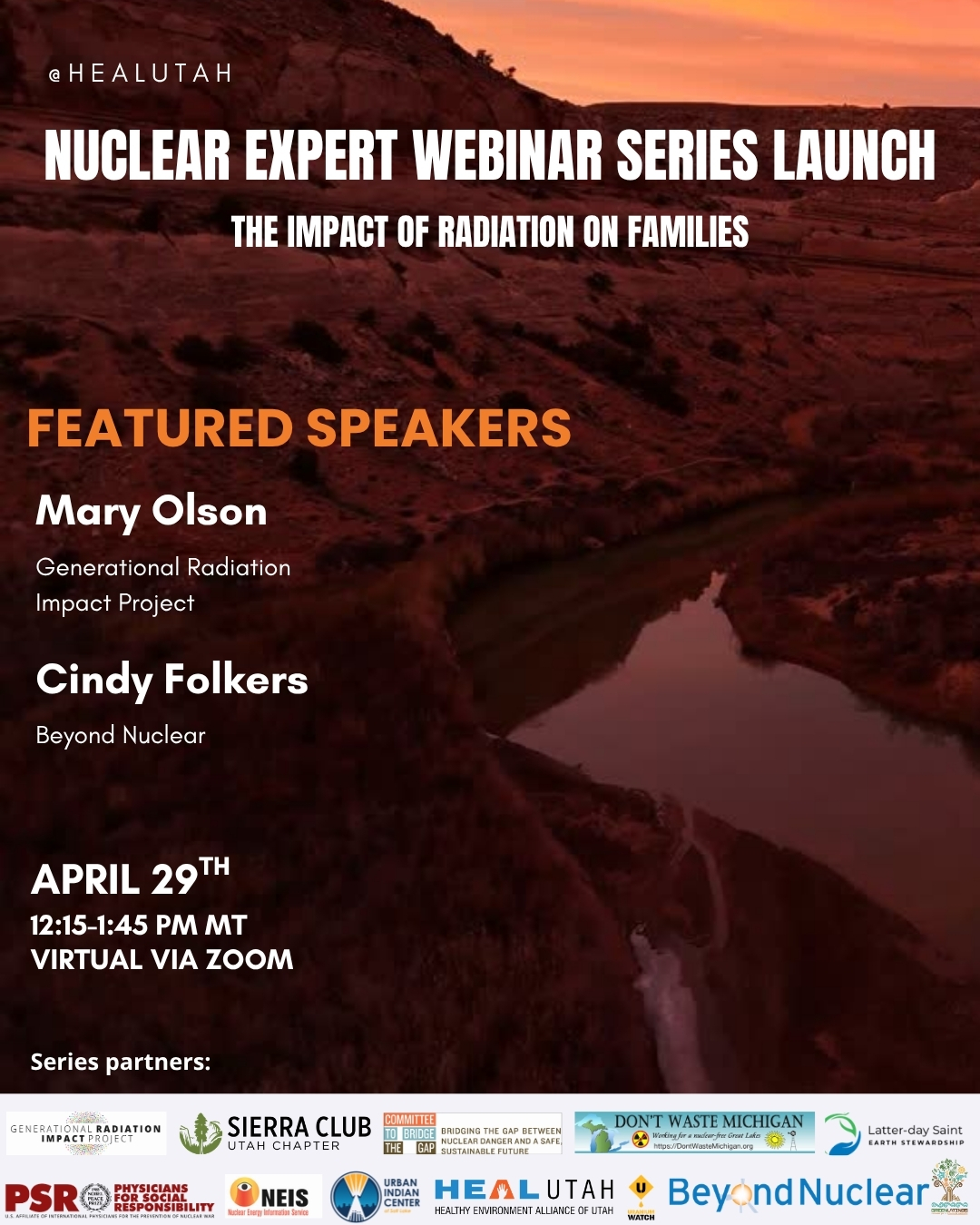
29 April – Nuclear Expert Webinar #1 – Radiation Impacts on Families with Mary Olson and Cindy Folkers
- 12:15 PM MT – 1:45 PM MT
- Location: Virtual – REGISTER TODAY

4 May -West Suburban Peace Coalition to discuss Iran war at May Educational Forum
Monday, May 4, 7:00 – 8:00 PM Central Standard Time
Title: : How Trump’s Narrative Tries to Shape the Reality of the War on Iran.
Contact Walt Zlotow, zlotow@hotmail.com 630 442 3045 for further information
14 May – online event From Bombs to Data Centres: the Face of Nuclear Colonialism

Pine Ridge Uranium is the real threat, not Tehran- Tell Burgum: Stop the Extraction.
Chernobyl: The Lost Tapes – A good documentary on Chernobyl on SBS available On Demand for the next 3 weeks– https://www.sbs.com.au/ondemand/tv-program/chernobyl-the-lost-tapes/2352741955560
To see nuclear-related stories in greater depth and intensity – go to https://nuclearinformation.wordpress.com
-
Archives
- May 2026 (25)
- April 2026 (356)
- March 2026 (251)
- February 2026 (268)
- January 2026 (308)
- December 2025 (358)
- November 2025 (359)
- October 2025 (376)
- September 2025 (257)
- August 2025 (319)
- July 2025 (230)
- June 2025 (348)
-
Categories
- 1
- 1 NUCLEAR ISSUES
- business and costs
- climate change
- culture and arts
- ENERGY
- environment
- health
- history
- indigenous issues
- Legal
- marketing of nuclear
- media
- opposition to nuclear
- PERSONAL STORIES
- politics
- politics international
- Religion and ethics
- safety
- secrets,lies and civil liberties
- spinbuster
- technology
- Uranium
- wastes
- weapons and war
- Women
- 2 WORLD
- ACTION
- AFRICA
- Atrocities
- AUSTRALIA
- Christina's notes
- Christina's themes
- culture and arts
- Events
- Fuk 2022
- Fuk 2023
- Fukushima 2017
- Fukushima 2018
- fukushima 2019
- Fukushima 2020
- Fukushima 2021
- general
- global warming
- Humour (God we need it)
- Nuclear
- RARE EARTHS
- Reference
- resources – print
- Resources -audiovicual
- Weekly Newsletter
- World
- World Nuclear
- YouTube
-
RSS
Entries RSS
Comments RSS
 nuclear-news