Are Americans Prepared To Fight A Nuclear War Over Taiwan?
1945, By Doug Bandow, 25 May 22,
The consequences of a U.S.-China war over Taiwan need to be understood: A president suffering from an occasional case of verbal diarrhea about political infighting is an embarrassment. A president repeating loose comments about international affairs is dangerous.
For the third time, President Joe Biden declared a new U.S. policy toward Taiwan, only to have his officials insist that nothing has changed. That might mollify the public, but other nations, especially the People’s Republic of China, aren’t fooled.
On his trip to East Asia, intended to convince friends and allies that Uncle Sam can walk and chew gum at the same time, the president’s statement roiled the region. When asked if he would defend Taiwan, he responded “yes,” adding that “it’s a commitment we made.” His words circled the globe at warp speed, appearing to yet again repudiate the policy of “strategic ambiguity,” by which Washington refused to clarify its position toward a Chinese attack on Taiwan.
Since the Carter administration dropped diplomatic ties with Taiwan, legally the Republic of China, and recognized the PRC, America’s defense ties with Taipei have been ambiguous. Washington retains unofficial diplomatic ties with the island state and is committed by law to sell the latter defensive weapons. However, Taiwan enjoys neither a defense treaty, as possessed by Japan and South Korea, nor any other formal military commitment. Making U.S. policy a straightforward “maybe.”
The Strategy of Strategic Ambiguity
In theory, the uncertainty and possibility of forfeiting U.S. support are supposed to deter Taipei from recklessly challenging Beijing. At the same time, the PRC is supposed to avoid taking military action, lest Washington decides to intervene. Voila, America achieves the best of both worlds. However, the opposite result also is possible. The Taiwanese might believe eight decades of cooperation in war and peace mean the U.S. would intervene on the former’s behalf. And the Chinese might decide that no rational American president would risk Los Angeles for Taipei.
In fact, strategic ambiguity looks like an excuse to avoid deciding. As long as policymakers need not give a clear yes or no, they need not clearly decide yes or no. And they can simply hope the contingency never arises.
China is Not Ambiguous About Reunification
However, this strategy is becoming increasingly untenable. There is no sign of an imminent Chinese military action, but noted by the Quincy Institute’s Michael Swaine: “this possibility cannot be discounted over the longer term if present trends continue.” Beijing’s patience appears to be diminishing:……………….
of the many possible lessons of Russia’s attack on Ukraine, the most important for Xi might be the importance of a quick victory.
……………………. Is America Ready for Strategic Clarity?
However, the American people should be consulted, starting now, Admitted Rep. Michael McCaul, ranking member of the House Foreign Affairs Committee. “I don’t know how many Americans would want to go to war over a tiny island they know nothing about,” he said. And if they fully understood the cost of defending Taiwan from China – the possibility of conventional defeat and nuclear disaster – they might firmly oppose doing so.
…………………………. Alas, fighting the PRC over Taiwan would be nothing like America’s recent military experience. Iraq and Afghanistan were cakewalks compared to high-intensity war against the well-armed and highly motivated People’s Liberation Army, generously stocked with missiles and an expanding nuclear arsenal. At its worst, air and naval combat between the U.S. and PRC would take Americans back to World War II’s Pacific war, which surely no one wants to relive, with a possible nuclear twist if such weapons were used against America.
And Beijing appears ready for war, if necessary, though that certainly is not its preference. …………………………………
In short, the American people could find themselves risking national bankruptcy and destruction to confront this one contingency: defending Taiwan from China.
The more than 23 million people of Taiwan deserve to set their own destinies. They have created a democratic policy, market economy, and vibrant society. However, risking their homeland is a high price for Americans to pay, too high. War with China means personnel killed, planes downed, ships sunk, and bases bombed. War with China also means the possibility of nuclear-tipped missiles hitting American cities. And even a U.S. victory likely would be transitory, as China could retreat and prepare for another round, rather like Germany between World Wars I and II.
Better to seek a regional modus vivendi, which ensures that Taipei eschews claims of independence and military relationships with other nations, while Beijing reduces military threats and affirms peaceful reunification.
Washington also should consider the lessons of Ukraine: arming and training Taiwanese forces, preparing global sanctions in response to an attack, and developing asymmetric military responses. The goal should be to put the greatest responsibility on Taiwan while raising the price more for China than for America.
The president’s inability to control his mouth is dangerous. Failing to consider the full consequences of war with China over Taiwan is worse. And expecting Americans to accept without debate the costs and risks of full-scale combat with the PRC is a political crime. The Biden administration should address all three issues before the Taiwan Strait becomes the world’s latest crisis. https://www.19fortyfive.com/2022/05/are-americans-prepared-to-fight-a-nuclear-war-over-taiwan/
Twenty-Two House Republicans Demand Accountability on Biden’s $40b War Spending

“The aid package approved by Congress provides unprecedented funding for a foreign conflict in which the United States is not fighting, while there have been no significant hearings or substantive briefings on the use of the money and weapons being provided at taxpayer expense.” The lawmakers raised the prospect of sophisticated weaponry falling into the hands of terrorist organizations, citing a documented history of illicit arms-trafficking within Ukraine, a market which is one of the largest in Europe:
A cohort of Republicans, part of the dissenting vote on Biden’s Ukraine war package, seeks oversight and specifics about the destination of U.S. money and weapons.
| Glenn Greenwald and Anthony Tobin, May 25 |
The House of Representatives, on May 10, approved President Biden’s $33 billion package for the war in Ukraine, and then, on its own initiative, added $7 billion on top of it. That brought the new war spending authorization to $40 billion, on top of the $14 billion already spent just 10 weeks into this war, which U.S. officials predict will last years, not months. The House vote in favor was 368-57. All 57 NO votes were from GOP House members. All House Democrats, including the Squad, voted YES.
A similar scene occurred when the Senate, “moving quickly and with little debate,” overwhelmingly approved the same war package. All eleven NO votes were from Senate Republicans. All Senate Democrats, including Sen. Bernie Sanders (I-VT), voted in favor, seemingly in direct contradiction to Sanders’ February 8 op-ed in The Guardian warning of the severe dangers of bipartisan escalation of the war. Efforts by Sen. Rand Paul (R-KY) to delay passage of the bill so that some safeguards and accountability measures could be included regarding where the money was going and for what purposes it would be used were met with scorn, particularly from Paul’s fellow Kentucky GOP Senator, Minority Leader Mitch McConnell, who condemned Paul as an “isolationist.” Following the Senate vote, a jet was used to fly the bill across the world to President Biden in South Korea, where he signed it into law.
But the lack of any safeguards over the destination of the money and weapons prompted close to two dozen House Republicans, led by Rep. Yvette Herrell (R-NM), to send a letter to the Biden White House on Monday demanding greater specificity and assurances about legal requirements on how weapons are used. The letter urges a public reckoning on the dangers of the U.S.’s bankrolling of the war in Ukraine: “We write today to express grave concern about the lack of oversight and accountability for the money and weapons recently approved by Congress for Ukraine,” it began.
“The aid package approved by Congress provides unprecedented funding for a foreign conflict in which the United States is not fighting, while there have been no significant hearings or substantive briefings on the use of the money and weapons being provided at taxpayer expense.” The lawmakers raised the prospect of sophisticated weaponry falling into the hands of terrorist organizations, citing a documented history of illicit arms-trafficking within Ukraine, a market which is one of the largest in Europe:
“According to a 2017 Small Arms Survey briefing on arms trafficking, over 300,000 small arms disappeared from Ukraine between 2013 and 2015 and only 13 percent were recovered. Criminal networks, corrupt officials, and underpaid military personnel can make a profitable business from the sale of arms from Ukrainian military stockpiles. For example, in 2019, the Ukrainian Security Service uncovered a plot by Ukrainian soldiers to sell 40 RGD-5 grenades, 15 grenade launchers, 30 grenade detonators, and 2,454 rounds of ammunition for 75,000 Ukrainian hryvnia or around $2,900.”
Indeed, the relentlessly war-supporting CNN last month acknowledged that “the US has few ways to track the substantial supply of anti-tank, anti-aircraft and other weaponry it has sent across the border into Ukraine.” Biden officials admitted the “risk that some of the shipments may ultimately end up in unexpected places.” ……………………… more https://greenwald.substack.com/p/twenty-two-house-republicans-demand?s=r
USA Energy Department nuclear waste backlog goes as far back as WWII

Federal News Network, Tom Temin@tteminWFED, May 25, 2022 The Energy Department has a backlog of nuclear waste clean up responsibilities, with material dating back to World War II. But continuing turnover in program leadership means things just aren’t happening. For more, Government Accountability Office natural resources and environmental team Director Nathan Anderson spoke with the Federal Drive with Tom Temin.
Interview transcript:
Tom Temin: So what is going on here, the Energy Department says it needs something like a half a trillion dollars to do the cleanup of nuclear waste. Give us the scope of what it is they’re trying to do here in the first place?
Nathan Anderson: Well, you’ve got the dollar figure, right, in terms of the best estimates that we can give to this point. It is looking like almost a half a trillion dollar future financial responsibility of the federal government. I want to take it back a little bit to how we got here. You know, for decades, we were in the Cold War. And we were producing nuclear weapons. And we had sites across the country that were engaged in the Manhattan Project, and ultimately in the arms race that we were involved in until the late 1980s. And then around that time, the switch was flipped, if you will. And all of a sudden, we had to embrace the cleanup responsibilities that came with the end of the Cold War and kind of embracing both environmental and moral responsibilities of cleaning up the waste. And that’s where we’re at now, you know, we’ve been at this for a little more than 30 years, in a way trying to figure out the best way forward in terms of addressing the environmental and human health risks. And also, you know, the financial risks.
Tom Temin: And what is the scope of the issue geographically is there material that needs to be dealt with all over the place?
Nathan Anderson: There are 15 active cleanup sites that the Department of Energy is responsible for addressing. The biggest site in terms of financial risk and scope of waste is probably the Hanford Site out in southwestern Washington. There’s also a massive cleanup operation at the Savannah River Site in South Carolina, there’s a nuclear repository down in New Mexico at the Waste Isolation Pilot Plant. DOE recently kind of completed some of their activities at the Brookhaven Lab in New York. But as I’m kind of going through this list, you can see it really is all across the country, where we have these sites and have these cleanup responsibilities.
Tom Temin: And what does cleanup actually entail? It has to be removed and put somewhere else and buried in concrete or what?
Nathan Anderson: Well, I think one of the best ways to describe this is you’ve got nuclear waste, and radioactive waste that is in a tank, a couple sites around the country. There are 177 underground tanks at the Hanford Site, these tanks are massive, I’ve stood in a mock up of one. They hold, you know, up to a million gallons of waste. You’ve also got contaminated soil and groundwater. Decades ago during the nuclear weapons production mission, not as much as understood about the risks that some of these liquids and some of these contaminants contained, and so some of it was dumped directly into the ground. And that has permeated into the groundwater at certain sites. And then you’ve also got contaminated facilities that need to be demolished and that contamination needs to be dealt with appropriately. So I would say the three big cleanup activities are addressing the waste that’s in the tank. That’s the really nasty stuff, the soil and groundwater that needs to be remediated. And then also the excess facilities that need to be demolished, and that contamination needs to be remediated.
Tom Temin: And does that put the Energy Department in the position of being a buyer of contracted services to actually do this? Are there companies that handle this type of thing?
Nathan Anderson: Yes, it does. DOE is one of the largest contracting departments out there, probably right behind DoD (Department of Defense) in terms of the percentage of money that is put out the contracts. And now you’ve got companies around the country that are technically equipped to do this. And what DOE needs to do is ensure that for the taxpayer, you get the benefits of competition at each one of these sites. And then you also have the kind of like the accountability frameworks that are embedded within the contracts themselves, to make sure that cleanup is happening in a risk informed way. I like to say that contractors can do anything we ask them to do in this country. It’s up to the Department of Energy, and specifically the Office of Environmental Management to make sure that what they are asking the contractors to do is aligned with the risks that some of this waste poses. You recently commented about cement. That’s a perfect example. There are opportunities to take some of this tank waste like out of Hanford and put it in cement rather than glass because it’s very low levels of risk and cement, or grout as a term in the industry is significantly cheaper than the alternatives.
Tom Temin: We’re speaking with Nathan Anderson, a director in the Natural Resources and Environmental Team at the GAO. And the thesis of your report this time around is not really though how big the task is. But the fact that a revolving door of leadership at the Environmental Management Office of DOE is one of the hindrances to steady progress here. Tell us more about what you found.
Nathan Anderson: You’re hitting the nail on the head in terms of what this most recent report does touch on. We’ve just spoken about kind of the size and complexity of the issues. And what you’ll see across government oftentimes when you have a set of issues that are technically challenging and huge in scope, and long lasting and enduring is you have a leader of those federal responsibilities who has either a fixed term appointment, and in many cases, also an elevated level within the department. And that’s what we are leaning towards in this new report is that Congress should take those two actions to address the frequent turnover by having like a fixed term appointment of four to five years, to make sure that you’ve got a strong signal inside and outside government that this is a position that requires stability, and then also, that there should be an undersecretary position within the Department of Energy to again, provide that signal that there needs to be a high level of organizational clout that these are issues that are long lasting, and require stability and commitment from the senior leader within the department.
………………………. Nathan Anderson: We do have a very dedicated cadre of technicians and public servants that serve in the Office of Environmental Management, you know, there have been tremendously capable senior leaders, assistant secretaries at the Department of Energy that are responsible for this mission. But at the end of the day, resources are scarce. At the end of the day, priorities need to be set. Not everything can be done. And what we’re seeing is an increase in cost, substantially increasing costs for the long term mission of environmental cleanup within the Department of Energy. And I think it’s over the last seven or eight years, it’s almost doubled in terms of what we call the environmental liability, that total cost to the government for the cleanup mission. And that is a kind of a strong prompt or a catalyst to say, OK, is the status quo working? I would argue that the status quo needs to change.
………………………. I would say that GAO has identified a handful of options that could really fly down that half a trillion dollar cost estimate that you kind of lead with, there are opportunities and I would submit that while those opportunities are tens of billions of dollars or more, it will require like elevated leadership attention to be able to get there. And yet another reason why a fixed term appointment and an undersecretary position could really help here. https://federalnewsnetwork.com/agency-oversight/2022/05/energy-department-nuclear-waste-backlog-goes-as-far-back-as-wwii/—
California makes misguided plea for feds to keep state’s last nuclear power plant alive

 | |||
|
California makes misguided plea for feds to keep state’s last nuclear power plant alive,
Alex Formuzisalex@ewg.org 23 May 22, SAN FRANCISCO – California Gov. Gavin Newsom’s administration is making a misguided plea for the U.S. Department of Energy to change the requirements of a federal fund so the aging, dangerous Diablo Canyon nuclear power plant can keep operating.
The state is asking the agency to free up part of the $6 billion in the Civil Nuclear Credit Program for Diablo Canyon to remain viable past its current scheduled closure date of 2025, Bloomberg reports. The plant is currently ineligible for the funds because California fully regulates utility power generation, and the money is available only for states with deregulated energy markets.
Newsom Cabinet Secretary Ana Matosantos sent a letter Monday to DOE Secretary of Energy Jennifer Granholm asking the Biden administration to alter the terms of the fund so Diablo Canyon can qualify. The fund is designed to help keep U.S. nuclear reactors in unregulated states operating.
“Moving the goal post to allow Diablo Canyon to continue running would set a dangerous precedent for other regulated states and utilities to keep aging, dilapidated nuclear plants operating,” said EWG President and California resident Ken Cook.
“Clinging to nuclear energy as a source of electricity as renewables like solar and wind grow by the day is not a sound, safe, forward-looking energy policy. We urge Secretary Granholm and the Biden administration to reject this plea to allow California to skirt the requirements of the program,” said Cook.
In a 2018 deal struck between Pacific Gas & Electric, which owns the nuclear power plant, labor unions, environmental groups and others, the utility agreed to shutter the two reactor units at Diablo Canyon in 2024 and 2025.
Here’s why keeping Diablo Canyon operating is concerning:
- It will be costly
- From 2011 to 2017, maintenance costs increased $110 million dollars.
- The plant is known for harm to aquatic life from discharging hot water directly into the Pacific Ocean. Upgrading the cooling system to address these concerns could cost billions of dollars.
- The plant is an extreme safety hazardIn 2014, a Nuclear Regulatory Commission inspector urged the NRC to shut the plant down due to earthquake hazard.
- Unit 1 at the facility is considered one of the most embrittled units in the country – meaning that if the plant were forced to suddenly shut down, cold water would be sent to the core, where the highly radioactive fuel resides, causing the containment vessel to shatter, causing a catastrophic accident.
- Newsom’s plea comes just days after he released an updated budget that calls for $5.2 billion in proposed funding for California’s electricity grid, according to a report by the nonprofit news outlet Canary Media. If approved by state lawmakers, the budget would add more fossil-fueled power, more pollution, and higher costs for ratepayers.
The Environmental Working Group is a nonprofit, non-partisan organization that empowers people to live healthier lives in a healthier environment. Through research, advocacy and unique education tools, EWG drives consumer choice and civic action.
South Carolina Woefully Underprepared for Nuclear Disaster
FITSNEWS, ByDylan Nolan, 23 May 22, Oconee Nuclear Station emergency sets off alarm bells,
South Carolina state government can’t get a nuclear reactor up and running, as was made clear by the spectacular failure of government-run utility Santee Cooper — which five years ago officially pulled the plug on the proposed V.C. Summer nuclear generating station expansion (a.k.a. NukeGate). The botched construction of this project cost Palmetto State ratepayers and taxpayers more than $10 billion.
What is less known, but potentially more ominous, is the fact that sources close to the S.C. Department of Health and Environmental Control (SCDHEC) Radiation Nuclear Safety unit say the state is woefully underprepared to respond to potential nuclear disasters.
Staffing this specialized unit has allegedly become an increasingly serious issue for SCDHEC in recent years. The unit dwindled from seven to three full-time employees as frustration with ineffective management led to employees finding work elsewhere.
The remaining full-time employees are stretched thin. The map below [on original] illustrates South Carolina’s nuclear facilities, as well as those in neighboring states that have the potential to harm South Carolinians in the event of a disaster.
The SCDHEC unit is responsible for more than just those facilities though, it also handles transportation incidents involving radiological materials
This seems like a herculean task for three individuals — one that could have ended poorly in early February when two of the (at that time) four employees of the unit were out of town at a training event when an incident involving a potential release of radiological material at the Oconee Nuclear Station threw the remaining two employees into high gear.
As the first light of dawn penetrated the darkness of the lakeside sky, it cast a dull glow over the three reactors — built in 1974 on the Keowee River at the foot of the Blue Ridge Escarpment. This still morning would soon be broken, however.
At 3:57 a.m. EST February 5, the west penetration room adjacent to one of the three reactors filled with smoke and prevented personnel from entering. At this time, officials at the plant filled out their initial nuclear power plant emergency notification form (ENF).
Nuclear facilities experiencing emergencies issue warnings indicating the severity of an accident. In this instance, employees at the Oconee station chose the second of four alert levels. According to the emergency response guide posted on plant operator Duke Energy’s website, this indicates “there is no impact to the public.” The plant’s resident Nuclear Regulatory Commission (NRC) inspector concurred with that assessment.
Had they chosen the next level of alert — a site area emergency warning — plant operators would have indicated they believed the event to be a “major operational/ security event that could affect plant safety” and would have likely warned the public of the event’s occurrence.
The Oconee County Fire Department responded by sending five trucks on-site with more staged off site.
SCDHEC’s response was solely conducted remotely. A source close to this unit characterized this response as “strictly for show” — adding that managers frequently refuse to allow the responders to go to the scene of the emergency.
SCDHEC’s director of media relations Ron Aiken told FITSNews that “because both the facility and the Nuclear Regulatory Commission confirmed no off-site release occurred, no emergency field-monitoring by SCDHEC was required.”
One SCDHEC insider frustrated with the response contended that “this unit is set up to be the state’s assurance that nothing is/was being released.”
“We should not have sat by and waited for the plant to tell us that there was no leak,” the insider said. “If there was a leak, it would have been too late to perform any protective actions.”
While plant operators did not issue a warning that would notify residents surrounding the plant, they sent employees to their Charlotte, N.C.-based emergency operations facility — which allows engineers to have off-site control of the plant in the event it had to be evacuated.
SCDHEC didn’t conduct independent soil and vegetation testing until three days after the incident. According their internal after-action report (below) “taking the soil, water and vegetation samples three days after the incident and with rain being present diminished the possibility of detecting anything.” A source familiar with the report added that “we don’t have any option but to take them (nuclear plant operators) at their word.”
……………….a federal response would take hours to arrive given both the complexity of responding to a nuclear disaster and the fact that federal officials are primarily located out of state. A failure to properly handle a situation in the hours before the feds arrive could turn an emergency into a tragedy
………. Individuals familiar with the operations of the unit have voiced concerns that none of the stakeholders truly care about the efficacy of the unit. The state’s nuclear power plant operators care a great deal about the state continuing to provide the Federal Emergency Management Agency (FEMA) with “reasonable assurance” that the state can adequately respond to nuclear disasters since their ability to operate plants is dependent on federal approval of state safety measures…………………………… https://www.fitsnews.com/2022/05/23/south-carolina-woefully-underprepared-for-nuclear-disaster-sources-say/. State and local officials must therefore be ready to stand in the gap during those crucial first hours.
Former Sect. of State Kissinger says U.S. should get along with China
Gary Clifford Gibson, Blog and Books, 23 May 22, Former Sect. of State Henry Kissinger; 99 years old, spoke at an economic forum on the need to get along with China. If the Biden administration had its oars in the water on international affairs it would understand that mentioning the U.S. would go to war if China invades Taiwan is a diplomatic faux pas.
There are other ways to let China know what the administration thinks about Taiwanese independence and U.S. support for that without using a bludgeon, in a manner of speaking.
The Democratic President and his party leadership are used to forcing whatever they want into being, since the U.S. is regarded as the most powerful nation on Earth militarily and financially and party leadership realizes that force can get what they want done sometimes. Yet nuclear war with either Russia or China shouldn’t be an option; and it is for Democrats as an escalation from conventional war implicitly. Having peaceful and mutually prosperous relations with China is advantageous for the world and the world environment. Intelligent leadership needs to find a way to return international affairs to order as soon as possible including ending sanctions on Russia directly if they sign on on halting the Ukraine venture in place and sign off on a permanent peace……….. https://wordpress.com/read/blogs/53114755/posts/13350
War in Ukraine is getting complicated, and America isn’t ready — The New York Times

https://en.thepage.ua/politics/war-in-ukraine-is-getting-complicated-and-america-isnt-ready Author Valery Moiseev, 22 May 22,
The Senate passed a $40 billion emergency aid package for Ukraine, but with a small group of isolationist Republicans loudly criticizing the spending and the war entering a new and complicated phase, continued bipartisan support is not guaranteed. This is stated in an editorial published in The New York Times (NYT).
Avril Haines, the director of national intelligence, warned the Senate Armed Services Committee recently that the war in Ukraine could take “a more unpredictable and potentially escalatory trajectory”, with the increased likelihood that Russia could threaten to use nuclear weapons.
The newspaper also notes that there are many questions that President Biden has yet to answer for the American public.
Is the United States, for example, trying to help bring an end to “this conflict” (as the newspaper calls the war in Ukraine) through a settlement that would allow for a sovereign Ukraine and some kind of relationship between the United States and Russia? Or is the United States now trying to weaken Russia permanently? Has the administration’s goal shifted to destabilizing Putin or having him removed? Does the United States intend to hold Putin accountable as a war criminal? Or is the goal to try to avoid a wider war — and if so, how to achieve this?
Without clarity on these questions, the White House not only risks losing Americans’ interest in supporting Ukrainians — who continue to suffer the loss of lives and livelihoods — but also jeopardizes long-term peace and security on the European continent, the NYT says.
The authors of the article believe that Americans “have been galvanized by Ukraine’s suffering”, but popular support for a war far from U.S. shores will not continue indefinitely. Inflation is a much bigger issue for American voters, and problems in global food and energy markets are likely to intensify.
“It is tempting to see Ukraine’s stunning successes against Russia’s aggression as a sign that with sufficient American and European help, Ukraine is close to pushing Russia back to its positions before the invasion. But that is a dangerous assumption.”
The article says that Russia remains too strong, and Putin has invested too much personal prestige in the invasion to back down.
“Unrealistic expectations could draw the United States and NATO ever deeper into a costly, drawn-out war. Russia, however battered and inept, is still capable of inflicting untold destruction on Ukraine and is still a nuclear superpower with an aggrieved, volatile despot who has shown little inclination toward a negotiated settlement.”
The NYT says that it is the Ukrainians who must make the hard decisions: they are the ones fighting, dying and losing their homes to Russian aggression, and it is they who must decide what an end to the war might look like. “If the conflict does lead to real negotiations, it will be Ukrainian leaders who will have to make the painful territorial decisions that any compromise will demand.”
But as the war continues, “Biden should also make clear to President Volodymyr Zelenskyy and his people that there is a limit to how far the United States and NATO will confront Russia, and limits to the arms, money and political support they can muster. It is imperative that the Ukrainian government’s decisions be based on a realistic assessment of its means and how much more destruction Ukraine can sustain.”
Confronting this reality may be painful, but it is not appeasement, the NYT stresses. This is what governments are duty bound to do, not chase after an illusory “win.” Russia will be feeling the pain of isolation and debilitating economic sanctions for years to come, and Putin will go down in history as a butcher. The challenge now is to shake off the euphoria, stop the taunting and focus on defining and completing the mission.
US Government Secret Files: Human Experiments With Plutonium Side Effects
by SOFREP, 22 May 22, ” …………………………………… The Manhattan Project………….. The most famous development of the Manhattan Project was when they produced atomic bombs, two of which were the Little Boy Bomb and the Fat Man Bomb, that were dropped on the two cities of Japan, Hiroshima, and Nagasaki. There was also this not-so-famous bomb that was supposed to be the third bomb to be dropped in Japan had they not surrendered, known as the Demon Core (know why it was called as such here.)
Although a huge chunk of the Manhattan Project was dedicated to the development and production of the weapons, a small portion of it was dedicated to studying the health effects of the radioactive materials involved in the project, which was Plutonium.
Human Experiments
…………………. the huge amounts of radioactive materials used in the experiments also led to widespread contamination even outside of the research facilities. They wanted to know exactly the risks and dangers that these researchers were facing, so they began studying the effects of radiation on human bodies.
The plutonium toxicity studies began with rats as the main subject. These were quickly deemed inconclusive, so they decided to move the experiments onto human trials beginning in 1945. They didn’t realize at the time that rats are pretty resistant to radiation. At that time, details about plutonium were not yet disclosed to the public, so they decided that for the secrecy of it, they would not inform anyone outside of scientific circles about the trials, not even the human test subjects.
A total of eighteen human subjects were selected and injected with plutonium without their knowledge from 1945 until 1947, their ages ranging from 4 to 69. One common thing about them was their diagnosis of a terminal illness.
Patient CAL-1
One of the involuntary subjects of the human radiation experiment was a house painter from Ohio in his late 50s named Albert Stevens, or patient CAL-1. At that time, he had checked into the University of California Hospital in San Francisco and was diagnosed with terminal cancer. It was suggested that a gastroscopy be performed to make sure that the diagnosis was accurate, but it never really happened. And so Stevens was chosen for the study because, according to acting chief of radiology Earl Miller, “he was doomed” to die.
Before he underwent the operation that would try to rid him of cancer, Stevens was injected with what would be known as the highest accumulated radiation dose in any human, 131 kBq (3.55 µCi) of plutonium. After that, stool and urine samples were taken from Stevens for analysis. He then underwent an operation to remove his cancer, which included taking out parts of his liver, entire spleen, lymph nodes, part of his pancreas, part of his omentum, and most of his ninth rib.
When some of the materials removed from Stevens were analyzed, they discovered that Stevens was misdiagnosed and did not have cancer in the first place. He was, in fact, suffering from a large gastric ulcer. He and his family were not informed about it and were instead told that his recovery was speedy. ………….. https://sofrep.com/news/us-government-secret-files-human-experiments-with-plutonium-side-effects/
Entergy shuts down Palisades nuclear station ahead of time
Entergy Corp said on Friday it has permanently shut a nuclear power
station in Michigan despite a Biden administration plan to rescue plants
like it because they generate electricity virtually free of carbon
emissions. Entergy closed the 800-Megawatt Palisades plant in Michigan that
had operated for more than 50 years. “After careful monitoring, operators
made the conservative decision to shut down the plant early due to the
performance of a control rod drive seal,” Entergy said in a statement about
the plant.
Reuters 21st May 2022
Global heating brings megadrought and water shortages to over half of the USA
The “megadrought” gripping the southwestern US has driven water levels
at the two largest reservoirs to record lows, forcing unprecedented
government intervention to protect water and power supplies across seven
states.
Millions of Americans already contending with critical water
shortages now face the prospect of black outs as energy demand grows during
heatwaves just as hydroelectric power supply is strained. A US power
regulator this week warned that a big swath of the US was at risk of
blackouts, partly as a result of drought conditions curtailing
hydroelectric supplies.
US government climate scientists have said more
than half the country is enduring drought conditions, while a separate
study estimated that the drought affecting southwestern states was the
worst to hit the region for 1,200 years after being exacerbated by human
activity.
FT 21st May 2022
https://www.ft.com/content/9f00dfff-3a44-483f-9d5a-f58db7806046
Seismic Concerns at Los Angeles Nuclear Laboratory and Expanded Plutonium Pit Production
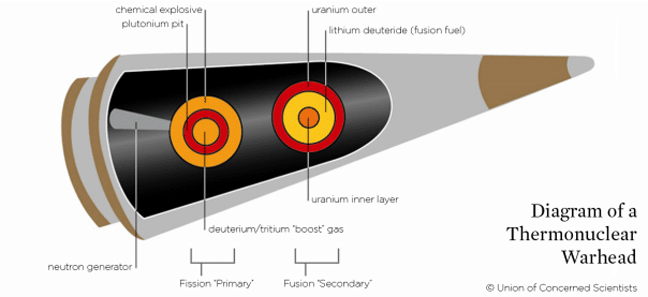
Seismic Concerns at LANL and Expanded Plutonium Pit Production http://nuclearactive.org/, May 19th, 2022, Ongoing Plutonium operations at Los Alamos National Laboratory’s Technical Area 55 are centered in the middle of the 36-square mile national nuclear weapons facility. LANL is the only U.S. facility with the capabilities to fabricate plutonium triggers, or the fissile pits, for nuclear weapons. However, Technical Area 55, or TA-55, is located within the complex Pajarito Fault Zone between two young, north – south running faults called the Guaje Mountain and Rendija Canyon faults. Visual evidence of faulting can be found in the canyons to the north of TA-55. http://nuclearactive.org/gilkeson/ see Seismic Documents.
The U.S. Department of Energy owns LANL. It has plans for expansion of all things plutonium-pit production at the Plutonium Facility and at least five new support buildings at TA-55. CCNS anticipates that DOE will continue its efforts to conceal and ignore the reality of the growing seismic threats of the young faults.
We witnessed similar efforts in the mid-2000s when DOE began to design a new super Walmart-sized Nuclear Facility within TA-55 next door to the Plutonium Facility. DOE was so bold as to dig into the volcanic tuff with heavy equipment to prepare a pad for future construction. http://www.nuclearactive.org/news/030510.html In the end, public opposition and escalating costs forced the cancellation of its plans. http://nuclearactive.org/livestreamed-nuclear-safety-board-hearing-on-february-21st-in-albuquerque/
Fabricating plutonium pits for nuclear weapons involves many steps – some using aqueous processes that result in water contaminated with radiation and hazardous materials. That water is treated across the street from the Plutonium Facility at the Radioactive Liquid Waste Treatment Facility and for decades was discharged through an industrial outfall into Effluent Canyon. Since November 2011, though, the treated water has been evaporated into the air at a mechanical evaporator.
In April, the Environmental Protection Agency renewed the five-year industrial permit for LANL to discharge through Outfall 051 into Effluent Canyon. https://www.epa.gov/nm/los-alamos-national-laboratory-lanl-industrial-wastewater-permit-final-npdes-permit-no-nm0028355
We note that on May 11th, CCNS, Honor Our Pueblo Existence, and the Albuquerque Veterans for Peace, Chapter No. 63, appealed the EPA decision to permit the outfall and five others to the Environmental Appeals Board. https://yosemite.epa.gov/oa/EAB_Web_Docket.nsf/f22b4b245fab46c6852570e6004df1bd/ba987f24df0c356085258837004f3dcd
Then on May 5th, the New Mexico Environment Department approved for the first time a ground water discharge permit for not only for the Radioactive Liquid Waste Treatment Facility, the outfall and Mechanical Evaporator, but for two large solar evaporative tanks, and a new low-level radioactive liquid waste treatment facility. In addition, DOE plans to build a liquid waste treatment facility for the transuranic plutonium liquid waste. https://www.env.nm.gov/public-notices/, go to Los Alamos County, and scroll down to DP-1132 where the draft permit is posted, but not the final permit.
These facilities are all in support of DOE’s plans for expanded plutonium pit production at LANL.
The extent of American radiation exposure is larger than you think

U.S. nuclear bomb testing spread radiation across the vast majority of the country https://www.deseret.com/opinion/2022/5/20/23125918/opinion-the-extent-of-american-radiation-exposure-nuclear-bomb-testing-reca By John LaForge, Readers’ Forum, May 21, 2022
In a May 3 editorial board opinion “The steep price of America bombing its own people,” it says “the interior West of the United States” is “the only part of the nation exposed repeatedly, over many years, to fallout from nuclear weapons tests conducted by the United States government.”
This is a gross underestimation of the nationwide extent of radioactive fallout spread from U.S. bomb testing in the atmosphere, fallout which, in fact, contaminated each and every county in the continental United States.
The board must certainly know of the groundbreaking October 1997 report by the National Cancer Institute, “Estimated Exposures and Thyroid Doses Received by the American People from Iodine-131 in Fallout Following Nevada Atmospheric Nuclear Bomb Tests.”
This report notes in its executive summary and in multiple map illustrations that “Some radioiodine was deposited everywhere in the United States, with the highest deposits immediately downwind of the NTS (Nevada test site).”
The report notes that “Ninety nuclear tests … released about 150 million curies of iodine-131, mainly in the years 1952, 1953, 1955, and 1957.” Of course beyond just iodine-131, there were dozens of other dangerous radioactive materials in the fallout. Radioiodine alone was studied because after being deposited on grass, it quickly contaminated cow’s milk and consequently the infants, children and adults that consumed the milk.
Americans Divided on Nuclear Energy
News Gallup poll. BY LYDIA SAAD, 20 May 22
STORY HIGHLIGHTS
- 51% of Americans favor, 47% oppose nuclear energy, similar to 2019
- Recent views contrast with 2004 to 2015, when majorities backed it
- Republicans and independents in favor, but not Democrats
WASHINGTON, D.C. — Americans are evenly split on whether nuclear energy should be a source of electricity in the U.S., with 51% in favor and 47% opposed. Three years ago, the two camps were tied at 49%, while in 2016, the majority (54%) opposed nuclear power.
Americans’ relatively limited support for nuclear energy in recent years contrasts with more solid backing from 2004 to 2015, when majorities of between 53% and 62% favored it.
……………………….. As Gallup has found previously, support for nuclear energy also differs sharply by gender, while it varies modestly by education. Older adults are slightly more positive than those younger than 55, but differences by age have been less consistent over time.
- Sixty-three percent of men versus 39% of women are in favor of using nuclear energy for electricity.
- Support by education ranges from 57% of college graduates to 50% of those with some college experience and 45% of those with no college.
- A 57% majority of adults 55 and older favor nuclear energy, compared with half of 18- to 34-year-olds and 45% of those aged 35 to 54.
………………………………. https://news.gallup.com/poll/392831/americans-divided-nuclear-energy.aspx
Five new plutonium buildings for Los Alamos National Laboratory, with the costly funding details rather obscure
Nuclear agency plans five new plutonium buildings at Los Alamos lab, Santa Fe New Mexican , By Scott Wyland swyland@sfnewmexican.com, May 18, 2022
As a further sign Los Alamos National Laboratory is inching toward its 2026 target for making 30 warhead triggers a year, nuclear security managers plan to construct five buildings in the lab’s plutonium complex over the next five years, in part to support that effort.
A new building would be funded annually, beginning in fiscal year 2023, with the aim of supporting production of the bomb cores, known as pits, and other plutonium operations, according to the National Nuclear Security Administration’s budget request for the coming year.
The total cost of the five buildings will be more than $240 million………………….
One critic of the lab’s pit production plans said each of the buildings was priced just under the $50 million threshold that would trigger a more rigorous congressional review.
That might allow the lab to change the office buildings into something else later for a different purpose, such as producing more pits, said Greg Mello, executive director of the Los Alamos Study Group.
“No one ever talked about these costs before,” Mello said. “We don’t think this is the end of the surprises. There are more surprises to come.”
The federal budget for plutonium operations has climbed steeply in recent years, both at the lab and at Savannah River Site in South Carolina, where officials hope to make an additional 50 pits yearly by the mid-2030s.
Under the U.S. Department of Energy’s draft budget, the lab’s plutonium modernization funding would climb to $1.56 billion in 2023 from the current year’s $1 billion, more than a 50 percent increase.
At the same time, the nuclear security agency, an Energy Department branch, has proposed funneling $700 million this coming year toward converting Savannah River Site into a pit factory. That’s a sizable jump from the $475 million spent for that purpose in the last budget cycle………………….
Jay Coghlan, executive director of Nuclear Watch New Mexico, said federal officials want the lab’s pit plant to be able to produce up to 80 pits for short periods.
He contends the lab is likely to use this “surge capacity” given the longer time it will take for Savannah River to begin production…………….. https://www.santafenewmexican.com/news/local_news/nuclear-agency-plans-five-new-plutonium-buildings-at-los-alamos-lab/article_48acffdc-d5fb-11ec-985e-5b26a02df8f5.html
Opposition mounts against 25-year licence extension request from New Brunswick nuclear plant with no long-term waste disposal plan
By Cloe Logan National Observer May 20th 2022 Sitting on the Bay of Fundy, one of the seven wonders of North America, is the Point Lepreau Nuclear Generating Station. New Brunswick Power hopes it will remain there a good long time: the company has asked for an unprecedented 25-year licence extension, prompting pushback during a recent round of public hearings.
Coming into operation in the 1980s, the station is one of four in Canada and the only nuclear power station outside of Ontario. Consisting of a singular CANDU reactor, a heavy-water reactor that generates power, Point Lepreau’s current licence renewal is reaching a close, so the Canadian Nuclear Safety Commission (CNSC) is required to grant a new one. The current term is five years, as was the one before that.
The request to operate until 2047 has raised concerns from numerous people, who say a shorter licence should be granted instead, and during that time, NB Power should focus on a decommissioning plan. So far, the CNSC has suggested a 20-year extension but will release its final decision before June 30, when the current licence expires. If the commission deems more information is needed, it could grant a short extension while deliberating, a spokesperson told Canada’s National Observer.
Many environmentalists oppose nuclear plants of any sort, insisting they stand in the way of cleaner and more sustainable renewable energy, such as wind. Although the CANDU reactor doesn’t directly produce carbon dioxide like oil or gas, the process produces harmful nuclear waste, and opponents say the cost and risk make it a poor solution to the climate crisis.
The concern around waste is top of mind for one Indigenous community — the Passamaquoddy, whose traditional territory includes Point Lepreau where the nuclear reactor is sited. Chief Hugh Akagi said at a public hearing in Saint John last week that a three-year extension would be more reasonable. As an intervenor through the Passamaquoddy Recognition Group (PRG), Akagi is deeply concerned about the nuclear waste resulting from the reactors. Nuclear waste is currently stored at Point Lepreau but will need to be moved elsewhere in the future. He notes there is no plan for long-term storage; the Nuclear Waste Management Organization is currently responsible for finding somewhere to bury the spent fuel but needs to convince a community to take on the responsibility.
| The Passamaquoddy Tribe spans across New Brunswick and Maine’s borders and are a federally recognized group in the States but not in Canada. Although they don’t have First Nations status, the Passamoquoddy in New Brunswick have a government and have been seeking recognition for decades.The nation wasn’t consulted about storing nuclear waste on its land, which goes against the United Nations Declaration on the Rights of Indigenous Peoples Act (UNDRIP), the PRG stated. It pointed to Article 29.2, which says: “States shall take effective measures to ensure that no storage or disposal of hazardous materials shall take place in the lands or territories of Indigenous peoples without their free, prior and informed consent.”………………………… https://www.nationalobserver.com/2022/05/20/news/opposition-against-25-year-licence-extension-request-nb-nuclear-plant |
1 This Month
26 April – Chernobyl: Inside the Meltdown airs on National Geographic on Sunday 26th April from 4pm

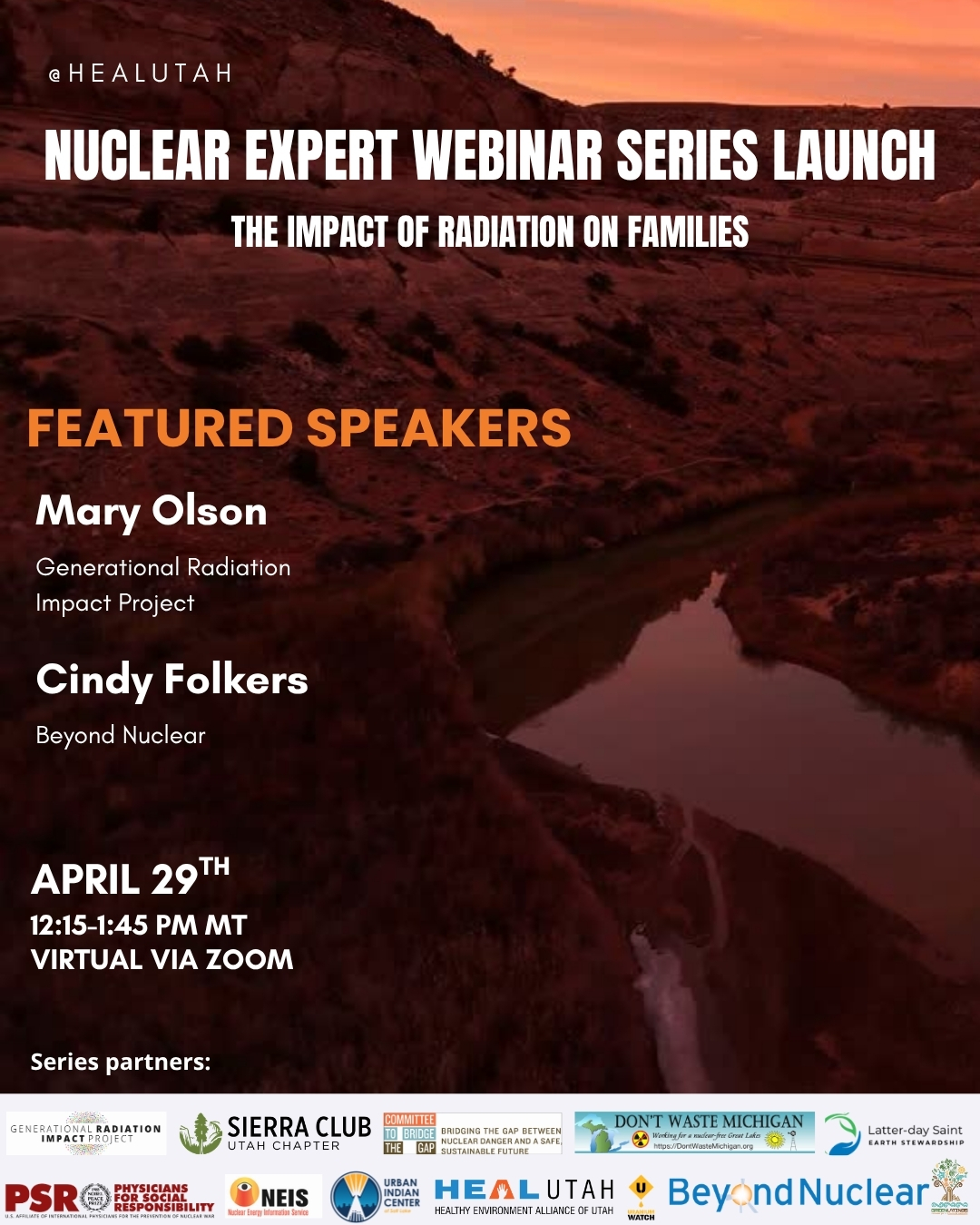
29 April – Nuclear Expert Webinar #1 – Radiation Impacts on Families with Mary Olson and Cindy Folkers
- 12:15 PM MT – 1:45 PM MT
- Location: Virtual – REGISTER TODAY

4 May -West Suburban Peace Coalition to discuss Iran war at May Educational Forum
Monday, May 4, 7:00 – 8:00 PM Central Standard Time
Title: : How Trump’s Narrative Tries to Shape the Reality of the War on Iran.
Contact Walt Zlotow, zlotow@hotmail.com 630 442 3045 for further information
14 May – online event From Bombs to Data Centres: the Face of Nuclear Colonialism

Pine Ridge Uranium is the real threat, not Tehran- Tell Burgum: Stop the Extraction.
Chernobyl: The Lost Tapes – A good documentary on Chernobyl on SBS available On Demand for the next 3 weeks– https://www.sbs.com.au/ondemand/tv-program/chernobyl-the-lost-tapes/2352741955560
To see nuclear-related stories in greater depth and intensity – go to https://nuclearinformation.wordpress.com
-
Archives
- May 2026 (25)
- April 2026 (356)
- March 2026 (251)
- February 2026 (268)
- January 2026 (308)
- December 2025 (358)
- November 2025 (359)
- October 2025 (376)
- September 2025 (257)
- August 2025 (319)
- July 2025 (230)
- June 2025 (348)
-
Categories
- 1
- 1 NUCLEAR ISSUES
- business and costs
- climate change
- culture and arts
- ENERGY
- environment
- health
- history
- indigenous issues
- Legal
- marketing of nuclear
- media
- opposition to nuclear
- PERSONAL STORIES
- politics
- politics international
- Religion and ethics
- safety
- secrets,lies and civil liberties
- spinbuster
- technology
- Uranium
- wastes
- weapons and war
- Women
- 2 WORLD
- ACTION
- AFRICA
- Atrocities
- AUSTRALIA
- Christina's notes
- Christina's themes
- culture and arts
- Events
- Fuk 2022
- Fuk 2023
- Fukushima 2017
- Fukushima 2018
- fukushima 2019
- Fukushima 2020
- Fukushima 2021
- general
- global warming
- Humour (God we need it)
- Nuclear
- RARE EARTHS
- Reference
- resources – print
- Resources -audiovicual
- Weekly Newsletter
- World
- World Nuclear
- YouTube
-
RSS
Entries RSS
Comments RSS
 nuclear-news