The UK’s Decision to Extradite Assange Shows Why The US/UK’s Freedom Lectures Are a Farce
Glenn Greenwald, 18 June 22, The Assange persecution is the greatest threat to Western press freedoms in years. It is also a shining monument to the fraud of American and British self-depictions.
The eleven-year persecution of Julian Assange was extended and escalated on Friday morning. The British Home Secretary, Priti Patel, approved the U.S.’s extradition request to send Julian Assange to Virginia to stand trial on eighteen felony charges under the 1917 Espionage Act and other statutes in connection with the 2010 publication by WikiLeaks of thousands of documents showing widespread corruption, deceit, and war crimes by American and British authorities along with their close dictatorial allies in the Middle East.
This decision is unsurprising — it has been obvious for years that the U.S. and UK are determined to destroy Assange as punishment for his journalism exposing their crimes — yet it nonetheless further highlights the utter sham of American and British sermons about freedom, democracy and a free press.
Having reported on the Assange case for years, on countless occasions I’ve laid out the detailed background that led Assange and the U.S. to this point. There is thus no need to recount all of that again; those interested can read the granular trajectory of this persecution here or here.
Suffice to say, Assange — without having been convicted of any crime other than bail jumping, for which he long ago served out his fifty-week sentence — has been in effective imprisonment for more than a decade…………………….
The Home Secretary’s decision this morning — characteristically subservient and obedient of the British when it comes to the demands of the U.S. — does not mean that Assange’s presence on U.S. soil is imminent. Under British law, Assange has the right to pursue a series of appeals contesting the Home Secretary’s decision, and will likely do so. Given that the British judiciary has more or less announced in advance their determination to follow the orders of their American masters, it is difficult to see how these further proceedings will have any effect other than to delay the inevitable………………….
What makes this law so insidious is that, by design, it is almost impossible for the government to lose. As I detailed in a Washington Post op-ed when the indictment was first revealed — arguing why it poses the greatest threat to press freedoms in the West in years — this 1917 law is written as a “strict liability” statute, meaning that the defendant is not only guilty as soon as there is proof that they disclosed classified information without authorization, but they are also barred from raising a “justification” defense — meaning they cannot argue to the jury of their peers that it was not only permissible but morally necessary to disclose that information because of the serious wrongdoing and criminality it revealed on the part of the nation’s most powerful political officials. That 1917 law, in other words, is written to offer only show trials but not fair trials.
………………. “free press” guarantees in the U.S. and UK exist only on a piece of parchment and in theory. Citizens are free to do “journalism” as long as it does not disturb or anger or impede real power centers. Employees of The Washington Post and CNN are “free” to say what they want as long as what they are saying is approved and directed by the CIA or the content of their “reporting” advances the interests of the Pentagon’s sprawling war machine…………… https://greenwald.substack.com/p/the-uks-decision-to-extradite-assange
No decision yet on choosing USA or UK nuclear submarines, but a USA Bill to train Australian submariners!

Ed. note: But Australian nuclear zealot Jonathon Mead (left) and nuclear enthusiast Peter Dutton are on the job, in lockstep with the Americans.
Booster For AUKUS: US Could Train Australian Navy On Its Nuclear Subs While Canberra Decides Between US, UK Submarines
Eurasian Times, By Sakshi Tiwari, June 18, 2022 The Australian nuclear submarine project, assisted by the US and the UK under the AUKUS agreement, has faced several controversies. Recently, the former Australian Defense Minister Peter Dutton made startling revelations about his government’s plan to buy American Virginia-class nuclear submarines.
Even though the claims enthused observers about a possible purchase by Australia, the officials have maintained that the decision has not been reached. Canberra is expected to choose between the US Virginia-class submarine or British Astute-class submarines.
In an all-new development, the US lawmakers have introduced a bill called ‘Australia-US Submarine Officer Pipeline Act’ to train Royal Australian Navy officers in the operation of nuclear submarines. The bill was moved into Congress even as doubts remain over the Virginia-class submarine purchase.
The ‘Australia-United States Submarine Officer Pipeline Act’ would allow Australian naval officers to begin training in the United States to operate and maintain nuclear-powered submarines before eventually commanding the future boats.
“The new bipartisan bill will establish a joint training pipeline between the US Navy and the Royal Australian Navy and enable the start of US-based training of Commanding Officers for Australia’s future fleet of nuclear-powered submarines under the AUKUS alliance,” the AUKUS working group said in a news release.
The bill requires the Secretary of Defense and Secretary of Energy to begin a training exchange in 2023 and continue it in subsequent years. It is the result of Congress’ AUKUS working group, formed in April to help develop the United States, United Kingdom, and Australia’s new cooperation.
In November 2021, Australia inked a nuclear submarine technology-sharing deal with the United States and the United Kingdom as part of the AUKUS defense agreement. Australia is only the second country after the United Kingdom to secure a transfer of nuclear propulsion technology from the US.
Currently, the AUKUS partners are pursuing an 18-month study period to assess the requirements of Canberra’s nuclear submarine project, as previously reported by EurAsian Times. In September 2021, it abandoned a deal with the Naval Group of France for diesel-electric submarines and signed the AUKUS pact in favor of nuclear submarines.
Training Before Manufacturing
Nuclear-powered submarines are more expensive, but they are quieter and harder to detect, and they can stay submerged longer since they don’t need to surface to refuel.
With Australia, the US plans to begin training a cadre of young officers now to be ready to command the country’s submarines when the time comes, noted Defense News.
“The AUKUS alliance is the most important national security partnership that America has entered into in decades,” Rep. Joe Courtney, D-Conn., said in a news release. “While [design] work is ongoing, it makes sense to open the US Navy’s nuclear training programs to Australia’s naval officers to acquire proficiency in the operation of nuclear submarines.”
The Chief of the Royal Australian Navy’s nuclear-powered submarine task force, Vice Admiral Jonathan Mead, previously told The Strategist that Australians co-crewing with American and British submarines are likely to be part of an interim submarine capability.
“To train personnel,” Mead said, “We could embed sailors and officers in a US or UK boat to the point where we may have a 50% UK or US crew and a 50% Australian crew.”
When the first submarine is launched in South Australia, the goal is to have the crew trained, the industrial base ready to maintain it, and the regulatory system set up. “We have exchange officers on board our submarines and ships all the time.”
Mead also toured training schools in the United Kingdom and the United States to assess their systems. Many crew members receive reactor training and study nuclear physics concepts, but they are not nuclear physicists.
“‘They’ve been given a six-month course, and then they go to sea and become competent and current on their tradecraft at sea in a submarine,’ he explained.
“So we need to set up a system supported by the US and UK to provide our people with reactor training. If you’re an engineer, you may be a nuclear physicist. If you’re working at the front end of the boat, you require some knowledge of the reactor in case there’s an emergency, but not to the same level.”
The sentiment in Australia, [i.e in Jonathon Mead] thus, seems to align with American plans to start training Australian sailors and Naval officers. However, the exact nature and specifics of the training module are not yet known……………………….
Australia does not have sufficient nuclear infrastructure or advanced industrial capacity to build nuclear submarines. The shortcomings in nuclear infrastructure have had many experts suggest purchasing subs from the two AUKUS partners or building Australian submarines overseas.
Building nuclear-powered submarines would cost Australia billions of dollars and years of infrastructure construction. However, for the project to become a reality and for Australia’s crew to operate nuclear subs perfectly, training is one of the top priorities for AUKUS.
Even though Australia sells some nuclear fuel and has a single nuclear reactor for scientific study, the country does not have a substantial civil or military nuclear program. To get a head start, Australia could first start training on American or British nuclear submarines or lease older retired American submarines until they can deploy their indigenous designs, according to a National Interest report.
The Urgency For AUKUS
Australia’s nuclear submarines are expected to be operational no sooner than the end of the next decade. Consequently, the former Defense Minister Dutton had indicated that his government wanted to purchase two US submarines “this decade” to avoid a gap in replacing the country’s outdated Collins-class submarine fleet, with another eight US submarines under development in South Australia as part of the project.
This plan, he claims, would have eliminated the need to wait until 2038 for the first submarines designed in the United States to be built in Australia. The Royal Australian Navy currently operates six diesel-electric guided-missile submarines.
……………… While a decision regarding purchasing a nuke sub from the UK or the US hangs in the balance, training to use a nuclear submarine could be an easier way forward…….. https://eurasiantimes.com/booster-for-aukus-us-to-train-australian-navy-on-its-nuclear-subs/
Biden Proposes Changes to Help Rescue California Nuclear Plant
Biden Proposes Changes to Help Rescue California Nuclear Plant https://www.bloomberg.com/news/articles/2022-06-18/biden-proposes-changes-to-help-rescue-california-nuclear-plant#xj4y7vzkg
By Mark Chediak, 18 June 2022, The US Department of Energy is proposing changes requested by California Governor Gavin Newsom that will allow the state’s last nuclear power plant to qualify for federal financial assistance.
The Energy Department proposed removing a requirement that would have prevented PG&E Corp.’s Diablo Canyon nuclear power plant from getting a portion of $6 billion in funds the Biden Administration is making available to rescue reactors at risk of closing early because they are losing money. The Energy Department posted the suggested amendment on its website and asked for public comments by June 27.
Newsom is reconsidering a state plan to retire Diablo Canyon in 2025 because of projected electricity shortages that could lead to blackouts in the state. The effort to keep Diablo Canyon open would gain momentum if the plant can qualify for federal financial aid. California’s potential reversal of its anti-nuclear power stance underscores the crisis the state is facing as it seeks to decarbonize its grid.
Last month, Newsom asked the Energy Department to amend its nuclear funding criteria so Diablo Canyon would be eligible. The federal program was originally designed to help nuclear plants that were financially struggling in competitive wholesale power markets, which wasn’t the case with Diablo Canyon.
The Energy Department suggested that it would eliminate a requirement that a nuclear reactor applying for funds not recover more than 50% of its costs from regulated rates or contracts. The costs of PG&E’s Diablo Canyon plant are recovered through bill charges to its customers.
US squanders $80,000 every minute on nuclear weapons


These think tanks are routinely quoted in the press, who treat the proclamation of these corrupt representatives of the arms dealers as the gospel truth.
WSWS, Andre Damon @Andre__Damon 17 June 22, The United States spends over $80,000 every single minute on nuclear weapons, more than every single country in the world combined, according to a new report by the International Campaign to Abolish Nuclear Weapons.
The massive annual spending on these weapons of mass destruction is more than the federal government spends on primary and secondary education programs.
Despite rising inflation and a raging pandemic, the United States is massively expanding its nuclear arsenal, with spending on nuclear weapons surging 14 percent between 2020 and 2021.
While the US spent $44.2 billion on nuclear weapons in 2021, China spent $11.7 billion, and Russia spent $8.6 billion.
………………. The report found that major corporations providing nuclear weapons contracts to the US and its allies had their nuclear arms contracts double in 2021. “Companies in France, the United Kingdom and the United States were awarded $30 billion in new contracts (some spanning decades into the future), twice as much as they received in 2020.”
The report noted that in 2021, the Department of Defense requested $28.9 billion for “Nuclear Modernization,” including the “Ground-Based Strategic Deterrent, B-21 Bomber, Long-Range Stand Off Weapon, Columbia class submarine, missile warning” and “$7 billion for Nuclear Command, Control, and Communications.”
[Ed. note. This article goe s on to detail USA weapons expenditure.]
……………………………. The International Campaign to Abolish Nuclear Weapons report further reviews the corrupt nexus between major corporations, lobbyists and leading think tanks, which function as paid-for agents of the arms manufacturers. The report notes:
At least twelve major think tanks that research and write about nuclear weapons in India, France, the United Kingdom, and the United States collectively received between $5.5 million and $10 million from companies that produce nuclear weapons. The CEOs and board members of companies that produce nuclear weapons sit on some of their advisory boards, serve as trustees and are listed as “partners” on their websites.
The Atlantic Council, according to the report, “received between $590,000 – $1,284,992 from eight companies that produce nuclear weapons: Airbus, Boeing, Lockheed Martin, MBDA, Northrop Grumman, Raytheon Technologies, Safran and Textron. Additionally, the Atlantic Council received between $50,000 – $99,999 from a national laboratory working on nuclear weapons, Los Alamos National Laboratory.”
The Brookings institution think tank, for its part, “received between $575,000 and $1,149,997 from three companies that produce nuclear weapons: Leonardo, Lockheed Martin and Northrop Grumman. This represents an inflation-adjusted increase of between $287,075 and $574,149 from past year funding. The Brookings Institution reported a new funder, Leonardo, and constant funding from Lockheed Martin and Northrop Grumman.”
These think tanks are routinely quoted in the press, who treat the proclamation of these corrupt representatives of the arms dealers as the gospel truth.
Ultimately, however, the damage caused by the colossal squandering of social resources on nuclear weapons pales in comparison to the damage that would be caused if these weapons were used.
With the United States massively escalating its war against Russia, the prospect of the weapons of mass destruction that the United States uses to cajole and bully the whole world being put to use is an increasingly dangerous reality. https://www.wsws.org/en/articles/2022/06/17/glvd-j17.html
When the secretaries of Defense and State said publicly the U.S. wants Ukraine to win and weaken Russia, Biden said tone it down

U.S. officials are increasingly concerned that the trajectory of the war in Ukraine is untenable and are quietly discussing whether President Volodymyr Zelenskyy should temper his hard-line public position that no territory will ever be ceded to Russia as part of an agreement to end the war, according to seven current U.S. officials, former U.S. officials and European officials.
“He was not happy with the rhetoric,” said one official familiar with President Biden’s conference call with Antony Blinken and Lloyd Austin. NBC News June 16, 2022, NBC News, By Carol E. Lee, Courtney Kube, Ken Dilanian and Abigail Williams
Defense Secretary Lloyd Austin and Secretary of State Antony Blinken had taken off on separate flights from southeastern Poland after their risky, high-stakes visit to Kyiv when they were conferenced into a phone call from President Joe Biden.
During their whirlwind April trip, Austin appeared to expand the U.S. goals in Ukraine, saying publicly that the administration wanted the Ukrainians to win the war against Russia, not just defend themselves, and that the U.S. hoped to weaken Russia to the extent that it could not launch another unprovoked invasion. Blinken had publicly aligned himself with the remarks. Now Biden wanted to discuss the mounting headlines that resulted.
Biden thought the secretaries had gone too far, according to multiple administration officials familiar with the call. On the previously unreported conference call, as Austin flew to Germany and Blinken to Washington, the president expressed concern that the comments could set unrealistic expectations and increase the risk of the U.S. getting into a direct conflict with Russia. He told them to tone it down, said the officials.
“Biden was not happy when Blinken and Austin talked about winning in Ukraine,” one of them said. “He was not happy with the rhetoric.”
The secretaries explained that Austin’s comments had been misconstrued, another senior administration official said. But the displeasure Biden initially conveyed during that phone call, the officials said, reflected his administration’s belief that despite Ukrainian forces’ unexpected successes early on, the war would ultimately head in the direction it is now in two months later: a protracted conflict in which Russia continues to make small and steady advances.
U.S. officials are increasingly concerned that the trajectory of the war in Ukraine is untenable and are quietly discussing whether President Volodymyr Zelenskyy should temper his hard-line public position that no territory will ever be ceded to Russia as part of an agreement to end the war, according to seven current U.S. officials, former U.S. officials and European officials.
Some officials want Zelenskyy to “dial it back a little bit,” as one of them put it, when it comes to telegraphing his red lines on ending the war. But the issue is fraught given that Biden is adamant about the U.S. not pressuring the Ukrainians to take steps one way or another. His administration’s position has been that any decision about how and on what terms to end the war is for Ukraine to decide.
“We are not pressuring them to make concessions, as some Europeans are. We would never ask them to cede territory,” one U.S. official said. “We are planning for a long war. We intend to prepare the American people for that, and we are prepared to ask Congress for more money.”
Biden announced a new $1 billion military aid package for Ukraine on Wednesday after speaking with Zelenskyy. Congress last month authorized an additional $40 billion in military and humanitarian aid for Ukraine, which is expected to last until October.
The National Security Council and the State Department declined to comment.
The Pentagon and the White House did not immediately respond to requests for comment.
The future of the war in Ukraine, including how it might end, is expected to be a key topic when world leaders gather in Europe next week for the NATO and G-7 summits.
European officials are more openly discussing their preference that Zelenskyy enter into negotiations with Russia and consider relinquishing some territory Russia has gained in its latest invasion. Russia first invaded Ukraine in 2014 and annexed Crimea.
On Wednesday, French President Emmanuel Macron said Zelenskyy must negotiate with Russia…………
many experts, as well as U.S. and European officials, believe Russian President Vladimir Putin will claim Ukraine’s eastern Donbas region as Russian territory once conquered in the coming months and declare victory, and Zelenskyy will have to negotiate.
Biden was asked on June 3 if he believes Ukraine will have to cede territory to achieve peace and he left open the possibility, saying he won’t tell the Ukrainians what to do………………
In April, Biden administration officials sounded more optimistic about Ukraine’s position in the war than they currently do…………………….
While White House officials are loath to be seen as pressuring Ukraine to agree to a deal with Russia that gives up some territory, there is growing concern that Zelenskyy’s public posture that there can be no deal unless all Russian troops leave Ukraine is unsustainable. Even if the Europeans lean more heavily into the notion of such a deal with Russia, which could get more pronounced as winter approaches, given Europe’s dependence on Russian oil and gas, administration officials said they intend to hold their ground on letting Ukraine decide its future………..https://www.nbcnews.com/politics/national-security/secretaries-defense-state-said-publicly-us-wanted-ukraine-win-biden-sa-rcna33826
What I Know About Human Life as a Nuclear Downwinder

A government that knowingly harms its own citizens must be held accountable. Our lives are worth more than civilization-ending weapons. https://www.commondreams.org/views/2022/06/17/what-i-know-about-human-life-nuclear-downwinder MARY DICKSON, June 17, 2022
With Russia’s invasion of Ukraine in February, we unbelievably find ourselves on the brink of a new Cold War, ironically as casualties of the last Cold War are running out of time to seek the compensation and justice they deserve.
President Biden recently signed into law a stopgap bill to extend for another two years the Radiation Exposure Compensation Act, which pays partial restitution to select victims of atmospheric nuclear testing on American soil. While a welcome first step, it fails to address thousands more Americans who have been excluded from compensation despite the devastating harms they have suffered from radiation exposure. Time is running out as many are literally dying as they wait for justice.
I am a casualty of the Cold War, a survivor of nuclear weapons testing. Growing up in Salt Lake City, Utah during the Cold War I was repeatedly exposed to dangerous levels of radioactive fallout from hundreds of detonations at the Nevada Test Site just 65 miles west of Las Vegas.
Our government detonated 100 bombs above ground in Nevada between 1951 and 1962 and 828 more bombs underground through 1992, many of which broke through the earth’s surface and spewed radioactive fallout into the atmosphere as well. The jet stream carried fallout far beyond the test site where it made its way into the environment and the bodies of unsuspecting Americans, while a government we trusted repeatedly assured us “there is no danger.”
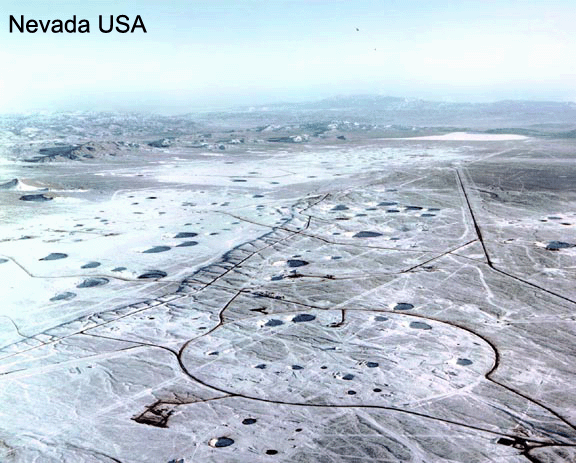
In the spring before my 30th birthday, I was diagnosed with thyroid cancer. Children, especially those under the age of five at the time of radiation exposure, as I was, were most at risk.
I have been sliced, radiated and scooped out. I have buried and mourned the dead, comforted and advocated for the living, and worried with each pain, ache and lump that I am getting sick again. I survived thyroid cancer as well as subsequent health complications that left me unable to have children. My sister and others I grew up with were not so fortunate. They lost their lives to various cancers and other radiation-related illnesses. Before she died, my sister and I counted 54 people in a five-block area of our childhood neighborhood who developed cancer, autoimmune disorders, and other diseases that ravaged them and their families.
The government’s ambitious program of nuclear testing had tragic consequences for countless unsuspecting, patriotic Americans living downwind. “We are veterans of the Cold War, only we never enlisted and no one will fold a flag over our coffins,” a late friend of mine was fond of saying.
The U.S. government finally acknowledged its responsibility in 1990 when it passed the bipartisan Radiation Exposure Compensation Act (RECA), which paid partial restitution to some fallout victims in select rural counties of Utah, Arizona and Nevada. The bill never went far enough. We now know that the harm wreaked by fallout extends far beyond these counties. We also know that people are still getting sick. The suffering has not ended.
As part of a coalition of impacted community groups working with allied advocates nationwide, we have worked hard for the speedy expansion and extension of RECA through the Radiation Exposure Compensation Act Amendments of 2021. This bipartisan bill would add downwinders from all of Utah, Nevada, Arizona, Idaho, Montana, Colorado, New Mexico and Guam, as well as uranium miners who worked in the industry beyond 1971. It also would increase compensation from $50,000 to $150,00 for all claimants and extend the program for 19 years.
The House bill currently has 68 co-sponsors, the Senate bill 18, Republicans and Democrats from across the country. What we now need are their colleagues in both parties to join them.
As we reach out to Senators and Representatives asking them to support the bills, we are sometimes confronted with questions about cost. What, I ask in return, is a human life worth? Over the last 32 years, RECA has paid out $2.5 billion to 39,000 Americans. To put that into perspective, each year this country spends $50 billion just to maintain our nuclear arsenal. Are our lives not worth 0.5% of the cost of weapons that harmed us?
What is paramount is rectifying the mistakes of the past. As Rep. Diane Titus of Nevada said, “These people are Cold Warriors and we do not leave our warriors on the field.”
A government that knowingly harms its own citizens must be held accountable. Our lives are worth more than civilization-ending weapons. It’s a simple matter of priorities and justice.
Indigenous groups challenge New Brunswick’s costly radioactive waste legacy
Difficulty, cost of managing radioactive waste underlined by hearings, https://nbmediacoop.org/2022/06/08/indigenous-groups-challenge-new-brunswicks-costly-radioactive-waste-legacy/ by Kim Reeder and Susan O’DonnellJune 8, 2022
The recent re-licencing hearing for New Brunswick’s Point Lepreau nuclear reactor highlighted the difficulty and cost of managing the province’s long-lived legacy of radioactive waste.
Most of the radioactive materials generated by the Lepreau nuclear facility were never found in nature before the discovery of nuclear fission 83 years ago.
The Point Lepreau facility, however, has produced – and will continue to produce – thousands of tons of these toxic radioactive materials in the form of high, intermediate and low-level radioactive waste which must be kept isolated from all living things for a period of time that dwarfs the span of recorded human history.
When the Point Lepreau reactor was first built, the materials used in the core area – the metal, the concrete, even the heavy water that fills the vessel – were ordinary, non-radioactive materials. However, these items have all been transformed into extremely radioactive material during the normal operation of the reactor.
In fact, because these materials are so toxic, once the plant is shut down, NB Power has a plan to let the facility sit for approximately three decades before dismantling it, a strategy referred to as ‘deferred decommissioning’. During this time, referred to as the ‘dormancy’ period, the radioactivity will decrease significantly. However, the radioactivity will still be sufficiently high as to require handling by robotic equipment and careful packaging so as not to deliver a lethal dose of radiation to an unshielded worker or the environment.
The second consideration is that currently, no waste disposal site exists for the Point Lepreau facility itself, which will become thousands of tons of radioactive rubble, classified as intermediate and low-level waste. By deferring decommissioning, NB Power avoids the need to store and monitor the wastes until a disposal facility becomes available. As well, they avoid potential double-handling of wastes to meet unknown future disposal facility requirements.
NB Media Co-op’s Harrison Dressler described in a previous article that during the re-licencing hearing for Point Lepreau, a main focus of the Peskotomuhkati Nation’s intervention reflected their concerns about the lack of adequate planning for the toxic decommissioning waste. The Nation is and always has been opposed to producing and storing radioactive waste on its territory, which includes Point Lepreau.
The Nation does not want the regulator, the Canadian Nuclear Safety Commission (CNSC), to ‘approve’ NB Power’s inadequate plan and financial guarantee for decommissioning Point Lepreau.
The Nation’s expert on the topic, Canadian Coalition for Nuclear Responsibility president Gordon Edwards, compared NB Power’s financial guarantee with an OECD study of dozens of reactors that have already been dismantled. In his report, Edwards notes that NB Power’s financial guarantee is less than 40 percent of what is needed according to the OECD study. Indeed, the total amount NB Power plans to set aside is more than a billion dollars less than what the OECD estimates is likely required.
NB Power’s current decommissioning plan assumes much of the decommissioning waste will be sent off-site to a licensed facility for permanent disposal. Currently no such facilities exist, which is recognized as an industry challenge.
Edwards also found that NB Power has so far made no effort to locate a repository to receive the decommissioning waste, which is solely the responsibility of NB Power and the provincial government. Without a storage site, and without adequate funding, where will it all go?
During the re-licencing hearings in May, both the CNSC and NB Power were questioned by the regulator about the unrealistic nature of their plan, considering the plan assumes there will be a permanent home for this waste – and that no plans are being made for such a facility.
CNSC staff explained that the current plan is all that is required under Canadian law, and NB Power said that because of the deferred decommissioning strategy, they have a long time to figure out a solution to the problem. Experience shows, however, that NB Power and the New Brunswick government are already late in starting the effort, if they indeed do intend to have a site approved in the 2050s. Lepreau is scheduled to be shut down around 2040.
At the CNSC hearing, the Mi’gmawe’l Tplu’taqnn Inc., and Kopit Lodge – representing Elsipogtog First Nation – also raised similar concerns about radioactive waste. The Wolastoq Nations did not participate in the hearing. However, in March 2021, the traditional Wolastoq Grand Council issued a declaration against producing more radioactive waste at Point Lepreau. No Indigenous community in Canada – or elsewhere – has so far declared itself in favour of storing radioactive waste on its traditional territory.
Without a dramatic increase in the financial guarantee that NB Power must accumulate while the reactor is still earning money by selling electricity, and without a concerted effort to develop a concrete long-term strategy for New Brunswick’s radioactive waste legacy, both the Peskotomuhkati Nation and the New Brunswick population will be left with a permanent dump for radioactive waste right on the shore of North America’s Natural Wonder: the Bay of Fundy.
Kim Reeder, a senior policy analyst with the RAVEN project at the University of New Brunswick, coordinated the CNSC intervention for the Passamaquoddy Recognition Group. Susan O’Donnell, the lead researcher for RAVEN, also participated at the CNSC hearing.
Putting People First in Low-Dose Radiation Research

Putting People First in Low-Dose Radiation Research, Bemnet Alemayehu Natural Resources Defense Council. 7 June 22.It is urgent and feasible to improve our understanding of low-dose and low-dose-rate ionizing radiation health effects according to a new report released by the National Academies of Sciences, Engineering, and Medicine (NAS). At the request of the U.S. Congress, the NAS formed a committee of experts to conduct the study, sponsored by the U.S. Department of Energy. The report’s primary goal was to recommend a research program to increase the certainty of how exposure to low-dose and low-dose-rate radiation affects human health.
NRDC agrees that this is the right time to reconsider low-dose interdisciplinary radiation research in the United States and explore opportunities that advances in radiation health physics and information technology are providing. A large fraction of the U.S. population is exposed to low-dose, and low-dose-rate radiation and this number is increasing. Low-dose radiation research is most relevant to impacted communities due to disproportionate level of radiation exposure these communities have experienced compared to the general U.S. population due to activities carried out as part of the U.S. nuclear weapons program. Going forward, the study should give an opportunity for stakeholders and impacted communities to have deep and meaningful engagement at all stages of the research program by identifying priorities of research that concern them. The study should also prioritize trust building and make use of local community expertise.
How are we exposed to low-dose radiation?
People are exposed to ionizing radiation from a variety of sources. Most of this exposure comes from background radiation sources and from medical procedures.
Ionizing radiation is radiation that carries with it enough energy to remove an electron from an atom. This process can initiate a chain of events leading to health problems. When considering the health effects of radiation, understanding the amount of radiation dose absorbed by a person or an organ is critical.
Low-dose and low-dose-rate (low-dose accumulated over several years) are defined to mean a dose below 100 milligray and 5 milligray per hour, respectively. Gray is a unit used to measure the amount of radiation absorbed by an object or person, reflecting the amount of energy that radioactive sources deposit in materials through which they pass. Low-dose radiation exposure includes exposure to natural radiation, medical applications, and occupational exposures. According to the NAS report, low doses of radiation delivered over long periods do not cause prompt tissue or organ damage but may cause cellular damage that increases an individual’s long-term risk of cancer and hereditary disorders in a stochastic (or probabilistic) fashion.
The NAS report identified the following seven low-dose and low-dose-rate radiation exposure sources to be relevant for the study:
- exposure from natural radiation sources
- exposure to patients from medical applications
- occupational exposures
- exposure of workers that results from nuclear power routine operations and accidents
- exposure from nuclear or radiological incidents
- exposures from the nuclear weapons program, and
- exposure from nuclear waste.
Key recommendations from the report
Research agenda
Ionizing radiation occurs in a wide range of settings and the number of exposed individuals is increasing. However, the relationship between exposure to radiation and cancer risk at the very low doses is not well established. Currently, there is also no dedicated low-dose and low-dose-rate radiation research program or coordinated research strategy in the United States.
The report recommended research programs that leverage advances in modern science to obtain direct information on low-dose and low-dose-rate radiation health effects. These are:
- advances in epidemiological study design and analysis
- advances in radiobiological research
- advances in biotechnology and research infrastructure
For the research to achieve its goals, integration and interaction between these research programs is critical.
Program funding
The report found that a significant investment over a sustained period spanning several decades is necessary to accomplish the research goals. The report estimated that $100 million annually is needed during the first 10 to 15 years with periodic assessments. The report cautioned that inadequate funding for the program would lead to the possible inadequate protection of patients, workers, and members of the public from the adverse effects of radiation.
Leadership for low-dose research in the United States
The report proposed joint Department of Energy and National Institute of Health leadership for low-dose radiation research that involves division of tasks based on capabilities. The report also recommended that the Department of Energy take strong and transparent steps to mitigate the issues of distrust toward research that it manages.
Engagement with impacted communities
Success of the low-dose radiation program would depend not only on its scientific integrity but also on its ability to meaningfully engage and communicate with the stakeholders, which includes impacted communities.
Impacted communities, according to the report, include indigenous communities; atomic veterans; nuclear workers; uranium miners, transporters, and their families; and individuals or communities impacted by radioactive contamination or nuclear fallout due to nuclear weapons testing, offsite radiation releases from nuclear weapons production sites, and nuclear waste cleanup activities.
Impacted communities have strongly objected to the Department of Energy’s management of the low-dose radiation program due to the Department’s responsibility for management and cleanup of nuclear sites conflicting with its role as a manager of studies on low-dose and low-dose-rate radiation health effects.
For the success of the low-dose radiation program, the program needs to:
- develop a transparent process for stakeholder identification, engagement, and communication
- include members of the impacted communities in the independent advisory committee so that they may participate in various aspects of research planning and implementation, and
- set up additional advisory subcommittees with substantial stakeholder participation to advise on specific projects that involve human populations exposed to low-dose radiation.
ELON MUSK IS NOT A RENEGADE OUTSIDER – HE’S A MASSIVE PENTAGON CONTRACTOR

while the 50-year-old businessman presents himself as a maverick science genius – an act that has garnered him legions of fans around the world – a closer inspection of his career shows he earned his fortune in a much more orthodox manner. First by being born rich, then by striking it big as a dot-com billionaire, and finally, like so many others, by feeding from the enormous government trough.
Perhaps more seriously though, SpaceX’s close proximity to both the military and the national security state marks it out as a key cog in the machine of U.S. empire, allowing Washington to spy, bomb or coup whoever it wants.
ALAN MACLEOD, Mint Press News, MAY 31ST, 2022 ”………………………………………….. Musk has deliberately cultivated this image of himself: a real life Tony Stark figure who thinks for himself and is not part of the established order. But behind this carefully constructed façade, Musk is intimately connected to the U.S. national security state, serving as one of its most important business partners. Elon, in short, is no threat to the powerful, entrenched elite: he is one of them.
TO UKRAINE, WITH LOVE
Musk, whose estimated $230 billion fortune is more than twice the gross domestic product of Ukraine, has garnered a great deal of positive publicity for donating thousands of Starlink terminals to the country, helping its people come back online after fighting downed the internet in much of the country. Starlink is an internet service allowing those with terminals to connect to one of over 2,400 small satellites in low Earth orbit. Many of these satellites were launched by Musk’s SpaceX technologies company.
However, it soon transpired that there is far more than meets the eye with Musk’s extraordinary “donation.” In fact, the U.S. government quietly paid SpaceX top dollar to send their inventory to the warzone. USAID – a government anti-insurgency agency that has regularly functioned as a regime-change organization – is known to have put up the cash to purchase and deliver at least 1,330 of the terminals.
Starlink is not a mass-market solution. Each terminal – which is, in effect, a tiny, portable satellite dish – has a markedly limited range, and is useful only in hyper-local situations. Mykhailo Fedorov, Ukraine’s Minister of Digital Transformation, estimated that the 10,000 Starlink terminals were allowing around 150,000 people to stay online.
Such a small number of people using the devices raises eyebrows. Who is important enough to be given such a device? Surely only high-value individuals such as spies or military operatives. That the Starlinks are serving a military purpose is now beyond clear. Indeed, in a matter of weeks, Starlink has become a cornerstone of the Ukrainian military, allowing it to continue to target Russian forces via drones and other high-tech machinery dependent on an internet connection. One official told The Times of London that he “must” use Starlink to target enemy forces via thermal imaging.
Starlink is what changed the war in Ukraine’s favor. Russia went out of its way to blow up all our comms. Now they can’t. Starlink works under Katyusha fire, under artillery fire. It even works in Mariupol,” one Ukrainian soldier told journalist David Patrikarakos.
The reference to Mariupol alludes to the infamous Nazi group, the Azov Battalion, who have also reportedly been using Musk’s technology. Even in a subterranean cavern beneath Mariupol’s steelworks, Azov fighters were able to access the internet and communicate with the outside world, even doing video interviews from underground. In 2015, Congress attempted to add a provision to U.S. military aid to Ukraine stipulating that no support could go to Azov owing to their political ideology. That amendment was later removed at the behest of the Pentagon.
Dave Tremper, Director of Electronic Warfare at the Pentagon, sang SpaceX’s praises. “How they did that [keeping Ukrainian forces online] was eye-watering to me,” he said, adding that in the future the U.S. military “needs to be able to have that agility.”
ROCKETMAN
Such a statement is bound to get the attention of SpaceX chiefs, who have long profited from their lucrative relationship with the U.S. military. SpaceX relies largely on government contracts, there being almost no civilian demand for many of its products, especially its rocket launches.
Musk’s company has been awarded billions of dollars in contracts to launch spy satellites for espionage, drone warfare and other military uses. For example, in 2018, SpaceX was chosen to blast a $500 million Lockheed Martin GPS system into orbit. While Air Force spokesmen played up the civilian benefits of the launch, such as increased accuracy for GPS devices, it is clear that these devices play a key role in global surveillance and ongoing drone wars. SpaceX has also won contracts with the Air Force to deliver its command satellite into orbit, with the Space Development Agency to send tracking devices into space, and with the National Reconnaissance Office (NRO) to launch its spy satellites. These satellites are used by all of the “big five” surveillance agencies, including the CIA and the NSA.
Thus, in today’s world, where so much intelligence gathering and target acquisition is done via satellite technology, SpaceX has become every bit as important to the U.S. war machine as more well-known companies like Lockheed Martin and Boeing. Without Musk’s company, the U.S. would not be able to carry out such an invasive program of spying and drone warfare around the world. Indeed, China is growing increasingly wary of this power, and is being advised to develop anti-satellite technologies to counter SpaceX’s all-seeing eye. Yet Musk himself continues to benefit from a general perception that he is not part of the system.
From its origins in 2002, SpaceX has always been extremely close to the national security state, particularly the CIA. Perhaps the most crucial link is Mike Griffin, who, at the time, was the president and COO of In-Q-Tel, a CIA-funded venture capital firm that seeks to nurture and sponsor new companies that will work with the CIA and other security services, equipping them with cutting edge technology. The “Q” in its name is a reference to “Q” from the James Bond series – a creative inventor who supplies the spy with the latest in futuristic tech………………………..
While at NASA, Griffin brought Musk in for meetings and secured SpaceX’s big break. In 2006, NASA awarded the company a $396 million rocket development contract – a remarkable “gamble” in Griffin’s words, especially as it had never launched a rocket before. As National Geographic put it, SpaceX, “never would have gotten to where it is today without NASA.” And Griffin was essential to this development. Still, by 2008, SpaceX was again in dire straits, with Musk unable to make payroll. The company was saved by an unexpected $1.6 billion NASA contract for commercial cargo services. Thus, from its earliest days, SpaceX was nurtured by government agencies that saw the company as a potentially important source of technology.
NUKING MARS & BACKING COUPS
Like Henry Ford, Musk went into the automobile business, purchasing Tesla Motors in 2004. And also like Henry Ford, he has shared some rather controversial opinions. In 2019, for instance, he suggested that vaporizing Mars’ ice caps via a series of nuclear explosions could warm the planet sufficiently to support human life. If this was done, it would arguably not even be his worst crime against space. During a 2018 publicity stunt, he blasted a Tesla into outer space using a SpaceX rocket. However, he did not sterilize the vehicle before doing so, meaning it was covered in earthly bacteria – microorganisms that will likely be fatal to any alien life they encounter. In essence, the car is a biological weapon that could end life on any planet it encounters.
NUKING MARS & BACKING COUPS
Like Henry Ford, Musk went into the automobile business, purchasing Tesla Motors in 2004. And also like Henry Ford, he has shared some rather controversial opinions. In 2019, for instance, he suggested that vaporizing Mars’ ice caps via a series of nuclear explosions could warm the planet sufficiently to support human life. If this was done, it would arguably not even be his worst crime against space. During a 2018 publicity stunt, he blasted a Tesla into outer space using a SpaceX rocket. However, he did not sterilize the vehicle before doing so, meaning it was covered in earthly bacteria – microorganisms that will likely be fatal to any alien life they encounter. In essence, the car is a biological weapon that could end life on any planet it encounters.
Musk also attracted attention when he appeared to admit that he worked with the U.S. government to overthrow Bolivian President Evo Morales in 2019………………….. The new government quickly invited Musk for talks. When asked on Twitter point blank whether he was involved in Morales’ ouster, Musk responded, “We will coup whoever we want! Deal with it.”………………………..
WORLD’S RICHEST MAN, FUNDED BY TAXPAYERS
In addition to the billions in government contracts Musk’s companies have secured, they also have received similar numbers in public subsidies and incentives. Chief among these is Tesla, which benefits greatly from complex international rules around electric vehicle production. In a push to reduce carbon emissions, governments around the world have introduced a system of credits for green vehicles, whereby a certain percentage of each manufacturer’s output must be zero-emission vehicles. Tesla only produces electric cars, so easily meets the mark.
However, the system also allows Tesla to sell their excess credits to manufacturers who cannot meet these quotas. In a competitive market where each manufacturer needs to hit certain targets, these credits are worth their weight in gold, and net Tesla billions in profit every year. For example, between 2019 and 2021 alone, Stellantis, which owns the Chrysler, Fiat, Citroen and Peugeot brands, forked out nearly $2.5 billion to acquire Tesla U.S. and European green credits.
This bizarre and self-defeating system goes some way to explaining why Tesla is worth more by market cap than Toyota, Volkswagen, Mercedes-Benz, BMW, GM, Ford, Honda, Hyundai, Kia, and Volvo put together, despite not being even a top-15 car manufacturer in terms of units sold.
Musk’s company also received significant government backing in its early stages, receiving a $465 million low-interest loan from the Department of Energy in 2010, at a time when Tesla was on the rocks and its future was in doubt.
Like many giant companies, Tesla is able to play states off against each other, each job-hungry location bidding against the others to give the corporation as much free cash and tax incentives as possible. In 2020, for example, Austin gave Tesla more than $60 million in tax breaks to build a truck plant there.
This, however, was small fry in comparison to some of the deals Musk has signed. The State of New York handed Musk over $750 million, including $350 million in cash, in exchange for building a solar plant outside of Buffalo – a plant that Musk was bound to build somewhere in the United States. Meanwhile, Nevada signed an agreement with Tesla to build its Gigafactory near Reno. The included incentives mean that the car manufacturer could rake in nearly $1.3 billion in tax relief and tax credits. Between 2015 and 2018, Musk himself paid less than $70,000 in federal income taxes.
Therefore, while the 50-year-old businessman presents himself as a maverick science genius – an act that has garnered him legions of fans around the world – a closer inspection of his career shows he earned his fortune in a much more orthodox manner. First by being born rich, then by striking it big as a dot-com billionaire, and finally, like so many others, by feeding from the enormous government trough.
Perhaps more seriously though, SpaceX’s close proximity to both the military and the national security state marks it out as a key cog in the machine of U.S. empire, allowing Washington to spy, bomb or coup whoever it wants.
It is for this reason that so much of the hysteria, both positive and negative, over Musk’s ongoing purchase of Twitter is misplaced. Elon Musk is neither going to save nor destroy Twitter because he is not a crusading rebel challenging the establishment: he is an integral part of it. https://www.mintpressnews.com/elon-musk-not-renegade-outsider-cia-pentagon-contractor/280972/
Canada’s nuclear waste liabilities total billions of dollars. Is a landfill site near the Ottawa River the best way to extinguish them?

Gordon Edwards, an activist and consultant with the Canadian Coalition for Nuclear Responsibility, accused CNL of obscuring the origin and hazardous nature of much of the waste. He said the worst of it includes cobalt-60 imported into Canada from other countries by private companies. He questioned why taxpayers should pay for its disposal. ‘‘They’re not being up front in telling people where these wastes are coming from,”
This is big business: Ottawa sends AECL more than half a billion dollars annually to pay for remediation efforts alone.

“It’s just piled right on top of a sloping hillside surrounded by wetlands, one kilometer from the Ottawa River,” “It would be hard to come up with a worse technology and site for permanent nuclear waste disposal.”
The Canadian Nuclear Laboratories’ proposed site for disposing radioactive waste has opponents watching with apprehension. Here’s what you need to know about the Near Surface Disposal Facility
GLOBE AND MAIL, MATTHEW MCCLEARN, 6 June 22, DEEP RIVER, ONT. One glance at Building 250 confirms that its demolition will be complicated.
Workers clad in protective gear are busy removing its asbestos cladding, which has been gridded off in orange ink into alphanumerically labelled boxes. The four-story wood structure cannot simply be knocked down with a wrecking ball. Before methodical dismantling can begin, virtually every plank, floor covering and panel must be studied and characterized.
Building 250 is one element of a multi-billion-dollar headache for the federal government. It’s among the oldest buildings at Chalk River Laboratories, 200 kilometers northwest of Ottawa, which long served as Canada’s premier nuclear research facility. Today the facility’s operator, Canadian Nuclear Laboratories (CNL), is addressing the resulting radioactive waste. It has already torn down 111 buildings, but Building 250 is among the most hazardous: it contained radioactive hot cells and suffered fires that spread contaminants throughout.

CNL needs a specially designated place to dispose of this hazardous detritus. This week, the Canadian Nuclear Safety Commission held final hearings for its environmental review of the Near Surface Disposal Facility (NSDF), CNL’s proposed landfill site for radioactive waste on what is now a thickly wooded hillside at Chalk River. Its decision is expected sometime around the end of this year, and no small number of opponents are watching with apprehension.
Continue readingRare Pediatric Cancers Persist 63 Years After Nuclear Accident

Melissa Bumstead is one of those residents. She and her family live 3.7 miles from the Santa Susana site. When her toddler Grace was diagnosed with a rare form of leukemia in 2014, doctors told Bumstead there were no known links between her daughter’s cancer and environmental contamination.
But during Grace’s treatment at Children’s Hospital Los Angeles, her mother began meeting other parents who lived near her and had children facing equally rare cancers.
They plotted their homes on Google Maps and found that they all lived within roughly 10 miles of one another. It would take another year for them to realize that the SSFL site was at the center of the circle.
WebMD Cancer news, By Neil Osterweil, March 11, 2022 –– Chernobyl. Fukushima. Three Mile Island.
The world knows these names all too well because of accidents there: complete or partial meltdowns of nuclear reactors that released massive amounts of cancer-causing radiation into the air, soil, and water.
The Santa Susana Field Lab (SSFL) is far less well-known, but no less infamous for what took place at this former rocket engine and nuclear energy test site just 28 miles northwest of downtown Los Angeles.
In July 1959, an accident involving one of 10 experimental nuclear reactors at the SSFL sitereleased a cloud of harmful radiation and toxic chemicals over the surrounding area, including Simi Valley, San Gabriel Valley, Chatsworth, and Canoga Park. The small reactor had no containment vessel.
This accident resulted in a release of radioactive iodine estimated to be as much as 250 times that of the partial meltdown that would occur 2 decades later at Three Mile Island, a much larger commercial reactor that had a containment vessel.
Six decades later, hundreds of potentially carcinogenic chemicals remain in the surrounding environment. And local children are being diagnosed with rare cancers at a rate that far outpaces what experts would predict.
Decades-Long Cover-Up
In 1959, the public knew nothing about what had happened at the site.
According to John Pace, then an employee at SSFL, the accident was covered up. Pace recounted the cover-up in the documentary In the Dark of the Valley, which first aired in November 2021 on MSNBC.
In fact, the accident at SSFL remained under wraps for 2 decades, according to Daniel Hirsch, former director of the Program on Environmental and Nuclear Policy at the University of California, Santa Cruz, and now president of Committee to Bridge the Gap, a nuclear policy nongovernmental organization.
“Students working with me while I was teaching at UCLA in 1979 uncovered these Atomic Energy Commission reports from Atomics International,” he said in an interview. “We had to order the documents from the annex to the UCLA Engineering Library. They were stored offsite, and it took a few days, and when we got them, we opened them up, and there were these fold-out photographs of the fuel [rods]. As we folded out the photographs further, we saw one photo with an arrow labeled ‘longitudinal cracks,’ and then other arrows showing other kinds of cracks, and then another arrow labeled ‘melted blob.’”
Hirsch and his students found that other accidents had occurred at SSFL, including a fuel fabrication system that leached plutonium, fires in a “hot” lab where irradiated nuclear fuel from around the United States was handled, and open-air burn pits where radioactive and toxic chemical wastes were illegally torched.
According to the Committee to Bridge the Gap, when the 2,800-acre SSFL site was being developed under the name Rocketdyne by aircraft maker North American Aviation, the area was sparsely populated, with nearly as many grazing animals as people in its hills and valleys.
North American Aviation later became part of Rockwell International, which in turn sold its aerospace and defense business units to the Boeing Company in 1996. Boeing, now in charge of the site and the cleanup efforts, is doing everything in its power to shirk or diminish its responsibility, Hirsch and other critics say.
Parents Against SSFL
Today, more than 150,000 people live within 5 miles of SSFL, and more than half a million live within 10 miles.
Continue readingJoe Biden’s huge move against Russia: ‘This is how nuclear war begins’

Yahoo News Australia and agencies, Thu, 2 June 2022
The US overnight has unveiled a new US$700 million package ($975 million) of sophisticated weapons for Ukraine in an urgent effort to prevent Russia from seizing the final swaths of land in the Donbas region.
But the most advanced rocket systems will take at least three weeks to reach the battlefront, raising questions of whether they will arrive in time to stop Russia’s slow but steady gains as the war inches closer to global catastrophe.
The Biden administration’s decision to send four medium-range rocket systems came after weeks of debate over whether the precision-guided weapons would provoke a strong military reaction from Russian President Vladimir Putin. It suggests the US believes it has zeroed in on what weapons deliveries are worth the risk…….
“The Ukrainians have given us assurances that they will not use these systems against targets on Russian territory,” Secretary of State Antony Blinken said Wednesday (local time).
“There is a strong trust bond between Ukraine and the United States.”
Nuclear war beings ‘one step at a time’
But not everyone has such faith in the latest decision by the US.
“The Ukrainians have given us assurances that they will not use these systems against targets on Russian territory,” Secretary of State Antony Blinken said Wednesday (local time).
“There is a strong trust bond between Ukraine and the United States.”
“This is a textbook example of how a nuclear war begins. One step at a time,” tweeted popular author Jim Rickards on Wednesday.
The Kremlin is also making threatening noises about the move. Kremlin spokesman Dmitry Peskov told reporters Wednesday the US is “deliberately and diligently pouring fuel on the fire.” He added that Russia doesn’t trust
Kyiv’s assurances that the multiple rocket launch systems supplied by the US will not be used to attack.
“In order to trust (someone), you need to have experience with situations when such promises were kept. Regretfully, there is no such experience whatsoever,” Peskov said.,……………….
The Pentagon would not say how many rockets it will provide to Ukraine, only that it is sending four of the truck-mounted HIMARS systems. The trucks each carry a container with six precision-guided rockets, which can travel about 70 kilometres……………… https://au.news.yahoo.com/joe-bidens-huge-move-against-russia-nuclear-war-223931012.html
U.S. government must increase the cleanup of Hanford’s very toxic nuclear wastes

In a worst case scenario, cleanup of Hanford might not be completed for another 150 years, or possibly never, Inslee wrote. He pointed out that Hanford’s older single-walled storage tanks are between 58 and 78 years old, which exceeds their designed lifespan of 20 to 30 years. At least two of those tanks are known to be leaking radioactive and other hazardous waste into the ground.
Inslee: Feds need to increase nuclear waste cleanup funds. https://www.bellinghamherald.com/news/business/national-business/article262083272.html By NICHOLAS K. GERANIOS and TED WARREN Associated Press June 03, 2022 Washington Gov. Jay Inslee, who has recently criticized the slow pace of cleaning up the Hanford Nuclear Reservation, toured the former nuclear weapons production site on Thursday and said more federal money is needed to finish the job. Hanford created more than two-thirds of the nation’s plutonium for nuclear weapons, including the atomic bomb dropped on Nagasaki, Japan, at the end of World War II. Left behind was the most contaminated nuclear site in the nation. Inslee wants the Biden administration to request $3.76 billion for Hanford cleanup in fiscal 2024, up from its current request of $2.52 billion for fiscal 2023. The $3.76 billion would help meet legal obligations, including court-ordered cleanup deadlines.
“We need the federal government to step up to the plate and do it’s job,” Inslee said Thursday. “This is an environmental justice issue.” Much of the waste is stored in 177 aging underground tanks, some of which are leaking.
The 580-square mile (1,500 square kilometer) Hanford site is located near Richland in southcentral Washington state. In a May letter to the director of the Office of Management and Budget at the Biden White House, Inslee wrote that Hanford budgets need to be far higher to avoid disaster, meet legal obligations and prevent the cleanup from continuing until as late as 2178, if not longer. “As the earliest possible date for cleanup continues to extend farther into the future, the harms to the surrounding communities and the danger of catastrophic impacts to the Pacific Northwest are occurring right now,” Inslee, a Democrat, said in the May 23 letter to OMB Director Shalanda Young.
In a worst case scenario, cleanup of Hanford might not be completed for another 150 years, or possibly never, Inslee wrote. He pointed out that Hanford’s older single-walled storage tanks are between 58 and 78 years old, which exceeds their designed lifespan of 20 to 30 years. At least two of those tanks are known to be leaking radioactive and other hazardous waste into the ground.
In addition. a tunnel storing highly contaminated equipment partially collapsed five years ago, and the collapse of a second waste storage tunnel was averted at great expense two years later, he wrote. “If the idea of investing in the cleanup today is unpalatable, consider this — whether calamity comes in the form of a release of radiation, groundwater contamination reaching the Columbia River, harmful exposures to workers at the site, or something else, the bill will eventually come due,” Inslee wrote. Relying on DOE data, Inslee said that even if cleanup is sufficiently funded every year, the earliest cleanup would be completed is 2064, but it could stretch to 2178 or later, if it ever is completed.
Each year that Hanford is underfunded adds 18 months to three years to the cleanup timeline as taxpayer dollars end up being spent on maintaining aging facilities and responding to emergency infrastructure failures, he said. “The slower this pace goes, the more it’s going to cost the American taxpayers,” Inslee said Thursday.
In a Senate subcommittee hearing in May, Energy Secretary Jennifer Granholm defended the administration’s latest budget request for Hanford, telling Washington’s Democratic Sen. Patty Murray it had to balance cleanup needs at all DOE sites. About a third of the nation’s defense-related environmental cleanup money goes to Hanford. ___ Geranios reported from Spokane, Washington.
Small nuclear reactors produce ’35x more waste’ than big plants

Mini nuclear reactors that are supposed to usher in an era of cheaper and
safer nuclear power may generate up to 35 times more waste to produce the
same amount of power as a regular plant, according to a study.
A team of researchers at Stanford University and the University of British Columbia
came to this conclusion after studying a design from each of three small
modular reactor (SMR) manufacturers: NuScale Power, Toshiba, and
Terrestrial Energy.
The study, published this week, found that not only did
those particular SMR approaches generate five times the spent nuclear fuel
(SNF), 30 times the long-lived equivalent waste, and 35 times the low and
intermediate-level waste (LILW), their waste is also more reactive,
therefore more dangerous and consequently harder to dispose of.
The Register 2nd June 2022
https://www.theregister.com/2022/06/02/nuclear_reactors_waste/
The Next Crapshot Reactor Explosion Will Dwarf the Next Psychotic School Shooting

https://buzzflash.com/articles/harvey-wasserman-for-buzzflash-the-next-crapshot-reactor-explosion-will-dwarf-the-next-psychotic-school-shooting May 31, 2022, By Harvey Wasserman
The next explosion at an atomic reactor will dwarf the latest school shooting
There’s a clear GOP stamp on this week’s mass slaughter of our beautiful school children and their teachers—-AND on the next.
Likewise the next nuke irradiation of countless downwind humans already has its horde of unrepentant enablers
To put it in the plainest possible terms: those now advocating continued operation of our increasingly dangerous, decrepit atomic fleet are personally responsible for upcoming explosion(s) at the individual reactors they refuse to evaluate.
And we can be sure that the blame dodging we’re now seeing in Texas will pale before the crocodile tears that will come with the next avoidable apocalypse.
So let’s be clear:
X No private insurance company will fully insure any US atomic reactor. https://www.nrc.gov/reading-rm/doc-collections/fact-sheets/nuclear-insurance.html
X Under federal law, your homeowner’s policy bars meaningful owner/operator liability for any melt-down’s fatal fallout.
X The limited federal liability fund for an apocalyptic reactor disaster represents a minuscule fraction of the likely damage.
X Just 45 miles from the San Andreas, California’s two Diablo reactors are surrounded by a dozen earthquake faults.
X Dr. Michael Peck, the Nuclear Regulatory Commission’s Diablo site inspector, demanded it shut for seismic dangers.
X The NRC purged Dr. Peck and trashed his warnings.
X Seismic shocks have already damaged Ohio’s Perry reactor and Virginia’s North Anna.
X Critical concrete is crumbling at New Hampshire’s Seabrook and Ohio’s Davis-Besse.
X Critical components at the South Texas Nuclear Plant recently froze.
X Vital core metals at Diablo are dangerously embrittled, cracked and decayed.
X Diablo’s owner-operator, PG&E, has pleaded guilty to manslaughter charges involving the avoidable deaths of nearly 100 people.
X Perry and Davis-Besse’s owners are linked to a $61 million legislative bribe meant to buy a $1 billion bail-out.
Like laws allowing psychopaths to buy assault weapons, nuclear non-regulation makes major catastrophes virtually certain.
All reactors regularly emit radiation, carbon, heat.
All can be replaced by renewables that are cheaper, cleaner, safer, more job-producing, quicker to deploy, free of radioactive wastes.
Nearly 800,000 Americans now work in wind, solar, batteries and/or efficiency.
Some 70,000 Californians now work in solar and wind, more than all Americans who mine coal. Just 1500 work at Diablo.
As with those who defend gun sales to mass murderers, reactor promoters can’t personally cover the unconscionable risks they so glibly demand we all take.
Come the next melt-down, their Texas-style moments of “silence and prayer” will reek of predictable hypocrisy.
As assault weapons must be banned, so these reactors must be shut.
In both cases, the ultimate gamble is being imposed by irresponsible crapshooters who can never pick up the pieces, cry as they might when their snake eyes bite the rest of us.
Harvey Wasserman’s THE PEOPLE’S SPIRAL OF US HISTORY narrates the atomic delusion (www.solartopia.org). Most Mondays at 5pm ET he co-convenes the Green Grassroots Election Protection Zoom (www.electionprotection2024.org)
1 This Month
26 April – Chernobyl: Inside the Meltdown airs on National Geographic on Sunday 26th April from 4pm

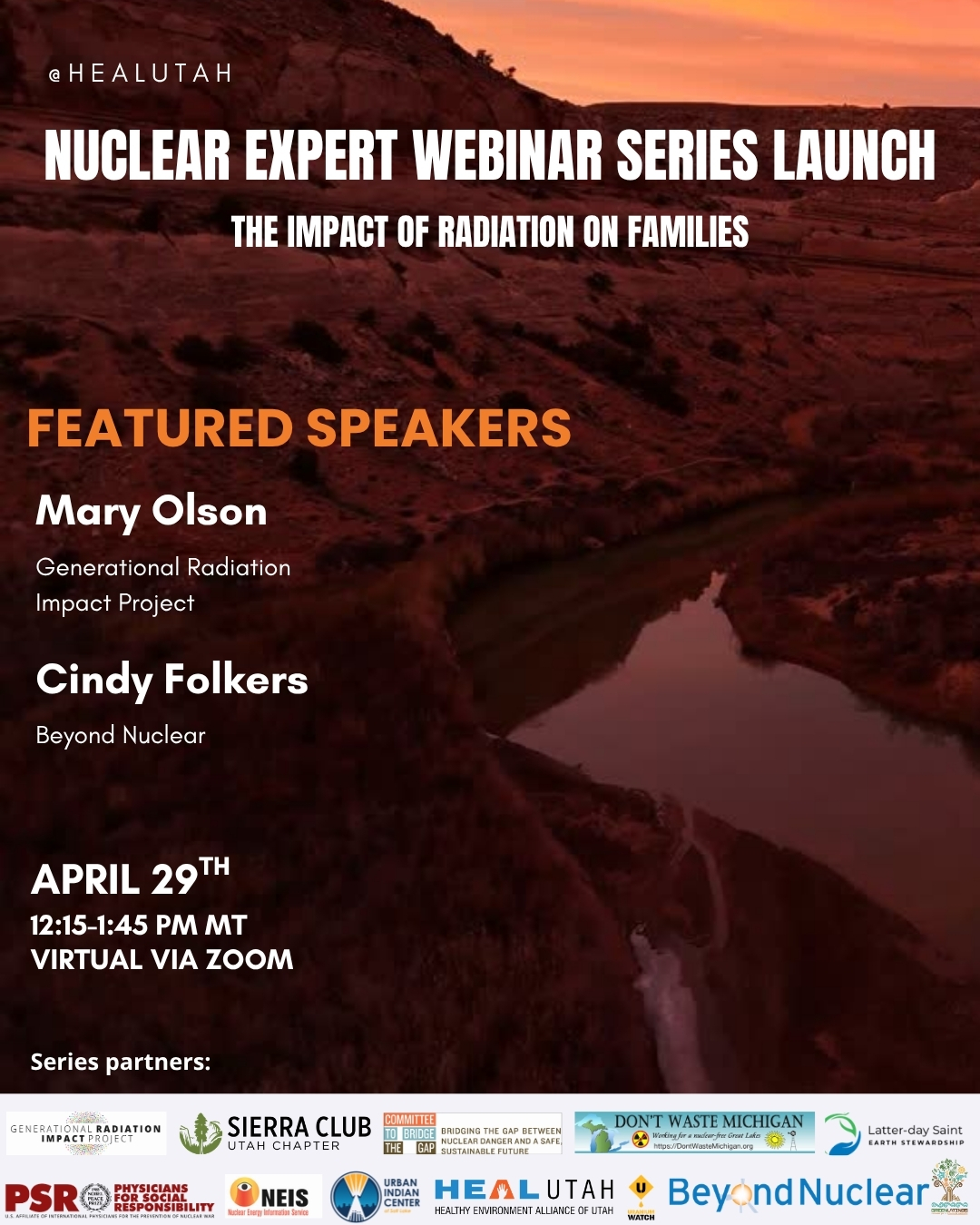
29 April – Nuclear Expert Webinar #1 – Radiation Impacts on Families with Mary Olson and Cindy Folkers
- 12:15 PM MT – 1:45 PM MT
- Location: Virtual – REGISTER TODAY

4 May -West Suburban Peace Coalition to discuss Iran war at May Educational Forum
Monday, May 4, 7:00 – 8:00 PM Central Standard Time
Title: : How Trump’s Narrative Tries to Shape the Reality of the War on Iran.
Contact Walt Zlotow, zlotow@hotmail.com 630 442 3045 for further information
14 May – online event From Bombs to Data Centres: the Face of Nuclear Colonialism

Pine Ridge Uranium is the real threat, not Tehran- Tell Burgum: Stop the Extraction.
Chernobyl: The Lost Tapes – A good documentary on Chernobyl on SBS available On Demand for the next 3 weeks– https://www.sbs.com.au/ondemand/tv-program/chernobyl-the-lost-tapes/2352741955560
To see nuclear-related stories in greater depth and intensity – go to https://nuclearinformation.wordpress.com
-
Archives
- April 2026 (346)
- March 2026 (251)
- February 2026 (268)
- January 2026 (308)
- December 2025 (358)
- November 2025 (359)
- October 2025 (376)
- September 2025 (257)
- August 2025 (319)
- July 2025 (230)
- June 2025 (348)
- May 2025 (261)
-
Categories
- 1
- 1 NUCLEAR ISSUES
- business and costs
- climate change
- culture and arts
- ENERGY
- environment
- health
- history
- indigenous issues
- Legal
- marketing of nuclear
- media
- opposition to nuclear
- PERSONAL STORIES
- politics
- politics international
- Religion and ethics
- safety
- secrets,lies and civil liberties
- spinbuster
- technology
- Uranium
- wastes
- weapons and war
- Women
- 2 WORLD
- ACTION
- AFRICA
- Atrocities
- AUSTRALIA
- Christina's notes
- Christina's themes
- culture and arts
- Events
- Fuk 2022
- Fuk 2023
- Fukushima 2017
- Fukushima 2018
- fukushima 2019
- Fukushima 2020
- Fukushima 2021
- general
- global warming
- Humour (God we need it)
- Nuclear
- RARE EARTHS
- Reference
- resources – print
- Resources -audiovicual
- Weekly Newsletter
- World
- World Nuclear
- YouTube
-
RSS
Entries RSS
Comments RSS
 nuclear-news