Americans now fear cyberattack more than nuclear attack
The Hill, BY DANIEL DE VISÉ – 04/07/23
Americans now see cyberattack as the greatest threat facing the country, two recent polls show, suggesting that cyber fears have outflanked concern over climate change, immigration, terrorism or nuclear weapons.
The national obsession with computer-on-computer attack, documented in a 2023 Gallup poll and a 2022 Pew Research survey, comes at a time when cyberattack seems to be everywhere and nowhere.
………………………………………………. In the Gallup poll, published last month, 84 percent of respondents rated cyberterrorism as a critical threat, ranking it above 10 other fears, including international terrorism, global warming, the conflict between Russia and Ukraine and Iran’s nuclear program. ……………………………………………………………………………………………………………………………………………
And, of course, the world faces many perils beyond cyberattack. One is nuclear war. Nuclear fears surged in the weeks after the Russian invasion of Ukraine in February 2022.
More than a year later, the nuclear threat seems greater than ever. The Doomsday Clock, a symbol of humanity’s proximity to extinction, stands at 90 seconds to midnight, signifying a moment of unprecedented danger.
Peter Kuznick, a history professor and director of the Nuclear Studies Institute at American University, believes “the danger of nuclear war is probably greater” now than at the invasion’s start.
But the nuclear threat, Kuznick said, is “something that people don’t want to think about.”
US Department of Energy is once again promoting large nuclear reactors, despite lack of supply chain and absurdly unaffordable costs

The US Department of Energy (DOE) is once again promoting large-scale
reactors after spending a decade advancing smaller models. It boldly
declares in a report last month that the domestic nuclear industry has the
potential to “scale from ~100 GW in 2023 to ~300 GW by 2050 — driven by
deployment of advanced nuclear technologies.”
This is beyond absurd — it’s irresponsible.
It’s absurd because the US no longer has the supply
chain needed for large-scale nuclear projects — it can’t even forge a
pressure vessel; it’s irresponsible because the cost of building 200-300
new reactors would be more than $3 trillion.
Resources devoted to rescuing
a dying industry are resources that wouldn’t be available for viable,
less-costly strategies to achieve net-zero emissions in the power sector.
More than that, the report reflects an energy agency still dominated by a
nuclear-centric culture, and badly out of step with the times.
Energy Intelligence 3rd April 2023
https://www.energyintel.com/00000187-2f8a-db48-adf7-ef9af9880000
Busting the spin about nuclear wastes – a Letter to the editor of the Hill Times.
(Not sure whether or not the Hill Times will publish this letter)
from: Angela Bischoff Director, Ontario Clean Air Alliance, 5 Apr 23
More happy talk from nuclear advocates is not what Canadians need when it comes to understanding the issue of how to deal with the hundreds of thousands of highly radioactive bundles currently stored in pools and warehouses at Canadian nuclear plants.
In their letter of April 5, two nuclear advocates from the industry-aligned Canadian Nuclear Society trot out the usual assurances that this waste can be safely stored underground for hundreds of thousands of years. That no country has actually done this, and that the industry-owned Canadian Nuclear Waste Management Organization is still struggling to identify a “willing host” community for such a facility in the face of adamant community and First Nation opposition, is blithely ignored.
There have been nuclear power operations in Canada for over 60 years now, yet the industry still has not managed to execute on its preferred strategy of dump-and-run. Comparing deadly radioactive waste to materials like niobium and cadmium is like comparing the likelihood of surviving a multi-vehicle car crash with falling off your bicycle. No one ever died from standing next to a wind turbine magnet.
Trying to paper over the level of risk involved in handling, transporting, and disposing of waste that must remain completely isolated for hundreds of thousands of years, just exposes how the nuclear industry would prefer to avoid hard questions about why it has been allowed to carry on without having an implementable plan for dealing with its deadly toxic waste. What other industry is given a huge free pass like this?
Crowd turns out for town hall on plutonium pits, nuclear waste storage

BY ALAINA MENCINGER / JOURNAL STAFF WRITER, WEDNESDAY, APRIL 5TH, 2023 Albuquerque Journal
“…………………………………………. a town hall meeting, where residents of Santa Fe, Albuquerque, Los Alamos and beyond asked questions and made comments about nuclear production and disposal in New Mexico. The crowd addressed a pair of officials from the National Nuclear Security Administration and the U.S. Department of Energy’s Office of Environmental Management.
There was hardly an empty seat in the auditorium; 150 others attended the town hall virtually.
Speakers at the town hall generally focused on three main issues: increased production of plutonium pits, ramped up disposal of transuranic waste at the Waste Isolation Pilot Plant, and nuclear proliferation.
One attendee, Erich Kuerschner, expressed concerns about health and safety regarding radiation.
“Have you ever seen any pictures of what humans looked like after Hiroshima and Nagasaki?” Kuerschner asked. “It’s horrible, because so many people haven’t — you know, they have no idea of what radiation does to a human being.”
Plutonium pits, bowling-ball-sized hollow spheres of radioactive plutonium, are essential to trigger nuclear reactions.
…………………………………………. many attendees questioned the necessity of adding to the country’s nuclear arsenal, including Santa Fe Archbishop John Wester.
“All your plans for the expanded plutonium pit stores — why is plutonium bomb core production even necessary when it is not to maintain the safety and reliability of the existing tested stockpile?” Wester asked.
He went on to call on the NNSA and DOE to prioritize cleanup at Los Alamos National Lab and beyond, denuclearize the country, and invest in “real national security threats that tangibly impact New Mexicans such as wildfires caused by climate change and preventing the next pandemic.”…………………………..
Other speakers raised concerns about transporting and storing nuclear waste in DOE’s Waste Isolation Pilot Plant in Carlsbad. WIPP is the only repository for transuranic waste — clothes, tools, soil and other materials contaminated with radiation — in the country. The plant was expected to stop taking new waste in 2024; however, a March 2022 report by the Office of Environmental Management titled “WIPP Strategic Vision: 2022-2032”, indicated that the plant “is currently anticipated to operate beyond 2050.”
Activist Cynthia Wheeler said four years ago she bought a house along the route from LANL to WIPP, under the assumption that in 2024, the plant would be closed.
“The federal agencies changed the rules to keep WIPP open for the rest of the century,” Wheeler said. “… I was following the rules. But DOE was breaking promises after the fact.”
………………….. The plant is in the process of renewing its permit. Public comment on the renewal has been extended by the New Mexico Environment Department until April 19 at 5 p.m.
Pentagon fake news about Chinese fast breeder reactors
Assistant Secretary of Defense John Plumb knew better when characterizing Russia-China reactor cooperation as a nuclear weapon threat
Asia Times, By JONATHAN TENNENBAUM, APRIL 3, 2023
The US Department of Defense and numerous private commentators allege that Russian-Chinese cooperation on fast breeder reactors will provide plutonium for large numbers of Chinese nuclear weapons. Assistant Secretary of Defense John Plumb told Congressional hearings on March 8:
“It’s very troubling to see Russia and China cooperating on this. They may have talking points around it, but there’s no getting around the fact that breeder reactors are plutonium, and plutonium is for weapons. So I think the [Defense] Department is concerned. And of course, it matches our concerns about China’s increased expansion of its nuclear forces as well, because you need more plutonium for more weapons.”
The Pentagon knows better than this. Anyone conversant with fast breeder reactor technology is aware that the type of plutonium that can be produced in such reactors is much less suitable for nuclear weapons than the plutonium produced in other reactor types, whose design and construction China has long mastered.
It is therefore nonsensical to charge that the main goal of the Chinese fast breeder program is weapons-related. Rather, the motivation for the program is consistent with that of other nations that have pursued fast breeder reactor designs, including greater efficiency in the utilization of nuclear fuel, reduction in the amount and toxicity of nuclear waste and greater independence from outside fuel supplies.
Here are the details, point by point. They speak for themselves:………………………………………………………………………………… more https://asiatimes.com/2023/04/pentagon-fake-news-about-chinese-fast-breeder-reactors/
Moltex vows to help Canada recycle its nuclear waste. Critics say the byproducts would be even worse.
“At best, they’ll end up with a small amount of various types of waste before the project is terminated, that will just create a bigger disposal hazard. And if it’s stuck in the province of New Brunswick, it will be their problem. But there’s zero chance of this cockamamie contraption being useful for generating electricity, or treating radioactive waste in a sound way.”
The Globe and Mail, MATTHEW MCCLEARN, 2 Apr 23,
Less than a kilometre from the western shore of the Bay of Fundy, the Point Lepreau Solid Radioactive Waste Management Facility temporarily houses about 160,000 spent fuel assemblies from New Brunswick’s only nuclear power reactor. Moltex Energy, a Saint John-based startup, proposes to recycle that radioactive waste into fresh fuel for a new 300-megawatt reactor called the Stable Salt Reactor-Wasteburner, or SSR-W.
Moltex promises these facilities will greatly diminish the waste inventory of NB Power, the province’s primary electric utility, beginning in the early 2030s, while at the same time producing electricity. Critics, however, warn the resulting wastes would be harder to dispose of than the assemblies themselves.
Criticisms notwithstanding, Moltex’s proposal appears to be gaining momentum. It has partnered with SNC-Lavalin Group, which holds a minority ownership stake and provides many of Moltex’s 35 employees through secondments – a vote of confidence from a company with deep roots in Canada’s nuclear sector…………….
Premier Blaine Higgs hailed Moltex in a speech in February, stating his government’s support “is positioning New Brunswick as a leader in development of new nuclear.” Mike Holland, Minister of Natural Resources and Energy Development, has extended what he described as “unwavering commitment to seeing this project become a reality.” The province has already supplied $10-million toward that end, while the federal government, through its Strategic Innovation Fund and other channels, has provided $50.5-million.
What these supporters have signed up for, however, isn’t entirely clear. Moltex’s technologies are embryonic; emphasizing that fact, partners that would play crucial roles in implementing them refused to discuss the implications with The Globe and Mail. Citing the need for commercial confidentiality, Moltex chief executive officer Rory O’Sullivan acknowledges the company hasn’t revealed many details about its reprocessing technology (known as Waste To Stable Salts, or WATSS).
Critics, though, say they’ve seen enough to recognize WATSS as merely the latest variations on nuclear waste reprocessing experiments dating back decades. Those experiences revealed reprocessing to be not a solution, they claim, but a curse.
About the size of a fire log, fuel assemblies from Canada’s CANDU reactors consist of rods known as “pencils” that are welded together; each contains cylindrical uranium pellets. Highly radioactive upon removal from a reactor, assemblies are stored in pools of water for about a decade before being warehoused at nuclear power plants in shielded containers. There are now about 3.2 million spent assemblies, which if stacked like cordwood would fill nine hockey rinks up to the boards……………..
WATSS would produce new wastes. By mass, the largest would be leftover uranium plus the metal cladding from CANDU fuel bundles, Mr. O’Sullivan said. This would be placed in the DGR, but in volumes greatly reduced than CANDU fuel bundles.
Then there’s fission products, a term encompassing hundreds of substances produced by nuclear fission inside a reactor. Though some are stable, others (such as cesium, technetium and strontium) are radioactive. These would be contained in salts that could be placed in canisters the same size as CANDU fuel bundles, facilitating storage in the DGR; Mr. O’Sullivan said they’d remain radioactive for up to 300 years………….
critics accuse Moltex of misleading the public. Gordon Edwards, a nuclear consultant and president of the Canadian Coalition for Nuclear Responsibility, said the company’s claim that the fission products would remain radioactive for only three centuries is “outrageous.”
“There are several radioactive materials which are very, very long-lived in the fission products, that have half-lives of not just thousands, but millions of years.”
The leftover uranium would contain leftover plutonium and fission products: “Experience has shown that this uranium is not clean, it’s contaminated,” he said. “You can’t just separate all of the fission products.”
WATSS wouldn’t significantly reduce storage volumes, Mr. Edwards added, as it’s the heat generated by radioactive waste – not the physical space occupied – that determines how large a DGR must be.
Ed Lyman, director of nuclear power safety with the Union of Concerned Scientists, has studied nuclear fuel reprocessing technologies since the 1980s. He said Moltex’s proposal is a variation on schemes that have been explored over many decades.
“All of the available evidence in the whole history of technology development in this area, as well as attempts to commercialize reprocessing in various ways, points to the fact that this is not going to work,” he said.
“At best, they’ll end up with a small amount of various types of waste before the project is terminated, that will just create a bigger disposal hazard. And if it’s stuck in the province of New Brunswick, it will be their problem. But there’s zero chance of this cockamamie contraption being useful for generating electricity, or treating radioactive waste in a sound way.”…………………
M.V. Ramana, a professor at the University of British Columbia’s public policy and global affairs school who researches nuclear issues, said Moltex’s $500-million estimate is highly optimistic. He pointed to Portland, Ore.-based NuScale Power, an early SMR developer, which spent US$1.1-billion over more than two decades developing what is essentially a scaled-down version of light water reactors common in the U.S.
As a molten salt reactor, the SSR-W should be far more difficult to license, Prof. Ramana said. Only two such reactors have ever been built, the last one closing in 1969, and neither generated electricity commercially.
Additionally, a sister company of Moltex, called MoltexFlex, is marketing another molten salt reactor in the Britain. (The companies share key personnel.) And Moltex must separately develop and license the WATSS process…………………..
“While we’re in early discussions with Moltex, they are still in the development phase, so we don’t have sufficient data at this time to respond to your technical questions about fuel waste,” NWMO spokesperson Russell Baker wrote in an e-mail.
All that adds up to a heap of unanswered questions. But having already spent $50-million on the project, Prof. Ramana said the federal government will be under considerable pressure to contribute more. He questioned the due diligence it has conducted to date.
“It’s not clear to me that the Trudeau government is interested in asking some of these hard questions,” he said. https://www.theglobeandmail.com/business/article-moltex-canada-nuclear-waste/
What nuclear disarmament leadership should look like — Beyond Nuclear International

Risk of nuclear war is too great for inaction
What nuclear disarmament leadership should look like — Beyond Nuclear International
Time to chart a new path before disaster strikes
By Robert Dodge and Sean Meyer
President Vladimir Putin’s recent announcement that Russia was suspending its participation in the New START Treaty—the last remaining nuclear arms control agreement between the United States and Russia—is the latest, stark reminder of the nuclear brink on which the world finds itself. This is on the heels of repeated reckless threats from Putin and other Russian officials to use nuclear weapons in Ukraine and at a time of rapidly deteriorating relations with China.
In short, the risk of nuclear war is all too real, perhaps greater than it has been since the Cuban Missile Crisis in 1962. It’s well past time for the United States, Russia, and the rest of the world’s nuclear powers to revitalize global nuclear disarmament efforts and take concrete steps to prevent nuclear war.
For its part, Congress has a very important role and voice in championing nuclear risk reduction and disarmament. Unfortunately, very few members have made this existential threat to humanity the priority it needs to be. That needs to change before the unthinkable happens.
………………….. here’s today’s reality: in less than one hour, billions of people could be killed because of an accident, miscalculation, or one person making a very bad decision. Last August, a landmark scientific study laid bare shocking truths about the potential consequences if even a small percentage of the world’s 13,000+ nuclear weapons are detonated over cities. The result would be catastrophic, with the ensuing climate disruption starving and killing hundreds of millions, even billions, of people and effectively ending human civilization as we know it. A large-scale nuclear conflict between the U.S. and Russia could lead to the deaths of up to 75% of the world’s population.
This time of war and heightened global tensions is precisely the right time for the United States, Russia, China, and all nuclear weapons states to recognize their mutual self-interest, and that of all humanity, in preventing a catastrophic nuclear war. Global adversaries can and must work together to solve global problems, especially in times of crisis or heightened tensions. This is exactly what President Ronald Reagan and then Soviet leader Mikhail Gorbachev did in the 1980s resulting in landmark nuclear arms control agreements that made the world a safer place.
Certainly, the problem won’t be addressed without leadership and new, bold thinking. Importantly, President Joe Biden needs to know that members of Congress, and the public, will have his back if he pursues a global nuclear disarmament agenda, even if it means negotiating with adversaries like Russia and China.
For members of the House, there’s one simple step they can take to show that leadership and signal to the administration and their constituents that this issue is important to them. They should co-sponsor H. Res. 77 introduced on January 31st by Rep. Jim McGovern (D-Mass.) and Rep. Earl Blumenauer (D-Ore.).
H. Res 77 calls on the United States to embrace the goals and provisions of the Treaty on the Prohibition of Nuclear Weapons (TPNW) which has now been signed by 92 countries and ratified by 66 of them “to actively pursue and conclude negotiations on a new, bilateral nuclear arms control and disarmament framework agreement with the Russian Federation before 2026 as well as to pursue negotiations with China and all other nuclear-armed states on an agreement or agreements for the verifiable, enforceable, and timebound elimination of global nuclear arsenals.”
H. Res 77 further calls for the the U.S. to lead a global effort to reduce nuclear risks and prevent nuclear war by
adopting the following common sense policies:
- Renounce the option of using nuclear weapons first;
- End the President’s sole authority to launch a nuclear attack;
- Take U.S. nuclear weapons off hair-trigger alert; and
- Cancel the plan to replace the entire nuclear arsenal of the United States with modernized, enhanced weapons at a cost that could exceed $2 trillion.
And there’s widespread public support for these policies. To date, over 70 municipal, county, and state governments including Los Angeles, Chicago, Salt Lake City, Philadelphia, Boston, Minneapolis, and many more have passed resolutions advocating for these very policies that have been organized by Back From the Brink, the national grassroots nuclear weapons abolition campaign. Some 150 local, state, and national organizations including the Union of Concerned Scientists, Physicians for Social Responsibility, Sierra Club, Natural Resources Defense Council, Peace Action, Public Citizen, and dozens of faith organizations have endorsed H. Res 77……………. more https://beyondnuclearinternational.org/2023/04/02/what-nuclear-disarmament-leadership-should-look-like/
—
Opponents pack Pilgrim Nuclear meeting as potential discharge of radioactive water looms

CAI | By Jennette Barnes, March 28, 2023
Opponents of the proposed discharge of radioactive water from the Pilgrim Nuclear Power Station packed a meeting on the future of the station last night.
Ryan Collins of Bourne received a standing ovation from the audience when he presented a thick binder of signatures from his Change.org petition. The petition calls for a stop to the discharge plan. It garnered more than 200,000 signatures.
The state’s Nuclear Decommissioning Citizens Advisory Panel hosted the meeting at Plymouth Town Hall as part of its regular calendar.
…………………………………… opponents argue that the terms of a state settlement with Holtec would make a release of contaminated water illegal, with or without a permit.
Many members of the audience held orange signs that read, “Protect our bays! No permit!” in reference to the proposed modification of Holtec’s permit under the National Pollutant Discharge Elimination System.
Jo-Anne Wilson-Keenan, of East Dennis, said she’s concerned about contamination. Speaking from the podium, she raised her arm to show the shape of Cape Cod and the location of Dennis.
“We live right here in the elbow, and when the radioactive water comes down from Plymouth, it’s going to land right on our beaches,” she said.
Jim Cantwell, state director for U.S. Sen. Ed Markey, discussed Markey’s March 17 letter to Holtec asking the company to use the ratepayer-funded decommissioning trust fund to pay for an independent scientific study of the risks of discharging the radioactive water stored at Pilgrim.
Last May, at a field hearing hosted by Markey in Plymouth, Singh agreed to allow independent testing.
Meanwhile, state-supervised testing of the Pilgrim water is set to begin with a collection of samples on April 5. Senior staff from the Massachusetts Department of Environmental Protection and Department of Public Health are scheduled to observe, along with a representative of the town of Plymouth.
But Seth Pickering, a deputy regional director with DEP, said the state no longer plans to use the previously identified Colorado lab, Eurofins, to test for non-radioactive pollutants.
The agency will instead rely on Gel Laboratories of South Carolina, which Pickering disclosed is a lab Holtec uses as well.
Members of the audience objected to the idea of using the same lab as Holtec……………. https://www.capeandislands.org/local-news/2023-03-28/opponents-pack-pilgrim-nuclear-meeting-as-potential-discharge-of-radioactive-water-looms
An obnoxious clause in Canada’s draft Act for Implementing the United Nations Declaration on the Rights of Indigenous Peoples (UNDRIP)

First -let’s see what the Assembly of First Nations of Canada (AFN) say about Small Modular Nuclear Reactors
The AFN resolution from 2018 against SMRs, available HERE says:
THEREFORE BE IT RESOLVED that the Chiefs-in-Assembly:
1. Demand that free, prior and informed consent is required to ensure that no storage or disposal of hazardous
materials shall take place in First Nations lands and territories.
2. Demand that the Nuclear Industry abandon its plans to operate Small Modular Nuclear Reactors in Ontario and
elsewhere in Canada.
3. Demand that the Government of Canada cease funding and support of the Small Modular Nuclear Reactors
program.
4. Direct that the National Chief and appropriate staff work to ensure that the Nuclear Industry and the Canadian Government abandon this program.
Now see what the Government includes in this draft Act
In the Environment section of Canada’s draft Act for Implementing the United Nations Declaration on the Rights of Indigenous Peoples (UNDRIP)- the specific SMRs text is found, in Chapter 1, Shared priorities. https://www.justice.gc.ca/eng/declaration/ap-pa/ah/p3.html
The Government of Canada will take the following actions……………
44. Increase capacity for Indigenous peoples to meaningfully engage, make informed decisions, and participate financially in clean energy alternatives like Small Modular Reactors (SMRs). SMRs in Canada are developing along three parallel streams including near-term on-grid, next generation and micro/off-grid, and there is potential for multiple benefits including use in remote Indigenous communities for abating emissions of heavy industry and increasing energy security. (Natural Resources Canada)
Canadian First Nations do not want small nuclear reactors on their lands

Decolonizing energy and the nuclear narrative of small modular reactors https://policyoptions.irpp.org/magazines/february-2022/decolonizing-energy-and-the-nuclear-narrative-of-small-modular-reactors/
Kebaowek First Nation is calling for an alternative to a planned SMR project, one that won’t undermine proper consultation and leave a toxic legacy.
by Lance Haymond, Tasha Carruthers, Kerrie Blaise, February 7, 2022 In early 2021, the Canadian Nuclear Safety Commission began reviewing the application from a company called Global First Power to build a nuclear reactor at the Chalk River Laboratories site about 200 kilometres northwest of Ottawa.
This project, known as a micro modular reactor project, is an example of the nuclear industry’s latest offering – a small modular reactor (SMR).SMRs are based on the same fundamental physical processes as regular (large) nuclear reactors; they just produce less electricity per plant. They also produce the same dangerous byproducts: plutonium and radioactive fission products (materials that are created by the splitting of uranium nuclei). These are all dangerous to human health and have to be kept away from contact with people and communities for hundreds of thousands of years. No country has so far demonstrated a safe way to deal with these.
Despite these unsolved challenges, the nuclear industry promotes SMRs and nuclear energy as a carbon-free alternative to diesel for powering remote northern communities. The Canadian government has exempted small modular reactors from full federal environmental assessment under the Impact Assessment Act. Many civil society groups have condemned this decision because it allows SMRs to escape the public scrutiny of environmental, health and social impacts.
The proposed new SMR in Chalk River, like the existing facilities, would be located on Algonquin Anishinabeg Nation territory and the lands of Kebaowek First Nation – a First Nation that has never been consulted about the use of its unceded territory and that has been severely affected by past nuclear accidents at the site.
At this critical juncture of climate action and Indigenous reconciliation, Kebaowek First Nation is calling for the SMR project at Chalk River to be cancelled and the focus shifted to solutions that do not undermine the ability of First Nations communities to be properly consulted and that do not leave behind a toxic legacy.
While these reactors are dubbed “small,” it would be a mistake to assume their environmental impact is also “small.” The very first serious nuclear accident in the world involved a small reactor: In 1952, uranium fuel rods in the NRX reactor at Chalk River melted down and the accident led to the release of radioactive materials into the atmosphere and the soil. In 1958, the same reactor suffered another accident when a uranium rod caught fire; some workers exposed to radiation continue to battle for compensation.
What makes these accidents worse – and calls into question the justification for new nuclear development at Chalk River – is that this colonized land is the territory of the Algonquin Anishinabeg Nation territory (which consists of 11 First Nations whose territory stretches along the entire Ottawa River watershed straddling Quebec and Ontario). Kebaowek First Nation, part of the Algonquin Nation, was among those First Nations never consulted about the original nuclear facilities on their unceded territory, and is still struggling to be heard by the federal government and nuclear regulator. Its land has never been relinquished through treaty; its leaders and people were never consulted when Chalk River was chosen as the site for Canada’s first nuclear reactors; and no thought was given to how the nuclear complex might affect the Kitchi Sibi (the Ottawa River).
History is being repeated at Chalk River today as the government pushes ahead with the micro modular reactor project without consent from Kebaowek. Assessments of the project have been scoped so narrowly that they neglect the historical development and continued existence of nuclear facilities on Kebaowek’s traditional territory. The justification for an SMR at this location without full and thorough consideration of historically hosted nuclear plants – for which there was no consultation nor accommodation – is a tenuous starting point and one that threatens the protection of Indigenous rights.
The narrative of nuclear energy in Canada is one of selective storytelling and one that hides the reality of the Indigenous communities that remain deeply affected, first by land being taken away for nuclear reactor construction, and later by the radioactive pollution at the site. All too fitting is the term radioactive colonialism coined by scholars Ward Churchill and Winona LaDuke, to describe the disproportionate impact on Indigenous people and their land as a result of uranium mining and other nuclear developments. In country after country, the uranium that fuels nuclear plants has predominantly been mined from the traditional lands of Indigenous Peoples at the expense of the health of Indigenous Peoples and their self-determination.
Kebaowek First Nation has been vocal in its objection to the continuation of the nuclear industry on its lands without its free prior and informed consent, as is its right under the United Nations Declaration on the Rights of Indigenous Peoples (UNDRIP). Despite requests for the suspension of the SMR project, pending adequate provisions for Indigenous co-operation and the Crown’s legal duty to initiate meaningful consultation, Kebaowek has yet to see its efforts reflected in government decisions and Crown-led processes.
Nuclear is a colonial energy form, but it is also bio-ignorant capitalism – a term coined by scholars Renata Avila and Andrés Arauz to describe the ways in which the current economic order ignores the planetary climate emergency, human and ecological tragedies, and the large-scale impact on nature. The narrative of nuclear as a “clean energy source” is a prime example of this bio-ignorance. Decision-makers have become fixated on carbon emissions as a metric for “clean and green,” ignoring the radioactive impacts and the risks of accidents with the technology.
It is more than 70 years since Chalk River became the site for the splitting of the nucleus. The continuation of nuclear energy production on unceded Indigenous territory without meaningful dialogue is a telling example of continued colonial practices, wherein companies extract value from Indigenous land while polluting it; offer little to no compensation to impacted communities; and abide by timelines driven by the project’s proponents, not the community affected. We need to move away from this colonial model of decision-making and decolonize our energy systems.
The challenge of climate change is urgent, but responses to the crisis must not perpetuate extractivist solutions, typical of colonial thinking, wherein the long-term impacts – from the production of toxic waste to radioactive releases – lead to highly unequal impacts.
The authors thank Justin Roy, councilor and economic development officer at Kebaowek First Nation, and M.V. Ramana, professor at the School of Public Policy and Global Affairs at the University of British Columbia, for contributing to this article.
Illinois Senate votes to lift nuclear construction ban
WSIU Public Broadcasting | By Andrew Adams | Capitol News Illinois, March 31, 2023
Environmental, anti-nuclear groups oppose the legislation
The Illinois Senate approved a measure on Thursday that would lift a 1980s-era moratorium on nuclear power plant construction.
Senate Bill 76, sponsored by Sen. Sue Rezin, R-Morris, was approved on a 39-13 vote. The bill now goes to the House of Representatives for consideration………………
Rezin said on the Senate floor that the bill would specifically allow for the construction of small modular nuclear reactors, or SMRs. ………………………………….
Senate proponents of the bill, including Sens. Bill Cunningham, D-Chicago, and Patrick Joyce, D-Essex, said that lifting the ban would help the state attract investment in new technology………………………….
“By lifting this ban, it allows Illinois, should they choose, to go after federal dollars that are provided by this administration, the Biden administration, who is embracing, supporting and investing in advanced nuclear reactors,” Rezin said.
Sen. Ram Villivalam, D-Chicago, said the bill was “still not fully baked,” adding that the question of what is done with nuclear waste still doesn’t have a solution.
“Whether it’s one pound or a thousand pounds, it’s still nuclear waste,” he said. …………
The state’s ban went into effect in 1987 and was intended to remain in effect until the federal government identifies a national nuclear waste disposal strategy. In 1987, Congress identified a site in Nevada as the nation’s repository for nuclear waste, although later opposition from the state and the White House quashed that plan. No national disposal site has been designated.
Some of the state’s largest environmental groups, including the Illinois Environmental Council, oppose the measure. Jack Darin, the head of the Illinois chapter of the Sierra Club, told Capitol News Illinois earlier this month that his organization doesn’t believe nuclear energy is “clean energy,” citing concerns over the environmental impact of nuclear waste.
David Kraft, the head of the Nuclear Energy Information Service, an anti-nuclear advocacy group based in Chicago, has said the bill will weaken the state’s landmark energy policy, the 2021 Climate and Equitable Jobs Act.
“Small modulars are not climate solutions, they’re not job generators until the 2030s and they’ll generate more nuclear waste,” Kraft said in a Thursday interview.
Kraft added he’s worried that lawmakers are not fully considering the safety implications of SMR technology…………………………….. https://www.northernpublicradio.org/illinois/2023-03-31/senate-votes-to-lift-nuclear-construction-ban
Covering (Up) Antiwar Protest in US Media

March 18 DC peace march almost completely blacked out in US corporate media
FAIR, DAVE LINDORFF, 30 Mar 23
In the early morning of March 20, 2003, US Navy bombers on aircraft carriers and Tomahawk missile-launching vessels in the Persian Gulf and the Mediterranean, along with Air Force B-52s in Britain and B-2s in Diego Garcia, struck Baghdad and other parts of Iraq in a “Shock and Awe” blitzkrieg to oust Iraqi dictator Saddam Hussein and occupy that oil-rich country.
Twenty years on, the US news media, as is their habit with America’s wars, published stories looking back at that war and its history (FAIR.org, 3/22/23), most of them treading lightly around the rank illegality of the US attack, a war crime that was not approved by the UN Security Council, and was not a response to any imminent Iraqi threat to the US, as required by the UN Charter.
Oddly, none of those national media organizations’ editors saw as relevant or remotely newsworthy a groundbreaking protest rally and march outside the White House of at least 2,500–3,000 people on Saturday, March 18, 2023, called by a coalition of over 200 peace and anti-militarism organizations to commemorate the 20th anniversary of the Iraq invasion.
The Washington Post, like the rest of the national news media, failed to mention or even run a photo of the rally in Lafayette Park. It didn’t even cover the peaceful and spirited march from the front of the White House along Pennsylvania and New York avenues to the K Street Washington Post building to deliver several black coffins as a local story—despite the paper’s having a reporter whose beat is actually described by Post as being to “to cover protests and general assignments for the metro desk.” An email request to this reporter, Ellie Silverman, asking why this local protest in DC went unreported did not get a response.
National press a no-show
The rally, organized by the ANSWER Coalition and sponsors such as Code Pink, Veterans for Peace, Black Alliance for Peace and Radical Elders, drew “several thousand” antiwar, anti-military protesters, according to ANSWER Coalition national director Brian Becker. He said the demonstration’s endorsers were calling for peace negotiations and an end to US arms for Ukraine, major cuts in the US military budget, an end to the US policy of endless wars, and freedom for Julian Assange and Indigenous prisoner Leonard Peltier.
………………………………………………… Filling the hole
Fortunately, alternative media, which have proliferated online, are filling in the hole in protest coverage, though of course readers and viewers have to seek out those sources of information. There was a news report on the march in Fightback News (3/23/23), for example, and commentary on the World Socialist Web Site (3/21/23) and Black Agenda Report (2/22/23).
Foreign coverage of the March 18 antiwar event in the US was substantial, which should embarrass editors at US news organizations
…………………………… Efforts to get either the Washington Post or New York Times to explain their airbrushing out the March 18 antiwar protest in Washington were unsuccessful. (Both publications have eliminated their news ombud offices, citing “budget issues.”)
………………………. more https://fair.org/home/covering-up-antiwar-protest-in-us-media/
Cancer as Weapon: Sowing Battlefields With Depleted Uranium

If the US has kept silent, the Brits haven’t. A 1991 study by the UK Atomic Energy Authority predicted that if less than 10 percent of the particles released by depleted uranium weapons used in Iraq and Kuwait were inhaled it could result in as many as “300,000 probable deaths.”
excuses in the absence of any action to address the situation are growing very thin indeed. Doug Rokke, the health physicist for the US Army who oversaw the partial clean up of depleted uranium bomb fragments in Kuwait, is now sick. His body registers 5,000 times the level of radiation considered “safe”.
CounterPunch, BY JEFFREY ST. CLAIR 29 Mar 23
With the UK’s unconscionable decision to send Depleted Uranium ammunition to Ukraine, it’s perhaps useful to revisit the environmental and health consequences of the US’s widespread use of such weapons in Iraq and Kuwait during the first Gulf War. This short essay is adapted from my book, Been Brown So Long It Looked Like Green to Me: the Politics of Nature.
At the close of the first Gulf War, Saddam Hussein was denounced as a ferocious villain for ordering his retreating troops to destroy Kuwaiti oil fields, clotting the air with poisonous clouds of black smoke and saturating the ground with swamps of crude. It was justly called an environmental war crime.
But months of bombing of Iraq by US and British planes and cruise missiles has left behind an even more deadly and insidious legacy: tons of shell casings, bullets and bomb fragments laced with depleted uranium. In all, the US hit Iraqi targets with more than 970 radioactive bombs and missiles.
It took less than a decade for the health consequences from this radioactive bombing campaign to begin to coming into focus. And they are dire, indeed. Iraqi physicians call it “the white death”-leukemia. Since 1990, the incident rate of leukemia in Iraq has grown by more than 600 percent. The situation is compounded by Iraq’s forced isolations and the sadistic sanctions regime, recently described by UN secretary general Kofi Annan as “a humanitarian crisis”, that makes detection and treatment of the cancers all the more difficult.
“We have proof of traces of DU in samples taken for analysis and that is really bad for those who assert that cancer cases have grown for other reasons,” said Dr. Umid Mubarak, Iraq’s health minister……………
“The desert dust carries death,” said Dr. Jawad Al-Ali, an oncologist and member England’s Royal Society of Physicians. “Our studies indicate that more than forty percent of the population around Basra will get cancer. We are living through another Hiroshima.”
Most of the leukemia and cancer victims aren’t soldiers. They are civilians. And many of them are children. The US-dominated Iraqi Sanctions Committee in New York has denied Iraq’s repeated requests for cancer treatment equipment and drugs, even painkillers such as morphine. As a result, the overflowing hospitals in towns such as Basra are left to treat the cancer-stricken with aspirin………………………………………………..
Depleted uranium is a rather benign sounding name for uranium-238, the trace elements left behind when the fissionable material is extracted from uranium-235 for use in nuclear reactors and weapons. For decades, this waste was a radioactive nuisance, piling up at plutonium processing plants across the country. By the late 1980s there was nearly a billion tons of the material.
Then weapons designers at the Pentagon came up with a use for the tailings: they could be molded into bullets and bombs. The material was free and there was plenty at hand. Also uranium is a heavy metal, denser than lead. This makes it perfect for use in armor-penetrating weapons, designed to destroy tanks, armored-personnel carriers and bunkers.
When the tank-busting bombs explode, the depleted uranium oxidizes into microscopic fragments that float through the air like carcinogenic dust, carried on the desert winds for decades. The lethal dust is inhaled, sticks to the fibers of the lungs, and eventually begins to wreck havoc on the body: tumors, hemorrhages, ravaged immune systems, leukemias.
In 1943, the doomsday men associated with the Manhattan Project speculated that uranium and other radioactive materials could be spread across wide swaths of land to contain opposing armies. Gen. Leslie Grove, head of the project, asserted that uranium weapons could be expected to cause “permanent lung damage.” In the late, 1950s Al Gore’s father, the senator from Tennessee, proposed dousing the demilitarized zone in Korea with uranium as a cheap failsafe against an attack from the North Koreans.
After the Gulf War, Pentagon war planners were so delighted with the performance of their radioactive weapons that ordered a new arsenal and under Bill Clinton’s orders fired them at Serb positions in Bosnia, Kosovo and Serbia. More than a 100 of the DU bombs have been used in the Balkans over the last six years.
Already medical teams in the region have detected cancer clusters near the bomb sites. The leukemia rate in Sarajevo, pummeled by American bombs in 1996, has tripled in the last five years. But it’s not just the Serbs who are ill and dying. NATO and UN peacekeepers in the region are also coming down with cancer. As of January 23, eight Italian soldiers who served in the region have died of leukemia.
The Pentagon has shuffled through a variety of rationales and excuses. ……………………………
If the US has kept silent, the Brits haven’t. A 1991 study by the UK Atomic Energy Authority predicted that if less than 10 percent of the particles released by depleted uranium weapons used in Iraq and Kuwait were inhaled it could result in as many as “300,000 probable deaths.”
The British estimate assumed that the only radioactive ingredient in the bombs dropped on Iraq was depleted uranium. It wasn’t. A new study of the materials inside these weapons describes them as a “nuclear cocktail,” containing a mix of radioactive elements, including plutonium and the highly radioactive isotope uranium-236. These elements are 100,000 times more dangerous than depleted uranium.
Typically, the Pentagon has tried to dump the blame on the Department of Energy’s sloppy handling of its weapons production plants.
He knows where to place the blame. “There can be no reasonable doubt about this,” Rokke told Australian journalist John Pilger. “As a result of heavy metal and radiological poison of DU, people in southern Iraq are experiencing respiratory problems, kidney problems, cancers. Members of my own team have died or are dying from cancer.”
Depleted uranium has a half-life of more than 4 billion years, approximately the age of the Earth. Thousand of acres of land in the Balkans, Kuwait and southern Iraq have been contaminated forever. If George Bush Sr., Dick Cheney, Colin Powell and Bill Clinton are still casting about for a legacy, there’s a grim one that will stay around for an eternity. https://www.counterpunch.org/2023/03/29/cancer-as-weapon-sowing-battlefields-with-depleted-uranium/
Canada’s “peaceful” nuclear program intimately involved in selling Plutonium For American Bombs

Canadians have been told repeatedly by spokespersons from Atomic Energy of Canada Limited, the Canadian Nuclear Association and the Government of Canada
- that the Canadian nuclear program has nothing to do with atomic bombs,
- that plutonium produced in Canadian reactors is unfit for military use, and
- that Canada has a strict policy that all nuclear materials supplied to other countries must be used for peaceful, non-explosive purposes.
What they don’t say is
that the Canadian nuclear program was born as part of the Manhattan Project — the secret project which produced the world’s first atomic bombs;
that the Canadian role in the atomic bomb project was focussed on basic research into the production and separation of plutonium for use in atomic bombs;
that the Chalk River Nuclear Establishment was built following a military decision in 1944 in Washington D.C. to utilize Canada’s plutonium research;
that for thirty years after the bombing of Hiroshima and Nagasaki, Canada sold plutonium to the Americans for use in their nuclear weapons program.
Recently, the U.S. Department of Energy published its stockpiles of plutonium, and revealed exactly how much plutonium was sent to or received from other countries. For the first time, through this letter dated March 4 1996, Canadians learned how much plutonium Canada contributed to the U.S. nuclear weapons program.
…………………………………………….. more http://www.ccnr.org/DOE.html
Elon Musk is remaking Twitter into a climate denier sanctuary
by ketanjoshi85 [very good graphs]
As I wrote recently here on my site, Elon Musk’s reputation as a ‘climate hero’ has been badly exaggerated. Every good thing he’s contributed to sits alongside a collection of actively counter-productive things. One of those things is killing a space that climate activists, communicators and experts used regularly – that is, Twitter. Still my core social media space, but a broken, burning one……………………………………………………………………….
The gradual rebirth of climate denier Twitter
It feels like something more fundamental in site dynamic has changed – particularly around which accounts and tweets get boosted and promoted.
I recently noticed that climate deniers, or climate delayers (who argue for no or slow climate action) have had massive increases in their followings, whereas pro-climate accounts have either lost followers, or gained very few of them. Musk has himself been cosying up with climate deniers, boosting, for instance, a conspiracy theory video from Australian climate denier and member of far-right xenophobic party One Nation, Senator Malcolm Roberts. “[Musk is] doing a marvellous job of rekindling freedom of speech,” Roberts told the SMH. “That alone is worthy of high praise.”
Berlin-based researcher Travis Brown has been tracking various changes at Twitter under Musk’s rule; particularly how the roll-out of the paid service ‘Twitter Blue’ has been going (I did an ad-hoc data snapshot of climate denial among Blue accounts, and…it’s bad). Being able to pay a tiny fee to simulate trustworthiness and get boosted into prominence in both algorithmic feeds and the sorting of replies on Twitter is invaluable for climate deniers.
It is, of course, very relevant given that Musk has just announced that the only tweets appearing in the algorithmic ‘For You’ feed will be those who’ve paid to subscribe to Twitter. Musk think he’s onto a solid grift here; offering prominence to those who are so deeply shit in their speech that they’ve failed to earn it.
Another recent analysis by ISD found that “fringe climate denialist websites have gained a foothold in online conversation with thousands of daily mentions on Twitter by highly followed climate-denying actors, pundits and outlets”. They also found that “some actors identified as ‘super-spreaders’ of climate misinformation by ISD and CAAD linked to the fringe websites”, including notorious denier accounts Patrick Moore, Steve Milloy and Peter Clack…………………………………………………………………..
Though my account selection method was somewhat ad-hoc, there’s basically no denying how significantly Musk-Twitter has caused a massive audience boost for climate deniers and delayers. To some degree, this had already kicked off around mid 2022, prior to Musk’s official purchase, but whatever dials Musk turned has accelerated this phenomenon significantly…………………………………………………………………
The change of ownership has had both direct and indirect influence in denier prominence on Twitter, accelerating this pre-existing problem. There’s been a general emboldening of the worst, most cruel right-wing accounts. There’s a spring in their step – their man is in the top job. And climate is a big focus for them.
A specific change to the algorithm to boost tweets ‘outside’ of one’s political sphere has resulted in far, far more eyeballs on right-wing content (in addition to being the core reason I get ferociously racist responses to innocuous things I post). And Twitter Blue subscriptions are helping grant legitimacy and prominence to the worst, pro-fossil deniers, as shown by journalist David Vetter. “As a platform, Twitter is now fully weaponized to undermine science, climate action and global sustainable development”, he wrote.
Some of the reason pro-climate accounts have lost followers has been people leaving Twitter. Musk has been publicly endorsing far-right and right-wing views,……………………………………………………………….. more https://ketanjoshi.co/2023/03/28/musk-is-remaking-twitter-into-a-climate-denier-sanctuary/
1 This Month
26 April – Chernobyl: Inside the Meltdown airs on National Geographic on Sunday 26th April from 4pm

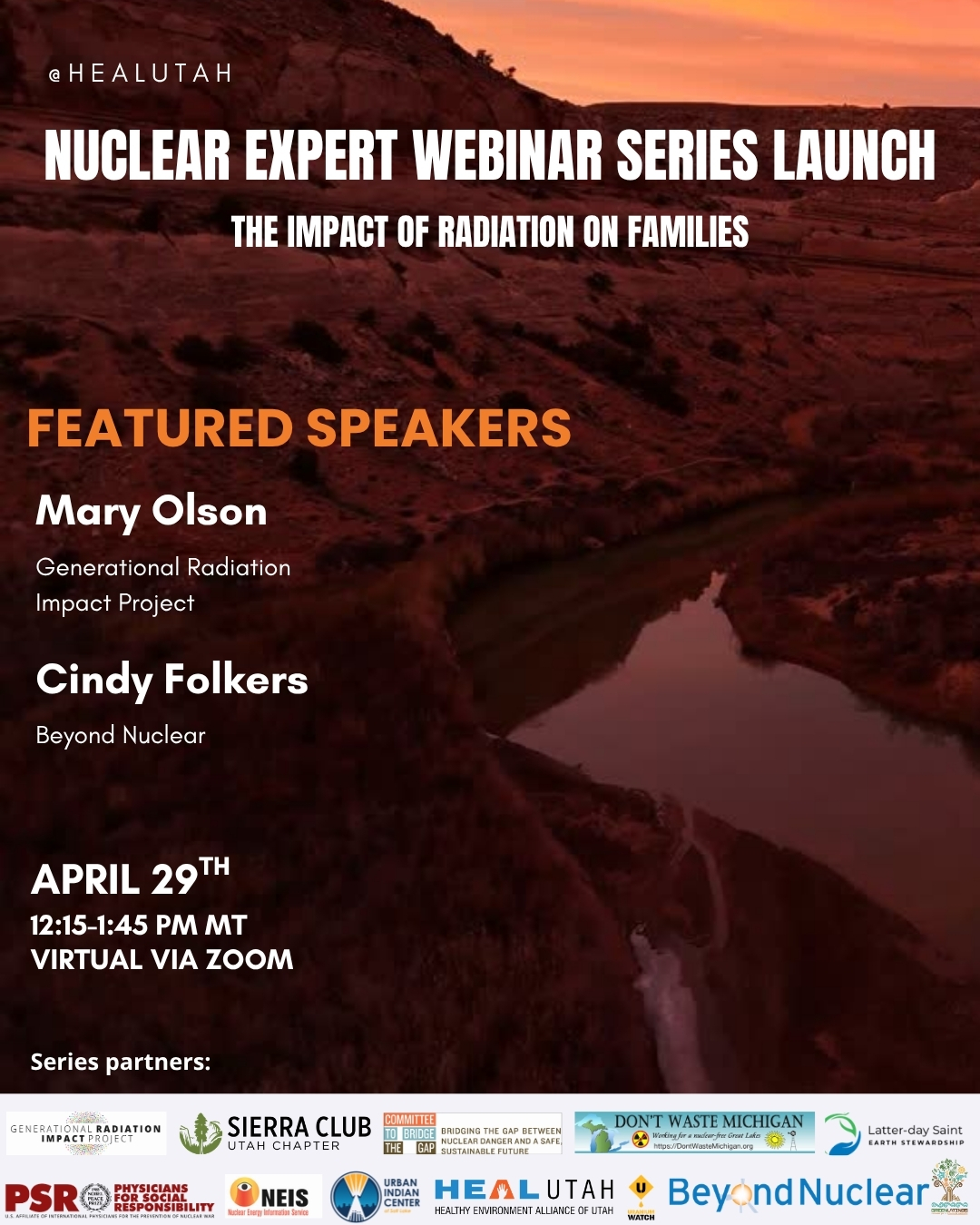
29 April – Nuclear Expert Webinar #1 – Radiation Impacts on Families with Mary Olson and Cindy Folkers
- 12:15 PM MT – 1:45 PM MT
- Location: Virtual – REGISTER TODAY

4 May -West Suburban Peace Coalition to discuss Iran war at May Educational Forum
Monday, May 4, 7:00 – 8:00 PM Central Standard Time
Title: : How Trump’s Narrative Tries to Shape the Reality of the War on Iran.
Contact Walt Zlotow, zlotow@hotmail.com 630 442 3045 for further information
14 May – online event From Bombs to Data Centres: the Face of Nuclear Colonialism

Pine Ridge Uranium is the real threat, not Tehran- Tell Burgum: Stop the Extraction.
Chernobyl: The Lost Tapes – A good documentary on Chernobyl on SBS available On Demand for the next 3 weeks– https://www.sbs.com.au/ondemand/tv-program/chernobyl-the-lost-tapes/2352741955560
To see nuclear-related stories in greater depth and intensity – go to https://nuclearinformation.wordpress.com
-
Archives
- April 2026 (327)
- March 2026 (251)
- February 2026 (268)
- January 2026 (308)
- December 2025 (358)
- November 2025 (359)
- October 2025 (376)
- September 2025 (257)
- August 2025 (319)
- July 2025 (230)
- June 2025 (348)
- May 2025 (261)
-
Categories
- 1
- 1 NUCLEAR ISSUES
- business and costs
- climate change
- culture and arts
- ENERGY
- environment
- health
- history
- indigenous issues
- Legal
- marketing of nuclear
- media
- opposition to nuclear
- PERSONAL STORIES
- politics
- politics international
- Religion and ethics
- safety
- secrets,lies and civil liberties
- spinbuster
- technology
- Uranium
- wastes
- weapons and war
- Women
- 2 WORLD
- ACTION
- AFRICA
- Atrocities
- AUSTRALIA
- Christina's notes
- Christina's themes
- culture and arts
- Events
- Fuk 2022
- Fuk 2023
- Fukushima 2017
- Fukushima 2018
- fukushima 2019
- Fukushima 2020
- Fukushima 2021
- general
- global warming
- Humour (God we need it)
- Nuclear
- RARE EARTHS
- Reference
- resources – print
- Resources -audiovicual
- Weekly Newsletter
- World
- World Nuclear
- YouTube
-
RSS
Entries RSS
Comments RSS
 nuclear-news