Canada’s push for small nuclear reactors will be costly, ineffective, some MPs warn
By David Fraser, The Canadian Press, Tue., April 25, 2023
Prime Minister Justin Trudeau has asserted that Canada is “very
serious” about developing nuclear technology across the country to meet
growing power needs, but some members of Parliament are warning the
technology could be costly and ineffective.
A Liberal MP is among the critics who say Ottawa is looking at an expensive investment into an unproven and potentially dangerous technology. The federal government
started actively exploring small modular reactor technology in 2018, and
released an action plan in 2020 that dubbed them a strategic Canadian asset
that could leverage significant economic, geopolitical, social and
environmental benefits.
But Green Party Leader Elizabeth May says other
renewable energy sources are getting cheaper, so there’s not much of a case
for Canada to expand its capacity on that technology, which she said is
being pushed by powerful lobbyists.
Liberal MP Jenica Atwin, who was first
elected under the Green banner, said she is used to being an outlier in her
caucus, but the party has allowed her to express her concerns about the
unknowns of emerging nuclear technologies. Four nuclear energy stations are
generating about 15 per cent of Canada’s electrical grid today, mostly in
Ontario and New Brunswick, and as the facilities age more attention is
being paid to the potential of smaller, more-portable reactors.
Toronto Star 25th April 2023
Once Shocking, U.S. Spying on Its Allies Draws a Global Shrug
April 13, 2023, New York Times https://www.nytimes.com/2023/04/13/us/politics/us-spying-allies.html
The last time a trove of leaked documents exposed U.S. spying operations around the world, the reaction from allied governments was swift and severe.
In Berlin, thousands of people protested in the streets, the C.I.A. station chief was expelled, and the German chancellor told the American president that “spying on friends is not acceptable.” In Paris, the American ambassador was summoned for a dressing-down.
That was a decade ago, after an enormous leak of classified documents detailing American surveillance programs by … Edward Snowden. The latest leak of classified documents that appeared online this year, the motive behind which remains unknown, has again illustrated the broad reach of U.S. spy agencies, including into the capitals of friendly countries such as Egypt, South Korea, Ukraine and the United Arab Emirates.
Though the documents mainly focus on the war in Ukraine, they include C.I.A. intelligence briefs describing conversations and plans at senior levels of government in those countries, in several cases attributed to “signals intelligence,” or electronic eavesdropping.
Unlike in 2013, however, U.S. allies appear to be mostly shrugging off the latest examples of apparent spying. So far, the only evident political fallout from the latest leaks has occurred in South Korea, where one classified U.S. document described a debate among senior national security officials about whether to send artillery shells abroad that might wind up in Ukraine, potentially angering Russia.
US Senators and Congress Members introduce Bill to stop A1 from power to launch a nuclear weapon.

MARKEY, LIEU, BEYER, AND BUCK INTRODUCE BIPARTISAN LEGISLATION TO PREVENT AI FROM LAUNCHING A NUCLEAR WEAPON
Washington (April 26, 2023) – Senator Edward J. Markey (D-Mass.) and Representatives Ted W. Lieu (CA-36), Don Beyer (VA-08) and Ken Buck (CO-04) today introduced the bipartisan and bicameral Block Nuclear Launch by Autonomous Artificial Intelligence Act, legislation to safeguard the nuclear command and control process from any future change in policy that allows artificial intelligence (AI) to make nuclear launch decisions.
The Department of Defense’s 2022 Nuclear Posture Review states that current policy is to “maintain a human ‘in the loop’ for all actions critical to informing and executing decisions by the President to initiate and terminate nuclear weapon employment” in all cases. The Block Nuclear Launch by Autonomous AI Act would codify the Department’s existing policy by ensuring that no federal funds can be used for any launch of any nuclear weapon by an automated system without meaningful human control. Furthermore, the National Security Commission on Artificial Intelligence, established by Congress through the FY19 National Defense Authorization Act, recommended in their final report that the U.S. clearly and publicly affirm its policy that only human beings can authorize employment of nuclear weapons. This bill follows through on their recommendation.
“As we live in an increasingly digital age, we need to ensure that humans hold the power alone to command, control, and launch nuclear weapons – not robots,” said Senator Markey. “That is why I am proud to introduce the Block Nuclear Launch by Autonomous Artificial Intelligence Act. We need to keep humans in the loop on making life or death decisions to use deadly force, especially for our most dangerous weapons.”……………………………………………………………………………………………….
In April, Senator Markey and Representative Lieu reintroduced the Restricting First Use of Nuclear Weapons Act to prohibit any U.S. President from launching a nuclear strike without prior authorization from Congress. Last October, Senator Markey, then-member of Senate Foreign Relations Committee, filed eight amendments to the National Defense Authorization Act (NDAA) to reduce the risk of ‘nuclear Armageddon’ and stop the proliferation of nuclear weapons. Last January, co-chairs of the Nuclear Weapons and Arms Control Working Group, Senators Markey and Jeff Merkley (D-Ore.) and Representatives John Garamendi (CA-03) and Beyer led 51 of their colleagues in a letter to President Joe Biden urging the United States to take bold steps to reduce the nation’s reliance on nuclear weapons and to elevate arms control. https://www.markey.senate.gov/news/press-releases/markey-lieu-beyer-and-buck-introduce-bipartisan-legislation-to-prevent-ai-from-launching-a-nuclear-weapon
In Indiana, small nuclear reactors don’t need to be “small” any more.

ED. – the picture above is of a NuScale smr design, not Rolls Royce, but the principle is the same. It’s not really small, and they know that truly small reactors are not economically viable.
New law boosts maximum size of nuclear reactors permitted in Indiana
nwi.com Dan Carden, Apr 24, 2023
Gov. Eric Holcomb approved a new state law Thursday increasing the maximum size of the small modular nuclear reactors that someday may be used by utility companies to generate electricity in Indiana.
Senate Enrolled Act 176, which took effect immediately, redefines a small modular reactor (SMR) as a nuclear reactor capable of generating up to 470 megawatts of energy — a 34% increase from the state’s former 350 MW generating cap.
Rep. Ed Soliday, R-Valparaiso, the sponsor of the legislation, said the higher generating capacity encompasses more of the nascent SMR market, including a 450 MW reactor designed by Rolls-Royce, an aircraft engine manufacturer based in Indianapolis…………………………………………..
State lawmakers directed the Indiana Utility Regulatory Commission last year to adopt rules by July 1, 2023, that would permit nuclear SMRs to be used to generate electricity in the Hoosier State……….
Critics of the plans have said there’s no need for Indiana to lead the way with nuclear SMRs, especially through rules that give utilities built-in profits, other incentives and the opportunity to recoup potentially billions of dollars in construction costs from ratepayers before a nuclear reactor actually generates any electricity. https://nwitimes.com/business/technology/new-law-boosts-maximum-size-of-nuclear-reactors-permitted-in-indiana/article_3962a672-8e8c-5168-bc88-31cc6891a88b.html
The US Has No Plans to Give Up Nuclear Weapons. The Public Needs to Change That.

While the U.S. nuclear enterprise has widespread support by both Democrat and Republican members of Congress, one of the boldest shows of opposition to nuclear weapons was voiced by Michigan congresswoman Rep. Rashida Tlaib, who has expressed her support for the Treaty for the Prohibition of Nuclear Weapons (TPNW). Additional support for the prohibition of TPNW (also called the “ban treaty”) came from Massachusetts Rep. James McGovern and Oregon Rep. Earl Blumenauer, who introduced a resolution in 2019 calling for “the American people to work towards reducing and ultimately eliminating nuclear weapons.” Furthermore, in 2022, more than 200 U.S. mayors collectively called for the adoption of a timebound plan for the total elimination of nuclear weapons.

A first step toward anti-nuclear advocacy is becoming aware of the current sprawling state of the U.S. nuclear arsenal.
By Jon Letman , TRUTHOUT April 24, 2023
hen Russian President Vladimir Putin announced his intention to deploy short-range nuclear missiles to Belarus in March, he pointed to U.S. nuclear weapons housed in five NATO nations as justification. Putin said the construction of a “special repository” for an Iskander missile complex in Belarus would not violate obligations under the Nuclear Nonproliferation Treaty.
But by accepting the deployment of Russian nuclear weapons, Belarus President Alexander Lukashenko would be reversing more than three decades free of nuclear weapons after it pledged to abandon them in 1991. Like Ukraine and Kazakhstan, Belarus gave up Soviet nuclear weapons shortly after the USSR broke apart.
In a statement, Daniel Högsta, acting executive director of the International Campaign to Abolish Nuclear Weapons (ICAN) said, “As long as Putin has nuclear weapons, Europe cannot be safe.” He also warned that decades of “nuclear sharing” with NATO nations “helps give Putin cover,” posing a grave risk far beyond Europe.
ICAN has played a central role in advocating for the UN Treaty on the Prohibition of Nuclear Weapons which entered into force in 2021. Although 68 countries have ratified the treaty which prohibits all aspects of developing, possessing or threatening to use nuclear weapons, none of the nine nuclear-armed nations — Russia, the United States, China, France, the United Kingdom, Pakistan, India, Israel and North Korea — recognizes the treaty.
According to the Federation of American Scientists’ Nuclear Information Project, the U.S. houses an estimated 100 B61 gravity bombs on air bases in five NATO nations (Belgium, Germany, Italy, the Netherlands and Turkey). Usually described as “tactical” or nonstrategic nuclear weapons, the new B61-12, which will replace older versions of the B61, has a selectable yield (energy released in a nuclear explosion) that can be adjusted from 0.3 to 50 kilotons. The atomic bombs which destroyed Hiroshima and Nagasaki were 15 and 21 kilotons respectively.
Daryl Kimball, executive director of the Arms Control Association, said that describing a nuclear weapon as “tactical” may lead people to wrongly assume that such weapons are necessarily “smaller,” less destructive, and would be confined to a battlefield or limited geographic area.
That, he said, is a dangerous assumption. ……………………………………………………
According to research by the Federation of American Scientists’ Nuclear Information Project, the United States maintains an estimated total inventory of 5,244 nuclear weapons, including reserve warheads and retired warheads awaiting dismantlement. Currently, 3,708 nuclear warheads make up the military stockpile (those weapons which could potentially be used in war).
Within the stockpile, the U.S. has 1,770 deployed nuclear warheads that make up the nuclear triad of air, land and sea-based bombs…………………………………….
Under the Sea
Widely considered to be least vulnerable to attack are long-range submarine-launched ballistic missiles (SLBM). The United States has two Strategic Weapons Facilities, one for the Pacific beside Naval Base Kitsap in Bangor, Washington, 20 miles west of Seattle, and a second facility for the Atlantic at Naval Submarine Base Kings Bay, Georgia…………………………………………………………………………
The U.S.’s Nuclear Sponge
The third leg of the nuclear triad is its intercontinental ballistic missiles (ICBMs), which are housed in fortified underground silos in five states (Montana, Colorado, Nebraska, Wyoming and North Dakota). The ICBM force is made up of aging Minuteman III missiles which are slated to be replaced with a new $96 billion system called Sentinel (formerly called Ground Based Strategic Deterrent).
Plagued by scheduling delays and cost overruns, there is growing public support for phasing out ICBMs. Despite this, the bipartisan congressional ICBM Coalition’s support is all but unshakable. But the idea of creating what has been called a “nuclear sponge” (referring to the idea that ICBM silos would attract enemy missiles and, like a sponge, soak up an incoming attack), raises serious questions about why rural communities only began receiving greater government support for improved communications and transportation infrastructure after they started hosting nuclear weapons. “I think it’s important to interrogate that and ask why the needs of the missiles have so often come before the needs of the people who actually live there,” Korda said.
In addition to the SLBM, ICBMs and bombers, Korda and his colleague Hans M. Kristensen have documented additional nuclear warheads (many awaiting dismantlement) at a storage complex in New Mexico and, Korda noted, California has “very important nuclear weapons infrastructure” which could potentially host a small number of nuclear weapons for design purposes.
Finally, there is the Pantex Plant near Amarillo, Texas, which describes itself as “the nation’s primary assembly, disassembly, retrofit, and life-extension center for nuclear weapons.” The dismantlement of retired nuclear warheads is ongoing but, Korda said, the pace has slowed in recent years……………………………………….
In recent years, arms control treaties such as the Intermediate-Range Nuclear Forces Treaty, the Open Skies Treaty and the Joint Comprehensive Plan of Action (“Iran Nuclear Deal”) have been abandoned by the U.S., Russia, or both. The last remaining nuclear arms control treaty between the U.S. and Russia, the New Strategic Arms Reduction Treaty (New START), was extended for five years just two days before it expired in 2021 but in February, Russia announced it was suspending participation, leaving the last U.S.-Russia arms control treaty hanging by a thread.
With the end of inspections, data exchanges, and much-needed communication between Washington and Moscow, as well as Beijing, Kimball worries mistrust can lead to the assumption of worst-case scenarios. He says there is a great need for increased public awareness and engagement on nuclear issues.
While the U.S. nuclear enterprise has widespread support by both Democrat and Republican members of Congress, one of the boldest shows of opposition to nuclear weapons was voiced by Michigan congresswoman Rep. Rashida Tlaib, who has expressed her support for the Treaty for the Prohibition of Nuclear Weapons (TPNW). Additional support for the prohibition of TPNW (also called the “ban treaty”) came from Massachusetts Rep. James McGovern and Oregon Rep. Earl Blumenauer, who introduced a resolution in 2019 calling for “the American people to work towards reducing and ultimately eliminating nuclear weapons.” Furthermore, in 2022, more than 200 U.S. mayors collectively called for the adoption of a timebound plan for the total elimination of nuclear weapons.
“This is an existential threat that demands engagement even with our worst adversaries and even with a bona fide war criminal like Vladimir Putin because our survival ultimately depends on it.”
Without dialogue and diplomatic engagement, the result, Kimball warned, could be an unconstrained three-way arms race between Russia, China and the U.S. “If we didn’t have enough problems already,” Kimball said, “it still can get worse.”
The public has a vital role in all this, Kimball said. “Over the long course of the nuclear age, concerned U.S. citizens have stood up and demanded that their leaders take action to reduce the number and the risks posed by nuclear weapons by engaging in arms control and disarmament diplomacy with our adversaries. That effort has to be renewed again.” https://truthout.org/articles/the-us-has-no-plans-to-give-up-nuclear-weapons-the-public-needs-to-change-that/
—
Presidential candidate Robert F. Kennedy Jr. vows to ‘unwind US empire’
Rt.com 23 Apr 23
Robert F. Kennedy Jr., nephew of JFK, is set to challenge Joe Biden for the Democratic nomination in 2024
US presidential candidate Robert F. Kennedy Jr has pledged to wind down American military interventionism abroad if he is elected to the White House in 2024.
Kennedy, who is the son of Robert F. Kennedy and the nephew of former President John F. Kennedy, confirmed his candidacy for the Democratic nomination at a campaign rally in Boston last week, placing him in competition with current US leader Joe Biden.
Also known for being a prominent anti-vaccine activist, the 69-year-old environmental lawyer has acknowledged that he is not an “ideal” candidate given his often-controversial brand of discourse, but has argued that he is “not one of those people who said I have to be careful because one day I’m going to be in the White House.”
Chief among Kennedy’s campaign proposals, as noted in a six-point plan published on his official website, would be drawing a line through US military interventionism abroad and “start[ing] the process of unwinding [an] empire.”
We will bring the troops home. We will stop racking up unpayable debt to fight one war after another. The military will return to its proper role of defending our country,” the plan stated, adding that “America cannot be an empire abroad and a democracy at home.”
Regarding the Ukraine conflict, Kennedy stated that the US mission is “to end the suffering of the Ukrainian people.” However, he argued that Ukrainians are “victims” not just of Russia, but also of “American geopolitical machinations going back to at least 2014.”
Kennedy, who has never held significant public office, has drawn criticism from health experts – and even members of his own family – amid various outspoken comments throughout his career. In 2005, a prominent science publication issued a stinging rebuke of claims he made in which he appeared to link the development of autism to vaccines.
His wife, the actress Cheryl Hines, condemned Kennedy last year for invoking the name of Anne Frank and the Holocaust while describing US vaccine requirements. He later withdrew the comments…..https://www.rt.com/news/575267-us-kennedy-unwin-empire/
 | |||
| to me | |||
‘It Is Skynet’: Pentagon Envisions Robot Armies in a Decade

Blitzkrieg 2040
Nazi Germany, overran Europe in a very, very short period of time … because they were able to take those technologies and put them together in a doctrine which we now know as Blitzkrieg,” he said.

Milley, and the Pentagon with him, hopes to do the same now by bringing together emergent capabilities like robotics, AI, cyber and space platforms, and precision munitions into a cohesive doctrine of war.
By being the first to integrate these technologies into a new concept, Milley says, the United States can rule the future battlefield.
The Pentagon’s quest for an AI-dominated battlefield is becoming a reality
Epoch Times, By Andrew Thornebrooke, April 20, 2023
WASHINGTON—Robotic killing machines prowl the land, the skies, and the seas. They are fully automated, seeking out and engaging with adversarial robots across every domain of war. Their human handlers are relegated to the rearguard, overseeing the action at a distance while conflicts are fought and won by machines.
Far from science fiction, this is the vision of Joint Chiefs of Staff Chairman Gen. Mark Milley.
The United States, according to Milley, is in the throes of one of the myriad revolutions in military affairs that have spanned history.
Such revolutions have spanned from the invention of the stirrup to the adoption of the firearm to the deployment of mechanized maneuver warfare and, now, to the mass fielding of robotics and artificial intelligence (AI).
It is a shift in the character of war, Milley believes, greater than any to have come before.
“Today we are in … probably the biggest change in military history,” Milley said during a March 31 discussion with Defense One.
“We’re at a pivotal moment in history from a military standpoint. We’re at what amounts to a fundamental change in the very character of war.”
Robotic Armies in 10 Years
Many would no doubt be more comfortable with the idea of robots battling for the control of Earth if it were in a science-fiction novel or on a movie screen rather than on the list of priorities of the military’s highest-ranking officer.
Milley believes, however, that the world’s most powerful armies will be predominantly robotic within the next decade, and he means for the United States to be the first across that cybernetic Rubicon.
“Over the next ten to fifteen years, you’ll see large portions of advanced countries’ militaries become robotic,” Milley said. “If you add robotics with artificial intelligence and precision munitions and the ability to see at range, you’ve got the mix of a real fundamental change.”
“That’s coming. Those changes, that technology … we are looking at inside of 10 years.”
That means that the United States has “five to seven years to make some fundamental modifications to our military,” Milley says, because the nation’s adversaries are seeking to deploy robotics and AI in the same manner, but with Americans in their sights.
The nation that gets there first, that deploys robotics and AI together in a cohesive way, he says, will dominate the next war.
“I would submit that the country, the nation-state, that takes those technologies and adapts them most effectively and optimizes them for military operations, that country is probably going to have a decisive advantage at the beginning of the next conflict,” Milley said.
The global consequences of such a shift in the character of war are difficult to overstate.
Milley compared the ongoing struggle to form a new way of war to the competition that occurred between the world wars
In that era, Milley says, all the nations of Europe had access to new technologies ranging from mechanized vehicles to radio to chemical weapons. All of them could have developed the unified concept of maneuver warfare that replaced the attrition warfare which had defined World War I.
But only one, he said, first integrated their use into a bona fide new way of war.
“That country, Nazi Germany, overran Europe in a very, very short period of time … because they were able to take those technologies and put them together in a doctrine which we now know as Blitzkrieg,” he said.
Blitzkrieg 2040
Milley, and the Pentagon with him, hopes to do the same now by bringing together emergent capabilities like robotics, AI, cyber and space platforms, and precision munitions into a cohesive doctrine of war.
By being the first to integrate these technologies into a new concept, Milley says, the United States can rule the future battlefield.
To that end, the Pentagon is experimenting with new unmanned aerial, ground, and undersea vehicles, as well as seeking to exploit the pervasiveness of non-military smart technologies from watches to fitness trackers.
Though the effort is just gaining traction, Milley has in fact claimed since 2016 that the U.S. military would field substantial robotic ground forces and AI capabilities by 2030.
Just weeks from now, that idea will begin to truly culminate, when invitations from the Defense Department (DoD) go out to leaders across the defense, tech, and academic spheres for the Pentagon’s first-ever conference on building “trusted AI and autonomy” for future wars.
The Pentagon is on a correlating hiring spree, seeking to pay six figures annually for experts willing and able to develop and integrate technologies including “augmented reality, artificial intelligence, human state monitoring, and autonomous unmanned systems.”
Likewise, the U.S. Army Futures Command, created in 2018, maintains as a critical goal the designing of what it calls “Army 2040.” In other words, the AI-dependent, robotic military of the future.
Though slightly further out than Milley’s assumption of 10 to 15 years, Futures Command deputy commanding general Lt. Gen. Ross Coffman believes that 2040 will mark the United States’ true entry into an age characterized by artificially intelligent killing machines.
…………………….. Everything Spins Out of Control’
Remaking the American military and forming a new, cohesive way of war is a tall order. It is nevertheless one that the Pentagon appears prepared to pay for.
The DoD is requesting a record $1.8 billion in funding for AI projects for the next year alone. That amount will exceed the estimated $1.6 billion in AI investments being made by China’s military.
……………….. John Mills, former director of cybersecurity policy, strategy, and international affairs at the Office of the U.S. Secretary of Defense, believes that this path is rife with the potential for unintended consequences.
“It is Skynet,” Mills told the Epoch Times, referencing the fictional AI that conquers the world in “The Terminator” movie franchise. “It is the realization of a Skynet-like environment.”
“The question is, what could possibly go wrong with this situation? Well, a lot.”
…………… “The integration of AI with autonomous vehicles, and letting them action independently without human decision-making, that’s where everything spins out of control.”
To that end, Mills expressed concern about what a future conflict might look like between the United States and its allies, and China in the Indo-Pacific.
Imagine, he said, an undersea battlespace in which autonomous submarines and other weapons systems littered the seas.
Fielded by Chinese, American, Korean, Australian, Indian, and Japanese forces, the resulting chaos would likely end with autonomous systems engaging in war throughout the region, while manned vessels held back and sought to best launch the next group of robotic war machines. Anything else would risk putting real lives in the way of the automated killers.
“How do you plan for engagement scenarios with autonomous undersea vehicles?” Mills said
“This is going to be absolute chaos in subsurface warfare.”
……………………… There is just one caveat to that ethical, trustworthy, governable, deployment of lethal AI systems: The Pentagon does not have any hard and fast rules to prohibit autonomous systems from killing…………………………………………………………….
more https://www.theepochtimes.com/in-depth-it-is-skynet-pentagon-envisions-robot-armies-in-a-decade_5207504.html?utm_source=China&src_src=China&utm_campaign=uschina-2023-04-20&src_cmp=uschina-2023-04-20&utm_medium=email&est=vibelq5SAFOai0xZ2IdvvJe4uwKWVBE7hfxTKp%2FcR9S0a9BSSEoQCAfiSObFUg%3D%3D
Daniel Ellsberg is still fighting — Beyond Nuclear International

For Ellsberg there was “no greater cause” than confronting the evils of nuclear weapons
Daniel Ellsberg is still fighting — Beyond Nuclear International
Legendary whistleblower keeps giving in his final months
By Linda Pentz Gunter
Most of us who have been around long enough in this movement probably have their own Daniel Ellsberg story. With the 91-year old famous whistleblower’s recent announcement that he has terminal pancreatic cancer, with just months to live, many were re-telling theirs. It was an apt outpouring of admiration, respect and love. So much so, that April 24-30 is now Daniel Ellsberg Week.
……………………………………….Thus I came to learn that one of the great heroes of our time, who was prepared to sacrifice a lifetime of freedom for a just cause, was indeed a man of quiet humility and one who has filled that lifetime that he views as some sort of unexpected bonus, with endlessly generous gifts of writing, insight, analysis and conviction.
His recent book — The Doomsday Machine, confessions of a nuclear war planner — is essential and definitive and nightmare-inducing. In other words, desperately important.
“In public, he has been a beacon of integrity and truth, willing to say and do what the warmakers and nuclear-holocaust planners find completely unacceptable,” RootsAction co-founder and director Norman Solomon told Common Dreams columnist, Brett Wilkins. ”In private, his thoughtful kindness and daily commitment to humanity are central to his being. And I want to emphasize right now that nothing in the world is more important to read and heed than Dan’s monumental book The Doomsday Machine.”
……………………………………………………………………….When I copied the Pentagon Papers in 1969, I had every reason to think I would be spending the rest of my life behind bars…………………………
………………………………………………….I was able to devote those years to doing everything I could think of to alert the world to the perils of nuclear war and wrongful interventions: lobbying, lecturing, writing and joining with others in acts of protest and non-violent resistance.
…………………………………………………..China and India are alone in declaring no-first-use policies. Leadership in the US, Russia, other nuclear weapons states, NATO and other US allies have yet to recognize that such threats of initiating nuclear war–let alone the plans, deployments and exercises meant to make them credible and more ready to be carried out–are and always have been immoral and insane: under any circumstances, for any reasons, by anyone or anywhere…………………………………………………….. more https://beyondnuclearinternational.org/2023/04/23/daniel-ellsberg-is-still-fighting/
Nuclear life extension plans tested by obsolete components

Reuters, By Paul Day, April 5 – Nuclear operators must be able to swap out old parts for new to keep a reactor running, but when like-for-like is unavailable, original equipment manufacturers (OEMs) are faced with the challenge of finding an alternative while avoiding making any major changes.
There’s a rule of thumb that if a plant has to do a design change, it’ll cost anywhere from $300,000-$500,000 just in engineering, licensing changes, drawing changes, and that doesn’t include the cost of the required equipment … so we try, wherever possible, to keep our clients from doing a design change,” says Vice President of Westinghouse Parts Business in its Operating Plant Services unit Craig Irish………………………….
Life extensions
Many of the world’s nuclear power plants were built several decades ago and applications for long-term operations (LTOs) beyond initial lifespans are becoming increasingly common.
…………………………………………………………..In the United States………….the average age of the fleet is 41 years including three reactors that started operation 52 years ago, according to the Department of Energy (DOE)
Nine U.S. reactors have active applications with the Nuclear Regulatory Commission (NRC) to extend their lives and 10 reactors have publicly announced plans to extend their licenses to 80 years.
“Under current license basis 92% of operating reactors would shut down by 2050 and 74 percent would shut down by 2050 with anticipated license renewals. However, if 54 reactors extended operation to 80 years, only 20% of operating reactors would shut down by 2050,” the DOE said in its 2022 report on nuclear energy supply chains.
Obsolescence challenge
The challenge, say OEMs, is keeping a supply chain running and up to date for complex, always-on machines that were built with Reagan-era (or earlier) technology.
………………with construction times for some plants approaching ten years, many of the parts can be obsolete before the plant has even started generating power, according to Westinghouse’s Irish.
……………………………………………Internationally, part of the challenge is many of the parts produced for the nuclear industry face varying specifications depending on the regulator they are working under, restricting an already tight market to national boundaries.
Such differences will become even more pronounced with the introduction of a new generation of reactors expected to begin commercial operations within the next decade, with more than 70 SMR designs under development in 18 countries.
…………………………………………………………………………… “The biggest problem is a lot of these discrete components, resistors, diodes, transistors, capacitors, etc are either substantially changed from the 70s and 80s when we built these instruments or they’re not available or they got bought and sold by another company,” he says. https://www.reuters.com/business/energy/nuclear-life-extension-plans-tested-by-obsolete-components-2023-04-05/
Complex safety problems in overhauling USA’s nuclear weapons stockpile, especially plutonium pits

TRUST BUT VERIFY. U.S. labs are overhauling the nuclear stockpile. Can they validate the weapons without bomb tests?
20 APR 2023, BY SARAH SCOLES Science.org
LOS ALAMOS, NEW MEXICO—Behind a guard shack and warning signs on the sprawling campus of Los Alamos National Laboratory is a forested spot where scientists mimic the first moments of a nuclear detonation. Here, in the Dual-Axis Radiographic Hydrodynamic Test (DARHT) facility, they blow up models of the bowling ball–size spheres of plutonium, or “pits,” at the heart of bombs—and take x-ray pictures of the results.
In a real weapon, conventional explosives ringing an actual pit would implode the plutonium to a critical density, triggering an explosive fissile chain reaction. Its energy would drive the fusion of hydrogen isotopes in the weapon’s second stage, generating yet more neutrons that would split additional fission fuel………………………………………………………..
Facilities like DARHT have been important since 1992, when the Department of Energy’s (DOE’s) three weapons labs—Los Alamos, Lawrence Livermore National Laboratory, and Sandia National Laboratory—stopped full-fledged tests of nuclear weapons. By 1996, the United States had signed the Comprehensive Nuclear-Test-Ban Treaty—credited not only with stopping the environmental damage of nuclear testing, but also with disincentivizing new weapons designs.
Without tests, however, the only things ensuring that warheads work are facilities like DARHT, computer simulations from “weapons codes,” and a cache of data from the old days of nuclear testing. For relatively minor changes to old weapons—new fuses, fresh top-ups of the hydrogen isotope tritium—that has been enough. Every year, DOE’s National Nuclear Security Administration (NNSA) and the Department of Defense have certified the stockpile, an assessment that means they are convinced the weapons will work when they’re supposed to, as they’re supposed to—and not do anything when they’re not supposed to. “Because we’ve blown up so many of them, these things are incredibly reliable,” says Geoff Wilson, director of the Center for Defense Information at the Project on Government Oversight, which argues nuclear weapons spending should be reduced.
But now the stockpile is getting an overhaul, the biggest in decades. This fiscal year, NNSA has a record $22.2 billion budget. Much of the money will go to producing new plutonium pits to replace those in the arsenal and to modernizing four warheads. A fifth weapon, dubbed the W93—a submarine-launched warhead—is a new design program. “It’s really the first warhead program we’ve had since the end of the Cold War” that isn’t a life extension or modernization of an existing weapon, says Marvin Adams, NNSA’s deputy administrator for defense programs………………………………
Wilson worries that the international dynamics and the U.S. overhaul could ultimately lead to a revival of bomb tests, bringing back their hazards and stoking a new arms race. “It is not unfathomable to me, which is scary to say.” It’s one thing to tweak weapons with a deep heritage. It’s another to infer functionality for modified weapons that have never been fully tested, he says………………………………….
SIMPLY REPLACING the bombs’ plutonium pits poses a science challenge: understanding how subtle changes affect their behavior. They aren’t easy to make, in part because plutonium, a metal only in existence since 1940, is mysterious and hard to handle. The last time anyone made pits at scale—in the 1980s at Colorado’s Rocky Flats plant—DOE’s contractor was shut down for environmental violations and forced to pay an $18.5 million fine.
This time, NNSA is splitting production between Los Alamos and the Savannah River Site in South Carolina. It has tasked them with making 80 new pits per year by 2030, a deadline NNSA admits it will not meet.
Los Alamos’s pits will be made at a facility called PF-4, a set of high-security buildings surrounded by cyclone fences with razor wire. Inside PF-4 are glovebox enclosures—radiation-shielded workstations where workers use thick gloves and peer through glass windows to manipulate the exotic metal. The lab is hiring thousands of workers, and its first pit is likely to be ready for the stockpile next year.
The gargantuan effort is motivated by a simple fact: many current pits are more than 40 years old, and plutonium behaves in confounding ways as it ages and radioactively decays. A green, fuzzy coating grows on it as its surface oxidizes. Atoms in its metallic lattice are knocked out of place as it spits out uranium isotopes. Its dimensions shift when it slips between six different solid phases. And the pits do not necessarily degrade smoothly. “We know at some point there will be a nonlinear piece,” says David Clark, director of Los Alamos’s National Security Education Center and editor of the Plutonium Handbook. “We just haven’t seen it.”…………….
One might think the new pits would make it easier to certify the stockpile, by avoiding the uncertainties of aging plutonium. But they come with uncertainties of their own. The new pits won’t be twins of their predecessors, so weapons scientists will have to understand how the alterations change pit behavior. They are being manufactured using recycled and purified plutonium from old pits, not fresh material, unlike the originals. Moreover, they will be made with different processes, and in some cases designed to slightly different specifications. “If you look at a new requirement,” Adams says, “you often will find that the old pits we have available to us are really, really suboptimal.”………………………………………. https://www.science.org/content/article/trust-verify-can-u-s-certify-new-nuclear-weapons-without-detonating-them
Chinese Diplomacy Seen as Threat to US ‘Peace,’ ‘Stability’
FAIR, GREGORY SHUPAK 21 Apr 23
China has undertaken a diplomatic blitz that has seen it broker a rapprochement between Iran and Saudi Arabia, warm relations with France, and put forth a proposal to end the war in Ukraine. US media coverage of these developments has involved illusion-peddling about America’s potentially waning empire, and calls for the US to escalate what amounts to a new cold war with China.
In Foreign Policy (3/14/23), Michael McFaul and Abbas Milani say that China “now shares the burden of keeping the peace in the Middle East. This is not an easy assignment, as the United States has learned bitterly over the decades.”
The US has done the opposite of “keeping the peace in the Middle East.” Nor has it sought to, as the Iraqi case makes tragically clear. Since the US-led 2003 invasion, Brown University’s Costs of War Project notes,………………………………………………………
Power = ‘peace’
Walter Russell Mead of the Wall Street Journal (3/27/23) claimed that while “American power” results in “peace and prosperity,” “challengers like China, Russia and Iran undermine the stability of the American order.” “Peace” and “stability” must seem like odd ways of characterizing that order to, say, Libyans, who had their country flattened by a US-led intervention (Jacobin, 9/12/13), and endured years of a brutal war, and even slavery.
David Ignatius of the Washington Post (3/16/23) asserted that
if Chinese President Xi Jinping wants to take on the role of restraining Iran and reassuring Saudi Arabia, good luck to him. The United States has been trying since 1979 to bend the arc of the Iranian revolution toward stability.
Washington supported Iraq’s invasion of Iran, to the point of helping Iraq use chemical weapons against the country. The US has also levied sanctions that have immiserated the country, undercutting Iranians’ access to food and medicine. Describing such aggression as attempts to engender “stability” inverts reality—to say nothing of Ignatius’ strange desire to “reassur[e]” Washington’s execution-happy longtime client in Riyadh.
In the case of the war that turned Yemen into the world’s worst humanitarian crisis, McFaul and Milani exculpate the US, writing that “the Biden administration, supported by other countries with a commitment to stopping this war, helped negotiate a truce.”
Like McFaul and Milani, Ignatius accuses China of “harvest[ing] the goodwill” after the US allegedly “laid the groundwork for a settlement of the horrific war in Yemen.” This omits the rather salient point that the United States is a major reason the war has gone on for as long as it has, with as high a price as it has had for Yemenis.
The Obama, Trump and Biden administrations prolonged and escalated the war……………………………………………………………………..
Looking just at wars in this century, the United States carried out a 20-year occupation of Afghanistan, and its troops remain in Iraq 20 years after it invaded and overthrew that country’s government. US troops still occupy parts of Syria against the will of that country’s government. Washington has carried out bombing campaigns against Libya, as noted, as well as Somalia and Pakistan.
Given that it is also the “major patron” of Israel, which invaded Lebanon in the relevant period (on top of occupying and annexing Syrian and Palestinian land), and of Saudi Arabia, the main aggressor against Yemen, there’s a strong case to be made that Uncle Sam is the world’s “most destabilizing state.”
If China overtakes the US’s position atop the global order, it’s uncertain exactly what the world system will look like. What is clear, however, is that US hegemony has been “anything but peaceful.”
Environmentalists say Starship failure boosts their concerns
Washington Post, 21 Apr 23
Thursday’s Starship explosion underscored the concerns of the American Bird Conservancy, which has opposed SpaceX’s operations at Boca Chica in South Texas because of the facility’s impacts on wildlife habitat and the species that rely on it, including species listed under the Endangered Species Act.
The fiery mishap highlighted in dramatic fashion the risks and the stakes of potential environmental destruction, the group said. Photos showed that the launch itself had sent debris flying across across the launch site and appeared to have damaged the company’s facilities. SpaceX and local officials had enforced a broad keep-out area to ensure no one was threatened by the launch.
“From our point of view, it’s good news it didn’t blow up at the pad site, but future launches could,” said American Bird Conservancy President Michael Parr. The sounds, debris and fires fueled by a crash could all pose risks to wildlife, he said. Had an explosion taken place over the sensitive wetlands, a cleanup would further disturb the environment………………………………………… https://www.msn.com/en-us/news/technology/unmanned-starship-explodes-over-gulf-after-liftoff/ar-AA1a6BtR?ocid=msedgdhp&pc=U531&cvid=225bf63143754ebc94b3de444cf9de7d&ei=14
Six war mongering think tanks and the military contractors that fund them.

Center for Strategic and International Studies
Center for a New American Security
Hudson Institute
Atlantic Council
International Institute for Strategic Studies
Australian Strategic Policy Institute
Amanda Yee, March 7, 2023 https://www.liberationnews.org/six-war-mongering-think-tanks-and-the-military-contractors-that-fund-them/
From producing reports and analysis for U.S. policy-makers, to enlisting representatives to write op-eds in corporate media, to providing talking heads for corporate media to interview and give quotes, think tanks play a fundamental role in shaping both U.S. foreign policy and public perception around that foreign policy. Leaders at top think tanks like the Atlantic Council and Hudson Institute have even been called upon to set focus priorities for the House Intelligence Committee. However, one look at the funding sources of the most influential think tanks reveals whose interests they really serve: that of the U.S. military and its defense contractors.
This ecosystem of overlapping networks of government institutions, think tanks, and defense contractors is where U.S. foreign policy is derived, and a revolving door exists among these three sectors. For example, before Biden-appointed head of the Pentagon Lloyd Austin took his current position, he sat on the Board of Directors at Raytheon. Before Austin’s appointment, current defense policy advisor Michèle Flournoy was also in the running for the position. Flournoy sat on the board of Booz Allen Hamilton, another major Pentagon defense contractor. These same defense contractors also work together with think tanks like the Center for Strategic and International Studies to organize conferences attended by national security officials. On top of all this, since the end of the Cold War, intelligence analysis by the CIA and NSA has increasingly been contracted out to these same defense companies like BAE Systems and Lockheed Martin, among others — a major conflict of interest. In other words, these corporations are in the position to produce intelligence reports which raise the alarm on U.S. “enemy” nations so they can sell more military equipment!
And of course these are the same defense companies that donate hundreds of thousands of dollars each year to think tanks. Given all this, is it any wonder the U.S. government is simultaneously flooding billions of dollars of weaponry into an unwinnable proxy war in Ukraine while escalating a Cold War into a potential military confrontation with China?
The funding to these policy institutes steers the U.S. foreign policy agenda. To give you a scope of how these contributions determine national security priorities, listed below are six of some of the most influential foreign policy think tanks, along with how much in contributions they’ve received from “defense” companies in the last year.
All funding information for these policy institutes was gathered from the most recent annual report that was available online. Also note that this list is compiled from those that make this information publicly available — many think tanks, such as the hawkish American Enterprise Institute, do not release donation sources publicly.
1 – Center for Strategic and International Studies
According to their 2020 annual report
$500,000+: Northrop Grumman Corporation
$200,000-$499,999: General Atomics (energy and defense corporation that manufactures Predator drones for the CIA), Lockheed Martin, SAIC (provides information technology services to U.S. military)
$100,000-$199,999: Bechtel, Boeing, Cummins (provides engines and generators for military equipment), General Dynamics, Hitachi (provides defense technology), Hanwha Group (South Korean aerospace and defense company), Huntington Ingalls Industries, Inc. (largest military shipbuilding company in the United States), Mitsubishi Corporation, Nippon Telegraph and Telephone Corporation (provides intelligence and information technology services to U.S. military), Qualcomm, Inc. (semiconductor company that produces microchips for the U.S. military), Raytheon, Samsung (provides security technology to the U.S. military), SK Group (defense technology company)
$65,000-$99,999: Hyundai Motor (produces weapons systems), Oracle
$35,000-$64,999: BAE Systems
2 – Center for a New American Security
$500,000+: Northrop Grumman Corporation
$250,000-$499,999: Lockheed Martin
$100,000-$249,000: Huntington Ingalls Industries, Neal Blue (Chairman and CEO of General Atomics), Qualcomm, Inc., Raytheon, Boeing
$50,000-$99,000: BAE Systems, Booz Allen Hamilton, Intel Corporation (provides aerospace and defense technology), Elbit Systems of America (aerospace and defense company), General Dynamics, Palantir Technologies
3 – Hudson Institute
According to their 2021 annual report
$100,000+: General Atomics, Linden Blue (co-owner and Vice Chairman of General Atomics), Neal Blue, Lockheed Martin, Northrop Grumman
$50,000-$99,000: BAE Systems, Boeing, Mitsubishi Heavy Industries
4 – Atlantic Council
According to their 2021 annual report
$250,000-$499,000: Airbus, Neal Blue, SAAB (provides defense equipment)
$100,000-$249,000: Lockheed Martin, Raytheon
$50,000-$99,000: SAIC
5 – International Institute for Strategic Studies
Based in London. From fiscal year 2021-2022
£100,000+: Airbus, BAE Systems, Boeing, General Atomics, Lockheed Martin, Raytheon, Rolls Royce (provides military airplane engines)
£25,000-£99,999: Northrop Grumman Aerospace Systems, Northrop Grumman Corporation
6 – Australian Strategic Policy Institute
Note: ASPI has been one of the primary purveyors of the “Uyghur genocide” narrative
From their 2021-2022 annual report
$186,800: Thales Australia (aerospace and defense corporation)
$100,181: Boeing Australia
$75,927: Lockheed Martin
$20,000: Omni Executive (aerospace and defense corporation)
$27,272: SAAB Australia
SpaceX launches most powerful rocket in history in explosive debut – like many first liftoffs, Starship’s test was a successful failure
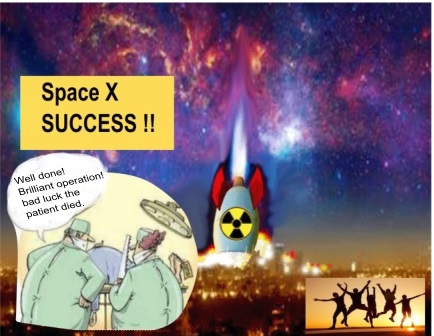
The Conversation, Wendy Whitman Cobb 21 Apr 23
Professor of Strategy and Security Studies, Air University
Starship is almost 400 feet (120 meters) tall and weighs 11 million pounds (4.9 million kilograms). An out-of-control rocket full of highly flammable fuel is a very dangerous object, so to prevent any harm, SpaceX engineers triggered the self-destruct mechanism and blew up the entire rocket over the Gulf of Mexico.
On April 20, 2023, a new SpaceX rocket called Starship exploded over the Gulf of Mexico three minutes into its first flight ever. SpaceX is calling the test launch a success, despite the fiery end result. As a space policy expert, I agree that the “rapid unscheduled disassembly” – the term SpaceX uses when its rockets explode – was a very successful failure.
The most powerful rocket ever built
This launch was the first fully integrated test of SpaceX’s new Starship. Starship is the most powerful rocket ever developed and is designed to be fully reusable. It is made of two different stages, or sections. The first stage, called Super Heavy, is a collection of 33 individual engines and provides more than twice the thrust of a Saturn V, the rocket that sent astronauts to the Moon in the 1960s and 1970s.
The first stage is designed to get the rocket to about 40 miles (65 kilometers) above Earth. Once Super Heavy’s job is done, it is supposed to separate from the rest of the craft and land safely back on the surface to be used again. At that point the second stage, called the Starship spacecraft, is supposed to ignite its own engines to carry the payload – whether people, satellites or anything else – into orbit.
An explosive first flight
While parts of Starship have been tested previously, the launch on April 20, 2023, was the first fully integrated test with the Starship spacecraft stacked on top of the Super Heavy rocket. If it had been successful, once the first stage was spent, it would have separated from the upper stage and crashed into the Gulf of Mexico. Starship would then have continued on, eventually crashing 155 miles (250 kilometers) off of Hawaii.
During the SpaceX livestream, the team stated that the primary goal of this mission was to get the rocket off the launch pad. It accomplished that goal and more. Starship flew for more than three minutes, passing through what engineers call “max Q” – the moment at which a rocket experiences the most physical stress from acceleration and air resistance.
According to SpaceX, a few things went wrong with the launch. First, multiple engines went out sometime before the point at which the Starship spacecraft and the Super Heavy rocket were supposed to separate from each other. The two stages were also unable to separate at the predetermined moment, and with the two stages stuck together, the rocket began to tumble end over end. It is still unclear what specifically caused this failure.
Starship is almost 400 feet (120 meters) tall and weighs 11 million pounds (4.9 million kilograms). An out-of-control rocket full of highly flammable fuel is a very dangerous object, so to prevent any harm, SpaceX engineers triggered the self-destruct mechanism and blew up the entire rocket over the Gulf of Mexico…………………………………… https://theconversation.com/spacex-launches-most-powerful-rocket-in-history-in-explosive-debut-like-many-first-liftoffs-starships-test-was-a-successful-failure-204248
Terrestrial Energy’s molten-salt reactor gets over one hurdle – but many more to come. Will it be a lemon?

Terrestrial Energy’s molten-salt reactor clears prelicensing review, Globe and Mail, MATTHEW MCCLEARN, APRIL 19, 2023
Nuclear-reactor developer Terrestrial Energy has completed a prelicensing review by the Canadian Nuclear Safety Commission, an early milestone along the road to commercialization of its next-generation product.
The Integral Molten Salt Reactor (IMSR) is the first of its kind to finish the CNSC process known as a vendor design review. Whereas conventional reactors use solid fuel, this novel variety features liquid fuel dissolved in molten salt that’s heated to temperatures above 600 degrees.
The review, which began in 2016, is intended to provide feedback to reactor vendors in the early stages of development, but does not confer a licence to build one. CNSC staff found “no fundamental barriers to licensing,” signalling their willingness to entertain next-generation designs radically different from Canada’s aging fleet of Candu reactors………..
the CNSC’s high-level findings, published Tuesday, highlight the challenges ahead. It called on Terrestrial to provide more information to confirm that the IMSR meets safety requirements. Sensors, monitoring equipment, instrumentation and control systems all need to be further developed……………
” you see a lot of engineering questions that have to be followed up on.” -Akira Tokuhiro, a professor at Ontario Tech’s energy and nuclear engineering department.
Prof. Tokuhiro said answering those questions means Terrestrial (which currently employs about 100 people) will need to grow its engineering staff. NuScale Power, an early developer of small modular reactors (SMR) founded in 2007, stands alone in achieving certification from the U.S. Nuclear Regulatory Commission. It needed 500 staff and US$1-billion to accomplish that, said Prof. Tokuhiro, who previously served as an engineer at NuScale.
“There have been SMR startups – I won’t name names – where the company and investors quit when they got to the point of going from 50 engineers to 500 engineers on payroll,” he said.
Prof. Tokuhiro estimated that fewer than 20 people throughout North America possess deep experience with molten salt technologies, making it difficult to find qualified workers. Moreover, Terrestrial will likely need to build a demonstration unit – another expensive undertaking.
“It has to be a facility that’s quality assured and quality controlled,” he said. “And it has to be able to produce data that the regulator accepts.”……..
nitially developed in the 1950s and 60s, molten salt reactors never operated commercially but have lately enjoyed renewed interest. The U.S. Department of Energy funded two small demonstration projects, and the Canadian government provided tens of millions of dollars to each of Terrestrial and Moltex Energy, another startup, based in New Brunswick, that’s marketing a model known as the Stable Salt Reactor – Wasteburner (SSR-W).
According to a 2021 report about advanced nuclear reactors by the Union of Concerned Scientists, molten salt reactors are “even less mature” than other novel designs such as sodium-cooled and gas-cooled reactors.
That report – entitled Advanced Isn’t Always Better– concluded they were “significantly worse” than traditional light-water reactors in terms of safety and the risk of nuclear proliferation and terrorism, but acknowledged that some molten salt reactors would generate less hazardous waste than conventional models.
“MSR fuels pose unique safety issues,” the report concluded. “Not only is the hot liquid fuel highly corrosive, but it is also difficult to model its complex behaviour as its flows through a reactor system. If cooling is interrupted, the fuel can heat up and destroy an MSR in a matter of minutes.
“Perhaps the most serious safety flaw is that, in contrast to solid-fuelled reactors, MSRs routinely release large quantities of gaseous fission products, which must be trapped and stored.”
The nuclear industry has precious few small modular reactors available for sale today, but is under intense pressure to bring new ones to market quickly to capitalize on an anticipated surge in demand for low-carbon electricity. Yet recent reactors based on conventional technologies took longer than 30 years to develop, license and build, and some ran disastrously overbudget……………………………………. https://www.theglobeandmail.com/business/article-terrestrial-energys-molten-salt-reactor-clears-prelicensing-review/
1 This Month
26 April – Chernobyl: Inside the Meltdown airs on National Geographic on Sunday 26th April from 4pm


29 April – Nuclear Expert Webinar #1 – Radiation Impacts on Families with Mary Olson and Cindy Folkers
- 12:15 PM MT – 1:45 PM MT
- Location: Virtual – REGISTER TODAY

4 May -West Suburban Peace Coalition to discuss Iran war at May Educational Forum
Monday, May 4, 7:00 – 8:00 PM Central Standard Time
Title: : How Trump’s Narrative Tries to Shape the Reality of the War on Iran.
Contact Walt Zlotow, zlotow@hotmail.com 630 442 3045 for further information
14 May – online event From Bombs to Data Centres: the Face of Nuclear Colonialism


Pine Ridge Uranium is the real threat, not Tehran- Tell Burgum: Stop the Extraction.
Chernobyl: The Lost Tapes – A good documentary on Chernobyl on SBS available On Demand for the next 3 weeks– https://www.sbs.com.au/ondemand/tv-program/chernobyl-the-lost-tapes/2352741955560
To see nuclear-related stories in greater depth and intensity – go to https://nuclearinformation.wordpress.com
-
Archives
- April 2026 (317)
- March 2026 (251)
- February 2026 (268)
- January 2026 (308)
- December 2025 (358)
- November 2025 (359)
- October 2025 (376)
- September 2025 (257)
- August 2025 (319)
- July 2025 (230)
- June 2025 (348)
- May 2025 (261)
-
Categories
- 1
- 1 NUCLEAR ISSUES
- business and costs
- climate change
- culture and arts
- ENERGY
- environment
- health
- history
- indigenous issues
- Legal
- marketing of nuclear
- media
- opposition to nuclear
- PERSONAL STORIES
- politics
- politics international
- Religion and ethics
- safety
- secrets,lies and civil liberties
- spinbuster
- technology
- Uranium
- wastes
- weapons and war
- Women
- 2 WORLD
- ACTION
- AFRICA
- Atrocities
- AUSTRALIA
- Christina's notes
- Christina's themes
- culture and arts
- Events
- Fuk 2022
- Fuk 2023
- Fukushima 2017
- Fukushima 2018
- fukushima 2019
- Fukushima 2020
- Fukushima 2021
- general
- global warming
- Humour (God we need it)
- Nuclear
- RARE EARTHS
- Reference
- resources – print
- Resources -audiovicual
- Weekly Newsletter
- World
- World Nuclear
- YouTube
-
RSS
Entries RSS
Comments RSS
 nuclear-news