Dealing with a debacle: A better plan for US plutonium pit production

Bulletin, By Curtis T. Asplund, Frank von Hippel | April 27, 2023
For two decades, the Pentagon and Congress have been increasingly concerned that the United States does not have a reliable capability to produce plutonium “pits,” the cores of US thermonuclear warheads. In 2018, the agency responsible for the production and maintenance of US nuclear warheads, the National Nuclear Security Administration (NNSA), responded with a plan to build, on a crash basis, pit production lines in New Mexico and South Carolina at the same time, with a combined production capacity of 80 pits per year.
One of the production lines is in an advanced state of installation at the Los Alamos National Laboratory in New Mexico, the home of US pit-production expertise. The other is to be installed at the Department of Energy’s Savannah River Site (SRS) in South Carolina, where there is no pit-production expertise, in a massive building that the Department of Energy built for another purpose and was then forced to abandon because of huge cost overruns. South Carolina’s congressional delegation, led by Sen. Lindsey Graham, successfully prevailed on the Trump administration to repurpose this $6 billion building—once known as Mixed Oxide Fuel Fabrication Facility and intended to downblend surplus military plutonium for use as commercial reactor fuel—to plutonium pit production. History is repeating itself, however. The NNSA’s cost estimate for using the Savannah River facility to manufacture warhead pits has already risen from $3.6 billion in 2017 for an 80 pit-per-year production capacity to $11.1 billion for a 50 pit-per-year capacity in 2023.
The NNSA’s rationale for its ambitious pit production program is, to say the least, questionable. The agency proposes to first build 800 pits for new US intercontinental ballistic missile (ICBM) warheads, which would be needed only if the US decides to increase the number of warheads on each missile from one to three. Previous US administrations have considered such uploading destabilizing; silo-based ICBMs are targetable and increasing the number of warheads they each carry would make them more attractive targets. Loading the ICBMs with more warheads would also make compliance with the New START arms control agreement with Russia extremely difficult, should that agreement be extended in 2026.
After producing the ICBM warheads, the NNSA plans to replace all 1,900 US submarine-launched ballistic missile warheads with new warheads, equipped with what is known as insensitive high explosive, which is shock resistant and therefore less susceptible to accidental explosions that could disperse a warhead’s plutonium. No such accident has ever happened with ballistic missile warheads, and it is unclear how much this program would actually improve safety. The warheads in the Trident II missile used by US submarines are located near the missile’s third stage, which carries propellant that is as detonable as conventional explosive.
There is also another concern about the NNSA’s plans: The designs of new warheads in which new plutonium pits would be used may depart from designs that have been previously tested. This could result in demands to resume explosive testing, which would undermine the moratorium on nuclear testing that has been observed by all nuclear-weapon states (other than North Korea) since 1998.
Given these questionable production plans and the already out-of-control cost and schedule of the Savannah River pit production facility, and because the remaining life expectancy of the pits in current US warheads is at least 60 years and perhaps much longer, we propose that the Savannah River facility be put on hold and that the Los Alamos program be focused on demonstrating reliable production of 10 to 20 pits per year. Such a demonstration production line would establish that the United States has the capacity to produce pits and would reduce the time required to build additional production lines, if they are needed.
The NNSA should also renew research programs at the Livermore and Los Alamos Laboratories to study the aging of the already existing plutonium pits in the US arsenal and also the older pits from retired warheads. ……………………………………………………………………………….. more https://thebulletin.org/2023/04/dealing-with-a-debacle-a-better-plan-for-us-plutonium-pit-production/
A means to dispose of nuclear waste remains elusive and Canada continues to store the most per capita.
Maybe we could store nuclear waste at Saskatchewan legislature, Murray Marien, Saskatoon https://thestarphoenix.com/opinion/letters/letter-maybe-we-could-store-nuclear-waste-at-saskatchewan-legislature 29 Apr 23
With all the talk about small nuclear reactors (SMR), I thought I would do some research on how the nuclear waste is being disposed of. Apparently it’s not being disposed of at all! There are no plans to dispose of the waste.
It’s “managed” at the facilities that produce it. So 75 years of discussion about nuclear waste disposal hasn’t produced a solution.
There also are some other interesting facts that you can search online. Canada has the largest amount of nuclear waste per person in the world, according to the Nuclear Waste Management Organization website. We have 3.2 million used nuclear bundles as of 2022.
As quoted from the organization’s website: “While the hazard continues to diminish over time, for practical purposes, used nuclear fuel remains hazardous, essentially indefinitely.”
Since it’s highly toxic and the current solution is to store it in a safe place where it can be monitored, I might suggest that we store it in the legislature building in Regina. That building has been known to contain some toxic stuff.
So while we’re already monitoring that toxic waste, adding the nuclear waste would be at no extra cost. Another solution would be for those that support SMRs to take some nuclear waste home with them to dispose of it as they see fit. You just can’t beat hands-on experience when looking for a solution.
The wrong stuff – Musk and the 4/20 rocket drill

on nearly all the times Musk has tried to land Starship its blown up or crashed.
But its Musk’s money, he can do whatever he likes with it surely? Actually, no Starship now forms a critical part of NASA’s lunar landing project. These tests are mostly taxpayer funded.
So on the 20th of April (4/20, so at least we know what he was smoking), chief twit Elon Musk launched his ego rocket to cheering crowds, which was deemed a success. …despite blowing itself to bits and scattering debris over a wetlands habitat. I’m sorry, but that’s not what can even be considered a success. But it just goes to show the double standards the media applies to Musk and other tech bro’s. And how lazy most journalists are.
The wrong stuff – Musk and the 4/20 rocket drill — daryanenergyblog
……………………………………. its considered bad luck to cheer during a rocket launch (as it was not unusual for people to cheer in these early days only for the rocket to shortly there after blow up). Musk and his fanboys seem intend on re-learning what we all ready know.
Indeed, there’s very little that we learnt from this test flight that couldn’t have been learned from ground testing, simulations, some quick calculations….or applying some basic common sense. For example, the main problem was how Musk’s rocket was less the world’s big’s rocket, but the the world’s biggest drill bit. It chewed up its own launch pad and effectively destroyed it, spraying chucks of concrete out to a distance of several hundred metres, damaging equipment on site (likely including the rocket itself as several engines failed immediately upon launch) and scatter debris into a protected wetland area.
This was entirely predictable and indeed several commentators did predict it (but obviously Musk the college drop out knows way more about rocketry than these guys with their fancy degrees). This is why most other launch complexes have a flame pit and maintain a large separation between the pad and anything that might not react well to flaming chucks of debris (like a tank full of propellants).
There were also some control and stability issues, as the aerodynamic surfaces at the front of the craft require control inputs from the engines at the back just to fly in a straight line (think of an arrow, where you put the fins on the front instead of on the back). Obviously, this means the engines have to work harder to steer. Plus you lose enough of the steerable engines (or you hit gimbal lock) and the rocket becomes uncontrollable (which towards the end of the flight, is basically what happened).
And since we are talking about it, I still can’t understand why he’s using Methane as a fuel. This gives a specific impulse of only 360s, while Lox/LH2 will give you at least 450s (i.e. 20% more bangs for each gram of fuel). And NASA has the RS-25 engines used by the SLS (based on the space shuttle engines, so a proven technology), which are also reusable and can be throttled. The only reason not to use them seems to be not invented here syndrome. Either way, it would make far more sense to adapt Starship to be brought up to orbit in sections by the SLS (or just go with a more sensible space craft design), or adapt SLS to lift it up in one go (e.g. cluster several core SLS stages together, similar to the soviet Energia system).
And least we forget, Starship is supposed to be a man rated rocket (which for NASA means getting the probability of loss down to 1 in 500…good luck with that one!). There has to be serious doubts about it meeting that now. Aside from the issued I discussed previously related to its stainless steel construction, it also has to undertake a very risky manoeuvre in order to separate both halves. The rocket does a 180 degree spin arse over end, sling shooting the upper stage away from the lower stage (keeping in mind the control issues I mentioned earlier, will be much worse due to the fact the rocket is now nose heavy, as most of the fuel in the lower stage is gone). And its possible the rocket broke its back trying to do this.
Its also unclear how Starship is supposed to separate and land safely in the event of a booster failure during the early launch phase (had more of those engines been lost earlier on, this type of failure would have occurred shortly after lift off). By contrast the Orion capsule on the SLS (or indeed Soyuz or the Dragon capsule) has an escape tower, which will boost the capsule and its crew away from a failing rocket. No such escape options appear to exist for Starship. Indeed on nearly all the times Musk has tried to land Starship its blown up or crashed.
But its Musk’s money, he can do whatever he likes with it surely? Actually, no Starship now forms a critical part of NASA’s lunar landing project. These tests are mostly taxpayer funded. Quite apart from the costs of delaying the entire lunar project, the costs of the impending FAA investigation and the time of the US wildlife service who are going to have to devote to cleaning up the mess in the wetlands.
And this is hardly the first time Musk has promised way more than he can deliver. As I mentioned before, Falcon was supposed to be fully reusable, but is only partially reusable (and even then, more in theory than practice), at a significantly higher cost. Hyperloop is still a pipe dream, and the loop is a glorified Disney ride. Meanwhile twitter is an increasingly unreliable hellscape which has lost half its value since he took it over, and self driving cars? Will be available in 2013, 2015, 2017, 2020, 2024.
I mean imagine if NASA behaved the same way as Musk. Or let’s suppose some Mexican billionaire started blowing up rockets just across the border in Mexico showering debris into the US. Would they be treated the same way by the US government or the media? No, they’d be pretty quick to shut them down. But being a billionaire is basically an excuse to get away with anything in America, even if its criminal, immoral or insane. https://daryanenergyblog.wordpress.com/2023/04/30/the-wrong-stuff-musk-and-4-20-rocket-drill/
Nuclear waste from small modular reactors – Simon Daigle comments on recent article

Simon J Daigle, B.Sc., M.Sc., M.Sc.(A) Concerned Canadian Citizen. Occupational / Industrial Hygienist, Epidemiologist. Climatologist / Air quality expert (Topospheric Ozone). 27 Apr 23
A recent article on SMRs in 2022 on potential nuclear waste risks and other proximate information on industrial and hazardous waste streams globally [References 2 to 5] below.
Nuclear waste from small modular reactors. PNAS Publication. Lindsay M. Kralla, Allison M. Macfarlaneb, and Rodney C. Ewinga. Edited by Eric J. Schelter, University of Pennsylvania, Philadelphia, PA; received June 26, 2021; accepted March 17, 2022 by Editorial Board Member Peter J. Rossky.
Simon Daigle comments:
- Development of SMRs have security issues and threats globally according to many experts including Dr Gordon Edwards (CCNR).
- SMR will produce more toxic radionuclides and waste stream analysis for potential SMR wastes streams are unknown in Canada and currently the Canadian government have no plans to complete this analysis yet or confirmed by an environmental impact assessment.
- SMR development and potential nuclear wastes generated will be extremely dangerous and toxic comparatively with current NPP SNF and other LILW [Ref. 1].
- SMR nuclear waste challenges of DGR disposal risks are unknown and are technically difficult to achieve even with safety assurances by governments globally, even more so for current nuclear wastes from NPP and other nuclear waste streams such as medical radiological waste streams.
- On a global scale, industrial and hazardous wastes are mismanaged to a point where poor countries are the favored territories to dump industry’s hazardous and industrial wastes because of poor regulatory or no regulatory legal framework to be followed by industries and corporations [Ref. 5].
- Global governments want to take on industrial and hazardous wastes for a financial benefit with no real ROI (Return on Investment) for any government or taxpayer when industrial waste companies know they can make a profit and unfortunately, the environment and population health in that country are impacted considerably without their own government helping out [Ref. 5]. This is also the case for nuclear wastes independent of point of origin and all coming from the nuclear industry’s operators, and similar industrial and hazardous waste operators on global scale.
- SMR development (and use) will have the same problems in disadvantaged poor or rich country that will accept SMR as a technology, and the result of a “free for all” dumping ground for nuclear waste that the nuclear industry chooses to dump on will inevitably happen in time. Poor countries are not equipped to deal with hazardous and industrial wastes generally to begin with and especially true for nuclear waste or any potential SMR waste streams.
- Hazardous wastes are already a problem in the province of Alberta. Alberta’s Oil Patch lands are contaminated and polluted to a point where taxpayers are on the hook for 260 billion dollars for the clean-up estimated in 2018 by one Alberta accountability office (Alberta Energy Regulator) [Ref. 2]. This figure is likely even higher in 2023. You could put a “financial” and hazardous caution tape all around Alberta for all the taxpayers in that province.
- If Alberta cannot clean the oil sands and patches, with its hazardous waste legacy coming from the oil industry because of failed financial securities, including the federal government oversight, we will also have a difficult time resolving any SMR nuclear waste issues and existing NPP nuclear waste streams and/or contaminated oil patch lands over decades or millennia as we are already having a difficult time resolving nuclear waste issues in Canada. The short-term benefit has always been profits for corporations and the Alberta taxpayer inherits the legacy waste [Ref. 2]
- International law is clearly inadequate for oil tanker spill accidents, oil platforms, oil exploration, under water gas pipelines, etc. Governments rely on corporate “citizenship” and due-diligence but we have already learned these failures over time with so much damages to the environment and to the population including maritime nuclear waste transport in international waters by nuclear merchants and inadequate insurance and financial securities. [Ref. 4].
- The impact of any nuclear waste accident or incident in open international waters by a nuclear waste operator independent of origin will be the same in the biosphere, financially and ecologically. It is highly likely to occur in time because there is no adequate emergency and contingency plan that exists with international agencies, corporations or governments including adequate financial insurance and securities [Ref. 4] to cover the damages. Very few international ocean cargo shippers accept to transport nuclear waste to any destinations because of the risks (including threats to security) with inadequate insurance and financial liabilities from any point of origin during an accident in international waters. So, who will pay the damages? No one.
- We have yet not cleared the lost nuclear bombs from WWII from the ocean floor so this makes you wonder who will take care of these nuclear wastes and other hazardous materials in time? Will it be IAEA or other international agency such as the IMO (International Maritime Organization). These hazardous and nuclear wastes, including lost nuclear warheads from WWII, in international waters are left to live on the ocean floor for archeologist to discover the “why they were lost” or “left there” to begin with in time [Ref. 3]. They are all plainly left out of sight for anyone to see. These lost nuclear warheads and similar weapons lost at sea remain a serious explosion hazard and ocean contamination is happening to this very day.
- If we can’t resolve current nuclear waste issues in Canada, and globally, we won’t be able to resolve (ever) new development of SMR technology accompanied with even more toxic nuclear wastes, as history showed us, we simply can’t.
- Similarly, we can’t even resolve our current issues for any hazardous and industrial wastes in Canada or globally, because somehow, somewhere, someone will inherit these wastes indefinitely in their backyard including all of its impacts on the biosphere and the general population. One example is clearly worrisome for Alberta with a 260 billion CDN clean up cost in 2018 in which will remain indefinitely [Ref. 2].
- Industries and governments are spreading hazardous wastes and pollution through a thin layer across the globe (air, water and soil), some thicker in concentration and toxicity in different geographic zones and all for a profit by corporations and industries. The population is always disadvantaged.
- In Feb 2023, one article proposed nuclear energy for maritime shipping and we are now looking at it to decarbonize international maritime transport, such as nuclear merchant ships, while further complicating nuclear risks and harm in international waters with nuclear pollution, risks and harm where insurance and financial securities are inadequate to this very day. [Ref. 4]. This is ridiculous to even consider given the risks and legacy waste generated but this article’s authors are from China where the government is planning to expand the nuclear industry.
- While NPP plants are decommissioning in some countries, we will se more advanced countries looking to take on nuclear waste processing and waste management and all will require land and ocean transportation.
- Air transport of nuclear materials or wastes are possible with air transport according to IATA (International Air Transport Association in Montreal) but are limited to Low Specific Activity (LSA) and Shipping Low-Level Radioactive Waste but we won’t see that happening on a large scale because of the obvious threats. IATA also provides information to irradiated individuals (from a source other than medical diagnosis or treatment) that needs to travel in order to reach a suitable treatment facility and new guidance was provided in 2011 by IATA.
- Usually, airlines do not know about radiation from within the body resulting from diagnostic procedures or may not know about contamination of an individual by radioactive material on the skin or clothes and the aviation industry monitoring these activities are inadequate. Just to add my personal experience, in 2006, I had a flight to New Baltimore (US) (within the US) to conduct an EHS audit for a company, and by curiosity, I noticed one traveller was equipped with medical equipment and I asked the flight attendant if there are any radionuclides in the equipment (with a radioactive symbol) or if the passenger had received oncology radiation treatment recently, and the answer was “I don’t know”! So I picked another seat in a different row but the other passengers were oblivious so I kept to myself the question that I even asked until the plane touchdown. Yes, people undergoing radiation treatment can be hazardous to family members at home and on flights. I won’t explain today, I will let an oncologist explain if one is brave and keen to explain.
- Self-governance by corporations is not acceptable for nuclear, hazardous and industrial wastes, and that includes the nuclear industry.
- The Canadian Government must adopt and practice better foresight, insight, hindsight, and oversight with SMRs and nuclear wastes with clear Authority, Accountability and Responsibility for Canadians and indigenous peoples, by Canadians and by indigenous peoples.
- Governments are not playing by their own rules as well for preventing the production of nuclear waste, nuclear risks or reducing harm and not even following IAEA’s ALARA principle “As Low as Reasonably Achievable”. It’s ironic and all for profit in which is a clear negative financially from the get go, even decades, for any taxpayer or any government.
Citizen opposition blocks discharge of radioactive water from Indian Point nuke into Hudson River, for now

Radioactive waste water won’t go into Hudson River…yet
Tritium dump paused — Beyond Nuclear International
Note: Beyond Nuclear is holding online teach-ins on tritium. The first — Tritium: Don’t Dump It! Tritium in the US Nuclear Power Sector — will take place on Tuesday, May 16, 2pm-3:30pm EDT and features: Dr. Ian Fairlie providing an overview of tritium and the harm it causes; Mary Lampert of Pilgrim Watch describing opposition to tritium dumping by Holtec into Cape Cod Bay from the closed Pilgrim, MA nuclear power plant; and lawyer, Michel Lee of the Council on Intelligent Energy & Conservation Policy, who will discuss the similar threat of tritium dumping by Holtec from the Indian Point nuclear power plant in New York into the Hudson River. Register here.
By Julia Conley, Common Dreams, 30 Apr 23
Clean water and public health advocates in New York’s Hudson Valley applauded on April 13 as the energy technology company Holtec International announced it will not move ahead with plans to dump wastewater in May from the former Indian Point Nuclear Power Plant, following intense pressure from local communities and state lawmakers.
The company had initially planned to complete its first discharge of wastewater from pools that were used to cool spent nuclear reactor fuel rods late this summer, but recently announced that in May it would discharge 45,000 gallons of the water into the Hudson River, which at least 100,000 people rely on for their drinking water.
The company ultimately plans to release one million gallons of wastewater into the river.
Holtec International said it was taking a “voluntary pause” in the plan to better explain the process of decommissioning the plant, which was shut down in 2021, to the local community and elected officials.
Local clean water group Riverkeeper expressed appreciation that Holtec “heard the concerns of public” and said advocates will continue pushing for an alternative to releasing the wastewater into the Hudson.
Riverkeeper and Physicians for Social Responsibility (PSR) are among the groups that have raised concerns about the presence in the wastewater of the isotope tritium, which can be carcinogenic and is harmful to pregnant women and developing fetuses. Advocates have called on Holtec to store the water in tanks on the Indian Point site until a safe alternative disposal method can be found.
“There has been no prior disclosure of what pollutants or radioactive contaminants are in the wastewater or any public education on the environmental safety and public health risks associated with any potential discharges from the site,” said local public health experts in a statement in January as PSR held the first of several public forums about the risks associated with Holtec’s discharge plan.
“My constituents are already overburdened with the negative environmental externalities left behind by industrial infrastructure, and we should not be treated like pawns in this process,” said Levenberg earlier this month. “What we need is a partner who will work with us to facilitate a safe and just decommissioning of this plant, in a way that respects the surrounding communities. The people of my district have made it clear that this conversation should not be one-sided; Holtec should not be the only participant driving the schedule. What is efficient for Holtec may not be what is in the best interest of our communities and our natural resources.”
U.S. Senate Majority Leader Chuck Schumer (D-N.Y.), who joined Sen. Kirsten Gillibrand (D-N.Y.) in writing to the Nuclear Regulatory Commission about Holtec’s plan on April 6, said he was “relieved that Holtec has heeded our call and will put a stop to its hastily hatched plan to dump radioactive wastewater into the Hudson.”…… https://beyondnuclearinternational.org/2023/04/30/tritium-dump-paused/—
Biden’s team fears the aftermath of a failed Ukrainian counteroffensive
Behind closed doors, the administration worries about what Ukraine can accomplish.
Politico, By JONATHAN LEMIRE and ALEXANDER WARD, 04/24/2023
The Biden administration is quietly preparing for the possibility that if Ukraine’s spring counteroffensive falls short of expectations, critics at home and allies abroad will argue that America has come up short, too.
Ukraine’s ever-imminent counteroffensive will attempt to retake Russian-seized territory most likely in the east and south, though for operational reasons no senior officials from Kyiv have detailed specifics.
Publicly, President Joe Biden’s team has offered unwavering support for Ukraine, pledging to load it up with weapons and economic aid for “as long as it takes.” But, if the impending fighting season yields limited gains, administration officials have expressed privately they fear being faced with a two-headed monster attacking it from the hawkish and dovish ends of the spectrum.
One side will say that Ukraine’s advances would’ve worked had the administration given Kyiv everything it asked for, namely longer-range missiles, fighter jets and more air defenses. The other side, administration officials worry, will claim Ukraine’s shortcoming proves it can’t force Russia out of its territory completely.
That doesn’t even account for the reaction of America’s allies, mainly in Europe, who may see a peace negotiation between Ukraine and Russia as a more attractive option if Kyiv can’t prove victory is around the corner.
Inside the administration, officials stress they’re doing everything possible to make the spring offensive succeed.
“We’ve nearly completed the requests of what [Ukraine] said they needed for the counteroffensive as we have surged weapons and equipment to Ukraine over the past few months,” said one administration official who, like others, was granted anonymity to discuss sensitive internal considerations.
But belief in the strategic cause is one thing. Belief in the tactics is another — and behind closed doors the administration is worried about what Ukraine can accomplish.
Those concerns recently spilled out into the open during a leak of classified information onto social media. A top secret assessment from early February stated that Ukraine would fall “well short” of its counteroffensive goals. More current American assessments are that Ukraine may make some progress in the south and east, but won’t be able to repeat last year’s success……………………………………………………………………….. more https://www.politico.com/news/2023/04/24/biden-ukraine-russia-counteroffensive-defense-00093384
Nuclear vs Solar: The Race For Renewable Dominance
oil Price, By Alex Kimani – Nov 11, 2020
“………………………………………………………….. now some nuclear experts and activists are suggesting a middle-ground: The Green Nuclear Deal.
Far more Republicans (65%) than Democrats (42%) are pro-nuclear as per Gallup Polls.
………………………………………………….. The United States Department of Energy (DOE), Nuclear Engineering & Science Center at Texas A&M, and the Idaho National Laboratory (INL) have partnered with Chicago-based Clean Core Thorium Energy (CCTE) to develop a new thorium-based nuclear fuel they have dubbed ANEEL. ANEEL, which is short for “Advanced Nuclear Energy for Enriched Life”, is a proprietary combination of thorium and “High Assay Low Enriched Uranium” (HALEU) that hopes to solve some of the knottiest problems nuclear power faces, including high costs and toxic wastes.
That said, we pointed out that the main sticking point to the promotion of thorium as a cleaner nuclear fuel is that it remains unproven on a commercial scale. Thorium MSRs (Molten Salt Reactors) have been in development since the 1960s by the United States, China, Russia, and France, yet nothing much ever came of them. Further, only about 50 of the world’s 440 reactors can currently be configured to run on thorium.
We have also highlighted how scientists have finally broken ground by kicking off the five-year assembly phase of the massive International Thermonuclear Experimental Reactor (ITER), the world’s largest fusion reactor, in Saint-Paul-les-Durance, France. Funded by six nations, including the U.S., Russia, China, India, Japan, and South Korea, ITER will be the world’s largest tokamak fusion device with an estimated cost of ~$24 billion and capable of generating about 500 MW of thermal fusion energy as early as 2025. Unfortunately, practical nuclear fusion remains a long-shot and could be decades away from becoming a commercial reality.
We simply don’t have the luxury of time.
Further, nuclear power in the U.S. faces an uncertain future. Of the country’s 97 currently active commercial nuclear reactors, 11 are scheduled for retirement by 2025. Only the Watts Bar plant in Tennessee has been commissioned over the past two decades, though two new reactors at the Vogtle plant in Georgia could be pressed into action as early as 2021.
The biggest obstacle for nuclear power, however, is that it remains a tough sell with well-publicized nuclear disasters such as Chernobyl, Fukushima, and Three Mile Island still looming large in the American public’s psyche. A Morning Consult survey has revealed that just 29% of Americans view nuclear energy favorably with 49% viewing it negatively thus making it the most unpopular energy source.
Solar rising
Whereas the nuclear sector comeback has its work cut out for it, solar power has clearly been on the ascendancy thanks in large part to falling costs………………………………….
Strongly Bullish
Despite challenges, the solar sector remains strongly bullish.
Indeed, S&P Platts says that the shift to renewable energy is likely to continue full steam ahead regardless of fed policies noting that the energy transition has “clearly been moving forward on a regional basis,” despite lacking clear endorsement at the federal level under Trump.
It remains to be seen whether nuclear energy can command the same level of support. https://oilprice.com/Alternative-Energy/Nuclear-Power/Nuclear-vs-Solar-The-Race-For-Renewable-Dominance.html
Stop SpaceX from crashing rockets in the Pacific.
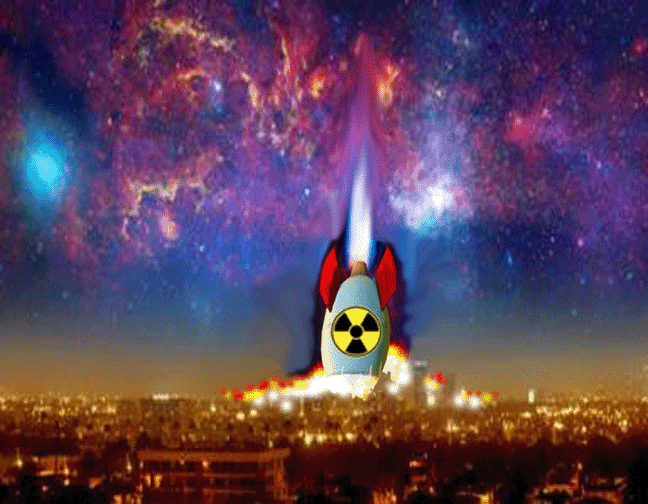
Hawaii should not be a collateral sacrifice zone for a private space company working for the pentagon
Hawaii needs to have input on SpaceX ocean-landing plan, STAR ADVERTISER. By Lynda Williams, APRIL 27, 2023
The world watched aghast as SpaceX blew up its own spaceship on April 20, four minutes after launch due to engine failure. Even though the mission was not completed, Elon Musk, CEO of SpaceX, claimed it was a success because the real goal was for the rocket to clear the launch pad at the spaceport in Boca Chica, Texas.
What most folks don’t know or realize is that Starship was always going to blow up when it crashlanded in the Pacific Ocean, just 62 nautical miles north of Kauai and a few hundred miles east of the Papahanaumokuakea Marine National Monument.
In the next test launch, which Musk boasted will happen in the next few months, the world’s largest spaceship will descend toward Earth in free fall and blow up upon impact with a force of a ton of TNT as fuel ignites in a great explosion. On a second and third launch test, Starship will break up in the atmosphere and tumble down and crash-land in a debris field several hundred miles southwest of the island chain.
SpaceX obtained a Federal Aviation Administration (FAA) commercial space launch license (experimental permit), rubber-stamped by the National Oceanic and Atmospheric Agency (NOAA) without any consultation of Hawaii’s people because, according to an email I received from the FAA: “No in-person public outreach was conducted in Hawaii as the Starship vehicle was planned to land outside of range for impacts to the residents of Hawaii.”
First of all, that is assuming everything goes exactly according to the plan, which we have all just witnessed doesn’t always happen. If the Starship goes off course by even a few degrees, the consequences could be catastrophic to Hawaii.
Secondly, I think most folks in Hawaii would agree that 62 miles north of Kauai is considered Hawaii culturally if not legally, and that is way too close for what is essentially a rocket bomb to crash-land.
SpaceX was not required to do a full environmental impact study (EIS), but a much-weaker environmental assessment (EA) that only requires the analysis of “nominal operations” or bestcase scenarios. Why was that allowed when the worst-case scenarios are so catastrophic?
In the EA, rather than doing a detailed analysis of the potential impact to marine mammals protected by the Endangered Species Act, NOAA wrote a “Biological Opinion” that argued “less than one” animal would be harmed by a 100 ton steel rocket exploding with the energy of a small nuclear bomb.
It came to that conclusion because it analyzed only one “nominal” scenario in which the rocket hits the water exactly horizontal to the surface with the fuel tanks orientated on top, which is impossible to control or predict. If the explosion is above water, NOAA argues, only a fraction of the energy will be transmitted into the ocean and travel deep enough to harm any of the 30 endangered species of whales, sharks, turtles, monk seals, dolphins and rays in Hawaii.
The EA has many unsubstantiated claims, such as no animals would be near the surface of the water during the crash — even though most are mammals that surface to breathe air.
It ignored the fact that Humpback whales migrate through the target “action area.” It assumed that most of the debris will be large enough to sink to the bottom of the ocean without encountering and injuring animals — but if any does drift into the Papahanaumokuakea Marine National Monument, then the Coast Guard would be sent to clean it up.
This alone is reason to contest the EA and demand an EIS since NOAA and the Office of Hawaiian Affairs co-manage Papahanaumokuakea and OHA should have been consulted, but was not.
The FAA and NOAA analyses are flawed, and both are failing in their duty to protect the people of Hawaii from extreme corporate and federal government abuse.
Hawaii must not become collateral damage and a colonized sacrifice zone for the government’s privatization of the space program and a billionaire’s personal ambition and corporate profits.
At minimum, the FAA must suspend the SpaceX license, conduct a full EIS and include the residents of Hawaii in the review process. The best plan is to ban SpaceX from trashing people and planet in Musk’s ego trip to Mars.
ISLAND VOICES
New nuclear tech not the answer to Canada’s climate woes, MPs say
National Observer, By Natasha Bulowski & Matteo Cimellaro, Ottawa Insider | April 26th 2023
Next-generation nuclear technology “has no part in fighting the climate emergency,” Green Party Leader Elizabeth May said Tuesday as a handful of MPs joined anti-nuclear activists to voice concern about the federal government’s intention to expand nuclear power.
“It, in fact, takes valuable dollars away from things that we know work, that can be implemented immediately, in favour of untested and dangerous technologies that will not be able to generate a single kilowatt of electricity for a decade or more,” the Saanich-Gulf Islands MP said at a cross-party press conference.
The comments came one day after Prime Minister Justin Trudeau said Canada must produce more nuclear power in the years to come. The federal government is funding the development of small modular reactors (SMRs) with a stated aim of replacing coal plants, powering heavy industry operations such as the oilsands and providing electricity for remote, diesel-reliant communities.
Ontario, Saskatchewan, New Brunswick and Alberta have agreed to a joint strategic plan for deploying SMRs to “provide safe, reliable and zero-emissions energy to power our growing economy and population.” In 2019, approximately 38 per cent of New Brunswick’s electricity generation was from nuclear, and Ontario is sitting at roughly 60 per cent.
…………critics argue the timelines, cost overruns and delays associated with building nuclear power generation facilities contrast with the need to immediately scale up fossil fuel-free energy to avoid the worst impacts of climate change. The longevity of radioactive waste, which is hazardous to human health and the environment, also raises questions among critics, as do concerns about nuclear proliferation.
Susan O’Donnell, a member of the Coalition for Responsible Energy Development in New Brunswick, warned: “SMRs create new types of toxic radioactive waste that would be very costly and difficult to isolate from the environment for millions of years.”
Some SMRs would extract plutonium — a radioactive, silvery metal used in nuclear weapons and power plants — mixed with other substances from nuclear fuel waste. But to do so undermines global nuclear weapons non-proliferation agreements, said O’Donnell, who is also an adjunct research professor in the environment and society program at St. Thomas University.
May, Liberal MP Jenica Atwin, Bloc Québécois MP Mario Simard and NDP MP Alexandre Boulerice attended the cross-party press conference on April 25…………..
May and Boulerice pointed to the influence of the nuclear industry on Parliament Hill and the close relationship between Natural Resources Canada and Atomic Energy of Canada Limited, a federal Crown corporation and the largest nuclear science and technology laboratory in the country.
“They don’t have to knock on the door to get into the house because they own the house,” said Boulerice of industry lobbyists.
“There’s no question that the nuclear industry has far more access to the Canadian Nuclear Safety Commission in terms of raising different concerns about SMRs” compared to the anti-nuclear camp, said O’Donnell.
The expansion and maintenance of nuclear power in Canada will have to deal with its significant waste problem. …………………..
…………………………………… not all agree Canada should remain a nuclear-dependent nation.
“I think the prime minister needs better advisers,” said O’Donnell, in reference to Trudeau’s recent comments that an expansion of nuclear energy will be necessary going forward………. https://www.nationalobserver.com/2023/04/26/news/new-nuclear-tech-not-answer-canada-climate-woes-mps-say
Lawmakers propose banning AI from singlehandedly launching nuclear weapons
29 Apr 23 https://www.theverge.com/2023/4/28/23702992/ai-nuclear-weapon-launch-ban-bill-markey-lieu-beyer-buck
Yes, this is already banned, but there are logical reasons to affirm the policy.
American Department of Defense policy already bans artificial intelligence from autonomously launching nuclear weapons. But amid rising fears of AI spurred by a plethora of potential threats, a bipartisan group of lawmakers has decided to make extra-double-sure it can’t.
As announced earlier this week, Senator Edward Markey (D-MA) and Representatives Ted Lieu (D-CA), Don Beyer (D-VA), and Ken Buck (R-CO) have introduced the Block Nuclear Launch by Autonomous AI Act, which would “prohibit the use of Federal funds to launch a nuclear weapon using an autonomous weapons system that is not subject to meaningful human control.” The act would codify existing Pentagon rules for nuclear weapons, which, as of 2022, read thusly:
“In all cases, the United States will maintain a human ‘in the loop’ for all actions critical to informing and executing decisions by the President to initiate and terminate nuclear weapon employment.”
The bill, by the same token, says that no autonomous system without meaningful human oversight can launch a nuclear weapon or “select or engage targets” with the intention of launching one. “Any decision to launch a nuclear weapon should not be made by artificial intelligence,” the text reads.
If this is already forbidden, why introduce the bill? Its sponsors note that a 2021 National Security Commission on Artificial Intelligence report recommended affirming a ban on autonomous nuclear weapons launches, not only to prevent it from happening inside the US government but to spur similar commitments from China and Russia.
Publicizing the bill calls attention to the potential dangers of current-generation autonomous artificial intelligence systems, a going concern in Congress and the tech world alike. And as indicated by the press release, it offers a chance to highlight the sponsors’ other nuclear non-proliferation efforts — like a recent bill restricting the president’s power to unilaterally declare nuclear war. I’ll let you make the obvious War Games joke yourself.
Plans to release nuclear wastewater into Hudson River delayed following outcry

Spectrum News, By John Camera Hudson Valley, Apr. 28, 2023
Manna Jo Greene, an Ulster County legislator and environmental director for Hudson River Sloop Clearwater, does not want to see the proposed release of nuclear wastewater from Indian Point into the Hudson River to go forward.
She says standards that deem the proposed discharge safe are outdated.
“And we’re also looking into whether or not this could impact communities that take their drinking water from the Hudson,” Greene said.
……………………………… For now, the release of about 300,000 gallons of nuclear wastewater has been slated for September, giving more time to determine the best path forward.
The next meeting from the Indian Point Decommissioning Oversight Board will take place June 15. https://spectrumlocalnews.com/nys/hudson-valley/news/2023/04/28/release-of-nuclear-wastewater-into-hudson-pushed-to-fall
MPs and activists push back as Ottawa pitches expansion of nuclear energy -“a dirty dangerous distraction”
Prime Minister Justin Trudeau says Canada is ‘going to have to be doing much more nuclear’
John Paul Tasker · CBC News · April 26 2023
Anti-nuclear activists and a cross-partisan group of MPs urged the federal government Tuesday to drop its support for nuclear energy projects, calling the energy source a “dirty, dangerous distraction” from climate action.
…………………………………… SMR technology is still in its infancy and it isn’t widely used around the world.
As of 2022, there were only three SMR projects in operation — one each in Russia, China and India — according to the International Energy Agency.
There are dozens of others under construction or in the design and planning phase — including one at Ontario Power Generation’s Darlington nuclear site.
Finance Minister Chrystia Freeland’s recent federal budget included a generous tax credit to spur clean energy development, including SMRs.
The industry lobby group, the Canadian Nuclear Association, has said the 15 per cent refundable tax credit is a recognition by Ottawa that nuclear power is “a fundamental and necessary component of Canada’s low carbon energy system.”
Susan O’Donnell, a professor and a member of the Coalition for Responsible Energy Development in New Brunswick, said Prime Minister Justin Trudeau and his cabinet are getting bad advice about nuclear energy.
“The nuclear industry, led by the U.S. and the U.K., has been lobbying and advertising heavily in Canada, trying to convince us that new SMR designs will somehow address the climate crisis,” O’Donnell told a press conference on Parliament Hill on Tuesday.
She said SMRs will produce “toxic radioactive waste” and could lead to serious “accidents” while turning some communities into “nuclear waste dumps.”
She also said there’s “no guarantee these nuclear experiments will ever generate electricity safely and affordably,” since SMRs are still relatively untested.
“Canada is wasting time that must be urgently spent on genuine climate action,” she said. “This is a dirty, dangerous distraction. We don’t need nuclear power.”
Asked how Canada would meet its baseload power requirements — the power that is needed 24 hours a day without fluctuation — without nuclear power or fossil fuel sources like natural gas, O’Donnell pointed to promising developments in energy storage technology.
Liberal MP Jenica Atwin was at the anti-nuclear press event.
“I want to be clear, I’m here as an individual, a concerned individual and a mother,” she said — before launching into remarks that raised questions about the “associated risks” and “many unknowns” of nuclear energy development, which is expected to see a sharp increase in activity due to her government’s proposed tax policies.
“When it comes to nuclear, there’s no margin for error,” Atwin said. “This is a time of action. We don’t have the luxury of waiting to see if things will pan out.”
Green Party Leader Elizabeth May, who once sat in caucus with Atwin before she decamped to the Liberals, said government funding for nuclear projects is a “fraud.”
“It has no part in fighting the climate emergency. In fact, it takes valuable dollars away from things that we know work, that can be implemented immediately, in favour of untested and dangerous technologies that will not be able to generate a single kilowatt of electricity for a decade or more,” May said……………………………………………………https://www.cbc.ca/news/politics/anti-nuclear-activists-ottawa-1.6821807
Biden and South Korea’s Yoon sign new agreement on nuclear weapons
By Jean Mackenzie in Seoul & Madeline Halpert in New York, BBC News 26 Apr 23
US President Joe Biden and South Korean President Yoon Suk-yeol have secured a landmark deal which includes plans to periodically deploy US nuclear-armed submarines in South Korea.
Washington has also agreed to involve Seoul in its planning for any use of nuclear weapons against North Korea.
In return, South Korea has agreed to not develop its own nuclear weapons.
………………………………… It does not ink a total commitment from the US that it would use nuclear weapons to defend South Korea if North Korea were to attack.
……… Plans for a nuclear-armed submarine to visit South Korea for the first time in four decades adds further weight to the US commitment.
In return, the US has demanded that South Korea remain a non-nuclear state and a faithful advocate of the non-proliferation of nuclear weapons. The US sees dissuading South Korea from going nuclear as essential, fearful that if it fails, other countries may follow in its footsteps.
But it is unclear how this commitment will be received by the influential, and increasingly vocal, group of academics, scientists and members of South Korea’s ruling party who have been pushing for Seoul to arm itself. https://www.bbc.com/news/world-us-canada-65404805
US nuclear weapons modernization plan spurs cost questions

Susan Montoya Bryan, Independent. 27 April 23
The U.S. agency that oversees development and maintenance of the nation’s nuclear arsenal is moving ahead with plans to modernize production of key components for the weapons, but some watchdog groups and members of Congress are concerned about persistent delays and cost overruns.
The National Nuclear Security Administration released its annual plan on Monday, outlining the multibillion-dollar effort to manufacture plutonium pits, the spherical cores that trigger the explosion in thermonuclear weapons, at national laboratories in New Mexico and South Carolina.
The Savannah River Site in South Carolina faces a 2030 deadline to make 50 pits per year. Officials already have acknowledged they won’t meet that timeline, and this year’s report no longer includes a target date for Los Alamos National Laboratory, in New Mexico, to meet its goal of 30 pits per year.
Last year’s report had pegged 2026 as the year when manufacturing would be up and running at Los Alamos, which played a key role in the Manhattan Project during World War II and was the birthplace of the atomic bomb……………..
The Biden administration is requesting $18.8 billion for weapons activities, a 10% increase over spending for the last fiscal year. Modernization of production accounts for $5.6 billion of the request.
Members of congressional subcommittees blasted Hruby and top defense officials during hearings in recent weeks about the delays and the increasing price tag. Hruby acknowledged that it would be another year before her agency would have a full cost estimate.
The NNSA fell short when it came to having a comprehensive schedule for the project and ran the risk of delays and increasing budgets because its plans for reestablishing plutonium pit production didn’t follow best practices, according to a January Government Accountability Office report.
Democratic U.S. Sen. Elizabeth Warren of Massachusetts suggested during a hearing this month that the NNSA was making up its plan as it goes along and that the timeline would be extended even further.
“It is not unreasonable for Congress to ask you to tell us how long a project is going to take and how much it’s going to cost in exchange for our forking over billions of dollars. And I suggest that’s what NNSA be required to do before we give them another penny,” Warren told Hruby……… https://www.independent.co.uk/news/world/americas/national-nuclear-security-administration-ap-congress-albuquerque-south-carolina-b2327627.html
1 This Month
26 April – Chernobyl: Inside the Meltdown airs on National Geographic on Sunday 26th April from 4pm

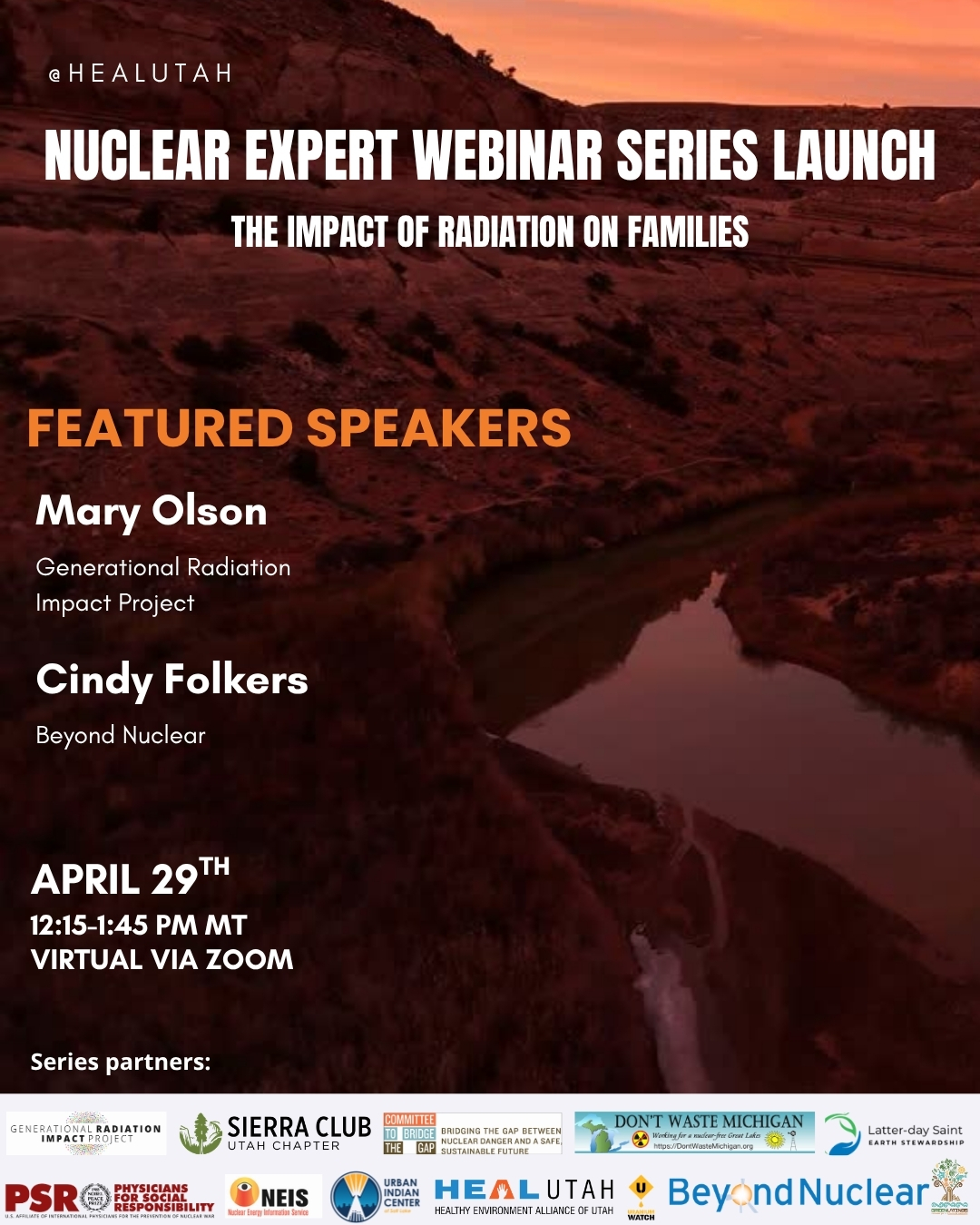
29 April – Nuclear Expert Webinar #1 – Radiation Impacts on Families with Mary Olson and Cindy Folkers
- 12:15 PM MT – 1:45 PM MT
- Location: Virtual – REGISTER TODAY

4 May -West Suburban Peace Coalition to discuss Iran war at May Educational Forum
Monday, May 4, 7:00 – 8:00 PM Central Standard Time
Title: : How Trump’s Narrative Tries to Shape the Reality of the War on Iran.
Contact Walt Zlotow, zlotow@hotmail.com 630 442 3045 for further information
14 May – online event From Bombs to Data Centres: the Face of Nuclear Colonialism

Pine Ridge Uranium is the real threat, not Tehran- Tell Burgum: Stop the Extraction.
Chernobyl: The Lost Tapes – A good documentary on Chernobyl on SBS available On Demand for the next 3 weeks– https://www.sbs.com.au/ondemand/tv-program/chernobyl-the-lost-tapes/2352741955560
To see nuclear-related stories in greater depth and intensity – go to https://nuclearinformation.wordpress.com
-
Archives
- April 2026 (317)
- March 2026 (251)
- February 2026 (268)
- January 2026 (308)
- December 2025 (358)
- November 2025 (359)
- October 2025 (376)
- September 2025 (257)
- August 2025 (319)
- July 2025 (230)
- June 2025 (348)
- May 2025 (261)
-
Categories
- 1
- 1 NUCLEAR ISSUES
- business and costs
- climate change
- culture and arts
- ENERGY
- environment
- health
- history
- indigenous issues
- Legal
- marketing of nuclear
- media
- opposition to nuclear
- PERSONAL STORIES
- politics
- politics international
- Religion and ethics
- safety
- secrets,lies and civil liberties
- spinbuster
- technology
- Uranium
- wastes
- weapons and war
- Women
- 2 WORLD
- ACTION
- AFRICA
- Atrocities
- AUSTRALIA
- Christina's notes
- Christina's themes
- culture and arts
- Events
- Fuk 2022
- Fuk 2023
- Fukushima 2017
- Fukushima 2018
- fukushima 2019
- Fukushima 2020
- Fukushima 2021
- general
- global warming
- Humour (God we need it)
- Nuclear
- RARE EARTHS
- Reference
- resources – print
- Resources -audiovicual
- Weekly Newsletter
- World
- World Nuclear
- YouTube
-
RSS
Entries RSS
Comments RSS
 nuclear-news