Blinken Dismisses Calls for a Ceasefire, Says US Must Build Up Ukraine’s Military

The Secretary of State called for Washington to continue to put militarism before diplomacy, by Kyle Anzalone
The US will focus its efforts on arming Ukraine and not attempting to bring the war to a negotiated settlement, America’s top diplomat said. Secretary of State Antony Blinken laid out a plan to massively expand Kiev’s military before talks begin.
In a speech delivered in Finland on Friday, Blinken stated, “The United States – together with our allies and partners – is firmly committed to supporting Ukraine’s defense today, tomorrow, for as long as it takes.” He continued, “We believe the prerequisite for meaningful diplomacy and real peace is a stronger Ukraine, capable of deterring and defending against any future aggression.”
Blinken dismissed the idea of even a temporary pause in the fighting. …………………………
The Secretary of State offered an ambitious vision of Kiev’s future military capabilities. “America and our allies are helping meet Ukraine’s needs on the current battlefield while developing a force that can deter and defend against aggression for years to come.” He added, “That means helping build a Ukrainian military of the future, with long-term funding, a strong air force centered on modern combat aircraft, an integrated air and missile defense network, advanced tanks and armored vehicles, national capacity to produce ammunition, and the training and support to keep forces and equipment combat-ready.”
It is unclear how long it would take to build the deterrence force envisioned by Blinken. American arms stockpiles are dwindling as Washington attempts to transfer Kiev enough military equipment to keep its army fighting. The US additionally has plans to significantly increase arms transfers to Taiwan.
Blinken claimed, “Our support for Ukraine hasn’t weakened our capabilities to meet potential threats from China or anywhere else – it’s strengthened them.” In November, the Wall Street Journal reported, “US government and congressional officials fear the conflict in Ukraine is exacerbating a nearly $19 billion backlog of weapons bound for Taiwan, further delaying efforts to arm the island.”
Additionally, the White House may not have the support it needs in the Capitol for such a massive military buildup in Ukraine. Blinken asserted that “in America, this support is bipartisan.” However, at the beginning of May, Rep. Michael McCaul (R-TX), chairman of the House Foreign Affairs Committee, said future support for Ukraine would be contingent on success in Kiev’s long-planned counteroffensive.
Since McCaul’s statement, Ukraine has slowly lost more territory to Russian forces, including Bakhmut. Zelensky committed endless resources to the city in a months-long battle despite the advice from his Western backers. The White House is now preparing for the counteroffensive to fail.
Washington’s strategy, as laid out by Blinken, calls for arming Ukraine and weakening Russia. ………..
However, Gen. Christopher Cavoli, the commander of US European Command, told Congress in April that Moscow’s ground forces are “bigger today” than before Moscow launched its invasion of Ukraine last year.
……………………………………………. In April 2022, Biden administration official Derek Chollet admitted that the White House refused to negotiate with the Kremin on Putin’s core concern, Ukraine becoming a member of NATO. “We made clear to the Russians that we were willing to talk to them on issues that we thought were genuine concerns,” Chollet said, adding that the administration didn’t think that “the future of Ukraine” was one of those issues and that its potential NATO membership was a “non-issue.”https://news.antiwar.com/2023/06/02/blinken-dismisses-calls-for-a-ceasefire-says-us-must-build-up-ukraines-military/
Nuclear energy just helped Finland slash electric costs by a staggering 75% — so why doesn’t the US follow suit? 3 reasons we are cool on the power source

Of course all bets on stability are off in the event of a meltdown — and in terms of catastrophes compared to anything possible with solar or wind, you might also say it’s not even close.
But in the end, nuclear is complicated — and it only takes a tsunami, fat finger on the control panel or mechanical breakdown to once again become reacquainted with the fallout.
Vishesh Raisinghani, Sun, June 4, 2023 https://finance.yahoo.com/news/nuclear-energy-just-helped-finland-110000152.html
The first new European nuclear plant in 16 years has already slashed Finland’s energy bill by three-fourths.
Olkiluoto 3, or OL3, joins two existing reactor units that have powered Finland’s grid for decades. This latest unit adds 1,600 megawatts to the plant’s production capacity — which means 30% of the nation’s electricity will soon come from just one plant on a tiny island in Western Finland.
When the new OL3 unit was fully activated in April, average spot electricity prices fell to €60.55 ($65.69) per megawatt hour. That’s 75.38% lower than the average spot price in December 2022 (€245.98 per megawatt hour).
While its operating company TVO called it “the greatest single climate act in Finland,” others argue that the benefits are hardly worth the risks.
Here’s why most countries are cool on this technology.
Fear
High-profile incidents like at Three Mile Island, Chernobyl and Fukushima have severely impacted the reputation of nuclear energy. Even if an overwhelming number of plants are safe, it only takes one accident to render the land around a plant uninhabitable.
In the U.S., “nukes” (as protesting musicians nicknamed them in the 1980s) continue to be unpopular. The number in the U.S. has dropped from a peak of 107 in 1990 to 93 as of 2022, according to the Pew Research Center.
Roughly 1-in-4 Americans say their government should actively discourage nuclear energy production, which could explain why so few plants have been built over the last 10 years. Yet fear is only part of the equation, as the financial bottom line also plays a crucial role in the lack of any nuclear energy embrace.
Cost
New nuclear power plants are mostly being built in countries where all infrastructure is cheaper to build. China is currently developing 24 new plants — the most in the world. Meanwhile, India is building eight new reactors. It’s simply cheaper to build plants in these regions.
According to the World Nuclear Association, the overnight cost of building a new plant in China, which assumes no interest payments, is $2500/kWe, while the cost in the U.S. is $6041/kWe (short for kilowatt-electric or one thousand watts of electric capacity). This price disparity is another reason why nuclear power isn’t favored in the developed world — though the causes go far beyond this.
Time
Nuclear power takes several years to deploy — and that’s on the conservative end. A plant can typically be constructed over a period of five years. However, regulatory and financial hurdles could delay these projects along the way. Meanwhile, a typical wind farm can be fully deployed in as little as six months, according to EDF Energy.
The classic example of how mismanaged a nuclear project can get is as close as Georgia. There, the third reactor at Plant Vogtle went online at full capacity in late May but was supposed to start generating power in 2016. It was approved for construction in 2009, and overruns pushed the cost to more than $17 million; combined with a fourth reactor still in the testing phase, the total price comes to a staggering $35 billion.
‘The most reliable source’
Indeed, time and cost ultimately represent the biggest barrier to adoption. Even Finland’s energy experts understand the commercial challenges. “[Nuclear] it seems is not very attractive for the investors,” Jukka Ruusunen, chief executive of Finland’s national grid operator Fingrid, told The National.
However, nuclear power has several non-commercial advantages. Unlike wind and solar, nuclear energy output is stable regardless of weather and sunshine hours. The U.S. Energy Department once called it “the most reliable energy source and it’s not even close.”
Of course all bets on stability are off in the event of a meltdown — and in terms of catastrophes compared to anything possible with solar or wind, you might also say it’s not even close.
Russia’s invasion of Ukraine has also highlighted nuclear’s potential to deliver national security and energy independence. Yet the near catastrophes at the Chernobyl plant during the war almost seem to counteract that fact.
On the upside, Finland’s new nuclear plant has helped it avoid blackouts despite sanctions on Russian energy and could help explain why several other European countries are also now pushing for more nuclear power.
But in the end, nuclear is complicated — and it only takes a tsunami, fat finger on the control panel or mechanical breakdown to once again become reacquainted with the fallout.
Unlimited money to Ukraine is now allowed, through USA’s “Debt Sealing” arrangement.

Debt Ceiling Deal Puts No Limits on Ukraine Aid https://scheerpost.com/2023/06/02/debt-ceiling-deal-puts-no-limits-on-ukraine-aid/
Emergency spending that has been used to arm Ukraine is exempt and it could also be used to arm Taiwan
June 2, 2023, By Dave DeCamp / Antiwar.com
The debt ceiling agreement reached between the White House and House Republicans places no constraints on spending on the war in Ukraine, a White House official told Bloomberg.
The $113 billion that has been authorized to spend on the war in Ukraine so far was passed as supplemental emergency funds, which is exempt from the spending caps that are part of the debt ceiling deal.
According to the Congressional Budget Office, funding “designated as an emergency requirement or for overseas contingency operations would not be constrained, and certain other funding would not be subject to the caps.” The deal suspends the nation’s debt limit through January 1, 2025.
Hawks in Congress are looking to use emergency spending to increase the $886 billion military budget that was agreed to as part of the deal. The emergency funds could go beyond Ukraine and might be used to send weapons to Taiwan or for other spending that hawks favor as part of their strategy against China.
“We are almost certainly going to need a supplemental for Ukraine, which is, in my view, one of the most pressing defense challenges we have right now,” said Sen. Richard Blumenthal (D-CT), according to Roll Call. “And the other obligations flow from China and Taiwan on one hand and Russia and Ukraine on the other.”
Other senators said they favor using the emergency funding to raise military spending altogether. The $886 billion budget is what President Biden asked for 2024, but Republican hawks have blasted the request as “inadequate.”
“Clearly our support for Ukraine will be outside the budget, as it has been in the past, but I’d like to see additional support for our own military in emergency supplementals as well,” said Sen. Mitt Romney (R-UT).
The Senate passed the agreement, known as the Fiscal Responsibility Act of 2023, on Thursday night in a vote of 63-36, sending the bill to President Biden’s desk. The legislation was passed through the House on Wednesday in a vote of 314-117.
Warren Report Reveals Vast Pentagon-to-Defense Contractor Lobbying Pipeline

In 2021, there were at least 672 former government officials working for top defense contractors like Lockheed Martin. By Sharon Zhang , TRUTHOUT April 27, 2023 https://truthout.org/articles/warren-report-reveals-vast-pentagon-to-defense-contractor-lobbying-pipeline/?utm_campaign=Truthout+Share+Buttons
Hundreds of former government officials, including former Pentagon officials, have been funneled through the infamous public-to-private revolving door to take their insider government knowledge to lobby for top defense contractors, a new report from the office of Sen. Elizabeth Warren (D-Massachusetts) reveals.
According to the report released Wednesday, as of 2021, there were at least 672 former officials who were working for the top 20 defense contractors, with the vast majority — 91 percent — in positions lobbying the very government they formerly worked for. Officials who weren’t lobbyists were in top positions as board members or senior executives. The officials include former members of Congress, senior staffers and military officers.
Perhaps not coincidentally, the companies that employed the most former government officials are also the companies who receive the most from the government in contracts. In 2021 and 2022, Lockheed Martin, Boeing, Raytheon, General Dynamics and Pfizer were the top 5 federal defense contractors in the U.S. — and in 2021 also employed among the highest numbers of “revolving door hires” out of the top 20 contractors, the report found, each with dozens of former government employees.
Hiring former government employees is extremely lucrative for the private sector. This is especially true for lobbying firms, who can benefit greatly from the knowledge and connections brought by former government employees, but is also true for many industries; for instance, there is a well-established revolving door between jobs at the Treasury Department and other tax-related agencies and top accounting firms, an issue Warren has previously raised.
Defense contractors are especially able to take advantage of such lobbying, as Congress and the president regularly approve huge sums of money for defense each year —– more than half of that money typically goes straight to contractors, amounting to hundreds of billions of dollars a year. Over the years, this leads to trillions of dollars in profits for defense contractors.
Warren highlighted the dangers of the revolving door in a hearing in the Senate Armed Services Subcommittee on Wednesday.
“Why is it they want to hire former Pentagon employees to work for them as lobbyists?” Warren asked Lawrence B. Wilkerson, chief of staff to George W. Bush’s Secretary of State, Colin Powell. “Why is it better to have someone who, for instance, they could hire people whose profession is lobbying, someone who’s lobbied in another field, say for the last 10 years. But they don’t want that — they’ll take somebody who’s never lobbied before, but who’s been employed at the Pentagon. Why is that?”
Wilkerson responded that the former Pentagon official “knows how to work those contacts” within the government and knows what “lies” to tell to sell the company’s services.
“If it’s specific program like the F-35, for example, which I’m somewhat familiar, then you get people who are very familiar with that on the inside, know all about the lies that you’ve been telling the federal government with regard to the program, and will come out and reinforce those lies, deceit, if you will, from their position with your business,” Wilkerson said. “It’s a very insidious, pernicious thing.”
These issues are compounded by the fact that defense spending is rife with fraud and abuse, as those who support reducing the Pentagon budget point out. Despite receiving the vast majority of federal discretionary spending year over year, the Pentagon is the only federal agency to never have passed an audit.
US cuts data sharing with Russia under New START nuclear deal
US says withholding information is retaliatory measure for Moscow’s suspension of New START (Strategic Arms Reduction Treaty).
The United States will stop providing Russia with some notifications required under the New START nuclear arms control treaty, including updates on missile and launcher locations, in what Washington describes as a retaliatory “countermeasure” due to Moscow’s “violations” of the accord.
The US state department said on Thursday that it had ceased providing the status and locations of its nuclear missiles and launchers but would continue to provide notification of the launch of intercontinental ballistic missiles and submarine-launched ballistic missiles.
Russian inspection activities on US territory have ceased and visas issued and pending for Russian New START (Strategic Arms Reduction Treaty) inspectors and their aircrews – as well as diplomatic clearance for Russian inspection aircraft – have been revoked, according to a state department fact sheet released on Thursday.
The US will also not provide telemetric information to Russia on the launch of US intercontinental and submarine-launched ballistic missiles. Such data involves information that originates during a missile’s test flights and under the treaty, both Moscow and Washington were to exchange such information annually…………………………..
Russian President Vladimir Putin has not formally withdrawn from the New START treaty, but he announced in February that Moscow would suspend its participation in what is a key pillar of US-Russian nuclear arms control.
Putin said Moscow could not accept US inspections of its nuclear sites under the agreement when Washington and its NATO allies had openly declared Moscow’s defeat in Ukraine as a primary goal.
In March, Moscow emphasised that it had not withdrawn from the START pact altogether and would continue to respect the caps on nuclear weapons the treaty sets. Russia’s foreign ministry had also said that Moscow would continue to notify the US of planned test launches of its ballistic missiles – a key element of the agreement.
Notices on ballistic launches are an essential element of nuclear strategic stability for decades, allowing Russia and the US to correctly interpret each other’s moves and make sure neither country mistakes a test launch for a preemptive nuclear missile attack.
Moscow and Washington collectively control nearly 90 percent of the world’s nuclear warheads – enough to destroy the planet several times over.
The New START limits the number of strategic nuclear warheads countries deploy. Signed in 2010 and due to expire in 2026, the New START treaty caps the number of strategic nuclear warheads that the US and Russia can deploy to no more than 1,550 strategic nuclear warheads and 700 land- and submarine-based missiles and bombers to deliver them……………………………………………………. https://www.aljazeera.com/news/2023/6/2/us-to-withhold-some-data-from-russia-under-new-start-nuclear-deal—
Biden wants to engage Russia on nuclear arms control
By Jonathan Landay and Arshad Mohammed, Canberra Times, June 2 2023
The United States will offer to abide by the nuclear weapons limits set in the New START treaty until its 2026 expiration to bolster global security if Russia does the same, two senior administration officials say.
US national security advisor Jake Sullivan will make the offer in a speech to the Arms Control Association, the oldest US arms control advocacy group, the officials said on Thursday on condition of anonymity.
Sullivan will say President Joe Biden’s administration is open to resuming unconditional talks with Moscow on managing nuclear dangers, including replacing New START with a new pact, the sources said…………………………………
Signed in 2010 and due to expire in February 2026, New START capped the number of strategic nuclear warheads the sides can deploy at 1550.
It also limits the number of land and submarine-based missiles and bombers that can deliver the warheads to 700.
Sullivan, the officials said, will offer US adherence to those limits through the treaty’s expiration if Russia does as well………… https://www.canberratimes.com.au/story/8220319/biden-wants-to-engage-russia-on-nuclear-arms-control/
Panellists discuss nuclear documentary ‘Atomic Bamboozle’ and warn against return of nuclear power .
Activists show, discuss nuclear documentary ‘Atomic Bamboozle’ at Kiggins in Vancouver, Film, panelists warn against return of nuclear power,
By Scott Hewitt, Columbian staff writer, June 2, 2023, https://www.columbian.com/news/2023/jun/02/activists-show-discuss-nuclear-documentary-atomic-bamboozle-at-kiggins-in-vancouver/
Get used to the phrase “small modular nuclear reactor” and its abbreviation, SMR. A global debate about this old-made-new energy idea is already heating up, with big implications for the people and environs of the Pacific Northwest.
SMRs are either the cleaner, safer, cheaper future of nuclear power or the return of the same old bundle of hazards, dressed up in newly attractive camouflage.
“They’re going to make nuclear energy cool again,” said former Trump administration energy secretary Rick Perry (consistently mispronouncing the word “nuclear”) in a news clip featured in the new documentary film “Atomic Bamboozle.”
“Atomic Bamboozle” is the latest in a series of timely, social-issue documentaries directed by Jan Haaken, a retired Portland State University psychology professor. Last year, Haaken produced a film about the courtroom victories of local oil-train protesters called “Necessity: Climate Justice and the Thin Green Line,” which screened, along with a panel discussion, at Vancouver’s Kiggins Theatre.
The same will happen at a Wednesday screening of “Atomic Bamboozle” at Kiggins. Environmental activists featured in the film will discuss the potential resurgence of nuclear power in the Pacific Northwest through supposedly safe, small, factory-built nuclear plants.
Panelists are Cathryn Chudy and Lloyd Marbet of the Oregon Conservancy Foundation; Desiree Hellegers, English professor and director of the Collective for Social and Environmental Justice at Washington State University Vancouver; public interest attorney Dan Meek; Dr. Patricia Kullberg, former medical director of the Multnomah County Health Department; “Atomic Days” author Joshua Frank; and film director Haaken.
(Frank’s book about the decommissioned Hanford nuclear site in Eastern Washington, “Atomic Days: The Most Toxic Place in America,” is the Fort Vancouver Regional Library system’s “Revolutionary Reads” book for this year. Free copies of the book are available to all at library branches.)
Climate wedge
Although small modular nuclear reactors are still more blueprint than reality, they’ve become a wedge issue among some environmentalists who are desperate to beat climate change, said Chudy, who lives in Vancouver.
“SMRs sound pretty cool but there are very big problems that they don’t want to talk about,” Chudy said during a phone interview with The Columbian.
“Atomic Bamboozle” reviews the troubled history of Oregon’s only commercial nuclear power plant, Trojan, which operated from 1976 through 1992 near Rainier, just across the Columbia River from Kalama. Trojan’s cooling tower dominated the skyline until it was demolished in 2006, but problems plagued the plant throughout its short life, including construction flaws, unexpected cracks, steam leaks and discovery of previously unknown earthquake fault lines nearby.
“We had assurances the plant was safe. The public relations around Trojan were amazing,” said Chudy, a pediatric mental health therapist at Legacy Emanuel Medical Center in Portland.
Chudy said today’s youth are struggling as never before with existential worry about a world that grown-ups have failed to steward. Proposed SMRs represent an opportunity to choose wisely and safely now rather than punting complicated problems into an unknown future, she said.
“Kids don’t trust adults to make good decisions,” Chudy said. “We are all putting our lives in the hands of people we elect … but I don’t think we can rely on them to steer the ship in the right direction without all of us being involved.”
Unsolved problems
Both Oregon and Washington have adopted clean energy policies for the future, Chudy said, but both include a loophole for nuclear power because nuclear plants do not emit carbon pollution.
She argues that nuclear power is actually a big cause of carbon pollution and a driver of global warming from many sources other than operating the plants themselves, including uranium mining as well as construction, decommissioning and materials transportation.
Necessary economies of scale are another serious question about nuclear power, Chudy added.
SMR boosters like them because they’re small. But what they contain is standard, old-school nuclear technology that’s simply operating on a tiny scale, M.V. Ramana, professor of physics, public policy and global affairs at the University of British Columbia, said in the film.
Early experiments with nuclear power started small too, Ramana said, but grew huge in pursuit of financial efficiency. Nothing has changed about that, he argues in the film, and new forecasts show the productions costs of nuclear power climbing.
“All nuclear reactors used to be small. The only way the nuclear industry could figure out to reduce cost was to go to larger reactors,” Ramana said. “There’s no way small modular reactors are going to be economically competitive.”
Soaring projected costs have led some members to drop out of a consortium of Western cities now pursuing an SMR on the Snake River in Idaho, according to Reuters.
The risk of nuclear accidents always remains, Ramana said in the movie. But siting decisions are made by politicians and investors in state and national capitals, far removed from the action.
US announces $46 million in funds to eight nuclear fusion companies
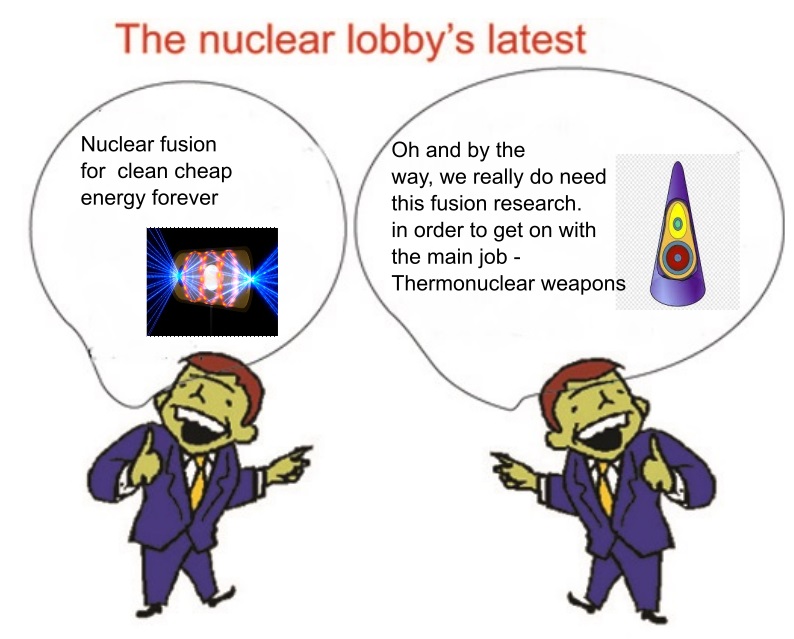
By Timothy Gardner, WASHINGTON, May 31 (Reuters) – Eight U.S. companies developing nuclear fusion energy will receive $46 million in taxpayer funding to pursue pilot plants attempting to generate power from the process that fuels the sun and stars, the Department of Energy said on Wednesday.
Generating more energy from a fusion reaction than goes into the fusion plant to heat fuel to temperatures of more than 100 million Celsius has eluded scientists for decades.
…………..”The Biden-Harris Administration is committed to partnering with innovative researchers and companies across the country to take fusion energy past the lab and toward the grid,” Energy Secretary Jennifer Granholm said in a release.
The awardees are:
-Commonwealth Fusion Systems (CFS)
-Focused Energy Inc
-Princeton Stellarators Inc
-Realta Fusion Inc
-Tokamak Energy Inc
-Type One Energy Group
-Xcimer Energy Inc
-Zap Energy Inc
The funding, which comes from the Energy Act of 2020, is for the first 18 months. Projects may last up to five years, with future funding totaling $415 million contingent on congressional approval and engineering and scientific milestones.
“Participating companies only get paid if they deliver results and the public program verifies the science is sound,” said Bob Mumgaard, the CEO and founder of CFS.
Looking to develop fusion plants that use lasers or magnets, private companies and government labs spent $500 million on their supply chains last year, according to a Fusion Industry Association (FIA) survey.
They plan to spend about $7 billion by the time their first plants come online, and potentially trillions of dollars mainly on high-grade steel, concrete and superconducting wire in a mature industry, estimated to be sometime between 2035 and 2050.
Reporting by Timothy Gardner in Washington Editing by Matthew Lewis and Diane Craft https://www.reuters.com/business/energy/us-announces-46-million-funds-eight-nuclear-fusion-companies-2023-05-31/
Call on ratepayers to fund a study for small nuclear reactors in Clark County

Nuclear power may again be on horizon for Clark County , By Lauren Ellenbecker, Columbian staff writer, June 2, 2023
Clark Public Utilities delays decision on helping fund study
“…………………..Energy Northwest invited Clark Public Utilities to participate in a feasibility study on its proposed small nuclear reactor development in Richland. The agency is considering creating four to 12 modular reactors, projected to generate 320 to 960 megawatts of power — less than its existing Columbia Generating Station, which has a capacity of 1,200 megawatts.
During a Clark Public Utilities Board of Commissioners meeting in May, Energy Northwest representatives sought $200,000 of ratepayer funds for the study, which is projected to cost $4 million. The body did not approve the request, as its three-member vote was split.
Commissioners Nancy Barnes and Jane Van Dyke both requested more time to consider Energy Northwest’s request and speak with other utilities, saying further clarity was needed.
Commissioner Jim Malinowski, who sits on Energy Northwest’s board of directors, advocated for Clark Public Utilities’ involvement. By providing funding, the utility would be “keeping the effort live” and showing there’s regional support for nuclear energy, he said.
Following the May meeting, skeptics said that discussions surrounding Energy Northwest’s project haven’t been substantive or transparent to the public, given the agency’s initial request for ratepayer funds.
“It seems this proposed financial investment is on a fast track with no obvious reason for the rush and shortchanges the public’s opportunity to ask questions and weigh meaningfully,” Cathryn Chudy of Vancouver wrote to the Clark Public Utilities commission.
Commissioners are expected to revisit Energy Northwest’s small modular reactor developments at their June 6 meeting.
Energy Northwest is meeting with Washington’s 28 public utility districts and municipalities for investments to its feasibility study, as well as reaching out to utilities in Oregon and Idaho. Eight utilities in Washington have contributed to date. https://www.columbian.com/news/2023/jun/02/nuclear-power-may-again-be-on-horizon-for-clark-county/
$528 Billion nuclear clean-up at Hanford Site in jeopardy

The government now appears to be seriously considering whether it will be necessary to leave thousands of gallons of leftover waste buried forever in Hanford’s shallow underground tanks, according to some of those familiar with the negotiations, and protect some of the waste not in impenetrable glass, but in a concrete grout casing that would almost certainly decay thousands of years before the toxic materials that it is designed to hold at bay.
At site after site, the solution has come down to a choice between an expensive, decades-long cleanup or quicker action that leaves a large amount of waste in place.
A Poisonous Cold War Legacy That Defies a Solution
NYT, By Ralph Vartabedian, Reporting from Richland, Wash., May 31, 2023
From 1950 to 1990, the U.S. Energy Department produced an average of four nuclear bombs every day, turning them out of hastily built factories with few environmental safeguards that left behind a vast legacy of toxic radioactive waste.
Nowhere were the problems greater than at the Hanford Site in Washington State, where engineers sent to clean up the mess after the Cold War discovered 54 million gallons of highly radioactive sludge left from producing the plutonium in America’s atomic bombs, including the one dropped on the Japanese city of Nagasaki in 1945.
Cleaning out the underground tanks that were leaching poisonous waste toward the Columbia River just six miles away and somehow stabilizing it for permanent disposal presented one of the most complex chemical problems ever encountered. Engineers thought they had solved it years ago with an elaborate plan to pump out the sludge, embed it in glass and deposit it deep in the mountains of the Nevada desert.
But construction of a five-story, 137,000 square-foot chemical treatment plant for the task was halted in 2012 — after an expenditure of $4 billion — when it was found to be riddled with safety defects. The naked superstructure of the plant has stood in mothballs for 11 years, a potent symbol of the nation’s failure, nearly 80 years after the Second World War, to deal decisively with the atomic era’s deadliest legacy.
The cleanup at Hanford is now at an inflection point. The Energy Department has been in closed-door negotiations with state officials and the U.S. Environmental Protection Agency, trying to revamp the plan. But many fear the most likely compromises, which could be announced in the coming months, will put the speed and quality of the cleanup at risk.
The government now appears to be seriously considering whether it will be necessary to leave thousands of gallons of leftover waste buried forever in Hanford’s shallow underground tanks, according to some of those familiar with the negotiations, and protect some of the waste not in impenetrable glass, but in a concrete grout casing that would almost certainly decay thousands of years before the toxic materials that it is designed to hold at bay.
“The Energy Department is coming to a big crossroads,” said Thomas Grumbly, a former assistant secretary at the department who oversaw the early days of the project during the Clinton administration.
Successive energy secretaries over the last 30 years, he said, “have slammed their heads against the wall” to come up with a technology and budget that would make the problem go away not only at Hanford, but also at other nuclear weapons sites around the country.
Plants in South Carolina, Washington, Ohio and Idaho that helped produce more than 60,000 atomic bombs have tons of radioactive debris that will be radioactive for thousands of years. And unlike nuclear power plants, whose waste consists of dry uranium pellets locked away in metal tubes, the weapons facilities are dealing with millions of gallons of a peanut butter-like sludge stored in aging underground tanks.
Two million pounds of mercury remain in the soils and waters of eastern Tennessee. Radioactive plumes are contaminating the Great Miami aquifer near Cincinnati.
At site after site, the solution has come down to a choice between an expensive, decades-long cleanup or quicker action that leaves a large amount of waste in place.
Hanford, some 580 square miles of shrub-steppe desert in south-central Washington State, is the largest and most contaminated of all the weapons production sites — too polluted to ever be returned to public use. But the problem is urgent, given the risk of radionuclides contaminating the Columbia River, a vital lifeline for cities, farms, tribes and wildlife in two states……………………………………………………………………………………………………
“The closer you get to the bottom of those tanks, the more radioactive, toxic and dangerous waste is,” said Geoffrey Fettus, a lawyer with the Natural Resources Defense Council, which has sued the government over the Hanford cleanup………………………………………………………………. more https://www.nytimes.com/2023/05/31/us/nuclear-waste-cleanup.html
Julian Assange: the plot thickens

The FBI has reopened its case against Wikileaks founder and Australian journalist Julian Assange, the SMH reports, after agents tried to interview his ghostwriter, Andrew O’Hagan, in London.
O’Hagan refused to talk to them because he would never give a statement against “a fellow journalist being pursued for telling the truth”. Badass, particularly as O’Hagan isn’t exactly fond of Assange as a person, as he famously wrote in the London Review of Books.
Anyway, Assange’s lawyer, Stephen Kenny, was taken by surprise by the news — he says it’s been years since the indictment was issued, and he didn’t realise there was an investigation under way. What if they’re gathering evidence to clear Assange’s name, considering there are growing rumours the Albanese government is working on it, as The New Daily’s reporting indicates? It’s not impossible, Kenny says, but it would be “very unusual” if the FBI was trying to help him.
USA urged not to use bomb-grade uranium in nuclear power experiment

By Timothy Gardner May 31, 2023 https://www.reuters.com/world/us/us-urged-not-use-bomb-grade-uranium-nuclear-power-experiment-2023-05-30/
(Reuters) – Former U.S. State Department and nuclear regulatory officials on Tuesday urged the U.S. Energy Department to reconsider a plan to use bomb-grade uranium in a nuclear power experiment, saying that its use could encourage such tests in other countries.
The Energy Department and two companies aim to share costs on the Molten Chloride Reactor Experiment (MCRE) at the Idaho National Laboratory and use more than 1,322 pounds (600 kg) of fuel containing 93% enriched uranium.
Bill Gates-backed company TerraPower LLC, the utility Southern Co (SO.N) and the department hope the six-month experiment will lead to breakthroughs in reactors……….
But a group of former Nuclear Regulatory Commission members, including former Chairman Allison Macfarlane, and U.S. assistant secretaries of state responsible for nonproliferation, said MCRE could give other countries an excuse to enrich uranium to bomb-grade level in pursuit of new reactors.
“The damage to national security could exceed any potential benefit from this highly speculative energy technology,” the experts said in a letter to Energy Department officials. They fear an increase in such experiments boosts risks that militants looking to create a nuclear weapon could get hold of the uranium.
Disconnecting War from Its Consequences, (cut welfare spending, increase weapons)
Common Wonders, By Robert C. Koehler, 31 May 23
Twenty-two years ago, Congress put sanity up for a vote. Sanity lost in the House, 420-1. It lost in the Senate, 98-0.
Barbara Lee’s lone vote for sanity — that is to say, her vote against the Authorization for the Use of Military Force resolution, allowing the president to make war against . . . uh, evil . . . without congressional approval — remains a tiny light of courageous hope flickering in a chaotic world, which is on the brink of self-annihilation.
Militarism keeps expanding, at least here in the USA. If there’s a problem out there, option one is to kill it quickly. Problem solved! This simplistic (and utterly false) mindset, which is always present — the companion of fear — may have a grip on American politics like never before, as demonstrated in the recent debt-ceiling standoff, in which President Biden came to an agreement with the Republicans that social spending will be slashed but “defense” spending must continue to expand.
You know. It’s the only thing that’s truly crucial. Poverty? Collapsing infrastructure? Underfunded schools? Climate disaster? We can worry about that stuff later, but as House Speaker Kevin McCarthy explained to reporters recently:
“Look, we’re always looking where we could find savings . . . but we live in a very dangerous world. I think the Pentagon has to actually have more resources.”
In other words, the USA is not a country with the maturity to discuss and analyze complex issues, such as the future of the world. Hey, it’s dangerous out there! It’s full of terrorists and dictators. That’s all you need to know. “Weak on defense” is the equivalent of “wants to defund the police” — a politician’s death sentence by advertising. No matter how much hell war creates — no matter how many families it displaces, no matter how many children it kills — we’ve got to be ready wage it, you know, whenever we feel like it. And the mainstream media, in its basic coverage, doesn’t question this or delve into a complex analysis of the world.
But we are still a country that is slowly and complexly evolving — no matter that the powers that be, for the most part, don’t know it. Let’s return to that AUMF vote, passed in the wake of the 9/11 devastation. Barbara Lee, whose father was in the Army, serving in both World War II and the Korean War, knew about the human costs of war. After 9/11 she was deeply uncertain what the nation’s immediate response should be. She attended the memorial service at the capital, held the day of the vote (and attended by four former presidents plus the sitting president, GWB).
There, as she told Politico, the Rev, Nathan Baxter, as he led the attendees in prayer, called on the nation’s leaders, as they considered how to respond, to “not become the evil we deplore.”…………………………………………………………… more http://commonwonders.com/disconnecting-war-from-its-consequences/
Proximity principle – nuclear waste should be stored as near as possible to the point of generation

Groups opposed to nuclear waste burial go to Queens Park, Toronto
Two anti-nuclear waste activist groups present a petition calling for the Ford government to implement a proximity principle for nuclear waste storage.
Clint Fleury 31 May 23 NWONewsWatch,
TORONTO — Two activist groups opposing the storage of nuclear waste in a deep geological repository are calling on the Ford government to mandate that a proximity principle to have the material stored cosser to where it is generated.
Members of We the Nuclear Free North in Northern Ontario from Northwestern Ontario and Protect Our Waterways – No Nuclear Waste in Southwestern Ontario have collected 1,141 signatures, with the petition presented in Queens Park on tuesday by Thunder Bay-Superior North MPP Lise Vaugeois, Kiiwetinoong MPP Sol Mamakwa and Green Party Leader Mike Schreiner.
“Their plan is not very well defined for the deep geological repository and it has several questionable areas. One of which is an option for a shallow cavern, which if approved, could see nuclear waste being moved into the area before the deep geological repository is complete and in operation,” said Charles Faust, a representative with We the Nuclear Free North.
Faust argued that the Nuclear Waste Management Organization’s plan to transport nuclear waste from power plants to a deep geological repository is “questionable.”
“I want you to remember 1,694. That’s the number of kilometres that it takes for a one-way trip from the average site of nuclear waste storage in Southern Ontario to the Ignace area — 1,694 kilometres,” Faust said. “They’re proposing two to three trucks a day, every day, for 50 years. That’s to deal with the 50,000 tonnes that are out there right now that they are looking for a place to be deposited.”
According to Faust, the concern with the transportation of nuclear waste is that Nuclear Waste Management Organization’s transportation phase is still in the early stages of development.
Bill Noll, a representative with Protect Our Waterways, expressed concern that once the nuclear waste reaches its destination, the fuel bundles will be sent to a repackaged facility and then stored in the repository.
“The repackaging facility is really unique. No other countries, Sweden, Finland, or any other country that I am aware of, is actually thinking about repackaging capability in what is a very small container,” said Noll.
Noll claimed the issue with nuclear waste is the spent heat that is generated.
“This is one of the real issues with the whole idea of how long it will last. It is a function of how much heat will be generated and how much damage that heat will do to not only the rock, but the container itself,” Noll said.
Both activist groups proposed that the solution to their concern would be for the Ford government to implement a proximity principle.
“Nuclear fuel waste should be managed at the point of generation by making on-site storage more robust and adopting a program of rolling stewardship for the long-term management of radioactive at or near its current location,” said Faust……………………………………
During the press conference, Vaugeois called the process of managing Canada’s nuclear waste “undemocratic.” https://www.nwonewswatch.com/local-news/groups-opposed-to-nuclear-waste-burial-go-to-queens-park-7073336
A Mothers Day protest: Activists blockaded the entrance to the US 2 Navy’s west-coast nuclear submarine base
No survivors. Protestors bring their annual message for peace to the gates of hell
By Leonard Eiger by beyondnuclearinternational
Activists blockaded the entrance to the US Navy’s west-coast nuclear submarine base, which is home to the largest operational concentration of deployed nuclear weapons, in a nonviolent direct action the day before Mother’s Day.
Eight peace activists from the Ground Zero Center for Nonviolent Action, holding banners reading “The Earth is Our Mother Treat Her With Respect” and “Nuclear Weapons are Immoral to Use, Immoral to Have, Immoral to Make,” briefly blocked all incoming traffic at the Main Gate at Naval Base Kitsap-Bangor in Silverdale, Washington as part of a May 13th Mothers Day observance.
Traffic was diverted as the 15 member Seattle Peace Chorus Action Ensemble, facing the Navy’s security detail, sang “The Lucky Ones”, an original composition by their director, Doug Balcom of Seattle, to the assembled guards and Navy personnel.
The song describes the different stages of personal, regional and global destruction that a nuclear war would inflict on humanity and the earth’s biosphere, and posits whether survivors to later stages of the devastation would wish they’d perished earlier; it ends with a call to save us from this fate by eliminating all nuclear weapons. …………………………………
Tom Rogers, a retired Navy captain and former nuclear submarine commanding officer, stated: “The destructive power of the nuclear weapons deployed here on board Trident submarines is beyond human imagination. The simple fact is, that a nuclear exchange between the great powers would end civilization on our planet. I understand this. If I fail to protest the existence of these evil weapons, then I am complicit.”
The civil disobedience was part of Ground Zero’s annual observance of Mothers Day, first suggested in the United States in 1872 by Julia Ward Howe as a day dedicated to peace. Howe saw the effects on both sides of the Civil War and realized destruction from warfare goes beyond the killing of soldiers in battle. …………………………………….
The Navy is currently in the process of building a new generation of ballistic missile submarines — called the Columbia-class — to replace the current OHIO-class “Trident” fleet. The Columbia-class submarines are part of a massive “modernization” of all three legs of the nuclear triad that also include the Ground Based Strategic Deterrent, which will replace the Minuteman III intercontinental ballistic missiles, and the new B-21 stealth bomber.
The Ground Zero Center for Nonviolent Action was founded in 1977. The center is on 3.8 acres adjoining the Trident submarine base at Bangor, Washington. We resist all nuclear weapons, especially the Trident ballistic missile system.
Leonard Eiger is with Ground Zero Center for Nonviolent Action.
1 This Month
26 April – Chernobyl: Inside the Meltdown airs on National Geographic on Sunday 26th April from 4pm


29 April – Nuclear Expert Webinar #1 – Radiation Impacts on Families with Mary Olson and Cindy Folkers
- 12:15 PM MT – 1:45 PM MT
- Location: Virtual – REGISTER TODAY

4 May -West Suburban Peace Coalition to discuss Iran war at May Educational Forum
Monday, May 4, 7:00 – 8:00 PM Central Standard Time
Title: : How Trump’s Narrative Tries to Shape the Reality of the War on Iran.
Contact Walt Zlotow, zlotow@hotmail.com 630 442 3045 for further information
14 May – online event From Bombs to Data Centres: the Face of Nuclear Colonialism


Pine Ridge Uranium is the real threat, not Tehran- Tell Burgum: Stop the Extraction.
Chernobyl: The Lost Tapes – A good documentary on Chernobyl on SBS available On Demand for the next 3 weeks– https://www.sbs.com.au/ondemand/tv-program/chernobyl-the-lost-tapes/2352741955560
To see nuclear-related stories in greater depth and intensity – go to https://nuclearinformation.wordpress.com
-
Archives
- April 2026 (317)
- March 2026 (251)
- February 2026 (268)
- January 2026 (308)
- December 2025 (358)
- November 2025 (359)
- October 2025 (376)
- September 2025 (257)
- August 2025 (319)
- July 2025 (230)
- June 2025 (348)
- May 2025 (261)
-
Categories
- 1
- 1 NUCLEAR ISSUES
- business and costs
- climate change
- culture and arts
- ENERGY
- environment
- health
- history
- indigenous issues
- Legal
- marketing of nuclear
- media
- opposition to nuclear
- PERSONAL STORIES
- politics
- politics international
- Religion and ethics
- safety
- secrets,lies and civil liberties
- spinbuster
- technology
- Uranium
- wastes
- weapons and war
- Women
- 2 WORLD
- ACTION
- AFRICA
- Atrocities
- AUSTRALIA
- Christina's notes
- Christina's themes
- culture and arts
- Events
- Fuk 2022
- Fuk 2023
- Fukushima 2017
- Fukushima 2018
- fukushima 2019
- Fukushima 2020
- Fukushima 2021
- general
- global warming
- Humour (God we need it)
- Nuclear
- RARE EARTHS
- Reference
- resources – print
- Resources -audiovicual
- Weekly Newsletter
- World
- World Nuclear
- YouTube
-
RSS
Entries RSS
Comments RSS
 nuclear-news