First Nations won’t back nuclear plant expansion until waste questions are answered
By Matteo Cimellaro | July 7th 2023 (The National Observer) https://www.nationalobserver.com/2023/07/07/news/first-nations-wont-back-nuclear-plant-expansion-until-waste-questions-are-answered#:~:text=Two%20First%20Nations%20near%20the,obtained%20by%20Canada’s%20National%20Observer.
Two First Nations near the proposed expansion of Canada’s largest nuclear power plant will not support any new projects until there is a solution to the nuclear waste problem on their territory, the Saugeen Ojibway Nation wrote in a letter to its membership obtained by Canada’s National Observer.
Bruce Power, the operator of the Bruce Nuclear Generating Station, will have to demonstrate safe nuclear waste management, the Ontario government said in a press release announcing the province’s first large-scale nuclear development in three decades. However, the release stopped short of mentioning the development of a deep geological repository set to be the solution for long-term nuclear waste storage for the country.
The Saugeen Ojibway Nation, composed of the Saugeen First Nation and the Chippewas of Nawash Unceded First Nation, is one of two possible hosts for the Nuclear Waste Management Organization’s (NWMO) proposed nuclear waste facility, along with Ignace, Ont., located 250 kilometres northwest of Thunder Bay.
The NWMO, a Canadian non-profit tapped to address the disposal of used nuclear fuel, will select a site to store Canada’s nuclear waste roughly 500 feet underground — as deep as the CN Tower is high — in a geological repository in March 2024.
“Until the Saugeen Ojibway are comfortable on the plan on how we’re going to resolve that waste issue, it’s really hard for us to buy into 100 per cent of what the province is doing,” Veronica Smith, chief of the Chippewas of Nawash Unceded First Nation, told Canada’s National Observer.
There will be compensation for the communities chosen to host the deep geological repository, Smith added. But it’s unclear if host First Nations might benefit from a nuclear waste facility revenue-sharing model or a lump sum payment. Those conversations haven’t even started between Saugeen Ojibway Nation and the NWMO, Smith said.
It’s also unclear if community members of both First Nations will be comfortable with the NWMO’s plan for a nuclear waste facility. Smith notes community members are the ultimate decision-makers over a proposed agreement to host the waste facility, not the elected chief and council.
Nishnawbe Aski Nation, the political organization that represents 49 First Nations in northern Ontario, including all those in Treaty 3 where the Ignace site is located, has vehemently opposed building the waste facility in the North. In 2022, the organization passed a resolution stating concerns over watersheds that lead up into Hudson Bay.
Within the northern First Nations, there are also worries a nuclear spill from transport trucks carrying waste could cut off the northern communities’ winter road access, cutting a vital supply route to several communities.
“What is NWMO going to say if both communities say no?” Smith asked.
In its letter to membership, the Saugeen Ojibway Nation also wrote that it wants a resolution and reconciliation over the historical legacy issues of nuclear power on their territory.
In the 1960s, the Bruce Power Station, one of the largest nuclear power stations in the world, was constructed on Saugeen Ojibway Nation’s territory without consultation and consent.
“What is NWMO going to say if both communities say no?” Smith asked.
In its letter to membership, the Saugeen Ojibway Nation also wrote that it wants a resolution and reconciliation over the historical legacy issues of nuclear power on their territory.
In the 1960s, the Bruce Power Station, one of the largest nuclear power stations in the world, was constructed on Saugeen Ojibway Nation’s territory without consultation and consent.
The ultimate technocratic fantasy: “a winnable nuclear war.”

The Era of Nukes and No Diplomacy: ‘Crossing a Rubicon to Armageddon’ byEDITORJuly 7, 2023, https://scheerpost.com/2023/07/07/the-era-of-nukes-and-no-diplomacy-crossing-a-rubicon-to-armageddon/
Professor Jackson Lears warns the Ukraine war has wrought “the ultimate technocratic fantasy: a winnable nuclear war.”
he Doomsday Clock continues to tick toward nuclear war, but at its fastest pace ever. Professor Jackson Lears, a former naval officer serving on a U.S cruiser carrying tactical nuclear weapons, considers the current moment more frightening than at any time during the Cold War. Then, there was intense alarm for the fate of the earth and the survival of the human race. Today, rather than diplomacy or negotiation, talk revolves around new weapons shipments, disappointment in Ukraine’s counteroffensive failures, and even drone strikes in Moscow. But far less attention has been paid to the prospect of nuclear war between Russia and the U.S that threatens to end all life on this planet as we know it. That is the alarm sounded by cultural historian and author Jackson Lears who joins host Robert Scheer to discuss Lears’s essay for Harper’s Magazine, “Behind the Veil of Indifference.”
Lears’s piece warns that despite the public indifference, a “winnable nuclear war” has entered the minds of American strategists and politicians once again, undermining years of work towards nuclear disarmament. Lears tells Scheer that it is similar to the attitudes from the Cold War, yet this time, there is an eerie disinterest from the American side about even talking to someone like Vladimir Putin. “[T]his is, in a sense, a return to the worst kind of confrontations of the early 1960s but there’s a big difference because even Kennedy and even Reagan, cold warriors that they were, were eager to create common ground ultimately between the U.S. and the Soviet Union. And that common ground no longer exists between the U.S. and Russia, and there is no interest in diplomacy at all,” Lears said.
Scheer and Lears highlight a critical factor in shaping public perception: the Russiagate controversy and the media’s role in complying with government demands for secrecy, beginning in the late 1970s, while also promoting narratives that fostered consent for war with Russia. Scheer said, “if you even dare suggest there’s some complexity to this issue, or that the other side might have a point of view, or there’s something even worth negotiating about, you’re now considered unpatriotic.” Lears agreed: “We have former directors of the CIA who have perjured themselves before Congress, now posing as professional wise men and professional truth tellers on MSNBC and CNN.”
Wrapping up the discussion, Lears gives an insight into his latest book, Animal Spirits: The American Pursuit of Vitality from Camp Meeting to Wall Street. In it, Lears explores the history behind thinkers in America who honed in on vitalism rather than the restrictive nature of traditional cultures involving religion, science and commercialization.
Workers, residents at US site that made Nagasaki A-bomb’s plutonium still suffering

June 18, 2023 (Mainichi Japan) https://mainichi.jp/english/articles/20230616/p2g/00m/0in/069000c
HANFORD, Washington (Kyodo) — As cleanup efforts continue in Washington state at a decommissioned U.S. nuclear facility that played a crucial role in the country’s acquisition of the atom bomb in World War II, questions linger over whether the site has caused serious health issues for workers and local residents.
Construction began on the facility, known as the Hanford site, eighty years ago in 1943 and involved the building of the world’s first large-scale nuclear reactor.
Through the Manhattan Project, a U.S. government research and development program for building nuclear weapons, the site’s B reactor, erected on a 580-square-mile stretch of land next to the Columbia River in south-central Washington, produced the nuclear material for one of the only two atomic bombs ever used in an armed conflict.
Codenamed “Fat Man,” the device was detonated over the city of Nagasaki in southwestern Japan on Aug. 9, 1945, effectively ending Japan’s involvement in the conflict.
The 6.2 kilograms of plutonium contained in the nuclear device released energy equivalent to 21 kilotons of TNT, taking the lives of tens of thousands of innocent people while subjecting the surrounding area to deadly radiation, killing countless more.
But citizens of Nagasaki may not be the only victims of Hanford’s plutonium production. During its decades of operation, U.S. residents living near and mainly downwind of the complex experienced severe health effects that they believe stem from the site’s activities.
One such resident is Tom Bailie, 76, who grew up and still resides just miles downwind from Hanford in a farming community.
Reflecting on his upbringing, Bailie recalled during an interview in April that no one ever thought the site at Hanford would cause harm to “patriotic American citizens.”
But, after he and a local journalist conducted a survey on surrounding farms in 1985, Bailie began to have doubts. Nearly all the families living nearby suffered from cancer, birth defects, or thyroid disease, he says — health issues that could be attributed to radiation exposure. This led to the area being coined “the death mile” by some journalists at the time.
Bailie said that his wife, father, and three uncles all had cancer before passing away, while his two sisters also have cancer and take thyroid medicine. The year before Bailie was born, his mother had a stillbirth. Bailie himself was born with birth defects and was on an iron lung when he was 4 years old. He now requires medication for a thyroid problem.
Bailie vividly remembers encounters with “men in space suits,” equipped with dosimeters to measure radiation levels, walking on his farm. The men would collect soil samples and even ask the farmers to send the heads and feet of ducks and rabbits they would kill while hunting to Hanford for analysis.
When he began speaking out about the hardships and health problems that he attributed to the Hanford site, many people from the community dismissed him as “nuts” or “crazy.” Some even mockingly referred to him as the “glow-in-the-dark farmer.”
But documents that were declassified in the late 1980s showed that Hanford had contaminated the surrounding farmland, air, farm animals, and crops with unsafe levels of radiation for years.
One such document shows that in December 1949, in an experiment called “Green Run,” Hanford scientists knowingly released thousands of curies of dangerous radioactive Iodine-131 from the site to track its course and better understand how it dispersed.
Even with the documents, some living downwind who joined the class action suit against the site were unable to explicitly prove their medical problems were caused by the contamination from the Hanford site. But Bailie still firmly believes the facility is the reason for many people’s health problems in the downwind areas.
Bailie said “the government should be ashamed of itself” for what it did to its citizens and that he thinks, at the very least, the government should cover the medical expenses of those who lived downwind.
Before being decommissioned in 1989, Hanford produced around 74 tons of plutonium, nearly two-thirds of all the plutonium produced for government purposes in the United States. One of the consequences of the site’s work was massive amounts of contamination and dangerous leftover byproducts, most of which remain on the site today.
Currently, 177 underground tanks containing 56 million gallons of highly radioactive waste, contaminated buildings, and cocooned reactors still exist there, alongside multiple other buried waste sites.
The same year Hanford was decommissioned, cleanup efforts began for dealing with the dangerous byproducts left over from the production of plutonium. Efforts to clean the area of waste are anticipated to be astronomically costly and time-consuming.
According to Hanford’s latest estimate, released in 2022, the total cost of the cleanup is projected to range from $319.6 billion to $660 billion, with a completion date not expected until at least fiscal 2078.
But Tom Carpenter, 66, former head of Hanford Challenge, a nonprofit organization dedicated to ensuring the responsible and safe clearing of the Hanford site, argues that using the word “cleanup” is misleading.
Carpenter says complete eradication of contamination from thousands of acres is impossible, and not the goal of the cleanup process. He asserts that the best that can be achieved at Hanford is “the mitigation of some risks.”
Hanford Challenge’s primary goal, he says, is to ensure authorities prioritize a swift cleanup and make sure that no corners are cut, nor workers put in unnecessary danger. This includes fighting for those who are currently working on the site.
Many workers involved in the cleanup of the Hanford site continue to be exposed to toxic chemicals, vapors, and radioactive materials, resulting in debilitating health conditions.
A recent survey of the workers by Washington state revealed more than 50 percent of them had been exposed to radioactive or toxic chemicals. Workers exposed to these dangerous materials and vapors have developed beryllium disease, cancers, organ damage, and occupational dementia.
Until recently, these workers had to prove that their health issues were directly caused by their work at the Hanford site to receive assistance with their medical expenses.
According to former worker and Hanford Challenge director Jim Millbauer, 65, proving this was extremely difficult, costly, time-consuming, and often fruitless, as most occupational illness claims were rejected.
But a recent law has changed this, presuming that any health effects suffered by workers who spend just eight hours working at Hanford are caused by working at the facility, making it easier for sick workers to get their treatment paid for.
Ben & Jerry’s, CodePink Co-Founders Arrested in DC Demanding Freedom for Julian Assange
“It seems to me,” said Ben Cohen, “that, right now, unless things change, and unless we change them, freedom of the press is going up in smoke.”
By Brett Wilkins / Common Dreams
Ben Cohen, the co-founder of the ice cream company Ben & Jerry’s, and Jodie Evans, who co-founded the peace group CodePink, were arrested Thursday outside Department of Justice headquarters in Washington, D.C. for blocking an entrance to the building to protest the U.S. government’s prosecution of WikiLeaks publisher Julian Assange.
Cohen and Evans were arrested while other demonstrators chanted slogans demanding freedom for Assange, the 52-year-old Australian facing extradition from the United Kingdom to the U.S., where he has been charged with Espionage Act violations and could be imprisoned for up to 175 years if convicted on all counts.
“It’s outrageous. Julian Assange is nonviolent. He is presumed innocent. And yet somehow or other, he has been imprisoned in solitary confinement for four years. That is torture,” Cohen said during the protest. “He revealed the truth, and for that he is suffering, and… we need to do whatever we can to help him, and to help preserve democracy, which is based on freedom of the press.”
“It seems to me that, right now, unless things change, and unless we change them, freedom of the press is going up in smoke,” Cohen asserted before lighting an effigy of the Bill of Rights in four places.
Evans asked, “Why do we have freedom of the press?”
“Because there needs to be someone reporting the truth about the violence of power,” she said. “When you don’t have freedom of the press and no one’s telling the truth, it weaponizes your capacity to feel, to have compassion and empathy.”
“If you don’t have the full story and if your heart is being manipulated with lies, then we’re all lost,” Evans added. “How can we have peace in the world if we’re just drowning in lies?”‘
Assange—who suffers from physical and mental health problems including heart and respiratory issues—published classified U.S. government documents, many of them provided by whistleblower Chelsea Manning. Some of the files exposed U.S. and allied war crimes, including the “Collateral Murder” video showing a U.S. Army helicopter crew killing a group of Iraqi civilians, the Afghan War Diary, and the Iraq War Logs.
According to the United Nations Working Group on Arbitrary Detention, Assange has been arbitrarily deprived of his freedom since he was arrested on December 7, 2010. Since then he has been held under house arrest, confined for seven years in the Ecuadorean Embassy in London while he was protected by the administration of former Ecuadorean President Rafael Correa, and jailed in Belmarsh Prison, where he is now.
After a U.K. court last month rejected Assange’s appeal against his extradition order to the United States, press freedom groups renewed calls for U.S. President Joe Biden to drop the charges against him.
John Bolton Accidentally Explains Why US Policy On Russia And China Is Wrong

Caitlin Johnstone 7 July 23
Professional psychopath John Bolton has an article out with The Hill titled “America can’t permit Chinese military expansion in Cuba” which inadvertently spells out exactly what’s wrong with the way the US empire keeps amassing heavily armed proxy forces on the borders of its large Asiatic enemies.
Citing a Wall Street Journal report from last month in which anonymous US officials claim that Havana has entered negotiations with Beijing for a possible future joint military training facility in Cuba, Bolton argues that the US must use any amount of aggression necessary to prevent this facility’s construction, up to and including regime change interventionism.
“The potential of significant Chinese facilities in Cuba is a red-flag threat to America,” Bolton writes, arguing that such activities “could well camouflage offensive weapons, delivery systems or other threatening capabilities.”
“For example, hypersonic cruise missiles, already harder to detect, track, and destroy than ballistic missiles, are natural candidates for installation in Cuba, a prospect we cannot tolerate, along with many other risks, like a Chinese submarine base,” he adds.
All of which are arguments that could be made pretty much note-for-note by Russia and China about the ways the US has been threatening their security interests with war machinery in their immediate surroundings…………………………………………………………….
This would be the same John Bolton who in 2002 falsely accused Cuba of having a biological weapons program in a bid to sweep the island up in the same post-9/11 war push he was helping the US construct against Iraq with extreme aggression…………………………………………..
The single dumbest thing the US-centralized empire asks us to believe is that the military encirclement of its top two geopolitical rivals is a defensive action, rather than an act of extreme aggression. The idea that the US militarily encircling Russia and China is an act of defense rather than aggression is so in-your-face transparently idiotic that anyone who thinks critically enough about it will immediately dismiss it for the foam-brained nonsense that it is, yet because of propaganda that is the mainstream narrative in the western world, and millions of people accept it as true.
………………. If the US would interpret a Chinese military presence in Cuba as an incendiary provocation, then logically the far greater military presence the US has amassed on the borders of Russia and China is a vastly greater provocation by that same reasoning, and the US knows it. There exists no argument to the contrary that doesn’t rely on baseless “well it’s different when we do it” assertions.
Demanding that Russia and China tolerate behavior from the US that the US would never tolerate from Russia or China is just demanding that the world subjugate itself to the US empire. Those who argue that Russia should have tolerated Ukraine being made into a NATO asset or that China should just accept US military encirclement because something something freedom and democracy are really just saying the US should be allowed to rule every inch of this planet completely uncontested……..https://caityjohnstone.medium.com/john-bolton-accidentally-explains-why-us-policy-on-russia-and-china-is-wrong-1ce1bcbb0074
Wishful thinking about nuclear energy won’t get us to net zero
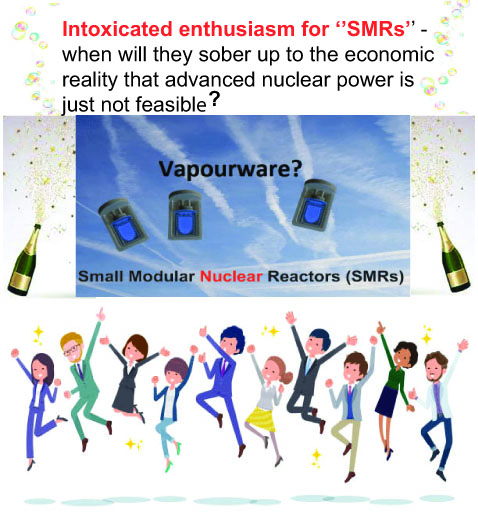
The climate problem is too serious to engage in unrealistic modelling exercises. Wishful thinking about nuclear energy will only thwart our ability to act meaningfully to lower emissions rapidly.
BY M.V. RAMANA AND SUSAN O’DONNELL | July 3, 2023 https://www.hilltimes.com/story/2023/07/03/wishful-thinking-about-nuclear-energy-wont-get-us-to-net-zero/391721/
On June 20, the Canada Energy Regulator (CER) released its 2023 Canada’s Energy Future report, developing scenarios for a path to net zero by 2050. These scenarios project roughly a tripling of nuclear energy generation capacity in Canada by 2050, seemingly reinforcing then-natural resources minister Seamus O’Regan’s statement in 2020 that there is “no path to net zero without nuclear.”
However, underlying both the scenarios and O’Regan’s contention is wishful thinking about the economics of nuclear energy, and how fast nuclear power can be scaled up.
The new nuclear capacity the report envisions consists of so-called small modular nuclear reactors (SMRs), which have so far not been built in Canada. Aside from refurbishing existing CANDU reactors, the CER does not think any more standard sized nuclear reactors will be built in Canada. Most of this buildup is to happen between 2035-2050, meaning that nuclear power will not help meet the government’s stated goal of decarbonizing the electricity grid by 2035.
But can SMRs be built rapidly after 2035? Only two Crown companies in the business of generating electricity for the grid have proposed to build SMRs: NB Power in New Brunswick, and Ontario Power Generation (OPG).
The reactor designs proposed for New Brunswick are cooled by molten salts and liquid sodium metal. Despite decades of development work and billions of dollars invested, major technical challenges have prevented molten salt reactors and sodium-cooled reactors from commercial viability, making it highly unlikely that the New Brunswick designs can be rapidly deployed in the time frame envisioned by the CER.
Assuming that OPG’s chosen design—the 300-megawatt BWRX-300—is the one to be deployed widely, then around 70 SMR units would need to be built and operating effectively on the grid between 2030-2050. The BWRX-300 design is yet to be approved by any safety regulator anywhere in the world.
But the report has an even more serious problem: economics. Nuclear power cannot compete economically, which is why its share of global electricity generation has declined from 17.5 per cent in 1996 to 9.2 per cent in 2022. Because SMRs lose out on economies of scale, they will produce even more expensive electricity.
The CER’s scenarios for nuclear power are based on the Electricity Supply Model, meant to calculate “the most efficient and cost-effective way to meet electricity demand in each region.” Such models are widely used in energy analysis and policymaking, but their utility depends on the validity of the assumptions used; garbage in, garbage out.
Two key parameters underlie the report’s scenarios: the capital cost of an SMR, and how that cost evolves with time. The CER’s assumptions in the two net-zero scenarios are that a SMR costs $9,262 per kilowatt in 2020, falling to $8,348 per kW by 2030, and to $6,519 per kW by 2050. Both these assumptions are ridiculously out of touch with the real world.
Consider the CAREM-25 SMR designed to feed 25 megawatts of electricity into the grid, being built in Argentina since 2014. Its original cost estimate in 2014 of US$446-million has escalated significantly since then, but even using these original costs, the project costs nearly $30,000 per kilowatt in 2022 Canadian dollars.
The NuScale design, arguably the closest to deployment in the United States, has been in development since 2007 with the build not yet begun. The January 2023 cost estimate for six NuScale SMRs with a total capacity of 462 megawatts is $9.3-billion, or over $26,000 per kilowatt in Canadian dollars.
Finally, the cost of the five-megawatt Micro Modular Reactor Project at Chalk River, Ont., was estimated by the proponent in May 2020 to be between $100- and $200-million. In 2022’s Canadian dollars, that works out to $22,000 to $44,000 per kilowatt.
In other words, the CER’s cost assumptions are wild underestimates, two-and-a-half to four times lower than the current evidence.
The second incorrect assumption is that costs will decrease with time. Both in the United States and France, the countries with the highest number of nuclear plants, the trend was the opposite: costs went up—not down—as more reactors were built. In both countries, the estimated construction cost of the most recent reactors being built—Vogtle in the United States and Flamanville-3 in France—have broken new records.
We need government organizations to do better. The climate problem is too serious for such unrealistic modelling exercises. Wishful thinking will only thwart our ability to act meaningfully to lower emissions rapidly.
M.V. Ramana is the Simons Chair in Disarmament, Global and Human Security and professor at the School of Public Policy and Global Affairs at the University of British Columbia. Susan O’Donnell is adjunct research professor and primary investigator of the CEDAR project at St. Thomas University in Fredericton, N.B.
Local colleges train students to work in a plutonium pit factory, but at what cost?

It carries a legacy of illness, death and environmental racism for countless others. History tells of a long practice of hiring local Hispano and Pueblo communities to staff some of the most dangerous positions.
History tells of a long practice of hiring local Hispano and Pueblo communities to staff some of the most dangerous positions, a practice that has its origins in the early years of the lab, as Myrriah Gómez describes in her 2022 book Nuclear Nuevo México.
- By Alicia Inez Guzmán Searchlight New Mexico, Jun 10, 2023 https://www.santafenewmexican.com/news/local_news/local-colleges-train-students-to-work-in-a-plutonium-pit-factory-but-at-what-cost/article_068bd3b2-0589-11ee-b8ba-93e1230989e7.html
Every day, thousands of people from all parts of El Norte make the vertiginous drive up to Los Alamos National Laboratory. It’s a trek that generations of New Mexicans have been making, like worker ants to the queen, from the eastern edge of the great Tewa Basin to the craggy Pajarito Plateau. All in the pursuit of “good jobs.”
Some, inevitably, are bound for that most secretive and fortified place, Technical Area 55, the very heart of the weapons complex — home to PF-4, the lab’s plutonium handling facility, with its armed guards, concrete walls, steel doors and sporadic sirens. To enter “the plant,” as it’s known, is to get as close as possible to the existential nature of the nuclear age.
For 40 years, some 250 workers were tasked, mostly, with research and design. But a multibillion-dollar mission to modernize the nation’s nuclear arsenal has brought about “a paradigm shift,” in the words of the Defense Nuclear Facilities Safety Board, a federal watchdog. Today, the plant is in the middle of a colossal expansion — growing from an aged building to what the safety board calls “a large-scale production facility for weapon components with the largest number of workers in its history.”
In short, the plant is slated to become a factory for making plutonium pits, the essential core of every nuclear warhead.
Four years ago, LANL began laying the groundwork for this expansion by searching out and shaping a highly trained labor pool of technicians to handle fissile materials, machine the parts for weapons, monitor radiation and remediate nuclear waste. The lab turned to the surrounding community tapping New Mexico’s small regional institutions — colleges that mostly serve minority and low-income students. The plan, as laid out in a senate subcommittee meeting, set forth a college-to-lab pipeline — a “workforce of the future.”
Taken altogether, Santa Fe Community College, Northern New Mexico College and the University of New Mexico’s Los Alamos campus have accepted millions of federal dollars for their role in preparing that workforce. They’ve graduated 74 people to date, many of whom will end up at TA-55.
As Kelly Trujillo, associate dean of SFCC’s School of Sciences, Health, Engineering and Math, put it, “A lot of these jobs are high-paying jobs and they allow [workers] to stay in their home, in the area that they love.”
The trade-offs, like so much involving LANL’s history in Northern New Mexico, are not without controversy. For many local families, the lab has been a gateway to the American dream. Its high wages have afforded generations of Norteños a chance at the good life — new houses, new cars, land ownership, higher education for their kids. To work there is to become part of the region’s upper crust.
It carries a legacy of illness, death and environmental racism for countless others. History tells of a long practice of hiring local Hispano and Pueblo communities to staff some of the most dangerous positions, a practice that has its origins in the early years of the lab, as Myrriah Gómez describes in her 2022 book Nuclear Nuevo México.
New Mexico’s academic institutions have for decades served as LANL’s willing partner, feeding students into the weapons complex with high school internships; undergraduate student programs; graduate and postdoc programs; and apprenticeships for craft trades and technicians. The lab heavily recruits at most local colleges, too.
Talavai Denipah-Cook can still remember LANL representatives plying her with promises of a high-paying job and good benefits at an American Indian Sciences and Engineering Society conference years ago. At the time, she was a student at a private high school in Española, and the future that they painted looked bright.
“I was like, ‘Wow, that sounds really intriguing.’ We don’t get that around here, especially as people of color,” said Denipah-Cook, now a program manager in the Environmental Health and Justice Program at Tewa Women United, an Indigenous nonprofit based in Española.
Then she remembered the words of her grandmother, a field nurse from Ohkay Owingeh, who once tended to Navajo Nation tribal members affected by uranium mining and saw the health impacts of radiation exposure firsthand.
“She used to tell me, ‘Don’t ever, ever work at Los Alamos National Labs.’”
‘The snake road’
For nearly eight decades, LANL’s repeated attempts to expand have run up against the plateau’s geography. During the Manhattan Project, the site proved problematic in terms of housing, transportation and access along the road that old-timers called el camino de la culebra — the snake road. In more recent years, the lab’s footprint has stretched to encompass a nearly 40-square-mile campus that abuts Bandelier National Monument, U.S. Forest Service lands, the cities of Los Alamos and White Rock, and San Ildefonso Pueblo.
One of its smallest areas, TA-55, sits at the north-central edge of campus. Within is “the plant” — a 233,000-square-foot building that ranks, according to the U.S. Department of Energy, as the only “fully operational, full capability plutonium facility in the nation.”
This is where plutonium and other irradiated materials are conveyed by a trolley system from a vault to rooms lined with gloveboxes, sealed and oxygen-free. Workers, their hands protected by bulky gloves, weigh and handle plutonium in all its forms — molten, metal and powder. They disassemble and inspect existing weapons from the stockpile; forge parts for nuclear batteries that help power spacecrafts; and perfect the dimensions of plutonium “hemishells” on hand-built machines. According to a retired machinist, each pit has to be so precisely crafted that the difference between it and others can vary no more than the width of a strand of hair.
A mass of certifications and protocols are required for every task; there is little margin for error. Should radiation escape its enclosure, a radiation control technician stands by with a Geiger counter to detect it and stop work immediately.
Plant employees earn an extra $20,000 of environmental pay — in order “to attract people, quite frankly, to work in our more challenging facilities,” said Stephen Schreiber, who works in weapons production as the technical director of the lab’s office of Science, Technology and Engineering.
When Joaquin Gallegos, the former chair of NNMC’s Biology, Chemistry and Environmental Sciences Department, recruited high school students to join the college pipeline, he cited the competitive salaries and drew upon his own family history: the aunts and uncles who worked at LANL while continuing to tend multigenerational land.
The lab “subsidized” their lifestyle and made it possible not to “sell out,” Gallegos said. “People who have 10 or 15 acres of agricultural land, that’s not enough to support a family. But if you work at the labs, you could still maintain that culture. You could still raise animals and maintain that as part of your family.”
Pendulum swings for pits
It’s been almost 75 years since LANL last produced plutonium pits at an industrial scale. In 1996, the lab was sanctioned to produce up to 20 plutonium war reserve pits a year for the W88 warhead. It produced 30 pits in a five-year period, until 2012 when all major plutonium operations were suspended, after four pieces of weapons-grade plutonium were placed side by side for a photo op — a positioning that could have caused a runaway neutron chain reaction and a flash of potentially fatal radiation.
“The lab has never had to be accountable for their promises,” said Greg Mello, of the Los Alamos Study Group, an influential anti-nuclear nonprofit based in Albuquerque. “Could they be a factory? Could they produce pits reliably? No. Not at all.”
LANL, regardless, was tapped as one of two sites — the other being South Carolina’s Savannah River plutonium processing facility — to produce no fewer than 80 pits annually by 2030, according to the Fiscal 2020 National Defense Authorization Act. The law authorized LANL to produce 30 pits per year by 2026.
What’s being proposed is so huge it has no precedent, said Jay Coghlan, executive director of Nuclear Watch New Mexico, an anti-nuclear advocacy organization in Santa Fe.
“Here we have this arrogant agency that thinks it can just impose expanded bomb production on New Mexico,” said Coghlan, referring to the National Nuclear Security Administration, the lead agency for pit production. “They do not have credible cost estimates and they do not have a credible plan for production. But yet they expect New Mexicans to bear the consequences.”
The costs, according to the Los Alamos Study Group, will come to some $46 billion by 2036 — the earliest the NNSA says it can hit 80 pits per year at the two sites. It’s roughly the same amount of money it would take to rebuild every single failing bridge in America.
The NNSA estimates the lab will need 4,100 full-time employees, including scientists and engineers, security guards, maintenance, craft workers, and “hard-to-fill positions,” as LANL has dubbed the pipeline jobs.
It is the most costly program in the agency’s history. It is also destined, Coghlan and others say, to collapse under its own weight. Both Los Alamos and Savannah River are, according to federal documents, billions of dollars over budget and years behind schedule.
Money, waste and risk
More than $20 billion is slated for paying personnel and underwriting the construction in and around TA-55, including parking structures, office buildings, facilities to process transuranic liquid waste, and demolishing and decontaminating hundreds of old gloveboxes and installing hundreds of new ones. Construction is taking place at night, while staff work toward meeting LANL’s new quota by day.
Safety and controlling risk are paramount, said Schreiber, the LANL technical director. “We really do instill that in our workers.” But observers at the Union of Concerned Scientists say the pace doesn’t bode well.
“When you have new employees who are not very experienced in a new facility running new procedures in a high-risk environment — trying to do it fast, trying to meet a quota — that’s a recipe for something bad to happen,” said Dylan Spaulding, a senior scientist in the nonprofit’s global security program.
New Mexico’s all-Democratic congressional delegation, whatever the controversies, supports the project wholeheartedly. It was Heinrich and South Carolina’s Republican Sen. Lindsey Graham who rallied behind pit production in their states — ushering it into law in the 2020 National Defense Authorization Act. Then-Congressman Ben Ray Luján helped shepherd money to the pipeline programs.
Radiation 101
Last spring, assistant professor Scott Braley taught two back-to-back introductory courses to 13 future radiation control technicians at NNMC. His lectures covered a host of topics: the history of “industrial-scale” radiation accidents worldwide, algebraic formulas to determine the correlation between individual cancer and workplace exposure, and maximum permissible doses for future workers like themselves. The rates are higher than for the general public, Braley explained, because, for one, radiation workers “have accepted a higher risk.”
Once they get their associate degree, NNMC graduates proceed to the second part of their training, in a Los Alamos classroom. There, they learn how to don and doff personal protective gear — a suit not unlike the one that recent NNMC graduate Karen Padilla said she once used to keep bees. Padilla, 42, participated in simulations of scenarios that she and others might one day face, learning the proper ways to detect radiation around trash and 55-gallon barrels of waste, for instance.
“Long-term, I don’t have really any fears about this because I feel like my instructors are doing a good job of helping me understand how to protect myself” and others, said Padilla. “I think ultimately that’s my job as a [radiation control technician], to protect people who are working, to make sure they’re not getting into something that could be harmful.”
Much of the college programs center around minimizing risk. And yet they present an ethical dilemma, said Eileen O’Shaughnessy, co-founder of Demand Nuclear Abolition.
“What does it mean to assume that exposure is acceptable at all? Because the thing about radiation is it’s cumulative and any amount is unsafe.”
Generations of Northern New Mexicans have faced the same time-worn question: Are the good jobs worth the trade-offs?
“You realize, yes, they are paying you well, but you’re being put in situations that you have no idea about,” said the retired machinist, with over two decades of experience working at the lab, much of it at the plant. He asked to remain anonymous for fear of retaliation. “It’s the mentality at the lab,” he said. “They don’t really think that people that are techs are even really worth much.”
A powerful neighbor
Dueling perspectives reveal the chasms around the lab and, in particular, what some consider the Manhattan Project’s original sin: Its use of eminent domain to force Indigenous and Hispano people off their farms and sacred lands on the Pajarito Plateau. Its arrival, oral histories hold, spelled the end of land-based living.
“When did we stop farming to sustain ourselves?” Kayleigh Warren recalled asking a relative from Santa Clara Pueblo. The answer: “When the labs came in.”
Now an environmental health and justice program coordinator at Tewa Women United, Warren has borne witness to the region’s change in values. The lab has so deeply carved itself into Northern New Mexico’s psyche that imagining another future and means of survival has come to seem impossible.
As the single largest employer in northern New Mexico, LANL’s horizon of influence is vast. And with billions more dollars flooding in, its sway in almost every sphere seems only to grow.
Despite the lab’s omnipresence, economic gains have been relatively limited. While Los Alamos County has one of the highest median household incomes in the nation, the surrounding communities — including Española — are among the poorest in the state.
“LANL has been a bad neighbor,” Warren said. “If the economic benefits are so good for them to continue their work and expand, you would think the communities around here would be doing better. But we’re not.”
US govt provides yet another round of money grants to companies, including Westinghouse, to promote nuclear power development

Westinghouse, 6 other companies get DOE vouchers to help accelerate advanced nuclear technologies, https://www.utilitydive.com/news/westinghouse-general-atomics-advanced-nuclear-doe-energy-vouchers/684957/
Voucher recipients “do not receive direct financial awards. Vouchers provide funding to DOE laboratories to help businesses overcome critical technological and commercialization challenges,” DOE said.
The Department of Energy announced last week that it has awarded vouchers to seven companies “to accelerate the innovation and application of advanced nuclear technologies.”
According to DOE, voucher recipients “do not receive direct financial awards. Vouchers provide funding to DOE laboratories to help businesses overcome critical technological and commercialization challenges.” All voucher recipients have to cover at least 20% of any costs, DOE said.
Companies receiving the awards include the following:
Alpha Tech Research Corp. will collaborate with Argonne National Laboratory “to advance the development of a promising yttrium hydride-based moderator for its molten salt microreactor concept. The data will be used to inform the design and size of the reactor.”General Atomics will work with Oak Ridge National Laboratory “to examine the material behavior of irradiated silicon carbide composite samples. The data will help inform material behavior models required to license the use of silicon carbide-based structures in nuclear reactors.”
Ultra Energy will work with Oak Ridge National Laboratory “to organize and design high-temperature reactor testing to support the testing and further development of its new prototype detector that could help enhance the safe operation of commercial reactors once commercialized. Test results will demonstrate suitability of the prototype and allow for further development for commercial deployment.”- Westinghouse Electric Co. will work with PNNL and Idaho National Laboratory “to perform post-irradiation experiments on its chromium-coated accident-tolerant fuel cladding. The project will focus on corrosion and hydrogen behavior in the cladding from two different coating processes.”
- The vouchers were provided under DOE’s Gateway for Accelerated Innovation in Nuclear initiative. Last week’s vouchers were the third round awarded in fiscal year 2023.
Missouri S&T will ask St. Louis-area residents their opinions about nuclear waste
St. Louis Public Radio | By Jonathan Ahl, July 5, 2023
Missouri University of Science and Technology wants to know what St. Louis-area residents think about nuclear waste. The school has received a $2 million grant from the U.S. Department of Energy to study the issue.
For decades, the federal government has explored the possibility of storing spent nuclear fuel at the Yucca Mountain repository in Nevada, but the Energy Department now says that option is off the table.
This has led to S&T’s involvement as the leader of one of 13 teams across the nation conducting research for the agency.
The S&T team will assess and document the concerns of residents in the St. Louis area who live in the proximity of legacy waste sites where national defense-related nuclear material from World War II up to the Cold War is stored………………………………………………..
Usman said the project is equal parts science, education and public opinion polling. The University of Illinois Urbana-Champaign, St. Louis University and the University of Missouri will be part of Missouri S&T’s research.
The findings from all over the country that are collected will be sent to the Department of Energy as it decides how to proceed with finding locations for nuclear waste storage.
Missouri has one operating large nuclear reactor, owned by Ameren, in Callaway County. Missouri S&T has a small nuclear reactor on campus that is primarily used for educational purposes.
There are six nuclear reactor sites in Illinois, all in the central or northern part of the state. https://news.stlpublicradio.org/health-science-environment/2023-07-05/missouri-s-t-will-ask-st-louis-area-residents-their-opinions-about-nuclear-waste
Report Shows How Military Industrial Complex Sets Media Narrative on Ukraine

by EDITOR, July 3, 2023, By Bryce Greene / Fairness and Accuracy In Reporting (FAIR) https://scheerpost.com/2023/07/03/report-shows-how-military-industrial-complex-sets-media-narrative-on-ukraine/
Wealthy donors have long funded think tanks with official-sounding names that produce research that reflects the interests of those funders (Extra!, 7/13). The weapons industry is a major contributor to these idea factories; a recent report from the Quincy Institute (6/1/23) demonstrates just how much influence war profiteers have on the national discourse.
The Quincy Institute—whose own start-up funding came mainly from George Soros and Charles Koch—looked at 11 months of Ukraine War coverage in the New York Times, Washington Post and Wall Street Journal, from March 1, 2022, through January 31, 2023, and counted each time one of 33 leading think tanks was mentioned. Of the 15 think tanks most often mentioned in the coverage, only one—Human Rights Watch—does not take funding from Pentagon contractors. Quincy’s analysis found that the media were seven times more likely to cite think tanks with war industry ties than they were to cite think tanks without war industry ties.
With 157 mentions each, the top two think tanks were the Atlantic Council and the Center for Strategic and International Studies (CSIS). Both of these think tanks receive millions from the war industry. The Atlantic Council has long been the brain trust of NATO, the military organization whose expansion towards Russia’s borders was a critical factor in Russia’s decision to invade Ukraine. (See FAIR.org, 3/4/22.) Both think tanks receive hundreds of thousands of dollars from Raytheon and Lockheed Martin, companies which have already been awarded billions of dollars in Pentagon contracts as a result of the war in Ukraine.
CSIS was revealed in a New York Times expose (8/7/16) to produce content that reflected the weapons industry priorities of its funders. It also “initiated meetings with Defense Department officials and congressional staff to push for the recommendations” of military funders.
Think tank media mentions related to US military support for Ukraine (Quincy Institute, 6/1/23).
In addition to showing think tanks’ enormous influence, the Quincy report highlights how difficult it is to trace just how much war industry funding these think tanks receive, and exactly whose interests they represent. “Think tanks are not required to disclose their funders,” study author Ben Freeman wrote, and “many think tanks list donors without indicating the amount of donations and others just list donors in ranges (e.g., $250,000 to $499,999).”
While the study was not aimed at establishing a causal connection between weapons industry funding and the think tanks’ positions, it acknowledges that funding typically plays a major role in shaping the institutions. “Funders,” Freeman wrote, “are able to influence think tank work through the mechanisms of censorship, self-censorship, and perspective filtering.” In other words, people with points of view antithetical to the funders likely would not last long in these think tanks.
Causal or not, there is a marked correlation between war industry funding and hawkish positions. “Think tanks with financial ties to the arms industry often support policies that would benefit the arms industry,” the report noted. For example, one Atlantic Council article (2/6/23) advocated against “any compromise with the Kremlin,” while another, titled “Equity for Ukraine” (1/16/23), argued that Ukraine has a “right to destroy critical infrastructure in Russia and plunge Moscow and other cities into darkness.”
Earlier this year, the president of the American Enterprise Institute—fifth on the list, with 101 mentions—was cited numerous times in the Wall Street Journal (e.g., 1/20/23, 1/25/23) arguing that “tanks and armored personnel carriers are essential,” and agreeing to provide them will “let Ukraine know that it can afford to risk and expend more of its current arsenal of tanks in counteroffensive operations because it can count on getting replacements for them.” AEI (6/9/23) has gone so far as to suggest that the US give tactical nuclear weapons to Ukraine, something that could easily escalate to all-out nuclear war.
The Quincy Institute did not find a single instance in which a media organization disclosed the fact that its source received funding from the war industry, obscuring how interested parties may be shaping coverage or promoting policy recommendations that directly benefit their funders.
The study found that for the few think tanks that receive little or no Pentagon contractor funding, positions on the war are dramatically different. With less influence from the war industry, the study found, these organizations emphasize “expository rather than prescriptive analysis, support for diplomatic solutions, and a focus on the impact of the war on different parts of society and the region.”
Human Rights Watch, which takes no war industry money, “was agnostic on the issue of providing US military assistance to Ukraine,” and instead “focused on human rights abuses in the conflict.” The Carnegie Endowment, which receives less than 1% of its funding from that industry, was never quoted advocating an increase in military spending or weapons sales during the Ukraine War.
One critical way that corporate news media manufactures consent for US foreign policy is by carefully selecting the sources and voices that they present, and narrowing the spectrum of debate. While this can take the form of uncritically repeating pronouncements from government officials, this research demonstrates that there are more subtle ways in which media outlets can push a corporate/state agenda under the guise of independent journalism.
High nuclear crimes don’t pay
by beyondnuclearinternational, By Linda Pentz Gunter
Politicians and executives snared for their roles in bribery and racketeering schemes
Breaking: On June 29, former Ohio Speaker of the House, Republican, Larry Householder, was handed down the maximum sentence of 20 years in prison for his role in the high crimes described below. His co-conspirator, Matt Borges, the former Ohio GOP Chairman, was sentenced on June 30 to fiveyears in federal prison.
This is part one of a two-part story on bribery and corruption in the nuclear power realm and the questionable ethics of legal lobbying. The original article was published in its entirety in Capitol Hill Citizen, a print-only newspaper published by Ralph Nader. These articles are reproduced with kind permission of the editor. Part two will be published in the next few weeks. Capitol Hill Citizen comes out in print only. To subscribe or purchase single copies, click here.
It all began when Ohio nuclear power plant owner, FirstEnergy, began “bleeding cash” in a desperate effort to keep its aging and uneconomical Davis-Besse and Perry nuclear power plants solvent.
The effort bankrupted FirstEnergy subsidiary, FirstEnergy Solutions, then owner of the two nuclear plants. The shareholders wanted out. FirstEnergy threatened to close the plants. But Ohio House Republican, Larry Householder, had other plans.
Householder concocted a nefarious scheme to extract $61 million from the failing company to ensure his re-election and that of enough political allies to guarantee his return to the House Speakership.
This, in turn, would secure enough votes to ensure passage of a $1.3 billion bailout bill, known as HB6, that would rescue the two nuclear plants along with struggling coal plants.
And it worked. For a while.
Householder, who had previously held the Ohio House Speakership from 2001-2004, was duly re-elected to that position in January 2019. Millions of dollars also poured into the campaign war chests of 21 political candidates in order to stack the House with votes in favor of the bailout bill. It duly passed the House on May 29, 2019 and the Senate on July 17, 2019. But the July 23, 2019 Ohio House concurrence vote passed the bill by only one vote. And then it all unraveled.
On July 21, 2020, Householder and four others were arrested for what investigating US Attorney for the Southern District of Ohio, David DeVillers, described as “the biggest criminal racketeering conspiracy in Ohio history.”
Householder, who was re-elected to the Ohio House shortly afterwards and refused to resign, was unanimously voted out as Speaker on July 30, 2020. Eleven months later the House voted 75-21 to expel Householder.
After a seven week trial, Householder and fellow conspirator, former GOP Chairman Matt Borges, were found guilty of racketeering conspiracy on March 9, 2023. The jury took just nine hours to reach their verdict. Householder was sentenced on June 29 to 20 years in prison — the maximum penalty. Borges was sentenced on June 30 to five years in federal prison. Both men said they would appeal.
The U.S. District judge in the case, Timothy Black, scolded Householder at sentencing, saying: “Beyond financial greed, I think you just liked power. You weren’t serving the people. You were serving yourself.”
Assistant U.S. Attorney Emily Glatfelter described Householder as “the quintessential mob boss, directing the criminal enterprise from the shadows and using his casket carriers to execute the scheme”, in a sentencing memorandum to the judge.
FirstEnergy Corp. was also charged with conspiring to commit honest services wire fraud, but the company signed a deferred prosecution agreement that could see the charges dismissed. FirstEnergy also agreed to pay a $230 million monetary penalty.
But an ongoing civil lawsuit against FirstEnergy alleging insider trading and other offenses has brought documents to light released by Ohio Consumers’ Council that reveal the true depth and scope of involvement of its executives in the scheme to ensure passage of HB6.
Nevertheless, Householder defense attorney, Steve Bradley, argued during the trial that Householder was just “being a good politician” and is simply “good at fundraising”. Never mind that Householder hid the source of the $61 million by funneling it through a murky 501(c)(4) called Generation Now, then redirected around $500,000 of it to pay off his personal credit card debt, settle a lawsuit, and repair a Florida home.
The flow of dark money to Generation Now, which FirstEnergy has now admitted supplying, also paid for a disinformation campaign to suppress a public petition drive to repeal HB6, launched by a coalition called Ohioans Against Corporate Bailouts. ……………………………………………………..
It remains to be seen whether the fate of those politicians and corporate executives who fell prey to greed and deception and to whom punishment will now be meted out, will serve as an adequate deterrent against further such conduct.
Linda Pentz Gunter is the international specialist at Beyond Nuclear and writes for and curates Beyond Nuclear International. https://beyondnuclearinternational.org/2023/07/02/high-nuclear-crimes-dont-pay/
US Nuclear-Capable B-52 Bombers Fly to Korean Peninsula in Latest Provocation
by EDITOR, July 3, 2023, By Dave DeCamp / Antiwar.com
The bombers participated in a training exercise with US and South Korean fighter jets.
US nuclear-capable B-52 bombers flew to the Korean Peninsula on Friday in the latest US provocation against North Korea.
The South Korean Defense Ministry and the US military said the bombers participated in exercises and were joined by US and South Korean fighter jets………………………….
According to Air & Space Forces Magazine, Friday’s B-52 deployment marked the seventh time in the last six months that B-52s or B-1s have flown above or near the Korean Peninsula.
The US is planning to dock a nuclear-armed submarine in South Korea for the first time since 1981. President Biden and South Korean President Yoon Suk-yeol announced the plan in April, but it’s not clear when the nuclear-armed submarine will arrive.
Because US nuclear-armed submarines can be patrolling waters anywhere in the world at any time and carry long-range missiles, from a strategic perspective, docking one in South Korea serves no purpose other than as a provocation toward North Korea. https://scheerpost.com/2023/07/03/us-nuclear-capable-b-52-bombers-fly-to-korean-peninsula-in-latest-provocation/
Senate passes $886 billion National Defense Authorization Act (NDAA): No audits necessary

Walt Zlotow, West Suburban Peace Coalition, Glen Ellyn IL 1 Aug 23
President Joe wants no audit of the billions in weapons of mass Ukrainian death provided in the 2024 National Defense Authorization Act (NDAA).
His compliant Senate majority gave him every buck of the 886 billion bucks he requested to wage US exceptionalism round the world. Besides ravaging the life of millions in dozens of countries worldwide from bombs and sanctions, US foreign policy risks nuclear war with Russia and China over Ukraine and Taiwan respectively.
Republican Sen. Rand Paul’s amendment requiring audits and investigations of Ukraine aid was swamped 78 -20, with all Democrats voting to keep auditors away from the weapons giveaways. They are terrified an honest investigation would reveal how billions in weapons wind up with bad actors, get destroyed as soon as they’re introduced into the killing fields, and simply raise the Ukrainian death toll that can only be eliminated by negotiations.

America’s grotesque military budget should be reported in full on every front page, instead of disappearing from public consumption like invisible ink. On cable/network news, it’s the shame of America that dare not speak its name.
Every day countless Ukrainians die for US exceptionalism, and every day nuclear confrontation creeps closer.
US navy accused of cover-up over radioactive shipyard waste

The US navy is covering up dangerous levels of radioactive waste on a
40-acre former shipyard parcel in San Francisco’s waterside Hunters Point
neighborhood, public health advocates charge.
The land is slated to be
turned over to the city as early as next year, and could be used for
residential redevelopment. The accusations stem from 2021 navy testing that
found 23 samples from the property showed high levels of strontium-90, a
radioactive isotope that replaces calcium in bones and causes cancer.
The Environmental Protection Agency raised alarm over the levels, but the navy
in 2022 said its testing was inaccurate and produced a new set of data that
showed levels of strontium-90 lower than zero, which was dismissed by
environmental health experts as impossible.
Guardian 25th June 2023
https://www.theguardian.com/us-news/2023/jun/25/us-navy-accused-radiocative-shipyard-waste
Nuclear Waste Transportation Draws Opposition in West

Concerns are growing in the west about nuclear waste transportation.
On Tuesday, the Snake River Alliance is holding a webinar on these concerns, heightened by the potential of a temporary waste facility opening in New Mexico.
Kevin Kamps is the radioactive waste specialist for Beyond Nuclear. He said these fears are combined with the recent train derailment of toxic waste in Ohio.
He said the federal government and nuclear power industry are rushing to create the New Mexico temporary waste facility.
“These dumps that are proposed are called consolidated interim storage facilities, which means it’s only temporary and the waste will have to move again,” said Kamps. “So it’s really wrongheaded. It’s going to automatically double transportation risks.”
In May, the U.S. Nuclear Regulatory Commission issued a license for the temporary waste site in New Mexico.
The Biden administration says nuclear power is a key component for the country’s clean energy future. However, state officials in New Mexico have voiced their opposition to the facility.
Nuclear waste also is a concern in Idaho. Experiments are starting on new nuclear reactor designs such as small modular reactors at the Idaho National Laboratory.
However, Kamps pointed out that recent research found these SMRs generate two to 30 times the amount of radioactive waste as traditional nuclear reactors.
“So another downside of all this SMR talk,” said Kamps, “which unfortunately Idaho is on the cutting edge of.”
Kamps said he believes the country is living on borrowed time when it comes to the potential for disaster from nuclear power.
“We really should be transitioning into a renewable energy economy in this country,” said Kamps, “which is much safer, much more secure and actually much more cost effective than nuclear power.”
1 This Month
26 April – Chernobyl: Inside the Meltdown airs on National Geographic on Sunday 26th April from 4pm

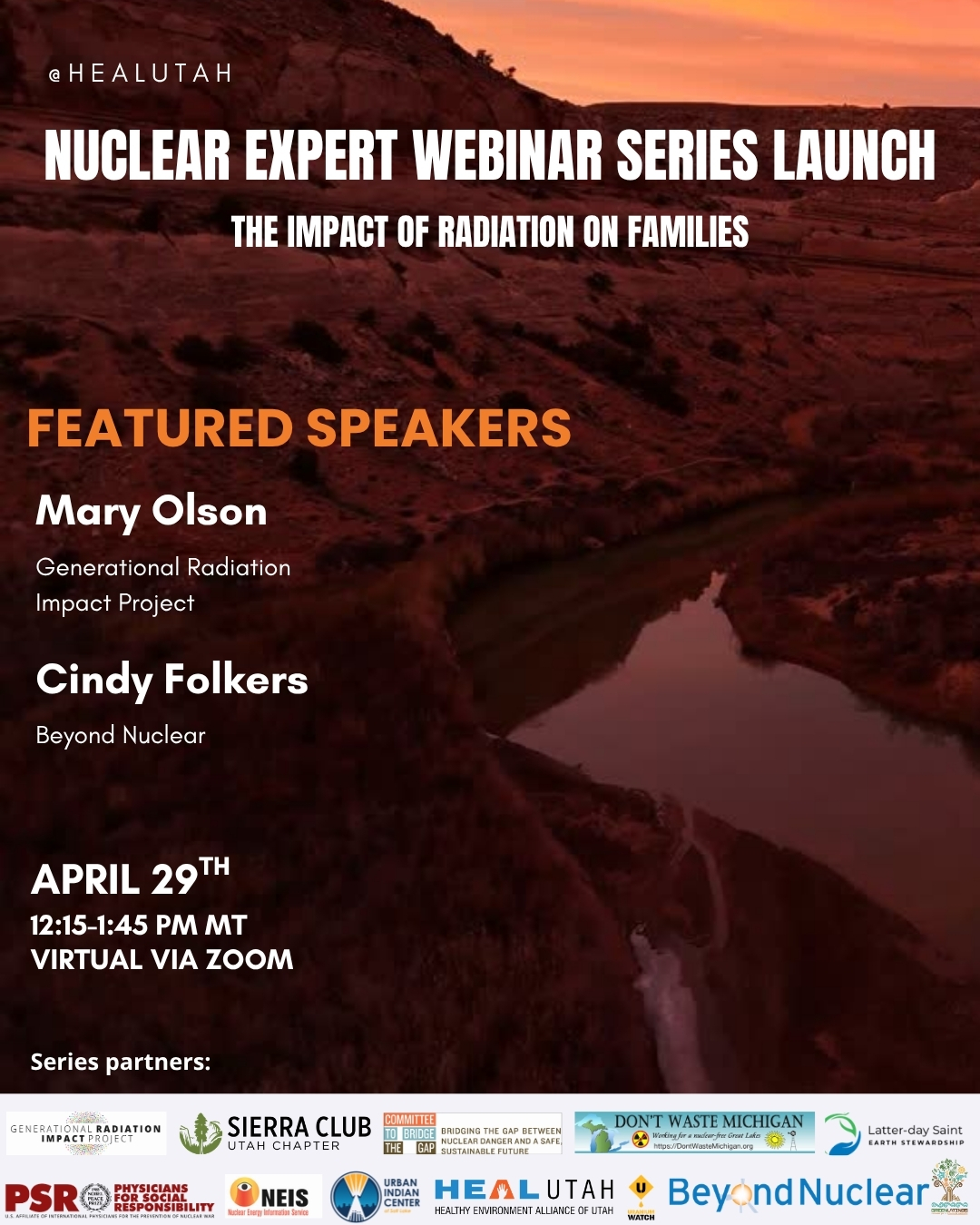
29 April – Nuclear Expert Webinar #1 – Radiation Impacts on Families with Mary Olson and Cindy Folkers
- 12:15 PM MT – 1:45 PM MT
- Location: Virtual – REGISTER TODAY

4 May -West Suburban Peace Coalition to discuss Iran war at May Educational Forum
Monday, May 4, 7:00 – 8:00 PM Central Standard Time
Title: : How Trump’s Narrative Tries to Shape the Reality of the War on Iran.
Contact Walt Zlotow, zlotow@hotmail.com 630 442 3045 for further information
14 May – online event From Bombs to Data Centres: the Face of Nuclear Colonialism

Pine Ridge Uranium is the real threat, not Tehran- Tell Burgum: Stop the Extraction.
Chernobyl: The Lost Tapes – A good documentary on Chernobyl on SBS available On Demand for the next 3 weeks– https://www.sbs.com.au/ondemand/tv-program/chernobyl-the-lost-tapes/2352741955560
To see nuclear-related stories in greater depth and intensity – go to https://nuclearinformation.wordpress.com
-
Archives
- April 2026 (317)
- March 2026 (251)
- February 2026 (268)
- January 2026 (308)
- December 2025 (358)
- November 2025 (359)
- October 2025 (376)
- September 2025 (257)
- August 2025 (319)
- July 2025 (230)
- June 2025 (348)
- May 2025 (261)
-
Categories
- 1
- 1 NUCLEAR ISSUES
- business and costs
- climate change
- culture and arts
- ENERGY
- environment
- health
- history
- indigenous issues
- Legal
- marketing of nuclear
- media
- opposition to nuclear
- PERSONAL STORIES
- politics
- politics international
- Religion and ethics
- safety
- secrets,lies and civil liberties
- spinbuster
- technology
- Uranium
- wastes
- weapons and war
- Women
- 2 WORLD
- ACTION
- AFRICA
- Atrocities
- AUSTRALIA
- Christina's notes
- Christina's themes
- culture and arts
- Events
- Fuk 2022
- Fuk 2023
- Fukushima 2017
- Fukushima 2018
- fukushima 2019
- Fukushima 2020
- Fukushima 2021
- general
- global warming
- Humour (God we need it)
- Nuclear
- RARE EARTHS
- Reference
- resources – print
- Resources -audiovicual
- Weekly Newsletter
- World
- World Nuclear
- YouTube
-
RSS
Entries RSS
Comments RSS
 nuclear-news