America’s first SMR fizzles out as uranium continues to ride high

SMR developer NuScale has, predictably, rebutted a short seller’s report from Iceberg Research on its operations last month.
Its stock is down 81% over the past year.
Yet enthusiasm for the nuclear renaissance is still strong
Stockhead, Josh Chiat, 14 Nov 23
Small modular reactors — they’re the technology the nuclear power industry hopes will mainstream the controversial energy sector and prove it can expand without the massive scale of traditional nuclear energy.
But the emerging market has been dealt a blow just as enthusiasm for a nuclear renaissance hits a new level of intensity.
It came in the form of a decision from the Utah Associated Municipal Power Systems and advanced SMR developer NuScale to dump a plan called the “Carbon Free Power Project”.
That would have been the first SMR rolled out in the States, six minireactors due to be constructed in Idaho Falls from 2026. But NuScale and UAMPS deemed it unviable after subscriptions fell well below the level required to underwrite the project’s construction.
It came despite strong political support, including from the Biden Administration, amid long delays and cost overruns for conventional plants.
Wood Mackenzie vice-chair of Americas Ed Crooks said it was a serious setback for the SMR industry.
“But while the end of the Carbon Free Power Project was not entirely unexpected, it is still a serious setback for nuclear power in the US, and for hopes of reducing greenhouse gas emissions globally,” he said in a note.
“It is increasingly likely that no new SMRs will be built in the US or Europe in the 2020s.”
According to Crooks the levelised cost of energy for the power to be delivered by the dumped project was over double that of utility-scale solar and materially higher than gas turbines.
“Estimates published in January set a target levelised cost of energy (LCOE) for the plant of US$89 per megawatt hour, up from an earlier estimate of US$58/MWh, including the benefit of tax credits and federal government support,” he wrote.
“But even that revised target relied on some favourable assumptions. Hitting that US$89/MWh target depended on cutting US$700 million from the Carbon Free Power Project’s estimated cost of US$5.1 billion.
“Without that, the LCOE would be US$105/MWh, and there were clear risks that it could rise higher.
“Wood Mackenzie calculated last year that the average LCOE from a combined-cycle gas turbine power plant in the US was US$58/MWh, while utility-scale solar was US$43/MWh.
“That makes the Carbon Free Power Project’s cost estimates seem expensive, even before any additional overruns.”
Enthusiasm for nuclear continues
Despite that news, SMR developer NuScale has, predictably, rebutted a short seller’s report from Iceberg Research on its operations last month.
Its stock is down 81% over the past year.
Yet enthusiasm for the nuclear renaissance is still strong, …………………………………………………………. https://stockhead.com.au/resources/ground-breakers-americas-first-smr-fizzles-out-as-uranium-continues-to-ride-high/
Who will clean up America’s nuclear wastes in Greenland?
Maine Voices: Long-buried U.S. nuclear waste would complicate any bid for Greenland https://www.pressherald.com/2019/08/24/maine-voices-long-buried-u-s-nuclear-waste-would-complicate-trumps-bid-for-greenland/
Would the U.S. or Denmark be responsible for cleaning up over 47,000 gallons of Cold War-era radioactive waste?
Deadly alliance: Why has the CIA decided to allow US media to confirm its involvement in Ukraine’s brutal assassination campaign?
The scale of US intelligence support for Kiev’s murderous operations has been brought to light at a very interesting moment
https://www.rt.com/russia/586692-cia-sbu-kiev-assassinations/
By Chay Bowes, journalist and geopolitical analyst, MA in Strategic Studies, RT correspondent
As Ukraine slips quietly from the top of the Western media’s news agenda, fascinating insights into the granular nature of the CIA’s involvement in Kiev’s assassination program are being revealed. By the very same outlets that had previously suggested Ukraine was on a solo run with its slew of extrajudicial killings and terror attacks.
Western media has routinely ignored the brutal exploits of Kiev’s successor to the KGB, the SBU. When they are reported upon, instead of calling out the illegal killing of journalists and activists, the press seeks to frame them as masterful operations of a band of freedom fighters administering tough justice to the “enemies of Ukraine.” A key element of that narrative was that while the US, British, and French intelligence services worked closely with the SBU, they didn’t have any direct control of its actions, particularly when those actions involved assassinating unarmed civilians. However, a recently published article in the Washington Post has now revealed that the CIA had, and continues to have, a central role in the group’s most disturbing activities.
A Washington Post article “Ukrainian spies with deep ties to CIA wage shadow war against Russia” outlines a labyrinthine relationship between the two intelligence agencies, and while the CIA still maintains it doesn’t sanction particular operations, the details revealed in the telling article suggest that this is nothing more than the usual stock disclaimer which accompanies most of Langley’s covert operations. The article is based on interviews with “more than two dozen current and former Ukrainian, US and Western intelligence and security officials” and its revelations are both shocking and fascinating.
One of the first claims it makes is that the relationship between the Ukrainian SBU and the CIA has been developing for decades with the latter working to “develop” Ukraine’s abilities to carry out sabotage and “operations” since at least 2014. The CIA has also been providing detailed intelligence, equipment and training to the SBU during that period and continues to spend “tens of millions” of dollars developing its capabilities. The sources quoted also confirm that the CIA even designed and built a new headquarters for the SBU in Kiev and currently share “levels of information and intelligence unthinkable” prior to Russia’s intervention in Ukraine.
According to the Washington Post, the CIA also now maintains a significant presence in Kiev, not only in terms of men and materiel but also information flow, all of which suggests that despite maintaining an overt distance, the CIA is in fact intimately involved in all aspects of SBU operations including the planning and execution of operations outside the state.
One such operation, and probably the most infamous carried out by the SBU since February 2022, was the assassination of Daria Dugina, daughter of prominent Russian philosopher Aleksandr Dugin. The Washington Post article goes into great detail to outline the complexity of the “operation” performed by the SBU that resulted in the death of the unarmed 23-year-old non-combatant in a car bombing outside Moscow in August 2022. It tells of the use of a pet carrier to transport explosives into Russia, and of the surveillance of the deceased woman’s home by the assassin, who then fled across the border soon after the horrendous killing, which was cynically referred to by the SBU as a “liquidation.”
The granular details outlined in the article suggest sources either within the CIA or SBU have now confirmed that their relationship, once presented as purely advisory and business-like, is in fact a deep and long-standing partnership. The article goes on to confirm the SBU’s involvement in several other targeted murders on Russian territory, including the assassination of Vladlen Tatarsky with a bomb in a crowded St. Petersburg cafe and the murder of ex-submarine commander Stanislav Rzhitsky, who was shot in the back while jogging unarmed in a park in Krasnodar.
The revealing article also refers to “uneasiness” in Kiev and Washington regarding the SBU’s penchant for this kind of assassination, noting concern that they could tarnish Ukraine’s image abroad especially among donor countries who recently admitted that without their help Ukraine would collapse within weeks.
What is most interesting about this piece is probably not its confirmation that the CIA is intimately involved in the operations of the SBU, what’s most fascinating is why a newspaper widely recognized as itself having an intimate relationship with the CIA has suddenly decided to basically confirm what many analysts already knew when it comes to Langley and the SBU.
The Washington Post’s revelation comes not only in the aftermath of the bloody Hamas incursion into Israel and the subsequent Israeli assault on Gaza but also as international attention, and more importantly, appetite to support Kiev, wanes. This shift in attention, not only in the media but also potentially in the scale of aid, bodes poorly for President Vladimir Zelensky’s regime, as it faces increasing domestic pressures and war-weary neighbors.
Couple this with the oncoming winter and the view looks increasingly grim for Zelensky even before mentioning Ukraine’s failed counteroffensive and recent Russian battlefield gains. It now also looks inevitable that Ukraine will find itself playing second fiddle to an emerging political and potentially military crisis in the Middle East while competing for the vital US aid that keeps the Kiev regime afloat. Crucially, all of these woes offer a beleaguered NATO an opportunity to apply pressure on Zelensky to seek peace, potentially solving an increasingly difficult puzzle for Kiev’s backers as they head towards elections that will be decided by populations ever more vocal in their disdain for the conflict.
So as Kiev’s woes compound and the world’s gaze shifts towards Gaza, it seems the truth about the West’s intimate relationship with the SBU is now being pulled out of the closet, not by a whistleblower or dissenting investigative journalist, but by a stalwart of the US intelligence community, the Washington Post. The question we should all be asking is why? How does this benefit or promote a Western ‘victory’ in Ukraine? The answer may well be that it’s not a victory that these revelations are supposed to facilitate. It’s more likely that it’s part of a strategy of edging Kiev towards accepting the undeniable reality that the entire US project in Ukraine is set to fail, and for Zelensky to seek accommodation before there’s nothing left to negotiate with.
The task now is to end it as painlessly as possible for NATO and Kiev’s exhausted backers, and to move on to the next crusade, leaving a devastated and dysfunctional Ukraine to be consigned to the growing graveyard of bloody US foreign policy misadventures.
Biden and Xi will sign a deal to keep AI out of control systems for nuclear weapons: report
Tom Porter , Nov 13, 2023, https://www.businessinsider.com/biden-xi-deal-ai-out-nuclear-weapons-systems-apec-report-2023-11
- China’s President Xi Jinping and US President Joe Biden will meet this week.
- They’re expected to agree to limit the use of AI in nuclear weapons, a report said.
- The meeting comes amid increasing tensions between the US and China.
US President Joe Biden and his Chinese counterpart Xi Jinping are set to sign a deal limiting the use of artificial intelligence in nuclear weapon control systems, according to The South China Morning Post.
The leaders are due to meet Wednesday at the Asia-Pacific Economic Cooperation (APEC) summit in San Francisco against a backdrop of increasing tensions between the superpowers.
Among the top items on the agenda is the proliferation of AI in military technologies, two sources familiar with the planned discussions told The South China Morning Post.
Biden and Xi will pledge a deal limiting the use of AI in autonomous weaponry, such as drones, as well as the systems used for the control and deployment of nuclear warheads, the report said.
U.S. Space Force and the dangerous clutter of human-produced stuff in space

What Does the U.S. Space Force Actually Do? Inside the highly secretive military branch responsible for protecting American interests in a vulnerable new domain
NYT, By Jon Gertner, Nov. 8, 2023
Chief Master Sgt. Ron Lerch of the U.S. Space Force sat down in his office in Los Angeles one morning in September to deliver a briefing known as a threat assessment. The current “threats” in space are less sci-fi than you might expect, but there are a surprising number of them: At least 44,500 space objects now circle Earth, including 9,000 active satellites and 19,000 significant pieces of debris.
What’s most concerning isn’t the swarm of satellites but the types. “We know that there are kinetic kill vehicles,” Lerch said — for example, a Russian “nesting doll” satellite, in which a big satellite releases a tiny one and the tiny one releases a mechanism that can strike and damage another satellite. There are machines with the ability to cast nets and extend grappling hooks, too. China, whose presence in space now far outpaces Russia’s, is launching unmanned “space planes” into orbit, testing potentially unbreakable quantum communication links and adding A.I. capabilities to satellites.
An intelligence report, Lerch said, predicted the advent, within the next decade, of satellites with radio-frequency jammers, chemical sprayers and lasers that blind and disable the competition. All this would be in addition to the cyberwarfare tools, electromagnetic instruments and “ASAT” antisatellite missiles that already exist on the ground. In Lerch’s assessment, space looked less like a grand “new ocean” for exploration — phrasing meant to induce wonder that has lingered from the Kennedy administration — and more like a robotic battlefield, where the conflicts raging on Earth would soon extend ever upward.
The Space Force, the sixth and newest branch of the U.S. military, was authorized by Congress and signed into law by President Donald Trump in December 2019. Its creation was not a partisan endeavor, though Trump has boasted that the idea for the organization was his alone. The initiative had in fact been shaped within the armed forces and Congress over the previous 25 years, based on the premise that as satellite and space technologies evolved, America’s military organizations had to change as well……………………………………………………………………………….
nearly every aspect of modern warfare and defense — intelligence, surveillance, communications, operations, missile detection — has come to rely on links to orbiting satellites………………
the strategic exploitation of space now extends well beyond military concerns. Satellite phone systems have become widespread. Positioning and timing satellites, such as GPS (now overseen by the Space Force), allow for digital mapping, navigation, banking and agricultural management. A world without orbital weather surveys seems unthinkable. Modern life is reliant on space technologies to an extent that an interruption would create profound economic and social distress…………………………………………………………………………………………………………………
Guardians tend to think of the realm they patrol as a kind of structured multilevel terrain — Earth as being surrounded by three highways, or three rings. The nearest level, low Earth orbit (LEO), is host to constellations like SpaceX’s Starlink network and the International Space Station, which moves about 250 miles above us at 17,500 miles per hour. A medium Earth orbit (MEO), between 1,200 and 22,000 miles above, is where GPS satellites circle. At the highest ring — at least for now — is a track known as “geosynchronous” orbit (GEO), because an object in such an orbit keeps pace with Earth’s rotation. This band is home to DirectTV satellites, weather-tracking instruments from the National Oceanic and Atmospheric Administration and crucial Defense Department communication links.
It’s a technological zoo up there. The satellite mix is foreign and domestic, young and old, sinister and peaceful. The technologies are all different sizes, flying at different speeds and altitudes. The challenge for the force is to monitor all movement but also to track the threatening presence of debris, some of which is naturally occurring (tiny rocks, for instance) and some of which has human origins (like shards of old rockets). Because space junk can move at extraordinary velocities, a floating screw might pack a destructive punch equivalent to a small bomb……………………………………………………………………………………………………………………………………
Capt. Raymond Pereira, drawing on a white board, pointed me to another concern: the crowd of satellites in low Earth orbit. “I would say we’re probably already entering into an area where congestion is a problem,” he said, “and anything that would generate debris would be catastrophic for the domain.” One plausible theory is known as the Kessler Syndrome, named after the former NASA scientist Donald Kessler, which posits that a release of wreckage and fragments in this orbit could eventually lead to a domino effect of unstoppable destruction. Pereira pointed out that if someone (or something) were to touch off such an event, “they would not only be harming their adversary; they would be harming themselves.” But even short of that, a single collision or attack might hamstring science missions to the moon, or to Mars, or lead to failures for GPS and communications systems, a problem that could have huge consequences for life on Earth.
………………………. A treaty from the late 1960s, signed by most of the major nations on Earth, prohibits the use of nuclear weapons in space and designates the moon for peaceful purposes. But recently, I was told, satellites from foreign adversaries have been coming close to machines from the United States and its allies. The treaty says nothing about such provocations — or about grappling hooks, nesting dolls and cyberwarfare.
Space Force leaders readily describe their guardians as working toward a state of combat readiness…………………………………………………………..
Debris has led military strategists to ponder a related issue: In space, it’s difficult to get out of the way of conflict……………………………………………………………………………………………………………….
………………….. “And then potentially every satellite becomes more debris,” Saltzman remarked. “Every peaceful satellite could become a weapon accidentally.”…………………………………………………………………………………. more https://www.nytimes.com/2023/11/08/magazine/space-force.html
Biden Moves To Reduce U.S. Reliance On Russian Nuclear Supply Chain
The U.S. depends on Russian state-operated firm Rosatom for nearly 50% of
global uranium enrichment, essential for the nation’s nuclear energy
production. America’s reliance on Russian nuclear supply chains continues
despite sanctions, inadvertently funding Russia’s defense sector and
creating a critical vulnerability in energy security. The Biden
administration is seeking $2.16 billion to boost domestic uranium
enrichment capabilities, emphasizing the urgency to diminish dependence on
Russian nuclear fuel for national security and energy independence.
Oil Price 11th Nov 2023
Deal to build pint-size nuclear reactors canceled, ‘avoiding a giant financial debacle.’

NuScale Power’s small modular reactors promised cheaper nuclear power, but costs soared and utilities balked
Science, NOV 2023 BY ADRIAN CHO
A plan to build a novel nuclear power plant comprising six small modular reactors (SMRs) fell apart this week when prospective customers for its electricity backed out. Utah Associated Municipal Power Systems (UAMPS), a coalition of community-owned power systems in seven western states, withdrew from a deal to build the plant, designed by NuScale Power, because too few members agreed to buy into it. The project, subsidized by the U.S. Department of Energy (DOE), sought to revive the moribund U.S. nuclear industry, but its cost had more than doubled to $9.3 billion.
“We still see a future for new nuclear,” says Mason Baker, CEO and general manager of UAMPS, which planned to build the plant in Idaho. “But in the near term, we’re going to focus on … expanding our wind capacity, doing more utility-scale solar, [and] batteries.” NuScale, which was spun out of Oregon State University in 2007, declined to make anyone available for an interview. But David Schlissel of the Institute for Energy Economics and Financial Analysis says, “The communities and their ratepayers have avoided a giant financial debacle.”
To some observers, the plan’s collapse also raises questions about the feasibility of other planned advanced reactors, meant to provide clean energy with fewer drawbacks than existing reactors. NuScale’s was the most conventional of the designs, and the closest to construction. “There’s plenty of reasons to think [the other projects] are going to be even more difficult and expensive,” says Edwin Lyman, a physicist and director of nuclear power safety at the Union of Concerned Scientists.
The U.S. nuclear industry has brought just two new power reactors online in the past quarter-century. In a deregulated power market, developers have struggled with the enormous capital expense of building a power reactor. Two new reactors at Plant Vogtle in Georgia, one of which came online in May, cost more than $30 billion.
To whack down cost, engineers at NuScale decided to think small. Each NuScale SMR would produce just a fraction of the 1.1 gigawatts produced by one of the new Vogtle reactors. As originally conceived in 2014, the plant would contain 12 SMRs, each producing 60 megawatts of electricity, for $4.2 billion.
Small reactors are not an obvious winner. Basic physics dictates that a bigger nuclear reactor will be more fuel efficient than a smaller one. And a big nuclear plant can benefit from economies of scale. However, a small reactor can be simpler. For example, NuScale engineers rely on convection to drive cooling water through the core of each SMR, obviating the need for expensive pumps. SMRs also can be mass-produced in a factory and shipped whole to a site, reducing costs.
Size aside, NuScale’s SMR is relatively conventional. Whereas other advanced reactor designs rely on exotic coolants, NuScale’s sticks to water. It also uses the same low-enriched uranium fuel as existing power reactors. Those features helped the NuScale design win approval from the Nuclear Regulatory Commission (NRC) in September 2020—the only advanced reactor to have done so.
DOE agreed to host the plant at its Idaho National Laboratory, bypassing the long site permitting process commercial reactors ordinarily face. Still, by the time NRC approved the design, the cost for the project has risen to $6.1 billion. That led DOE to chip in $1.4 billion and developers to reduce the design to six modules, each pumping out 77 megawatts. In January, an analysis revealed that the cost had increased by an additional $3 billion. It suggested power from the plant would cost $89 per megawatt-hour, roughly three times as much as power from wind or utility-scale solar.
Why the costs sky-rocketed remains unclear. Lyman notes that NuScale’s first plant was always going to be expensive, as the company’s production lines still need to be developed. Even so, he says, NuScale designers overestimated how much they could save with a simpler design. “They never demonstrated that you could compensate for that penalty in economies of scale with these other factors.”
Jacopo Buongiorno, a nuclear engineer at the Massachusetts Institute of Technology, says the NuScale design has an Achilles’ heel. Each reactor’s core resides within a double-walled steel cylinder, with a vacuum between the walls to keep heat from leaking out. The reactor modules sit in a big pool of water, which in an emergency can flood into the vacuum space around a reactor to prevent it overheating. Compared with a conventional reactor’s building, the pool requires more reinforced concrete, the price of which has soared, Buongiorno says. “In terms of tons of reinforced concrete per megawatt of power, NuScale’s design is off the chart.”
UAMPS’s members balked at the cost of that power. UAMPS had to line up agreements to buy 80% of the plant’s 462 megawatt output before early next year, Baker says, but it had commitments for only 26%. On 7 November the 26 of the 50 UAMPS members that had signed up for the project voted to terminate it, Baker says.
Other, more ambitious nuclear projects are in the works. DOE has agreed to help a company called Terrapower develop a reactor that will use molten sodium as a coolant. It will also help another company, X-power, develop an SMR cooled by xenon gas. Both plants would use novel fuel enriched to 20% uranium-235. That fuel is not yet commercially available, and it could make those designs even more expensive, Lyman says………………………….. https://www.science.org/content/article/deal-build-pint-size-nuclear-reactors-canceled
 | |||
| |||
White House Aides “Simply Cannot Stomach” Biden’s Israel Policy, Dissent Memos Leak, Revolt At State Dept
BY TYLER DURDEN, FRIDAY, NOV 10, 2023, https://www.zerohedge.com/political/white-house-aides-simply-cannot-stomach-bidens-israel-policy-dissent-memos-leak-revolt
A revolt is brewing within the Biden administration over how the White House is handling the Israel-Gaza war, as the civilian death toll and mass Palestinian displacement soars, and as Biden’s top officials continue to say “no conditions” have been placed on how Israel uses US-supplied weapons. Pressure from the press pool is also piling on, with near daily spats and antagonistic back-and-forth exchanges on display in the State Department and White House briefing rooms.
This week there have emerged reports of scathing ‘dissent memos’ criticizing White House Israel policy being circulated, collecting many hundreds of signatures chiefly from among State Department and USAID staff. A primary theme of the pushback and pressure is that President Biden must change course on the Gaza crisis.
First, on Monday Politico obtained and published portions of a memo issued by State Department personnel giving a blistering critique which according to the publication argued that “among other things, the U.S. should be willing to publicly criticize the Israelis.”
It was issued after the Biden’s Secretary of State, Antony Blinken, repeatedly made clear that the US does not back a ceasefire, but is only sheepishly calling for brief humanitarian ‘pauses’. Politico points out the memo represents a “growing loss of confidence” among Biden’s corps of diplomats:
The message suggests a growing loss of confidence among U.S. diplomats in President Joe Biden’s approach to the Middle East crisis. It reflects the sentiments of many U.S. diplomats, especially at mid-level and lower ranks, according to conversations with several department staffers as well as other reports. If such internal disagreements intensify, it could make it harder for the Biden administration to craft policy toward the region.
The memo has two key requests: that the U.S. support a ceasefire, and that it balance its private and public messaging toward Israel, including airing criticisms of Israeli military tactics and treatment of Palestinians that the U.S. generally prefers to keep private.
The memo, marked “sensitive but unclassified’ was sure to leak, and that was likely the point. It bluntly underscores that Biden’s policy is hurting America’s standing in the world as much of global opinion has been appalled at the Gaza death toll which this week surpassed 10,500.
The memo sates that the gap between Biden officials’ private and public messaging “contributes to regional public perceptions that the United States is a biased and dishonest actor, which at best does not advance, and at worst harms, U.S. interests worldwide.”
“We must publicly criticize Israel’s violations of international norms such as failure to limit offensive operations to legitimate military targets,” the dissent memo continues. “When Israel supports settler violence and illegal land seizures or employs excessive use of force against Palestinians, we must communicate publicly that this goes against our American values so that Israel does not act with impunity.”
Next, hundreds of staffers at the United States Agency for International Development (USAID) have issued a letter calling for an “immediate ceasefire” while also criticizing the White House’s failure to hold Israel accountable in any way for “numerous violations of international law” and the huge numbers of Gaza civilian casualties, especially among women and children.
The USAID staffers are also outraged that the US last month vetoed a UN Security Council resolution which sought a pause in fighting in order to allow humanitarian aid to get through to the Gaza Strip. The USAID dissent memo, which also went public by the middle of this week, includes the following:
“We believe that further catastrophic loss of human life can only be avoided if the United States Government calls for an immediate ceasefire in Gaza, the release of Israeli hostages, and the restoration of water, food, fuel, and electricity to the people of Gaza by the State of Israel,” it reads.
“In the longer term, we call on the United States Government to join the international community and human rights organizations in holding all parties, including the State of Israel, to international law, which includes ending Israel’s illegal occupation of the Palestinian territories and settlements on occupied land.”
Publicly, President Biden is coming under most pressure from a tiny handful of outspoken Progressive Democrats in Congress (the Squad), but the more significant pushback appears to be coming from within his own administration.
Increasingly, bold public statements from Israeli leaders themselves have introduced huge, obvious contradictions between the White House’s rhetoric and that of Netanyahu’s government, which is much more open about its intent in Gaza…
On Thursday, CNN issued a new investigative report quoting senior White House staffers as saying they increasingly “cannot stomach” defending Biden’s policy anymore. The report also describes “great moral anxiety” – in the words of one unnamed senior admin official, who is quoted in the following:
Angst, unease and outrage are spreading through corners of the Biden administration as Israeli forces show no signs of letting up their relentless attacks inside Gaza and the civilian death toll in the besieged enclave – already in the thousands – continues to climb.
One month into the Israel-Hamas war, some senior officials privately say there are aspects of Israel’s military operations they simply cannot stomach defending; calls for the US to back a ceasefire are growing among government employees; and others are distraught by the incessant images of Palestinian civilians being killed by Israeli airstrikes, multiple sources told CNN.
“It has created great moral anxiety,” said one senior administration official. “But no one can say it because we all work at the pleasure of the president and he’s all in.”
More high level resignations could come as a result, which will certainly only increase the pressure on Biden’s team while headed into an election year, already has his poll numbers are at record lows.
CNN notes that a full-on revolt is underway in the State Department: “Some of the fiercest backlash has come from inside the State Department, including an official who publicly resigned from the agency last month over the Biden’s administration’s approach to the conflict,” the report says. “Elsewhere in the administration, officials are quietly fuming as the civilian death toll mounts.”
The Democratic base too, could increasingly shift to become more sympathetic to the unrelenting denunciations issued by the Squad. Progressives and protesters are calling Biden “genocide Joe” – as CNN describes further:
The internal administration dissent is becoming so visible that White House National Security Council spokesman John Kirby was forced to address it in a press briefing on Tuesday. He sought, and failed, to calm anxiety by saying, “the president understands that there’s strong emotions and feelings here, all around, all across the board – and here inside the administration and the federal government, that’s certainly the case as well.”
These tensions are likely only to grow given there are no signs Israel’s military is ready to exercise any restraint, given Israeli leadership likely perceives that Washington has given it a ‘blank check’ (akin to Ukraine). Already Israel receives at least $3.8 billion in military aid annually, and Biden is now seeking some $14 billion more in assistance this year.
No possibility of Gaza ceasefire – Biden
Rt.com 12 Nov,23
Israel has, however, agreed to daily “four-hour pauses” in fighting, the White House says
US President Joe Biden has ruled out any hope of achieving a lasting ceasefire between Israel and Hamas in Gaza.
“None. No possibility,” Biden told reporters outside the White House on Thursday when asked about the chances of a firm cessation in hostilities.
Speaking to reporters separately later in the day as he was boarding Air Force One, the president revealed he had been pushing for a “pause” in fighting “for a lot more than three days.”
The US, however, has not managed to secure any significant pause from Israel, which is reportedly determined to continue its war on Hamas until the militant group is completely destroyed…………………………………………………………. more https://www.rt.com/news/586950-gaza-ceasefire-no-possibility/
Small Nuclear Reactor Contract Fails, Signaling Larger Issues with Nuclear Energy Development in U.S
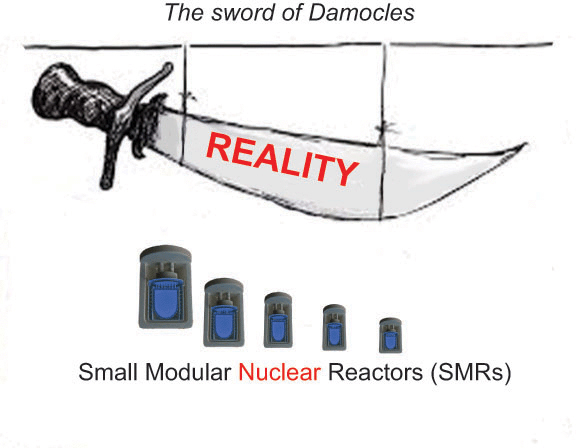
Statement by Dr. Edwin Lyman, Director of Nuclear Power Safety, Union of Concerned Scientists, Nov 9, 2023
https://www.ucsusa.org/about/news/small-nuclear-reactor-contract-fails-signaling-larger-issues-nuclear-energy-development
NuScale Power Cooperation, the first company in the United States to secure approval for the design of a small modular nuclear reactor (SMR), ended its contract with the Utah Associated Municipal Power Systems (UAMPS) on Wednesday. The companies cited rising costs as the reason for terminating the contract.
Throughout the development process, NuScale made several ill-advised design choices in an attempt to control the cost of its reactor, but which raised numerous safety concerns. The design lacked leak-tight containment structures and highly reliable backup safety systems. It also only had one control room for 12 reactor units despite the Nuclear Regulatory Commission (NRC) typically requiring no more than two units per control room.
Additionally, the company led efforts to sidestep critical safety regulations, including requirements for offsite emergency response plans to protect nearby communities. But NuScale’s justification for all this regulatory corner-cutting—that the design is “passively safe”—was undermined when concerns about its passive emergency core cooling system arose late in the design certification process.
The end of the project reflects the fragility of the advanced nuclear power industry in the U.S., which has been driven by an oversupply of reactor developers and a lack of genuine demand. As new reactor developers look for utilities and other end users to buy their products, the high cost and risks of their experimental, untested technologies are proving too onerous.
Below is a statement by Dr. Edwin Lyman, the director of nuclear power safety at the Union of Concerned Scientists (UCS).
“The termination of NuScale’s contract signals the broader challenges of developing nuclear energy in the United States. Placing excessive reliance on untested technologies without adequate consideration of economic viability, practicality, and safety concerns is irresponsible and clearly won’t work. The failure of this project underscores the need for decision makers to work diligently to ensure that the pursuit of nuclear energy aligns with the imperatives of public safety and financial feasibility.
“For all its problems, NuScale is one of the designs with the best prospects for commercialization because of its similarity to conventional light-water reactors, which allowed the company to learn from extensive operating experience and to leverage much of the existing nuclear power supply chain. Thus, the failure of the NuScale project with UAMPS does not bode well for the dozens of other, more exotic reactor types in various stages of development that are being touted as the next best thing in nuclear power, such as sodium-cooled fast reactors, gas-cooled reactors and molten-salt reactors. These reactors, which are based on much less mature designs and generally require fuels and materials that are not readily available, will be even riskier bets than NuScale for the foreseeable future. There are currently no other new nuclear power reactor designs under NRC licensing review.
“As private interests continue to turn their attention to emerging nuclear energy technology, lessons from this project should be held top of mind.” #nuclear #antinuclear #nuclearfree #NoNukes
Nuclear energy is not ‘clean’ or ‘green’ in the European Union’s taxonomy

In the end, however, the poor economics of nuclear technology raise doubts that any labeling of nuclear energy as “clean” or “green” will spur private sector investment. Today, despite the industry’s self-proclaimed nuclear renaissance, private investment in nuclear technologies is minimal, and nuclear proponents are pinning their hopes on massive public sector handouts.
BY SUSAN O’DONNELL, MADIS VASSAR | November 8, 2023 https://www.hilltimes.com/story/2023/11/08/nuclear-energy-is-not-clean-or-green-in-the-european-unions-taxonomy/402401/
As calls are increasing for Finance Minister Chrystia Freeland to release the government’s “transition taxonomy” of energy sources aligned with climate goals, misinformation is circulating about the role of nuclear energy in the European Union’s taxonomy.
The Canadian government is expected to identify technologies for priority private sector investment to help Canada meet its “net-zero” targets.
An Oct. 13 letter to MPs from the Canadian Nuclear Association, a nuclear lobby group, states that “The European Union (EU) formally voted to include nuclear energy in its EU taxonomy.” This statement is partially true, but misleading.
On May 16, at a meeting of the House Natural Resources Committee, Bloc Québécois MP Mario Simard asked if Canada was one of the only countries that considers nuclear to be clean energy. In response, Mollie Johnson, assistant deputy minister of Natural Resources, said “under the taxonomy of the European Union, they have classified it as clean energy as well.” This statement is incorrect.
The European Commission (EC) established its Technical Expert Group on Sustainable Finance to develop scientific guidelines for the taxonomy. The group was asked to develop recommendations for technical screening criteria for economic activities that can make a major contribution to climate change mitigation and adaptation, while at the same time avoiding significant harm to sustainable use and protection of water and marine resources, transition to a circular economy, address pollution prevention control, and protection and restoration of biodiversity and ecosystems.
After the report excluded nuclear because of the generated toxic radioactive waste, the lobby group convinced the EC to commission another report by the nuclear-friendly Joint Research Centre which concluded that nuclear was eligible. After weeks’ more lobbying, a slight majority of the European Parliament voted in favour of adding nuclear and fossil gas in the taxonomy only as “transitional technologies”—definitely neither as green, clean, nor sustainable. Also, the members of the European Parliament did not approve any public investments in nuclear energy.
The transitional technology classification requires a country seeking funding for nuclear energy to fulfill stringent safety criteria. This means having solid plans within five years, including financing, for an operational deep geological disposal for used fuel and high-level waste in 2050. This criteria will be a huge challenge for states other than Sweden, France and Finland. The Onkalo used nuclear fuel repository in Finland was built at a cost of 5-billion euros, and after some 40 years, is still not licenced. Most other countries do not have those funds available, meaning that potential nuclear power-plant operators would have to contribute to the costs, making nuclear even less competitive in the energy market.
A similar political power play lacking wider environmental considerations surrounds another recent document, the Net-Zero Industry Act. The aim is to promote investments in the production capacity of products key to meeting the EU’s climate neutrality goals, and, again, nuclear was initially not included. Once again, strong lobby efforts won the reintroduction of nuclear, first as a “non-strategic” technology due to its long build times and staggering costs—factors that push any tangible climate benefits far into the future, as opposed to “strategic” climate mitigation options such as solar panels, batteries, and heat pumps. In the latest text, however, any distinction between different technologies is gone. As the Greens in the European Parliament commented, the Act has lost the initial focus, and it’s now for just about any technology.
Given that nuclear energy is not considered “green” in the EU taxonomy, financial analysts have questioned its value as a global “gold standard” because investors might prefer to use other taxonomies that value their real green investments. Canada has the opportunity to learn from these blunders.
In the end, however, the poor economics of nuclear technology raise doubts that any labeling of nuclear energy as “clean” or “green” will spur private sector investment. Today, despite the industry’s self-proclaimed nuclear renaissance, private investment in nuclear technologies is minimal, and nuclear proponents are pinning their hopes on massive public sector handouts.
However, aside from the Canada Infrastructure Bank’s $970-million ‘low-interest loan’ for Ontario Power Generation to develop an American design for a small modular nuclear reactor, the public funds for new nuclear proponents from Innovation, Science and Economic Development Canada have been just under $100-million in the past three years. Those funds require matching private sector funding that has not materialized. This is a far cry from the billions of dollars required to develop just one small modular nuclear reactor, and where that money will come from is still an open question. #nuclear #antinuclear #nuclearfree #NoNukes
Susan O’Donnell, PhD, is lead investigator for the CEDAR project at St. Thomas University. Madis Vasser, PhD, is senior expert on SMRs for Friends of the Earth Estonia.
The First Small-Scale Nuclear Plant in the US Died Before It Could Live

“One of the stories they’ve kept telling people was that the SMR was going to be a lot cheaper than large-scale nuclear,” David Schlissel, an analyst at the nonprofit Institute for Energy Economics and Fiscal Analysis, told WIRED last month. “It isn’t true.”
Wired. 10 Nov 23
Six nuclear reactors just 9 feet across planned for Idaho were supposed to prove out the dream of cheap, small-scale nuclear energy. Now the project has been canceled.
The plan for the first small-scale US nuclear reactor was exciting, ambitious, and unusual from the get-go. In 2015, a group of city- and county-run utilities across the Mountain West region announced that they were betting on a new frontier of nuclear technology: a mini version of a conventional plant called a “small modular reactor” (SMR).
Advocates said the design, just 9 feet in diameter and 65 feet tall, was poised to resurrect the US nuclear industry, which has delivered only two completed reactors this century. It was supposed to prove out a dream that smaller, modular designs can make splitting atoms to boil water and push turbines with steam much cheaper. But first that reactor, the Voygr model designed by a startup called NuScale, had to be built. A six-reactor, 462-megawatt plant was slated to begin construction by 2026 and produce power by the end of the decade.
On Wednesday, NuScale and its backers pulled the plug on the multibillion-dollar Idaho Falls plant. They said they no longer believed the first-of-its-kind plant, known as the Carbon Free Power Project (CFPP) would be able to recruit enough additional customers to buy its power.
Many of the small utilities underwriting the pioneering project, members of a group called the Utah Associated Municipal Power Systems (UAMPS) saw the pint-sized nuclear plant as a potential solution to pressure to reduce their carbon emissions. The Department of Energy, which was due to host the plant at Idaho National Lab, awarded $1.4 billion to the project over 10 years.
But as WIRED reported in February, the utilities backing the plant were spooked late last year by a 50 percent increase in the projected costs for the project—even after factoring in substantial funds from the Inflation Reduction Act. The Idaho Falls reactors’ chances of survival began to look slimmer.
At the time, commitments in place to buy the reactor’s future power covered less than 25 percent of its output. UAMPS set itself a year-end deadline to bump that figure to 80 percent by recruiting new customers. Reaching that number was seen as key to ensuring the project’s long-term viability. As the project moved into site-specific planning and construction, its costs were poised to become more difficult to recoup if the plant ultimately failed, heightening the risks for the members.
Atomic Homecoming
As recently as last month, local officials returned to their communities from a UAMPS retreat with a reassuring message that the Idaho Falls project was on track to secure the new backers it needed, according to local meetings reviewed by WIRED.
That appeared to be good news in places like Los Alamos, New Mexico, where an official this spring described the project as a “homecoming” for atomic technology. The project was due to arrive just in time to help the county meet its goal of decarbonizing its electrical grid and adjusting to the retirement of aging fossil fuel plants nearby. At the time, locals expressed concern about where they would find clean and consistent power if the first-of-its-kind plant was to go away, given limited capacity to connect to new wind and solar projects in the region.
Now that the project is dead, SMR skeptics say the municipalities should find those cleaner power sources and focus on proven technologies. “One of the stories they’ve kept telling people was that the SMR was going to be a lot cheaper than large-scale nuclear,” David Schlissel, an analyst at the nonprofit Institute for Energy Economics and Fiscal Analysis, told WIRED last month. “It isn’t true.”
UAMPS spokesperson Jessica Stewart told WIRED that the utility group would expand its investments in a major wind farm project and pursue other contracts for geothermal, solar, battery, and natural gas projects………………………………………………………………………………………………….. more https://www.wired.com/story/first-small-scale-nuclear-plant-us-nuscale-canceled/
NuScale shares plunge as it cancels flagship small nuclear reactor project
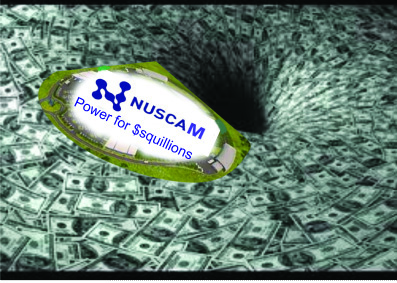
BY DAVID MEYER, November 10, 2023
Rafael Grossi, the head of the International Atomic Energy Agency, yesterday warned that nuclear energy has to be part of the energy shift away from fossil fuels. However, while the UN agency is increasing its forecasts for nuclear energy production, Grossi also said this was contingent on “a better investment playing field.”……………. (behind a paywall, of course) more https://fortune.com/2023/11/09/nuscale-shares-smr-small-modular-reactor-cfpp-utah-rolls-royce-microsoft/ #nuclear #antinuclear #nuclearfree #NoNukes
‘Buying influence’: top US nuclear board advisers are tied to arms business

“What we’ve consistently seen is the nuclear weapons industry buying influence and that means we cannot make serious decisions about our security when the industry is buying influence through thinktanks and commissioners that are skewing the debate,” said Susi Snyder, program coordinator at the International Campaign to Abolish Nuclear Weapons.
“Instead of having a debate about the tools and materials we need to make ourselves safe,” she added, “we’re having a debate about which company should get the contracts. And that doesn’t make the American people safe or anyone else in the world.”
None of the potential conflicts of interest between commissioners’ financial interests and the policy proposals laid out in their final report were disclosed by the CCSPUS itself within its final report or at any public event highlighting its findings.
Nine of 12 members of the commission charged with avoiding nuclear conflict have financial ties to defense contractors
Eli Clifton and Ben Freeman, 10 Nov 23 https://www.theguardian.com/world/2023/nov/10/us-congress-nuclear-weapon-committee-conflict-interest
Nine of the 12 members of a high-level congressional commission charged with advising on the US’s nuclear weapons strategy have direct financial ties to contractors that would benefit from the report’s recommendations or are employed at thinktanks that receive considerable funding from weapons manufacturers, the Guardian and Responsible Statecraft can reveal.
While the Congressional Commission on the Strategic Posture of the United States (CCSPUS) purports to recommend steps to avoid nuclear conflict, it does nothing to disclose its own potential conflicts of interest with the weapons industry in its final report or at rollout events at thinktanks in Washington.
The United States will soon face “a world where two nations [China and Russia] possess nuclear arsenals on par with our own”, warned the commission’s final report, released in mid-October. “In addition,” the report charged, “the risk of conflict with these two nuclear peers is increasing. It is an existential challenge for which the United States is ill-prepared.”
According to the CCSPUS, this potential doomsday scenario requires the US to make “necessary adjustments to the posture of US nuclear capabilities – in size and/or composition”, a policy shift that would steer billions of taxpayer dollars to the Pentagon and nuclear weapons contractors.
“What we’ve consistently seen is the nuclear weapons industry buying influence and that means we cannot make serious decisions about our security when the industry is buying influence through thinktanks and commissioners that are skewing the debate,” said Susi Snyder, program coordinator at the International Campaign to Abolish Nuclear Weapons.
The CCSPUS was established two years ago via the annual defense policy bill, and conflicts of interest on the commission were apparent from the beginning. But an analysis by the Guardian and Responsible Statecraft found deep ties between the commission and the weapons industry.
The most recognizable member of the CCSPUS is its vice-chair, Jon Kyl, who served as a senator from Arizona from 1995 to 2013, and again in 2018 after the death of John McCain. While this is included in his biography in the commission’s report, what’s left out is his more recent employment as a senior adviser with the law firm Covington & Burling, whose lobbying client list includes multiple Pentagon contractors that would benefit from the commission’s recommendations.
In 2017 Kyl, personally, was registered to lobby for Northrop Grumman, which manufactures the B-21 nuclear bomber that the commission recommends the US should purchase in greater numbers, at a cost to taxpayers of nearly $700m each.
Kyl did not respond to questions about his employment status with Covington & Burling, but the former senator was listed as a “senior adviser” on the firm’s website until at least 1 December 2022, nearly 10 months after the commissioner selections for the CCSPUS were announced in March 2022.
Another commissioner, Franklin Miller, is a principal at the Scowcroft Group, a business advisory firm that describes Miller as having expertise in “nuclear deterrence”, and acknowledges its work in the weapons sector.
“The Scowcroft Group successfully advised a European defense leader on a strategic acquisition opportunity,” says the consulting firm in the “Defense/Aerospace” section of its website. “We have also assisted a major defense firm in pursuing global partnerships and co-production opportunities.”
Miller did not respond to a request for comment about the identity of the Scowcroft Group’s clients.
Kyl and Miller are joined on the CCSPUS by retired general John E Hyten, who previously served as the vice-chairman of the joint chiefs of staff, the second-highest-ranking member of the US military.
While Hyten’s biography in the commission’s report lauds his extensive military service, in retirement he has worked closely with a number of firms that could benefit immensely from the commission’s recommendations.
This March he was appointed as special adviser to the CEO of C3 AI, an artificial intelligence company that boasts of working with numerous agencies at the Department of Defense. In June 2022, Hyten was named executive director of the Blue Origins foundation, called the Club for the Future, and as a strategic adviser to Blue Origin’s senior leadership. Blue Origin is wholly owned by the Amazon founder Jeff Bezos, and works directly with the National Aeronautics and Space Administration (Nasa), the air force and the space force on space launch-related capabilities.
Hyten’s ties to these firms are notable given the CCSPUS report’s repeated overtures for improving and investing in space and artificial intelligence capabilities. Specifically, the report recommends the United States “urgently deploy a more resilient space architecture” and take steps to ensure it is “at the cutting edge of emerging technologies – such as big data analytics, quantum computing, and artificial intelligence (AI)”.
Hyten did not respond to a request for comment.
The CCSPUS also included thinktank scholars whose employers receive significant funding from the arms industry. Two commission members work at the Hudson Institute, which, according to its most recent annual report, received in excess of $500,000 from Pentagon contractors in 2022. This includes six-figure donations from some of the Pentagon’s top contractors, including Lockheed Martin, Northrop Grumman and BAE Systems.
On Monday, 23 October, the Hudson Institute held an event to highlight the CCSPUS’s report that included the two Hudson Institute employees who also served as commissioners. The event unabashedly promoted recommendations from the report that would be a financial windfall for Hudson’s funders. The landing page for the event features a photo of a B-21 stealth bomber, the same photo used in the commission report that also recommended that the US strategic nuclear posture be modified to “increase the planned number of B-21 bombers and tankers an expanded force would require”.
Neither at the event nor in the report is it noted that the plane’s manufacturer, Northrop Grumman, is in the Hudson Institute’s highest donor tier, contributing in excess of $100,000 in 2022.
The Hudson Institute staff who served as commissioners did not respond to requests for comment.
Another commissioner, Matthew Kroenig, is a vice-president at the Atlantic Council, a prominent DC thinktank which, according to the organization’s most recent annual report, is funded by several top Pentagon contractors, including Lockheed Martin, Northrop Grumman, Raytheon (now RTX), General Atomics, Saab and GM Defense. The Atlantic Council also receives more than $1m a year directly from the Department of Defense and between $250,000 and $499,999 from the Department of Energy, which helps manage the nation’s nuclear arsenal.
These seeming conflicts of interest were not mentioned at any point in the CCSPUS’s report or at an Atlantic Council event promoting the report and featuring the same photo of the B-21 used by the Hudson Institute and the commission.
Kroenig did not respond to a request for comment.
Even commissioners whose careers had included positions that were notably critical of nuclear weapons had recently established ties with firms that profit from the nuclear and conventional weapons industry.
Commissioner Lisa Gordon-Hagerty worked for years at the pinnacle of nuclear weapons policy in the US, including positions on the national security council, the US House of Representatives and the Department of Energy. She was also the director of the Federation of American Scientists, a non-profit organization known for advocating for reductions in nuclear weapons globally. Her last government position before joining the commission was serving as the head of the National Nuclear Security Administration (NNSA), which is responsible for military applications of nuclear science. She resigned from the post in 2020, allegedly after heated disagreements with the secretary of energy, who tried to cut NNSA funding.
While much of her career is mentioned in the commission report, what’s left out is that Gordon-Hagerty has also been cashing in on her nuclear expertise. After leaving the NNSA, in 2021 she joined the board and became director of strategic programs at Westinghouse Government Services, a nuclear weapons contractor that has been paid hundreds of millions of dollars for work with the Department of Defense and Department of Energy.
Gordon-Hagerty did not respond to a request for comment.
Like Gordon-Hagerty, fellow commissioner Leonor Tomero had a distinguished career at the highest levels of nuclear weapons policy. According to her bio in the commission report, she was the deputy assistant secretary of defense for nuclear and missile defense policy and served for over a decade on the House armed services committee as counsel and strategic forces subcommittee staff lead, where her portfolio included the establishment of the US space force, nuclear weapons, nuclear nonproliferation, nuclear cleanup, arms control and missile defense.
Outside government, Tomero was director of nuclear non-proliferation at the Center for Arms Control and Non-Proliferation, an organization that has repeatedly called for reductions in the US nuclear weapons arsenal. Tomero is also on the board of the Council for a Livable World, which explicitly states that its goal is to eliminate nuclear weapons.
Yet, in September, Tomero became a vice-president of government relations at JA Green & Company, a lobbying firm whose client list includes a host of military contractors that could see revenues soar if the CCSPUS’s recommendations are adopted. SpaceX, for example – which pays $50,000 every three months to JA Green for lobbying related to “issues related to national security space launch” – would probably benefit mightily from the commission recommendation that “the United States urgently deploy a more resilient space architecture and adopt a strategy that includes both offensive and defensive elements to ensure US access to and operations in space”.
“No clients of JA Green & Company sought to influence the work of the Commission or the Commission’s recommendations in any way,” said Jeffrey A Green, president of JA Green, in an email. “We follow all applicable ethics rules and there are no conflicts of interest.”
None of the potential conflicts of interest between commissioners’ financial interests and the policy proposals laid out in their final report were disclosed by the CCSPUS itself within its final report or at any public event highlighting its findings.
While many commissioners did not respond to requests for comment, the commission’s executive director, William A Chambers, provided a statement on behalf of the CCSPUS and its members.
“Members of [the commission] were chosen and appointed by Members of Congress based on their national recognition and significant depth of experience in such professions as governmental service, law enforcement, the Armed Forces, law, public administration, intelligence gathering, commerce, or foreign affairs,” wrote Chambers. “Before they began performing their role as Commissioners, they were instructed on the ethics rules that govern congressional entities and were required to comply with rules set forth by the Select Committee on Ethics of the Senate and the Committee on Ethics of the House of Representatives.”
Chambers did not respond to a request for a copy of the ethics rules.
But the opacity about potential conflicts of interest leaves some experts questioning the CCSPUS’s recommendations.
“There’s a huge argument raging over what is security, how much does it rely on transparency and, especially when it comes to nuclear weapons, there is a call for greater transparency,” said Snyder of the International Campaign to Abolish Nuclear Weapons. “That light they’re asking to shine on China, North Korea and Iran is a light they also need to shine on their own decision-making.”
Co-published with Responsible Statecraft
Failed U.S. Nuclear Project Raises Cost Concerns for Canadian Small Modular Reactor (SMR) Development
“Once you’re on a dead horse, you dismount quickly. That’s where we are here.”
“the massively expensive SMR projects in Canada will eventually face the same reckoning”
Primary Author: Mitchell Beer, The Energy Mix, November 10, 2023 more https://www.theenergymix.com/2023/11/10/failed-u-s-nuclear-project-raises-cost-concerns-for-canadian-smr-development/
NuScale and its customer, Utah Associated Municipal Power Systems (UAMPS), announced they were cancelling the project earlier this week, after its anticipated cost increased 53% over earlier estimates, Bloomberg reports. “The decision to terminate the project underscores the hurdles the industry faces to place the first so-called small modular reactor into commercial service in the country.”
But a clear-eyed assessment of the project’s potential was really made possible by a level of accountability that doesn’t exist in Canada, said Gordon Edwards, president of the Canadian Coalition for Nuclear Responsibility.
“Private investors in Utah forced NuScale to divulge financial information regarding the cost of electricity from its proposed nuclear plant,” and “cost became the deal-breaker,” Edwards told The Energy Mix in an email. “Publicly-owned utilities in Canada are not similarly accountable. The public has little opportunity to ‘hold their feet to the fire’ and determine just how much electricity is going to cost, coming from these first-of-a-kind new nuclear reactors.”
In the U.S., the business case started to fall apart last November, when NuScale blamed higher steel costs and rising interest rates for driving the cost of the project up from US$58 to $90 or $100 per megawatt-hour of electricity. The new cost projection factored in billions of dollars in tax credits the project would receive under the Biden administration’s Inflation Reduction Act, amounting to a 30% saving.
At the time, the Institute for Energy Economics and Financial Analysis (IEEFA) estimated the total subsidy at $1.4 billion. This week, Bloomberg said NuScale had received $232 million of that total so far.
The cost increase meant that UAMPS “will not hit certain engineering, procurement, and construction benchmarks, allowing participants to renegotiate the price they pay or abandon the project,” Utility Dive wrote.
Scott Hughes, power manager for Hurricane City Power, one of the 27 municipal utilities that had signed on to buy power from the six NuScale reactors, said the news was “like a punch in the gut when they told us.” Another municipal utility official called the increase a “big red flag in our face.”
Nearly a year later, NuScale had to acknowledge that UAMPS would not be able to sell 80% of the output from the 462-MW project to its own members or other municipal utilities in the western U.S., Bloomberg writes. “The customer made it clear we needed to reach 80%, and that was just not achievable,” NuScale CEO John Hopkins said on a conference call Wednesday. “Once you’re on a dead horse, you dismount quickly. That’s where we are here.”
In Canada, “the massively expensive SMR projects in Canada will eventually face the same reckoning” predicted Susan O’Donnell, an adjunct research professor at St. Thomas University and member of the Coalition for Responsible Energy Development in New Brunswick. While the Canadian Energy Regulator’s modelling assumes SMRs could be built at a cost of C$9,262 per kilowatt in 2020, falling to $8,348 per kilowatt by 2030 and $6,519 by 2050, the latest cost estimate from NuScale exceeded $26,000 per kilowatt in Canadian dollars, O’Donnell said—and the technology had been in development since 2007.
“Too bad our leaders have chosen to pursue an energy strategy which is too expensive, too slow, and too costly in comparison with the alternatives of energy efficiency and renewables—the fastest, cheapest, and least speculative strategies,” Edwards wrote. He added that waste disposal and management challenges and costs for SMRs will be very different from what Canadian regulators have had to confront with conventional Candu nuclear reactors.
The news from NuScale landed just days after civil society groups in the European Union warned that SMR development won’t help the continent reach its climate goals. Citing prolonged project delays and cost overruns, the long time frame to develop unproven technologies, and the risks associated with radioactive waste disposal and proliferation of nuclear materials, they urged EU governments to focus on renewable energy, power grid development, and energy storage.
“Nuclear energy is being pushed by powerful lobbies and geostrategic interests,” with several EU states relying on Russian state nuclear company Rosatom for their uranium supplies, the groups said. “To quickly decarbonize, we must choose cheap technologies, easy to deploy at scale, like solar panels and windmills.”
But in the U.S., proponents are still holding out hope for future SMR development. “We absolutely need advanced nuclear energy technology to meet ambitious clean energy goals,” the U.S. Department of Energy said in a statement. “First-of-a-kind deployments, such as CFPP, can be difficult.”
1 This Month
26 April – Chernobyl: Inside the Meltdown airs on National Geographic on Sunday 26th April from 4pm


29 April – Nuclear Expert Webinar #1 – Radiation Impacts on Families with Mary Olson and Cindy Folkers
- 12:15 PM MT – 1:45 PM MT
- Location: Virtual – REGISTER TODAY

4 May -West Suburban Peace Coalition to discuss Iran war at May Educational Forum
Monday, May 4, 7:00 – 8:00 PM Central Standard Time
Title: : How Trump’s Narrative Tries to Shape the Reality of the War on Iran.
Contact Walt Zlotow, zlotow@hotmail.com 630 442 3045 for further information
14 May – online event From Bombs to Data Centres: the Face of Nuclear Colonialism

Pine Ridge Uranium is the real threat, not Tehran- Tell Burgum: Stop the Extraction.
Chernobyl: The Lost Tapes – A good documentary on Chernobyl on SBS available On Demand for the next 3 weeks– https://www.sbs.com.au/ondemand/tv-program/chernobyl-the-lost-tapes/2352741955560
To see nuclear-related stories in greater depth and intensity – go to https://nuclearinformation.wordpress.com
-
Archives
- April 2026 (288)
- March 2026 (251)
- February 2026 (268)
- January 2026 (308)
- December 2025 (358)
- November 2025 (359)
- October 2025 (376)
- September 2025 (257)
- August 2025 (319)
- July 2025 (230)
- June 2025 (348)
- May 2025 (261)
-
Categories
- 1
- 1 NUCLEAR ISSUES
- business and costs
- climate change
- culture and arts
- ENERGY
- environment
- health
- history
- indigenous issues
- Legal
- marketing of nuclear
- media
- opposition to nuclear
- PERSONAL STORIES
- politics
- politics international
- Religion and ethics
- safety
- secrets,lies and civil liberties
- spinbuster
- technology
- Uranium
- wastes
- weapons and war
- Women
- 2 WORLD
- ACTION
- AFRICA
- Atrocities
- AUSTRALIA
- Christina's notes
- Christina's themes
- culture and arts
- Events
- Fuk 2022
- Fuk 2023
- Fukushima 2017
- Fukushima 2018
- fukushima 2019
- Fukushima 2020
- Fukushima 2021
- general
- global warming
- Humour (God we need it)
- Nuclear
- RARE EARTHS
- Reference
- resources – print
- Resources -audiovicual
- Weekly Newsletter
- World
- World Nuclear
- YouTube
-
RSS
Entries RSS
Comments RSS
 nuclear-news