The Members of This Reservation Learned They Live with Nuclear Weapons. Can Their Reality Ever Be the Same?
The Mandan, Hidatsa and Arikara peoples are learning more about the missiles siloed on their lands, and that knowledge has put the preservation of their culture and heritage in even starker relief.
Scientific American. By Ella Weber on November 24, 2023
“………………Ella Weber: I met Jayli Fimbres at the recently opened MHA Nation Interpretive Center in New Town, North Dakota, the most populous town on the Fort Berthold reservation. While she says she doesn’t know much about nuclear weapons, she’s been dreaming about nuclear war.
Fimbres: I think I’ve, even within those dreams, I had dreams of surviving those things as well. But there was, like, radioactive damage and stuff. And we were, like, mutating, but we, like, learned to get through it.
Weber: You are listening to Scientific American’s podcast series, The Missiles on Our Rez. I’m Ella Weber, a member of the Mandan, Hidatsa and Arikara Nation, a Princeton student, and a journalist. This is Episode 5: “What Happens Now?”
Weber: This is the last episode of our series. Throughout the first four episodes, we learned about how nuclear missiles arrived on our reservation. We also learned how the Air Force failed to appropriately describe the human and environmental consequences associated with its plans to modernize existing nuclear missile silos.
Those plans included placing new missiles on our land for the next 60 years.
We discussed the risks associated with living with these weapons for the tribe — and what it really meant for our members—including my family—to live in a national nuclear sacrifice zone.
In this final episode, I’m returning to my tribe, the MHA Nation, to share what I found.
Weber: I met with my grandma, Debra Malnourie, to find out when she first learned about the missile silos. She grew up on the reservation and currently resides there.
Debra Malnourie: Then, like I said, I was driving around, and I was like, “What are these places?” And then I don’t even remember who told me that they were missile sites, that missiles [are] down in there, and I was like, “How do you know?” And I knew nothing about it. It wasn’t even in my radar, actually. Probably still isn’t right now.
Weber: Debra didn’t know much about this.
Malnourie: But I always thought if there was a big war, we’d all end up going. And truthfully, I would not want to be one of the ones that didn’t go. Because what [are] you going to do? I don’t know.
Debra Malnourie: Then, like I said, I was driving around, and I was like, “What are these places?” And then I don’t even remember who told me that they were missile sites, that missiles [are] down in there, and I was like, “How do you know?” And I knew nothing about it. It wasn’t even in my radar, actually. Probably still isn’t right now.
Weber: Debra didn’t know much about this.
Malnourie: But I always thought if there was a big war, we’d all end up going. And truthfully, I would not want to be one of the ones that didn’t go. Because what [are] you going to do? I don’t know………………………………………………………………………………………………………………………………………………………….
Weber: As we mentioned in the last episode, Edmund would later find out from our Nuclear Princeton research team, and Princeton researcher Sébastien Philippe, that the entire 3,000-page environmental impact statement, or EIS package–first published in June 2022 in draft form–didn’t actually go into a great amount of detail about the ramifications of potential nuclear strikes on the silos and the surrounding community.
……………………….
As I mentioned in Episode 2, the Garrison Dam, constructed in 1947 by the Army Corps of Engineers, was built adjacent to our land — and against our will. There’s a famous picture of chairman George Gillette crying as he signed the agreement in 1948.
When the dam flooded in 1953, countless tribal families were displaced, and our homes were destroyed. It separated our remaining reservation into five areas—another assault on our language and culture.
It turns out there’s actually a link between the historical destruction of our community by the U.S. government and the loss of our language. People such as Jayli Fimbres—who you first heard in the beginning of this episode—are trying to bring our language back………………………………
As I mentioned in Episode 2, the Garrison Dam, constructed in 1947 by the Army Corps of Engineers, was built adjacent to our land — and against our will. There’s a famous picture of chairman George Gillette crying as he signed the agreement in 1948.
When the dam flooded in 1953, countless tribal families were displaced, and our homes were destroyed. It separated our remaining reservation into five areas—another assault on our language and culture.
It turns out there’s actually a link between the historical destruction of our community by the U.S. government and the loss of our language. People such as Jayli Fimbres—who you first heard in the beginning of this episode—are trying to bring our language back…………………………………………………….
Despite the negative effects associated with the nuclear modernization program that the Air Force listed in the environmental impact statement, I found that the impacts are much farther reaching than what is described in the scope of the document.
Baker: What’s the purpose of a nuclear warhead? Depends on who you talk to. “They defend freedom.” No, they’re meant to kill. They’re meant to destroy. That was never in part of our land, intentional land spirit.
Weber: That’s Edmund Baker who says that not only do warheads go against our land spirit—but they also go against the core concepts in our Hidatsa language……………………………………………………………………………..
Weber: Throughout this project, I came to understand how the story of the U.S. government’s land theft and attempts at destroying our culture are directly related to the history of how the missile silos got here. And our community has been fighting to survive for as long as we’ve been around. This is just another test………………………………………………..
Moniz: So, in closing, should something go wrong, should something happen with all these warheads that are on our tribal nation, our children, our future generations, what we’re working to reclaim and reconnect and revitalize will all—could be diminished. It could be diminished.
Thinking about that and thinking about what could go wrong–what could happen–really puts things into perspective, and in closing I would urge…not encourage, but welcome more folks to the work. And let’s keep going and let’s get this out there. People need to know what’s happening. Our people need to know what’s happening.
Baker: For the future, to keep our people, our land, intact, what’s left of it–our unity…to try to give some space to work on our values, and re-remember who we are… it would make it this much easier if you just get these silos out of here. You know, you’d help that way, if you really care about us, federal government……………………………………………………………………………………………..
Weber: Will things continue as they are but with people now being aware of what the missile silos mean for us?
Could the silos be removed from the reservation?
Could communities in North Dakota, Native and not, work together towards a different future—with no missiles in the state?
I don’t know. What makes me hopeful, though, is the new generation of people willing to continue the fight for our tribe, our land, our rights, our culture, and our futures…………………………………………………… more https://www.scientificamerican.com/podcast/episode/the-members-of-this-reservation-learned-they-live-with-nuclear-weapons-can-their-reality-ever-be-the-same/
US providing Israel with satellite data of aid facilities in Gaza, which Tel Aviv later bombs
SOTT, Erin Banco, Politico, Wed, 22 Nov 2023
The Biden administration has been providing Israel with the location of humanitarian groups in Gaza for weeks to prevent strikes against their facilities. But Israel has continued to hit such sites.
The information included GPS coordinates of a number of medical facilities and information on movements of aid groups in Gaza to the Israeli government for at least a month, according to three people familiar with the communications. All were granted anonymity because they feared speaking publicly would make it more difficult for aid groups to operate in Gaza.
Still, Israel has launched operations against Hamas in or near aid sites, including hospitals, leading to the destruction of buildings and the blocking of fuel and other critical supplies.
………………………………… State Dept.: Hostage deal would ‘unlock’ potential for more Gaza aid
In public statements, U.S. officials have stressed that aid groups are struggling to operate in the Gaza Strip because of Hamas, noting the militant group uses civilians as human shields and operates tunnels underneath hospitals.
But Israel’s continued bombardment of these humanitarian facilities raises more questions about whether Washington has the political sway many in the administration want with Israel. And the divide is particularly stark given that the goal is protecting aid workers — one of the most fundamental tenets of international humanitarian law…………………………………………………………………………………………………. more https://www.sott.net/article/486230-US-providing-Israel-with-satellite-data-of-aid-facilities-in-Gaza-which-Tel-Aviv-later-bombs
What Would It Mean to ‘Absorb’ a Nuclear Attack?- nuclear missile silos as a “sponge”

Scientific American , By Ella Weber on November 22, 2023
The missiles on the Fort Berthold Reservation in North Dakota make it a potential target for a nuclear attack. And that doesn’t come close to describing what the reality would be for those on the ground.
This podcast is Part 4 of a five-part series. Listen to Part 1 here, Part 2 here, and Part 3 here. The podcast series is a part of “The New Nuclear Age,” a special report on a $1.5-trillion effort to remake the American nuclear arsenal.…..
Ella Weber: Members of my tribe live with nuclear missiles on the Fort Berthold Reservation. The weapons sit in underground concrete silos that are surrounded by antennas in small, fenced-off areas. The missiles are armed and ready to launch in 60 seconds. This is one reason they are called Minutemen missiles…………………………….
Weber: After learning that the Air Force had not explained to my tribe what the new nuclear missiles were for–which the Air Force intended to deploy for another 60 years on our reservation–I decided to dig deeper.
I wanted to know what role the missiles and their silos play today in U.S. nuclear strategy and what the risks for the tribe were in hosting them—something that the tribe never agreed to in the first place………………….
I wasn’t really clear on what Secretary Jim Mattis meant by the ICBM force providing a “cost-imposing strategy,” so I talked to Leonor Tomero to get some clarity. She used to serve as deputy assistant secretary of defense for nuclear and missile defense policy in the Biden administration in 2021…………
Weber: Leonor explained to me that should the U.S. face a potential nuclear attack, the president would have two choices with regards to the ICBMs: launch them preventively before the missiles possibly got destroyed, or decide to absorb the attack and retaliate later.
Weber (tape): What do you mean by absorbing an attack?
Tomero: I think, you know, it’s, you know, they’re considered a sponge.
Weber (tape): So it’s kind of like making these ICBMs, like, a target ….
Tomero: Yes…
Weber (tape): …. rather than, like, these other major cities or other places…
Tomero: Right.
Weber: In case you don’t know — the role of the ICBM is to force an adversary to use many nuclear weapons if they decided to attack the U.S. The silos are basically meant to divert and absorb the incoming nuclear missiles from important and critical areas in the country, like cities.
But what would that mean for the Fort Berthold reservation?……………………………………………………………………
Frank Von Hippel: Basically the secretary of defense had come in and testified to Congress. When one of the senators asked how many people would such an attack kill, he estimated 15,000 to 25,000. And he said, ‘Well, that would be terrible, but it would be not what you would expect from a major nuclear attack.’
That seemed low to, actually, the senator from New Jersey [Clifford Case]. And he asked for a peer review of the Defense Department calculations, and, and I was then asked to be an unpaid consultant to look into that. And, in fact, I went over to the Pentagon to talk to the people who have done the calculations.
Weber: Frank found something unexpectedly horrifying.
Von Hippel: The Defense Department had assumed that explosions of the warheads over the ICBM silos would be so high that they would not cause fallout. They pointed out they would also not damage the silos.
Weber: Basically, the Department of Defense hadn’t calculated properly. The DOD had made incorrect assumptions about the altitude of nuclear explosions aimed at destroying the silos. Initially, it had thought the nuclear explosions would need to be at an altitude. But–they actually needed to be at ground level.
Von Hippel: The DoD was forced to go back and do new calculations reflecting these points, and they came out about 1,000 times higher: 20 million—on the order of 20 million people killed.
Weber (tape): Wow.
…………………………………. Von Hippel: Well, you know, the, I don’t know who coined this term about the silos being a nuclear sponge, but the local….I think there would be annihilation of the local population around the silos. Wouldn’t just be the fallout—would also be the, the blast effects, and so on. So they would be the worst affected.
Weber (tape): My grandma only lives two and a half miles away from an ICBM silo. What would happen to her and her place?
Von Hippel: I think she would be within the blast radius … and the fire radius…. I don’t know how flammable… her house would be presumably burned after being knocked flat. And then there would be the fallout. These explosions would have to be low enough to hit the set of silos with sufficient overpressure to destroy the missiles inside. It would have to be low enough for, for the dirt to be and debris to be sucked up into the cloud. And then that would bring down some of the radioactivity in a very intense patch around the silo. So … multiple ways in which she might die. I’m sorry.
Weber (tape): I mean, she didn’t make the decision to have them there. So …
Von Hippel: Yeah, I know
Weber: Being treated as expendable isn’t new to Indigenous communities. As far as I could tell, members of the Mandan, Hidatsa and Arikara Nation don’t see themselves as living in a sacrifice zone.
This designation treats certain areas and people as acceptable losses; they bear the brunt of the risks and consequences associated with nuclear weapons and decisions made by others. Maybe if members of the tribe had a better understanding of what the risks were, they could challenge the deployment of these silos on our land…………………………….
Sébastien Philippe: Now I’m going to put the whole image of the entire areas that can be impacted by the fallout, and I can walk you through the color coding, but that’s basically the worst case possible for every single person on the map.
Edmund Baker: Okay. Holy crap. Even Disneyland’s not immune. Disney World’s out. New York—there’s no safe place.
So that batch there, North Dakota, the white sort of color…?
Philippe: Yeah.
Baker: That’s 100 percent fatality in that zone?
Philippe: Times 10. Yeah, ten times what you would need to die—and that’s just from the radioactivity.
Baker: Okay, so that’s not in the EIS, I figure, or is it?
Philippe: Uh, no.
Weber: By the way, Edmund’s talking about an environmental impact statement, or EIS—a two-volume report released by the U.S. Air Force that is meant to analyze, “the potential effects on the human and natural environments from the deployment of the Sentinel intercontinental ballistic missile system.”
This was the report that the Air Force had presented to my reservation—in a different place than it had initially advertised. And in the entire 3,000 pages of the report and its appendices— which cost $33 million to write, by the way — Sébastien had found that the consequences of a nuclear war that could impact my tribe were kind of glossed over.
The EIS mentioned the “casualties” and “grave implications” of such a war but they didn’t really go beyond that.
Here’s Frank again, speaking about the military’s attitudes toward the consequences of war in general.
Von Hippel: They talk about people like your grandmother as being collateral damage. I mean…, they try to desensitize themselves to what the consequences are, what they’re talking about—and, in fact, I remember when I first went over to the Pentagon to talk to people, I learned—the first time I heard this word called “collateral damage,” that is—“We, you know, we didn’t intend to kill your grandmother…. She’s, unfortunately, collateral damage.”…………………………………………………………………………………………………………………………………………….
Weber: If anyone could advise the U.S. on resilience and survivability, it would be us: the MHA Nation. And I have a feeling that keeping ICBM silos operating across our land may not be part of our preferred strategy.
In the next and final episode, I go back to the rez and report what I found to my family and members of the tribe. We sit down and discuss: What happens now?
This show was reported by me, Ella Weber, produced by Sébastien Philippe and Tulika Bose. Script editing by Tulika Bose. Post-production design and mixing by Jeff DelViscio. Thanks to special advisor Ryo Morimoto and Jessica Lambert. Music by Epidemic Sound.
I’m Ella Weber, and this was The Missiles on Our Rez, a special podcast collaboration from Scientific American, Princeton University’s Program on Science and Global Security, Nuclear Princeton, and Columbia Journalism School. https://www.scientificamerican.com/podcast/episode/what-would-it-mean-to-absorb-a-nuclear-attack/
Failed U.S. Nuclear Project Raises Cost Concerns for Canadian SMR Development

The Energy Mix November 10, 2023, Primary Author: Mitchell Beer
The abrupt failure of the leading small modular nuclear reactor (SMR) project in the United States is shining a light on public subsidies that might keep similar technology under development in Canada, even if it’s prone to the same cost overruns that scuttled NuScale Power Corporation’s Carbon Free Power Project (CFPP) in Utah.
NuScale and its customer, Utah Associated Municipal Power Systems (UAMPS), announced they were cancelling the project earlier this week, after its anticipated cost increased 53% over earlier estimates, Bloomberg reports. “The decision to terminate the project underscores the hurdles the industry faces to place the first so-called small modular reactor into commercial service in the country.”
But a clear-eyed assessment of the project’s potential was really made possible by a level of accountability that doesn’t exist in Canada, said Gordon Edwards, president of the Canadian Coalition for Nuclear Responsibility.
“Private investors in Utah forced NuScale to divulge financial information regarding the cost of electricity from its proposed nuclear plant,” and “cost became the deal-breaker,” Edwards told The Energy Mix in an email. “Publicly-owned utilities in Canada are not similarly accountable. The public has little opportunity to ‘hold their feet to the fire’ and determine just how much electricity is going to cost, coming from these first-of-a-kind new nuclear reactors.”
In the U.S., the business case started to fall apart last November, when NuScale blamed higher steel costs and rising interest rates for driving the cost of the project up from US$58 to $90 or $100 per megawatt-hour of electricity. The new cost projection factored in billions of dollars in tax credits the project would receive under the Biden administration’s Inflation Reduction Act, amounting to a 30% saving.
At the time, the Institute for Energy Economics and Financial Analysis (IEEFA) estimated the total subsidy at $1.4 billion. This week, Bloomberg said NuScale had received $232 million of that total so far.
The cost increase meant that UAMPS “will not hit certain engineering, procurement, and construction benchmarks, allowing participants to renegotiate the price they pay or abandon the project,” Utility Dive wrote……………………………….
In Canada, “the massively expensive SMR projects in Canada will eventually face the same reckoning,” predicted Susan O’Donnell, an adjunct research professor at St. Thomas University and member of the Coalition for Responsible Energy Development in New Brunswick. While the Canadian Energy Regulator’s modelling assumes SMRs could be built at a cost of C$9,262 per kilowatt in 2020, falling to $8,348 per kilowatt by 2030 and $6,519 by 2050, the latest cost estimate from NuScale exceeded $26,000 per kilowatt in Canadian dollars, O’Donnell said—and the technology had been in development since 2007.
“Too bad our leaders have chosen to pursue an energy strategy which is too expensive, too slow, and too costly in comparison with the alternatives of energy efficiency and renewables—the fastest, cheapest, and least speculative strategies,” Edwards wrote. He added that waste disposal and management challenges and costs for SMRs will be very different from what Canadian regulators have had to confront with conventional Candu nuclear reactors.
The news from NuScale landed just days after civil society groups in the European Union warned that SMR development won’t help the continent reach its climate goals. Citing prolonged project delays and cost overruns, the long time frame to develop unproven technologies, and the risks associated with radioactive waste disposal and proliferation of nuclear materials, they urged EU governments to focus on renewable energy, power grid development, and energy storage.
“Nuclear energy is being pushed by powerful lobbies and geostrategic interests,” with several EU states relying on Russian state nuclear company Rosatom for their uranium supplies, the groups said. “To quickly decarbonize, we must choose cheap technologies, easy to deploy at scale, like solar panels and windmills.”………….https://www.theenergymix.com/2023/11/10/failed-u-s-nuclear-project-raises-cost-concerns-for-canadian-smr-development/
Lawsuit Against Alleged CIA Spying on Assange Visitors: A Rare Court Hearing
A federal judge pushed back when a government attorney refused to confirm or deny whether the CIA had engaged in warrantless surveillance.
SCHEERPOST, By Kevin Gosztola / The Dissenter, November 21, 2023
A United States court held an extraordinary hearing on November 16, where a judge carefully considered a lawsuit against the CIA and former CIA director Mike Pompeo for their alleged role in spying on American attorneys and journalists who visited WikiLeaks founder Julian Assange.
Judge John Koeltl of the Southern District of New York pushed back when Assistant U.S. Attorney Jean-David Barnea refused to confirm or deny that the CIA had targeted Americans without obtaining a warrant. He also invited attorneys for the Americans to update the lawsuit so that claims of privacy violations explicitly dealt with the government’s lack of a warrant.
In August 2022, four Americans sued the CIA and Pompeo: Margaret Ratner Kunstler, a civil rights activist and human rights attorney; Deborah Hrbek, a media lawyer who represented Assange or WikiLeaks; journalist John Goetz, who worked for Der Spiegel when the German media organization first partnered with WikiLeaks; and journalist Charles Glass, who wrote articles on Assange for The Intercept.
The lawsuit alleged that as visitors Glass, Goetz, Hrbek, and Kunstler were required to “surrender” their electronic devices to employees of a Spanish company called UC Global, which was contracted to provide security for the Ecuador embassy.
UC Global and the company’s director David Morales “copied the information stored on the devices” and shared the information with the CIA. The agency even had access to live video and audio feeds from cameras in the embassy………………………………………………………………………………………………
Though the court was open to reviewing arguments against the CIA, Koeltl seemed highly skeptical that the claim against Pompeo in his individual capacity would survive against the government.
In 1971, a U.S. Supreme Court case known as Bivens created a process for bringing cases against federal government officials for violating a person’s constitutional rights. Pompeo was sued under that doctrine. However, courts have been extremely reluctant to allow plaintiffs to pursue damages when a case may set a precedent or lead to a court intruding upon national security and foreign policy matters…………………………………………………………….
The CIA knew from their passports whether they were American citizens or not, and the agency still went ahead with targeted surveillance against them. https://scheerpost.com/2023/11/21/lawsuit-against-alleged-cia-spying-on-assange-visitors-a-rare-court-hearing/
Small nuclear reactors are NOT emissions-free

No emissions claim mars SaskPower webinar on nuclear power
A reader comments that a presentation by SaskPower on small modular nuclear reactors failed to include information about nuclear emissions.
Nov 18, 2023 , Dale Dewar, Wynyard https://thestarphoenix.com/opinion/letters/letter-no-emissions-claim-mars-saskpower-webinar-on-nuclear-power
SaskPower held a webinar on its proposal for a Hitachi Boiling Water Reactor (BWRX300), a small modular nuclear reactor in Southern Saskatchewan. Its otherwise informative webinar was marred by a statement that the BWRX300 would have no emissions.
No emissions! People may not know everything about nuclear power plants, but most of us know that tritium or “hydrogen” is created and released in planned or unplanned episodes. It could build up and cause an explosion.
Tritium is more dangerous than the nuclear industry admits. Tritium is radioactive hydrogen. When combined with oxygen, it forms radioactive water. Tritium has been described as a “weak beta emitter.” Its beta particle can be stopped by paper or skin.
Our bodies incorporate hydrogen into every cell and cellular structure in our bodies. Our bodies are unable to distinguish between a normal hydrogen atom and tritium. This means that every tritium atom that we ingest into our bodies could spontaneously decay into helium, a gas.
As the tritium decays, it emits energy that can oxidize cellular contents including RNA and DNA, genetic material. Many believe that tritium is the culprit for the increase in children developing leukemia close to nuclear power plants.
With a half-life of 12 years, the tritium that is released today will not be “gone” for 120 years.
But let’s not forget the small amounts of other radioactive elements emitted: krypton-85, carbon-14, strontium-90, iodine-131, and caesium-137, to name a few. Nuclear power plants also emit all the types of pollutants any other steam- or gas-powered electrical plant emits.
Nuclear Fusion Won’t Save the Climate But It Might Blow Up the World

the United States’ first full-scale hydrogen bomb was, in fact, a fission explosion that initiated a fusion reaction.
since first tried out in that monstrous Marshall Islands explosion, fusion has been intended as a tool of war. And sadly, so it remains,
Buried deep in the Lawrence Livermore National Laboratory’s website, the government comes clean about what these fusion experiments at the $3.5 billion National Ignition Facility (NIF) are really all about.
above – Edward Teller – inventor of the thermonuclear fusion bomb – (a man consumed by his fear and hatred of Russia)
they require 100 times more energy to charge than the energy they ended up producing.
Resilience, By Joshua Frank, originally published by TomDispatch 23 Jan 23
.”…………………. the New York Times and CNN alerted me that morning, at stake was a new technology that could potentially solve the worst dilemma humanity faces: climate change and the desperate overheating of our planet. Net-energy-gain fusion, a long-sought-after panacea for all that’s wrong with traditional nuclear-fission energy (read: accidents, radioactive waste), had finally been achieved at the Lawrence Livermore National Laboratory in California…………………..
…All in all, the reviews for fusion were positively glowing and it seemed to make instant sense. After all, what could possibly be wrong ……………..
The Big Catch
On a very basic level, fusion is the stuff of stars. Within the Earth’s sun, hydrogen combines with helium to create heat in the form of sunlight. Inside the walls of the Livermore Lab, this natural process was imitated by blasting 192 gigantic lasers into a tube the size of a baby’s toe. Inside that cylinder sat a “hydrogen-encased diamond.” When the laser shot through the small hole, it destroyed that diamond quicker than the blink of an eye. In doing so, it created a bunch of invisible x-rays that compressed a small pellet of deuterium and tritium, which scientists refer to as “heavy hydrogen.
“In a brief moment lasting less than 100 trillionths of a second, 2.05 megajoules of energy — roughly the equivalent of a pound of TNT — bombarded the hydrogen pellet,”explained New York Times reporter Kenneth Chang. “Out flowed a flood of neutron particles — the product of fusion — which carried about 3 megajoules of energy, a factor of 1.5 in energy gain.”
As with so many breakthroughs, there was a catch. First, 3 megajoules isn’t much energy. After all, it takes 360,000 megajoules to create 300 hours of light from a single 100-watt light bulb. So, Livermore’s fusion development isn’t going to electrify a single home, let alone a million homes, anytime soon. And there was another nagging issue with this little fusion creation as well: it took 300 megajoules to power up those 192 lasers. Simply put, at the moment, they require 100 times more energy to charge than the energy they ended up producing.
“The reality is that fusion energy will not be viable at scale anytime within the next decade, a time frame over which carbon emissions must be reduced by 50% to avoid catastrophic warming of more than 1.5°C,” – climate expert Michael Mann
Tritium Trials and Tribulations
The secretive and heavily secured National Ignition Facility where that test took place is the size of a sprawling sports arena. It could, in fact, hold three football fields. Which makes me wonder: how much space would be needed to do fusion on a commercial scale? No good answer is yet available. Then there’s the trouble with that isotope tritium needed to help along the fusion reaction. It’s not easy to come by and costs about as much as diamonds, around $30,000 per gram. Right now, even some of the bigwigs at the Department of Defense are worried that we’re running out of usable tritium.
…………”tritium, with a half-life of 12.3 years, exists naturally only in trace amounts in the upper atmosphere, the product of cosmic ray bombardment.” – writes Daniel Clery in Science.
…………………… the reactors themselves will have to be lined with a lot of lithium, itself an expensive chemical element at $71 a kilogram (copper, by contrast, is around $9.44 a kilogram), to allow the process to work correctly.
Then there’s also a commonly repeated misstatement that fusion doesn’t create significant radioactive waste, a haunting reality for the world’s current fleet of nuclear plants. True, plutonium, which can be used as fuel in atomic weapons, isn’t a natural byproduct of fusion, but tritium is the radioactive form of hydrogen. Its little isotopes are great at permeating metals and finding ways to escape tight enclosures. Obviously, this will pose a significant problem for those who want to continuously breed tritium in a fusion reactor. It also presents a concern for people worried about radioactivity making its way out of such facilities and into the environment.
“Cancer is the main risk from humans ingesting tritium. When tritium decays it spits out a low-energy electron (roughly 18,000 electron volts) that escapes and slams into DNA, a ribosome, or some other biologically important molecule,” David Biello explains in Scientific American. “And, unlike other radionuclides, tritium is usually part of water, so it ends up in all parts of the body and therefore can, in theory, promote any kind of cancer. But that also helps reduce the risk: any tritiated water is typically excreted in less than a month.”
If that sounds problematic, that’s because it is. This country’s above-ground atomic bomb testing in the 1950s and 1960s was responsible for most of the man-made tritium that’s lingering in the environment. And it will be at least 2046, 84 years after the last American atmospheric nuclear detonation in Nevada, before tritium there will no longer pose a problem for the area.
Of course, tritium also escapes from our existing nuclear reactors and is routinely found near such facilities where it occurs “naturally” during the fission process. In fact, after Illinois farmers discovered their wells had been contaminated by the nearby Braidwood nuclear plant, they successfully sued the site’s operator Exelon, which, in 2005, was caught discharging 6.2 million gallons of tritium-laden water into the soil.
In the United States, the Nuclear Regulatory Commission (NRC) allows the industry to monitor for tritium releases at nuclear sites; the industry is politely asked to alert the NRC in a “timely manner” if tritium is either intentionally or accidentally released. But a June 2011 report issued by the Government Accountability Office cast doubt on the NRC’s archaic system for assessing tritium discharges, suggesting that it’s anything but effective. (“Absent such an assessment, we continue to believe that NRC has no assurance that the Groundwater Protection Initiative will lead to prompt detection of underground piping system leaks as nuclear power plants age.”)
Consider all of this a way of saying that, if the NRC isn’t doing an adequate job of monitoring tritium leaks already occurring with regularity at the country’s nuclear plants, how the heck will it do a better job of tracking the stuff at fusion plants in the future? And as I suggest in my new book, Atomic Days: The Untold Story of the Most Toxic Place in America, the NRC is plain awful at just about everything it does.
Instruments of Death
All of that got me wondering: if tritium, vital for the fusion process, is radioactive, and if they aren’t going to be operating those lasers in time to put the brakes on climate change, what’s really going on here?
Maybe some clues lie (as is so often the case) in history. The initial idea for a fusion reaction was proposed by English physicist Arthur Eddington in 1920. More than 30 years later, on November 1, 1952, the first full-scale U.S. test of a thermonuclear device, “Operation Ivy,” took place in the Marshall Islands in the Pacific Ocean. It yielded a mushroom-cloud explosion from a fusion reaction equivalent in its power to 10.4 Megatons of TNT. That was 450 times more powerful than the atomic bomb the U.S. had dropped on the Japanese city of Nagasaki only seven years earlier to end World War II. It created an underwater crater 6,240 feet wide and 164 feet deep…………….
Nicknamed “Ivy Mike,” the bomb was a Teller-Ulam thermonuclear device, named after its creators Edward Teller and Stanislaw Ulam. It was also the United States’ first full-scale hydrogen bomb, an altogether different beast than the two awful nukes dropped on Japan in August 1945. Those bombs utilized fission in their cores to create massive explosions. But Ivy Mike gave a little insight into what was still possible for future weapons of annihilation.
The details of how the Teller-Ulam device works are still classified, but historian of science Alex Wellerstein explained the concept well in the New Yorker:
“The basic idea is, as far as we know, as follows. Take a fission weapon — call it the primary. Take a capsule of fusionable material, cover it with depleted uranium, and call it the secondary. Take both the primary and the secondary and put them inside a radiation case — a box made of very heavy materials. When the primary detonates, radiation flows out of it, filling the case with X rays. This process, which is known as radiation implosion, will, through one mechanism or another… compress the secondary to very high densities, inaugurating fusion reactions on a large scale. These fusion reactions will, in turn, let off neutrons of such a high energy that they can make the normally inert depleted uranium of the secondary’s casing undergo fission.”
Got it? Ivy Mike was, in fact, a fission explosion that initiated a fusion reaction. But ultimately, the science of how those instruments of death work isn’t all that important. The takeaway here is that, since first tried out in that monstrous Marshall Islands explosion, fusion has been intended as a tool of war. And sadly, so it remains, despite all the publicity about its possible use some distant day in relation to climate change. In truth, any fusion breakthroughs are potentially of critical importance not as a remedy for our warming climate but for a future apocalyptic world of war.
Despite all the fantastic media publicity, that’s how the U.S. government has always seen it and that’s why the latest fusion test to create “energy” was executed in the utmost secrecy at the Lawrence Livermore National Laboratory. One thing should be taken for granted: the American government is interested not in using fusion technology to power the energy grid, but in using it to further strengthen this country’s already massive arsenal of atomic weapons.
Consider it an irony, under the circumstances, but in its announcement about the success at Livermore — though this obviously wasn’t what made the headlines — the Department of Energy didn’t skirt around the issue of gains for future atomic weaponry. Jill Hruby, the department’s undersecretary for nuclear security, admitted that, in achieving a fusion ignition, researchers had “opened a new chapter in NNSA’s science-based Stockpile Stewardship Program.” (NNSA stands for the National Nuclear Security Administration.) That “chapter” Hruby was bragging about has a lot more to do with “modernizing” the country’s nuclear weapons capabilities than with using laser fusion to end our reliance on fossil fuels.
“Had we not pursued the hydrogen bomb,” Edward Teller once said, “there is a very real threat that we would now all be speaking Russian. I have no regrets.” Some attitudes die hard.
Buried deep in the Lawrence Livermore National Laboratory’s website, the government comes clean about what these fusion experiments at the $3.5 billion National Ignition Facility (NIF) are really all about:
NIF’s high energy density and inertial confinement fusion experiments, coupled with the increasingly sophisticated simulations available from some of the world’s most powerful supercomputers, increase our understanding of weapon physics, including the properties and survivability of weapons-relevant materials… The high rigor and multidisciplinary nature of NIF experiments play a key role in attracting, training, testing, and retaining new generations of skilled stockpile stewards who will continue the mission to protect America into the future.”
Yes, despite all the media attention to climate change, this is a rare yet intentional admission, surely meant to frighten officials in China and Russia. It leaves little doubt about what this fusion breakthrough means. It’s not about creating future clean energy and never has been. It’s about “protecting” the world’s greatest capitalist superpower. Competitors beware.
Sadly, fusion won’t save the Arctic from melting, but if we don’t put a stop to it, that breakthrough technology could someday melt us all. https://www.resilience.org/stories/2023-01-26/nuclear-fusion-wont-save-the-climate-but-it-might-blow-up-the-world/
U.S. military quietly revokes planned contract for small nuclear plant at Alaska Air Force base

the systems now under development have not been commercially proven: No micro-reactors have yet been built in the U.S. since the earliest days of nuclear technology.
This month, the only company with an approved design, Oregon-based Nuscale Power, announced that it had canceled a leading demonstration project in Idaho. Several potential customers had abandoned the project amid increasing costs, according to Reuters.
The military had planned to give a contract for a “micro-reactor” to Silicon Valley firm Oklo — whose chairman, Sam Altman, also leads the company behind the ChatGPT artificial intelligence chatbot.
Alaska Beacon, BY: NATHANIEL HERZ, NORTHERN JOURNAL – NOVEMBER 18, 2023
The U.S. military has rescinded the preliminary award of what could be a nine-figure contract with the company it had tentatively selected to build a small-scale nuclear power plant at Eielson Air Force Base near Fairbanks.
The Department of the Air Force and the Defense Logistics Agency in August announced an “intent to award” the contract to Oklo — a Silicon Valley startup backed by Sam Altman, who, until his ouster this week, also led the company behind ChatGPT.
In late September, the DLA’s energy arm revoked its decision, citing a need for “further consideration” of its obligations under a specific military contracting regulation, according to a memo sent to a competing bidder and obtained by Northern Journal from another source.
The regulation says the military should engage in post-bidding negotiations and discussions for contracts worth $100 million or more.
A DLA spokeswoman, Michelle McCaskill, declined to make agency officials available for an interview. In an emailed response to questions, she explained the revocation by repeating the language from the memo and said all bidders that responded to the agency’s request for proposals are still under consideration.
McCaskill said a “pre-filing notice of protest” of the award to Oklo was submitted to the U.S. Court of Federal Claims, but she declined to share a copy. A spokeswoman for Ultra Safe Nuclear Corp., the company that received the memo obtained by Northern Journal, confirmed that her business had made the pre-filing notice but added that a formal protest had not been filed.
Oklo is one of a growing number of businesses developing what are known as “micro-reactors,” which the military describes as small projects with “built-in safety features that self-adjust to changing conditions and demands to prevent overheating.”
The Eielson contract drew broad interest from the energy industry; officials from companies like Westinghouse, Rolls-Royce and Siemens participated in an informational meeting about it last year, according to a roster published by the military.
Oklo’s chief executive, Jake DeWitte, said in a brief interview Friday that his company is letting the contracting process play out.
the systems now under development have not been commercially proven: No micro-reactors have yet been built in the U.S. since the earliest days of nuclear technology.
This month, the only company with an approved design, Oregon-based Nuscale Power, announced that it had canceled a leading demonstration project in Idaho. Several potential customers had abandoned the project amid increasing costs, according to Reuters……………………………………………………….
Following the revocation, the office of Republican U.S. Sen. Lisa Murkowski, who helped secure federal spending on micro-reactor development, asked the Department of Defense for a timeline but has not heard back, spokesman Joe Plesha said in an email.
“We will continue to monitor this issue closely,” he said……………………………………………
USNC, which is based in Seattle, has proposed to build what could be Canada’s first micro-reactor, in Ontario, and aims for it to go online by 2028.
Nov 2023
The Deeper Dig: A plan for what’s left of Vermont Yankee nuclear power plant
Vermont’s only nuclear plant is about two years away from being fully decommissioned.
VT Digger By Emma Cotton and Sam Gale Rosen, November 20, 2023
For decades, Vermont Yankee, a nuclear power plant in Vernon, was the largest producer of electricity for the state.
The plant has been shut down since 2014, and the company that now owns it is in the process of deconstructing it. That company, NorthStar, has recently submitted a plan that describes in detail the final steps of decommissioning, which is projected to be completed ahead of schedule, by 2026.
However, national developments mean that radioactive spent fuel on the site is likely to stay where it is for the foreseeable future.
Host Sam Gale Rosen spoke to VTDigger environmental reporter Emma Cotton, who has been covering the decommissioning process.
Emma:………………………………………………………………………………………………………………………………………… In 2010, Vermont lawmakers voted in favor of denying that 20-year license renewal. They had safety concerns, particularly after the plant had a tritium leak, which is a radioactive substance. That decision became the subject of a federal lawsuit about whether the state or the feds had authority over the plant. But soon enough, that issue was of little consequence. In 2013, citing the economic environment, Entergy announced that it plans to shut Vermont Yankee down
It officially disconnected from the grid and shut down on Dec. 29, 2014. And then the private company NorthStar — which decommissions nuclear plants and other energy facilities like coal plants around the country — they bought Vermont Yankee in 2019, and they are using funds set aside by Entergy to complete this decommissioning work…………………
Vermont’s only nuclear plant is about two years away from being fully decommissioned, at which point the site will look a lot like an open lot, with the exception of 58 spent fuel casks, which will remain there, likely, for a long time……………………………………………………………………………………….
Sam: So they’re on track to have the facility disassembled before 2026. But the other thing you’ve been covering is what happens to the spent fuel, right?
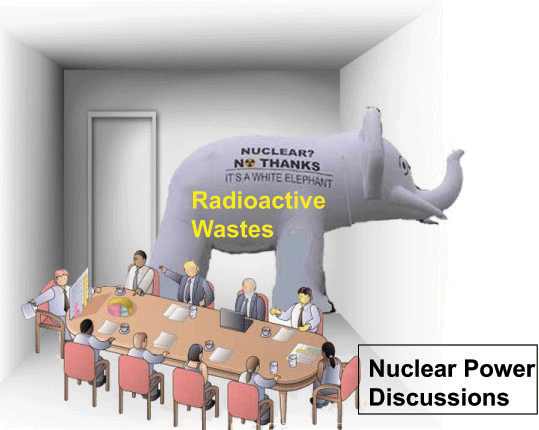
Emma: Yeah, this is kind of the elephant in the room, I think, for Vernon, the town where this is located. So after the fuel rods were used to heat water, they were transferred to cooling towers, and the process of cooling brought their radioactivity down. For a long time nuclear plants around the country were designed to temporarily store spent fuel this way, in cooling pools, and then they would be transferred to one or more federally designated areas for permanent storage.
But the federal government has not found a permanent place to store spent fuel. There has been a lot of conversation about a site in Nevada — Yucca Mountain — but there has been strong local opposition to storing the entire country’s nuclear waste there.
So nuclear plant owners had to find another storage solution. And so they started storing spent fuel in what are called dry casks, which are metal or concrete cylinders that form shells outside of the fuel rods. And according to the NRC, that shell shields people pretty effectively from this highly radioactive spent fuel. So Entergy transferred all of their spent fuel into dry casks, and now there are 58 of those that remain on the site. It’s a 2-acre part of the parcel.
NorthStar does ship some radioactive material to a facility in Texas, but it doesn’t have anywhere to send its spent fuel. So according to Northstar CEO, Scott State, the fuel will remain there until the feds come up with another plan. And that could be a while. So NorthStar will own the spent fuel until it’s removed from the property……………………………………………………………………………………………………………………………………………………. https://vtdigger.org/2023/11/20/the-deeper-dig-a-plan-for-whats-left-of-vermont-yankee-nuclear-power-plant
Jill Stein’s Ominous Warning on Growing Threat of Nuclear War
NewsWeek, Nov 19, 2023, By Jason Lemon
Green Party presidential hopeful Jill Stein warned that President Joe Biden and U.S. leaders are “absolutely” risking the possibility of nuclear war by their actions in support of Israel.
Stein, who previously ran for president in 2012 and 2016, announced on November 9 that she is once again throwing her hat in the ring for the 2024 cycle. The long-shot candidate blasted Biden, Democrats and Republicans for their response to the Israel-Gaza War in an exclusive interview with Newsweek on Thursday, warning that the response could be pushing the world to a point of no return………………………………..
The U.S. government, which classifies Hamas as a terrorist group, has reiterated its support and solidarity with Israel. Fourteen U.S. Navy ships have been positioned in the Mediterranean to assist Israel with intelligence gathering and to deter other regional actors from getting involved in the conflict. Additionally, an Ohio-class nuclear-powered submarine has been sent to the region, according to a November 5 CENTCOM statement.
“I would just note that the U.S. has sent a nuclear submarine there now aside from two battleship or two missiles groups,” she said. “In a nuclear submarine, you have enormous firepower as a rule that’s equivalent to about four or 5,000 Hiroshima bombs packed into one nuclear submarine.”
“The world won’t survive this,” she warned. “And yes, we’re not at nuclear war now, but could a nuclear war be triggered? Absolutely. And we’re seeing this become more dangerous every day.”
The Times of Israel reported on November 6 that it’s unclear whether the nuclear-powered submarine in the Mediterranean is carrying nuclear warheads. The aquatic military vessel is, however, capable of carrying such warheads. The submarine can carry 154 Tomahawk cruise missiles.
Stein, who is Jewish, described Israel’s actions towards Gaza as “genocide.” She also accused Israel of being an “apartheid” state.
“Israel doesn’t have a future if this violence is allowed to continue. I don’t mean just violence from Hamas. There will be violent resistance to apartheid and occupation so you can wipe out Hamas, and then you’ll have the next generation of Hamas, which is going to be even more vicious and brutal,” she said.
Israel rejects claims that it’s committing “genocide” and that it’s an “apartheid” state. Israeli leaders and U.S. leaders routinely describe the country as a “beacon of democracy” in a troubled region of the world. They also often dismiss such criticism as “antisemitic.”
Human Rights Watch and Amnesty International have said Israel’s treatment of Palestinians amounts to “apartheid.” Pro-Palestinian activists, including some progressive anti-Zionist Jewish groups, have accused Israel of perpetuating a “genocide” in Gaza. https://www.newsweek.com/exclusive-jill-stein-warning-nuclear-war-1844899
Canadian Nuclear Safety Commission queried on proposal for untested small nuclear reactors in Ontario.

to the question of whether it is appropriate to propose the siting of up to four untested reactors
No BWRX-300 reactors are operating anywhere in the world
Submission Concerning the Proposed Development of BWRX-300 reactors at the Darlington Site
November 19,2023 by Evelyn Gigantes
I am submitting my response to the proposed development by Ontario Power Generation of 4 BWRX-300 reactors on the existing site of the Darlington CANDU nuclear reactors.
Apparently this project has been given a CNSC license to” Prepare the Site” based on the CNSC’s decision that OPG has met the recommendations of the 2011 Environmental Assessment Report by the Joint Review Panel. However nowhere is evidence available that the recommendations of the JRP have been addressed by OPG, or required by the CNSC.
It is critical that the many environmental concerns raised by the JRP in 2011 – everything from the existing geographic and soil structure of the site, the possible air and water contaminants, the surrounding housing, noise, and potential shoreline alteration, must be addressed by OPG, and approved by the CNSC, before OPG is permitted to prepare the Darlington site for additional reactors. The same is true of recommendations by the JRP concerning a decommissioning financial guarantee which should include the cost of rehabilitating the site if the project does not proceed beyond site preparation.
If the CNSC has, in fact, required OPG to meet these recommendations, the material associated with that requirement should be made easily available to outside organizations and individuals who wish to take part in public discussion concerning these matters.
Now to the question of whether it is appropriate to propose the siting of up to four untested reactors next to the 4 existing CANDUs at Darlington, and their stored nuclear waste.
No BWRX-300 reactors are operating anywhere in the world. The proposed design and operation of a BWRX-300 is entirely different from the CANDU design and involves a structure and a method of operating which is, in large part, below ground level. Again the many issues of the quality of the soil and rock structures and how the physical and operating structures of 4 new BRWX-300 reactors might affect, or be affected by, the issues raised by the JRP recommendations concerning the physical attributes of the Darlington site, need to be openly addressed by OPG and considered publically by the CNSC.
This is the very least that is required before the CNSC begins to examine whether it might permit OPG to begin building even one untested BRWX-300 SMR at the Darlington location.
Simon Daigle lists the public concerns that must be addressed in planned development of BWRX-300 small nuclear reactors – Submission to Canadian Nuclear Safety Commission
Submission Concerning the Proposed Development of BWRX-300 – multiple reactors at the Darlington Site (Ontario)
Submitted November 19,2023 by Simon J Daigle, Simon J Daigle, B.Sc., M.Sc., M.Sc(A) Montreal, Quebec Canada
Response to the proposed development of OPGs BWRX-300 reactors at the Darlington CANDU reactors site and the items below are all real public concerns and must all be addressed independently and individually, as per the following categories:
CNSC licensing of the BWRX-300 reactors & Multiple Reactors nearby a NPP is inadequate [References: 1, 2, 4, 5]
- BWRX-300 stands for Boiling Water Reactor eXperimental 300 and developed by GE Hitachi Nuclear Energy (GEH) and will not aim to address any key challenges faced by traditional nuclear power plants. In fact, they will be costly, and generate extremely toxic nuclear wastes more than what would be expected by traditional NPP plants. [Ref. 4].
- This experimental compact design will not reduce construction costs, will not simplify operation nearby one NPP, or will ever enhanced safety measures. In fact, it will do the exact opposite as per IAEA [Ref. 1 and 5].
- It is questionable to say the least that by utilizing natural circulation and passive safety systems you will eliminate the need for external pumps and active cooling mechanisms because during a meltdown, fire or catastrophic event (lightening, flooding, extreme air temperatures over decades because of climate change), who will shut it off? A worker? I’m more reassured when a Pilot on commercial flight is present when he or she is using the auto-pilot function [Ref. 1].
- CNSC license to built an experimental reactor based on the CNSC’s decision that OPG has met the recommendations of the 2011 Environmental Assessment Report by the JRP is not objectively verifiable or can be validated based on the 2023 Update report [Ref. 2].
- No objective evidence is available to validate what specific recommendations of the JRP have been adopted, analysed and/or implemented by OPG or CNSC. [Ref. 2].
- No BWRX-300 reactors are operating anywhere in the world and is a real public concern for the citizens living nearby as well as the potential impacts of a catastrophic environmental event that could be transboundary across many municipalities.
Engineering Design Risks: Experimental, Natural water cooling & neutron leakage [4,5].
- Water cannot be used to cool a reactor as it is experimental design reactor that will use use low pressure water to remove heat from the core. A distinct feature of this reactor design is that water is circulated within the core by natural circulation and yet no data is measured or validated by any laboratory confirmed analysis or modelling study.
- Neutron leakage will be problematic for any SMR design as well as for the BRMX-300 reactor as no proof of any safe SMR reactor system can be validated or compared too to this very day.
- This is no experimental data to elude or conclude that this experimental reactor will work in terms of an internal cooling system of the core.
- BWRX-300 is by all means not small as it covers a full football field.
- No BWRX-300 reactors are operating anywhere in the world.
- The proposed design and operation of a BWRX-300 is entirely different from the CANDU design and involves a structure and a method of operating which is, in large part, below ground level.
- No data on any potential meltdown of the core of any modular nuclear including BWRX-300 including catastrophic events cascading located nearby a Nuclear Power Plant.
- Neutron leakage is a huge problem with SMRs and will be as well with the BWRX-300.
- SMR Neutronics and Design: [Ref. 4].
- “A nuclear reactor is designed to sustain criticality, a chain reaction of fission events that generates energy (∼200 MeV per fission event) and extra neutrons that can cause fission in nearby fissile nuclides.
- The neutron “economy” of a reactor depends on the efficiency of the chain reaction process; the fate of neutrons absorbed by abundant nuclides, such as 238U or 232Th; the fission of newly generated fissile nuclides, such as 239Pu and 233U; and the loss of neutrons across the fuel boundary.
- These “lost” neutrons can activate structural materials that surround the fuel assemblies. Each of these physical processes generates radioactive waste.
- Thus, the final composition of the SNF and associated wastes depend on the initial composition of the fuel, the physical design of the fuel, burnup, and the types of structural materials of the reactor.
- The probability of neutron leakage is a function of the reactor dimensions and the neutron diffusion length, the latter of which is determined by the neutron scattering properties of the fuel, coolant, moderator, and structural materials in the reactor core.
- The neutron diffusion length will be the same in reactors that use similar fuel cycles and fuel–coolant–moderator combinations; thus, the neutron leakage probability will be larger for an SMR than for a larger reactor of a similar type.”
- Public Consultation, indigenous peoples and social acceptability: [Ref. 2].
- No objective evidence has been elucidated or clearly documented with transparency.
- EIA Impact statement: page 84 of [Ref. 2].
- EIA impact statement, nor final PPE parameters, did not follow IAEA Multi-Unit Probabilistic Safety Assessment required for 1 or 4 experimental reactors nearby a Nuclear Power Plant despite the fact that EIA significance analysis had assessed all the residual adverse effects [Ref. 1, 5]. Please refer to the list of EIA and PPE selected quotes below as the reference to compare with the IAEA Multi-Unit Probabilistic Safety Assessment that is lacking [Ref. 1, 5].
EIA and PPE selected quotes:
“EIS significance analysis had assessed all the residual adverse effects to be “Not Significant”. Of the likely residual adverse effects that were forwarded for assessment of significance in the EIS:
• Seven (7) were also determined to result in minor residual adverse effects from the BWRX-300 but less than that described in the EIS,
• Four (4) were not applicable to the BWRX-300 reactor,
• Five (5) were determined to have residual adverse effects not significant after completion of additional studies to assess the likely effects to retained terrestrial features not considered in the EIS.
- The PPE Of the 198 PPE parameters, 60 PPE parameters were not applicable to the BWRX-300. Of the 138 applicable PPE parameters evaluated, eight (8) BWRX-300 parameters are currently not within their respective PPE parameters. These are largely due to characteristics inherent to the design of the GEH reactor technology. These eight parameters are related to the following topics:
- The rate of fire protection water withdrawal and the quantity of water in storage,
- Deeper foundations (38 m below grade) than the reactors previously assessed in the EIS (13.5 m),
- Airborne releases of radioactive contaminants and normal operation minimum release height above finished grade,
- The different proportions of radionuclides in solid wastes generated by the operation of the BWRX-300,
- The weight of the cask used to transport the BWRX-300 spent fuel on site, and
- The multiplication factors applied to basic wind speed to develop the plant design.
- A full environmental impact assessment is required to fulfill provincial and federal jurisdiction best practices for air, water and soil & biosphere impacts during a catastrophic event or meltdown of this experimental reactor as well as maritime and lake biosphere impacts.
Nuclear accidents, incidents, multiple explosion risks or 1 or 4 BMRX-300 reactors nearby a NPP, Soil Stability, hydrogeology, lithospheric & seismic Risks: [Ref. 1,2, 5].
- No objective risk assessment has been completed by OPG or CNSC as per the required IAEA Multi-Unit Probabilistic Safety Assessment required for 1 or 4 experimental reactors nearby a Nuclear Power Plant. [Ref. 1,5].
- The appropriateness of building 1 or 4 untested reactors next to the 4 existing CANDUs at Darlington as well as the current and potential stored nuclear waste is questionable given the fact that the probabilistic safety assessment was not completed according to the IAEA methodology [Ref. 1].
- JRP recommendations concerning the physical conditions of the Darlington site need to be applied with transparency by OPG and the CNSC. [Ref. 2].
Other public and safety concerns: these issues need to be addressed
- Climate change impacts have not been included in the EIS report.
- Unknown: reliability data to reduce the risk of potential accidents.
- Unknown: demonstrating that the BMRX-300 is a clean and reliable source of electricity, capable of generating vast amounts of energy without producing greenhouse gas emissions as it is only an experimental design.
- Concerns surrounding safety, waste disposal, and cost have hindered its widespread adoption globally. A handful of countries have adopted this design but no data on the true financial costs to governments or to that taxpayer. [Ref. 4].
Unknown: BWRX-300 did not address safety concerns, efficiency, efficacy as a cost-effective alternative compared to renewables such as hydro, solar or wind energy generation.
Unknown: sustainability and reliability compared to wind and solar energies to meet the growing demand for electricity.- BWRX-300 represents a significant step backwards in power technology. It is not compact, it does not meet nuclear wastes (as per the IAEA ALARA principle) that will last for thousands of years, and most certainly, it is not cost effective over time to store and monitor SMR or BWRX-300 nuclear wastes based on the probability of any heat instability of the nuclear core over time and the generation of highly toxic nuclear waste. You cannot turn off radioactivity like an electrical light bulb as there are no fuse switch off for ionizing radiation.
The End of DOE’s Flagship Small Modular Nuclear Reactor (SMR) — A Cautionary Tale
10 years is a long time for investors; and it doesn’t sit well in the context of climate change, which requires solutions now. Since 2011, Congress has appropriated some $6.6 billion for SMRs, out of which DOE has “obligated” some $3 billion, including $583 million for NuScale — more than for any other SMR project. (The other two lead developers, TerraPower and X-energy, have received DOE obligations of $318 million and $242 million, respectively, so far). Yet not one megawatt of commercial carbon-free energy has resulted from this spending.
SMR Craze Continues
Decarbonization goals aren’t being served by wasteful spending on nuclear projects that don’t or won’t deliver the carbon-free power that’s needed. Yet the SMR craze continues both in the US and elsewhere
Fri, Nov 17, 2023, Stephanie Cooke, Washington, https://www.energyintel.com/0000018b-cf50-dbb5-a5ef-df7378750000
The collapse of the US Department of Energy’s (DOE) flagship small modular reactor (SMR) project should serve as a cautionary tale to SMR developers everywhere. When the agency first announced funding for NuScale Power’s SMR project in 2013, then Energy Secretary Ernest Moniz said it represented “a new generation of safe, reliable, low-carbon nuclear energy technology” that would “provide a strong opportunity for America to lead this emerging global industry.” Yet despite years of trying, NuScale failed to deliver. DOE has so far spent some $3 billion on SMRs, according to a department spokesperson, and this is not its first failed SMR project — a Babcock & Wilcox “mPower” design that received the agency’s first SMR funding in 2012 and was regarded as the industry leader in SMRs collapsed in 2017. The question now is whether or when DOE and its multitude of congressional supporters will finally wise up and end the nuclear bonanza?
NuScale and its primary customer, Utah Associated Municipal Power Systems (UAMPS), a nonprofit electricity wholesaler with 50 utility members across seven Western states, couldn’t generate enough interest among the utilities to keep the project going. Under power purchase agreements, individual utility subscribers were obligated to help pay project development costs, which continued to rise, based on their level of offtake. Off-ramps were provided at specific dates with the caveat that any subscriber choosing to take one would have to bear the brunt of its costs to date. Eight subscribers chose to do that in 2020, with a very large offtaker following suit in 2021.
In mid-2021, the target price of power from the proposed 462-megawatt plant, consisting of six 77 MW reactor modules, stood at $58 per megawatt hour; it then rose to $89/MWh, a 53% increase. The project, planned for a DOE site in Idaho, survived despite a sea of local opposition, including from the Utah Taxpayers Association, but it never recovered from the mass exit. The remaining subscribers faced an off-ramp early next year; by deciding to unanimously exit they could avoid bearing costs to date, and instead receive compensation. That’s what they decided to do.
Downward Spiral

The collapse announced on Nov. 8 followed a scathing financial report on NuScale’s prospects by a European short-seller, Iceberg Research, on Oct. 19. That report sent NuScale’s share price into a tailspin, and may have accelerated the decision by the remaining subscribers to leave, which led to another downward spiral. But there were “many reports, articles and opinion pieces published regionally and nationally that raised well-researched questions and doubts about the project’s necessity and financial viability and led potential new subscribers and investors to hesitate,” points out Scott Williams, who spearheaded environmental group Heal Utah’s opposition to the project.
However, the Iceberg report cast a pall over the small community of niche investors in new nuclear. X-energy, one of DOE’s two lead “advanced” reactor developers, cited “challenging market conditions” following the Iceberg report for its decision to pull out of an attempted public offering. The company had planned to follow NuScale’s example and merge with a “blank check” special purpose acquisition company (SPAC) to gain access to stock market investors. The SPAC process has the advantage of allowing a small relatively unknown company to widen its investor base without the regulatory scrutiny involved in a conventional initial public offering.
When Fluor signed the merger deal for the NuScale SPAC in December 2021, the company’s executive chairman, Alan Boeckmann, predicted it would “bolster and accelerate the path to commercialization and deployment of NuScale Power’s unique small modular nuclear reactor technology.” But Fluor itself was under pressure from the market to sell down its majority holding in NuScale — which stands at roughly 55% — something it has been notably unsuccessful in doing. “This is the next step in Fluor’s plan, first outlined 10 years ago, to work closely with NuScale Power, Congress and the Department of Energy to commercialize this unique carbon-free energy technology,” Boeckmann noted.
Decarbonization Goals
10 years is a long time for investors; and it doesn’t sit well in the context of climate change, which requires solutions now. Since 2011, Congress has appropriated some $6.6 billion for SMRs, out of which DOE has “obligated” some $3 billion, including $583 million for NuScale — more than for any other SMR project. (The other two lead developers, TerraPower and X-energy, have received DOE obligations of $318 million and $242 million, respectively, so far). Yet not one megawatt of commercial carbon-free energy has resulted from this spending.
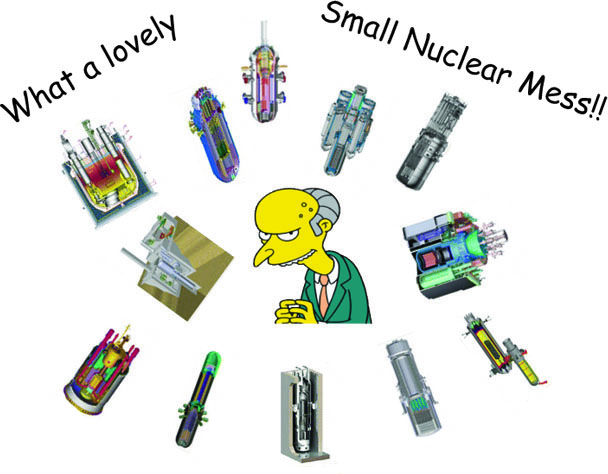
Meanwhile developers have been allowed to chase a rainbow of reactor designs, using different types of coolants and fuels, that date back to the mid-20th century. And as one long-time expert put it, “It’s hard to believe that these more exotic designs will be any cheaper” than the conventional light-water design NuScale was pursuing. A DOE report in March effectively admitted that only large reactors (1 gigawatt or more) deployed en masse have a chance at making an impact on decarbonization, and that “waiting until the mid-2030s to deploy at scale could lead to missing decarbonization targets and/or significant supply chain overbuild.”
The report also noted that “the nuclear industry today is at a commercial stalemate between potential customers and investments in the nuclear industrial base needed for deployment — putting decarbonization goals at risk.”
SMR Craze Continues
Decarbonization goals aren’t being served by wasteful spending on nuclear projects that don’t or won’t deliver the carbon-free power that’s needed. Yet the SMR craze continues both in the US and elsewhere. “I see a clear window of opportunity opening up,” EU Commissioner for Energy Kadri Simson told a European SMR “partnership event” in Bratislava on Nov. 6, two days before NuScale’s announcement. “I am confident that the EU can have a leadership role in achieving technological maturity for SMRs,” Simson added. “The first SMRs must be connected to the European electricity grid within a decade at the latest. This must be our goal.” The day after NuScale’s announcement, on Nov. 9, officials from the US State Department, also in Bratislava, and Slovakia’s Ministry of Economy launched the “Phoenix Project” aimed at replacing aging coal plans with SMRs.
So, what next for DOE’s SMR effort? Should it find another US developer to lead the way and hope for ‘third time lucky’? Or redefine its program in order to justify more foolish spending? Some guess the Canadians might steal the lead on SMRs, a prospect that is loaded with irony, since the project everyone is watching involves a Babcock & Wilcox spinoff called BWX Technologies and a design inspired by a conventional boiling water reactor design that was never built.
More importantly, will Congress wake up and hear the music? The UAMPS subscribers to the NuScale project trusted in NuScale to deliver, and at a reasonable cost, until they no longer did, and wisely chose the off-ramp. Congress should follow suit and stop funding a dead-end enterprise.
Time’s Up for Netanyahu and Biden

The question for today is what the world will do to enable the Palestinian people to live in peace and security in a nation where their children enjoy the opportunities most Americans and Europeans take for granted.
By Dan Siegel ScheerPost 17 Nov 23 https://scheerpost.com/2023/11/17/times-up-for-netanyahu-and-biden/
We can tell the world is changing when tens of thousands of Texans rally in the capital of America’s most important red state to demand a ceasefire in Gaza and freedom for Palestine. No longer can the Israeli government enforce its deadly calculus of 10 (or 50? or 100?) Palestinian lives for each Israeli killed in its futile effort to suppress Palestine’s struggle for self-determination. No longer can an American President assume that the public will support propping up an Israeli government whose constant, murderous violations of international law bring us daily exposure to the violence and deprivation imposed on the Palestinian population.
The issues are no longer whether Israel should survive and whether Hamas’ murders must be condemned. Those are the easy questions. Countless millions of us have moved on.
The question for today is what the world will do to enable the Palestinian people to live in peace and security in a nation where their children enjoy the opportunities most Americans and Europeans take for granted. No one suggests that this challenge can be easily resolved, but the first step is for the U.S. to stop supporting the most right-wing government in Israel’s history from imposing unlimited violence and deprivation on Gaza while accelerating violent settler expansion in the West Bank.
Israel’s strategies to ensure its survival and the means it chooses to defend itself should no longer enjoy unquestioned American support. Netanyahu’s government has exhausted its legitimate right to defend itself against the Hamas attack. It has already killed 11,000 Palestinians and provided no evidence that any of them were responsible for Hamas’ violence.
Israel’s air campaign against Gaza relies on the “emergency” American appropriation of $14 billion in military aid. American weapons have been designated for Israeli settlers stealing Palestinian land in the West Bank. U.S. officials know that Israel’s actions will not lead to peace. So do Israeli leaders, including many in the military. Netanyahu and his government survive because they have American support, including Jews who continue to maintain that criticism of the Israeli government is the equivalent of antisemitism. Many of us disagree. Recent polling demonstrates that the American public is evenly divided on support for the Israeli bombing of Gaza.
Organizations like Jewish Voice for Peace and J Street represent ever growing numbers of American Jews. We are no longer cowed from describing Israel’s actions against the people of Gaza as genocide or its policies in the West Bank as apartheid. We are no longer intimidated by an American Jewish establishment that wields specious and exaggerated accusations of antisemitism and harassment to silence critics of the Netanyahu government.
America’s Jewish establishment does its best to suppress the contentious history of Zionism within the Jewish community worldwide. My grandfather grew up in the late 1800s in a small town in Belarus and became a student and political activist in Minsk. The intellectual life of his community focused on the debate about whether socialism or Zionism best served Jews’ long term interests.
Much public debate focuses on “who started it?,” and the simplistic answer given by Israel’s defenders points to the Hamas attack of October 7 as justification for Israel’s excesses. But the war between Israel and Palestine did not begin on Oct. 7, or even in 1979 or 1967 or 1948, and it was not created in the Holocaust. It makes more sense to say that the roots of the current conflict go back to the Crusades, a campaign that began around 1095 when Europe’s Christian kings raised and sent armies to the Middle East to overthrow its Muslim leaders and take their land. As they marched across Europe, the Crusaders attacked Jewish communities, murdering their populations and stealing their wealth. Almost 1,000 years later the descendants of those Arab and Jewish people contend for the land conquered by the Crusaders.
History will not tell us which side has right on its side. The search for peace must be forward-looking and requires a commitment to the welfare of both the Palestinian and Israeli people. American officials are far from powerless to stop the Netanyahu government. The problem is that they refuse to do so. The current crisis has created a demand for leadership with a vision of a world at peace.
This is Joe Biden’s Lyndon Johnson moment, the time for him to follow LBJ’s 1968 decision to withdraw from the campaign for reelection. The issue is not that Biden is too old. His policies are too old. The American Empire is no more. We need leaders ready to engage the emerging multipolar world, who do not imagine that the U.S. is going to war over Taiwan, who welcome sharing power with the nations of Europe and the BRICS countries. The end of America’s uncritical support of the Israeli government can be the first step in creating leadership for a world at peace.
Washington raises stakes on ‘losing hand’ in Ukraine – Jeffrey Sachs

Sachs noted that he and other observers predicted the Ukraine debacle in the early days of the conflict. “This one was not very hard to see,” he said. “Like you said, how can you beat Russia? It was very obvious. These people just are not very clever. Biden, Nuland, [National Security Advisor Jake] Sullivan, [Secretary of State Antony] Blinken – they’ve been at this since 2014.”
https://www.rt.com/news/587370-sachs-ukraine-losing-hand/ 17 Nov 23
Just three days after Russian forces launched a military offensive against Ukraine in February 2022, Ukrainian President Vladimir Zelensky sought to resolve the conflict by pledging neutrality, Sachs said. However, he suggested that, when Zelensky reached a preliminary agreement with the Russians on a peace settlement a few weeks later, US President Joe Biden’s administration torpedoed the deal.
The leading American analyst has argued that Washington needs a new foreign policy after 15 years of failure in Eastern Europe
Washington has continually escalated a failed foreign policy in Eastern Europe since at least 2008, driving Ukraine to the brink of total destruction by failing to address Russia’s legitimate security concerns in the former Soviet republic, US public policy analyst Jeffrey Sachs has argued.
“The US has played a losing hand badly for 15 straight years,” Sachs said on Wednesday in an interview with independent journalist Glenn Greenwald. “This is really important to understand if one wants to learn a little bit about geopolitical poker, which is, we keep raising the stakes on a losing hand.”
Sachs, an award-winning economist who advised the Russian and Ukrainian governments following the Soviet Union’s breakup, detailed how at various points in the past two decades, Washington could have forestalled a military conflict without Kiev losing any territory. He pointed out that Moscow was demanding that NATO not expand onto its doorstep, which US officials refused to concede.
When Ukraine’s then-president, Viktor Yanukovych, chose neutrality over aligning with the West and agreed to extend the Russian Black Sea Fleet’s lease of its naval base in Crimea, that wasn’t good enough for US leaders, Sachs said. US State Department official Victoria Nuland “and friends” then helped overthrow Kiev’s democratically elected government in 2014, leading to Ukraine’s loss of Crimea, he said.
Even then, Russia wasn’t demanding more territory. Rather, Sachs said, Moscow wanted Ukraine to refrain from shelling ethnic Russians in the breakaway Donbass region and to grant them a degree of autonomy. Those terms were included in the Minsk II agreement, which was unanimously endorsed by the UN Security Council, but US officials told Ukrainian leaders that they didn’t need to comply with the deal, the analyst said.
In December 2021, Russian President Vladimir Putin proposed a security pact pledging no further expansion of NATO and negotiations on placement of US missile systems in Eastern Europe. The US reply came in January 2022.
“We don’t have to discuss any of that with you,” Sachs said, summing up Washington’s stance at the time. “That was the reply. We don’t have to discuss NATO with you. It’s none of your business.”
Just three days after Russian forces launched a military offensive against Ukraine in February 2022, Ukrainian President Vladimir Zelensky sought to resolve the conflict by pledging neutrality, Sachs said. However, he suggested that, when Zelensky reached a preliminary agreement with the Russians on a peace settlement a few weeks later, US President Joe Biden’s administration torpedoed the deal.
Washington has since approved $113 billion in aid to Ukraine, essentially prolonging the fighting, the analyst argued. Earlier this year, the Biden administration goaded Kiev into a major counteroffensive against Russian forces that was “clearly an impossibility,” Sachs said.
“They’ve raised the stakes for 15 years on a losing hand, and they can’t get it,” the economist said. “And this is our team. They failed.”
Sachs noted that he and other observers predicted the Ukraine debacle in the early days of the conflict. “This one was not very hard to see,” he said. “Like you said, how can you beat Russia? It was very obvious. These people just are not very clever. Biden, Nuland, [National Security Advisor Jake] Sullivan, [Secretary of State Antony] Blinken – they’ve been at this since 2014.”
Kiev’s much-anticipated offensive campaign, launched in the summer, has failed to achieve any significant victories or win back much territory. Valery Zaluzhny, Ukraine’s top general, said in a recent interview that the fighting has reached “a stalemate.”
The Economist reported this week that Western officials “increasingly think” that the conflict could last for another five years.
1 This Month
26 April – Chernobyl: Inside the Meltdown airs on National Geographic on Sunday 26th April from 4pm

29 April – Nuclear Expert Webinar #1 – Radiation Impacts on Families with Mary Olson and Cindy Folkers
- 12:15 PM MT – 1:45 PM MT
- Location: Virtual – REGISTER TODAY

4 May -West Suburban Peace Coalition to discuss Iran war at May Educational Forum
Monday, May 4, 7:00 – 8:00 PM Central Standard Time
Title: : How Trump’s Narrative Tries to Shape the Reality of the War on Iran.
Contact Walt Zlotow, zlotow@hotmail.com 630 442 3045 for further information
14 May – online event From Bombs to Data Centres: the Face of Nuclear Colonialism

Pine Ridge Uranium is the real threat, not Tehran- Tell Burgum: Stop the Extraction.
Chernobyl: The Lost Tapes – A good documentary on Chernobyl on SBS available On Demand for the next 3 weeks– https://www.sbs.com.au/ondemand/tv-program/chernobyl-the-lost-tapes/2352741955560
To see nuclear-related stories in greater depth and intensity – go to https://nuclearinformation.wordpress.com
-
Archives
- April 2026 (288)
- March 2026 (251)
- February 2026 (268)
- January 2026 (308)
- December 2025 (358)
- November 2025 (359)
- October 2025 (376)
- September 2025 (257)
- August 2025 (319)
- July 2025 (230)
- June 2025 (348)
- May 2025 (261)
-
Categories
- 1
- 1 NUCLEAR ISSUES
- business and costs
- climate change
- culture and arts
- ENERGY
- environment
- health
- history
- indigenous issues
- Legal
- marketing of nuclear
- media
- opposition to nuclear
- PERSONAL STORIES
- politics
- politics international
- Religion and ethics
- safety
- secrets,lies and civil liberties
- spinbuster
- technology
- Uranium
- wastes
- weapons and war
- Women
- 2 WORLD
- ACTION
- AFRICA
- Atrocities
- AUSTRALIA
- Christina's notes
- Christina's themes
- culture and arts
- Events
- Fuk 2022
- Fuk 2023
- Fukushima 2017
- Fukushima 2018
- fukushima 2019
- Fukushima 2020
- Fukushima 2021
- general
- global warming
- Humour (God we need it)
- Nuclear
- RARE EARTHS
- Reference
- resources – print
- Resources -audiovicual
- Weekly Newsletter
- World
- World Nuclear
- YouTube
-
RSS
Entries RSS
Comments RSS
 nuclear-news