Government gives Canadian Strategic Missions Corporation (CSMC) $4.5M for Micro-Nuclear Technology in Canada’s Arctic

COMMENT CSMC are very adept at getting government funding (no private investors) for an idea. The company CEO has a background in real estate and “making deals.” They already had at least $3.1 million in public funds before this latest grant, which leaves them about …. $1 billion or so short of building a reactor, if indeed they know how to do that.
CSMC awarded $4.5 million through the Government of Canada to accelerate micro-nuclear technology for Canada’s Arctic
Canadian Strategic Missions Corporation (CSMC) is honoured to announce that it is receiving a $4.5 million Government of Canada investment through the Federal Economic Development Agency for Southern Ontario (FedDev Ontario) to advance Canadian-made energy solutions that will secure the North.
This investment is a major milestone that will accelerate the development of CSMC’s micro-nuclear reactor towards detailed design and a fueled demonstration, readying the technology for deployment in Canada’s Arctic. This project represents a critical step toward ensuring Canada can meet its energy and defence needs with sovereign, made-in-Canada solutions.
Daniel Sax, CEO and Founder of CSMC said -“As private industry continues to drive innovation within the nuclear sector CSMC is proud to partner with the Canadian government to accelerate the R&D process. Our goal is to bring promising new technology online faster – in line with peer markets – to ensure that our nation can reinforce its defence capabilities, including in the North.”………………………. https://canadiandefencereview.com/csmc-awarded-4-5m-for-micro-nuclear-technology-in-canadas-arctic/
Trump Administration Eyes Offshore Nuclear to Power AI Boom
By Irina Slav – Jul 23, 2026,
https://oilprice.com/Alternative-Energy/Nuclear-Power/Trump-Administration-Eyes-Offshore-Nuclear-to-Power-AI-Boom.html
- The Trump administration is exploring offshore nuclear power as part of its plan to expand U.S. nuclear capacity.
- Floating nuclear projects are gaining momentum globally, with Russia already operating one plant while U.S., South Korean and Chinese firms develop commercial offshore reactor technologies.
- Despite growing interest, offshore nuclear faces regulatory, national security and environmental hurdles before large-scale deployment becomes a reality.
The Trump administration is studying the deployment of offshore nuclear power generation, with the Marine Minerals Administration and the Nuclear Regulatory Commission agreeing this week to coordinate on any future developments. The announcement comes amid surging electricity demand driven by Big Tech.
“Submerged reactor systems have been safely deployed in naval applications for decades, demonstrating their potential as a reliable source of energy in demanding marine environments. While no commercial deployment on the Outer Continental Shelf is planned or approved at this time, it could greatly strengthen America’s energy security in the future,” the acting director of the Marine Mineral Administration, Matt Giacona, said.
The new partnership is part of a broader push to boost the share of nuclear power in the U.S. energy mix, with Reuters recalling in a report that President Trump wants to increase nuclear capacity in the country fourfold by 2050. Indeed, nuclear, which previously fell out of favor because of the high upfront costs and a perception of high risk, has recently been regaining
That last fact has really tipped the scales in favor of nuclear as Big Tech emerges as the main driver of global electricity demand growth because of its focus on artificial intelligence development and application. The industry—just like every other, and households—needs a reliable power supply, and that means either baseload from hydrocarbons or nuclear, or wind and solar plus batteries, with battery technology still not advanced enough to secure the 24/7 uninterrupted supply necessary for data center operators.
Nuclear is making a return, but floating nuclear generation specifically is not really a popular technology globally, yet. There is only one offshore nuclear power station in operation, and that is Russia’s Akademik Lomonosov, which was built to power the Far Eastern Chukotka Peninsula and Yakutia regions. The station began commercial operation in 2020 and was recently reported to have generated its first billion kilowatt-hours.
The facility works with reactors similar to those used in Russian nuclear-powered icebreakers, and Rosatom, which built the station, plans to build four more and export the technology, offering plant capacity of 100 Mwe and a service life of 60 years.
China is also working on floating nuclear power generation. One company recently unveiled plans to build a nuclear-powered offshore logistics hub that would produce zero emissions, including through using nuclear fuel for powering ships.
It seems interest in offshore nuclear is growing, with two recent news reports about companies working on the technology. One of these is a U.S. startup by the name of Bluecore Energy, which is developing small modular reactors that can be deployed on floating barges and supply electricity to ports and other infrastructure, Baird Maritime reported this week.
Trump’s Phantom Enemies

The Trump administration is laying the groundwork for blacklisting and criminalizing all left-wing, progressive, anti-war and anti-imperialist dissent.
Chris Hedges ScheerPost, July 23, 2026, https://scheerpost.com/2026/07/23/trumps-phantom-enemies/
The State Department’s 100-page report on Cuba’s “campaign of subversion against the United States,” along with Donald Trump’s assertion that “Americans were blatantly lied to about the security of our election infrastructure,” lays the groundwork for dictatorship.
Elections will be sabotaged in the name of “national security.” Left-wing dissent will be criminalized in the name of “combating terrorism.” Democracy will be snuffed out in the name of protecting “freedom.”
Trump, who has lately taken to issuing warnings about a communist plot to take over America, posits that an island of 9.6 million people — nearly 90 percent of whom live in extreme poverty amid extended blackouts due to decades of U.S. economic warfare — is an existential threat.
These accusations are not meant to be rational. They, like the charge that our elections are manipulated, are transparent excuses to go after institutions and individuals that are seen as threatening Trump and the Republican Party’s absolute grip on power. While Cuba has supposedly “carried out one of the most durable and damaging foreign intelligence penetrations in American history” Russia, China, Iran and North Korea, as well as non-state groups, “have the capability to compromise U.S. election infrastructure.”
Under the heading “Front Groups and Fellow Travelers,” the report assembles a disparate collection of organizations belonging to Cuba’s“ideological network.”
For example, the Interreligious Foundation for Community Organization (IFCO), founded as an ecumenical social justice organization by the Presbyterian Church, is described as part of a Cuba “solidarity network” which “facilitates radical agitation within the United States.”
I am an ordained Presbyterian minister. I can assure you the Presbyterian Church is not facilitating “radical agitation.”
The report lists a wide variety of organizations on whose behalf IFCO has acted as an intermediary — perfectly legally — facilitating tax-exempt donations and handling grant management, compliance and reporting. These include The Jericho Movement, Equality for Flatbush, Claudia Jones School, Haitian Women for Haitian Refugees, changingFrequencies, Viva Palestina US, and The People’s Forum, which the report describes as “a major activist group in Cuba’s U.S. ideological network.”
The National Lawyers Guild (NLG) and Democratic Socialists of America (DSA) are castigated in the same chapter. The NLG “is one of the most persistently relevant — and insidious — organizations in Cuba’s U.S. network.”
The report continues:
“The association of extreme-left lawyers and radical street activists has played a key role in a disproportionate share of the far-left terror and violence that has plagued the United States from the 1960s up to today. Throughout its history, it has maintained intimate ties to Cuba and other communist regimes and has explicitly sought to advance the causes of the international far left, including by working to defend and facilitate terrorism and extremist violence — from the Weather Underground of the 1970s to the violent BLM militants and Antifa terror cells of today.”
The NLG is labeled a foreign influence operation because it provides assistance to activists, whose right to legal representation is constitutionally enshrined.
In 2025, the Trump administration conditioned federal funding to Harvard University on defunding and dissolving the law school’s chapter of the National Lawyers Guild (HLS NLG), which provided legal assistance to individuals and student groups that opposed the genocide.
A subsection in the report is dedicated to the anti-war activists at CODEPINK and their co-founders Medea Benjamin and Jodie Evans. It notes Evans’ marriage to the wealthy software entrepreneur Neville Roy Singham was attended by a “Who’s Who’ of progressivism” including co-host of Democracy Now! Amy Goodman; Ben & Jerry’s co-founder Ben Cohen and the playwright V (formerly known as Eve Ensler) who wrote “The Vagina Monologues.”
Naming guests at a wedding is one of the more bizarre passages.
The report grossly exaggerates the influence of Singham’s support for left-wing organizations — described as “far-left” — while ignoring the massive sums supplied by U.S. corporations, millionaires and billionaires, as well as the Israel lobby, to both major political parties, super PACs, think tanks and advocacy networks.
Israel has a far more insidious influence on U.S. politics and foreign policy than Cuba, Russia and China combined.
The State Department attacks the co-founders of The People’s Forum, Manolo De Los Santos and Claudia De la Cruz.
It draws on documents that are often decades old and infused with Cold War paranoia. These include a 1966 Senate report claiming there is “overwhelming evidence that the machinery of the Cuban Government has been progressively organized over the years, to carry out its number one task — the export of Communist subversion.”
It ignores more thoughtful assessments, including a 1981 CIA estimate that acknowledged “[m]uch of the turmoil around the world is rooted in regional and local disputes of a political, social, or religious nature and has nothing to do with Communism.”
In a chapter titled “Revolutionary Tourism,” the Venceremos (“We Shall Overcome”) Brigade is characterized as one of the most “extensive and dangerous infiltration operations ever undertaken by a foreign power against the United States.” This assertion libels thousands of individuals and organizations as Cuban assets, offering nothing more than innuendo.
It lists “the founder of Mother Jones,” — although there were four founders —– along with “several other [unnamed] notable magazine editors, leaders of powerful labor unions and advocacy groups, think tank executives, and a suite of professors at top U.S. universities” as Brigade “alumni.”
Transporting humanitarian goods to Cuba is not a crime. Although the Justice Department’s extradition request from Spain of philanthropist Fergie Chambers, who provided funds to humanitarian organizations in Gaza, may see the criminalization of any person or any group that assists those suffering under sanctions and a blockade.
The report attacks members of the March 2026 “Nuestra América Convoy” which transported goods to Cuba “in defiance of U.S. sanctions.” It notes that 120 organizations “from across 33 countries joined the caravan” with “a suite of influential progressives,” including Isra Hirsi — daughter of U.S. Rep. Ilhan Omar, video game live streamer and commentator Hasan Piker — with whom I discussed my book “A Genocide Foretold” last year — former U.K. Labour Party leader Jeremy Corbyn and “several other current and former members of European Parliament.” Even the Gaza flotilla activist Thiago Avila — who I interviewed last month after he was tortured by Israeli soldiers — gets a mention.
Those listed in the report did not become “radicals” because of Cuban indoctrination. Their politics are homegrown, formed in opposition to racism, genocide, police violence, the terrorizing and killing of immigrants and U.S. citizens by Immigration and Customs Enforcement (ICE) thugs and neoliberalism, along with the crimes of U.S. imperialism and militarism.
The report makes passing reference to a wide range of people on grounds so tenuous that it has to be read to be believed.
New York City Mayor Zohran Mamdani is mentioned for refusing “to denounce” a “tribute to [Assata] Shakur,” who was almost certainly framed for murder and who fled to Cuba after escaping from a U.S. prison in 1979.
It dedicates two paragraphs to Los Angeles Mayor Karen Bass for her “friendliness towards the communist regime.” The evidence provided is her participation in a congressional delegation that joined then President Barack Obama on a visit to the island.
Cuban agents, it charges, “maintain a foothold in hundreds of front groups, activist organizations, solidarity centers, and ideological NGO and nonprofit networks. These groups collectively represent one of the single largest, most sophisticated and dangerous vectors for hostile foreign influence in modern American history.” Cuba has allegedly “infiltrated the highest reaches of the U.S. government, recruited and cultivated generations of American activists [and] backed an unprecedented wave of leftwing terrorism [my emphasis] on American soil.”
Note the word terrorism. Note that it makes these individuals and organizations terrorists. Note that it makes them subject to draconian terrorism laws. And note that the Trump administration has committed itself to hunting down and rooting out the “radical left.”
The report charges that Cuba and its allies are mounting “a revolution against western civilization itself — waged, in part, via the novel and insidious method of persuading the children of the West to turn against their own inheritance.” It accuses Havana of “gleeful support of the George Floyd uprisings.” It asserts that “the rise of antifa” and “the explosion of pro-terrorist activism on American college campuses,” can be “linked, in some way, shape, or form, to Cuban influence.”
It characterizes the DSA as serving “as a particularly potent illustration of the ideological victory of Cuba’s effort to position itself as the spiritual capital of Third Worldist radicalism.” It claims the organization maintains a “fierce, almost religious commitment to the cause of the Cuban regime.” It alleges Cuba has built a “sprawling revolutionary network” that has “shaped America’s most famous and influential extremist movements” including the Black Panthers, the Weather Underground and antifa. These networks include “powerful leftist nonprofits, anti-ICE collectives, socialist groups, and Marxist militant organizations” in the U.S.
Cuba, the report concludes, “has sought to undermine, degrade and destabilize America with spies and soldiers, but also with students and intellectuals; with terrorist cells, but also with solidarity committees and nonprofit networks with intelligence officers operating under diplomatic cover.”
The broadside is chilling. It is worse than McCarthyism. It presages a savage purging of American society.
Those named in the report are condemned without evidence. They are denied due process. That the assertions in the report are distorted at best, and often fictitious, is irrelevant. Fascist propaganda is not rooted in truth. It is rooted in a hatred for liberal values, democracy and the left. It is rooted in the belief that once those condemned as human contaminants are removed, there will be a moral, spiritual and economic renaissance.
We have seen this fascist dance before. We know what comes next. It is not good.
Saudi Arabia, the Khashoggi murder case: the nuclear connections with Terra Power, Bill Gates, Breakthrough etc.

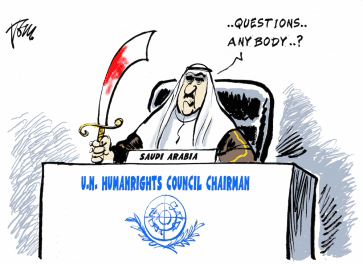 US Nuclear Energy Policy & Khashoggi Murder: Appeasement Or Threat? Clean Technica, December 12th, 2018 by Tina Casey “…………..The Nuclear Energy Connection
Either way, that brings us around to the idea that the corporate world needs to step up and press for meaningful action on the Khashoggi case, since the White House is falling down on the job.
In particular, the tech sector is feeling the pressure not only because of its financial ties to Saudi Arabia, but also because of the high profile of its biggest players.
That brings us right back around to the nuclear energy angle, where the US nuclear company TerraPower has been making waves.
TerraPower was formed back in 2006 and crossed the CleanTechnica radar during COP 2015, when it popped up in relation to a newly launched investor umbrella organization called the Breakthrough Energy Coalition.
Breakthrough is a tech incubator with a focus on clean energy and rapid decarbonization, and nuclear energy makes the cut.
As a global organization, Breakthrough can provide TerraPower with a platform for pitching its technology overseas — a key consideration, given the morbid state of demand for new nuclear power plants here in the US.
So far TerraPower has been focusing on foreign markets, particularly China, for its new technology.
If all of this is beginning to ring some bells, that’s where the tech and Silicon Valley connections kick in.
Microsoft’s Bill Gates is financial backer of TerraPower and chairman of its board.
Gates is also the chair of the Breakthrough Coalition’s Breakthrough Energy Ventures, where you’ll find a host of other familiar top-dollar investors with an interest in decarbonization including Jeff Bezos, Richard Branson, Vinod Khosla, and Michael Bloomberg.
Saudi Arabia is represented among Breakthrough members through Prince Alwaleed bin Talal, who is Chairman of Alwaleed Philanthropies and a supporter of Gates’s “giving pledge.”
Saudi Arabia is also represented among the 24 countries (including the EU) that support the Mission Innovation clean energy initiative, which is in turn receives considerable support from Breakthrough, so there’s that.

Not for nothing, but as of last August the Department of Energy has supported a TerraPower molten salt reactor project with $28 million in cost-shared funds.
When Will The Silicon Valley Crickets Stop Chirping And Start Acting?
All this is by way of saying that when it comes to the Saudi government, the Khashoggi murder, and the cash flow, all roads lead back to Silicon Valley and the US tech sector.
The New York Times raised a red flag on Saudi financial ties to Silicon Valley last year. Among other developments since then, Tesla has been ramping up its profile in the country, and Google has expressed interest in building data centers there.
Perhaps it’s not fair for the tech sector to take all the heat, but on the other hand these are the guys who promised to make life better for millions if not billions of people all over the world. More is expected of them than, say, the CEO of a local pest control company.
The Trump family’s financial ties with Saudi Arabia seem to be the driving force behind Trump’s response to the Khashoggi murder, and now it seems those same ties have silenced the US tech sector.
The fact is that the Khashoggi murder is not going away. New details about the murder are emerging on a regular basis, and even Trump’s Republican allies have finally stirred into action.
In the latest development, today the US Senate is reportedly set to debate cutting off US support for the Saudi-lead war in Yemen. The measure has been linked directly to outrage over the country’s role in the Khashoggi killing.
Meanwhile, CleanTechnica is reaching out to TerraPower for comment, so stay tuned for more on that.
Follow me on Twitter. https://cleantechnica.com/2018/12/12/us-nuclear-energy-policy-khashoggi-murder-appeasement-or-threat/
A nuclear deal for the Saudis, media blackout for Kushner’s corruption
Judd Legum, Rebecca Crosby, and Noel Sims, Jul 23, 2026,
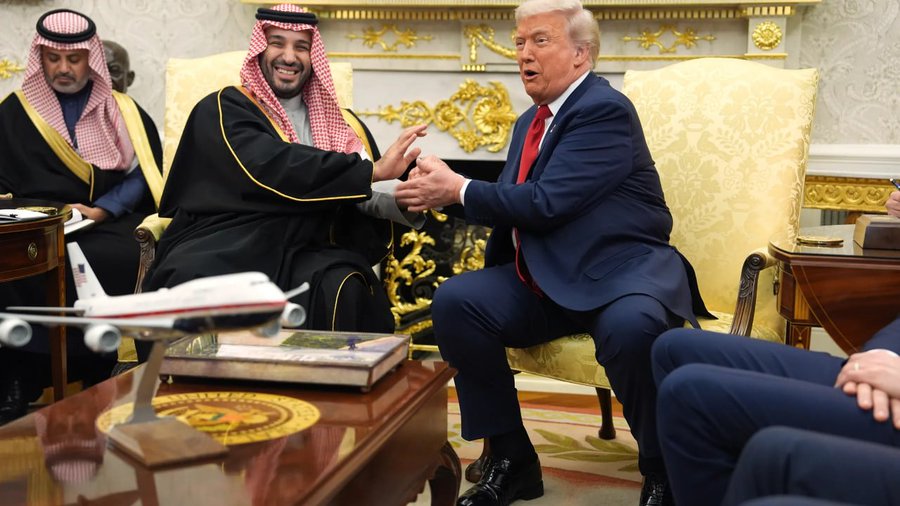
On Wednesday, the Trump administration signed a 30-year nuclear agreement with Saudi Arabia that paves the way for the kingdom to enrich its own uranium. The Saudi government has been aggressively seeking such a deal for years, eager to gain an edge over regional rivals. The agreement lacks safeguards that previous administrations, and many independent foreign policy analysts, viewed as essential to prevent nuclear proliferation.
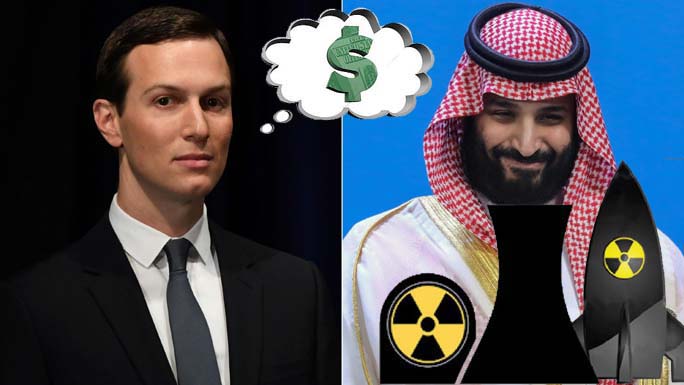
The deal comes after the Saudi government’s Public Investment Fund (PIF) invested $2 billion in Jared Kushner’s private equity fund, Affinity Partners. Since 2021, Kushner, President Trump’s son-in-law, has collected over $110 million from the Saudi government in management fees. In March, Kushner was seeking billions more from the Saudis. (After Kushner’s fundraising was exposed, his efforts were purportedly put on hold.)
Kushner also has a close personal relationship with Saudi Crown Prince Mohammed bin Salman (MBS) — the pair are known to communicate regularly over WhatsApp. In 2021, when the PIF committee originally recommended rejecting Kushner’s proposal due to the high price and Kushner’s inexperience, MBS overruled the recommendation.
As he continues to collect fees from the Saudi government, Kushner has resumed his role as a top foreign policy aide to Trump. He has played a key role in virtually every significant foreign policy negotiation since Trump returned to the White House.
.Kushner’s specific involvement in the nuclear pact, if any, has not been disclosed. But the fact that one of the president’s top foreign policy advisors is receiving large, ongoing financial payments from the Saudi government is unquestionably relevant to the story.
Proposed US-Saudi nuclear energy deal: What we know so far
Reports suggest the Trump administration backs a pact with Saudi Arabia allowing it to enrich uranium.
22 Jul 2026, https://www.aljazeera.com/news/2026/7/22/proposed-us-saudi-nuclear-energy-deal-what-we-know-so-far
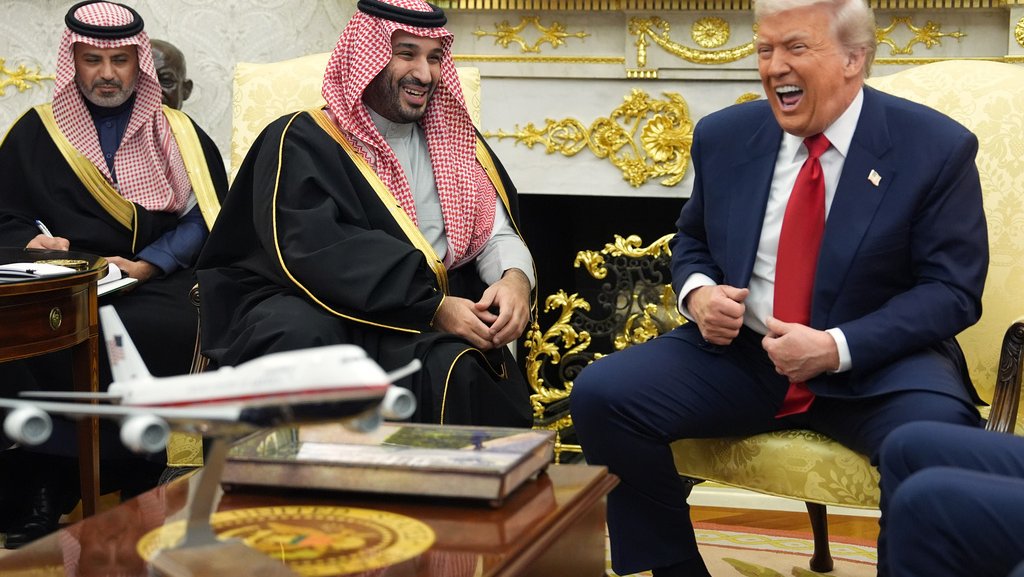
United States President Donald Trump has approved an agreement that would allow Saudi Arabia to develop a civilian nuclear programme with the potential to enrich uranium on its own soil, marking a significant shift in longstanding US non-proliferation policy, according to media reports.
Citing people familiar with the discussions, the Wall Street Journal and The New York Times reported on Tuesday that Trump is expected to ask Congress to approve the agreement, which could pave the way for US companies to help build Saudi Arabia’s nuclear industry.
The timing is likely to prove controversial, with the US saying one of the objectives of its military campaign against Iran is to prevent it from acquiring the ability to build a nuclear weapon. Critics say that allowing Saudi Arabia to enrich uranium could weaken that message, even if the programme is intended for civilian use, while other commentators fear that raising nuclear enrichment levels could be misused.
Here’s what we know.
Why is this significant?
Saudi Arabia has long sought a civilian nuclear programme as part of plans to diversify its economy and reduce its dependence on oil.
Negotiations over US nuclear cooperation have stretched across multiple administrations. Under former President Joe Biden, talks were tied to a broader package that included Saudi recognition of Israel, according to The Times.
Those negotiations stalled after Israel’s genocidal war on Gaza, but the Trump administration revived discussions, removing the normalisation requirement.
During Saudi Crown Prince Mohammed bin Salman’s visit to the US last year, the two countries announced a framework for civilian nuclear cooperation, laying the groundwork for what they described as a long-term partnership built on non-proliferation standards.
What does the reported agreement say?
According to the reports, the agreement would last for 30 years and allow US companies, including Westinghouse, a Pittsburgh-based nuclear energy giant, to help develop Saudi Arabia’s civilian nuclear sector.
One of its most significant provisions would permit Saudi Arabia to pursue domestic uranium enrichment following a joint US-Saudi study.
Enriching uranium is not illegal and is used to produce fuel for nuclear power plants. However, the same technology can also produce highly enriched uranium suitable for nuclear weapons if enrichment continues to much higher levels.
Saudi Arabia has previously said it would seek a nuclear weapon if Iran were ever to acquire one, although Tehran insists its nuclear programme is peaceful.
Why are some experts concerned?
The reported agreement is expected to fall short of the standards accepted by some other US partners.
In 2009, the United Arab Emirates signed a so-called “123 Agreement” with Washington before opening its Barakah nuclear power plant, agreeing not to enrich uranium or reprocess spent nuclear fuel – a model that non-proliferation experts have often described as the “gold standard”.
Reports suggest the Saudi agreement would instead allow enrichment and may not require the International Atomic Energy Agency’s (IAEA) Additional Protocol, which gives inspectors broader powers to verify that nuclear material is not being diverted for military purposes.
Michael Horowitz, a geopolitical analyst, said the Saudi agreement would be “very consequential” for a number of reasons.
“The US reportedly agreed to a deal that falls both below the gold standard and doesn’t include the Additional Protocol – both of which are made to ensure a civilian programme doesn’t turn into a military one,” he said.
“This isn’t a detail: If Riyadh had wanted to just have US backing for a civilian programme, it would have done so years ago – with Washington’s blessing. In other words, the goal is to get US support for a deal that doesn’t fully exclude a pathway to a nuclear programme,” he added.
“That’s not to say that there aren’t guarantees. But guarantees are purely bilateral, and that means they will be entirely dependent” on the state of US-Saudi relations, said Horowitz.
Why would the US agree?
Supporters argue the agreement would strengthen US influence in the Gulf.
In a report submitted to Congress earlier this year, the Trump administration argued that expanding civilian nuclear cooperation would help maintain US leadership in the global nuclear industry while preventing strategic competitors from gaining influence in the kingdom.
The administration has also argued that Saudi Arabia’s growing electricity demand makes nuclear energy an increasingly important part of its long-term energy strategy, despite its vast oil resources and climate well suited for solar power.
Will Congress approve it?
Any civilian nuclear cooperation agreement must be submitted to Congress, which has the power to review and block so-called “123 agreements”.
Congress would need a two-thirds majority to block the proposed agreement and override any presidential veto.
The proposal is expected to face scrutiny from lawmakers in both parties over the safeguards governing Saudi uranium enrichment.
Some members of Congress and Israeli officials have said that permitting enrichment could leave open a future pathway to a Saudi nuclear weapons capability, even if the programme begins for civilian purposes.
Andrea Stricker, deputy director of the Foundation for Defense of Democracies’ Nonproliferation Program, urged Congress to “block” the proposed agreement.
“If it does not, one hopes the policy will be reversed by a subsequent administration before too much damage is done in terms of watering down safeguards, setting negative precedents for other states, and failing to contain the spread of enrichment,” said Stricker.
War Criminal Pete Hegseth Disrupted
July 23, 2026, https://scheerpost.com/2026/07/23/war-criminal-pete-hegseth-disrupted/
CODEPINK Disrupts Secretary of War Crimes Pete Hegseth During Senate Appropriations Hearing.
Washington, DC – On Tuesday afternoon, activists from CODEPINK, Vets About Face DMV, and the National Iranian American Council disrupted Secretary of War Crimes Pete Hegseth during his testimony before the U.S. Senate Committee on Appropriations, demanding an immediate end to the disastrous U.S. war on Iran and condemning the administration’s request for additional funding.
Four people managed to disrupt Hegseth; of the four, two were Iranian-Americans, one U.S. veteran, and one nurse. They were each removed from the hearing and arrested.
Today’s action comes as the administration escalates its unprovoked war, where, notably, on the first day of attacks, the U.S. bombed a grade school, killing 73 boys, 47 girls, and 26 female teachers. Since then, the U.S. has targeted Iran’s civilian infrastructure, including water plants, airports, bridges, universities, sports facilities, and the electric grid. The World Health Organization reports that the U.S. war has killed or injured over 35,000 civilians.
“Pete Hegseth and this administration will be remembered for the killing of innocent civilians and children. They have protected neither the American people nor our security, only the interests that have lined their pockets,” said Bella of the National Iranian American Council, who joined the protest. “While Americans struggle to afford their lives, this government always finds billions to bomb our families in Iran, Palestine, Lebanon, and elsewhere. This is a repugnant betrayal of humanity. It is illegal, and the American people will hold them accountable.”
More and more people in the U.S. are now rejecting additional military spending and would rather the government redirect resources to domestic needs. A recent Reuters/Ipsos poll found only 37% of Americans back new U.S. strikes on Iran, while half believe the conflict has not been worth its cost. The war has also taken a significant economic toll, as65% of Americans want a deal to end the war as soon as possible. Despite this, Hegseth appeared before the committee to request additional funding for a war that has already cost over $132 billion.
CODEPINK will continue to work towards a reinvestment of the $1.5 trillion proposed war budget into real security for people in the form of healthcare, housing, and climate justice.
The Chris Hedges Report: Is Iran Becoming Another ‘Forever War’?
July 22, 2026, https://chrishedges.substack.com/p/is-iran-becoming-another-forever
The Trump administration has embroiled the United States in another quagmire, similar to the Vietnam War and recent wars in the Middle East, by going to war against Iran. Now that the June 17th Memorandum of Understanding (MOU) with Iran is dead, the US and Iran seem to be stuck in a tit for tat war where the US bombs Iran and Iran retaliates against US and allies’ in the region. As Gulf States that are being targeted by Iran mount pressure on President Trump to stop the attacks, and a global economic crisis looms, the US is running out of options and time.
For a greater understanding of the balance of power in the region, the US’ military capacity and possible outcomes of the US-Iran War, Chris Hedges speaks with Professor John Mearsheimer in this episode of The Chris Hedges Report. Mearsheimer argues that what happens in the coming week is crucial in determining whether there can be a peaceful resolution to the conflict. At present, Iran has the upper hand, and the United States lacks the capacity to follow through on President Trump’s threats to escalate if Iran doesn’t acquiesce to Trump’s demand that it concede. If the US does escalate, then there is a real risk that in addition to a renewed closure of the Strait of Hormuz, Yemen may close the Bab-el-Mandeb Strait, cutting off oil flows as strategic reserves around the world dwindle, which could trigger a global depression.
Hedges and Mearsheimer discuss the similarities between the war on Iran and the Vietnam War. Leadership in the United States knew early on that they could not win in Vietnam, but they continued escalating anyway. It is likely that the Trump administration knows that they have failed in Iran, but they refuse to give in even though they lack an exit strategy. Mearsheimer frames the June 17th MOU as the first concession by the US and says, “The idea that we have a newfound advantage over the Iranians now that we didn’t have when we signed the June 17th MOU agreement makes no sense at all.”
Hedges summarizes the potential paths available to the United States: “One, if the United States does continue to attack infrastructure, we are headed for a humanitarian disaster in the Gulf. If it doesn’t, then it leaves open the possibility of some kind of a negotiated settlement that is even more advantageous to Iran than the memorandum of understanding.” A glimmer of hope, Mearsheimer offers, is that President Trump halted further attacks on Iranian infrastructure this week, but what happens next is uncertain.
US Troops Always Die For The US Alone
July 22, 2026, Nate Bear, https://www.donotpanic.news/p/us-troops-always-die-for-the-us-alone
In the wake of the death of three American troops on a base in Jordan following a retaliatory attack by Iran, I’ve seen a lot of commentary online stating that they “died for Israel.”
This idea that Americans are dying for Israel has become an oft-repeated narrative since the US and Israel began their illegal war of aggression on Iran.
I understand the impulse, attraction and utility of this argument.
Yes, Zionists and their apartheid death state have a huge amount of slaughter, blood and destruction on their hands.
And yes, the entity and its supporters have established a symbiotic relationship with US governance which has allowed them to advance the genocide of the Palestinian people and their project of regional domination.
And I think it’s likely that convincing Americans that Americans are dying for another country helps undermine support for Israel and brings us closer to the day that the relationship is severed for good.
But the apartheid entity and its supporters are merely the parasite feeding from the lifeblood of the host. The host is providing the weapons and money as well as the global political cover for the grossly engorged entity to act with impunity.
And it is doing it wilfully.
The most revealing comment ever made about Israel didn’t come from Donald Trump, it came from Joe Biden, who as far back as 1986 said, loudly and proudly from the floor of the Senate, that “if Israel did not exist the United States would have to invent an Israel to protect our interests in the region.”
This should tell you absolutely everything you need to know.
The Middle East and West Asia is a vital zone of influence for empire, and Israel is just one of the on-shore aircraft carriers that enables imperial power projection thousands of miles from its shores.
The US soldiers died in Jordan, just one of the nodes in a broad network of bases spanning Kuwait, Oman, Bahrain, Iraq, the UAE, Saudi Arabia, some of which have been in existence since the 1940s. While Israel is particularly useful to the imperium because it shares the expansionist, colonial instincts of its host, all these countries have friendly relations with the entity, the Gulf Arabs having long ago decided to choose Zionism and the siren call of empire over regional solidarity and Palestine. These bases don’t exist for Israel or the protection of Israel, they exist, exactly as Joe Biden said, to advance American interests.
Arguing that Americans are dying for Israel feels to me like a way to offload responsibility for a globe spanning empire, to indulge a fantasy that a benign America exists, and to deny the historical reality of American barbarism. It feels, ultimately, like a way for Americans to absolve themselves of their imperial sins.
Israel is a vital component of empire, but its crimes flow from the impunity and barbarity of US empire, not the other way around.
And for sure, the dismantling of a proxy regime like Israel is a necessary step on the road to a more just world, but that’s exactly what Israel is. A proxy. The tip of a spear. And an important one at that, but it isn’t the throwing arm. From Ukraine to Taiwan to its mercenaries and local insurgent groups across the globe, empire has plenty of other spear tips.
Did the apartheid state make the US invade Vietnam, commit genocide in Korea, bomb Panama, destroy clinics in Sudan or murder Venezuelans in Caracas just seven months ago? Did the Jewish ethno-state make it so that rape followed by the murder of Vietnamese women was so common that US soldiers had a special term for it: double veteran?
I don’t think so.
If Israel ceased to exist, the US regime wouldn’t pack away its toys, dissolve its one trillion dollar military death machine and go home. It would find or create another Israel.
The US resumed bombing Iran all on its own, after all.
The tragedy isn’t that American empire gets impressionable young men and women to die for Israel, the tragedy is that it gets them to die for it. For empire.
I don’t mean a tragedy we should be particularly sad about. I mean a tragedy in the original meaning of the world.
A Latina (as one of the dead soldiers, Isabella Gonzalez, was) dying for an empire of white nationalist supremacy currently trying to deport her neighbours, an empire which will never mourn her, is a genuinely classical level of tragedy, one the Greeks would be proud of.
Framing the deaths of soldiers in the Middle East as deaths for Israel makes it sound as if there would be some other just cause for which US troops could die.
There isn’t. All American troops die for empire.
The goal shouldn’t be to get Americans to stop dying for Israel.
The goal should be to get Americans to stop dying for the United States of America.
The Collapse of the Bipartisan Consensus over US-Israel Ties
22 July 2026 AIMN Editorial, By Dr Dan Steinbock
After the Gaza genocide, bipartisan consensus over US-Israel ties is crumbling. As legal debate is expanding, the political foundation of unconditional U.S. military support for Israel has entered its most serious crisis in decades.
For decades, U.S. support for Israel rested on one of Washington’s strongest bipartisan assumptions: that military assistance was strategically necessary and politically untouchable. But Gaza has weakened that consensus.
Critics now see Israeli military aid as a misguided strategy and political target. The most visible shift has occurred inside the Democratic Party.
A collapsing bipartisan consensus on Israel
Driven by voter and demographic shifts, humanitarian concerns in Gaza, and the unwarranted conflict with Iran, more than 100 House Democrats recently supported an amendment seeking to block billions of dollars in Israel-related assistance, an extraordinary departure from previous voting patterns.
House Democratic leadership (including Minority Leader Hakeem Jeffries) has officially called for a “major reset” in U.S.-Israel relations.
Senate efforts to restrict weapons transfers have also attracted substantial Democratic support, reflecting growing concern about civilian casualties, international law, and U.S. responsibility.
The Republican coalition is also less unified than before. While most Republican lawmakers remain strongly supportive of Israel, MAGA-aligned figures influenced by anti-interventionism, “America First” priorities, and skepticism toward foreign aid have increasingly questioned open-ended commitments.
Growing opposition within the MAGA movement to U.S. arms transfers centers on a deep ideological rift over foreign interventionism. Former Georgia Congresswoman Marjorie Taylor Greene left office in January 2026 after a bitter falling out with President Trump.
While much of the base supports President Trump’s foreign policy, a growing, vocal faction—backed by prominent voices like Tucker Carlson, Candace Owens, and Representative Thomas Massie—challenges continued, unconditional weapons shipments.
The result is a new political landscape: traditional pro-Israel Democrats, evangelical conservatives, progressive Democrats, libertarian Republicans, and anti-interventionist conservatives now approach the issue from fundamentally different premises.
The debate is therefore no longer simply “pro-Israel versus anti-Israel.” It concerns whether U.S. strategic interests, domestic law, international obligations, and humanitarian concerns can continue to be reconciled under existing policy.
From political controversy to legal challenges
At the same time, legal initiatives accusing U.S. officials of complicity or failure to prevent alleged Israeli violations have moved the debate from politics into courts, international institutions, and questions of historical accountability.
The legal debate has developed along several tracks. The most significant U.S. case was Defense for Children International–Palestine v. Biden, brought by Palestinian organizations, Gaza residents, and Palestinian-Americans against President Biden, Secretary of State Antony Blinken, and Defense Secretary Lloyd Austin, for their alleged “failure to prevent and complicity in the unfolding genocide against Gaza.”
Along with the human rights organizations, the lawsuit was promoted by Josh Paul who had resigned from the U.S. State Department over arms shipments to Israel; Jewish Voice for Peace; and genocide and Holocaust scholars spearheaded by international lawyer William Schabas.
The plaintiffs proposed that a genocide, or serious risk of genocide, of Palestinians in Gaza was occurring. They also argued the U.S. is violating its duties under international law to prevent and not be complicit in the genocide. Those U.S. failures were seen to contribute to the erosion of “long and widely held norms of international law,” including the Genocide Convention and Universal Declaration of Human Rights…………………………………………………………………………………………………………………………………………………………………………………………………………………………………………….https://theaimn.net/the-collapse-of-the-bipartisan-consensus-over-us-israel-ties/
Democrats prepare to resist Saudi nuclear deal
Eleanor Mueller, Nicholas Wu, and Burgess Everett, Jul 23, 2026, https://www.semafor.com/article/07/22/2026/democrats-prepare-to-resist-saudi-nuclear-deal
The Trump administration has yet to formally notify Congress of its nuclear deal with Saudi Arabia, but Democrats are already laying the groundwork for an attempt to block it.
The civil nuclear pact, announced Wednesday, is designed to strengthen US-Saudi relations as President Donald Trump seeks an end to the Iran war plus funnel billions of dollars to the US nuclear industry.
But lawmakers in both parties will have questions about the details, especially the deal’s anticipated lack of additional nuclear oversight by the International Atomic Energy Agency.
Once the Energy Department transmits the deal to Congress as promised, the Atomic Energy Act gives lawmakers 90 legislative days to adopt a joint resolution disapproving of the agreement or let it automatically take effect. Democrats on relevant House and Senate committees told Semafor they’re already approaching the Saudi deal with a high degree of skepticism — citing, among other issues, the Trump administration’s escalating Iran war.
“I’m very concerned” over the deal, Rep. Greg Meeks, D-N.Y., his party’s top House Foreign Affairs Committee member, told Semafor. He added that “the timing seems funny,” and that the nuclear pact “seems as though it might be something that the Trump administration is doing to pay the Saudis to do something in the region.”
Democrats, still in the congressional minority, have dim prospects at winning passage of any disapproval resolution. Their level of pushback against the nuclear deal, however, could create a new and unwelcome political headache for Republicans who are fighting to preserve their majorities this fall amid the spiking unpopularity of Trump’s Iran war.
Any Senate vote to overturn the deal would be at a simple majority, meaning that Trump would only have to keep most of his party in line and, at worst case, survive a veto override. That’s likely: Sen. John Kennedy, R-La., said he initially had questions about the deal but after reviewing it is not “uncomfortable” with it.
Meeks’ Senate counterpart, Foreign Relations Committee ranking member Jeanne Shaheen of New Hampshire, told Semafor she believes the deal is “going to have to come before the Senate.”
Another Foreign Relations Democrat, Sen. Tim Kaine of Virginia, said he’s “pretty nervous” that the Saudi pact doesn’t meet the so-called gold standard set by the US’ nuclear deal with the United Arab Emirates.
That agreement allowed for IAEA oversight of the UAE’s civil nuclear activity, a provision not expected to be part of the new US-Saudi deal.
Ukraine: America’s Enduring Proxy War on Russia

Eisenhower’s warning that US policy would be captured by a scientific-technological elite supplies a specific reason the US sustains the Ukraine war: Ukraine has become a unique, live-fire laboratory for AI warfare at scale
Henry Kissinger is famously credited with telling the truth to nations that the US would use and discard: To be an enemy of the United States may be dangerous, but to be a friend is fatal. – Ukraine is dying at American hands.
The deepest cruelty is that Russia sought, repeatedly and for 30 years, a security arrangement with the US in which both countries and their neighborhoods would live in peace, mutual respect, and indivisible security
Jeffrey D. Sachs, Sybil Fares July 22, 2026, https://www.commondreams.org/opinion/us-proxy-war-in-ukraine
In his farewell address of January 1961, Dwight Eisenhower warned Americans against the “acquisition of unwarranted influence, whether sought or unsought, by the military-industrial complex,” and the danger that “public policy could itself become the captive of a scientific-technological elite.” Sixty-five years on, Eisenhower’s warnings have been repeatedly and tragically vindicated. American democracy hangs by a thread, while the military-industrial complex, now including Silicon Valley, runs American foreign policy over the objections of the American people.
The aim is American primacy, meaning the unchallenged wealth, power, and prerogatives of American elites, unchecked by any other nation or group of nations. What this means in practice is that Wall Street, military contractors, Silicon Valley, and Big Oil control American foreign policy to maximize elite wealth and access to global resources, supply chains, and strategic choke points. The rest of the world is to fall in line.
The military-industrial complex deploys a toolkit that we summarize as “regime control,” directed at subordinating the rest of the world’s governments to the United States. The instruments used for regime control include the imposition or removal of trade barriers; the access to or denial of technologies; the introduction or removal of economic sanctions; the ownership and manipulation of foreign media; electoral interference of varying extent; political assassinations, color revolutions, CIA-backed coups; the instigation of overseas bank runs and the supply of emergency loans when states submit; the freezing and unfreezing of foreign assets; the targeting of foreign officials with corruption claims, extradition, or kidnapping; and, when none of these suffice for regime control, outright war. The US wars of choice (really, wars for regime control) are perpetual, and lucrative for the war industries, though the deep state typically prefers that other governments cave in without a fight.
Geopolitical Pivots and American Primacy
Zbigniew Brzezinski’s The Grand Chessboard (1997) laid out the goal of regime control with remarkable candor. Eurasia is the board on which America’s global primacy must be secured. To succeed, America should dominate “geopolitical pivots,” meaning states that are unimportant to America per se but useful for weakening another major power. Brzezinski named key geopolitical pivots, the most important of which was Ukraine. He repeatedly proclaimed that Russia without Ukraine ceases to be a great power. He identified Iran as another pivot. Control over Iran secures America’s hold on the Persian Gulf, Mideast oil, and the Caspian region. It is no surprise that US wars rage in both places.
The US does not want security with mutual respect. It wants primacy, which is an altogether different thing.
This is important to understand the decisions of six seemingly different presidents, who all pursued one consistent Ukraine policy. Bill Clinton set out to enlarge NATO to Ukraine and other border states of Russia, counting on Russia being too weak to object. He and subsequent presidents assumed that Russia would ultimately accept its diminished global status, accept the reality of NATO on its borders, and settle into a subordinate role of supplying raw materials to the West within an American-ordered Eurasia.
Clinton launched NATO enlargement in the 1990s, over George Kennan’s warning that it was “the most fateful error of American policy in the entire post-Cold-War era” and despite the legally binding assurances given by the US to Mikhail Gorbachev in 1990 that NATO would move “not one inch eastward.” George W. Bush withdrew from the ABM Treaty and, at Bucharest in 2008, committed NATO to membership for Ukraine and Georgia, crossing what William Burns, then ambassador in Moscow and later CIA director, privately called “the brightest of all redlines” for the entire Russian elite.
Read more: Ukraine: America’s Enduring Proxy War on RussiaBarack Obama’s administration backed the 2014 Maidan overthrow of Ukraine’s elected, neutral government (we know this through Victoria Nuland’s intercepted call where she discusses choosing the next prime minister), and then supported the new regime’s bid to join NATO. Donald Trump, in his first term, sent Javelin systems to the US-backed regime in Kyiv to fight the breakaway, Russian-speaking Donbas. Joe Biden brushed aside Russia’s December 2021 draft security treaties without negotiating and scuttled the near-agreement between Russia and Ukraine at Istanbul in the spring of 2022, which would have ended the war. And so the war continues to this day.
Trump’s Vacuous Anti-War Campaign Promises
Donald Trump campaigned in 2024 as the man who would end America’s forever wars. This turned out to be far from the truth.
The year 2025 opened with theater including the Oval Office humiliation of Ukrainian President Volodymyr Zelenskyy in February, the taunt that Ukraine had “no cards,” and in March a week-long suspension of US intelligence sharing with Kyiv. That week proved two things. First, this is an American war: Deprived of US intelligence for only a few days, Ukraine’s deep-strike capacity and battlefield awareness visibly degraded. Second, the White House pressure was aimed not at peace with Moscow but at obedience from Kyiv. The US military spigot was reopened, and what followed, behind a proscenium of summits and phone calls, was the most systematic escalation of the American military role since 2022.
In June 2025, Trump signed Executive Order 14307, “Unleashing American Drone Dominance,” directing the rebuilding of the American drone industrial base and instructing that the Pentagon “must be able to procure, integrate, and train using low-cost, high-performing drones.” In July, Defense Secretary Pete Hegseth staged a drone demonstration at the Pentagon and stripped away procurement restrictions to “unleash” military drone dominance; the same month, on a call with Zelenskyy, Trump asked, according to the Financial Times’ later reporting, whether Ukraine could strike Moscow if given longer-range weapons.
From midsummer 2025, the US supplied the intelligence for Ukraine’s long-range drone campaign against Russian refineries, pipelines, and power stations, shaping route planning, altitude, timing, and mission decisions; by some officials’ account, setting the target priorities itself. In August came the Alaska summit, suggesting diplomacy, yet at the same time the sale of Extended Range Attack Munitions for Ukraine, with European allies paying. By October, Trump had formally authorized the Pentagon and the intelligence agencies to hand Ukraine targeting data for strikes on Russian energy infrastructure deep inside Russia, a step the Biden administration itself had refused as too escalatory, while Washington pressed NATO allies to do the same and openly debated Tomahawks with the range to reach Moscow. Through it all, CIA Director John Ratcliffe kept the agency’s presence in Ukraine at its highest level, increased funding for its programs there, coordinated Ukrainian strikes on Russian refineries by sharing intelligence on infrastructure vulnerabilities, and patiently guided Trump toward blessing the campaign. The United States, it emerged, had spent billions building Ukraine’s drone program from the start, in an effort backed by the CIA throughout.
Trump lies constantly, and much of it is the improvisation of a vain and careless man. But the consequential lying is systematic, and in one direction: in the service of the military-industrial complex.
The Laboratory
Eisenhower’s warning that US policy would be captured by a scientific-technological elite supplies a specific reason the US sustains the Ukraine war. Ukraine has become a unique, live-fire laboratory for AI warfare at scale: millions of drone sorties, a continuous adaptation race against a peer adversary’s electronic warfare, and thousands of hours of combat data that constitute the most valuable military AI asset on Earth.

At the center of this sits Palantir, born of CIA seed money, running the Pentagon’s Maven targeting enterprise, and threaded through the British security establishment via a revolving door that includes a former MI6 chief among more than 30 UK officials hired or contracted by the company. Its chief executive openly boasts that Palantir software performs “most of the targeting” done by Ukraine. In January 2026 Ukraine’s defense ministry announced that Palantir was building the “Brave1 Dataroom” to feed real battlefield data into the AI brains of interceptor drones; by May, minister and CEO were discussing expanded cooperation in battlefield analysis and military planning, the ministry promising to “transfer the war onto Russian territory.”
Nor is Iran a separate story from the Ukraine saga. Recall that in Brzezinski’s geography the arc from the Persian Gulf through the Caspian is the second great prize, with Iran as its keystone pivot. Ukrainian interceptor teams have deployed to Jordan against Iranian drones; the counter-drone systems proven against Russia are marketed to the Gulf. Two geopolitical pivots, one chessboard, and one ultimate source of these two wars of choice: the military-industrial complex.
Kissinger’s Admonition to Friends of the US
Henry Kissinger is famously credited with telling the truth to nations that the US would use and discard: To be an enemy of the United States may be dangerous, but to be a friend is fatal.
Ukraine is dying at American hands. Thirty years since Brzezinski pointed to Ukraine as the key geopolitical pivot for American primacy, Ukraine has been demographically hollowed and territorially truncated, with its energy grid pounded, its elections suspended, and its politics reduced to corrupted palace intrigues. This month’s rupture in Kyiv shows that in the midst of what Western coverage calls Ukraine’s great comeback, Zelenskyy dissolved his government for the fourth time in the war; dispatched his prime minister toward the Washington embassy to manage the “key partner;” and summarily sacked Mykhailo Fedorov, the popular minister celebrated as the architect of the drone ecosystem. A country truly winning its war does not behave this way.
The deepest cruelty is that Russia sought, repeatedly and for 30 years, a security arrangement with the US in which both countries and their neighborhoods would live in peace, mutual respect, and indivisible security. Yet the US does not want security with mutual respect. It wants primacy, which is an altogether different thing. In the process, it sacrifices Ukraine and Iran to its hubris. Peace in Ukraine requires only that the US relinquish the hubris it has maintained for decades that Russia can be pressured into surrender, and instead accept Ukraine as a neutral bridge between Europe and Russia rather than a geopolitical pivot to be used against Russia. Eisenhower foresaw why acceptance of peace would be so hard: The military-industrial complex does not merely influence policy; it defines it. Until the American people reclaim the democracy from Palantir, BlackRock, SpaceX, Chevron, and their ilk, the battlefield “laboratories” will stay open, and Ukraine will pay the fatal price for American “friendship.”
Court says NRC doesn’t have to factor climate extremes into licensing

July 21, 2026, https://beyondnuclear.org/court-says-nrc-doesnt-have-to-factor-climate-extremes-into-licensing/
In a shocking and disappointing decision — and at a time when Texas is flooding, wildfires are making the air unbreathable and New York City is under a tornado warning — a DC court has ruled against an appeal by Beyond Nuclear and the Sierra Club. The court’s decision effectively allows the US Nuclear Regulatory Commission to ignore future (or even the clearly present) harsher and more violent climate change impacts on the safe operation of nuclear power plants, to which the NRC is presently awarding license extensions out to 60, 80 and even possibly 100 years.
Court decision to allow nuclear regulator to ignore climate impacts on future reactor operations does not serve public safety
Groups vow to continue their challenge to extreme reactor license extensions
A unanimous decision by three US Court Of Appeals judges in the District Of Columbia to deny an appeal based on the risks of climate change on nuclear reactor safety is a shocking disregard for the ever worsening weather conditions that could put reactor communities at grave risk, said Beyond Nuclear today, one of the groups that brought the appeal.
The petition denied by the court was brought by Beyond Nuclear and the Sierra Club, against the US Nuclear Regulatory Commission (NRC), and the Nuclear Energy Institute (NEI), et al. The NRC is federally mandated to protect public safety. The NEI is the lobbying arm and trade group representing the nuclear power industry.
The petitioners argued that the NRC and industry did not adequately consider how aging components and climate change would affect the risk of severe accidents involving reactor-core damage. Of greatest concern is the extension of operating the licenses of the country’s already aging nuclear power plants well beyond the initial 40-year licensing period and the NRC’s refusal to view the more extreme conditions caused by climate change as risk factors to future safe operation.
“We are stunned by the court’s decision, which let the NRC get away with the generalized claim that large conservatisms in their accident risk analyses can cover the unique and site-specific effects of climate change,” said attorney Diane Curran, who argued the case on behalf of Beyond Nuclear and the Sierra Club. “The NRC has never provided a shred of evidence to show that it has, in fact, evaluated the effects of climate change on accident risk — so how could it know that?”
Paul Gunter, director of the reactor oversight project at Beyond Nuclear said, “This decision allows the NRC to consider future safety challenges to nuclear plants caused by worsening climate conditions by looking in the rear-view mirror. What we are already experiencing today with raging wildfires and extreme flooding, sea-level rise and more frequent violent storms due to climate change, sends a warning that evaluating reactor safety based on the worst climate conditions of the past is not only unrealistic but reckless.
“Just this past week we have seen extreme climate change-driven conditions with raging wildfires in Canada that could equally easily happen in the hotter United States and catastrophic flooding in Texas,” Gunter said. “It is shocking that the court accepted the NRC’s argument that under future climate conditions the chances of a severe accident are ‘small.’ Instead of evaluating the real risks, the court decided to adjudicate whether or not the NRC’s environmental review was ‘reasonably explained.’ This does not serve the interests of public safety,” Gunter said.
Beyond Nuclear is carefully evaluating its legal options and will continue to challenge the extreme license extensions at the Oconee (SC), Peach Bottom (PA) and North Anna (VA) nuclear power plants.
“Oconee is of particularly alarming concern because it sits downstream of two earthen rock-filled dams and two million acre feet of water,” Gunter pointed out. “In bringing this case, we were striving to ensure that this community does not become the tragic test case for a failure to guarantee robust safety regulations at our nation’s nuclear plants for the remainder of their operating lives.”
US and Japan clash over meltdown liability in $40bn nuclear power deal
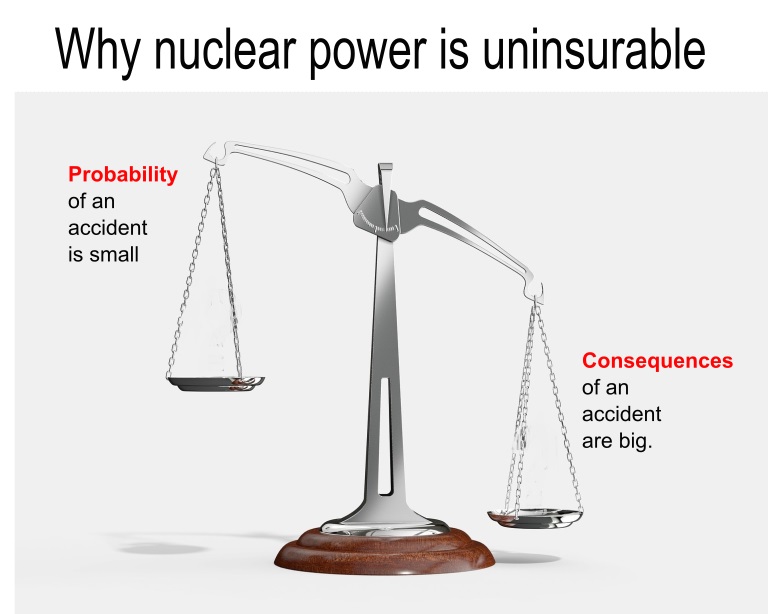
Japan’s participation in a $40bn nuclear power project in the US has hit
a roadblock over fears that its lenders might have to assume liability for
any meltdown on American soil.
Prime Minister Sanae Takaichi agreed during
a visit to Washington in March that Japan would provide funding and
industrial co-operation to build next-generation small modular reactors in
Tennessee and Alabama.
The project was agreed as part of Tokyo’s
commitment to invest $550bn in the US, a promise given in return for lower
US tariffs on Japanese exports under Donald Trump’s “liberation day”
regime. But details of the project are still being thrashed out between
Tokyo and Washington because of concerns on the Japanese side about their
potential liability in a nuclear accident, according to four people
familiar with the discussions.
The US commerce department has offered
verbal reassurance that the state-backed Japan Bank for International
Cooperation and other Japanese institutions would not take on any liability
for a potential nuclear accident, said the people. A person close to
commerce secretary Howard Lutnick said he had personally assured Japan it
would not have any liability in relation to the projects. However, that
promise has not been put in writing in legal terms — a process that could
take months or years of complex regulatory discussion to settle, said the
people.
FT 23rd July 2026, https://www.ft.com/content/4b9d0e1a-c423-4b14-a7fe-d4988e24c7c0
US signs landmark nuclear deal with Saudi Arabia
Nuclear experts and former officials in Israel – the US’s top ally in the Middle East – have voiced concern that the plan could ultimately lead to Saudi Arabia being able to develop a nuclear weapon – though other experts say that path would likely take decades and spark pushback from the international community.
James FitzGerald and Max Matza
The US and Saudi Arabia have signed a landmark deal that will allow the Gulf kingdom to develop a civilian nuclear programme.
The deal is described as a “peaceful nuclear co-operation agreement” that will provide “great access for American companies in the Saudi nuclear energy program” by the US energy department.
Text from the deal has not been made public, but US media report that it could allow Saudi Arabia to enrich uranium in the future – which can be used as fuel for power plants, but also to make nuclear bombs.
Experts say that would mark a first for the US and could run the risk of future nuclear proliferation in an already unstable region.
Trump’s nuclear deal with Saudis jettisons longstanding US demands
The US Department of Energy said a “bilateral safeguards agreement” had been signed along with the co-operation deal.
“Together, these two agreements lay the legal foundation for a decades-long, multi-billion-dollar partnership that advances several priority economic and strategic objectives, including nuclear nonproliferation,” the statement said.
The Saudi government also released a statement saying the deal “represents an extension of existing co-operation between the two countries in the energy sector”, noting that it comes after the Saudi leader visited Washington last November.
The nuclear issue has been at the centre of the months-long US-Israeli conflict with Iran. The two nations say one of the reasons they attacked Iran in February was to prevent the country from ever developing a nuclear weapon – something that Tehran denies planning to do.
Saudi Arabia’s de facto ruler, Crown Prince Mohammed bin Salman, told CBS News in 2018 that his own nation was not planning to acquire a nuclear weapon, but that “without a doubt if Iran developed a nuclear bomb, we will follow suit as soon as possible”.
Wednesday’s announcement came as fighting escalates between the US and Iran. Saudi Arabia, a longtime US ally, hosts several US bases that have been targeted by Iranian attacks. It also comes two days after Iran’s allies in Yemen, the Houthis, announced a “maritime blockade” against the kingdom.
Specific details of the nuclear deal have not been given but earlier media reports suggested that, after undertaking a joint study with the US, Saudi Arabia may be allowed to enrich uranium on its soil to produce fuel at a US-built enrichment facility, instead of relying on imported fuel.
This could be worth billions of dollars to the US, whose companies could be involved in building a facility to produce enriched uranium, which can be used as fuel for power plants but also to make nuclear bombs.
“Rest assured, these agreements uphold the highest standards of nuclear safety and nonproliferation, while relying on the world’s best nuclear technology and scientists, designed right here in the United States,” US Secretary of Energy Chris Wright said.
The energy department said the deal would advance both “US and regional security”, and would strengthen America’s “competitive edge in civil nuclear technology”.
Nuclear experts and former officials in Israel – the US’s top ally in the Middle East – have voiced concern that the plan could ultimately lead to Saudi Arabia being able to develop a nuclear weapon – though other experts say that path would likely take decades and spark pushback from the international community.
Israeli Economy Minister Nir Barkat said his country “can manage it” if Saudi Arabia had nuclear power for peaceful means.
Israel itself is widely believed to have nuclear weapons, but it neither confirms nor denies that this is the case.
Rosemary Kelanic, the director of the Middle East programme at the US-based Defense Priorities think tank, said it would be “quite shocking” if the US were to allow Saudi Arabia uranium enrichment facilities.
“The US has never done that before. We have never helped another country enrich on their own soil,” she said, adding that this was because “if you can produce your own nuclear fuel, you become a much bigger risk” for building nuclear weapons.
The agreement will now be sent to the US Congress for review.
1 This Month

To see nuclear-related stories in greater depth and intensity – go to https://nuclearinformation.wordpress.com
-
Archives
- September 2026 (174)
- August 2026 (330)
- July 2026 (355)
- June 2026 (287)
- May 2026 (306)
- April 2026 (356)
- March 2026 (251)
- February 2026 (267)
- January 2026 (308)
- December 2025 (358)
- November 2025 (359)
- October 2025 (375)
-
Categories
- 1
- 1 NUCLEAR ISSUES
- business and costs
- climate change
- culture and arts
- ENERGY
- environment
- health
- history
- indigenous issues
- Legal
- marketing of nuclear
- media
- opposition to nuclear
- PERSONAL STORIES
- politics
- politics international
- Religion and ethics
- safety
- secrets,lies and civil liberties
- spinbuster
- technology
- Uranium
- wastes
- weapons and war
- Women
- 2 WORLD
- ACTION
- AFRICA
- Atrocities
- AUSTRALIA
- Christina's notes
- Christina's themes
- culture and arts
- Events
- Fuk 2022
- Fuk 2023
- Fukushima 2017
- Fukushima 2018
- fukushima 2019
- Fukushima 2020
- Fukushima 2021
- general
- global warming
- Humour (God we need it)
- Nuclear
- RARE EARTHS
- Reference
- resources – print
- Resources -audiovicual
- Weekly Newsletter
- World
- World Nuclear
- YouTube
-
RSS
Entries RSS
Comments RSS
 nuclear-news