Submissions to the Federal Court of Appeal about UN Declaration on the Rights of Indigenous Peoples (UNDRIP)
Raven Trust, By Levin Chamberlain, February 10, 2026
Gitxaała Nation’s recent decision in the British Columbia Court of Appeal (BCCA) in Gitxaala v. British Columbia (Chief Gold Commissioner), 2025 BCCA 430 that incorporates the United Nations Declaration on the Rights of Indigenous Peoples (UNDRIP) into positive law is getting attention. While media outlets are focused on David Eby’s commitment to amending the Declaration on the Rights of Indigenous Peoples Act (DRIPA) — undermining the rule of law and potentially reversing decades of reconciliation — behind the scenes, there’s a company trying to further undermine Indigenous rights – Canadian Nuclear Laboratories (CNL).
CNL recently filed a submission in Kebaowek First Nation’s case over the proposed nuclear waste facility on their territory, a legal case that RAVEN has supported for almost two years. If built in its current location, the facility would hold over one million cubic metres of nuclear waste just one kilometre from the Kichi Sibi (Ottawa river), which provides millions of people with clean drinking water.
Kebaowek recently went to the Federal Court of Appeal with CNL, who is seeking to overturn the need for the First Nation’s free, prior, and informed consent over the consultation process to build the nuclear waste facility. You can read more about the decision and why Kebaowek cross-appealed here.
With the BCCA decision in Gitxaała’s case being such a powerful precedent that incorporates UNDRIP, the Federal Court judges gave CNL and Kebaowek the opportunity to make new submissions specifically about this decision. Not only does this show how interconnected Indigenous-led litigation is (which RAVEN is integral to in supporting both cases), but it also allows for both sides to share new perspectives.
The Submissions
CNL’s response with a new submission to the courts argues that Gitxaała’s case is “wholly distinguishable” from their case, and that it doesn’t alter the one sole point that CNL is relying on: consultation with Kebaowek was fulfilled. They comb through the specific differences between DRIPA and Canada’s own United Nations Declaration on the Rights of Indigenous Peoples Act (UNDA) in attempts to show how UNDA shouldn’t be taken the same way as DRIPA. CNL also criticizes two aspects of the BCCA’s decision in Gitxaala v. British Columbia as “unsupported statements of law.”
Is that fear we are picking up on in CNL’s submission? Or is it just pure hypocrisy……………………………………..
The Reality
Unfortunately, instead of navigating toward reconciliation between the Crown, industry, and Indigenous Peoples, we are witnessing more conflict and tension than before. UNDRIP and its incorporation into positive law in Canada should be something to celebrate with clear pathways toward long-term economic development and environmental protections while honouring Indigenous rights and their territories. Working in a good way with First Nations, like Kebaowek, is crucial for getting decisions right, especially in a world with a rapidly accelerating climate, sincere threats to democratic processes, and a troubling shift of public support away from reconciliation.
In 2007, Canada and three other nation-states initially opposed the ratification of UNDRIP. They opposed enshrining the human rights of Indigenous Peoples on an international stage. That – and much, much worse – will always be a part of our dark history in Canada. Unless we see a real shift in accountability and action, future generations will view this time period and the responses by industry and the Crown as another era of oppression.
But, even if the decision is overturned and Kebaowek doesn’t have their day at the Supreme Court of Canada; even if David Eby is successful in reducing the legal teeth of UNDRIP for Indigenous Peoples to use in B.C.’s courtrooms; even if something similar happens to UNDA; there will be no end to pursuits for justice. UNDRIP rights are fundamental human rights of Indigenous Peoples that are just now being recognized through colonial doctrines. These rights have existed since time immemorial in their own beautiful and unique ways, and although injustice is present, the people will continue to resist, and justice shall persist. https://raventrust.com/articles/the-law-is-connected-new-submissions-to-the-federal-court-of-appeal-about-undrip/
WANTED: Volunteers to host nuclear waste, forever
By Sarah Mcfarlane, Timothy Gardner and Susanna Twidale, February 6, 2026, https://www.reuters.com/sustainability/land-use-biodiversity/wanted-volunteers-host-nuclear-waste-forever-2026-02-06/
- U.S. wants campuses to host nuclear facilities and data centers
- Asks states to volunteer, permanent waste disposal a must-have
- No deep geological waste facility yet in operation worldwide
LONDON/WASHINGTON, Feb 6 (Reuters) – The Trump administration’s plan to unleash a wave of small futuristic nuclear reactors to power the AI era is falling back on an age-old strategy to dispose of the highly toxic waste: bury it at the bottom of a very deep hole.
But there’s a problem. There is no very deep hole, and the stockpile of some 100,000 tons of radioactive waste being stored temporarily at nuclear plants and other sites across the United States keeps getting bigger.
To resolve this quandary, the U.S. administration is now dangling a radioactive carrot.
States are being asked to volunteer to host a permanent geological repository for spent fuel as part of a campus of facilities including new nuclear reactors, waste reprocessing, uranium enrichment and data centers, according to a proposal published by the Department of Energy (DOE) last week.
Its request for information (RFI) marks a big shift in policy. The plan to boost nuclear energy is now combined with a requirement to find a permanent home for waste and puts decisions in the hands of local communities – decisions worth tens of billions of dollars in investment and thousands of jobs, according to a spokesperson for the DOE’s Office of Nuclear Energy.
“By combining this all together in a package, it’s a matter of big carrots being placed alongside a waste facility which is less desirable,” said Lake Barrett, a former official at the U.S. Nuclear Regulatory Commission (NRC) and the DOE. States including Utah and Tennessee have already expressed interest in nuclear energy investments, he said.
The nuclear office said the request had generated interest but did not comment on individual states, which have 60 days to respond. Officials in Utah and Tennessee did not respond to requests for comment.
President Donald Trump wants to quadruple U.S. nuclear power capacity, opens new tab to 400 gigawatts by 2050 as electricity demand surges for the first time in decades thanks to the boom in data centers driving artificial intelligence and the electrification of transport.
In 2025, the DOE picked 11 new advanced nuclear test reactor designs for fast-track licensing and aims to have three pilots built by July 4 this year.
However, public acceptance of nuclear energy hinges partly on the promise of burying nuclear waste deep underground, according to studies by the U.S. and British governments as well as the European Commission.
“A complete nuclear strategy must include safe, durable pathways for final disposition, and that remains a required element of the RFI,” the Office of Nuclear Energy spokesperson said.
Previous efforts to find a solution have run into strong local opposition.
The DOE started looking for a permanent waste facility in 1983 and settled on Nevada’s Yucca Mountain in 1987. But former President Barack Obama halted funding in 2010 due to opposition from Nevada lawmakers worried about safety and the effect on casinos and hotels – with nearly $15 billion already spent.
NEW REACTOR DESIGNS
To accelerate the deployment of nuclear power, countries including the United States, Britain, Canada, China and Sweden are championing so-called small modular reactors (SMRs).
The appeal of SMRs lies in the idea they can be mostly prefabricated in factories, making them faster and cheaper to assemble than the larger reactors already in use.
But none of the new SMR designs are expected to solve the waste problem. Experts say designers are not compelled to consider waste at inception, beyond a plan for how it will be managed.
“This rush to create new designs without thinking about the full system bodes really poorly for effective regulatory oversight and having a well-run, safe, and reliable waste management program over the long term,” said Seth Tuler, associate professor at the Worcester Polytechnic Institute and previously on the U.S. Nuclear Waste Technical Review Board.
Most of the new SMRs are expected to produce similar volumes of waste, or even more, per unit of electricity than today’s large reactors, according to a study published in the Proceedings of the National Academy of Sciences in 2022.
SMRs can also be sited in areas lacking the infrastructure needed for larger plants, raising the prospect of many more nuclear sites which could become interim waste dumps too. And in the United States, “interim” can mean more than century after a reactor closes, according to the U.S. nuclear power regulator.
Reuters contacted the nine companies behind the 11 SMR designs backed by the DOE’s fast-track programme. Some said nuclear waste was an issue for the operators of the reactors, and the government.
Others said they hoped technological advances in the coming decades would improve prospects for reprocessing fuel, although they agreed a permanent repository was still needed.
The prospect of a new wave of nuclear reactors, has rekindled interest in reprocessing spent fuel whereby uranium and plutonium are separated out and, in some instances, reused.
“Modern technologies, particularly advanced recycling and reprocessing, can dramatically shrink the volume of nuclear material requiring disposal,” the spokesperson for the nuclear energy office said. “At the same time, reprocessing does not eliminate the requirement for permanent disposal.”
Nuclear security experts, however, questioned whether reprocessing would be included in any of the new campuses.
“Every time it’s been attempted, it’s failed, it creates security and proliferation risks, the costs are enormous, and it complicates waste management,” said former DOE official Ross Matzkin-Bridger. He said the few countries reprocessing fuel were recycling between zero to 2%, far below the 90% promised.
A PERMANENT PROBLEM
For now, most waste in the United States, Canada, Europe, and Britain is stored on site indefinitely, first in spent fuel pools to cool and then in concrete and steel casks. France sends spent fuel to La Hague in Normandy for reprocessing.
The more than 90 nuclear reactors operating in the United States – the world’s biggest nuclear power producer ahead of China and France – add about 2,000 tons of waste a year to existing stockpiles, according to the DOE.
Office of Nuclear Energy data shows that as of the end of 2024, U.S. taxpayers have paid utility companies $11.1 billion to compensate them for storing spent fuel, some of which can remain harmful to humans for hundreds of thousands of years.
Scotland’s Dounreay site, where the last reactor closed in 1994, has repeatedly extended its decommissioning period and budget due to complications handling waste, according to the British government, in an early sign of the issues the industry faces as older plants shut down.
Vast vaults are being stocked with low-level radioactive waste in large metal containers as Dounreay, once at the cutting edge of Britain’s nuclear industry, is dismantled.
Ever since the first commercial nuclear plant went online 70 years ago in England, the consensus has been that burying the most toxic waste deep underground is the safest option but there is still no repository in operation anywhere in the world.
Getting a repository up and running is a slow process. Governments need community buy-in and geological studies are required to determine the flow of groundwater and the stability of the rock up to 1,000 metres (1,090 yards) underground.
Finland has made the most progress and is close to opening the world’s first permanent nuclear repository in Olkiluoto – having also kicked off the process way back in 1983.
Posiva, the Finnish company behind the project, began transferring test canisters more than four hundred meters below ground in 2024. It told Reuters its goal is to start commercial operations this year, though it is waiting for the Finnish Radiation and Nuclear Safety Authority to approve the operating licence, which will be followed by technical checks.
Once up and running, separate underground tunnels will be filled with canisters made of copper and iron housing the waste, and then sealed forever.
Sweden began constructing its permanent repository in January 2025, aiming to have it running by the late 2030s. Canada has agreed a site in Ontario which it aims to be operational by the late 2040s. Switzerland and France have chosen sites too and hope to have their repositories open from about 2050. Britain is shooting for the late 2050s, but has yet to settle on a location.
Pending the construction of a permanent repository somewhere in the country, high-level waste from nuclear sites such as Dounreay is sent for storage at Sellafield in England.
Some decommissioned nuclear sites, including Dounreay, are also being promoted as locations for data centers, as they’re hooked up to the power grid already and won’t need to wait for a connection.
But the clean-up there has a way to go. Irradiated nuclear fuel was flushed into the sea decades ago and a “minor” radioactive fragment was found on a local beach as recently as January.
The last “significant” particle was found in April and fishing is banned within a 2 kilometer (1.25 mile) radius of Dounreay’s outlet pipe because of radioactive particles on the seabed.
Last year, Britain extended the time frame for the Dounreay clean-up from 2033 to the 2070s.
Reporting by Sarah McFarlane and Susanna Twidale in London, Timothy Gardner in Washington; Visual Production by Morgan Coates; Editing by David Clarke
Leading Papers Call for Destroying Iran to Save It

Gregory Shupak, February 10, 2026, https://fair.org/home/leading-papers-call-for-destroying-iran-to-save-it/
The United States has no right to wage war on Iran, or to have a say who governs the country. The opinion pages of the New York Times and Washington Post, however, are offering facile humanitarian arguments for the US to escalate its attacks on Iran. These are based on the nonsensical assumption that the US wants to help brighten Iranians’ futures.
In two editorials addressing the possibility of the US undertaking a bombing and shooting war on Iran, the Washington Post expressed no opposition to such policies and endorsed economic warfare as well.
Crediting Trump with “the wisdom of distinguishing between an authoritarian regime and the people who suffer under its rule,” the first Post editorial (1/2/26) approvingly quoted Trump’s Truth Social promise (1/2/26) to Iranian protesters that the US “will come to their rescue…. We are locked and loaded and ready to go.”
For the Post, the problem was not that Trump was threatening to bomb a sovereign state, but that “airstrikes are, at best, a temporary solution”:
If the administration wants this time to be different, it will need to oversee a patient, sustained campaign of maximum pressure against the government…. The optimal strategy is to economically squeeze the regime as hard as possible at this moment of maximum vulnerability. More stringent enforcement of existing oil sanctions would go a long way…. Western financial controls are actually working quite well.
Thus, the paper offers advice on how to integrate bombing Iran into a broader effort to overthrow the country’s government in a hybrid war. Central to that project are the sanctions with which the Post is so thoroughly impressed. Such measures have “squeeze[d] the regime” by, for example, decimating “the government’s primary source of revenue, oil exports, limiting the state’s ability to provide for millions of impoverished Iranians through social safety nets” (CNN, 10/19/25).
That the US continues to apply the sanctions, knowing that they have these effects, demonstrates that it has no interest in, as the Post put it, “free[ing]” Iranians “from bondage.”
‘Always more room for sanctions’
The second Washington Post editorial (1/23/26) expressed disappointment that, despite “mass killings” and the “most repressive crackdown in decades,” “Trump has ratcheted back his earlier rhetoric.” It emphasized that “the regime is now mocking Trump for backing down.” The paper offered advice for the president:
Airstrikes alone won’t bring down the regime—or make it behave like a normal country. But Israel and the US have shown in recent years that bombing can cause significant tactical setbacks. And there is always more room for sanctions pressure….
The president cannot maintain effective deterrence by turning the other cheek [in response to Iranians who have taunted him]. How he responds is just as important as how quickly he does it.
The implication is that, to deter Iran’s government from killing Iranians, the US needs to kill Iranians. After all, bombing campaigns come with “mass killings” of their own: The US/Israeli aggression against Iran last June killed more than 1,000 Iranians, most of them civilians.
Meanwhile, those sanctions the paper wants to use to deter the Iranian government from “harm[ing] its own people” do quite a bit of damage in their own right, often causing “low-income citizens’ food consumption” to “deteriorate due to sanctions”—a rather novel approach to harm reduction.
Bombing other countries, depriving them of food—is this what it means to “behave like a normal country”?
‘Too depraved’ for reform
Over its own pro–regime change piece, the New York Times editorial board headline (1/14/26) declared: “Iran’s Murderous Regime Is Irredeemable.”
“The Khamenei regime is too depraved to be reformed,” the editors wrote, spending the majority of the piece building its case to that effect before turning to solutions. For the Times, these start “with a unified expression of solidarity with the protesters,” and quickly move to punitive measures against the Iranian government:
The world can also extend the sanctions it has imposed on Iran. The Trump administration this week announced new tariffs on any countries that do business with Iran, and other democracies should impose their own economic penalties.
For the authors, “deprav[ity]” needs to be resisted by Washington and its partners, who have demonstrated their moral superiority with their presumably depravity-free sanctions. These have, as Germany’s DW (11/23/25) reported, “caused medical shortages that hit [Iran’s] most vulnerable citizens hardest,” preventing the country from being able “to purchase special medicines—like those required by cancer patients.”
The Times also supported US military violence against Iran—if with somewhat more restraint than the Post, asking Trump to “move much more judiciously than he typically does.” The Times wants him to seek “approval from Congress before any military operation,” and make “clear its limitations and goals.” The paper warned Trump not to attack “without adequate preparation and resources”:
Above all, he should avoid the lack of strategic discipline and illegal actions that have defined the Venezuela campaign. He should ask which policies have the best chance of undermining the regime’s violent repression and creating the conditions for a democratic transition.
One glaring problem with suggesting that a US “military operation” should be based on “policies [that] have the best chance of…creating the conditions for a democratic transition” is that very recent precedents show that US wars don’t bring about democracy, and are not intended to do so; instead, such wars bring about social collapse.
Consider, for example, US interventions in Libya and Syria. In both cases, the US backed decidedly nondemocratic forces (Jacobin, 9/2/13; Harper’s, 1/16) and, as one might expect, neither war resulted in democracy. In Libya’s case, the outcome has been slavery and state collapse (In These Times, 8/18/20). In Syria, the new, unelected government is implicated in sectarian mass murder (FAIR.org, 6/2/25).
If DHS killed Pretti, why not bomb Iran?
There are no grounds for believing that the US would chart a different course if it bombs Iran again. But that hasn’t stopped other Times contributors from suggesting that the US should conduct a war in Iran—for the good of Iranians, of course.
Times columnist Bret Stephens (1/27/26) worried about the “risk” posed by “the example of a US president who urged protesters to go in the streets and said help was on the way, only to betray them through inaction.”
Invoking the DHS’s killing of Minneapolis resident Alex Pretti, Stephens urged “thoughtful Americans” to encourage the same administration that killed him to exercise “the military option” in Iran:
But if Pretti’s death is a tragedy, what do we say or do in the face of the murder of thousands of Iranians? Are they, as Stalin might have said, just another statistic?
Stephens is citing people’s outrage against the US government killing a protester as a reason they should support the US government inflicting more violence against Iran. The logical corollary to that would be that if you’re opposed to Iran suppressing anti-government forces, you should therefore be in favor of Tehran launching armed attacks to defend protesters in the US.
Masih Alinejad, a US-government-funded Iranian-American journalist, wrote in the Times (1/27/26) that Trump
encouraged Iranians to intensify their mass protests, writing, “HELP IS ON ITS WAY.” That help never came, and many protesters now feel betrayed. Still, the USS Abraham Lincoln aircraft carrier strike group has recently arrived in the Middle East. Mr. Trump has not said what he plans to do now that it is there, but it does give him the option of striking a blow against government repression.
Policy of pain
Both Stephens and Alinejad present their calls for the US to assault Iran in moral terms, suggesting that the US should demonstrate loyalty to Iranian protestors by “help[ing]” them through an armed attack on the country in which they live. Their premise is that the US is interested in enabling the Iranian population to flourish, an assertion contradicted by more than 70 years of Washington’s policy of inflicting pain on Iranians in an effort to dominate them.
That US policy has included overthrowing Iran’s democratically elected government in 1953 (NPR, 2/7/19), propping up the Shah’s brutal dictatorship for the next 26 years (BBC, 6/3/16; AP, 2/6/19), sponsoring Saddam Hussein’s invasion of the country and use of chemical weapons against it (Foreign Policy, 8/26/13), partnering with Israel in a years-long campaign of murdering Iranian scientists (Responsible Statecraft, 12/21/20), and currently maintaining—along with its allies—a sanctions regime that is associated with a substantial drop in Iranian life expectancy (Al Jazeera, 1/13/26).
If Stephens or Alinejad had evidence that the US is so radically re-orienting its conduct in the international arena, one imagines that they would want to share with their readers the proof that the Trump administration’s magnanimity is so profound that it overrides the UN Charter, and justifies America carrying out a war to “help” a country it has terrorized for decades.
Bad Beginnings: The End of New START

Putin was also of the opinion that “a complete renunciation of New START’s legacy would, from many points, be a grave and short-sighted mistake”, having “adverse implications for the objectives of the [Nuclear Non-Proliferation Treaty].
11 February 2026 Dr Binoy Kampmark, AIM,
Future of How awful could it get? The New Strategic Arms Reduction Treaty (New START) expired on February 5, terminating an era of arms control and imposed limits on lunatically contrived nuclear weapons programs of the United States and Russia. The New START Treaty entered into force on February 5, 2011 and initially imposed a timeline of seven years for the parties to meet the central limits on strategic offensive arms. Those limits would then be maintained for the duration of the Treaty.
Till its expiry, the countries maintained limits on the following nuclear arms and systems: 700 deployed intercontinental ballistic missiles (ICBMs), deployed submarine-launched ballistic missiles (SLBMs), and deployed heavy bombers capable of using nuclear armaments; 1,550 nuclear warheads on all three deployed platforms; and 800 deployed and non-deployed nuclear capable systems (ICBM launchers, SLBM launchers, and nuclear capable heavy bombers).
Such limits were hardly laudatory, or even exceptional. The cap of 1,550 nuclear warheads is the sort of thing that would only impress the limited crazed circle that passes for arms negotiators in this field, and the various thanocrats who populate such institutes as RAND. Such a show is merely intended for both Moscow and Washington to tell other countries with, or without nuclear weapons, that they could impose restraints on their own gluttonous conduct. Even then, New START, as with all such instruments dealing with limiting nuclear weapons, came with the intended, gaping lacunae. It failed to cover, for instance, tactical nuclear weapons, nor limit the deployment of new strategic weapon systems.
The treaty also fell into neglect with the outbreak of the COVID-19 pandemic. Suspended on-site inspections never resumed after 2022. As François Diaz-Maurin of the Bulletin of the Atomic Scientists points out, “Russia has not shared data on its deployed strategic nuclear forces since September 2022, it suspended its treaty participation altogether in February 2023, and the United States has not published any aggregate numbers since May 2023.” New START came to increasingly look like a gentleman’s agreement being sniffed at by truculent adolescents.
In September last year, Russian President Vladimir Putin dangled the prospect of extending the treaty’s core limits for a year. At a September 22, 2025 Russian Security Council Meeting, he promised that Moscow was “prepared to continue observing the … central quantitative restrictions” stipulated in New START for twelve months provided the US acted “in similar spirit.” Following the year’s extension, “a careful assessment of the situation [and] a definite decision on whether to uphold these voluntary self-limitations” would be made. Putin was also of the opinion that “a complete renunciation of New START’s legacy would, from many points, be a grave and short-sighted mistake”, having “adverse implications for the objectives of the [Nuclear Non-Proliferation Treaty].
When word of this reached the White House, Press Secretary Karoline Leavitt expressed the view that the proposal sounded “pretty good.” Two weeks later, President Donald Trump responded to a question posed by a TASS reporter that Putin’s proposal sounded “pretty like a good idea to me.” Little, however, was subsequently done. Indeed, Trump has cut the number of diplomats tasked with nuclear matters in the State Department and made public statements last October that nuclear testing might be resumed. He has also complicated arms control matters by insisting that China be added to the limitation talks, something Beijing has shown little interest in doing. In January this year, the president seemed unfussed that the international document was about to pass into the archives of diplomatic oblivion. “If it expires, it expires. We’ll do a better agreement.”
The US political establishment had been struck by a distinct lack of interest, even lethargy, on the subject. New START seemed to be yet another irritating fetter on an administration more enthused by ignoring international obligations than following them. Only a clutch of Democrats seemed to show concern in reflecting about what would follow the treaty’s expiration in House speeches given on January 14. This month, Massachusetts Democrat Sen. Ed Markey, co-chair of the Senate’s Nuclear Weapons and Arms Control Working Group, held a press conference urging the Trump administration to renew the vows of fidelity to arms control agreements. “Let’s be honest. America needs another nuclear weapon about as much as Donald Trump deserves a Nobel Peace Prize.”………………………………………………………..
The two powers most responsible for keeping nuclear weapons unforgivably attractive to those who would acquire them show promise of blotting their copybook further. There is a serious sentiment in Washington that the nuclear stockpile will and should grow. The Bulletin of Atomic Scientists, in a fit of gloominess, moved its metaphorical Doomsday Clock just that bit closer to “midnight,” the point where biblical calamity will be assured. It now stands at 85 seconds to midnight. Not long to go now. https://theaimn.net/bad-beginnings-the-end-of-new-start/
New Mexico Environment Department Takes Necessary Action on Los Alamos National Laboratory’s Hexavalent Chromium Plume.
Concerned Citizens for Nuclear Safety, 13 Feb 26
On Tuesday, February 11th, the New Mexico Environment Department took bold actions to hold the Department of Energy (DOE) and Los Alamos National Laboratory (LANL) accountable for the release and distribution of hexavalent chromium contamination into the regional drinking water aquifer and onto Pueblo de San Ildefonso lands. The Environment Department released two administrative compliance orders, both with civil penalties, totaling over $15,775,000.00.
This Update focuses on the first Environment Department administrative compliance order, No. 26-01, which revolves around the Environment Department’s consideration of LANL’s application for a discharge permit for the extraction, treatment of the contaminated waters and injection of those waters back into the regional drinking water aquifer and the requirements to take action to protect the regional drinking water supply. https://cloud.env.nm.gov/resources/_translator.php/MjMzYzM5YTExNTJlYjUwNTA0MTQ3ZGQzNl8yMTc2NzU~.pdf
In 2015, LANL submitted an application to the Environment Department for a groundwater discharge permit to investigate the protective interim measures that could be taken to protect the regional drinking water aquifer and to characterize the hexavalent chromium plume to determine the best course of action to clean up the contamination and to stop future contamination. After a public hearing, the Environment Department issued the groundwater discharge permit, DP-1835, to LANL.
The 44-page administrative order details the steps that were taken, the obstacles that were placed in the way, and the back and forth between the parties to address the plumes.
Sixth Trump meeting with his de facto boss…good day to fire him.
Walt Zlotow West Suburban Peace Coalition Glen Ellyn IL , 12 Feb , 26
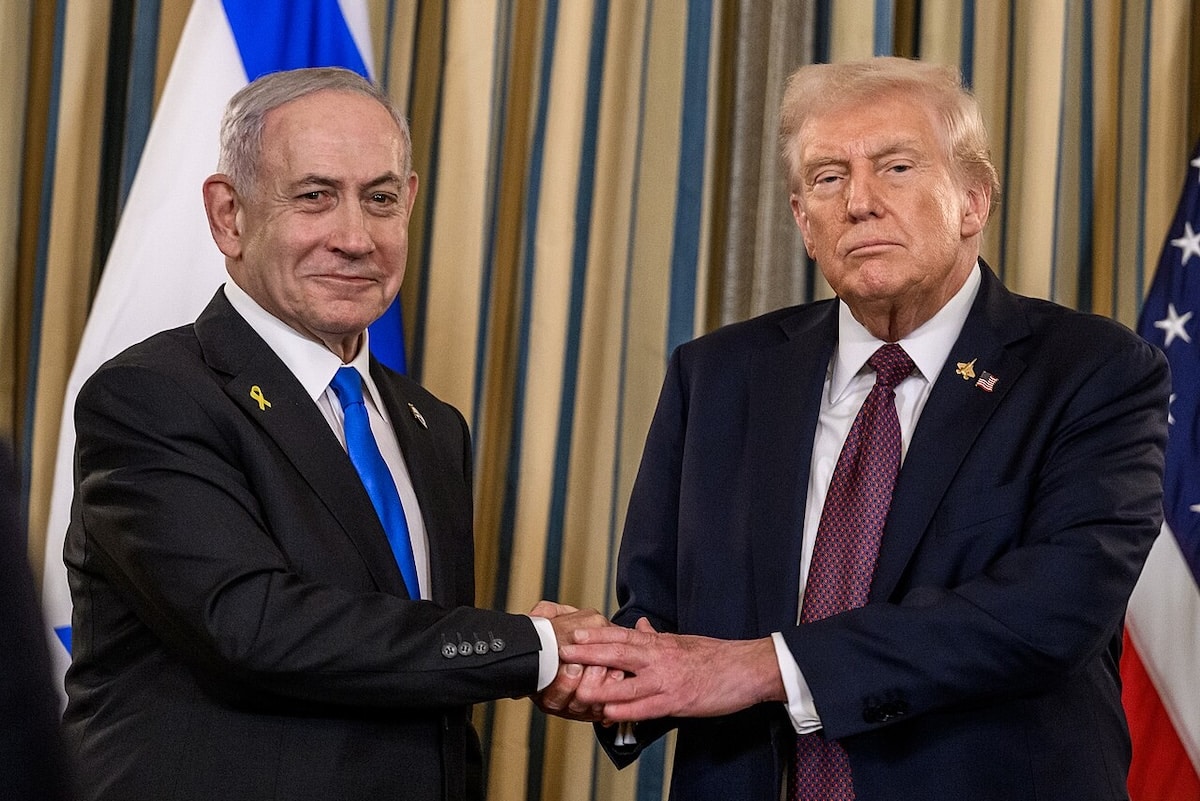
President Trump’s de jure, constitutional boss is We the People. 77 302,580 of us, giving Trump 58% of the Electoral College, hired him November 5, 2024. Trump serves and reports to Us.
But during the past 13 months he’s dismissed his true boss to take orders from Israeli Prime Minister Benjamin Netanyahu. Support the Israeli genocide obliterating Palestinians in Gaza with billions in weapons…check. Conspire with Netanyahu to sucker punch Iran with a sneak attack to decapitate their regime last June…check. Support Israeli provocateurs to infiltrate domestic Iranian protests to overthrow the Iranian regime last December…check.
Netanyahu is furious both his murderous Iranian regime change ventures failed. So he demanded, and of course got, his sixth sit down with Trump scheduled for today. Topic Number One? Iran, and not to make peace with Iran, likely the next and most massive attack that will finally achieve Netanyahu’s cherished dream of a decapitated, degraded Israeli rival for Middle East supremacy.
At Netanyahu’s behest Trump has moved a massive military armada into the region. Pulling back is near impossible when Trump’s boss demands he pull the trigger on senseless war that could blow up the Middle East, indeed possibly the world.
It would take a psychiatrist, maybe a team of psychiatrists, to unravel why Trump allows Netanyahu to be his real boss. It may simply be the near quarter of a billion dollars Netanyahu’s Israel Lobby has provided Trump’s campaign coffers since 2020.
Regardless, someone in the Trump orbit needs to convince Trump who his real boss is. We the People do not want our treasure supporting genocide in Gaza. Nor do we want it used to launch massive war on Iran to please Trump’s de facto boss Benjamin Netanyahu.
Trump needs to usher Netanyahu into the Oval Office today and immediately announce…’You’re fired.’
US campaign puts case for disposal, not reprocessing, of used nuclear fuel

This article, from the the nuclear lobby’s propaganda voice – World Nuclear News – goes on later to push for nuclear reprocessing, anyway.
Reprocessing or not -it’s really becoming clear that new nuclear, and patched-up old nuclear reactors are not clean, safe, or economically viable.
WNN, 12 February 2026
The Nuclear Scaling Initiative’s Scale What Works campaign says that direct disposal of used nuclear fuel in the US is the “safest, most secure and least expensive pathway for the country” as nuclear energy capacity is expanded.
clear, straightforward direct disposal policies’ (Image: Posiva)
The initiative – which is a collaboration of the Clean Air Task Force, the EFI Foundation and the Nuclear Threat Initiative – aims to “build a new nuclear energy ecosystem that can quickly and economically scale to 50+ gigawatts of safe and secure nuclear energy globally per year by the 2030s”.
The Nuclear Scaling Initiative (NSI) Executive Director Steve Comello said: “Making smart fuel management choices today, that acknowledge that reprocessing technologies today are not economically viable and pose security and waste management risks, can drive grid reliability, innovation, and economic and national security for the United States and beyond.”
NSI, whose global advisory board is chaired by former US Secretary of State John Kerry, says that all forms of energy production produces waste, and says that in nuclear’s case, directly storing and “eventually disposing of intact spent fuel” underground “is a safe, straightforward process that uses existing expertise and infrastructure”.
Countries should learn from the reprocessing experience in the UK, Japan and France, NSI says, adding that its view is that reprocessing used fuel is “costly, complex and time-intensive, increasing energy prices for consumers and diverting resources from readily deployable technologies”.
Former Deputy Secretary of Defense and Under Secretary of Energy John Deutch said: “Reprocessing is not a reasonable option: it threatens security, is not cost-effective and will slow our ability to scale nuclear energy.”
Reprocessing of used fuel from commercial reactors has been prohibited in the USA since 1977, with all used fuel being treated as high-level waste………………………………………………………. https://www.world-nuclear-news.org/articles/us-campaign-puts-case-for-disposal-not-reprocessing-of-used-fuel
US congressional report explores option of not delivering any Aukus nuclear submarines to Australia.

COMMENT – What a typical USA plan?
They reneg on delivering the “goods” sold, but keep the $368 billion!
the Congressional Research report describes an alternative “military division of labour”, under which the US would not sell any Virginia-class submarines to Australia.
Report offers alternative of the US navy retaining boats and operating them out of Australian bases
Ben Doherty, Guardian, 6 Feb 26
A new United States congressional report openly contemplates not selling any nuclear submarines to Australia – as promised under the Aukus agreement – because America wants to retain control of the submarines for a potential conflict with China over Taiwan.
The report by the US Congressional Research Service, Congress’s policy research arm, posits an alternative “military division of labour” under which the submarines earmarked for sale to Australia are instead retained under US command to be sailed out of Australian bases.
One of the arguments made against the US selling submarines to Australia is that Australia has refused to commit to supporting America in a conflict with China over Taiwan. Boats under US command could be deployed into that conflict.
The report, released on 26 January, cites statements from the Australian defence minister, Richard Marles, and the chief of navy that Australia would make “no promises … that Australia would support the United States” in the event of war with China over Taiwan.
“Selling three to five Virginia-class SSNs [nuclear-powered general-purpose attack submarines] to Australia would thus convert those SSNs from boats that would be available for use in a US-China crisis or conflict into boats that might not be available for use in a US-China crisis or conflict,” the report argues.
“This could weaken rather than strengthen deterrence and warfighting capability in connection with a US-China crisis or conflict.”
Under the existing Aukus “optimal pathway’, Australia will first buy between three and five Virginia-class nuclear-powered conventionally armed submarines, the first in 2032.
Following that, the first of eight Australian-built Aukus submarines, based on a UK design, is slated to be in the water “in the early 2040s”.
But the Congressional Research report describes an alternative “military division of labour”, under which the US would not sell any Virginia-class submarines to Australia.
The boats not sold to Australia “would instead be retained in US Navy service and operated out of Australia” alongside US and UK attack submarines already planned to rotate through Australian bases.
The report speculated Australia could use the money saved to invest on other defence capabilities, even using those capabilities as a subordinate force in support of US missions.
“Australia, instead of using funds to purchase, build, operate, and maintain its own SSNs, would instead invest those funds in other military capabilities – such as … long-range anti-ship missiles, drones, loitering munitions, B-21 long-range bombers … or systems for defending Australia against attack … so as to create an Australian capacity for performing other missions, including non-SSN military missions for both Australia and the United States.”
The report also raises cybersecurity concerns, noting that “hackers linked to China” are “highly active” in attempting to penetrate Australian government and contractors’ computers.
It argues that sharing nuclear submarine technology with another country “would increase the attack surface, meaning the number of potential digital and physical entry points that China, Russia, or some other country could attempt to penetrate to gain access to that technology”.
The debate over whether the US should sell boats to Australia is also grounded in ongoing concern over low rates of shipbuilding in the US: the country’s shipyards are failing to build enough submarines to supply America’s own navy, let alone build boats for Australia.
For the past 15 years, the US Navy has ordered boats at a rate of two a year, but its shipyards have never met that build rate “and since 2022 has been limited to about 1.1 to 1.2 boats per year, resulting in a growing backlog of boats procured but not yet built”.
The US fleet currently has only three-quarters of the submarines it needs (49 boats of a force-level goal of 66). Shipyards need to build Virginia-class submarines at a rate of two a year to meet America’s own needs, and to lift that to 2.33 boats a year in order to be able to supply submarines to Australia.
Legislation passed by the US Congress prohibits the sale of any submarine to Australia if the US needs it for its own fleet. The US commander-in-chief – the president of the day – must certify that America relinquishing a submarine “will not degrade the United States undersea capabilities”.
The report argues that Australia’s strict nuclear non-proliferation laws could also weaken US submarine force projection under the current Aukus plan.
Australian officials have consistently told US counterparts that, in adherence to Australia’s commitments as a non-nuclear weapon state under the Treaty on the Non-Proliferation of Nuclear Weapons, Australia’s attack submarines can only ever be armed with conventional weapons.
“Selling three to five Virginia-class SSNs to Australia would thus convert those SSNs from boats that could in the future be armed with the US nuclear-armed sea-launched cruise missile with an aim of enhancing deterrence,” the report states……………………………………………………………………. https://www.theguardian.com/world/2026/feb/05/not-delivering-any-aukus-nuclear-submarines-to-australia-explored-as-option-in-us-congressional-report
No evidence to support US claim China conducted nuclear blast test: Monitor

Robert Floyd, executive secretary of the Comprehensive Nuclear-Test-Ban Treaty Organization, said in a statement on Friday that the body’s monitoring system “did not detect any event consistent with the characteristics of a nuclear weapon test explosion” at the time of the alleged Chinese test, adding that that assessment remains unchanged after further detailed analyses.
Washington wants Beijing to join a new nuclear weapons treaty after expiration of the New START accord between the US and Russia.
By Al Jazeera and News Agencies, 6 Feb 26, https://www.aljazeera.com/news/2026/2/7/no-evidence-to-support-us-claim-china-conducted-nuclear-blast-test-monitor
An international monitor said it has seen no evidence to support the claim by a senior United States official who accused China of carrying out a series of clandestine nuclear tests in 2020 and concealing activities that violated nuclear test ban treaties.
US Under Secretary of State for Arms Control and International Security Thomas DiNanno made the assertions about China at a United Nations disarmament conference in Geneva, Switzerland, on Friday, just days after a nuclear treaty with Russia expired.
“I can reveal that the US government is aware that China has conducted nuclear explosive tests, including preparing for tests with designated yields in the hundreds of tonnes,” DiNanno said at the conference.
China’s military “sought to conceal testing by obfuscating the nuclear explosions because it recognised these tests violate test ban commitments,” he said.
“China conducted one such yield-producing nuclear test on June 22 of 2020,” he said.
DiNanno also made his allegations on social media in a series of posts, making the case for “new architecture” in nuclear weapons control agreements following the expiration of the New START treaty with Russia this week.
“New START was signed in 2010 and its limits on warheads and launchers are no longer relevant in 2026 when one nuclear power is expanding its arsenal at a scale and pace not seen in over half a century and another continues to maintain and develop a vast range of nuclear systems unconstrained by New START’s terms,” he said.
Robert Floyd, executive secretary of the Comprehensive Nuclear-Test-Ban Treaty Organization, said in a statement on Friday that the body’s monitoring system “did not detect any event consistent with the characteristics of a nuclear weapon test explosion” at the time of the alleged Chinese test, adding that that assessment remains unchanged after further detailed analyses.
China’s ambassador on nuclear disarmament, Shen Jian, did not directly address DiNanno’s charge at the conference but said Beijing had always acted prudently and responsibly on nuclear issues while the US had “continued to distort and smear China’s national defence capabilities in its statements”.
We firmly oppose this false narrative and reject the US’s unfounded accusations,” Shen said.
“In fact, the US’s series of negative actions in the field of nuclear arms control are the biggest source of risk to international security,” he said.
Later on social media, Shen said, “China has always honored its commitment to the moratorium on nuclear testing”.
Diplomats at the conference said the US allegations were new and concerning.
China, like the US, has signed but not ratified the Comprehensive Nuclear Test Ban Treaty (CTBT), which bans explosive nuclear tests. Russia signed and ratified it, but withdrew its ratification in 2023.
US President Donald Trump has previously instructed the US military to prepare for the resumption of nuclear tests, stating that other countries are conducting them without offering details.
The US president said on October 31 that Washington would start testing nuclear weapons “on an equal basis” with Moscow and Beijing, but without elaborating or explaining what kind of nuclear testing he wanted to resume.
He has also said that he would like China to be involved in any future nuclear treaty, but authorities in Beijing have shown little interest in his proposal.
In nuclear race with Russia, Trump goes back to a Cold War future
After letting New START expire, Trump threatens to replace the era of arms control with a new arms race against Russia and China.
Aaron Maté, Feb 07, 2026
As if the lingering prospect of a new attack on Iran is not dangerous enough, the Trump administration is toying with a greater threat to global security.
With Thursday’s expiration of the New START treaty, the US and Russia no longer have any legal constraints on their arsenals of nuclear weapons. President Trump let the treaty collapse rather than accept a Kremlin offer to extend for one year, the maximum possible. This removes the last formal constraint on a renewed arms race between two states that already can destroy the world many times over.
There are unconfirmed reports that the two sides have reached an informal understanding to observe the treaty’s terms for at least six months. And, in a rare sign of progress, Moscow and Washington have announced a resumption of high-level military-to-military dialogue. The Biden administration suspended those contacts in late 2021 as Russia built up its forces on Ukraine’s borders.
Yet the news is far from reassuring…………………………………….(Subscribers only) https://www.aaronmate.net/p/in-nuclear-race-with-russia-trump?utm_source=post-email-title&publication_id=100118&post_id=187111056&utm_campaign=email-post-title&isFreemail=true&r=ln98x&triedRedirect=true&utm_medium=email
Northwatch Comments on the NWMO’s Initial Project Description of a Proposed Deep Geological Repository for High-Level Nuclear Waste

7 Feb 26, https://iaac-aeic.gc.ca/050/evaluations/proj/88774/contributions/id/64898
The following points summarize Northwatch’s comments on the NWMO’s Initial Project Description of a Proposed Deep Geological Repository for High-Level Nuclear Waste to be located at the Revell site in Treaty 3 territory in northwestern Ontario:
- NWMO’s Deep Geological Repository Project should be designated for a full impact assessment and public hearing
- The long-distance transportation of nuclear fuel waste from the reactor stations to the proposed repository site must be included in the impact assessment
- NWMO’s Initial Project Description is inadequate and does not provide the information required, including and particularly it does not sufficiently describe or otherwise demonstrate that it has adequately examined alternatives to the project or alternative means of carrying out the project, and the IPD largely goes off course in its description of the need and purpose of the project.
- As directed by the Nuclear Fuel Waste Act the need or purpose of the project is to effectively isolate the nuclear fuel wastes from people and the environment.
- The NWMO has not provided a clear statement of the need and purpose for the project, and when it discussed the need and purpose of the project in its IPD it muddied the waters by including unsupported promotional statements and out-of-scope policy statements about the future role of nuclear power.
- Instead of setting out careful consideration of alternative means of meeting the project need (to safely contain and isolate the nuclear fuel waste from people and the environment) the NWMO simply summarized some aspects of their 2003 studies. The IPD should include a contemporary assessment of alternative means of meeting the project need.
- The NWMO’s consideration of alternative means of carrying out the project is too limited; the alternative means examination should also include alternative sites, alternatives in repository access (ramp vs shaft), transportation in used fuel containers instead of in transportation packages, the alternative means of in-water transfer of used fuel at repository site (vs “in air” ie. in hot cells), alternative mining methods, alternatives in waste emplacement (in-room vs in-floor) and alternatives in used fuel container design
- The NWMO’s description of the project and project activities is too limited, and at times is promotional rather than factual in its approach.
- The NWMO has misrepresented the fuel waste inventory, upon which repository size, years of operation, and resulting degrees of risk and contamination all hinge.
- The NWMO excluded the first step in their project, which is the transfer of the used fuel waste from dry storage containers into transportation containers at the reactor site; this is consistent with past practice.
- Without foundation the NWMO is attempting to exclude long-distance transportation from the Impact Assessment process; this is inconsistent with the impact assessment law in Canada and with the manner in which the NWMO has been describing their project over the last twenty years.
- The Initial Project Description inadequately describes major project components and activities, including the Used Fuel Packaging Plant, waste placement and repository design and construction and closure, decommissioning and monitoring.
- The description of the Project Site, Location and Study Area(s) is flawed and in some respects inaccurate.
- The potential effects of the project are poorly described and in some instances the NWMO text is promotional rather than factual.
- The description of the site selection process is very selective in the information it presents and creates a false impression of community experience through the siting process in the 22 communities that the NWMO investigated.
- There are significant gaps and deficiencies in the Initial project description; several subject areas fundamental to the assessment of the deep geological repository are extremely limited or fully absent including the subjects of long-term safety, emergency response and evacuation plans, accidents and malevolent acts and security.
- The Initial Project Description was poorly organized and was not copy edited; it lacked an index and there was no glossary included.
“Journalism Deserves Better”: Ex-Washington Post Staffers Slam Billionaire Bezos for Gutting Paper
Democracy Now, February 06, 2026
The Washington Post has laid off more than 300 journalists, dismantling its sports, local news and international coverage. “Everybody is grieving, and it’s a loss for our readers,” says Nilo Tabrizy, one of the paper’s recently laid-off staff, who describes a “robotic” meeting announcing the cuts. “They didn’t have the dignity to look us in the eye.” The shocking staff culling has been widely attributed to the paper’s leadership under Amazon founder Jeff Bezos, who bought the nearly 150-year-old institution in 2013. Karen Attiah, the former global opinion editor at the Post, was hired soon after Bezos’s arrival. She recounts how the arrival of a billionaire backer initially revitalized the paper with resources and creative freedom, before souring over the next decade.
“We thought [he] shared the same values that we had,” says Attiah, who was fired from the Post last fall over comments she made about the death of conservative activist Charlie Kirk. “Journalism deserves better than a billionaire owner who decides that partying in Europe is more important than people’s lives.”……………………………………………………………………………………………………………………………………………………https://www.democracynow.org/2026/2/6/karen_altiah_washington_post_layoffs_journalists
Iran’s Comprehensive Peace Proposal to the United States

The Middle East stands at a crossroads between endless war and comprehensive peace. A framework for peace does exist. Will the US finally seize it?
Jeffrey D. Sachs, Sybil Fares, Common Dreams, Feb 09, 2026
History occasionally presents moments when the truth about a conflict is stated plainly enough that it becomes impossible to ignore. Iranian Foreign Minister Abbas Araghchi’s February 7 address in Doha, Qatar (transcript here) should prove to be such a moment. His important and constructive remarks responded to the US call for comprehensive negotiations, and he laid out a sound proposal for peace across the Middle East.
Last week, US Secretary of State Marco Rubio called for comprehensive negotiations: “If the Iranians want to meet, we’re ready.” He proposed for talks to include the nuclear issue, Iran’s military capabilities, and its support for proxy groups around the region. On its surface, this sounds like a serious and constructive proposal. The Middle East’s security crises are interconnected, and diplomacy that isolates nuclear issues from broader regional dynamics is unlikely to endure.
On February 7, Iranian Foreign Minister Araghchi’s responded to the United States’ proposal for a comprehensive peace. In his speech at the Al Jazeera Forum, the foreign minister addressed the root cause of regional instability – “Palestine… is the defining question of justice in West Asia and beyond” and he proposed a path forward.
The Foreign Minister’s statement is correct. The failure to resolve the issue of Palestinian statehood has indeed fueled every major regional conflict since 1948. The Arab-Israeli wars, the rise of anti-Israel militancy, the regional polarization, and the repeated cycles of violence, all derive from the failure to create a State of Palestine alongside the State of Israel. Gaza represents the most devastating chapter in this conflict, where Israel’s brutal occupation of Palestine was followed by Hamas’s attack on Israel on October 7, 2023, and then by Israel’s genocide against the people of Gaza.
In his speech, Araghchi condemned Israel’s expansionist project “pursued under the banner of security.” He warned of the annexation of the West Bank, which Israeli government officials, as National Security Minister Ben Gvir, continually call for, and for which the Knesset has already passed a motion.
Araghchi also highlighted another fundamental dimension of Israeli strategy which is the pursuit of permanent military supremacy across the region. He said that Israel’s expansionist project requires that “neighboring countries be weakened—militarily, technologically, economically, and socially—so that the Israeli regime permanently enjoys the upper hand.” This is indeed the Clean Break doctrine of Prime Minister Netanyahu, dating back 30 years. It has been avidly supported by the US through 100 billion dollars in military assistance to Israel since 2000, diplomatic cover at the UN via repeated vetoes, and the consistent US rejection of accountability measures for Israel’s violations of international humanitarian law.
Israel’s impunity has destabilized the region, fueling arms races, proxy wars, and cycles of revenge. It has also corroded what remains of the international legal order. The abuse of international law by the US and Israel with much of Europe remaining silent, has gravely weakened the UN Charter, leaving the UN close to collapse.
In the concluding remarks of his speech, he offered the US a political solution and path forward. “The path to stability is clear: justice for Palestine, accountability for crimes, an end to occupation and apartheid, and a regional order built on sovereignty, equality, and cooperation. If the world wants peace, it must stop rewarding aggression. If the world wants stability, it must stop enabling expansionism.”
This is a valid and constructive response to Rubio’s call for comprehensive diplomacy…………………………………………………………………………………………………………………….. https://www.commondreams.org/opinion/comprehensive-peace-plan-middle-east
Collapsing Empire: US Bows To African Revolutionaries
Kit Klarenberg, Global Delinquents, Feb 09, 2026
On February 2nd, the BBC published an extraordinary report on how the Trump administration “has declared a stark policy shift” towards Burkina Faso, Mali and Niger, the governments of which have sought to eradicate all ties to Western imperial powers, and forged the Alliance of Sahel States (AES). The independent bloc is a revolutionary enterprise, with the prospect further countries will follow its members’ lead. Washington is under no illusions about the new geopolitical realities unfolding in Africa.
The British state broadcaster records how Nick Checker, State Department African Affairs chief, is due to visit Mali to convey US “respect” for the country’s “sovereignty”, and chart a “new course” in relations, moving “past policy missteps.” Checker will also express optimism about future collaboration with AES, “on shared security and economic interests.” This is an absolutely unprecedented development. After military coups deposed the elected presidents of all three countries 2020 – 2023, the trio became Western pariahs.
France and the US initially aimed to isolate and undermine the military governments, halting “cooperation” projects in numerous fields. Meanwhile, the Economic Community of West African States, a neocolonial union of which all three were members, first imposed severe sanctions on Burkina Faso, Mali, and Niger, before its combined armed forces prepared to outright invade the latter in summer 2023. The three countries didn’t budge, and in fact welcomed Western isolation, forging new international partnerships and strengthening their ties. ECOWAS military action never came to pass.
In January 2025, the trio seceded from the union and created AES. Western-funded, London-based Amani Africa branded the move “the most significant crisis in West Africa’s regional integration since the founding of ECOWAS in 1975,” claiming it dealt “a significant blow to African…cooperation architecture.” Meanwhile, Burkina Faso’s leader Capt Ibrahim Traoré has become a media hate figure. A disparaging May 2025 Financial Times profile slammed him as a cynical opportunist leading a “Russia-backed junta”, and his supporters a “cult”.
As the BBC unwittingly explains, such antipathy towards Traoré stems from establishing himself “as a standard-bearer in resisting ‘imperialism’ and ‘neocolonialism’.” Via “vigorous social media promotion, he has gained huge support for this stance and personal popularity among young people across the continent and beyond,” ever since seizing office in September 2022. Far from just talk, Traoré and his fellow AES “junta” leaders have systematically neutralised malign Western influence locally, while pursuing left-wing economic policies for the good of their populations.
France and the US have proven markedly powerless to hamper, let alone reverse, this seismic progress…………………………………………………………………………………………………………………………………………………………………………………………………………………………. https://www.kitklarenberg.com/p/collapsing-empire-us-bows-to-african
If You Think Our Rulers Do Bad Things In Secret, Wait Til You See What They Do Out In The Open.
Caitlin Johnstone, Feb 09, 2026, https://www.caitlinjohnst.one/p/if-you-think-our-rulers-do-bad-things?utm_source=post-email-title&publication_id=82124&post_id=187345674&utm_campaign=email-post-title&isFreemail=true&r=1ise1&triedRedirect=true&utm_medium=email
They launched a live-streamed genocide in full view of the entire world.
They’re openly targeting civilian populations with siege warfare in Iran and Cuba in full view of the entire world.
They openly kidnapped the president of a sovereign nation in full view of the entire world.
They deliberately provoked a horrific and dangerous proxy war in Ukraine in full view of the entire world.
They spent years actively backing Saudi Arabia’s monstrous genocidal atrocities in Yemen in full view of the entire world.
They’re plundering and exploiting the resources and labor of the global south in full view of the entire world.
They’re killing the biosphere we all depend on for their own enrichment in full view of the entire world.
They’re circling the globe with hundreds of military bases to secure planetary domination in full view of the entire world.
They engage in nuclear brinkmanship and wave around armageddon weapons like pistols in full view of the entire world.
People go homeless and die of exposure while billionaires buy private islands and choose the next president in full view of the entire world.
Weapons manufacturers lobby for wars and then profit from the death and destruction they cause in full view of the entire world.
The president of the United States has repeatedly admitted to being bought and owned by the world’s richest Israeli in full view of the entire world.
The US Treasury Secretary has been repeatedly admitting that the US deliberately sparked the violence and unrest in Iran by methodically immiserating the population via economic warfare, in full view of the entire world.
I keep seeing people freaking out and asking how it’s possible that the individuals in the Epstein files haven’t been arrested for their secret nefarious behavior. And I always want to ask them, mate, have you seen the nefarious behavior they’re engaging in right out in the open?
Pay attention to the Epstein files. Pay attention to what little we can learn about how these freaks conduct themselves behind closed doors. By all means, pay close attention to these things.
But don’t forget to also pay attention to the far greater evils they are inflicting in full view of the entire world.
1 This Month

of the week – Shut Down Drone Warfare!


Tell the Ukrainian Government to Drop Prosecution of Peace Activist Yurii Sheliazhenko

Petition to revoke the licensing of the Near Surface Nuclear Disposal Facility (NSDF) at Chalk River. https://www.ourcommons.ca/petitions/en/Petition/Details?Petition=e-7247
To see nuclear-related stories in greater depth and intensity – go to https://nuclearinformation.wordpress.com
-
Archives
- March 2026 (244)
- February 2026 (268)
- January 2026 (308)
- December 2025 (358)
- November 2025 (359)
- October 2025 (376)
- September 2025 (257)
- August 2025 (319)
- July 2025 (230)
- June 2025 (348)
- May 2025 (261)
- April 2025 (305)
-
Categories
- 1
- 1 NUCLEAR ISSUES
- business and costs
- climate change
- culture and arts
- ENERGY
- environment
- health
- history
- indigenous issues
- Legal
- marketing of nuclear
- media
- opposition to nuclear
- PERSONAL STORIES
- politics
- politics international
- Religion and ethics
- safety
- secrets,lies and civil liberties
- spinbuster
- technology
- Uranium
- wastes
- weapons and war
- Women
- 2 WORLD
- ACTION
- AFRICA
- Atrocities
- AUSTRALIA
- Christina's notes
- Christina's themes
- culture and arts
- Events
- Fuk 2022
- Fuk 2023
- Fukushima 2017
- Fukushima 2018
- fukushima 2019
- Fukushima 2020
- Fukushima 2021
- general
- global warming
- Humour (God we need it)
- Nuclear
- RARE EARTHS
- Reference
- resources – print
- Resources -audiovicual
- Weekly Newsletter
- World
- World Nuclear
- YouTube
-
RSS
Entries RSS
Comments RSS
 nuclear-news