Solar energy could outdo nuclear power
Ontario Solar Power could match US Nuclear Power, Alternative Energy April 20th, 2010 –Queen’s University Applied Sustainability Research Group located in Kingston, Canada comes out with two studies that claim solar power in southeastern Ontario can be created in abundance. The natural question is how much abundance?. The answer is mind-boggling. Southeastern Ontario has the potential to produce almost as much power as all the nuclear reactors in the United States! Continue reading
Desert solar energy in Ontario could provide immense electrical power
“Nuclear power for all of the United States is about 100 gigawatts. We can produce 90 on barren land with just solar in this tiny region
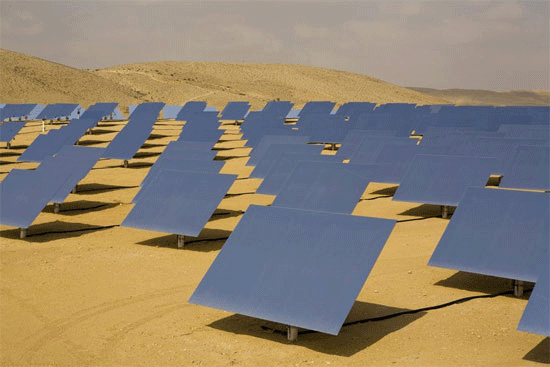
Solar Power in Ontario Could Produce Almost as Much Power as All U.S. Nuclear Reactors, Studies Find ScienceDaily (Apr. 14, 2010) — Solar power in southeastern Ontario has the potential to produce almost the same amount of power as all the nuclear reactors in the United States, according to two studies conducted by the Queen’s University Applied Sustainability Research Group located in Kingston, Canada. Continue reading
Enriched uranium to USA – Canada joins the move
Canada to Transfer Enriched Uranium to U.S. ABC News , April 12, 2010 As President Obama’s Nuclear Security Summit kicked off Monday, Canadian Prime Minister Stephen Harper announced that his government had agreed to return to the United States highly enriched uranium from the nuclear reactor at the Chalk River Laboratories in Ontario. Canada to Transfer Enriched Uranium to U.S. – Political Punch
Renewable energy gets big boost in Ontario
Ontario Issues $8 Billion in Renewable Energy Contracts – Green Inc. Blog – NYTimes.com April 9, 2010, By JOHN LORIN An Ontario government agency yesterday announced $8 billion in new renewable energy deals under the province’s bulked up feed-in tariff program, with 184 wind, solar, hydro and landfill gas projects winning long-term contracts to provide a total of about 2,500 megawatts of green power…..
Ontario Issues $8 Billion in Renewable Energy Contracts – Green Inc. Blog – NYTimes.com
How the war industry contributes to global warming, and not to humanity
“Lockheed Martin has 21 paid lobbyists on Parliament Hill,” “and none from environment, women or peace groups, which can’t afford it.”
War on Earth, THE COAST, Halifax, Nova Scotia, Canada, Against the people’s wishes, governments and the war industry choose destruction over protection.by Chris Benjamin, 25 March 2010,
If money talks, what does it say that Canada spends 12 times more on the Department of National Defence than it does on Environment Canada, and 120 times more on defence than it does on climate change mitigation? Continue reading
Quebec government’s contempt for public opposition to uranium mining
(Canada) Quebec disregards petition, rejects call for uranium moratorium Media Co-op, Tim McSorley, 22 March 2010, Concerned residents of Sept-Iles are furious with the Quebec government today, calling the Minister of Natural Resources Serge Simard a liar after he announced there would be no moratorium on uranium exploration in the area. Simard was responding to a 14,000-signature peitition in support of the moratorium……. Continue reading

Uranium One’s losses due to low uranium prices
Uranium One announces $36.5m net loss for full year 2009 , 11 Mar 2010,(Reuters) “….– Uranium One Inc (UUU.TO: Quote) posted a net loss in 2009, hurt mainly by lower realized uranium prices, ….Earnings from mine operations fell 41.2 percent to $54.6 million. The company said average realized sales prices fell 30 percent in 2009.
Shares of the Vancouver, British Columbia-based miner closed at C$2.81 Wednesday on the Toronto Stock Exchange. (Reporting by Abhiram Nandakumar in Bangalore; Editing by Maju Samuel)
First Uranium rescued by shareholders, from financial disaster
First Uranium shareholders provide capital lifeline Winnepedg Free Press, By: THE CANADIAN PRESS 12 March 2010, TORONTO – First Uranium Corp. (TSX:FIU) is getting a much-needed infusion of capital from a major shareholder and a new chief executive.The Toronto-based gold and uranium company had warned last month that its financial condition had been “severely compromised” by problems getting government environmental approval for a future storage site in South Africa.
First Uranium shareholders provide capital lifeline – Winnipeg Free Press
Groundwater threatened by uranium mining
“It’s a huge potential for contamination of groundwater.”

Uranium Mining In The Black Hills – Debra White Plume’s Response to ‘Clean Nuclear’ Republic of Lakotah, March 3, 2010 The planned uranium mine site in the southern Black Hills can impact four aquifers. Powertech, Inc. USA plans to begin uranium extraction in 2011 and operate for 15 years in the permit area of 10,580 acres located in Dewey and Burdock Counties, north of Edgemont, SD. Continue reading
New uranium mine in Canada to avoid federal environmental assessment
Nunavut uranium proposal won’t undergo federal review, CBC News, 5 March 2010, A uranium mine being proposed in Nunavut will not be subject to a federal environmental assessment, but instead be reviewed by a territorial regulator. Continue reading
Biggest uranium miner downgraded due to failing uranium price
Fraser Phillips, analyst with RBC Capital Markets, has downgraded Cameco Continue reading
Nuclear scientist missing in Canada
Police give up search for missing nuclear scientist thestar.com Adrian Morrow
On January 18, Lachlan Cranswick left the Chalk River nuclear reactor, where he worked, and took a bus to Deep River, the small town on the Ottawa River where he lived.The 41-year-old physicist, whose job entailed running experiments for the National Research Council, had just finished some work for a researcher overseas…..Then, he vanished without a trace
Police give up search for missing nuclear scientist – thestar.com
Mass exposure of workers to nuclear radiation
The CNSC said the workers were exposed to alpha contamination, a dangerous form of radiation that, if breathed in or ingested, poses a risk of cancer.

(Canada) Nuclear watchdog investigates possible mass radiation exposure – The Globe and Mail Martin Mittelstaedt Feb. 16, 2010 As many as 217 workers involved in November incident at Ontario plant, according to filing from Nuclear Safety Commission Continue reading
Uranium mining continues to damage indigenous communities
Déline is known as the “village of widows’ because most of the men who worked as labourers in the mines have died of some form of cancer.

The impacts of uranium mining on indigenous communities.-Peace, Earth and Justice News Heather Tufts February 13, 2010 – “….. Uranium mining speculation lacks comprehensive health and safety regulations while the ethics of Canadian exported uranium, which can lead to depleted uranium used in zones of war, needs greater scrutiny. Continue reading
Canadian govt sort of abandoning nuclear industry
Nuclear industry left hanging, Tim Hudak says Dalton McGuinty Liberals still debating whether to build another plant
Rob Ferguson Queen’s Park Bureau With files from Tanya Talaga thestar.com 10 Feb 2010
The McGuinty government is leaving Ontario’s nuclear industry “drifting in the wind” after handing foreign-based Samsung a $7 billion deal to develop green power, Progressive Conservative Leader Tim Hudak charges. Continue reading
1 This Month



26 September – International Day for the Total Elimination of Nuclear Weapons


PLEASE OPPOSE HR 8255 AND S.3639 – bills would accelerate satellite deployment, with no environmental review or safeguards – https://ncstd5li.quorum.us/campaign/169331/
To see nuclear-related stories in greater depth and intensity – go to https://nuclearinformation.wordpress.com
-
Archives
- September 2026 (245)
- August 2026 (330)
- July 2026 (355)
- June 2026 (287)
- May 2026 (306)
- April 2026 (356)
- March 2026 (251)
- February 2026 (267)
- January 2026 (308)
- December 2025 (358)
- November 2025 (359)
- October 2025 (375)
-
Categories
- 1
- 1 NUCLEAR ISSUES
- business and costs
- climate change
- culture and arts
- ENERGY
- environment
- health
- history
- indigenous issues
- Legal
- marketing of nuclear
- media
- opposition to nuclear
- PERSONAL STORIES
- politics
- politics international
- Religion and ethics
- safety
- secrets,lies and civil liberties
- spinbuster
- technology
- Uranium
- wastes
- weapons and war
- Women
- 2 WORLD
- ACTION
- AFRICA
- Atrocities
- AUSTRALIA
- Christina's notes
- Christina's themes
- culture and arts
- Events
- Fuk 2022
- Fuk 2023
- Fukushima 2017
- Fukushima 2018
- fukushima 2019
- Fukushima 2020
- Fukushima 2021
- general
- global warming
- Humour (God we need it)
- Nuclear
- RARE EARTHS
- Reference
- resources – print
- Resources -audiovicual
- Weekly Newsletter
- World
- World Nuclear
- YouTube
-
RSS
Entries RSS
Comments RSS
 nuclear-news