Canada’s tax-payers up for increased costs for nuclear wastes
 Nuclear waste cleanup liability cost up by $2.4B, Ottawa told Andy Johnson, CTV News, , Mar. 20, 2013 The cost of cleaning up Canada’s nuclear program has risen dramatically in recent years and Ottawa is being warned another $2.4 billion is needed, bring the total to $6 billion.
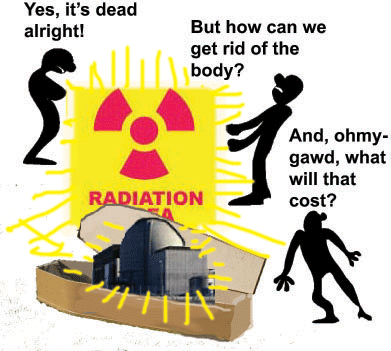 Atomic Energy of Canada Limited posted a statement Tuesday saying liability costs will go up by $2.4 billion from $3.6 billion in March of last year.
The estimate represents the cost associated with “decommissioning, managing and disposing of its radioactive waste in a manner that will ensure long-term health, safety, security and environmental responsibility.” “The main reason for the liability adjustment is an increase in the indirect costs attributed to the decommissioning and waste management over the period of up to 70 years of the program,” said a statement posted on the AECL website. Continue reading
Ontario shutting down coal fired power, going for renewables
Ontario to add renewable energy, shut coal-fired power plants Mar 1,
2013 (Reuters) – Ontario’s power grid operator expects more than
3,200 megawatts (MW) of renewable capacity to be connected to the
transmission system, while the province’s remaining coal-fired plants
will shut over the next 18 months.
In a report published on Thursday, the Independent Electricity
System Operator (IESO) said the renewable capacity
includes the Canadian province’s first two transmission grid-connected
solar projects.
By August 2014, the IESO said total wind and solar generation
connected to the transmission and distribution systems is expected to
reach about 6,800 MW.
“Integrating renewable resources into Ontario’s changing supply
mix has been a learning process for both us and the renewable
generators,” Bruce Campbell, IESO Vice-President of Resource
Integration, said in the release.
“Everything we’ve learned will be applied in the coming months as
wind and solar gain even more prominence on the grid,” he
said……..http://www.reuters.com/article/2013/03/01/utilities-ontario-ieso-idUSL1N0BT5TX2013030
Medical isotopes from non nuclear sources – no nuclear reactor needed
 Canada to fund non-nuclear sources for medical isotopes By Randall Palmer and David Ljunggren | Reuters –28 Feb 13,
 To that end, the federal government will fund three research institutes developing cyclotron and linear accelerator technologies for production of isotopes on a commercial scale, Natural Resources Minister Joe Oliver said.
Canada’s only current source of the isotopes is a problem-plagued reactor at Atomic Energy of Canada Ltd’s facility at Chalk River, Ontario. The reactor is licensed to run until 2016.
“Our challenge now is to prove that cyclotron and linear accelerator production can be commercially viable. … We envision a future where isotope production will no longer require highly enriched uranium — a weapons-grade material,” he said.
The government will give a total of C$25 million ($24.3 million) to the three facilities for this goal…. http://news.yahoo.com/canada-fund-non-nuclear-sources-medical-isotopes-190403191–sector.html
Media keep mum about barrels in Lake Superior – ?radioactive
Paper: News blackout over mystery barrels in Lake Superior — Purplish ooze, bouncing Geiger counters reported — No ‘immediate’ health threat to public http://enenews.com/paper-news-blackout-over-mystery-barrels-in-lake-superior-reports-of-purplish-ooze-bouncing-geiger-counters-no-immediate-health-threat-to-public February 23rd, 2013
Title: Our view: New mysteries emerge in big-lake barrel saga
Source: Duluth News Tribune
Date: February 22, 2013
h/t Anonymous tip
Our view: New mysteries emerge in big-lake barrel saga
[…] 1,400 barrels dumped in [Lake Superior] in the late 1950s and early 1960s not far from the Duluth-Superior Harbor. The Department of Defense barrels were said to hold scrap metal from a grenade project the U.S. was eager to keep secret from the Soviets. But reports of purplish ooze, bouncing Geiger counters and more long fueled speculation, concern and even conspiracy theorists.
The [Red Cliff Band of Chippewa] recovered only 25 barrels, and it did so under what was called a “news blackout.” No media was allowed near the recovery work and there were no briefings with reporters about what was going on or what was found. A “safety zone” kept curious boats well away.
“We need to stay focused on the work rather than informing the public,” Red Cliff Environmental Director Melonee Montano said in an August story in the News Tribune. […]
In January, the band did say there were no “immediate (health) threats or concerns to the public,” an assurance it reiterated a month later. […]
A Tribune editorial from 2012: Duluth Newspaper: Maybe Yucca Mountain-type nuclear waste dump should be in Minnesota, Wisconsin or Michigan instead — Sounds scary, but is it?
STOP THE GREAT LAKES NUCLEAR DUMP FACT SHEET

1. Ontario Power Generation (OPG), a multi-billion dollar corporation wholly owned by the Province of Ontario, plans to build a nuclear waste dump at the Bruce Nuclear Power Plant site, Municipality of Kincardine, Ontario “located approximately 1 km inland from the shore of Lake Huron at the surface and more than 400 metres below the deepest near-site point of Lake Huron.” http://tinyurl.com/arc34y2 , page 55 OPG owns all Ontario’s nuclear plants and all radioactive nuclear waste created.
2. Low and intermediate level radioactive nuclear waste will be buried in the nuclear waste dump. Intermediate level nuclear wastes are highly radioactive and many remain toxic for over 100,000 years. Some are as dangerous as nuclear spent fuel. No scientist or geologist can provide a 100,000 year guarantee that this nuclear waste dump will not leak. Continue reading
Federal court rules against Cameco getting money from uranium spill ship
No money for Cameco after sale of ship that had uranium spill By Kevin O’Connor CBC News Feb 7, 2013 Saskatchewan mining company Cameco will not get any money from the sale of a ship that once had a uranium spill at sea — and that it spent millions cleaning up.
Instead, according to a recent Federal Court decision, a German bank that held a mortgage on the shipping vessel MCP Altona will get most of the $4.6 million raised when it was sold.
The case stems from an incident at sea two years ago….. http://www.cbc.ca/news/canada/saskatchewan/story/2013/02/07/sk-radioactive-spill-on-boat-case-1302.html
No nuclear wastes dump near Lake Huron – Bruce County group
Bruce County group opposes burying nuclear waste near Lake Huron, The Record, Frances Barrick, Jan 15 2013 A Bruce County-based group opposed to burying nuclear waste near Lake Huron is taking its fight to Canada’s largest city.
A billboard along Toronto’s Gardiner Expressway says “bad idea” to a plan to build an underground repository to store low- and intermediate-level nuclear waste at the Bruce nuclear plant near Kincardine.
“We feel this is a national issue and we want to bring this to the attention of all Canadians,” Beverly Fernandez, spokesperson for Stop the Great Lakes Nuclear Dump Inc., said of the sign on one of Canada’s busiest commuter routes.
The Ontario Power Generation is in the midst of seeking approval from the federal government for this project, which would be built about one kilometre from the shores of Lake Huron. Approval is expected in about nine months, she said.
“It defies common sense to bury radioactive waste beside a source of drinking water that 40 million people rely on,” said Fernandez, a Southampton resident.
This project is separate from plans by the Nuclear Waste Management Organization to bury highly radioactive nuclear waste in a “willing” community in Canada…..
The group has also launched an online petition intended for federal Environment Minister Peter Kent, who has final approval of the project. The petition is at www.gopetition.com/petitions/stopthegreatlakesnucleardump.html…..
Coal mining’s radiation hazard should be recognised, too
 The nuclear lobby is out to convince us that ionising radiation is not harmful .
This is a lie.
However, if we are seriously concerned about ionising radiation, we need to recognise that it is a serious threat from sources other than the nuclear industry, as well.
Two other serous sources of ionising radiation are medical radiation, and mining operations, especially coal.
There is an argument for medical radiation. Used judicially, medical radiation is beneficial in diagnosis, treatment, and pain relief in illness.
There really is no longer an argument for coal mining, given it’s role in global warming. But also, attention should be paid to the menace of ionising radiation in coal ash. – Christina Macpherson 7 Jan 13
EPA agrees to look into town’s radiation concerns SF Gate, January 6, 2013 TOWN OF PINES, Ind. (AP) — Federal environmental officials will investigate concerns about radiation levels in a northwestern Indiana community after residents and activists raised concern. The U.S. Environmental Protection Agency notified local officials late last month that the EPA would study the levels in The Pines early this year, The Times reported (http://bit.ly/UmBcgA ).
Matthew Ohl, the EPA’s project remedial manager, said NIPSCO, Brown, Inc., Ddalt Cop. and Bulk Transport Corp. proposed sampling in “certain residential yards in the Town of Pines.” The study was requested by a local environmental panel, which heard a presentation in November by Paul Kysel and Larry Jensen of PINES, or People in Need of Environmental Safety.
Jensen, a former EPA employee, conducted his own study of radiation levels and concluded that levels in the town are elevated. The PINES group believes coal ash, which was used as fill in roads, could be the cause of elevated radiation levels. The Pines is home to a landfill operated by Brown Inc. and holds about 1 million tons of fly ash created by NIPSCO’s burning of coal in its power plants. The facility was cited in 2000 by the EPA for contaminating drinkingwater …..http://www.sfgate.com/news/science/article/EPA-agrees-to-look-into-town-s-radiation-concerns-4170911.php#ixzz2HJy2xPxC
Despite the anti wind energy bluster, wind energy is the best deal for Ontario
Wind energy is
the smarter long-term choice based on cost, environmental protection,
and wider sharing of benefits to rural communities.
At its current rate of 11.5 cents per kWh in Ontario, wind energy is
cost-competitive with virtually all other new sources of electricity
generation.
While some politicians and a group of highly motivated anti-wind
activists have worked hard to discredit wind energy, the benefits and
attributes of the world’s fastest-growing major source of electricity
speak loud and clear.
Wind energy is a better deal for Ontario than new nuclear
http://www.thespec.com/opinion/columns/article/863783–wind-energy-is-a-better-deal-for-ontario-than-new-nuclear
Chris Forrest Jan 04 2013 Last year, 2012, saw wind energy’s
contribution of clean power to Canada’s electricity supply grow by
nearly 20 per cent to just over 6,200 megawatts (mw) of installed
capacity, maintaining Canada’s position as one of the world’s leading
wind energy markets.
Every 1,000 mw of new wind energy drives $2.5 billion in investment,
creates 10,500 person-years of employment, and provides enough clean
power for more than 300,000 Canadian homes. New wind energy projects
have been commissioned in British Columbia, Alberta, Ontario, Quebec,
Manitoba, Northwest Territories and Nova Scotia in 2012. Ontario
continues to lead the country with more than 2,000 mw of installed
wind energy capacity now in place. Continue reading
Idle No More – indigenous movement spreads beyond Canada
Why Idle No More matters, Montreal Gazette, The aboriginal protest
movement fits into a pattern that suggests we are entering a new era
of collective action
By Celine Cooper, Special to The Gazette December 30, 2012 MONTREAL —
In a teepee on Victoria Island in the Ottawa River just a stone’s
throw from Parliament Hill, Attawapiskat First Nations Chief Theresa
Spence is engaging in a hunger strike. Her actions have come to
represent the growing social movement known as Idle No More.
Set into motion and founded by four women from Saskatchewan — Sheelah
McLean, Nina Wilson, Sylvia McAdam and Jessica Gordon — Idle No More
(#idlenomore on Twitter) has gained momentum as an indigenous-led
protest against the mammoth omnibus Bill C-45 tabled by the federal
Conservative government this month. Critics of the bill have taken
particular issue with its amendments to the Indian Act and the
Navigable Waters Act, arguing that it disrespects treaty rights and
aboriginal sovereignty and erodes protection of the environment. Continue reading
$2 billion to shut down Quebec’s nuclear plant, but $4 billion to keep it open
The Parti Quebecois also announced it will set aside another $200 million in a
“diversification fund” to help the surrounding communities retrain
their workforces and spur alternative development opportunities.
Shutdown of Que. nuclear plant to cost $2B, Ifp
QMI Agency
December 28, 2012 MONTREAL – The licence for Quebec’s only
operational nuclear power plant expired Friday, and the provincial
government said it will spend hundreds of millions of dollars over the
next 50 years to dismantle the reactor.
The Parti Quebecois campaigned against refurbishing the plant,
claiming that the $4-billion price tag was financially unjustifiable, Continue reading
Quebec’s nuclear power plant will be gone – but the radioactive problem lingers on
 Non Nukes: Québec Shutters Its Only Nuclear Power Plant http://www.7dvt.com/2012non-nukes-qu-bec-shutters-its-only-nuclear-power-plant
BY KEN PICARD [12.26.12] “….. Seven Days reported in May, “G-2” is closer to northern Vermont than any American reactor, including Vermont  Yankee. And, like the Vernon plant, G-2 got a new lease on life when its owner, Hydro-Québec, announced plans to refurbish the reactor and keep it operational for another three decades.
Canadian antinuke activists have fought for years to shut down G-2. Since going online in 1983, the plant has experienced problems eerily similar to those at Vermont Yankee — but worse. G-2 releases more radioactive tritium into the air and water each day than the tritium estimated to have leaked from Vermont Yankee in all of 2011.
Yet despite those problems and overwhelming opposition from Québécois — 320 Québec municipalities adopted resolutions calling for G-2’s closure — Canadian regulators earlier this year gave the plant approval to continue splitting atoms. In October, Hydro-Québec announced it would close G-2 at the end of this year — specifically, on December 28.
Why the change of heart? The company cited “increased production costs” — $6.3 billion compared to $1.8 billion to decommission the plant — combined with “falling market prices” for electricity.
Politicians, too, were against the plant. During last summer’s election, Québec’s newly elected premier, Pauline Marois, promised to shutter the province’s only nuke when its license expires at the end of 2012.
Gordon Edwards, president of the Canadian Coalition for Nuclear Responsibility, hailed the decision, saying “Québecers are proud that ours will be the first jurisdiction in North America to phase completely out of nuclear power.”
But even after G-2’s electricity is long gone, its radiation will linger. HQ plans to leave the facility dormant for 40 years before removing its spent fuel and radioactive equipment, dismantling the facility, and restoring the site. That work won’t be completed until 2062.
Great lakes nuclear threat is greater than all its other pollution problems
Nuclear power: The ultimate near shore threat to the Great Lakes? Great Lakes Echo
DEC 21 2012 GARY WILSON
Commentary
“I hope you rethink your really scary plan to bury radioactive waste located only half a mile from Lake Huron…”
That’s a concerned citizen responding to a Canadian nuclear power company’s proposal to store radioactive waste underground near Lake Huron for 100,000 years.
The best-known near shore threats to the Great Lakes are raw sewage and algae blooms. Both receive considerable attention from government agencies and accounts about them are regularly reported in the popular media.
The threat posed by the nuclear power plants that dot the region could easily trump both. It may be the ultimate near shore threat. Continue reading
Cree Nation stand against uranium mining in Quebec
many concerned groups and individuals are now joining the Crees in urging the Quebec government to conduct an independent and comprehensive assessment of the long-term environmental, social and ethical challenges presented by the uranium industry
When the mining is done and the profits have been taken, these tailings will be left behind in my people’s backyard, where we have lived for thousands of years, and where we hunt, fish and trap, raise our children and bury our dead.
It is indisputable that these uranium tailings will remain radioactive and highly toxic for hundreds of thousands of years.
The Cree Nation will not be intimidated or silenced
Quebec should support Cree moratorium on uranium mining http://www.montrealgazette.com/news/Opinion+Quebec+should+support+Cree+moratorium+uranium+mining/7695600/story.html By Matthew Coon Come, Montreal Gazette December 13, 2012 This summer, my people, the James Bay Cree Nation, enacted a permanent moratorium on uranium exploration, mining, milling and waste emplacement in our territory on the east shore of James Bay, Eeyou Istchee. I was
mandated to take all necessary steps to ensure full recognition of our stand. Continue reading
Canadian govt abandoning environmental protection
When yet another omnibus budget bill passed through Parliament this week, it ushered in a new era in Canadian history. The “Navigable Waters Protection Act” no longer protects “Water”. The “Fisheries Act” no longer protects “Fish”. The “Environmental Assessment Act” no longer requires “Environmental Assessments” be done before important decisions are made. If you are looking to federal environmental law and policy to protect Canada’s environment, you’re a dinosaur. A throwback. A relic of the 20th Century.
“No need to worry,” the federal government says, “the provinces will protect you now.”
Everything’s changed, Northumberland View ca Dec 06, 2012 – Krystyn Tully, Waterkeeper.ca Weekly“……. It’s no secret that the Government of Canada’s been undergoing some kind of post-environmentalism re-envisioning exercise. You’ve seen the stories about massive layoffs in federal environmental departments, heard about scientists being “muzzled”, listened to members of parliament debating sweeping changes to federal laws.
The exercise is over. The “new normal” is here.
For the last thirty years, Canada was a rule-of-law kind of country. Our environmental laws spelled out what you can’t do (pollute or block a river, for example). They spelled out how decisions had to be made (major projects were reviewed by independent panels, with input from qualified experts, for example). Those who wanted to develop or dump on the water had to prove to a decision-maker that their actions would not harm other people’s abilities to safely swim, drink, or fish those same waters. With a few notable exceptions, the federal rules were generally the same across Canada.
This is no longer true. Continue reading
1 This Month
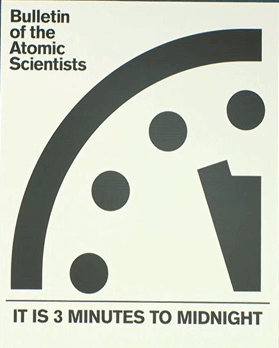
Watch the 2026 Doomsday Clock unveiling live here on January 27 at 10 a.m. EST
To see nuclear-related stories in greater depth and intensity – go to https://nuclearinformation.wordpress.com/

29 Jan. Thursday 7-8 p.m. Webinar – World’s Largest Nuclear Station in Port Hope, ON?


31st January – Challenging the War Machine – a DECLASSIFIED UK SUMMIT


Website of the Week
Now until to February 10, 2026 Radioactive waste storage in France: the debate is finally open! How to participate?
-
Archives
- January 2026 (277)
- December 2025 (358)
- November 2025 (359)
- October 2025 (376)
- September 2025 (258)
- August 2025 (319)
- July 2025 (230)
- June 2025 (348)
- May 2025 (261)
- April 2025 (305)
- March 2025 (319)
- February 2025 (234)
-
Categories
- 1
- 1 NUCLEAR ISSUES
- business and costs
- climate change
- culture and arts
- ENERGY
- environment
- health
- history
- indigenous issues
- Legal
- marketing of nuclear
- media
- opposition to nuclear
- PERSONAL STORIES
- politics
- politics international
- Religion and ethics
- safety
- secrets,lies and civil liberties
- spinbuster
- technology
- Uranium
- wastes
- weapons and war
- Women
- 2 WORLD
- ACTION
- AFRICA
- Atrocities
- AUSTRALIA
- Christina's notes
- Christina's themes
- culture and arts
- Events
- Fuk 2022
- Fuk 2023
- Fukushima 2017
- Fukushima 2018
- fukushima 2019
- Fukushima 2020
- Fukushima 2021
- general
- global warming
- Humour (God we need it)
- Nuclear
- RARE EARTHS
- Reference
- resources – print
- Resources -audiovicual
- Weekly Newsletter
- World
- World Nuclear
- YouTube
-
RSS
Entries RSS
Comments RSS
 nuclear-news