NO to uranium mining. Quebec’s Nunavik Inuit stand firm
Makivik President Jobie Tukkiapik says the consensus is clear: Nunavik Inuit fears for radioactive contamination of the land trump any economic windfall they might reap from uranium mining.
“Uranium is a controversial topic, and must be considered separately from conventional mining activities exploiting other minerals in Nunavik,” Tukkiapik says.
Makivik Corporation, the land claims organization, teamed up with the Kativik Regional Government in stating their case to Quebec’s environmental consultation office.
The land claims organization made the announcement following three years of consultations throughout Nunavik’s 14 communities. They also did consultations in Montreal and some neighbouring Cree villages. KRG chair Maggie Emudluk says the key concern is the health of country food.
Inuit rely on hunting wildlife for sustenance, and Emudluk says the impact of radioactive material getting into the food chain could be deadly.
“The psychological effects cannot be underestimated,” she says. “People are afraid of uranium in general, but when a population is so dependent on locally sourced food, the fear and uncertainty escalate.”
It remains to be seen whether the declaration is legally enforceable under Quebec law
Petition to stop Saskatchewan plan for small nuclear reactors- University in grip of nuclear lobby

 Stop plans to build small nuclear reactors in Saskatchewan to power oil extraction from the Alberta Tar Sands. https://secure.avaaz.org/en/petition/Stop_plans_to_build_small_nuclear_reactors_in_Saskatchewan_to_power_oil_extraction_from_the_Alberta_Tar_Sands_1/?pv=10
Why this is important to me
When elected in 2007, Saskatchewan Premier Brad Wall (his Saskatchewan Party is ideologically tied to Harper’s federal Conservatives) created the Uranium Development Partnership (UDP), chaired by one of the U of S vice-presidents. With industry support from Bruce Power (nuclear reactors) and its majority shareholders, Cameco (uranium mining) and TransCanada Corporation (the Keystone pipeline), the UDP pushed to establish a nuclear program at the University.
Public consultations in 2009 gave a resounding 88% “NO” to this nuclear agenda , but the government/corporate/university consortium have used the U of S to bypass this overwhelming expression of public opinion. The Canadian Centre for Nuclear Innovation (CCNI) was announced in March 2011 with $30 million of Government funding over 7 years. Its first goal is to build a prototype small nuclear reactor on campus. In August 2011 the Government and Hitachi-GE Nuclear Energy Ltd announced another $10 million towards that objective.
Current U of S President MacKinnon and Board of Governors Chair Nancy Hopkins have been deeply involved in this project. Hopkins owns nearly $2 million in Cameco investments and is a paid Cameco director ($175,872 in 2009). MacKinnon accepted an all-expenses-paid trip to Cameco’s northern operations and exclusive lodge in 2009, at the peak of the public debate about the UDP report.
But MacKinnon retires from the U of S on June 30. We must send a clear message to his successor, Ilene Busch-Vishniac, to step off this destructive path.
Brad Wall’s government has starved the University of essential funding – U of S has an accumulated $90 million debt. Existing infrastructure is crumbling. New buildings on campus can’t open. And the $40 million for the CCNI and related nuclear projects won’t help U of S out of this crisis.
The University of Saskatchewan, founded in 1907, was once proudly called “the people’s university” – set in the heartland of the Canadian cooperative movement, home to Tommy Douglas, the greatest Canadian, the father of Medicare. Today the University has become an easy target for corporate takeover and a tool for the nuclear and petroleum industries. But right now we have a chance to stop this from happening.
No transparency in Ontario Energy Board’s multi-billion-dollar plan to overhaul six nuclear reactors
 Ontario Energy Board won’t probe Bruce nuclear overhaul Opposition, Ontario Clean Air Alliance want to see public scrutiny of the multi-billion-dollar plan to overhaul six reactors at the Bruce nuclear generating station. By: John Spears The Star, Business reporter, Nov 27 2014
The multi-billion-dollar plan to overhaul six reactors at the Bruce nuclear generating station won’t be submitted to the Ontario Energy Board for scrutiny.
Nuclear critics had called for public examination of the project, expected to cost in the range of $15 billion.
An energy official confirmed Wednesday that energy minister Bob Chiarelli won’t send the issue to the energy board for hearings.
Jack Gibbons of the Ontario Clean Air Alliance said the energy board should examine at the project in public.
“This would be the hugest private-sector deal in Ontario’s history,” he said in an interview.
Peter Tabuns, energy critic for the New Democrats, agreed.
“I don’t think it’s something that should be negotiated behind closed doors and stamped in the premier’s office,” he said.
“The public have to be shown a business case for going down this route.” The contract is currently being negotiated between Bruce Power — the private consortium that operates the station under lease — and the Ontario Power Authority. Bruce Power produces about 30 per cent of Ontario’s electricity.
The reactors are owned by Ontario Power Generation, whose sole shareholder is the province………
Gibbons and Tabuns argued that the public needs to be able to see what’s proposed and ask questions before an agreement is signed.
One question: Whether the deal would push up electricity prices, and by how much.
Another: How badly the power is needed, or whether it could be obtained elsewhere. Currently, Ontario frequently has surplus power, some of which is exported at a loss. At times the province has to pay neighbouring jurisdictions to take it.
Tabuns also said he’d like to question whether having a private company operating the plant is the right thing.
“We have not been well served by private ownership and operation of our hydro system,” he said.
“I think it’s time to question that in the kind of forum that the OEB can provide.” http://www.thestar.com/business/2014/11/27/ontario_energy_board_wont_probe_bruce_nuclear_overhaul.html
Pickering nuclear power station has radioactive leak
Radioactive leak at Pickering nuclear station, Caledon Enterprise, 26 Nov 14
Heavy water contained inside reactor; no impact to public, environment Pickering News Advertiser
PICKERING — Thousands of litres of radioactive heavy water leaked in a reactor at the Pickering nuclear station Friday.
The incident happened in Unit 7, which was undergoing a scheduled maintenance outage, at about 4 p.m. on Nov. 21.
A valve on the moderator system opened inside the reactor building, Ontario Power Generation reported on Twitter….. 6,900 litres of heavy water leaked……http://www.caledonenterprise.com/news-story/5154334-updated-radioactive-leak-at-pickering-nuclear-station/
Determined campaign by Northern Quebec Cree against uranium mining and exploration
 Northern Quebec Cree start 850 km trek to protest against uranium mining By Caroline Nepton, CBC News Nov 21, 2014 “……this weekend Iserhoff, who is the chair of the Cree Nation Youth Council, will join a group of Crees walking to Montreal to hand deliver a message to the province’s environmental protection agency’s (BAPE) commission on the uranium industry in Quebec.
The group has a message for BAPE: There will be no uranium exploration and exploitation on the Cree territory of Eeyou Istchee.
“We are the stewards of the land, therefore we have this responsibility to protect for the generations to come,” Iserhoff said.
The walkers will be leaving Mistissini this Sunday to travel over 850 kilometers to reach Montreal by Dec. 15, the last day of the BAPE’s public hearings on the uranium industry in Quebec.
They want other nations and other Quebecers to join the walk. “Innu’s are coming, Algonquins are coming and maybe Atikamekw,” Iserhoff said. ‘The Crees are only one voice and so we are seeking allies.’– Matthew Coon Come, grand chief of Cree Grand Council
The trek is one of the many strategies used by the Crees to protest against uranium mining in their territory.
The Cree Nation government firmly opposes all uranium exploration, mining and waste storage in Eeyou Istchee, Cree territory in northern Quebec. A couple of weeks ago the Cree government launched a website and a social campaign: #StandAgainstUranium. They are still asking people to take selfies with the Stand Against Uranium sign.
The government also sponsored The Wolverine: The Fight of the James Bay Cree, which was presented at the Uranium Festival in Germany last September.
“The Crees are only one voice and so we are seeking allies,” saidMatthew Coon Come, the grand chief of the Cree Grand Council.
One of the most advanced uranium projects in the province is the Strateco Resource Matoush project in Otish Mountain, north ofMistissini.
In 2013, Quebec became the third Canadian province, after Nova Scotia and British Columbia, to establish a moratorium on uranium development. In light of that moratorium, Quebec’s environment minister refused to grant Strateco the permits it had requested to go ahead with the project. http://www.cbc.ca/news/aboriginal/northern-quebec-cree-start-850-km-trek-to-protest-against-uranium-mining-1.2844050
Medical isotopes made without need for a nuclear reactor
 Saskatoon scientists make medical isotopes without nuclear reactor http://saskatoon.ctvnews.ca/saskatoon-scientists-make-medical-isotopes-without-nuclear-reactor-1.2102945#ixzz3JBjS72AU November 14, 2014 Canadian Light Source scientists have developed a way to produce medical isotopes without the use of a nuclear reactor.
The Saskatoon-based facility announced Friday they recently shipped isotopes made by powerful X-rays to Winnipeg for clinical trials.
“To be part of a project that will meet the health needs of so many Canadians, that is the most gratifying element,” said Canadian Light Source CEO Rob Lamb in a media release. Medical isotopes are used in medical imaging to diagnose cancer and heart disease. According to Health Canada, energy emitted by the isotope is detected by a special camera during a scan.
The Medical Isotope Project facility in Saskatoon is the first of its kind in the world, light source officials said. A particle accelerator hits molybdenum-100 metals — which resemble dimes — with high-energy X-rays. The rays knock a neutron from the nuclei and convert the molybdenum-100 to molybdenum-99, which then decays into a medically useful isotope — technetium-99m. Leftover metals are recovered and recycled. A nuclear reactor is not needed and no nuclear waste is created. Continue reading
Saudi Arabia to learn from Canadian renewable energy success story
renewable sources generate up to 65 percent of Canada’s electricity. Solar and wind are the country’s two fastest growing sources.According to him, Solar photovoltaic capacity reached 1,210 megawatts of cumulative installed capacity in 2013. The Canadian Solar Industry Association forecasts that annual capacity will increase three folds by 2025. By then, the Canadian solar industry will support more than 35,000 jobs, displacing 15 to 31 million tons of greenhouse gas emissions per year.
Canada has two of the largest solar farms in the world
Saudi Arabia, Canada to hold renewable energy seminar http://www.arabnews.com/economy/news/651686 29 Oct 14, A Canadian trade delegation, headed by Canada’s Deputy Minister of International Trade Simon Kennedy arrived in Saudi Arabia on Monday to meet several Saudi officials and major firms with a special focus on renewable energy in Saudi Arabia.
Canadian Ambassador Thomas MacDonald said Canada’s first renewable energy mission, which is focused on solar technology, will visit the King Abdullah City for Atomic and Renewable Energy (KACARE), the Saudi Electricity Company (SEC), ACWA Power and other industry leaders. Continue reading
Big task ahead, as Canada’s nuclear industry must try to protect 100s of thousands of citizens against radiation
Radiation protection pills delivered by end of 2015, Star.com New rules from the Canadian Nuclear Safety
 Commission dictate that iodine thyroid-blocking pills must be delivered to homes and workplaces near nuclear plants by the end of next year. By: John Spears Business reporter, Oct 14 2014
People living and working within 8 to 16 kilometres of a nuclear power plant should have radiation protection pills in their hands by the end of 2015, under new federal regulations.
But Durham’s Medical Officer of Health says it will be “very tight – extremely tight” to meet the deadline.New rules from the Canadian Nuclear Safety Commission dictate that iodine thyroid-blocking pills must be delivered to homes and workplaces near nuclear plants by the end of next year.
The pills, often known as potassium iodide pills or KI pills, inhibit the thyroid gland from absorbing radiation.Nuclear plant operators must pay the cost of buying and distributing the pills, but provincial and local health officials will be working out how to get them into the hands of tens of thousands of people from Scarborough to Clarington in time for the deadline.
Dr. Robert Kyle, Durham’s medical officer of health, said his unit already given stocks of pills to pharmacies and to institutions like schools, daycares, and police and fire departments……..
The pills will have to be sent out with readily understandable directions in different languages, he added.And someone will have to track new residents to make sure they get their pills.
The new rules also require pills to be stocked in institutions over a wide area beyond the immediate zones around the plants, he said.
“It’s a very tall order,” Kyle said. “It sounds like a year is a long time, but it may take a while to get this all planned and resourced.”
Toronto officials will also have to be involved, since eastern Scarborough is within 10 kilometres of the Pickering plant, he noted. (Lenore Bromley of Toronto Public Health took a different tack, however, saying that distributing the pills is “not something that would fall within our domain.”)
Kyle said he hasn’t tallied up the number of residents within 10 kilometres of the Pickering and Darlington plants, but said “you may be talking about 100,000.”
Ontario Power Generation operates the Pickering and Darlington nuclear plants east of Toronto.
Company spokesman Neal Kelly said it has cost about $180,000 to buy and distribute pills to pharmacies and institutions under the old rules.
“Under this new regulation, there will be significant costs associated with public communications and delivery,” Kelly said.
He wouldn’t name a figure. OPG will have to foot that bill, but who does the work on the ground is still being worked on, he said.
Canada’s public to get iodine pills in wide area around nuclear reactors
Nuclear plants must give iodine pills to nearby residents, regulator says Radiation protection pills will be pre-distributed to people and businesses located near nuclear plants, according to a new regulation announced by the Canadian Nuclear Safety Commission on Friday. The Star, By: John Spears Business reporter, Oct 10 2014
Residents and businesses near nuclear plants must be given radiation protection pills as a precautionary measure, says Canada’s nuclear regulator.
The pills must be pre-distributed, before any accident occurs, in co-operation with government authorities.
The Canadian Nuclear Safety Commission announced the new measure Friday, as it published a new regulation. The pills, which contain potassium iodide, block the thyroid gland from absorbing radiation.
The regulation requires nuclear operators to pre-distribute the pills to “all residences, businesses and institutions” within the primary area where the plume from a radiation release would likely spread.
The radius of the area may vary from location to location but “is typically sized in the range of eight to 16 kilometres,” according to the regulation. A 10-kilometre radius from the Pickering nuclear plant would extend from the eastern part of Scarborough to Whitby.
In a larger zone — typically 50 to 80 kilometres — nuclear plant operators must make sure that there is a stock of pills “ready for prompt distribution” and “located so that it can be efficiently obtained by, or distributed to, members of the public when required,” the regulation says.
An 80-kilometre zone would embrace all of Greater Toronto………The regulation also requires nuclear plant operators to deliver emergency preparedness information “in hard copy annually to every residence, business and institution” within the pill pre-distribution area. http://www.thestar.com/business/2014/10/10/nuclear_plants_must_give_iodine_pills_to_nearby_residents_regulator_says.html
First Nations Quebec-Labrador (AFNQL) reaffirm their opposition to uranium mining on their land
Quebec and Labrador First Nations draw the line against uranium By: Henry Lazenby 27 Sep 2014 TORONTO (miningweekly.com) – At a workshop on uranium development hosted by the Assembly of First Nations Quebec-Labrador (AFNQL) on Friday, First Nations from across the region reaffirmed their opposition to uranium development on their territories and throughout Quebec.
In March 2013, the AFNQL passed a resolution inviting its members to voice their opposition to uranium development and to declare a blanket rejection of the uranium exploration and exploitation on all First Nation territories. This followed a resolution adopted by the Grand Council of the Crees in August 2012 declaring a permanent moratorium on uranium development in Cree territory.
“The exploration and exploitation of uranium constitute major and irreversible threats to our population, our territories and the resources they contain. As First Nations, we have a sacred duty to protect our territories and ensure the sustainable development of our natural resources,” Timiskaming First Nation Chief Terence McBride said.
“Our experience here today has clearly demonstrated that the First Nations of Quebec and Labrador are united in our opposition to uranium development in our territories. We strongly encourage all the First Nations and citizens in Quebec to clearly and publicly express their opposition to uranium development,” Cree Nation Grand Chief Matthew Coon Come added.
In March 2013, Quebec’s Minister of the Environment announced a moratorium on uranium exploration or mining permits until the Bureau d’audiences publiques sur l’environnement (BAPE) had completed hearings on the uranium industry in Quebec and provided recommendations to the Minister. The BAPE’S mandate began in May.
This week, the BAPE completed the second phase of its inquiry, during which it heard from various ministries, experts and industry representatives on a number of topics relating to uranium and its associated risks. The third phase of the BAPE hearings were scheduled to start in November, at which time members of the public would have the opportunity to make oral and written submissions to the BAPE.
Anyone wishing to make submissions must file a notice of intention, available on the BAPE website, by October 16.
Resolution in US Senate opposing Canadian nuclear waste dump plan for Lake Huron area
 Senate resolution urges Obama administration to oppose Canadian nuclear waste near Lake Huron Star Tribune, : Associated Press September 21, 2014 TRAVERSE CITY, Mich. — U.S. Sen. Carl Levin has introduced a resolution urging the Obama administration to oppose a Canadian proposal to bury radioactive waste less than a mile from Lake Huron.
A federal panel in Canada is taking testimony on the plan to store low- and intermediate-level waste from nuclear power plants in rock chambers more than 2,000 feet below the surface.
Ontario Power Generation proposes storing low- and intermediate-level waste from nuclear power plants in rock chambers at a site in Kincardine, Ontario, about 140 miles north-northeast of Detroit. ………
According to the resolution, “more than 40 million people in Canada and the United States depend on the fresh water from the Great Lakes for drinking water” and “a spill of nuclear waste into the Great Lakes could have lasting and severely adverse environmental, health and economic impacts on the Great Lakes and the people that depend on them for their livelihood.”
The resolution, co-sponsored by Sens. Debbie Stabenow, D-Mich.; Mark Kirk, R-Ill.; and Tammy Baldwin, D-Wis., urges President Barack Obama and Secretary of State John Kerry “to take appropriate action to work with the Canadian government” to prevent building of a permanent nuclear waste repository within the Great Lakes Basin.
U.S. Rep. Dan Kildee, D-Flint., sponsored a similar measure in the House earlier this month.http://www.startribune.com/politics/national/275945461.html
Citizens’ groups call for ombudsman in battle over planned Lake Huron area nuclear waste dump
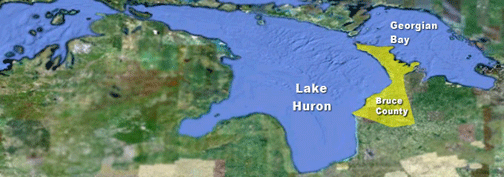 Lake Huron nuclear waste battle: Citizen groups want ombudsman called in http://kitchener.ctvnews.ca/lake-huron-nuclear-waste-battle-citizen-groups-want-ombudsman-called-in-1.2015050#ixzz3Dt9SdLgr Colin Perkel, The Canadian Press September 19, 2014 TORONTO — Groups fighting a proposed nuclear waste storage site on the shores of Lake Huron called on Ontario Premier Kathleen Wynne on Thursday to establish penalties for municipalities who break the law by holding secret meetings.
In addition, the groups — Save our Saugeen Shores and the Southampton Residents Association — called on Ontario’s ombudsman to review the circumstances that led to a report critical of Bruce County council for meeting nuclear waste representatives without telling anyone or documenting the discussions.
“This was a major error of provincewide importance in light of the evidence of an 8.5-year egregious disregard of the law and the public’s right to open and transparent government,” Rod McLeod, the group’s lawyer, said in a statement. The current end result trivializes important provincial legislation designed to preserve transparency in municipal government.”
Last month, an outside investigation concluded the municipal politicians in the region that is home to one of the world’s largest nuclear power plants violated provincial law.
However, the report concluded the officials did not violate the Municipal Act deliberately, something the groups said was nonsense.
“The evidence was overwhelming that the mayors knew exactly what they were doing and that it was unlawful,” their statement said.
Overall, McLeod said, the investigation failed to treat the violations with the seriousness deserved and the lack of sanctions for a breach in the Municipal Act is not good enough. Wynne had no comment but a spokesman for the Municipal Affairs Minister Ted McMeekin suggested changing the current legislation was not in the cards because municipalities already have the power to establish penalties for failing to follow the rules.
“Ultimately, all elected officials have a responsibility to follow provincial legislation and are accountable to the people who elected them,” Mark Cripps said in an email.
Ombudsman Andre Marin said there was nothing he could do under current legislation but called the report “flawed.”
Ontario Power Generation is proposing to build a massive underground nuclear waste site at the Bruce nuclear power plant near Kincardine, Ont., a plan that has drawn opposition from environmentalists, aboriginal groups and legislators in Michigan.
At issue were numerous meetings of the “community consultation” advisory group, comprising the mayors who sit on county council and representatives of the Nuclear Waste Management Organization and Ontario Power Generation, that began in 2005.
The citizen groups alleged the discussions were kept secret because the politicians feared damaging their electoral fortunes and pointed to informal notes from one meeting in February 2010 that showed a mayor fretting about “a negative backlash at the polls.”
The probe by Amberley Gavel — a company based in London, Ont., that helps municipalities with closed-meeting procedure investigations — concluded the public never knew about any of the meetings.
It also found the discussions had a marked influence on the mayors’ decisions regarding the radioactive waste project despite their contention the meetings were simply information sessions at which they passed no motions.
The citizen groups said the province should be reviewing the conduct of Ontario Power Generation.
They also said the county response — to ask staff to provide annual reminders about the law requiring open meetings — was “appallingly weak.”
Council members have “thus far show defiance with no hint of remorse,” the statement said
USA Congressman Dan Kildee fighting proposal for nuclear waste dump near Lake Huron

they must also stop making this radioactive trash
U.S. Rep. Dan Kildee to fight proposed Canadian nuclear waste facility on shores of Lake Huron M Live, By Sam Easter | seaster@mlive.com on August 28, 2014 BAY CITY, MI — Standing at the helm of the tall ship Appledore IV, U.S. Rep. Dan Kildee said the schooner based in downtown Bay City was the “perfect” place to make a few points about protecting the Great Lakes from nuclear waste.
Kildee spoke during the afternoon of Thursday, Aug. 28, addressing plans by Ontario Power Generation to build a storage facility for low- to intermediate-level nuclear waste at a proposed underground facility near Kincardine, Ontario.
“Canada is a friend, but it is a country with vast land mass, and I’m sure that the best place for a nuclear storage facility cannot be less than a mile from the shores of Lake Huron,” he said, regardless of whether officials say it’s scientifically sound. A point of contention among Michigan’s state and federal legislators for at least a year, the proposed facililty has also met strong opposition from local governments — officials from Bay County and Essexville both passed resolutions opposing the facility this month.
Kildee on Thursday announced he plant to introduce a Congressional resolution when legislators return from recess on Monday, Sept. 8, that — while lacking regulatory power — would voice the opinion of Congress on the matter. The resolution states that 40 million people in both countries depend on the Great Lakes’ drinking water, and that a nuclear spill “could have lasting and severely adverse environmental, health and economic impacts on the Great Lakes.”
If adopted, the resolution would discourage the Canadian government from building a nuclear storage site in the Great Lakes Basin and urge both President Obama and Secretary of State John Kerry to work with their Canadian counterparts to find an alternate location……..
Multiple officials were present for Kildee’s announcement, including Laura Ogar, Bay County director of environmental affairs and community development, as well as Terry Miller, chairman of the local environmental group Lone Tree Council.
Shirley Roberts is the executive director of BaySail, which owns and operates the Appledore. She said that the Appledore was an appropriate place for the presentation, and that she support’s Kildee’s fight against the facility.
“I have grave concerns about the concept,” she said. http://www.mlive.com/news/bay-city/index.ssf/2014/08/us_rep_dan_kildee_announces_pl.html
Safety problems, toxic spill, in Canada’s uranium industry
Nuclear watchdog requests safety checks after B.C. mine breach CTV News, Dene Moore, The Canadian Press August 19, 2014 VANCOUVER –– A toxic spill from a British Columbia mine has prompted the country’s nuclear watchdog to request a series of checks at uranium facilities.
The Canadian Nuclear Safety Commission will discuss the failure of the tailings pond at the Mount Polley gold and copper mine during a meeting Wednesday.
In the interim, the commission has asked the uranium mining and milling operations it oversees to ensure that all necessary inspections and monitoring are in compliance with licence conditions……..
The breach sent 10 million cubic metres of waste water and 4.5 million cubic metres of silt into a network of salmon-bearing lakes and rivers near Likely, 600 kilometres northeast of Vancouver.
The reason for the failure at Mount Polley is not yet known: http://www.ctvnews.ca/canada/nuclear-watchdog-requests-safety-checks-after-b-c-mine-breach-1.1966932#ixzz3AzIudlBn
Toxicity of planned wastes raises anxiety about Lake Huron nuclear dump scheme
Lake Huron nuclear dump scheme in trouble Hamilton Spectator by Thomas Walkom 7 Aug 14, Ontario’s plan to bury nuclear waste beside Lake Huron is running into heavy weather.
Ontario Power Generation, the Crown corporation behind the proposed dump site for low and intermediate level radioactive waste, has publicly acknowledged that its long-term safety plans are based, in part, on new technologies that have not yet been invented.
As the Star’s John Spears reported this week, that explanation hasn’t endeared itself to the small but politically important aboriginal communities near the proposed Kincardine dump site.
In a brief to the federal review panel that will eventually rule on the plan, the Saugeen Ojibway Nation reminds OPG of its assurance that no nuclear waste dump will be built without aboriginal consent
Will that consent be given? The first nation doesn’t say. But in its brief, it does express profound unease with what it calls OPG’s vague and open-ended scheme.
Plans for this so-called deep geological repository at Kincardine have been in the works since 2005.
Initially, the proposed dump was supposed to house waste such as the rubber gloves used by nuclear workers — items with relatively low levels of radioactivity.
Right now, nuclear waste from Ontario atomic power generating plants is stored on the surface.
But once federal hearings started last fall, OPG changed tack. It announced it wanted to double the size of the underground dump to roughly 400,000 cubic metres in order to accommodate waste that will be produced when the province’s existing nuclear plants are taken apart.
This so-called decommissioning waste, which includes components such as pressure tubes (but not nuclear fuel), will remain highly radioactive for thousands of years.
Critics cried foul. The three-member federal panel hearing the proposal ordered OPG to better explain how it would handle this more difficult waste.
It also told the Crown utility to look into why a similar U.S. nuclear waste facility near Carlsbad New Mexico — cited by dump proponents as a model — suffered two accidents in February……….http://www.thespec.com/opinion-story/4737032-lake-huron-nuclear-dump-scheme-in-trouble/
1 This Month



26 September – International Day for the Total Elimination of Nuclear Weapons


PLEASE OPPOSE HR 8255 AND S.3639 – bills would accelerate satellite deployment, with no environmental review or safeguards – https://ncstd5li.quorum.us/campaign/169331/
To see nuclear-related stories in greater depth and intensity – go to https://nuclearinformation.wordpress.com
-
Archives
- September 2026 (219)
- August 2026 (330)
- July 2026 (355)
- June 2026 (287)
- May 2026 (306)
- April 2026 (356)
- March 2026 (251)
- February 2026 (267)
- January 2026 (308)
- December 2025 (358)
- November 2025 (359)
- October 2025 (375)
-
Categories
- 1
- 1 NUCLEAR ISSUES
- business and costs
- climate change
- culture and arts
- ENERGY
- environment
- health
- history
- indigenous issues
- Legal
- marketing of nuclear
- media
- opposition to nuclear
- PERSONAL STORIES
- politics
- politics international
- Religion and ethics
- safety
- secrets,lies and civil liberties
- spinbuster
- technology
- Uranium
- wastes
- weapons and war
- Women
- 2 WORLD
- ACTION
- AFRICA
- Atrocities
- AUSTRALIA
- Christina's notes
- Christina's themes
- culture and arts
- Events
- Fuk 2022
- Fuk 2023
- Fukushima 2017
- Fukushima 2018
- fukushima 2019
- Fukushima 2020
- Fukushima 2021
- general
- global warming
- Humour (God we need it)
- Nuclear
- RARE EARTHS
- Reference
- resources – print
- Resources -audiovicual
- Weekly Newsletter
- World
- World Nuclear
- YouTube
-
RSS
Entries RSS
Comments RSS
 nuclear-news