Canada’s Orwellian muzzling of science writers

 Tightened science muzzle is ‘Orwellian’ July 3, 2012Margaret Munro Vancouver Sun, Sept 13, 2010 By Margaret Munro, Postmedia News https://margaretmunro.wordpress.com/2012/07/03/tightened-science-muzzle-is-orwellian/
The Harper government has tightened the muzzle on federal scientists, going so far as to control when and what they can say about floods at the end of the last ice age.
Natural Resources Canada (NRC) scientists were told this spring they need “pre-approval” from Minister Christian Paradis’ office to speak with journalists. Their “media lines” also need ministerial approval, say documents obtained by Postmedia News through access-to-information legislation.
The documents say the “new” rules went into force in March and reveal how they apply to not only to contentious issues including the oilsands, but benign subjects such as floods that occurred 13,000 years ago.
They also give a glimpse of how Canadians are being cut off from scientists whose work is financed by taxpayers, critics say, and is often of significant public interest — be it about fish stocks, genetically modified crops or mercury pollution in the Athabasca River.
“It’s Orwellian,” says Andrew Weaver, a climatologist at the University of Victoria. The public, he says, has a right to know what federal scientists are discovering and learning………
Environment Canada and Health Canada now tightly control media access to researchers and orchestrate interviews that are approved.
Environment Canada has even produced “media lines” for federal scientists to stick to when discussing climate studies they have coauthored with Weaver and are based on research paid for through his university grants.
“There is no question that there is an orchestrated campaign at the federal level to make sure that their scientists can’t communicate to the public about what they do,” says Weaver, adding that the crackdown is seriously undermining morale in federal labs. “Science is about generating new knowledge and communicating it to others.”
Over 70 experts produce report showing Canada can have100% renewable energy
Complete shift to renewable energy within Canada’s reach, academics say IVAN SEMENIUK AND SHAWN MCCARTHY TORONTO and OTTAWA — The Globe and Mail, Mar. 18 2015, Canada could shift entirely to renewable sources of electricity by 2035 and eliminate 80 per cent of its greenhouse gas emissions by mid-century, says a group of Canadian academics that is aiming to spur government action on climate change.
To get there, they recommend a national carbon-pricing plan, and greater effort to move electricity produced from low-carbon sources such as hydro dams across provincial borders.
In a 56-page policy document scheduled for release on Wednesday, more than 70 scientists, engineers and economists say Canada is in a more favourable position than most countries for a switch to renewable power, including large-scale hydroelectric. The most significant barrier is not technical or economic, but a lack of political will, they said.
The report says 77 per cent of Canada’s electricity is already produced without burning fossil fuels, and it has many sources of renewable energy.
“This is within reach. We could be the world leader … that’s a very important message for Canadians to understand,” said Catherine Potvin, an ecologist and Canada Research Chair in climate change mitigation at McGill University, who led the writing of the document.
The plan includes improvements to the east-west electrical grid so that energy that is produced where hydroelectric sources are abundant, such as Quebec, Labrador, British Columbia and northern Manitoba, to supply the rest of the country more efficiently.
Topping the list of policy recommendations is a move that would be anathema to Prime Minister Stephen Harper: a national program that would put a price on emitting carbon, either through a tax or a cap-and-trade system……..http://www.theglobeandmail.com/news/politics/complete-shift-to-renewable-energy-within-canadas-reach-academics-say/article23513579/
Manitoba First Nation leader criticised – accepted money from the Nuclear Waste Management Organization
 FN leader asked to step down for accepting money from nuclear waste organization http://www.cbc.ca/news/canada/manitoba/fn-leader-asked-to-step-down-for-accepting-money-from-nuclear-waste-organization-1.2994960 Grand Chief David Harper says nuclear waste will never be stored in northern Manitoba By Tim Fontaine, CBC News Mar 13, 2015 A northern Manitoba First Nation leader is being criticized for accepting money from the Nuclear Waste Management Organization (NWMO) and some are even calling on Grand Chief David Harper to step down.
Harper, who is head of the Manitoba Keewatinowi Okimakanak (MKO), recently signed a $312,689 agreement with the NWMO. Harper told CBC the money is going toward educating his citizens about the risks involved with nuclear waste, and was not accepted in an agreement to store it.
“As a matter of fact there is legislation that was put in place in 1987 that there will be no nuclear waste in Manitoba,” Harper said.
But a group of chiefs from the Swampy Cree Tribal Council (SCTC) — which is politically aligned with MKO — said just signing the agreement contravenes a 2014 moratorium against the storing of nuclear waste in Manitoba.
In a March 11, 2015 press release, the Swampy Cree chiefs said they’ve “lost all faith in MKO Grand Chief David Harper. His signing of this deal with NWMO without our knowledge or consent is a major breach of trust.”
Those chiefs say they’re pulling out of MKO until the grand chief has been removed from office — something Harper refuses to do.
“I’m doing my job to protect First Nations,” said Harper.
Since 2000, the NWMO has been trying to find sites to store radioactive waste produced by nuclear electricity plants in Ontario, Quebec and New Brunswick. They want to store the nuclear waste deep under the ground, in the rock of the Canadian Shield.
The NWMO recently ruled out Creighton, Sask. as a potential host site.
Canada’s nuclear company Lavalin led Canada to the top of the World Bank’s Corrupt Companies Blacklist
 Extraordinary that South Australia should look to Canada, of all countries, for advice on how to set up a nuclear industry?
Canada’s Corrupt Corporations: World Bank’s Corrupt Companies Blacklist, Dominated By Canada By Global Research News, January 05, 2015 The Huffington Post Canada has the dubious honour of being home to the largest number of firms on a World Bank blacklist of corrupt companies.
 But virtually all of that can be attributed to one Canadian company — SNC Lavalin, the construction and engineering giant whose name is becoming a paragon of Canadian corruption.
Of the more than 600 companies now listed as barred from doing business with the World Bank over corruption, 117 are Canadian, the most of any one country. And of those, 115 represent SNC-Lavalin and its subsidiaries, the Financial Post reports.
Among the listed SNC subsidiaries are Candu Energy, which designs CANDU nuclear reactors, and Evergreen Rapid Transit Holdings, the SNC-Lavalin company established to build Vancouver’s new Sky Train line.
The World Bank’s head of corruption investigations, James David Fielder, told the paper the SNC subsidiaries’ inclusion was due to “a World Bank investigation relating to the Padma Bridge project in Bangladesh where World Bank investigators closely cooperated with the Royal Canadian Mounted Police in an effort to promote collective action against corruption.”……
Bangladesh is not the only place where SNC-Lavalin is alleged to have engaged in bribery.
The company’s former CEO, Pierre Duhaime, was arrested last year on corruption charges related to $56 million in “questionable payments” believed linked to some of the company’s overseas operations. Duhaime was arrested again earlier this year in connection with allegations of corruption surrounding a contract to build a new facility for the McGill University Health Centre (MUHC) in Montreal.
SNC-Lavalin’s links to the former Gadhafi regime in Libya are said to have been so close that the company offered one of the dictator’s sons a vice-president position in 2008, according to news reports.
SNC-Lavalin is also alleged to have been engaged in corrupt practices in Algeria. http://www.globalresearch.ca/canadas-corrupt-corporations-world-banks-corrupt-companies-blacklist-dominated-by-canada/5422924
Areas in Creighton, Saskatchewan and Schreiber assessed, not likley to be suitable for nuclear wastes

they should stop making radioactive trash – with nowhere to put it
NWMO Concludes Studies in Creighton, Saskatchewan and Schreiber, Ontario TORONTO, March 3, 2015 – The Nuclear Waste Management Organization (NWMO) is concluding preliminary assessment work in two communities engaged in learning about Adaptive Phased Management (APM), Canada’s plan for the long-term management of used nuclear fuel.
A Canadian plea for ethical government, media integrity and true science
 Not In Our Name, Kickstarter 1 March 15 by Chris Hill A film telling how a nation went to war against its own veterans and scientists, and kept its head in the tar sands on climate change.
About this project How many wrong decisions can one nation endure? Every
week there’s a new story that shows a shocking lack in judgment or ethics on the part of the government. It’s open season on the environment, on science, on the rights of veterans, and it shames us all.
Media in disarray Cuts to investigative journalism by most media outlets (including Canada’s CBC, which has been decimated by recent government funding cuts) are allowing many stories to remain under-covered, or untold altogether.
Media consolidation has meant there are fewer voices reporting, with ever-tightening restrictions on what they can say. This is a critical threat to democracy, and it’s the principal motivation for this film. Independent voices must pick up the slack.
Science Abandoned The Canadian tradition of being at the forefront of scientific research and innovation, critical to the nation’s prosperity, has been all but abandoned. The Harper government has pulled the plug on any science that doesn’t conform to its specific oil and gas agenda, and it has effectively muzzled scientists by forbidding them from speaking out to the press.
Critical programs that monitored the melting arctic, smoke stack emissions, food inspections, water quality, oil spills and climate change have been systematically dismantled.
Hundreds of the world’s scientists have written an open letter to the Harper government, voicing concerns over the inability to conduct basic research environmental and health issues, and other areas of science that should contribute to the public good.
It is a frivolous waste of taxpayers’ dollars to fund research only to have it repressed, causing decisions to be made without adequate data and information. This puts our citizens at risk, as it leaves us flying blind amid the dangers of increasing pollution and climate change.and other environmental hazards.
Our tradition of scientific prowess and innovation has been flushed down the toilet because of what scientific research is revealing — the effects of our own country’s destructive policies……..
“Not in Our Name”: the film
“Not in Our Name” (NION) will explore the axis of Industry, Media, and Government, which prioritizes corporate interests over the people’s. The film will show how similar tactics are being employed in the US, Britain, Australia…leaders administering the instructions of the multinational corporations who bought them. They count the profits while we, society and the environment count the cost.
If we don’t vigorously confront their stranglehold on our governments, we will have forever crossed the Rubicon, and there will be no turning back. https://www.kickstarter.com/projects/1916096034/not-in-our-name
The massive costs and massive dangers of hosting a radioactive nuclear trash dump
Inside the race for Canada’s nuclear waste: 11 towns vie to host deep burial site Canada’s nuclear waste will be deadly for 400,000 years. What town would like the honour of hosting it?CHARLES WILKINS TheGlobe and Mail Feb. 26 2015,

“If I piled any quantity of shit out there and left it with no disposal plan, I’d be shut down and condemned within weeks. And here’s an industry with the capacity for global devastation, with no permanent plan for their garbage, the most dangerous stuff on Earth, and they’re allowed to keep producing it indefinitely.”
There is in fact a plan for that waste. A federally mandated body, the Nuclear Waste Management Organization (NWMO), wants to bury it in what the nuclear industry calls a Deep Geological Repository, or DGR. First, though, the organization must complete its quest—in effect, a competition, although the NWMO doesn’t see it that way—to find a municipality that will serve as a “willing host” for the repository. Among the contenders for the distinction are the municipalities of Huron-Kinloss, South Bruce and Central Huron, all of them close neighbours to Fran and Tony McQuail.
If it doesn’t seem like a competition any municipality would want to win, consider that spending on the project will likely run as high as $24 billion. And, the construction phase aside, the jobs involved are not the sort that will last only until another, perhaps cheaper, location is found. According to the NWMO’s plan, 400,000 years or more will pass between the point at which the waste is buried and the happy day when any sort of safety sticker is likely to be affixed to the vast toxic grave.
One morning in October, 1957, the principal of Keyes Public School in Deep River, Ontario, came into our Grade 5 classroom and declared that we, the children of the town, had “nothing to be afraid of.” We were to pay no attention to rumours that the reactors at nearby Chalk River would be among the Soviet Union’s first targets should the Cold War suddenly heat up.
Because we had older siblings ever willing to heighten our appreciation of reality, we already knew that if the reactors got hit, the explosion would be the equivalent of a thousand, maybe a million, H-bombs. We knew, too, that Deep River was located exactly seven miles from the reactors because that was the minimum distance at which human life would be spared if the plant ever got hit.
Mercifully, the missiles never came. And the plant never blew.
Others did: Three Mile Island (1979), Chernobyl (1986), Fukushima (2011).
Most of the reactor stories we heard as kids turned out to be fables. Yet more than half a century later, they remain bristling little allegories not just of the risks of splitting the atom but of the doggedness of those who continue to tell us we have “nothing to fear” from an industry that in 1945 said hello to humanity by incinerating 80,000 citizens of Hiroshima…….http://www.theglobeandmail.com/report-on-business/rob-magazine/inside-the-race-for-canadas-nuclear-waste/article23178848/
The ever-accumulating tonnage of Canada’s radioactive trash
the Nuclear Waste Management Organization (NWMO), wants to bury it in what the nuclear industry calls a Deep Geological Repository, or DGR
“Finally,” says Eugene Bourgeois, whose idyllic property lies within a kilometre of the Bruce Power reactors, “it has to be impervious to the potential ignorance or delinquency of people, perhaps ‘peopleoids,’ more than a quarter-million years from now”—which is to say, peopleoids who likely will have no notion even of the languages in which the safety code and signage of the DGR were written.
At the same time, the site can’t be too remote. It must be serviced by roads and rail, so that waste can be brought in, and must have a sufficient population that the thousands of folks who will build the facility and the hundreds who will be employed there long-term will have a place to live

Inside the race for Canada’s nuclear waste: 11 towns vie to host deep burial site Canada’s nuclear waste will be deadly for 400,000 years. What town would like the honour of hosting it? CHARLES WILKINS TheGlobe and Mail Feb. 26 2015,
……..the Western Waste Management Facility, where Ontario Power Generation stores much of its share of the 48,000 tonnes of waste that have accumulated in Canada during the past 65 years and that the company and other nuclear-power producers hope will eventually be lowered into the national DGR (Deep Geological Repository)
The ever-accumulating tonnage, which in the wrong hands could provide payloads for thousands of atomic bombs, is entombed in a thousand snow-white containers (a half-inch of steel atop reinforced concrete), each the size of, say, a Lincoln Navigator set on end and weighing 70 tonnes……..
The $24-billion cost of a deep repository—to be paid by the producers (hence ultimately their customers) out of a fund that now stands at less than $3 billion—sounds like a lot for the existing quantity of nuclear-fuel waste in the country. NWMO spokesman Mike Krizanc visualizes Canada’s 48,000-tonne waste pile as “enough to cover six NHL-sized hockey rinks to the top of the boards.”
The discrepancy is explained by toxicity. According to Gordon Edwards, a mathematician who has critiqued the nuclear industry for decades as president of the Canadian Coalition for Nuclear Responsibility, irradiated—that is, used—nuclear fuel is “millions of times more radioactive and deadly than when the unirradiated fuel was placed in the reactors.” Studies have connected the various isotopes contained in the waste to cancer, immune system damage and genetic mutation. Those six hockey rinks are enough, say nuclear detractors, that if the waste is buried in the wrong place, or in the wrong way, it could ruin our water, render the landscape useless for agriculture, or, in a darker scenario, render it useless for human habitation…… Continue reading
SNC Lavalin Nuclear and Ontario Power Generation (OPG) in court over costs of Darlington nuclear rebuild
 We’ll see SNC Lavalin Nuclear in court http://www.cleanairalliance.org/bulletins Angela Bischoff 24 Feb 15 In March 2011, the Ontario Clean Air Alliance (OCAA) filed a Freedom of Information (FOI) request to obtain details of the contract between Aecon Construction, SNC Lavalin Nuclear and Ontario Power Generation (OPG) for the re-building of four reactors at the Darlington Nuclear Station on Lake Ontario.
Aecon Construction and SNC Lavalin, not surprisingly, are not keen to reveal just how rich this mega contract is and refused to provide the information. However, the the Information and Privacy Commissioner of Ontario (IPC) ruled that the companies should provide relevant details, a decision Aecon and SNC then appealed to the Superior Court.
 The companies are insisting that they were “confused” by the Freedom of Information request process, which the Privacy Commissioner’s counsel notes is rather odd, considering that these “are multi-billion dollar companies that have access to a wealth of internal and external legal resources [and] have a history of being involved in access to information requests in other Canadian jurisdictions.“
The companies are also trying to use another technicality to shield the details of the deal, including whether it allows cost overruns to be passed onto taxpayers and ratepayers. They are insisting that contracts are not covered by FOI legislation because they represent information provided by one party to another. The Commissioner’s counsel strongly disagrees in her response, citing an explanation from the Government of Canada:
“.. . The intention of Parliament in exempting financial and commercial information from disclosure applies to confidential information submitted to the government, not negotiated amounts for goods or services. Otherwise, every contract amount with the government would be exempt from disclosure, and the public would have no access to this important information …”
Given the long history of secret deals in Ontario’s nuclear power sector that have led to massive cost overruns – and massive debt for Ontario taxpayers and ratepayers – the OCAA believes the public has every right to know more about the deal struck between OPG and these two construction and engineering giants. We would like to thank the Information and Privacy Commissioner for robustly defending our right to see this information.
We’re hoping we won’t have to repeat this difficult and time consuming exercise with another secret nuclear deal – an agreement to rebuild reactors at the Bruce Nuclear Station. Instead of forcing public interest groups to file freedom of information requests after the fact, the government should walk its talk on openness and transparency by sending any proposed Bruce Deal to the Ontario Energy Board for a full public review.
Please join us to observe the proceedings as well as to show your support for greater transparency in government decision making this coming Monday :
- Monday March 2, 10 a.m.(come at any time during the day)
- Osgoode Hall, 130 Queen St. West (NE corner of Queen/University), in Courtroom # 3 (on 2ndfloor), entrance off Queen St., Toronto
A little sunshine can keep everyone healthier.
p.s. Our Ontario budget proposal to take a pass on rebuilding the Darlington Nuclear Plant in favour of importing lower-cost water power from Quebec has clearly made some vested interests in the Ontario nuclear industry very nervous. Our proposal on the government’s budget consultation website has suddenly been inundated with “thumbs down” votes. This orchestrated campaign to deep six our idea just shows how the nuclear industry really can’t compete with our highly sensible proposal. Don’t let them get away with it! Give our idea a thumbs up right now.
White Elephant CANDU nuclear technology sold to scandal-plagued engineering firm SNC Lavalin.
Inside the race for Canada’s nuclear waste: 11 towns vie to host deep burial site Canada’s nuclear waste will be deadly for 400,000 years. What town would like the honour of hosting it?CHARLES WILKINS TheGlobe and Mail Feb. 26 2015,
…….So accustomed have we become to such power, we have largely stopped thinking about its uncomfortable truths: For example, that Canada’s signature nuclear technology, the CANDU reactor, seeded proliferation of atomic weapons in Pakistan and India.
 Or that the supposedly world-beating CANDU turned out to be a financial white elephant: The CANDU’s creator, Atomic Energy of Canada Ltd., devoured billions in subsidies before the CANDU technology was finally sold for a pittance to scandal-plagued engineering firm SNC Lavalin.
Nuclear power is said to be cheap—but only if one doesn’t count costs that either have been offloaded or are yet to be fully funded, such as accident liability, waste management and the debts incurred in reactor construction. Moreover, the industry has a history of wild cost overruns: The bill for creating Ontario’s Darlington facility during the 1980s climbed from a projected $3.9 billion to more than $14 billion………http://www.theglobeandmail.com/report-on-business/rob-magazine/inside-the-race-for-canadas-nuclear-waste/article23178848/
Lavalin, the company promoting thorium nuclear reactors faces rare corporate fraud and bribery charges
 SNC-Lavalin faces rare corporate fraud and bribery charges LES PERREAUX, JEFF GRAY AND BERTRAND MAROTTE MONTREAL and TORONTO — The Globe and Mail, Feb. 19 2015, The RCMP have laid rare corporate fraud and bribery charges against SNC-Lavalin Group Inc. after protracted negotiations with prosecutors failed to reach a settlement, threatening the future of an enormous Canadian firm that builds infrastructure around the world.
While former company executives already face criminal charges related to bribing Libyan officials – former vice-president Riadh Ben Aissa has pleaded guilty to Swiss charges – a series of scandals has shown a culture of breaking ethics rules in the company’s executive suite prior to 2012. These are the first charges targeting the company as a whole.
SNC is accused of using at least $47.7-million to bribe Libyan officials. A second count is for fraud of about $130-million related to construction projects in Libya. SNC responded quickly, saying the alleged activities took place between 2001 and 2011 and the people involved have been fired. The company says it has co-operated with authorities for the past three years and intends to plead not guilty.
A source familiar with the investigation said settlement talks between SNC-Lavalin and prosecutors were close to a deal in October.
As part of any deal, the company was expected to face a multimillion-dollar fine. But the possibility that a guilty plea could automatically trigger a 10-year ban on winning Canadian government contracts “complicated everything” and must have been among the factors that scuppered the settlement, the source said.
Long considered soft on anti-corruption enforcement, Canada’s international reputation may benefit from the charges, according to one of the country’s staunchest critics.
“This is a step in advance. Canada is actually gaining ground on its past,” said Mark Pieth, a criminal law professor at the University of Basel in Switzerland and the former chairman of the Organization for Economic Co-operation and Development’s bribery working group.
“Finally. I had waited for action against the company for a long time.”
Business analysts played down any immediate threat to the company, saying charges and an eventual fine of up to $300-million were expected. But chief executive Robert Card was unequivocal when he told The Globe and Mail last fall SNC could be broken up or “cease to exist” if the company were convicted and barred from Canadian government contracts for 10 years. He said even laying charges could be damaging enough to SNC’s reputation to pose a threat…..
Riyaz Dattu, a Toronto lawyer with Osler, Hoskin & Harcourt LLP who advises companies on corruption issues, said the charges for SNC-Lavalin are a dire warning for other Canadian companies that they need to bring in stronger anti-corruption controls and new training for employees to ensure bribes are not being paid around the world.
“The message is coming through loud and clear to corporate Canada,” Mr. Dattu said.
The Libyan allegations are not the only corruption troubles facing SNC. Ethics probes have involved SNC employees who worked on projects in Algeria, Bangladesh and Montreal. Mr. Ben Aissa is at the centre of many of the allegations, including fraud and corruption charges related to building a Montreal hospital……….http://www.theglobeandmail.com/report-on-business/snc-lavalin-faces-rare-corporate-fraud-and-bribery-charges/article23108284/
The battle by Indigenous Canadians against the uranium industry
the National Academies of Sciences have found conclusively that any exposure to ionizing radiation will increase the risks of developing cancer.
Calls for baseline and epidemiological health studies on the impacts of uranium mining and milling on nearby communities have gone unanswered by both government and industry since the 1970s.
 Indigenous Canadians Are Fighting the Uranium Mining Industry, VICE February 11, 2015 by Michael Toledano On November 22, 2014, a small group of Dene trappers called the Northern Trappers Alliance set up a checkpoint on Saskatchewan’s Highway 955, allowing locals to pass while blockading the industrial traffic of tar sands and uranium exploration companies. On December 1, officers of the Royal Canadian Mounted Police descended on the site with an injunction from the province and forcibly dismantled the blockade.
Eighty days later, the trappers remain camped on the side of the highway in weather that has routinely dipped below -40 C. They are constructing a permanent cabin on the site that will be a meeting place for Dene people and northern land defenders.
“We want industry to get the hell out of here and stop this killing,” said Don Montgrand, who has been at the encampment since day one and was named as one of its leaders on the police injunction. “We want this industry to get the hell out before we lose any more people here. We lose kids, adults, teenagers.”
“They’re willing to stay as long as it takes to get the point across that any of this kind of development is not going to be welcomed,” said Candyce Paul, the alliance’s spokesperson and a member of the anti-nuclear Committee for the Future Generations. “It’s indefinite.”
“We don’t want to become a sacrifice zone. That’s where we see ourselves heading.”
The trappers say an unprecedented rise in cancer is the legacy of contamination from nearby uranium mines. With significant tar sands and uranium deposits in their area, the trappers are developing a long-term strategy to halt the industrial growth threatening to deform their surroundings and scare away the wildlife they depend on for food, income, and culture.
About an hour north of the alliance’s location, a recent discovery by Fission Uranium Corp. could lead to the development of one of the world’s largest high-grade uranium mines.
Further north, abandoned and decommissioned uranium mines already host millions of tons of radioactive dust (also known as tailings) that must be isolated from the surrounding environment for millennia, while no cleanup plans exist for the legacy of severe and widespread watershed contamination that is synonymous with Uranium City, Saskatchewan. To the east, “an integrated uranium corridor spreading over 250 kilometers” hosts the largest high-grade uranium mines and mills in the world, with their own stockpiles of radioactive tailings and a decades-long history of radioactive spills…….
The province is looking to indigenous lands in the north for new bitumen and mineral mines, a high-level nuclear waste dump site, and the construction of nuclear reactors to encourage “environmentally responsible” tar sands extraction by exporting energy to Alberta.
“We know the government really doesn’t care about the northern people. They would rather see us move out of our region,” Continue reading
Renewable Energy + Storage a better option for Ontario than Nuclear Power
Is nuclear refurbishment Ontario’s best option?, Corporate Knights, BY TYLER HAMILTON FEBRUARY 11, 2015 A renewables and energy storage combo could do the job and shouldn’t be ignored, a Navius Research analysis argues. ances are slim that shiny new nuclear plants will be built in Ontario. High upfront costs and a history of delays and cost overruns are among the reasons “new builds” will likely never happen in the province.
But there remains widespread debate over plans to refurbish existing reactors at the Darlington Nuclear Generating Station in Clarington, about an hour east of Toronto.
Ontario Power Generation, the province-owned electricity generator, is determined to rebuild the cores of four reactors at the Darlington site. Together, the four reactors represent about 3,500 megawatts of generating capacity and refurbishing them will extend their lives by about 30 years.
The utility estimates the project will carry a final price tag of $12.9 billion once completed a little over a decade from now. Is that a deal for Ontario ratepayers, or is there a better, less risky, and just as climate-friendly alternative?
Let’s put aside the standard anti-nuclear talking points about the risk of a Fukushima-style accident or the challenges and unknown costs involved with storing highly toxic nuclear waste far into the future. A new case study done by Vancouver-based Navius Research calls into question the wisdom of Ontario’s refurbishment plan in a world where solar power and energy storage costs are falling dramatically.
The Navius report, using a detailed model of Ontario’s electricity system that accounts for the current mix and performance of energy generation, simulated the grid for a full year under a variety of different conditions to see how it would respond.
It found that renewables in combination with the right amount of energy storage – in this case, compressed air energy storage (CAES) – and a small amount of natural gas generation would result in “equivalent GHGs and quite similar electricity system costs” compared to nuclear refurbishment……..
the findings are compelling enough that it should give Ontario pause before taking the plunge with Darlington, …….http://www.corporateknights.com/channels/utilities-energy/nuclear-refurbishment-ontarios-best-option/
Uranium company Cameco continues to get miserable results
 Uranium Producer Cameco Looks Depleted Full-Year Results Lowest Since 2006, WSJ, By SPENCER JAKAB Feb. 8, 2015 Customers shutting down in droves? Environmentalists creating headaches? Low cost competitors flooding the market? Nuke ‘em. ……
he nearly two-thirds decline in Cameco’s U.S.-listed share price since February 2011 is about more than a delayed earnings bonanza. Furthermore, fluctuations in uranium’s thinly traded spot market should be viewed cautiously.
Not only do utilities in Japan and elsewhere have substantial inventory on hand but other sources of uranium supply hang over the market. These include low-cost mines in Kazakhstan that now supply around 40% of the market as well as nuclear fuel derived from nonmine sources such as the waste “tailings” of previously processed uranium.
Assuming analysts’ 2018 scenario plays out in terms of output and prices, Cameco now fetches just under 10 times that year’s consensus forecast earnings according to FactSet—hardly a bargain in today’s depressed mining landscape. The cloud hanging over Cameco may not dissipate soon.http://www.wsj.com/articles/uranium-producer-cameco-looks-depleted-ahead-of-the-tape-1423421905
Global consequences from Fukushima-like nuclear disaster; Many nations at risk of ‘great exposure’
January 28th, 2015
Study: Global consequences from Fukushima-like nuclear disaster; Many nations at risk of ‘great exposure’ — Transport of hot particles to US was especially effective during worst releases after reactor explosions — Radioactivity confined ‘close to surface’ due to seasonal factors
T. Christoudias and Y. Proestos of The Cyprus Institute, J. Lelieveld of Max Planck Institute of Chemistry (Germany), Dec 12, 2014 (emphasis added):
- We estimate the contamination risks from the atmospheric dispersion of radionuclides released by severe nuclear power plant accidents… We present an overview of global risks… [These] risks exhibit seasonal variability, with the highest surface level concentrations of gaseous radionuclides in the Northern Hemisphere during winter [Fukushima crisis began with 10 days left in winter].
- The model setup was evaluated… using emission estimates from… Fukushima
- The risk posed from nuclear power plant accidents is not limited to the national or even regional level, but can assume global dimensions. Many nations may be subjected to great exposure after severe accidents.
- Our model shows increased surface-level concentrations throughout the Northern Hemisphere during the boreal winter months compared to the summer… Not only the expected risk magnitude is higher, but the geographical extent of the high concentrations of transported radionuclides is more pronounced towards the north… Horizontal advection [i.e. transfer] is more efficient in winter due to relatively stronger winds, and the concentrations are highest near the surface [and] surface level concentrations in the summer tend to be more localized in the emission region.
- Our results illustrate that accidents… could have significant trans-boundary consequences. The risk estimate [shows] increased surface level concentrations of gaseous radionuclides in the Northern Hemisphere during winter and a larger geographical extent towards the north and the east… This is related to the relatively shallow boundary layer in winter that confines the emitted radioactivity to the lowest part of the atmosphere close to the surface…It is the view of the authors that it is imperative to assess the risks from the atmospheric dispersion of radioactivity from potential NPP accidents [for] emergency response planning on national and international levels.
Source: http://www.mdpi.com/1996-1073/7/12/8338
JAMSTEC, Univ. of Tokyo, etc.: We show a numerical simulation for the long-range transport from the [Fukushima] plant to the US… Large-scale updraft [over] Japan from March 14 to 15 was found effective in lifting the particles [to the] jet stream that could carry the particles across the Pacific within 3 to 4 days [See study: On Mar. 15, Fukushima reactors emitted 100 quadrillion Bq of cesium into air — This one day was equal to total lifetime release from Chernobyl]… Some of the particles [had a] long-range atmospheric transport over — 10,000 km within 3 to 4 days… [R]adioactive materials were detected in that period over the east and west coasts of the U.S… In order for the particles to be transported with the jet stream, they must be lifted up from the surface boundary layer to the mid- or upper troposphere. Large-scale updraft was indeed observed… on March 14 through 15… [T]he westerlies in mid-March were thus particularly effective in the trans-Pacific transport of the radioactive materials…
Watch the numerical plume simulation here http://www.docin.com/p-773002550.html
1 This Month
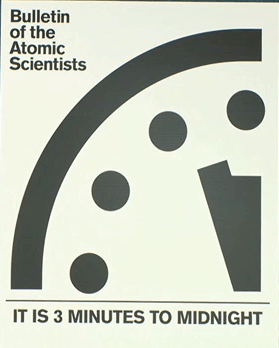
Watch the 2026 Doomsday Clock unveiling live here on January 27 at 10 a.m. EST
To see nuclear-related stories in greater depth and intensity – go to https://nuclearinformation.wordpress.com/

29 Jan. Thursday 7-8 p.m. Webinar – World’s Largest Nuclear Station in Port Hope, ON?


31st January – Challenging the War Machine – a DECLASSIFIED UK SUMMIT


Website of the Week
Now until to February 10, 2026 Radioactive waste storage in France: the debate is finally open! How to participate?
-
Archives
- January 2026 (271)
- December 2025 (358)
- November 2025 (359)
- October 2025 (376)
- September 2025 (258)
- August 2025 (319)
- July 2025 (230)
- June 2025 (348)
- May 2025 (261)
- April 2025 (305)
- March 2025 (319)
- February 2025 (234)
-
Categories
- 1
- 1 NUCLEAR ISSUES
- business and costs
- climate change
- culture and arts
- ENERGY
- environment
- health
- history
- indigenous issues
- Legal
- marketing of nuclear
- media
- opposition to nuclear
- PERSONAL STORIES
- politics
- politics international
- Religion and ethics
- safety
- secrets,lies and civil liberties
- spinbuster
- technology
- Uranium
- wastes
- weapons and war
- Women
- 2 WORLD
- ACTION
- AFRICA
- Atrocities
- AUSTRALIA
- Christina's notes
- Christina's themes
- culture and arts
- Events
- Fuk 2022
- Fuk 2023
- Fukushima 2017
- Fukushima 2018
- fukushima 2019
- Fukushima 2020
- Fukushima 2021
- general
- global warming
- Humour (God we need it)
- Nuclear
- RARE EARTHS
- Reference
- resources – print
- Resources -audiovicual
- Weekly Newsletter
- World
- World Nuclear
- YouTube
-
RSS
Entries RSS
Comments RSS
 nuclear-news