Texas-based Uranium Energy Corporation strongly lobbying Trump administration, and demonising Canadian company Uranium One
The Nuclear Energy Industry Goes MAGA to Win Over Trump
A U.S. uranium company set up shop at CPAC and started spreading Clinton scare stories. The Daily Beast, Lachlan Markay, 03.03.19 A leading U.S. uranium producer is confident that President Donald Trump is going to crack down on its foreign competitors. But in the spirit of not taking any chances, the company rented space at the annual Conservative Political Action Conference, enlisted a top Trumpworld public relations executive, and invoked a well-worn Trump attack line on his 2016 campaign opponent to try to nail down a policy win.
“New nukes” company Terrestrial Energy sets up a new group to promote its (as yet non-existent) molten salt nuclear reactors.

SNC-Lavalin, with its record of corruption should be barred from federal contracts:
 SNC-Lavalin should be barred from federal contracts: Angus, Call comes after two former executives pleaded guilty to breaking laws · CBC News Feb 03, 2019 The Canadian government should suspend engineering giant SNC-Lavalin from competing for future federal government contracts after two former top executives pleaded guilty to charges in recent weeks, says NDP MP Charlie Angus.
Canada’s dangerous foray into nuclear weapons in the 1960s
One that, thankfully, never came to haunt me.
Fifty-five years ago — on Dec. 31, 1963 — the Liberal government of Lester Pearson formally acquired American-controlled nuclear weapons for use by the Canadian military.
Among the RCAF Squadrons stood up specifically for this purpose was RCAF 447 Surface to Air (SAM) Squadron at LaMacaza near Mont Tremblant, a mere hour and change drive from my childhood home.
This and its sister squadron, 446 SAM at North Bay, Ont., combined housed 56 Canadian BOMARC missiles — each carrying a 10-kiloton nuclear warhead maintained, armed and jealously guarded by in-house American servicemen.
Their mission, in layman terms, was to get the BOMARC warhead to detonate in the air close enough to the incoming Soviet bombers so as to destroy, avert or at least delay their further progress on their targets.
But the Canadian and American officers and NCOs who guarded, serviced and stood by ready to launch these U.S manufactured and nuclear-tipped Canadian BOMARCS were by no means alone. RCAF and Army bases, across Canada and into Europe, served as multi-faceted purveyors of U.S nuclear weapons………..
Though actual delivery systems were to change and consolidate over time, the Canadian Armed Forces continued to use tactical nuclear weapons until 1984, which, ironically, happened to be the same year Pierre Trudeau finally, left office. To put it another way, only when Conservative Brian Mulroney took office did the Canadian Armed Forces officially become “nuke-free” again. ………https://torontosun.com/opinion/columnists/guest-column-remembering-canadas-dangerous-foray-into-nuclear-weapons
Saskatchewan sues federal government over cost to clean up abandoned uranium mine
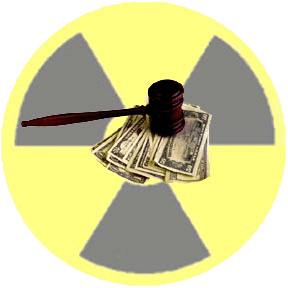 Cleanup cost more than 10 times initial estimate, Adam Hunter – CBC News, The Saskatchewan government is suing Ottawa over costs associated with the cleanup of the Gunnar mine site, an abandoned uranium mine.
The lawsuit, filed on Tuesday, calls on the federal government to honour a 2006 memorandum of agreement (MOA) that saw both sides committing to sharing the cost of cleaning up the northern Saskatchewan site.
When the MOA was signed, the estimated cost was $24.6 million over 17 years. The two sides agreed to split the cost.
The cost has now ballooned to an estimated $280 million. To date, the province has paid $125 million cleaning up the mine and its associated satellite sites. The province said the federal government has contributed $1.13 million.
“The federal government agreed to cost-share this project equally, but has since refused to uphold its end of the agreement,” said Minister of Energy and Resources Bronwyn Eyre.
She said after years of back and forth the province was left with “no choice” because it has an obligation to fully remediate the site.
In an emailed statement to CBC, a spokesperson from the Ministry of Natural Resources said, “as the owner of the site, the Government of Saskatchewan is responsible for the Gunnar Mine Remediation Project.”
It goes on to say the federal government has provided funding for the first phase of the project and it will commit to funding the remaining two phases “after Saskatchewan obtains all the necessary approvals required to proceed with remediation.”
Mine’s history…...https://www.cbc.ca/amp/1.4923849?__twitter_impression=true
NuScale and Ontario Power Generation (OPG) trying to make Small Nuclear Reactors happen in Canada
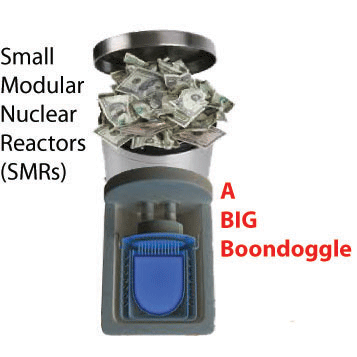 NuScale partners with Ontario Power Generation to bring small nuclear reactors to Canada, The Chemical Engineer Amanda Doyle, 9 Nov 18, NUSCALE has signed a memorandum of understanding with Ontario Power Generation (OPG) in a bid to bring NuScale’s small modular reactors (SMRs) to the Canadian market.
? Canada’s nuclear regulator wants Small Nuclear Reactors exempted from full Environmental Assessment

Federal nuclear regulator urges government to exempt smaller nuclear
reactors from full Environmental Assessment panel review, Globe and Mail 6th Nov 2018 -(subscribers only)
https://www.theglobeandmail.com/business/article-federal-nuclear-regulator-urges-liberals-to-exempt-smaller-reactors/
Small Modular Reactors not commercially viable, but nuclear companies want the government handouts
there is no market for the expensive electricity that SMRs will generate. Many companies presumably enter this business because of the promise of government funding. No company has invested large sums of its own money to commercialize SMRs.Are Thousands of New Nuclear Generators in Canada’s Future? https://thetyee.ca/Opinion/2018/11/07/Nuclear-Generators-Canada-Future/Ottawa is pushing a new smaller, modular nuclear plant that could only pay off if mass produced. By M.V. RamanaM. V. Ramana is the Simons Chair in Disarmament, Global and Human Security at the School of Public Policy and Global Affairs at UBC, and the author of The Power of Promise: Examining Nuclear Energy in India, Penguin Books, New Delhi (2012)
Canada’s government is about to embrace a new generation of small nuclear reactors that do not make economic sense.
Amidst real fears that climate change will wreak devastating effects if we don’t shift away from fossil fuels, the idea that Canada should get deeper into nuclear energy might seem freshly attractive to former skeptics.
For a number of reasons, however, skepticism is still very much warranted.
On Nov. 7, Natural Resources Canada will officially launch something called the Small Modular Reactor Roadmap. The roadmap was previewed in February of this year and is the next step in the process set off by the June 2017 “call for a discussion around Small Modular Reactors in Canada” issued by Canadian Nuclear Laboratories, which is interested in figuring out the role the organization “can play in bringing this technology to market.”
Environmental groups and some politicians have spoken out against this process. A petition signed by nearly two dozen civil society groups has opposed the “development and deployment of SMRs when renewable, safer and less financially, socially and environmentally costly alternatives exist.”
SMRs, as the name suggests, produce relatively small amounts of electricity in comparison with currently common nuclear power reactors. The last set of reactors commissioned in Canada is the four at Darlington. These started operating between 1990 and 1993 and can generate 878 megawatts of electricity (although, on average, they only generate around 75 to 85 per cent of that). In comparison, SMRs are defined as reactors that generate 300 MW or less — as low as 5 MW even. For further comparison, the Site C dam being built in northeastern B.C. is expected to provide 1,100 MW and BC Hydro’s full production capacity is about 11,000 MW.
Various nuclear institutions, such as Canadian Nuclear Laboratories, Canadian Nuclear Association and the CANDU Owners Group are strongly supportive of SMRs. Last October, Mark Lesinski, president and CEO of CNL announced: “Small modular reactors, or SMRs, represent a key area of interest to CNL. As part of our long-term strategy, announced earlier this year, CNL established the ambitious goal of siting a new SMR on a CNL site by 2026.”
Likewise, the CANDU Owners Group announced that it was going to use “their existing nuclear expertise to lead the next wave of nuclear generation — small modular reactors, that offer the potential for new uses of nuclear energy while at the same time offering the benefits of existing nuclear in combating climate change while providing reliable, low-cost electricity.”
A fix for climate change, says Ottawa
Such claims about the benefits of SMRs seems to have influenced the government too. Although NRCan claims to be just “engaging partners and stakeholders, as well as Indigenous representatives, to understand priorities and challenges related to the development and deployment of SMRs in Canada,” its personnel seem to have already decided that SMRs should be developed in Canada.
“The Government of Canada recognizes the potential of SMRs to help us deliver on a number of priorities, including innovation and climate change,” declared Parliamentary Secretary Kim Rudd. Diane Cameron, director of the Nuclear Energy Division at Natural Resources Canada, is confident: “I think we will see the deployment of SMRs in Canada for sure.” Such talk is premature, and unwise.
Canada is a late entrant to this game of talking up SMRs. For the most part it has only been talk, with nothing much to show for all that talk. Except, of course, for millions of dollars in government funding that has flown to private corporations. This has been especially on display in the United States, where the primary agency that has been pumping money into SMRs is the Department of Energy.
In 2001, based on an overview of around 10 SMR designs, DOE’s Office of Nuclear Energy concluded that “the most technically mature small modular reactor designs and concepts have the potential to be economical and could be made available for deployment before the end of the decade, provided that certain technical and licensing issues are addressed.” Nothing of that sort happened by the end of that decade, i.e., 2010. But in 2012 the U.S. government offered money: up to $452 million to cover “the engineering, design, certification and licensing costs for up to two U.S. SMR designs.” The two SMR designs that were selected by the DOE for funding were called mPower and NuScale.
The first pick was mPower and, a few months later, the DOE projected that a major electricity generation utility called the Tennessee Valley Authority “plans to deploy two 180 megawatt small modular reactor units for commercial operation in Roane County, Tennessee, by 2021, with as many as six mPower units at that site.”
The company developing mPower was described by the New York Times as being in the lead in the race to develop SMRs, in part because it had “the Energy Department and the T.V.A. in its camp.”
But by 2017, the project was essentially dead.
Few if any buyers
Why this collapse?
In a nutshell, because there is no market for the expensive electricity that SMRs will generate. Many companies presumably enter this business because of the promise of government funding. No company has invested large sums of its own money to commercialize SMRs.
An example is the Westinghouse Electric Co., which worked on two SMR designs and tried to get funding from the DOE. When it failed in that effort, Westinghouse stopped working on SMRs and shifted its focus to decommissioning reactors that are being shut down at an increasing rate, which is seen as a growing business opportunity. Explaining this decision in 2014, Danny Roderick, then president and CEO of Westinghouse, said: “The problem I have with SMRs is not the technology, it’s not the deployment — it’s that there’s no customers…. The worst thing to do is get ahead of the market.”
Many developing countries claim to be interested in SMRs but few seem to be willing to invest in the construction of one. Although many agreements and memoranda of understanding have been signed, there are still no plans for actual construction. Examples are the cases of Jordan, Ghana and Indonesia, all of which have been touted as promising markets for SMRs, but none of which are buying one because there are significant problems with deploying these.
A key problem is poor economics. Nuclear power is already known to be very expensive. But SMRs start with a disadvantage: they are too small. One of the few ways that nuclear power plant operators could reduce the cost of nuclear electricity was to utilize what are called economies of scale, i.e., taking advantage of the fact that many of the expenses associated with constructing and operating a reactor do not change in linear proportion to the power generated. This is lost in SMRs. Most of the early small reactors built in the U.S. shut down early because they couldn’t compete economically.
Reactors by the thousands?
SMR proponents argue that they can make up for the lost economies of scale in two ways: by savings through mass manufacture in factories, and by moving from a steep learning curve early on to gaining rich knowledge about how to achieve efficiencies as more and more reactors are designed and built. But, to achieve such savings, these reactors have to be manufactured by the thousands, even under very optimistic assumptions about rates of learning. Rates of learning in nuclear power plant manufacturing have been extremely low. Indeed, in both the United States and France, the two countries with the highest number of nuclear plants, costs went up, not down, with construction experience.
In the case of Canada, the potential markets that are most often proffered as a reason for developing SMRs are small and remote communities and mines that are not connected to the electric grid. That is not a viable business proposition. There are simply not enough remote communities, with adequate purchasing capacity, to be able to drive the manufacture of the thousands of SMRs needed to make them competitive with large reactors, let alone other sources of power.
There are thus good reasons to expect that small modular reactors, like large nuclear power plants, are just not commercially viable. They will also impose the other well-known problems associated with nuclear energy — the risk of severe accidents, the production of radioactive waste, and the linkage with nuclear weapons — on society. Rather than seeing the writing on the wall, unfortunately, NRCan and other such institutions are regurgitating industry propaganda and wasting money on technologies that will never be economical or contribute to any meaningful mitigation of climate change. There is no justification for such expensive distractions, especially as the climate problem becomes more urgent. ![[Tyee]](https://ci4.googleusercontent.com/proxy/-dbM2-hlkJWqmnDhMjXoXTKhgMN4lAbQ2wyqv_IW2Qs-IMWKHJAwJI-q0jLCPSZjrmKGcsJD2R_OTYg=s0-d-e1-ft#https://thetyee.ca/ui/img/ico_fishie.png)
Canada’s glaciers are retreating – and fast!
|
We’ve never seen this’: massive Canadian glaciers shrinking rapidly Glaciers in the Yukon territory are retreating even faster than expected in a warming climate, scientists warn, https://www.theguardian.com/world/2018/oct/30/canada-glaciers-yukon-shrinking Guardian, Leyland Cecco in Toronto |
|
|
“Clean Energy Ministerial”: despite Canada’s Liberal claims, nuclear power will not save the environment
 Despite Liberal claims, nuclear power will not save the environment http://rabble.ca/columnists/2018/10/despite-liberal-claims-nuclear-power-will-not-save-environment, Ole Hendrickson October 23, 2018 Want a shiny new nuclear reactor in your community? Justin Trudeau has a deal for you.
In the lead-up to the 2015 election, he said the economy and environment “go together like paddles and canoes. Unless you have both, you won’t get to where you are going.” Such vacuous statements helped him win a majority government.
Did Liberal voters think “real change” would mean maintaining fossil fuel subsidies, buying the Kinder Morgan pipeline, and promoting new nuclear reactors?
When the Liberals renamed the cabinet committee on “Environment, Climate Change and Energy” to “Environment and Clean Growth” on August 28, 2018, Trudeau’s office said this “reflects the government’s commitment to addressing climate change through growing the economy.” But putting “clean” in front of “growth” is a con job — like putting “sustainable” in front of “development.”
Behind closed doors in the “clean growth” cabinet committee, the minister of natural resources will discuss next year’s “Clean Energy Ministerial” — a gathering of energy ministers from the world’s richest nations, hosted by Canada.
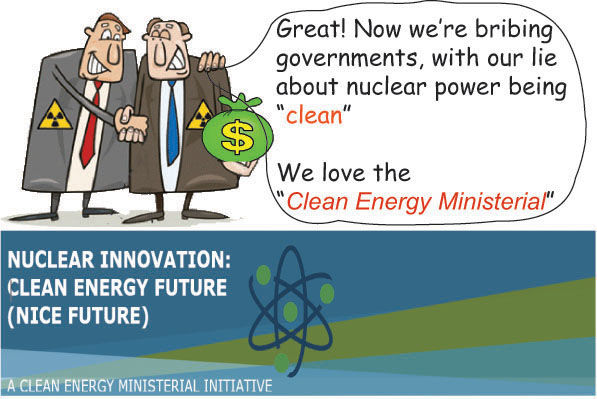
One of Canada’s objectives for this meeting, together with the U.S., is to advance plans for the “next generation” of nuclear reactors. In preparation, a federal nuclear reactor “road map” will be released next month at a Canadian Nuclear Society conference in Ottawa subsidized by the Trudeau government.
For the one-percenters, “clean growth” includes nuclear power. The military industrial complex needs nuclear power and nuclear weapons just as much as it needs fossil fuels.
Government officials and lobbyists who call nuclear power “clean energy” cannot provide a shred of evidence that a new generation of reactors will help Canada and other nations achieve the Paris Agreement greenhouse gas reduction targets.
The real point of this exercise is to perpetuate the military industrial complex.
The nuclear industry is desperately casting about for ways to attract young scientists and engineers. It promotes fantasies of reactor technologies that will provide carbon-free electricity, eliminate existing nuclear waste stockpiles, desalinate ocean water, power remote Indigenous communities, and enable travel to Mars.
But these technologies have been around for decades. They are enormously expensive. They require huge government subsidies, waste taxpayer dollars and generate budget deficits characteristic of the U.S. military industrial complex.
Climate justice incompatible with economic growth
Addressing climate change through economic growth is an ecocidal fantasy. To claim that humans can appropriate more and more of the planet’s resources, and still protect the environment and halt climate change is ludicrous.
This is business as usual — continuation of the “great acceleration” created by post-Second World War governments who transformed the war machine into the “peacetime” military industrial complex.
Politicians and corporate executives — the one-percenters — have no intention of putting the brakes on this machine. They need to fuel the nuclear sub fleets in the U.S. and U.K., and the armoured vehicles that Canada makes and sells to Saudi Arabia. They will try to extract every last gram of uranium and drop of oil. Nuclear and fossil fuels are both the means and end of war.
Ultimately, the military industrial complex is waging war against the planet, against ourselves and against all living creatures. The Earth is in great peril.
Revolution is brewing. Activists, Indigenous and non-Indigenous alike are rejecting these corporate-driven technological fantasies. Energy is changing. The capitalist system will not survive. But what will replace it?
Ole Hendrickson is a retired forest ecologist and a founding member of the Ottawa River Institute, a non-profit charitable organization based in the Ottawa Valley.
Photo: European Parliament/Flickr
Non nuclear production of medical isotopes – Canada
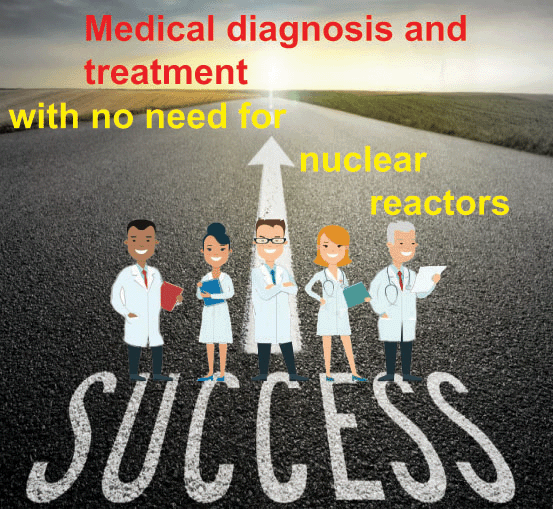
Canada to build advanced medical isotope centre, WNN 02 November 2018 Canada is to invest more than CAD50 million (USD38 million) on a new centre for advanced medical isotope research and development. The centre will be on the campus of Triumf, the national laboratory for particle physics, at the University of British Columbia.
Canadian Prime Minister Justin Trudeau yesterday announced federal funding for the Institute for Advanced Medical Isotopes (IAMI) during a visit to Triumf.
The 2500-square-metre state-of-the-art facility will house a new TR-24 medical cyclotron, a cyclotron control room and six laboratories. It will also have technical rooms, quality control laboratories, office space, and electrical control rooms.
The construction of the facility is valued at CAD31.8 million, Triumf said. “With additional equipment and philanthropic funding, the total value of the IAMI project will be more than CAD50 million,” it added.
The government of Canada will contribute CAD10,232,310 to the project through the Investing in Canada infrastructure plan. The Province of British Columbia has contributed CAD12,250,000, Triumf is contributing CAD5,352,638 and, through fundraising initiatives, BC Cancer and the University of British Columbia are each contributing CAD2 million.
“IAMI promises to secure a local supply of several important medical isotopes, including critical imaging isotope technetium-99m (Tc-99m), and to enable Canadian access to the global Tc-99m market,” Triumf said. Canada is already a leader in the global medical isotope market – worth some USD3 billion – and contributes more than 50% of the world’s raw material for medical isotope supply.
Announcing the federal funding, Trudeau said: “The Institute for Advanced Medical Isotopes will be a state-of-the-art facility where industry leaders and academics can work together to push the boundaries of research and discover new ways to protect and improve our health. We will continue to invest in cutting-edge research and facilities – like the Institute for Advanced Medical Isotopes – to ensure Canada remains a world leader in medical research and innovation.”………http://www.wor
The dangerous radioactive trash – 60,000 tons on the shores of the Great Lakes
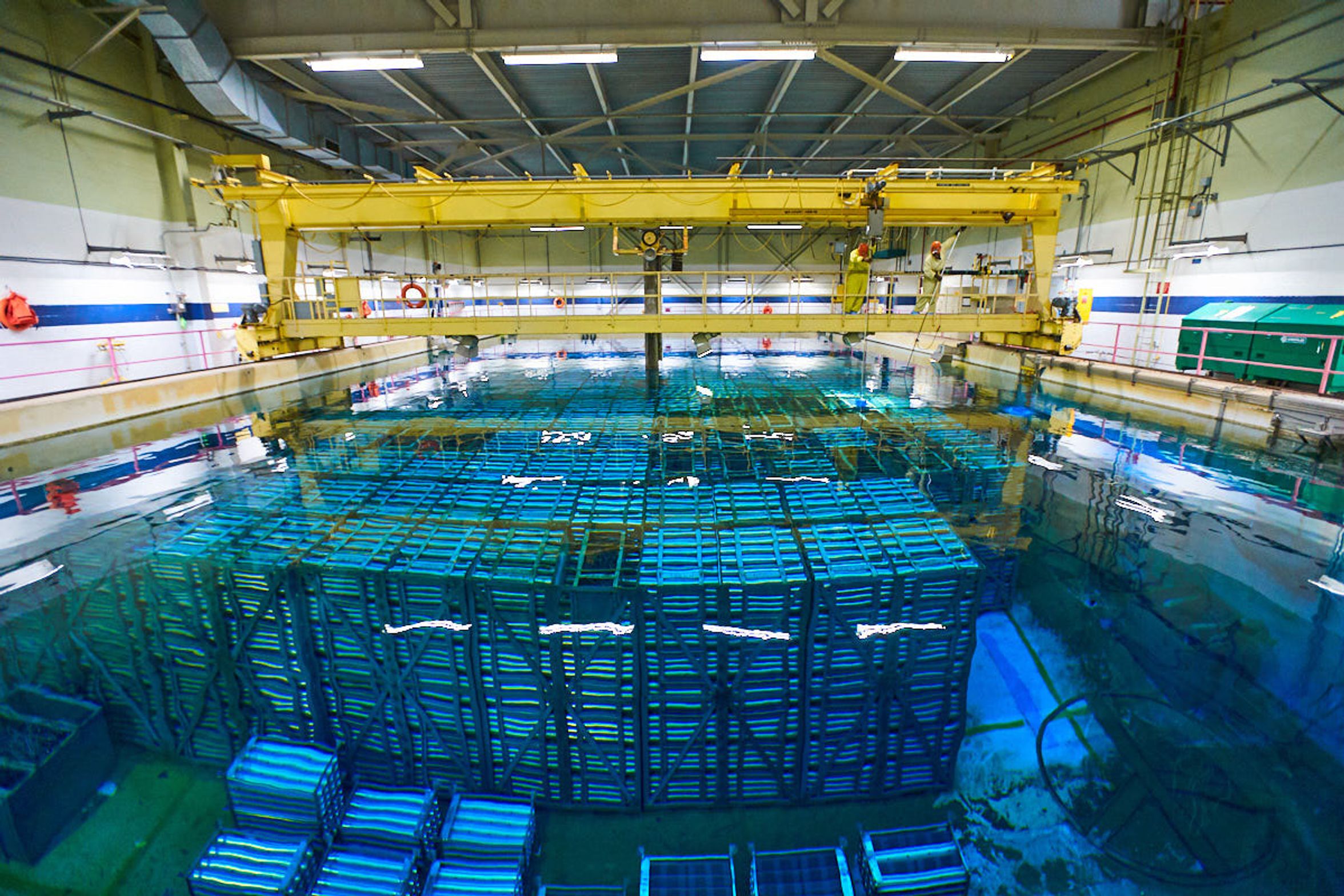 60,000 tons of dangerous radioactive waste sits on Great Lakes shores, THE EFFECTS OF A WORST-CASE SCENARIO — FROM A NATURAL DISASTER TO TERRORISM — COULD CAUSE UNTHINKABLE CONSEQUENCES FOR THE GREAT LAKES REGION, Keith Matheny, Detroit Free Press, Oct. 19, 2018 More than 60,000 tons of highly radioactive spent nuclear fuel is stored on the shores of four of the five Great Lakes — in some cases, mere yards from the waterline — in still-growing stockpiles.
“It’s actually the most dangerous waste produced by any industry in the history of the Earth,” said Gordon Edwards, president of the nonprofit Canadian Coalition for Nuclear Responsibility.
The spent nuclear fuel is partly from 15 current or former U.S. nuclear power plants, including four in Michigan, that have generated it over the past 50 years or more. But most of the volume stored along the Great Lakes, more than 50,000 tons, comes from Canadian nuclear facilities, where nuclear power is far more prevalent.
It remains on the shorelines because there’s still nowhere else to put it. The U.S. government broke a promise to provide the nuclear power industry with a central, underground repository for the material by 1998. Canada, while farther along than the U.S. in the process of trying to find a place for the waste, also doesn’t have one yet.
The nuclear power industry and its federal regulator, the U.S. Nuclear Regulatory Commission, point to spent nuclear fuel’s safe on-site storage over decades. But the remote possibility of a worst-case scenario release — from a natural disaster, a major accident, or an act of terrorism — could cause unthinkable consequences for the Great Lakes region.
Scientific research has shown a radioactive cloud from a spent fuel pool fire would span hundreds of miles, and force the evacuation of millions of residents in Detroit, Chicago, Cleveland, Toronto or other population centers, depending on where the accident occurred and wind patterns.
It would release multiple times the radiation that emanated from the Fukushima disaster in Japan in 2011 — a disaster that led to mass evacuations, no-go zones that exist to this day, and a government ban on fishing in a large, offshore area of the Pacific Ocean because of high levels of radioactive cesium in the water and in fish. The fishing industry there has yet to recover, more than seven years later.
“The Mississippi and the Great Lakes — that would be really bad,” said Frank von Hippel, senior research physicist and professor of public and international affairs emeritus at Princeton University.
Added Jim Olson, environmental attorney and founder of the Traverse City-based nonprofit For Love of Water, or FLOW: “The fact that it’s on the shorelines of the Great Lakes takes that high consequence that would be anywhere and paints it red and puts exclamation marks around it.”
Spent nuclear fuel is so dangerous that, a decade removed from a nuclear reactor, its radioactivity would still be 20 times the level that would kill a person exposed to it. Some radioactive byproducts of nuclear power generation remain a health or environmental hazard for tens of thousands of years. And even typically harmless radioactive isotopes that are easily blocked by skin or clothing can become extremely toxic if even small amounts are breathed in, eaten or drank, making their potential contamination of the Great Lakes — the drinking water supply to 40 million people — the connected Mississippi River and the prime agricultural areas of the U.S. a potentially frightening prospect. ……….
For five years, Michigan residents, lawmakers, environmental groups and others around the Midwest have, loudly and nearly unanimously, opposed a planned Canadian underground repository for low-to-medium radioactive waste at Kincardine, Ontario, near the shores of Lake Huron.
Meanwhile, spent nuclear fuel, vastly more radioactive, sits not far from the shores of four Great Lakes — Michigan, Huron, Erie and Ontario — at 15 currently operating or former nuclear power plant sites on the U.S. side. In Michigan, that includes Fermi 2; the Donald C. Cook nuclear plant in Berrien County; the Palisades nuclear plant in Van Buren County, and the former Big Rock Point nuclear plant in Charlevoix County, which ceased operation in 1997 and where now only casks of spent nuclear fuel remain.
Neither the U.S. nor the Canadian government has constructed a central collection site for the spent nuclear fuel. It’s not just a problem in the Great Lakes region — more than 88,000 tons of spent nuclear fuel, an amount that is rising, is stored at 121 U.S. locations across 39 states…….
Spent nuclear fuel isn’t only radioactive, it continues to generate heat. It requires storage in pools with circulating water for typically five years before it can be moved into so-called dry-cask storage — concrete-and-steel obelisks where spent fuel rods receive continued cooling by circulating air.
In practice, however, because of the high costs associated with transferring waste from wet pools to dry casks, nuclear plants have kept decades worth of spent fuel in wet storage. Plant officials instead “re-rack” the pools, reconfiguring them to add more and more spent fuel, well beyond the capacities for which the pools were originally designed.
“The prevailing practice in the United States is you re-rack the pools until they are just about as dense-packed as the nuclear core,” von Hippel said.
Only in recent years have nuclear plants stepped up the transition to dry cask storage because there’s no room left in the wet pools. Still, about two-thirds of on-site spent nuclear fuel remains in wet pools in the U.S.
That’s a safety concern, critics contend. A catastrophe or act of terrorism that drains a spent fuel pool could cause rising temperatures that could eventually cause zirconium cladding — special brackets that hold the spent fuel rods in bundles — to catch fire.
Such a disaster could be worse than a meltdown in a nuclear reactor, as spent nuclear fuel is typically stored with nowhere near the fortified containment of a reactor core.
“The long-term land-contamination consequences of such an event could be significantly worse than those from Chernobyl,” a 2003 research paper by von Hippel and seven other nuclear experts stated.
The reference is to the worst nuclear power disaster in world history, the April 1986 reactor explosion at the Chernobyl Nuclear Power Plant in the former Soviet Union, now a part of the Ukraine, where 4,000 to 90,000 are estimated to have died as a result of the radiation released. A study by the University of Exeter in Great Britain, released this June, found that cow’s milk from farms about 125 miles from the Chernobyl accident site still — more than 30 years later —- contains the radioactive element cesium at levels considered unsafe for adults and at more than seven times the limit unsafe for children.
Allison Macfarlane, a professor of public policy and international affairs at George Washington University, served as chairman of the NRC during the Obama administration from July 2012 until December 2014.
“What I think needs more examination is the practice of densely packing the fuel in the pool,” she said.
The NRC does not regulate how much fuel can be in a pool, in what configuration it’s placed, and how old the fuel is, Macfarlane said. ……….
In a Great Lakes region where magnitude-9.0 earthquakes and tsunamis aren’t a potential threat to stockpiles of spent nuclear fuel, terrorism remains possible………
In a Great Lakes region where magnitude-9.0 earthquakes and tsunamis aren’t a potential threat to stockpiles of spent nuclear fuel, terrorism remains possible.
“The NRC’s position on beyond design basis threats is essentially that this is a matter for the national security apparatus — it’s not our job, so somebody else will take care of it,” he said. “But if you look at the Pentagon, Homeland Security, I think you will look in vain to find any part of that apparatus that is addressing that area that the NRC says is not its job.”……….
Welcome to Zion, nuclear waste dump ………..
SNC-Lavalin shares fall to lowest since 2016 on news foreign bribery case will go to court
 SNC-Lavalin shares fall to lowest since 2016 on news foreign bribery case will go to court SNC-Lavalin shares fall to lowest since 2016 on news foreign bribery case will go to courtFormer employees accused of paying bribes in Libya to win contracts CBC News · October 11 Shares in Canadian engineering giant SNC-Lavalin fell to their lowest level in more than two years after the company revealed the federal government has decided it won’t let the company settle allegations of foreign bribery out of court. |
|
|
Coalition calls to “Make nuclear waste site Ottawa Valley election issue”

 Make nuclear waste site Ottawa Valley election issue: coalition https://www.insideottawavalley.com/news-story/8948934-make-nuclear-waste-site-ottawa-valley-election-issue-coalition/ NEWS Oct 05, 2018 by John Carter Arnprior Chronicle-Guide A group of concerned citizens is making a concerted effort to make the proposed nuclear waste disposal at Chalk River an election issue throughout Renfrew County, especially those municipalities along the Ottawa River.The informal alliance that also includes Ottawa Riverkeeper, the Coalition Against Nuclear Dumps on the Ottawa River and two cottagers groups, has sent a lengthy letter to each municipal candidate, spelling out “major concerns” about the plan. The groups stress they’re not advocating the closure of Chalk River nuclear laboratories but want changes to proposals on how and where radioactive nuclear waste is to be disposed.
It asks candidates to support efforts to petition the federal government to move the proposed radioactive nuclear disposal site “much farther away” from the Ottawa River and to use more-secure containment methods.
“Your constituents are very worried that large amounts of radioactive waste could contaminate the Ottawa River if these plans are not changed,” says the letter. That would affect the drinking water of millions of people.
The letter points out the contract includes the requirement to “seek the fastest, most cost-effective means” to dispose of all the radioactive waste that has been accumulating at Chalk River and other federal nuclear sites. The contract also includes decommissioning and entombing the nuclear reactor at Rolphton, which the coalition calls inappropriate.
The letter says the proposed 27-acre containment “mound” will contain up to one million cubic metres of radioactive nuclear waste, including materials transported in from other Canadian decommissioned nuclear sites. It is to be covered over by a combination of sand, stone, gravel and topsoil that could reach about 25 metres high.
The coalition is particularly concerned because the location is directly over an active earthquake zone, above porous and fractured rock, and less than a kilometre from the Ottawa River. It is beside a small lake that drains directly into the Ottawa River through a small creek, the letter points out.
The letter says the danger is exacerbated if the mound is left uncovered for more than 50 years, as planned. Furthermore, “climate change brings unpredictable, catastrophic weather that could cause permanent radioactive contamination of the Ottawa River,” the letter adds.
It suggests retired Atomic Energy of Canada Ltd. (AECL) senior nuclear scientists have raised serious concerns about the proposal. It quotes Dr. J.R. Walker as saying it “employs inadequate technology and is problematically located” and “does not meet regulatory requirements with respect to the health and safety of persons and the protection of the environment.”
The letter urges candidates, if elected, to introduce resolutions questioning the process and opposing the waste proposals as they currently stand, as well as the importation of nuclear waste to Chalk River from other locations “as more than 135 municipalities in Ontario and Quebec have already done.”
Town Council election becomes a debate on nuclear waste hosting
Hornepayne, Ont., municipal election to become debate on nuclear waste, Community one of three in  northwestern Ontario to consider hosting nuclear waste J · CBC News Oct 04, 2018 Voters in the small northwestern Ontario town of Hornepayne will have more to consider at the ballot box than tax rates and economic growth.
1 This Month
To see nuclear-related stories in greater depth and intensity – go to https://nuclearinformation.wordpress.com/

29 Jan. Thursday 7-8 p.m. Webinar – World’s Largest Nuclear Station in Port Hope, ON?


31st January – Challenging the War Machine – a DECLASSIFIED UK SUMMIT

Website of the Week
Now until to February 10, 2026 Radioactive waste storage in France: the debate is finally open! How to participate?
-
Archives
- January 2026 (259)
- December 2025 (358)
- November 2025 (359)
- October 2025 (376)
- September 2025 (258)
- August 2025 (319)
- July 2025 (230)
- June 2025 (348)
- May 2025 (261)
- April 2025 (305)
- March 2025 (319)
- February 2025 (234)
-
Categories
- 1
- 1 NUCLEAR ISSUES
- business and costs
- climate change
- culture and arts
- ENERGY
- environment
- health
- history
- indigenous issues
- Legal
- marketing of nuclear
- media
- opposition to nuclear
- PERSONAL STORIES
- politics
- politics international
- Religion and ethics
- safety
- secrets,lies and civil liberties
- spinbuster
- technology
- Uranium
- wastes
- weapons and war
- Women
- 2 WORLD
- ACTION
- AFRICA
- Atrocities
- AUSTRALIA
- Christina's notes
- Christina's themes
- culture and arts
- Events
- Fuk 2022
- Fuk 2023
- Fukushima 2017
- Fukushima 2018
- fukushima 2019
- Fukushima 2020
- Fukushima 2021
- general
- global warming
- Humour (God we need it)
- Nuclear
- RARE EARTHS
- Reference
- resources – print
- Resources -audiovicual
- Weekly Newsletter
- World
- World Nuclear
- YouTube
-
RSS
Entries RSS
Comments RSS
 nuclear-news