Say goodbye to independent assessments of nuclear projects in Canada
3 July 2026
The Nuclear Fist: Five Federal Initiatives Pushing and Promoting Nuclear Power
There are currently five federal nuclear related initiatives / announcements: “Getting Major Projects Built in Canada – Discussion Paper on Proposed Legislative, Regulatory, and Policy Reforms” announced May 8th with the deadline now extended to July 22; the electricity strategy “Powering Canada Strong: A National Strategy for an Electrified Canadian Economy” which was announced May 14 with comment invited but no deadline; the Standing Committee on Natural Resources and the Environment electrification study with the deadline – and the study – now extended to mid-September; the Nuclear Energy Strategy for Canada announced June 22 with no comment invited and so no deadline for comment, and the June 24 announcement of the potential “listing” of the NWMO DGR under the Build Canada Act (aka Bill C-5), also no public comment period.
Prime Minister Mark Carney wants to end independent assessment of nuclear projects and hand over this responsibility to the Canadian Nuclear Safety Commission. READ SUBMISSIONS
Why is this a bad idea?
The CNSC cannot be trusted because it:
- Is led by industry insiders
- Often is seen as a promoter and co-proponent of nuclear projects
- Reports to the Minister who promotes nuclear power
- Has never denied a licence application
- Often excludes the public from its hearings
- Does not have the required independence from the nuclear industry
- Secretly authorised transport of radioactive fuel waste from Gentilly-1 nuclear plant across Quebec into Ontario
Nuclear power is uniquely complex and risky.
Fast-tracking nuclear projects is outright dangerous:
- Accidents can have catastrophic consequences
- Nuclear materials are toxic and radioactive – some literally forever!
- Nuclear power is linked to nuclear proliferation
Decisions about nuclear projects must be based on sound information that has been examined and tested by the public, independent experts and an independent review panel. Social concerns, protection of public health and the environment, and economic value must all be considered.
What can you do?
Between now and July 22 you can provide comments on the government’s discussion paper. Following that, when legislation is tabled, you can comment on the legislation. Throughout this time, contact your Member of Parliament and members of Cabinet by email, phone and in-office visits and share your concerns about these changes, and the speed with which they are being made.
…………………………………………………………………………………………………………………………………https://nuclearwastewatch.weebly.com/assessing-nuclear-risk.html
Anishinabek Nation stands united in unequivocal opposition to the transportation of nuclear waste through the entire Anishinabek Nation territory.

ANISHINABEK NATION TERRITORY (July 1, 2026) – The Anishinabek Nation Grand Council Chief shares a statement as the Nation prepares to celebrate Canada Day.
“We wish you a Happy Canada Day!
Anishinabek Nation statement on Canada Day
ANISHINABEK NATION TERRITORY (July 1, 2026) – The Anishinabek Nation Grand Council Chief shares a statement as the Nation prepares to celebrate Canada Day. https://anishinabeknews.ca/2026/07/anishinabek-nation-statement-on-canada-day/
“We wish you a Happy Canada Day! We celebrate the diversity, cultures, and contributions of this Nation with pride and encourage others to join in celebration. However, we also encourage citizens of this Nation to take the time to understand that this land you have come to know as Canada has a colourful past with a legacy that continues to negatively affect the Original People of this land. While some parts of the country are celebrating, First Nations people are contemplating the Government of Canada’s plans for a toxic nuclear waste dump in a small town in Northwestern Ontario within the Treaty 3 territory.
The Anishinabek Nation stands united in unequivocal opposition to the transportation of nuclear waste through the entire Anishinabek Nation territory from southern Ontario to the proposed burial of nuclear waste in the Township of Ignace, Ontario, and Wabigoon Lake Ojibway Nation. While Prime Minister Carney claims, ‘We are defending and building together, the true North, strong and free’, there is a stark contrast between words and actions, and rightsholders and citizens of this land are taking note. Instead of protecting our homeland, the plan is to pollute it with toxic nuclear waste, far from the populations that utilize and benefit from nuclear energy produced in the south.
The Anishinabek Nation stands united in unequivocal opposition to the transportation of nuclear waste through the entire Anishinabek Nation territory from southern Ontario to the proposed burial of nuclear waste in the Township of Ignace, Ontario, and Wabigoon Lake Ojibway Nation. While Prime Minister Carney claims, ‘We are defending and building together, the true North, strong and free’, there is a stark contrast between words and actions, and rightsholders and citizens of this land are taking note. Instead of protecting our homeland, the plan is to pollute it with toxic nuclear waste, far from the populations that utilize and benefit from nuclear energy produced in the south.
Imagine for a moment that the federal and provincial governments proposed nuclear waste in a DGR in Southern Ontario, the most densely populated heart of the country. Would you be so eager to impose such a dangerous burden on those communities that have no choice but to live with the risk? Would there be silence or dismissiveness? Or would Canadians stand up and demand meaningful engagement, transparency, and respect for their health and environment?
magine for a moment that the federal and provincial governments proposed nuclear waste in a DGR in Southern Ontario, the most densely populated heart of the country. Would you be so eager to impose such a dangerous burden on those communities that have no choice but to live with the risk? Would there be silence or dismissiveness? Or would Canadians stand up and demand meaningful engagement, transparency, and respect for their health and environment?
As stated in Article 29 of the United Nations Declaration on the Rights of Indigenous Peoples, “States shall take effective measures to ensure that no storage or disposal of hazardous materials shall take place in the lands or territories of Indigenous Peoples without their free, prior and informed consent,” and we do not consent to the transportation of this nuclear waste in our territory and member First Nations.
We call on the federal government to reconsider its pursuit of a dangerous, toxic nuclear waste dump that threatens our future generations, and to cease these reckless plans immediately. We ask that you respect the treaty relationship, our inherent rights, and our sovereignty. Listen to our voices and prioritize safe and environmentally sound solutions that do not put any communities or the environment at risk. It is painfully clear that the transportation and disposal of hazardous nuclear waste bring risks, uncertainty, and consequences for all.
National interest in nuclear site gets mixed reaction

Organizations opposing the waste site say they’re worried, should the repository be deemed a project of national interest, that oversight would weaken.
“Our major concern would be the approval process being fast-tracked,”
The Nuclear Waste Management Organization says such a designation would not weaken oversight, opponents of the deep geological repository don’t agree
Matt Prokopchuk, Jun 24, 2026
IGNACE — The potential for changing how a proposed nuclear waste facility is studied has set off a flurry of reactions across the region.
On Wednesday, the federal government announced three initiatives were being referred to its Major Projects Office, which will consider whether to name them projects of national interest under the Building Canada Act. That designation is designed to alter the processes that determine whether projects get approved, with the goal of speeding up that decision.
The Nuclear Waste Management Organization’s proposed deep geological repository for high-level used fuel near Revell Lake was one of the initiatives Ottawa announced was up for consideration.
“The deep geological repository for used nuclear fuel is nationally significant infrastructure that supports clean growth, advances reconciliation, delivers long term economic benefits and strengthens Canada’s energy security and resilience,” the Nuclear Waste Management Organization said in an emailed statement.
The NWMO is a government-mandated not-for-profit funded by the nuclear industry tasked with the long-term management of the country’s nuclear waste. It selected the Revell Lake-area site in 2024.
The project is currently undergoing a multi-phase environmental impact assessment and regulatory review by the Impact Assessment Agency of Canada and the Canadian Nuclear Safety Commission. They have been tasked with deciding whether to green-light the proposed facility through a scheduled years-long study.
Organizations opposing the waste site say they’re worried, should the repository be deemed a project of national interest, that oversight would weaken.
“Our major concern would be the approval process being fast-tracked,” said Wendy O’Connor, a volunteer with We the Nuclear Free North, a coalition of organizations and residents opposing the transportation and storing of nuclear waste in northern Ontario. “What we’ve been relying on so far is the impact assessment office and an impact assessment. And we’ve been assured that it was going to be a full impact assessment, which was a win for us.”
“Now, that is all potentially taken apart if this referral to the major projects office actually does go through.”
According to a federal government media release, consultations about whether to list the project will “begin over the coming weeks,” with a decision expected in the fall.
Newswatch has requested comment from the Impact Assessment Agency of Canada about what listing the deep geological repository under the Building Canada Act would mean to the ongoing review the agency is doing.
Wabigoon Lake Ojibway Nation Chief Clayton Wetelainen told Newswatch, should the project receive the “national interest” designation from the Major Projects Office, the First Nation’s independent parallel approvals process won’t be affected. Wabigoon Lake is one of two host communities for the repository, along with Ignace.
“That’s why we, in our agreement to host it, to look at it, is that we have our own independent sovereign regulatory approval process that will mitigate if there’s anything that Wabigoon Lake sees that is going to be problematic,” he said.
The NWMO, in its statement, argued making the project one of national significance “would not reduce the scope, rigour or independence of the regulatory decision-making process.”
Opponents say they’re not convinced, adding that the public consultation phases of the ongoing impact assessment have garnered hundreds of comments, with many expressing concern or outright opposition.
“The risks are monumental and Canadians deserve a thorough examination of the risks in a full impact assessment,” O’Connor said.
“That is what we continue to press for and we were sure that was going to happen and now this (announcement) puts it in question again.”
The Northwestern Ontario Municipal Association, which represents 37 municipalities across the region, including Ignace, said in a media release that it and its sister organization in the northeast “welcome” the referral, but “stress that the project must continue through a rigorous regulatory, environmental, scientific, and Indigenous consultation process before any final decisions are made.”
The organizations added that similar consideration should also be given to the Trans-Canada Highway through the north — particularly with the prospect of hundreds of trucks of nuclear waste travelling each year on Highways 11 and 17.
“Should the deep geological repository ultimately proceed, transportation associated with the project could occur on northern Ontario highways within the coming decades,” NOMA’s media release said.
“Preparing for that future requires a highway system that is safe, reliable, resilient and capable of supporting nationally significant projects.”
In Wabigoon Lake, Wetelainen said the time to make a decision on a nuclear waste site is now.
“It’s a problem today and it’s been a problem yesterday,” he said. “The critical voices and the people who are supportive of it, are going through some times.”
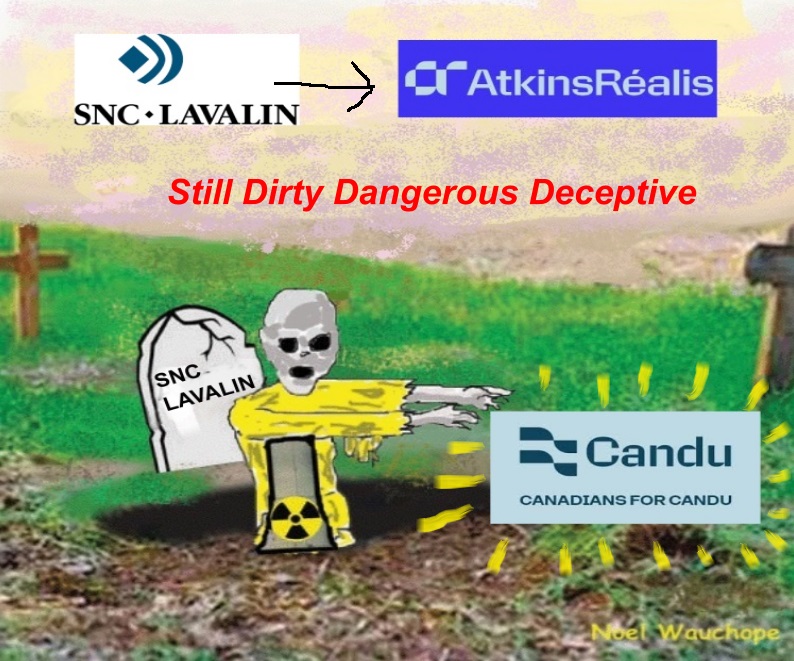
Nuclear Power is NOT the Solution – It’s the Problem! NO CANDU!
F. R. Greening Ph.D. 3 July 26
Carney’s Liberal Government has recently become fixated on promoting nuclear power as the best way for Canada to generate so-called “clean”, carbon-emission-free, electrical energy. In support of this policy the government likes to boast about Canada’s past accomplishments in developing and exploiting nuclear engineering technology through our very own, home-grown expertise.
Now this view may have had a basis in truth back in the 1970’s when Chalk River Laboratories truly was a center of nuclear research excellence that led to the development of the CANDU reactor. It’s also true that the first generation of CANDU reactors, located at Pickering and Bruce, were quite successful, with operating capacity factors well over 80% during their first 10-years of operation.
But this was back in the 1970s; fast forward to 2026 and, with all of these first generation CANDU reactors either refurbished or permanently shut down, we are left with a somewhat uncertain future for nuclear energy in Canada. Indeed, I believe we are now in an electrical energy crisis here in Ontario because our home-grown nuclear power stalwart – the CANDU reactor – has been in failure mode for at least the past 10 years.
This decline is due to the aging of Ontario’s fleet of 18 CANDU reactors: 6 at Pickering, 8 at Bruce and 4 at Darlington. All Pickering and Bruce Units are now over 40 years old, and it is important to note that these nuclear reactors were designed and built using 1960’s technology, with 1960’s computers. Thus, it is impressive that Pickering B and Bruce B units lasted 40 years before requiring major refurbishments.
However, the performance of Darlington is another story because all four Darlington units required refurbishments after only about 30 years of operation, thereby creating a short-fall in Ontario’s nuclear energy production. This is clearly illustrated in Figure 1, below, which shows Ontario’s nuclear power output has declined from about 92 TWh in 2014, to a current value of about 75 TWh – a loss of about 20 % in Ontario’s electric power output in just 12 years. But to make matters worse, it is predicted that this decline will continue to about 60 TWh by 2030, before all existing CANDUs have been refurbished, and/or new reactors have been built and commissioned.
[Greening supplies graphs on this issue
the percentage of Ontario’s electricity derived from natural gas has increased substantially from about 10% in 2015 to 30% in 2026. Furthermore, extrapolation of these data points predicts that natural gas as a source of electricity for Ontario will exceed nuclear generated electricity production by 2028.
It is indeed ironic that “Climate-Change Carney” recently, (Canada Day!), declared:]
“We can’t afford to restrain the growth of an important part of our energy mix – natural gas – to meet a short-term goal. I want to be clear on this point. The changes we have made will mean that our GHG emissions will be higher in the next few years than were projected under the previous (Liberal!) government’s plan”.
What Carney fails to acknowledge, however, is that when it comes to Ontario’s electrical energy short-fall, nuclear power is not the solution; it’s the problem! If Ontario’s CANDU reactors were performing up to expectations, there would be no need for OPG to rely on natural gas combustion,
, with the associated annual release of tens of Megatonnes of CO2, as a viable alternative. And Carney et al’s blind faith in Canada’s alleged nuclear prowess, as exemplified by the CANDU reactor, is in reality a myth that is not supported by fact!
By way of proof of Canada’s less than excellence in its CANDU reactor’s performance, consider lifetime capacity factor data, (derived from the IAEA PRIS website), for seventeen countries with extensive nuclear power programs. Sad to say, Canada has the lowest lifetime capacity factor, a miserable 68.2%, compared to any other country on the list.
Canada’s Nuclear Energy Strategy a “Cash Cow” for the Nuclear Industry.

Gordon Edwards, 30 June 2026
| Ottawa – Critics from civil society organizations and academia are calling out the Nuclear Energy Strategy for Canada released by the Federal Government as a cash cow for the nuclear industry and a hubris-driven attempt to grab world “energy superpower” status based on past-Century technology. The Strategy, released on June 22, is an ambitious agenda to spend public funds on new nuclear reactors to the detriment of readily available clean renewable sources, and to short-circuit independent oversight of nuclear projects. The document reads like a wish list of nuclear developments, including the goal of 10 new large reactor projects in Canada by 2040. It parallels a US announcement made the next day, also promising 10 new large reactor projects and standing to benefit some of the same corporations. Critics are calling the Canadian strategy a gross economic mistake, dangerous for human health and security, and a diversion from urgently needed action on safer, faster and cheaper energy alternatives. The federal initiative would seriously delay or derail an urgently needed energy transition, buying time for the fossil fuel sector and funneling billions of tax dollars to well-connected nuclear industry players. “While the world moves urgently to clean renewables and storage to meet electricity needs, Canada is diverting major resources to dirty, dangerous and absurdly expensive Cold War era technology which will burden future generations,” commented J. P. Unger, director with the Greenspace Alliance of Canada’s Capital. “The strategy reads like a public relations fantasy rather than the cost data and financial risks analysis that would attract private investment” said Dr. Susan O’Donnell, Sustainability and Environmental Studies Program, St. Thomas University. “Lost is the memory of massive cost overruns and extensive delays that plagued the construction of the current fleet of reactors in the 1970s and ‘80s. Those decisions led to the demise of “Ontario Hydro” – death by drowning (in debt),” said Gordon Edwards, President of the Canadian Coalition for Nuclear Responsibility. “Gone is the “sticker shock” that caused Ontario to cancel the last push for a nuclear “renaissance” in the early 2000s. Forgotten are the financial realities of previous international sales, where Canada swallowed huge losses (Argentina) or accepted goods like strawberries rather than actual money (Romania) in exchange for the CANDU reactors they were peddling overseas”. The document also promises to “streamline” the regulation of nuclear projects by removing independent oversight and speeding up approvals. This presents a huge public risk when dealing with inherently dangerous technology like nuclear power. The government is also promoting the export of home-grown CANDU reactors, something that will facilitate the proliferation of nuclear weapons, as happened when Canada gifted reactor technology to India, sparking an arms race in South Asia. “Putting all our eggs in the nuclear exports basket completely ignores the risk of a major nuclear accident anywhere in the world, which history has shown will immediately tank enthusiasm for this technology,” said Anne Lindsey, an organizer with the Manitoba Energy Justice Coalition’s No-Nukes campaign The pressing issue of nuclear waste is sandwich “This strategy is not fooling anyone who is serious about the energy transition. Private money is pouring into wind, solar and energy storage developments, not nuclear energy – by far the most expensive way to generate electricity.” “Lost is the memory of massive cost overruns and extensive delays that plagued the construction of the current fleet of reactors in the 1970s and ‘80s. Those decisions led to the demise of “Ontario Hydro” – death by drowning (in debt),” said Gordon Edwards, President of the Canadian Coalition for Nuclear Responsibility. “Gone is the “sticker shock” that caused Ontario to cancel the last push for a nuclear “renaissance” in the early 2000s. Forgotten are the financial realities of previous international sales, where Canada swallowed huge losses (Argentina) or accepted goods like strawberries rather than actual money (Romania) in exchange for the CANDU reactors they were peddling overseas”. The document also promises to “streamline” the regulation of nuclear projects by removing independent oversight and speeding up approvals. This presents a huge public risk when dealing with inherently dangerous technology like nuclear power. The government is also promoting the export of home-grown CANDU reactors, something that will facilitate the proliferation of nuclear weapons, as happened when Canada gifted reactor technology to India, sparking an arms race in South Asia. “Putting all our eggs in the nuclear exports basket completely ignores the risk of a major nuclear accident anywhere in the world, which history has shown will immediately tank enthusiasm for this technology,” said Anne Lindsey, an organizer with the Manitoba Energy Justice Coalition’s No-Nukes campaign The pressing issue of nuclear waste is sandwiched into the section of the strategy on massive expansion of uranium production, with false claims and reassurances that the problem has been solved by handing the long-term management of nuclear waste over to the nuclear industry. A deep geological repository for high-level waste proposed for northwestern Ontario is taken as if already established despite major questions and opposition, including legal challenges. Two days after the Nuclear Strategy was released the federal government announced that the Nuclear Waste Management Organization’s proposed Deep Geological Repository was being considered for listing as a “Project of National Interest” under the Build Canada Act, meaning that its approval would be guaranteed. “Designating NWMO’s DGR project as a Project of National Interest would be a betrayal of public trust”, commented Brennain Lloyd with the northern Ontario based environmental coalition Northwatch. “The project is unprecedented, it’s still at a conceptual stage of development, the transportation will impact millions along the route, and the waste is lethal virtually forever. That project approval could be a foregone conclusion – despite the lack of evidence that the project can be done safety – is absolutely beyond reason”. The nuclear strategy followed the discussion paper Getting Major Projects Built in Canada and the National Strategy for an Electrified Canadian Economy, both released in early May. The discussion paper announces plans to gut the impact assessment process for nuclear projects, while the electricity strategy promotes nuclear power ahead of lower cost options such as renewable energy and energy efficiency which could be brought online much more quickly. Unlike the discussion paper and the electricity strategy, there is no public comment period on the Nuclear Energy Strategy for Canada. |
Canada – Federal Initiative to Fast-Track Approvals for Deep Geological Repository a Betrayal of Public Trust
| June 24, 2026, We the Nuclear Free North |
| Borups Corners – We the Nuclear Free North vehemently opposes the Canadian government’s initiative, announced today, to potentially designate the Nuclear Waste Management Organization’s (NWMO’s) Deep Geological Repository (DGR) as a Project of National Interest under the Building Canada Act. Such a designation would mean guaranteed approval of the DGR, despite any lack of evidence to support the safety of the project. In its media release today, the federal government defined the implications for the DGR project and other projects that were named: “Listing these projects under the Act would streamline and consolidate key federal permits and authorizations, subject to a document outlining the conditions under which the project may proceed.” “If the federal government does designate the NWMO’s DGR project as a Project of National Interest, it is very likely that the full Impact Assessment of the Project, currently underway, would be discontinued,” said Brennain Lloyd, project coordinator with Northwatch. “At best, the remaining vestiges of environmental assessment and licencing would be simply adding details to a done deal. Project approval would be a foregone conclusion.” Today’s announcement stated that national interest listing of a project would include “shifting Canada’s regulatory focus from ‘whether’ the project should proceed to ‘how’ it will proceed.” “In its ‘Getting Major Projects Built in Canada’ framework, the government had proposed that nuclear projects in the Impact Assessment’s Planning Stage, such as the DGR project, be vetted by the Canadian Nuclear Safety Commission (CNSC) instead.” “Canadians have well-founded doubts about the CNSC’s objectivity and its strong ties to the nuclear industry,” continued Lloyd. “When it comes to the integrity of the CNSC’s potential safety assessment process, the faith of Canadians just isn’t there. CNSC has never denied a licence to a nuclear project.” We the Nuclear Free North volunteer Wendy O’Connor said, “As we continue our strong opposition to this project, it is jarring that the federal government would propose a measure that could discontinue the Impact Assessment process. Concerned Canadians have already sent more than a thousand comments to the Impact Assessment’s Registry – most of them expressing concerns with or opposition to the DGR project. We have been relying on the Impact Assessment Agency’s full assessment process to stringently vet the project’s social and environmental safety. I want to stress that the decision on this has yet to be made by our federal government. We are watching for promised input opportunities regarding this proposed change. Canadians have a right to a thorough and responsible assessment process. We the Nuclear Free North also noted that in the case of the two other projects named in the announcement – the Mackenzie Valley Highway and the Grays Bay Road and Port projects – the federal government committed that the project moving forward would be “contingent on both projects successfully completing treaty-based impact assessment and regulatory processes”. No such statement was made with respect to the proposed deep geological repository in Treaty 3 territory. Grand Council Treaty #3 Chiefs in Assembly passed a unanimous resolution opposing the project in October 2024, just weeks before the site selection was announced, and Wabigoon Lake Ojbway Nation, whom the Nuclear Waste Management Organization refers to as a “host” for the project, responded to the site selection by announcing that they would be holding their own sovereign Regulatory Assessment and Approvals Process. There is no acknowledgment of the treaty rights or respect for a treaty-based impact assessment for the deep geological repository project in today’s announcement. We the Nuclear Free North continues to strongly oppose the NWMO’s proposed DGR project in northwestern Ontario and is requesting meetings with Ministers and Members of Parliament in response to today’s announcement. The organization will monitor federal government announcements regarding actions under the Building Canada Act, including public input opportunities, and share those engagement opportunities with the public. |
Canada Initiates Process to List Major [Nuclear] Projects under the Building Canada Act
Listing these projects under the Act would streamline and consolidate key federal permits and authorizations, subject to a document outlining the conditions under which the project may proceed. National interest listing of the project would provide confidence that key federal permits and authorizations for the project will be granted, shifting Canada’s regulatory focus from ‘whether’ the project should proceed to ‘how’ it will proceed.
Government of Canada, From: One Canadian Economy 25 June 26
News release
Yellowknife, Northwest Territories, June 24, 2026 – The world is changing rapidly. In response, a confident Canada is choosing to build. Canada’s government is building major projects – new ports, mines, highways, and energy infrastructure – that will transform our economy and unlock billions of dollars in new investment for Canadian workers and businesses. Key to those efforts is the Major Projects Office (MPO) and the Building Canada Act (the Act), which are helping streamline federal approval and financing processes to get major projects built faster, while respecting Indigenous rights and safeguarding the environment.
Today, the Honourable Tim Hodgson, Minister of Energy and Natural Resources; the Honourable Steven MacKinnon, Minister of Transport and Leader of the Government in the House of Commons; and the Honourable Rebecca Alty, Minister of Crown-Indigenous Relations, announced a significant milestone for the government’s plan to build Canada strong. Ministers announced that the government is initiating the process toward potential listing of three major projects – the Mackenzie Valley Highway Project, the Grays Bay Road and Port Project, and the Nuclear Waste Management Organization’s (NWMO)’s Deep Geological Repository (DGR) – as projects of national interest under the Act.
In March 2026, the Grays Bay Road and Port project and the Mackenzie Valley Highway project were referred to the MPO and today, the Government is referring the DGR to the MPO as well. Located in northwestern Ontario, near Wabigoon Lake Ojibway Nation and the Township of Ignace area, the DGR project is a world-recognized best practice solution for safe, long-term storage of all used nuclear fuel from Canada’s existing nuclear reactor fleet, as recognized under the federal government’s new Nuclear Energy Strategy.
Listing these projects under the Act would streamline and consolidate key federal permits and authorizations, subject to a document outlining the conditions under which the project may proceed. National interest listing of the project would provide confidence that key federal permits and authorizations for the project will be granted, shifting Canada’s regulatory focus from ‘whether’ the project should proceed to ‘how’ it will proceed. In the case of the Mackenzie Valley Highway and the Grays Bay Road and Port projects, this will be contingent on both projects successfully completing treaty-based impact assessment and regulatory processes.
The support of Indigenous communities for these projects is critical. To determine if these projects are of national interest and should be listed under the Act, consultations will be held with impacted Indigenous rights holders and communities, provinces and territories. Consultations for each project will begin over the coming weeks, with the aim of supporting a listing decision by the Government in relation to the projects in fall 2026. Canada is committed to upholding its duty to consult with Indigenous Peoples throughout the process. This commitment is guided by section 35 of the Constitution Act, 1982, while recognizing the United Nations Declaration on the Rights of Indigenous Peoples Act, and Modern Treaties and Self-Government Agreements…………………………………………………………………………………………………………………………………………………………………………………………………………………………………………………………….. https://www.canada.ca/en/one-canadian-economy/news/2026/06/canada-initiates-process-to-list-major-projects-under-the-building-canada-act0.html
SMRs axed from New Brunswick Power’s energy plan

it has become increasingly clear that faith in small modular technology is fleeting.
Looming integrated resource plan likely to leave out new nuclear, a dramatic change from the last plan the utility released
Adam Huras, Telegraph Journal, Jun 09, 2026
NB Power’s new plan to meet New Brunswick’s electricity needs likely won’t include any new nuclear power, according to the utility.
It’s a dramatic change from the last plan the utility released just three years ago that relied heavily on adding small modular nuclear reactors over the next decade as a linchpin to meeting demand.
And it’s a move that raised eyebrows when first delivered by NB Power CEO Lori Clark at a major industry forum last week in Saint John set up to push forward new nuclear power in the province.
“In the short term, our integrated resource plan would say it’s gas plants, batteries are part of the solution going forward,” Clark said at the Pioneering New Nuclear in Atlantic Canada forum at the Saint John Trade & Convention Centre. That’s despite her openly backing new nuclear as the solution.
Clark also stated that legislation calls on the utility to pick the lowest-cost option to meet demand.
It means new nuclear power will largely be ruled out in a plan that’s soon to be released.
In a statement to Brunswick News, NB Power spokesperson Tracey Stephenson confirmed a new integrated resource plan, to be released in early fall, “focuses on least cost options” and, as a result, “it is likely that new nuclear will not be a part of the base case.”
Stephenson added that “existing nuclear” will be included in the plan.
“Sensitivities will be provided for new nuclear.”
Clark made clear her interest in pursuing additional nuclear capabilities in New Brunswick………………………………………………………………………..
Regardless, the new plan looks to say something different.
NB Power must release a new integrated resource plan every three years to reflect the changing energy landscape and customer expectations.
It ultimately lays out several likely scenarios NB Power can take in the decades ahead to balance demand for more power, calls from customers to keep rates stable, federal mandates, and provincial government direction.
The plan just three years ago was based heavily on small modular nuclear reactor development.
“SMRs are a critical part of the future of electricity in New Brunswick,” reads the 2023 plan. “They provide a unique opportunity for New Brunswick to offer stable and predictable carbon-free generation.”
Four scenarios developed by NB Power in 2023 banked on at least 450 megawatts of power from SMRs by 2034-35.
That ranged upward to 750 megawatts.
The only analysis that removed SMRs from future projections suggested the need for “extreme volumes of wind and solar builds,” over 4,000 megawatts, would be needed in its place.
Under the province’s Electricity Act, NB Power is legally required to seek out the lowest-cost options for energy generation.
That said, amendments to the act passed into law by the former Higgs government in December 2023 mandated the utility to purchase electricity generated by small modular nuclear reactors, even if it wasn’t the lowest-cost option.
Then-Energy Minister Mike Holland said that may have prevented power purchase agreements with SMR operators.
NB Power said in an email that “the mandate regarding the purchase of electricity from small nuclear reactor technology remains,” while pointing to the provincial government for further clarity.
With the Holt government in power, it has become increasingly clear that faith in small modular technology is fleeting.
Two SMR companies that have set up in New Brunswick have both pushed back timelines.
Amid delays, NB Power has said it’s completing pre-development work at Lepreau to accommodate a wide variety of SMRs working towards commercialization, giving the utility the flexibility to eventually choose a viable winner that might not be a made-in-New Brunswick design.
Energy Minister René Legacy said last October that the Holt government wasn’t interested in building a “first-of-a-kind” SMR at Lepreau, adding they’re “always the most expensive.”
Those words came after the federal government pledged $2 billion toward the building of four small modular nuclear reactors at Ontario’s Darlington nuclear plant, with that model now becoming an eventual option for New Brunswick.
More recently, Premier Susan Holt unveiled what she called an “action plan” in response to an independent review of the troubled utility’s finances and its recent pattern of large rate increases for customers.
That said, it delays decisions on things like splitting the Point Lepreau nuclear generating station into its own separate company, as well as a recommendation to build a second larger nuclear reactor at Point Lepreau.
Clark also stated that legislation calls on the utility to pick the lowest-cost option to meet demand.
It means new nuclear power will largely be ruled out in a plan that’s soon to be released. https://tj.news/new-brunswick/smrs-axed-from-nb-powers-energy-plan
Experts Warn Against Handing Impact Assessment of Nuclear Projects Over to Captured Regulator.
Academics, environmental lawyers and civil society organizations are raising the alarm about proposals in the federal discussion paper, “Getting Major Projects Built in Canada.” An initial 30 day comment period ending June 7th was recently extended to July 22 after the government received “feedback from thousands of stakeholders, Indigenous groups, and members of the public”.
The Canadian Environmental Law Association says the proposals in the discussion paper are “unjustified, regressive, and contrary to the public interest,” would reduce “public participation, transparency, and accountability,” and “would constitute the most significant rollback of federal environmental laws in recent decades.”
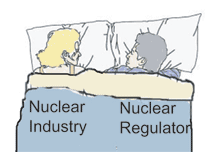
Particularly problematic is the proposal to hand assessment of nuclear projects over to the Canadian Nuclear Safety Commission (CNSC). Experts say nuclear projects require meaningful public participation and careful evaluation, based on evidence tested rigorously by independent experts.
The CNSC is led by industry insiders, has never turned down a license application, reports to a Minister who promotes nuclear power, and withholds information. Academic studies observe that the CNSC has features of a “captured regulator”. Public trust in the CNSC has declined over many years. Assessing-Nuclear-Risk.ca.
Expert Warns of ‘Rubber Stamp’ Approvals as Ontario Expands Nuclear Spending
the changes effectively shift final authority from the Canadian Nuclear Safety Commission (CNSC) to cabinet if concerns arise during assessment. It also shifts accountability if those decisions eventually go wrong—although the elected officials involved would likely be out of office by the time the full impacts were known.
the budget “goes on at some length about how wonderful [nuclear projects] are in terms of their economic contributions, but never actually talks about costs.”
the combination of the proposed new builds, the SMR pilots, and refurbishments will push capital expenditures “north of $400 billion”.
June 3, 2026, Nathaniel Crouch, https://www.theenergymix.com/expert-warns-of-rubber-stamp-approvals-as-ontario-expands-nuclear-spending/?utm_source=The+Energy+Mix&utm_campaign=7f479c951f-TEM_RSS_EMAIL_CAMPAIGN&utm_medium=email&utm_term=0_dc146fb5ca-7f479c951f-510028305
Federal impact assessment reviews for two Ontario nuclear projects risk serving as little more than procedural approvals, a Toronto environmental studies professor says, as they move through the process without first identifying the reactor types to be built.
Ontario’s Wesleyville Project in Port Hope has several reactor technologies under consideration, and the Bruce C expansion near Kincardine has not yet selected a technology, either. Both are undergoing federal impact assessment.
Mark Winfield, a professor at the Faculty of Environmental and Urban Change at York University, told The Energy Mix he is also concerned that proposed federal approval reforms, combined with Bill C-5 passed last summer, and the newly announced National Electricity Strategy, could lead to what he called “the explicit politicization of decision-making on nuclear projects.” Where “once projects are designated as being in the national interest,” he said, “they will be approved regardless of what the technical reviews find.”
That would be “a very dangerous situation when dealing with what will be first-of-kind reactors in Canada, or in some cases globally,” he added.
Winfield said the changes effectively shift final authority from the Canadian Nuclear Safety Commission (CNSC) to cabinet if concerns arise during assessment. It also shifts accountability if those decisions eventually go wrong—although the elected officials involved would likely be out of office by the time the full impacts were known.
“The implication of going to cabinet is that the regulator’s concerns could be overridden for political or economic reasons,” he said, recalling Harper government’s 2008 decision to fire the CNSC chair after the rejection of the MAPLE reactors at Chalk River.
Winfield said Canada’s new electricity strategy seemed to “aggressively skate over” the cost implications of its nuclear heavy focus, as nuclear energy continues to be subject to enormous capital costs and construction delays.
“Essentially the federal strategy seems to be following Ontario’s lead—a heavy emphasis on gas and nuclear, and mostly ignoring the global movement in the direction of renewables.”
Ontario, Ratepayers Confront Growing Nuclear Costs
Critics have warned that Ontario’s nuclear expansion strategy could carry major long-term financial consequences.
In May, the Ontario government announced a $300-million cost-sharing agreement with Bruce Power to advance early planning for the expansion of the Bruce C nuclear complex, a project the province said would support 18,900 jobs and help make Ontario home to the largest nuclear generating facility in the world.
The announcement marked one of the clearest signals yet that Premier Doug Ford’s government sees large-scale nuclear expansion as the backbone of Ontario’s future electricity system. It also landed amid criticism that the province is shifting billions in electricity costs onto taxpayers, obscuring the long-term price of nuclear refurbishments, new reactors, and small modular nuclear projects.
Ontario’s 2026 budget led the province into a $13.8-billion deficit, with energy expenditures— and nuclear energy in particular—central to the shortfall. The government’s budget documents flagged large “amounts for electricity cost relief” and related line items, but stopped short of detailing long-term capital costs. That omission drew sharp criticism from electricity system experts.
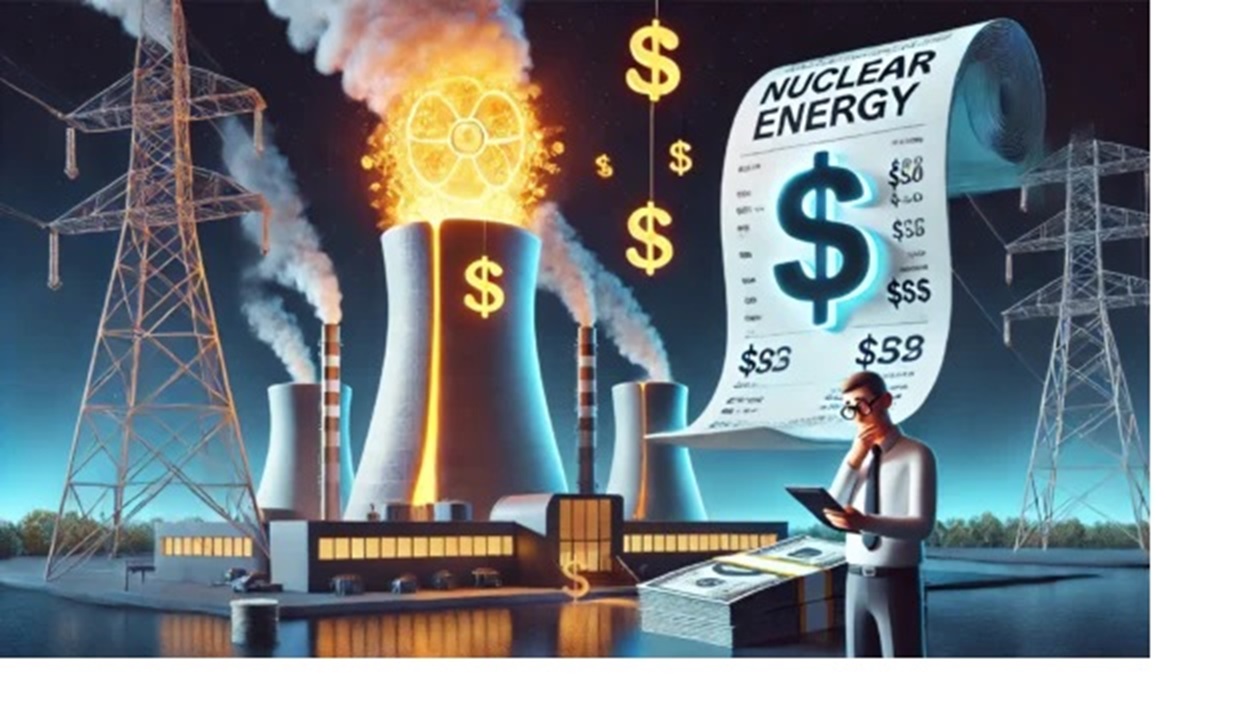
Winfield said the budget “goes on at some length about how wonderful [nuclear projects] are in terms of their economic contributions, but never actually talks about costs.” Using figures the province provided for electricity supports, Winfield calculated that electricity-related spending accounted for roughly half the deficit—about $6.9 billion on the books—but said it would be difficult to figure out exactly how much of that line item in the budget is nuclear related because the figures are “deliberately opaque.”
Environmental Defence Canada Programs Director Keith Brooks too linked the deficit to rising nuclear and legacy refurbishment costs, as well as growing use of gas power plants to meet growing demand while the nuclear plants are being brought online.
29% Rate Hike
Last November, Ontario raised its basic electricity rate by 29% and simultaneously expanded rebate programs, which the government framed as short-term relief and a change in cost allocations. Both Winfield and Brooks said those measures masked the underlying driver: rising costs tied to refurbished and new nuclear plants. “What they seem to be doing is setting a precedent—allowing the costs for these projects to be charged to ratepayers before they’re built,” Winfield said, adding that the combination of the proposed new builds, the SMR pilots, and refurbishments will push capital expenditures “north of $400 billion”.
the combination of the proposed new builds, the SMR pilots, and refurbishments will push capital expenditures “north of $400 billion”.
Nuclear Power Returns to the Forefront of Quebec’s Energy Debate

“It’s an industry that’s generally heavily subsidized by the government, because the private sector is less willing to take on these risks,” adds Jean-Pierre Finet. He points out that the majority of nuclear power plant construction projects, which typically span about a decade, exceed their scheduled timelines and budgets. “Public funds are used to mitigate the risks of these projects,” he notes, adding that customers are then called upon to absorb the excess costs.
Nuclear power continues to polarize the debate. Here’s why.
French-language article, by Juliane C Lelarge, Le Devoir, June 3 2026
As Ottawa accelerates its nuclear development, Quebec evaluates various energy scenarios, and new Liberal leader Charles Milliard says he is open to the sector. Nuclear power is resurfacing in the public debate. Presented by its supporters as a carbon-free solution to meet growing electricity demand, nuclear power continues to polarize the debate. Here’s why.
Why is there a resurgence of interest in nuclear power?
The electrification of society and the gradual phase-out of fossil fuels, particularly in transportation and buildings, are expected to lead to a marked increase in electricity demand over the coming years, explains Karim Zaghib, a professor of chemical engineering at Concordia University and former director of research at Hydro-Québec. He also highlights the rapid growth of artificial intelligence and data centers, which is likely to exacerbate this pressure.
Current geopolitical instability and aspirations for energy independence are also fueling a global resurgence in the nuclear industry. And the development of new technologies, such as small modular reactors, is reinforcing this trend, although some experts are calling for caution.
This interest was particularly evident in the preliminary drafts of the Integrated Energy Resources Management Plan (PGIRE), published in March, which explores a scenario involving a return to nuclear power, even though many industry stakeholders question the influences behind this inclusion.
“We know, for example, that in Quebec, the firm AtkinsRéalis [formerly known as SNC-Lavalun] is lobbying in this direction. There are also American corporations exerting pressure,” explains Jean-Pierre Finet, an analyst with the Regroupement des organismes environnementaux en énergie.
Does nuclear energy have advantages?
Nuclear power is among the energy sources with the lowest CO2 emissions over its entire life cycle, on a par with wind and hydroelectric power. “Compared to wind power, it also has the advantage of being quieter and having no significant impact on the landscape or land use,” explains Karim Zaghib, who notes that Quebec’s geography—and its multitude of waterways—is well-suited to the installation of power plants.
According to Guy Marleau, a professor in the Department of Engineering Physics at Polytechnique Montréal, nuclear infrastructure also has a much longer lifespan: 60 years for a power plant, compared to an average of 12 years for a wind turbine. The electricity production of a nuclear power plant is also incomparable to that of renewable energy sources, he notes.
Karim Zaghib views nuclear power as a complement to wind and solar energy, and stresses the importance of diversifying energy sources to ensure the grid’s resilience. This is because nuclear power provides a more stable baseload energy supply, he explains.
In Jean-Pierre Finet’s view, however, nuclear power’s inflexibility is a disadvantage. “With hydroelectric power, we can adapt to demand. With nuclear, it’s like having the pedal to the metal all the time,” he explains, noting that energy produced during periods of low demand is sold at a low price, or even at a loss. “That’s why we buy a lot of low-cost energy from Ontario, which sometimes has no choice but to offload it.” Advances in energy storage also put the issue of renewable energy’s intermittency into perspective, he says.
“Nuclear power is sometimes seen as an alternative for more climate-skeptical stakeholders who reject renewables on principle,” notes Philippe Gauthier, an energy analyst at the Rivières Foundation, citing the energy strategy implemented by the Trump administration in the United States as an example.
What would reinvesting in the sector in Quebec entail?
“It would be extremely expensive,” Philippe Gauthier states right off the bat, noting that nuclear development is one of the most costly forms of energy production.
“It’s an industry that’s generally heavily subsidized by the government, because the private sector is less willing to take on these risks,” adds Jean-Pierre Finet. He points out that the majority of nuclear power plant construction projects, which typically span about a decade, exceed their scheduled timelines and budgets. “Public funds are used to mitigate the risks of these projects,” he notes, adding that customers are then called upon to absorb the excess costs.
Another challenge: Quebec’s nuclear expertise is disappearing. “To shut down the Gentilly plants, Hydro-Québec had to reach out to its retirees, who were the only ones left with that expertise,” recalls Philippe Gauthier. This lack of expertise makes the industry still very much an American one, asserts Jean-Pierre Finet, who rejects the argument for energy sovereignty. He points out that Canada’s largest federally-owned nuclear facilities, the Chalk River Laboratories, have been managed since 2025 by a private American consortium, some of whose largest companies are linked to the U.S. defense sector.
Is the issue of safety still relevant today?
“Today, safety is a given,” argues Karim Zaghib, noting that accidents are now very rare. The issue that remains a subject of debate is radioactive waste. “With our current drilling capabilities, we’re able to bury it tens of kilometers underground,” says the researcher.
“The waste issue is far from resolved,” counters Jean-Pierre Finet. He cites as an example the discharge of toxic wastewater from the Chalk River facilities into the Ottawa River in 2024. The nuclear project, which in recent weeks received a federal grant of $2.2 billion, calls for the burial of large quantities of radioactive waste near the surface. This part of the project is the subject of litigation, including with the Anishinaabe community of Kebaowek, which won a victory on this matter on May 28 in the Federal Court of Appeal.
More broadly, experts criticize the nuclear industry for a real lack of transparency. “The current oversight process is practically nonexistent,” laments Philippe Gauthier, who believes the ties between the industry and regulatory bodies are too close. He cites as an example the case of the 62.8 tons of irradiated uranium fuel that was transported in secret on Quebec’s roads in the summer of 2025.
Several experts interviewed believe that the global trend toward a return to nuclear energy must also be analyzed in light of the phenomenon of nuclear rearmament. “The military industry needs the civilian industry to develop its expertise,” explains Philippe Gauthier. “We cannot ignore the fact that military applications are still part of the nuclear equation.”
Is the development of nuclear power part of a transition strategy?
“We must not confuse adding carbon-free generation with decarbonization,” explains Jean-Pierre Finet. “All we’ve done so far is add carbon-free generation without reducing the rest of our [fossil fuel] consumption, which doesn’t reduce GHG emissions. It’s mainly a pretext for further industrialization.”
According to him, the issue isn’t about increasing energy production, but about better managing its distribution and consumption, particularly through more efficient use and storage.
More broadly, experts are calling on governments to dare to talk about energy conservation. “It seems like we’re doing all this to avoid having to change our behaviors, and then our lifestyles. The extractivist approach is not sustainable,” argues Mr. Finet.
The atomic clock is ticking.
Western countries build far more slowly, when they build at all. The Darlington SMR is one of only six in the entire Western Hemisphere to begin construction in the past 40 years. Of those, only two, located in the U.S., completed construction, both spectacularly late.
A nuclear project’s schedule and cost are inextricably linked: Any delay will eat into contingencies, and, if sustained, will blow budgets to smithereens. Moreover, delays compound the already daunting challenge of financing the project.
even within the nuclear industry, many doubt SMRs can offer sufficient advantages to attract orders; the results of the first SMR in a G7 country could settle the matter.
Will Canada’s first new nuclear reactor in decades be built on time? Here’s how an Ontario utility’s promises stack up against the numbers
Matthew McClearn, The Globe and Mail, June 4, 2026, https://www.theglobeandmail.com/business/article-nuclear-reactor-ontario-power-generation-utility/
The race to build Canada’s first new nuclear reactor in more than three decades has officially begun on the north shore of Lake Ontario.
In late April, the Ontario government announced that the foundation of the building that will house the reactor had been lifted to its final resting place, down a 35-metre-deep vertical shaft, by one of the world’s largest crawler cranes. The foundation weighed more than 950 tonnes – heavier than three Airbus A380s, the government said.
With that, a clock started ticking.
As far as Ontario Power Generation is concerned, the Darlington small modular reactor, or SMR, has been under construction for about a year now. But according to nuclear industry bodies such as the International Atomic Energy Agency and Mycle Schneider Consulting, which compile data on nuclear projects globally, construction officially begins with the placing of concrete for the foundation of the reactor building.
OPG and its partners – including reactor developer GE Vernova Hitachi Nuclear Energy, construction company Aecon Group Inc., and architect-engineer AtkinsRéalis Group Inc. – have just four years and seven months to complete construction and connect the reactor to the grid, as promised, by the end of 2030. Once built, the reactor could supply enough electricity to power 300,000 homes. It’s a crucial first step for Ontario’s energy plans, which envision building many more reactors in the coming years.
Nuclear plants join high-speed rail, large bridges and tunnels, hydroelectric dams (think Site C) and major IT initiatives (think the federal Phoenix payroll system) on the list of complex engineering works that are highly likely to suffer lengthy delays. They’re akin to the Olympics for project managers; by promising the SMR in less than five years, OPG has effectively promised a gold medal.
Don’t let the “small” moniker fool you: The Darlington SMR is no minor undertaking. Lately, as many as 1,500 workers have been on-site on a typical work day.
OPG’s lengthy task list includes building the first-ever BWRX-300 reactor, a robust containment building to house it, a control building which will include the main control room, and another structure to house the turbine generator. It must also complete support structures for the other three planned units. They include a water cooling system complete with underground tunnels, and a switchyard.
According to an analysis of data from Mycle Schneider Consulting by The Globe and Mail, few reactors have been built in less than five years in recent history.
The fortunes of corporate executives, politicians, suppliers and even the nuclear industry itself depend on whether OPG’s team can demonstrate they are as exceptional as their political masters claim.
Why would completing a reactor in five years be difficult?
Canada’s nuclear industry finished building its last nuclear power reactor more than three decades ago. The 25 Candu reactors that started construction between 1958 and 1985 took an average of slightly longer than seven years to bring into commercial operations. Many of those reactors have been refurbished, which has reinvigorated Ontario’s nuclear industry. Even so, many of the skills required to build a plant from scratch have atrophied.
The closest Canadian analogue to the Darlington SMR might be Douglas Point, the earliest attempt to construct a commercial nuclear power plant. When work began in 1960 in Tiverton, Ont., Canada had limited experience building nuclear plants. Just like Douglas Point, the Darlington SMR is essentially a prototype. Douglas Point’s 200-megawatt output placed it in the same class. It took 8½ years to build.
Canada’s fastest build was Pickering-3, running from late 1967 to early 1972. Those years spanned a period when Ontario hit its stride building multiple reactors, but shows tight timelines were achievable back then.
How long has it taken to build nuclear plants globally?
China dominates modern reactor construction: According to Mycle Schneider Consulting data, 44 of the 75 reactors that began construction worldwide since 2016 are there. Yet few Chinese reactors are delivered within five years.
Western countries build far more slowly, when they build at all. The Darlington SMR is one of only six in the entire Western Hemisphere to begin construction in the past 40 years. Of those, only two, located in the U.S., completed construction, both spectacularly late.
Boasting about modular construction techniques, American reactor developer Westinghouse promised it could build its AP1000 reactor in just 36 months. Four AP1000s eventually started construction in the U.S. in 2013. Two of them, Vogtle Units 3 and 4, took more than a decade each. The other two, V.C. Summer Units 2 and 3, in South Carolina, were abandoned after roughly four years; efforts to restart their construction are now under way.
The only reactor attempted in France so far this century, Flamanville-3, was planned to take a little more than four years. It took 17. The only two reactors started in the United Kingdom since 2016 were at the Hinkley Point station, Britain’s largest nuclear power site; they’re approaching 12 years and counting, still under construction.
Why are nuclear builds so frequently delayed?
Nuclear projects face delays for numerous reasons. But some cardinal sins occur regularly, such as proceeding without a complete set of detailed blueprints.
The two V.C. Summer units in South Carolina, for example, began construction when engineering designs were incomplete. Drawings often turned out to be not constructible, sending designs back to the drawing board. Those changes, in turn, led to more work for subcontractors, which provoked disputes over who’d pay the resulting costs. Any changes also had to be approved by the U.S. Nuclear Regulatory Commission.
A report by Jean-Martin Folz, former head of French automaker Peugeot, found that construction at France’s Flamanville-3 also began without a complete set of validated plans. The result was that the plant’s design continuously changed during construction, and lots of work had to be redone.
Quality control is another common stumbling block. At Flamanville-3, Mr. Folz catalogued a wide range of defects including poor welds and badly-manufactured forged components. Defects can lead to a cycle of delays, rework and disputes.
Once delays start piling up, it’s hard to recover. At Flamanville, Mr. Folz noted that Électricité de France tried to accelerate work schedules to get back on track. That only led to other problems, leading to further rework and delays, not to mention overloaded and demoralized crews.
After years of poor performance, the construction of the Vogtle units in Georgia was placed under new management. Don Grace was an engineer hired by the Georgia Public Service Commission to evaluate the project’s progress. During testimony in 2022, he explained that the new proponents “prematurely” started testing equipment at the plant, even as construction continued.
The problem? Mr. Grace said it resulted in too many workers toiling alongside one another on compressed timetables – a problem dubbed “stacking of crafts.” That was exacerbated by management’s tendency to defer planned work to achieve near-term milestones that provided “an inaccurate impression of having made significant progress.”
Mr. Grace put it this way: “The scope of work for a new nuclear plant is so large, and how the proper scoping and sequencing of all the activities comes together is highly important.”
What’s behind OPG’s confidence?
OPG believes the BWRX-300, while being first of its kind, is the simplest-ever boiling water reactor, a mature American-designed technology. There are more than 100 of them operating worldwide, so many of its basic principles have been demonstrated before.
OPG also counts on modular construction techniques to speed things up. The Darlington SMR’s base mat is a good example: It is comprised of 56 sections that were manufactured off-site. Upon delivery to Darlington, they were welded together in a special building with a retractable roof, then lifted into place by crane. In theory, this should be more efficient than assembling a warren of rebar, erecting forms and then pouring huge volumes of concrete.
“Many components will be pre-assembled offsite into larger modules and lifted into place – such as skid-mounted systems and pre-assembled piping – reducing onsite duration and risk,” wrote OPG spokesperson Neal Kelly in a written response to questions.
OPG is also taking an off-the-shelf approach wherever possible. For example, the plant’s turbine and generator are to be the same standard units already proven in natural gas plants.
And OPG is using what it calls an “integrated project delivery contract model,” which it says will encourage partners to collaborate, share risks and rewards, and maximize efficiency. Previous nuclear projects have demonstrated that how contracts are written, and how the various stakeholders work together, matters a great deal – especially when unforeseen challenges arise.
Of note, Mr. Kelly wrote that the plant’s design was completed in December.
What’s at stake?
Most immediately, the fate of the Darlington SMR. A nuclear project’s schedule and cost are inextricably linked: Any delay will eat into contingencies, and, if sustained, will blow budgets to smithereens. Moreover, delays compound the already daunting challenge of financing the project: Owners must wait that much longer to start earning revenue by generating electricity.
A nuclear project’s schedule and cost are inextricably linked: Any delay will eat into contingencies, and, if sustained, will blow budgets to smithereens. Moreover, delays compound the already daunting challenge of financing the project: Owners must wait that much longer to start earning revenue by generating electricity.
Though contracts haven’t been signed yet, Ontario has already committed to build three more BWRX-300s. Its existing nuclear plants all have four identical reactors, an approach that has demonstrated significant benefits. An $8-billion one-off lemon would be a costly miss.
The Darlington SMR is the signature project of Nicole Butcher, who assumed OPG’s top job in early 2025. Ontario Energy Minister Stephen Lecce, who approved it, has bet heavily on OPG’s prowess, insisting the utility stands alone in building on-time and on-budget.
Mr. Lecce’s entire vision for Ontario’s electricity hinges on that statement being true. His plan involves a major expansion of nuclear power, in which the SMR would be followed by two much larger projects, the combined cost of which would likely be in the hundreds of billions of dollars. Failure to deliver the comparatively modest Darlington SMR might compel a rethink.
Similarly, the federal government has invested considerable political and financial capital in SMRs. Yet of all the research clusters and demonstration units promised over the past decade, the Darlington SMR is just about the only one still standing. Ottawa has provided billions of dollars in financing, thus becoming a substantial minority owner in the project, and referred it to Prime Minister Mark Carney’s new Major Projects Office.
Other utilities around the world have expressed interest in building their own BWRX-300s. More than 100 Canadian companies have signed agreements to provide components and services for the Darlington SMR; successful delivery could lead to contracts if global utilities feel bold enough to build their own.
SMRs represent a promising but untested approach to manufacturing reactors – one that emphasizes simplification and mass production. Whereas large reactors are purchased almost exclusively by resource-rich utilities, SMRs are marketed as being cheaper and quicker to build – and thus suitable for a broader range of customers. Yet even within the nuclear industry, many doubt SMRs can offer sufficient advantages to attract orders; the results of the first SMR in a G7 country could settle the matter.
And that’s why the Darlington SMR is one of the most important nuclear projects worldwide.
No pressure.
Canadian nuclear company Bruce Power has launched a CAD1 million (USD722,000)bribery system to win over municipalities.

World Nuclear News, 2 June 2026
Bruce Power has launched a CAD1 million (USD722,000) Regional Municipal Readiness Assessment Fund to support municipalities in the Bruce, Grey, and Huron counties in advancing planning related to the proposed Bruce C Project. The fund is designed to support studies and assessments that help municipalities prepare for the potential opportunities and impacts associated with Bruce C – a proposed new power plant of up to 4.8 GW at the Bruce Power site in Ontario – with individual projects to be completed by the end of 2027.
“Municipal leadership is critical in planning for large-scale infrastructure opportunities,” Pat Dalzell, Bruce Power’s Vice-President, Corporate Affairs and Market Development, said. “This new fund will help to ensure communities are well positioned to capture economic benefits while maintaining the services and quality of life residents depend on.”
| brennainlloyd . 3June 26 |
Bruce Power has launched a CAD1 million (USD722,000) Regional Municipal Readiness Assessment Fund to support municipalities in the Bruce, Grey, and Huron counties in advancing planning related to the proposed Bruce C Project. The fund is designed to support studies and assessments that help municipalities prepare for the potential opportunities and impacts associated with Bruce C – a proposed new power plant of up to 4.8 GW at the Bruce Power site in Ontario – with individual projects to be completed by the end of 2027.
“Municipal leadership is critical in planning for large-scale infrastructure opportunities,” Pat Dalzell, Bruce Power’s Vice-President, Corporate Affairs and Market Development, said. “This new fund will help to ensure communities are well positioned to capture economic benefits while maintaining the services and quality of life residents depend on.”
Species at risk score a reprieve

by beyondnuclearinternational, https://beyondnuclearinternational.org/2026/05/31/species-at-risk-score-a-reprieve/
Canadian court sends radioactive waste dump plan back to the drawing board in a win for wildlife and the Kebaowek First Nation and others who protect them
News from Canadian Coalition for Nuclear Responsibility, and Sierra Club Canada Kebaowek First Nation, Concerned Citizens of Renfrew County and Area, the Canadian Coalition for Nuclear Responsibility, and Sierra Club Canada Foundation.
Canadian Coalition for Nuclear Responsibility, and Sierra Club Canada, Kebaowek First Nation, Concerned Citizens of Renfrew County and Area, the Canadian Coalition for Nuclear Responsibility, and Sierra Club Canada Foundation welcome a significant victory following the decision of the Federal Court of Appeal to dismiss Canadian Nuclear Laboratories’ (CNL) appeal regarding the Species at Risk Act permit issued for the proposed Near Surface Disposal Facility (NSDF) at Chalk River.
The Court upheld the Federal Court’s earlier ruling and ordered Environment and Climate Change Canada (ECCC) to reconsider its decision to grant the permit.
The permit would have authorized CNL to destroy endangered species and their habitats in order to construct a massive radioactive waste disposal facility less than 1.1 kilometres from the Ottawa River (Kichi Sibi), a watershed that provides drinking water to millions of Canadians.
In its decision, the Federal Court of Appeal concluded that ECCC failed to adequately explain how it determined that all reasonable alternatives had been considered and that the best solution had been selected, as required under the Species at Risk Act.
The Court emphasized that the Minister’s reasons lacked sufficient transparency, intelligibility, and justification, and directed ECCC to conduct a new determination.
The Court also confirmed that the Federal Court’s interpretation of section 73 of the Species at Risk Act is not binding on ECCC and that the Minister must independently provide a clear and reasonable analysis when reconsidering the permit application.
Furthermore, the Court found that the public notice issued by ECCC failed to provide a meaningful explanation to Canadians about why endangered species would be harmed in support of the project.
The ruling represents another important legal milestone in the ongoing efforts to protect species at risk, uphold environmental laws, and ensure accountability in decision-making surrounding the proposed NSDF.
“The Federal Court of Appeal has confirmed that Environment Canada must go back and do its job properly. This decision reinforces what we have been saying from the beginning: decisions that threaten endangered species, sensitive ecosystems, and our sacred river must be based on a transparent, rigorous, and lawful process,” said Chief Lance Haymond of Kebaowek First Nation. “Kebaowek remains committed to protecting the Kichi Sibi, defending our responsibilities to future generations, the drinking water of millions of citizens of Quebec and Ontario, and ensuring that Indigenous rights and environmental protections are respected every step of the way.”
The area selected by CNL for the NSDF is home to numerous species protected under the Species at Risk Act, including the Blanding’s Turtle, Little Brown Bat, Northern Myotis, Tri-coloured Bat, Canada Warbler, Golden-winged Warbler, Whip-poor-will, Eastern Wolf, and Black Ash.
The proposed site consists of mature forests, wetlands, streams, and critical habitat that have remained largely undisturbed for decades. The organizations argue that CNL’s site selection process failed to adequately assess alternative locations that may have posed fewer risks to endangered species and their habitats. The Court’s decision now provides an opportunity for ECCC to conduct a more rigorous and transparent review of the evidence before making a new determination.
“This decision is an important victory for science, transparency, and common sense,” said Ole Hendrickson, spokesperson for Concerned Citizens of Renfrew County and Area. “The Court recognized that the public deserves meaningful explanations when decisions are made that could result in the destruction of endangered species and their habitats. The ecological value of this site is extraordinary, and it deserves careful consideration before irreversible damage is permitted.”
“This ruling confirms that environmental protections under the Species at Risk Act cannot simply be treated as a procedural box to check,” said Dr. Gordon Edwards, President of the Canadian Coalition for Nuclear Responsibility.
“We will continue working to ensure that all reasonable alternatives are fully examined and that the protection of species at risk remains a central consideration. More generally, we will work to ensure that the principle of “justification” is enshrined in Canadian law, as recommended twice by the International Atomic Energy Agency,” Edwards added.
“The Court’s decision reinforces a fundamental principle: Canadians have the right to understand why environmental harm is being authorized and whether less damaging alternatives exist,” said Gretchen Fitzgerald, Executive Director, Sierra Club Canada Foundation. “This case is about accountability, transparency, and ensuring that environmental laws are applied as Parliament intended. Sierra Club Canada Foundation remains committed to supporting efforts that protect biodiversity and uphold the public interest.”
This decision builds upon two important Federal Court rulings related to the proposed NSDF project. In March 2025, the Federal Court ruled that the Species at Risk Act permit issued for the project must be reconsidered because reasonable alternative locations were not properly assessed.
In a parallel case, the Federal Court also ruled in favour of Kebaowek First Nation regarding the implementation of the United Nations Declaration on the Rights of Indigenous Peoples (UNDRIP) and the duty to consult in the NSDF licensing process. That landmark decision is currently before the Federal Court of Appeal and is expected to help clarify how Free, Prior and Informed Consent (FPIC) and UNDRIP should be applied in federal regulatory decision-making across Canada.
While the Court has returned the matter to ECCC for redetermination rather than permanently rejecting the permit, the organizations intend to actively participate in the reconsideration process. They will continue to present evidence demonstrating that alternative locations exist and that the proposed Chalk River site is not the best option for protecting species at risk and their habitats.
The organizations also note that CNL may seek leave to appeal to the Supreme Court of Canada, although leave applications are granted only in a small number of cases involving issues of national importance.
Kebaowek First Nation, Concerned Citizens of Renfrew County and Area, the Canadian Coalition for Nuclear Responsibility, and Sierra Club Canada Foundation remain united in their commitment to protecting the Ottawa River watershed, safeguarding endangered species, and ensuring that environmental decision- making respects both ecological integrity and Indigenous rights.
For more information on Kebaowek First Nation’s efforts to halt the NSDF project, visit Stop Nuclear Waste website. For more information on how to support Kebaowek First Nation’s legal efforts, visit Kebaowek First Nation – Raven Trust.
Canada’s nuclear ambitions need fuel security, not just new reactors.
Canada is expanding nuclear power but remains dependent on foreign enriched uranium for the next generation of reactors.
Policy Options, May 28, 2026, Alex MacDonald
“……………………………………………………. In Canada, refurbishments of existing large-scale reactors are being completed. The first small modular reactor (SMR) in the G7 is scheduled to come online in 2030 in Ontario with three more planned. Alberta and Saskatchewan are considering adding nuclear power to their energy mix while advanced nuclear reactors are even being pitched to alleviate the persistent energy struggles in Northern Canada………………………………
The Canadian Nuclear Association predicts that Canada will adopt billions of dollars worth of new and advanced nuclear technologies – large light-water reactors, SMRs and micro modular reactors – all of which will be deployed in Canada for the first time.
These technologies have one thing in common. They require enriched uranium to operate. Their supply chains and operational needs are different and more risk-exposed than what Canada has historically operated in the nuclear field………………………….
It makes little sense for governments and ratepayers to underwrite the necessary large capital expenditures of these new reactors without maximizing certainty on operational costs and supply. It is like commissioning the building of a skyscraper without knowing the cost of the steel to build it………………………………………………………………………….. https://policyoptions.irpp.org/2026/05/canada-nuclear-fuel-security-uranium-enrichment/
1 This Month
23-25 October – on Zoom – World BEYOND War’s annual global conferenc


Shut down the radiation-damaged Heysham nuclear reactors now
To see nuclear-related stories in greater depth and intensity – go to https://nuclearinformation.wordpress.com

Say No to NASA’s Reckless Nuclear Reactor on the Moon
Say No to NASA’s Reckless Nuclear Reactor on the Moon

-
Archives
- October 2026 (231)
- September 2026 (339)
- August 2026 (330)
- July 2026 (355)
- June 2026 (287)
- May 2026 (306)
- April 2026 (356)
- March 2026 (251)
- February 2026 (267)
- January 2026 (308)
- December 2025 (358)
- November 2025 (359)
-
Categories
- 1
- 1 NUCLEAR ISSUES
- business and costs
- climate change
- culture and arts
- ENERGY
- environment
- health
- history
- indigenous issues
- Legal
- marketing of nuclear
- media
- opposition to nuclear
- PERSONAL STORIES
- politics
- politics international
- Religion and ethics
- safety
- secrets,lies and civil liberties
- spinbuster
- technology
- Uranium
- wastes
- weapons and war
- Women
- 2 WORLD
- ACTION
- AFRICA
- Atrocities
- AUSTRALIA
- Christina's notes
- Christina's themes
- culture and arts
- Events
- Fuk 2022
- Fuk 2023
- Fukushima 2017
- Fukushima 2018
- fukushima 2019
- Fukushima 2020
- Fukushima 2021
- general
- global warming
- Humour (God we need it)
- Nuclear
- RARE EARTHS
- Reference
- resources – print
- Resources -audiovicual
- Weekly Newsletter
- World
- World Nuclear
- YouTube
-
RSS
Entries RSS
Comments RSS

