Financial hypocrisy in Canada – the pretence that nuclear power is green and cheap

A Global First: BMO Supports Bruce Power with World’s First Nuclear Green Financing Framework, Yahoo Finance TORONTO, Nov. 22, 2021 /PRNewswire/ – Bruce Power, Ontario’s leading private sector power provider, has taken another industry-leading step in its environmental [?], social and governance strategy by launching the world’s first green [?] finance framework with nuclear use of proceeds.
Acting as Co-Lead Green Structuring Agent, BMO Financial Group (TSX:BMO) (NYSE:BMO), today announced the successful issuance of CAD $500 Million in green [?] bonds under the framework, which is designed to guide future issues of green bonds with a focus on Bruce Power’s Life-Extension Program and investments related to increasing the output of nuclear units and extending the plant’s life beyond 2060.
The framework sets out the guidelines in accordance with the Green Bond Principles issued by the International Capital Markets Association (ICMA) and the Green Loan Principles issued by the Loan Market Association (LMA) and Loan Syndications and Trading Association (LSTA) – ensuring the proceeds are exclusively allocated to green projects and activities that promote environmental sustainability and deliver clear environmental benefits.

CICERO Shades of Green, an internationally-recognized leading provider of independent review and second-party opinions on green financing frameworks, [REALLY?} has given Bruce Power’s Green Finance Framework the highest possible governance score of Excellent, and an overall designation of CICERO Medium Green, acknowledging the role of nuclear power in mitigating climate change and recognizing Bruce Power’s strong risk management processes.
Clean nuclear power is crucial to fighting climate change, and today’s announcement marks another industry-leading step in the company’s environmental, social and governance strategy,” said Mike Rencheck, Bruce Power’s President and CEO…..
“We’re proud to partner with Bruce Power to build a green framework that facilitates the alignment of the company’s business and financing activities to support nuclear power’s critical role in mitigating climate change,” said Jonathan Hackett, Head, Sustainable Finance, BMO Capital Markets. ………. https://finance.yahoo.com/news/global-first-bmo-supports-bruce-143800875.html
Climate change intensifies disastrous floods in Canada
A state of emergency has been declared in the Canadian western province of
British Columbia after a major storm cut road and rail links in the region.
The Canadian Armed Forces have been deployed to help thousands of stranded
residents who have been trapped since the storm hit overnight on Sunday.
Local officials warned on Thursday that the price tag to rebuild could
exceed C$1bn ($790m, £590m). One woman was killed in a landslide, and two
people are missing. Officials expect more fatalities to be confirmed in the
coming days. One man caught up in the storm told the BBC the scenes
afterwards were like “Armageddon”.
BBC 18th Nov 2021
https://www.bbc.co.uk/news/world-us-canada-59324764
Canada floods: 18,000 people still stranded in ‘terrible, terrible
disaster’. Alarm grows about climate change in British Columbia after
summer wildfires wiped out vegetation that could have slowed flooding.
Guardian 19th Nov 2021
Canada’s Environment Minister refuses to declare his support for nuclear energy
Guilbeault refuses to declare his support of nuclear energy iPolitics, By Aidan Chamandy. Nov 5, 2021 Environment Minister Steven Guilbeault says “it’s not up to the government to decide” which sources of energy will reduce the country’s greenhouse-gas emissions to net zero by 2050.
Nor would he say explicitly whether he supports nuclear energy, which he’d opposed in his work before entering politics in 2019……
Before running for the Liberals in 2019, Guilbeault worked for decades as an environmental activist for Greenpeace and Équiterre.
In 2018, he said the Pickering nuclear plant in Ontario should be shut down and replaced with other forms of renewable energy. https://ipolitics.ca/2021/11/05/guilbeault-refuses-to-declare-his-support-of-nuclear-energy/
War hawks quietly positioning Canada to participate in US-led Ballistic Missile Defence program
War hawks quietly positioning Canada to participate in US-led Ballistic Missile Defence program, The Canada Files: Joyce Nelson , 20 Sept 21,
During the 2021 federal election campaign, there has been almost no emphasis or discussion in the media on the Liberal government’s plan to spend more than $553 billion on the military over the next 20 years, including the awarding of contracts for purchase of military fighter jets and armed drones in the next few months. The contracts for new frigates have already been awarded, including design components by Raytheon, Lockheed Martin, and BAE Systems.
Even more telling, there has been virtual silence about the fact that Canada is quietly being moved into position to participate in U.S. ballistic missile defence (BMD) – a hot-button issue in Canada since December 2001, when U.S. President George W. Bush withdrew from the Anti-Ballistic Missile Treaty.
Since then, the U.S. has spent more than $100 billion attempting to build a missile shield, and for almost two decades the U.S. and defense industry lobbyists (Boeing, Raytheon, Lockheed Martin) have been pressuring Canada to join in.
In January 2021, CBC News reported, “The recent Liberal defence policy reaffirmed the 2005 decision by Paul Martin’s government to remain on the sidelines of any continental BMD effort, despite pleas from both the Senate and House of Commons defence committees to reconsider joining.”
Only six months later, however, that Liberal policy appears to have dramatically changed.
In fact, the day before the election call, Canada’s Defence Minister Harjit Sajjan and U.S. Defense Secretary Lloyd Austin issued a joint statement agreeing to “modernize” NORAD, the North American Aerospace Defense Command, and outlining “priority areas for new investments”.
Their August 14th joint statement says: “Canada and the United States share a desire to coordinate in fielding new capabilities to complement and eventually replace the North Warning System with more advanced technological solutions as soon as possible, including next-generation over-the-horizon radar systems that can dramatically improve early warning and persistent surveillance of North American airspace and approaches. Ensuring effective awareness ultimately requires a system-of-systems approach including a network of Canadian and U.S. sensors from the sea floor to outer space.”
“System-of-systems” is Pentagon jargon for BMD.
Political/Defense analyst Keith Jones has stated that this joint commitment is meant to pave the way “for Canada’s participation in the US ballistic missile shield, whose underlying purpose is to enable the US to wage ‘winnable’ nuclear war.”
That may be why there has been so much silence around the joint statement. If no one knows about it, or what it means, then there can be no opposition to it.
A Bit of History………
Renewed BMD Rhetoric……….
Increased Insecurity Both Russia and China have warned that the Pentagon’s relentless pursuit of ballistic missile defense destabilizes security for their countries and causes nuclear escalation.
Both Russia and China have warned that the Pentagon’s relentless pursuit of ballistic missile defense destabilizes security for their countries and causes nuclear escalation.
As Canadian peace activist Peggy Mason, president of the Rideau Institute, recently wrote, “So the untold billions spent by the USA on nuclear modernization and missile defences have played a key role in convincing China that it, too, must increase its nuclear arsenal. Can there be clearer proof of the utter disconnect between the US nuclear posture and the security of that country (and its allies)?”
For a thorough analysis of BMD, a must-read is the lengthy July 26, 2021 report by Ernie Regehr, called “Canada and the Limits to Missile Defence,” available on The Simons Foundation website. Regehr is particularly scathing about U.S. “first strike,” pre-emptive attacks and the chronic strategic destabilization and instability that BMD is causing around the world.
Perhaps a deeper dive into the origins of the missile shield concept will reveal the urgency of stopping it.
A Deeper Dive…….
Canada & BMD Presently, the NDP is further embracing militarism. Their current party platform complains about “outdated” military hardware
and states : “In contracting for new military equipment, including ships and fighter jets, New Democrats will ensure maximum industrial benefits and jobs. This will help ensure the survival of healthy shipbuilding and aerospace industries all across Canada.”
With anti-Russia and China rhetoric so paramount, with militarism and military spending so rampant, and with Canada’s war hawks (especially Harjit Sajjan and Chrystia Freeland) eager to please the U.S., it looks like BMD is quietly back on the federal agenda in Canada.
Ernie Regehr asks the important questions about ballistic missile defence: “Would Canada want to be partnered to a system headed for the weaponization of space? Would Canada want to be a partner in a defence system that depends on pre-emptive attacks?”
Regehr urges that Canada “maintain its decades-long wariness of strategic missile defence” and instead pursue, “in the company of like-minded states, the arms control/disarmament and prevention strategies on which Canadian and global security really do depend.” https://www.thecanadafiles.com/articles/war-hawks-quietly-positioning-canada-to-participate-in-usa-led-ballistic-missile-defence-program
South Bruce citizens want a referendum on plan to permanently house Canada’s nuclear waste.

South Bruce, Ont. citizens push for referendum to decide location of nuclear waste, Scott Miller, CTV News London Videographer, 25 Oct 21, TEESWATER, ONT. – Michelle Stein is putting up signs around her community she hopes will lead to referendum on whether South Bruce should permanently house Canada’s most radioactive nuclear waste.“That’s the fair way to do it. People that see benefits from the project can vote yes, those of us that feel the risks are too great we get to vote no,” says the chair of Protect our Waterways, a citizens’ group opposing plans to bury high-level nuclear waste in the Municipality of South Bruce.
- Stein believes a binding referendum during next October’s municipal election would be the best way for the 5,600 citizens of the Municipality of South Bruce to determine their willingness to host Canada’s first permanent nuclear waste facility, under 1,500 acres of farmers fields north of Teeswater…………
The Nuclear Waste Management Organization say they’ll decide whether Ignace, QC or South Bruce will house Canada’s first permanent nuclear waste facility in 2023.
How communities decide their willingness to do so, is up to each community. South Bruce’s Willingness Study final report will be before council in November.
Protect our Waterways will be going door to door in South Bruce this month and next, to try and get residents to sign a petition urging South Bruce council to commit to a binding referendum on the nuclear waste topic in time for the 2022 municipal election.
“This is a decision that will forever change our community, and every single person deserves a voice, and deserves to have their vote counted,” says Stein. https://london.ctvnews.ca/south-bruce-ont-citizens-push-for-referendum-to-decide-location-of-nuclear-waste-1.5637381
Problems and public opposition to the plan to store high level nuclear wastes under the Great Lakes
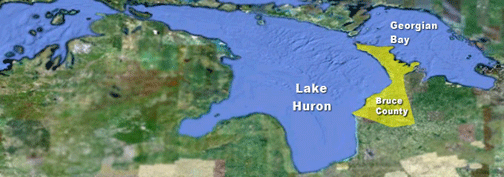
Nuclear Question: Debate continues over long-term storage of nuclear waste in the Great Lakes. Great Lakes Now, By Andrew Reeves, 25 Oct 21,
Canada’s plan to store spent nuclear fuel 1,600 feet below ground in the Great Lakes basin, some 30 miles from Lake Huron, is continuing to ruffle feathers throughout the Great Lake states.
Earlier this month, U.S. lawmakers called out the Canadian plan for failing to prioritize the health of the Great Lakes and the 40 million residents who depend on it for clean drinking water ahead of its own energy needs.
Michigan Democratic Rep. Dan Kildee is leading a 20-member bipartisan group calling on President Joe Biden to pressure Canadian Prime Minister Justin Trudeau to halt the plans for storing an anticipated 57,000 tons of high-level radioactive material within the basin.
Michigan Gov. Gretchen Whitmer, in a statement on the ongoing legal battle over the future of Enbridge’s Line 5 pipeline, accused the Canadian federal government of “adding even more risk to our waters” by allowing plans to store radioactive nuclear waste in a 1,400-acre underground warehouse to proceed.
Yet despite concerns within the basin from politicians and environmental groups, and unrest among local farmers worried about water contamination and potentially tanking property values, the project is moving ahead as planned. Geologic testing at one location in southern Ontario began this spring.
Even so, determining the long-term fate of Canada’s spent nuclear fuel remains far from settled as rifts develop within the host community, and between Canada and frustrated U.S. lawmakers.
“There’s a divide taking place,” Canadian Member of Parliament Brian Masse noted on a recent tour of the proposed South Bruce site with concerned residents. “I do believe there needs to be some responsibility taken on a federal level to make sure our communities aren’t broken in this process.”………
When spent nuclear fuel bundles are removed from a reactor they are currently interred in a water-filled pool for up to seven years until radioactivity decreases. From there the rods are relocated to dry storage containers made of 20-inch-thick, high-density concrete lined with steel half an inch thick. These storage facilities have a lifespan of roughly 50 years, and Canada has been generating nuclear power since the early 1960s. While the dry storage silos can be refurbished to extend their use, it does nothing to address the long-term need for safe storage solutions.
Experts at NWMO settled on a deep geological repository as the preferred storage option in 2007 after three years of discussion with European nuclear engineers.
The basic premise of the DGR is deceptively simple: bury the spent fuel. If NWMO could identify a willing host community that is situated in an area with suitable geology, the stage would be set to spend $23 billion over 40 years to construct a massive underground labyrinth of tunnels bored into rock that, in total, would be capable of storing the 57,000 tons of spent fuel that Canada currently has in cement-encased copper canisters. The aboveground footprint of buildings would be little more than a mile across.
But the question remains: Where should three million bundles of spent nuclear fuel be stored for what is, essentially, the rest of time?
Identifying a willing host community
The process for identifying a willing host community began in 2008.
From an initial pool of 22 potential locations across Canada, on-site investigations quickly whittled that list down to two, both of which are in Ontario: South Bruce, at a location some 30 miles from Lake Huron, and Ignace in northwestern Ontario. (The Ignace location, northwest of Lake Superior, is not within the Great Lakes basin; rather, it sits within the Winnipeg River basin. Borehole drilling to determine the suitability of the bedrock beneath the proposed site began in Ignace in 2017.)…………
U.S. lawmakers aren’t the only ones concerned about the proposed DGR. Public opposition to the proposal among South Bruce residents has been mounting steadily. …………. https://www.greatlakesnow.org/2021/10/storage-nuclear-waste-great-lakes/
Ontario’s Unfunded Nuclear Decommissioning Liability is in the $18-$27 Billion CAD Range

Ontario’s Unfunded Nuclear Decommissioning Liability is in the $18-$27 Billion CAD Range
https://tinyurl.com/5a9du4mz Editorial Team, August 6 2021 Late last year I worked up the likely amount of public money that would have to be thrown at the nuclear industry in order to successfully and safely decommission the 100 operational reactors and the now shut down ones. Unsurprisingly, the nuclear industry had been very optimistic in its estimates of decommissioning costs and timeframes, when the global empirical averages were trending to a billion USD and 100 years per reactor.
Recently I was asked by an Ontario journalist what I thought the likely situation in Ontario would be, and whether the decommissioning trusts were equally underfunded. I was unsurprised to find that Canada is in the same boat as the US, with highly optimistic schedule and cost projections which belie Canadian empirical experience with the CANDU reactor, and that the fund had nowhere near the money necessary for the job. Let’s run the numbers. [diagram on original]
Ontario Power Generation (OPG) is the chunk of the provincial utility that was carved apart in the late 1990s by the Mike Harris Conservatives to handle generation alone. It operates 18 aging CANDU reactors across three sites: Bruce, Pickering, and Darlington.
Table of operational nuclear generation reactors in Ontario
OPG has a nuclear decommissioning fund of about $5 billion CAD or US$4 billion right now. If the experience of other countries on the actual cost of a billion USD per reactor and an actual timeline of decommissioning of a century holds true, and I see no reason why it doesn’t, that means that there is currently a $17.5 billion CAD gap in Ontario, in addition to the existing $19.3 billion CAD in debt still being serviced from their construction. When the government of the era split up the utility, it moved all of the debt off of the components and into general debt. One of the many appropriate and sensible things that the McGuinty Administration did in the 2000s, in addition to shutting down coal generation entirely, was to move the debt back into the utility and set about servicing it from utility bills.
Most of the reactors at Bruce Nuclear are aging out, with several over 40 years old and the remainder approaching 40. Darlington’s are around 30, so they have a bit of runway. Pickering’s reactors are going to be shut down in 2024 and 2025 and start decommissioning in 2028. While refurbishment could bridge Ontario’s for another 20 years in many cases, that’s expensive and typically won’t pass any economic viability assessment compared to alternatives.
The likelihood is that all reactors in Ontario will reach end of life by 2035, and be replaced by some combination of renewable energy and HVDC transmission from neighboring jurisdictions, with both Manitoba and Quebec having excellent, low-carbon hydroelectric to spare.
Does the empirical experience of shutting down CANDU reactors track to the roughly billion USD that’s seen for other reactors? According to the World Nuclear Association, no.
The fourth unit is Gentilly 2, a more modern Candu 6 type, which was shut down at the end of 2012 after 30 years operation. It is being defuelled and the heavy water was to be treated over 18 months to mid-2014. A decommissioning licence was issued for 2016 to 2026 and the main part of the reactor will be closed up and left for 40 years to allow radioactivity to decay before demolition. All 27,000 fuel bundles are expected to be in dry storage (Macstor) by 2020. The decommissioning cost is put at C$ 1.8 billion over 50 years.”
That translates to US$1.44 billion, so it would appear as if CANDUs are on the expensive side to decommission. If that holds true, Ontario’s gap is actually in the range of $27 billion CAD.
Nuclear decommissioning funding comes from reactors operating revenue. In the US, it’s 0.01 to 0.02 cents per kWh as a set aside. I wasn’t able to find the required set aside for Ontario’s fleet, but obviously they aren’t setting aside sufficient funds now, or have absurdly optimistic fund growth expectations. They only have a decade to set aside more money from operating reactors, and have only set aside $5 billion CAD after 50 years, so the most generous assumption is that they will set aside perhaps $7 billion CAD in the OPG fund by end of life of the reactors, and have a liability for decommissioning of $15.5 to $27 billion CAD. For the next step, let’s assume $20 billion CAD for the sake of round numbers.
Given the likelihood of all of Ontario’s reactors being off of the grid by 2035, with major decommissioning occurring every few years until then, the kWh generated by Ontario’s nuclear fleet from now through 2060 will be in the range of about 1000 TWh assuming there are no lengthy outages at any of the plants, which to be clear is an awful lot of low carbon electricity.
However, $20 billion is a big number too. It turns into about 19 cents per kWh if you only count electricity generated from today through end of life for the reactors. It’s obviously a lot lower if you calculated from beginning of the lifetime of the reactors. However you count it though, that’s only the unfunded Ontario liability, and it’s on top of subsidized security costs Canada and Ontario and municipalities bear, and it’s on top of the outstanding $19.3 billion in debt that has only been receiving servicing on the interest since the McGuinty government brought it back into the utility. It’s likely that the majority of that debt will be outstanding in 2035 still, as it has gone from $20 billion to $19.3 billion in the last 11 years, so expecting it to be gone by 2035 is not realistic.
So yes, Ontario’s nuclear program will be a fiscal burden on Ontarians to the tune of around $40 billion CAD which will be spent through roughly 2135, finally being paid off by the great-grandchildren of babies born in 2021.
Nuclear, the gift that keeps on giving.
This article was originally published by Cleantechnica.com.
Read the original article here.
Nuclear power: Why molten salt reactors are problematic and Canada investing in them is a waste

Nuclear power: Why molten salt reactors are problematic and Canada investing in them is a waste https://theconversation.com/nuclear-power-why-molten-salt-reactors-are-problematic-and-canada-investing-in-them-is-a-waste-167019, MV Ramana, Simons Chair in Disarmament, Global and Human Security at the Liu Institute for Global Issues, University of British ColumbiaSeptember 15, 2021

Should an MSR be built, it will also saddle society with the challenge of dealing with the radioactive waste it will produce. This is especially difficult for MSRs because the waste is in chemical forms that are “not known to occur in nature” and it is unclear “which, if any, disposal environment could accommodate this high-level waste.” The Union of Concerned Scientists has also detailed the safety and security risks associated with MSR designs.
One of the beneficiaries of the run-up to a potential federal election has been the nuclear energy industry, specifically companies that are touting new nuclear reactor designs called small modular reactors. The largest two financial handouts have been to two companies, both developing a specific class of these reactors, called molten salt reactors (MSRs).
First, in October 2020, Canada’s minister of innovation, science and industry announced a $20-million grant to Ontario-based Terrestrial Energy and its integral molten salt reactor (IMSR) design. In March 2021, New Brunswick-based Moltex received $50.5 million from the Strategic Innovation Fund and Atlantic Canada Opportunities Agency.
As a physicist who has analyzed different nuclear reactor designs, including small modular reactors, I believe that molten salt reactors are unlikely to be successfully deployed anytime soon. MSRs face difficult technical problems, and cannot be counted on to produce electricity consistently.
How they work
Molten salt reactors use melted chemicals like lithium fluoride or magnesium chloride to remove the heat produced within the reactor. In many MSRs, the fuel is also dissolved in a molten salt.
These designs are very different from traditional reactor designs — currently, the Canada Deuterium Uranium (CANDU) design dominates Canada’s nuclear energy landscape. CANDU uses heavy water (water with deuterium, the heavier isotope of hydrogen) to transport heat, slow down or “moderate” neutrons produced during fission, and natural uranium fabricated into solid pellets as fuel. Slower neutrons are more effective in triggering fission reactions as compared to highly energetic, or fast, neutrons.
Terrestrial’s IMSR is fuelled by uranium which contains higher concentrations of uranium-235, a lighter isotope as compared to uranium found in nature (natural uranium), which is used in CANDU reactors. The enriched uranium is dissolved in a fluoride salt in the IMSR. The IMSR also uses graphite, instead of heavy water used in CANDU reactors, to moderate neutrons.
Moltex’s Stable Salt Reactor (SSR), on the other hand, uses a mixture of uranium and plutonium and other elements, dissolved in a chloride salt and placed inside a solid assembly, as fuel. It does not use any material to slow down neutrons.
Because of the different kinds of fuel used, these MSR designs need special facilities — not present in Canada currently — to fabricate their fuel. The enriched uranium for the IMSR must be produced using centrifuges, while the Moltex design proposes to use a special chemical process called pyroprocessing to produce the plutonium required to fuel it. Pyroprocessing is extremely costly and unreliable.
Both processes are intimately linked to the potential to make fissile materials used in nuclear weapons. Earlier this year, nine non-proliferation experts from the United States wrote to Prime Minister Justin Trudeau expressing serious concerns “about the technology Moltex proposes to use.”
Difficult questions
Experience with MSRs has not been very encouraging either. All current designs draw upon the only two MSRs ever built: the 1954 Aircraft Reactor Experiment that ran for just 100 hours and the Molten Salt Reactor Experiment that operated intermittently from 1965 to 1969. Over those four years, the latter reactor’s operations were interrupted 225 times; of these, only 58 were planned. The remaining were due to various unanticipated technical problems. In other words, the reactor had to be shut down at least once every four out of five weeks — that is not what one would expect of a reliable power plant.
Even the U.S. Atomic Energy Commission that had funded the U.S. MSR program for nearly two decades raised difficult questions about the technology in a devastating 1972 report. Many of the problems identified continue to be technical challenges confronting MSR designs.
Another basic problem with MSRs is that the materials used to manufacture the various reactor components will be exposed to hot salts that are chemically corrosive, while being bombarded by radioactive particles. So far, there is no material that can perform satisfactorily in such an environment. A 2018 review from the Idaho National Laboratory could only recommended that “a systematic development program be initiated” to develop new alloys that might work better. There is, of course, no guarantee that the program will be successful.
These problems and others have been identified by various research laboratories, ranging from France’s Institut de radioprotection et de sûreté nucléaire (IRSN) to the Nuclear Innovation and Research Office in the United Kingdom. Their conclusion: molten salt reactors are still far from proven.
As the IRSN put it in 2015: “numerous technological challenges remain to be overcome before the construction of an MSR can be considered,” going as far as saying that it does not envision construction of such reactors “during the first half of this century.”
Should an MSR be built, it will also saddle society with the challenge of dealing with the radioactive waste it will produce. This is especially difficult for MSRs because the waste is in chemical forms that are “not known to occur in nature” and it is unclear “which, if any, disposal environment could accommodate this high-level waste.” The Union of Concerned Scientists has also detailed the safety and security risks associated with MSR designs.
Problematic solutions
The Liberal government’s argument for investing in molten salt reactors is that nuclear power is necessary to mitigate climate change. There are good reasons to doubt this claim. But even if one were to ignore those reasons, the problems with MSRs laid out here show that they cannot be deployed for decades.
The climate crisis is far more urgent. Investing in technologies that are proven to be problematic is no way to deal with this emergency.
he Liberal government’s
Responses to Candidate Questionnaire: Radioactive Waste in the Ottawa Valley — Concerned Citizens of Renfrew County and Area

September 13, 2021 We asked federal candidates from all parties in 13 ridings in West Quebec, Eastern Ontario and Ottawa the following questions: Will you oppose the current plans for a radioactive waste disposal facility at Chalk River and reactor entombment at Rolphton, Ont.? Will you ensure that decisions on radioactive waste disposal in the […]
Responses to Candidate Questionnaire: Radioactive Waste in the Ottawa Valley — Concerned Citizens of Renfrew County and Area
Pentagon calls on corporations for nuclear-powered propulsion for its satellites
 |
|

General Atomics, Blue Origin and Lockheed Martin are the prime contractors on that effort
Pentagon taps industry for nuclear-powered propulsion for its satellitesBy Nathan Strout WASHINGTON — The Department of Defense is looking to industry for nuclear-powered propulsion technology to drive its spacecraft, freeing them from the low-energy limitations of current electric and solar-based propulsion systems.
……. DIU’s government customers are looking for lightweight, long-lasting commercial nuclear power solutions that can provide greater propulsion and electric power for small and medium-sized spacecraft. Interested companies that can show a plan for prototype development within three to five years could be awarded other transaction authority contracts to support laboratory-based prototyping of such systems, followed by a path to flight-based testing.
This isn’t the military’s first time dipping its toe into developing nuclear-powered spacecraft. Most recently, the Defense Advanced Research Projects Agency issued contracts to three companies in April to design a nuclear thermal propulsion system for space. The program, known as the Demonstration Rocket for Agile Cislunar Operations, seeks to build nuclear thermal propulsion that can enable rapid maneuver in space, particularly for cislunar operations.
General Atomics, Blue Origin and Lockheed Martin are the prime contractors on that effort………. https://www.c4isrnet.com/battlefield-tech/space/2021/09/10/pentagon-taps-industry-for-nuclear-powered-propulsion-for-its-satellites/
More issues at Bruce power station raise concerns about aging nuclear infrastructure
More issues at Bruce power station raise concerns about aging nuclear infrastructure, MATTHEW MCCLEARN, The Globe and Mail, 5 Sept 21,
Unexpectedly high levels of hydrogen in pressure tubes at a nuclear power plant in Ontario have renewed questions about how long Canada’s aging CANDU reactors can continue to operate safely.
At a meeting before the Canadian Nuclear Safety Commission (CNSC) on Friday, officials confirmed more pressure tubes at the Bruce Nuclear Generating Station on the eastern shore of Lake Huron were found to contain hydrogen concentrations in excess of regulatory limits, and above what the industry expected. Bruce Power disclosed in July that it had discovered two tubes that exceeded regulatory limits.
The cause has not been determined, nor is it clear how many other pressure tubes in Canadian reactors might also be affected. Bruce Power did not answer questions from The Globe late Friday on how many additional tubes were found to violate the station’s licensing requirements.
Pressure tubes are six-metre rods that contain fuel bundles of uranium, and are considered the major life-limiting component in CANDUs, the reactors in all of Canada’s nuclear power plants. Tubes containing high hydrogen concentrations are more vulnerable to fracturing if they have pre-existing cracks. If one ruptures, coolant could be lost, which could trigger a range of scenarios from a relatively minor incident contained by the plant’s safety systems to a catastrophe in which fuel overheats.
The issue is particularly a concern when the reactor is below normal operating temperatures, such as during shutdown or startup…………
The Bruce station has eight reactors, each containing 480 pressure tubes; the offending tubes were found in Units 3 and 6, neither of which is operating. One tube in Unit 6 exhibited readings of 211 parts per million, approaching double the regulatory limit, and far above Bruce Power’s prediction of 100 ppm. Bruce Power officials said all of the elevated readings were discovered in the same region, close to one end of the tube………
Frank Greening, a retired Ontario Power Generation chemist who worked in the company’s pressure tube group for the last decade of his career, warned that it’s possible the rate of hydrogen pickup may have accelerated in older tubes in the past few years.
“And if that’s true, then the rate at which it’s going in is scary,” he said.
He added: “There is something happening that’s quite serious. And they’re saying ‘We don’t know how or why it’s happening.’ It’s pathetic. I can’t accept that.”
A CNSC commissioner, Marcel Lacroix, said during the meeting that industry officials had not satisfactorily explained what might be causing the problem……….. https://www.theglobeandmail.com/canada/article-more-issues-at-bruce-power-station-raise-concerns-about-aging-nuclear/
The final costly burden of Ontaria’s nuclear decommissioning will fall to the great-grandchildren of babies born in 2021
So yes, Ontario’s nuclear program will be a fiscal burden on Ontarians to the tune of around $40 billion CAD which will be spent through roughly 2135, finally being paid off by the great-grandchildren of babies born in 2021.
Ontario’s Unfunded Nuclear Decommissioning Liability Is In The $18-$27 Billion CAD Range eTransport News, 12 Aug 21, Late last year I worked up the likely amount of public money that would have to be thrown at the nuclear industry in order to successfully and safely decommission the 100 operational reactors and the now shut down ones. Unsurprisingly, the nuclear industry had been very optimistic in its estimates of decommissioning costs and timeframes, when the global empirical averages were trending to a billion USD and 100 years per reactor.
Recently I was asked by an Ontario journalist what I thought the likely situation in Ontario would be, and whether the decommissioning trusts were equally underfunded. I was unsurprised to find that Canada is in the same boat as the US, with highly optimistic schedule and cost projections which belie Canadian empirical experience with the CANDU reactor, and that the fund had nowhere near the money necessary for the job. Let’s run the numbers.
Ontario Power Generation (OPG) is the chunk of the provincial utility that was carved apart in the late 1990s by the Mike Harris Conservatives to handle generation alone. It operates 18 aging CANDU reactors across three sites: Bruce, Pickering, and Darlington.
OPG has a nuclear decommissioning fund of about $5 billion CAD or US$4 billion right now. If the experience of other countries on the actual cost of a billion USD per reactor and an actual timeline of decommissioning of a century holds true, and I see no reason why it doesn’t, that means that there is currently a $17.5 billion CAD gap in Ontario, in addition to the existing $19.3 billion CAD in debt still being serviced from their construction. When the government of the era split up the utility, it moved all of the debt off of the components and into general debt. One of the many appropriate and sensible things that the McGuinty Administration did in the 2000s, in addition to shutting down coal generation entirely, was to move the debt back into the utility and set about servicing it from utility bills.
Most of the reactors at Bruce Nuclear are aging out, with several over 40 years old and the remainder approaching 40. Darlington’s are around 30, so they have a bit of runway. Pickering’s reactors are going to be shut down in 2024 and 2025 and start decommissioning in 2028. While refurbishment could bridge Ontario’s for another 20 years in many cases, that’s expensive and typically won’t pass any economic viability assessment compared to alternatives.
The likelihood is that all reactors in Ontario will reach end of life by 2035, and be replaced by some combination of renewable energy and HVDC transmission from neighboring jurisdictions, with both Manitoba and Quebec having excellent, low-carbon hydroelectric to spare……………….
Nuclear decommissioning funding comes from reactors operating revenue. In the US, it’s 0.01 to 0.02 cents per kWh as a set aside. I wasn’t able to find the required set aside for Ontario’s fleet, but obviously they aren’t setting aside sufficient funds now, or have absurdly optimistic fund growth expectations. They only have a decade to set aside more money from operating reactors, and have only set aside $5 billion CAD after 50 years, so the most generous assumption is that they will set aside perhaps $7 billion CAD in the OPG fund by end of life of the reactors, and have a liability for decommissioning of $15.5 to $27 billion CAD. For the next step, let’s assume $20 billion CAD for the sake of round numbers.
Given the likelihood of all of Ontario’s reactors being off of the grid by 2035, with major decommissioning occurring every few years until then, the kWh generated by Ontario’s nuclear fleet from now through 2060 will be in the range of about 1000 TWh assuming there are no lengthy outages at any of the plants, which to be clear is an awful lot of low carbon electricity.
However, $20 billion is a big number too. It turns into about 19 cents per kWh if you only count electricity generated from today through end of life for the reactors. It’s obviously a lot lower if you calculated from beginning of the lifetime of the reactors. However you count it though, that’s only the unfunded Ontario liability, and it’s on top of subsidized security costs Canada and Ontario and municipalities bear, and it’s on top of the outstanding $19.3 billion in debt that has only been receiving servicing on the interest since the McGuinty government brought it back into the utility. It’s likely that the majority of that debt will be outstanding in 2035 still, as it has gone from $20 billion to $19.3 billion in the last 11 years, so expecting it to be gone by 2035 is not realistic.
So yes, Ontario’s nuclear program will be a fiscal burden on Ontarians to the tune of around $40 billion CAD which will be spent through roughly 2135, finally being paid off by the great-grandchildren of babies born in 2021.
Nuclear, the gift that keeps on giving. https://etransportnews.com/2021/08/06/ontarios-unfunded-nuclear-decommissioning-liability-is-in-the-18-27-billion-cad-range/
Canada’s nuclear reactors may not be fit for service
Canada’s nuclear reactors may not be fit for service, Rabble ca, Joyce Nelson, 11 Aug 21, On July 13, Bruce Power announced that two reactors at its Bruce Nuclear Generating Station in Kincardine, Ontario had violated its operating license.
It had “higher than anticipated readings” of hydrogen-equivalent concentration (Heq) in pressure tubes in two units. Pressure tubes must not exceed the allowable limit of 120 parts per million of Heq. Each pressure tube in a reactor contains 12 bundles of uranium, which are the basis for the nuclear reaction, but the pressure tubes also contain the coolant that keeps the fuel from overheating and triggering a meltdown. Pressure tubes with high levels of Heq can develop cracks and fractures, thereby compromising a reactor’s safety.
As The Globe and Mail reported:
“In response to Bruce Power’s contraventions, on July 13, the CNSC [Canadian Nuclear Safety Commission] ordered the company, along with fellow CANDU [Canada Deuterium Uranium] operators Ontario Power Generation (OPG) and New Brunswick Power, to review the fitness for service of their pressure tubes and report back no later than the end of July.”
Aging reactors
Many of Canada’s aging CANDU reactors are older than their design-life for pressure tubes, which originally was designated as 210,000 effective full power hours (EFPH), or about 30 years.
When Hydro Quebec’s Gentilly-2 CANDU reactor reached that limit, it closed the plant.
As The Globe and Mail reported:
“Thierry Vandal, chief executive at the time, testified before Quebec’s national assembly that he considered 210,000 EFPH ‘the extreme limit’ beyond which his management team dared not go. ‘I would no more operate Gentilly-2 beyond 210,000 hours than I would climb onto an airplane that does not have its permits and that does not meet the standards,’ he said, according to a translated transcript.”
Under industry pressure, the Canadian Nuclear Safety Commission subsequently raised the limit to 247,000 EFPH in 2014, and then to 295,000 EFPH in 2018.
In 2018, the CNSC extended OPG’s license for its Pickering Nuclear Generating Station for 10 years. Rather than require that OPG replace aging pressure tubes, the regulator mandated more frequent inspections.
When asked how often pressure tubes are checked, retired nuclear scientist and radioactive chemistry expert Dr. Frank Greening answered by email:
“Pressure tubes are checked for their hydrogen/deuterium concentrations about every two years, but it’s a little more complex than that. Each CANDU unit contains about 400 tubes and each tube is about six meters in length. This means it’s next to impossible to check every tube at every location, so only about 10 tubes are checked at a time. In addition, corrosion and [hydrogen/deuterium] pickup are expected to be most significant at the hot, outlet end of each tube, so samples are usually restricted to this location.”
As a result of such limited inspections, the industry relies on mathematical models to predict how long the untested tubes can safely remain in service. But this modeling is not necessarily accurate, as evidenced by the July 13 “higher than anticipated readings” at Kincardine.
Indeed, in March 2021, The Globe reported:
“Documents obtained under the federal Access to Information Act by Ottawa researcher Ken Rubin, and provided to The Globe, show that since 2017, CNSC staffers had grown increasingly concerned about unreliable data arising from OPG’s inspections of pressure tubes…The whole method by which operators assessed fitness for service of pressure tubes had been called into question.”
Another Fukushima?………………….
Canada’s nuclear reactors may not be fit for service
Canada’s Moltex small nuclear reactor project -its plutonium process brings danger of nuclear weapons proliferation.
Diane Francis: Trudeau’s multi-million dollar nuclear deal called out by non-proliferation experts https://financialpost.com/diane-francis/diane-francis-trudeaus-multi-million-dollar-nuclear-deal-called-out-by-non-proliferation-experts ,
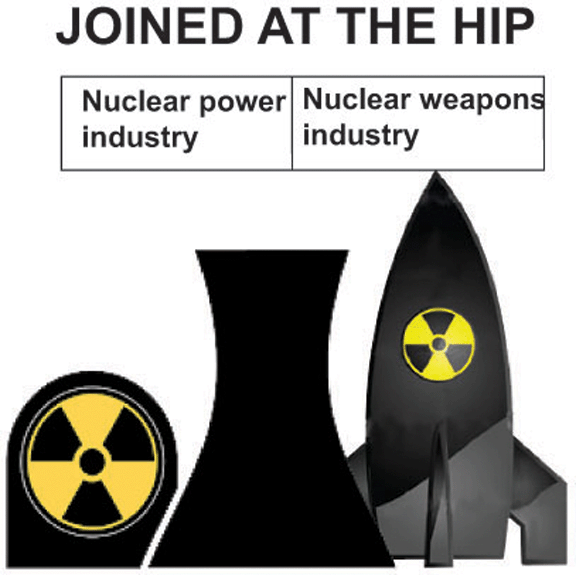
Scientists fear that the technology used to extract plutonium from spent fuel could be used to make nuclear bombs, Diane Francis Aug 12, 2021 In May, the Geneva-based International Campaign to Abolish Nuclear Weapons (ICAN) called out Prime Minister Justin Trudeau’s government over a deal he has approved and funded that critics say will undermine the goal of nuclear non-proliferation, according to an article published in the Hill Times and recently republished in the Bulletin of the Atomic Scientists.
Moltex Energy was selected by NB Power and the Government of New Brunswick to develop its new reactor technology and locate it at the Point Lepreau nuclear plant site by the early 2030s. Moltex is one of several companies that are promoting small, “next generation” nuclear reactors to replace fossil fuels in the production of electricity.
Moltex, a privately owned company that is based in the United Kingdom and has offices in Saint John, N.B., says it will “recycle nuclear waste” from New Brunswick’s closed Point Lepreau nuclear plant for use in its small-scale nuclear reactor. Federal funding and approval was announced on March 18 by Dominic LeBlanc, a New Brunswick MP who serves as minister of intergovernmental affairs.
The scientists dispute the claim that this is “recycling” and are concerned because the technology Moltex wants to use to extract plutonium, a key ingredient in nuclear weapons, from spent fuel could be used by other countries to make nuclear bombs. Decades ago, the U.S. and many of its allies, including Canada, took action to prevent this type of reprocessing from taking place.
“The idea is to use the plutonium as fuel for a new nuclear reactor, still in the design stage. If the project is successful, the entire package could be replicated and sold to other countries if the Government of Canada approves the sale,” reads the article.
On May 25, nine high-level American non-proliferation experts sent an open letter to Trudeau expressing concern that by “backing spent-fuel reprocessing and plutonium extraction, the Government of Canada will undermine the global nuclear weapons non-proliferation regime that Canada has done so much to strengthen.”
The signatories to the letter include senior White House appointees and other government advisers who worked under six U.S. presidents and who hold professorships at the Harvard Kennedy School, Princeton University and other eminent institutions.
The issue of nuclear proliferation dates back to 1974, when Canada got a black eye after India tested its first nuclear weapon using plutonium that was largely extracted using the CIRUS reactor, which was supplied by Canada for peaceful uses. Shortly after, other countries attempted to repurpose plutonium from reactors and were stopped — except for Pakistan, which, like India, succeeded in creating atomic weapons.
The Hill Times pointed out that, “To this day, South Korea is not allowed to extract plutonium from used nuclear fuel on its own territory — a long-lasting political legacy of the 1974 Indian explosion and its aftermath — due to proliferation concerns.”
The letter to Trudeau concluded: “Before Canada makes any further commitments in support of reprocessing, we urge you to convene high-level reviews of both the non-proliferation and environmental implications of Moltex’s reprocessing proposal including international experts. We believe such reviews will find reprocessing to be counterproductive on both fronts.”
The scientists’ letter has not yet been answered by the government. However, Canadians deserve to be fully briefed on all this and its implications. They deserve to know who owns Moltex, what the risks are to non-proliferation and why taxpayers are sinking millions of dollars into a project that’s morally questionable and potentially hazardous.Read and sign up for Diane Francis’ newsletter on America at dianefrancis.substack.com.
Revell River Action Draws Attention to Nuclear Waste Burial Site,
Revell River Action Draws Attention to Nuclear Waste Burial Site, https://wawa-news.com/index.php/2021/08/15/revell-river-action-draws-attention-to-nuclear-waste-burial-site/ Residents concerned about a site near the Revell River being put on the receiving end of all of Canada’s high level radioactive waste have set up a pop-up event at the Ministry of Transportation’s Revell River picnic area, drawing attention to the project and the threat it will pose to the region and the watersheds in Northwestern Ontario.The MTO picnic area, approximately 40 km west of Ignace, is approximately 2 km from the nearest of six drill sites that the Nuclear Waste Management Organization has disclosed.
“These drill sites are at the height of land between the English River – Wabigoon River system and the Turtle River Lake of the Woods system” explained Charles Faust, a volunteer with the group who has studied the area watersheds and waterflow.“One of the many concerns we have with this project is its potential to impact the downstream areas.
The NWMO can point to their computer models and their wishful thinking, but the reality is that this project carries a lot of risk, both during its operation and for the thousands of years afterwards that the radioactive wastes remain highly hazardous.Local residents think that most people in Northwestern Ontario don’t know the details or the risks of the NWMO project, and are unaware of how it could impact them, both before and after the waste is buried in the Revell River area.
“The drill sites are just a couple of kilometres off the highway – just a few kilometres from where we’re standing now at the Revell River picnic area – and most people are unaware of it. The NWMO spends a lot of money promoting their project in a very glossy magazine manner, but have done nothing in terms of signage for the drill sites or alerting people to where they are actually investigating their candidate sites”, commented Brien Polek, a resident of Dryden.I
n addition to signage on the highway drawing attention to the drill sites and the nuclear waste project, the group setting up the pop-up event today today at the Revell River picnic area will provide information to the public from noon until 4 pm. Similar to the information events in Ignace on August 14 and at the Dyment Hall on August 16, the group is encouraging the public to stop by the outdoors events, which they say will be all about information sharing, conversation, and discussion of the NWMO’s project and important concerns.
Volunteers from across the region will be on hand to discuss environmental and soci
nformation sharing, conversation, and discussion of the NWMO’s project and important concerns.
Volunteers from across the region will be on hand to discuss environmental and social concerns with the Nuclear Waste Management Organization’s plan to construct a deep geological repository for all of Canada’s high level radioactive Waste. Those wanting more information in advance about the alliance’s independent critiques of nuclear waste burial and transportation, or any interested in arranging a small meeting (following COVID-19 health directives) are encouraged visit the We the Nuclear Free North website at wethenuclearfreenorth.caSOURCE – We the Nuclear Free North
1 This Month


Tell the Ukrainian Government to Drop Prosecution of Peace Activist Yurii Sheliazhenko

Petition to revoke the licensing of the Near Surface Nuclear Disposal Facility (NSDF) at Chalk River. https://www.ourcommons.ca/petitions/en/Petition/Details?Petition=e-7247


of the week – STOP SMALL MODULAR REACTORS IN CANADA
To see nuclear-related stories in greater depth and intensity – go to https://nuclearinformation.wordpress.com
-
Archives
- March 2026 (183)
- February 2026 (268)
- January 2026 (308)
- December 2025 (358)
- November 2025 (359)
- October 2025 (376)
- September 2025 (258)
- August 2025 (319)
- July 2025 (230)
- June 2025 (348)
- May 2025 (261)
- April 2025 (305)
-
Categories
- 1
- 1 NUCLEAR ISSUES
- business and costs
- climate change
- culture and arts
- ENERGY
- environment
- health
- history
- indigenous issues
- Legal
- marketing of nuclear
- media
- opposition to nuclear
- PERSONAL STORIES
- politics
- politics international
- Religion and ethics
- safety
- secrets,lies and civil liberties
- spinbuster
- technology
- Uranium
- wastes
- weapons and war
- Women
- 2 WORLD
- ACTION
- AFRICA
- Atrocities
- AUSTRALIA
- Christina's notes
- Christina's themes
- culture and arts
- Events
- Fuk 2022
- Fuk 2023
- Fukushima 2017
- Fukushima 2018
- fukushima 2019
- Fukushima 2020
- Fukushima 2021
- general
- global warming
- Humour (God we need it)
- Nuclear
- RARE EARTHS
- Reference
- resources – print
- Resources -audiovicual
- Weekly Newsletter
- World
- World Nuclear
- YouTube
-
RSS
Entries RSS
Comments RSS
 nuclear-news