Canada: Federal gifts for the nuclear and mining industries
The government needs a more transparent and evidence-based approach to decision-making when assessing choices for decarbonization.
Policy Options, by Mark Winfield, January 25, 2023
Canada’s nuclear industry got an important pre-Christmas gift from the federal government in the form of the announcement of its decision not to conduct an assessment under the 2019 Impact Assessment Act of a proposed small modular nuclear reactor (SMR) at the Point Lepreau site in New Brunswick.
The Lepreau SMR proposal has been highly controversial, given its reliance on technologies where the performance, costs and risks are essentially unknown. Moreover, serious questions have even been raised about whether the project, intended to reprocess fuel from the Lepreau CANDU reactors, would violate the Treaty on the Non-Proliferation of Nuclear Weapons. It would have seemed precisely the kind of situation where a very thorough, public review is needed before a project can proceed. The federal government has chosen otherwise.
The Lepreau decision capped a string of federal decisions and multi-billion-dollar announcements around technologies claimed to be essential to decarbonizing Canada’s economy. There was the $970-million investment through the Canada Infrastructure Bank in another SMR project at Ontario Power Generation’s Darlington facility. A “critical minerals strategy,” also released in December, reads like a mining industry wish list. Billions had already been committed to “critical minerals” projects and infrastructures. A tax credit for carbon capture, utilization and storage (CCUS), with a value in the range of $1.5 billion per year, was introduced in the March 2022 budget. Hundreds of millions more have gone into fossil-fuel-based “blue hydrogen-related” technologies…………………………………………………………………
The SMR component of the federal government’s approach to “clean” electricity, for its part, carries high trade-off risks, ranging from direct impacts to questions of geopolitical security. At the same time, the technology remains immature and unlikely to make any contribution to the achievement of Canadian or global emission-reduction targets for 2030 or even by mid-century. Rather, it may represent a “dead-end” pathway – albeit one with very significant risks of major legacy costs and impacts………… more https://policyoptions.irpp.org/magazines/january-2023/federal-gifts-for-the-nuclear-and-mining-industries/
Canadian MP Charlie Angus Questions the Claims of SMRs (Small Modular Reactors)
Proponents of SMRs are on a major spin campaign. None of them have been approved for licensing. The Toronto Star calls them a “boutique boondoggle”. The IPCC raises serious questions about the dangers of nuclear proliferation. Chris Keefer is their big proponent. Here is the exchange at the Natural Resources Committee.
“Proponents of SMRs are on a major spin campaign. None of them have
been approved for licensing. The Toronto Star calls them a “boutique
boondoggle”. The IPCC raises serious questions about the dangers of
nuclear proliferation.”
Shouldn’t a new and experimental reactor deserve a federal impact assessment?
These risks are all new to Canada. No sodium-cooled reactor has ever been built here.
BY M.V. RAMANA AND SUSAN O’DONNELL | January 12, 2023 The Hill Times https://www.hilltimes.com/story/2023/01/12/shouldnt-a-new-and-experimental-reactor-deserve-a-federal-impact-assessment/360512/
Towards the end of December 2022, Environment and Climate Change Minister Steven Guilbeault chose to ignore public concerns about small modular nuclear reactors (SMRs), rejecting a request to put a project through an additional federal impact assessment, favouring the nuclear industry and weakening oversight of an untested and risky technology.
When the revised Impact Assessment Act (IAA) became law in 2019, new nuclear reactors were exempted from assessment if they met certain conditions. Those pushing the exemption aimed to open the path to building new reactors. No surprise, then, that the conditions for exemption apply to almost all the SMR designs being considered for construction, even though Canada has no experience with them whatsoever.
The first SMR officially deemed exempt under the IAA is the ARC-100 sodium-cooled fast reactor proposed by NB Power for the Point Lepreau site on the Bay of Fundy in New Brunswick. Given the ecological sensitivity of the site and inherent problems with such reactors, the Coalition for Responsible Energy Development in New Brunswick (CRED-NB) formally requested Guilbeault to designate the project for a full impact assessment. The minister rejected the request on Dec. 22, claiming that a review by the Canadian Nuclear Safety Commission (CNSC) and the New Brunswick government would be adequate.
The federal impact assessment is the most rigorous form of public review available under law, seeking inputs from multiple stakeholders with different forms of expertise and outlooks. Ideally, the review panel would not be solely constituted by CNSC personnel and staff of the provincial government, a project funder. Indigenous nations and public interest groups had clearly stated their concerns to Guilbeault. Letters of support for CRED-NB’s request were submitted by the Wolastoq Grand Council, and Indigenous organizations representing the Peskotomuhkati Nation and the Mi’gmaq First Nations in New Brunswick, as well as more than 300 groups and individuals.
Why the public concern? Unlike the CANDU reactors operating in Ontario and New Brunswick, the ARC-100 design uses molten sodium instead of heavy water to transfer the intense heat produced by nuclear fission. Sodium reacts badly with air or water, burning or exploding upon such contact. Japan’s Monju demonstration reactor was shut down in 1995 within a few months of the reactor starting to generate power because of a sodium fire; it was reactivated in 2010 but was shut down again after another accident. The total price tag for this reactor and its cleanup is upwards of $10-billion.
Sodium also tends to leak out of pipes and vessels because of chemical interactions with the stainless steel in reactors. France’s Superphénix, the world’s largest sodium-cooled reactor, suffered numerous operational problems, including a major sodium leak. When put out of its misery in 1998, its load factor was under eight per cent, a fraction of the 80 to 90 per cent typical of commercial reactors.
Sodium-cooled reactors have also had numerous accidents, starting with the 1955 partial core meltdown of the EBR-1 in Idaho. A decade later, the Fermi-1 demonstration fast reactor near Detroit, Michigan suffered a similar but more devastating accident, leading to the book We Almost Lost Detroit and a song by Gil Scott Heron.
Sodium-cooled reactors have never been successfully commercialized despite numerous attempts over decades. Shut-down sodium-cooled reactors have proven difficult to decommission. In the U.S., the EBR-II reactor was shut down in 1994, but to date it has been unfeasible to extract the sodium metal from the highly radioactive spent fuel. The challenge is to dispose of this material without causing underground explosions due to a sodium-water reaction, as happened with the sodium-cooled Dounreay reactor in Scotland.
Radioactive particles are still being found on the Dounreay foreshore, more than four decades after the reactor waste exploded. A similar accident with the proposed ARC-100 reactor could result in widely spread radioactive contamination next to the Bay of Fundy.
These risks are all new to Canada. No sodium-cooled reactor has ever been built here. The Canadian Nuclear Safety Commission has never evaluated such reactors, one reason why the CNSC’s claim that its regulatory process provides sufficient oversight for SMR development rings hollow. What’s more, the CNSC’s active lobbying to speed up the regulatory process so SMRs could be more quickly brought to market suggests a fundamental conflict of interest by an “independent” regulator.
The ARC-100 project requires federal oversight and assessment. Its impacts on Indigenous rights as well as socio-economic factors and alternatives to the project will not be within the remit of either a CNSC review or a provincial assessment. The opportunities for an independent and official review of public concerns on these issues have now been significantly curtailed.
Susan O’Donnell is an adjunct professor at the University of New Brunswick and St. Thomas University, and a member of the Coalition for Responsible Energy Development in New Brunswick. M.V. Ramana is the Simons Chair in Disarmament, Global and Human Security and professor at the School of Public Policy and Global Affairs, University of British Columbia.
Canada: Pressure tubes at two nuclear reactors deteriorated far too quickly
Early in the summer of 2021, Canada’s nuclear safety regulator received
alarming news. Inspections had revealed that two pressure tubes from
different reactors at Canada’s largest nuclear power plant, the Bruce
Nuclear Generating Station, had deteriorated far more quickly than
expected.
This meant the station’s operator, Bruce Power, had violated the
terms of its operating licence. The revelation put the Canadian Nuclear
Safety Commission in a tight spot. How were its leaders to respond?
Globe & Mail 5th Jan 2023
https://www.theglobeandmail.com/canada/article-canada-nuclear-power-plants-candu-tubes/
What’s an SMR? Canada’s bet on the contentious next-gen nuclear tech, explained.
National Observer Cloe Logan | News | January 4th 2023
What is an SMR?
An SMR, or small modular reactor, is a nuclear power unit used to produce energy. As of now, SMRs don’t technically exist; no unit has been fully built. But like nuclear energy in general, the tech is especially polarizing: while many — including the federal government — tout SMRs as a way to reach net-zero greenhouse gas emissions and achieve our climate goals, others say the risk they pose heavily outweighs any potential reward.
SMRs create energy through nuclear fission, similar to traditional nuclear reactors. That process creates heat, which generates electricity but doesn’t create greenhouse gas emissions, unlike fossil fuel energy sources such as coal and natural gas.
What does SMR stand for, and how are they different from existing reactors?
SMR stands for small modular reactor. Here’s a word-by-word definition……………………
Small: SMRs have a smaller energy output compared to traditional nuclear reactors…………..
Modular: According to the federal government, this means the reactors “are factory constructed, portable and scalable.” Compared to traditional nuclear plants, which are built from the ground up, SMRs can be constructed in a central factory and shipped elsewhere as a whole. However, that process will rely on how much demand there is for SMRs and how feasible it is to ship the units once they’re built. Because SMR technology is still in its early stages, this is still to be determined.
Reactor: The type of reactor an SMR uses can vary.
Why do we need SMRs?…………………………………. According to the federal government, SMRs could be used to help achieve our climate goal in three ways: by replacing coal plants, powering heavy industry operations in places like the oilsands and remote mines, and providing electricity for remote communities reliant on diesel.
……………………………… An analysis published in Policy Options found that as of 2018, 24 remote mines reliant on diesel were potential candidates for SMRs by 2030. However, the authors concluded the cost of producing an SMR was too high to justify an electricity demand of this magnitude. Rather, wind and solar are more affordable
The role of SMRs in powering remote, mostly Indigenous communities that now rely on diesel has also been contested. Research has shown SMRs to be one of the least desirable energy options to those communities, who are concerned with being left with nuclear waste and the high costs of SMRs compared to cheaper renewables.
Why are people against SMRs?
Those against SMRs often oppose them for three main reasons:
1. They will be in operation too late to address the climate crisis.
In Canada, the first SMR is supposed to be ready by 2028 for the Darlington Nuclear Generating Station in Ontario. However, some say that goal is unrealistic. An early SMR built by Oregon’s NuScale was originally supposed to generate electricity by 2016, but the completion date has since been pushed to 2029 or 2030. A new report by the Institute for Energy Economics and Financial Analysis described the project as “too late, too expensive, too risky and too uncertain.”
Meanwhile, renewable sources of energy like wind and solar already have technology that is developed and proven.
2. They’re too expensive.
Since SMRs haven’t yet been built, it’s hard to say how much they will ultimately cost, but it’s in the billions. Don Morgan, minister responsible for SaskPower in Saskatchewan, said a small reactor would cost around $5 billion. And the costs of projects underway have often ballooned: the NuScale project went from costing $3.1 billion in 2014 to $6.1 billion in 2020. As a result, the power generated by SMRs is expensive. A 2015 report from the International Energy Agency and the OECD Nuclear Energy Agency found electricity costs from SMRs are predicted to be 50 to 100 per cent higher than typical nuclear reactors.
3. They create harmful nuclear waste.
According to research from Stanford University and the University of British Columbia, SMRs are actually set to produce more nuclear waste than conventional plants. As of now, Canada’s nuclear waste is stored on site at facilities, but all of the locations are designed to be temporary. There is no waste disposal plan for nuclear waste from SMRs, and Canada has been struggling with where to dispose of the nuclear waste already created from existing and past reactors for around a decade. The Canadian Environmental Law Association notes: “SMR wastes will also have higher concentrations of radiation and the SMR designs that claim to ‘burn up’ existing radioactive waste will create new, even more toxic waste streams.”
Who is building SMRs in Canada and how far along are they?
In Canada, the federal government is currently backing SMR technology through its action plan, as are the provinces of Alberta, Ontario, Saskatchewan and New Brunswick, all of which signed a memorandum of understanding expressing support for SMRs.
According to provincial SMR plans, the first one in operation will be at the Darlington nuclear site in Ontario in 2028. Plans are also underway in Alberta and New Brunswick, where ARC Clean Energy is aiming to have an SMR in operation by 2029, and Moltex Energy says its spent fuel recovery system and reactor will come online in the early 2030s. Four more SMRs will follow between 2034 and 2042 in Saskatchewan.
In the plans, they also note another type of SMRs which would be smaller and have less power generation. Rather than supplying grids, they’re designed “primarily to replace the use of diesel in remote communities and mines.” The plan also notes the nuclear research facility at Chalk River, Ont., which is aiming to be in operation by 2026.
Are SMRs viable?
That is the biggest question surrounding SMRs. Although the plans for these next-generation nuclear units might hypothetically work, their viability hasn’t been proven anywhere. Proponents of the tech don’t let that get them down: they say the proposals are strong and are the key to reducing emissions.
But there is no sign that opponents will back down, either. In Canada, numerous Indigenous, scientific, environmental and citizen groups have called the technology a “dirty, dangerous distraction” from real climate action. https://www.nationalobserver.com/2023/01/04/news/what-is-an-smr-canada
Civil society groups urge feds to ban reprocessing used nuclear fuel.

Natasha Bulowski / Local Journalism Initiative / Canada’s National Observer, 30 Dec 22,
Canada’s forthcoming radioactive waste policy should include a ban on plutonium reprocessing, a national alliance of civil society organizations says.
Plutonium — a radioactive, silvery metal used in nuclear weapons and power plants — can be separated from spent nuclear reactor fuel through a process known as “reprocessing” and reused to produce weapons or generate energy.
The federal government is expected to release its policy for managing radioactive waste early next year. On Dec. 15, a handful of organizations urged Ottawa to include a ban on plutonium reprocessing because of its links to nuclear weapons proliferation and environmental contamination.
The World Nuclear Association says reprocessing used fuel to recover uranium and plutonium “avoids the wastage of a valuable resource.”
Ottawa has yet to take a definitive stance on the process. A draft policy released last February said: “Deployment of reprocessing technology … is subject to policy approval by the Government of Canada.”
But in 2021, a New Brunswick company, Moltex Energy, received $50.5 million from the federal coffers to help design and commercialize a molten salt reactor and spent fuel reprocessing facility. Commercial plutonium reprocessing has never been carried out in Canada, and we should not start now, according to Nuclear Waste Watch, a national network of Canadian organizations concerned about high-level radioactive waste and nuclear power. The group is among those pushing for a plutonium reprocessing ban.
More than 7,000 Canadians submitted letters including a demand to ban plutonium reprocessing throughout the consultation process, according to a Nuclear Waste Watch news release.
The group points to a 2016 report by Canadian Nuclear Laboratories stating reprocessing would “increase proliferation risk.”
“There is no legitimate reason to support technologies that create the potential for new countries to separate plutonium and develop nuclear weapons,” Susan O’Donnell, spokesperson for the Coalition for Responsible Energy Development in New Brunswick, said in Nuclear Waste Watch’s news release. “The government should stop supporting this dangerous technology.”
China, India, Japan, Russia, the United Kingdom and some European countries, like France, reprocess their spent nuclear fuel.
Canada’s forthcoming radioactive waste policy should include a ban on plutonium reprocessing, a national alliance of civil society organizations says. Plutonium separated from used nuclear fuel can be reused in power generation or nuclear weapons
Canada’s first new nuclear power reactor in 30 years has embarked on a crucial review. Can it pass quickly?

GE says it’s the simplest reactor it has ever designed. Such claims are common among SMR developers, and are almost entirely untested.
“The vendors would really like to have basically no guards with guns at a reactor site, if they can avoid it,”
While a solar or wind farm can typically be built in a few years, nuclear reactors have been known to take a decade or longer. With governments and utilities pondering how to achieve net-zero greenhouse emissions by mid-century, this has proved to be a significant competitive disadvantage for nuclear power.
Globe and Mail, Dec. 28, 2022, Matthew McClearn
On the shores of Lake Ontario, about 70 kilometres east of Toronto, something is happening that hasn’t happened in Canada in well over a generation: Workers are breaking ground for a new nuclear reactor.
Ontario Power Generation plans to construct a GE-Hitachi BWRX-300 at its Darlington Nuclear Generating Station in Clarington. To do that it needs permission from the Canadian Nuclear Safety Commission (CNSC)
The utility’s application to the CNSC, which it submitted in the fall, will be the first real test of GE-Hitachi’s claims about the reactor, a new model that is not yet used anywhere else in the world. The uncertain process could have dramatic implications for what this new reactor will ultimately cost, how long it will take to build – and whether anyone else will want to build one.
The reactor’s design is novel in several respects. At 300 megawatts, the BWRX-300 is marketed as a small modular reactor, or SMR. (Darlington’s existing four reactors each produce 935 megawatts.) In considering the application, the CNSC will be the first regulator in the world to review an SMR for large-scale power generation.
This will be the first large nuclear power reactor the CNSC has reviewed since 1993. And, if built, it would be the first nuclear power reactor in Canadian history that wasn’t of the homegrown CANDU design.
GE-Hitachi has said the BWRX-300 will be 60 per cent less expensive per megawatt than a typical reactor, making it the cheapest SMR on the market, and that it can be built in as few as 24 months. And the company has touted “passive safety systems.” Even if operators walked away, it has said, the reactor would cool itself without power for a whole week, at minimum. The company also claims the BWRX-300′s environmental footprint is less than that of larger reactors. GE says it’s the simplest reactor it has ever designed.
Such claims are common among SMR developers, and are almost entirely untested. The BWRX-300 “has not gone through any licensing review anywhere, in any country,” said M.V. Ramana, a professor at the University of British Columbia’s School of Public Policy and Global Affairs who researches nuclear energy. “When a design is submitted to a regulator for safety review, the regulators ask questions, and the design starts being changed. And so there is going to be this process of evolution.”…………………………………
Allison Macfarlane, director of UBC’s School of Public Policy and Global Affairs, said SMR vendors have also sought smaller emergency-planning zones in the U.S. And she noted that some vendors argue that SMRs will require less physical security than larger reactors. “The vendors would really like to have basically no guards with guns at a reactor site, if they can avoid it,” she added.
Acquiring regulatory approval to build a newly designed reactor within two or three years is not the norm.
Prof. Macfarlane said there is no hard rule on how long the process takes. The fastest application she has seen before the NRC was a request by the U.S. Navy for an informal review of a reactor for a nuclear aircraft carrier. (The Navy didn’t actually require NRC approval.) The NRC’s review took 18 months, she said.
For a power reactor, the best case scenario before the NRC is three to four years. At worst, the process can stretch out for a decade.
“Usually, there’s just this endless back and forth,” she said.
Prof. Ramana is also skeptical of OPG’s timeline. Most nuclear projects suffer delays, he said. “When it comes to a new reactor design, those delays tend to be much larger. … It should not be a surprise to anyone if this design is going to be quite delayed.”
That accords with GE-Hitachi’s own experiences in the U.S. The company applied to the NRC for final design approval for its Economic Simplified Boiling Water Reactor in 2005. The reactor wasn’t certified until nine years later, in 2014. In 2011, the company applied to the NRC to renew the design certification for its Advanced Boiling Water Reactor, which had first been certified in the 1990s. That process took about a decade.
Even if the CNSC does grant OPG its construction license in record time, delays are not uncommon after construction has commenced. One notorious example is Westinghouse’s AP1000 reactor, which made an outsized contribution to that company’s filing for bankruptcy protection in 2017.
“In the case of the AP1000, the delays happened well after the design was licensed to be constructed,” Prof. Ramana said.
That historical experience notwithstanding, OPG, various levels of government and voices from across the nuclear industry have said that this new reactor will be in service as early as 2028. Meeting that deadline is a matter of no small urgency for the nuclear industry. While a solar or wind farm can typically be built in a few years, nuclear reactors have been known to take a decade or longer. With governments and utilities pondering how to achieve net-zero greenhouse emissions by mid-century, this has proved to be a significant competitive disadvantage for nuclear power…………………..
The CNSC is an administrative tribunal that reports to Parliament through the Minister of Natural Resources. While it doesn’t answer to him, that minister, Jonathan Wilkinson, has promoted SMRs in recent statements. By adopting them early, he said in October, “Canada could realize a significant share of the global exports of technology, goods and services.” In its most recent budget, the federal government earmarked nearly $51-million to improve the CNSC’s capacity to regulate SMRs.
CNSC president Rumina Velshi is also a vocal supporter. She declared in October that SMRs “are likely to be an important part of the next generation of nuclear” and that they “will need to be deployed quicker, less expensively and much more widespread than reactors of the past.” The CNSC has established a new group focused exclusively on SMRs, which will “guide the entire organization on SMR readiness.”
Earlier this year, Ms. Velshi told attendees of a summit on advanced reactors that the CNSC would rise “to the challenge of conducting SMR licensing reviews efficiently and effectively.”
Ms. Velshi is enthusiastic about the CNSC harmonizing its codes and standards with those of regulators of other countries. She has said this is “essential” for SMR deployment worldwide, and has signalled her intent to work closely with the NRC.
In September, the two regulators signed an agreement to collaborate on reviewing the BWRX-300.
Allison Macfarlane, director of UBC’s School of Public Policy and Global Affairs, said SMR vendors have also sought smaller emergency-planning zones in the U.S. And she noted that some vendors argue that SMRs will require less physical security than larger reactors. “The vendors would really like to have basically no guards with guns at a reactor site, if they can avoid it,” she added.
Acquiring regulatory approval to build a newly designed reactor within two or three years is not the norm.
Prof. Macfarlane said there is no hard rule on how long the process takes. The fastest application she has seen before the NRC was a request by the U.S. Navy for an informal review of a reactor for a nuclear aircraft carrier. (The Navy didn’t actually require NRC approval.) The NRC’s review took 18 months, she said.
For a power reactor, the best case scenario before the NRC is three to four years. At worst, the process can stretch out for a decade.
“Usually, there’s just this endless back and forth,” she said.
Prof. Ramana is also skeptical of OPG’s timeline. Most nuclear projects suffer delays, he said. “When it comes to a new reactor design, those delays tend to be much larger. … It should not be a surprise to anyone if this design is going to be quite delayed.”
That accords with GE-Hitachi’s own experiences in the U.S. The company applied to the NRC for final design approval for its Economic Simplified Boiling Water Reactor in 2005. The reactor wasn’t certified until nine years later, in 2014. In 2011, the company applied to the NRC to renew the design certification for its Advanced Boiling Water Reactor, which had first been certified in the 1990s. That process took about a decade.
Even if the CNSC does grant OPG its construction license in record time, delays are not uncommon after construction has commenced. One notorious example is Westinghouse’s AP1000 reactor, which made an outsized contribution to that company’s filing for bankruptcy protection in 2017.
“In the case of the AP1000, the delays happened well after the design was licensed to be constructed,” Prof. Ramana said.
That historical experience notwithstanding, OPG, various levels of government and voices from across the nuclear industry have said that this new reactor will be in service as early as 2028. Meeting that deadline is a matter of no small urgency for the nuclear industry. While a solar or wind farm can typically be built in a few years, nuclear reactors have been known to take a decade or longer. With governments and utilities pondering how to achieve net-zero greenhouse emissions by mid-century, this has proved to be a significant competitive disadvantage for nuclear power.
A successful, quick application would bode well for further BWRX-300 construction, in Canada and beyond. OPG’s environmental impact statement suggests the utility could deploy up to four at Darlington, with the last one completed in 2035.
Earlier this year, SaskPower, Saskatchewan’s main electric utility, selected the BWRX-300 for “potential” deployment in the province in the mid-2030s. (It won’t make a firm decision until 2029.) A U.S. utility, the Tennessee Valley Authority, also plans to build a BWRX-300.
The CNSC is an administrative tribunal that reports to Parliament through the Minister of Natural Resources. While it doesn’t answer to him, that minister, Jonathan Wilkinson, has promoted SMRs in recent statements. By adopting them early, he said in October, “Canada could realize a significant share of the global exports of technology, goods and services.” In its most recent budget, the federal government earmarked nearly $51-million to improve the CNSC’s capacity to regulate SMRs.
CNSC president Rumina Velshi is also a vocal supporter. She declared in October that SMRs “are likely to be an important part of the next generation of nuclear” and that they “will need to be deployed quicker, less expensively and much more widespread than reactors of the past.” The CNSC has established a new group focused exclusively on SMRs, which will “guide the entire organization on SMR readiness.”
Earlier this year, Ms. Velshi told attendees of a summit on advanced reactors that the CNSC would rise “to the challenge of conducting SMR licensing reviews efficiently and effectively.”
Ms. Velshi is enthusiastic about the CNSC harmonizing its codes and standards with those of regulators of other countries. She has said this is “essential” for SMR deployment worldwide, and has signalled her intent to work closely with the NRC.
In September, the two regulators signed an agreement to collaborate on reviewing the BWRX-300.
| Reply |
Canada’s Feds forgo environmental assessment for controversial nuclear project
By Cloe Logan | News | December 23rd 2022
The federal government has decided not to require a controversial nuclear project to undergo an environmental assessment, prompting criticism from experts opposed to the technology who fear the rejection sets an “unfortunate precedent.”
New Brunswick’s primary energy provider, Énergie NB Power, has proposed the project, which relies on a small modular reactor (SMR) — a portable nuclear technology still in the development stage. The federal government and some provincial governments are betting on SMRs, which don’t produce greenhouse gas emissions, to replace coal and other fossil fuels as an energy source. However, many experts say the risks heavily outweigh the benefits: SMRs are expensive, experimental, produce toxic nuclear waste and are unlikely to be financially viable.
NB Power has plans to operate two SMRs and a spent fuel reprocessing facility at its current site on the Bay of Fundy, the Point Lepreau Nuclear Generating Station. The Moltex SMR and spent fuel reprocessing unit are expected to be in operation by the early 2030s, while the ARC SMR will be up and running by 2029, according to the company. The latter project was being considered for federal assessment after a request from the Coalition for Responsible Energy Development in New Brunswick (CRED-NB) since it does not automatically fall under the federal assessment process. The Moltex project does because it will require recycling nuclear waste, according to CBC News.
The federal government is currently pushing the new technology through its SMR Action Plan, touting its ability to play an essential role in the pathway to net-zero greenhouse gas emissions. Likewise, the provinces of Alberta, Ontario, Saskatchewan and New Brunswick have signed a memorandum of understanding expressing support for SMR technology.
However, because SMRs are still in the development stage, any potential benefits they might have in slashing greenhouse gas emissions wouldn’t happen soon enough to contribute to Canada’s goal of cutting emissions 40 per cent below 2005 levels by 2030, CRED-NB told Canada’s National Observer in March.
CRED-NB, comprised of 20 citizen groups and businesses and more than 100 individuals across the province, asked federal Environment and Climate Change Minister Steven Guilbeault in July to consider the importance of evaluating the SMR project under the Impact Assessment Act, a federal process that examines the environmental impacts of major projects, including all oil and gas, refineries, pipelines and liquefied natural gas (LNG) facilities. The group raised concerns about its potential impacts to the surrounding environment, nuclear waste and Indigenous treaty rights.
The Passamaquoddy Recognition Group, representing the Peskotomuhkati Nation and the Wolastoq Grand Council, which has spoken out about how the storage of nuclear waste and continued funding for nuclear goes against the United Nations Declaration on the Rights of Indigenous Peoples Act (UNDRIP), also sent letters of support.
In the initial request, CRED-NB notes concerns with “project splitting,” which is the “intentional breaking up of the project in its components parts” in order to get around the need for an impact assessment. In 2019, the federal government exempted nuclear reactors with fewer than 200 megawatts of thermal power and SMRs on pre-existing nuclear sites with fewer than 900 megawatts from the Impact Assessment Act. This came after lobbying from the Canadian Nuclear Safety Commission, the federal-level independent regulator of nuclear power, which raised concerns the assessment process would hurt the SMR industry in briefing notes obtained by Greenpeace.
Since there are two SMRs slated for the Point Lepreau site, the coalition argues they are essentially one project with different operators. However, assessing the ARC SMR individually means it falls under the megawatt limit.
In Guilbeault’s decision, he said an impact assessment for the SMR project was “unwarranted” because current legislative processes will address the issues raised by CRED-NB and that his decision was based on analysis from the Impact Assessment Agency. The project is set to undergo provincial assessment and will need to be licensed by the Nuclear Safety and Control Act, he noted.
In a submission to the Impact Assessment Agency, New Brunswick’s environmental assessment branch said concerns raised “would be expected to be addressed as part of the provincial [environmental impact assessment] review.”
However, CRED-NB stressed the federal government process is more thorough than a provincial assessment, which will come in 2023.
“The mechanism we had to uphold environmental justice has been denied,” said Kerrie Blaise, an environmental lawyer who assisted CRED-NB with the impact assessment request.
“The many unknowns and the potential for not only severe but irreversible impacts to the health of communities and the environment will not be subject to a rigorous public and cumulative effects assessment that an IA (impact assessment) provides. This is quite simply something that cannot be achieved by the nuclear regulator in their licence-specific assessment.”
Canada’s Federal environment minister rejects impact assessment for small modular nuclear reactor on the Bay of Fundy.
Coalition for Responsible Energy Development in New Brunswick (CRED-NB), December 23, 2022
SAINT JOHN, NEW BRUNSWICK – In a deeply disappointing decision for the environment and public oversight, Steven Guilbeault, federal Minister of Environment and Climate Change, has ruled against a full federal Impact Assessment (IA) for a small modular nuclear reactor (SMR) proposed by New Brunswick Power at Point Lepreau in New Brunswick.
This decision comes in response to a request submitted by the Coalition for Responsible Energy Development in New Brunswick (CRED-NB) on July 4, 2022, calling for an IA for this first-of-its-kind nuclear project in Canada. Letters of support for CRED-NB’s request were submitted by the Wolastoq Grand Council, and Indigenous organizations representing the Peskotomuhkati Nation and the Mi’gmaq First Nations in New Brunswick and over 300 public interest groups and individuals.
In rejecting the need for an IA for the proposed SMR project, the Minister found it would be “unwarranted” as the concerns raised by Indigenous peoples and members of the public would be considered as part of the licensing process by the nuclear regulator and within New Brunswick’s Clean Environment Act.
“The Minister’s choice not to designate the SMR for an assessment goes against their commitments to sound, science-based decision-making and public participation,” noted Ann McAllister of CRED-NB, reacting to the news of the Minister’s decision. “This lack of a precautionary approach is especially dismaying given that sodium-cooled nuclear technology – of which this SMR is one – has a known history of accidents and has never been successfully commercialized, despite repeated attempts over the decades.”
“The mechanism we had to uphold environmental justice has been denied,” reacted Kerrie Blaise, an environmental lawyer who assisted CRED-NB with the IA request. “The many unknowns and the potential for not only severe but irreversible impacts to the health of communities and the environment will not be subject to a rigorous public and cumulative effects assessment that an IA provides. This is quite simply something that cannot be achieved by the nuclear regulator in their license-specific assessment.”
“By refusing an IA for the SMR project at Point Lepreau, the Minister suggested the concerns about the project raised by CRED-NB would be dealt with by a provincial Environmental Impact Assessment,” said Dr. Susan O’Donnell,Adjunct Professor at the University of New Brunswick and St. Thomas University, and CRED-NB member. “The provincial process is not as comprehensive as the federal IA. However in its submission, the Government of New Brunswick stated that a provincial EIA would address all the concerns raised in the CRED-NB request, and that the premier has confirmed that a provincial EIA review, including public consultation, will be required before the project can proceed. We look forward to that comprehensive provincial review in the new year.”
Pressure from the nuclear industry lobby changed federal environmental assessment law in 2019, exempting SMRs below a certain threshold from undergoing a full environmental IA. The only way for thisproject to have undergone an IA, was at the direction of the Minister. The Minister’s decision sets an unfortunate precedent, weakening our impact assessment laws and ability for broad public participation.
Point Lepreau nuclear plant taken offline after power loss
Bobbi-Jean MacKinnon · CBC News · Dec 14, 2022
The Point Lepreau nuclear generating station has been taken offline, following a partial loss of power.
The Canadian Nuclear Safety Commission was informed of the incident Wednesday around 5:30 a.m. and has staff onsite, closely monitoring the situation, according to a news release late Wednesday afternoon..
“At the time of this update, NB Power has not identified any reports of injuries, radiation contamination or spills into environment,” said the commission, whose mandate includes protecting health, safety, security and the environment.
N.B. Power says further assessments are underway to perform the maintenance required to reconnect the station to the grid…….. N.B. Power spokesperson Dominique Couture did not immediately respond to a request for more information, such as when and why the power loss occurred, or how long it’s expected to take to get the plant back online……………
‘Major equipment replacement’ delayed until April
Point Lepreau was shut down for a week in August due to an undisclosed “equipment issue.”
That outage came only five days after the generating station came back online following scheduled spring maintenance, which dragged on for more than 100 days and wasn’t completed as planned.
Supply and personnel shortages and more significant problems with station equipment than anticipated all contributed to the delay, Couture had said.
She said a 22-day outage is planned for April 2023 to deal with the unfinished work — a “major equipment replacement … to ensure predictable, reliable station operations going forward.”
According to N.B. Power’s annual reports, unscheduled outages at the nuclear plant cost the utility between $28,500 and $45,700 per hour, depending on the time of year and market conditions, plus the cost of any required repairs.
According to filings with the New Brunswick Energy and Utilities Board, Lepreau has experienced 8,000 more hours of downtime than projected since it underwent a 4½-year, $2.4-billion refurbishment in late 2012, not including the spring outage.
Lepreau’s operating licence was renewed by the Canadian Nuclear Safety Commission in June for 10 years. N.B. Power had sought an unprecedented 25-year licence renewal. https://www.cbc.ca/news/canada/new-brunswick/point-lepreau-offline-power-loss-canadian-nuclear-safety-commission-nb-power-1.6686212
Will small modular reactors seed a nuclear renaissance?
Corporate Knights does not consider new nuclear power projects to be “green” i
However, big questions remain about SMRs as the technology is largely untested. It’s unclear what the electricity from SMRs will cost and whether the technology can compete with cheap renewable sources like wind and solar backed up by storage. The prospect of micro reactors dotting remote Canadian landscapes also raises serious issues around safety and management of highly radioactive wastes.
Four Canadian provinces are banking on SMRs to help decarbonize their electricity grids, but critics argue the technology is unproven
Corporate Knights, BY SHAWN MCCARTHY, DECEMBER 8, 2022
It’s been more than a decade since Atomic Energy of Canada Ltd. (AECL) pulled the plug on its advanced CANDU reactor – a newly designed mega-reactor that industry said would usher in a “nuclear renaissance.”
Now Canada is seeing yet another promised resurgence for the nuclear industry. And this time, it comes in a size small. On December 1, Ontario Premier Doug Ford participated in a groundbreaking at Darlington nuclear facility, where provincially owned Ontario Power Generation (OPG) plans to build a small modular reactor (SMR).
If the Darlington project gets a green light on the final investment decision, the unit will be the first new reactor built in Canada in nearly 40 years, as other companies are pursuing plans to build SMRs across the country. (The nuclear sector has, however, been buoyed by massive reactor refurbishment projects at Darlington and Bruce Power’s eight-reactor site on Lake Huron.)
The industry’s latest hope, SMRs have a capacity of up to 300 megawatts and modular design features that are meant to keep construction costs under control (nuclear projects are notorious for their multibillion-dollar cost overruns). Micro reactors can be as small as five megawatts and are touted as an energy solution for remote communities and industrial sites like mines.
That’s in sharp contrast with the 1,000-megawatt behemoths that were marketed around the world in the first decade of the century by reactor manufacturers, including then federally owned AECL, Westinghouse Electric Co. and others.
The federal government and four provinces – Ontario, New Brunswick, Saskatchewan and Alberta – are lining up to support the commercial deployment of SMRs as low-carbon sources of electricity.
However, big questions remain about SMRs as the technology is largely untested. It’s unclear what the electricity from SMRs will cost and whether the technology can compete with cheap renewable sources like wind and solar backed up by storage. The prospect of micro reactors dotting remote Canadian landscapes also raises serious issues around safety and management of highly radioactive wastes.
Corporate Knights does not consider new nuclear power projects to be “green” in its Sustainable Economy Taxonomy. In July, the European Union overturned a draft proposal and included nuclear in its taxonomy for the purposes of green investing, though that controversial decision is being challenged in court by Austria, backed by several environmental groups.
In its fall fiscal update, the federal government introduced an investment tax credit of up to 30% for clean energy technologies, including SMRs. Ottawa has also committed $970 million in low-interest financing through the Canada Infrastructure Bank for the Darlington SMR project.
A bad day to go nuclear
Last decade was not kind to the nuclear industry, as Japan’s Fukushima meltdown after a tsunami in 2011 was the worst nuclear disaster since the Chernobyl accident of 1986 and led to the shutdown of all the country’s reactors. Those safety threats loom large today as Russia has attacked Ukraine’s nuclear energy site.
As well, the economic case for large new reactors has taken a beating over the years, as projects have been plagued by delays and cost overruns………………………….
At the National Energy Roundtable’s conference at the end of November, several speakers argued for the inclusion of nuclear in Canada’s strategy to electrify the economy. Energy ministers from Ontario and New Brunswick touted the benefits of SMRs, saying the technology can provide affordable, continuous, non-emitting power.
The two provinces – in addition to Alberta and uranium-rich Saskatchewan – have agreed to work together on the commercialization of SMRs……………………………….
At Darlington, OPG expects to receive a construction licence in 2024 and will release detailed cost estimates as design and regulatory work proceeds, OPG spokesman Neal Kelly said in an email.
Former mayor of Iqaluit Madeleine Redfern said at the roundtable discussion that SMRs can help northern communities and industry end their reliance on expensive, dirty and often unreliable diesel generators. Small reactors, she said, would be more reliable than intermittent electricity production from wind or solar projects. (Redfern is also chief operating officer of CanArctic Inuit Networks and an Indigenous advisor to nuclear energy developer USNC-Power, which is partnering with OPG on a demonstration reactor project, as it seeks approvals from the federal nuclear regulator.)…………………………………
Critics argue that SMRs pose the same problems of safety and waste disposal that have bedevilled the nuclear industry for decades. The future “lies in capturing the sun and wind, not in splitting atoms,” Greenpeace campaigner Keith Stewart said in an email. “SMRs have been a decade away from deployment for the last 30 years, while wind and solar are actually being deployed.”…………………….
Ontario Energy Minister Todd Smith
aid Ontario is committed to electrification but will need the federal government to be a reliable partner to help keep costs down. “If the price of electricity soars, we’re not going to see electrification unfold,” he said.
However, whether SMRs can be a timely source of cheap and low-carbon electricity for Ontario and beyond remains to be seen. https://www.corporateknights.com/category-climate/will-smrs-bring-nuclear-renaissance/
—
No legitimate reason to support the controversial nuclear technology planned for New Brunswick

Producing more plutonium will only exacerbate nuclear proliferation.
This is why a recent report published by the International Panel on Fissile Materials called for a global ban on separating plutonium.
The Canadian government is pushing in the opposite direction, increasing its research capacity to separate plutonium, and funding a company that seeks to export SMRs fuelled by this material.

The nuclear industry’s hope that reactors that can burn plutonium-based fuel will be less expensive has been illusory. Molten salt reactors like the Moltex SMR have a problematic history and investing in them is wasteful.
Separation of plutonium massively increases risk of proliferation, write M.V. Ramana and Susan O’Donnell
https://nbmediacoop.org/2022/11/26/commentary-no-legitimate-reason-to-support-the-controversial-nuclear-technology-planned-for-new-brunswick/ by M.V. Ramana and Susan O’Donnell, November 26, 2022
NB Power plans to develop new nuclear reactors at Point Lepreau that will use a controversial technology with implications for global security. Provincial and federal government support for this technology–called reprocessing–should end.
At an international conference on nuclear power in Washington, D.C. in October, federal Natural Resources Minister Jonathan Wilkinson proclaimed that Canada desires to play a leadership role in nuclear energy and promote its peaceful use around the world. Unfortunately, the leadership role the federal government has chosen involves separating plutonium, which enormously increases the risk of furthering nuclear proliferation.
Earlier in the year, Atomic Energy of Canada Limited (AECL), a federal Crown corporation, broke ground on a large nuclear research facility. The Advanced Nuclear Materials Research Centre, described as “the cornerstone” of the government’s $1.2-billion expansion of AECL’s Chalk River site, is to feature 12 “new shielded hot cells” and “glovebox facilities” for research on fuel associated with proposed small modular nuclear reactors (SMRs). The shielding and the glovebox are needed to develop some SMR designs that require plutonium as fuel to operate.
One of those SMR designs is being developed by Moltex, a company based in Saint John that received $50.5-million from Innovation, Science and Economic Development Canada. In his Washington address, Wilkinson took credit for investing in Moltex to develop its plutonium-extraction technology that can “recycle CANDU spent nuclear fuel into new fuel.” He said he would like Canada to export such “technology, goods and services” globally.
Another of these designs is the ARC-100, an SMR that will “breed” plutonium. NB Power is planning to apply for a licence to develop the Point Lepreau site for the ARC SMR in June 2023. Both the Moltex and ARC companies have signed agreements with Canadian Nuclear Laboratories to conduct nuclear fuel research at the Chalk River site.
Both companies have also received funding from the New Brunswick government and NB Power. In 2018, they gave $5M each to ARC and Moltex to bring them to the province and set up offices in Saint John. In 2021, the provincial government announced a further $20M grant to ARC.
Will expanding Canada’s plutonium interests support the peaceful use of nuclear energy?
Plutonium is intimately connected with nuclear power since it is created in all reactors when uranium absorbs neutrons. Using a chemical process called “reprocessing,” this plutonium can be separated from the remaining, highly radioactive, byproducts contained in irradiated nuclear fuel. Once removed, the plutonium could be used as fuel in some nuclear power plants.
But countries and individuals could make nuclear weapons with plutonium. Indeed, most people learned about this material first from news of the Fat Man bomb that flattened Nagasaki. The two uses of plutonium lie at the heart of India’s nuclear program. Set up ostensibly for peaceful purposes, India justified acquiring a reprocessing plant in the 1960s by announcing plans to develop reactors fuelled with plutonium. The source of the plutonium was CIRUS, a research reactor gifted by Canada. However, India’s first use of such plutonium was in the atomic bomb exploded in 1974, yet again demonstrating how plutonium separation and nuclear weapons are connected.
Since then, the United States, the country with the most nuclear reactors anywhere in the world, has stopped civilian reprocessing and the use of plutonium as fuel. Unfortunately, other countries didn’t follow suit—specifically, the United Kingdom, France, and Russia. The result: a stockpile of approximately 545 tonnes of plutonium. The Fat Man bomb exploded over Nagasaki used roughly six kilograms of plutonium. It is easy to do the math and calculate how many tens of thousands of nuclear weapons can be fabricated from this stockpile of separated plutonium.
Producing more plutonium will only exacerbate nuclear proliferation. This is why a recent report published by the International Panel on Fissile Materials called for a global ban on separating plutonium. The Canadian government is pushing in the opposite direction, increasing its research capacity to separate plutonium, and funding a company that seeks to export SMRs fuelled by this material.
In 2021, a group of U.S. non-proliferation experts and former government officials and advisers with related responsibilities penned an open letter to Prime Minister Justin Trudeau expressing concerns about the Moltex project. Moltex responded with the argument that the plutonium that would be produced in their proposed process is “impure” and cannot be used in nuclear weapons.
But the Moltex argument has long been refuted, for example in a 2009 report by safeguards experts from six US national laboratories. The reason is simple: any process that allows plutonium from spent fuel to be cleaned up adequately for use as nuclear fuel will make the material almost good enough for use in nuclear weapons; only relatively cheap and easy processing in a “hot cell” is necessary after that. This is why the International Atomic Energy Agency considers all plutonium (with one exception that does not apply to the process proposed by Moltex) as being “of equal sensitivity” when it comes to safeguards.
The open letter also suggested that the government carry out high-level reviews of the non-proliferation and environmental implications of the project. Instead of commissioning such reviews, the Canadian government has funded building an expensive laboratory to work on plutonium, that too at Chalk River, the site where reprocessing was carried out until 1954.
After India’s nuclear weapons test, separating plutonium b
ecame a political liability, and the nuclear establishment has only considered burying irradiated fuel in a deep geological repository. That changed under Trudeau’s leadership in March 2021, when Moltex received $50.5-million.
There is no legitimate reason to support reprocessing technology
The nuclear industry’s hope that reactors that can burn plutonium-based fuel will be less expensive has been illusory. Molten salt reactors like the Moltex SMR have a problematic history and investing in them is wasteful. Vast stores of separated plutonium sit in storage because nobody has built a reactor that can burn plutonium fuel successfully and economically. Concerns about running out of cheap uranium ore that were common in the early decades of the nuclear age have proven mistaken; there is plenty of uranium ore globally to fuel current and proposed nuclear reactors.
Further, a 2016 report from the Canadian Nuclear Laboratories found that there was no business case for reprocessing CANDU fuel, in part “due to its low fissile content,” and the associated costs and risks. The report also noted “significant upfront investment and numerous investments over a long timeframe,” and that reprocessing in other countries has not been commercially successful. Crucially, the report emphasized that reprocessing “would increase proliferation risk.”
Meanwhile, all Canada’s current and proposed plutonium activities have reduced regulatory oversight. In 2019, the Canadian Parliament approved Bill C-69, which allows some small modular reactors and associated nuclear projects below various thresholds, to move forward without being subject to a federal impact assessment.
This is why the Coalition for Responsible Energy Development in New Brunswick has petitioned Environment and Climate Change Minister Steven Guilbeault to require an impact assessment for NB Power’s ARC-100 SMR project. Unless Guilbeault requires it, there will be no federal impact assessment of this new plutonium project.
Over six decades of global experience with building nuclear power plants has clearly demonstrated that they are expensive and take years and years to start operating. Electricity from nuclear plants costs far more than from renewable energy sources. Nuclear power, then, cannot be a viable solution to climate change.
Nuclear reactors are also susceptible—albeit infrequently—to severe accidents that lead to long-lasting radioactive particles contaminating large tracts of land. The risk of accidents will increase as climate change worsens and extreme weather events become more common, or in the event of war—as evidenced by the ongoing situation at the Zaporizhzhia nuclear plant in Ukraine. There is also no demonstrated way to safely manage nuclear waste for the millennia the radioactive materials take to decay.
Small modular reactors are not going to solve these problems. On the contrary, adding plutonium separation to the Canadian nuclear industry’s repertoire will create a new global security risk and raise legitimate questions about Canada’s stated goal to be a leader in the peaceful use of nuclear energy. There is no legitimate reason to support technologies that create the potential for new countries to separate plutonium and develop nuclear weapons. The government should stop supporting this dangerous technology.
M.V. Ramana is the Simons Chair in Disarmament, Global and Human Security and professor at the School of Public Policy and Global Affairs, University of British Columbia, and the author of The Power of Promise: Examining Nuclear Energy in India.
Susan O’Donnell is the primary investigator of the RAVEN project at the University of New Brunswick, a member of the Coalition for Responsible Energy Development in New Brunswick, and an adjunct research professor in the Environment and Society program at St. Thomas University.
Nuclear power no solution for Canada’s North West Territory
Nuclear power no solution for the N.W.T., some experts suggest, Liny Lamberink · CBC News · Nov 23, 2022
When it comes to reducing greenhouse gas emissions — nuclear power is a divisive option.
But for Canada’s North, two academics on different sides of the debate agree: small modular reactors, called SMRs, are not an economically feasible way of getting remote northern communities off of diesel-generated power.
Since 2017, the N.W.T. government has been part of a working group looking at the possibility of SMRs.
John Richards, a fellow at the C.D. Howe Institute, co-authored a paper published last week that said Canada needs to embrace small modular reactors in order to meet its greenhouse gas reduction goals.
In a transition to cleaner forms of energy, Richards says Canada can’t entirely rely on solar and wind power because it’s intermittent. He said nuclear power can be used in conjunction with those forms of renewable energy to provide a constant supply of energy — when there’s no wind or no sunlight.
But, he said, he sees it as an option in Saskatchewan or Manitoba — where there isn’t much more potential for hydro. In the small remote communities in the North, he said, small modular reactors would be too expensive.
Who will build them?
Small modular reactors are nuclear reactors that use fission to produce energy, similar to existing large reactors, but with smaller power capacity. They’re “modular” because they’re designed to be assembled in a factory, transported by flatbed trucks or trains, and installed where needed. The International Atomic Energy Agency defines reactors as “small” if their output is under 300 megawatts.
Small modular reactors are still in the prototype phase now. Even if they can be built small enough so as not to massively over-supply power in a small remote community, M.V. Ramana — a professor at the School of Public Policy and Global Affairs at the University of British Columbia and a critic of nuclear power — doubts a private sector manufacturer will do so.
Ramana said a manufacturer would want to be guaranteed there’s a market for the technology, and he thinks they’ll be too expensive for remote communities to buy them. According to Natural Resources Canada, a 20 megawatt SMR for the mining industry is expected to cost between $200 and $350 million.
Ramana co-authored a report that found all the remote communities and all the remote mines in Canada would not generate enough demand to serve as an incentive for a manufacturer to build an SMR factory.
The price of the technology would also drive up the cost of the power it generates.
“Our estimates showed that the price of electricity from a small modular reactor built in the remote parts of Canada could cost up to 10 times as much as the cost of electricity from diesel,” he said.
Too much power
During peak demand in the winter months, Yellowknife uses about 34 megawatts of power, according to the Northwest Territories Power Corporation. Elsewhere in the N.W.T., Inuvik’s peak demand is 5.5 megawatts, while in Jean Marie River, it’s just 0.5 megawatts.
In an emailed statement to CBC News in late October, Ben Israel, a senior co-ordinator with the N.W.T.’s infrastructure department, said the smallest available size of SMR might still be oversized for most of the territory’s remote communities.
Israel said the territory has been part of an SMR working group since 2017, and that it is also participating in an SMR feasibility study being carried out by the Yukon government.
“Any development of SMR technology in the N.W.T. would first require extensive demonstration of safety and cost-effectiveness in other jurisdictions — as well as education about the technology … before it would be considered as an option by the Government of the Northwest Territories.”
Kevin O’Reilly, the MLA for Frame Lake, said nuclear energy comes up every so often “as some kind of climate crisis saviour” — and he isn’t convinced yet that it would work.
“If we want to deal with the climate crisis, I think we need to be looking at some fundamental changes in the way we do things and the way we consume and extract energy.”……………………….. https://www.cbc.ca/news/canada/north/nuclear-power-smr-nwt-north-1.6659679—
Small modular nuclear reactors risky venture for Saskatchewan
https://thestarphoenix.com/opinion/letters/letters-small-modular-nuclear-reactors-risky-venture-for-saskatchewan 16 Oct 22, Small modular reactors do not exist yet
Referring to nuclear as a possible part of our future energy mix in “SaskPower working to find right mix for the future,” (Oct. 5) CEO Rupen Pandya said “small modular reactors are smaller, easier to build, more affordable and safer”. This statement is both misleading and inappropriate.
Pandya’s use of the word “are” is a red flag: SMRs do not yet exist. The type of SMR SaskPower has selected to build — if it ever gets beyond the conceptual stage — would use enriched uranium fuel imported from the
USA, thus cannot be considered “safe”.
Are SMRs easier to build? We don’t know, since none have ever been built.
The exact cost of building the GE-Hitachi BWRX-300 is unknown, but would be in the billions of dollars, and is certainly less affordable than renewable energy options that are already available.
Nuclear power projects are prone to cost over-runs and delays — but this is an advantage for the companies involved in their design and construction, as it means more money will be be transferred to them from
the taxpayer.
An energy mix based on expensive, uncertain and risky SMRs would foreclose on building a truly sustainable energy future based on energy conservation and renewable sources like solar, wind, hydro, geothermal
and energy storage systems.
SaskPower should be listening — not trying to sell us on a particular option.
Cathy Holtslander, Saskatoon
SMRs are hardly emissions free
Re. Cameco engineer Brahm Neufeld’s letter on small modular reactors.
The marketing of SMRs has been entirely fraudulent. No emissions? Of course there will be emissions. All nuclear power plants must release radioactive gases, tritium and krypton intermittently and sometime inadvertently.
If carbon dioxide is included it would likely be radioactive carbon-14. Green? The carbon cost of building, mining, refining, enriching and decommissioning is many times that of solar and wind.
Dale Dewar, Wynyard
Plutonium and high-level nuclear waste
About plutonium and the “reprocessing” or “recycling” of used nuclear fuel. Gordon Edwards, 12 Oct 22
Plutonium is less than 1/2 of one percent of the used nuclear fuel, but it is a powerful source of energy that can be used for military or civilian purposes (nuclear bomb or nuclear reactors). To get the plutonium out of the used fuel is a very messy operation. The places where reprocessing has been done on a large scale are among the most radioactively contaminated sites in the world. Although NWMO says that plutonium use is not on their agenda, it is included, in writing, as one of their options. Today, in New Brunswick, government funding is going to Moltex Corp. to proceed with plans that require plutonium use. Chalk River is just beginning to build a billion-dollar brand new research facility that will be dealing with plutonium as a priority. A large nuclear industry mural painted on the walls of the Saskatoon Airport states that reprocessing used fuel to get the plutonium out is the last step in the “Nuclear Fuel Cycle”.
(1) Nuclear fuel can be handled with care before it goes into a nuclear reactor. But used nuclear fuel will never be handled by human hands again, at least for several centuries, because of the hundreds of newly-created radioactive materials inside each fuel bundle. These are (a) the broken pieces of uranium atoms that have been spit, (b) the newly-created “transuranic” (heavier than uranium) materials that are produced, and (c) the so-called “activation products” (non-radioactive materials that have been de-stabilized and so are now radioactive). See “Nuclear Waste 101” https://youtu.be/wD2ixadwXW8
(2) Radioactivity is not a thing, but a property of certain materials that have unstable atoms. Most atoms are stable and unchanging. Radioactive atoms are unstable. Each radioactive atom is like a tiny little time bomb, that will eventually “explode” (the industry uses the word “disintegrate”). When an atom disintegrates it gives off projectiles that can damage living cells, causing them to develop into cancers later on. These projectiles are of four kinds: alpha particles, beta particles, gamma rays, and neutrons. These damaging emissions are called “atomic radiation”. No one knows how to turn off radioactivity, so they remain dangerous while they exist.
(The danger lasts for tens of millions of years)
(3) Used nuclear fuel is so radioactive that it can give a lethal dose of gamma radiation and neutrons to any unshielded humans that are nearby. Even the “30-year old” used fuel that NWMO wants to transport to a “willing host community” is still far too dangerous to be handled without massive shielding and robotic equipment. The job of repackaging the used fuel bundles requires the use of shielded “hot cells” — which are specially constructed airtight rooms with thick windows (4 to 6 feet thick) and large robot arms like those used in outer space to protect the workers from being overexposed to radiation. Any damage to the outer metal coating on the fuel bundles will allow radioactive materials to escape from inside the fuel in the form of radioactive gasses, vapours, or dust. That’s why the hot cells have to be air-tight, and why these rooms themselves will eventually become radioactive waste.
See https://youtu.be/g8EPo8BntPQ (below)
(3) Nuclear proponents often point out that the used nuclear fuel – the stuff that NWMO wants to “bury” underground – still has a lot of energy potential and could be “recycled”. That’s because one of the radioactive materials in the waste, called “plutonium”, can be used to make atomic bombs or other kinds of nuclear weapons, and it can also be used as a fuel for more nuclear reactors. But to get plutonium out of the fuel bundles they have to be dissolved in some kind of acid or “molten salt”, turning the waste into a liquid form instead of a solid form. This allows radioactive gasses to escape from the fuel, and makes it much more difficult to keep all the other radioactive materials (now in liquid form) out of the environment of living things. Any plutonium extraction technology is called “reprocessing”.
4) Although NWMO says that reprocessing is not their intention, it has always been considered a possibility and has never been excluded. It is stated in all NWMO documentation that reprocessing remains an option. Once a willing host community has said “yes” to receive all of Canada’s used nuclear fuel, the government and industry can then decide that they want to get that plutonium out of the fuel before burying it. That means opening up the fuel bundles and spilling all the radioactive poisons into a gaseous or liquid medium so they can separate the plutonium (and maybe a few other things) from all the rest of the radioactive garbage. Canada has built and operated reprocessing plants in the 1940s and 1950s at Chalk River. AECL tried but failed to get the government to build a commercial-scale reprocessing plant in the late 1970s. Canada did some experimental reprocessing in Manitoba, when AECL built the “Underground Research Laboratory” to study the idea of a DGR for used nuclear fuel in the 1980s and 1990s. Read http://www.ccnr.org/AECL_plute.html .
(5) The big reprocessing centres in the world include Hanford, in Washington State; Sellafield, in Northern England; Mayak, in Russia; La Hague, in France; and Rokkasho, in Japan. There is also a shut-down commercial reprocessing plant at West Vallay, New York. These sites are all environmental foul-ups requiring extremely costly and dangerous cleanups.
HANFORD: over $100 billion needed to clean up the sitehttps://www.seattletimes.com/seattle-news/hanfords-soaring-cost-of-radioactive-waste-cleanup-is-targeted-as-nw-governors-seek-more-funding/
SELLAFIELD: over 200 billion pounds ($222 billion) for cleanuphttps://www.theguardian.com/environment/2022/sep/23/uk-nuclear-waste-cleanup-decommissioning-power-stations
MAYAK: severe environmental contamination but no cost estimateshttps://bellona.org/news/nuclear-issues/radwaste-storage-at-nuclear-fuel-cycle-plants-in-russia/2011-12-russias-infamous-reprocessing-plant-mayak-never-stopped-illegal-dumping-of-radioactive-waste-into-nearby-river-poisoning-residents-newly-disclosed-court-finding-says
LA HAGUE: widespread contamination, no detailed dollar figure providedhttps://ejatlas.org/conflict/la-hague-center-of-the-reprocessing-of-nuclear-waste-france
ROKKASHO: years of cost overruns and delays – $130 billion for starters
https://www.neimagazine.com/news/newsjapans-rokkasho-reprocessing-plant-postponed-again-8105722
WEST VALLEY: only operated for 6 years, about $5 billion in cleanup costhttps://www.ucsusa.org/resources/brief-history-reprocessing-and-cleanup-west-valley-ny
(6) Newer reprocessing technologies are smaller and use different approaches – but basically, any time you are going to open uo the fuel bundles, you are “playing with fire” and it is much harder to keep all the radioactive pioisons in check once they are out of the fuel bundle.
Read http://www.ccnr.org/paulson_legacy.html
(7) My feeling is that any “handling” or “repackaging” or “reprocessing” of used nuclear fuel should NOT be done in a remote community that does not have the economic or political “clout” to demand that things be done properly. If It is to be dine at all, this should be done back in the major population centres where the reactors are located and people living there can raise a fuss if things are not done safely.
(8) Also, my feeling is that the fuel should not be moved at all until the reactors are all shut down. The radioactive wastes can be very well packaged and carefully guarded where they are. Since NWMO will only move 30-year old used fuel, there will ALWAYS be 30 years worth of unburied waste right at the surface, right beside the reactors, ready to suffer a catastrophe of some sort, no matter HOW fast they bury the older fuel. In fact, the nuclear indusrtry does not really want to “get rid” of nuclear waste at all, but just move some of the older stuff out of the way so that they can keep on making more. The best place to take the waste is where there are no reporters or TV broadcasters or influential wealthy people to blow the whistle if things go badly. Maybe I’m a little over-suspicious, but given the history of waste management, you can’t be too careful.
9) In Germany, they buried radioactive waste in an old salt mine as a kind of DGR for a very long time. When radioactive contamination kept leaking into the ground water and the surface waters, the nuclear scientists in charge did not tell the government or the public for almost 10 years. Then, when it became clear that the environment was being severely affected, the German government decided to take all the waste OUT of the DGR – a difficult and dangerous operation that will take 15-30 years and cost over 3.7 billion euros ($5 billion Canadian equivalent.)
Read https://www.neimagazine.com/features/featureclearing-out-asse-2/
Any potential willing host community would be well advised to insist that all “handling” of individual fuel bundles, of any kind whatsoever, whether repackaging or reprocessing, should not be part of the plan for the willing host community to accept. But it would have to be in writing and legally enforceable.
Of course the decision is entirely up to the willing host community, not me – and hopefully, not the industry either.
1 This Month


Tell the Ukrainian Government to Drop Prosecution of Peace Activist Yurii Sheliazhenko

Petition to revoke the licensing of the Near Surface Nuclear Disposal Facility (NSDF) at Chalk River. https://www.ourcommons.ca/petitions/en/Petition/Details?Petition=e-7247


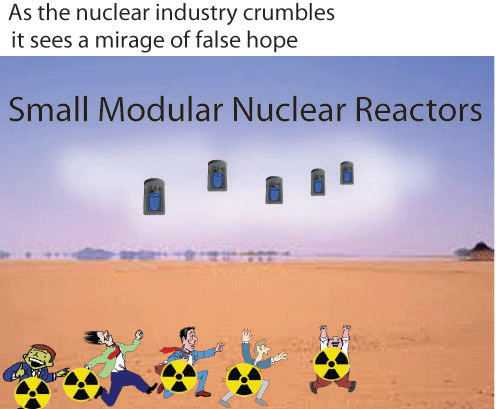
of the week – STOP SMALL MODULAR REACTORS IN CANADA
To see nuclear-related stories in greater depth and intensity – go to https://nuclearinformation.wordpress.com
-
Archives
- March 2026 (176)
- February 2026 (268)
- January 2026 (308)
- December 2025 (358)
- November 2025 (359)
- October 2025 (376)
- September 2025 (258)
- August 2025 (319)
- July 2025 (230)
- June 2025 (348)
- May 2025 (261)
- April 2025 (305)
-
Categories
- 1
- 1 NUCLEAR ISSUES
- business and costs
- climate change
- culture and arts
- ENERGY
- environment
- health
- history
- indigenous issues
- Legal
- marketing of nuclear
- media
- opposition to nuclear
- PERSONAL STORIES
- politics
- politics international
- Religion and ethics
- safety
- secrets,lies and civil liberties
- spinbuster
- technology
- Uranium
- wastes
- weapons and war
- Women
- 2 WORLD
- ACTION
- AFRICA
- Atrocities
- AUSTRALIA
- Christina's notes
- Christina's themes
- culture and arts
- Events
- Fuk 2022
- Fuk 2023
- Fukushima 2017
- Fukushima 2018
- fukushima 2019
- Fukushima 2020
- Fukushima 2021
- general
- global warming
- Humour (God we need it)
- Nuclear
- RARE EARTHS
- Reference
- resources – print
- Resources -audiovicual
- Weekly Newsletter
- World
- World Nuclear
- YouTube
-
RSS
Entries RSS
Comments RSS
 nuclear-news