Nuclear waste site a potential danger to all who live here

Residents of affected communities should have a say on a potential nuclear waste storage site in Northwestern Ontario.
Chris Mills, https://www.nwonewswatch.com/letters-to-the-editor/nuclear-waste-site-a-potential-danger-to-all-who-live-here-8044416 1 Jan 2024
Nuclear Waste Management Organization has stated that they will put to a vote in two communities, Ignace/Wabagoon First Nation and South Bruce/Saugeen Ojibway Nation, for a permanent burial of nuclear waste.
I have been following this search for a burial place for nuclear waste since the early 1980s when Atomic Energy of Canada was in charge of the process. The planning and testing the concept of burial of nuclear waste goes back to the 1960s with drilling in Northern Manitoba. Manitoba has a High-Level Nuclear Waste Act, which states that there will be no storage of any nuclear waste that was not produced in Manitoba.
The site proposed to burial this nuclear waste is half way between Ignace and Dryden, but people in Dryden will not be given the option to vote on this waste site. When there is a leak (not if) the water flow will go into the Wabagoon water system, though to Dryden, Kenora and parts of Manitoba before heading north to Hudson Bay and south to Minnesota.
Do any of the people who will be affected have a vote on this nuclear waste site?
No.
When there is a nuclear accident with a transport moving this waste, we have no knowledge on how long the highway will be closed. We are not talking about a transport truck moving Amazon packages or a logging truck that closes down the highway for 12 hours, we could be talking weeks.
When there is an accident, and your home is contaminated, your insurance policy is null and void. If you read the fine print in your policy, it clearly stated that in case of a nuclear incident you are not covered.
You and everyone who is on the route to move this nuclear waste through Northwestern Ontario is in danger of losing everything you have worked so hard for. But you don’t have a vote because the Nuclear Waste Management Organization has rigged the system on who is allowed to say yes or no.
If this was great jobs and a safe option, do you honestly think that Southern Ontario would allow it to be buried in Northern Ontario? The answer would be no, they would be fighting to keep the jobs down in the South. But they got all the nuclear power, all the jobs, all the spin off jobs, and now they want to “Share” by giving us the hole.
‘Cover-up’ hearing Canadian Nuclear Safety Commission for late January 2024.

Gordon Edwards., 29 Dec 23
There will be a most unusual public hearing by the CNSC in late January 2024. It’s not a licensing hearing. It’s an attempt to cover up or to exonerate an act already performed by OPG without explicit approval.
The first construction licence for a commercial SMNR (Small Modular Nuclear Reactor) in Canada has been requested by OPG, who wants to build up to 4 GE-Hitachi “boiling water” reactors on the Darlington site. But there’s a glitch.
OPG used an old 2011 “site preparation licence” to prepare the site for the GE-Hitachi BWRX-300 reactor on the same property as the Darlington Nuclear Generating Station, where 4 large CANDU reactors are currently being refurbished.
The old licence was granted on the basis of an Environmental Assessment Report published in 2011 by a Joint Review Panel (JRP) who had examined and approved four large candidate reactors that had very little in common with the BWRX-300.
The JRP stipulated in their report that if OPG chooses a reactor design that is “significantly different” from those that they had examined from 2009-2011, then a NEW EA should be conducted. In other words, OPG should start over again.
But OPG “jumped the gun” by using that antiquated site preparation licence without explicit approval.
Fearing that they may have violated the terms of the 2011 EA Report, by using an old site preparation licence granted for a significantly different reactor construction project, OPG is now asking the CNSC to declare that the BWRX-300 design was, in effect, already approved by the JRP back in 2011 (even though no design of that type was ever considered by the JRP).
My intervention for this upcoming hearing is entitled “DNNP: Mischief in the Making” in which I argue that the 2011 EA Report did not and could not be construed to cover the BWRX-300, and recommending the CNSC to so confirm as a matter of fact.
Accordingly, before a construction licence is considered for a BWRX-300, a new EA is required.
Here is a link to my intervention: http://www.ccnr.org/DNNP-Mischief_in_the_Making_2023.pdf
Site for Canada’s underground nuclear waste repository to be selected next year

They don’t know if this vastly expensive nuclear waste disposal system will work – to protect future generations from toxic ionising radiation.
Yet they still keep making the poisonous stuff any way !!!
Allison Jones, The Canadian Press, December 27, 2023
A critical milestone is on the horizon for Canada’s 175-year-long plan to bury its nuclear waste underground, with two pairs of Ontario communities set to decide if they would be willing hosts.
Late next year, the Nuclear Waste Management Organization plans to select the site for Canada’s deep geological repository, where millions of bundles of used nuclear fuel will be placed in a network of rooms connected by cavernous tunnels, as deep below the Earth’s surface as the CN Tower is tall — if the process goes according to plan.
The sites are down to the Wabigoon Lake Ojibway Nation-Ignace area in northwestern Ontario and the Saugeen Ojibway Nation-South Bruce area in southern Ontario. The municipalities and First Nations are planning votes for next year, the culmination of a years-long information gathering process that some say has left deep divisions within their communities.
The process to move ahead with a deep geological repository is already more than 20 years along. The NWMO was established under legislation in 2002 and is funded by the corporations that generate nuclear power and waste, such as Ontario Power Generation and Hydro-Quebec.
While officials say they are confident at least one area will say yes, two rejections would be a major setback for the $26-billion project.
Ultimately, if both areas say no, then we have to start over — and by we I mean Canada,” said Lise Morton, the vice-president of site selection.
“We as a country would then be really pushing the resolution of this issue to the next generation.”
Both the municipality and First Nation in the area of either proposed site must confirm willingness to host the repository before the NWMO will proceed.
…………………………..there are a good number of people in the community who are not convinced — about 20 per cent are with Protect Our Waterways, the main opposition group, Goetz estimates — and it has caused “quite a friction.”
South Bruce is also in the shadow of Walkerton, Ont., where seven people died and thousands fell ill after drinking contaminated water in 2000. Fears about drinking water have lingered there long after the tragedy, said Bill Noll, vice chair of Protect Our Waterways.
Water also weighs heavily on the minds of members of the Wabigoon Lake Ojibway Nation, who have seen members of another northwestern Ontario First Nation on the English-Wabigoon river system grapple with generations of mercury poisoning after a mill in Dryden dumped 9,000 kilograms of the substance in the 1960s.
“That’s the evidence right now of how an industry went astray or how government oversight wasn’t there,” said Wabigoon Lake Ojibway Nation Chief Clayton Wetelain…………………………………………………….
all the tests and planning and modelling are not easing the fears of the project’s critics, either with the southern Ontario-based Protect Our Waterways or We the Nuclear Free North.
“The whole thing is a grand experiment,” said Brennain Lloyd, with the northern group.
“There’s not a deep geological repository … operating anywhere in the world. The NWMO likes to say, ‘Well, this is best international practice,’ but practice implies that it’s been done before. And there is no practice. Nobody has done this before.”…………………………………………………………………………….more https://www.cp24.com/news/site-for-canada-s-underground-nuclear-waste-repository-to-be-selected-next-year-1.6701756
“There is a big concern relative to water,” Noll said. “Once you pollute the water, there’s not much you can do about it.”
Bribery to indigenous people – by Canada’s nuclear lobby

Canada’s Nuclear Regulator Funds Indigenous Relations Boost
Mirage News, 12 Dec 23
Today, the Canadian Nuclear Safety Commission (CNSC) announced that it is awarding nearly $4 million to 19 Indigenous Nations and communities over 2 years through the new Indigenous and Stakeholder Capacity Fund (ISCF) – Indigenous Capacity Support stream. The ISCF serves to increase recipients’ capacity to better engage and participate in the CNSC’s full lifecycle of regulatory processes, programs and initiatives.
Launched in May 2023, the ISCF provides support for staffing and internal resources, Indigenous knowledge and land use studies, IT equipment acquisition, education and training opportunities, technical assistance, and other much-needed resources……………………………….. https://www.miragenews.com/canadas-nuclear-regulator-funds-indigenous-1141295/
Chinese Nuclear Weapons and Canada: An Uncivil-Military Connection

The United States should take action to ensure that domestic and foreign actors are not boosting the nuclear programs of adversaries.
by Henry Sokolski, https://nationalinterest.org/feature/chinese-nuclear-weapons-and-canada-uncivil-military-connection-207727 6 Dec 23
For decades, the Defense Department made little or no connection between China’s civilian nuclear power program and its military nuclear weapons buildup. No longer.
For the last three years, the Pentagon has explicitly linked Beijing’s “peaceful” fast reactor power program to China’s ramped-up weapons plutonium efforts and the projection China will acquire more than 1,000 nuclear warheads by 2030. In its latest annual China military power report, the Defense Department went further and revealed that China is using its civilian nuclear reactors to produce tritium to fuel its thermonuclear weapons.
China is doing this by placing lithium rods in power reactors and bombarding the rods with neutrons. This produces tritium, which subsequently is separated, much like how America makes its weapons tritium. It’s unclear if China uses all its power reactors—American, Canadian, Russian, French, or Chinese-designed—for this purpose.
The Pentagon report, however, notes that China uses a tritiated heavy water extraction process to cull tritium produced when hydrogen atoms absorb neutrons and become tritium atoms. The only reactors in China that use heavy water are located in Haiyan and operated by China National Nuclear Power Corporation (CNNC)—Beijing’s premier nuclear weapons contractor.
Canada supplied these reactors through Atomic Energy of Canada Limited (AECL), a Canadian government-owned firm. In addition, AECL agreed to work with CNNC on advanced heavy water reactors and related technologies. In 2011, AECL sold its heavy water reactor business to SNC-Lavalin Inc. (recently renamed AtkinsRealis). AtkinsRealis continues to collaborate with CNNC on its heavy water reactors.
However, Canada’s nuclear transfers to China aren’t limited to reactors. In late October, the Canadian firm Cameco, one of the world’s largest uranium suppliers, announced it had contracted to sell more than 97,500 metric tons of uranium to CNNC. Cameco says it will send the CNNC more than 12,700 metric tons annually for the next four years. 12,700 metric tons is roughly 200 to 300 metric tons more than China’s entire civilian sector consumes annually. The 200-to-300-ton surplus alone could fuel as many as 100 bombs each year.
This should raise eyebrows. With poor domestic uranium resources, China insists it’s only building up its uranium reserves for future nuclear power use. Perhaps, but there is no agreed way to verify this. The same is true with tritium. Currently, there are no effective controls on either nuclear substance to assure their peaceful end-use. Both, however, are critical to making nuclear weapons, and CNNC, China’s top weapons vendor, controls these materials.
What should be done?
First, our government needs to name and shame firms exporting critical nuclear materials and technologies to America’s nuclear-armed rivals. This would require spotlighting Canada’s Cameco and AkinsRealis. It also would require listing France’s nuclear firm, EDF, which this spring announced it would work with CNNC in developing advanced spent fuel recycling, a process critical to producing weapons plutonium. Yet, another entity that deserves dishonorable mention is Rosatom, Russia’s prime nuclear weapons developer, in addition to firms in business with the company. The House has already spotlighted Rosatom as a bad actor, asking the White House to sanction it for assisting China’s fast reactor program.
To expose these entities further, the Departments of Defense and the Intelligence Community should produce an unclassified annual report clarifying which domestic and foreign firms might be transferring nuclear materials and technologies to hostile states’ nuclear weapons entities.
Second, the U.S. government should prohibit government purchases and subsidies to these firms. Congress and the White House may be reticent to sanction firms for trading with hostile states’ nuclear weapons entities. But our government should, at least, not buy goods from such firms or subsidize them.
Finally, the United States and other like-minded nations should call on the International Atomic Energy Agency to track and safeguard tritium and unenriched uranium to prevent their diversion to make bombs. Fortunately, there is little commercial demand for tritium. Most of what is produced is then extracted from reactors for occupational safety reasons and is accounted for.
Similarly, most uranium ore is used to fuel legitimate civilian reactors. Yet, it too is critical to make nuclear weapons, and it is not currently tracked or safeguarded. Given that the government already tracks and sanctions certain oil and gas transfers—a daunting task—it’s difficult to understand why we don’t do the same for uranium and tritium. In the lead-up to the next Nuclear Nonproliferation Treaty Review Conference in 2026, the United States should close this gap.
Henry Sokolski is the executive director of the Nonproliferation Policy Education Center in Arlington, Virginia, and the author of Underestimated: Our Not So Peaceful Nuclear Future (2019). He served as deputy for nonproliferation policy in the office of the U.S. Secretary of Defense during the George H.W. Bush administration.
Canadians should be afraid of radiation: Frank Greening.

Dr. Frank Greening, Hamilton, Ont. 4Dec 23
Re: “We can manage predictable radiation: Canadian Nuclear Society,” (The Hill Times, Nov. 15, 2023, letter to the editor. The gist of this CNS letter to The Hill Times appears to be: we should not be afraid of radiation because it’s predictable and we can manage it.
I have to say that when it comes to radiation exposures at nuclear power stations, the Canadian nuclear industry has proven time and again that radiation exposures to workers have often been quite unpredictable and totally mismanaged. As proof of this assertion consider what happened at Pickering Nuclear Generating Station (NGS) in March 1985 and at Bruce NGS in January 2010.
In the case of the Pickering NGS 1985 event, workers involved in the refurbishment of Units 1 and 2 were exposed to airborne beta-active particulate.
Most unfortunately for the CNSC, there is ample evidence that the Bruce alpha exposure event was not unforeseen. Indeed, in November 2009, the CNSC reported that a routine survey during refurbishment operations at the Bruce Nuclear Generating Station detected the presence of radioactive alpha contamination in the Unit 1 reactor vault. Nevertheless, both Bruce Power and the CNSC proceeded with the Unit 1 refurbishment.
I would say that Canadians should be afraid of radiation when our very own nuclear industry and the regulatory body, responsible for the safety of nuclear facilities, appear to be incapable of protecting nuclear workers from needless radiation exposures during reactor refurbishments.
A sobering analysis of the Canadian plan for small modular nuclear reactors (SMRs) and their toxic waste problem

“We found that small modular reactors will generate at least nine times more neutron-activated steel than conventional power plants. These radioactive materials have to be carefully managed prior to disposal, which will be expensive.” The study concluded that, overall, small modular designs were inferior to conventional reactors with respect to radioactive waste generation, management requirements, and disposal options.
Canada does not have a permanent solution to deal with the radioactive waste that has already been produced
Nuclear Power and SMR Development
Story by The Canadian Press • 11h (December 1, 2023) , Carol Baldwin, Local Journalism Initiative Reporter, Wakaw Recorder
In August it was announced that Ottawa had approved up to $74 million in federal funding for small modular reactor (SMR) development in the province. Jonathan Wilkinson, Federal Minister of Energy and Natural Resources, made the announcement at the Sylvia Fedoruk Canadian Centre for Nuclear Innovation at the University of Saskatchewan in Saskatoon. The funding will support pre-engineering work and technical studies, environmental assessments, regulatory studies, and community and Indigenous engagement to help advance the SMR project, Natural Resources Canada said.
On November 20, Dustin Duncan, Saskatchewan’s minister responsible for SaskPower, was joined by Ontario Energy Minister Todd Smith as SaskPower announced it had signed a five-year master services agreement with Ontario Power Generation and its subsidiary Laurentis Energy Partners. Duncan said the deal will allow for the development of a Canadian fleet of SMRs.
“To have an agreement that allows us to tap into that expertise and knowledge from a jurisdiction and organizations that have a great deal of expertise and history in the nuclear sector is critically important for Saskatchewan to carry forward with,” he said. What he failed to acknowledge, however, is that Ontario’s expertise and knowledge is with the older and much larger CANDU reactor. SMR technology is a newly developed field and Ontario itself is still in the process of building its first SMR.
Nuclear power does have a long history in Canada, with the first plant, the Nuclear Power Demonstration Reactor in Rolphton, Ont., going online in the early 1960s. Today, larger nuclear-generating stations in Ontario and New Brunswick supply about 15 percent of Canada’s electricity. However, accidents like those at Chalk River, Three-Mile Island, Chernobyl, and Fukushima invariably bring up questions about safety and environmental impacts. President of the Canadian Nuclear Safety Commission, Rumina Velshi, has said in promoting SMRs, that when it comes to new builds the technology has improved safety by incorporating a passive system that is supposed to shut the reactor down if ‘things go wrong.’
While the CANDU reactors in operation in Canada and around the world do have a good safety record, SMRs are recent technology and many in the public are skeptical of the ‘infallibility’ of new technology. That skepticism is perhaps, not misplaced, according to a study. A study published at the end of May 2022, in “Proceedings of the National Academy of Sciences” concluded that “most small modular reactor designs will actually increase the volume of nuclear waste in need of management and disposal,” said study lead author Lindsay Krall, a former MacArthur Postdoctoral Fellow at Stanford University’s Center for International Security and Cooperations (CISAC). The study found that, because of their smaller size, small modular reactors will experience more neuron leakage than conventional reactors. This increased leakage affects the amount and composition of their waste streams.
“We found that small modular reactors will generate at least nine times more neutron-activated steel than conventional power plants. These radioactive materials have to be carefully managed prior to disposal, which will be expensive.” The study concluded that, overall, small modular designs were inferior to conventional reactors with respect to radioactive waste generation, management requirements, and disposal options. (https://news.stanford.edu/2022/05/30/small-modular-reactors-produce-high-levels-nuclear-waste/#) There are literally dozens of different models of SMRs and reports on this study did not identify which models it examined. SaskPower hosted an online and call-in event on October 5th, 2023, to engage the public with the development of a small modular reactor site in the province, but studies like this by an entity that seemingly has nothing to gain from a positive or negative study outcome, will not reassure people that the new build will be a safe neighbour in their community.
A research paper compiled by Esam Hussein, Faculty of Engineering and Applied Science at the University of Regina, agreed that some SMRs identified as integral reactors do have a higher leakage of neutrons and thermal energy due to a higher surface-to-volume ratio, but the boiling water reactors, such as the one chosen by SaskPower, do not experience the same leakage rate. At the end of his paper, he quotes a discussion paper of the CNSC which states that most “SMR concepts, although based on technological work and operating experience from past and existing plants, propose to employ several novel approaches. Novel approaches can affect the certainty of how the plant will perform under not only normal operation but also in accident conditions, in which predictability is paramount to safety.” In other words, SMRs are new and there is no guarantee about what hazards may or may not come into play.
Another concern that should be considered when advancing nuclear power generation, is that Canada does not have a permanent solution to deal with the radioactive waste that has already been produced and is sitting in temporary storage at the plants where it was produced. CNSC president Velshi has said work is being done to change that through a deep geological repository, but after ten years of work to locate and create one it still does not exist.
According to authors Kerrie Blaise and Shawn-Patrick Stensil, roughly 20 years ago it was recognized that for any type of revival and expansion of the nuclear industry, there needed to be a plan to manage the stockpiles of radioactive waste that had been accumulating since the 1960s. In 2002, the Nuclear Fuel Management Act was passed by the federal government, which then led to the creation of the Nuclear Waste Management Organization, whose mandate was to develop and implement a management plan. The fundamental assumption in all the management options considered was that ‘the volume of used nuclear fuel which needs to be managed was assumed to be limited to the projected inventory from the existing fleet of reactors’ (Nuclear Waste Management Organization 2004).
Put simply, when it came to planning for a repository for nuclear waste, the plan did not count on an increase in the number of nuclear plants and the resultant increase in the amount of nuclear waste. [Chapter 11, Small Modular Reactors in Canada: Eroding Public Oversight and Canada’s Transition to Sustainable Development, J.L. Black-Branch and D. Fleck (eds.), Nuclear Non-Proliferation in International Law-Volume V (chrome-extension://efaidnbmnnnibpcajpcglclefindmkaj/https://cela.ca/wp-content/uploads/2021/01/Blaise-Stensil-Ch11-Small-Modular-Reactors.pdf)]
Government and industry proponents portray SMRs as a needed component in a low-carbon society and notably every press conference and news release is filled with assurances that the technology is safe. Nevertheless, recent events at federal and province levels of government involving interference, cover-up, and withholding of information have left a sense of distrust amongst many in the public. Trust once lost can be a difficult hurdle to overcome.
Hydro- Quebec decides against restarting Gentilly 2 nuclear station
Hydro-Québec has decided not to go ahead with recommissioning Gentilly 2 but nuclear remains an option it is considering to increase its production capacity beyond 2035, and it will keep studying nuclear energy, CEO Michael Sabia has said. Earlier this year the government-owned corporation launched a feasibility study on the possible restart of the 675 MWe unit which closed in 2012.
AtkinsRéalis “did a 50,000-foot analysis of the viability of Gentilly”, Sabia said. “For now, given the social acceptability issues, we have decided not to proceed with this. But there are a lot of evolutions in technologies”, SMRs “could be very well structured for some places in Quebec”, he added, according to the Montreal Gazette.
Source: World Nuclear News, 1 December 2023
The President of the Canadian Nuclear Safety Commission spent $288,000 on travel in 19 months
Luxury hotel, $12,000 plane tickets:
a senior public servant even had her luggage carrier reimbursed
PASCAL DUGAS BOURDON and CHARLES MATHIEU , Journal de Montréal, Monday, November 27, 2023 https://tinyurl.com/ydmpyaa3
$1,000 per night accommodation in a luxury hotel with luggage porter, business-class airfare
to Tokyo, Dubai and Vienna: the outgoing President of the Canadian Canadian Nuclear Safety Commission has multiplied her expensive trips at taxpayers’ expense. According to a compilation by our Bureau of Investigation, Rumina Velshi was reimbursed $288,000 in business travel in 19 months between January 2022 and July 2023.
She is by far the biggest spender in the senior federal civil service, spending $100,000 more than any other publicly employed executive… (more)
Failed U.S. Nuclear Project Raises Cost Concerns for Canadian SMR Development
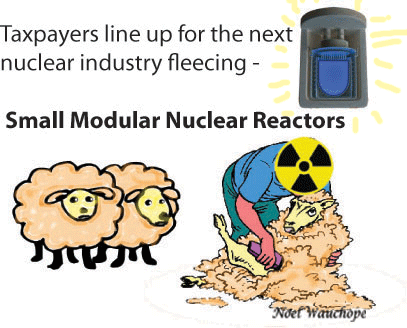
The Energy Mix November 10, 2023, Primary Author: Mitchell Beer
The abrupt failure of the leading small modular nuclear reactor (SMR) project in the United States is shining a light on public subsidies that might keep similar technology under development in Canada, even if it’s prone to the same cost overruns that scuttled NuScale Power Corporation’s Carbon Free Power Project (CFPP) in Utah.
NuScale and its customer, Utah Associated Municipal Power Systems (UAMPS), announced they were cancelling the project earlier this week, after its anticipated cost increased 53% over earlier estimates, Bloomberg reports. “The decision to terminate the project underscores the hurdles the industry faces to place the first so-called small modular reactor into commercial service in the country.”
But a clear-eyed assessment of the project’s potential was really made possible by a level of accountability that doesn’t exist in Canada, said Gordon Edwards, president of the Canadian Coalition for Nuclear Responsibility.
“Private investors in Utah forced NuScale to divulge financial information regarding the cost of electricity from its proposed nuclear plant,” and “cost became the deal-breaker,” Edwards told The Energy Mix in an email. “Publicly-owned utilities in Canada are not similarly accountable. The public has little opportunity to ‘hold their feet to the fire’ and determine just how much electricity is going to cost, coming from these first-of-a-kind new nuclear reactors.”
In the U.S., the business case started to fall apart last November, when NuScale blamed higher steel costs and rising interest rates for driving the cost of the project up from US$58 to $90 or $100 per megawatt-hour of electricity. The new cost projection factored in billions of dollars in tax credits the project would receive under the Biden administration’s Inflation Reduction Act, amounting to a 30% saving.
At the time, the Institute for Energy Economics and Financial Analysis (IEEFA) estimated the total subsidy at $1.4 billion. This week, Bloomberg said NuScale had received $232 million of that total so far.
The cost increase meant that UAMPS “will not hit certain engineering, procurement, and construction benchmarks, allowing participants to renegotiate the price they pay or abandon the project,” Utility Dive wrote……………………………….
In Canada, “the massively expensive SMR projects in Canada will eventually face the same reckoning,” predicted Susan O’Donnell, an adjunct research professor at St. Thomas University and member of the Coalition for Responsible Energy Development in New Brunswick. While the Canadian Energy Regulator’s modelling assumes SMRs could be built at a cost of C$9,262 per kilowatt in 2020, falling to $8,348 per kilowatt by 2030 and $6,519 by 2050, the latest cost estimate from NuScale exceeded $26,000 per kilowatt in Canadian dollars, O’Donnell said—and the technology had been in development since 2007.
“Too bad our leaders have chosen to pursue an energy strategy which is too expensive, too slow, and too costly in comparison with the alternatives of energy efficiency and renewables—the fastest, cheapest, and least speculative strategies,” Edwards wrote. He added that waste disposal and management challenges and costs for SMRs will be very different from what Canadian regulators have had to confront with conventional Candu nuclear reactors.
The news from NuScale landed just days after civil society groups in the European Union warned that SMR development won’t help the continent reach its climate goals. Citing prolonged project delays and cost overruns, the long time frame to develop unproven technologies, and the risks associated with radioactive waste disposal and proliferation of nuclear materials, they urged EU governments to focus on renewable energy, power grid development, and energy storage.
“Nuclear energy is being pushed by powerful lobbies and geostrategic interests,” with several EU states relying on Russian state nuclear company Rosatom for their uranium supplies, the groups said. “To quickly decarbonize, we must choose cheap technologies, easy to deploy at scale, like solar panels and windmills.”………….https://www.theenergymix.com/2023/11/10/failed-u-s-nuclear-project-raises-cost-concerns-for-canadian-smr-development/
Small nuclear reactors are NOT emissions-free

No emissions claim mars SaskPower webinar on nuclear power
A reader comments that a presentation by SaskPower on small modular nuclear reactors failed to include information about nuclear emissions.
Nov 18, 2023 , Dale Dewar, Wynyard https://thestarphoenix.com/opinion/letters/letter-no-emissions-claim-mars-saskpower-webinar-on-nuclear-power
SaskPower held a webinar on its proposal for a Hitachi Boiling Water Reactor (BWRX300), a small modular nuclear reactor in Southern Saskatchewan. Its otherwise informative webinar was marred by a statement that the BWRX300 would have no emissions.
No emissions! People may not know everything about nuclear power plants, but most of us know that tritium or “hydrogen” is created and released in planned or unplanned episodes. It could build up and cause an explosion.
Tritium is more dangerous than the nuclear industry admits. Tritium is radioactive hydrogen. When combined with oxygen, it forms radioactive water. Tritium has been described as a “weak beta emitter.” Its beta particle can be stopped by paper or skin.
Our bodies incorporate hydrogen into every cell and cellular structure in our bodies. Our bodies are unable to distinguish between a normal hydrogen atom and tritium. This means that every tritium atom that we ingest into our bodies could spontaneously decay into helium, a gas.
As the tritium decays, it emits energy that can oxidize cellular contents including RNA and DNA, genetic material. Many believe that tritium is the culprit for the increase in children developing leukemia close to nuclear power plants.
With a half-life of 12 years, the tritium that is released today will not be “gone” for 120 years.
But let’s not forget the small amounts of other radioactive elements emitted: krypton-85, carbon-14, strontium-90, iodine-131, and caesium-137, to name a few. Nuclear power plants also emit all the types of pollutants any other steam- or gas-powered electrical plant emits.
Canadian Nuclear Safety Commission queried on proposal for untested small nuclear reactors in Ontario.

to the question of whether it is appropriate to propose the siting of up to four untested reactors
No BWRX-300 reactors are operating anywhere in the world
Submission Concerning the Proposed Development of BWRX-300 reactors at the Darlington Site
November 19,2023 by Evelyn Gigantes
I am submitting my response to the proposed development by Ontario Power Generation of 4 BWRX-300 reactors on the existing site of the Darlington CANDU nuclear reactors.
Apparently this project has been given a CNSC license to” Prepare the Site” based on the CNSC’s decision that OPG has met the recommendations of the 2011 Environmental Assessment Report by the Joint Review Panel. However nowhere is evidence available that the recommendations of the JRP have been addressed by OPG, or required by the CNSC.
It is critical that the many environmental concerns raised by the JRP in 2011 – everything from the existing geographic and soil structure of the site, the possible air and water contaminants, the surrounding housing, noise, and potential shoreline alteration, must be addressed by OPG, and approved by the CNSC, before OPG is permitted to prepare the Darlington site for additional reactors. The same is true of recommendations by the JRP concerning a decommissioning financial guarantee which should include the cost of rehabilitating the site if the project does not proceed beyond site preparation.
If the CNSC has, in fact, required OPG to meet these recommendations, the material associated with that requirement should be made easily available to outside organizations and individuals who wish to take part in public discussion concerning these matters.
Now to the question of whether it is appropriate to propose the siting of up to four untested reactors next to the 4 existing CANDUs at Darlington, and their stored nuclear waste.
No BWRX-300 reactors are operating anywhere in the world. The proposed design and operation of a BWRX-300 is entirely different from the CANDU design and involves a structure and a method of operating which is, in large part, below ground level. Again the many issues of the quality of the soil and rock structures and how the physical and operating structures of 4 new BRWX-300 reactors might affect, or be affected by, the issues raised by the JRP recommendations concerning the physical attributes of the Darlington site, need to be openly addressed by OPG and considered publically by the CNSC.
This is the very least that is required before the CNSC begins to examine whether it might permit OPG to begin building even one untested BRWX-300 SMR at the Darlington location.
Small nuclear reactors in Canada: at what cost?

Transparency requirements in the U.S. forced NuScale proponents to disclose the projected costs of electricity to potential investors on a regular basis. This is not the case in Canada.
none of the Canadian nuclear proponents have laid out the projected costs of electricity production. In New Brunswick, the government has changed legislation to force the electricity utility to purchase power from new nuclear reactors even when it is not the lowest cost option.
Canadian Coalition for Nuclear Responsibility https://crednb.ca/2023/11/13/small-nuclear-reactors-in-canada/
In collaboration with and endorsed by:
Clean Green Saskatchewan, Coalition for Responsible Energy Development in New Brunswick, Friends of the Earth Canada, Inter-Church Uranium Committee Educational Cooperative (Saskatchewan), Ontario Clean Air Alliance, Prevent Cancer Now Le Regroupement des organismes environnementaux en énergie, (Quebec), The Society of High Prairie Regional Environmental Action Committee (Alberta) 23 Nov 23
The sudden cancellation last week of the first small nuclear reactor project in the United States, the NuScale project, calls into question the economic viability of Canada’s plans to develop and deploy small modular reactors.
Potential customers in Utah balked at the soaring projections for the cost of electricity the NuScale reactor would generate, and the project was unable to recruit other customers to buy its power.
Today, in response, civil society groups across Canada are demanding transparency and accountability for the costs of other small nuclear reactor designs planned in this country.
“Canada should stop writing blank cheques to nuclear promoters who cannot deliver on their promises of cheap, reliable electricity,” said Gordon Edwards, President of the Canadian Coalition for Nuclear Responsibility.
Transparency requirements in the U.S. forced NuScale proponents to disclose the projected costs of electricity to potential investors on a regular basis. This is not the case in Canada.
Earlier this year, the target price for electricity from the NuScale project rose by over 50 percent to $89 US per MWh ($122.99 Canadian) with indications that future increases would be forthcoming. Investor confidence was shaken, and the project was scrapped.
The NuScale reactor design has been in development for more than 15 years and the company’s first commercial joint venture with electrical utilities in Utah was launched in 2015.
Governments in New Brunswick, Ontario, Saskatchewan and Alberta have committed to building small reactors, while the Quebec government is conducting feasibility studies.
However, none of the Canadian nuclear proponents have laid out the projected costs of electricity production. In New Brunswick, the government has changed legislation to force the electricity utility to purchase power from new nuclear reactors even when it is not the lowest cost option.
Three years ago, more than 140 civil society groups across Canada signed a statement calling the proposed new reactors a “dirty, dangerous distraction,” from real climate action.
Nuclear critics have consistently said these new reactor designs will take too long to develop, and will cost too much compared with existing proven renewable energy option, to deal effectively with the climate crisis that requires immediate action.
To date, federal and provincial taxpayers have subsidized these reactors through a $970 million low interest loan to Ontario Power Generation, more than $100 million in grants to private companies and public utilities in Ontario, New Brunswick, Saskatchewan and Alberta, and millions more to research fuelling requirements for small reactors at Chalk River.
Civil society groups are demanding accountability for these costly nuclear developments. Without full transparency, taxpayers and ratepayers will be forced to subsidize these experimental reactor projects and pass on an unwanted economic debt legacy to our children and grandchildren, along with the radioactive waste legacy that all nuclear reactors are adding to every day.
Quotes:
Michael Poellet, President, Inter-Church Uranium Committee Educational Cooperative:
“Small Modular Reactors (SMRs) were meant to remedy the grossly excessive, over-budget costs of nuclear power generation. With the price of renewables dropping precipitously the economics of SMRs has only worsened. The cancellation of the NuScale project with its utility partner Utah Associated Municipal Power Systems demonstrates that commercial electrical generation with SMRs is not economically viable. Canadian federal and provincial governments must allow the economic realities to break the spell that enchantment with SMRs has over them.”
rix ?
Media release from CRED-NB and collaborators. Le français suit…
From:
Canadian Coalition for Nuclear Responsibility
In collaboration with and endorsed by:
Coalition for Responsible Energy Development in New Brunswick
Inter-Church Uranium Committee Educational Cooperative (Saskatchewan)
Le Regroupement des organismes environnementaux en énergie (Quebec)
The Society of High Prairie Regional Environmental Action Committee (Alberta)
For immediate release
November 13, 2023
Small nuclear reactors in Canada: at what cost?
The sudden cancellation last week of the first small nuclear reactor project in the United States, the NuScale project, calls into question the economic viability of Canada’s plans to develop and deploy small modular reactors.
Potential customers in Utah balked at the soaring projections for the cost of electricity the NuScale reactor would generate, and the project was unable to recruit other customers to buy its power.
Today, in response, civil society groups across Canada are demanding transparency and accountability for the costs of other small nuclear reactor designs planned in this country.
“Canada should stop writing blank cheques to nuclear promoters who cannot deliver on their promises of cheap, reliable electricity,” said Gordon Edwards, President of the Canadian Coalition for Nuclear Responsibility.
Transparency requirements in the U.S. forced NuScale proponents to disclose the projected costs of electricity to potential investors on a regular basis. This is not the case in Canada.
Earlier this year, the target price for electricity from the NuScale project rose by over 50 percent to $89 US per MWh ($122.99 Canadian) with indications that future increases would be forthcoming. Investor confidence was shaken, and the project was scrapped.
The NuScale reactor design has been in development for more than 15 years and the company’s first commercial joint venture with electrical utilities in Utah was launched in 2015.
Governments in New Brunswick, Ontario, Saskatchewan and Alberta have committed to building small reactors, while the Quebec government is conducting feasibility studies.
However, none of the Canadian nuclear proponents have laid out the projected costs of electricity production. In New Brunswick, the government has changed legislation to force the electricity utility to purchase power from new nuclear reactors even when it is not the lowest cost option.
Three years ago, more than 140 civil society groups across Canada signed a statement calling the proposed new reactors a “dirty, dangerous distraction,” from real climate action.
Nuclear critics have consistently said these new reactor designs will take too long to develop, and will cost too much compared with existing proven renewable energy option, to deal effectively with the climate crisis that requires immediate action.
To date, federal and provincial taxpayers have subsidized these reactors through a $970 million low interest loan to Ontario Power Generation, more than $100 million in grants to private companies and public utilities in Ontario, New Brunswick, Saskatchewan and Alberta, and millions more to research fuelling requirements for small reactors at Chalk River.
Civil society groups are demanding accountability for these costly nuclear developments. Without full transparency, taxpayers and ratepayers will be forced to subsidize these experimental reactor projects and pass on an unwanted economic debt legacy to our children and grandchildren, along with the radioactive waste legacy that all nuclear reactors are adding to every day.
Quotes:
Michael Poellet, President, Inter-Church Uranium Committee Educational Cooperative:
“Small Modular Reactors (SMRs) were meant to remedy the grossly excessive, over-budget costs of nuclear power generation. With the price of renewables dropping precipitously the economics of SMRs has only worsened. The cancellation of the NuScale project with its utility partner Utah Associated Municipal Power Systems demonstrates that commercial electrical generation with SMRs is not economically viable. Canadian federal and provincial governments must allow the economic realities to break the spell that enchantment with SMRs has over them.”
David Geary, Writer and Researcher, Clean Green Saskatchewan:
“Our group, Clean Green Saskatchewan, was always confident that NuScale and all other SMR startup enterprises, GE-Hitachi included [a new reactor design selected for Ontario and Saskatchewan], would fail because of the ‘bottom line’ … i.e., the economics, the ‘financials’. They simply cannot compete in the energy marketplace…compared to any other electrical energy producing technology.”
Jack Gibbons, Chair, Ontario Clean Air Alliance
“The failure of the most advanced small nuclear project in the U.S. to come even remotely close to being financially viable should be a wake-up call for politicians in Canada dreaming about castles in the sky. Counting on unproven new nuclear technology to provide low-cost power is like counting on snow in July. It is time for Premier Ford to follow Hydro Quebec’s example and develop a financially prudent plan to meet all of Ontario’s future electricity needs by investing in energy efficiency, renewables and storage. It doesn’t make sense to waste public money on high-cost, high-risk nuclear projects when we have much cleaner, safer and lower cost options to keep our lights on.”
Susan O’Donnell, Spokesperson, Coalition for Responsible Energy Development in New Brunswick
“Our provincial government is backing two nuclear start-ups and their experimental small reactor designs. These two designs are based on earlier reactors that never operated successfully commercially despite billions of dollars in public subsidies in other countries. We believe that despite the tens of millions of public dollars given to the start-ups so far, their costly boondoggles will never be built. In effect, our government is kicking the can down the road, delaying real climate action by betting on unicorns and fairy dust.”
Gordon Edwards, President, Canadian Coalition for Nuclear Responsibility
“Public utilities are owned by the government. People elect the government. So every citizen is a shareholder in the utility company and deserves to be kept informed of all business decisions that they will ultimately have to pay for. In the midst of a climate crisis and crippling inflation, Spending Money Recklessly (SMR) is a terrible strategy. We should not delay climate action by wasting our time, our money, and our political will on speculative reactors that are all ‘first-of-a-kind’ experiments.”
Jean-Pierre Finet, Porte-parole, Regroupement des organismes environnementaux en énergie
“There is no social acceptability for nuclear energy in Quebec. Small modular reactors are not only costly, they take away government funding that would be better used on proven technologies such as heat pumps and heat storage. It is time that the Canadian government comes clean about the cost of this pseudo clean energy.”
Nuclear energy is not ‘clean’ or ‘green’ in the European Union’s taxonomy
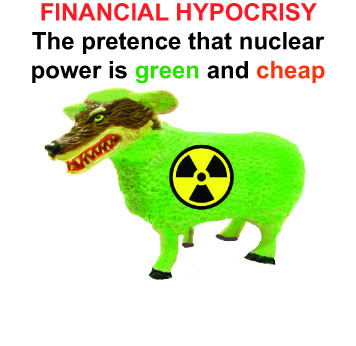
In the end, however, the poor economics of nuclear technology raise doubts that any labeling of nuclear energy as “clean” or “green” will spur private sector investment. Today, despite the industry’s self-proclaimed nuclear renaissance, private investment in nuclear technologies is minimal, and nuclear proponents are pinning their hopes on massive public sector handouts.
BY SUSAN O’DONNELL, MADIS VASSAR | November 8, 2023 https://www.hilltimes.com/story/2023/11/08/nuclear-energy-is-not-clean-or-green-in-the-european-unions-taxonomy/402401/
As calls are increasing for Finance Minister Chrystia Freeland to release the government’s “transition taxonomy” of energy sources aligned with climate goals, misinformation is circulating about the role of nuclear energy in the European Union’s taxonomy.
The Canadian government is expected to identify technologies for priority private sector investment to help Canada meet its “net-zero” targets.
An Oct. 13 letter to MPs from the Canadian Nuclear Association, a nuclear lobby group, states that “The European Union (EU) formally voted to include nuclear energy in its EU taxonomy.” This statement is partially true, but misleading.
On May 16, at a meeting of the House Natural Resources Committee, Bloc Québécois MP Mario Simard asked if Canada was one of the only countries that considers nuclear to be clean energy. In response, Mollie Johnson, assistant deputy minister of Natural Resources, said “under the taxonomy of the European Union, they have classified it as clean energy as well.” This statement is incorrect.
The European Commission (EC) established its Technical Expert Group on Sustainable Finance to develop scientific guidelines for the taxonomy. The group was asked to develop recommendations for technical screening criteria for economic activities that can make a major contribution to climate change mitigation and adaptation, while at the same time avoiding significant harm to sustainable use and protection of water and marine resources, transition to a circular economy, address pollution prevention control, and protection and restoration of biodiversity and ecosystems.
After the report excluded nuclear because of the generated toxic radioactive waste, the lobby group convinced the EC to commission another report by the nuclear-friendly Joint Research Centre which concluded that nuclear was eligible. After weeks’ more lobbying, a slight majority of the European Parliament voted in favour of adding nuclear and fossil gas in the taxonomy only as “transitional technologies”—definitely neither as green, clean, nor sustainable. Also, the members of the European Parliament did not approve any public investments in nuclear energy.
The transitional technology classification requires a country seeking funding for nuclear energy to fulfill stringent safety criteria. This means having solid plans within five years, including financing, for an operational deep geological disposal for used fuel and high-level waste in 2050. This criteria will be a huge challenge for states other than Sweden, France and Finland. The Onkalo used nuclear fuel repository in Finland was built at a cost of 5-billion euros, and after some 40 years, is still not licenced. Most other countries do not have those funds available, meaning that potential nuclear power-plant operators would have to contribute to the costs, making nuclear even less competitive in the energy market.
A similar political power play lacking wider environmental considerations surrounds another recent document, the Net-Zero Industry Act. The aim is to promote investments in the production capacity of products key to meeting the EU’s climate neutrality goals, and, again, nuclear was initially not included. Once again, strong lobby efforts won the reintroduction of nuclear, first as a “non-strategic” technology due to its long build times and staggering costs—factors that push any tangible climate benefits far into the future, as opposed to “strategic” climate mitigation options such as solar panels, batteries, and heat pumps. In the latest text, however, any distinction between different technologies is gone. As the Greens in the European Parliament commented, the Act has lost the initial focus, and it’s now for just about any technology.
Given that nuclear energy is not considered “green” in the EU taxonomy, financial analysts have questioned its value as a global “gold standard” because investors might prefer to use other taxonomies that value their real green investments. Canada has the opportunity to learn from these blunders.
In the end, however, the poor economics of nuclear technology raise doubts that any labeling of nuclear energy as “clean” or “green” will spur private sector investment. Today, despite the industry’s self-proclaimed nuclear renaissance, private investment in nuclear technologies is minimal, and nuclear proponents are pinning their hopes on massive public sector handouts.
However, aside from the Canada Infrastructure Bank’s $970-million ‘low-interest loan’ for Ontario Power Generation to develop an American design for a small modular nuclear reactor, the public funds for new nuclear proponents from Innovation, Science and Economic Development Canada have been just under $100-million in the past three years. Those funds require matching private sector funding that has not materialized. This is a far cry from the billions of dollars required to develop just one small modular nuclear reactor, and where that money will come from is still an open question. #nuclear #antinuclear #nuclearfree #NoNukes
Susan O’Donnell, PhD, is lead investigator for the CEDAR project at St. Thomas University. Madis Vasser, PhD, is senior expert on SMRs for Friends of the Earth Estonia.
Failed U.S. Nuclear Project Raises Cost Concerns for Canadian Small Modular Reactor (SMR) Development
“Once you’re on a dead horse, you dismount quickly. That’s where we are here.”
“the massively expensive SMR projects in Canada will eventually face the same reckoning”
Primary Author: Mitchell Beer, The Energy Mix, November 10, 2023 more https://www.theenergymix.com/2023/11/10/failed-u-s-nuclear-project-raises-cost-concerns-for-canadian-smr-development/
NuScale and its customer, Utah Associated Municipal Power Systems (UAMPS), announced they were cancelling the project earlier this week, after its anticipated cost increased 53% over earlier estimates, Bloomberg reports. “The decision to terminate the project underscores the hurdles the industry faces to place the first so-called small modular reactor into commercial service in the country.”
But a clear-eyed assessment of the project’s potential was really made possible by a level of accountability that doesn’t exist in Canada, said Gordon Edwards, president of the Canadian Coalition for Nuclear Responsibility.
“Private investors in Utah forced NuScale to divulge financial information regarding the cost of electricity from its proposed nuclear plant,” and “cost became the deal-breaker,” Edwards told The Energy Mix in an email. “Publicly-owned utilities in Canada are not similarly accountable. The public has little opportunity to ‘hold their feet to the fire’ and determine just how much electricity is going to cost, coming from these first-of-a-kind new nuclear reactors.”
In the U.S., the business case started to fall apart last November, when NuScale blamed higher steel costs and rising interest rates for driving the cost of the project up from US$58 to $90 or $100 per megawatt-hour of electricity. The new cost projection factored in billions of dollars in tax credits the project would receive under the Biden administration’s Inflation Reduction Act, amounting to a 30% saving.
At the time, the Institute for Energy Economics and Financial Analysis (IEEFA) estimated the total subsidy at $1.4 billion. This week, Bloomberg said NuScale had received $232 million of that total so far.
The cost increase meant that UAMPS “will not hit certain engineering, procurement, and construction benchmarks, allowing participants to renegotiate the price they pay or abandon the project,” Utility Dive wrote.
Scott Hughes, power manager for Hurricane City Power, one of the 27 municipal utilities that had signed on to buy power from the six NuScale reactors, said the news was “like a punch in the gut when they told us.” Another municipal utility official called the increase a “big red flag in our face.”
Nearly a year later, NuScale had to acknowledge that UAMPS would not be able to sell 80% of the output from the 462-MW project to its own members or other municipal utilities in the western U.S., Bloomberg writes. “The customer made it clear we needed to reach 80%, and that was just not achievable,” NuScale CEO John Hopkins said on a conference call Wednesday. “Once you’re on a dead horse, you dismount quickly. That’s where we are here.”
In Canada, “the massively expensive SMR projects in Canada will eventually face the same reckoning” predicted Susan O’Donnell, an adjunct research professor at St. Thomas University and member of the Coalition for Responsible Energy Development in New Brunswick. While the Canadian Energy Regulator’s modelling assumes SMRs could be built at a cost of C$9,262 per kilowatt in 2020, falling to $8,348 per kilowatt by 2030 and $6,519 by 2050, the latest cost estimate from NuScale exceeded $26,000 per kilowatt in Canadian dollars, O’Donnell said—and the technology had been in development since 2007.
“Too bad our leaders have chosen to pursue an energy strategy which is too expensive, too slow, and too costly in comparison with the alternatives of energy efficiency and renewables—the fastest, cheapest, and least speculative strategies,” Edwards wrote. He added that waste disposal and management challenges and costs for SMRs will be very different from what Canadian regulators have had to confront with conventional Candu nuclear reactors.
The news from NuScale landed just days after civil society groups in the European Union warned that SMR development won’t help the continent reach its climate goals. Citing prolonged project delays and cost overruns, the long time frame to develop unproven technologies, and the risks associated with radioactive waste disposal and proliferation of nuclear materials, they urged EU governments to focus on renewable energy, power grid development, and energy storage.
“Nuclear energy is being pushed by powerful lobbies and geostrategic interests,” with several EU states relying on Russian state nuclear company Rosatom for their uranium supplies, the groups said. “To quickly decarbonize, we must choose cheap technologies, easy to deploy at scale, like solar panels and windmills.”
But in the U.S., proponents are still holding out hope for future SMR development. “We absolutely need advanced nuclear energy technology to meet ambitious clean energy goals,” the U.S. Department of Energy said in a statement. “First-of-a-kind deployments, such as CFPP, can be difficult.”
1 This Month
23-25 October – on Zoom – World BEYOND War’s annual global conferenc


Shut down the radiation-damaged Heysham nuclear reactors now
To see nuclear-related stories in greater depth and intensity – go to https://nuclearinformation.wordpress.com

Say No to NASA’s Reckless Nuclear Reactor on the Moon
Say No to NASA’s Reckless Nuclear Reactor on the Moon

-
Archives
- October 2026 (247)
- September 2026 (339)
- August 2026 (330)
- July 2026 (355)
- June 2026 (287)
- May 2026 (306)
- April 2026 (356)
- March 2026 (251)
- February 2026 (267)
- January 2026 (308)
- December 2025 (358)
- November 2025 (359)
-
Categories
- 1
- 1 NUCLEAR ISSUES
- business and costs
- climate change
- culture and arts
- ENERGY
- environment
- health
- history
- indigenous issues
- Legal
- marketing of nuclear
- media
- opposition to nuclear
- PERSONAL STORIES
- politics
- politics international
- Religion and ethics
- safety
- secrets,lies and civil liberties
- spinbuster
- technology
- Uranium
- wastes
- weapons and war
- Women
- 2 WORLD
- ACTION
- AFRICA
- Atrocities
- AUSTRALIA
- Christina's notes
- Christina's themes
- culture and arts
- Events
- Fuk 2022
- Fuk 2023
- Fukushima 2017
- Fukushima 2018
- fukushima 2019
- Fukushima 2020
- Fukushima 2021
- general
- global warming
- Humour (God we need it)
- Nuclear
- RARE EARTHS
- Reference
- resources – print
- Resources -audiovicual
- Weekly Newsletter
- World
- World Nuclear
- YouTube
-
RSS
Entries RSS
Comments RSS

