Small nuclear reactor industry in big trouble?

From STOP SMALL MODULAR REACTORS IN CANADA 12 July 23
2 Mycle Schneider, who produces the World Nuclear Industry Status Report (WNISR) says that the recent announcements by the Ontario government about new nuclear reactors at Darlington and Bruce amount to “a mixture of tech fantasy and collective denial of the state of the industry.”
He gave evidence to the Belgian Parliament on SMRs on 20 June 2023, following a first hearing on 30 May 2023. Six of ten presentations were given by technology providers, one by a former administrator of the French Alternative Energies and Atomic Energy Commission (CEA), one by an International Energy Agency representative, and one by a Dutch ex-government “expert” — a very open, balanced panel – sound familiar?
All ten presentations – including Mycle’s – are available in one volume here. Most are in English. He says they provide “useful documentation on current SMR strategies. NuScale and Rolls Royce were invited but did not show up. Maybe NuScale did not feel like coming… When it became public that the NuScale CFO has sold most of his shares, their value on the stock market plunged even further.
The videos of the hearings, including Q&A are here and here.
Nuclear waste issue must be resolved before new facility can be explored, says Saugeen Ojibway Nation
APTN News, By Kierstin Williams, Jul 11, 2023
The Bruce Nuclear Station was built in the 1960s without the consultation or consent of the Saugeen Ojibway Nation.
The Saugeen Ojibway Nation is not making any commitments on the proposed expansion of the Bruce Power nuclear plant until the issue of whether nuclear waste will be stored on its territory is resolved.
Last week, Todd Smith, Ontario’s minister of energy, announced preliminary studies with Bruce Power to explore the expansion of Canada’s largest nuclear plant. The expansion would see an additional 4,800 megawatts of nuclear generation at the site.
The Bruce Power Nuclear Generating Station is located on the eastern shore of Lake Huron, the traditional territory of the Saugeen Ojibway Nation (SON), which is comprised of Saugeen First Nation and the Chippewas of Nawash First Nation.
“We have stated clearly that SON will not support any future projects until the history of the nuclear industry in our Territory is resolved and there is a solution to the nuclear waste problems that is acceptable to SON and its People,” said both chiefs in a letter on behalf of Saugeen and Nawash.
SON says the Bruce Nuclear Station was built in the 1960s without its consultation or consent.
The Nuclear Waste Management Organization (NWMO), the federal agency responsible for the long-term management of Canada’s used nuclear waste, plans to select a host site for its proposed deep geological nuclear waste facility by the fall of 2024. The facility would hold used nuclear fuel in a vault approximately 500 metres underground.
The two possible sites are within Saugeen Ojibway’s traditional territory and Wabigoon Lake Ojibway Nation near Ignace, Ont.
“The long overdue resolution of the nuclear legacy issues must occur before any future project is approved,” said Chief Conrad Ritchie and Ogimaa Kwe Veronica Smith in the letter. “Similarly, we must also have a plan in place that has been agreed to by SON to deal with all current and future nuclear waste before any future projects could go ahead.
“In no way does this announcement commit the SON to new nuclear development on SON territory,” added the letter posted on the band’s Facebook page…………………………………………..
In response to SON’s letter, NWMO said the storage site plan “will only proceed in an area with informed and willing hosts, where the municipality, First Nation communities, and others in the area are working together to implement it.
“This means the proposed South Bruce site would only be selected to host a deep geological repository with Saugeen Ojibway Nation’s willingness,” said the NWMO. https://www.aptnnews.ca/featured/nuclear-waste-issue-must-be-resolved-before-new-facility-can-be-explored-says-saugeen-ojibway-nation/
First Nations won’t back nuclear plant expansion until waste questions are answered
By Matteo Cimellaro | July 7th 2023 (The National Observer) https://www.nationalobserver.com/2023/07/07/news/first-nations-wont-back-nuclear-plant-expansion-until-waste-questions-are-answered#:~:text=Two%20First%20Nations%20near%20the,obtained%20by%20Canada’s%20National%20Observer.
Two First Nations near the proposed expansion of Canada’s largest nuclear power plant will not support any new projects until there is a solution to the nuclear waste problem on their territory, the Saugeen Ojibway Nation wrote in a letter to its membership obtained by Canada’s National Observer.
Bruce Power, the operator of the Bruce Nuclear Generating Station, will have to demonstrate safe nuclear waste management, the Ontario government said in a press release announcing the province’s first large-scale nuclear development in three decades. However, the release stopped short of mentioning the development of a deep geological repository set to be the solution for long-term nuclear waste storage for the country.
The Saugeen Ojibway Nation, composed of the Saugeen First Nation and the Chippewas of Nawash Unceded First Nation, is one of two possible hosts for the Nuclear Waste Management Organization’s (NWMO) proposed nuclear waste facility, along with Ignace, Ont., located 250 kilometres northwest of Thunder Bay.
The NWMO, a Canadian non-profit tapped to address the disposal of used nuclear fuel, will select a site to store Canada’s nuclear waste roughly 500 feet underground — as deep as the CN Tower is high — in a geological repository in March 2024.
“Until the Saugeen Ojibway are comfortable on the plan on how we’re going to resolve that waste issue, it’s really hard for us to buy into 100 per cent of what the province is doing,” Veronica Smith, chief of the Chippewas of Nawash Unceded First Nation, told Canada’s National Observer.
There will be compensation for the communities chosen to host the deep geological repository, Smith added. But it’s unclear if host First Nations might benefit from a nuclear waste facility revenue-sharing model or a lump sum payment. Those conversations haven’t even started between Saugeen Ojibway Nation and the NWMO, Smith said.
It’s also unclear if community members of both First Nations will be comfortable with the NWMO’s plan for a nuclear waste facility. Smith notes community members are the ultimate decision-makers over a proposed agreement to host the waste facility, not the elected chief and council.
Nishnawbe Aski Nation, the political organization that represents 49 First Nations in northern Ontario, including all those in Treaty 3 where the Ignace site is located, has vehemently opposed building the waste facility in the North. In 2022, the organization passed a resolution stating concerns over watersheds that lead up into Hudson Bay.
Within the northern First Nations, there are also worries a nuclear spill from transport trucks carrying waste could cut off the northern communities’ winter road access, cutting a vital supply route to several communities.
“What is NWMO going to say if both communities say no?” Smith asked.
In its letter to membership, the Saugeen Ojibway Nation also wrote that it wants a resolution and reconciliation over the historical legacy issues of nuclear power on their territory.
In the 1960s, the Bruce Power Station, one of the largest nuclear power stations in the world, was constructed on Saugeen Ojibway Nation’s territory without consultation and consent.
“What is NWMO going to say if both communities say no?” Smith asked.
In its letter to membership, the Saugeen Ojibway Nation also wrote that it wants a resolution and reconciliation over the historical legacy issues of nuclear power on their territory.
In the 1960s, the Bruce Power Station, one of the largest nuclear power stations in the world, was constructed on Saugeen Ojibway Nation’s territory without consultation and consent.
Wishful thinking about nuclear energy won’t get us to net zero
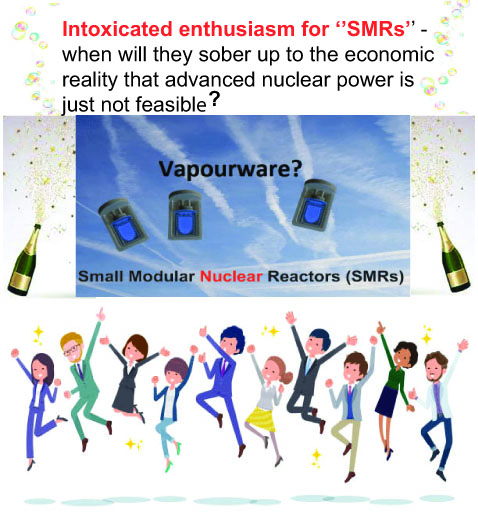
The climate problem is too serious to engage in unrealistic modelling exercises. Wishful thinking about nuclear energy will only thwart our ability to act meaningfully to lower emissions rapidly.
BY M.V. RAMANA AND SUSAN O’DONNELL | July 3, 2023 https://www.hilltimes.com/story/2023/07/03/wishful-thinking-about-nuclear-energy-wont-get-us-to-net-zero/391721/
On June 20, the Canada Energy Regulator (CER) released its 2023 Canada’s Energy Future report, developing scenarios for a path to net zero by 2050. These scenarios project roughly a tripling of nuclear energy generation capacity in Canada by 2050, seemingly reinforcing then-natural resources minister Seamus O’Regan’s statement in 2020 that there is “no path to net zero without nuclear.”
However, underlying both the scenarios and O’Regan’s contention is wishful thinking about the economics of nuclear energy, and how fast nuclear power can be scaled up.
The new nuclear capacity the report envisions consists of so-called small modular nuclear reactors (SMRs), which have so far not been built in Canada. Aside from refurbishing existing CANDU reactors, the CER does not think any more standard sized nuclear reactors will be built in Canada. Most of this buildup is to happen between 2035-2050, meaning that nuclear power will not help meet the government’s stated goal of decarbonizing the electricity grid by 2035.
But can SMRs be built rapidly after 2035? Only two Crown companies in the business of generating electricity for the grid have proposed to build SMRs: NB Power in New Brunswick, and Ontario Power Generation (OPG).
The reactor designs proposed for New Brunswick are cooled by molten salts and liquid sodium metal. Despite decades of development work and billions of dollars invested, major technical challenges have prevented molten salt reactors and sodium-cooled reactors from commercial viability, making it highly unlikely that the New Brunswick designs can be rapidly deployed in the time frame envisioned by the CER.
Assuming that OPG’s chosen design—the 300-megawatt BWRX-300—is the one to be deployed widely, then around 70 SMR units would need to be built and operating effectively on the grid between 2030-2050. The BWRX-300 design is yet to be approved by any safety regulator anywhere in the world.
But the report has an even more serious problem: economics. Nuclear power cannot compete economically, which is why its share of global electricity generation has declined from 17.5 per cent in 1996 to 9.2 per cent in 2022. Because SMRs lose out on economies of scale, they will produce even more expensive electricity.
The CER’s scenarios for nuclear power are based on the Electricity Supply Model, meant to calculate “the most efficient and cost-effective way to meet electricity demand in each region.” Such models are widely used in energy analysis and policymaking, but their utility depends on the validity of the assumptions used; garbage in, garbage out.
Two key parameters underlie the report’s scenarios: the capital cost of an SMR, and how that cost evolves with time. The CER’s assumptions in the two net-zero scenarios are that a SMR costs $9,262 per kilowatt in 2020, falling to $8,348 per kW by 2030, and to $6,519 per kW by 2050. Both these assumptions are ridiculously out of touch with the real world.
Consider the CAREM-25 SMR designed to feed 25 megawatts of electricity into the grid, being built in Argentina since 2014. Its original cost estimate in 2014 of US$446-million has escalated significantly since then, but even using these original costs, the project costs nearly $30,000 per kilowatt in 2022 Canadian dollars.
The NuScale design, arguably the closest to deployment in the United States, has been in development since 2007 with the build not yet begun. The January 2023 cost estimate for six NuScale SMRs with a total capacity of 462 megawatts is $9.3-billion, or over $26,000 per kilowatt in Canadian dollars.
Finally, the cost of the five-megawatt Micro Modular Reactor Project at Chalk River, Ont., was estimated by the proponent in May 2020 to be between $100- and $200-million. In 2022’s Canadian dollars, that works out to $22,000 to $44,000 per kilowatt.
In other words, the CER’s cost assumptions are wild underestimates, two-and-a-half to four times lower than the current evidence.
The second incorrect assumption is that costs will decrease with time. Both in the United States and France, the countries with the highest number of nuclear plants, the trend was the opposite: costs went up—not down—as more reactors were built. In both countries, the estimated construction cost of the most recent reactors being built—Vogtle in the United States and Flamanville-3 in France—have broken new records.
We need government organizations to do better. The climate problem is too serious for such unrealistic modelling exercises. Wishful thinking will only thwart our ability to act meaningfully to lower emissions rapidly.
M.V. Ramana is the Simons Chair in Disarmament, Global and Human Security and professor at the School of Public Policy and Global Affairs at the University of British Columbia. Susan O’Donnell is adjunct research professor and primary investigator of the CEDAR project at St. Thomas University in Fredericton, N.B.
Nuclear-based fantasies are holding back real climate action

SMR Education Task Force, June 22, 2023, https://crednb.ca/2023/06/22/nuclear-based-fantasies-are-holding-back-real-climate-action/—
Today a network of groups across Canada announces the launch of the SMR Education Task Force to share under-reported facts about small modular nuclear reactors (SMRs) with members of Parliament and provincial legislatures.
We begin with the latest report from Canada Energy Regulator (CER). This federal document, called Canada’s Energy Future, projects that enough new nuclear reactors (SMRs) will be operational by 2050 to more than double Canada’s existing nuclear electricity generation.
Canada currently has 19 operating power reactors, built over 58 years. The new report claims that we will build more than 50 new reactors in much less time.
This fantasy has no basis in reality. It is inconsistent with independent analyses by energy researchers not tied to the nuclear industry. One such study in the Bulletin of Atomic Scientists makes it clear that SMRs have at best a marginal role to play in a truly effective climate action plan. SMRs fail the tests of timeliness and affordability – they take too long and cost too much.
In addition to Ontario and Alberta, the CER report imagines deploying SMRs in Quebec and British Columbia. This is news to citizens in those provinces. BC ratepayers have rejected nuclear power in the past, and Quebec phased out of nuclear power in 2012. With every reactor comes long-lived radioactive waste — including the structure itself, which is a provincial responsibility to safeguard for thousands of years after shutdown.
Yesterday, the Coalition for Responsible Energy Development in New Brunswick (CRED-NB) sent a letter to Canada’s Natural Resources Minister reminding him that more than 120 civil society, public interest, faith-based and Indigenous groups across Canada have signed a statement warning that SMRs are a dirty, dangerous distraction from urgent climate action.
These groups understand that responding to the climate emergency does not require gambling on untested nuclear reactors. They know that energy efficiency measures and renewable sources cost at least 3 to 7 times less than nuclear power per tonne of carbon emissions avoided.
The groups oppose using public funds earmarked for climate action to support the nuclear industry’s eager experimentation with novel reactor designs. We are challenging the government to release the research and data that support its nuclear-based strategy.
Nuclear promoters, with long-standing allies embedded in the federal and provincial governments, are making unsubstantiated promises about SMRs in an audacious attempt to grab as much public funding as possible to keep their dying industry alive.
Worldwide, nuclear’s share of global electricity has dropped over the last 25 years from 17% to less than 10%. The International Energy Agency forecasts that more than 90% of all new electricity installations worldwide over the next 5 years will be non-hydro renewables.
The industry’s money-grab will succeed only if our public representatives remain uninformed about the facts. That is why we are pleased to announce the SMR Education Task Force and look forward in the months ahead to share information about SMRs based on independent science and research.
‘We need to wake up’: Algonquin leaders sound alarm over planned nuclear waste facility near Ottawa River
By Matteo Cimellaro | News, Urban Indigenous Communities in Ottawa | June 20th 2023
Four Algonquin chiefs spoke out on Tuesday, calling out the government and its private-sector contractor over what they say are inadequate consultations over a planned nuclear waste storage facility.
Last year, the Canadian Nuclear Safety Commission (CNSC) paused its decision to move ahead with the planned waste facility, located at the Canadian Nuclear Laboratories in Chalk River, Ont. The site is 180 kilometres north of Ottawa and sits within a kilometre of the Ottawa River, otherwise known as the Kichi Sibi in Algonquin.
The pause was intended to give more time for consultations with Kebaowek First Nation and Kitigan Zibi Anishinabeg, whose traditional territories circle the Ottawa River on both sides of Quebec and Ontario.
“It’s a huge victory for us,” Coun. Justin Roy of Kebaowek First Nation told Canada’s National Observer at the time.
But now, Algonquin leaders are slamming the CNSC for failing to give adequate time for meaningful consultation. The process only lasted six months, which the leaders argued is a short time frame given the challenges of negotiating funding agreements for Indigenous-led environmental assessments.
Still, the Algonquin-led assessment found the proximity to the Ottawa River, which supplies water to millions, including Algonquins, a major red flag. The river was given status of a Canadian Heritage River by Ontario and Quebec and it holds the utmost spiritual and historical importance for the Algonquin nation.
The assessment also pointed to potential risks to Indigenous harvesting rights and the environment, including contamination concerns to local moose, migratory birds and fish.
There are also concerns about tritium, a radioactive form of hydrogen, leaching from the nuclear waste into the Ottawa River, Chief Lance Haymond of Kebaowek First Nation said.
“We need to wake up and recognize what a danger Chalk River poses not only to the Algonquin people but to all Canadians, especially those living in the Ottawa-Gatineau area,” he added.
At the press conference, Haymond was flanked by Dylan Whiteduck, chief of Kitigan Zibi, and grand chiefs Savanna McGregor and Lisa Robinson, who are leaders of the Algonquin Anishinabeg Nation Tribal Council and Algonquin Nation Secretariat, respectively.
Elizabeth May, co-leader of the federal Green Party, sponsored the press conference. In brief comments, she pointed to the primary shareholder of the company that manages Canadian Nuclear Laboratories, criticizing the decision to build the facility so close to the Ottawa River.
Canadian Nuclear Laboratories is a subsidiary of the Crown corporation Atomic Energy Limited Corporation, but it is operated under contract by the Canadian National Energy Alliance, a private-sector consortium led primarily by SNC-Lavalin. The Canadian National Energy Alliance is responsible for the daily operations of the nuclear laboratories, as well as the decommissioning and management of nuclear waste from the facilities, according to the SNC-Lavalin website.
“I don’t think we had in mind that SNC-Lavalin would once again get its way,” she said, alluding to the company’s role in a scandal that rocked the federal government four years ago.
The Algonquin leaders are also calling foul on the consultation process for a divide-and-conquer strategy of picking which Algonquin nations to consult with, which Haymond calls a “continuation of colonialism.” Pikwakanagan First Nation signed a long-term relationship agreement with Canadian Nuclear Laboratories on June 9.
“It’s a First Nation who seemed to have forgotten their responsibilities and priorities as protectors of the land, protectors of the water,” he said.
Haymond notes Pikwakanagan was given years of consultation through the controversial organization Algonquins of Ontario, which local Algonquins have accused of dividing the nation and giving free passes to false Indigenous identity claims. The organization even named a building in Algonquin at the Canadian Nuclear Laboratories site.
An official hearing for the near-surface nuclear waste facility is scheduled for Aug. 10.
“We’ve been here for millennia, the Algonquin nation and our people,” Chief Whiteduck said.
“We’re still here, and we’re gonna be here for another 1,000 years. We’re hoping to deal with these contaminants that will be poured into our river.”
— With files from Natasha Bulowski
Ontario Government Response on Nuclear Proximity Principle Expected by Mid-October.

www.nuclearwastewatch.ca 12 June 23
| Toronto – Groups that travelled to Queen’s Park last week for the reading of their petition asking the Provincial government to adopt a Proximity Principle requiring that high-level radioactive waste be managed close to where it is generated may wait until mid-October to hear to back from the Provincial government. The government has 24 sitting days to respond to petitions presented in the Provincial legislature. The groups say they won’t be idle during that waiting period. Members of We the Nuclear Free North, in Northern Ontario, and Protect Our Waterways – No Nuclear Waste, in Southwestern Ontario, attended the May 30 session of Ontario’s Legislative Assembly to witness their petition being presented by Lise Vaugeois (NDP – Thunder Bay-Superior North), Sol Mamakwa (NDP – Kiiwetinoong) and Mike Schreiner (GPO Leader – Guelph). The petition calls for the adoption of the proximity principle with respect to the management of (nuclear waste) and for the government to direct Ontario Power Generation (OPG) to further their development of robust extended storage systems at the reactor locations. In conjunction with attending the Legislature to witness the reading of the Petition, the dozen representatives of the two groups were present at Queen’s Park for a related media conference and for meetings with members of the Provincial parliament. |
“We had an excellent day at Queen’s Park, and are ready for more,” commented Anja van der Vlies, President of Protect Our Waterways – No Nuclear Waste, which is based in South Bruce, one of the areas under investigation by the Nuclear Waste Management Organization (NWMO) for a deep geological repository for nuclear fuel waste.
The groups plan to continue meeting with MPPs as well as with municipal and First Nation leaders, seeking their support and learning what additional concerns or questions they have, either about the Proximity Principle or about the NWMO’s nuclear waste burial plan which would include 2-3 transport trucks of nuclear waste per day for 50 years, travelling an average of 1,600 kilometres one-way.
The petitions bearing 1,141 signatures were presented in the Legislature. An additional 977 signatures had been collected but were not included in the packages presented at Queen’s Park due to a formatting issue.
“Each of those 2,200 signatures represents a conversation,” explained Dodie LeGassick, member of We the Nuclear Free North and Nuclear Lead for Environment North.
| Toronto – Groups that travelled to Queen’s Park last week for the reading of their petition asking the Provincial government to adopt a Proximity Principle requiring that high-level radioactive waste be managed close to where it is generated may wait until mid-October to hear to back from the Provincial government. The government has 24 sitting days to respond to petitions presented in the Provincial legislature. The groups say they won’t be idle during that waiting period.Members of We the Nuclear Free North, in Northern Ontario, and Protect Our Waterways – No Nuclear Waste, in Southwestern Ontario, attended the May 30 session of Ontario’s Legislative Assembly to witness their petition being presented by Lise Vaugeois (NDP – Thunder Bay-Superior North), Sol Mamakwa (NDP – Kiiwetinoong) and Mike Schreiner (GPO Leader – Guelph). The petition calls for the adoption of the proximity principle with respect to the management of (nuclear waste) and for the government to direct Ontario Power Generation (OPG) to further their development of robust extended storage systems at the reactor locations.In conjunction with attending the Legislature to witness the reading of the Petition, the dozen representatives of the two groups were present at Queen’s Park for a related media conference and for meetings with members of the Provincial parliament.“We had an excellent day at Queen’s Park, and are ready for more,” commented Anja van der Vlies, President of Protect Our Waterways – No Nuclear Waste, which is based in South Bruce, one of the areas under investigation by the Nuclear Waste Management Organization (NWMO) for a deep geological repository for nuclear fuel waste.The groups plan to continue meeting with MPPs as well as with municipal and First Nation leaders, seeking their support and learning what additional concerns or questions they have, either about the Proximity Principle or about the NWMO’s nuclear waste burial plan which would include 2-3 transport trucks of nuclear waste per day for 50 years, travelling an average of 1,600 kilometres one-way.The petitions bearing 1,141 signatures were presented in the Legislature. An additional 977 signatures had been collected but were not included in the packages presented at Queen’s Park due to a formatting issue.“Each of those 2,200 signatures represents a conversation,” explained Dodie LeGassick, member of We the Nuclear Free North and Nuclear Lead for Environment North.“We are hearing it repeatedly from public – the nuclear industry has to do better than their 1970s plan to ship and bury all of Canada’s high-level waste in a single location and then abandon it. When people learn about the Proximity Principle they say, ‘What can I sign to support that?’” Additional petitions are active among groups opposing the NWMO’s proposed deep geological repository. Environment North has collected over 12,000 signatures on an online petition that opposes NWMO’s nine-step siting plan, and Protect Our Waterways – No Nuclear Waste is circulating a petition informing the Ontario government that Ontario is not a willing host for a deep geological repository, and demanding programs that prioritize the investigation of technology alternatives. Ontario Power Generation (OPG) owns over 90% of the nuclear fuel waste in Canada, and is a major shareholder in the NWMO, which is seeking a site for a deep geological repository for all of Canada’s nuclear fuel waste. Two sites are now short-listed: the Revell Site between Ignace and Dryden, and the South Bruce-Teeswater Site near Teeswater. The Provincial government can issue directives to OPG, which is a Provincial crown corporation. A Backgrounder on the Proximity Principle and High Level Nuclear Waste is HERE. |
3
Canada’s controversial nuclear waste disposal design for Chalk River

How safe is the Ottawa River from nuclear waste? Canada’s National Observer April 8th 2019 “……..Nuclear disposal site design
The proposed Near Surface Disposal Facility is not new technology, according to its proponents. The same technology set for Chalk River has also been adopted in the U.K. and Belgium, the company says.
The key component is an engineered containment mound. It is contained by a large cover system designed to keep out rain and other elements. Below the cover, a liner system is meant to collect contaminated water — and alert monitoring systems to leaks — and direct the effluent to treatment systems.
The timeline for the project is monumental. The mound will be filled with low-level nuclear waste that is currently held on site at Chalk River, as well as a small amount of waste that will be transported to the facility from other locations such as hospitals, universities and other nuclear facilities in Canada. Five per cent of the total waste will come from Whiteshell Laboratories in Manitoba, which is undergoing its own decommissioning process.

The waste in the mound would be split into cells according to contaminants or time for decay. A temporary cover would allow time to add radioactive waste for 50 years. When the site is full it would be permanently sealed.
The site would be monitored for 300 years after the permanent cover is installed at which point the radioactive material will have decayed. The facility is designed to last 550 years, the company says.
The radioactive waste inside the mound will break down. The half-life for tritium is around 12 years, and the half-life for strontium-90 is about 29 years. That means half of the tritium or strontium stored on the site decays during that period, with half of the remainder taking a further 12 or 29 years to decay. The process keeps repeating itself until ultimately all the material has broken down.
The engineered containment mound is CNL’s preferred nuclear waste storage option. In its draft environmental impact statement, CNL includes a discussion of the various other types of disposal options and techniques including deep-underground repositories, above-ground cement vaults and different on-and off-site locations.
In an opinion article in the Ottawa Citizen in April 2018, Eva Schacherl, a former executive director of the Canadian Environmental Network, argued the project was “the wrong plan at the wrong site,” and a vault buried hundreds of metres deep below the grounds should have been chosen.
In a draft environmental assessment, the lab did not conduct geological tests far below the surface. Although the deep-underground method provides additional protections against leakage, CNL says there is not enough evidence to outweigh the benefits of its chosen model.
A deep-underground vault would be much more expensive to monitor and maintain over its life cycle, according to CNL’s analysis. CNL has made several changes to the proposal since public consultations began in May 2016, in response to some of the hundreds of initial comments by the public during an ongoing environmental assessment.
Ottawa Riverkeeper advocates a type of facility that does not come into contact with water. “We want a solution that will safeguard all species from the radioactive waste that is currently onsite at Chalk River and Rolphton,” Riverkeeper said in a Nov. 1 update. “We would like to see Canada look to countries like Finland who have constructed siloed geological repositories to safeguard all levels of radioactive waste. We want a disposal facility where radioactive waste does not come into contact with water.”
CNL acknowledged during an interview for this story that it was not transparent enough during the environmental impact statement process in explaining why the particular location near the Ottawa River on the CRL site was the best choice.
Subsequent studies, analyses and updates to the document are part of the delay that will push the delivery of CNL’s final environmental impact statement to the CNSC for approval back to around spring 2020, according to the company. The delay was also caused by technical questions from provincial and government agencies that have required additional study, including a notable point where nuclear waste is discharged into Perch Lake.
The public comment process has led to other significant changes to the project design. The original project was meant to hold predominantly low-level intermediate waste, but also allowed for about one per cent intermediate-level waste or mixed wastes. The company has now decided to restrict the waste going into the storage facility to only the low-level category.
The change was purely driven by feedback from the community, the company representatives said. The site was never intended to hold high-level waste, such as spent nuclear fuel from a reactor.
“It’s in response to concerns from the public or interest groups,” said Meggan Vickerd, director of the nuclear waste facility project for CNL. “Intermediate-level waste was only a fraction of the inventory, plus it was not all of the intermediate-level waste, so we knew we still needed another facility.”
Controversy over near-surface disposal
The company says the project prompted hundreds of public comments during its opening consultation phase. Pat Quinn, CNL’s communications director, says the company is dedicated to transparency and open communication.
Activist organizations and Indigenous groups have raised a number of red flags about the suggested nuclear waste site and the overall security of decommissioning, including its construction about one kilometre away from the river.
Riverkeeper has also emphasized that despite the Canadian government’s rhetoric about the importance of a Nation to Nation relationship, “there has been no consultation with Indigenous Governments to develop a radioactive waste policy on terms that would be acceptable to Indigenous peoples.
“Likewise, there has been no consultation with the Algonquin Anishinaabe people about consolidating all federal radioactive wastes within their traditional, unsurrendered territory.”
Some local farmers have also expressed concern. One is Taylor Hanrath, an organic pork farmer and the owner of Butternutty Farm who lives downstream in Pembroke.
“If there’s a leak at all, in some way, shape, or form it would have the pretty big Ottawa River right beside it to transport it quickly and there’s always going to be the potential for human error, on top of a possible earthquake or tornado.” Hanrath said. “Even right now I don’t know what the plan would be for my farm if a leak were to happen at the current site.”
………The International Atomic Energy Agency indicates better ways to store nuclear waste are to bury it in “caverns, vaults, or silos, at least a few tens of metres below ground level, and up to a few hundred metres below ground level.” It does state, however, that a near-surface facility would be sufficient for low-level waste, such as decommissioned structures, old laboratory materials and soil.
Chalk River: Radioactive Wastes and the Honour of the Crown
Background: May 9, 2023
A consortium of multinational corporations, operating under the banner CNL (Canadian Nuclear Laboratories), is contracted to manage all of the federal government’s nuclear facilities. The contract obliges CNL to “reduce the liability” associated with the multibillion dollar legacy of radioactive wastes created in the name of the Crown by uranium processing (mainly at Port Hope, Ontario) and by nuclear fission (mainly at Chalk River). CNL has been given close to a billion dollars a year for the last five years from Canadian taxpayers.
The Port Hope and Chalk River nuclear facilities are outgrowths of the World War II Atomic Bomb project and the subsequent Cold War era. Canada sold uranium and plutonium almost exclusively for nuclear weapons use from 1941 to 1965. In a very real sense, the “legacy radioactive wastes” at these two sites are in large part leftovers of the American bomb program and the Cold War arms buildup.
How does CNL propose to deal with the radioactive legacy of the nuclear age? At Chalk River, CNL proposes to build a huge earthen mound of “low-level” radioactive and toxic chemical wastes within one kilometre of the Ottawa River. The low-level waste is a minute fraction of the total radio-toxic burden at Chalk River, which includes highly radioactive reactor cores, tanks of reprocessing liquid, plutonium handling facilities, and large quantities of high-level and intermediate-level radioactive wastes for which there is as yet no plan at all. The mound is a cheap and convenient way of dealign with the most voluminous material, clearing the decks for building new facilities that will produce even more challenging forms of nuclear wastes, while ignoring the bulk of the radioactivity that afflicts this “Nuclear Sacrifice Zone”.
The engineered mound – a glorified landfall 5 to 7 stories high – will hold a million cubic metres of toxic waste, on a site that drains into Perch Lake and then into the Ottawa River. Called a “Near Surface Disposal Facility” (NSDF), this megadump is planned to be built on lthe unsurrendered territory of several Algonquin communities that have inhabited the Ottawa Valley for thousands of years.
Canada’s nuclear regulator, the Canadian Nuclear Safety Commission (CNSC) conducted an environmental assessment of the NSDF and held a week of public hearings in February 2022. Since then, two Algonquin communities – the Keboawek First Nation (KFN) and the Kitigan Zibi Anishinabeg (KZA) community, have demonstrated their strong opposition to the proposed megadump, as have more than a hundred communities downstream from Chalk River, including the 18 municipalities comprising the Montreal City Agglomeration Council. KFN has done outstanding work in documenting several key species inhabiting the proposed site that have been totally ignored by the environmental assessment process.CNL is now asking CNSC to grant CNL a licence amendment to prepare the contested site for the NSDF.
Public hearings will be held remotely on June 27 with no opportunity for intervenors to appear in person before the Commission, despite strong requests from the Indigenous communities to allow face-to-face meetings.
All those who intervened in the February 2022 hearings are allowed no more than 5000 words to give their final input on this issue before CNSC renders its decision. Here is the final submission from the Canadian Coalition for Nuclear Responsibility.
Radioactive Wastes and the Honour of the Crown
Final report submitted to the Canadian Nuclear Safety Commission
by Gordon Edwards, president, Canadian Coalition for Nuclear Responsibility
www.ccnr.org/CCNR_CNSC_NSDF_final_2023.pdf
Contents –
1. The Honour of the Crown
2. Protecting the Environment & the Health and Safety of Persons
3. Communicating with Future Genera>ons
4. Safety Culture and the Justification Principle
5. A Tale of Two Dumps
6. List of radioactive poisons
Canadian Federal Court Upholds Alcohol and Drug Testing at Nuclear Facilities
Mirage News, 7 June 23
The Canadian Nuclear Safety Commission (CNSC) is pleased to confirm that on June 6, 2023, the Federal Court endorsed the Commission’s move to require pre-placement and random alcohol and drug testing of workers in safety-critical positions at high-security nuclear facilities, as mandated by CNSC regulatory document REGDOC-2.2.4, Fitness for Duty, Volume II: Managing Alcohol and Drug Use.
In early 2021, following the legalization of cannabis in Canada, the CNSC provided new regulatory requirements for the pre-placement and random testing of workers as part of a proactive approach to enhance nuclear safety and security at high-security nuclear facilities in Canada.
These new requirements were based on the results of extensive consultations with scientists and other experts, licensees of and workers at high-security nuclear sites, the Canadian Human Rights Commission, and the public.
Fitness for duty is one factor that affects human performance. An important element of being fit for duty is being free from the influence of alcohol, legal or illicit drugs, or performance-altering medication while at work………………… more https://www.miragenews.com/federal-court-upholds-alcohol-and-drug-testing-1022447/
Proximity principle – nuclear waste should be stored as near as possible to the point of generation

Groups opposed to nuclear waste burial go to Queens Park, Toronto
Two anti-nuclear waste activist groups present a petition calling for the Ford government to implement a proximity principle for nuclear waste storage.
Clint Fleury 31 May 23 NWONewsWatch,
TORONTO — Two activist groups opposing the storage of nuclear waste in a deep geological repository are calling on the Ford government to mandate that a proximity principle to have the material stored cosser to where it is generated.
Members of We the Nuclear Free North in Northern Ontario from Northwestern Ontario and Protect Our Waterways – No Nuclear Waste in Southwestern Ontario have collected 1,141 signatures, with the petition presented in Queens Park on tuesday by Thunder Bay-Superior North MPP Lise Vaugeois, Kiiwetinoong MPP Sol Mamakwa and Green Party Leader Mike Schreiner.
“Their plan is not very well defined for the deep geological repository and it has several questionable areas. One of which is an option for a shallow cavern, which if approved, could see nuclear waste being moved into the area before the deep geological repository is complete and in operation,” said Charles Faust, a representative with We the Nuclear Free North.
Faust argued that the Nuclear Waste Management Organization’s plan to transport nuclear waste from power plants to a deep geological repository is “questionable.”
“I want you to remember 1,694. That’s the number of kilometres that it takes for a one-way trip from the average site of nuclear waste storage in Southern Ontario to the Ignace area — 1,694 kilometres,” Faust said. “They’re proposing two to three trucks a day, every day, for 50 years. That’s to deal with the 50,000 tonnes that are out there right now that they are looking for a place to be deposited.”
According to Faust, the concern with the transportation of nuclear waste is that Nuclear Waste Management Organization’s transportation phase is still in the early stages of development.
Bill Noll, a representative with Protect Our Waterways, expressed concern that once the nuclear waste reaches its destination, the fuel bundles will be sent to a repackaged facility and then stored in the repository.
“The repackaging facility is really unique. No other countries, Sweden, Finland, or any other country that I am aware of, is actually thinking about repackaging capability in what is a very small container,” said Noll.
Noll claimed the issue with nuclear waste is the spent heat that is generated.
“This is one of the real issues with the whole idea of how long it will last. It is a function of how much heat will be generated and how much damage that heat will do to not only the rock, but the container itself,” Noll said.
Both activist groups proposed that the solution to their concern would be for the Ford government to implement a proximity principle.
“Nuclear fuel waste should be managed at the point of generation by making on-site storage more robust and adopting a program of rolling stewardship for the long-term management of radioactive at or near its current location,” said Faust……………………………………
During the press conference, Vaugeois called the process of managing Canada’s nuclear waste “undemocratic.” https://www.nwonewswatch.com/local-news/groups-opposed-to-nuclear-waste-burial-go-to-queens-park-7073336
Gordon Edwards explains and comments on Canada’s policy on radioactive waste and nuclear decommissioning
Until recently, Canada’s stated policy on radioactive waste management consisted of a flimsy 25-year-old statement of 143 words, making no mention of intermediate level waste (such as decommissioning waste) or plutonium extraction (reprocessing).
In 2019, a team of IAEA nuclear experts reviewed Canada’s nuclear regulatory practices and recommended that Canada produce an enhanced radioactive policy statement and articulate an accompanying national radioactive waste strategy for the first time ever.
In 2020 Canada accepted this recommendation and undertook a two year consultation period with hundreds of Canadian organizations and individuals.
Non-governmental organizations overwhelmingly recommended that Canada should have radioactive waste management and decommissioning agency that is independent of the nuclear waste producers and agencies that promote nuclear power, such as the Natural Resources Department (NRCan).
They also recommended that reprocessing (plutonium extraction) be banned altogether and that careful consideration be given to establishing a classification of radioactive waste materials based on toxicity, mobility, longevity, and radioactive progeny. Special attention was paid to the need for a policy regarding intermediate level wastes such as those resulting from rector decommissioning operations.
In 2022 a draft policy was released for public comment and an alternative policy was recommended by Nuclear Waste Watch, incorporating the policy recommendations mentioned in the preceding paragraphs.
In March 2023, the government — through NRCan, the very department that is obligated to promote nuclear power and uranium mining — released its final radioactive waste and decommissioning policy. That document ignores almost completely the input from civil society over the course of the previous two years. The policy is verbose and rhetorical with very little substance, and with a pronounced pro-nuclear bias.
On May 25, Nuclear Waste Watch hosted a “debriefing” webinar to inform other groups who had also participated in the consultation process of the nature of the government’s policy, and the distressing fact that NRCan has relegated to the nuclear waste producers the task of constructing a radioactive waste strategy for Canada.
Here is a short slide show (bilingual) that summaries and briefly comments on the main features of the Canadian government’s radioactive waste policy:
Clean energy transition sparks nuclear reaction

Along with its many known problems, as an inflexible, costly baseload power source, nuclear is becoming as outdated as fossil fuels.
By David Suzuki with contributions from Senior Editor and Writer Ian Hanington, https://davidsuzuki.org/story/clean-energy-transition-sparks-nuclear-reaction/ 26 May 23
As the impacts of climate disruption become more frequent and intense, we need a range of solutions. One that’s getting a lot of attention is nuclear power.
Industry is pushing hard for it, especially “small modular reactors,” and the federal government has offered support and tax incentives. After 30 years without building any new reactors, Ontario is also jumping onto the nuclear bandwagon again. How should we react?
Along with its many known problems, as an inflexible, costly baseload power source, nuclear is becoming as outdated as fossil fuels. Small modular reactors will create even more waste and cost more — and slow the necessary transition to renewable energy.
Many disadvantages of nuclear are well known. It can contribute to weapons proliferation. Radioactive waste remains highly toxic for a long time and must be carefully and permanently stored or disposed of. And while serious accidents are rare, they can be devastating and difficult to deal with, as the Chernobyl and Fukushima disasters demonstrated.
Along with its many known problems, as an inflexible, costly baseload power source, nuclear is becoming as outdated as fossil fuels.
Uranium to fuel nuclear also raises problems, including high rates of lung cancer in miners and emissions from mining, transport and refining. Add that to the water vapour and heat it releases, and nuclear power produces “on average 23 times the emissions per unit electricity generated” as onshore wind, according to Stanford University professor Mark Jacobson.
But the biggest issues are that nuclear power is expensive — at least five times more than wind and solar — and takes a long time to plan and build. Small modular reactors are likely to be even more expensive, especially considering they’ll produce far less electricity than larger plants. And because the various models are still at the prototype stage, they won’t be available soon.
Because we’ve stalled for so long in getting off coal, oil and gas for electricity generation, we need solutions that can be scaled up quickly and affordably.
The last nuclear plant built in Ontario, Darlington, ended up costing $14.4 billion, almost four times the initial estimate. It took from 1981 to 1993 to construct (and years before that to plan) and is now being refurbished at an estimated cost of close to $13 billion. In 1998, Ontario Hydro faced the equivalent of bankruptcy, in part because of Darlington.
Ontario’s experience isn’t unique. A Boston University study of more than 400 large-scale electricity projects around the world over the past 80 years found “on average, nuclear plants cost more than double their original budgets and took 64 per cent longer to build than projected,” the Toronto Star reports. “Wind and solar, by contrast, had average cost overruns of 7.7 per cent and 1.3 per cent, respectively.”
China has been building more nuclear power plants than any other country — 50 over the past 20 years. But in half that time, it has added 13 times more wind and solar capacity.
As renewable energy, energy efficiency and storage technologies continue to rapidly improve and come down in price, costs for nuclear are rising. As we recently noted, the Intergovernmental Panel on Climate Change’s Sixth Assessment report shows that nuclear power delivers only 10 per cent of the results of wind and solar at far higher costs. In the time it takes to plan and build nuclear, including SMRs, and for much less money, we could be putting far more wind, solar and geothermal online, and developing and increasing storage capacity, grid flexibility and energy efficiency.
The amount it will cost to build out sufficient nuclear power — some of which must come in the form of taxpayer subsidies — could be better put to more quickly improving energy efficiency and developing renewable energy such as wind, solar and geothermal.
Putting money and resources into nuclear appears to be an attempt to stall renewable electricity uptake and grid modernization. Small modular reactors are likely to cost even more than large plants for the electricity they generate. And, because more will be required, they pose increased safety issues.
David Suzuki Foundation research shows how Canada could get 100 per cent reliable, affordable, emissions-free electricity by 2035 — without resorting to expensive and potentially dangerous (and, in the case of SMRs, untested) technologies like nuclear.
New nuclear is a costly, time-consuming hurdle on the path to reliable, flexible, available, cost-effective renewable energy. The future is in renewables.
Canadian reactors that “recycle” plutonium would create more problems than they solve

Bulletin, By Jungmin Kang, M.V. Ramana | May 25, 2023
In 2021, nine US nonproliferation experts sent an open letter to Canada’s Prime Minister Justin Trudeau. In their letter, the experts expressed their concern that the Canadian government was actually increasing the risk of nuclear weapons proliferation by funding reactors that are fueled with plutonium. Earlier that year, the Federal Government had provided 50.5 million Canadian dollars to Moltex Energy, a company exploring a nuclear reactor design fueled with plutonium. The linkage to nuclear weapons proliferation has also led several civil society groups to urge the Canadian government to ban plutonium reprocessing.
Much of the concern so far has been on Canada setting a poor example by sending a “dangerous signal to other countries that it is OK to for them to extract plutonium for commercial use.” But Moltex plans to export its reactors to other countries raise a different concern. Even if a country importing such a reactor does not start a commercial program to extract plutonium, it would still have a relatively easy access to plutonium in the fuel that the reactor relies on to operate. Below we provide a rough estimate of the quantities of plutonium involved—and their potential impact on nuclear weapons proliferation—to help explain the magnitude of the problem. But there is more. By separating multiple radionuclides from the solid spent fuel and channeling it into waste streams, Moltex reactors will only make the nuclear waste problem worse.
Moltex’s technological claims. Moltex established its Canadian headquarters in the province of New Brunswick after it received an infusion of 5 million Canadian dollars from the provincial government. The company offers two products: a molten salt reactor and a proprietary chemical process that Moltex terms “waste to stable salts” technology. Moltex claims that, by using its chemical process, it can “convert” spent fuel from Canada’s deuterium uranium nuclear reactors (CANDUs) into new fuel that can be used in its reactor design. Moltex essentially claims it can “reduce waste.” In light of the problematic history associated with molten salt reactors, Moltex’s proposed reactors, and especially the chemical process needed to produce fuel, deserve more scrutiny. These will have serious implications for nuclear policy.
In its response to the open letter from the US nonproliferation experts, Moltex dismissed the ability of outsiders to comment, arguing that experts “are not aware of [its proprietary] process as only high-level details are made public.” Moltex has been indeed sparse in what it shared publicly about its technologies. Still, there is much one can surmise from earlier experiences with the processing of spent fuel and from basic science. With some simple calculations based on these high-level details provided by Moltex so far—and taking those at face value, i.e., without evaluating the feasibility of the design or their plans—we show that there is reason to be concerned about the amounts of plutonium that will be used in the reactor.
[Technical explanation here about chemical processes]…………………………………………………………………………….
Moltex’s proposed technology has not yet been evaluated by the International Atomic Energy Agency for how well it can be safeguarded; nor is it possible to evaluate how well the technology can be safeguarded in advance of a final design. But there is good reason to think that a determined country—one that might not play by the rules set by the IAEA—might find a way to divert some plutonium from Moltex’s chemical process to use it in nuclear weapons.
Diversion has been a long-standing concern with pyroprocessing, which is closely related to what Moltex is proposing. …………………………………………………………more https://thebulletin.org/2023/05/canadian-reactors-that-recycle-plutonium-would-create-more-problems-than-they-solve/
1 This Month
19 February – VIRTUAL EVENT-Decision Time: AI and Our Nuclear Arsenal
12:45 p.m. Central / 1:45 p.m. Eastern
To see nuclear-related stories in greater depth and intensity – go to https://nuclearinformation.wordpress.com
-
Archives
- February 2026 (161)
- January 2026 (308)
- December 2025 (358)
- November 2025 (359)
- October 2025 (376)
- September 2025 (258)
- August 2025 (319)
- July 2025 (230)
- June 2025 (348)
- May 2025 (261)
- April 2025 (305)
- March 2025 (319)
-
Categories
- 1
- 1 NUCLEAR ISSUES
- business and costs
- climate change
- culture and arts
- ENERGY
- environment
- health
- history
- indigenous issues
- Legal
- marketing of nuclear
- media
- opposition to nuclear
- PERSONAL STORIES
- politics
- politics international
- Religion and ethics
- safety
- secrets,lies and civil liberties
- spinbuster
- technology
- Uranium
- wastes
- weapons and war
- Women
- 2 WORLD
- ACTION
- AFRICA
- Atrocities
- AUSTRALIA
- Christina's notes
- Christina's themes
- culture and arts
- Events
- Fuk 2022
- Fuk 2023
- Fukushima 2017
- Fukushima 2018
- fukushima 2019
- Fukushima 2020
- Fukushima 2021
- general
- global warming
- Humour (God we need it)
- Nuclear
- RARE EARTHS
- Reference
- resources – print
- Resources -audiovicual
- Weekly Newsletter
- World
- World Nuclear
- YouTube
-
RSS
Entries RSS
Comments RSS
 nuclear-news