|
U.S. approved secret nuclear power work for Saudi Arabia
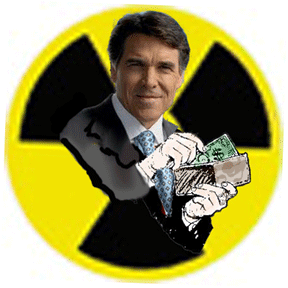
 Timothy Gardner, 28 Mar 19, WASHINGTON (Reuters) – U.S. Energy Secretary Rick Perry has approved six secret authorizations by companies to sell nuclear power technology and assistance to Saudi Arabia, according to a copy of a document seen by Reuters on Wednesday. Timothy Gardner, 28 Mar 19, WASHINGTON (Reuters) – U.S. Energy Secretary Rick Perry has approved six secret authorizations by companies to sell nuclear power technology and assistance to Saudi Arabia, according to a copy of a document seen by Reuters on Wednesday.
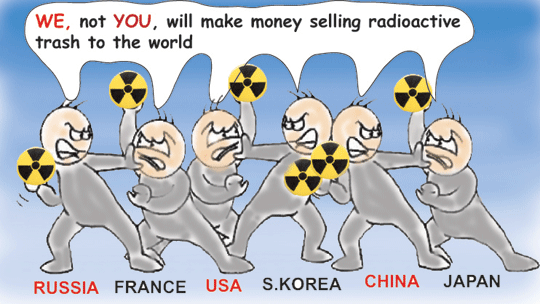
The Trump administration has quietly pursued a wider deal on sharing U.S. nuclear power technology with Saudi Arabia, which aims to build at least two nuclear power plants. Several countries including the United States, South Korea and Russia are in competition for that deal, and the winners are expected to be announced later this year by Saudi Arabia.
Perry’s approvals, known as Part 810 authorizations, allow companies to do preliminary work on nuclear power ahead of any deal but not ship equipment that would go into a plant, a source with knowledge of the agreements said on condition of anonymity. The approvals were first reported by the Daily Beast.
The Department of Energy’s National Nuclear Security Administration (NNSA) said in the document that the companies had requested that the Trump administration keep the approvals secret.
“In this case, each of the companies which received a specific authorization for (Saudi Arabia) have provided us written request that their authorization be withheld from public release,” the NNSA said in the document. In the past, the Energy Department made previous Part 810 authorizations available for the public to read at its headquarters. ……..
Last month, Democratic House members alleged in a report that top White House aides ignored warnings they could be breaking the law as they worked with former U.S. officials in a group called IP3 International to advance a multibillion-dollar plan to build nuclear reactors in the Middle East, including Saudi Arabia. https://www.reuters.com/article/us-usa-saudi-nuclear/us-approved-secret-nuclear-power-work-for-saudi-arabia-idUSKCN1R82MG
|
|
March 30, 2019
Posted by Christina Macpherson |
marketing, Saudi Arabia, secrets,lies and civil liberties, USA |
Leave a comment
 Congressional watchdog to probe Saudi nuclear power talks
A congressional watchdog has agreed to investigate the Trump administration’s discussions about sharing nuclear technology with Saudi Arabia, according to people familiar with the matter. The Government Accountability Office, a non-partisan agency that conducts investigations on behalf of Congress, is in talks with lawmakers over the scope of a probe into the nuclear power talks that the Trump administration has held with Saudi Arabia. One person familiar with the discussions between the GAO and lawmakers said they were in their “initial phase”. In February, lawmakers accused White House officials of pushing a plan to sell US nuclear power technology to Saudi Arabia in potential defiance of legal restrictions. A report prepared for the oversight committee of the Democratic-led House of Representatives said Trump aides were attempting “to rush the transfer of highly sensitive US nuclear technology to Saudi Arabia”, which may have violated the Atomic Energy Act.
The US and Saudi Arabia do not have a nuclear co-operation agreement under section 123 of the act — which governs civil nuclear agreements — but the two countries have been in the process of negotiating one since 2012. The GAO is responding to a recent request from Marco Rubio, a senior Republican member of the Senate Foreign Relations Committee, and Robert Menendez, the top Democrat on the panel. In making their request, Mr Rubio and Mr Menendez said they were concerned about reports that the administration had been negotiating a nuclear co-operation deal — a so-called 123 agreement — with Riyadh without keeping Congress apprised of the situation. The two senators added that they were “especially concerned that negotiations or discussions of nuclear co-operation are happening in a very opaque manner”.
According to the state department, it is the lead negotiator for all international civil nuclear co-operation agreements. Under section 123 of the Atomic Energy Act, any talks are to be led by the secretary of state and with “technical assistance” from the energy secretary. Senators Menendez and Rubio said they believed the energy department was leading the negotiations with Saudi, however, adding that they were “concerned” the inter-agency process was not being followed……
https://www.ft.com/content/a43577c0-5003-11e9-b401-8d9ef1626294
March 27, 2019
Posted by Christina Macpherson |
politics international, Saudi Arabia, USA |
Leave a comment
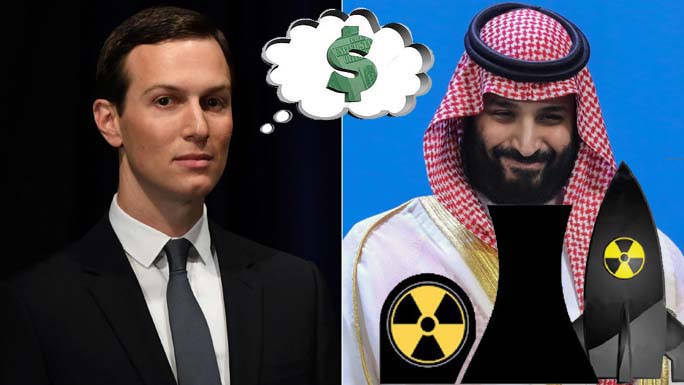
Trump’s endeavour to nuclearise Saudi Arabia is driven by family business interests and tacitly approved by Israel. Aljazeera, by Hamid Dabashi, 8 Mar 2019 Like chronic indigestion that refuses to go away, presidential son-in-law Jared Kushner is back causing much discomfort to the general public.
“Kushner meets Saudi’s MBS for the first time since Khashoggi murder,” Al Jazeera recently reported, “The meeting focused on ‘increasing cooperation’ between Washington and Riyadh, as well as the Middle East peace process.”
But there might be more on their plate than just another bogus “peace process”.
Kushner has two paramount concerns while sitting comfortably in the big pocket of Saudi Crown Prince Mohammed bin Salman (MBS): pursuing his own personal financial gains and helping Israel steal what is left of Palestine. MBS also has two objectives while playing with Kushner, like a shiny marble in his pocket: To confront Iran and to establish himself as a ruling tyrant not just in Saudi Arabia but throughout the Arab and Muslim world.
The slaughter of innocent men, women and children in Yemen and the butchery of Jamal Khashoggi are the first flowers of his dream of a Saudi Spring. But in his pursuit of power and glory through murder and destruction, MBS does not seem to be satisfied with using only conventional means. It appears that he is now harbouring a great desire to go nuclear and the Trump administration is more than willing to oblige.
As the New York Times recently revealed, the Trump administration has been pursuing a deal with Saudi Arabia to develop its nuclear energy sector. “By ramming through the sale of as much as $80 billion in nuclear power plants, the Trump administration would provide sensitive know-how and materials to a government whose de facto leader, Crown Prince Mohammed bin Salman, has suggested that he may eventually want a nuclear weapon as a hedge against Iran and has shown little concern for what the rest of the world thinks,” the newspaper claimed.
At the forefront of these efforts, of course, are Kushner and his business interests. It turns out a company that bailed out his family after an ill-conceived real estate deal in New York brought them close to bankruptcy now intends to sell nuclear reactors in Saudi Arabia.
That, along with other shenanigans, has gotten the US security establishment worried. Their attempts to cancel his security clearance, however, have been repeatedly overridden by his father-in-law.
Hence, Kushner remains undeterred in his pursuit to nuclearise Saudi Arabia.
In exposing this worrying reality, the US media, however, has made two very wrong assumptions: one, that a nuclear deal with Saudi Arabia somehow contradicts the interests of the Israeli leadership; two, that it is the result of some kind of a Gulf-money entrapment.
……. Given that President Donald Trump’s son-in-law has been the principal driving force behind a “peace plan” that aims to strip Palestinians of all their legitimate rights and legalise the Israeli occupation, it is hard to believe that he is now pursuing a policy that contradicts Israeli interests. …….
The reason why a Saudi nuclear programme is in the interest of the Israeli settler colony is very simple: It would fuel Saudi-Iranian rivalry, keeping them in a permanent state of war in the shadow of nuclear proliferation, which is good for Zionism, and of course, for the Israeli arms industry. It would keep the populations of both countries preoccupied with the imagined Sunni-Shia conflict and make them increasingly oblivious to the plight of the Palestinian people and the desecration of the holy sites in Jerusalem. …….. https://www.aljazeera.com/indepth/opinion/making-nuclear-mbs-190307135114759.html
March 9, 2019
Posted by Christina Macpherson |
Saudi Arabia, secrets,lies and civil liberties, USA |
Leave a comment
Before Saudi Arabia Goes Nuclear, It May Have to Follow Iran’s Lead, Bloomberg, By Jonathan Tirone March 7, 2019,
- Kingdom has yet to clinch enhanced atomic monitoring deal
- World powers are meeting with Iran on Wednesday in Vienna.
“………Focus on Saudi Arabia’s nuclear program has risen in the last month after the U.S. Congress opened an investigation into the potentially illegal transfer of sensitive technologies to the kingdom. This week the International Atomic Energy Agency, responsible for verifying that countries don’t divert material for weapons, weighed in on what its inspectors need before the kingdom can start generating nuclear power.
Focus on Saudi Arabia’s nuclear program has risen in the last month after the U.S. Congress opened an investigation into the potentially illegal transfer of sensitive technologies to the kingdom. This week the International Atomic Energy Agency, responsible for verifying that countries don’t divert material for weapons, weighed in on what its inspectors need before the kingdom can start generating nuclear power.
Riyadh’s nuclear program is developing “based on an old text” of safeguard rules, even as it expects to complete its first research reactor this year and plans to tap uraniumreserves, according to IAEA Director General Yukiya Amano, who told journalists this week in Vienna that he’s “appealing to all countries to rescind” those old ways of doing business.
“We’re encouraging all countries to conclude and implement an additional protocol and that includes Saudi Arabia,” said Amano, who’s also in charge of enforcing the 2015 nuclear deal struck between Iran and world powers. The Japanese career diplomat has called the set of rules established by that accord, which U.S. President Donald Trump withdrew from in May, as “the most rigorous monitoring mechanism ever negotiated.”……
the IAEA comments could strike a precautionary note among vendors lining up to service the kingdom’s nuclear ambitions. Receiving the imprimatur of IAEA inspectors, who account for gram-level quantities of nuclear material worldwide, is a precondition for receiving technologies and fuel. Without reaching a new understanding with monitors, Saudi plans for 3.2 gigawatts of atomic power by the end next decade could flounder. …….
Maintaining that level of IAEA access to Iran’s nuclear program is the reason that China, France, Germany, Russia and the U.K. continue to defy U.S. calls to abandon the 2015 deal and reimpose sanctions. Diplomats from those countries convened Wednesday in Vienna in their first meeting since the European Union established a trade channel to skirt U.S. threats.
Snap Inspections in Iran
IAEA complementary access to sites rose under agreement with world powers……https://www.bloomberg.com/news/articles/2019-03-06/before-saudi-goes-nuclear-it-may-have-to-follow-iran-s-lead
March 7, 2019
Posted by Christina Macpherson |
Iran, politics international, Saudi Arabia, weapons and war |
Leave a comment
 Team Trump Keeps Pushing Deal to Send Nuclear Tech to Saudis
Congress raised ‘grave concerns’ about the Trump administration’s past attempts to send nuclear technology to the Saudis. But Team Trump isn’t done trying. The Daily Beast, Erin Banco, Betsy Woodruff 03.04.19 The Trump administration is still actively working to make a deal to send U.S. nuclear technology to Saudi Arabia, according to two U.S. officials and two professional staffers at federal agencies with direct knowledge of those conversations. American energy businesses are still hoping to cash in on Riyadh’s push for energy diversification,
“This could be a very big contract. This administration is all about contracts,” said Hussein Ibish, a resident scholar at the Arab Gulf States Institute in Washington. “And there is a big market here that U.S. companies can get in on. The question is if the U.S. will decide, in the end, to go through with an official agreement or not.”
During the first few months of President Trump’s administration, members of his team tried to pull together a nuclear export deal that included private U.S. companies, according to three people with direct knowledge of those efforts and a congressional
report issued in late February.
That pursuit raised concerns at the time among professional staff inside the Departments of Energy, State, and Commerce. Those worries grew as it became clear that members of the administration had not engaged in regulatory and legal conversations about the export of such technology. Worse, the nuclear export plan was, in essence, the work of a single company. The firm, IP3, was connected to a pack of former generals, including then-National Security Adviser Michael Flynn and its proposal was “not a business plan,” one senior political official told investigators from the House Oversight and Government Reform committee, but rather “a scheme for these generals to make some money.” …….
A letter obtained by The Daily Beast shows how CEOs from six different energy companies, as well as members of IP3, courted Crown Prince Mohammed bin Salman and pitched the idea of working together on a nuclear plan called the “Iron Bridge Program.” (Iron Bridge is an IP3 subsidiary that counted Flynn as one of its advisers.)
The letter, which was reportedly sent to MBS in January 2017, says the nuclear plan would “create long term government to government and commercial to commercial partnerships between the United States and the Kingdom of Saudi Arabia.”………. https://www.thedailybeast.com/team-trump-keeps-pushing-deal-to-send-nuclear-tech-to-saudis
March 5, 2019
Posted by Christina Macpherson |
politics international, Saudi Arabia, USA |
Leave a comment
Jared and the Saudi Crown Prince Go Nuclear? https://www.nytimes.com/2019/03/02/opinion/sunday/saudi-arabia-jared-kushner-nuclear.html
There are too many unanswered questions about the White House’s role in advancing Saudi ambitions. By Nicholas Kristof, March 2, 2019
Jared Kushner slipped quietly into Saudi Arabia this week for a meeting with Crown Prince Mohammed bin Salman, so the question I’m trying to get the White House to answer is this: Did they discuss American help for a Saudi nuclear program?
Of all the harebrained and unscrupulous dealings of the Trump administration in the last two years, one of the most shocking is a Trump plan to sell nuclear reactors to Saudi Arabia that could be used to make nuclear weapons.
Even as President Trump is trying to denuclearize North Korea and Iran, he may be helping to nuclearize Saudi Arabia. This is abominable policy tainted by a gargantuan conflict of interest involving Kushner.
Kushner’s family real estate business had been teetering because of a disastrously overpriced acquisition he made of a particular Manhattan property called 666 Fifth Avenue, but last August a company called Brookfield Asset Management rescued the Kushners by taking a 99-year lease of the troubled property — and paying the whole sum of about $1.1 billion up front.
Alarm bells should go off: Brookfield also owns Westinghouse Electric, the nuclear services business trying to sell reactors to Saudi Arabia.
Saudi swamp, meet American swamp.
It may be conflicts like these, along with even murkier ones, that led American intelligence officials to refuse a top-secret security clearance for Kushner. The Times reported Thursday that Trump overruled them to grant Kushner the clearance.
This nuclear reactor mess began around the time of Trump’s election, when a group of retired U.S. national security officials put together a plan to enrich themselves by selling nuclear power plants to Saudi Arabia. The officials included Michael Flynn, Trump’s national security adviser, and they initially developed a “plan for 40 nuclear power plants” in Saudi Arabia, according to a report from the House Oversight and Reform Committee. The plan is now to start with just a couple of plants.
As recently as Feb. 12, Trump met in the White House with backers of the project and was supportive, Reuters reported.
These are civilian nuclear power plants, and Saudi Arabia claims it wants them for electricity. But the Saudis insist on producing their own nuclear fuel, rather than buying it more cheaply abroad. Producing fuel is a standard way for rogue countries to divert fuel for secret nuclear weapons programs, and the Saudi resistance to safeguards against proliferation bolsters suspicions that the real goal is warheads.
Trump may be vigilant (destructively so) about Iran’s nuclear plants, but in the Saudi case his response seems to be: There’s money to be made! When Israeli Prime Minister Benjamin Netanyahu raised objections to the transfer last year, Axios reported, “Trump and his advisers told Netanyahu that, if the U.S. does not sell the Saudis nuclear reactors, other countries like Russia or France will.”
Trump seems to believe that the Saudis have us over a barrel: If we don’t help them with nuclear technology, someone else will. That misunderstands the U.S.-Saudi relationship. The Saudis depend on us for their security, and the blunt truth is that we hold all the cards in this relationship, not them.
Why on earth would America put Prince Mohammed on a path to acquiring nuclear weapons? He is already arguably the most destabilizing leader in an unstable region, for he has invaded Yemen, kidnapped Lebanon’s prime minister, started a feud with Qatar, and, according to American intelligence officials, ordered the murder of the Washington Post columnist Jamal Khashoggi.
The prince has also imprisoned and brutally tortured women’s rights activists, including one who I’m hoping will win the Nobel Peace Prize, Loujain al-Hathloul. As Representative Brad Sherman, a California Democrat, has noted, “A country that can’t be trusted with a bone saw shouldn’t be trusted with nuclear weapons.”
There’s another element of Trump’s Saudi policy that is simply repulsive: the fawning courtship of a foreign prince who has created in Yemen the world’s worst humanitarian crisis, murdered a journalist and tortured women’s rights activists. The White House genuflections are such that Prince Mohammed had a point when, according to The Intercept, he bragged that he had Kushner in his “pocket.”
No one knows whether Prince Muhammed will manage to succeed his father and become the next king, for there is opposition and the Saudi economic transformation he boasts of is running into difficulties. Trump and Kushner seem to be irresponsibly trying to boost the prince’s prospects, increasing the risk that an unstable hothead will mismanage the kingdom for the next 50 years. Perhaps with nuclear weapons.
March 4, 2019
Posted by Christina Macpherson |
business and costs, politics international, Saudi Arabia, secrets,lies and civil liberties, USA |
Leave a comment
 Middle East Monitor 2nd March 2019 ,
 Doubts have been raised about Saudi Arabia’s plans for its nuclear
capabilities, which it maintains are for peaceful purposes, to meet its
population’s energy needs. However a US body charged with looking in to
Saudi’s nuclear plans has warned that “many whistleblowers have warned
against conflicts of interest that could fall within the scope of the
Federal Criminal Law.” The Committee on Oversight and Reform issued the
warning after President Donald Trump announced he intended to sell
“sensitive nuclear technology” to Saudi Arabia to benefit US companies.
https://www.middleeastmonitor.com/20190302-us-officials-question-saudis-nuclear-plans/
March 4, 2019
Posted by Christina Macpherson |
Saudi Arabia, secrets,lies and civil liberties, USA |
Leave a comment
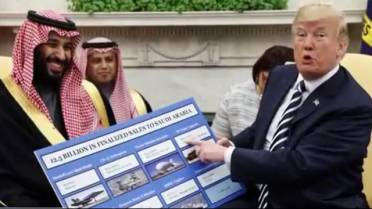 Why proposals to sell nuclear reactors to Saudi Arabia raise
 red flags, The Conversation, Chen Kane,Director, Middle East Nonproliferation Program, Middlebury, February 23, 2019 According to a congressional report, a group that includes former senior U.S. government officials is lobbying to sell nuclear power plants to Saudi Arabia. As an expert focusing on the Middle East and the spread of nuclear weapons, I believe these efforts raise important legal, economic and strategic concerns.
It is understandable that the Trump administration might want to support the U.S. nuclear industry, which is shrinking at home. However, the congressional report raised concerns that the group seeking to make the sale may have have sought to carry it out without going through the process required under U.S. law. Doing so could give Saudi Arabia U.S. nuclear technology without appropriate guarantees that it would not be used for nuclear weapons in the future.
A competitive global market
Exporting nuclear technology is lucrative, and many U.S. policymakers have long believed that it promotes U.S. foreign policy interests. However, the international market is shrinking, and competition between suppliers is stiff.
Private U.S. nuclear companies have trouble competing against state-supported international suppliers in Russia and China. These companies offer complete construction and operation packages with attractive financing options. Russia, for example, is willing to accept spent fuel from the reactor it supplies, relieving host countries of the need to manage nuclear waste. And China can offer lower construction costs.
Saudi Arabia declared in 2011 that it planned to spend over US$80 billion to construct 16 reactors, and U.S. companies want to provide them. Many U.S. officials see the decadeslong relationships involved in a nuclear sale as an opportunity to influence Riyadh’s nuclear future and preserve U.S. influence in the Saudi kingdom.
Why does Saudi Arabia want nuclear power?
With the world’s second-largest known petroleum reserves, abundant untapped supplies of natural gas and high potential for solar energy, why is Saudi Arabia shopping for nuclear power? Some of its motives are benign, but others are worrisome. ………..
US nuclear trade regulations
Under the U.S. Atomic Energy Act, before American companies can compete to export nuclear reactors to Saudi Arabia, Washington and Riyadh must conclude a nuclear cooperation agreement, and the U.S. government must submit it to Congress. Unless Congress adopts a joint resolution within 90 days disapproving the agreement, it is approved. The United States currently has 23 nuclear cooperation agreements in force, including Middle Eastern countries such as Egypt (approved in 1981), Turkey (2008) and the United Arab Emirates (2009).
The Atomic Energy Act requires countries seeking to purchase U.S. nuclear technology to make legally binding commitments that they will not use those materials and equipment for nuclear weapons, and to place them under International Atomic Energy Agency safeguards. It also mandates that the United States must approve any uranium enrichment or plutonium separation activities involving U.S. technologies and materials, in order to prevent countries from diverting them to weapons use.
American nuclear suppliers claim that these strict conditions and time-consuming legal requirements put them at a competitive disadvantage. But those conditions exist to prevent countries from misusing U.S. technology for nuclear weapons. I find it alarming that according to the House report, White House officials may have attempted to bypass or sidestep these conditions – potentially enriching themselves in the process.
According to the congressional report, within days of President Trump’s inauguration, senior U.S. officials were promoting an initiative to transfer nuclear technology to Saudi Arabia, without either concluding a nuclear cooperation agreement and submitting it to Congress or involving key government agencies, such as the Department of Energy or the Nuclear  Regulatory Commission. One key advocate for this so-called “Marshall Plan” for nuclear reactors in the Middle East was then-national security adviser Michael Flynn, who reportedly served as an adviser to a subsidiary of IP3, the firm that devised this plan, while he was advising Trump’s presidential campaign.
The promoters of the plan also reportedly proposed to sidestep U.S. sanctions against Russia by partnering with Russian companies – which impose less stringent restrictions on nuclear exports – to sell reactors to Saudi Arabia.
Flynn resigned soon afterward and now is cooperating with the investigation into Russian interference in the 2016 campaign. But IP3 access to the White House persists: According to press reports, President Trump met with representatives of U.S. industry, a meeting organized by IP3 to discuss nuclear exports to Saudi Arabia as recently as mid-February 2019……..https://theconversation.com/why-proposals-to-sell-nuclear-reactors-to-saudi-arabia-raise-red-flags-112276
February 25, 2019
Posted by Christina Macpherson |
business and costs, politics, politics international, Saudi Arabia, USA, weapons and war |
1 Comment
 Guardian 23rd Feb 2019 The idea that the US might sell state-of-the-art nuclear technology to
Saudi Arabia, potentially enabling Crown Prince Mohammed bin Salman’s reckless regime to build nuclear weapons, sounds so far-fetched as to be almost grotesque.
After all the near-hysterical American and Israeli warnings about the risk of Iran, the Saudis’ arch-rival, acquiring the
bomb, surely even Donald Trump would balk at such breathtaking – and dangerous – hypocrisy? Apparently not.
According to a congressional inquiry, senior White House officials, retired generals and Trump’s close relatives and business cronies have been secretly pursuing a multibillion-dollar scheme to cut a nuclear deal with Riyadh.
The talks are said to be continuing, despite increased public scrutiny and legal advice that a technology transfer lacking strict conditions could contravene US law, breach international counter-proliferation safeguards, and fuel a
nuclear arms race.
https://www.theguardian.com/us-news/2019/feb/23/trump-cronies-secret-talks-nuclear-tech-saudi-arabia
February 25, 2019
Posted by Christina Macpherson |
Saudi Arabia, secrets,lies and civil liberties, USA |
Leave a comment
Why was the Trump administration so eager to give nuclear technology to the reckless Saudi regime? https://www.washingtonpost.com/opinions/global-opinions/why-was-the-trump-administration-so-eager-to-give-nuclear-technology-to-the-reckless-saudi-regime/2019/02/21/e40e38e6-353c-11e9-a400-e481bf264fdc_story.html?utm_term=.cdaa56e24b47, By Editorial Board, February 21 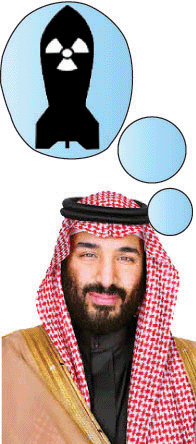 SAUDI ARABIA’s Crown Prince Mohammed bin Salman has built a record of reckless aggression against opponents both at home and abroad. He has also declared on at least one occasion that his regime could seek to acquire nuclear weapons. It would seem common-sensical for the United States to avoid transferring any nuclear technology to his regime without ironclad guarantees that it could not be used to build bombs. Yet the Trump administration appears to have persisted in considering proposals to do just that — in part at the urging of senior officials and lobbyists with troubling conflicts of interest. SAUDI ARABIA’s Crown Prince Mohammed bin Salman has built a record of reckless aggression against opponents both at home and abroad. He has also declared on at least one occasion that his regime could seek to acquire nuclear weapons. It would seem common-sensical for the United States to avoid transferring any nuclear technology to his regime without ironclad guarantees that it could not be used to build bombs. Yet the Trump administration appears to have persisted in considering proposals to do just that — in part at the urging of senior officials and lobbyists with troubling conflicts of interest.
A report by the Democratic staff of the House Oversight and Reform Committee this week provided new details of how former national security adviser Michael Flynn and other National Security Council officials attempted to rush through a plan for U.S. companies to sell nuclear power plants to Saudi Arabia in the early weeks of the Trump administration. Ignoring warnings by career officials that they could violate laws on technology transfers, as well as conflict-of-interest rules, they pushed a scheme drawn up by a firm represented by several well-connected retired generals.
According to the committee report, Mr. Flynn had identified himself as an adviser to the company, and the plan called for President Trump to appoint his close friend Tom Barrack to oversee a deal with the Saudis even though his private business has raised considerable funds from Saudi investors.
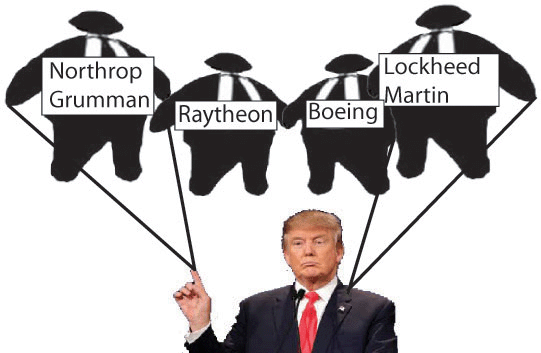
Though the NSC initiative appears to have been squelched by H.R. McMaster, who replaced Mr. Flynn, negotiations with the Saudis have quietly continued under Energy Secretary Rick Perry. As recently as last week, Mr. Trump held a meeting with nuclear company executives in the Oval Office to discuss power-plant sales to Saudi Arabia. The session was organized by the firm that previously collaborated with Mr. Flynn, and the shadows of possible conflicts of interest persist. One of the nuclear companies, Westinghouse Electric, is owned by a firm that also bought a stake in a troubled Manhattan skyscraper owned by Jared Kushner’s family company. Mr. Kushner, a key interlocutor with Mohammed bin Salman, is due to visit the kingdom again next week.
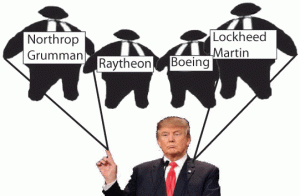 There is an argument to be made for U.S. firms selling nuclear plants to Saudi Arabia: If the kingdom is determined to acquire them, then it would be better it do so from U.S. companies than from their Russian or Chinese competitors. But that logic holds only if the administration negotiates a deal with Riyadh imposing strict controls on the technology. In the case of Saudi Arabia, the only responsible accord would be one that prohibited the regime from any enrichment of uranium or reprocessing of spent fuel — techniques that can be used to build nuclear weapons. There is an argument to be made for U.S. firms selling nuclear plants to Saudi Arabia: If the kingdom is determined to acquire them, then it would be better it do so from U.S. companies than from their Russian or Chinese competitors. But that logic holds only if the administration negotiates a deal with Riyadh imposing strict controls on the technology. In the case of Saudi Arabia, the only responsible accord would be one that prohibited the regime from any enrichment of uranium or reprocessing of spent fuel — techniques that can be used to build nuclear weapons.
Unsurprisingly, the arrogant crown prince is refusing to accept those terms — probably because he wishes to preserve a nuclear-arms option. Though federal law requires the United States to negotiate a protocol on the conditions for supplying nuclear technology and submit that to Congress, it does not mandate those conditions. So Congress must insist that any nuclear deal with Saudi Arabia embrace this gold standard. To do otherwise would only compound the danger posed by Mohammed bin Salman.
|
|
|
February 23, 2019
Posted by Christina Macpherson |
business and costs, politics international, Saudi Arabia, USA, weapons and war |
Leave a comment
Zarif decries ‘US hypocrisy’ over planned nuclear sale to Saudis
Neither human rights or a burgeoning nuclear programme are a real concern for the US, Iran’s foreign minister  says. Aljazeera, 21 Feb 19, Iranian Foreign Minister Mohammad Javad Zarif accused the US of hypocrisy for allegedly attempting to sell nuclear technology to Saudi Arabia while Washington tries to wreck Iran’s nuclear programme.
Zarif’s comment on Twitter on Wednesday came after reports the administration of President Donald Trump is trying to bypass US Congress to advance the sale of nuclear power plants to Saudi Arabia.
“Day by day it becomes clearer to the world what was always clear to us: neither human rights nor a nuclear program have been the real concern of the US,” Zarif wrote.
“First a dismembered journalist; now illicit sale of nuclear technology to Saudi Arabia fully expose #USHypocrisy,” Zarif added, referring to the killing of Saudi writer Jamal Khashoggi at the hands of Saudi agents, and the new report by a US congressional committee on the planned technology sale. …….
Mohammad Ali Shabani, Iran Pulse Editor at Al-Monitor, said he doubted the US would sell uranium-enrichment technology to Saudi Arabia and, therefore, Riyadh would not have the capability to develop a nuclear weapon.
“However, the sidestepping of America’s own laws to facilitate sales of nuclear power plants puts the Trump administration’s broader credibility under question,” Shabani told Al Jazeera.
‘Terrorist attack’
Tensions between Washington and Tehran – bitter foes since Iran’s 1979 revolution – have intensified since Trump withdrew the US from the Joint Comprehensive Plan of Action (JCPOA), better known as the Iran nuclear deal, under which it scaled back its uranium enrichment programme and promised not to pursue nuclear weapons.
In exchange for the deal signed in 2015 in Vienna with six world powers – the US, UK, France, Germany, Russia, China and the European Union – international sanctions were lifted allowing Iran to sell its oil and gas worldwide.
Trump reimposed sanctions with the aim of slashing Iranian oil sales and choking its economy in order to curb its ballistic missile programme and activities in the Middle East, especially in the conflicts in Syria and Yemen.
Iranian President Hassan Rouhani said on Wednesday Iran-US relations are at a new low and sanctions imposed by the Trump administration targeting Tehran’s oil and banking sectors amounted to “a terrorist attack”.
“The struggle between Iran and America is currently at a maximum. America has employed all its power against us,” Rouhani was quoted as saying in a cabinet meeting by the state broadcaster IRIB.
“The US pressures on firms and banks to halt business with Iran is 100 percent a terrorist act,” he said.
The International Atomic Energy Agency (IAEA) has repeatedly confirmed Tehran has been meeting its nuclear commitments fully.
‘Khashoggi cover-up’
The Trump administration has faced additional congressional opposition due to concerns about the role of Saudi Crown Prince Mohammed bin Salman (MBS) in the murder of Jamal Khashoggi……. https://www.aljazeera.com/news/2019/02/zarif-decries-hypocrisy-planned-nuclear-sale-saudis-190220100506949.html
February 21, 2019
Posted by Christina Macpherson |
Iran, politics international, Saudi Arabia, USA |
Leave a comment
 US will not open door to Saudi Arabia building nuclear weapons, deputy energy secretary says CNBC David Reid| 17 Feb 2019
- The Trump administration wants to sell its nuclear energy technology to cash-rich Saudi Arabia.
- To prevent nuclear arms development, the U.S. wants to place tight controls on how the technology can be used.
- Saudi Arabia has put the U.S. on a shortlist with China, Russia and others to bid for nuclear power projects in the country.
“………….The Saudis have so far refused to rule out their right to enrich uranium for nuclear weapons, pointing to neighboring Iran’s ability to do so under the 2015 nuclear agreement that world powers struck with Tehran.
In an interview in March on CBS’s “60 Minutes” Saudi Crown Prince Mohammed bin Salman said the country wasn’t interested in developing weapons but would develop nuclear capability should Iran ever develop a working nuclear bomb.
On Sunday, Saudi Arabian Prince Turki Al-Faisal responded directly to Brouillette’s words, saying the country had more options than just U.S. technology.
“Well the nuclear energy market is open. It is not just the United States that is providing nuclear technology,” he told CNBC’s Hadley Gamble in Munich.
“We have France, we have Russia, we have China. We have our friends in Pakistan and in other places as well, so if they want to remove themselves from that market, well, that’s up to them.” https://www.cnbc.com/2019/02/16/brouillette-us-wont-give-saudi-arabia-key-to-nuclear-weapon-building.html
February 18, 2019
Posted by Christina Macpherson |
politics international, Saudi Arabia, weapons and war |
Leave a comment
World War 3 fears SURGE as experts warn Saudi Arabia could be seeking ‘NUCLEAR weapons’
FEARS Saudi Arabia could be seeking to build nuclear weapons have surged following reports the Kingdom has launched a domestic ballistic missile programme. Express UK By JAMES BICKERTON, Jan 25, 2019 According to a report published in The Washington Post, Saudi Arabia appears to have constructed a ballistic missile factory, which could threaten to trigger a new Middle Eastern arms race. Saudi Arabia already owns foreign-brought ballistic missiles but has yet to construct its own. A number of experts have warned this could signal a Saudi desire to become nuclear armed.
Satellite images taken in November appear to show a ballistic missile factory near the town of Al-Watah, according to the report.
The site is situated next to an existing Saudi Arabian missile base.
A team led by nuclear expert Jeffrey Lewis, from the Middlebury Institute of International Studies, uncovered the pictures.
Mr Lewis said the images raise “the possibility that Saudi Arabia is going to build longer-range missiles and seek nuclear weapons”…..https://www.express.co.uk/news/world/1077486/World-War-3-Saudi-Arabia-nuclear-weapons-Middle-East-arms-race
January 26, 2019
Posted by Christina Macpherson |
Saudi Arabia, weapons and war |
Leave a comment
Saudi Arabia Receives Offers from 5 Countries to Build 2 Nuclear Reactors 23 January, 2019 Riyadh – Asharq Al-Awsat
Five countries have submitted their requests for the establishment of two nuclear reactors in Saudi Arabia on the Arabian Gulf coast.
The bid was made after the peaceful Saudi nuclear project met the requirements of the International Atomic Energy Agency (IAEA).
The oil-rich Kingdom launched a tender to define specifications of sites that will host the two reactors, said Chairman of King Abdullah City for Atomic and Renewable Energy (KACARE) Khalid al-Sultan.
He added that KACARE asked the services providers in the US, Russia, France, South Korea and China to present their preliminary offers……. https://aawsat.com/english/home/article/1558606/saudi-arabia-receives-offers-5-countries-build-2-nuclear-reactors
January 24, 2019
Posted by Christina Macpherson |
marketing, Saudi Arabia |
Leave a comment