
 Guardian 23rd Feb 2019 The idea that the US might sell state-of-the-art nuclear technology to
Saudi Arabia, potentially enabling Crown Prince Mohammed bin Salman’s reckless regime to build nuclear weapons, sounds so far-fetched as to be almost grotesque.
After all the near-hysterical American and Israeli warnings about the risk of Iran, the Saudis’ arch-rival, acquiring the
bomb, surely even Donald Trump would balk at such breathtaking – and dangerous – hypocrisy? Apparently not.
According to a congressional inquiry, senior White House officials, retired generals and Trump’s close relatives and business cronies have been secretly pursuing a multibillion-dollar scheme to cut a nuclear deal with Riyadh.
The talks are said to be continuing, despite increased public scrutiny and legal advice that a technology transfer lacking strict conditions could contravene US law, breach international counter-proliferation safeguards, and fuel a
nuclear arms race.
https://www.theguardian.com/us-news/2019/feb/23/trump-cronies-secret-talks-nuclear-tech-saudi-arabia
February 25, 2019
Posted by Christina Macpherson |
Saudi Arabia, secrets,lies and civil liberties, USA |
Leave a comment
Why was the Trump administration so eager to give nuclear technology to the reckless Saudi regime? https://www.washingtonpost.com/opinions/global-opinions/why-was-the-trump-administration-so-eager-to-give-nuclear-technology-to-the-reckless-saudi-regime/2019/02/21/e40e38e6-353c-11e9-a400-e481bf264fdc_story.html?utm_term=.cdaa56e24b47, By Editorial Board, February 21 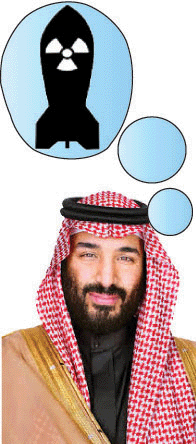 SAUDI ARABIA’s Crown Prince Mohammed bin Salman has built a record of reckless aggression against opponents both at home and abroad. He has also declared on at least one occasion that his regime could seek to acquire nuclear weapons. It would seem common-sensical for the United States to avoid transferring any nuclear technology to his regime without ironclad guarantees that it could not be used to build bombs. Yet the Trump administration appears to have persisted in considering proposals to do just that — in part at the urging of senior officials and lobbyists with troubling conflicts of interest. SAUDI ARABIA’s Crown Prince Mohammed bin Salman has built a record of reckless aggression against opponents both at home and abroad. He has also declared on at least one occasion that his regime could seek to acquire nuclear weapons. It would seem common-sensical for the United States to avoid transferring any nuclear technology to his regime without ironclad guarantees that it could not be used to build bombs. Yet the Trump administration appears to have persisted in considering proposals to do just that — in part at the urging of senior officials and lobbyists with troubling conflicts of interest.
A report by the Democratic staff of the House Oversight and Reform Committee this week provided new details of how former national security adviser Michael Flynn and other National Security Council officials attempted to rush through a plan for U.S. companies to sell nuclear power plants to Saudi Arabia in the early weeks of the Trump administration. Ignoring warnings by career officials that they could violate laws on technology transfers, as well as conflict-of-interest rules, they pushed a scheme drawn up by a firm represented by several well-connected retired generals.
According to the committee report, Mr. Flynn had identified himself as an adviser to the  company, and the plan called for President Trump to appoint his close friend Tom Barrack to oversee a deal with the Saudis even though his private business has raised considerable funds from Saudi investors. company, and the plan called for President Trump to appoint his close friend Tom Barrack to oversee a deal with the Saudis even though his private business has raised considerable funds from Saudi investors.
Though the NSC initiative appears to have been squelched by H.R. McMaster, who replaced Mr. Flynn, negotiations with the Saudis have quietly continued under Energy Secretary Rick  Perry. As recently as last week, Mr. Trump held a meeting with nuclear company executives in the Oval Office to discuss power-plant sales to Saudi Arabia. The session was organized by the firm that previously collaborated with Mr. Flynn, and the shadows of possible conflicts of interest persist. One of the nuclear companies, Westinghouse Electric, is owned by a firm that also bought a stake in a troubled Manhattan skyscraper owned by Jared Kushner’s family company. Mr. Kushner, a key interlocutor with Mohammed bin Salman, is due to visit the kingdom again next week. Perry. As recently as last week, Mr. Trump held a meeting with nuclear company executives in the Oval Office to discuss power-plant sales to Saudi Arabia. The session was organized by the firm that previously collaborated with Mr. Flynn, and the shadows of possible conflicts of interest persist. One of the nuclear companies, Westinghouse Electric, is owned by a firm that also bought a stake in a troubled Manhattan skyscraper owned by Jared Kushner’s family company. Mr. Kushner, a key interlocutor with Mohammed bin Salman, is due to visit the kingdom again next week.
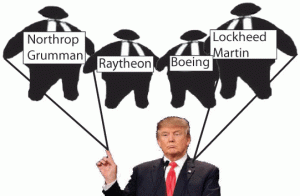 There is an argument to be made for U.S. firms selling nuclear plants to Saudi Arabia: If the kingdom is determined to acquire them, then it would be better it do so from U.S. companies than from their Russian or Chinese competitors. But that logic holds only if the administration negotiates a deal with Riyadh imposing strict controls on the technology. In the case of Saudi Arabia, the only responsible accord would be one that prohibited the regime from any enrichment of uranium or reprocessing of spent fuel — techniques that can be used to build nuclear weapons. There is an argument to be made for U.S. firms selling nuclear plants to Saudi Arabia: If the kingdom is determined to acquire them, then it would be better it do so from U.S. companies than from their Russian or Chinese competitors. But that logic holds only if the administration negotiates a deal with Riyadh imposing strict controls on the technology. In the case of Saudi Arabia, the only responsible accord would be one that prohibited the regime from any enrichment of uranium or reprocessing of spent fuel — techniques that can be used to build nuclear weapons.
Unsurprisingly, the arrogant crown prince is refusing to accept those terms — probably because he wishes to preserve a nuclear-arms option. Though federal law requires the United States to negotiate a protocol on the conditions for supplying nuclear technology and submit that to Congress, it does not mandate those conditions. So Congress must insist that any nuclear deal with Saudi Arabia embrace this gold standard. To do otherwise would only compound the danger posed by Mohammed bin Salman.
|
|
|
February 23, 2019
Posted by Christina Macpherson |
business and costs, politics international, Saudi Arabia, USA, weapons and war |
Leave a comment
Zarif decries ‘US hypocrisy’ over planned nuclear sale to Saudis
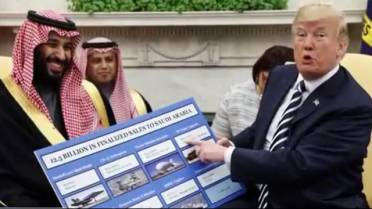
Neither human rights or a burgeoning nuclear programme are a real concern for the US, Iran’s foreign minister  says. Aljazeera, 21 Feb 19, Iranian Foreign Minister Mohammad Javad Zarif accused the US of hypocrisy for allegedly attempting to sell nuclear technology to Saudi Arabia while Washington tries to wreck Iran’s nuclear programme.
Zarif’s comment on Twitter on Wednesday came after reports the administration of President Donald Trump is trying to bypass US Congress to advance the sale of nuclear power plants to Saudi Arabia.
“Day by day it becomes clearer to the world what was always clear to us: neither human rights nor a nuclear program have been the real concern of the US,” Zarif wrote.
“First a dismembered journalist; now illicit sale of nuclear technology to Saudi Arabia fully expose #USHypocrisy,” Zarif added, referring to the killing of Saudi writer Jamal Khashoggi at the hands of Saudi agents, and the new report by a US congressional committee on the planned technology sale. …….
Mohammad Ali Shabani, Iran Pulse Editor at Al-Monitor, said he doubted the US would sell uranium-enrichment technology to Saudi Arabia and, therefore, Riyadh would not have the capability to develop a nuclear weapon.
“However, the sidestepping of America’s own laws to facilitate sales of nuclear power plants puts the Trump administration’s broader credibility under question,” Shabani told Al Jazeera.
‘Terrorist attack’
Tensions between Washington and Tehran – bitter foes since Iran’s 1979 revolution – have intensified since Trump withdrew the US from the Joint Comprehensive Plan of Action (JCPOA), better known as the Iran nuclear deal, under which it scaled back its uranium enrichment programme and promised not to pursue nuclear weapons.
In exchange for the deal signed in 2015 in Vienna with six world powers – the US, UK, France, Germany, Russia, China and the European Union – international sanctions were lifted allowing Iran to sell its oil and gas worldwide.
Trump reimposed sanctions with the aim of slashing Iranian oil sales and choking its economy in order to curb its ballistic missile programme and activities in the Middle East, especially in the conflicts in Syria and Yemen.
Iranian President Hassan Rouhani said on Wednesday Iran-US relations are at a new low and sanctions imposed by the Trump administration targeting Tehran’s oil and banking sectors amounted to “a terrorist attack”.
“The struggle between Iran and America is currently at a maximum. America has employed all its power against us,” Rouhani was quoted as saying in a cabinet meeting by the state broadcaster IRIB.
“The US pressures on firms and banks to halt business with Iran is 100 percent a terrorist act,” he said.
The International Atomic Energy Agency (IAEA) has repeatedly confirmed Tehran has been meeting its nuclear commitments fully.
‘Khashoggi cover-up’
The Trump administration has faced additional congressional opposition due to concerns about the role of Saudi Crown Prince Mohammed bin Salman (MBS) in the murder of Jamal Khashoggi……. https://www.aljazeera.com/news/2019/02/zarif-decries-hypocrisy-planned-nuclear-sale-saudis-190220100506949.html
February 21, 2019
Posted by Christina Macpherson |
Iran, politics international, Saudi Arabia, USA |
Leave a comment
 US will not open door to Saudi Arabia building nuclear weapons, deputy energy secretary says CNBC David Reid| 17 Feb 2019
- The Trump administration wants to sell its nuclear energy technology to cash-rich Saudi Arabia.
- To prevent nuclear arms development, the U.S. wants to place tight controls on how the technology can be used.
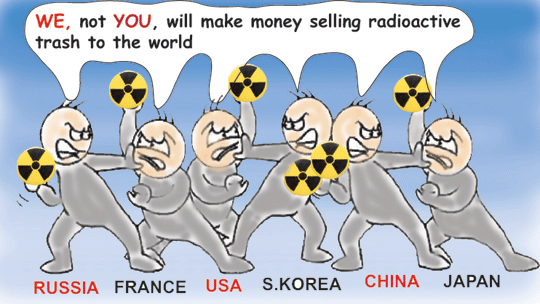
- Saudi Arabia has put the U.S. on a shortlist with China, Russia and others to bid for nuclear power projects in the country.
“………….The Saudis have so far refused to rule out their right to enrich uranium for nuclear weapons, pointing to neighboring Iran’s ability to do so under the 2015 nuclear agreement that world powers struck with Tehran.
In an interview in March on CBS’s “60 Minutes” Saudi Crown Prince Mohammed bin Salman said the country wasn’t interested in developing weapons but would develop nuclear capability should Iran ever develop a working nuclear bomb.
On Sunday, Saudi Arabian Prince Turki Al-Faisal responded directly to Brouillette’s words, saying the country had more options than just U.S. technology.
“Well the nuclear energy market is open. It is not just the United States that is providing nuclear technology,” he told CNBC’s Hadley Gamble in Munich.
“We have France, we have Russia, we have China. We have our friends in Pakistan and in other places as well, so if they want to remove themselves from that market, well, that’s up to them.” https://www.cnbc.com/2019/02/16/brouillette-us-wont-give-saudi-arabia-key-to-nuclear-weapon-building.html
February 18, 2019
Posted by Christina Macpherson |
politics international, Saudi Arabia, weapons and war |
Leave a comment
 World War 3 fears SURGE as experts warn Saudi Arabia could be seeking ‘NUCLEAR weapons’
FEARS Saudi Arabia could be seeking to build nuclear weapons have surged following reports the Kingdom has launched a domestic ballistic missile programme. Express UK By JAMES BICKERTON, Jan 25, 2019 According to a report published in The Washington Post, Saudi Arabia appears to have constructed a ballistic missile factory, which could threaten to trigger a new Middle Eastern arms race. Saudi Arabia already owns foreign-brought ballistic missiles but has yet to construct its own. A number of experts have warned this could signal a Saudi desire to become nuclear armed.
Satellite images taken in November appear to show a ballistic missile factory near the town of Al-Watah, according to the report.
The site is situated next to an existing Saudi Arabian missile base.
A team led by nuclear expert Jeffrey Lewis, from the Middlebury Institute of International Studies, uncovered the pictures.
Mr Lewis said the images raise “the possibility that Saudi Arabia is going to build longer-range missiles and seek nuclear weapons”…..https://www.express.co.uk/news/world/1077486/World-War-3-Saudi-Arabia-nuclear-weapons-Middle-East-arms-race
January 26, 2019
Posted by Christina Macpherson |
Saudi Arabia, weapons and war |
Leave a comment
Saudi Arabia Receives Offers from 5 Countries to Build 2 Nuclear Reactors 23 January, 2019 Riyadh – Asharq Al-Awsat
Five countries have submitted their requests for the establishment of two nuclear reactors in Saudi Arabia on the Arabian Gulf coast.
The bid was made after the peaceful Saudi nuclear project met the requirements of the International Atomic Energy Agency (IAEA).
The oil-rich Kingdom launched a tender to define specifications of sites that will host the two reactors, said Chairman of King Abdullah City for Atomic and Renewable Energy (KACARE) Khalid al-Sultan.
He added that KACARE asked the services providers in the US, Russia, France, South Korea and China to present their preliminary offers……. https://aawsat.com/english/home/article/1558606/saudi-arabia-receives-offers-5-countries-build-2-nuclear-reactors
January 24, 2019
Posted by Christina Macpherson |
marketing, Saudi Arabia |
Leave a comment
Saudi Arabia to work closely with US on nuclear power plans, https://www.straitstimes.com/world/middle-east/saudi-arabia-to-work-closely-with-us-on-nuclear-power-plans JAN 10, 2019, RIYADH (REUTERS) – Saudi Arabia aims to work closely with the United States on its plans to build nuclear power generation capacity in the oil producing kingdom, the energy minister said on Wednesday (Jan 9).
Riyadh wants Washington to be “part and parcel” of Saudi Arabia’s nuclear programme, which will be entirely for peaceful purposes, Energy Minister Khalid al-Falih said.
He also said the United States was a key provider for nuclear technology.
January 12, 2019
Posted by Christina Macpherson |
politics international, Saudi Arabia |
Leave a comment

Lawmakers Want a Greater Say as U.S. Seeks a Saudi Nuclear Deal, Members of Congress from both parties demand that an agreement to sell Riyadh civilian nuclear technology be based on stringent controls, WSJ . By Michael R. Gordon, Dec. 16, 2018
The Trump administration’s push to sell civilian nuclear technology to Saudi Arabia is emerging as the next battleground in the struggle between the White House and Congress over U.S. policy toward Riyadh following the killing of journalist Jamal Khashoggi.
The debate over Riyadh’s nuclear ambitions intensified last week after Energy Secretary Rick Perry brushed aside congressional appeals that nuclear talks be suspended because of Mr. Khashoggi’s killing and traveled to Saudi Arabia, where he accentuated the role American companies could play in helping the country establish a nuclear energy program.
…….But the CIA assessment that Saudi Crown Prince Mohammed bin Salman likely ordered Mr. Khashoggi’s killing has fueled concerns in Congress that the Saudi leader is too ruthless to be entrusted with nuclear technology. Saudi Arabia has repeatedly said the crown prince had no knowledge of the operation.
Lawmakers of both parties are demanding a deal be based on the most stringent nonproliferation controls. And some are now pushing legislation that would give Congress more of a say by requiring that a nuclear accord with Saudi Arabia be approved by the Senate and the House of Representatives.
“Before Khashoggi, I would say our chances were quite modest,” said Rep. Brad Sherman, a California Democrat, referring to prospects of House legislation he is drafting. “Now I would have to say our chances are better than 50-50.”
An identical measure is being prepared in the Senate by Sens. Ed Markey (D., Mass.) and Marco Rubio (R., Fla.), though the prospects for winning approval are likely to be more challenging.
The prospective nuclear deal comes amid a broader debate over Saudi policy, including a Senate vote last week to halt U.S. support for the Saudi-led coalition that is fighting in Yemen.
Even since the Trump administration signaled its interest in a nuclear agreement with Saudi Arabia last year, there has been debate about proliferation controls that should be imposed under an accord authorizing the transfer of U.S. nuclear technology, known as a 123 agreement.
……..Nuclear experts have also said that it would be important for Saudi Arabia to agree to the “Additional Protocol,” a formal arrangement with the International Atomic Energy Agency that provides for far-reaching inspections. The Saudis have been resisting that step, former officials who have been tracking the talks say. A spokeswoman for the Saudi embassy didn’t respond to a request for comment..
……..Under current law, a nuclear cooperation agreement with Saudi Arabia would go forward unless congressional opponents backed a joint resolution against it. That means that two-thirds of the lawmakers would need to oppose the accord so Congress could overcome a potential veto.
Mr. Sherman’s new bill aims to put nuclear accord skeptics in a more favorable position by requiring the administration to win approval from both the Senate and the House. That means a simple majority in one legislative chamber would be enough to block the agreement…….https://www.wsj.com/articles/lawmakers-want-a-greater-say-as-u-s-seeks-a-saudi-nuclear-deal-11544990606
December 18, 2018
Posted by Christina Macpherson |
politics, Saudi Arabia, USA |
Leave a comment
US Nuclear Energy Policy & Khashoggi Murder: Appeasement Or Threat? Clean Technica, December 12th, 2018 by Tina Casey
The horrific murder of journalist Jamal Khashoggi last October continues to fester, and some of the blowback has been falling on the shoulders of the US tech sector. Rightfully so, considering the connection between Saudi wealth, Japan-based SoftBank, and Silicon Valley A-listers. Meanwhile, US President* Donald Trump has dismissed evidence that Saudi Crown Prince Mohammed bin Salman was directly responsible for the crime, but a recent nuclear energy announcement could indicate that someone in Trump’s cabinet is stirring the pot.
Khashoggi Or Not, Trump Administration Still Sharing Nuclear Energy Love With Saudi Arabia…
There is also a nuclear weapons angle to the story, but for now lets focus on the nuclear energy angle.
Despite its vast solar and wind resources, Saudi Arabia has expressed a growing interest in building a fleet of power plants fueled by nuclear energy.
CleanTechnica has been among those taking note, though not in any particular depth — until earlier this week, when the US Department of Energy released a readout of Energy Secretary Rick Perry’s recent visit with the Saudi Minister of Energy, as well as the CEO of Saudi Aramco and other officials.
The readout hit the Intertubes just about the time word leaked out that there is now a written transcript of the audiotape that recorded the last minutes of Khashoggi’s life.
Anyone — even those who do not speak Arabic — can now read and understand the last words that Khashoggi screamed out in the course of his murder.
So, was the readout yet another example of Secretary Perry tone deafness? Or was it yet another one of his curiously timed missives that undercut White House policy even while seeming to affirm it.
Here, you do the math. This is where the readout deals with the visit to Saudi Arabia (Perry also went to Qatar on the same trip):
…the Secretary expressed that the United States continues to view Saudi Arabia as an important ally, particularly in the energy space. Perry and Al-Falih spoke about last week’s OPEC announcement of production cuts and Perry reiterated the need for stable supply and market values. They also discussed the 2018 increase in Saudi oil production and the impact it has had on world markets in the wake of the Iran sanctions.
And, here’s the summary message (emphasis added):
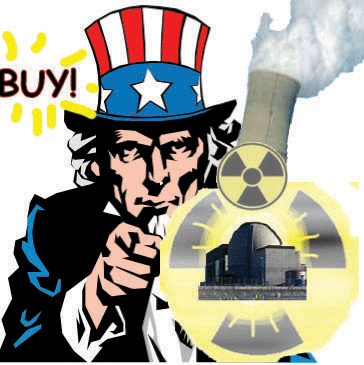
Secretary Perry underscored the message that he carries all over the world: any nation seeking to develop a truly safe, clean, and secure nuclear energy program should turn to American companies who have the ability to provide the technology, knowledge, and experience that are essential to achieving that goal.
The US nuclear energy industry is in a state of near collapse, domestically speaking. As with coal power, the only hope for growth is to export the technology elsewhere…but the readout makes it clear there are standards to be met.
Or Not
The readout is not particularly startling in and of itself, though there is a lot to chew on between the lines.
What really sticks out is the summary message. It could be read in two different ways.
Number one, Secretary Perry was blithely pitching the US nuclear energy industry to the Saudi government, ignoring — as per White House policy — the latest revelations about the Khashoggi murder.
That would be consistent with the Rick Perry, who toes the Trump line on a whole host of other issues, inside and outside of the energy space.
Number two relates to the other Rick Perry — the one who has consistently pushed for the Department of Energy’s scientific and renewable energy missions, even when (or perhaps especially when) those missions clash with Trump’s anti-science, pro-coal rhetoric.
In this scenario, the nuclear message is not a pitch. It’s practically the opposite: a reminder that the US holds the nuclear energy cards.
To be clear, the US doesn’t hold all the nuclear energy cards, but it does hold enough of them to make trouble. Earlier this fall, for example, the Trump administration announced new restrictions on nuclear technology exports to China. Though some have downplayed the impact, that’s gotta hurt.
As applied to the Saudi government, Perry could wield the authority of his agency under its nonproliferation mission as a stick, not a carrot.
Or, maybe not. If you apply Occam’s razor to the readout, it is just what it is: a message that, Khashoggi or not, it’s business as usual between Saudi Arabia and the US.
What do you think? Drop us a note in the comment thread! ………… https://cleantechnica.com/2018/12/12/us-nuclear-energy-policy-khashoggi-murder-appeasement-or-threat/
December 18, 2018
Posted by Christina Macpherson |
politics international, Saudi Arabia, USA |
Leave a comment
 US Nuclear Energy Policy & Khashoggi Murder: Appeasement Or Threat? Clean Technica, December 12th, 2018 by Tina Casey “…………..The Nuclear Energy Connection
Either way, that brings us around to the idea that the corporate world needs to step up and press for meaningful action on the Khashoggi case, since the White House is falling down on the job.
In particular, the tech sector is feeling the pressure not only because of its financial ties to Saudi Arabia, but also because of the high profile of its biggest players.
That brings us right back around to the nuclear energy angle, where the US nuclear company TerraPower has been making waves.
TerraPower was formed back in 2006 and crossed the CleanTechnica radar during COP 2015, when it popped up in relation to a newly launched investor umbrella organization called the Breakthrough Energy Coalition.
Breakthrough is a tech incubator with a focus on clean energy and rapid decarbonization, and nuclear energy makes the cut.
As a global organization, Breakthrough can provide TerraPower with a platform for pitching its technology overseas — a key consideration, given the morbid state of demand for new nuclear power plants here in the US.
So far TerraPower has been focusing on foreign markets, particularly China, for its new technology.
If all of this is beginning to ring some bells, that’s where the tech and Silicon Valley connections kick in.
Microsoft’s Bill Gates is financial backer of TerraPower and chairman of its board.
Gates is also the chair of the Breakthrough Coalition’s Breakthrough Energy Ventures, where you’ll find a host of other familiar top-dollar investors with an interest in decarbonization including Jeff Bezos, Richard Branson, Vinod Khosla, and Michael Bloomberg.
Saudi Arabia is represented among Breakthrough members through Prince Alwaleed bin Talal, who is Chairman of Alwaleed Philanthropies and a supporter of Gates’s “giving pledge.”
Saudi Arabia is also represented among the 24 countries (including the EU) that support the Mission Innovation clean energy initiative, which is in turn receives considerable support from Breakthrough, so there’s that.
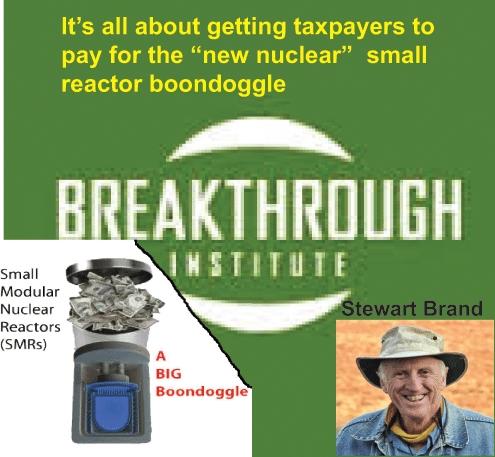
Not for nothing, but as of last August the Department of Energy has supported a TerraPower molten salt reactor project with $28 million in cost-shared funds.
When Will The Silicon Valley Crickets Stop Chirping And Start Acting?
All this is by way of saying that when it comes to the Saudi government, the Khashoggi murder, and the cash flow, all roads lead back to Silicon Valley and the US tech sector.
The New York Times raised a red flag on Saudi financial ties to Silicon Valley last year. Among other developments since then, Tesla has been ramping up its profile in the country, and Google has expressed interest in building data centers there.
Perhaps it’s not fair for the tech sector to take all the heat, but on the other hand these are the guys who promised to make life better for millions if not billions of people all over the world. More is expected of them than, say, the CEO of a local pest control company.
The Trump family’s financial ties with Saudi Arabia seem to be the driving force behind Trump’s response to the Khashoggi murder, and now it seems those same ties have silenced the US tech sector.
The fact is that the Khashoggi murder is not going away. New details about the murder are emerging on a regular basis, and even Trump’s Republican allies have finally stirred into action.
In the latest development, today the US Senate is reportedly set to debate cutting off US support for the Saudi-lead war in Yemen. The measure has been linked directly to outrage over the country’s role in the Khashoggi killing.
Meanwhile, CleanTechnica is reaching out to TerraPower for comment, so stay tuned for more on that.
Follow me on Twitter. https://cleantechnica.com/2018/12/12/us-nuclear-energy-policy-khashoggi-murder-appeasement-or-threat/
December 17, 2018
Posted by Christina Macpherson |
business and costs, Saudi Arabia, secrets,lies and civil liberties, USA |
1 Comment
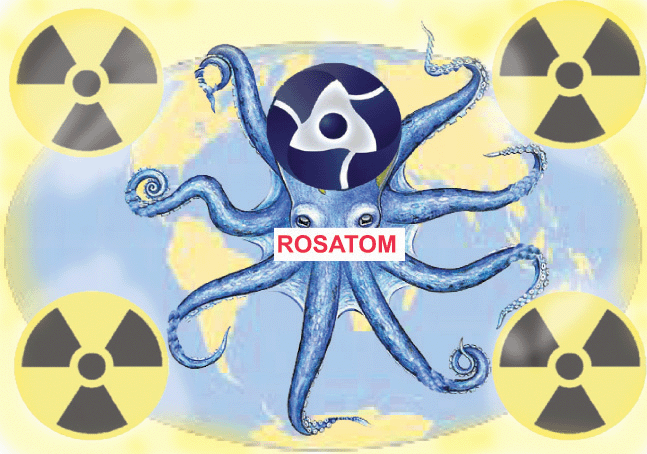
 Riyadh hosts workshop on Russian nuclear technology RIYADH — ROSATOM State Atomic Energy Corporation organized a workshop on Russian nuclear technologies in Riyadh on Dec. 5 for representatives of Saudi companies. The event was held at the Council of Saudi Chambers of Commerce………
Milos Mostecky, vice president of Rusatom Overseas, highlighted the vast experience of ROSATOM in engaging local suppliers while projects implementation abroad.
“We are confident that Saudi companies are ready to take part in large-scale projects in power sector. Our Saudi partners are willing to participate in NPP construction in Saudi Arabia and think highly to perspective of cooperation with Rosatom,” Mostecky added.
In June 2018, ROSATOM was shortlisted to the next stage of competitive dialogue on Saudi Arabia’s first nuclear power project.
Russia and Saudi Arabia signed an Intergovernmental Agreement on cooperation in the field of nuclear energy for peaceful purposes. On Oct. 5, 2017, ROSATOM and King Abdullah City for Atomic and Renewable Energy signed Program for Cooperation in the peaceful uses of nuclear energy. According to the program, Russia and Saudi Arabia intended to cooperate in the field of small and medium reactors, nuclear infrastructure development, consideration of prospects for establishing a center for nuclear science and technology in the Kingdom of Saudi Arabia based on a Russian-design research reactor etc…….
http://saudigazette.com.sa/article/550060/SAUDI-ARABIA/Riyadh-hosts-workshop-onRussian-nuclear-technology
December 13, 2018
Posted by Christina Macpherson |
marketing, Russia, Saudi Arabia |
Leave a comment
 US, Saudi Arabia back-of-the-pack on curbing climate change, Researchers have identified the United States and Saudi Arabia as the climate change laggards. https://www.sbs.com.au/news/us-saudi-arabia-back-of-the-pack-on-curbing-climate-changeThe United States and Saudi Arabia rank last when it comes to curbing climate change among the 56 nations accounting for 90 percent of planet-warming greenhouse gas emissions, researchers said Monday.A large number of laggards means the world is dangerously off-track when it comes to slashing the carbon pollution that has already amplified droughts, flooding and deadly heatwaves worldwide, they reported on the margins of UN climate talks in Katowice, Poland.
Only a few countries have started to implement strategies to limit global warming well below 2 degrees Celsius (3.6 degrees Fahrenheit),” the cornerstone target of the 2015 Paris climate treaty, according to NewClimate Institute and Germanwatch, an NGO.
Most governments “lack the political will to phase out fossil fuels with the necessary speed.” Continue reading →
December 11, 2018
Posted by Christina Macpherson |
climate change, Saudi Arabia, USA |
Leave a comment
Guardian, Jonathan Wattsand Ben DohertyMon 10 Dec 2018 , Move shocks delegates at UN cnference as ministers fly in for final week of climate talks The US and Russia have thrown climate talks into disarray by allying with Saudi Arabia and Kuwait to water down approval of a
landmark report on the need to keep global warming below 1.5C.
After a heated two-and-a-half-hour debate on Saturday night, the backwards step by the four major oil producers shocked delegates at the UN climate conference in Katowice as ministers flew in for the final week of high-level discussions.
It has also raised fears among scientists that the US president, Donald Trump, is going from passively withdrawing from climate talks to actively undermining them alongside a coalition of climate deniers.
Two months ago, representatives from the world’s governments hugged after agreeing on the 1.5C report by the UN Intergovernmental Panel on Climate Change (IPCC), commissioned to spell out the dire consequences should that level of warming be exceeded and how it can be avoided.
Reaching a global consensus was a painstaking process involving thousands of scientists sifting through years of research and diplomats working through the night to ensure the wording was acceptable to all nations.
But when it was submitted to the UN Framework Convention on Climate Change on Saturday, the four oil allies – with Saudi Arabia as the most obdurate – rejected a motion to “welcome” the study. Instead, they said it should merely be “noted”, which would make it much easier for governments to ignore. The motion has not yet been able to pass as a result of the lack of consensus.
t opened up a rift at the talks that will be hard to close in the coming five days. During the plenary, the EU, a bloc of the 47 least developed countries, as well as African and Latin and South American nations, all spoke in favour of the report. Several denounced the four countries trying to dilute its importance. ………
Scientists were also outraged. “It is troubling. Saudi Arabia has always had bad behaviour in climate talks, but it could be overruled when it was alone or just with Kuwait. That it has now been joined by the US and Russia is much more dangerous,” said Alden Meyer, the director of strategy and policy in the Union of Concerned Scientists….
Ministers have only five days to establish a rulebook for the Paris agreement. A wild card is the role of the host nation, Poland – the most coal-dependant nation in Europe – which will chair the final week of the meeting………
As well as acceptance of the report, there are several other potential fights brewing regarding transparency rules for reporting emissions and proposals for wealthy high emitters to provide financial support to poorer nations struggling to adapt. https://www.theguardian.com/environment/2018/dec/09/us-russia-ally-saudi-arabia-water-down-climate-pledges-un
December 10, 2018
Posted by Christina Macpherson |
climate change, Russia, Saudi Arabia, USA |
Leave a comment
Climate science on 1.5C erased at UN talks as US and Saudis step in Climate Home News, 08/12/2018, In a moment of drama in Poland, countries closed ranks against a push by oil producers to water down recognition of the UN’s report on the impacts of 1.5C warming By
Sara Stefanini and
Karl Mathiesen
Four big oil and gas producers blocked UN climate talks from welcoming the most influential climate science report in years, as a meeting in Poland descended into acrimony on Saturday.
By failing to reach agreement after two and half hours of emotional negotiations, delegates in Katowice set the scene for a political fight next week over the importance of the UN’s landmark scientific report on the effects of a 1.5C rise in the global temperature.
The battle, halfway through a fortnight of Cop24 negotiations, was over two words: “note” or “welcome”.
Saudi Arabia, the US, Kuwait and Russia said it was enough for the members of the UN climate convention (the UNFCCC) to “note” the findings.
But poor and undeveloped countries, small island states, Europeans and many others called to change the wording to “welcome” the study – noting that they had commissioned it when they reached the Paris climate agreement in 2015.
“This is not a choice between one word and another,” Rueanna Haynes, a delegate for St Kitts and Nevis, told the plenary. “This is us, as the UNFCCC, being in a position to welcome a report that we requested, that we invited [scientists] to prepare. So it seems to me that if there is anything ludicrous about the discussion that is taking place, it is that we in this body are not in a position to welcome the report.”
The four opposing countries argued the change was not necessary. Saudi Arabia threatened to block the entire discussion if others pushed to change the single word – and warned that it would disrupt the last stretch of negotiations between ministers next week.
The aim of the Cop24 climate summit is to agree a dense set of technical rules to underpin the Paris Agreement’s goals for limiting global warming to well below 2C, and ideally 1.5C, by the end of the century.
The scientific report was published by the Intergovernmental Panel on Climate Change (IPCC) in October. It found that limiting global warming to 1.5C, rather than below 2C, could help avoid some of the worst effects of climate change, and potentially save vulnerable regions such as low-lying islands and coastal villages in the Arctic. But it also made clear that the world would have to slash greenhouse gases by about 45% by 2030……….
Financial aid is still contentious issue. The rules on how and what developed countries must report on their past and planned funding, and the extent to which emerging economies are urged to do the same, remains largely up for debate.
In a further moment of drama on Saturday afternoon, Africa stood firm as UN officials tried to finalise a draft of the rules that will govern the deal. Africa’s representative Mohamed Nasr said the continent could not accept the deal as it was presented, forcing the text to be redrafted on the plenary floor.
“You can’t bully Africa, it’s 54 countries,” said one negotiator, watching from the plenary floor.
The change will mean new proposals to be made to the text next week. That would allow African ministers to attempt to strengthen a major climate fund dedicated to helping countries adapt to climate change and push for less strict measures for developing countries.
“We have been voicing our concerns, maybe the co-chairs in their attempt to seek a balanced outcome they overlooked some of the stuff. So we are saying that we are not going to stop the process but we need to make sure that our views are included,” Nasr told CHN.
Mohamed Adow, a campaigner with Christian Aid, said the African intervention had “saved the process” by ensuring that dissatisfied countries could still have their issues heard.
“It’s actually much better than it’s ever been in this process at this stage,” he said. “Because this is the end of the first week and ministers have been provided with clear options. Of course nothing is closed but the options are actually narrower.”
It was a long and emotional plenary meeting to mark the halfway point in a fortnight of negotiations.
Four big oil and gas producers blocked the UN climate talksfrom welcoming the most influential climate science report in years – and met backlash from a broad range of poor, developing and rich countries. The battle was over two words: “note” or “welcome”.
Saudi Arabia, the US, Kuwait and Russia wanted the final statement to merely “note” the UN science report on the effects of 1.5C rise in the global temperature. But a call that started with the alliance of small island states pushed to “welcome” the findings.
The plenary chair’s attempt to find a compromise fell flat, setting the scene for a big political fight when ministers arrive in Katowice next week.
And that wasn’t the only moment of drama on Saturday. Earlier in the day, Africa stood firm as UN officials tried to finalise a draft of the rules that will govern the Paris Agreement. “You can’t bully Africa, it’s 54 countries,” one negotiator said.
The change will mean new proposals could come next week. http://www.climatechangenews.com/2018/12/08/climate-science-1-5c-erased-un-talks-us-saudis-step/
December 10, 2018
Posted by Christina Macpherson |
climate change, Russia, Saudi Arabia, USA |
Leave a comment










 nuclear-news