Israel vehemently opposes any effort by the Saudi Arabia to relax “gold standard” non-proliferation limits on enriching uranium or reprocessing nuclear fuel in any deal between the two countries, Yuval Steinitz, Israel’s energy minister, told Reuters in an interview.
“Once you allow one country to enrich uranium or reprocess fuel, it will be extremely difficult to tell other countries in this vicinity or elsewhere in the world not to do so,” he said.
Steinitz, in Washington for the World Gas Conference, met this week with people in the Trump administration about Saudi Arabia’s quest to build at least two nuclear power stations with the help of U.S. technology. He did not identify who he met with.
U.S. Energy Secretary Rick Perry has been working with Saudi Arabia on a civilian nuclear agreement that could allow the kingdom to enrich uranium and reprocess plutonium, practices that non-proliferation advocates worry could one day be covertly altered to produce fissile material for nuclear weapons.
The Energy Department did not immediately respond to a request for comment about the status of the nuclear power talks with Saudi Arabia.
Israel and Saudi Arabia do not have diplomatic relations, but they share concern about Iranian influence in the Middle East.
If the United States allows Saudi to relax the standards, “then you deteriorate the non-proliferation effort, so I am confident the Americans would listen to our concern,” Steinitz said.
Steinitz said it would support Saudi Arabia’s development of nuclear power only if it included the gold standard protections and if the kingdom purchases uranium from the United States.
Saudi Arabia has said if it does not get U.S. assistance to build reactors it could turn to other international partners. The kingdom is also in talks with companies from Russia, China, South Korea and other countries on nuclear power., Reporting by Timothy Gardner; Editing by James Dalgleish
US Promised Saudis to ‘Kill Iran Nuclear Deal’ – AnalystSputnik News, 14 June18 Saudi Arabia made its defense cooperation with the US conditional on Washington exiting the 2015 nuclear deal with Iran, the founder of the Ibero-Persia consultancy firm has said.
“The large-scale US arms supplies to Saudi Arabia in May 2017 made it perfectly clear that the sanctions against Iran were coming back and the nuclear deal was dead,” Sharoj Habibi claimed in an interview with Sputnik Mundo.
According to Habibi, the contract for the delivery of delivery of $350 billion worth of US-made THAAD air defense missile systems to Riyadh was negotiated, among others, by President Trump’s son-in-law Jared Kushner.
“Obviously, if you let your son-in-law clinch such a deal, this big-time operation is bound to offer very lucrative bonuses,” Habibi noted adding that the Trump family could have earned a very comfortable, though undisclosed, commission from the deal.
He alleged that as part of the contract, the US authorities “promised to do everything possible to kill the nuclear agreement with Tehran, which made it possible for Iran to economically outpace Saudi Arabia and develop its gas producing sector. Iranian gas would effectively sideline America’s Middle Eastern ally, Saudi Arabia,” the expert said.
He added that because Riyadh’s ultimate goal is to ”control everything that is happening in the Middle East,” it needs to bring the US into play. With Donald Trump’s arrival inat the White House, he continued, the Saudis jumped on the occasion.
“Therefore, instead of calling Trump crazy or dumb, I would say that he is an unscrupulous or ruthless businessman,” Habibi noted.
During his May 2016 official visit to Saudi Arabia, President Trump signed off on a historic arms delivery deal with Riyadh to the tune of up to $350 billion.
Washington sees the agreement as a means of boosting the Gulf kingdom’s defense capabilities and supporting its efforts to counter terrorist groups operating in the region
…….Iran has been in full compliance with the terms of agreement as verified in 11 inspection reports of the International Atomic Energy Agency (IAEA).On June 8, 2018, President Trump announced that the United States was walking out of the nuclear agreement with Tehran, a decision that has been strongly criticized by other signatories to the deal, including the EU, Russia and China.https://sputniknews.com/middleeast/201806141065411103-saudi-us-arms-deal/
Israel ‘is selling nuclear information’ to Saudi Arabia, Middle East Monitor, May 31, 2018
Western security agencies believe that Israel is selling nuclear information to Saudi Arabia, Arabi21 has reported. According to Israeli writer Ami Dor-on, such information will give the government in Riyadh nuclear weapons capabilities. Writing on the News One website, Dor-on said that the joint intention is to make sure that Iran will not be the only country in the region that possesses such weapons which threaten the security and safety of the Kingdom.
“This information should shock us,” he said, “as we see the world is changing for the worse, following the race for the possession of nuclear weapons that pass right over our heads in the Middle East.” Saudi Arabia no longer conceals its wish to develop nuclear weapons, the writer added.
However, General Amos Yadlin, former chief of Israel’s Military Intelligence Directorate, has suggested that the Saudis would not wait to get nuclear capabilities. “They will go to Pakistan, and take whatever they want,” he claimed……..
While Pakistan could clearly simply transfer a nuclear bomb to Saudi Arabia, that would not be Israel’s intention. “Israel may transfer information and nuclear expertise to the Kingdom that would enable it to develop its advanced capabilities in this specific area,” Dor-on clarified. “Yadlin’s comments as a senior Israeli intelligence official gives credibility to the leaks of the Western intelligence services.”
Saudi Arabia: Thousands Held Arbitrarily, Dramatic Increase in Detention Without Trial Human Rights Watch , 6 May 18, (Beirut) – Saudi Arabia is detaining thousands of people for more than six months, in some cases for over a decade, without referring them to courts for criminal proceedings. Saudi Arabia’s attorney general should promptly charge or release all criminal defendants and stop holding people arbitrarily.
Human Rights Watch analyzed data from a public online Interior Ministry database, which revealed that authorities have detained 2,305 people who are under investigation for more than six months without referring them to a judge. The number held for excessively long periods has apparently increased dramatically in recent years. A similar Human Rights Watch analysis in May 2014 revealed that only 293 people had been held under investigation for that period.
“If Saudi authorities can hold a detainee for months on end with no charges, it’s clear that the Saudi criminal justice system remains broken and unjust, and it only seems to be getting worse,” said Sarah Leah Whitson, Middle East director at Human Rights Watch.
“It seems that MBS’s ‘Vision2030’ plan better describes the length of detentions without charge than an aspirational time horizon for reforms.”
Saudi Arabia’s use of arbitrary detention has faced increasing scrutiny since the November 4, 2017 mass arrest of 381 people on corruption allegations. The arrests raised human rights concerns and appeared to take place outside of any recognizable legal framework, with detainees forced to trade financial and business assets for their freedom.
…….Human Rights Watch analyzed the data on April 2, which was updated through March 31. Of the 5,314 people in the database, 3,380 had been held for over six months without a conviction or their “case file under judicial review,” including 2,949 for more than a year and 770 for over three years. The database indicated Saudi authorities were holding 2,305 people “under investigation” for more than six months, 1,875 for more than a year, and 251 for over three years.
Saudi authorities have held one Saudi citizen without a conviction since September 2003 and another “under investigation” since December 2006. Of the 251 held “under investigation” for over three years, 233 are Saudis.
“We’ve reverted to a Saudi version of Kafka when authorities detain citizens for over a decade without charge because they are ‘under investigation’,” Whitson said. “This effectively means that Saudi authorities can detain and jail anyone they want by claiming they are investigating them, however endless the investigation.”………..
Extended detention without charge or trial or without an appearance before a judge is arbitrary, and violates both Saudi law and international human rights standards.
The Pentagon is speeding up US weapons deliveries to allied militaries such as Saudi Arabia, Romania, Japan, and South Korea through new “pilot authorities that change how it can design and execute contracts” according to news reports.
Defense One, quoted Ellen Lord, US defense undersecretary for acquisition and sustainment, as saying, Wednesday “we have a whole variety of specific programs where we are focused on applying these authorities: Patriot Missiles for Romania; Global Hawk for Japan, THAAD [high-altitude air defense missiles] for Saudi Arabia, and TOW [vehicle-launched missiles] for multiple foreign military sales partners.”
These new authorities will allow the Pentagon to shave “years” off the time it takes to deliver weapons to friendly militaries, Lord said at the annual SOFIC event here.
The report added that Saudi Arabia is a frequent target of missile strikes by Houthi rebels. Regional authorities routinely fret about Iran’s growing missile capabilities.
The Trump administration, working to increase exports of US-made weapons, has started the process to execute the sale 120,000 precision-guided munitions to allies Saudi Arabia and the United Arab Emirates.
Reuters said Tuesday that the White House asked the US Congress to review the deal.
Last year, the Trump administration approved the sale of about $7 billion of the precision-guided weapons to Saudi Arabia.
Raytheon Co is the largest maker of the PGMs in the United States.
Administration and congressional sources confirmed that the informal 40-day review period to sell the munitions to the two countries was under way.
Loujain is a well-known campaigner for women’s right to drive in the ultra-conservative kingdom. Late last week, we learned that she had been arrested from her home. She was one of at least six prominent women’s rights activists detained by the Saudi Arabian authorities.
Loujain has been arrested several times in recent years for campaigning for women’s right to drive and the abolition of the male guardianship system. Now, she is the victim of a state-orchestrated smear campaign, designed to undermine the important campaigning that she and other human rights activists have been undertaking.
Along with the other human rights activists, Loujain has been detained and accused of crimes including “suspicious contact with foreign entities” and undermining the “security and stability” of the country. She was branded a ‘traitor’ to the country by state-aligned media. These arrests come one month before Saudi Arabian authorities will lift the ban on women driving in the kingdom. It is a cruel irony that the very women who championed the right to drive campaign may not be able to benefit from their activism – instead, they may be behind bars instead of behind the wheel.
These accusations are nothing more than ludicrous lies, intended to silence strong feminist voices speaking up for women’s rights.
The following morning, it only got worse. A vile and unprecedented smear campaign took over the front pages of Saudi newspapers and spread across social media platforms. Local newspapers like Okaz and Al-Jazirah were filled with aggressive front-page headlines, photos and countless opinion articles, calling the activists spies. On Twitter, one graphic was widely shared, revealing the faces and names of these activists with the word “traitor” stamped across their photos.
We fear that they, like many other peaceful activists and human rights defenders, will be tried and sentenced to lengthy prison terms for their activism. This continued criminalization of peaceful activism and human rights work is repulsive. It’s been a week since their arrests, and we still don’t know where the activists are, if they have been presented with clear legal charges, or have had access to a lawyer of their choosing.
In recent weeks, Saudi Arabia’s Crown Prince Mohammad bin Salman has travelled the world on a PR blitz, shaking hands with fellow leaders while promising positive change in the kingdom. MbS (as he’s known) claims women’s rights will be respected as part of his reforms. These arrests show those promises to be a lie.
How can the Crown Prince tell the world that he is an advocate for women’s rights while locking up activists who have called for the reforms he claims credit for? How can he claim to support women’s empowerment when the brave activists who have sacrificed their freedom for the rights and freedoms of Saudi Arabian women in the country won’t be able to drive next month?
For government leaders around the world who have been taken in by MbS’ talk of reform, we have a simple message: as long as human rights activists are deemed a threat to state security, and as long as the rights to freedom of expression, association, and assembly are equated with terrorism, Saudi reform is not meaningful.
It is clear that underneath all the PR hype and spin, Crown Prince Mohammad bin Salman doesn’t care about women’s rights and real human rights reforms. Saudi Arabian authorities cannot continue to publicly state they are dedicated to reform, while treating women’s rights campaigners in this cruel way. It’s time to end the systematic discrimination against women and the repression of the human rights community in Saudi Arabia.
Samah Hadid is Amnesty International’s Middle East Director of Campaigns
Saudi Arabia has widened its crackdown on women’s rights activists, bringing the number of arrests up to 11 people, according to human rights groups.
Since the sweep began on May 15, the detained activists, most of whom are women, have been branded “traitors” by pro-government news outlets and social media accounts, according to Human Rights Watch. Over the weekend, several state-linked newspapers published the names and photographs of those detained in what rights groups dubbed a “smear campaign“.
Those arrested reportedly include prominent women’s rights defenders who have long advocated for ending the ban on women driving, among them, Loujain al-Hathloul, Aziza al-Yousef and Eman al-Nafjan, along with Mohammed al-Rabea, an activist, and Ibrahim al-Modaimeegh, a human rights lawyer. They may face charges for “suspicious contact with foreign parties” and undermining “stability,” according to the Presidency for State Security, an office which reports to the king.
Since the kingdom is expected to soon lift its prohibition on women driving, rights groups said the motivation behind the escalating arrests remains unclear.
King Salman bin Abdulaziz Al Saud and his son, Crown Prince Mohammed bin Salman, drew international plaudits last year when they announced the ban on female drivers would end on June 24.
But now international outrage over the arrests threatens to derail the crown prince’s image as liberalizer.
“The crown prince, who has styled himself as a reformer with Western allies and investors, should be thanking the activists for their contributions to the Saudi women’s rights movement,” Sarah Leah Whitson, HRW’s Middle East director said in a statement. “Instead, the Saudi authorities appear to be punishing these women’s rights champions for promoting a goal bin Salman alleges to support — ending discrimination against women.”
The cloak that hides the dagger – nuclear deals and geopolitics, Daily Maverick , Saliem Fakir • 18 May 2018The nature of nuclear plants make them very prone to sovereign compromise if national governments can no longer pay their debt bills.
Nuclear deals should not be seen as pure commercial arrangements but sometimes an apparatus of geo-politics, especially in state-to-state relations. They are always more than what you can see from the surface. Perhaps, what is true about nuclear may be true about other technologies and large-scale infrastructure or resource extraction deals.
The question arises as to whether South Africa is not long overdue in having a foreign investment review process for private or state foreign firms in matters that of national security and where investments could pose a sovereign risk to the national economy
Large-scale infrastructure projects concentrate capital (usually debt), technical expertise and long-term supply and maintenance arrangements with foreign firms. Unpaid debt can be converted into odious obligations by a foreign power.
There has been some focus on Russia’s nuclear interests, via Rosatom, in South Africa’s bid to secure a nuclear fleet – with somewhat dubious reasons under Jacob Zuma’s presidency.
While, the Russians got the lion’s share of attention the courts in fact ruled, in the case brought by Earthlife Africa (ELA) and the South African Faith Communities Environment Institute (SAFCEI), against all agreements signed by the South Africa government forcing a retreat from early agreements signed with the US, South Korea, China and Russia.
The courts sent the government back to the drawing board with parliament to debate and vet these agreements in future.
This is all now a moot point given that nuclear power is unlikely to be pursued as part of South Africa’s energy mix under President Cyril Ramaphosa. This being said some future insights can be gained on the nexus between large infrastructure programmes and their relation with geo-politics and geo-economics.
This is a topic less of a focus here and hardly debated nor appreciated given how much of the world is now in the throes of multi-polarity and geopolitical rivalry. In this world – state-to-state relations will gain ascendency even if market mechanisms are used. When it comes economic rebooting even ‘non-interfering’ states in liberalised market economies are willing to do the bidding of their flagship firms. Foreign relations easily mesh with geo-economic interests.
This is because liberal economists see the utopia of markets and not the world as it is, and the world as it is, is being slowly shaped by great power rivalries, in a range of geographies vital to sustaining such power.
On the geographical point consider Djibouti: its strategic location at a crucial choke-point and Sea Lane of Communication (SLOC), through which vital shipping passes between Europe and Asia, is home to multiple military bases of rival powers. Djibouti’s economy is highly dependent on revenue from these military bases and its entire economic logic is shaped by security concerns in the Gulf of Aden and Bab-al-Mandeb – the narrowest point going through the Red Sea given the situation of conflict in Somalia and Yemen.
………The irony is that the hand of geopolitics is everywhere to be seen but little examined here on our shores both in theory and as its existence manifests within the sinews of each deal that involves state-to-state relations or even seemingly independent market pursuits by flagship multinationals who are also proud carriers of their national flag.
……….The nature of nuclear plants make them very prone to sovereign compromise if national governments can no longer pay their debt bills.
If one is beholden to a long continuity of dependence (given the long life-span of nuclear plants) for expertise and debt obligations then autonomy will have to soften and give way to compromise and concessions in other arenas of the economy if these obligations cannot be met. A quick scan of the history of sovereign debt and foreign relations will easily make clear the poignancy of the narrative presented above.
…….A geopolitical story is unfolding as Saudi Arabia is seeking to build nuclear plants putting the US in a Catch-22.
The US has to give permission to the Saudi requests for it to go ahead with a nuclear power programme as US companies are also keen to bid and be freed up to supply the necessary technology and materials to the Saudis through the behest of the NSG. Otherwise the Saudis will turn to others.
Naturally, the US is concerned about nuclear arms race in the Middle East in the light of the now collapsing nuclear deal with Iran under the Joint Comprehensive Plan of Action (JCPOA) given that the US has withdrawn from it. Other fronts where national interests confront foreign control over strategic assets are the interest of China Nuclear Gen’s bid to buy a stake in Britain’s NuGen in Moorside. The British desperately want foreign investment but also do not want to have their economy held at ransom to Chinese nuclear plant operators if Britain is still part of the western alliance. China’s bid has not been short of anxious Brits concerned about national security.
The litany of examples need not be given further detail here as the point has been made.
The question of geopolitics and sovereign geo-economic interests will become more the norm than not in the future. A foreign investment review process is long overdue in the light of the fact that South Africa nearly saw itself caught up in a foreign power’s geopolitical games: even when hidden under the cover of commerce there is the fear that behind the silky cloak there is possibly also a dagger. DM https://www.dailymaverick.co.za/opinionista/2018-05-18-the-cloak-that-hides-the-dagger-nuclear-deals-and-geopolitics/#.WwHjPDSFPGg
Times 12th May 2018 Saudi Arabia is seeking to enrich its own uranium, prompting fears of a nuclear arms race in the Middle East after President Trump’s withdrawal from the Iran deal. Riyadh says it wants to make nuclear fuel to diversify its energy sources but recent public warnings from Saudi leaders about acquiring a nuclear bomb have raised doubts about their commitment to non-proliferation as the Iran nuclear agreement teeters.
Saudi Arabia’s Crown Prince Mohammed bin Salman warned during a trip to the US in March that if Iran developed a nuclear bomb his country would “follow suit as soon as possible”. That warning was repeated by his foreign minister this
week after Mr Trump withdrew from the deal with Iran and its leaders threatened to resume enrichment. Saudi Arabia would “do whatever it takes to protect our people,” Adel al-Jub eir told CNN. “We have made it very clear that if Iran acquires a nuclear capability we will do everything we can to do the same.” https://www.thetimes.co.uk/edition/world/saudis-bid-to-match-iran-by-enriching-uranium-vrj7q9rms
Saudi Arabia and Israel have been itching for an attack on Iran. That would be a dangerous move by either of those States. But hey! What if you get get America to do this on their behalf? With Trump now surrounding himself with belligerent advisors, like Mike Pompeo and John Bolton, and with Trump’s son-in-law Jared Kushner cosying up to Israel and Saudi Arabia – there’s every chance that USA will move closer to the military brink. After all, Trump recently warned Iran that if it started enriching uranium “there will be very severe consequences,” and “something will happen”
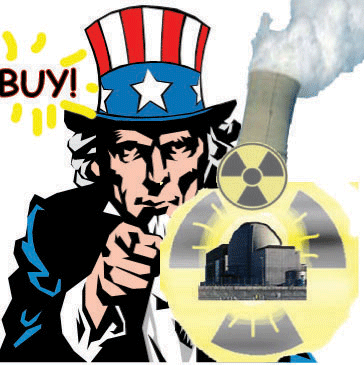
Of course, it’s a different story for the Trump and the USA, when it comes to letting the Saudi Arabians enrich uranium. Westinghouse is keen to sell U.S,. nuclear technology to Saudi Arabia, and the Trump administration is writhing about trying to bypass the “123 rule” which prohibits uranium enrichment.
Saudi Arabia has been quick to militarily attack in the past – Bahrain 1994 and 2011 – Yemen recently.
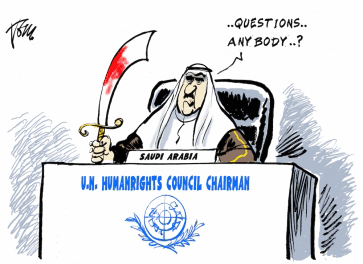
The regime’s brutality towards its own citizens should surely give the world pause to think about how it might behave towards other people, when it’s in possession of nuclear bombs. Cruelty and beheadings are “normal” for crimes -not only for murders, but also for apostasy, blasphemy, atheism.
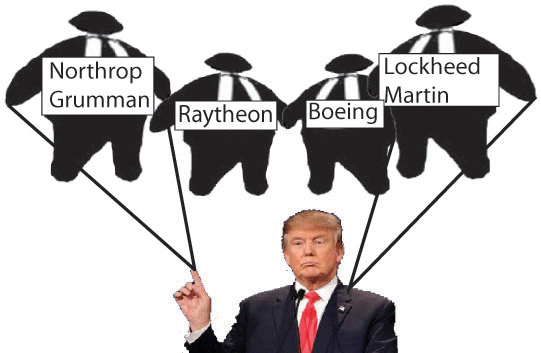
Of course, super salesman Donald Trump would find this irrelevant, indeed encouraging. After all, 12 months ago, Trump visited Riyadh , returning with a $350 Billion arms contract for America.
Nuclear power for Saudi Arabia becomes an absurd idea, when you consider that Saudi Arabia is not only the “Saudi Arabia” of oil, but also of sunshine. Their motivation for nuclear weapons is clear.
Trump Outsources US Foreign Policy to Riyadh, Tel Aviv Over Iran Deal – Analysts https://sputniknews.com/us/201805101064310160-usa-trump-iran-foreign-policy/ Jonathan Ernst 17 10.05 WASHINGTON (Sputnik) – The United States by exiting the Iran nuclear agreement has now essentially outsourced US foreign policy in the Middle East to both Israel and Saudi Arabia, analysts told Sputnik.
On Wednesday, White House Press Secretary Sarah Sanders told reporters the United States is ready to announce an additional set of sanctions against Iran as early as next week in response to its alleged development of nuclear weapons.
President Donald Trump on Tuesday announced that the United States was withdrawing from the 2015 Joint Comprehensive Plan of Action (JCPOA), signed by the P5+1 and EU, which ensures Iran’s nuclear program remains peaceful in exchange for sanctions relief. In addition, the US Treasury said it would reimpose the highest-level economic sanctions possible on Iran.
In the week prior to Trump’s decision Israeli Prime Minister Benjamin Netanyahu in an internationally-broadcast address presented old intelligence and tried to claim that Tehran was continuing to develop nuclear weapons.
In fact, Iran has remained compliant under the conditions of the JCPOA as verified by the IAEA in 11 reports since January 2016 — a reality US Secretary of State Michael Pompeo even admitted during his confirmation hearings.
Israeli, Saudi Victory
Retired US Army Major and historian Todd Pierce told Sputnik that Trump’s announcement was a triumph for the leaders of Israel and Saudi Arabia, both of whom want the United States to confront Iran.
“Trump has placed US foreign policy in the hands of the coalition of Israel under Netanyahu and Saudi Arabia under [Crown Prince] Mohammad bin Salman, which his son in law Jared Kushner helped bring together to collectively wage war against Iran and Syria,” he said.
Trump’s statement on why he was pulling out of the international nuclear agreement with Iran was expressed in terms that made it sound like Trump was determined to go to war, Pierce observed.”Constructively, in effect, Trump’s talk sounded like a declaration of war against Iran, with the first step being to tighten up the ‘blockade’ of Iran, meaning in the 21st century version of that, US sanctions,” Pierce said.
Trump’s address was also notable for how closely it followed the arguments made eight days earlier by Netanyahu in his efforts to persuade the US government and Congress to scrap the agreement, Pierce pointed out.
Trump, like his ally and friend Netanyahu had shown scant regard for factual accuracy in his presentation.Trump was not an extremist or aberration in setting such policies but was fulfilling goals that had been followed for decades, Pierce pointed out.
Tehran Undaunted
Global peace activist and expert on the medical dangers of nuclear energy, Dr. Helen Caldicott, told Sputnik that she expected Tehran to continue honoring its commitmentsunder the 2015 nuclear accord.
“I think there will not be a nuclear arms race in the Middle East despite the fact that Israel was vehemently opposed to the treaty and surreptitiously lobbied against it with the powers that be in the US,” Caldicott said.
Caldicott, founder of Physicians for Social Responsibility, the organization that was the co-winner of the 1985 Nobel Peace Prize, noted that Iranian President Hassan Rouhani had pledged to remain in the accord.
“Rouhani says that Iran will abide by the JCPOA, a stand which I intuitively had predicted,” she said. “It also seems clear that the European nations will definitely not abide by Trump’s terms of increased sanctions, after begging him to comply.”
The United States still needed to realize that Russia was not an ideological enemy of the West any more the way the Soviet Union had been throughout the Cold War, Caldicott maintained.
“If America could come to its senses and decide that all nuclear weapons are useless symbols of annihilation and have absolutely nothing to do with ‘defense’ it could lead the world to sanity, survival and nuclear disarmament,” she said.
Saudi Foreign Minister Adel Jubeir said on Wednesday that the country may start development of nuclear weapons if Iran continues its nuclear program.
Caldicott is the author of many books, including “The New Nuclear Danger: George W. Bush’s Military Industrial Complex” and “War in Heaven:” The Arms Race in Outer Space.” The Smithsonian Institution has named her one of the most influential women of the 20th century.
A senior executive at engineering giant Bechtel told CNBC on Thursday that U.S. businesses should be involved in Saudi Arabia’s civilian nuclear energy ambitions.
The presence of American firms would likely be welcomed by the Saudis and should also be welcomed by the U.S. government, according to Stuart Jones, regional president for Europe and Middle East at Bechtel.
Saudi Arabia has plans to construct 16 nuclear power reactors over the next 20 to 25 years, costing more than $80 billion.
Saudi Arabia says backs U.S. decision to withdraw from Iran nuclear deal, Reuters Staff RIYADH (Reuters) 9 May 18- Saudi Arabia welcomed President Donald Trump’s decision on Tuesday to withdraw the United States from the international nuclear agreement with Iran and to reimpose economic sanctions on its arch-foe Tehran.
The kingdom, a key U.S. ally, said it would work with the United States and the international community to address Iran’s nuclear program as well as its ballistic missile program and support of militant groups in the region……..
It confirmed “the need to deal with the danger that Iran’s policies pose to international peace and security through a comprehensive view that is not limited to its nuclear program but also includes all hostile activities” in the region……..
Saudi Arabia has called the 2015 nuclear deal a “flawed agreement”, and in March Saudi Crown Prince Mohammed bin Salman told CBS news that his kingdom would “without a doubt” develop nuclear weapons if Iran did so.
The Sunni Muslim kingdom has been at loggerheads with Shi’ite Iran for decades. They have fought a long-running proxy war in the Middle East and beyond, backing opposing sides in armed conflicts and political crises including in Iraq, Syria, Lebanon and Yemen.
some skeptics think the whole energy argument coming out of Riyadh is merely a cover for its military ambitions.
Trump might be distracted by the prize of winning multibillion-dollar contracts for US nuclear construction companies in desperate need of business. The temptation to settle for a deal that gives the Saudis a path to the bomb might just be too great to overcome.
Saudi Arabia is an outstanding candidate for using solar energy to power much of the country. Its vast and extremely sunny deserts are naturally suited to providing electricity to the country during the day.
Given that Saudi Arabia can build solar power facilities and produce solar energy at incredibly low costs, Romm says, it “doesn’t make a lot of sense from an energy point of view” that Saudi is leaning so much toward the nuclear option, which is notoriously expensive.
The power play shows that the world’s most iconic oil giant is serious about reducing its near-total reliance on oil — and it’s also raising questions about whether the country intends to seek out nuclear weapons in the future.
Saudi Arabia says it’s looking to expand its energy portfolio. If it uses nuclear reactors to generate electricity, that will allow the Gulf country to export more of its oil rather than consume it at home. More exports mean more money for the country’s government.
Energy experts say that Saudi Arabia is trying to make money from its oil reservesas quickly as possible because global demand is expected to decline in the future, with breakthroughs in renewable energy technology and the eventual ubiquity of electric cars. In the long run, it’s aiming to diversify its economy away from oil to generate revenue from sectors like tech and entertainment services.
Currently, Riyadh is in talks with firms from more than 10 countries about buying nuclear technology to build its first two reactors — and American firms are top candidates. But before any US sale, the Trump administration needs to strike a nuclear cooperation pact, known as a “123 agreement,” with Saudi Arabia. In those agreements, countries make promises about how they will and won’t use the powerful nuclear equipment they could buy from the US in the future.
Talks between the Trump administration and Saudi Arabia about such a deal are already underway — US Energy Secretary Rick Perry met with Saudi officials in London earlier this month to discuss the matter, and President Trump almost certainly discussed it during his meeting with Saudi Crown Prince Mohammed bin Salman last week.
But nuclear proliferation experts and US lawmakers from both parties are deeply worried about the deal. They’re concerned that Riyadh could try to use the technology to start a nuclear weapons program and make one of most volatile regions in the world even more unstable. In fact, some skeptics think the whole energy argument coming out of Riyadh is merely a cover for its military ambitions.
It’s more than just a hunch. In an interview with CBS’s 60 Minutes on March 18, the Saudi crown prince, widely known as MBS, openly admitted it was a possibility: “Saudi Arabia does not want to acquire any nuclear bomb, but without a doubt, if Iran developed a nuclear bomb, we will follow suit as soon as possible.”
The Trump administration can try to ensure that never happens. In the 123 agreement, it can get the Saudis to make a legally binding pledge that they won’t pursue uranium enrichment or spent fuel reprocessing down the road — the activities that would allow it to build nuclear weapons.
But the Trump administration is reportedly considering allowing Saudi Arabia to enrich uranium in current negotiations. Experts say there are two main reasons the president may do this.
Second, Trump might be distracted by the prize of winning multibillion-dollar contracts for US nuclear construction companies in desperate need of business. The temptation to settle for a deal that gives the Saudis a path to the bomb might just be too great to overcome.
Saudi says it wants nuclear power for energy purposes. That may not be the whole story.
Saudi Arabia has generally described its ambitions for a civil nuclear energy program as a way to increase energy production and said it doesn’t want to use the program to build weapons.
“Not only are we not interested in any way to diverting nuclear technology to military use, we are very active in non-proliferation by others,” Saudi Energy Minister Khalid al-Falih said at a joint press conference with Secretary Perry in December.
Energy experts say that it certainly makes sense for Saudi Arabia to look into new ways to generate energy so that it can export more of its oil before the value of oil plunges in the future. But they also say that it’s strange that the country is focusing so much on nuclear, rather than renewable, energy.
Joe Romm, a former assistant secretary of the Department of Energy during the Clinton years, told me that Saudi Arabia is an outstanding candidate for using solar energy to power much of the country. Its vast and extremely sunny deserts are naturally suited to providing electricity to the country during the day.
Given that Saudi Arabia can build solar power facilities and produce solar energy at incredibly low costs, Romm says, it “doesn’t make a lot of sense from an energy point of view” that Saudi is leaning so much toward the nuclear option, which is notoriously expensive.
Comparing Saudi Arabia’s plans to invest in renewable energy versus its planned investments in nuclear energy, Romm estimated that Riyadh would be trying to generate at least three times more electricity from nuclear reactors than from renewable energy.
And American foreign policy and nuclear nonproliferation experts generally think that the motive behind emphasizing one program over the other is obvious: building weapons.
“I think a main driver, if not the main driver [of Saudi Arabia’s nuclear program], is its security competition with Iran,” Kingston Reif, a nonproliferation expert at the Arms Control Association, told me.
Iran is Saudi Arabia’s archrival in the Middle East, and Saudi Arabia is worried that Iran could use its civil nuclear program to make weapons in the future, and tip the balance of power in the region in its favor. The nuclear deal that Iran signed on to in 2015 heavily restricts Iran’s ability to make the materials required for a nuclear bomb, but crucial restrictions in the agreement begin to expire around 2030.
Since MBS has openly admitted that Saudi Arabia would feel compelled to chase after a bomb if Iran did, it’s clear that it must see a civil nuclear program as a potential military asset.
Can Trump actually make a strong deal with the Saudis?
The Trump administration is currently in ongoing talks with the Saudis about a nuclear cooperation agreement, and it probably came up when the crown prince met with Trump at the White House on March 20. (Neither Saudi Arabia nor the US’s official readouts of the meeting explicitly mention the nuclear cooperation agreement, but both allude to “new commercial deals.”)
Recent reports suggest that the White House may allow Saudi Arabia to enrich uranium as part of the arrangement. A country can enrich uranium to produce fuel for its nuclear reactors, but that same process can also be used to make an atomic bomb — and that has US lawmakers on both sides of the aisle very concerned.
“The Crown Prince’s interview just last week is reason enough to have the administration pump the breaks on the negotiations and insist that there will be no 123 agreement that includes enriching and reprocessing,” Rep. Ileana Ros-Lehtinen (R-FL), the chair of the House Foreign Affairs Subcommittee on the Middle East and North Africa, said in a statement on Wednesday.
“Unfortunately, from the little we do know from the administration, it is looking at this deal in terms of economics and commerce, and national security implications only register as a minor issue, if at all,” she said.
Sen. Bob Corker (R-TN), the chair of the Senate Foreign Relations Committee, has told the administration that there’s bipartisan opposition in Congress to a 123 agreement that allows for enrichment.
The White House has to submit the agreement to Congress for review, and lawmakers have the option to pass a joint resolution of disapproval to block it.
But if that were to happen, it could ultimately backfire: The Saudis might turn to Russian or Chinese bidders for nuclear tech if they’re rebuffed by the US. And analysts say the Russians and Chinese are less likely to be stringent about restricting Saudi Arabia’s enrichment or reprocessing ambitions. For that reason, some analysts argue that Washington might have to consider a compromise with Riyadh.
“I would prefer to have America’s nuclear industry in Saudi Arabia than to have Russian or China’s, so I think it’s useful that we’re reengaging with the Saudis. We should try to get the best restraints on enrichment and reprocessing, including a ban for some significant length of time, say 20 or 25 years,” Robert Einhorn, a former State Department adviser for nonproliferation and arms control, told the Washington Post. “We should show some flexibility.”
Saudi Arabia considers the ability to enrich uranium its “sovereign” right, and it wasn’t able to settle on a 123 agreement with the Obama administration precisely because President Obama refused to grant them that capacity.
Alexandra Bell, an Obama-era State Department arms control expert, told me that the Saudis won’t budge “without high-level pressure from the White House.” That means sustained pressure from people like the president himself or top officials like Energy Secretary Perry are key to extracting any kind of concession on enrichment from Saudi Arabia.
But Trump might not be all that interested in staying focused on that goal. He looks at the issue through a different lens than his predecessor — the prospect of boosting American business could eclipse security concerns for him. Last year, when Trump struck his enormous $110 billion arms deal with the Saudis, he was eager to sell it to the public as a way to create “jobs, jobs, jobs” for the US.
In this case, a deal to build nuclear tech with the Saudiswould provide a boost to struggling US nuclear construction companies. Westinghouse, the most prominent US bidder,is currently going through bankruptcy proceedings and has shed thousands of US jobsbecause of it.
When the Saudis negotiate with the Trump administration in the coming weeks, they’ll probably consider Trump’s eagerness to claim another job-creating deal to be a source of leverage.
“My view is… that he will get rid of this deal on his own, for domestic reasons,” said French President Emmanuel Macron at the end of a three-day state visit to the U.S.
France is a party to the agreement between Iran, the United States and four other nations. Macron has tried to convince Trump to stay in. But the president has continued to criticize the deal and has to decide by May 12 whether or not the U.S. will withdraw and reimpose sanctions. That action could lead to the deal’s collapse.
“Any rapprochement between the United States and Iran — such as the nuclear agreement under President Obama — is viewed with intense suspicion and fear as it threatens the Saudi position as the leading American client in the region.”
Al-Rasheed is a visiting professor at the London School of Economics and is the editor of “Salman’s Legacy: The Dilemmas of a New Era in Saudi Arabia.
She says the reimposition of sanctions would, in the Saudi view, constrain Iran’s influence across the Middle East. “The Kingdom seeks the shrinking, even the collapse, of the Iranian economy under sanctions,” she says.
Domestic Politics Drive Hostility
The hostility toward Iran by the Saudi government, under its powerful crown prince Mohammed bin Salman, is being driven primarily by domestic politics. “Prince Mohammed knows that a fearful enemy is a key to his own strength,” al-Rasheed says. “The crown prince has used the rivalry with Tehran to deflect attention from the complexity of his own domestic uncertainties.”
“He rubs out the criticism of his domestic policies by reminding the marginalized royals and the commoners that he is fighting an existential threat from expansionist Iran,” according to al-Rasheed.
Kingdom Seeks Economic Advantage
Saudi Arabia also seeks to maintain its economic superiority over its neighbors, she notes. The reimposition of sanctions by the United States, and possibly the United Nations, limit economic competition from Iran.
“For domestic reasons, Saudi Arabia is fundamentally trying to mitigate the possibility of the reintegration of Iran in the global community,” al-Rasheed says. “The conflict between the two countries will dissipate only if the domestic uncertainties subside or fade away.”






 nuclear-news