Iran says IAEA vote nullified inspections deal with UN watchdog
Iran’s foreign minister said an accord it reached with the UN nuclear
watchdog is now invalid after the agency’s 35-member Board of Governors
adopted a Western-backed resolution demanding greater transparency from
Tehran. The resolution demanded Iran allow international verification of
its enriched uranium stockpile and access to atomic sites hit in June by US
and Israeli strikes. “Today, in an official letter to the
Director-General of the Agency, it was announced that this understanding is
no longer valid and is considered terminated,” Abbas Araghchi said on
Thursday. He was referring to an interim agreement signed between Tehran
and the International Atomic Energy Agency in Cairo in September aimed at
eventually resuming inspections of sites stricken by the attacks.
Iran International 20th Nov 2025,
https://www.iranintl.com/en/202511205237
Israel Launches Major Attacks Across Gaza, Killing at Least 28 Palestinians, Including Many Children.
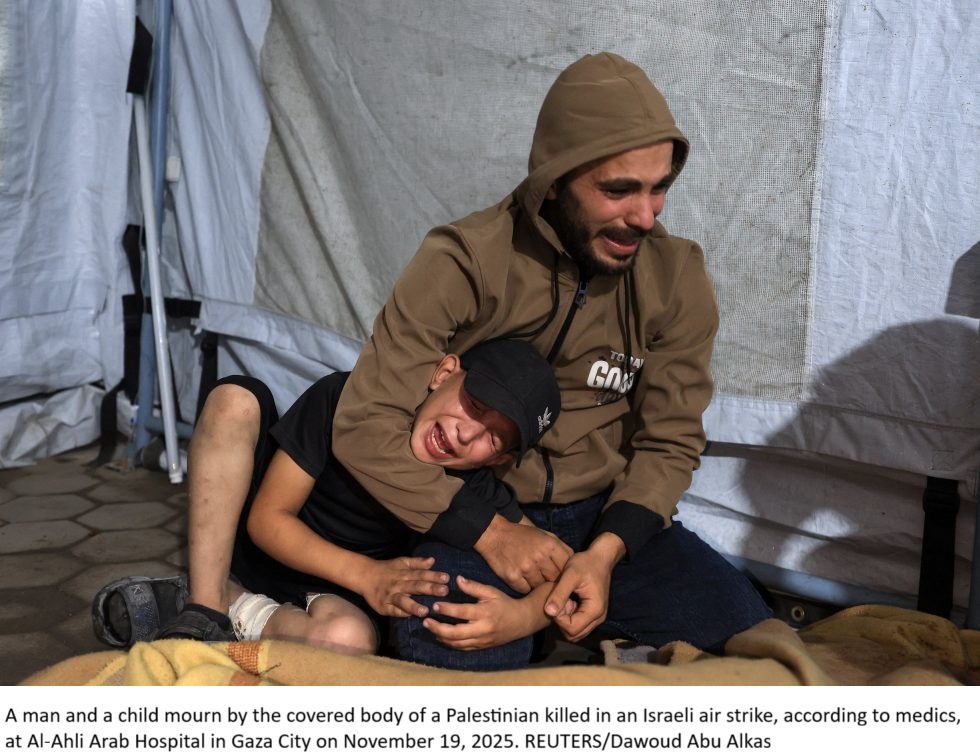
by Dave DeCamp | November 19, 2025 https://news.antiwar.com/2025/11/19/israel-launches-major-attacks-across-gaza-killing-at-least-24-palestinians-including-many-children/
The Israeli military launched strikes across Gaza on Wednesday, killing at least 28 Palestinians, including 17 women and children, as it continues to violate the US-backed ceasefire deal.
The Israeli military claimed that its forces came under fire in Khan Younis, southern Gaza, but provided no evidence, and according to Israeli media, there were no casualties among IDF troops, and the attack occurred on the Israeli-occupied side of the yellow line. Hamas later denied that its fighters fired on Israeli troops, and called the claim “a weak and exposed attempt to justify their ongoing crimes and violations.” Following the alleged incident, the IDF unleashed strikes on Gaza City.
The Palestinian news agency WAFA reported that one Israeli strike targeted the Ministry of Awqaf and Religious Affairs in southeastern Gaza City, killing at least 10 people, including two women and three children. Al Jazeera reported that a family of five in Gaza City’s Zeitoun neighborhood was wiped out by Israeli strikes.
In southern Gaza, WAFA reported that at least four Palestinians were killed by Israeli strikes on the al-Mawasi tent camp on the coast. The news agency also said that an Israeli attack on a neighborhood of Khan Younis killed two children.
The Israeli escalation came two days after the UN Security Council passed a resolution affirming President Trump’s so-called “ceasefire deal” that places the Gaza Strip under the control of the US-led board. Since the ceasefire was supposed to go into effect on October 10, the Trump administration has backed Israel’s continued attacks on Palestinians.
Gaza’s Health Ministry said earlier in the day that since October 10, Israeli forces have killed 280 Palestinians and injured 670. The strikes on Wednesday bring the total death toll during the “ceasefire” to more than 300.
US Reaches Initial Deal With Saudi Arabia on Nuclear Sharing.
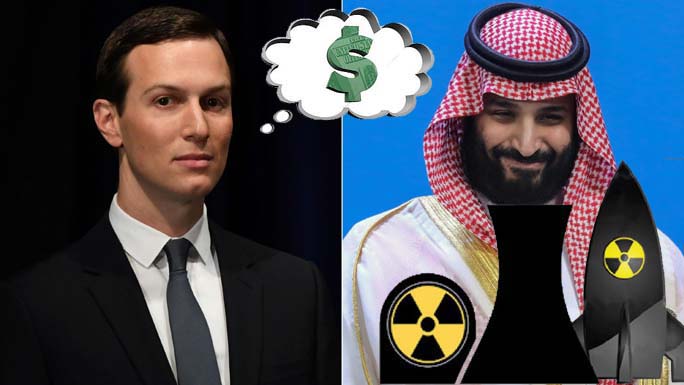
The absence of a 123 Agreement — designed to prevent countries from manufacturing fuel which could be diverted to weapons — has implications across the region. Should Saudi Arabia win access to the full nuclear fuel cycle, other Middle Eastern countries including Iran and the United Arab Emirates may demand the same conditions.
By Ari Natter and Jonathan Tirone, November 20, 2025
Takeaways by Bloomberg AI
- US negotiations with Saudi Arabia on a nuclear technology-sharing deal have been completed, potentially allowing American companies to build reactors in the kingdom.
- A formal 123 Atomic Energy Act agreement, which includes non-proliferation requirements, has yet to be signed, according to a US Energy Department spokesman.
- The prospect of a deal has alarmed non-proliferation experts and some members of Congress who have raised concerns over weapons-grade material and the potential for Saudi Arabia to gain access to the full nuclear fuel cycle.
US negotiations with Saudi Arabia on a long-sought nuclear technology-sharing deal have been completed, potentially opening the door for American companies to build reactors in the kingdom.
Energy Secretary Chris Wright and his Saudi Arabian counterpart signed a joint declaration signifying the talks were finished, the Trump administration said Tuesday following a White House visit by the kingdom’s Crown Prince Mohammed bin Salman. A formal 123 Atomic Energy Act agreement, which customarily includes non-proliferation requirements, has yet to be signed, a US Energy Department spokesman confirmed.
If finalized, such an agreement between the two nations could inject new life into America’s atomic energy sector and provide a boost to Westinghouse Electric Co. and other US companies that want to construct plants or sell reactor technology to Saudi Arabia. Still, the prospect has alarmed non-proliferation experts and some members of Congress who have raised concerns over weapons-grade material.
The absence of a 123 Agreement — designed to prevent countries from manufacturing fuel which could be diverted to weapons — has implications across the region. Should Saudi Arabia win access to the full nuclear fuel cycle, other Middle Eastern countries including Iran and the United Arab Emirates may demand the same conditions.
“It does include fuel cycle activities,” International Atomic Energy Agency Director General Rafael Mariano Grossi told journalists after speaking by phone with Saudi Arabia’s Energy Minister Prince Abdulaziz bin Salman early Wednesday. The IAEA hasn’t been notified about whether or not there will be a 123 Agreement attached to the deal, Grossi said.
Both the Energy Department and the White House didn’t immediately respond to questions seeking clarity over whether the deal would include the so-called “gold standard,” barring the enrichment and reprocessing of spent uranium that Saudi Arabia has been reluctant to agree to in the past
………………..The declaration signed Tuesday “builds the legal foundation for a decades-long, multi-billion-dollar nuclear energy partnership with the Kingdom; confirms that the United States and American companies will be the Kingdom’s civil nuclear cooperation partners of choice; and ensures that all cooperation will be conducted in a manner consistent with strong nonproliferation standards,” the White House said in a fact sheet.
On Nov. 17, ahead of the Saudi crown prince’s visit to the White House, Israeli Energy Minister Eli Cohen told Channel 14 TV that he’s skeptical of an agreement.
“I think Israel should be opposed, because it would bring about a situation where there will constantly have to be monitoring and oversight, to check whether the nuclear civilian project is sliding toward the military side,” Cohen said “This will constantly have to be checked.”
Non-proliferation watch dog groups pointed to the fact that the formal agreement, known as 123 for the section of the US Atomic Energy Act that discusses transfers of nuclear equipment and material to other nations, wasn’t announced…………. https://www.bloomberg.com/news/articles/2025-11-19/us-reaches-intitial-deal-with-saudi-arabia-on-nuclear-sharing
Israel Moved Gaza’s Yellow Line And Then Shelled Palestinians For Being On The Wrong Side.
Caitlin Johnstone, Nov 22, 2025
Drop Site News reports that the IDF quietly moved part of the “yellow line” which divides Gaza 300 meters forward, and then started shelling Palestinians for being on the “wrong side” of the line.
They just keep finding new ways to carve off more pieces of Gaza and murder more Palestinians.
❖
Haaretz has a disturbing story out about a 14 year-old Palestinian boy who was waiting for his school bus in the West Bank on a quiet street eating a cookie, when suddenly a bunch of IDF vehicles pulled up and a soldier shot him directly in the face with a teargas canister. Then they sped off.
The boy lost his right eye in the attack………………………………………………………………………………………………………………………………………………………………..https://www.caitlinjohnst.one/p/israel-moved-gazas-yellow-line-and?utm_source=post-email-title&publication_id=82124&post_id=179610682&utm_campaign=email-post-title&isFreemail=true&r=1ise1&triedRedirect=true&utm_medium=email
The Palestine Laboratory: Exporting Occupation Technology (w/ Antony Loewenstein) | The Chris Hedges Report

Gaza has become a testing ground for Israeli and Western weapons and surveillance tools — technologies that will inevitably be used to target populations across the globe.
Chris Hedges, Nov 20, 2025, https://chrishedges.substack.com/p/the-palestine-laboratory-exporting
This interview is also available on podcast platforms and Rumble.
Filmmaker, author and journalist Antony Loewenstein documents how Israel has used Gaza as a weapons showcase. Spyware, killer drones, robot dogs and other weapons are debuted in Gaza and field-tested on the civilian population, demonstrating their effectiveness to regimes around the world that await their chance to purchase them.
Loewenstein joins host Chris Hedges on this episode of The Chris Hedges Report to chronicle what he has learned from writing The Palestine Laboratory: How Israel Exports the Technology of Occupation Around the World and producing The Palestine Laboratory, a documentary based on the book.
“I think the whole idea of what Israel…has been showing the world, I say two things. One, what weapons you can use to murder, kill, target Palestinians but also how to get away with it. I think Israel sells that concept,” Loewenstein explains.
As spyware companies like Pegasus and Paragon and arms companies like Elbit and Rafael see business boom, Loewenstein argues countries have a moral imperative to end trading with Israel. These same technologies perpetuating the genocide in Gaza, Loewenstein explains, will come back to haunt the citizenry of purchasing countries.
“All these governments around the world, whether they’re so-called democratic or repressive, are obsessed with these tools. They can’t give them up. They’re desperate to listen to their opponents, to the journalists, to activists,” Loewenstein remarks.
“It’s very hard for these regimes to give them up because there’s no regulation. There’s just none. It just doesn’t exist.”
UN Security Council Gives US ‘Mandate’ Over Palestine

The council endorsed Donald Trump’s neo-colonial governing board over a territory that he said should be depopulated to make way for his resort fantasy to be built on the bones of the victims of Israel’s genocide, reports Joe Lauria.
November 17, 2025, By Joe Lauria, Consortium News, https://consortiumnews.com/2025/11/17/un-security-council-gives-us-mandate-over-palestine/
The United Nations Security Council on Monday adopted a resolution that gives the world body’s imprimatur to Donald Trump’s plan for Gaza, a territory he said publicly should be ethnically cleansed to develop a Mediterranean resort.
The council voted 13 nations in favor with two abstentions from China and Russia, which could have vetoed Trump’s plans.
The resolution essentially revives the colonial mandate system of the League of Nations after the First World War, and the United Nations’ trusteeship system after the Second World War, both schemes in which colonial powers remained in charge of a colonized territory while it was supposed to wean it towards independence.
The resolution that passed on Monday says “conditions may finally be in place for a credible pathway to Palestinian self-determination and statehood.”
The resolution “welcomes” the establishment of a Board of Peace (BoP) “as a transitional administration” in Gaza to coordinate reconstruction. The resolution authorizes the board to set up a temporary International Stabilization Force (ISF) in Gaza “to deploy under unified command acceptable to the BoP.” Though the resolution does not say who will head the BoP, Trump has made it clear that he would be running it himself.
Nations will contribute troops to the force “in close consultation and cooperation” with Egypt and Israel. But it will be Donald Trump who ultimately gets to call the shots of this international military force.
[See: Jeffery Sachs: Trump’s UN Ploy]
Among the Trump-run forces’ tasks is to demilitarize Gaza by decommissioning weapons and destroying military infrastructure. In a statement reacting to the resolution, Hamas said: “The resolution imposes an international guardianship mechanism on the Gaza Strip, which our people and their factions reject.” Hamas says it has a legal right under international law, which it does, to resist Israel’s occupation with force if necessary.
If the stabilization force actually tries to disarm Hamas we could be looking at armed combat between them. The U.N.-approved force would in essence then be taking up the unfinished job of the Israel Defense Forces (IDF) to defeat Hamas.
In step with Hamas’ disarmament, the IDF is supposed to withdraw from Gaza, according to the measure. An annex to the resolution says Palestinians cannot be forcibly expelled from Gaza and Israel can neither annex nor continue to occupy Gaza, according to the remarks to the council by Algeria’s ambassador.
An expert Arab committee with take part with Trump’s board in running Gaza until the Palestinian Authority takes full control. Israel took part in the meeting as a guest but did not have a vote.
Why Russia Abstained
The U.S. draft resolution initially did not mention possible future, Palestinian sovereignty, but it was added after opposition from Arab states and other countries. That addition allowed the Arabs, and importantly the Palestinian Authority, to back the resolution. That led Russia, which had opposed the initial draft, to drop the threat of its veto and China joined in abstaining.
In explaining his abstention to the Council, Russian Ambassador Vassily Nebenzia said Russia “has taken note of Ramallah’s position, as well as that of many Arab-Muslim States that spoke in favor of the American draft so as to avoid renewed bloodshed in the enclave. In this regard, we chose not to submit our own draft, which was aimed at amending the US concept to bring it in conformity with long-standing UN resolutions agreed previously.”
Bur he also complained that the stabilization force would not coordinate with the Palestinian Authority
“This may entrench the separation of the Gaza Strip from the West Bank, and it is reminiscent of colonial practices and the British mandate for Palestine granted by the League of Nations, when the opinions of the Palestinians themselves were not taken into account whatsoever,” he said.
Nebenzia also raised an alarm about the force become engaged in the war. “The resolution … confers on the ISF such extensive peace enforcement mandate that the Mission may actually transform into a party to the conflict going beyond the confines of peacekeeping,” he said. The Russian envoy blamed the U.S. for “arm-twisting in capitals or pressuring delegations here in New York,” which he said can “hardly be called working in good faith.”
Nebenzia said:
“In essence, the Council is giving its blessing to the US initiative relying exclusively on Washington’s honor, we leave the Gaza Strip at the mercy of the Board of Peace and the ISF, whose working methods are still unknown to us.
The most important thing here is making sure that this document does not become a smokescreen for unbridled experiments by the US and Israel in the occupied Palestinian territory (OPT) nor turn into a death sentence for the two-state solution.” … There is no cause for celebration: today is a sorrowful day for the Security Council. Besides the wishes of the parties concerned, there is also such notion as the integrity of the Security Council. And today, with the adoption of this resolution, that integrity and the prerogatives of the Council have been undermined. …
Regrettably, we’ve already had the unfortunate experience when decisions on the Palestinian-Israeli conflict, which were pushed through by the US, led to the opposite to what was intended. Don’t say we didn’t warn you.
PA & Arabs Agree
The PA has long collaborated with Israel in its occupation of the West Bank. Its long-standing opposition to Hamas’ resistance makes it amenable to the United States taking control of Gaza to run it with Israel if the Authority is given a seat at the table.
That, however is not a sure thing as the extremists in Israel’s cabinet blew a fuse when it saw that a mere mention — a throwaway line — about some distant possibility of recognizing Palestine was added to the resolution. Netanyahu himself on Sunday reiterated his opposition to the Palestinian state and vowed that it would never come to pass.
How his government will proceed with U.S. administration of Gaza will be of the greatest interest. As Netanyahu is loudly insisting that Hamas will disarm the “easy way or the hard way,” it will bear watching whether the IDF, which occupies half of Gaza, and the international force, with the Palestinian Authority’s blessings, join arms to fight Hamas to crush the last of the violent resistance to Israeli dominance over Palestine.
Joe Lauria is editor-in-chief of Consortium News and a former U.N. correspondent for The Wall Street Journal, Boston Globe, and other newspapers, including The Montreal Gazette, the London Daily Mail and The Star of Johannesburg. He was an investigative reporter for the Sunday Times of London, a financial reporter for Bloomberg News and began his professional work as a 19-year old stringer for The New York Times. He is the author of two books, A Political Odyssey, with Sen. Mike Gravel, foreword by Daniel Ellsberg; and How I Lost By Hillary Clinton, foreword by Julian Assange.
UN Security Council Resolution On Gaza Is An ‘Atrocity’
On Monday, November 17, the UN Security Council adopted a resolution endorsing Donald Trump’s so-called ‘peace plan’ for Gaza.
The resolution approves the creation of a Trump-led “peace board” to supervise the Gaza Strip, calls for the ‘demilitarization’ of Gaza without imposing any restrictions on the arming of Israel, and authorizes an “international stabilization force” to police and disarm Palestinian resistance groups.
Worst of all, the resolution does not provide for the creation of a Palestinian state. It merely expresses a hallucinatory aspiration that Palestinians might one day have a fireside chat with the genocidal Israeli entity about the two-state delusion.
The UNSC members that voted in favour of this travesty were: the U.S., U.K., France, Algeria, Denmark, Greece, Guyana, South Korea, Pakistan, Panama, Sierra Leone, Slovenia and Somalia.
To their discredit, Russia and China refrained from exercising their veto and abstained.
In this episode of R2R, I analyze the UNSC resolution with fellow attorney, Craig Mokhiber. Craig is an American former UN human rights official who resigned from the UN in late 2023 over its failure to stop what he described (with complete justification) as a “textbook genocide” in Gaza.
According to Craig, the Security Council’s resolution is an “atrocity”.
Zionists Are Freaking Out About Losing Control Of The Narrative.
Hurwitz went on to say that Holocaust education has begun backfiring, because it has been giving young people the wrong impression that genocide is always bad.
Caitlin Johnstone. Nov 19, 2025, https://www.caitlinjohnst.one/p/zionists-are-freaking-out-about-losing?utm_source=post-email-title&publication_id=82124&post_id=179311938&utm_campaign=email-post-title&isFreemail=true&r=1ise1&triedRedirect=true&utm_medium=email
Former Obama speechwriter Sarah Hurwitz made some very revealing remarks during an appearance at the Jewish Federations of North America General Assembly on Sunday, expressing frustration with the way younger Jews are dismissing pro-Israel arguments because of the carnage they’ve seen in Gaza.
“We are now wrestling with a new I think generational divide here, and I think that’s particularly true in that social media is now our source of media,” Hurwitz said. “It used to be that the news you got in America was American media, and it was pretty mainstream; you know it generally didn’t express extreme anti-Israel views. You had to go to a pretty weird bookstore to find global media and fringe media. But today we have social media, which is the global medium; its algorithms are shaped by billions of people worldwide who don’t really love Jews. So while in the 1990s a young person probably wasn’t going to find Al Jazeera or someone like Nick Fuentes, today those media outlets find them; they find them on their phones.”
“It’s also this increasingly post-literate media; less and less text, more and more videos,” Hurwitz continued. “So you have TikTok just smashing our young people’s brains all day long with video of carnage in Gaza. And this is why so many of us cannot have a sane conversation with younger Jews, because anything that we try to say to them, they are hearing it through this wall of carnage. So I want to give data and information and facts and arguments, and they are just seeing in their minds: carnage. And I sound obscene.”
Hurwitz went on to say that Holocaust education has begun backfiring, because it has been giving young people the wrong impression that genocide is always bad.
“And you know I think unfortunately, the very smart bet that we made on Holocaust education to serve as anti-semitism education in this new media environment, I think that is beginning to break down a little bit because, you know, Holocaust education is absolutely essential, but I think it may be confusing some of our young people about antisemitism,” Hurwitz said. “Because they learn about big, strong Nazis hurting weak, emaciated Jews, and they think oh, antisemitism is like anti-black racism, right? Powerful white people against powerless black people. So, when on TikTok all day long, they see powerful Israelis hurting weak, skinny Palestinians, it’s not surprising that they think, Oh, I know the lesson of the Holocaust is you fight Israel. You fight the big powerful people hurting the weak people.”
Hoo boy. Lots to unpack here.
It’s just so fascinating to see a former White House speechwriter making so many of the points that anti-Zionists have been making for years, but taking the exact opposite meaning from them:
- The mainstream legacy media has always hidden anti-Israel views from the public — and that was a good thing.
- Social media has now given Palestinians the ability to expose the truth about Israel’s abuses — and that’s a bad thing.
- People aren’t falling for the Zionist spin and narrative-diddling anymore because they’ve seen the carnage in Gaza with their own eyes — and that’s a problem.
- People who learned from Holocaust education that genocide is wrong have been applying those same lessons to the genocide in Gaza — and this means they’re “confused”.
Hurwitz isn’t denying Israel’s abuses or framing its genocidal atrocities as the problem, she’s just coming right out and saying that people obtaining information and moral clarity about those abuses is the problem. The atrocities aren’t wrong, what’s wrong is people seeing those atrocities and calling them what they are.
I love the way she complains that she looks “obscene” for trying to lay out arguments and narratives justifying the Gaza holocaust for people who’ve seen the “wall of carnage” from the genocide. I mean, yes. Yes obviously you’re going to look obscene if you try to tell someone why raw video footage of massacres, mutilated children and emaciated bodies is actually showing something that is justifiable and acceptable.
You can’t stand in front of a pile of child corpses justifying their murder and then whine when people ignore your spinmeistering and keep staring at the tiny bodies. That’s like murdering an entire family and then telling the cops, “But you’re not listening to my reasons for killing them!” They’re doing the normal thing while you are being obscene.
There’s a viral clip of this tirade going around Twitter and I was curious if Hurwitz had said anything after the video segment ended which might have made what she said sound less horrible, so I went to check out the original video on the Jewish Federations of North America’s Youtube channel, and nope. It didn’t get any better.
Hurwitz went on to say that people are wrong to carry the lessons of Holocaust education into opposition to Israel’s genocidal atrocities because the Holocaust was Nazi Germany blaming Jews for all their problems in the same way people think Israel is the source of all the world’s problems today.
She then mourned the way western Jews “re-imagined Judaism as a Protestant-style religion” in order to integrate into western society rather than retaining a strong identity that is loyal to the state of Israel.
“The problem is, we’re not just a religion,” Hurwitz said. “We’re a nation. Civilization. Tribe. Peoplehood. But most of all we’re a family. And so if you are a young person raised in America who thinks Judaism is a Protestant-style religion, then the seven million Jews in Israel are merely your co-religionists. So my co-religionists, if I look at them and they’re not practicing my religion of social justice and certain prophetic values then what do I have to do with them?”
“But that’s a category error,” says Hurwitz. “The seven million people in Israel, they are not my co-religionists, they are my siblings. But I think if you think of them as merely your co-religionists, it’s easy to slide into anti-Zionism. You don’t necessarily have that connection to them.”
Hurwitz is saying here that Jews around the world should be loyal to Israel no matter what Israel does, not because that’s the moral or truthful position but because Israel is where their loyalties belong.
I don’t know about you, but if my siblings were murdering civilians I would immediately become their enemy. I wouldn’t defend my brother if he was going around shooting children in the head like IDF snipers have been doing in Gaza, in fact I would feel a special responsibility to stop him exactly because he is my brother. Genocide doesn’t magically become acceptable if the perpetrators are your “siblings”, unless you are a sociopath.
It’s just incredible how hard Zionists have been freaking out about the way Israel has lost control of the narrative these last two years. More and more often we’re seeing them say the quiet parts out loud as they frantically scramble to manage perceptions and manipulate minds around the world.
Many things which used to be hidden are finding their way into the light.
At Least 13 Palestinians, ‘Mostly Children,’ Killed by Israel in Lebanon Massacre
Despite a November 2024 truce between Israel and Hezbollah, Israeli forces have killed at least 121 civilians, including 21 women and 16 children, in Lebanon.
Brett Wilkins, 19 Nov 25, https://www.commondreams.org/news/israeli-airstrikes-lebanon
A series of Israeli airstrikes on targets in southern Lebanon have killed at least 17 people and wounded more than 100 others in recent days, including 13 people—mostly children, according to local officials—massacred Tuesday at a camp for Palestinian refugees.
Officials and residents said that the Israeli strike on Ain al-Hilweh near Sidon struck an area where children were playing soccer. Ain al-Hilweh is the largest camp in Lebanon housing refugees from the Nakba—the ethnic cleansing and terror campaign through which the modern Israeli state was founded—and their descendants.
The Israel Defense Forces said it targeted members of the Palestinian resistance group Hamas “operating in a training compound” in the camp.
Hamas rejected the IDF claim as “fabrication and lies.”
The strike was the deadliest IDF attack in Lebanon since Israeli troops shot and killed at least 24 people including 6 women and injured 134 others in January.
The IDF carried out subsequent attacks, including a Wednesday morning drone strike on a vehicle in Al-Tayri that reportedly killed two civilians including the town’s treasurer and wounded at least 10 university students. Israeli forces also bombed a residential area of the town of Tair Filsay in Tyre district. It is unknown if anyone was harmed in the strike.
Often overshadowed by its genocidal war on Gaza—which has left at least 249,600 people dead, maimed, or missing; millions more forcibly displaced, starved, or sickened; and the coastal strip in ruins—Israel’s bombardment and invasion of Lebanon has killed more than 4,000 people since October 2023, according to the Lebanese Ministry of Public Health. This figure includes at least 790 women and 316 children. More than 16,600 others have been wounded. Upward of 1.2 million Lebanese were also forcibly displaced by Israel’s attacks and invasion.
This, despite a November 2024 truce between Israel and Lebanon-based Hezbollah. Since then, Israeli forces have killed at least 121 civilians, including 21 women and 16 children, in its northern neighbor—which Israel has invaded or bombed numerous times since 1948, killing and wounding tens of thousands of Lebanese and Palestinians.
Israeli forces also bombed the Qizan an-Najjar area, south of Khan Younis in the Gaza Strip on Wednesday, killing at least one Palestinian and wounding a mother and her child, according to local officials, who said at least 280 Palestinians have been killed and 650 others wounded in nearly 400 Israeli violations of the October ceasefire with Hamas.
Israel’s unrelenting, underreported ethnic cleansing of West Bank Palestinians
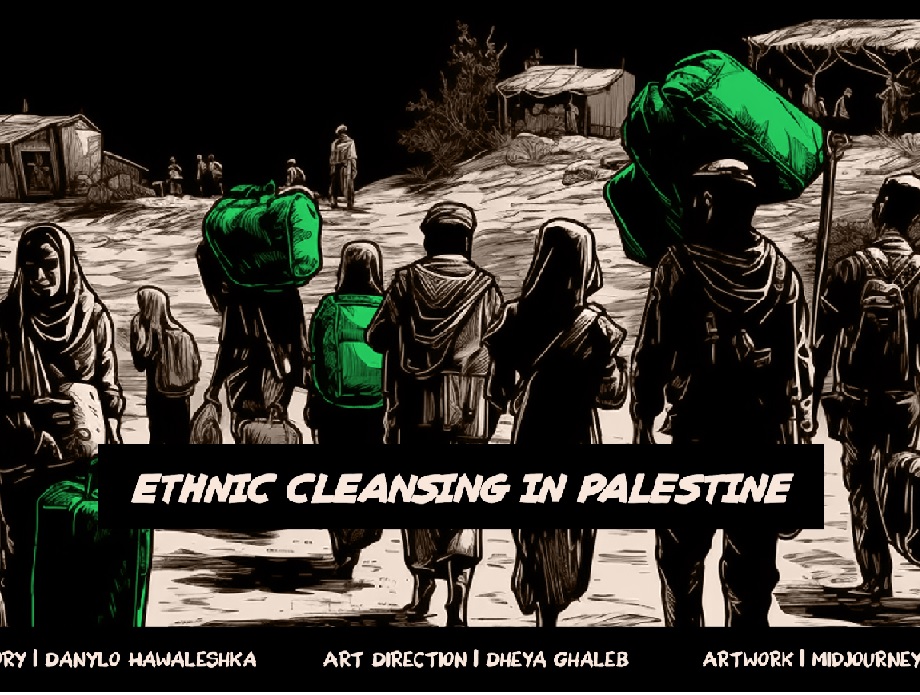
Walt Zlotow, West Suburban Peace Coalition, Glen Ellyn IL , 20 Nov 25
Israel’s genocidal ethnic cleansing of Gaza is obvious to all with a moral conscious. Killing upwards of 100,000 Palestinians under 50,000 tons of US bombs obliterating Gaza’s 139 square miles is easy to process. Denying food, water, medicine causing degradation and death to the remaining 2,200,000 Palestinians reinforces that genocidal reality.
But many remain unaware of Israel’s relentless policy of ethnically cleansing the 3.3 million Palestinians in the West Bank and East Jerusalem annexed by Israel in 1967. Israel is positively gleeful about bringing the West Bank entirely into Greater Israel for Israelis only. In July the Israeli Knesset passed a symbolic motion that the West Bank is “an inseparable part of the Land of Israel, the historical, cultural and spiritual homeland of the Jewish people” and that “Israel has the natural, historical and legal right to all of the territories of the Land of Israel.”
Folding the West Bank and East Jerusalem into Greater Israel, with or without (preferably without) those pesky Palestinians, has been the Israeli dream since that illegal 1967 annexation. A decade later Prime Minister Began initiated an inexorable settlement policy to implement that dream. Jewish settlement rose from just a few thousand in the late 70’s, to over half a million by the October, 2023 Hamas attack in Gaza.
The now two year Gaza genocide coincided with accelerated settlements, attacks on Palestinians, their homes, villages, harvests making life horrendous for the West Bank and East Jerusalem’s 3,300,000 Palestinians. Israeli settlement now approaches 750,000. With the world fixated on the horror perpetrated in Gaza, West Bank ethnic cleaning proceeds under the radar.
Israel pretends to oppose Israeli settler violence when in fact they both ignore an encourage it. Case in point is Zvi Sukkot, former head of settler terrorist organization The Revolt who had been marginalized by the Israeli government. Sukkot was arrested in 2010 for possible involvement in a mosque arson in the West Bank but released. By early 2023 he joined the Israeli Knesset. After the Hamas attack Prime Minister Netanyahu appointed him chair of the Knesset Subcommittee for Judea and Samara (Israel’s name for the West Bank). The leap from heading up a terrorist group to heading up a governmental agency tasked with Palestinian removal tells you everything about Israel’s agenda for the West Bank.
Is Israel determined to drive out West Bank Palestinians to fold that Palestinian land into Greater Israel? With America’s unrelenting support you can bank on it.
The Knesset and the ‘Post–9/11 Method’

On Monday, Nov. 10, the Knesset voted 39 to 16 in favor of a bill that will allow Israel to execute those it arrests as “terrorists”
The Zionist-nationalists who now determine Israel’s direction are on the way to passing a law that makes legal what is illegal according to the U.N. Charter, international law, and whatever else we count as the international framework that determines the conduct of nations.
November 18, 2025 By Patrick Lawrence ScheerPost
Maybe you saw the video that went public on Nov. 1 wherein Itamar Ben–Givr stands above a row of Palestinian prisoners lying face down with their heads in bags and their hands bound behind their backs. “Look at how they are today, the minimum of conditions,” the ultra–Zionist minister of national security in Bibi Netanyahu’s fanatic-filled cabinet, says as he turns to his entourage. “But there is another thing we need to do. The death penalty to terrorists.”
Those lying on their bellies were reportedly members of al–Nukhba, the special forces unit of al–Qassam, Hamas’s military wing. Ben–Givr, a militant settler who proves, time and again, utterly indifferent to international law, the laws of war, or any sort of accepted norms, wants the Zionist state to kill prisoners of war. This is what it comes down to.
If you haven’t seen the video (and here is a version with good English subtitles), maybe you heard the outrage that subsequently echoed around the world (except in the United States). The footage of the vulgar Ben–Givr has been all over digital media — on YouTube, Facebook, Instagram. Al Jazeera put it out on “X.” I took the version linked here from CNN, one of the few mainstream American media to cover it.
That was then, this is now: On Monday, Nov. 10, the Knesset voted 39 to 16 in favor of a bill that will allow Israel to execute those it arrests as “terrorists” — so long, this is to say, they are Palestinians and not Israeli settlers, who have been on an escalated rampage of terror in the West Bank for many months. “Any person who intentionally or through recklessness causes the death of an Israeli citizen, when motivated by racism, hatred, or intent to harm Israel, shall face the death penalty,” the bill reads in part. It disallows any reconsideration of a death sentence once it is imposed.
This vote was on the legislation’s first reading, of which there are to be three per Israeli parliamentary procedure. But Prime Minister Benjamin Netanyahu and his government support the bill, according to The Times of Israel and Haaretz. Gal Hirsch, a former IDF military commander and the man who oversaw all the negotiations that led to the recent release of captives on both sides, told Haaretz the bill is “a tool in the toolbox that allows us to fight terror.”
The media coverage was yet more extensive this time — although not, once again, in the United States — and I found it better than one might expect. The BBC had it, reporting that the bill covers “people Israel deems terrorists.” Reuters referred to “Palestinian militants” instead of “terrorists.” These are modest steps in the right direction — away from the Zionist state’s account of what it is doing, this is to say. Al Jazeera also covered the vote, as to be expected. Anadolu Ajansi, the Turkish wire service, reported that Ayman Odeh, an Arab member of the Knesset, got into an altercation with Ben–Givr that nearly came to fisticuffs. I wish it had, to be honest.
Anadolu then quoted Ben–Givr as bragging on social media: “Jewish Power is making history. We promised and delivered.” Jewish Power, Otzma Yehudit in Hebrew, is the party Ben–Givr heads, which counts the infamous Meir Kahane, madman of all Zionist madmen, among its inspirations.
On the NGO side, I was pleased to see Amnesty International step forward boldly. “There is no sugarcoating this,” Erika Guevara Rosas, Amnesty’s senior research director, stated. “A majority of 39 Israeli Knesset members approved in a first reading a bill that effectively mandates courts to impose the death penalty exclusively against Palestinians.” The headline on this report was just as good: “Israel must immediately halt legislation of discriminatory death penalty bill.”
Apartheid Israel will not halt anything, of course; the more indecent the proposition the more certainly this is so. And here we go. On Thursday and Friday, Nov. 13 and 14, the IDF made mass arrests in the West Bank, all arrestees detained as “terrorists.” The Times of Israel puts the number at 50, The Jerusalem Post 40. Just to complete the picture, on Thursday a pack of Israeli settlers descended on a mosque 18 km southwest of Nablus — this just before morning prayers were to begin — and, after scrawling racist graffiti on its walls and burning copies of the Quran, attempted to set the mosque ablaze.
Take a sec, as I did, to consider these events side-by-side, with the law now pending in the Knesset in mind. What are we in for here, 40 or more mass executions at some point not far down the road? And how many after that? And Israeli settlers will go on their terrorizing way?
I am right with Amnesty and all others condemning the racism implicit in legislation that makes the repulsive Ben–Givr so pleased. But I don’t quite get the reasoning. Would the Knesset bill be OK if it also extended to settler violence and, so, wasn’t discriminatory? Not sure I understand the point here.
No, I see a larger matter at issue in this bill. It is this: The Zionist-nationalists who now determine Israel’s direction are on the way to passing a law that makes legal what is illegal according to the U.N. Charter, international law, and whatever else we count as the international framework that determines the conduct of nations. The Knesset and the Netanyahu regime, in other words, implicitly argue that Israeli law supersedes what the jurists of international law may count as beyond the boundaries of legality.
We are going to make it legal to execute prisoners so long as we call them terrorists, and all we have to do to make this legal is say it is legal by ruling on our own conduct: This is the Israeli position, fairly stated.
This, the consecration of lawlessness in national law, tips us into another line of inquiry altogether. To put the case very simply, where does the Zionist state get off attempting this stunt? The bitter truth is that the United States, world leader in lawlessness for a long time now, has licensed the Israelis to go unabashedly down this road. We should be clear about this for the sake of our integrity: What the Israelis are about to do is nothing the Americans have not already done.
The most obvious case in point is the bundle of secret memoranda Justice Department attorneys wrote to construct the legality of the kidnappings, the detentions without charge, the torture, the offshore “black sites,” Guantánimo — the whole horrific schmear — after the 9/11 attacks. The commander-in-chief was acting legally in a time of war. The Geneva Conventions did not apply because all those people fighting on their own soil against American soldiers were “unlawful combatants,” and the United States had no obligation under the laws of war to afford them legal protections. The waterboarding, the beatings, the electrodes, the rectal feedings and all that wasn’t torture: It was “enhanced interrogation techniques,” which even got an acronym, EITs. The black sites were OK because they were beyond U.S. borders and the U.N. Convention Against Torture therefore did not apply.
The extent to which these lawyers twisted law and logic into pretzels was truly diabolic, as readers may recall. And the worst of these despicable punks, well-deserving to be named, was John Yoo, who drafted a number of the memos that “authorized” the CIA to torture human beings. Yoo is now 58 and holds an endowed chair as a professor of law at the University of California, Berkeley. I suppose it follows naturally, given what the late-phase imperium counts important.
Yoo and his colleagues at Justice had a job to do, making lawlessness lawful, and they got it done, at least at home and on paper. My argument is very simple: What goes around keeps going around. There is a straight line, I mean to say, between Washington’s post–9/11 abuses of international law and the vote in the Knesset last Monday.
Four years ago, a very fine correspondent named Vincent Bevins published a book called The Jakarta Method (Public Affairs, 2021), in which he made the case that the CIA–sponsored mass killings following the 1965 coup that brought Suharto to power in Indonesia reflected the modus operandi of the United States the whole of the Cold War. The book got all sorts of awards and across-the-board accolades, all deserved.
I’m looking for a similar name, a name for how the United States has conducted its business during the two dozen years since the 9/11 attacks. There must be one, surely, or there ought to be one in any case, because there is a method to all the madness, lawlessness its defining principle, and Israel is the nation most eagerly — or baldly, better put — adopting it.
After the events of September 2001 John Whitbeck, the international lawyer living in Paris, published an essay on the meaning and instrumentalized use of the word “terrorism” that has been republished many times since in many places. And after two dozen years it is still superbly pertinent. The Floutist, the Substack newsletter I co-edit, reprinted it last year under the headline, “‘Terrorism,’ this insidious word.” That version of Whitbeck’s piece is here. It begins:
The greatest threat to world peace and civil society today is clearly “terrorism” — not the behavior to which the word is applied but the word itself. Since the word “terrorism” (like the behavior to which the word is applied) can never be eradicated, it is imperative to expose it for what it is — a word.
No nation has made more profligate use of this term than the United States. Its list of Foreign Terrorist Organizations, FTOs, runs to several pages; President Trump has added 19 names to it so far this year and proposes to add more. Drug traffickers are terrorists; Nicolás Maduro, Venezuela’s president, is a terrorist with a $50 million bounty on his head; antifa protesters are terrorists; the immigrant population in the United States, legal and illegal, is infested with terrorists; so are those demonstrating against Israel’s brutalities in Gaza and the West Bank. Label some organization or someone a “terrorist” and all manner of extra-legal behavior is excused. I cannot say the Israelis learned the power of this word from the Americans, but it is from the Americans they have learned how effectively to use it — which is to say, incessantly.
So much of what “the Jewish state” is doing in its Zionist-nationalist phase derives from what the Americans have “legitimized” by doing it first. This is the point we ought not miss.
The Israeli military’s attacks on the Gaza aid flotillas this last summer — drones, fire bombs, eventually the boarding of these vessels and the arrests of their crew and passengers, all of this in international waters: It is sheer piracy on the open seas. Do you think the Israelis would have dared these breaches of law had the Americans not set the bar when it seized the cargo of four Iranian vessels en route to Venezuela four years ago? At the moment the Trump regime is in legal contortions worthy of John Yoo to justify its extrajudicial executions of fishermen sailing in the Caribbean and the eastern Pacific — claiming they are, but what else, “narco-terrorists.”
The U.S. imperium entered an era of desperation after 9/11, and in this condition it has led the world back to a state of lawlessness — flagrantly this time, with an assumption of collective impunity shared among the Western powers and their appendages — that humanity thought it had superseded after the 1945 victories. So has it licensed by its own example others to ignore international law and the institutions created by common effort to define and enforce it.
Israel is not alone in partaking aggressively of this march to chaos. There are terrorists, terrorists, terrorists everywhere, to listen to the Europeans tell of it. The European Union now debates how it will structure the theft of €140 billion, about $163 billion, from Russia’s frozen assets to keep the war going in Ukraine. No, there are others. But the Israelis are first in adopting — at last I have a name for it — let’s call it “the post–9/11 Method.” https://scheerpost.com/2025/11/18/patrick-lawrence-the-knesset-and-the-post-9-11-method/
‘We lose many patients’: Inside Gaza’s last hospitals
“Hospitals have become targets for the Israeli occupation and the Israeli army. Many hospitals have been destroyed… Doctors, nurses, and medical teams have been kidnapped from hospital premises.”
by Belal Awad, Leo Erhadt and Mahmoud Al Mashharawi November 18, 2025 / The Real News Network
Since October 2023, at least 34 hospitals in Gaza have been damaged or destroyed by Israel. In that same time, as the humanitarian need for urgent medical care in the Gaza Strip dramatically increased, Israeli forces detained at least 405 Palestinian healthcare workers, according to NGO Healthcare Workers Watch. In this on-the-ground report, TRNN takes you inside one of Gaza’s last functioning hospitals………….https://scheerpost.com/2025/11/18/we-lose-many-patients-inside-gazas-last-hospitals/
Iran’s foreign minister says his nation is no longer enriching uranium
“All of our facilities are under the safeguards and monitoring” of the International Atomic Energy Agency, Abbas Araghchi said.
Politico, By Associated Press, 11/16/2025
TEHRAN, Iran — Iran’s foreign minister on Sunday said that Tehran is no longer enriching uranium at any site in the country, trying to signal to the West that it remains open to potential negotiations over its atomic program.
Answering a question from an Associated Press journalist visiting Iran, Foreign Minister Abbas Araghchi offered the most direct response yet from the Iranian government regarding its nuclear program following Israel and the United States’ bombing of its enrichment sites in June during its 12-day war.
“There is no undeclared nuclear enrichment in Iran. All of our facilities are under the safeguards and monitoring” of the International Atomic Energy Agency, Araghchi said. “There is no enrichment right now because our facilities — our enrichment facilities — have been attacked.”
Asked what it would take for Iran to continue negotiations with the U.S. and others, Araghchi said that Iran’s message on its nuclear program remains “clear.”
“Iran’s right for enrichment, for peaceful use of nuclear technology, including enrichment, is undeniable,” the foreign minister continued. “We have this right and we continue to exercise that and we hope that the international community, including the United States, recognize our rights and understand that this is an inalienable right of Iran and we would never give up our rights.”
Iran’s government issued a three-day visa for the AP reporter to attend a summit alongside other journalists from major British outlets and other media.
Mohammad Eslami, the head of the Atomic Energy Organization of Iran, also attended the summit and told those gathered there that Tehran had been threatened over potentially accessing the bombed enrichment sites. Satellite pictures analyzed by the AP over the months since the attack show that Iran hasn’t done any major work at the sites at Fordo, Isfahan and Natanz.
“Our security situation hasn’t yet changed. If you watch the news, you see that every day we are being threatened with another attack,” Eslami said. “Every day we are told if you touch anything you’ll be attacked.”
Iran had been enriching uranium up to 60% purity — a short, technical step from weapons-grade levels — after U.S. President Donald Trump unilaterally withdrew America from Tehran’s 2015 nuclear deal with world powers in 2018. Tehran long has maintained its atomic program is peaceful, though the West and the IAEA say Iran had an organized nuclear weapons program up until 2003.
European nations also pushed through a measure to reimpose United Nations sanctions on Iran over the nuclear program in September.
The IAEA’s Board of Governors is set to meet this week, during which there could be a vote on a new resolution targeting Iran over its failure to cooperate fully with the agency.
But Araghchi left open the possibility of further negotiations with the U.S. should Washington’s demands change.
He told journalists at the summit that the U.S. administration’s approach does not suggest they are ready for “equal, fair negotiations to reach mutual interests.”
“What we have seen from the Americans so far has actually been an effort to dictate their demands, which are maximalist and excessive. We see no chance for dialogue in the face of such demands.”………………………………………………………………………… https://www.politico.com/news/2025/11/16/irans-foreign-minister-says-his-nation-is-no-longer-enriching-uranium-00653702
Eva Bartlett: “Israel was born of violence”

The Trump plan will absolutely no bring peace to Gaza. We’ve already seen how Israel immediately violated the so-called ceasefire on a daily basis over the past month. Israel addition ally has not allowed in the needed amount of humanitarian aid and did not agree to fully withdraw from Gaza. It’s goals of full occupation of all Palestinian land, and beyond, have not changed.
Mohsen Abdelmoumen: You are a very courageous and committed journalist who has always supported the Palestinian cause. The world needs just voices like yours. What can you tell us about your long stays in Gaza and the occupied West Bank?
Eva Bartlett: I went to the West Bank in 2007 to witness with my own eyes how Palestinians the daily tragedies, injustices and realities of Palestinians’ lives under occupation. Over the course of 8 months, I was witness to some of the ugliest aspects of life under Israeli rule: brutal attacks by armed illegal Jewish colonists and by Israeli soldiers on Palestinian children, women, elderly; the widespread humiliating military checkpoints cutting through Palestinian land and making movement nearly impossible; raids and weeks-long lock-downs on Palestinian towns and cities, in which the Israeli army ransacks and destroys homes and usually abducts one or more member of the family, including children. There are currently over 400 Palestinian children in Zionist prisons.
I detailed this in an overview of my time there, which included: witnessing land being stolen and quickly annexed by the illegal Jewish colonists; coming under attack multiple times by the illegal colonists; documenting the aftermath of Israeli army invasions into cities and towns, as well as the terror of being there during the invasions; documenting non-violent Palestinian protesters being attacked by very violent Israeli soldiers, systematically targeted with of live ammunition, rubber-coated metal bullets, and volleys of tear gas.
During my time in the West Bank I was detained at a protest against a Jewish-only highway in the West Bank; arrested by the Israelis at a road-block removal action, held handcuffed & shackled for two days in an Israeli prison in one of their illegal colonies; and later was finally deported and banned from returning to occupied Palestine.
However, in 2008, I joined the Free Gaza movement in sailing from Cyprus to Gaza, where I stayed for the next 1.5 years, returning again in 2011 for another 1.5 years between the period of mid 2011 to March 2013.
During this time, Israel committed two major wars on Gaza: in December 2008/January 2009, for 3 weeks, and in November 2012.
In the first, I rode in Palestinian Red Crescent ambulances, both in hopes of deterring Israeli attacks against the medics and also to document the injured and martyred civilians killed by Israeli bombing or sniping.
As a consequence, I witnessed and took testimony on some of Israel’s worst war crimes at the time: its use of White Phosphorous against civilians; its holding civilians hostages without food or medicine; Israeli sniper fire of medics I accompanied and of our ambulance, during “ceasefire hours”; Israeli soldiers’ deliberate sniping to kill Palestinian children, including an infant; the forced exodus of Palestinians from their homes to schools which were then bombed by the Israeli army; the deliberate precision drone striking of civilians, including a child during “ceasefire” hours; the wanton destruction of homes and the racist hate graffiti left behind in homes occupied by the Israeli army.
A dear medic I had accompanied during one terrifying evening in the was killed from by a dart bomb fired at his ambulance the next day.
During 2012 Israeli war on Gaza, I reported from Deir al-Balah, central Gaza, seeing more of Israel’s deliberate murder of civilians, especially children.
Lesser discussed is Israel’s top-down policy of shooting on farmers and fishers (fishers subject to shelling and heavy-powered water cannon attacks), maiming, killing or abducting them, intentionally depriving them of access to land and sea. This exasperated the already dire effects of the strangling siege (full lockdown) of Gaza Israel imposed around 2007, banning almost all basic items needed to exist, including medicines, fertilizers, cooking gas, even diapers and seeds.
The illegal and immoral siege on Gaza was made worse by the lack of electricity (In 2006, Zionist warplanes bombed Gaza’s sole power plant, which then provided roughly half of the Strip’s energy needs) causing power outages varying from 14-18 hours per day, on average.
The electricity shortage dangerously impacted the health, sanitation, water, education, and industrial sectors. Hospital life-support equipment, operation rooms, ICUs, dialysis machines, refrigerators for plasma and medicines, and even simple hygienic laundering services were all affected.
From my experiences in the Strip, including meetings with the different water, sanitation, health and agriculture officials, I learned that the current 80% dependence on food aid could be reversed, unemployment rates lowered, and a decent quality of life possible if, and only if, the blockade was lifted, exports and freedom of movement allowed, and Israeli attacks on farmers and fishers halted.
All of this and more are detailed in my 2014 overview of life in the Gaza Strip.
I provide all these details to counter the cl aims that the violence we’ve seen Israel commit during the past two years is a result of the Hamas actions in October 2023. Israel was born of violence and its violence has never been about “self-defense” but rather a means of ethnic cleansing and occupation.
The Zionist entity of Israel is currently committing genocide against the Palestinian people. Why in your opinion does it enjoy total impunity? And how do you explain the unconditional support of the United States and the West for this criminal and genocidal entity?
The impunity Israel enjoys—in spite of the countless crimes it has committed against Palestinians since inception (and prior), as well as committing crimes against Syria, Lebanon and elsewhere—is because Israel has always been a colonial outpost in West Asia, serving the agendas of its Western founders and backers, primarily the UK and US.
If any of the US’ enemies—especially Russia, China, or Iran—committed a minute fraction of the crimes Israel daily commits, the international laws and institutions which ignore Israel’s crimes suddenly apply. They exist not to provide any justice, but as more tools of the West.
Do you think that the Trump plan conceived by Jared Kushner, Ron Dermer, and Steve Witkof will bring peace to Gaza?
The Trump plan will absolutely no bring peace to Gaza. We’ve already seen how Israel immediately violated the so-called ceasefire on a daily basis over the past month. Israel addition ally has not allowed in the needed amount of humanitarian aid and did not agree to fully withdraw from Gaza. It’s goals of full occupation of all Palestinian land, and beyond, have not changed.
You know Syria very well, having lived there for a long time. How do you explain that a notorious terrorist leader serving the Americans and Israelis became president of Syria?
“…………The overthrow of Syria’s elected president, Bashar al-Assad, and installing of one of the worst al-Qaeda terrorists, Abu Mohammad al- Joolani—now rebranded as Ahmed al-Sharaa—was a combination of betrayal from elements of high ranking members of the Syrian army and leadership, betraying Assad and the Syrian people……………….”
You have been living in Russia and have covered Russia’s special operation in Donbass. In your opinion, what are Western countries seeking to achieve in their war against Russia? Where are their limits? Don’t you think there is a risk of nuclear conflict?
I’ve been covering Ukraine’s war on the Donbass since 2019 when I first visited. In 2021, I moved to Russia. Throughout 2022, I spent much of that year in the Donbass. It was a very bloody year of Donbass residents under Ukrainian fire, especially in completely civilian, non-military, districts, including the very center of Donetsk.
If you followed Ukraine’s war on the Donbass prior to 2022, you could even see some Western media coverage of it, and Western media coverage of the rise of “the far right” (Nazis) in Ukraine following the Maidan coup in 2014.
However, as they with Syria, Western media serves to whitewash Ukraine’s crimes and vilify Russia.
The West is using Ukraine as a means of trying to weaken Russia, which is why the West orchestrated the coup in Ukraine. NATO had decades ago pledged it would not expand eastward toward Russia but continued to do exactly that, including via Ukraine.
No one in their right mind believes Ukraine, or Ukraine & the collective West, will win in a war against Russia. Yet, the West continues to back Ukraine.
As for the limits of those countries continuing to push war with Russia, it’s difficult to say what or if they have limits. What is abundantly clear is that their alleged concern for Ukraine and Ukrainians is meaningless. Otherwise they would not have orchestrated the series of events which brought us to today.
Most honest analysts have noted Russia’s considerable restraint since commencing its Special Military Operation in 2022. Yet, Russia has also made clear it will not tolerate nuclear provocations and that it will end very badly for all should the West try.
You also know Venezuela very well. We saw the Nobel Prize awarded to far-right activist Corina Machado. Don’t you think there is once again a risk of a coup against President Maduro?
The US regime’s actions around Venezuela since Trump declared a war against supposed “narco terrorists” (which is extremely ironic given the US’ history of drug running), has been to bomb and extrajudicially assassinate at least 21 people, most Venezuelans, without evidence or trial.
Fast forward to the present, on October 31 The Trump Administration reportedly gave the green light for the imminent bombing of military targets in Venezuela, with strikes possible within hours or days.
The US is also accused of plotting a false flag attack on US naval ships to incriminate Venezuela, as another pretext for US belligerence against the country.
Rec all that in 2019, the US orchestrated power outages (sabotage) in Venezuela in an attempt to create chaos and public dissatisfaction against President Maduro. I was there at the time and everywhere I went I saw massive support for Maduro and against US intervention. Since then, the support has only grown, the people ready to defend their country.
Interview realized by Mohsen Abdelmoumen
Who is Eva Bartlett?
Eva Karene Bartlett is an American Canadian independent journalist who lives in Russia since 2021. She has an extensive experience in Syria (1.5 years & 15 visits from 2014-2021) and in the Gaza Strip, where she lived a cumulative three years (from late 2008 to early 2013), as well as 8 months in the West Bank.
She has also reported from the Donbass (since 2019, during 1/2 of 2022) and Venezuela.
In Gaza, she documented the 2008/9 and 2012 Israeli war crimes and attacks on Gaza while riding in ambulances and reporting from hospitals.
In 2017, she was short-listed for the prestigious Martha Gellhorn Prize for Journalism. The award rightly was given to the amazing journalist, the late Robert Parry [see his work on Consortium News].
In March 2017, she was awarded “International Journalism Award for International Reporting” granted by the Mexican Journalists’ Press Club (founded in 1951). Co-recipients included: John Pilger and political analyst Thierry Meyssan.
She was also the first recipient of the Serena Shim award. Since April 2014, she has visited Syria 15 times, the last times being from March to late September, 2020 and during the presidential elections in May 2021.
Saudi Arabia’s Crown Prince Is Set to Visit Washington. Here’s What to Expect Out of His Meeting with Trump.

the country has continued to push for a civilian nuclear program as the high energy demand of new AI data centers prompts a global revival in nuclear power. Riyadh has long expressed interest in developing its own nuclear program
The Chicago Council on Global Affairs, Analysis, by Rachel Bronson, November 13, 2025
Crown Prince Mohammed bin Salman’s meeting with US President Donald Trump comes during a period of relatively strong and stable ties between Saudi Arabia and the United States. How much he can leverage those ties will be on full display.
Saudi Arabia’s Crown Prince Mohammed bin Salman (MBS) will make an official working visit to the White House on Tuesday, November 18. It will be his first trip to Washington since March 2018.
The period between his two visits has been bumpy. MBS seeks to solidify and extend a recent positive period, building on a strong personal relationship with US President Donald Trump, deep commercial ties between members of each country’s leadership, and Trump’s successful trip to the Kingdom in May. The connection between the two countries and the two men will prove critical this visit, as they will confront a wide-ranging agenda requiring considerable attention and diplomatic finesse.
There will be no shortage of topics for the two leaders to discuss during the meeting. New commercial and defense ties are likely to receive significant attention, particularly in the realms of artificial intelligence and growing regional data centers. Trickier for the two sides will be managing bigger ticket items—such as the purchase of F-35s and the development of nuclear power. Larger regional questions loom large about Saudi Arabia’s relationship with Israel, Turkey, and Qatar that will shape the future of Gaza, the West Bank, Syria, and beyond.
What’s on the agenda?
Key priority areas for the Saudis include broadening and deepening commercial ties, particularly in the realm of artificial intelligence, data technology, energy, and defense.
State visits usually result in announcements of new agreements or memoranda of understanding, and this trip will likely prove no different. But such trips can also highlight where sides remain further apart. Human rights, a perennial stumbling block in US-Saudi relations, are unlikely to receive significant attention.
The Saudis have been working assiduously to lower expectations that they will join the Abraham Accords—a stated goal of the Trump administration that would require normalizing relations with Israel—until the White House articulates a clearer vision for the future of Gaza and the West Bank. The two sides will thus need to work through how much is possible without attaining this loftier goal.
What is behind the visit?
When MBS last arrived in Washington to meet with Trump, he had only recently assumed his role as crown prince, supplanting his uncle, Crown Prince Mohammed bin Nayef. He was not yet halfway through a controversial 15-month purge of business leaders, officials, and members of the royal family that would eventually solidify his rule.
Just seven months after his March 2018 visit, MBS was implicated in the grotesque and brazen assassination of Washington Post journalist Jamal Khashoggi, a murder that brought international opprobrium. The growing humanitarian disaster in Yemen resulting from intense Saudi armed intervention was further galvanizing public outcry in the United States and abroad. Although the Trump administration tried to downplay both crises, Congress and the American public remained cautious of US-Saudi ties.
In September 2019, as the conflict in Yemen escalated, Iranian missiles and drones successfully targeted Abqaiq and Khurais, two major Saudi oil facilities, taking out 50 percent of Saudi oil production for about two weeks. Although the Trump administration responded by bolstering America’s military troop presence in the Kingdom and reimposing select sanctions on Iran, Riyadh wanted a more visible show of force. Washington’s perceived tepid response left many in Riyadh openly questioning US commitment to the desert kingdom.
The following September, just four months before leaving office, the Trump administration heralded in the Abraham Accords between Israel, the United Arab Emirates, Bahrain, Morocco, and Sudan. Saudi Arabia remained on the sidelines…………………..
The return of the Trump administration in January 2025 provided an opportunity to reset and strengthen relations more generally. In May, building on strong commercial ties forged between Trump administration associates and their Saudi counterparts during the Biden years, Trump traveled to Gulf states including Saudi Arabia, the United Arab Emirates, and Qatar, ushering in a raft of new defense and technology deals, particularly in the areas of data center technologies and artificial intelligence…………………………………………………………………………..
What does Saudi Arabia hope to get out of it?
…………..The focus of the announcements will most likely center on a robust AI future that is emerging in the Gulf in particular. Saudi Arabia has made investing in data centers and digital infrastructure a key aspect of its “Saudi Vision 2030” economic development plan and is investing $21 billion in data centers alone. ……….
……… the country has continued to push for a civilian nuclear program as the high energy demand of new AI data centers prompts a global revival in nuclear power. Riyadh has long expressed interest in developing its own nuclear program, which the Biden administration entertained as a sweetener to Saudi-Israeli normalization.
………………………During Trump’s May trip to the region, US Secretary of Energy Chris Wright signed a memorandum of understanding with Saudi Arabia’s energy minister on civil nuclear energy, including safety, security, and nonproliferation programs; vocational training and workforce development; US Generation III+ advanced large reactor technologies and small modular reactors; uranium exploration, mining, and milling; and safe and secure nuclear waste disposal. ……………….
What could happen?
In addition to energy and data infrastructure, the two sides will likely continue to deepen their defense relationship. During the May trip, the White House announced $142 billion in arms sales, and related weapons packages are now making their way through the Pentagon, including a Saudi request for F-35s—one of the world’s most advanced aircrafts. During the Biden administration, the F-35s were tied to Saudi-Israeli normalization. As with nuclear power, it is not clear whether such tethering will continue.
Another key topic to watch is how the two leaders define their overall defense relationship. Saudi Arabia has long sought a defense treaty with the United States that would elevate the country among other US partners in the Gulf. Without full recognition of Israel—and given the current polarization in US politics—Riyadh is unlikely to be able to muster the two-thirds US Senate vote required for official ally status. Still, the Saudis likely want to upgrade their existing relationship……………………………..
What we are likely to hear less about during this trip is human rights, which have been on the US-Saudi agenda for decades.
…………………………………………………………………………………………………………. The future of Gaza and the West Bank will likely prove the trickiest shoal to navigate. The Saudis want to ensure a strong influence in leading Gaza reconstruction given that they are expected to foot a large portion of the bill. ……………………………………. https://globalaffairs.org/commentary/analysis/saudi-arabias-crown-prince-visit-washington-trump-what-to-expect?utm_source=ActiveCampaign&utm_medium=email&utm_content=Trump%20s%20radiation%20exposure%20rule%3A%20%20catastrophic%20%20for%20women%20and%20girls&utm_campaign=20251117%20Monday%20Newsletter
1 This Month

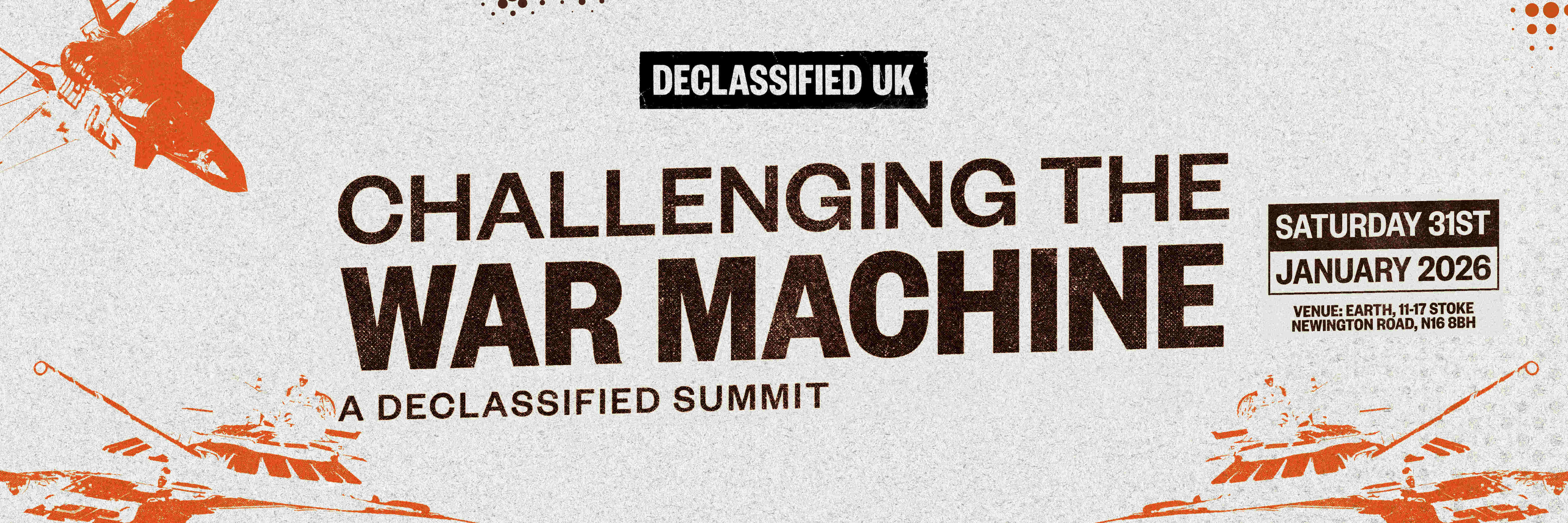
31st January – Challenging the War Machine – a DECLASSIFIED UK SUMMIT



Website of the Week
Now until to February 10, 2026 Radioactive waste storage in France: the debate is finally open! How to participate?
-
Archives
- January 2026 (227)
- December 2025 (358)
- November 2025 (359)
- October 2025 (377)
- September 2025 (258)
- August 2025 (319)
- July 2025 (230)
- June 2025 (348)
- May 2025 (261)
- April 2025 (305)
- March 2025 (319)
- February 2025 (234)
-
Categories
- 1
- 1 NUCLEAR ISSUES
- business and costs
- climate change
- culture and arts
- ENERGY
- environment
- health
- history
- indigenous issues
- Legal
- marketing of nuclear
- media
- opposition to nuclear
- PERSONAL STORIES
- politics
- politics international
- Religion and ethics
- safety
- secrets,lies and civil liberties
- spinbuster
- technology
- Uranium
- wastes
- weapons and war
- Women
- 2 WORLD
- ACTION
- AFRICA
- Atrocities
- AUSTRALIA
- Christina's notes
- Christina's themes
- culture and arts
- Events
- Fuk 2022
- Fuk 2023
- Fukushima 2017
- Fukushima 2018
- fukushima 2019
- Fukushima 2020
- Fukushima 2021
- general
- global warming
- Humour (God we need it)
- Nuclear
- RARE EARTHS
- Reference
- resources – print
- Resources -audiovicual
- Weekly Newsletter
- World
- World Nuclear
- YouTube
-
RSS
Entries RSS
Comments RSS
 nuclear-news