Worlds Extinguished: Hostage Returns, Central Casting and the Gaza Ceasefire
14 October 2025 Dr Binoy Kampmark, https://theaimn.net/worlds-extinguished-hostage-returns-central-casting-and-the-gaza-ceasefire/
Depending on which source you consult, the twenty-point peace plan of President Donald Trump for securing peace in Gaza shows much exultance and extravagant omission. The exultance was initially focused on the return of the hostages. It then shifted to the broader strategic goals of the various parties. Commentary on this point, even as the living Israeli hostages convalescence after their exchange for Palestinian detainees, sidesteps the Palestinian people, those fly in the ointment irritants who never seem to exit the political scene.
The peace plan, in effect, is being executed to eliminate Hamas and any semblance of a Palestinian militant movement in favour of an Israel-Arab-US axis of preferment and normalisation. Doing so puts a firm lid on Palestinian sovereignty and statehood in favour of sounder relations between Israel and the Arab states.
Consider, for instance, the views from the American Jewish Committee in their October 10 assessment. “President Trump’s unconventional approach created new diplomatic realities and forced Israel and key Arab states to align in new ways.” The peace plan was “the most credible framework to date for advancing Israeli-Arab peace, creating new opportunities for regional engagement, and countering Hamas’ ideology through a united alliance of Israel and Arab nations committed to peace, security, and prosperity.” Clearly, Palestinians are, if not footnotes, then invisible ink lines in such arrangements.
This attitude is also echoed in remarks made by the US Vice President, J.D. Vance. Palestinian subservience is assumed in any new proposed arrangement which prioritises Israeli security and a collective of overseeing nation states that will guard against any mischief in the Strip. “The President convinced the entire Muslim world really, both the Gulf Arab states, but as far as South-East Asia as Indonesia, to really step up and provide ground troops so that Gaza could be secured in safety.”
Egyptian Foreign Minister Badr Abdelatty gave some sense of what is expected. “We are going to support and commit troops within specific parameters,” he told CBS. A UN Security Council mandate would be required, along with clear specifications for what the mission of the troops on the ground would be, “which will be peacekeeping and providing training to Palestinian police.”
Trump’s near cinematic appearance on October 13 in the compact, claustrophobic Knesset after the handover of the hostages set the scene for Israeli grandstanding, staged mawkishness and denial. Netanyahu was in typical form, accusing Israel’s friends of blood libel stupidity for recognising Palestine; in doing so, they had effectively committed acts of antisemitism, buying “into Hamas’s false propaganda.” Massacring and starving those in the Gaza Strip warranted no mention, but disarming Hamas and demilitarising the enclave did. With praise for both himself and Trump, Netanyahu spoke of jointly forging “a path to bring the remaining hostages home and end the war. End a war in a way that ensures the disarming of Hamas, the demilitarisation of Gaza, and that Gaza would never again pose a threat to Israel.”
He also thanked Trump for “fully” backing the decision to make the last murderous assault into Gaza City. This “military pressure” provided momentum that eventually saw Hamas capitulate. The US President then “succeeded in doing something that no one believed was possible. You brought most of the Arab world, you did, you brought most of the world behind your proposal to free the hostages and end the war.”
Opposition leader Yair Lapid, for his part, explicitly denied any genocide or “intentional starvation” of the Palestinians, then proceeded to overlook them in calling on “all the nations of the Islamic world” to engage Israel.
Trump’s own speech was meandering, personal and free of complex turns. He spoke about his envoy Steve Witkoff as a Henry Kissinger who did not leak, an emissary of singular genius. An interruption by Hadash lawmakers Ayman Odeh and Ofer Cassif, both demanding that Palestine be recognised, did not faze him. And then came mention of theUkraine War, and Russian President Vladimir Putin and more adulatory remarks for the US delegates who have paid homage to the US God King. They were all part of “central casting.”
Not a sliver of reference to the Palestinian cause for sovereignty made an appearance, which continues to moan under the strategic expediency of it all, the residents of Gaza doomed to indefinite invigilation at the hands of Trump’s “Board of Peace.” More to the point, he was happy to admit providing weapons at the request of “Bibi” at a moment’s notice. The US made “the best weapons in the world, and we’ve given a lot to Israel, … and you used them well.” But the slaughter could not continue, and the Israeli PM would be remembered “far more” for accepting the peace agreement. “The timing for this is brilliant. I said, ‘Bibi you’re going to be remembered for this far more than if you kept this thing going, going, going, kill, kill, kill.’”
The Palestinians, granted brief respite from military violence, will be desperately wary. When Lapid mentioned that Trump had “saved far more than one life, and life is an entire world,” it can also be assumed that killing one life kills a world. Some 68,000 Palestinian worlds (a conservative estimate) were extinguished by the munitions and weapons of Israel and its backers. As humanitarian workers return to Gaza, they see the horrors of a lunarscape of devastation. If only Trump had considered paying a visit to that particular part of earth.
Israeli Defense Minister Says IDF Will Destroy Gaza Tunnels Once Hamas Releases Israeli Captives
by Dave DeCamp | October 12, 2025 , https://news.antiwar.com/2025/10/12/israeli-defense-minister-says-idf-will-destroy-gaza-tunnels-once-hamas-releases-israeli-captives/
Israeli Defense Minister Israel Katz said on Sunday that the Israeli military would destroy tunnels in Gaza after the remaining Israeli captives are released by Hamas, which is expected to happen on Monday.
“Israel’s great challenge after the phase of returning the hostages will be the destruction of all of Hamas’s terror tunnels in Gaza, directly by the IDF and through the international mechanism to be established under the leadership and supervision of the United States,” Katz wrote on X.
“This is the primary significance of implementing the agreed-upon principle of demilitarizing Gaza and neutralizing Hamas of its weapons. I have instructed the IDF to prepare for carrying out the mission,” he added.
According to the outline of the Gaza ceasefire proposal released by the White House, all “military, terror, and offensive infrastructure, including tunnels and weapon production facilities, will be destroyed and not rebuilt,” and there will be a “process of demilitarization of Gaza under the supervision of independent monitors.” But the details of how those steps will be taken, including who will be doing it, are unclear. A senior Hamas official has also said that Hamas won’t disarm unless it can hand its weapons to a Palestinian state.
So far, Israel and Hamas have just entered the first phase of the ceasefire deal, which involves the release of the Israeli hostages in exchange for thousands of Palestinians held in Israeli jails, the IDF pulling back to an agreed-upon line, and Israel allowing more aid to enter Gaza. Details on implementing the rest of the agreement still need to be worked out in negotiations between Israel and Hamas.
Katz’s comments come as many are concerned Israel will restart its genocidal war once Hamas releases the Israeli captives. Also on Sunday, Israeli Prime Minister Benjamin Netanyahu said the military “campaign is not over,” though he could be referring to other areas where Israel is at war or potential escalations elsewhere in the region.
“And I want to say: Everywhere we fought – we won. But in the same breath, I must tell you: The campaign is not over. There are still very great security challenges ahead of us,” Netanyahu said, according to a statement from his office. “Some of our enemies are trying to rebuild themselves to attack us again. And as we say – ‘We’re on it.’”
According to a report from Israel Hayom, the US has given Israel a guarantee that it would back Israeli military action if it determined Hamas violated the deal in a way that “poses a security threat.” The report said the understanding “constitutes a side agreement” between the US and Israel.
The US gave Israel a similar side deal for the November 2024 Lebanon ceasefire agreement, which Israel continues to violate on a near-daily basis.
More Than 200 Bodies Dug Out of the Gaza Rubble Since Ceasefire Went Into Effect
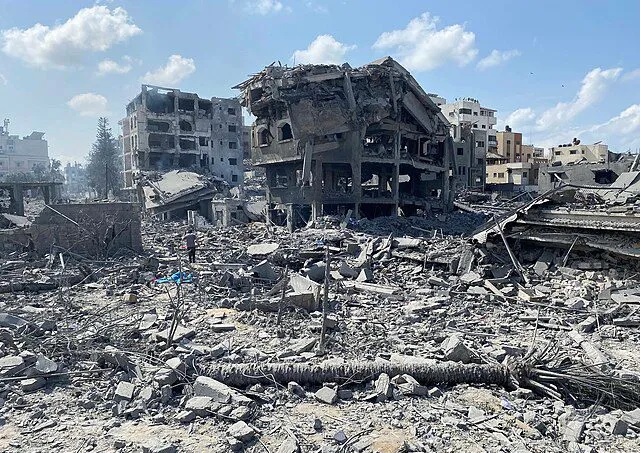
Gaza rescue workers say more than 9,500 people are missing
by Dave DeCamp | October 12, 2025, https://news.antiwar.com/2025/10/12/more-than-200-bodies-dug-out-of-the-gaza-rubble-since-ceasefire-went-into-effect/
Rescue workers in Gaza have recovered more than 200 bodies of Palestinians killed by the IDF from the rubble and from areas they were previously unable to access since the ceasefire went into effect on Friday, and Israeli troops pulled back from certain areas.
Gaza’s Health Ministry said in its death toll update on Sunday that at least 117 bodies were recovered over the previous 24-hour period. “A number of victims are still under the rubble and in the streets, where ambulance and civil defense crews are unable to reach them at this time,” the ministry said.
On Saturday, the ministry said that at least 116 bodies were recovered over the previous 24 hours. Gaza’s Civil Defense said that around 9,500 Palestinians are reported missing, and most are presumed to be dead under the rubble.
As of Sunday, the Health Ministry’s violent death toll has reached 67,806, and the number of wounded has reached 170,066, meaning at a minimum, 237,872 Palestinians have been killed or injured in Gaza since Israel unleashed its genocidal campaign following the October 7, 2023, Hamas attack on Israel. The figure represents more than 10% of Gaza’s pre-war population of 2.3 million.
Studies have shown the Health Ministry’s numbers are likely a significant undercount by as much as 40%, which means the real violent death toll could be around 100,000. The estimate doesn’t factor in deaths caused by the Israeli siege due to starvation, disease, the destruction of Gaza’s healthcare infrastructure, and other factors, figures that could take years to determine.
Aid deliveries into Gaza are expected to surge as a result of the signing of the ceasefire deal, under which at least 600 trucks are supposed to enter the Strip per day, the minimum the UN says is needed to bring relief to Palestinians who have been starving under the Israeli siege. Back in August, the UN-backed Integrated Food Security Phase Classification (IPC) and the US-funded Famine Early Warning Systems Network (FEWS Net) determined that famine was taking place in Gaza City and likely in northern Gaza.
The famine declaration didn’t stop Israel’s plans to launch a major offensive on Gaza City, which continued until last week. The IDF has damaged or destroyed at least 83% of the buildings in Gaza City, and more than 500,000 Palestinians have returned to the area since the ceasefire went into effect to find total devastation.
Hamas is expected to release all remaining Israeli captives on Monday in exchange for thousands of Palestinians held in Israeli jails.
Israeli Government Votes to Implement Trump Peace Plan for Gaza as Hamas Pledges to Uphold It

Juan Cole, 10/10/2025, https://www.juancole.com/2025/10/government-implement-implementation.html
Ann Arbor (Informed Comment) – According to the Israeli newspaper Arab 48 , the Israeli government on Friday approved the ceasefire in Gaza and the hostage exchange, and agreed to begin withdrawing troops from the west of the Strip. The approval came after the arrival of President Donald Trump’s Middle East envoys Steve Witkoff and Jared Kushner and their meeting with Israeli Prime Minister Benjamin Netanyahu.
The ceasefire was expected to go immediately into effect, with the Israeli military beginning its withdrawal from Gaza, to be followed by the exchange of hostages between Hamas and Israel over the next three days.
The extreme-right Religious Zionism and Jewish Power blocs, led by Bezalel Smotrich and Itamar Ben-Gvir respectively, voted against the agreement. Ordinarily, Netanyahu would need these votes for a majority in the 120-member Knesset or Israeli parliament, where his coalition has 64 seats. In this instance, however, the other Israeli parties, mostly center-right, had wanted this sort of agreement all along, and so they supported the sitting government from its left.
Orit Strook, Minister of Settlements and National Missions, also from Religious Zionism, said she was disappointed that Netanyahu had not explained to President Trump that Gaza is an inalienable part of Israel. (It isn’t.)
Smotrich expressed “Mixed feelings on a complex morning.” He spoke of his joy about the release of the remaining hostages, even though he had earlier repeatedly said that achieving the release of the hostages was not a high priority.
Smotrich defended his earlier obstructionism on the grounds that he had opposed “partial deals” that would have prevented the occupation of Gaza and the elimination of Hamas. In fact, of course, he opposed all deals and wanted to empty Gaza of its indigenous Palestinians, or the ones still left alive after two years of intensive bombing of civilian apartment buildings and infrastructure. Smotrich had also obstructed the delivery of aid to Gaza’s civilian population. He also opposed the release of 250 Palestinian hostages taken over the years by Israel, warning that they would go on to spill Jewish blood. Large numbers of the some 10,000 Palestinians kidnapped by Israel have never been so much as charged with committing violence, much less convicted. He pledged to go on striving to “eradicate” Hamas. Some ceasefire.
Conflicting reports are issuing from high Trump administration officials about whether 200 American troops would be sent to Gaza as observers of the ceasefire, with some confirming it and others denying it.
Hamas affirmed that they were committed to a deal that would end the two-year-long conflict.
Meanwhile, the United Nations Relief and Works Agency said that it has enough food aid ready to go into Gaza to last for three months. The Israeli government has attempted to ban UNRWA, formed by the United Nations to help Palestinian refugees expelled from their homes by the Israelis, from operating in the occupied Palestinian territories, and has blocked most food aid since April. Gaza cannot feed itself, especially after the Israelis destroyed 80% of Gaza’s farmland. Nevertheless, UNRWA still has 12,000 workers in Gaza ready to swing into action to relieve the Israeli-imposed famine.
About the Author
Juan Cole is the founder and chief editor of Informed Comment. He is Richard P. Mitchell Professor of History at the University of Michigan He is author of, among many other books, Muhammad: Prophet of Peace amid the Clash of Empires and The Rubaiyat of Omar Khayyam. Follow him on Twitter at @jricole or the Informed Comment
Chris Hedges: Trump’s Sham Peace Plan
October 11, 2025, By Chris Hedges ScheerPost , https://scheerpost.com/2025/10/11/chris-hedges-trumps-sham-peace-plan/
There is no shortage of failed peace plans in occupied Palestine, all of them incorporating detailed phases and timelines, going back to the presidency of Jimmy Carter. They end the same way. Israel gets what it wants initially — in the latest case the release of the remaining Israeli hostages — while it ignores and violates every other phase until it resumes its attacks on the Palestinian people.
It is a sadistic game. A merry-go-round of death. This ceasefire, like those of the past, is a commercial break. A moment when the condemned man is allowed to smoke a cigarette before being gunned down in a fusillade of bullets.
Once Israeli hostages are released, the genocide will continue. I do not know how soon. Let’s hope the mass slaughter is delayed for at least a few weeks. But a pause in the genocide is the best we can anticipate. Israel is on the cusp of emptying Gaza, which has been all but obliterated under two years of relentless bombing. It is not about to be stopped. This is the culmination of the Zionist dream. The United States, which has given Israel a staggering $22 billion in military aid since Oct, 7, 2023, will not shut down its pipeline, the only tool that might halt the genocide.
Israel, as it always does, will blame Hamas and the Palestinians for failing to abide by the agreement, most probably a refusal — true or not — to disarm, as the proposal demands. Washington, condemning Hamas’s supposed violation, will give Israel the green light to continue its genocide to create Trump’s fantasy of a Gaza Riviera and “special economic zone” with its “voluntary”relocation of Palestinians in exchange for digital tokens.
Of the myriads of peace plans over the decades, the current one is the least serious. Aside from a demand that Hamas release the hostages within 72-hours after the ceasefire begins, it lacks specifics and imposed timetables. It is filled with caveats that allow Israel to abrogate the agreement. And that is the point. It is not designed to be a viable path to peace, which most Israeli leaders understand. Israel’s largest-circulation newspaper, Israel Hayom, established by the late casino magnate Sheldon Adelson to serve as a mouthpiece for Prime Minister Benjamin Netanyahu and champion messianic Zionism, instructed its readers not to be concerned about the Trump plan because it is only “rhetoric.”
Israel, in one example from the proposal, will “not return to areas that have been withdrawn from, as long as Hamas fully implements the agreement.”
Who decides if Hamas has “fully implemented” the agreement? Israel. Does anyone believe in Israel’s good faith? Can Israel be trusted as an objective arbitrator of the agreement? If Hamas — demonized as a terrorist group — objects, will anyone listen?
How is it possible that a peace proposal ignores the International Court of Justice’s July 2024 Advisory Opinion, which reiterated that Israel’s occupation is illegal and must end?
How can it fail to mention the Palestinian’s right to self-determination?
Why are Palestinians, who have a right under international law to armed struggle against an occupying power, expected to disarm while Israel, the illegally occupying force, is not?
By what authority can the U.S. establish a “temporary transitional government,” — Trump’s and Tony Blair’s so-called “Board of Peace” — sidelining the Palestinian right to self-determination?
Who gave the U.S. the authority to send to Gaza an “International Stabilization Force,” a polite term for foreign occupation?
How are Palestinians supposed to reconcile themselves to the acceptance of an Israeli “security barrier” on Gaza’s borders, confirmation that the occupation will continue?
How can any proposal ignore the slow-motion genocide and annexation of the West Bank?
Why is Israel, which has destroyed Gaza, not required to pay reparations?
What are Palestinians supposed to make of the demand in the proposal for a “deradicalized” Gazan population? How is this expected to be accomplished? Re-education camps? Wholesale censorship? The rewriting of the school curriculum? Arresting offending Imams in mosques?
And what about addressing the incendiary rhetoric routinely employed by Israeli leaders who describe Palestinians as “human animals” and their children as “little snakes”?
“All of Gaza and every child in Gaza, should starve to death,” the Israeli rabbi Ronen Shaulov announced. “I don’t have mercy for those who, in a few years, will grow up and won’t have mercy for us. Only a stupid fifth column, a hater of Israel has mercy for future terrorists, even though today they are still young and hungry. I hope, may they starve to death, and if anyone has a problem with what I’ve said, that’s their problem.”
Israeli violations of peace agreements have historical precedents.
The Camp David Accords, signed in 1978 by Egyptian president Anwar Sadat and Israeli prime minister Menachem Begin — without the participation of the Palestine Liberation Organization (PLO) — led to the 1979 Egypt-Israel Peace Treaty, which normalized diplomatic relations between Israel and Egypt.
Subsequent phases of the Camp David Accords, which included a promise by Israel to resolve the Palestinian question along with Jordan and Egypt, permit Palestinian self-governance in the West Bank and Gaza within five years, and end the building of Israeli colonies in the West Bank, including East Jerusalem, were never implemented.
The 1993 Oslo Accords, signed in 1993, saw the PLO recognize Israel’s right to exist and Israel recognize the PLO as the legitimate representatives of the Palestinian people. Yet, what ensued was the disempowerment of the PLO and its transformation into a colonial police force. Oslo II, signed in 1995, detailed the process towards peace and a Palestinian state. But it too was stillborn. It stipulated that any discussion of illegal Jewish “settlements” were to be delayed until “final” status talks. By then, Israeli military withdrawals from the occupied West Bank were scheduled to have been completed. Governing authority was poised to be transferred from Israel to the supposedly temporary Palestinian Authority. Instead, the West Bank was carved up into Areas A, B and C. The Palestinian Authority had limited authority in Areas A and B while Israel controlled all of Area C, over 60 percent of the West Bank.
The right of Palestinian refugees to return to the historic lands that Jewish settlers seized from them in 1948 when Israel was created — a right enshrined in international law — was given up by the PLO leader Yasser Arafat. This instantly alienated many Palestinians, especially those in Gaza where 75 percent are refugees or the descendants of refugees. As a consequence, many Palestinians abandoned the PLO in favor of Hamas. Edward Said called the Oslo Accords “an instrument of Palestinian surrender, a Palestinian Versailles” and lambasted Arafat as “the Pétain of the Palestinians.”
The scheduled Israeli military withdrawals under Oslo never took place. There were around 250,000 Jewish colonists in the West Bank when the Oslo agreement was signed. Their numbers today have increased to at least 700,000.
The journalist Robert Fisk called Oslo “a sham, a lie, a trick to entangle Arafat and the PLO into abandonment of all that they had sought and struggled for over a quarter of a century, a method of creating false hope in order to emasculate the aspiration of statehood.”
Israel unilaterally broke the last two-month-long ceasefire on March 18 of this year when it launched surprise airstrikes on Gaza. Netanyahu’s office claimed that the resumption of the military campaign was in response to Hamas’s refusal to release hostages, its rejection of proposals to extend the cease-fire and its efforts to rearm. Israel killed more than 400 people in the initial overnight assault and injured over 500, slaughtering and wounding people as they slept. The attack scuttled the second stage of the agreement, which would have seen Hamas release the remaining living male hostages, both civilians and soldiers, for an exchange of Palestinian prisoners and the establishment of a permanent ceasefire along with the eventual lifting of the Israeli blockade of Gaza.
Israel has carried out murderous assaults on Gaza for decades, cynically calling the bombardment “mowing the lawn.” No peace accord or ceasefire agreement has ever gotten in the way. This one will be no exception.
This bloody saga is not over. Israel’s goals remain unchanged: the dispossession and erasure of Palestinians from their land.
The only peace Israel intends to offer the Palestinians is the peace of the grave.
Yemen’s Houthis To ‘Monitor’ Israel Compliance With Gaza Ceasefire Deal
Yemeni attacks will stop if Israel implements the deal
by Dave DeCamp | October 9, 2025, https://news.antiwar.com/2025/10/09/yemens-houthis-to-monitor-israel-compliance-with-gaza-ceasefire-deal/
Abdul-Malik al-Houthi, the leader of Yemen’s Ansar Allah, said on Thursday that Yemen will be “monitoring” Israel’s compliance with the Gaza ceasefire deal, warning Yemeni support for the Palestinians in Gaza would continue if the deal isn’t implemented.
“We must be at the highest levels of caution and readiness, and continue the massive popular momentum with the Palestinian people, until we determine whether the agreement will be achieved, or whether we will continue our path of support and assistance to the Palestinian people,” al-Houthi said, according to Yemen’s SABA news agency.
“We will remain vigilant, prepared, and monitor the progress of the agreement. Will it lead to an end to the aggression on the Gaza Strip and the entry of aid, food, medicine, and humanitarian needs to the Palestinian people? Will the Americans and Israelis stop their genocide against the Palestinian people and commit to a ceasefire? This is what we hope for, and it was our goal in the support operations and confronting the attack on the Palestinian people and the nation in general,” al-Houthi added.
Ansar Allah, commonly known as the Houthis, has maintained that its attacks on Israel and blockade of Israeli-linked shipping in the Red Sea would end if there were a ceasefire in Gaza and an end to the Israeli blockade on aid entering the Palestinian territory. The Houthis halted their attacks back when a ceasefire deal was signed in January 2025.
After Israel violated the ceasefire deal in March by imposing a total blockade on Gaza, al-Houthi announced that Yemen would restart its blockade on Israeli shipping. In response to that announcement, the US began a very heavy bombing campaign targeting Yemen, known as Operation Rought Rider, which lasted from March 15 to May 6 and killed over 250 civilians.
While the Trump administration framed the bombing campaign as necessary to protect American ships, the Houthis were not attacking US vessels before it started. It ended with an agreement that the Houthis wouldn’t target US ships if the US stopped bombing Yemen, as the Trump administration gave up on trying to get Ansar Allah to stop its attacks on Israel.
Moniz’s Proposal for a Regional Nuclear Consortium with Iran

11 October 2025
WANA (Oct 11) – As the reinstatement of international sanctions against Iran effectively signals the formal collapse of the JCPOA, Ernest Moniz, former U.S. Secretary of Energy and a key figure in the original nuclear deal, has reintroduced the debate on Iran’s nuclear program with a bold proposal. In an article published in Foreign Policy, Moniz calls for the creation of a regional nuclear consortium involving Iran and other Middle Eastern countries—an initiative he claims could curb nuclear tensions while promoting peaceful nuclear energy across the region.
The End of the JCPOA and a New Idea Emerges
Moniz argues that the return of international sanctions highlights the final breakdown of the JCPOA, which had successfully restrained Iran’s nuclear activities until the U.S. withdrawal in 2018. He claims that Iran’s accelerated uranium enrichment to 60 percent and reduced cooperation with the International Atomic Energy Agency (IAEA) have made the deal irreparable.
Yet, Moniz emphasizes that military action or sanctions alone cannot resolve the issue. The only viable path, he argues, is a new framework based on regional cooperation: a “Middle Eastern Nuclear Consortium.”
Consortium: Cooperation or Control?
Under this plan, countries in the region—including Iran, Saudi Arabia, the UAE, Jordan, and Egypt—would jointly participate in the production and peaceful use of nuclear energy. According to Moniz, the nuclear fuel cycle would be distributed among multiple countries, preventing any single state from independently developing nuclear weapons.
This division of responsibilities—from uranium extraction to fuel production—would accelerate peaceful nuclear technology while raising the cost and difficulty of nuclear weapons development. Countries found v
Iran’s Special Role: Limitation or Participation?
The most contentious aspect of Moniz’s plan concerns Iran. He argues that uranium enrichment should not take place on Iranian soil, but rather in a neutral location—potentially an island in the Persian Gulf or territory in Oman—under direct IAEA supervision.iolating the consortium’s rules could be removed, and their nuclear programs dismantled.
“Iran has enriched over 400 kilograms of uranium to 60 percent, which has no reasonable civilian purpose. To prevent recurrence, enrichment must occur in an international facility outside Tehran’s direct control,” Moniz writes.
He also proposes regional nuclear fuel banks to ensure all member states, including Iran, have secure access to nuclear fuel. Meanwhile, Iran could temporarily continue limited enrichment (up to 5 percent) until the regional fuel cycle is fully operational. In exchange for halting enrichment on its territory and accepting enhanced transparency, Western countries would facilitate investment in Iran’s civilian nuclear energy program.
Silence on Israel’s Nuclear Arsenal
A notable criticism of Moniz’s proposal is the absence of any reference to Israel’s nuclear weapons. Previous Iranian proposals, such as the “Minaret Plan” by former Foreign Minister Mohammad Javad Zarif and ex-ambassador Mohsen Baharvand, emphasized a nuclear-weapon-free Middle East. Moniz’s plan, however, does not address Israel’s arsenal, which some analysts view as a one-sided U.S. approach……………………………………………………
Moniz stresses that implementing this plan requires tough decisions from all parties. From his perspective, Iran must dilute its 60-percent enriched uranium, return to JCPOA-level cooperation, and accept expanded inspections. In return, the U.S. and Europe would reopen pathways for investment in Iran, fostering the growth of civilian nuclear energy within the country.
However, Iranian officials have repeatedly affirmed that domestic enrichment is a red line and that Iran’s nuclear program remains entirely peaceful—a position echoed by IAEA Director General Rafael Grossi.
Moniz’s plan can be seen as an attempt to reimagine the JCPOA in a regional format: ostensibly promoting peaceful nuclear energy while structurally limiting Iran’s nuclear capabilities. Analysts note that if designed on the principles of mutual respect, non-discrimination, and equal participation, such multilateral cooperation could reduce tensions and enhance nuclear technology collaboration in the Middle East.
Yet, the fundamental question remains: Will Iran, having experienced what it considers Western breaches of trust in the JCPOA, agree to transfer parts of its most sensitive nuclear activities abroad? https://wanaen.com/monizs-proposal-for-a-regional-nuclear-consortium-with-iran/
The Israeli media is reporting on a ‘secret clause’ in the Gaza ceasefire deal that no one is talking about.

Hebrew-language Israeli media reports say there is a “secret clause” buried in the Gaza ceasefire agreement that would allow Israel to resume the war. Palestinians worry this is the pretext Netanyahu needs to get out of completing the deal.
By Qassam Muaddi October 10, 2025 https://mondoweiss.net/2025/10/the-israeli-media-is-reporting-on-a-secret-clause-in-the-gaza-ceasefire-deal-that-no-one-is-talking-about/
The ceasefire deal between Israel and Hamas could collapse due to an alleged “secret clause” in the agreement that would allow Israel to resume the war, according to reports in the Arab and Hebrew-language Israeli media. That so-called clause would reportedly be “activated” in the event that Hamas is unable to locate all the Israeli captives within the 72-hour window allotted to the Palestinian resistance group during the first part of the deal’s implementation.
On Friday, Al Jazeera’s Palestine Bureau Chief Walid al-Omary pointed out on the network’s live broadcast that the second article of the deal concerning the release of Israeli captives included a phrase in the Hebrew version about an undisclosed annex. According to al-Omary, if Hamas fails to release all Israeli captives, dead and alive, a “secret clause in appendix B” would be “activated.”
Israel’s Kan TV was the first to report on the clause, which was subsequently covered by other Israeli media outlets. According to Kan, an unnamed source who had been exposed to the content of the secret clause said that it was “jumbles of words.” Israel’s Channel 13 also reported that an Israeli court dismissed a petition to disclose the “secret contents” of the deal, citing security considerations.
Although the alleged clause implies punitive consequences on Hamas in the event of failing to meet the 72-hour deadline, Hamas official Osama Hamdan said in an interview hours after the deal was first announced that the time needed to find, gather, and release Israeli captives would depend on “field conditions.” Hamdan added that locating the captives might take longer. U.S. President Donald Trump also admitted that finding the dead bodies of Israeli captives might take longer than anticipated.
Hamas has officially denied the existence of such a clause. A Hamas official told Al Jazeera that “the reported rumors concerning the presence of ‘secret clauses’ in the agreement to end the war on Gaza are completely untrue.”
The potential existence of such a secret clause has reinforced already-existing Palestinian concerns that Israeli Prime Minister Benjamin Netanyahu would seek to find a way to sabotage the deal. Already in March, Israel broke the first ceasefire after the release of all civilian Israeli captives in the first phase of the deal. Last July, Hamas accepted a proposed deal following talks through Egyptian and Qatari mediators, while Netanyahu completely ignored it as mediators waited for Israel’s response.
Moreover, the lack of any additional terms within the deal for the end of the war, known as Trump’s “20-Point Plan,” has contributed to the spread of such reports in Arab media outlets. Issues relating to disarmament, Gaza’s postwar administration, and Israel’s withdrawal have all been relegated until after the prisoner exchange.
Israeli media reported late on Thursday that talks ended over the names and numbers of Palestinian prisoners and detainees set to be released as part of the deal. Israel had reportedly vetoed the names of Fatah leader Marwan Barghouthi, and the secretary general of the PFLP Ahmad Saadat. Another Israeli veto was placed on the names of 14 out of the 303 Palestinians serving life sentences, because they are Palestinians who hold Israeli citizenship. The final lists of agreed-on names haven’t yet been made public.
Meanwhile, the Israeli army began its withdrawal from Gaza City and other parts of the Strip. The Israeli army would remain in control of 53% of the strip, excluding urban areas.
Meanwhile, Palestinians have started to return to Gaza City following the entry of the ceasefire into effect on Friday. This comes after almost a month of Israel’s largest offensive yet on Gaza City, which included three army divisions and the detonation of hundreds of remotely controlled and outdated armored personnel carriers packed with explosives in civilian neighborhoods. Before the announcement of the ceasefire, on Thursday, Israel had pushed around 900,000 Palestinians out of Gaza City.
Israel’s war on Gaza, which Israel announced following Hamas’s October 7 attack, has killed over 66,000 Palestinians, a third of whom were children. The war displaced almost 2 million Palestinians and destroyed both the health and education systems. The war has been recognized as a genocide by the UN.
What we know about the first phase of the Gaza ceasefire and what comes next
The ceasefire deal between Israel and Hamas includes halting military actions, an Israeli withdrawal, increased humanitarian aid, and a prisoner swap. But it doesn’t guarantee an end to the war or that Israel won’t resume the genocide.
By Qassam Muaddi October 9, 2025, https://mondoweiss.net/2025/10/what-we-know-about-the-first-phase-of-the-gaza-ceasefire-and-what-comes-next/
Two days after the Israeli war on Gaza entered its third year, Palestinians across the Gaza Strip burst into celebration on Thursday morning after U.S. President Trump announced that a ceasefire deal had been reached between Israel and Hamas.
The announcement came following four days of talks in Sharm al-Sheikh in Egypt, which included a Hamas negotiating team headed by its political chief, Khalil al-Hayyeh, whom Israel attempted to assassinate last month in an airstrike on Doha, Qatar. The Israeli negotiating team was headed by Israel’s Minister of Strategic Affairs, Ron Dermer. The ceasefire talks had been renewed after Trump announced his plan to end the war in Gaza in late September.
The known details of the deal include only the first phase of a ceasefire, which includes a halt to military operations, the withdrawal of Israeli forces to an agreed line inside Gaza, the entry of humanitarian aid into the Strip, and an exchange of prisoners that would see the release of all Israeli captives in Gaza.
According to the Trump plan’s map, Israel would withdraw its forces in an initial phase up to a line that starts from the northern Gaza governorate cities of Beit Hanoun and Beit Lahia. The line extends east of Gaza City, through the Bureij refugee camp in the central governorate, and east of Deir al-Balah. It then continues to the town of Khuza’a, east of Khan Younis, and ends in the east of Rafah.
Shortly after the deal was announced on Thursday, the Israeli Army Radio reported that the Israeli army began to withdraw its forces from Gaza City and its surroundings, where Israel has been conducting a large-scale invasion, forcing up to 900,000 Palestinians to flee the city.
Palestinian prisoners
The announced deal also includes the release of 20 living Israeli captives in exchange for the release of 250 Palestinian prisoners serving high sentences, in addition to 1,700 Palestinians who were detained in the Gaza Strip throughout the war.
Israeli reports indicated that the negotiations over the names of Palestinian prisoners to be released were still ongoing in the final hours before the deal was announced. Hamas and the other Palestinian factions insisted on releasing the 303 Palestinians who are serving life sentences for their involvement in attacks that led to the death of Israelis. Israel, on the other hand, only agreed to discuss 289 names, as the remaining 14 are citizens of Israel, and refuses to recognize them as Palestinians, considering them an internal Israeli issue.
In addition, Israel held its veto on several high-ranking names among Palestinian prisoners, namely Fatah leader Marwan Barghouthi, the secretary general of the PFLP, Ahmad Saadat, and Hamas leader Ibrahim Hamed, whom the Palestinian factions insisted on. The final list of Palestinian prisoners set to be released has not been made public yet. However, the Qatar-based al-Araby TV quoted sources as saying that negotiations over the names of prisoners have ended, and that both sides have made concessions.
Currently, Israel holds some 11,000 Palestinians in its prisons, a third of whom are administrative detainees, held without charge or trial. About 400 of them are minors.
Humanitarian aid
According to the deal, Israel would also allow the entry of 400 trucks carrying humanitarian aid per day for the first few days, with the quantity later increasing to 600 trucks per day. Before the war, the daily rate of trucks entering Gaza was 500-600 trucks per day, which is considered the minimum required quantity, according to international organizations. The UN Under-Secretary-General for Humanitarian Affairs, Tom Feltcher, said on Thursday that the entry of humanitarian aid into the Strip requires several entry points and security guarantees
The deal also stipulates that Palestinians would be allowed to return to Gaza City and areas of northern Gaza, which have been forcibly depopulated by Israeli forces in recent months. Israel had already displaced the residents of those areas in the final months of 2024 in a large-scale offensive known as “the Generals’ Plan.”
During the offensive, Israeli forces destroyed most residential blocks and buildings, leaving nowhere for Palestinians to return. In late January 2025, as Israel cleared the way back to the area as part of the first ceasefire deal, hundreds of thousands of Palestinians returned to the north in a historic return march.
After the ceasefire went into effect, some people tried to return to north Gaza via al-Rashid Street along the coast, but Israeli tanks positioned nearby fired tank shells at the displaced. At least a million Palestinians continue to be crowded in the narrow coastal Mawasi area in Khan Younis, and in Deir al-Balah in the central Gaza Strip.
Political responses
The deal has not been signed yet. Israel’s Prime Minister, Benjamin Netanyahu, held a cabinet meeting late on Thursday to approve the deal. Netanyahu’s account on X shared a post past midnight local time with photos of the cabinet meeting, which was also attended by U.S. special envoy Steve Witkoff and the son-in-law of President Trump, Jared Kushner.
Trump said in a statement to the press from the White House that he will travel to the Middle East and that Israeli captives will be released on Monday or Tuesday. Trump also admitted that around 70,000 Palestinians have been killed in Gaza. Hamas’s politburo member, Usama Hamdan, said the release of Israeli captives will begin on Monday.
Meanwhile, Israeli bombings continued in Gaza, even after the announcement of the ceasefire deal. The spokesperson of the Palestinian Civil Defense in Gaza, Muhammad al-Mughir, told AFP that since the announcement of the deal, Israeli strikes have targeted several areas in the Strip, especially in the north. Al-Mughir added that Civil Defense teams are having difficulties in reaching survivors due to the damage to roads and the continuous flights of Israeli warplanes in the area.
In Israel, hardline National Security Minister Itamar Ben-Gvir and Finance Minister Bezalel Smotrich voiced their opposition to the deal, stating that they would oppose it in the cabinet, but without pulling out of the government coalition, which the pair have threatened to do in the past.
Hamas, for its part, announced the end of the war in a statement read by its politburo chief, Khalil al-Hayyeh. The Hamas official said that the ceasefire deal was reached “thanks to the perseverance of our people,” adding that “despite the enemy’s attempts to break the agreements, our efforts continued seriously and responsibly in negotiations, and our only goal has been halting the aggression and saving the blood of our people.”
During al-Hayyeh’s live statement, Israeli warplanes bombed and destroyed a large residential building in the center of Gaza City. According to the Palestinian Civil Defense, approximately 40 people, including children, are still missing under the rubble.
Next steps
The deal doesn’t include any clauses on the definitive end of the war, the disarmament of Hamas and other Palestinian resistance factions, the postwar administration of Gaza, or reconstruction. All of these issues have been relegated to the second phase of the negotiations, which are set to begin immediately after the ceasefire officially takes effect, according to Hamas.
Although U.S. President Trump has repeatedly expressed his will to end the war as a pathway for peace in the Middle East, there is no written guarantee that Israel will not break the ceasefire and resume its bombing of Gaza after the release of its captives, as it did last March
Gaza Deal Requires A Permanent End To Israel’s War on Gaza.
So what is the ultimate significance of this agreement? In my view, if Israel complies with this agreement, it means a hell of a lot for the Palestinians because that would result in a permanent end to the war on Gaza, a permanent withdrawal from much, if not all of Gaza, and the provision of sufficient humanitarian aid uh to the people of Gaza along with the release of nearly 2,000 Palestinian prisoners. These are vitally important developments to be welcomed uh by all people of conscience for uh the people of Gaza.
Clearly uh the uh most lunatic members of Netanyahu’s cabinet are not being silent about this. They’re not agreeing to it.
I do remain suspicious on that basis just on the basis of Israel’s long and sorted history of violating ceasefire agreements about whether or not Netanyahu will comply with this agreement. even uh uh substantially let let alone uh completely.
Dimitri Lascaris, Oct 11, 2025
Hours before Israel’s genocide forces began withdrawing from the Gaza Strip, a reporter from Israel’s Kan News published a copy of the agreement between Hamas and Israel providing for a cessation of hostilities in the Gaza Strip.
In this episode of Reason2Resist, I analyze the terms of the agreement and conclude that it unambiguously requires Israel to end its war on Gaza and to withdraw permanently from most of the Gaza Strip.
I also examine the reactions of Netanyahu’s most extreme Ministers to the Gaza agreement, the reasons for which Donald Trump might finally force Israel to comply with the agreement, and the likely consequences if Israel violates it.
ED. Below I post extracts from this video
“As of now, no agreement has been reached regarding the list of prisoners and the circulating circulating lists concerning the prisoners intended for release …………….
whether the Israelis will release uh resistance leader Maran Barguti, who has been languishing in an Israeli dungeon for over 20 years on uh charges, trumped up charges uh of involvement in terrorist acts against Israelis. ……….
I’d like to note uh that Hamas officials have said repeatedly that the agreement provides for a permanent end to Israel’s genocidal war on Gaza………there’s much more than that. Uh, paragraph two states, quote, “The war will immediately end upon the approval of the Israeli government.” Close quote. So, here we’re not talking about a suspension of the war. We’re not talking about a pause of the war. We’re not talking even about u a temporary ceasefire. It says the war will immediately end. ……….
upon approval of the agreement, all military operations will be suspended. So there they use the term suspended but and they do not use the word terminated. Uh so the use of the word suspended suggests that under certain circumstances military operations can be resumed……..
key statement. It says that the Israeli military quote will not return close to areas it has withdrawn from as per the attached map quote as long as Hamas fully implements the agreement………
So this agreement clearly envisions a permanent withdrawal from certain parts of the Gaza Strip although we don’t know uh exactly which parts as of yet. Uh and uh moreover, and this too is critically important, the agreement says nothing about the IDF’s withdrawal from parts of the Gaza Strip that it will continue to occupy after the initial withdrawal
the question of course is whether those assurances are worth anything and uh that of course remains to be seen.
So, in any case, and for the reasons I just cited, the agreement clearly envisions a permanent end to Israel’s genocidal war on Gaza and a permanent withdrawal from the vast majority of the Gaza Strip. So, if anyone claims that uh this agreement does not envision a permanent end to Israel’s war in Gaza or a permanent withdrawal, then either they’re lying or they simply haven’t reviewed this agreement carefully or at all. …..
I’m showing you on the screen here, the United Nations Relief Works Agency and other international agencies that are independent of Israel must be permitted to deliver humanitarian aid to the people of Gaza.
This, of course, is important because the Gaza Humanitarian Foundation, as it’s called, this beast that was established by Israel and the Americans several months ago, purportedly to deliver aid uh to the starving population of Gaza turned out to be nothing but a tool for the mass murder of Palestinians seeking desperately needed humanitarian assistance. GHF assassins murdered more than 2600 Palestinians at aid distribution points since GHF was established several months ago. The assassins also wounded more than 19,000 Palestinian civilians at these aid distribution points during those several months. So it is extremely important, needless to say, that independent humanitarian agencies assume responsibility for distributing aid to the people of Gaza
That agreement provided as follows. Israel would have to allow the entry of sufficient quantities of humanitarian aid, 600 trucks per day, of which 300 are for the north. Included in this were 50 fuel trucks, including the fuel necessary for operating the power plant, trade, and equipment needed for rubble removal, rehabilitation, and operation of hospitals, health centers, and bakeries in all areas of the Gaza Strip. …….
But let’s recall what happened under the January ceasefire agreement. From the time it was agreed, Israel’s genocide forces killed Palestinians on a near daily basis and substantially hindered the entry of humanitarian aid into the Gaza Strip. And in fact, this led to the suspension by Hamas of the release of hostages and uh uh ultimately the uh the release of the hostages was resumed. Uh but there was nearly a blowup of the agreement at that point in time the point came for Israel to withdraw at as it had undertaken to do under the January 19th agreement from Ratha.
Israel refused to withdraw, tore up the agreement and started starving the civilian populationof Gaza. um the flimsy excuse that Israel offered for its killing of Palestinians while the January 19 agreement was in effect, daily killing of Palestinians and uh its hindrance of humanitarian aid was that uh Hamas it alleged was violating the deal with delays in providing the names of hostages. ….
So what is the ultimate significance of this agreement? In my view, if Israel complies with this agreement, it means a hell of a lot for the Palestinians because that would result in a permanent end to the war on Gaza ….
Now, there’s one other aspect of this prisoner exchange agreement that is, in my view, particularly odious. namely paragraph 5G prohibits any public ceremonies or media coverage of the release of prisoners and hostages.
Now, I can understand if Israel were demanding uh that there be no ceremonies involving uh the release uh at least
16:31ceremonies in the Gaza Strip uh involving the release of its PS.
16:37But uh there’s no conceivable justification for Israel demanding that there be no ceremonies or media coverage of the uh 2,000 or so Palestinians that are being released from its dungeons. Many of them, if not all of them, have been subjected to various levels and forms of torture and severe privation. Uh there’s uh no doubt that that will be apparent apparent from their appearance uh and upon their release uh from prison. They will be asked about this. Uh I’m sure that many of them will be anxious to tell the public and their fellow Palestinians what they endured under the brutalities of Israeli incarceration. Uh and essentially
this prohibition on ceremonies and media coverage of the release of Palestinian prisoners can only be designed to do two things. And that is first impede uh the delivery of the truth to the public about what was done to those prisoners in jail. Uh and secondly uh to prevent the Palestinians from uniting in what is an important victory uh for the resistance and you know sharing in a moment a desperately needed moment of uh national unity and relief and joy at the release of their brothers and sisters from Israeli dungeons.
Israeli genocidal regime does everything within its power to prevent the truth of what it is doing to the Palestinian people from reaching uh those of us living here in the West.
Uh finally, this agreement is important for what it does not say. It does not say uh unlike Trump’s 20point proposal that the resistance must disarm. And in fact, it says nothing about disarmament at all. Now, Western media continue to this very day to report without citing any credible identifiable sources that Hamas may be willing to agree to a complete or partial disarmament uh by, for example, a partial disarmament might involve uh Hamas giving up its missiles but retaining its uh small arms. Uh, however, Hamas has consistently and emphatically denied these reports.
Israel, remains armed to the teeth. If anybody should be required to disarm first, it should be the perpetrator of genocide and not its victims.
Now, returning to the one-pager, it also says nothing about the future governance of the Gaza Strip or the presence of foreign troops in Gaza or the departure of Hamas officials into exile…
The United States is sending 200 troops to Israel to monitor the implementation of the ceasefire deal in Gaza. US officials said Thursday. The official said US Central Command will establish a civil military coordination center in Israel to provide security and humanitarian support. The US troops will join soldiers from nations including Egypt, Qatar, Turkey, and the United Arab Emirates to provide oversight. The US troops are not intended to go into Gazo, one of the US officials said. So, uh, assuming we’re being told the truth….
The bottom line, my friends, is that the one-page agreement says nothing about the long-term issues confronting the Palestinian people, not even the uh reconstruction of Gaza and uh does not even contain an explicit commitment to negotiate the longer term and underlying issues. Uh and in particular, the agreement says nothing about a Palestinian state.
it also says nothing, not one word about the West Bank where Israel is also committing genocide, albeit at a lower level of intensity than in Gaza.
So what is the ultimate significance of this agreement? In my view, if Israel complies with this agreement, it means a hell of a lot for the Palestinians because that would result in a permanent end to the war on Gaza, a permanent withdrawal from much, if not all of Gaza, and the provision of sufficient humanitarian aid uh to the people of Gaza along with the release of nearly 2,000 Palestinian prisoners. These are vitally important developments to be welcomed uh by all people of conscience for uh the people of Gaza.
But at the same time, even if Israel complies fully with the deal, the core underlying injustices of the occupation will persist and no one would or should have the slightest faith in Israel to voluntarily address those injustices in a manner that is fair uh to the Palestinian people. Uh so even if Israel complies fully wit the deal, the core underlying problems will remain.
even worse, of course, Israel might simply flush the agreement down the toilet once it has its PS back.
When it comes to the question of whether Israel will comply, uh I think we can glean a lot from examining the reactions of the most lunatic ministers uh in Israel’s cabinet. Those who are typically referred to by the press as far although again any rational human being would regard every single member of Netanyahu’s uh cabinet as being far right. and in particular uh the arch war criminal Benjamin Netanyahu himself.
Now uh why do I say we can uh divine Israel’s true intentions from their reaction? Because if they the most lunatic members of his cabinet approve of the deal even grudgingly or if they are quiet about it uh then the most logical inference is that Netanyahu has given them private assurances that he’ll break the deal, resume the mass murder of Palestinians and reoccupy the Gaza trip.
So, this of course raises the question of how the lunatics uh have responded thus far. And here you’ll see an article that was published this morning at 3:32 a.m. by the Times of Israel. Uh Gaza ceasefire takes effect as the government approves deal to free the hostages. The subheading there, uh most far-right ministers vote against agreement to halt fighting with Hamas. Kushner and Witoff tell cabinet that IDF’s bravery, yes, the latte sipping baby killers are being lauded for their bravery by uh Kushner and Whitov. Uh but uh they commend Netanyahu’s difficult decisions and say that those decisions enabled the agreement.
Now the Times of Israel goes on and reports as follows. Netanyahu’s office announced the approval of the deal but did not immediately provide a vote tally though the agreement was opposed by national security minister Bengavir Negev Galilee and national resilience minister Yitsak was of and heritage minister am elyahu of the farright Otma Yahudate party. If I’m not mistaken, Eli Yahu was the uh the psychopathic lunatic who at some point during the genocide called for Israel to nuke Gaza.
Uh in any event, the Times of Israel article article goes on and says, “Far right leaders have been critical of the deal with Smootrich announcing on Thursday that religious Zionism would not vote in favor. Speaking with the Times of Israel, a party source said that it remained up in the air whether or not the far-right faction would bolt the government. Bengavir had also announced ahead of the cabinet meeting that Utma Yehudit would vote against the first phase of the deal in which Palestinian prisoners will be released in exchange for all four Israeli 48 Israeli hostages held in Gaza. So 48 I think refers obviously not only to the 20 living PS but also the remains of 28 uh other captives uh who died in captivity.
now uh what is my take uh on these revelations? I I do draw some encouragement from them. Clearly uh the uh most lunatic members of Netanyahu’s cabinet are not being silent about this. They’re not agreeing to it.
I do remain suspicious on that basis just on the basis of Israel’s long and sorted history of violating ceasefire agreements about whether or not Netanyahu will comply with this agreement. even uh uh substantially let let alone uh completely.
So uh let’s move on and uh let’s talk about the allimportant question of what the Trump is going to do to ensure Israel’s compliance. Now some are saying that Trump is serious this time about bringing an end to the war in Gaza because he desperately wants the Nobel Peace Prize. I understand that the winner of that peace prize is going to be announced today.
And let me say in passing that in a sane and decent world, the winner of 1that peace prize would be Francesca Albani, the extraordinarily brave, intelligent, and eloquent UN special rapaturur for the human rights situation in occupied Palestine. I’ve read reports that she’s been nominated. uh but frankly I don’t have much confidence in the Nobel committee to award the prize…

the main motivation that Trump has for doing this deal is because he wants to win the Nobel Peace Prize. I do recognize that he is extraordinarily narcissistic and a megalomaniac and I don’t doubt for one second that he wants this peace prize uh and that he’d love to have this peace prize.
But if he was so enamored of the Nobel Peace Prize, why did he allow Israel to tear up the agreement back in March and then begin to starve the civilian population of Gaza? …..
For example, um Donald Trump, I if I were him, I would be deeply concerned about the midterm elections. Uh right now, Donald Trump’s uh approval rating uh is very low. …
Uh he came into the White House and immediately began to involve America in new wars. uh and all of his rhetoric and all of the energies that he uh claimed to have invested in bringing an end to the Ukraine war have come to nowt. Donald Trump is now fully on board with the enterprise of uh Ukraine. He said as much with Ukraine trying to recapture all of its territory, which is a practical impossibility. There’s no indication whatsoever that Donald Trump is going to come anywhere close to doing what’s necessary to bringing that war to an end
so basically he has betrayed his base the president of peace. And uh if this genocide were to continue right up until the midterms, have no doubt about the fact that uh Netanyahu is capable of carrying this on for years to come. As long as there is a, you know, there are bullets in the guns of the Israeli military and bombs in the, you know, aircraft bays of the war planes supplied by the United States to the Israeli Air Force. uh they will continue to kill uh Palestinians in Gaza, in the West Bank, and then probably also in East Jerusalem, and within the 1948 boundaries of Israel itself.
Uh he’s basically uh you know using the United States Constitution as toilet paper running roughshot over the basic civil liberties of Americans uh you know engaging in outrageous overreach of the executive powers of the president. Uh so uh I think he must be quite concerned about this and to me that is probably the biggest point of pressure on Donald Trump to bring this slaughter to an end. his concern about the midterm elections. ….
And of course, the Zionist lobby must be very concerned……
also at the same time the United States, Germany and other Western military suppliers of Israel have been supplying Ukraine. And that is a conflict that has consumed even more munitions uh than Israel has consumed, I would imagine. So you’re looking at highly depleted weapon stocks, uh a demoralized and exhausted army, uh various forms of crisis within the Israeli military. Uh I would not at all be surprised if you know uh people within the Israeli military itself have secretly or perhaps not so secretly appealed to the Trump regime uh to bring this to an end. And there may be people, powerful and influential people in the Zionist lobby in the United States who are in contact with the uh Israeli military and understand the gravity of 1the situation who have been politely and quietly requesting that Donald Trump bring this to an end when it’s so obvious that Netanyahu himself uh was unwilling to do so. So again, I think this is likely to be much more important to Donald Trump than uh the Nobel Peace Prize.
Finally, let me offer a perspective on what will happen if Israel does does what it always has done and treats this agreement like toilet paper. Well, uh in my uh submission to you, my friends, uh that would put Israel in an even worse place than it is now. And it’s already in a very very dark place…..
think it will be much harder much harder for Netanyahu to uh to uh argue that the violence should be continue particularly violence directing civilians uh if these uh hostages have been returned or these PS have been returned to Israel. uh in a sense at a bare minimum what’s going to happen here in addition to the release of Palestinian prisoners which is in and of itself is very important and even if this is just a temporary pause in the bombing of the people of Gaza and even if the increase in humanitarian aid is substantial but temporary uh those are certainly good things important things vitally important things for the civilian population of Gaza
But uh I think that in effect by handing over the PS the resistance has situated itself more firmly on the moral high ground. And if we see a resumption now of the horrors that the Palestinians have endured for the past two years, um I think that you are going to see an even more rapid and precipitous decline in the standing of Israel in the West in the broader world. And it is already arguably the most detested so-called country on God’s green earth.
Uh so one way or another, this thing is coming to an end. This genocide will not succeed.
it’s just a question of when, not if. Perhaps now is the time. Perhaps we’re going to have to wait a little longer. But that day is coming and judgment day is coming for all the criminals who perpetrated this crime.
This is Demetri Lceris coming to you from Kalamat Greece on October 10th, 2025. https://reason2resist.substack.com/p/revealed-gaza-deal-requires-a-permanent?utm_source=post-email-title&publication_id=2811845&post_id=175824008&utm_campaign=email-post-title&isFreemail=true&r=1ise1&triedRedirect=true&utm_medium=email
5 Days in Israel’s Desert Prison: Jewish Flotilla Activist David Adler on Harrowing Detention Ordeal
10 Oct 2025, https://www.youtube.com/watch?v=T_pM-ZDaPAA
Israeli forces have abducted over 500 peace activists over the past week who were sailing to Gaza in an effort to deliver humanitarian aid to the besieged territory.
Organizers of the Global Sumud Flotilla say most of the participants were sent to Ktzi’ot Prison, notorious for harsh and abusive conditions. Some have reported physical abuse, humiliation and inhumane treatment by Israeli soldiers. Jewish American activist David Adler, co-general coordinator of the Progressive International, says he faced additional abuse because of his background. Democracy Now! is an independent global news hour that airs on over 1,500 TV and radio stations Monday through Friday. Watch our livestream at democracynow.org Mondays to Fridays 8-9 a.m. ET.
Israel illegally detained UK citizens, and Starmer did nothing
John McEvoy, 9 Oct 25
This week, Israeli forces kidnapped British citizens participating in the Global Sumud Flotilla, which aimed to break the siege of Gaza and deliver aid to starving Palestinians. The flotilla, carrying some 470 activists from over 40 countries, had been sailing in international waters some 90 nautical miles from Gaza when it was approached by Israeli naval boats and boarded by armed soldiers. The aid vessels were subsequently towed to the port of Ashdod in Israel, where the activists were unloaded and taken to Israeli prisons. Most of them were transferred to the notorious Ketziot prison, a maximum-security facility in the Negev desert which has served as a detention and torture site for Palestinian captives. The cells were infested with bed bugs, and the activists were deprived of food and water. “We had to drink out of a tap in the toilets that produced water infected with fecal matter”, said British-Palestinian journalist Kieran Andrieu. Israel’s national security minister Itamar Ben-Gvir, who travelled to Ketziot and taunted the activists, said they “should get a good feel for the conditions in Ketziot prison and think twice before they approach Israel again”. This was not the first time that the Global Sumud Flotilla had been attacked by the Israel Defence Forces (IDF). |
A Philadelphia company’s obscured support for killing Palestinians with autonomous flying bombs

Ghost and RoboTiCan were quick to capitalize on the Israeli invasion of Gaza, with Ghost’s Vision 60 robot dogs being deployed into Gazan tunnels
Philadelphia’s Ghost Robotics elevated its exclusive partnership with the Israeli military drone manufacturer RoboTiCan as the company began advertising its usage for bombing indoor Palestinians.
Jack Poulson, Oct 09, 2025, https://jackpoulson.substack.com/p/ghost-robotics-robotican-gaza-lethal-reyburn?utm_source=post-email-title&publication_id=1269175&post_id=175669807&utm_campaign=email-post-title&isFreemail=true&r=8cf96&triedRedirect=true&utm_medium=email
It was a simple idea. Enclose the left and right sides of a quadcopter drone with 12-inch wireframe wheels to form a nearly 16-inch-long cylinder. In addition to providing the ability to switch between flying and rolling across the floors of houses and tunnels, the surrounding cage would further act as a sort of bumper to prevent the drone’s rotors from hitting walls in cramped spaces.
The Omer, Israel-based manufacturer RoboTiCan labeled the resulting product a ‘Rooster’ and pronounced it “the ultimate indoor drone system.” A February 2023 promotional video made explicit the driving use case for the product, showing a first-person view of the Rooster alternating between rolling and flying through a set of war-torn buildings, including by passing a brick wall graffitied with the slogan “FREE PALESTINE.”
Despite an initial pretense of nonlethality, the Rooster drones are now advertised as supporting 300 gram explosive payloads, and the flagship customers — beyond the Israeli military — include the U.S. Drug Enforcement Administration (DEA) and the North Atlantic Treaty Organization (NATO). The result is an industrialized nation’s analogue of urban suicide bombers, though the weapons industry prefers the sanitized label of ‘loitering munition’.
The University of Pennsylvania spin-out Ghost Robotics — widely known as the weaponized competitor to Boston Dynamics — recently began advertising itself as the exclusive reseller of the Rooster in the United States. The move follows Ghost pitching its robots to U.S. commandos, including through a polished portrayal of its flagship four-legged ‘Vision 60’ robot executing two humans with attached SigSauer rifles. The U.S. Army’s 10th Mountain Division similarly experimented with attaching M16 rifles to the Vision 60 robots as part of Operation Hard Kill on August 1, 2024.
Adding further international complexity to the partnership between RoboTiCan and Ghost, the South Korean weapons manufacturer LIG Nex1 bought a 60% stake in Ghost for $240 million last year, establishing a beachhead in the United States for exporting its products. The majority control followed a separate contract between the Philadelphia-based Ghost and the South Korean company Ghost Robotics Technology (GRT), with GRT both serving as a reseller of the Vision 60 within Korea and as an intermediary for Vision 60 parts manufactured by its close affiliate and investee, Korea Robot Manufacturing Co. (KRM).
Following the Hamas raid of Israel on October 7, 2023, the Israeli military responded with unprecedented death and destruction, killing at least 67,074 and injuring at least 168,716 of the roughly two million Palestinians in Gaza prior to Wednesday’s nominal ceasefire deal. Alongside the mass murder — including of at least 20,000 children — Israeli soldiers became infamous for posting photos of themselves modeling the clothing of Palestinian women whose homes had been assaulted. Israeli commandos also openly raided humanitarian flotillas bound for Gaza, brazenly portraying their kidnappings of peaceful human rights activists as counter-terrorism.
Ghost and RoboTiCan were quick to capitalize on the Israeli invasion of Gaza, with Ghost’s Vision 60 robot dogs being deployed into Gazan tunnels as a sort of aircraft carrier for the RoboTiCan Roosters. Promotional photos of the Rooster docked on top of the Ghost Vision 60 robot were widely published in the international press by early 2024, but RoboTiCan had begun promoting the usage of Vision 60 robots in Gaza by the end of 2023, including with footage of the robots firing assault rifles.
The Gazan use cases for the robotic duo were reported almost universally as surveillance and reconnaissance, despite RoboTiCan in December 2023 promoting its Channel 13 coverage with the headline “A robot in the Hamas tunnels: the electric dog that can neutralize charges and shoot.” RoboTiCan last month publicly repositioned the Rooster as a tool for lethal urban warfare, with CEO Hagai Balshai stating that the Rooster was “bringing precision and autonomy to environments that were previously off-limits to loitering munitions,” adding that, “Forces can now conduct surgical strikes inside structures.”
Ghost’s explicit promotion of its company as the exclusive U.S. reseller of the Rooster has come since the product’s lethal reorientation. Ghost’s nominally nonviolent support for the Israeli invasion of Gaza through RoboTiCan had already led to sustained protests against the company, including Ghost CEO and UPenn PhD Gavin Kenneally having the front door of his Fairmount townhome spraypainted with the word ‘MURDERER’ in the early morning of July 9, 2024, according to an apparent confession on the Philly Anti-Capitalist website.
A subsequent post to the same website the following October detailed both another defacement of Dr. Kenneally’s home — allegedly writing “Funded By Genocide” across his garage and smashing his windows— as well as the spraypainting of “NO KILLER TECH” across Ghost’s then-headquarters within UPenn’s innovation center. “Ghost Robotics AI-enabled machine-gun-armed robot dogs have been used against Palestinians in Gaza,” stated the explanation.
Ghost Robotics appears to have attempted to prevent further protests of its facilities by hiding its headquarters. A January 22 press release stated that the firm had “signed a lease and relocated from Pennovation Works to a new, larger location in Philadelphia, PA.” But Ghost remained tight-lipped about where this “larger location” would be, with the firm’s LinkedIn profile and corporate records continuing to list the Pennovation Works address.
But a recently public, $120,000 agreement for Ghost to sell the U.S. Army Research Laboratory two of its Vision 60 robots lists a new address for the company. As recently as February, Ghost sold the U.S. Army’s Armaments Center a $3.2 million “Wolfpack” of Vision 60 robots through its old Pennovation Works address. Ghost’s newest contract instead lists its headquarters as Apartment 170 within the refurbished former central factory of the Pep Boys auto services company in the northwest Philadelphia region of Bala Cynwyd.
Acquired by Icahn Enterprises in 2016, Pep Boys ceased operations at the factory by early 2021, with investors turning what is now known as the Reyburn Manufacturing Company Building into a beautiful five-story condominium, complete with a rooftop pool and a podcasting studio.
With its loft-style apartments only located on the second through fifth floors, the Reyburn’s first-floor addresses are assigned to a detached, single-story partitioned warehouse on the north side of the building, with addresses counting down as you move north. The nonprofit Share Food Program occupies a section just north of a pink sign reading ‘106’, while the section assigned to Ghost remains unadorned.
Despite months of Ghost Robotics and its parent company refusing to respond to questions about the location of the company’s new headquarters, apparent confirmation came three weeks after the firm’s latest contract to sell the U.S. Army two Vision 60 robots. According to U.S. Customs records, a 740 kilogram “40 Foot General Purpose Container” with three motors from Korea Robot Manufacturing arrived at Ghost’s Suite 107 at the Reyburn Building on July 30, 2025.Subscribe
Israel Attacks Another Group of Civilian Ships Bound for Gaza
Israeli forces have once again targeted civilian vessels sailing to Gaza, aiming to break the blockade and deliver medical supplies.
October 08, 2025 by Ana Vračar, https://peoplesdispatch.org/2025/10/08/israel-attacks-another-group-of-civilian-ships-bound-for-gaza/
In a new act of state terrorism, Israel has assaulted vessels from the Freedom Flotilla Coalition and the Thousand Madleens to Gaza initiative in international waters, abducting more than 140 crew members. The attack comes barely a week after Israeli armed forces targeted the Global Sumud Flotilla, another civilian fleet sailing to break the illegal blockade of Gaza and deliver essential supplies.
“Unarmed crew aboard, including doctors, journalists, and elected officials, have been abducted, as well as the vital aid worth over USD 110,000 in medicines, respiratory equipment, and nutritional supplies that were destined for Gaza’s starving hospitals,” the Freedom Flotilla Coalition stated soon after the event.
The latest mission to open a humanitarian corridor to Gaza by sea was specific considering that most of its crew consisted of health and media workers, two groups continuously targeted by Israeli forces during the genocide in Gaza. Nurse Stefano Argerio, speaking shortly before his abduction, emphasized the peaceful and civilian character of the initiative. “It’s a humanitarian, medical mission,” he told Public Services International (PSI), stressing that obstructing it would only add to Israel’s long list of crimes.
Aboard the “Conscience”, the fleet’s largest vessel, was Belgian physician Hanne Bosselaers of Medics for the People (MPLP-GVHV), who is also active in the People’s Health Movement (PHM). Having participated in preparations for the Global Sumud Flotilla, she joined this mission to help keep global attention on Gaza. “The Israeli armed forces want to totally annihilate it [Gaza], and they’re accelerating the process,” Bosselaers told the Workers’ Party of Belgium (PTB–PVDA). “Even if our media no longer shows it, we absolutely must keep our eyes on it. Humanity must heed the call of the Palestinians to stop the genocide.”
Bosselaers, who previously volunteered in Gaza, established contact with staff from the Awda Association while en route. “[They] told us live about how they experience genocide in their hospitals and health centers,” she said. “They have great confidence in our arrival and it gives them hope and courage to see that caregivers around the world are mobilizing, that they are not forgotten.”
Members of the Freedom Flotilla and Thousand Madleens to Gaza initiatives anticipated the risk of Israeli attacks, especially after the assault on the Global Sumud Flotilla. Yet, instead of retreating, they called for even stronger mobilization from the medical community in support of Gaza’s health workers and the flotillas’ missions. “We know that what can happen to us is still only a fraction of what Palestinians have endured every day for 77 years,” Bosselaers said. “We hope that seeing our rights violated as white Europeans might amplify the message and draw attention to the Palestinians.”
Pharmacist Aziz Rhali among GSF crew still held by Israel
As of the morning of October 8, six members of the Global Sumud Flotilla remain imprisoned in Israel: Abdeladim Bendraoui and Aziz Rhali from Morocco; Christoforos Schuff O’Moore, Eline Norli, and Samuel Rostol from Norway; and Reyes Rigo Cervilla from Spain.
Before departure, Rhali, a pharmacist and long-time human rights defender, highlighted the importance of global solidarity among health professionals. “We must also emphasize the role of Gaza’s healthcare workers, who remain on the front line of resistance,” he said. “Despite everything, they stay, they work, they do their best to help the population … They need us, and we need them. Just as lawyers are pursuing justice through the courts – the International Court of Justice, the International Criminal Court – our role, as health workers, is to stand with our Palestinian colleagues. We can do that directly, by being on the ground with them.”
PHM Global Coordinator Román Vega told People’s Health Dispatch that Rhali had been struggling for months to reach Gaza and support his colleagues and patients. Instead of being allowed to provide essential care, “he was abducted by the genocidal Israeli regime,” Vega said. “We are deeply concerned for his safety, especially after hearing of the abuse suffered by members of the flotilla who have returned home. We are calling for his immediate release and for the protection of his life and rights.”
Trump Says Israel and Hamas ‘Signed Off on the First Phase’ of Gaza Plan

The announcement came as the confirmed death toll from Israel’s two-year genocidal assault on Gaza rose to 67,183 Palestinians, widely believed to be an undercount.
Common Dreams Staff, October 9, 2025, https://www.commondreams.org/news/israel-ceasefire
Just over a week after unveiling a proposal for the Gaza Strip at the White House with Israeli Prime Minister Benjamin Netanyahu, US President Donald Trump said on social media Wednesday night that “I am very proud to announce that Israel and Hamas have both signed off on the first Phase of our Peace Plan.”
“This means that ALL of the Hostages will be released very soon, and Israel will withdraw their Troops to an agreed-upon line as the first steps toward a Strong, Durable, and Everlasting Peace,” he claimed on Truth Social. “All Parties will be treated fairly!”
“This is a GREAT Day for the Arab and Muslim World, Israel, all surrounding Nations, and the United States of America, and we thank the mediators from Qatar, Egypt, and Turkey, who worked with us to make this Historic and Unprecedented Event happen,” Trump added. “BLESSED ARE THE PEACEMAKERS!”
Netanyahu—who faces an International Criminal Court warrant over his country’s genocidal assault of Gaza—also took to social media, writing in Hebrew that it was “a great day for Israel” and he would “convene the government to approve the agreement and bring all our dear hostages home.” The prime minister then thanked the Israel Defense Forces and Trump.
Trump’s announcement came shortly after Drop Site News‘ Jeremy Scahill spoke with a Hamas official who confirmed that “from our side, yes,” the Palestinians reached a deal, but they still needed to “finalize some points” with the mediators.
“It’s over, it’s over. It’s been decided,” a second source told the journalist. “Everybody’s agreed on it. There are a few things that will be discussed, but it’s over.”
Hamas led an attack on southern Israel that killed over 1,100 people on October 7, 2023. Since then, Israeli forces have bombed and blockaded Gaza, whose health officials put the death toll at 67,183, with another 169,841 injured. Global experts have warned that these are likely undercounts, given the thousands of people missing and presumed dead and buried beneath the strip’s destroyed infrastructure.
1 This Month

26 September – International Day for the Total Elimination of Nuclear Weapons


PLEASE OPPOSE HR 8255 AND S.3639 – bills would accelerate satellite deployment, with no environmental review or safeguards – https://ncstd5li.quorum.us/campaign/169331/
To see nuclear-related stories in greater depth and intensity – go to https://nuclearinformation.wordpress.com
-
Archives
- September 2026 (206)
- August 2026 (330)
- July 2026 (355)
- June 2026 (287)
- May 2026 (306)
- April 2026 (356)
- March 2026 (251)
- February 2026 (267)
- January 2026 (308)
- December 2025 (358)
- November 2025 (359)
- October 2025 (375)
-
Categories
- 1
- 1 NUCLEAR ISSUES
- business and costs
- climate change
- culture and arts
- ENERGY
- environment
- health
- history
- indigenous issues
- Legal
- marketing of nuclear
- media
- opposition to nuclear
- PERSONAL STORIES
- politics
- politics international
- Religion and ethics
- safety
- secrets,lies and civil liberties
- spinbuster
- technology
- Uranium
- wastes
- weapons and war
- Women
- 2 WORLD
- ACTION
- AFRICA
- Atrocities
- AUSTRALIA
- Christina's notes
- Christina's themes
- culture and arts
- Events
- Fuk 2022
- Fuk 2023
- Fukushima 2017
- Fukushima 2018
- fukushima 2019
- Fukushima 2020
- Fukushima 2021
- general
- global warming
- Humour (God we need it)
- Nuclear
- RARE EARTHS
- Reference
- resources – print
- Resources -audiovicual
- Weekly Newsletter
- World
- World Nuclear
- YouTube
-
RSS
Entries RSS
Comments RSS
 nuclear-news