The World Has Failed to Stop Israel. Our Only Choices Now: Leave or Die.
I soon face the possibility of never being able to return to Gaza City.
By Shahad Ali , Truthout, September 5, 2025, https://truthout.org/articles/the-world-has-failed-to-stop-israel-our-only-choices-now-leave-or-die/?utm_source=Truthout&utm_campaign=8f0fef14a2-EMAIL_CAMPAIGN_2025_09_05_06_10_COPY_01&utm_medium=email&utm_term=0_bbb541a1db-78c28ffcdf-650192793
s the Israeli army launches the first phase of its latest military operation in Gaza City — aimed at fully occupying the area and displacing its roughly 1 million residents to the south — the city has descended into unending hell. Night after night, relentless and terrifying explosions rob us of sleep. Entire neighborhoods are being invaded and demolished, forcing families to flee toward an uncertain fate, while bloody massacres have become a grim part of daily life.
For a moment, these cruel scenes harken back to the first months of the war, when Israeli forces, for the first time, compelled residents of the city to flee south under threat of ground invasion. The sky then looked the same as it does now — gray and thick with billowing smoke, signaling imminent danger. The people’s faces reflected the same unbearable anxiety and fear, only now the worry is sharper: We fear that this time we may be forced to leave Gaza City forever, without ever being allowed to return.
The Israeli forces began their operation by intensifying military pressure along multiple axes in the north, east, and south of the city, including neighborhoods such as Al-Zaitoun, Tel al-Hawa, Al-Sabra, and Sheikh Radwan, with the seeming aim of fully encircling the city and confining its residents to a specific area to compel them to move southward.
These neighborhoods have witnessed heavy shelling from artillery and airstrikes, as well as the destruction of entire residential blocks by Israeli robots carrying tons of explosives, in addition to intense gunfire from Israeli tanks and drones. This has caused a large wave of displacement of residents toward the central and western parts of the city, which are already overcrowded and still considered dangerous war zones by the Israeli military. The threat of invasion looms at any moment.
The forced displacement has further exacerbated the suffering of Palestinians in Gaza, who are already drained mentally, physically, emotionally, and financially after enduring 23 months of ongoing genocide. Most families in Gaza City had been displaced to the south for more than 15 months and were only able to return during the ceasefire in January 2025. They have not forgotten what it was like to live in tents without basic necessities. They still vividly remember being displaced, bombed, and starved in areas that Israel claimed were safe. Moreover, their longing for their homes and neighborhoods remains unfulfilled.
Many of those families tried to resist by staying in their homes, but this time the Israeli forces have left them with no choice: either be killed or leave — though leaving is almost as dreadful as death. Within the past week, many have evacuated under heavy bombardment, and their focus on mere survival meant they were unable to take even the most basic necessities, such as food, clothes, and mattresses. They were later forced to repurchase these items at exorbitant prices within the informal economy. Those considered “lucky” enough to salvage a few belongings from their homes faced steep transportation costs — up to $150 for a donkey cart and $250 for a vehicle.
Adding to this suffering is the exhausting struggle of homelessness. Most families in Gaza City were forced to venture into the unknown, many ending up in the streets with nowhere to go. A single tent now costs $1,000 — an amount far beyond the reach of most families, as the war has destroyed livelihoods and driven poverty to unbearable levels. Even when a tent is secured, finding space to set it up is another challenge, since the central and western parts of Gaza City are already overcrowded with tents of displaced families from Gaza’s northern governorates, as well as from the eastern neighborhoods of Gaza City, following the start of the Israeli military operation Gideon’s Chariots, which was launched in May 2025.
Some families went directly to the south, driven by Israeli army threats and its claims of available space, tents, and aid, only to find the situation even worse. Israeli forces are now taking over two of the largest cities in the south — Khan Younis and Rafah — while people there are crammed into the Central Governorate and al-Mawasi near Khan Younis, with no sufficient space left to set up tents for the displaced from Gaza City.
Abed Abo Laban, 19, said he and his family initially refused to leave their Al-Zaitoun home despite the danger. “The artillery shelling was heavy, and shrapnel scattered across our roof. Quadcopters fired randomly and even burned neighboring tents, but we stayed because we had nowhere else to go,” he said.
Abo Laban recounted that they left only after an Israeli drone targeted their home, killing his brother and father. “We realized that if we hadn’t left, we would all have been killed like them,” he said.
Abo Laban and his family fled south to Al-Mawasi in Khan Younis but found no place to set up their tent. “The Israelis claim there is space in the south, but that is the biggest lie I have ever heard. There was absolutely no space; we just sat on the sand of Al-Mawasi Beach, helpless and exhausted, with nowhere to put our tent,” he said. “The area was cramped, with tents set up right next to each other. There was no privacy, no clean water, no sewage system, and it was infested with insects and flies.”
Mohamed Alkateeb, 46, who lives in the heart of Gaza City, said he has begun packing his belongings, preparing for an evacuation order at any moment. “The thought of leaving my home, fearing I might never return, and venturing into the unknown — without anywhere to go, not even a tent, and with winter approaching — is unbearable. If it were up to me, I would stay; I would prefer death over displacement, which feels like dying slowly. But when you have children, everything changes. I am now forced to leave to protect them as best I can,” he said.
The Israeli army is moving forward with its plan, and it seems nothing can stop it from erasing Gaza City, massacring its people, and displacing us. Now, Israel wants to push us south, but no one knows what the next destination will be. We have pleaded with the world in every way possible — to intervene, to protect us, to recognize our right to live in dignity — but it seems all our efforts have failed. We are left helpless and in despair, awaiting the next chapter of torture and suffering in exile, with no end in sight.
Satellite images show construction at site linked to Israel’s suspected nuclear weapons programme
Israel does not confirm or deny having atomic weapons
Jon Gambrell, Independent , Wednesday 03 September 2025
Intensified construction work has been seen at a facility central to Israel’s long-suspected atomic weapons programme, according to satellite images analysed by experts. The development at the Shimon Peres Negev Nuclear Research Center near Dimona could signify a new reactor or a facility designed for assembling nuclear arms, though the programme’s inherent secrecy makes precise identification difficult.
This activity is set to reignite questions surrounding Israel’s widely believed status as the Middle East’s only nuclear-armed state. It also risks drawing international criticism, particularly as it follows joint operations in June where Israel and the United States bombed nuclear sites across Iran, including the heavy water reactor at Arak, amid concerns Tehran could pursue atomic weapons.
Seven experts who examined the images all said they believed the construction was related to Israel’s long-suspected nuclear weapons program, given its proximity to the reactor at Dimona, where no civilian power plant exists. However, they split on what the new construction could be.
Three said the location and size of the area under construction and the fact that it appeared to have multiple floors meant the most likely explanation for the work was the construction of a new heavy water reactor. Such reactors can produce plutonium and another material key to nuclear weapons.
The other four acknowledged it could be a heavy water reactor but also suggested the work could be related to a new facility for assembling nuclear weapons. They declined to be definitive given the construction was still in an early stage……………………………………………………………………………………… https://www.independent.co.uk/news/world/middle-east/israel-nuclear-shimon-peres-negev-b2818997.html
Israel beginning mass mobilization to take Gaza City – Jerusalem Post
02 Sep 2025 , https://www.sott.net/article/501619-Israel-beginning-mass-mobilization-to-take-Gaza-City-Jerusalem-Post
Tens of thousands of Israeli reservists have begun reporting for duty as the Israel Defense Forces (IDF) prepares for a new offensive to take full control of Gaza City,The Jerusalem Post reported on Tuesday. Israeli Army Radio said about 40,000 reservists were expected to be called up.
The renewed pressure from Prime Minister Benjamin Netanyahu and his security cabinet to speed up the operation reportedly has faced pushback from the military. During a heated cabinet meeting on Sunday, IDF Chief of Staff Eyal Zamir called for a ceasefire deal, warning that the campaign could endanger hostages still held in Gaza and overextend the army, the Post wrote.
According to officials present, the IDF said it cannot begin the operation for at least two months due to logistical and humanitarian concerns, as more time is needed for aid to civilians in Gaza, where starvation has spread.
This follows similar exchanges between Zamir and Netanyahu’s cabinet last month, when the prime minister ordered the military to speed up the timetable for taking what he describes as Hamas’ last bastion.
Some reservists have also voiced frustration with the government’s plan, Reuters reports. Surveys cited by the outlet have shown notable dissatisfaction within the ranks, with some citing the lack of a clear strategy for victory. “I don’t feel like I’m doing anything that really applies significant pressure to have Hamas release the hostages,” one combat reservist told Reuters, speaking anonymously.
Israel launched the latest Gaza City operation last month, targeting Hamas command centers, weapons caches, and tunnel networks embedded in civilian areas. Over 1,000 buildings have been demolished, which has left hundreds trapped under rubble and thousands without homes, according to the Palestinian authorities.
Israel has said the operation is necessary for national security, and that the goal is to eliminate Hamas infrastructure.
The conflict began on October 7, 2023, after the militant group led an attack on southern Israel that killed about 1,200 people and took 250 hostages. Around 50 remain in captivity. Gaza’s Health Ministry says more than 62,000 people have been killed and about 156,000 wounded in Israeli strikes since then.
Comment: Obsession is ‘Never Enough’:
More than 1,000 buildings have been destroyed in Gaza City’s Zaytoun and Sabra neighborhoods since Israeli forces began a new ground incursion this month, Al Jazeera has reported, citing Palestinian Civil Defence.
In a statement on Sunday, Civil Defence reported that continued shelling and blocked access routes have made it nearly impossible for emergency crews to reach hundreds of trapped civilians or respond to reports of missing persons. Hospitals in the area are reportedly overwhelmed.
“There are grave concerns about the continued incursion of Israeli forces into Gaza City, at a time when field crews lack the capacity to deal with the intensity of the ongoing Israeli attacks.”
Israeli tanks have reportedly advanced into Sabra, and heavy bombardment has been reported across the city. Al Jazeera quoted medical sources saying at least 51 people were killed on Sunday, including 27 in Gaza City, and 24 others who were seeking aid.
Gaza’s Ministry of Health said eight more people died of hunger on Sunday, bringing the total number of malnutrition-related deaths since the war began to 289, including 115 children.
Philippe Lazzarini, head of the UN agency for Palestinian refugees (UNRWA), warned that famine was now the“last calamity”affecting Gaza.“People are enduring hell in all shapes,” he said, calling for full access for aid groups and international journalists.
The Israeli military announced the start of an operation to take over Gaza City last week, targeting Hamas command centers, weapons caches, and tunnel networks embedded in civilian areas. Zaytoun and Sabra have previously been identified by Israeli officials as strategic zones for the militant group’s activity.
According to Gaza’s Health Ministry, more than 62,000 people have been killed and around 156,000 wounded in Israeli attacks on the Palestinian enclave.
A global blowback has begun in earnest, the winds of change are upon him. Netanyahu wants to complete his land grab ASAP. Genocide and total destruction…his best shortcuts.
Iran accuses Europe of surrendering nuclear deal to Trump’s veto
Foreign ministry official says US will be dictating what happens once UN-wide sanctions are reimposed.
Patrick Wintour in Tehran, 2 Sept 25, https://www.theguardian.com/world/2025/sep/01/iran-accuses-europe-surrendering-nuclear-deal-trump-veto
Europe is on the verge of abandoning its role as a mediator between the US and Iran and instead handing the Iran nuclear file over to Donald Trump’s veto, Iran’s foreign ministry spokesperson has said in an interview with the Guardian in Tehran.
Esmail Baghaei said that as soon as UN-wide sanctions were reimposed at Europe’s demand in less than 30 days’ time, the US would regain its security council veto over what happens next, including the continuance of sanctions.
“The Europeans are doing what Trump dictated to them,” he said. “The Europeans’ role is going to be diminished. If you go back to the European foreign policy leaders in the history of the nuclear deal, Javier Solana, Cathy Ashton, Federica Mogherini, Josep Borrell, they all tried to liaise between Iran and the US.
“They tried to prove they were credible negotiating partners. But now the Europeans have decided to be the proxy of the US and Israel. It is absolutely irresponsible of them to hand over that role to the US.”
He highlighted the claim by Friedrich Merz, the German chancellor, that Israel was doing “the dirty work … for all of us” by attacking Iran’s nuclear sites in June. “In a way, all of the European countries condoned what Israel did, and very likely provided information to the Israeli regime,” Baghaei said.
His remarks may be designed to put pressure on European capitals to distance themselves from the US and tone down the conditions they have set before they will agree to defer UN sanctions.
Baghaei also said the Iranian government was not constitutionally able to block Iran’s withdrawal from the nuclear non-proliferation treaty (NPT) if the Iranian parliament went ahead and passed a law withdrawing from it in response to the European reimposition of UN sanctions. Withdrawal from the treaty was the prerogative of parliament, he said.
The number of MPs backing an NPT withdrawal bill is due to be revealed on Tuesday but MPs said the measure was likely to be rushed through parliament with overwhelming support. Withdrawal from the NPT would mean the UN loses all rights to oversee Iran’s nuclear programme and would inevitably raise US concerns about whether Iran will build a nuclear bomb covertly or overtly.
The powerful factions in the parliament seem convinced that Iran has the firepower to inflict heavy damage on Israel in the event of a second western attack.
We are prepared because this is a matter of our dignity and sovereignty,” Baghaei said. “I think you in the UK had your blitz spirit when attacked by Nazi Germany. We have the same spirit because we knew this war imposed on us in the middle of negotiations was so unjust.”
The three European signatories to the original nuclear deal – France Germany and the UK – notified the UN last Thursday that they intended to use their right to reimpose UN-wide sanctions at the end of September unless Iran met three conditions: a return of UN weapons inspectors to the bombed Iranian nuclear sites, the handover of details of the whereabouts of its 400kg stockpile of highly enriched uranium, and agreement to open talks with America on the future of its nuclear programme.
Europe says there is still room for diplomacy in the coming four weeks to reach an agreement on these conditions. Baghaei described the European conditions as “a sign they are not serious and they do not have good faith”.
He said: “There is an extreme trust deficit between the UN weapons inspectors from IAEA and Iran. There is a real concern that the information gathered at the sites by the IAEA would end up being passed on to Israel.
“It has been a real concern especially after the highly politicised approach of the IAEA. We cannot ignore the fact that previous IAEA reports were abused by America and Israel to craft the resolution to the IAEA board which claimed that Iran was not in compliance with its obligations.” He said that resolution was used as a pretext for the Israeli attack on Iran in June.
He conceded that Iran’s room for diplomatic manoeuvre at the UN in the next month was limited because of the public mood in Iran.
“The fact is our public is outraged because of the unlawful attacks on our facilities and as a government we have to be accountable to our people and to our parliament,” he said.
“The western media goes on about our cooperation with the IAEA and stockpiles, but the western public has to remember the outrageous [acts] committed by Israel and the US. They torpedoed the diplomatic process, they attacked the rule of international law because our facilities have been under inspection 24 hours a day for throughout the past three decades.”
Iranian officials insist that the aim remains to reach a compromise in the next month that will allow the weapons inspectors to return. Iranian diplomats have given assurances to the IAEA that the stockpiles have not been moved. They also insist they are willing to speak to the Americans, but repeated messages sent to Washington have not been met with any response so far.
Baghaei said Iran was willing to reduce the purity level to which it enriched uranium back to 3.67%, the level set in the old nuclear deal, so long as an overall agreement was reached that preserves Iran’s right to enrich uranium domestically.
He questioned why the US was so intent on removing Iran’s right to enrich if, as Trump claimed, Iran’s ability to undertake such enrichment had been already destroyed by the joint US-Israeli attacks.
An Elbit-Bain Consortium is Nightmare Fuel: the UK Government Must Not Award £2bn Contract to These Corporate Horrors
Why are Israel’s largest arms firm and a company mired in a corruption scandal even being considered for training British troops?
ANDREW FEINSTEIN, PAUL HOLDEN and JACK CINAMON, DECLASSIFIED UK.
28 August 2025
Britain’s Ministry of Defence might imminently award a 15 year contract, worth £2.5bn, to a consortium headed by the British subsidiary of the Israeli arms firm Elbit Systems and including the US management consultancy firm, Bain and Company.
If successful, Elbit’s consortium would be responsible for training as many as 60,000 members of the UK military.
The consortium seems well-placed to win the contract; it is, in fact, one of only two shortlisted and preferred bidders.
The Ministry of Defence has already given the consortium a £2m contract so that it can develop its proposals further.
This is unacceptable. And it is frankly unbelievable that this consortium is even in the running considering its track record.
Elbit Systems UK is the fully-owned subsidiary of Elbit Systems Limited. Elbit Systems Limited is headquartered in Tel Aviv and is listed on both the Israeli and US stock exchanges.
Elbit is one of the two largest Israeli weapons manufacturers and is central to the IDF’s operations, providing 85% of its drones. Elbit International is also a major contributor to the F-35 fighter jet program, bragging that it plays a ‘critical role’ in the ‘success of the world’s most advanced fighter jet.’
In July 2025, Francesca Albanese, the UN Special Rapporteur for the Occupied Palestine Territories, published an excoriating report setting out corporate complicity in Israel’s “plausibly” genocidal conduct in Gaza – for which she was subsequently sanctioned by Donald Trump.
Her report is clear that Elbit forms a central part of Israel’s military-industrial complex, which has become “the economic backbone of [Israel].”
“Elbit has cooperated closely on Israeli military operations, embedding key staff in the Ministry of Defence,” Albanese points out, further noting that Elbit provides “a critical domestic supply of weaponry.”
Bain
But we’re also deeply concerned about Elbit’s partner, Bain and Company. Bain and Company (not to be confused with the mega hedge fund Bain Capital, which confirmed to us that it is not involved in the Elbit consortium) is a US-based management consultancy firm. …………………………………………………………………….. https://www.declassifieduk.org/labour-must-not-award-elbit-a-2-billion-military-deal/
Entire UN Security Council Except US Says Gaza Famine ‘Man-Made’ as 10 More People Starve to Death
While acknowledging that “hunger is a real issue in Gaza,” the US ambassador to the UN repeated a debunked claim that the world’s leading authority on starvation lowered its standards to declare a famine.
Brett Wilkins, Common Dreams, Aug 27, 2025
Every member nation of the United Nations Security Council except the United States on Wednesday affirmed that Israel’s engineered famine in Gaza is “man-made” as 10 more Palestinians died of starvation amid what UN experts warned is a worsening crisis.
Fourteen of the 15 Security Council members issued a joint statement calling for an immediate Gaza ceasefire, release of all remaining hostages held by Hamas, and lifting of all Israeli restrictions on aid delivery into the embattled strip, where hundreds of Palestinians have died from starvation and hundreds of thousands more are starving.
“Famine in Gaza must be stopped immediately,” they said. “Time is of the essence. The humanitarian emergency must be addressed without delay and Israel must reverse course.”
“Famine in Gaza must be stopped immediately,” they said. “Time is of the essence. The humanitarian emergency must be addressed without delay and Israel must reverse course.”
“This is a man-made crisis,” the statement stresses. “The use of starvation as a weapon of war is clearly prohibited under international humanitarian law.”
Israel, which is facing a genocide case at the UN’s International Court of Justice, denies the existence of famine in Gaza. Israeli Prime Minister Benjamin Netanyahu and former Defense Minister Yoav Gallant are wanted by the International Court of Justice for alleged war crimes and crimes against humanity, including murder and forced starvation.
The 14 countries issuing the joint statement are: Algeria, China, Denmark, France, Greece, Guyana, Pakistan, Panama, the Republic of Korea, the Russian Federation, Sierra Leone, Slovenia, Somalia, and the United Kingdom.
While acknowledging that “hunger is a real issue in Gaza and that there are significant humanitarian needs which must be met,” US Ambassador to the UN Dorothy Shea rejected the resolution and the IPC’s findings…………………………………………………………………………………………….. https://www.commondreams.org/news/un-security-council-gaza-famine
Israel’s Killing of Journalists Follows a Pattern of Silencing Palestinian Media That Stretches Back to 1967.

From the first days of the occupation in 1967, Israel has tried to keep a tight grip on media reporting, building a legal and military architecture that aimed to control and censor Palestinian journalism.
The Conversation, August 27, 2025, Maha Nassar, Associate Professor in the School of Middle Eastern and North African Studies, University of Arizona
Five journalists were among the 22 people killed on Aug. 25, 2025, in Israeli strikes on the Nasser Hospital in the Gaza Strip. Following global condemnation, the office of Israeli Prime Minister Benjamin Netanyahu issued a statement saying Israel “values the work of journalists.” But the numbers tell a different story.
Those deaths bring the total number of journalists killed in Gaza in almost two years of war to 192. The Committee to Protect Journalists, which collates that data, accuses Israel of “engaging in the deadliest and most deliberate effort to kill and silence journalists” that the U.S.-based nonprofit has ever seen. “Palestinian journalists are being threatened, directly targeted and murdered by Israeli forces, and are arbitrarily detained and tortured in retaliation for their work,” the committee added.
As a scholar of modern Palestinian history, I see the current killing of reporters, photographers and other media professionals in Gaza as part of a longer history of Israeli attempts to silence Palestinian journalists. This history stretches back to at least 1967, when Israel militarily occupied the Palestinian territories of the West Bank, East Jerusalem and the Gaza Strip following the Six-Day War.
Beyond the humanitarian toll, what makes matters even more drastic now is that, with Israeli restrictions on foreign media entering Gaza, local Palestinian journalists are the only people who can bear witness to the death and destruction taking place – and report it to a wider world. Indeed, nearly all of the nearly 200 journalists killed since Oct. 7, 2023, have been Palestinian.
A decades-long process in the making
From the first days of the occupation in 1967, Israel has tried to keep a tight grip on media reporting, building a legal and military architecture that aimed to control and censor Palestinian journalism.
In August 1967, the army issued Military Order 101, effectively criminalizing “political” assembly and “propagandistic” publications in the occupied territories. …………………………………………………………………………………………………………………………………………………………………………………….
Culture of impunity
Even prior to the deadly Hamas-led attacks on Israel on Oct. 7, 2023, the picture emerging was that of impunity for Israeli forces who killed journalists – by accident or by design. A May 2023 report from the Committee to Protect Journalists concluded that Israel engaged in a “deadly pattern” of lethal force against journalists and failed to hold perpetrators accountable.
Since October 2023, journalists in Gaza have faced even deadlier conditions. Israel continues to ban international news agencies from reporting inside the Gaza Strip. As a result, local Palestinian journalists are often the only ones on the ground.
Aside from the deadly conditions, they contend with Israeli smears against their work and threats against their families.
Palestinian journalists there often run toward bombardments when others run away. As a result, they are sometimes killed in “double-tap” strikes, where Israeli air and drone strikes return to an area that has just been struck, killing rescue workers and the journalists covering them.
All this has led to an unbearable personal toll for those continuing to report from within Gaza. On Oct. 25, 2023, Al Jazeera’s Gaza bureau chief, Wael al-Dahdouh, was reporting live on air when he learned that an Israeli airstrike had killed his wife, two children and grandson. He returned on air the next day.
And the killing has not eased up. On Aug. 10, 2025, Israeli forces killed Anas al-Sharif in Gaza City, another prominent Al Jazeera correspondent who had stayed on the streets through months of bombardment. Five of his fellow journalists were also killed in the same airstrike.
The Aug. 25 strike on Nasser Hospital is just the latest in this deadly pattern.
Among the five journalists killed in that attack were freelancers working for Reuters and The Associated Press – two international media outlets frustrated by Israel’s refusal to allow its journalists into Gaza to document the war.
Despite the danger, global newsrooms have repeatedly urged Israel to open Gaza to independent media, and a coalition of 27 countries recently pressed for access in Gaza.
Israel continues to refuse these requests. As such, Palestinian journalists remain the primary witnesses of Israel’s relentless assault on Gaza. And they are increasingly killed as they do so. The question remains whether the international community will hold Israel to account. https://theconversation.com/israels-killing-of-journalists-follows-a-pattern-of-silencing-palestinian-media-that-stretches-back-to-1967-263891
UK aware of Israel’s ‘terror’ for over 20 years
Declassified files show Britain has long known of Israel’s criminality against Palestinians, as Whitehall has deepened its military, trade and diplomatic support.
MARK CURTIS, 15 August 2025, https://www.declassifieduk.org/uk-aware-of-israels-terror-for-over-20-years/
The parallels are remarkable.
There were “numerous reports that the Israeli authorities have prevented medical and other humanitarian assistance from reaching those in need”.
The Red Cross was saying “that their staff have been threatened at gunpoint, warning shots have been fired at their vehicles and two ICRC [Red Cross] vehicles have been damaged by tanks”.
There were “media reports of people dying for lack of treatment” and on the “humanitarian impact of curfews affecting over 1 million people”.
There were Israeli soldiers indulging in “theft and looting from homes and shops and the vandalism of people’s homes”.
And “many reports of the killing of unarmed Palestinians”.
Sound familiar?
But this is not Gaza in 2025. It was the occupied West Bank in 2002, described in an internal Foreign Office report revealed in the British archives.
‘Defensive shield’
Then as now, Israel claimed to be acting “defensively”.
In April 2002, it launched “Operation Defensive Shield”, a large-scale military intervention in the major cities and surrounding areas of the West Bank.
Ordered by then prime minister Ariel Sharon in response to numerous suicide bombings against Israelis by Palestinian militant groups, including Hamas, the Israeli military killed nearly 500 Palestinians within a month.
An official in the Foreign Office’s Middle East Peace Process Section wrote that the intervention in the West Bank involved a “pattern” of “human rights abuses” by the Israeli military.
Some British officials protested at the nature of those Israeli military operations. Sherard Cowper-Coles, Britain’s ambassador to Israel, privately told Sharon’s foreign policy adviser, Danny Ayalon, that he was “appalled at the military assault on the Palestinian areas”.
“The IDF’s behaviour was worthy more of the Russian army than that of a supposedly civilised country”, he told him. “There was no doubt that individual soldiers were out of control, and committing acts which were outraging international opinion”.
Lord Michael Levy, prime minister Tony Blair’s special envoy to the Middle East, was just as blunt. He told Israeli defence minister Binyamin Ben-Eliezer in another private meeting that “There was no military solution to this kind of problem. We condemned terror from either side, Palestinian or the IDF”.
Ben-Eliezer responded by repeating that Israel sought to “destroy all terrorist infrastructure”.
Indeed, as in Gaza today, the onslaught in 2002 was supposedly meant to end terrorism against Israel.
Two weeks before major operations began, Ayalon told Cowper-Coles that “the plan was to mount long-term, large-scale military operations in the Territories, which would dismantle once and for all the terrorist infrastructures there”.
‘Routine excessive force’
The files, released last year, contain an extraordinary report by an unnamed senior British army officer, who wrote that the Israel Defense Forces (IDF) were a “second rate, ill disciplined, swaggering and bullying force”.
“They routinely use excessive force such as firing at the ‘legs’ of stone throwers or at ‘car tyres’ with the inevitable stream of ambulances ferrying youths to hospital with fatal bullet wounds to the head and body”, he wrote.
The officer added, in another echo of the present: “The only area where individuals have been held accountable is where IDF actions have resulted in deaths of their own as opposed to the deaths of Palestinians”.
He believed the IDF “look down on the Arabs and despise them… It needs to be said that the average Israeli does not value an Arab life as equal to a Jewish one.”
Then as now, Israeli actions involved war crimes. The files contain a report from Oxfam lamenting that in April 2002 the Israeli military used its tanks and bulldozers to cut the main water supply pipelines at 24 different places in Ramallah and other towns in the West Bank.
When Israel cut off water supplies in Gaza in October 2023 Keir Starmer notoriously supported it. When asked on LBC, he said Israel had the “right” to do that.
Indeed, Oxfam’s 2002 report could virtually have been written at any time during Israel’s latest onslaught against Gaza.
It noted “grave breaches of humanitarian law, including the targeting of medical personnel, denial of medical care to the injured and chronically ill, actual and threatened violence against clearly-identified staff of the ICRC, Palestinian Red Crescent Society and the UN, wanton destruction of civilian infrastructure for water and electricity, and a basic lack of respect for civilian life and welfare”.
20 years of support
What has the UK been doing in the 23 years since officials were privately horrified by Israeli war crimes during Operation Defensive Shield?
The answer is that it has been deepening relations with Israel across the board.
In April 2002, the UK was supplying less than £1m a year in arms to Israel, the files state. Even since 2008, the UK has exported no less than £590m worth of military equipment to Israel.
At times, during other episodes in Israel’s criminality, Britain has temporarily halted some arms exports, as it has today. But then they always resume, supplying the same army known to have committed war crimes.
Then there’s the military training and exercises, across all branches of the UK and Israeli services, ongoing over the decades, again benefitting the forces promoting “terror” against Palestinians.
There’s the secret military agreement the UK signed with Israel in December 2020 and the strategic ‘Roadmap’ accord agreed between Britain and Israel in 2023.
Not to mention the 2022 “strategic approach” to securing a new trade agreement and a host of further financial and diplomatic backing emanating from Whitehall, in Westminster and at the UN and globally.
Over the past 20 years, Britain has been one of the leading world forces aiding Israel, helping to prevent international action against it as the brutal occupation and illegal settling of Palestine have intensified.
Promoting terrorism
All this has been done in the knowledge that Israel’s repressive policies and “routine excessive force” have inspired the terrorism that Israel says it is fighting. The 2002 files are explicit on this point.
Levy told Ben-Eliezer in April 2002, referring to Israel’s military activities, that “all it would do was produce more suicide bombers”.
Indeed, Levy wrote to Blair and foreign secretary Jack Straw on 1 April 2002 stating: “Dreadful suicide bombs almost daily and motivation only increased by current IDF operations”.
He added: “My experience in the region is that it is just not possible to keep 3½ million Palestinians under formal occupation against their will. If a 16 year old girl is prepared to join the ranks of suicide bombers something is fundamentally wrong”.
But still helping Israel
Yet these officials, while coldly recognising the reality of Israel’s actions, still couldn’t bring themselves to make Britain seriously challenge it.
The write–up of Levy’s meeting with Ben-Eliezer states: “Lord Levy ended the meeting by underlining our wish to help Israel get out of the mess into which it has got itself by launching the campaign into Palestinian areas.”
On 9 April, Blair’s private secretary Matthew Rycroft suggested that his boss “reaffirm my own commitment to Israel” in being awarded an honorary doctorate from Haifa University.
Neither could those officials bring themselves to unequivocally recognise Palestine as a state.
The 2002 files contain a ten-page report by the Cabinet Office called “Making a Palestinian State”. Twenty three years on, the conditions for the emergence of a viable Palestinian state are far worse, with hundreds of thousands of illegal Israeli settlers now living in the West Bank.
British officials knew then of Israel’s effective opposition to a Palestinian state. David Manning, Blair’s foreign policy adviser, wrote on 2 April that Sharon’s government offered only “some extremely vague idea of a Palestinian state that might at some point acquire the attributes of true statehood, but only when it suited Israel”.
Two years later, Blair even considered establishing a “privileged Israeli partnership” with Nato and the European Union in the event of a peace deal with the Palestinians, the British files also show.
There were no red lines, there are no red lines. British ministers, in both 2002 and in 2025, remain knee-deep in aiding and abetting what they know is Israel’s brutal criminality.
Gaza to Donbass: How Israel and Ukraine Built a Fascist, Transnational War Machine.
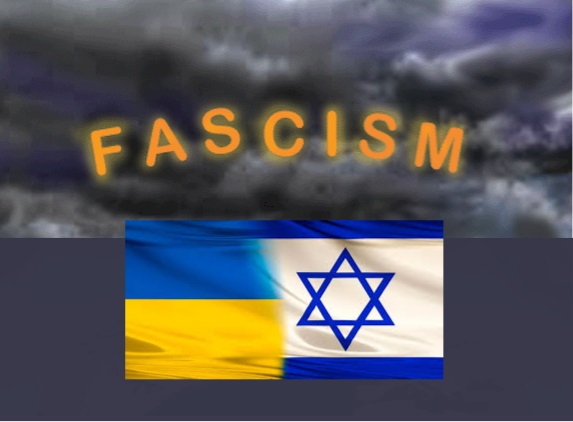
Orinoco Tribune By Sarah B. – Aug 20, 2025
From Bandera to Ben-Gurion, a new axis of ethno-supremacy is rising, fueled by U.S. backing. Same guns. Same flags. Same ideology. Gaza and Donbass are not separate wars. They are one machine.
The Ukraine–Israel Nexus: Pragmatic Alliances Amid Paradoxes and Shared Challenges
From Bandera to Ben-Gurion, echoes of ethno-nationalist revival resonate in the modern trajectories of Ukraine and Israel, two states forged through war, hardened by siege mentalities, and fueled by historical narratives of existential struggle. But these similarities are no accident of parallel development. They reflect a deepening alignment shaped by shared adversaries like Russia and Iran, backed and brokered by the same Western patrons.
In 2022, an officer of Ukraine’s Azov Regiment, toured Israel after surviving the siege of Mariupol. By 2025, Israeli drones were flying missions over Rafah, while American-made PSRL-1 rocket launchers, initially supplied to Ukraine, were spotted in conflict zones across the Middle East. Some experts suggest these may have reached Gaza through black-market channels, though a direct transfer remains unproven. What is undeniable, however, is the convergence of military technologies, intelligence doctrines, and battlefield logistics spanning both theaters.
In April 2022, Ukrainian President Volodymyr Zelenskyy, himself a stalwart ally to the Zionist cause, declared that he envisioned Ukraine becoming “a big Israel.” In doing so, he abandoned the pretense of liberal reform and embraced a future defined by permanent militarization, domestic surveillance, and an ideologically mobilized citizenry. Ukraine, he suggested, would survive not by joining Europe’s post-national dream, only by imitating the ethos of a heavily securitized Middle Eastern state.
Zelenskyy’s statement didn’t emerge in a vacuum. It followed decades of quietly intensifying Ukrainian–Israeli ties, in historical memory, military cooperation, tech integration, and shared narratives of victimhood. But it also exposed a deeper and more disturbing fusion. When the president of a country still reckoning with the legacy of the Holocaust and its own fascist collaborators calls for the building of a “Big Israel,” he is not just invoking a model of defense, he is invoking a model of justified violence, permanent siege, and a long tradition of selective memory, one that both Ukraine and Israel have wielded to reconcile uncomfortable historical alliances of culpability.
Just as the OUN’s collaboration with Nazi Germany is selectively reframed within the Ukrainian national mythos, Israel’s founding story often omits its own moments of strategic accommodation with fascism.
In the 1930s and ’40s, elements of the Zionist movement, most notably the Haavara Agreement between Nazi Germany and the Jewish Agency, facilitated Jewish emigration to Palestine while bypassing international boycotts of the Nazi regime. Revisionist factions like Lehi (the Stern Gang) and Irgun Zvai Leumi even sought military cooperation with the Axis powers against the British. These uncomfortable truths, long buried beneath the moral absolutism of Holocaust remembrance, underscore a shared willingness, Ukrainian and Zionist alike, to collaborate with and even become genocidal regimes when national aspirations were at stake.
What binds Gaza and Donbass is not a monolithic “machine of violence” but a transnational matrix of ideological alignment, technical cooperation, and strategic utility. Ukraine’s campaign of “decommunization” often mirrors Israel’s internal securitization and demographic engineering, both clad in the moral armor of historical trauma. In practice, both states justify aggressive internal and external policies through the language of survival.
This article maps the ideological, military, economic, and cultural architecture of the Ukraine–Israel relationship. From Soviet-era tensions to the post-2014 reconfiguration of alliances, we explore how pragmatic imperatives have forged a new axis of ethno-nationalist power, increasingly central to NATO’s long-term vision of regional dominance.
I. Historical Ties
To understand the modern partnership between Ukraine and Israel, one must begin with their shared, and often contradictory past. Ukraine was both a cradle of early Zionism and a site of violent antisemitic pogroms. Movements like Hibbat Zion, emerged in the 1880s in cities like Odessa and Kiev, decades before Theodor Herzl’s more famous Vienna-based political Zionism. Their mission: to restore the Jewish people to their ancestral homeland in Palestine. Ukraine, in this sense, was an incubator for the ideological DNA of the Israeli state……………………………………………………………………………………………………………………………………………………………………………………………….
…………………….The historical relationship between Israel and Ukraine is not one of ideological clarity. It is a pragmatic evolution, shaped by war, memory, trauma, and strategy. The next sections will examine how these contradictions manifest on the battlefield through weapons, doctrine, personnel, and propaganda, across Gaza and Donbass alike.
Selective Memory: How Competing Genocides Forged Strategic Amnesia
In the narrative war between historical truth and political utility, few examples are as revealing, or as cynical, as the ways Ukraine and Israel have reframed and often embellished their respective traumas to enable strategic cooperation.
By the 1980s, Ukrainian nationalist émigrés began aggressively promoting the 1932–33 Soviet famine, or Holodomor, as the “Ukrainian Holocaust.” This was a calculated response to the rising global awareness of Jewish suffering, spurred by the 1978 NBC miniseries Holocaust, which explicitly portrayed Ukrainians as Nazi collaborators. For diaspora groups still loyal to Stepan Bandera’s legacy, the documentary posed a threat to their rehabilitated image, which they had worked fervently to whitewash. In turn, they constructed a counter-narrative of equal, if not greater, Ukrainian victimhood, one that would cast the Soviet state as genocidal and reframe Ukrainian history through the lens of national martyrdom.
This rhetorical project relied on inflating death tolls,………………………………………………………………..
The result is a pact built on strategic amnesia: a cold alliance between two states whose foundational traumas have been rewritten to serve military alignment, ideological affinity, and common enemies………………………….
…………II. Blood Ties and Battle Lines: Commanders, Crusaders, and Collaborators
The machinery of transnational warfare is not only built with weapons, laws, and doctrines, but with men. Individuals who embody the ideological convergence between Zionist ethno-nationalism and Ukrainian fascism do not operate in the shadows; they are often celebrated, recruited, and strategically deployed across theaters like Gaza and Donbass. These figures serve as ideological evangelists, field commanders, propaganda tools, and networking nodes between far-right militias, Western intelligence networks, and private security structures.
Some are Azov veterans turned actors and influencers. Others are American-Israeli contractors building bridges between Tel Aviv and Kiev. ……………………..
Continue readingIran parliament presses government to apply law limiting IAEA cooperation
Iran’s parliament on Tuesday urged the Foreign Ministry and Atomic
Energy Organization to fully implement existing legislation limiting
cooperation with the International Atomic Energy Agency, amid growing
pressure from Western powers and renewed nuclear talks in Geneva. In a
strongly worded statement, the National Security and Foreign Policy
Committee of Iran’s parliament described IAEA chief Rafael Grossi as “a
servant of the US and the Zionist regime,” accusing him of siding with
hostile powers and remaining silent over attacks on Iranian nuclear sites,
according to remarks published by state media.
Iran International 26th Aug 2025, https://www.iranintl.com/en/202508262134
UN inspectors back in Iran as IAEA chief gets protection over Tehran threat
The UN nuclear watchdog’s inspectors have returned to Iran after their
expulsion during a brief war with Israel and the US, IAEA chief Rafael
Grossi said Tuesday, amid reports he has been placed under 24/7 protection
following Iran’s threat to his life. “Now the first team of IAEA inspectors
is back in Iran, and we are about to restart,” International Atomic Energy
Agency (IAEA) director general Grossi said. Grossi, who was in Washington
DC for the annual meeting of the Institute of Nuclear Materials Management,
stopped short of saying there was an agreement or timeline for them to
resume their work. “When it comes to Iran, as you know, there are many
facilities. Some were attacked, some were not. So we are discussing what
kind of modalities, practical modalities, can be implemented in order to
facilitate the restart of our work there.”
Iran International 26th Aug 2025, https://www.iranintl.com/en/202508265100
Israel Bombs Gaza Hospital, Kills 5 Journalists from AP, Al Jazeera, Reuters, NBC
August 26, 2025
Transcript………………………………………………………………………………………………………………………………… https://www.democracynow.org/2025/8/25/gaza_journalists
Report: Smotrich Told IDF Chief That Anyone Who Doesn’t Evacuate Gaza City Can ‘Die of Hunger or Surrender’
Israel’s Channel 12 also reported that Netanyahu has said he has Trump’s full support for the planned offensive to take over Gaza City but has limited time
by Dave DeCamp | August 24, 2025, https://news.antiwar.com/2025/08/24/report-smotrich-told-idf-chief-that-anyone-who-doesnt-evacuate-gaza-city-can-die-of-hunger-or-surrender/
Israeli Finance Minister Bezalel Smotrich has told the head of the Israeli military that anyone who remains in Gaza City after an IDF evacuation order can “die of hunger or surrender,” The Times of Israel reported on Saturday, citing a TV report from Israel’s Channel 12.
“We ordered you [to carry out] a quick operation. In my opinion, you can besiege them,” Smotrich reportedly told IDF Chief of Staff Eyal Zamir. “Whoever doesn’t evacuate, don’t let them. No water, no electricity, they can die of hunger or surrender. This is what we want and your capable [of doing it].”
The Channel 12 report said that during the same meeting, Israeli Prime Minister Benjamin Netanyahu and Strategic Affairs Minister Ron Dermer said that President Trump fully supports Israe’s plans to conquer Gaza City, which involves the forced displacement of over 1 million civilians amid a famine in the area, but that the US president wants a quick and decisive operation.
Thousands of Palestinians have fled Gaza City amid ramped-up Israeli attacks in the area, but there’s been no sign of a mass evacuation despite Israel’s orders to leave. Palestinians in Gaza City have rejected the idea of another displacement since most of them have been forced to move many times, and they don’t believe the area they’re being told to flee to will be much safer since the IDF continues to bomb the south.
The Palestinians in Gaza City are also likely aware that Israel’s plans involve the complete destruction of the city, which means they almost certainly won’t be able to return. The IDF has told the Israeli government that it will likely take months or possibly over a year to demolish the city.
The Channel 12 report said that Zamir clashed with Smotrich and Israeli National Security Minister Itamar Ben Gvir over the length of time the plan to take over Gaza City will take. Smotrich’s call to starve the remaining Palestinians to death aligns with previous comments he has made.
In April of this year, about a month after Israel imposed a total blockade on Gaza, Smotrich said Israel wouldn’t allow a “grain of wheat” to enter the Strip. Last year, Smotrich said at a conference that it may be “justified and moral” for Israel to starve two million Palestinians to death, but that the world wouldn’t allow it to happen.
“We are bringing in aid because there is no choice,” Smotrich said in August 2024. “We can’t, in the current global reality, manage a war. Nobody will let us cause 2 million civilians to die of hunger even though it might be justified and moral until our hostages are returned.”
Why has Donald Trump not spoken out about the famine in Gaza? – Inside Story
26 Aug 2025 Al Jazeera
A global hunger monitor, backed by the United Nations, has declared famine in Gaza City and the surrounding areas. The confirmation that Israel has engineered a man-made catastrophe prompted outrage from many nations, with a notable exception.
Neither the White House nor the US State Department has uttered a word in response. While Israel says it’s ‘an outright lie’, how much longer can the US remain silent? Is that silence an implicit go-ahead for the Israeli military’s large-scale assault on Gaza City and the drip-feeding of aid?
Eighteen Palestinians Starve to Death in Gaza Over Three Days Due to Israeli Siege
The Integrated Food Security Phase Classification (IPC) has confirmed that famine is taking place in Gaza City.
by Dave DeCamp | August 24, 2025, https://news.antiwar.com/2025/08/24/eighteen-palestinians-starve-to-death-in-gaza-over-three-days-due-to-israeli-siege/
Gaza hospitals have recorded 18 more malnutrition deaths in Gaza over the past three days, according to press releases from Gaza’s Health Ministry, as Palestinians continue to starve due to the US-backed Israeli siege.
In its latest release on Sunday, the Health Ministry said at least eight Palestinians, including one child, had starved to death over the previous 24-hour period. “This brings the total number of victims of famine and malnutrition to 289, including 115 children,” the ministry said.
On Friday, the UN-backed Integrated Food Security Phase Classification (IPC) confirmed that famine was taking place in the Gaza Governorate, which includes Gaza City and nearby towns, and that more than 500,000 people in the area were facing “catastrophic conditions characterised by starvation, destitution and death.”
The IPC said that conditions are expected to worsen and that between mid-August and the end of September, famine is expected spread to Deir el-Balah, central Gaza, and Khan Younis in the south.
The Israeli government and its supporters are denying that famine is occurring, pointing to the fact that many children suffering from severe malnutrition had pre-existing medical conditions. But the most vulnerable are always the first to be impacted when famine sets in, and there have been many cases recorded of people suffering from severe malnutrition who have no pre-existing conditions.
The Israeli newspaper Haaretz published a report on August 21 based on virtual tours of hospitals and health centers in Gaza that examined the cases of 27 children and found that 17 of them “deteriorated into a state of severe malnutrition without preexisting health conditions” while 10 suffered from previous illnesses.
“Based on our conversations, a simple fact emerged: Anyone who claims that the images of starvation in the Strip are a result of acute genetic or other diseases, and not due to a grave shortage of food, are lying to themselves,” the report said.
The IPC said that in order to prevent further catastrophe, there must be an immediate ceasefire and the lifting of all restrictions on aid entering Gaza. But Israel is planning a major escalation to take over Gaza City, and President Trump, who has the power to stop the genocidal war by cutting off weapons shipments to Israel, has signaled he’ll back whatever the Israeli government chooses to do.
1 This Month

of the week – Shut Down Drone Warfare!


Tell the Ukrainian Government to Drop Prosecution of Peace Activist Yurii Sheliazhenko

Petition to revoke the licensing of the Near Surface Nuclear Disposal Facility (NSDF) at Chalk River. https://www.ourcommons.ca/petitions/en/Petition/Details?Petition=e-7247
To see nuclear-related stories in greater depth and intensity – go to https://nuclearinformation.wordpress.com
-
Archives
- April 2026 (114)
- March 2026 (251)
- February 2026 (268)
- January 2026 (308)
- December 2025 (358)
- November 2025 (359)
- October 2025 (376)
- September 2025 (257)
- August 2025 (319)
- July 2025 (230)
- June 2025 (348)
- May 2025 (261)
-
Categories
- 1
- 1 NUCLEAR ISSUES
- business and costs
- climate change
- culture and arts
- ENERGY
- environment
- health
- history
- indigenous issues
- Legal
- marketing of nuclear
- media
- opposition to nuclear
- PERSONAL STORIES
- politics
- politics international
- Religion and ethics
- safety
- secrets,lies and civil liberties
- spinbuster
- technology
- Uranium
- wastes
- weapons and war
- Women
- 2 WORLD
- ACTION
- AFRICA
- Atrocities
- AUSTRALIA
- Christina's notes
- Christina's themes
- culture and arts
- Events
- Fuk 2022
- Fuk 2023
- Fukushima 2017
- Fukushima 2018
- fukushima 2019
- Fukushima 2020
- Fukushima 2021
- general
- global warming
- Humour (God we need it)
- Nuclear
- RARE EARTHS
- Reference
- resources – print
- Resources -audiovicual
- Weekly Newsletter
- World
- World Nuclear
- YouTube
-
RSS
Entries RSS
Comments RSS
 nuclear-news