Israel Raids Global Sumud Flotilla, Abducts Over 400 Volunteers, Group Says.
“This is an unlawful abduction, in direct violation of international law and basic human rights,” the flotilla said.
By Elizabeth Weill-Greenberg , Truthout, October 2, 2025, https://truthout.org/articles/israel-raids-global-sumud-flotilla-abducts-over-400-volunteers-group-says/
Overnight on Wednesday, Israeli soldiers raided more than a dozen boats carrying humanitarian aid to Gaza, blocked the ships’ communications, and abducted more than 400 volunteers from 47 countries.
During the raid, Israeli forces attacked volunteers with water cannons and doused them with “skunk water,” according to a press release issued by the flotilla. The volunteers were reportedly taken to the large naval vessel, the MSC Johannesburg, but the lawyers representing the volunteers have been given “minimal updates,” as per the press release.
“This is an unlawful abduction, in direct violation of international law and basic human rights,” the group said, adding that “intercepting humanitarian vessels in international waters is a war crime.”
“[D]enying legal counsel and concealing the fate of those seized compounds that crime,” the group continued.
The Global Sumud Flotilla set sail in August, carrying volunteers from more than 40 countries on dozens of civilian boats filled with humanitarian aid for Gaza, including baby formula, medicine, and prosthetic limbs. As a result of Israel’s genocide, Gaza has the largest population of child amputees per capita in the world.
The flotilla posted several prerecorded messages from volunteers stating their name, their country of origin, and that they had been abducted by Israeli forces.
Among the people aboard the flotilla were Nkosi Zwelivelile “Mandla” Mandela, Nelson Mandela’s grandson; European Parliament Member Emma Fourreau; and climate justice activist Greta Thunberg. The raid on the Global Sumud Flotilla occurred on the Jewish holiday of Yom Kippur, the day of atonement. Israel largely shuts down for the holiday, but that did not stop the raid or its attacks on Gaza.
Israel’s raid on the boats sparked demonstrations overnight throughout the world, and Italian unions have called for a general strike on Friday in solidarity with the flotilla. The unions held a general strike just weeks ago in support of the flotilla.
The Council on American-Islamic Relations (CAIR) called Israel’s raid on the Global Sumud Flotilla “an act of piracy meant to sustain its genocide.”
“Every nation that pays lip service to international law should condemn this illegal attack on the Global Sumud Flotilla and take their own steps to forcibly break the siege of Gaza,” CAIR Deputy Executive Director Edward Ahmed Mitchell said in a statement.
Earlier this week, more than a dozen U.S. lawmakers called on the Trump administration to protect the volunteers onboard the flotilla’s ships.
“The law is clear: any attack on the Global Sumud Flotilla or its civilians is a clear and blatant violation of international law,” the lawmakers wrote in a letter to Secretary of State Marco Rubio. “The United States has an obligation to protect its citizens from foreign attack.”
The lawmakers also demanded that the administration “address the issue at root of this voyage: the brutal Israeli blockade and genocide of the Palestinians in Gaza.”
The flotilla said they will not be deterred by Israel’s illegal attacks on the flotilla.
“We have to make it clear: They take one boat, we sail with 40,” the group posted on Instagram. “They try to stop us, we escalate. Take the streets, take the ports, take the seas.”
Israeli Defense Minister says half a million Palestinians in Gaza City will be considered ‘terrorists’ if they don’t evacuate.
One of the most devastating aspects of the ongoing Israeli campaign has been the phenomenon of what locals call the use of remote-controlled “robots” rigged with explosives and sent into dense built-up areas to be detonated, causing widespread destruction………….. each of these explosions equals the explosive force of two heavy air missiles.
With at least half a million people still left in Gaza City, Israeli Defense Minister Israel Katz issued a “final warning” for residents to evacuate, saying those who remain will soon be regarded as “terrorists or terrorist supporters.”
By Qassam Muaddi October 1, 2025, https://mondoweiss.net/2025/10/israeli-defense-minister-says-half-a-million-palestinians-in-gaza-city-will-be-considered-terrorists-if-they-dont-evacuate/
The Israeli army just announced that it won’t allow Palestinians in central and southern Gaza to travel north to Gaza City. Movement will only be allowed to leave the city for the south, the Israeli army said in a statement. Israeli Defense Minister Israel Katz also said that this was the Palestinians’ “last warning” to leave Gaza City, adding that anyone who remains will be considered “terrorists or terrorist supporters.”
An estimated 500,000 Palestinians remain in Gaza City, who are now officially cut off from any provisions coming from the south, including food, water, fuel, and medicine. To the north, Gaza City is completely sealed off from northern Gaza, including the cities of Jabalia, Beit Lahia, and Beit Hanoun, where the Israeli army is operating and has emptied of most of its inhabitants.
The announcement comes two days after the Trump administration announced its new plan for the end of the war on Gaza, amid an intensification of Israel’s campaign in Gaza City ahead of its planned occupation in the coming days or hours. According to the Israeli army, some 700,000 Palestinians have left, leaving at least 500,000 Palestinians still within the city. As of last Monday, September 29, half a million Palestinians remain trapped there, occupying a space of less than 8 square kilometers, UNRWA spokesperson Adnan Abu Hasna said.
The slow pace of evacuations from the city for the central and southern parts of the Strip had forced the Israeli army to delay sending in the third of its three military divisions (the 36th division), finally pushing it into Gaza last week.
Israel’s Channel 12 quoted military sources saying that the occupation would take up to three months, according to a report airing on September 16. The Israeli channel had reported earlier in August of disagreements between the Israeli army and the Israeli cabinet on the timing of the scheduled invasion. The cabinet insists on a faster operation, while the army prefers to conduct operations at a slower pace.
According to the Israeli daily Maariv, the Israeli army is avoiding combat with Palestinian resistance fighters, concentrating on air and artillery strikes to increase pressure on residents before sending in ground troops. Yet armored Israeli vehicles have still reached several areas, including the vital Jalaa street and the vicinity of the al-Shifa Hospital.
Despite the slow advance of ground forces, aerial and artillery bombardment has been relentless, sowing overwhelming destruction. Already, the iconic Shuja’iyya district in eastern Gaza City has been completely flattened, 90% of the Tuffah district has been destroyed, and 300 buildings have been demolished in Gaza’s largest neighborhood, Zeitoun.
In addition to entire residential blocks, Israeli strikes have targeted universities, where thousands of displaced Palestinians have taken shelter.
Remote-controlled ‘robots’ rigged to explode
One of the most devastating aspects of the ongoing Israeli campaign has been the phenomenon of what locals call the use of remote-controlled “robots” rigged with explosives and sent into dense built-up areas to be detonated, causing widespread destruction.
The deadly weapon is essentially an outdated Israeli armored personnel carrier (APC), which is retrofitted with large amounts of explosives and sent into neighborhoods. According to a report by Israeli army radio reporter Doron Kadosh, aired on September 21, each of these explosions equals the explosive force of two heavy air missiles.
The report pointed out that each APC explosion sends fragments across 500 square meters, turning the sky red for several seconds and pulverizing anything — including bodies — in its perimeter. The report confirmed that the Israeli army has been using these weapons “at an industrial scale,” detonating dozens of APCs in Gaza City every day, especially at night.
Meanwhile, Nibal Farsakh, spokesperson for the Palestinian Red Crescent Society (PRCS), told Al-Araby TV on Wednesday that the only two hospitals still operating in Gaza City are the al-Ahli Arab Hospital and the al-Quds Hospital, which is also owned by PRCS. Both hospitals are running without essential medical supplies, and access to al-Quds Hospital has been cut off by Israeli forces for the past nine days, Farsakh said, adding that the hospital can only treat the patients already inside it.
Farsakh said that the hospital is using its last stock of oxygen canisters, which are about to run out at any moment, warning that today’s blockade on the only way into the city puts thousands of patients at risk. Farsakh noted that as large numbers of wounded individuals have continued to require treatment, most essential medicines and medical supplies have run out.
If Gaza City falls
Amid the offensive, Palestinians are practically trapped in the city. Moving south is only possible through vehicles that charge up to 8,000 shekels per trip (about $2,420), with long delays due to the high volume of requests. For thousands of families, the only alternative is to flee on foot, which is impossible for the elderly, the sick, and the wounded. Many of them have already fled Israeli strikes numerous times.
Although most Palestinians from north Gaza have already fled the cities of Jabalia and Beit Lahia, which have been completely destroyed, most of them moved a short distance south to Gaza City.
The majority of them had fled during the Israeli operation between October and December of 2024, dubbed “the Generals’ Plan.” The majority of these displaced Palestinians returned to the destroyed north during the ceasefire between January and March of this year. After Israel broke the ceasefire, most Palestinians remained in the north, exhausted by the displacement they had already experienced since October 2023, especially after Israel bombed places to which they had fled in the south that the army designated as “safe zones.”
The Palestinians who have already fled Gaza City have concentrated in the central Gaza Strip, in and around the cities of Deir Al-Balah, Khan Younis, and the coastal Mawasi area. These areas have been crowded with tent encampments for almost two years.
A Palestinian displaced from Gaza City in Mawasi, who asked not to be named, told Mondoweiss that “there is no place left in Mawasi, not even for a needle.” He noted that “people are expanding the tent encampments into the areas in Khan Younis controlled by the Israeli army, which is putting their lives at risk.”
“They’ve been removing the rubble of other people’s homes with their bare hands for days, just to make some room for another tent,” he said.
Another Palestinian who remains in Gaza City told Mondoweiss that “we had a difficult and long discussion inside my family over moving out or not, and decided to split.”
“My mother and two sisters left to the south, and my father and I remained,” they said. “The moment we said goodbye was the most difficult of my entire life. I hugged my mother for several minutes, and we both wept, as neither of us knew if we were going to see each other again.”
Gaza City is the largest urban center in the Strip, and is 5,000 years old. It has been an economic and cultural hub for a millennia.
Now Palestinians fear that Israel plans on wiping it out entirely, the same way it did with Rafah, which has now been completely leveled. If Gaza City meets the same fate, it would be the end of the Gaza Strip as we know it.
A breakdown of Tony Blair’s bizarre proposal to run Gaza
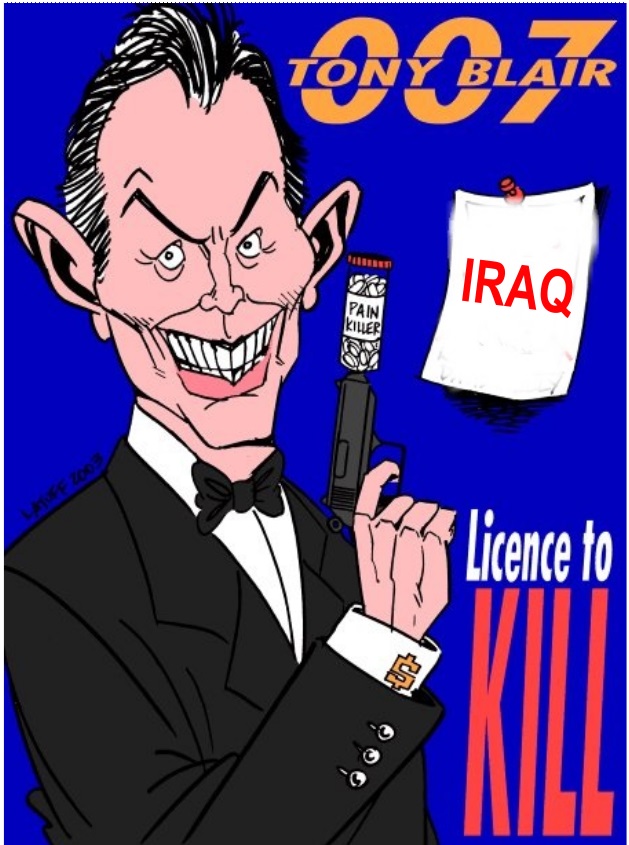
His handling of the Iraq war as premier of the UK, as well as his dealings with a string of autocrats, has left him deeply unpopular across the globe.
Proposed transitional authority will have global billionaires and businesspeople at top and Palestinians at bottom, according to leaked draft
Middle East Eye, By Rayhan Uddin, 29 September 2025
An unlikely answer has been found for who should lead the process of running Gaza after Israel’s genocidal war: Tony Blair.
It was revealed last week that the former British prime minister – a controversial figure in the Middle East, to say the least – was being considered to lead a transitional authority in the enclave.
Haaretz has now published a leaked draft plan of what Gaza would look like under Blair’s initiative.
The plan reveals a hierarchy in which an international board of billionaires and businesspeople sit at the top, while highly vetted “neutral” Palestinian administrators are at the bottom.
It sets out a three-year plan, budgeted at $90m in the first year, $134m in the second and $164m in the third (these are solely management expenses, and don’t include reconstruction or aid).
The administration would work closely with Israel, Egypt and the US, and, according to Israeli sources cited by Haartez, has the backing of the White House.
Middle East Eye breaks down key highlights from the 21-page leaked document.
Board of billionaires
Gaza International Transitional Authority, or Gita, is the name given to the new institution which will administer the Palestinian enclave.
According to the draft, Gita will be run by an international board which has “supreme political and legal authority for Gaza during the transitional period”.
The board will be in charge of all appointments, and supervise every component of the authority.
It will be made up of between seven and 10 members, including a chair.
The board will include a senior UN official, with Sigrid Kaag, the UN’s special coordinator for the Middle East peace process, cited as an example.
It would also include “leading international figures with executive and financial expertise”.
Three names are cited as potential candidates: Marc Rowan, a billionaire who owns one of America’s largest private equity firms, Naguib Sawiris, an Egyptian billionaire in the telecommunications and technology sector, and Aryeh Lightstone, chief executive of the Abraham Accords Peace Institute.
Lightstone was a senior adviser to David Friedman, a staunch defender of Israel’s illegal settlement movement, when he was US ambassador to Israel between 2017 and 2021 under Donald Trump’s first administration.
According to Haaretz, he was also deeply involved in the creation of the highly controversial Gaza Humanitarian Foundation.
Not every single board member will be a billionaire or have links to Israel or America.
There will be “at least one qualified Palestinian representative”, potentially coming from the “business or security sector”. It wasn’t made clear what “qualified” means.
And finally, the document said that the board would have “a strong representation of Muslim members to ensure regional legitimacy and cultural credibility”.
These Muslim figures would ideally have the political support of their countries, but also “long standing business credibility”.
Members of the board would be “nominated by contributing states and confirmed through a process coordinated by the UN”.
The board would report to the UN Security Council, which would ultimately grant it authority to carry out its functions.
The Security Council currently includes non-permanent members that have been highly critical of Israel’s genocide in Gaza, such as Algeria, Pakistan and Slovenia, in addition to permanent members Russia and China.
It would be interesting to see if these countries would approve a transitional government in Gaza run mostly by non-Palestinian billionaires and business figures.
The chairman (probably Blair)
Various media outlets have reported that Blair is being touted to be the chair of the transitional authority, though his name is not mentioned in the draft.
Public-private partnerships to run government projects, one of Blair’s hallmark policies as prime minister of the UK, is mentioned in the document.
According to the draft plan, the chairman will serve as the “senior political executive, principal spokesperson, and strategic coordinator for the entire transitional authority”.
They would be appointed through “international consensus” and endorsement by the UN Security Council. There is no mention of Palestinian consensus in choosing them.
If Blair is indeed the proposed chairman, he may have his work cut out gaining “international consensus” for his appointment.
His handling of the Iraq war as premier of the UK, as well as his dealings with a string of autocrats, has left him deeply unpopular across the globe.
The chair will represent Gita “in all diplomatic, donor and intergovernmental forums”. They will also lead “strategic security diplomacy” with other actors, “including Israel, Egypt and the United States”.
The document notes that initially, Gita’s senior officials won’t be in Gaza. ………………………………………………………………………………………………………………………………………………………………………
Palestinian Executive Authority, with little authority
Despite the name, the Palestinian Executive Authority, at the bottom of the hierarchy, has little to no independent authority.
It is separate from the PA, which administers parts of the occupied West Bank…………………………………………
It’s notable that the language used for all roles throughout the document, like board, chairman and CEO, reflects a business structure rather than a country or territory.
The Palestinian CEO will lead the process of identifying “directors” (not ministers) to head up the various departments like health, education, infrastructure and planning. …..
The international board of billionaires and businesspeople will have the final say on appointments “to safeguard institutional legitimacy and independence”.
“All department heads are subject to performance review and can be dismissed or replaced in accordance with transitional governance procedures,” the document notes.
An Israeli source told Haaretz that the Palestinian Executive Authority would be completely subordinate to the board and have no independent authority.
As such, it would be far weaker than the technocratic administration set out in a joint Arab plan led by Egypt earlier this year.
Below the Palestinian Executive Authority are a number of municipal roles related to the running of local public services and utilities. ………………………………………………………….. https://www.middleeasteye.net/news/breakdown-tony-blairs-bizarre-proposal-run-gaza
Will Tony Blair rule over Gaza?

Declassified UK, 2 Oct 25, John McEvoy
This week, US president Donald Trump unveiled his 20-point “comprehensive plan to end the Gaza conflict”. The plan aims, in effect, to help Israel to achieve diplomatically what it has failed to achieve militarily: the neutering of armed resistance, the dismembering of Hamas, and the removal of political agency from Palestinians in Gaza. The first point notes that “Gaza will be a deradicalized terror-free zone that does not pose a threat to its neighbors”, and it later says that “all military, terror, and offensive infrastructure” in the strip “will be destroyed and not rebuilt”. The document also implicitly acknowledges that the Israeli government has been collectively punishing the Palestinian population by refusing to allow aid into the besieged enclave. |
“Upon acceptance of this agreement, full aid will be immediately sent into the Gaza strip”, says point seven. “Entry and distribution of aid in the Gaza strip will proceed without interference”.
But perhaps most remarkably, Trump’s so-called peace plan includes a proposal for Gaza to be “governed under the temporary transitional governance of a technocratic, apolitical Palestinian committee”.
This committee would be “made up of qualified Palestinians and international experts, with oversight and supervision by a new international transitional body” chaired by Trump alongside former UK prime minister Tony Blair.
Blair’s credentials for promoting peace in the Middle East are far from impeccable.
After sponsoring the illegal war on Iraq in 2003 – which ignited violence and extremism across the region – Blair worked for the Quartet on the Middle East, an unsuccessful attempt at mediating the Israeli-Palestinian peace process. The former prime minister has also been historically sympathetic to Israel’s interests. “I have never actually found it hard to be a friend of Israel, I am proud to be a friend of Israel”, Blair told a Labour Friends of Israel reception in September 2006.More concerningly, Blair is now closely linked to pro-Israel businessmen. |
Larry Ellison, a US tycoon who has donated millions to the Israel Defence Forces, is one of the key funders of the Tony Blair Institute, having pledged around $500m over recent years.
None of this appears to worry Keir Starmer, who came out in support of Trump’s plan, saying it “is profoundly welcome and I am grateful for President Trump’s leadership”.
Trump says Hamas has “three or four days” to respond to the proposal, saying the group will “pay in hell” if it rejects the deal.
But Hamas looks unlikely to accept it. A senior official told the BBC that the group will reject the plan, claiming it “serves Israel’s interests and ignores those of the Palestinian people”.
Blair’s campaign to profit from the rubble of Gaza, then, is far from a done deal.
Iran won’t risk Russia, China’s ire by quitting nuclear treaty, expert says
Threats by Iranian hardliners to leave the Non-Proliferation Treaty (NPT)
after a June war are likely headed nowhere because of Tehran’s keenness not
to irritate Russia and China, Middle East expert Kenneth Pollack told Iran
International. “The Chinese absolutely do not want to see Iran acquire
nuclear weapons. That would be very problematic for them. For the same
reason, the Chinese do not want to see Iran violate the NPT,” added
Pollack, Vice President for Policy at the Middle East Institute think tank
in Washington DC.
Iran International 2nd Oct 2025, https://www.iranintl.com/en/202510021782
How the media tears up its own rulebook to hide Israel’s atrocities

Jonathon Cook, 30 September 2025 , https://www.jonathan-cook.net/blog/2025-09-30/media-rulebook-hide-israel-atrocities/
The news cycle has rules every rookie journalist understands. When the media choose to break them, you can be sure it is for entirely non-journalistic reasons
You can tell much from how the media choose to cover a news story – and from the facts they decide to e, mphasise in a headline. And you can tell even more from the fact that, on certain subjects, the media uniformly choose to break the most basic rules of news gathering taught to every young journalist.
Typically, reporters try to extract as much news “value” from a story as they can. That means there is often a formula hiding behind the coverage.
When the news first hits, it is handled as what we call a “breaking story”. It is the first draft of the event, containing essential information as it can best be understood at the time of the report.
Here’s an example of a possible headline on a breaking news story: “Two dead, over 40 injured as London-to-Brighton train derails.”
Later the same news event is repackaged in what is called a “follow-up” – once more information is available and errors can be corrected, or because, with more time to talk to those directly involved, there is the chance to present a different, or more interesting, angle on the same story.
Here’s the headline on a possible follow-up: “Train driver reportedly had heart attack before fatal train derailment.”
But there are cases where the natural order of the news cycle gets disrupted – and when it does, there are invariably likely to be non-journalistic reasons in play.
In the case of Israel, the news-gathering rulebook often gets torn up.
The first lesson taught to every rookie journalist is this: wherever possible, supply the reader with the “who, what, when, where, why and how” of the story.
I would not be the first to note how often news media forget in headlines – the only part of a story most readers see – to mention the first of those points, “Who?”, if the responsible party is Israel and it is committing indisputable war crimes.
We have had two years filled with this kind of rogue reporting, designed to obscure Israel’s role in systematically perpetrating atrocities that amount to genocide:
But I want to highlight a less noticed element to the media’s perverse coverage of Israel. And that is the regular skewing of the traditional news cycle. Too often the media simply skip the breaking stage of a news story and head straight to the follow-up.
By now, you might be able to guess why. Because a breaking story presents only the essential facts, and those facts cannot disguise the nature of Israel’s crimes.
By moving straight to the follow-up, the media get to muddy the water with Israel’s rationale, however preposterous, for its war crimes at the very moment those crimes first come to public attention.
Let us take as an example Israel’s strike last month on Nasser hospital in Khan Younis, the only major hospital still functioning, partially, in Gaza after Israel put out of action dozens of others. The strike killed scores of journalists and rescue workers.
The media uniformly framed Israel’s attack on a protected building – a hospital – and its murder of civilians there as potentially warranted by amplifying an Israeli claim that was patently ridiculous on at least three counts.
First, Israel claimed that it was targeting a camera on an outside balcony – and that the camera was such a threat, and an immediate one, that it needed to hit Nasser hospital with missiles to destroy it.
Second, Israel claimed that the camera was being used by Hamas, even though it belonged to a Reuters journalist and was actually being used by Reuters for a live feed at the time it and the hospital were hit.
And third, Israel claimed that the only way the camera could be disabled was by hitting the hospital with a series of missile strikes that killed journalists and emergency workers who rushed to assist those killed and injured in the initial strike that had destroyed the camera.
The problem with the coverage ran much deeper than the astounding levels of gullibility demonstrated by the entire press corps in reporting Israel’s “Hamas camera” claim.
The media also had to pervert the normal news cycle by failing to report the attack on the hospital as a breaking story. Instead the media moved straight to the follow-up, in which Israel was allowed to foreground its atrocity “denial” with the camera claim.
In large part, the media could do this only because Israel – which understands how to manipulate the news cycle, especially when the media are so ready to spread its disinformation – had its excuses ready from the outset of the attack. That alone should have rung alarm bells with any real journalists.
But further, major media outlets all chose as their follow-up Israel’s ludicrous rationale for an illegal attack on the hospital: the red herring of the “Hamas camera”. Were they doing their jobs properly, these outlets could have chosen an entirely different follow-up. They could have taken testimony from experts and witnesses on the ground to tear apart Israel’s tissue of lies.
The goal here, of course, was to distort the audience’s understanding of a simple news event – Israel’s attack on a hospital in violation of international law to kill journalists and emergency workers, also in violation of international law – to ensure any loss of sympathy with Israel was kept to a minimum.
The media’s role in artificially sustaining support for Israel, in the face of all the evidence of its crimes, has been absolutely essential to smoothing the path, over the past two years, to genocide.
Once you understand how the media pervert the normal news cycle when it serves larger political purposes, the strange presentation of other events starts to make more sense. Such as the minimal coverage of police detaining George Galloway, a former MP and leader of a UK political party, at Gatwick airport at the weekend under draconian terrorism laws. Galloway also had his electronic devices seized.
His detention alone should have been a big news story. But there was also plenty of extra news “value” that could have been extracted from it.
The story was more than ripe for follow-ups, given Galloway’s outspokenness about Israel and its genocide in Gaza; the Starmer government’s efforts to silence dissent on Gaza from journalists, lawyers and now politicians using terrorism laws; and the government’s recent abuses of the terrorism laws to proscribe for the first time in British history the direct-action group Palestine Action, which has been targeting weapons factories in the UK, like the Israeli firm Elbit’s, supplying Israel with the tools to carry out the Gaza genocide.
Were the Russian government to detain and seize the electronic devices of a politician critical of Putin’s policies in Ukraine, we all know how the British media would cover that story. There would be endless follow-ups of Putin’s growing and ruthless authoritarianism, of the struggle of critics to speak openly about events in Ukraine, of the need for more sanctions on Russia, and so on.
Contrast that to the coverage of Galloway’s persecution – which comes in the wake, also largely unreported, of a growing number of arrests and investigations of journalists and lawyers under the same terrorism laws after they have criticised the Starmer government’s complicity in the Gaza genocide.
Notice two days later the lack of follow-ups in the British media on Galloway’s detention. Outlets have reported the breaking story – one in which headlines connect Galloway to “terrorism” – but not issued follow-ups whose headlines might push back against the authoritarian over-reach of the British security state overseen by Starmer.
In this case, the breaking story serves the British establishment’s interests in implicitly vilifying Galloway far better than any follow-up.
A follow-up would either have to “put up” – that is, provide a rationale for detaining Galloway under terrorism laws that, we can infer, doesn’t exist – or interrogate the narrative the government has been manufacturing to justify its persecution of regime dissidents.
Paradoxically, the only outlet that has offered a follow-up – as shown in the screenshot above of a Google search late this afternoon – was from the rightwing Israeli outlet The Jerusalem Post. Uniquely, its headline “‘Politically motivated intimidation’: George Galloway reportedly detained at Gatwick airport” captures the story the British media is carefully avoiding.
The media aren’t reporting the news. They are shaping the news to shape our minds, our perceptions, our sympathies. Until we grasp that simple fact, we will continue cheering those whose only goal is to keep oppressing us and enriching themselves.
Trump says Israel can ‘finish the job’ in Gaza if Hamas rejects latest ceasefire plan

If Hamas rejects the deal, Trump said Israel “would have my full backing to finish the job” of destroying the group. Netanyahu said Hamas could choose the “easy way or hard way” going forward.
Donald Trump says Benjamin Netanyahu accepted the latest U.S.-backed “peace plan” in Gaza and threatened Hamas that if it rejects the proposal, Israel would have his “full backing to finish the job” of destroying the group.
By Michael Arria September 29, 2025, https://mondoweiss.net/2025/09/trump-says-israel-can-finish-the-job-in-gaza-if-hamas-rejects-latest-ceasefire-plan/
President Donald Trump says Israeli Prime Minister Benjamin Netanyahu has accepted the latest U.S.-backed “peace plan,” which is ostensibly aimed at securing a ceasefire in Gaza.
Trump made the announcement during a joint press conference with Netanyahu, which followed a White House meeting between the two leaders. It’s Netanyahu’s fourth trip to Washington since Trump began his term in January.
During the meeting, Trump facilitated an Oval Office phone call between Netanyahu and Qatari Prime Minister Mohammed bin Abdulrahman bin Jassim al-Thani, in which the Israeli leader apologized for the September 9 attack on Doha.
Netanyahu expressed regret about the strikes and, specifically, “that, in targeting Hamas leadership during hostage negotiations, Israel violated Qatari sovereignty,” according to a White House readout of the phone call.
Despite being touted as a diplomatic breakthrough, the 20-point plan recycles a number of previous White House declarations.
The plan would include a prisoner swap, complete Hamas disarmament, and the formulation of a transitional government led by an international body. Additionaly, it requires Gaza to become “deradicalized terror-free zone.”
Trump would chair a “board of peace” to reconstruct the Gaza Strip as part of the program, while Jordan and Egypt would train new Palestinian security forces.
Trump told reporters that it was an “extremely fair” proposal and claimed that Hamas “wants to get this done too,” despite reports that Hamas has yet to receive the plan.
“I also want to thank Prime Minister Netanyahu for agreeing to the plan and for trusting that if we work together, we can bring an end to the death and destruction that we’ve seen for so many years, decades, even centuries and begin a new chapter of security, peace and prosperity for the entire region,” said Trump.
If Hamas rejects the deal, Trump said Israel “would have my full backing to finish the job” of destroying the group. Netanyahu said Hamas could choose the “easy way or hard way” going forward.
“Everyone understands that the ultimate result must be the elimination of any danger posed in the region, and that danger is caused by Hamas,” explained Trump.
Neither leader took questions after the press conference.
Shortly before the meeting, Axios published a report by Marc Caputo and Barak Ravid, which claimed Trump is “willing to break with him over Gaza for the first time since returning to office.” It quoted an anonymous Trump official who insisted that “everyone — and I mean everyone — is exasperated with Bibi.”
Despite such assertions, the Trump administration has continued to support the assault on Gaza without conditions of any kind.
Earlier this month, in a 72-page report, the UN Commission of Inquiry concluded that Israel is committing genocide in Gaza and called for an arms embargo on the country.
“What does this mean for the international community?,” wrote UN human rights chief and commission member Navi Pillay after the report was released. “It means its obligations are not optional. Every state has an obligation to prevent genocide wherever it occurs,” she continued. “That obligation requires action: halting the transfer of weapons and military support used in genocidal acts, ensuring unimpeded humanitarian assistance, stopping the mass displacement and destruction, and using all available diplomatic and legal means to stop the killing. To do nothing is not neutrality. It is complicity.”
Exposing JFK Airport’s hidden arms pipeline to Israel
Shipping records obtained by Mondoweiss show New York’s JFK Airport is a key transit hub for U.S. weapons parts headed to Israel’s genocide in Gaza.
By Shaniyat Turani-Chowdhury September 30, 2025, https://mondoweiss.net/2025/09/exposing-jfk-airports-hidden-arms-pipeline-to-israel/
On July 16, 2025, a Boeing 747 operated by Challenge Airlines lifted off from JFK Airport in New York. The cargo manifest listed a 347-kilogram shipment from Lockheed Martin. Inside was a BRU-68 bomb release unit, a mechanism that allows an F-35 fighter jet to drop 2,000-pound bombs.
The flight’s final stop was Nevatim Air Base in southern Israel, home to the F-35I fleet bombing Gaza.
This was not an isolated transfer. Internal shipping records shared by the Palestinian Youth Movement, and cross-referenced with public flight-tracking data, reveal a steady flow of U.S.-made weapons components moving from New York to Israel. Parts for fighter jets, missile launchers, and ammunition have routinely left JFK on commercial cargo flights while Israel’s air campaign destroys homes, schools, and hospitals.
These shipments started before the current genocide, but have increased greatly since October 7, 2023. They continue now despite mounting evidence of war crimes and calls for an arms embargo. What they reveal is that New York City is a crucial logistical hub in the supply chain arming Israel’s assault.
Between July 2 and July 23, at least six arms shipments from JFK to Israel were verified through waybills, flight data, and internal records provided to Mondoweiss.
These findings add new depth to earlier reporting in The Intercept and The Ditch, showing how JFK Airport has become a critical link in Israel’s military supply chain.
“What these records show is that the genocide in Gaza isn’t only manufactured in Washington—it’s facilitated right here in New York,” said Kaleem Hawa of the Palestinian Youth Movement. “JFK has become a gateway for the weapons that are killing our people.”
These flights and their deadly cargo reveal the logistics networks arming Israel’s genocide in Gaza that, for many in the U.S., is hiding in plain sight.
A civilian airport moving weapons to genocide
Challenge Airlines flight ICL982 departs JFK for Tel Aviv on a near-routine schedule, often before sunrise. Cargo bays handle electronics, produce, and mail. Mixed in are crates labeled “aircraft components” or “hazardous materials,” terms that hide their military use.
Among the shipments traced in July were:
- Aircraft structural parts and missile launcher struts from Lockheed Martin
- Fuel selector valves used in Elbit Systems aircraft
- Ammunition link containers for Israel Military Industries
- A BRU-68 ejector unit for the F-35
- Wingtip protective lenses for fighter jets
Each part is essential to the maintenance and repair of larger weapons systems, and they are moved under the cover of civilian logistics.
“Most of us just scan the cargo tags—we’re not told what’s inside,” a JFK cargo worker who asked to remain anonymous told Mondoweiss. “When pallets show up wrapped and labeled ‘confidential’ or ‘secret,’ we know not to ask questions. They bypass normal screening. We just load them.”
A second cargo handler recalled the difference on days when major military shipments arrive. “The pallets are heavier, wrapped tight, and marked with tags you don’t see on normal freight. Security is always hovering nearby. We’re told nothing and only given the signal to load.”
Why JFK? Geography, logistics, and loopholes
JFK’s east coast location shortens routes to Europe and the Middle East. Explosives depots along the coast allow rapid transport from factory to plane.
Jack Cinamon of Shadow World Investigations, an international research group that tracks the global arms trade and corruption, who studies U.S.-Israel weapons transfers, points to two reasons JFK is such a strategic node in the supply chain. The first is proximity to suppliers. “Along the East Coast are multiple explosives and ammunition depots,” he explained to Mondoweiss. “Being close to those locations makes JFK much more advantageous.”
Cinamon also says the abundance of established cargo carriers, like Challenge and FedEx, which operate full logistics hubs inside JFK, provides cover for defense contractors.
The airport also stores hazardous and explosive materials, a capability not available everywhere. This combination lets military cargo move in the same space as ordinary freight, hidden by commercial operations.
JFK is not the only American airport feeding the supply lines into Israel’s war machine. Dallas-Fort Worth, Memphis International, and Oakland also serve as key transit points in this network.
The endpoint: Nevatim Air Base
The end of the line is Nevatim Air Base, carved into the Negev desert southeast of Be’er Sheva. It’s here that Israel stations its fleet of F-35I “Adir” jets, the U.S.-built fighters engineered for precision bombing runs.
Among the cargo routed from New York City are BRU-68 ejector units, the hardware that allows these jets to release heavy munitions. The Pentagon itself places the BRU-68 under “Category VIII – Aircraft and Related Articles” on the U.S. Munitions List, noting its use in deploying precision weapons like the 2,000-pound GBU-31. These ejectors wear down quickly and must be replaced often, making the shipments routine. Alongside them are fuel valves, targeting consoles, and protective lenses—the pieces that keep the F-35Is in the sky and combat-ready.
The path is seamless. Parts are made from a Lockheed Martin assembly line, to a cargo bay at JFK, to the blast craters in Rafah. It is this steady pipeline between New York and Nevatim that enables Israel to sustain its air campaign over Gaza.
Law, policy, and complicity
Under the International Traffic in Arms Regulations (ITAR), Israel receives exemptions that speed licensing for some weapons components. The Arms Export Control Act and the Leahy Law bar U.S. assistance to military units committing human rights abuses, yet exports have continued throughout the bombing of Gaza.
Patrick Wilcken, Amnesty International’s head of military, security, and policing work, told Mondoweiss any state transferring arms to Israel “risks complicity in genocide and war crimes” and violates its obligation under the Genocide Convention to prevent genocide. States that knowingly continue transfers, he added, risk “aiding and assisting” in crimes under international law, including war crimes, crimes against humanity, and genocide.
Wilcken noted that Israel’s preferential treatment under U.S. export rules does not override international obligations. “International humanitarian law prohibits all states—including the U.S.—from transferring weapons to a party to an armed conflict where there is a clear risk that doing so would contribute to the commission of war crimes,” he said. Amnesty has long called for a total arms embargo, citing extensive evidence of repeated violations in Gaza.
The risk extends to private industry. “Companies, their executives, and employees risk being accomplices in crimes under international law if the products and services they provide contribute substantively in the commission of those crimes,” Wilcken explained. If they know their cargo will likely be used unlawfully, “they could be found legally liable.”
Amnesty says the threshold for halting arms transfers has already been met. Court challenges in Belgium and the Netherlands have successfully blocked shipments to Israel, even as similar efforts in France and the UK have failed.
In Belgium, regional governments suspended licenses for military goods bound for Israel following legal pressure and public outcry, while in Ireland, parliamentarians have raised questions over flights carrying Israeli explosives through Shannon Airport. Reporting from The Ditch revealed that shipments tied to Israel’s Ministry of Defense were routed through Europe, sparking scrutiny of how states may be complicit in the transfer of arms used in Gaza.
Congressional oversight
JFK Airport sits within the district of Congress member Gregory Meeks, who, as a ranking member of the House Foreign Affairs Committee, holds one of the key positions in Congress responsible for reviewing and overseeing arms sales. Under the Arms Export Control Act, his committee can delay, question, or block transfers, and Meeks has made use of that authority in the past. In 2021, he sought a temporary pause on a $735 million sale of precision-guided munitions to Israel to allow more time to review, and in 2024, he pressed the State Department for further assurances on a multibillion-dollar package of F-15s. These episodes highlight that he is not only aware of the stakes but is willing, at least in certain cases, to assert the committee’s oversight powers.
At the same time, Meeks has long been supported by pro-Israel advocacy networks, including AIPAC, whose lobbying efforts consistently push for expedited transfers and minimal restrictions on U.S. defense exports to Israel. Meeks has received more than $400,000 from AIPAC as of the most recent federal elections filings. Those ties place him at the center of competing pressures: on one side, his formal role as a gatekeeper tasked with scrutinizing foreign military sales, and on the other, the political influence of a lobby that has made the uninterrupted flow of weapons a top priority.
Mondoweiss contacted Representative Meeks for a comment on the fact that these shipments leave directly from his district through JFK. His office did not respond.
Protest and suppression
On July 9, protesters gathered outside JFK to stop a shipment of Elbit Systems parts. Authorities responded with a coordinated lock down. The Port Authority, MTA, and NYPD restricted access to all terminals, barring the press from the grounds. Protesters were pushed out of sight.
“We were blocked from every angle,” said a protester who asked to remain anonymous. “Police set up barricades so far back you couldn’t see the cargo area—not the planes, not the loading trucks, nothing. Anyone without a boarding pass was turned away. From where we were pushed, it was impossible to tell if anything was being moved. It felt deliberate.”
“They shut down the public’s right to witness it,” added another organizer.
The flight left on schedule.
Trump’s 20-Point Gamble: A bold bid to end the Gaza War – or a recipe for stalemate?
30 September 2025 Roswell AIM Extra, https://theaimn.net/trumps-20-point-gamble-a-bold-bid-to-end-the-gaza-war-or-a-recipe-for-stalemate/
In the sweltering corridors of power at the White House, where deals are struck and destinies rewritten over Diet Cokes and classified briefings, President Trump has once again thrust himself into the heart of the Middle East maelstrom. On September 29, 2025, flanked by Israeli Prime Minister Benjamin Netanyahu, Trump unveiled a sweeping 20-point plan aimed at halting Israel’s relentless war on Gaza – a conflict that has claimed over 66,000 Palestinian lives and left the enclave in rubble since October 2023.
With characteristic bombast, Trump declared the proposal “tremendous,” a “game-changer” that could usher in “greatness in the Middle East,” while Netanyahu nodded in apparent agreement, vowing Israel’s full backing if Hamas balks.
Here is the full text of the peace proposal:
- Gaza will be a deradicalised terror-free zone that does not pose a threat to its neighbours.
- Gaza will be redeveloped for the benefit of the people of Gaza, who have suffered more than enough.
- If both sides agree to this proposal, the war will immediately end. Israeli forces will withdraw to the agreed upon line to prepare for a hostage release. During this time, all military operations, including aerial and artillery bombardment, will be suspended, and battle lines will remain frozen until conditions are met for the complete staged withdrawal.
- Within 72 hours of Israel publicly accepting this agreement, all hostages, alive and deceased, will be returned.
- Once all hostages are released, Israel will release 250 life sentence prisoners plus 1,700 Gazans who were detained after October 7th 2023, including all women and children detained in that context. For every Israeli hostage whose remains are released, Israel will release the remains of 15 deceased Gazans.
- Once all hostages are returned, Hamas members who commit to peaceful co-existence and to decommission their weapons will be given amnesty. Members of Hamas who wish to leave Gaza will be provided safe passage to receiving countries.
- Upon acceptance of this agreement, full aid will be immediately sent into the Gaza Strip. At a minimum, aid quantities will be consistent with what was included in the January 19, 2025, agreement regarding humanitarian aid, including rehabilitation of infrastructure (water, electricity, sewage), rehabilitation of hospitals and bakeries, and entry of necessary equipment to remove rubble and open roads.
- Entry of distribution and aid in the Gaza Strip will proceed without interference from the two parties through the United Nations and its agencies, and the Red Crescent, in addition to other international institutions not associated in any manner with either party. Opening the Rafah crossing in both directions will be subject to the same mechanism implemented under the January 19, 2025, agreement.
- Gaza will be governed under the temporary transitional governance of a technocratic, apolitical Palestinian committee, responsible for delivering the day-to-day running of public services and municipalities for the people in Gaza. This committee will be made up of qualified Palestinians and international experts, with oversight and supervision by a new international transitional body, the “Board of Peace,” which will be headed and chaired by President Donald J Trump, with other members and heads of State to be announced, including Former Prime Minister Tony Blair. This body will set the framework and handle the funding for the redevelopment of Gaza until such time as the Palestinian Authority has completed its reform program, as outlined in various proposals, including President Trump’s peace plan in 2020 and the Saudi-French proposal, and can securely and effectively take back control of Gaza. This body will call on best international standards to create modern and efficient governance that serves the people of Gaza and is conducive to attracting investment.
A Trump economic development plan to rebuild and energize Gaza will be created by convening a panel of experts who have helped birth some of the thriving modern miracle cities in the Middle East. Many thoughtful investment proposals and exciting development ideas have been crafted by well-meaning international groups, and will be considered to synthesize the security and governance frameworks to attract and facilitate these investments that will create jobs, opportunity, and hope for future Gaza.- A special economic zone will be established with preferred tariff and access rates to be negotiated with participating countries.
- No one will be forced to leave Gaza, and those who wish to leave will be free to do so and free to return. We will encourage people to stay and offer them the opportunity to build a better Gaza.
- Hamas and other factions agree to not have any role in the governance of Gaza, directly, indirectly, or in any form. All military, terror, and offensive infrastructure, including tunnels and weapon production facilities, will be destroyed and not rebuilt. There will be a process of demilitarization of Gaza under the supervision of independent monitors, which will include placing weapons permanently beyond use through an agreed process of decommissioning, and supported by an internationally funded buy back and reintegration program all verified by the independent monitors. New Gaza will be fully committed to building a prosperous economy and to peaceful coexistence with their neighbors.
- A guarantee will be provided by regional partners to ensure that Hamas, and the factions, comply with their obligations and that New Gaza poses no threat to its neighbors or its people.
- The United States will work with Arab and international partners to develop a temporary International Stabilization Force (ISF) to immediately deploy in Gaza. The ISF will train and provide support to vetted Palestinian police forces in Gaza, and will consult with Jordan and Egypt who have extensive experience in this field. This force will be the long-term internal security solution. The ISF will work with Israel and Egypt to help secure border areas, along with newly trained Palestinian police forces. It is critical to prevent munitions from entering Gaza and to facilitate the rapid and secure flow of goods to rebuild and revitalize Gaza. A deconfliction mechanism will be agreed upon by the parties.
- Israel will not occupy or annex Gaza. As the ISF establishes control and stability, the [Israeli military] will withdraw based on standards, milestones, and timeframes linked to demilitarization that will be agreed upon between the [Israeli military], ISF, the guarantors, and the Unites States, with the objective of a secure Gaza that no longer poses a threat to Israel, Egypt, or its citizens. Practically, the [Israeli military] will progressively hand over the Gaza territory it occupies to the ISF according to an agreement they will make with the transitional authority until they are withdrawn completely from Gaza, save for a security perimeter presence that will remain until Gaza is properly secure from any resurgent terror threat.
- In the event Hamas delays or rejects this proposal, the above, including the scaled-up aid operation, will proceed in the terror-free areas handed over from the [Israeli military] to the ISF.
- An interfaith dialogue process will be established based on the values of tolerance and peaceful co-existence to try and change mindsets and narratives of Palestinians and Israelis by emphasizing the benefits that can be derived from peace.
- While Gaza re-development advances and when the PA reform program is faithfully carried out, the conditions may finally be in place for a credible pathway to Palestinian self-determination and statehood, which we recognize as the aspiration of the Palestinian people.
- The United States will establish a dialogue between Israel and the Palestinians to agree on a political horizon for peaceful and prosperous co-existence.
Yet, as the ink dries on this audacious blueprint – floated last week to leaders from Qatar, Saudi Arabia, Egypt, and beyond at the UN General Assembly – the devil lurks in the details, and Hamas has yet to even receive a written copy. The plan nods to Palestinian aspirations for statehood, a pathway Netanyahu has long scorned, while offering amnesty to Hamas fighters who swear off violence and exile for the rest – echoing Trump’s first-term Abraham Accords but with a sharper edge of coercion.
Trump’s optimism is infectious: “Everyone else has accepted it,” he boasted, hinting at full U.S. support for Israel to “do what you have to do” if talks falter. But with Gaza City under fresh bombardment and over 700,000 displaced in recent escalations, the question hangs heavy: Is this a genuine olive branch, or another high-stakes poker game where the Palestinians hold the weakest hand? As the world watches, the stakes couldn’t be higher.
Palestinian Subordination: Donald Trump’s Gaza Peace Plan
2 October 2025 Dr Binoy Kampmark, https://theaimn.net/palestinian-subordination-donald-trumps-gaza-peace-plan/
He had moments of discomfort and embarrassment – pressed into calling the Qatari Prime Minister by his host to apologise for striking Doha and made to pay lip service to the prospect of a Palestinian state – but Israel’s Benjamin Netanyahu had many reasons to be pleased. On September 29, President Donald Trump advanced a peace proposal that essentially preservesIsraeli pre-eminence regarding the fate of Palestinians, though it entails a cessation of hostilities, an affirmation that Gazans would not be expelled (those leaving would have the right to return), and an injunction against Israeli annexation of the Strip. But Hamas, militarily and politically, would have to surrender all claims, with the Palestinian Authority shepherded and supervised by foreign powers.
Trump’s peace proposal comprises twenty points. They include a “deradicalized terror-free zone,” Gaza’s redevelopment for the benefit of its people aided by “a panel of experts who have helped birth some of the thriving miracle cities in the Middle East,” and an immediate end to the war on its acceptance by the parties. Israel would withdraw to an agreed upon line in anticipation of a hostage release, during which all military operations would cease pending complete withdrawal. All hostages, dead and alive, would be returned within 72 hours, to be followed by the release of 250 Palestinian life sentence prisoners and Gazans detained since October 7, 2023.
Hamas and militant factions will forfeit any role in governing Gaza, with any offensive infrastructure and equipment destroyed, but any of its members wishing to commit to “peaceful co-existence” and decommissioning of weapons will be granted amnesty, with those wishing to leave given safe passage to receiving countries. Compliance by the militant group will be overseen by “regional partners.” Full aid would resume, with the UN and Red Crescent restored to their role as chief distributors.
On the issue of governance, a temporary technocratic “apolitical Palestinian committee” of qualified Palestinians and “international experts” would form a temporary transitional body, subject to a “Board of Peace” personally chaired by Trump. Most unfortunately, it is likely to include such figures as Sir Tony Blair, the Middle East’s typhoid Mary when it comes to peace. The transitional authority would hold the reins till reforms by the Palestinian Authority had been completed. With immediacy, however, the US would work with Arab and international partners to deploy an “International Stabilisation Force” to Gaza. The ISF will be responsible for training Palestinian police forces and provide support in terms of vetting recruits, with assistance from Jordan and Egypt.
The proposal clearly envisages a significant role for the ISF, though says about who will comprise it. Israel will not, under the plan, occupy or annex Gaza, surrendering what territory it has taken to the ISF. Even if Hamas were to delay or reject the proposal, the Israeli Defense Forces would still hand over occupied territory of “terror-free areas” to the stabilisation force but retain a security perimeter to stem “any resurgent terror threat.”
The plan also envisages the establishment of an interfaith dialogue to promote the values of peace between the parties, and a “credible pathway to Palestinian self-determination and statehood” if the programs for Gaza’s redevelopment and PA reform take place as planned. A vague US promise to “establish a dialogue” between Israel and the Palestinians regarding peaceful and prosperous co-existence rounds off the points.
There was palpable grumbling from the Israeli camp. Netanyahu undoubtedly harbours ambitions of finishing “the job”, and there is little to say the war will not resume once the Israeli hostages are returned. Having previously rejected any governing role of the Palestinian Authority in Gaza, he now reluctantly accepts the idea subject to a “radical and genuine overhaul” of the body.
Finance Minister Bezalel Smotrich, one of the right-wing heavies in the Israeli cabinet, is threatening to withdraw his Religious Zionist Party from the coalition. Agreeing with the plan had been “an act of wilful blindness that ignores every lesson of October 7.” It would only “end in tears.” Fellow zealot, National Security Minister Itamar Ben-Gvir, is also likely to be seething.
Opposition leader Yair Lapid is also suspicious of Netanyahu, who tends to say “yes” when visiting Washington, “standing in front of the cameras at the White house, feeling like a breakthrough statesman.” On returning to Israel, however, he always seemed to add a qualifying “but”, his political base always reminding him “who the boss is.”
In keeping with history, the Trump plan, even if it were to be implemented to the letter, enshrines the essential subordination of Palestinian goals to the dictates of other powers. Palestinian military presence is not only to be curtailed but essentially eliminated altogether. Hamas, never consulted regarding the peace terms, is to accept its own effacing. The PA is to accept its own subservience and infantilisation. The Gazans are also to accept an economic and development program dictated and directed from without. Statehood is to be kept in cold storage till appropriate, controlled conditions for its release are approved – and certainly not by the Palestinians themselves. They, it would seem, remain the considered errant children of international relations, mistrusted and requiring permanent, stern invigilation.
Expect A Huge Fuss About The October 7 Anniversary As The World Turns Against Israel
Caitlin Johnstone, Sep 30, 2025
Israel apologists are probably going to make a much, much bigger deal about the second October 7 anniversary than they did about the first anniversary, because they kind of have to. The world is turning against Israel in unprecedented ways in 2025, and yelling about October 7 is all they’ve got left.
They’ve already got a scripted October 7 series coming out on Paramount+, and another, separate scripted October 7 series coming out on HBO Max for the anniversary. There are probably numerous news media segments and articles scheduled. Maybe some new “revelations” about alleged October 7 atrocities which have been just waiting in the wings this whole time for some reason.
The hasbarists are going to be so obnoxious. They’ll be babbling about Hamas beheading babies and then cooking the beheaded babies in the oven and then having sex with the beheaded babies and then eating the beheaded babies and then playing soccer with the baby heads while singing about how much they love Adolf Hitler.
They’ll need to do this, because what else do they have? All the attention has long ago moved from October 7 to the genocide in Gaza, because Israel is the victimizer in literally every news story that’s come out about Palestine since that one day. Every relevant humanitarian institution on earth is saying that Israel is committing genocide and starving civilians, and we’ve been watching the evidence of this on our screens for two years.
In 2023 you had westerners saying “How could Hamas do such a thing??”, but in 2025 everyone’s looking back and going “Ehh, I kinda get it.” There are only so many horrific atrocities you can witness before you stop seeing Israel as the poor widdle Bambi-eyed victim. There are only so many times you can hear Israeli officials stating their plans to ethnically cleanse the Gaza Strip of all Palestinians, only so many Israeli soldiers you can see mockingly dressed in the undergarments of the dead and displaced Palestinian women they’ve been genociding, only so many hospital bombings you can read about, only so many accounts of IDF troops massacring starving civilians at aid sites you can listen to, before you start thinking to yourself that Israel probably had it coming.
So they’ve got to try and reignite that initial shock and horror Israel’s western allies experienced on October 7, using whatever tools of emotional manipulation they can. Try to take us all by the hand and lead us back to that naive time when the mainstream narrative was that Israel had just been attacked by a bunch of hateful savages who wanted to murder Jews simply because they are Jewish.
It won’t work, though. We’ve seen too much. What has been seen cannot be unseen. No matter how much they moan about October 7, no matter how much control they shore up over TikTok and other social media platforms to silence criticism of Israel, no matter how loudly they concern troll about a pretend epidemic of antisemitism, what has been seen will never be unseen.
We see what Israel is. We see what Israel is doing. We see what the western governments who support Israel are. There is nothing anyone can say or do that will cause us to unsee what we have seen and un-know what we now know.
And we will never, ever forgive them.
Israel Launches Major Airstrikes on Yemeni Capital, Killing at Least Nine.
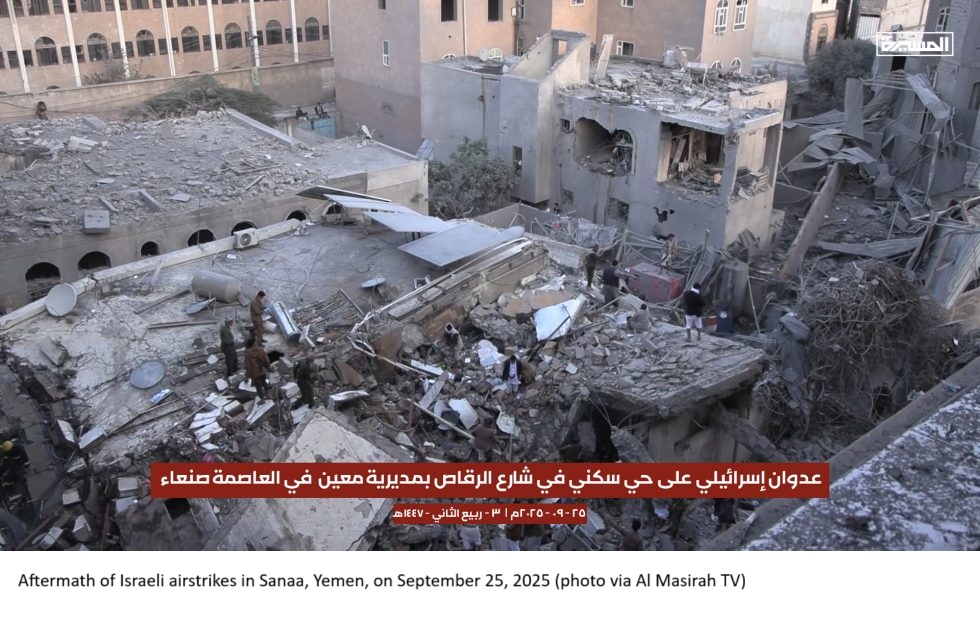
The attack came after a Yemeni drone hit the Israeli city of Eilat
by Dave DeCamp | September 25, 2025, https://news.antiwar.com/2025/09/25/israel-launches-major-airstrikes-on-yemeni-capital-killing-at-least-two-and-wounding-dozens/
The Israeli military launched major airstrikes on the Yemeni capital of Sanaa on Thursday, an assault that came after a Yemeni drone struck the Israeli city of Eilat, as the Houthis have vowed their attacks on Israel won’t stop until there’s an end to Israel’s genocidal war on Gaza.
Yemeni Health Ministry spokesman Anis al-Asbahi said the Israeli attacks targeted “civilian, service, and residential facilities, causing damage to a number of homes.” He said that at least nine people were killed and 174 were wounded, but it’s a preliminary death toll that’s expected to rise. Among those killed were four children and two women.
Footage and photos from Yemen’s Al Masirah TV show significant damage to a residential area of Sanaa and Yemenis, including children, being treated at a hospital.
Netanyahu’s General Assembly Tirade Telegraphs A Resumption of Israel’s War On Iran.
Dimitri Lascaris, Sep 28, 2025, https://reason2resist.substack.com/p/netanyahus-general-assembly-tirade?utm_source=post-email-title&publication_id=2811845&post_id=174714909&utm_campaign=email-post-title&isFreemail=true&r=1ise1&triedRedirect=true&utm_medium=email
On September 26, indicted war criminal Benjamin Netanyahu delivered a bombastic speech in the UN General Assembly in which he set Israel’s sights squarely upon the Islamic Republic of Iran.
Netanyahu also castigated many of Israel’s few remaining allies for taking the purely cosmetic step of recognizing a Palestinian state.
Shortly before Netanyahu’s speech at the UN, U.S. Secretary of War Pete Hegseth summoned hundreds of senior U.S. military officers from around the world to a highly unusual, emergency meeting in Virginia. The Trump regime is being tight-lipped about the purposes of this meeting.
n this episode of Reason2Resist, I examine these recent developments and argue that we may be mere days away from a resumption of Israel’s criminal war of aggression on Iran.
I also discuss a new poll by Quinnipiac University which confirms that support for Israel continues to plummet in the United States.
Iran angry as sweeping UN sanctions take effect after failure of nuclear talks
Foreign ministry attacks ‘unjustifiable’ return of measures expected to have wide effects on troubled economy
Guardian, Agence France-Presse 28 Sept 25
Widespread UN sanctions against Iran have come back into force for the first time in a decade, prompting anger from Tehran, after last-ditch nuclear talks with western powers failed to produce a breakthrough.
The sanctions, which came into effect late on Saturday and three months after Israel and the US bombed Iran, bar dealings related to Tehran’s nuclear and ballistic missiles programme and are also expected to have wider effects on the country’s troubled economy.
In a statement on Sunday, as the Iranian rial plummeted to a record low against the US dollar, the Iranian foreign ministry hit out at the move. “The reactivation of annulled resolutions is legally baseless and unjustifiable,” it said. “All countries must refrain from recognising this illegal situation.”
European and US diplomats stressed immediately after the resumption of sanctions that diplomacy was not over…………………………………
Iran has allowed UN inspectors to return to its nuclear sites, but the president, Masoud Pezeshkian, said the US had offered only a short reprieve in return for handing over its whole stockpile of enriched uranium, a proposal he described as unacceptable.
An 11th-hour effort by Iran’s allies Russia and China to postpone the sanctions until April failed to win enough votes in the security council on Friday, leading to the measures taking effect at 1am BST on Sunday…………………………………..
The sanctions are a “snapback” of measures frozen in 2015 when Iran agreed to major restrictions on its nuclear programme under a deal negotiated by the former US president Barack Obama.
The US has already imposed massive sanctions, including trying to force all countries to shun Iranian oil, in steps taken by Donald Trump when he withdrew from the deal in his first presidential term.
Iran and the US had held several rounds of Omani-brokered talks this year before they collapsed in June when first Israel and then the US attacked Iranian nuclear facilities.
Iran recalled its envoys from the UK, France and Germany for consultations on Saturday, state television reported…………………………………………. https://www.theguardian.com/world/2025/sep/28/sweeping-un-sanctions-on-iran-come-into-effect-after-nuclear-talks-fail
Steve Witkoff’s Latest ‘Peace Plan’ Is A Scam
Only weeks after Israel attempted to murder the negotiating team of the Palestinian resistance in Qatar, Israeli media report that Donald Trump’s ‘peace envoy’, Steve Witkoff, has developed a 21-point peace plan.
Moreover, both Trump and U.S. Vice-President Donald Trump claim that the U.S. government is on the precipice of ending Israel’s war on Gaza.
Is any of this credible?
Dimitri Lascaris examines closely the reported substance of Witkoff’s proposal, as well as the record of the Trump and Netanyahu regimes, with a view to assessing whether Witkoff’s proposal stands a serious chance of ending Israel’s genocide in Gaza.
1 This Month

of the week – Shut Down Drone Warfare!


Tell the Ukrainian Government to Drop Prosecution of Peace Activist Yurii Sheliazhenko

Petition to revoke the licensing of the Near Surface Nuclear Disposal Facility (NSDF) at Chalk River. https://www.ourcommons.ca/petitions/en/Petition/Details?Petition=e-7247
To see nuclear-related stories in greater depth and intensity – go to https://nuclearinformation.wordpress.com
-
Archives
- April 2026 (91)
- March 2026 (251)
- February 2026 (268)
- January 2026 (308)
- December 2025 (358)
- November 2025 (359)
- October 2025 (376)
- September 2025 (257)
- August 2025 (319)
- July 2025 (230)
- June 2025 (348)
- May 2025 (261)
-
Categories
- 1
- 1 NUCLEAR ISSUES
- business and costs
- climate change
- culture and arts
- ENERGY
- environment
- health
- history
- indigenous issues
- Legal
- marketing of nuclear
- media
- opposition to nuclear
- PERSONAL STORIES
- politics
- politics international
- Religion and ethics
- safety
- secrets,lies and civil liberties
- spinbuster
- technology
- Uranium
- wastes
- weapons and war
- Women
- 2 WORLD
- ACTION
- AFRICA
- Atrocities
- AUSTRALIA
- Christina's notes
- Christina's themes
- culture and arts
- Events
- Fuk 2022
- Fuk 2023
- Fukushima 2017
- Fukushima 2018
- fukushima 2019
- Fukushima 2020
- Fukushima 2021
- general
- global warming
- Humour (God we need it)
- Nuclear
- RARE EARTHS
- Reference
- resources – print
- Resources -audiovicual
- Weekly Newsletter
- World
- World Nuclear
- YouTube
-
RSS
Entries RSS
Comments RSS
 nuclear-news