Iran’s Bushehr Nuclear Power Plant ‘hit in strike’ as radiation update issued

A projectile struck the grounds of the Bushehr Nuclear Power Plant sparking fears of a terrifying nuclear incident, according to the CEO of the Russian company which runs the plant.
Joe Smith, 18 Mar 2026, https://www.mirror.co.uk/news/world-news/breaking-irans-bushehr-nuclear-power-36887601
An Iranian nuclear power plant has been hit, sparking fears of a nightmare radioactive incident.
A projectile struck the grounds of the Bushehr Nuclear Power Plant, both Russia and Iran said. Neither country has confirmed whether there has been a release of nuclear material in the incident on Tuesday evening.
Russia’s state-run Tass news agency quoted Rosatom CEO Alexey Likhachev late Tuesday as claiming “a strike hit the area adjacent to the metrology service building located at the Bushehr Nuclear Power Plant site, in close proximity to the operating power unit.” Russian technicians from Rosatom operate the plant, using Russian-made, low-enriched uranium.
Any strike on a nuclear plant risks radioactive material being released into the environment, a nightmare scenario in any war. Bushehr sits on the Persian Gulf meaning contamination of the waters could spell disaster for millions living in the Gulf States, which rely on desalination plants for their water supplies.
“There were no casualties among Rosatom State Corporation personnel,” Likhachev said. “The radiation situation at the site is normal.”
The Atomic Energy Organization of Iran later issued a statement saying “no financial, technical, or human damage occurred and no part of the plant was harmed.” Tass later reported that Iran blamed the strike on the United States and Israel.
The International Atomic Energy Agency said: “The IAEA has been informed by Iran that a projectile hit the premises of the Bushehr NPP on Tuesday evening.”
The United Nations agency added: “No damage to the plant or injuries to staff reported.”
It remains unclear what the “projectile” that hit the complex was and neither Iran nor Russia have published images of the damage.
Iran’s nuclear materials and equipment remain a danger in an active war zone
March 17, 2026 , Matthew Bunn, The Conversation
Before launching his war on Iran, President Donald Trump said his most important goal was that Iran would “never have a nuclear weapon.” Yet it is not clear what, if anything, his administration has planned for dealing with Iran’s stock of enriched uranium that could be used to make nuclear bombs – or its remaining deeply buried nuclear facilities and the nuclear equipment that might be in them, or hidden elsewhere.
U.S. and Israeli strikes in June 2025 seriously damaged Iran’s major nuclear facilities and killed several prominent scientists associated with the country’s nuclear program. However, contrary to Trump’s claim that the Iranian nuclear program had been “completely obliterated,” it appears that Iran had stored much or all of its enriched uranium in deep tunnels that were not destroyed.
The Trump administration’s demand, just two days before the attacks began, that Iran export its enriched uranium stocks represented a tacit acknowledgment that Iran’s government still had control of this material or could get access to it.
So, as airstrikes on Iran continue, an unclear fate faces several elements of Iran’s nuclear program, including:
- Its stock of enriched uranium.
- Its centrifuges for enriching more uranium, and parts for more centrifuges.
- Any equipment it may have for turning enriched uranium into metal, shaping it into nuclear weapons components and taking other weapons-assembly steps.
- The documents and expertise from its past nuclear weapons program.
- Its as-yet-intact nuclear facilities that are deep underground.
I have been studying steps to stop the spread of nuclear weapons – including managing the dangers of Iran’s nuclear program – for decades. My conclusion is that if all these capabilities remain in place, the war will have accomplished little in reducing Iran’s nuclear capability, while likely increasing the government’s belief that it needs a nuclear weapon to defend itself.
Where could Iran’s uranium be?
The most immediate concern is roughly 970 pounds (441 kilograms) of highly enriched uranium containing 60% of the U-235 isotope that is relatively easy to split. That’s what Iran was believed to have before the summer 2025 bombings, and much of it reportedly survived those strikes.
Over 440 pounds (200 kilograms) of it is reportedly stored in deep underground tunnels near Isfahan. Other stocks of this material are thought to be in a deep underground facility near Natanz known as Pickaxe Mountain, and in Fordow, one of the sites bombed in summer 2025.
Gen. Dan Caine, chairman of the U.S. Joint Chiefs of Staff, has reportedly acknowledged that the Isfahan tunnels are too deep to destroy with bunker-buster bombs like those used on the underground Fordow facility last summer. Pickaxe Mountain, under granite, would be at least as challenging a target.
What could the uranium be used for?
With just 100 centrifuges, Iran could further enrich the 60% enriched material to be 90% or more U-235 in a few weeks. That is the concentration needed for the nuclear weapon design that Iran was working on in the secret nuclear weapons program it largely stopped in late 2003.
Even without further enrichment, the 60% enriched material could be used in a bomb, either exploding with less power or using more material and explosives.
Beyond Iran using this material itself, there are other concerns. Nobody knows who might get it if Iran’s government collapses. Some lower-level people managing it might decide to try to sell it as part of trying to save themselves from the current crisis, as happened after the 1991 collapse of the Soviet Union. Government studies have warned that even a sophisticated terrorist group might be able to make a crude nuclear bomb if it had the needed uranium.
Could it be removed peacefully?
One possibility is that the current Iranian government, or a future one, might be willing to cooperate or at least acquiesce in getting rid of the country’s nuclear material. The existing Iranian government reportedly offered to blend it down to a lower concentration in the negotiations that Trump ended by attacking Iran in February 2026.
Highly enriched uranium has been removed from many cooperative countries over the years. One early example was Project Sapphire, in 1994, in which U.S. teams worked with Kazakhstan to fly some 1,280 pounds (580 kilograms) of highly enriched uranium to safe storage in Tennessee. Similar efforts have removed tons of plutonium and highly enriched uranium from scores of sites around the world, removing the risk that terrorists could get hold of that material.
Could it be captured?
Without cooperation, and with the uranium in tunnels too deep to destroy from the air, the only other option for eliminating them could be sending in a team of either U.S. or Israeli soldiers and experts while the war continues.
U.S. special forces troops have long trained with federal scientists and experts to disable or secure adversaries’ nuclear weapons and material. But it wouldn’t be easy: Mark Esper, a defense secretary in Trump’s first term, has warned that actually doing so in Iran would take a large force and be “very perilous.”
Trump has said he would only do so if Iran was “so decimated that they wouldn’t be able to fight on the ground level.”……………………………………………………………………………………………………………………
Fundamentally, Iran’s nuclear knowledge cannot be bombed away. Ultimately, I believe, U.S. security would be best served through agreements to limit Iran’s nuclear efforts, coupled with effective international inspection, keeping watch year after year. Provisions to do that were central to the 2015 Iran nuclear deal between China, France, Germany, Russia, the United Kingdom, the United States, the European Union and Iran. Trump pulled the U.S. out of the agreement in 2018, enabling Iran to make the highly enriched uranium that now poses a danger.
In my view, only diplomacy can again provide strict limits and effective monitoring in the future. But this war may well have ruined the chances for such diplomatic options for many years to come. https://theconversation.com/irans-nuclear-materials-and-equipment-remain-a-danger-in-an-active-war-zone-278008
Trump, Netanyahu down to last card in criminal Iran war
10 March 2026 AIMN Editorial, By Walt Zlotow, West Suburban Peace Coalition Glen Ellyn IL, https://theaimn.net/trump-netanyahu-down-to-last-card-in-criminal-iran-war/
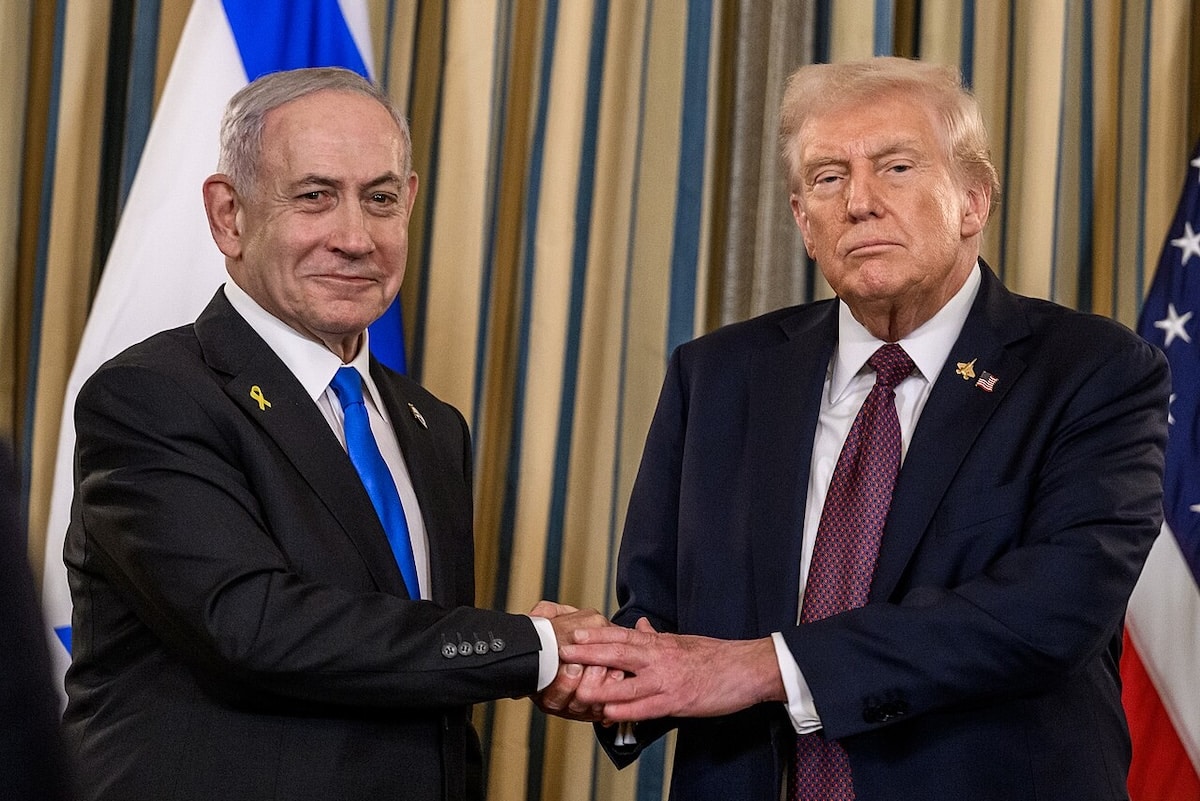
President Trump and Israeli Prime Minister began their second war on Iran in 7 months with just 2 war crime cards to play.
The first card was the US, Israeli version of Blitzkrieg from the air. Kill Iran’s beloved leader the Ayatollah Ali Khamenei, demand surrender, then wait for the 90 million Iranians to capitulate to new masters Trump and Netanyahu. That was projected to take just about 72 hours.
As expected, millions of Iranians came into the streets following Khamenei’s assassination. But not to welcome the grisly invaders bombing them. It was to show near total support to the Islamic government, cheering them on to inflict as much retaliation possible to repel the Trump Netanyahu criminal tag team.
And they are succeeding, causing massive damage to US military facilities in Bahrain, Qatar, Jordan, Kuwait. Saudi Arabia and UAE. All 6 are running out of defensive interceptors provided by Uncle Sam. Why? Trump is giving them all to himself and his war partner Netanyahu. When this is all over, the Gulf States will never again trust America for their defense. They may even tell the US to vamoose the region PDQ.
Iran is also bombing Israel night and day, giving Netanyahu, flying around the region 24/7 to avoid Khamenei’s fate, a taste of what he visited on Palestinians in Gaza for 2 years.
That leaves Trump and Netanyahu with their last war crime card to play. Bomb Iran to smithereens till there is no more Iranian weapons or personnel left with which to retaliate.
Big problem facing America and Israel is size. Both Israel and US military facilities nearby are compact in size making them easy targets, while Iran, the 17th largest country by area, has their tens of thousands of missiles scattered and largely unreachable.
Now that Iran has chosen to fight to the death rather than capitulate as expected, the advantage may be tiltng in their favor. Rumors surfacing Trump is pondering an off ramp to stop the bleeding he has no way of controlling.
Worst case scenario remains that Netanyahu may get so desperate facing unfathomable defeat, he escalates to war crime card 3… nuke Tehran.
Israel planned this war on Iran for 40 years. Everything else is a smoke screen.
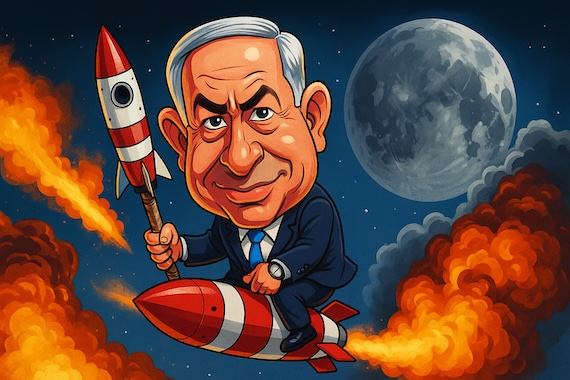
The Israeli prime minister, Benjamin Netanyah……… gloated: “This combined effort allows us to do what I have hoped to achieve for 40 years: to crush the regime of terror completely. That’s my promise and this is what is going to happe
And all the while, Israel’s own arsenal of nuclear weapons, undeclared and therefore unmonitored, has been an open secret.
The embers of resistance – in Gaza, Iraq, Lebanon, Syria, Yemen – have not been snuffed out. With the attack on Iran, they are being fanned into a fire
Jonathan Cook, Mar 06, 2026
It is near impossible to make sense – at least from the justifications on offer – of what US President Donald Trump really hopes to achieve with his and Israel‘s blatantly illegal war of aggression on Iran.
Is it to destroy an Iranian nuclear weapons programme for which there has never been any tangible evidence, and which Trump claimed just a few months ago to have “completely and totally obliterated” in an earlier lawbreaking attack?
Or is it intended to force Tehran back to negotiations on its nuclear energy enrichment programme that were brought prematurely to an end when the US launched its unprovoked attack – talks, we should note, that were made necessary because in 2018, during his first term, Trump tore up the original deal with Iran?
Or is the war supposed to browbeat Iran into greater flexibility, even though Trump blew up the talks at the very moment Oman, the chief mediator, insisted that Tehran had capitulated on almost every one of Washington’s onerous demands and that a deal was “within our reach“?
Or are the air strikes designed to “liberate” Iranians, even though the early victims included at least 165 civilians in a girls’ school, most of them children aged between 7 and 12?
Or is the aim to pressure Iran to give up its ballistic missiles – the only deterrence it has against attack, and which would leave it utterly defenceless against US and Israeli malevolent designs?
Or did Washington believe Tehran was about to strike first, even though Pentagon officials have confided to congressional staff that there was zero intelligence an attack was about to happen?
Or is the goal to decapitate the Iranian regime, as the strikes have already achieved with the assassination of Iran’s supreme leader, Ali Khamenei? If so, to what purpose, given that Khamenei was so opposed to an Iranian nuclear bomb that he issued a religious edict, a fatwa, against its development?
Might Khamenei’s successor – having seen how utterly untrustworthy the US and Israel are, how they operate as rogue states unconstrained by international law – now decide that developing a nuclear bomb is an absolute priority to protect Iran’s sovereignty?
No clear rationale
There is no clear rationale from Washington because the author of this attack is not to be found in either the White House or the Pentagon. This plan was cooked up in Tel Aviv decades ago.
The Israeli prime minister, Benjamin Netanyahu, admitted as much on Sunday. He gloated: “This combined effort allows us to do what I have hoped to achieve for 40 years: to crush the regime of terror completely. That’s my promise and this is what is going to happen.”
Those four decades, let us note, were also the timeframe for an endless series of warnings from Netanyahu and other Israeli leaders that Tehran was only months away from developing a nuclear bomb.
Netanyahu has been peddling this same urgent, nonsensical pretext for attacking Iran all that time. For 40 years, each year has been proclaimed the very last opportunity to stop the “mad mullahs” from obtaining a bomb – a bomb that never materialised.
And all the while, Israel’s own arsenal of nuclear weapons, undeclared and therefore unmonitored, has been an open secret.
Europe helped Israel develop its bomb, while the US turned a blind eye, even as Israeli leaders espoused a suicidal doctrine known as the “Samson Option“, which posited that Israel would rather detonate its nuclear arsenal than suffer a conventional military defeat.
The Samson Option implicitly rejects the idea that any other state in the Middle East can be allowed to acquire a bomb and thereby level the military playing field with Israel.

It is that very premise that, for decades, has guided Israeli policy towards Tehran. Not because Iran has shown an inclination to develop a weapon. Nor because its supposedly “mad mullahs” would be foolish enough to fire them at Israel were they ever to acquire them.
No, it was for other reasons. Because Iran is the largest and most unified state in the region, one with a rich history, a strong cultural identity and a formidable intellectual tradition. Because Iran has repeatedly shown itself – whether under secular or religious leaders – unwilling to submit to western, and Israeli, colonial domination.
And because it is looked to as a source of authority and leadership by Shia religious communities in neighbouring countries – Iraq, Lebanon, Syria, Yemen – that have a history of similarly refusing to bow to Israeli hegemony.
Israel’s fear was that, were Iran to follow North Korea and acquire a nuclear weapon, Israel would be finished as the West’s most useful militarised client state in the oil-rich Middle East.
Stripped of its ability to terrorise its neighbours, stoke sectarian division and help project US imperial power into the region, Israel would lose its rationale. It would become the ultimate white elephant.
Israeli leaders – grown fat on endless military subsidies paid for by US taxpayers and given licence to plunder the Palestinians’ resources – were never going to willingly step off their gravy train.
Which is why Iran has rarely been out of Israel’s sights……………………………………………………………………………………………………………………………………………………………………………………………………………………………………………………….
The last time Iran had a democratic government, in the early 1950s, its secular, socialist prime minister, Mohammad Mossadegh, outraged the West by nationalising Iran’s oil industry for the benefit of Iranians.
The CIA’s Operation Ajax toppled him in 1953 and reinstated the brutal Mohammad Reza Pahlavi as monarch, or Shah, allowing the US and Britain to take back control of Iran’s oil.
The backlash was 26 years coming. Islamic clerics rode an outpouring of popular hatred for the US and Israeli-backed Shah to launch their revolution…………………………………………………………………………………………………………….
Pact with the devil
Washington’s western allies may be privately uncomfortable at being visibly associated with another illegal US-Israeli war. But in supporting more than two years of genocide in Gaza, they already made their pact with the devil. There is no going back now.
Which is why Britain, France, Germany, Canada and Australia all dutifully lined up behind the Trump administration as the mayhem began………………………………………………………………………….
The embers of resistance – in Gaza, Iraq, Lebanon, Syria, Yemen, and potentially in new sites like Bahrain – have not been snuffed out. And now, with the attack on Iran, they are being fanned into a fire with every new crime, every new outrage, every new atrocity. https://jonathancook.substack.com/p/israel-planned-this-war-on-iran-for?utm_source=post-email-title&publication_id=476450&post_id=190093136&utm_campaign=email-post-title&isFreemail=true&r=17yeb&triedRedirect=true&utm_medium=email
.
Iran signals a ‘fight to the end’ with choice of new ayatollah

Tyler Durden, ZeroHedge, Mon, 09 Mar 2026
Meanwhile, the US struggles to define Israeli-coordinated endgame
Summary:
- Lebanon wants direct peace talks with Israel to end fighting but Israeli rejects it, also amid US skepticism: Axios.
- Trump says too soon to talk about seizing Iran’s oil but does not rule it out, tells NBC.
- Analyst consensus on question of potentially protracted conflict: Iran Signals a Fight to the End With Appointment of Khamenei’s Son
- Senator Graham: “The American Embassy is being evacuated in Riyadh because of sustained attacks by Iran against the Kingdom of Saudi Arabia.”
- Timeline to end Iran war? Trump signals decision will be only after ‘mutual’ decision with Netanyahu.
- Trump Truth Social post calls for Australia to give Iran National Woman’s Soccer team Asylum, but it remains unclear if the whole team is actually requesting it, or if individuals are.
- Iranian official to Al Jazeera: “we are able to continue the war for a long time and there is no room for diplomacy now.”
- G7 ‘closely monitoring’ energy markets, ‘ready’ to take necessary measures, including possible oil stockpile release.
- Younger, reportedly more ‘hardline’ Ayatollah takes command as regime stability continues: Military and political elites have pledged allegiance to Mojtaba Khamenei, who replaces his slain father as supreme leader and is viewed as a figure favored by the IRGC.
- Offramp, or more global shock & pain ahead? Trump after seeing oil prices: Short term oil prices, which will drop rapidly when the destruction of the Iran nuclear threat is over, is a very small price to pay for U.S.A., and World, ONLY FOOLS WOULD THINK DIFFERENTLY!
- Threat of whole regional war ongoing: Turkey says second Iranian ballistic missile shot down by NATO defenses in airspace, but then NATO quickly contradicts – saying no 2nd missile was intercepted.
- Nation-building, nation-smashing, divergent US-Israeli aims? More from Trump”…will work tirelessly to bring Iran back from the brink of destruction, making it economically bigger, better, and stronger than ever before.” But US officials distance themselves from big weekend attacks on Iranian oil.
Iran shuts door on ceasefire talk possibility, accuses US of seeking ‘partition’: as several countries have begun mediation efforts; however Foreign Ministry says: “While military aggression continues, there is little room to talk about anything other than a decisive response.”- CENTCOM confirms 8th US troop death; More Iranian missile/drone hits on Gulf sites, IDF ground operations expand inside Lebanon
Update(1240ET): Iran on Monday is seeking to showcase its continuity and ‘stability’ of government after a week of heavy US-Israeli bombardment failed to produce regime change. Instead, Tehran is vowing to fight back, saying it can keep the war going for as long as needed. Analysts have pointed out Iran needs to inflict a cost on the US and Israel, fearing it will just be attacked again somewhere down the line, even if years from now.
And yet, Trump admin officials have been signaling the American public there won’t be a protracted war. But on this big looming question, The Wall Street Journal is out Monday with the following ominous headline suggesting a lengthy conflict ahead:
Iran Signals a Fight to the End With Appointment of Khamenei’s Son…
The elevation of Mojtaba Khamenei, a conservative long close to Iran’s Islamic Revolutionary Guard Corps, shows that Trump’s efforts so far to cow the regime into surrender have failed. It also appears to have put hard-liners in firm control of the country, with moderate and reformist factions long marginalized. The 56-year old Khamenei is expected to take a confrontational stance toward the West.
His appointment also shows that Iran won’t acquiesce to Trump’s demand that he approve the country’s new top cleric. Trump told Axios last week that “Khamenei’s son is unacceptable to me.”
The younger Khamenei’s ascendance “suggests the continuation of the same old strategy: repression at home and resistance internationally,” said Sanam Vakil, director of the Middle East and North Africa program at Chatham House.
There remains the question of if US and Israeli goals and objectives are truly aligned on the Iran war. Some of Trump’s latest remarks are cause for concern, and highlight the aforementioned question: “Iran was going to destroy Israel and everything else around it. We’ve worked together. We’ve destroyed a country that wanted to destroy Israel,” Trump asserted.
The President indicated that he would keep the ultimate prerogative but while consulting directly with Netanyahu.
“I think it’s mutual, a little bit. We’ve been talking. I’ll make a decision at the right time, but everything’s going to be taken into account.”
Some admin officials are likely looking for a quick exit ramp, which would probably involve a politically expedient moment to declare ‘victory’ and get out. But will the Israelis cooperate when/if that moment comes?……………………………………………………………………………………………………………………………………………………………………………………………………………………………………………………..
As for ‘what’s next’ – escalation or offramp… the following from Bloomberg suggests there could be a gateway to ground troops if things take an escalatory war path: “Trump is weighing the option of deploying special forces on the ground to seize Iran’s near bomb-grade uranium, according to diplomats. He told the Times of Israel that a decision on when to end the war will also involve Benjamin Netanyahu,” Bloomberg reviews of prior weekend reporting.
This as there are claims that Washington and Tel Aviv don’t see eye to eye on ultimate war aims and strategy: “Israel’s strikes on 30 Iranian fuel depots Saturday went far beyond what the U.S. expected when Israel notified it in advance, sparking the first significant disagreement between the allies since the war began eight days ago, according to a U.S. official, Israeli official and a source with knowledge.” But all of this fresh reporting of ‘distance’ between the close allies who are executing Trump’s Operation Epic Fury could by design be meant to create artificial distance between the president and what might prove to be an unpopular war. https://www.sott.net/article/505074-Iran-signals-a-fight-to-the-end-with-choice-of-new-ayatolla
US Argues ‘Emergency’ of Iran War Means Israel Needs 20,000+ More Bombs Without Congressional Approval
This is the first time that the second Trump administration has formally declared an emergency, allowed under the Arms Export Control Act, to bypass Congress to sell arms to Israel. The administration has bypassed the informal approval process in Congress three times to sell arms or send weapons aid to Israel, but previously has not declared an emergency
‘Who cares about Israel’s genocide, apartheid, and aggression?” asked one human rights expert.
Jon Queally, Mar 07, 2026, https://www.commondreams.org/news/us-bombs-for-israel-iran-lebanon
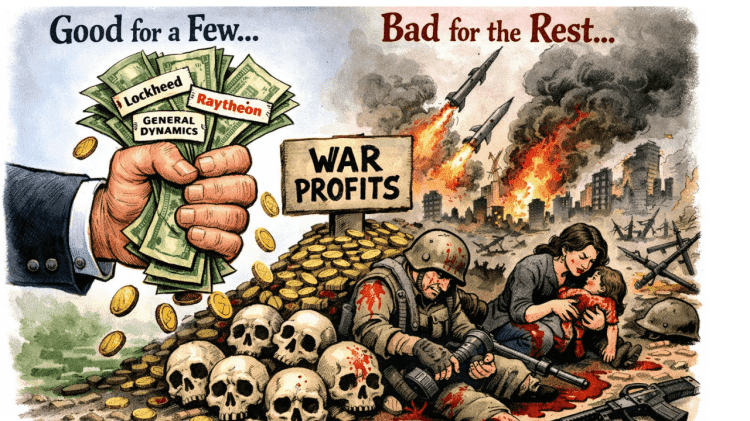
The US State Department is hiding behind the war against Iran that was started by US President Donald Trump last week to justify an emergency order to ship more than 20,000 bombs—estimated at a value of $660 million—to Israel, skirting a pending approval process for the sale by Congress.
In a statement issued quietly on Friday night, the State Department said 12,000 BLU-110A/B general purpose, 1,000-pound bombs had been determined for approval, noting that Secretary of State Marco Rubio has “provided detailed justification that an emergency exists that requires the immediate sale to the Government of Israel of the above defense articles and defense services is in the national security interests of the United States, thereby waiving the Congressional review requirements under Section 36(b) of the Arms Export Control Act.”
Not included in the statement, according to the New York Times, were additional parts of the sale that “include 10,000 bombs of 500 pounds each and 5,000 small-diameter bombs.”
“This is an emergency of the Trump administration’s own creation.” —Rep. Gregory Meeks (D-N.Y.)
According to the Times:
The State Department did not mention these details in the announcement, but two current US officials and a former, Josh Paul, who worked on weapons transfers at the State Department, said they were part of the emergency sale. The current officials spoke on the condition of anonymity to discuss sensitive arms transactions.
This is the first time that the second Trump administration has formally declared an emergency, allowed under the Arms Export Control Act, to bypass Congress to sell arms to Israel. The administration has bypassed the informal approval process in Congress three times to sell arms or send weapons aid to Israel, but previously has not declared an emergency.
The push for the “emergency” arms sale comes as Israel pummels Lebanon with airstrikes, forcing an estimate 500,000 people or more in southern regions outside of Beirut to flee their homes. It also coincides with Israeli forces hitting targets in Iran alongside the US in what experts say is a wholly illegal attack on that country.
Rep. Gregory W. Meeks (D-N.Y.), ranking member of the House Foreign Affairs Committee, denounced the move by the Rubio in a Friday statement.
“Today’s invocation of the Arms Export Control Act’s emergency authority to bypass congressional review for two munitions cases to Israel exposes a stark contradiction at the heart of this administration’s case for war,” said Meeks. “The Trump administration has repeatedly insisted it was fully prepared for this war. Rushing to invoke emergency authority to circumvent Congress tells a different story. This is an emergency of the Trump administration’s own creation.”
Others also questioned the emergency sale, especially given Israel’s record of genocide in Gaza over the last two years and its pivotal role in pushing the Trump administration toward a war of choice with Iran.
Meeks, in his statement, argued that key questions about Trump’s war in Iran remain unanswered.
“What is the endgame? What preparations have been made to protect American citizens in the region? And how much will this war cost the American people?” asked Meeks. “The administration has provided no credible answers. The American people deserve answers, and Congress must demand them.”
In US/Israeli war on Iran, all roads point to rise in global nuclear weapons.
Trump and Netanyahu are already boasting of success. But the war is not going to plan for any of the parties involved
Paul Rogers, 6 March 2026, https://www.opendemocracy.net/en/us-iran-israel-war-lead-to-nuclear-weapons-donald-trump-netanyahu/
One week in, there is little prospect of an early end to the Israeli war with Iran and even less of preventing a regional escalation. Given Binyamin Netanyahu’s success in bringing Donald Trump’s United States on board as Israel’s partner in a widening war, he may feel satisfied with progress so far. In reality, though, the conflict is not going according to plan for any of the three states involved.
Netanyahu’s intended outcome was straightforward regime termination in Tehran, with the assassination of the supreme leader and most of Iran’s senior war leaders. A public uprising would then have followed, ending the power of the theocrats.
Israel and the US could then have brought sufficient force to terminate Iran’s nuclear and ballistic missile program and cut back its conventional forces, starting with the abolition of the Iranian Revolutionary Guard Corps (IRGC).
Finally, the removal of the US’s punishing economic sanctions on Iran would have been agreed, allowing some civil recovery for the country – although this would, of course, have been contingent on the new leaders agreeing to oil and gas deals that would prove punitive for Iran and lucrative for the US, likely ensuring Trump’s continued support for Israel.
The Israeli war aims may have been clear, but it is impossible to say for sure what the White House wanted.
A muddle of reasons and statements of intent for bombing Iran have been given by Trump, his secretary of state, Marco Rubio and self-styled secretary of war, Pete Hegseth, who last year sought to rebrand from the ‘secretary of defense’ title that has been used by successive post-holders since the end of the Second World War. While Washington initially embraced Israel’s desire for total regime termination through an uprising, that aim has disappeared from its recent statements. Now it seems that crushing Iran’s military capabilities, starting with its nuclear ambitions, is the US order of the day.
For Iran’s theocratic leadership, the primary war aim was survival in the face of the massive power of the Israeli/US war machine, which would itself have been quite an achievement. Indeed, Iran’s supreme leader, Ayatollah Khamenei, barely survived the first hour or so of the war before being killed in a missile strike.
The unexpected has since become clear: Khamenei is gone, but Iran’s leadership system is likely to survive for now. His successor will probably be his son, Ayatollah Mojtaba Khamenei, who will quite possibly be as hard-line as his father. Israeli defence minister Israel Katz has declared that whoever is chosen as Iran’s next supreme leader will be “a target for elimination” – a clear indication that for Netanyahu and the Israeli Defence Forces, there is no turning back.
If regime survival is one of the surprises of the conflict, the other is Iran’s continuing ability to fire barrages of armed drones and ballistic missiles, which has been the least expected element of the war so far.
By last July, the IDF and the US believed they had massively damaged Iran’s air defences, with Trump boasting of “spectacular military success” in a press conference. On top of this, the past week has seen the determined and intensive targeting of Iran’s missile systems by the combined power of the IDF and US armed forces. Yet to the genuine surprise of many Western political and military analysts, Iran can still launch its missiles.
Three elements of this survival offer a clue as to what comes next.
One is that the regime in Tehran is likely to continue to survive. Look to Gaza, where Hamas is still active despite the massive destruction that Israel has inflicted over the past two and a half years. This, as I noted in last week’s column, is largely down to its quite extraordinary network of tunnels dug mostly by hand and reinforced with concrete walls. The network, which extends to around the distance from London to Edinburgh, has around 5,700 shafts, as well as electricity, ventilation and communication facilities.
In Iran, the IRGC now looks to have been similarly active in extensively preparing for war. It has built numerous and widely dispersed underground ‘missile cities’ – deep tunnel complexes built into mountains for making and storing armed drones and other weapons – as well as producing undersea armed drones for use against the US Navy, especially if it tries to guide tankers through the Strait of Hormuz.
The second element follows on. There are indications that the IRGC appears to be using its older and least advanced missiles and drones first, aiming to deplete Israeli and US stocks of their anti-missile defences. Quite apart from anything else, this means Israel and the US are depleting their high-cost weaponry to “catch” incoming missiles, while Iran saves its most recently developed drones and ballistic missiles – with greater reach and more power for destruction, as well as improved accuracy and reliability – for later in the war.
Finally, there is the decision to opt for economic warfare against Western interests in many Gulf states. This involves the closure of the Strait of Hormuz, alongside attacks on oil and gas processing plants and distribution systems, as well as tourist infrastructure across the Gulf, with a luxury hotel in Dubai reportedly hit by a retaliatory strike.
This puts states such as Saudi Arabia, Kuwait and the United Arab Emirates in a difficult position as to how to respond. To react forcefully by joining the war against Iran may be the natural response, but this has consequences. It means allying with an Israel that has killed at least 80,000 Palestinian Arabs in Gaza and enacted violence in the occupied West Bank to make life fraught with difficulty and increasingly dangerous.
This war is barely a week old but is having a worldwide impact and, despite Trump’s bluster, is already problematic for the US. The killing of at least 165 people, many of them children, at the Shajareh Tayyebeh Girls School in Minab is just one example of this, while another may be significant in a different way.
On Wednesday, a US Navy submarine torpedoed an Iranian frigate, the IRIS Dena, killing at least 87 crew members. The Dena had recently left a series of exercises organised by the Indian Navy in the Bay of Bengal, and its sinking was reported with great glee by Hegseth, who told reporters: “Yesterday, in the Indian Ocean, an American submarine sunk an Iranian warship that thought it was safe in international waters. Instead, it was sunk by a torpedo. Quiet death. The first sinking of an enemy ship by a torpedo since World War II.”
Earlier in the press conference, Hesgeth had used the same celebratory and boastful tone to discuss what he framed as early US success. “We are only four days into this, and the results have been incredible. Historic, really,” he said. “Only the United States of America could lead this – only us. But when you add the Israeli Defence Forces, a devastatingly capable force, the combination is sheer destruction for our radical Islamist Iranian adversaries. They are toast, and they know it. Or at least, soon enough, they will know it. America is winning – decisively, devastatingly, and without mercy.”
The US war secretary’s speech betrayed the sense of impunity in Trump’s White House, confirming that members of his administration are certain in their own minds that in this war, Israel and the US can do what they like.
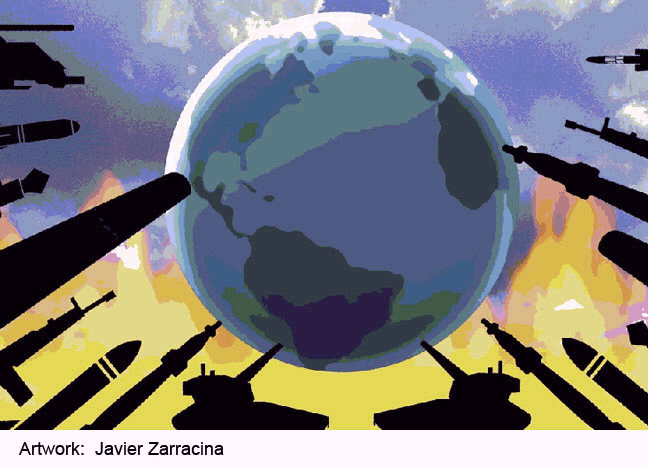
The consequences of this war are impossible to say for sure, but all roads appear to lead to increased uptake of nuclear weaponry, leaving the world an even less safe and stable place. If Israel and the US fail to terminate the Iranian regime and if any significant part of the IRGC survives, the very first thing it will do is to go to the ends of the earth to put together a crude nuclear device. Across the wider region, any state that sees two nuclear-armed regimes seeking to destroy a non-nuclear regime will see a need to go nuclear itself.
IAEA says no evidence Iran is building a nuclear bomb
Middle East Monitor 4th March 2026
The head of the International Atomic Energy Agency (IAEA), Rafael Grossi, has said there is no evidence that Iran is currently building a nuclear bomb, while warning that unresolved issues surrounding Tehran’s nuclear programme remain a serious concern.
Speaking in remarks reported on Tuesday evening, Grossi said Iran possesses a large stockpile of enriched uranium that has reached levels close to weapons-grade. However, he stressed that the agency has not found proof that Iran is developing a nuclear weapon…………………
Oman’s Foreign Minister, Badr al-Busaidi, said one day before the conflict began that Iran had agreed in principle not to retain enriched uranium as part of ongoing diplomatic discussions. According to al-Busaidi, the proposal included relinquishing enriched material and ensuring that no nuclear fuel would be stockpiled, with verification mechanisms in place.
US President Donald Trump, however, insisted that Iran should not enrich uranium at all, including at levels below weapons-grade, reiterating Washington’s long-standing demand that Tehran completely halt enrichment activities. https://www.middleeastmonitor.com/20260304-iaea-says-no-evidence-iran-is-building-a-nuclear-bomb/
COMMENTS:
There has never been evidence and the Ayatollah had banned nuclear weapons due to their religion. Getting a US president to believe this has taken Netanyahu over 30 years. Then along came the ignorant, unintelligent deranged Trump…………..and here we are.
Israel is the only country in the Middle East which has nuclear weapons. But it has not signed the Treaty on the Non-Proliferation of Nuclear Weapons (NPT) and refuses to place its nuclear facilities under the watch of UN inspectors. This is unlike Iran, whose facilities are monitored constantly and which, as a non nuclear-weapon state which is a signatory to the NPT, has also agreed not to seek or acquire these weapons…
Israel is not only believed to possess 90 nuclear warheads, but also to have produced enough plutonium to produce 100 to 200 more nuclear weapons. And according to new research from the Stockholm International Peace Research Institute (SIPRI), it is actively modernising its nuclear arsenal.
(‘When it comes to WMDs, Israel’s are very much part of the problem’, Canary 24 June 2025)
Trump Says He Must Have a Say in Picking Iran’s New Leader
by Dave DeCamp | March 5, 2026, https://news.antiwar.com/2026/03/05/trump-says-he-must-have-a-say-in-picking-irans-new-leader/
President Trump said in an interview with Axios on Thursday that he must have a say on who is chosen as Iran’s next leader following the killing of Iranian Supreme Leader Ayatollah Ali Khamenei, contradicting other administration officials who say the US’s goal is not regime change.
Trump made clear to Axios reporter Brak Ravid that Khamenei’s son, Mojtaba Khamenei, who has reportedly emerged as a frontrunner to replace his father, wouldn’t be acceptable to the US.
“They are wasting their time. Khamenei’s son is a lightweight. I have to be involved in the appointment, like with Delcy [Rodriguez] in Venezuela,” the president said, referring to Venezuelan Acting President Delcy Rodriguez.
The US didn’t choose Rodriguez as Nicolas Maduro’s replacement, but she was the next in line as the vice president and has been willing to work with the US to stave off another attack. A much different dynamic is unfolding in Iran as the killing of Khamenei has not slowed Iran’s military response, and the country’s leadership shows no sign of backing down despite the massive US-Israeli bombing campaign, which has killed over 1,000 civilians.
Trump said that he wouldn’t accept any leader who continues Khamenei’s policies because it would result in the US launching another war within five years. “Khamenei’s son is unacceptable to me. We want someone that will bring harmony and peace to Iran,” he said.
Earlier this week, Trump said that all of the people he had in mind to replace Khamenei have been killed and acknowledged that in the end, Iran’s next leader could be “as bad” as Khamenei.
“The worst case would be we do this, and then somebody takes over who’s as bad as the previous person,” he said. “That could happen. We don’t want that to happen. It would probably be the worst — you go through this and then in five years, you realize you put somebody in who was no better.”
In Iran, Israel’s morbid military cult now has the US fully in its grip
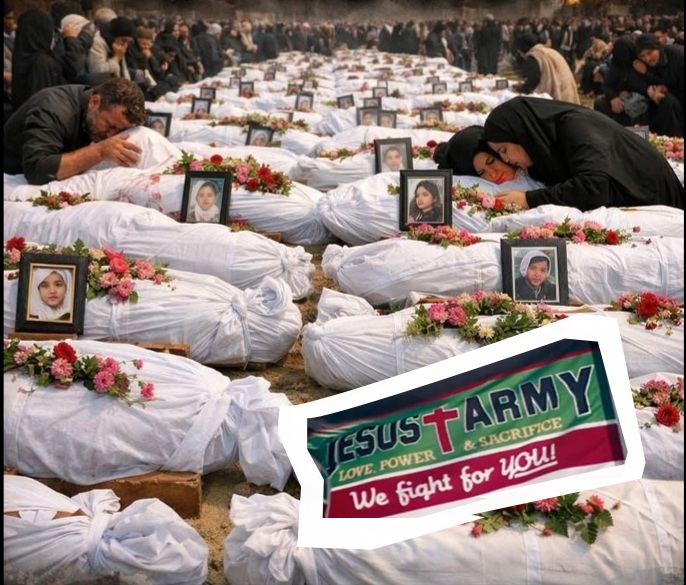
In this catastrophic war of choice, it is Tehran fighting a rearguard action to restore geopolitical sanity. If Iran loses, god only knows where Israel and the US will drag the world next
Jonathan Cook, Mar 06, 2026
The admission this week by US secretary of state Marco Rubio, echoed by Mike Johnson, Speaker of the House of Representatives, that Israel forced Washington’s hand in attacking Iran has rightly caused consternation.
Breathing life into something that would normally be treated as an antisemitic trope, Rubio argued that the Trump administration had been left with no choice but to attack Iran because, had it not, Israel would have launched an attack anyway, exposing US soldiers to retaliation.
Rubio stated: “The president made the very wise decision: We knew that there was going to be an Israeli action, we knew that that would precipitate an attack against American forces, and we knew that if we didn’t preemptively go after them before they launched those attacks, we would suffer higher casualties.”
Rubio was using the term “preemptively” in a highly irregular and misleading way.
In international law, aggression is an illegal application of force – the “supreme international crime”, according to the 1950 principles set out by the Nuremberg war crimes tribunal. But there is a potential mitigating factor if the attacking state can show it was acting pre-emptively: that is, it was acting to prevent a plausible, immediate and severe threat of attack.
Rubio, however, was not suggesting that the US acted “preemptively” against a threat from Iran. He meant Washington had acted preemptively to stop its ally, Israel, from setting off a chain of military events that would lead to US soldiers being harmed.
Had the Trump administration really been acting preemptively in these circumstances, the US should have attacked Israel, not Iran.
Paper tiger
But Rubio’s comment begged a further question: Why didn’t Washington simply tell Israel it was forbidden from starting a war against Iran without US approval?
After all, Israel would be incapable of mounting any kind of attack on Iran without the critical support provided by the US.
Israel has had to rely on help from US military bases dotted around the region, as well as the Arab states that host those bases.
The attack would have been quite inconceivable without the backup of a massive armada of US war ships sent to the region by Trump.
Israel can withstand Iranian retaliation only because it gets a degree of protection from missile interception systems provided and funded by the US.
And on top of all that, Israel is regional hegemon only because it gets massive subsidies from the US – worth many billions of dollars a year – to preserve it as one of the strongest militaries in the world.
In other words, Israel would have found it impossible to wage war on Iran alone. It is a paper tiger without the US.
Rubio’s comment suggested one of two possibilities: either that the US, with the strongest military in world history, is under the thumb of the tiny state of Israel; or that Trump has made his own military, the strongest-ever, servile to Israel.
Whichever it is, it is hard to square with Trump’s repeated assertion that he is putting America First.
This point is so glaringly obvious it is presumably the reason why Rubio was forced to walk back his comments the next day. Meanwhile, Trump hurriedly suggested it was he who had forced Israel’s hand to attack Iran, not the other way round.
Geopolitical insanity
The more likely truth is not that Israel forced Trump’s hand. It is that he was seduced by Israeli prime minister Benjamin Netanyahu’s false claim that an attack on Iran would be a cakewalk – if they struck at a moment when they could be sure of killing Iran’s supreme leader, Ali Khamenei.
Such a decapitation strike, Trump was led to believe, would be a repeat of his Venezuela “success”, when he kidnapped President Nicolas Maduro from Caracas to bring him to trial in New York.
In Venezuela, the flagrant flouting of international law by the US was intended to be the equivalent of pointing a loaded shotgun at the head of Maduro’s replacement, Delcy Rodriguez. Do as we say, or the new president gets it from both barrels.
Netanyahu knew exactly how to sell Trump, still giddy on the noxious fumes of this lawbreaking venture, the idea that he could repeat the exercise in Iran. The ayatollah’s successor would similarly be putty in his hands.
Which is why, in this catastrophic war of choice by the US and Israel, it is Tehran fighting a rearguard action to restore a little geopolitical sanity. If Iran loses, or the US succeeds without paying a fearsome price, god only knows where Israel and Washington will drag the world next.
The world’s fate, in a real sense, is in Tehran’s hands.
Israelisation’ of the US
What the joint attack on Iran demonstrates most clearly is how much Netanyahu has succeeded over the past quarter of a century in “Israelising” Washington and the Pentagon.
The US has always waged illegal wars of aggression. It has always been more gangster than global policeman. But just because Washington was run by ruthless criminals, it did not mean it was incapable of getting still more deranged, still more psychopathic.
That is what Netanyahu has been working on. And Trump is now giving full rein to the Israelisation of the US. The clues are everywhere.
On Wednesday secretary of war Pete Hegseth – the traditional title of “secretary of defence” presumably sounded too law-abiding – dropped any pretence of being the good guy.
He insisted US forces were acting “without mercy” and that the Iranian regime “are toast”. The US would deliver “death and destruction all day long”.
The previous day he had set out the game plan: “No stupid rules of engagement, no nation-building quagmire, no democracy building exercise, no politically correct wars.”………………………………………………………………………………………………………………………………………………………………………………………………………………………………………
The word of God
Central to these beliefs is the gathering of Jews, as God’s Chosen People, into the Land of Israel – a much larger area than that covered by the modern state of Israel.
For Christian fundamentalists such as Hegseth and a growing number of US commanders, Israel is the catalyst for the End Times.
For very obvious reasons, Israel has been nuturing its ties with the huge numbers of Christian fundamentalists in the US. They are politically active – their vote secured the presidency for Trump – and they treat Israel as a critically important domestic issue rather than a foreign policy matter. https://jonathancook.substack.com/p/in-iran-israels-morbid-military-cult
Who Bombed Girls’ School in Iran? Reporter Nilo Tabrizy on What We Know About Massacre of 175 People
Democracy Now, 5 Mar 2026
After a strike on a girls’ elementary school in Minab, Iran, killed at least 175 people, nearly all young schoolchildren, online reports spread disinformation about the attack, including claims that the Iranian government itself had bombed the school. Journalist Nilo Tabrizy describes how outside reporters have been able to verify the attack despite Iran’s internet blackout and says attempts are still being made to confirm whether the strike is attributable to the U.S. or to Israel.
Democracy Now! is an independent global news hour that airs on over 1,500 TV and radio stations Monday through Friday. Watch our livestream at democracynow.org Mondays to Fridays 8-9 a.m. ET.
Negotiation to Detonation

. A peaceful resolution would have prevented the long-term U.S. plan to consolidate and weaponize its control over Middle Eastern oil
By Michael Hudson, Monday, March 2, 2026, https://michael-hudson.com/2026/03/negotiation-to-detonation/
Last Friday the mediator of the U.S. and Iranian nuclear negotiations in Oman, that country’s foreign minister Badr Albusaidi, pulled the rug out from President Trump’s deceptive pretense threatening war with Iran. Why? Because it had refused his demands to give up what he claimed was its own atom bomb. The Omani foreign minister explained on CBS’s Face the Nation that the Iranian team had agreed not to accumulate enriched uranium and offered “full and comprehensive verification by the IAEA.” This new concession was a “breakthrough that has never been achieved any time before. And I think if we can capture that and build on it, I think a deal is within our reach” to achieve “agreement that Iran will never, ever have a nuclear material that will create a bomb. This is, I think, a big achievement.”
Pointing out that this breakthrough “has been missed a lot by the media,” he emphasized that by calling for “zero stockpiling” went far beyond what had been negotiated during President Obama’s administration, because “if you cannot stockpile material that is enriched then there is no way you can actually create a bomb.”
Ayatollah Ali Khamenei – who already had issued a fatwa against doing any such thing, and had repeated this position year after year – called Iran’s Shi’a leaders and military chief to discuss ratification of the agreement to cede control of its enriched uranium in order to prevent war.
But any such capitulation was precisely what neither the United States nor Israel could accept. A peaceful resolution would have prevented the long-term U.S. plan to consolidate and weaponize its control over Middle Eastern oil, its transportation and the investment of its oil export revenues, and to use Israel and al Qaeda/ISIS as its client armies to block independent oil-producing countries from acting in their own sovereign interests.
Israeli intelligence apparently alerted the U.S. military to suggest that the meeting at the Ayatollah’s compound offered a great chance to decapitate the leading decision makers all together. This followed the U.S. military handbook advice that killing a political leader whom the U.S. deems to be undemocratic will liberate popular dreams of regime change. That was the hope of bombing President Putin’s country residence last month, and it was in line with the U.S’s recent Starlink attempt to mobilize popular opposition for revolution in Iran.
The joint U.S.-Israeli attack makes it clear that there is nothing that Iran could have conceded that would have deterred the long-standing U.S. drive to control Middle Eastern oil, alongside using Israel and ISIS/Al Qaeda client armies to prevent sovereign nations in the region from emerging to take control of their oil reserves. That control remains an essential arm of U.S. foreign policy. It is the key to the U.S. ability to hurt other economies by denying them access to energy if they do not adhere to U.S. foreign policy. This insistence on blocking the world’s access to energy sources not under American control is why the U.S. has attacked Venezuela, Syria, Iraq, Libya and Russia.
The attack on negotiators (the second time America has done this to Iran) is a perfidy that will go down in history. It was to prevent Iran’s intended move to peace, before its leaders could have disproven Trump’s false claim that Iran had refused to give up its desire to obtain its own atom bomb.
The markets last week were vastly underestimating the risk of closing the Oil Gulf. U.S. oil companies will make a killing. China and other oil importers will suffer. U.S. financial speculators also will make a killing, because their oil production is domestic. This fact may even have played a role in the U.S. decision to end the world’s access to Middle Eastern oil for what promises to be a lengthy period.
The trade and financial disruption in fact will be so worldwide that I think we can think of Saturday’s February 28 attack on Iran as the true trigger of World War III. For most of the world, the imminent financial crisis (to say nothing of the moral outrage) will define the next decade of international political and economic restructuring.
European, Asian and the Global South countries will be unable to obtain oil except at prices that make many industries unprofitable and many family budgets unaffordable. The rise in oil prices also will make it impossible for Global South countries to service their dollar debts falling due to Western bondholders, banks and the IMF.
Countries can save themselves from having to impose domestic austerity, currency depreciation and inflation only by recognizing that the U.S. attack (supported by Britain and Saudi Arabia, with ambiguous Turkish acquiescence) had ended the U.S. unipolar order – and with it the dollarized international financial system. If this is not recognized, acquiescence will continue until it becomes unsustainable in any case..
If this is the inaugural real battle of World War III, it is in many ways a final battle to decide what World War II was all about. Will international law crumble as a result of the unwillingness of enough countries to protect the rules of civilized law supporting the principles of national sovereignty free from foreign interference and coercion from the 1648 Peace of Westphalia to the UN Charter? And with regard to wars that inevitably are to be waged, will they spare civilians and non-belligerents, or will they be like Ukraine’s attack on its Russian speaking population in its eastern provinces, Israel’s genocide against ethnic Palestinians, Wahabi religious cleansing of non-Sunni Arab populations, or indeed the Iranian, Cuban and other populations under U.S.-sponsored attack.
Can the United Nations be saved without freeing itself and its member countries from U.S. control? An early litmus test of where alliances are sorting out will be which countries join the legal move to declare Donald Trump and his cabinet war criminals. Something more than the present ICC is needed, given the U.S. Government’s personal attacks on ICC judges that found Netanyahu guilty.
What is required is a Nurenberg-scale trial against the Western military policy that has been seeking to plunge the entire world into political and economic chaos if it does not submit to the U.S. unipolar ruler-based order. If other countries do not create an alternative to the US-European-Japanese-Wahabi offensive, they will suffer what U.S. Secretary of State Rubio called (in his recent Munich speech) a resurgence of the Western history of conquest to the basic principles of international law and equity.
An alternative requires restructuring the United Nations to end the U.S. ability to block majority resolutions. In view of the fact that U.N. Secretary-General Antonio Guterres has said that it may be bankrupt by August and have to close its New York City headquarters, this is a propitious time to move it out of the United States itself. The U.S. has banned Francesca Albanese from entering the United States as a result of her report describing Israeli genocide in Gaza. There can be no rule of law as long as control over the U.N. and its agencies remains in U.S. hands and those of its European satellites.
You Deserve Better, Iran
The Here and Now, Mar 03, 2026
I’ve spent the last three days obsessively refreshing the New York Times app. Every few minutes there are updates: missiles raining down in Tehran, nearly 200 girls massacred by a bomb “accidentally” hitting their school in southern Iran, retaliatory attacks carried out by the country’s (few) allies, the death of the tyrannical Ayatollah Khamenei. But nowhere on the screen—no matter how far past the fold I read—is there coverage of the Ebrahimi family and what has become of them. Instead, I find locations that have been bombed and I enter them into Google Maps, plotting how far they are from my family’s apartment. I look at the red, inverted teardrop pinpointing their building, and I wonder if they will make it through this alive………………………………………………………………………………………………………..
My anger reaches back to the past, all the way to 1953 and the coup. So few Americans know that Iran wasn’t always an Islamic regime. The democratically-elected Prime Minister Mohammad Mossadegh nationalized Iran’s oil so that his country could benefit from their primary natural resource. The US couldn’t have that. So the CIA orchestrated a coup, overthrowing Mossadegh, and reinstalling Reza Pahlavi, the former Shah, who was essentially a puppet of the West. The 1979 Iranian Revolution was a direct response to this, and that’s when the Islamic Republic of Iran was born. And it has suppressed and terrorized its people ever since.
……………………………………………………………… From the constant fear of internal crackdowns and external war, to the failing economy and assault on civil liberties, Iranians haven’t known peace in decades. But they continue to stand up and fight for their rights, they continue to educate themselves to contribute to their society and the world, and they continue to sacrifice their lives so that their children can know a better day.
…………………………………………………………… I’m no historian or political scientist, but even I know that regime change cannot come from external forces. It has to come from within. Khamenei may have been killed, but there is no organized opposition coming to step in and rule, there is no charismatic leader around which the people can coalesce, there is no one to save the day and liberate Iran. Instead, there is the Iranian Revolutionary Guard Corps (IRGC), the military that protects the interests of the Islamic Regime, and it is still very much alive. No one knows how this war will play out, but the likeliest scenario is that the IRGC will retain control, and whoever they tap to lead Iran will be even worse than Khamenei.
………………….. I have a hard time believing that’s what this is. This is Epstein. This is midterm elections. This is a narcissist vying for a Nobel Prize. But most of all, to Trump and the others, this is a game. It even has a game’s name: Operation Epic Fury. They don’t give a fuck if their own people die, why would they care about some brown people halfway across the globe.
Trump’s 3 day ‘quickie’ war turning into a 3 year catastrophe.
Walt Zlotow West Suburban Peace Coalition Glen Ellyn IL, 5 Mar 26
President Trump bet his entire criminal attack on Iran as a quick 3 day operation which would force Iran’s capitulation. Kill its leader Ayatollah Ali Khamenei and the 90 million Iranians would rise up against their government and make peace with new master America.
It has backfired spectacularly. The vast majority of Iranians have rallied around the Islamic government. When Trump demanded Iran surrender, the remaining government publicly told Trump, ‘Go to hell.’ Instead, they have launched thousands of missiles and drone explosives on US instillations thruout the region. American deaths and injuries are occurring. They are successfully bombing America’s criminal war partner Israel, the real mastermind of this self-destructive war. Iran has closed the Strait of Hormuz which will quickly destabilize the world economy over oil pricing. Iran’s attacks on US resources in the Gulf States will possibly destabilize the entire region.
Trump, realizing he’s both failed and trapped, is becoming increasingly more detached from reality. The US is already running low munitions to fight a long war, but Trump claims we have enough to fight multiple wars “forever”. But he quickly contradicted himself by claiming any shortages are due to negligence of his predecessor he only refers to as “Sleepy Joe”. This from a debilitated president falling asleep at public events. He’s cut off all trade with Spain because they refuse to help Trump wage his criminal war. Trump hints at boots on the ground in Iran, setting congressional critics’ hair on fire.
Why doesn’t Iran fold against the largest military in the world and its criminal war partner Israel? Simple. After trying to negotiate peace with these two brutal, vicious countries for decades, Iran realizes both represent an existential threat to their existence. Facing obliteration, proud Iran has decided to go down fighting, taking America and Israel with them.
Knowing it was coming, Iran has been preparing years for all out war. It has tens of thousands of missiles and drones scattered and well-hidden to prevent US, Israeli destruction. The US, Israeli hunters are now becoming the hunted. US embassies in the region, some already under attack, are telling their staffers they cannot help evacuate them.
Trump has nearly 3 years left in office. His failed 3 day quickie war to destroy Iran as an Israeli hegemonic rival may turn his last 3 years into an unrelenting personal catastrophe. Alas, it may also be a catastrophe for Israel, America, the Middle East, possibly the entire world.
Debunking the lies of the Iran War

The truth is, the United States has no idea what will happen if the Iranian government does fall. They are killing one leader after another, thinking they will eventually find someone who will work with the U.S. as Delcy Rodriguez has in Venezuela.
I’m aware of no one who actually studies Iran who thinks that is going to happen. It’s even less likely now that he’s killed most of the people he thought might fit that bill.
The U.S.-Israeli war on Iran has been built on lies. Here is the truth about Iran’s nuclear weapons program, the claim that Iran was an imminent threat, and the lie that Trump has a plan for what happens next.
By Mitchell Plitnick March 4, 2026, https://mondoweiss.net/2026/03/debunking-the-lies-of-the-iran-war/
When the United States invaded Iraq in 2003, many of us knew, and argued loudly, that the American public was being lied to. We knew that Iraq had no weapons of mass destruction and could back up our claims. The war went ahead anyway, but eventually, the lies were exposed.
Rather than build up support for his illegal and immoral war on Iran, as George W. Bush did nearly a quarter century ago, Donald Trump elected to simply ignore public opinion and start the war on his own. But, while Trump has his war and is not likely to be stopped by domestic forces until the war runs its course, he has found a need to justify his criminal actions.
As is their way, Trump and his minions simply lie. They’re not convincing many people, as polling shows that only about one in four Americans supports the Israeli-American attack on Iran.
This time, the lies are coming in true Trumpian fashion: they are inconsistent, contradictory, and confusing, meant more to overwhelm the audience than to convince it. But we shouldn’t be complacent about these lies. They have a way of both framing the debate and taking on a life of their own over time.
It’s important to examine some of these lies, and we should start with the biggest one.
The “Iran nuclear weapons program” lie
Over and over, we hear about the threat of an Iranian nuclear weapon. But rare indeed are the arguments for why this should be considered a casus belli when all reliable intelligence assessments have agreed that Iran has not pursued a nuclear weapon since 2003.
That assessment never wavered and never changed. It remains in place today. In the United States, it was reinforced by Donald Trump’s own intelligence services, collectively, just last year.
Moreover, while Trump’s endless boasting about having “obliterated” Iran’s nuclear program was always a lie, it is undeniable that significant damage was done to Iran’s key nuclear facilities last year. Yet we are somehow meant to believe that Iran’s nuclear potential is a threat, a mere eight months later.
The issue of a nuclear weapon has been a chimera from the start. Unfortunately, it was also manipulated by Iran at times. Having little real leverage against the United States, either militarily or diplomatically, Iran would sometimes turn to nuclear enrichment to try to get leverage in its efforts to either confront the West or press for sanctions relief.
That was a dubious strategy, even if it was understandable under the circumstances, as it gives the United States all it needs to falsely characterize Iran’s nuclear program as an effort to acquire a nuclear weapon. Iran would also, from time to time, diminish or even suspend cooperation with the International Atomic Energy Agency (IAEA). This, too, was an understandable strategy under the circumstances, but it had the same effect of creating evidence for arguments about the covert and dangerous nature of Iran’s nuclear program.
These tactics have been part of Iran’s game plan for 20 years. It’s not often discussed in those terms in the West, but it’s well understood in most governments and, coupled with the consistent intelligence assessments, makes it clear that Iran has not been in pursuit of a nuclear weapon. Whether Donald Trump can grasp this is, of course, an open question.
Yet when presented with a deal they perceive as in their interests, Iran has shown remarkable flexibility. The 2015 JCPOA, often called the Iran Nuclear Deal, provided for far more intrusive inspections than any country has ever been forced to undergo. Iran agreed and upheld its part of the bargain, despite the fact that the United States—which had agreed not only to lift certain nuclear-related sanctions but also to encourage investment in Iran to help its economy recover—had been actively discouraging economic support for Iran’s recovery. And despite the fact that its main regional adversary, Israel, had its own secret, undeclared, and unmonitored nuclear weapons stockpile of dozens, perhaps hundreds, of warheads.
This time, Iran agreed not only to IAEA inspections that were at least as intrusive, it also agreed not to stockpile enriched uranium. That means they would enrich only what they needed for their civilian use, and any excess would be handed over to whomever the IAEA agreed to send it to.
That’s what the Omani foreign minister announced to the world the day before Israel and the United States launched their attack on Iran. Given how closed-mouth Oman is in general and how close to the chest they have always kept information during all the negotiations they have mediated, this declaration was unprecedented. That he made that statement indicates he knew the attack was coming and hoped to thwart it. Sadly, he failed because neither Israel nor the Trump administration cares about being embarrassed by being caught in an outright lie.
The nuclear lie is the root of all of this, but many other lies are a part of the picture.
The “imminent threat” lie
The Trump administration has argued that there was an imminent threat to U.S. troops in the region. When Secretary of State and National Security Adviser Marco Rubio was asked to detail the threat, he said that, “It was abundantly clear that if Iran came under attack by anyone, … they were going to respond and respond against the United States. If we stood and waited for that attack to come first, before we hit them, we would suffer much higher casualties. We knew that there was going to be an Israeli action, we knew that that would precipitate an attack against American forces.”
So, Rubio is arguing that we had to attack Iran because otherwise Israel, beyond our control, was going to attack Iran and precipitate an attack on U.S. troops in the region. That, he argued, was the “imminent threat.”
The circular reasoning here is fallacious to the point that one would think it was spoken by a kindergartener.
There can’t be an imminent threat spurred by something you yourself have control of.
Moreover, just last June, we saw Trump literally force Israeli warplanes to reverse course mid-flight. He is more than capable of stopping an Israeli attack before one happens. Netanyahu would not dare spit in Trump’s face in that manner.
The U.S. was well aware that Iran had no plans to attack it. On Sunday, the Pentagon revealed, in a congressional briefing, that there was no intelligence in American possession whatsoever that indicated Iran was planning an attack. There simply was no imminent threat.
The “underground missiles” lie
“They’re totally fanatic about this, about the goal of destroying America. So they started building new sites, new places, underground bunkers that would make their ballistic missile programs and their atomic bomb programs immune within months if no action was taken.”
That was Netanyahu spelling out his cover story for this war of choice. This is a different kind of lie: it’s not exactly false, but it is decontextualized and deeply misleading.
Iran was reinforcing its underground facilities. This is only sensible. They had been attacked in June by two nuclear powers, both of which are militarily much stronger, especially in terms of air power, than Iran.
Iran was obviously aware that their nuclear facilities and ballistic missile stock and program were the main targets. Building underground facilities for the nuclear program and missiles is simply good sense, and absolutely Iran’s right. Further, all the United States had to do regarding the nuclear program was strike an agreement with Iran, and the IAEA would have had full access to the underground nuclear facilities.
Again, the idea that this justifies an unprovoked attack is absurd and well outside what is permissible under international law.
The Pahlavi lie
I’m using Reza Pahlavi, the son of the long-deposed Shah of Iran, as a marker for the general lack of any vision of what happens as a result of this criminal attack.
For Israel, this question is less pressing. While an Iran that looks like Syria or Libya would mean considerably less security for Israeli citizens, that is not a bad thing from Netanyahu’s point of view. His brand of demagoguery literally feeds off the fear of the citizens he rules, and threats only enhance his ability to eliminate the democracy that exists for Jews in Israel.
For the U.S., it’s a more pressing matter, yet one they apparently haven’t thought through.
They seem initially to have believed that Pahlavi could be brought in to lead Iran in place of the Islamic Republic, although Trump has expressed his lack of confidence in Pahlavi. He offered flowery words about being a stopgap leader who was simply going to usher in a new, pro-Western, pro-Israel, Iranian democracy.
But let’s recall who Pahlavi is. His father, Mohammad Reza Pahlavi was a brutal dictator, reinstalled by the United States in 1953 after the democratically elected prime minister, Mohammad Mosaddegh, was ousted in a CIA-backed coup.
Pahlavi himself lived in exile from the time his father was ousted, and after his father’s death, he named himself the new king of Iran. In 1982, Pahlavi was part of a plot, backed by the U.S. and Israel, to launch a coup in Iran, but it was abandoned when the Israeli leadership changed and the new prime minister, Yitzhak Shamir, thought the venture unwise. There are other instances like this in his history.
Pahlavi denies being connected to Israel or to American intelligence, but that is hardly credible. He is the son of a monarch, and his calls for democracy, given his history, ring hollow. More to the point, while there are some who have called his name during protests, Pahlavi, like other exiled Iranian figures and groups, has no coordinated support within Iran.
The Trump administration is currently encouraging Kurdish and other ethnic militias to help overthrow the Islamic Republic government, but the efforts have thus far been met with skepticism. That’s not surprising given the American history of abandoning such people after they rise up, reinforced only recently during the protests in Iran.
The truth is, the United States has no idea what will happen if the Iranian government does fall. They are killing one leader after another, thinking they will eventually find someone who will work with the U.S. as Delcy Rodriguez has in Venezuela. I’m aware of no one who actually studies Iran who thinks that is going to happen. It’s even less likely now that he’s killed most of the people he thought might fit that bill.
Deception is the main characteristic of American planning here, and one aspect of that is self-deception. Trump has allowed Netanyahu to convince him to engage in this foolish and reckless endeavor. It says much that none of Trump’s predecessors, going all the way back to the days of Ronald Reagan, were this stupid.
Make no mistake, this is an American war, even as it fulfills Netanyahu’s dearest and oldest dream. Trump was not forced or even tricked into this. He, and others on his staff (chiefly Marco Rubio) are flush with their apparent success in Venezuela, and Trump has visions of going down in history as the man who eliminated the hated Islamic Republic, a target of widespread, bipartisan American scorn since 1979.
There was never any possibility of a diplomatic resolution, as evidenced by what Iran offered just before Israel struck the first blow. For both Israel and the Trump administration, this war is rooted in the deep desire to eliminate the one country that has defied American and Israeli hegemony for years. The threat of a nuclear weapon is a lie, the concern about Iran’s quite abysmal human rights record is a complete sham.
It’s a war of choice, built on lies. We’ve been here before, two decades ago. Most Americans learned a lesson from that, which is why so few support this calamity. Unfortunately, the ones making the decisions are among the few who learned nothing.
1 This Month

of the week – Shut Down Drone Warfare!


Tell the Ukrainian Government to Drop Prosecution of Peace Activist Yurii Sheliazhenko

Petition to revoke the licensing of the Near Surface Nuclear Disposal Facility (NSDF) at Chalk River. https://www.ourcommons.ca/petitions/en/Petition/Details?Petition=e-7247
To see nuclear-related stories in greater depth and intensity – go to https://nuclearinformation.wordpress.com
-
Archives
- March 2026 (237)
- February 2026 (268)
- January 2026 (308)
- December 2025 (358)
- November 2025 (359)
- October 2025 (376)
- September 2025 (257)
- August 2025 (319)
- July 2025 (230)
- June 2025 (348)
- May 2025 (261)
- April 2025 (305)
-
Categories
- 1
- 1 NUCLEAR ISSUES
- business and costs
- climate change
- culture and arts
- ENERGY
- environment
- health
- history
- indigenous issues
- Legal
- marketing of nuclear
- media
- opposition to nuclear
- PERSONAL STORIES
- politics
- politics international
- Religion and ethics
- safety
- secrets,lies and civil liberties
- spinbuster
- technology
- Uranium
- wastes
- weapons and war
- Women
- 2 WORLD
- ACTION
- AFRICA
- Atrocities
- AUSTRALIA
- Christina's notes
- Christina's themes
- culture and arts
- Events
- Fuk 2022
- Fuk 2023
- Fukushima 2017
- Fukushima 2018
- fukushima 2019
- Fukushima 2020
- Fukushima 2021
- general
- global warming
- Humour (God we need it)
- Nuclear
- RARE EARTHS
- Reference
- resources – print
- Resources -audiovicual
- Weekly Newsletter
- World
- World Nuclear
- YouTube
-
RSS
Entries RSS
Comments RSS
 nuclear-news