Iran has complied with its obligations to get rid of enriched uranium – John Kerry

 Iran nuclear deal: Tehran on track, says John Kerry http://www.bbc.com/news/world-middle-east-35191146 28 December 2015
The US says Iran has taken a “significant step” towards meeting its nuclear commitments, by sending a large quantity of uranium abroad. Secretary of State John Kerry spoke after Iran dispatched a shipment of more than 11 tonnes of low-enriched uranium to Russia.
Iran signed a deal in July with six international powers. It is designed to demonstrate that Iran is not on the threshold of being able to make an atomic bomb.
Under the deal, Iran agreed to reduce its holdings of low-enriched uranium; sharply reduce its quantity of centrifuges – used to enrich uranium – and cut its output of plutonium by re-engineering a power plant.
Mr Kerry said Monday’s shipment of low-enriched uranium to Russia had tripled the amount of time it would take to produce enough fuel for a bomb – from two or three months to nine months. “I am pleased to report that we have seen important indications of significant progress towards Iran completing its key nuclear commitments under the deal,” Mr Kerry said.
Under July’s agreement, the International Atomic Energy Agency will decide when Tehran has complied with its obligations.
After this, the US and other world powers will begin to dismantle their programme of economic sanctions against Iran.

Key areas of the nuclear deal:
Uranium enrichment: Iran can operate 5,060 first generation centrifuges, configured to enrich uranium to 3.67%, a level well below that needed to make an atomic weapon. It can also operate up to 1,000 centrifuges at its mountain facility at Fordow – but these cannot be used to enrich uranium.
Plutonium production: Iran has agreed to reconfigure its heavy water reactor at Arak, so that it will only produce a tiny amount of plutonium as a by-product of power generation, and will not build any more heavy water reactors for 15 years.
Inspections: International monitors will be able to carry out a comprehensive programme of inspection of Iran’s nuclear facilities.
Sanctions: All EU and US energy, economic and financial sanctions, and most UN sanctions, will be lifted on the day Iran shows it has complied with the main parts of the deal.
All of Iran’s enriched uranium removed with Russian assistance
That’s It: All Enriched Uranium Removed From Iran Under Russian Assistance http://sputniknews.com/politics/20151229/1032438231/iran-uranium-russia.html MOSCOW (Sputnik) – All of the enriched uranium in Iran under the Joint Comprehensive Plan of Action, accepted on July 14 in Vienna on Iran’s nuclear energy program, has been removed under Russia’s assistance, the Russian Foreign Ministry said Tuesday.
“Under Russia’s assistance, all of the enriched uranium falling into the Joint Comprehensive Plan of Action has been removed from Iran,” the ministry said in a statement.
On July 14, Iran and the P5+1 group of mediators — Russia, the United States, China, France and the United Kingdom plus Germany — reached an agreement on maintaining a peaceful nature of Tehran’s nuclear program in exchange for sanctions relief.
On Monday, US Secretary of State John Kerry said that Russia played a vital role in arranging for Tehran’s low-enriched uranium being shipped out of Iran under the P5+1 nuclear deal
Cyber dangers to Turkey’s planned Russian nuclear plant
 Turkey’s planned Russian nuclear plant vulnerable to cyber threats, Today’s Zaman, 17 Dec 15 Turkey lacks the required policy tools, legal regulations and IT infrastructure to ensure that a planned Russian-made nuclear power plant in Akkuyu is well-guarded against a potential cyber-attack, according to a report released on Thursday that exposes a vital security gap amid the ongoing political crisis with Moscow.
In the wake of the month-long political spat with Moscow, the idea of a Russian-operatednuclear plant on Turkish soil brings to Turkish skeptics’ minds a number of questions from crisis management to security gaps. Russian officials moved to soothe such concerns over the planned nuclear plant, but some civil society groups and Turkish experts are still posing serious questions over the issue. Among the major concerns, the threat of a cyber-attack is considered the most critical, or Turkey’s Achilles heel, according to a report released by the İstanbul-based Centre for Economics and Foreign Policy Studies (EDAM)……. http://www.todayszaman.com/business_turkeys-planned-russian-nuclear-plant-vulnerable-to-cyber-threats_407281.html
IAEA concludes its probe in Iran’s history of nuclear weapons research
The IAEA concluded that Iran conducted nuclear weapons-related research until 2003 and to a lesser extent until 2009, but found no evidence of this since.
The lifting of sanctions, agreed in a July deal with world powers, hinged on the IAEA’s findings on the issue.
Iran has strongly denied pursuing a clandestine nuclear weapons programme.
Iranian Foreign Minister Javad Zarif welcomed Tuesday’s announcement by the Vienna-based IAEA (International Atomic Energy Agency), saying it showed the peaceful nature of Iran’s nuclear programme.
“This resolution goes far beyond closing the issue of so-called PMD (Possible Military Dimension) and cancels the 12 previous resolutions of the council of governors of the IAEA which seriously restricted our country’s nuclear programme,” Mr Zarif was quoted as saying by Iranian media.
The BBC’s Bethany Bell in Vienna says sanctions against Iran could be lifted as early as the middle of January……………..
Key areas of the nuclear deal:
Uranium enrichment: Iran can operate 5,060 first generation centrifuges, configured to enrich uranium to 3.67%, a level well below that needed to make an atomic weapon. It can also operate up to 1,000 centrifuges at its mountain facility at Fordow – but these cannot be used to enrich uranium.
Plutonium production: Iran has agreed to reconfigure its heavy water reactor at Arak, so that it will only produce a tiny amount of plutonium as a by-product of power generation, and will not build any more heavy water reactors for 15 years.
Inspections: International monitors will be able to carry out a comprehensive programme of inspection of Iran’s nuclear facilities.
Sanctions: All EU and US energy, economic and financial sanctions, and most UN sanctions, will be lifted on the day Iran shows it has complied with the main parts of the deal. http://www.bbc.com/news/world-middle-east-35104715
Russia suspends work on Turkish Nuclear Station
Russia ‘Halts Work’ At Turkish Nuclear Plant, Radio Free Europe, December 09, 2015 Turkish officials say Russia has stopped construction work at Turkey’s first planned nuclear power plant, amid a bitter row between Moscow and Ankara.
Turkey shot down a Russian warplane on the Syrian border on November 24, prompting Moscow to impose economic sanctions on Ankara.
Unientified Turkish energy officials were quoted as saying on December 9 that Russia’s state nuclear company, Rosatom, had not terminated the contract for the building of the plant in the southern Turkish town of Akkuyu, and is reluctant to do so because of the heavy compensation clauses.
However, the officials said Turkey was assessing other potential candidates for the $20 billion project…….http://www.rferl.org/content/russia-turkey-nuclear-plant-work-halted/27417247.html
Russia trying to sell to Egypt nuclear reactors with 80 year operation
 Moscow, Cairo to Discuss Construction of Nuclear Power Plant on January 31, Sputnik News, 8 Dec 15 Egyptian Ambassador to Russia Mohamed Badri said that Russia and Egypt will discuss the construction of a nuclear power plant within the framework of the Russia-Egypt intergovernmental committee on January 31……
On November 19, Moscow and Cairo signed an intergovernmental deal on the construction of a nuclear power plant in Egypt.
According to the Russian state nuclear corporation Rosatom, the plant will take around 10 years to build and will be in operation for around 80 years…….. http://sputniknews.com/business/20151208/1031425665/russia-egypt-nuclear-power.html#ixzz3tldVDvoI
USA research shows that Israel has 115 Nuclear Warheads
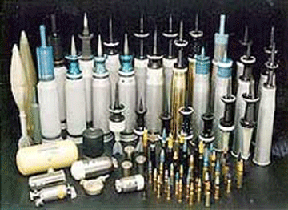
 Israel Has 115 Nuclear Warheads, U.S. Research Institute Says, Haaretz, 22 Nov 15
 Iran helped by world powers to redesign reactor as part of nuclear deal
World powers to help Iran redesign reactor as part of nuclear deal, REUTERS, 21 Nov 15 DUBAI | BY BOZORGMEHR SHARAFEDIN Six world powers will help Iran redesign its Arak heavy water reactor so that it cannot produce weapons-grade plutonium, according to a document released by the state news agency IRNA on Saturday.
The document was signed separately on Nov. 13, 17 and 18 by the foreign ministers of Iran and the P5+1 (the United States, Britain, France, China and Russia plus Germany) as well as EU foreign policy chief Federica Mogherini. It became effective on the date it was signed by all states.
The fate of the Arak reactor in central Iran was one of the toughest sticking points in the long nuclear negotiations that led to an agreement in July. Removing the core of the heavy water reactor to produce less plutonium is a crucial step before the relief from sanctions starts…….http://www.reuters.com/article/2015/11/21/us-iran-nuclear-arak-idUSKCN0TA0IK20151121#REED39oPKDuwmqS4.97
Despite airplane bombing , and Egypt’s lax security, Russia to provide nuclear reactors to Egypt!


 Egypt’s Nuclear Power Plant Deal With Russia Signed Amid Escalating Tensions By Menna Zaki, AllAfrica, 20 Nov 15
President Abdel Fattah al-Sisi signed a nuclear power plant deal with Russia Thursday, just days after the Kremlin’s unilateral announcement that the Russian charter flight which blew up over Sinai late October was downed by an act of terrorism…….
The deal, which has been under negotiation for months, was signed days after Russia vowed to avenge the terrorist bombing of a Russian airliner killing all 224 passengers and crew on board, the majority of whom were Russian holidaymakers visiting the resort city of Sharm el-Sheikh and heading to St. Petersburg.
Since the crash, Egypt has made no conclusive statements on the results of the Egypt-led international investigation, agreeing only that the jet broke up midair after abruptly disappearing from the radar 23 minutes from takeoff.
Egyptian officials said on separate occasions that it is too early to jump to conclusions and that no criminal evidence can be established so far.
Russia, on the other hand, announced days before signing the nuclear deal with Egypt that the crash was a terrorist act. Days after the crash, Russia had halted all flights to Egypt and banned the national carrier EgyptAir from flying to Russia, apparently based on information passed on by the UK which was not shared with Egypt, according to Egyptian officials…….
Russia announced Thursday that it has evacuated 90,000 of its citizens from Egypt, with the remaining 2,500 to leave by November 30………Egypt’s lax airport security has come under heavy scrutiny since the incident amid news reports that small bribes by travellers are enough to help them bypass queues and luggage scanners…….http://allafrica.com/stories/201511201808.html
Iran hastening process of dismantling uranium-enriching centrifuges
 Iran starts dismantling nuclear equipment, SMH November 19, 2015 – Vienna: Iran has disconnected almost a quarter of its uranium-enriching centrifuges in less than a month, the UN nuclear watchdog said on Wednesday, suggesting the nation is racing to implement an agreement restricting its nuclear activities.
- Under the July deal, sanctions against Iran will be lifted in exchange for measures including slashing the number of centrifuges in operation and reducing its stockpile of uranium.
- Officials have been speculating about the speed at which Iran can dismantle the centrifuges, sensitive machines that spin at supersonic speeds to purify uranium to levels at which it can be used as fuel in power stations or, potentially, weapons.
- Disconnecting and moving the machines is a time-consuming process if it is to be done without damaging the equipment, making it one of the steps most likely to delay implementation of the deal, and therefore the lifting of sanctions.
- “They have been dismantling centrifuges that did not contain hexafluoride,” the senior diplomat said, referring to uranium hexafluoride, the feedstock for centrifuges. “Dismantling centrifuges that have or have had hexafluoride is a much more complicated thing than the clean ones.”
- A confidential report by the International Atomic Energy Agency to its Board of Governors said Iran had moved around 4500 centrifuges from their positions at the Fordow and Natanz enrichment sites between October 18 and November 15.
- The speed at which Iran dismantles the centrifuges is central to the question of whether Tehran can implement the deal reached in July with the US, Russia, France, Britain, Germany and China before parliamentary elections in February…….
http://www.smh.com.au/world/iran-starts-dismantling-nuclear-equipment-20151118-gl2jjw.html
Russia marketing nuclear reactors to Egypt, involving big debt for Egypt
 Egypt, Russia sign deal to build a nuclear power plant Reuters, 19 Nov 15 CAIRO Moscow and Cairo signed an agreement on Thursday for Russia to build a nuclear power plant in Egypt, with Russia extending a loan to Egypt to cover the cost of construction.
A spokesman for Russia’s state-owned nuclear firm Rosatom said the plant, Egypt’s first, would be built at Dabaa in the north of the country and was expected to be completed by 2022.
Egyptian President Abdel Fattah al-Sisi, speaking on state TV, gave few details but said the project would involve the building of a ‘third-generation’ plant with four reactors.
It is not clear how much the deal is worth but Sisi said the loan from Russia would be paid off over 35 years……..http://www.reuters.com/article/2015/11/19/us-nuclear-russia-egypt-idUSKCN0T81YY20151119#BuK0P0P54h5xD8LD.97
Iran c ontinues to comply with nuclear deal commitments, removing uranium enrichment centrifuges
 Iran continues removing centrifuges within nuclear deal commitments 15 NOVEMBER 2015, By Umid Niayesh– Trend: Head of the Atomic Energy Organization of Iran (AEOI) Ali Akbar Salehi once again emphasized that the Islamic Republic continues removing , in compliance with its commitments, as stated in the recently signed nuclear agreement.
Iran began removing inactive centrifuges at the Nataz nuclear site two weeks ago, Salehi said in statements to IRIB 3 state TV Nov. 14.
Iran has 20,000 centrifuges in Natanz, half of them inactive, Salehi noted, adding that Tehran has not yet begun removing centrifuges from Fordow.
“In line with our commitments under the Joint Comprehensive Plan of Action (JCPOA), we have started removing centrifuges in Natanz,” Salehi said, criticizing some hardline politicians who questioned his earlier statements on the removal of centrifuges.
On Nov. 2, Salehi announced that Iran, for the first time, has begun shutting down centrifuges under the terms of the nuclear agreement which triggered disputes in the country.
According to the JCPOA, signed between Iran and the P5+1 group of countries made up of the UK, US, France, Germany, Russia, and China, Tehran is committed to reducing its number of centrifuges……..http://en.trend.az/iran/nuclearp/2456707.html
Iran going for renewable energy
Iran signs landmark $6 billion power deal, Press TV, 4 Nov 15 The Iranian government says it has signed an agreement worth $6 billion with a European company to build 4,250 megawatts of power capacity in the country.
The agreement between Iran’s Ministry of Energy and the foreign firm envisages developing gas-powered plants for 3,250 MW and wind farms for 1,000 MW of electricity, Government spokesman Mohammad Baqer Nobakht said.
“This big investment will be made in the current year (ending on March 20, 2016) under the existing political conditions where the Joint Comprehensive Plan of Action and the lifting of sanctions has not started yet,” he said……..
Renewable projects
The government is eyeing renewables as the new alternative to fossil fuels which constitute about 90% of Iran’s energy mix.
The existing renewable capacity is focused on hydro power plants which produce about 8,500 MW. Just 150 megawatts of green power plants are currently operating in the country.
The government plans to install 5,000 MW of renewable capacity, putting Iran among the likes of the UK and France in this category. The Ministry of Energy is already implementing 500 MW wind converters and further 100 MW biomass projects.
The Middle East’s first geothermal power plant, a 50-megawatt pilot project, is being built at the foot of an inactive volcanic peak in northwest Meshguin Shahr.
However, Iran’s renewable energy potential is huge where only the wind capacity is estimated at 30,000 megawatts.
Foreign projects
German companies are reportedly about to begin next year building wind farms in Iran at a cost of $331 million. In August, they signed a document for generation of 100 MW of wind power plus 400 MW of solar in the southern Khuzestan province.
Italy’s Fata, the engineering unit of leading industrial group Finmeccanica, also signed then a 500 million euro ($543 million) contract with Ghadir Investment Company to build a power plant in Iran.
A consortium of Iranian, Indian and South Korean companies further seeks to set up an energy park in the Khuzestan province in a project worth $10 billion, including generation of 1,000 megawatts of solar power. http://www.presstv.com/Detail/2015/11/04/436250/Iran-electricity-investment-Europe-renewables
United Arab Emirates leading the way on renewable energy
UAE is the example to follow on energy, the National ae, Thamer Al Subaihi October 29, 2015 ABU DHABI // The oil-rich countries of the region should follow the UAE’s example in recycling their wealth into renewable energy, the UK’s secretary of state for foreign and commonwealth affairs said.
“The countries of this region have a choice,” said Philip Hammond at Masdar City on Thursday. “They can choose to do very little and hope climate change will not affect them, or take a lead from the UAE, investing in renewable energy and clean technology.”
Also speaking at the event was Dr Sultan Al Jaber, UAE Minister of State and chairman of Masdar, who said the UAE was committed to significantly increasing its use of renewable energy through the Intended Nationally-Determined Contribution plan it has submitted to the United Nations.
“Within the plan is the UAE’s national target to generate 24 per cent of its electricity from clean energy resources by 2021,” he said.
Mr Hammond praised the UAE’s investment in renewable energy domestically and globally as well as its ambitious plan of increasing its use of it. “Your target to achieve a quarter of your energy from clean sources within six years is bold and impressive,” said Mr Hammond.
While the UAE has the world’s seventh-largest reserves of oil and gas, Mr Hammond said it was to the nation’s credit that it was “already planning for a future beyond oil”.
The talk took place ahead of the global climate summit set to take place in Paris in December.
Mr Hammond said the time to invest in renewable energy was now, as climate change had the potential to significantly impact every country. “Climate change knows no borders and will respect no sovereignty,” he said. “While the UK would suffer from more extreme rainfall, storms and flooding, this region would be at risk from evermore extreme heat, water scarcity and drought.”
Adnan Amin, director general at the Masdar-based International Renewable Energy Agency, said that although significant strides had been made in the sector over the past decade, much more had to be done to prevent the global surface temperature increasing by 2ºC, which some experts said could be the tipping point to major climate change……..http://www.thenational.ae/uae/environment/uae-is-the-example-to-follow-on-energy
United Arab Emirates called upon to lead in regional nuclear disarmament
UAE must lead by example for regional nuclear disarmament ABU DHABI , Caline Malek The National.ae, 25 Oct 15 The head of a European nuclear safety organisation is calling on the UAE to lead its neighbours into a treaty that prevents testing of nuclear weapons.
Dr Lassina Zerbo, secretary general of the Preparatory Commission for the Comprehensive Nuclear-Test-Ban Treaty Organisation (CTBTO), said on Sunday that a Middle East free of nuclear weapons could not happen without a test-free zone.
“If people in the region are concerned about the Iran nuclear deal, one of the things they should see is that it can only contribute to building confidence in the region,” he said on the sidelines of the World Economic Forum in Abu Dhabi.
“It could conclude a framework for countries in the Middle East and the Gulf, [such as] Iran, Israel, Egypt and Saudi Arabia, to adhere to all pending arms control and non-proliferation treaties that are out there.”
The UAE has signed and ratified a number of nuclear treaties, including the CTBTO’s treaty, which prevents nuclear testing, and the United Nations’ Treaty on the Non-Proliferation of Nuclear Weapons, which is the main legal framework for nuclear disarmament, non-proliferation and peaceful use of nuclear energy.
Hamad Alkaabi, UAE Ambassador to the International Atomic Energy Agency (IAEA), said the UAE viewed global nuclear non-proliferation and disarmament as critical to regional and international peace and security. “The comprehensive nuclear test ban treaty is instrumental in achieving the goals of nuclear disarmament,” he said. “This year marks 70 years since the atomic bombings of Hiroshima and Nagasaki in Japan, and yet the international community has not been able to put the CTBT into force.”
Although the treaty has now reached 183 signatures and 164 ratifications, Mr Alkaabi said more needed to be done.
“The UAE will continue to support all efforts to reach this end,” he said. “In particular, the UAE has been encouraging states that have not yet signed and ratified the treaty to do so without further delay.”
Dr Zerbo said the UAE could be of great help to organisations like the CTBTO.
“I think they can help us to deal with what is happening in the region, a region that is difficult,” he said. “They could be of help in defusing the tensions that are here, should they have the will to [lead], which they can because they have the possibilities – financially, technically and politically.
“We need a country that can lead this region into that process of confidence-building that is required for all countries in the Middle East to adhere to the arms control and non-proliferation treaties that are still pending.”
He called nuclear security a global issue linked to arms control, making them a priority on the international agenda……..http://www.thenational.ae/uae/government/uae-must-lead-by-example-for-regional-nuclear-disarmament
1 This Month
26 September – International Day for the Total Elimination of Nuclear Weapons





PLEASE OPPOSE HR 8255 AND S.3639 – bills would accelerate satellite deployment, with no environmental review or safeguards – https://ncstd5li.quorum.us/campaign/169331/
To see nuclear-related stories in greater depth and intensity – go to https://nuclearinformation.wordpress.com
-
Archives
- September 2026 (323)
- August 2026 (330)
- July 2026 (355)
- June 2026 (287)
- May 2026 (306)
- April 2026 (356)
- March 2026 (251)
- February 2026 (267)
- January 2026 (308)
- December 2025 (358)
- November 2025 (359)
- October 2025 (375)
-
Categories
- 1
- 1 NUCLEAR ISSUES
- business and costs
- climate change
- culture and arts
- ENERGY
- environment
- health
- history
- indigenous issues
- Legal
- marketing of nuclear
- media
- opposition to nuclear
- PERSONAL STORIES
- politics
- politics international
- Religion and ethics
- safety
- secrets,lies and civil liberties
- spinbuster
- technology
- Uranium
- wastes
- weapons and war
- Women
- 2 WORLD
- ACTION
- AFRICA
- Atrocities
- AUSTRALIA
- Christina's notes
- Christina's themes
- culture and arts
- Events
- Fuk 2022
- Fuk 2023
- Fukushima 2017
- Fukushima 2018
- fukushima 2019
- Fukushima 2020
- Fukushima 2021
- general
- global warming
- Humour (God we need it)
- Nuclear
- RARE EARTHS
- Reference
- resources – print
- Resources -audiovicual
- Weekly Newsletter
- World
- World Nuclear
- YouTube
-
RSS
Entries RSS
Comments RSS

