Saudi Arabia applauds Donald Trump in pulling out of the Iran nuclear deal

 Saudi Arabia says backs U.S. decision to withdraw from Iran nuclear deal, Reuters Staff RIYADH (Reuters) 9 May 18- Saudi Arabia welcomed President Donald Trump’s decision on Tuesday to withdraw the United States from the international nuclear agreement with Iran and to reimpose economic sanctions on its arch-foe Tehran.
The kingdom, a key U.S. ally, said it would work with the United States and the international community to address Iran’s nuclear program as well as its ballistic missile program and support of militant groups in the region……..
It confirmed “the need to deal with the danger that Iran’s policies pose to international peace and security through a comprehensive view that is not limited to its nuclear program but also includes all hostile activities” in the region……..
Saudi Arabia has called the 2015 nuclear deal a “flawed agreement”, and in March Saudi Crown Prince Mohammed bin Salman told CBS news that his kingdom would “without a doubt” develop nuclear weapons if Iran did so.
Reporting by Stephen Kalin and Sarah Dadouch; Writing by Ghaida Ghantous; Editing by Michael Georgy and Hugh Lawson https://www.reuters.com/article/us-iran-nuclear-gulf/saudi-arabia-says-backs-u-s-decision-to-withdraw-from-iran-nuclear-deal-idUSKBN1I92SH
Rouhani says Iran will remain in nuclear deal
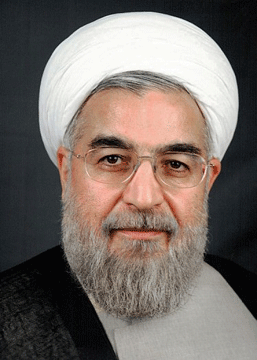 https://en.trend.az/iran/politics/2900330.html, 8 May 2018
President Hassan Rouhani said on Tuesday that Iran would remain committed to a multinational nuclear deal despite U.S. President Donald Trump’s decision to withdraw from the 2015 agreement designed to deny Tehran the ability to build nuclear weapons, Reuters reported.
“If we achieve the deal’s goals in cooperation with other members of the deal, it will remain in place… By exiting the deal, America has officially undermined its commitment to an international treaty,” Rouhani said in a televised speech.
“I have ordered the foreign ministry to negotiate with the European countries, China and Russia in coming weeks. If at the end of this short period we conclude that we can fully benefit from the JCPOA with the cooperation of all countries, the deal would remain,” he added.
The Joint Comprehensive Plan of Action (JCPOA) is the full name for the nuclear deal, struck in 2015 between Iran, the five permanent members of the U.N. Security Council – the United States, Russia, China, Britain and France – and Germany.
Rouhani added that Iran was ready to resume its nuclear activities after consultations with the other world powers which are part of the agreement.
European leaders consider ways to save the Iran nuclear deal


 Europe pledges to save Iran nuclear deal ‘for our shared security’ https://www.smh.com.au/world/europe/europe-pledges-to-save-iran-nuclear-deal-for-our-shared-security-20180509-p4ze4a.html, By Nick Miller, 9 May 2018
Budapest: European leaders have hinted at financial incentives or compensation for Iran to persuade it to stay it in the nuclear deal that the US has rejected.
And they are likely to act to protect European companies trading with Iran despite the US re-imposing sanctions.
In a joint statement UK prime minister Theresa May, German Chancellor Angela Merkel and French president Emmanuel Macron greeted with “regret and concern” Donald Trump’s announcement that he would re-impose sanctions against Iran and withdraw from the Iran nuclear deal.
“Together, we emphasise our continuing commitment to the (agreement),” they said. “This agreement remains important for our shared security.”
They said Iran “continues to abide by the restrictions” in the deal preventing its development of nuclear weapons, and “the world is a safer place as a result”.
“Our governments remain committed to ensuring the agreement is upheld, and will work with all the remaining parties to the deal to ensure this remains the case including through ensuring the continuing economic benefits to the Iranian people that are linked to the agreement.”
They encouraged Iran to “show restraint in response to the decision by the US” and to continue to meet all its obligations including atomic agency inspections and monitoring.
“In turn, Iran should continue to receive the sanctions relief it is entitled to whilst it remains in compliance with the terms of the deal,” the leaders said.
The European Commission’s foreign affairs representative and vice president Federica Mogherini said the nuclear deal “is not a bilateral agreement and it is not in the hands of any single country to terminate it”.
“It is a key element of the global nuclear non-proliferation architecture,” Mogherini said, adding that it was “even more” relevant in the context of negotiations with North Korea.
“The nuclear deal with Iran is crucial for the security of the region, of Europe and of the entire world,” she said.
She said Europe “fully trusted” the work of the nuclear watchdog which had certified Iran had fully complied with it s commitments under the deal.
And she too suggested Europe would look to compensate Iran for the impact of renewed US sanctions.
“The EU has repeatedly stressed that the lifting of nuclear related sanctions has a positive impact on trade and economic relations with Iran, including crucial benefits for the Iranian people,” she said
“The EU is fully committed to ensuring that this continues to be delivered on. I am particularly worried by the announcement of new sanctions. I will consult with all our partners in the coming hours and days to assess their implications. The EU is determined to act in accordance with its security interests and to protect its economic investments.”
And she appealed to Iran to “stay true to your commitments, as we will stay true to ours. And together, with the rest of the international community, we will preserve the nuclear deal.”
May, Macron and Merkel said they wanted to build on the nuclear deal to address other issues including Iran’s ballistic missile programme and “its destabilising regional activities, especially in Syria, Iraq and Yemen”.
Macron Tweeted that the three countries would “work collectively on a broader framework” covering nuclear activity after the deal ends in 2025, ballistic activity and “stability in the Middle East”.
On Monday UK Foreign Secretary Boris Johnson travelled to the US to make a last-ditch appeal to save the deal, but didn’t get an audience with the president.
Instead he appeared on the cable news program Fox & Friends – which Trump regularly watches – and remarked that “Plan B does not seem, to me, to be particularly well developed at this stage”.
The power of environmentalism – Israelis, Palestinians and Jordanians unite in campaign for the environment
 EcoPeace Middle East and the power of environmentalism, Independent Australia, Sophia McNamara
Sophia McNamara introduces Gidon Bromberg and EcoPeace Middle East — an organisation brokering peaceful cooperation with environmentalism.
ECOPEACE MIDDLE EAST is a unique regional organisation that brings together Israeli, Palestinian and Jordanian environmentalists.
It is the only regional non-government organisation (NGO) that exists in Israel, Palestine and Jordan. Among its many battles, Ecopeace Middle East recently helped increase the supply of clean water and energy to Gaza. This is particularly critical considering the United Nations has predicted that Gaza will become uninhabitable by 2020.
I interviewed Israeli co-director and co-founder of EcoPeace Middle East Gidon Bromberg and he told me:
“Just a one hour drive from here in Tel Aviv, there is a water and sanitation crisis in Gaza … Two million people have run out of water. And today, about 97% of the groundwater is undrinkable.”
Bromberg came up with the idea to start EcoPeace when he realised the environment was being completely left out of the peace agenda of the early 1990s.
Originally from Elsternwick in Melbourne, Bromberg attended Elwood High School (formerly Elwood College) and graduated with degrees in Law and Economics from Monash University. Since age 11, Bromberg had known he wanted to return to his family’s hometown of Tel Aviv, Israel.
Straight after university, he made “aliyah“ — a term that describes the process of a Jewish person returning to Israel.
Bromberg came across an advert saying that a newly established non-profit called the Israel Union for Environmental Defence wanted their first lawyer. He volunteered there one day a week for four years, while still working four days a week in private practice, taking a pay cut in the process.
He was then offered a scholarship to study his Masters of Law at the American University in Washington DC, where he ended up being right on the doorstep of negotiations for the Oslo Accords and the Israel-Jordan Peace Treaty. Bromberg’s Masters thesis posed the question: will peace be environmentally sustainable? He concluded that peace could, in fact, be truly harmful to the environment and sustainability unless it was put on the political track.
Bromberg had the idea to create a regional environmental organisation that would address this exact issue. He wanted to hold a meeting with Israeli, Egyptian, Palestinian and Jordanian environmentalists to discuss the possibility of this organisation. He spoke with potential investors in Washington DC — they all told him it was a great idea, but he needed to come back to them when he was older.
In 1994, he went back to Israel and, as part of his scholarship, he worked for a year at the Israel Union of Environmental Defence as a full-time lawyer.
Bromberg immediately wrote to all the potential investors in the United States again, this time from Israel. One of them called him and said he had thought about it and that if he could make the meeting happen, he would fund it. As these were the days before the internet, Bromberg had never met a Palestinian, Jordanian or Egyptian environmentalist.
The World Wildlife Fund had a guide on environmentalist organisations in the region — so he contacted all of them. Bromberg had a meeting in East Jerusalem with a Palestinian environmentalist, who responded to the enquiry, and spoke over the phone to an Egyptian and Jordanian. …..
Today, EcoPeace has adapted to a changed political climate, increased water scarcity and urgency required by climate change. They focus heavily on shared natural resources, regional water security and sustainable development.
A particularly successful initiative by EcoPeace is the Good Water Neighbours Program. This is where youth and adult activists, as well as mayors and municipal staff from Israeli, Palestinian and Jordanian communities all work together across the borders to advance shared solutions for the rehabilitation of natural watersheds.
The Jordan River, possibly the holiest river in the world, with large religious significance in Christianity, Judaism and Islam, “has been turned into little more than an open sewer now,” says Bromberg.
Bromberg says the issue is about more than the river itself:
“The largest number of volunteers from Jordan who have joined ISIS are from Jordan Valley communities. There is a link between ecological demise, poverty, underdevelopment… and then radical, dangerous ideologies. Water security, ours and our neighbours, are national security concerns.”
This is the case EcoPeace make when they lobby Israeli, Palestinian and Jordanian governments into committing themselves to cross-border water and sanitation projects………. https://independentaustralia.net/politics/politics-display/ecopeace-middle-east-and-the-power-of-environmentalism,11470
Ending Iran nuclear deal could have grave consequences: Jordan fears new arms race
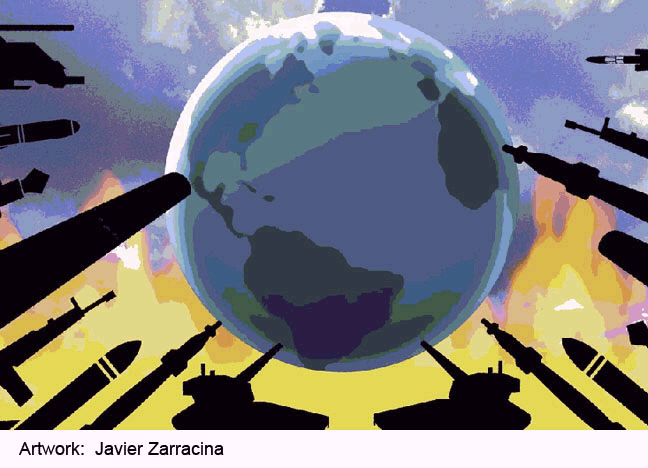 JORDAN’S FOREIGN MINISTER SEES ARMS RACE IF IRAN NUCLEAR DEAL ENDS
Jordanian Foreign Minister Ayman al-Safadi says an end of the Iran deal could have grave consequences across the Middle East, BY REUTERS JERUSALEM POST MAY 8, 2018 MURNAU – Jordanian Foreign Minister Ayman al-Safadi on Tuesday warned of “dangerous repercussions” and a possible arms race in the Middle East unless a political solution was found to free the region of nuclear weapons and other weapons of mass destruction.
Al-Safadi spoke in Germany before an expected announcement by US President Donald Trump on whether he will pull out of the Iran nuclear deal or work with European allies who say it has successfully halted Iran’s nuclear ambitions.
“We all need to work together in making sure that we solve the conflicts of the region … and strive for a Middle East that is free of all weapons of mass destruction,” he told reporters after a meeting with leaders of Chancellor Angela Merkel’s right-left “grand coalition” government.
“If we do not look at the political picture and … find a way to ensure that the whole region is free of (these weapons), we’ll be looking at a lot of dangerous repercussions that will affect the region in terms of an arms race,” he said.
In March, Saudi Arabian Crown Prince Mohammed bin Salman told CBS news that his kingdom would “without a doubt” develop nuclear weapons if Iran, Riyadh’s arch foe, did so.
Israel is widely believed to be the only nuclear-armed state in the Middle East, although it neither confirms nor denies possessing atomic weapons. …….https://www.jpost.com/Middle-East/Jordans-foreign-minister-sees-arms-race-if-Iran-nuclear-deal-ends-554777
Israel prepares missile defence systems and BOMB SHELTERS as US leaves Iran nuclear deal
ISRAEL has deployed multiple iron dome defence systems across the northern parts of the country as Israeli authorities fear an Iranian attack is imminent following the US’s withdrawal from the Iran nuclear deal. Express UK, By NICOLE STINSON, May 8, 2018
Israel has instructed local authorities in the Israeli-held Golan Heights to “unlock and ready bomb shelters” after identifying what the military described as “irregular activity of Iranian forces in Syria”.
The military statement further said that its defence systems had been deployed “and IDF (Israel Defence Force) troops are on high alert for an attack”.
Reports have emerged of explosions being heard south of the Syrian capital of Damascus towards the Israeli border……https://www.express.co.uk/news/world/956884/iran-nuclear-threat-israel-iron-dome-defence-systems-iran-attack-donald-trump-ww3
Iran’s moderate Rouhani government in danger, if U.S. President Donald Trump scraps Tehran’s nuclear deal
 Nuclear deal a challenge for Rouhani as Iran hardliners close in, Parisa Hafezi, ANKARA (Reuters) 4 May 18 – Iran’s hardliners are preparing to bring President Hassan Rouhani to heel if U.S. President Donald Trump scraps Tehran’s nuclear deal with major powers, officials and analysts believe.
Trump has threatened to abrogate the 2015 agreement by not extending sanctions waivers when they expire on May 12, if Britain, France and Germany do not “fix” its “terrible flaws”.
This sets the stage for a resurgence of political infighting within Iran’s complex power structure, Iranian officials said.
Annulment of the accord could tip the balance of power in favor of hardliners looking to constrain the relatively moderate Rouhani’s ability to open up to the West.
While the spotlight is on Trump’s eventual decision there will be a display of unity in Tehran, a senior Iranian official told Reuters, on condition of anonymity.
“But when the crisis is over, hardliners will try to weaken and sideline the president,” the official said.
Nor can the president expect any weakening of Iran’s system of clerical rule as a result of the uncertainty surrounding the nuclear deal, meaning “Rouhani will be in a no-win situation”, said a relative of Khamenei.
For Rouhani the stakes are high. If the deal falls apart, he could become politically vulnerable for promoting the 2015 accord, under which non-nuclear sanctions were lifted in return for Tehran curbing its nuclear program.
“It will also lead to a backlash against the moderates and pro-reformers who backed Rouhani’s detente policy with the West … and any hope for moderation at home in the near future will fizzle out,” said political analyst Hamid Farahvashian.
It is a delicate balance. Supreme leader Ayatollah Ali Khamenei knows that Iranians, many of whom took to the streets earlier this year to protest against high food prices, can only take so much economic pressure.
….. The internal politics will make it difficult, if not impossible, for Rouhani to pursue detente with the West and make concessions in return for economic gains,” said another Iranian government official. https://www.reuters.com/article/us-iran-nuclear-politics-analysis/nuclear-deal-a-challenge-for-rouhani-as-iran-hardliners-close-in-idUSKBN1I51P0
Israel, Too, Lied About Its Nuclear Capabilities
 Yes, Iran Lied About Its Nuclear Capabilities. But So Did Israel
Netanyahu’s arrogant theatricals exposed Israel’s lack of current incriminating evidence on Iran – and Israel’s hypocrisy about its own nuclear capabilities, Haaretz, Avner Cohen and Ben McIntosh
Israel’s nuclear weapons
Welcome to Israeli Nuclear Weapons 101 The National Interest, Daniel R. DePetris, September 20, 2015
1. The Number is in Doubt:
While everyone believes that the Israelis possess a sizable nuclear arsenal, no one really knows how big that arsenal is. In 2008, President Jimmy Carterestimated that Israel probably had a minimum of 150 weapons in stock ready to use if the most dire circumstances warrant. Six years later, the former President revised that estimate and put the figure in the 300 range, which—based on Carter’s calculations—would mean that Israel doubled its arsenal from the 2008-2014 time-period. Iranian foreign minister Mohammad JavadZarif told reporters at the United Nations at the height of the P5+1-Iran nuclear talks that Israel is “sitting on 400 nuclear warheads.” The Bulletin of Atomic Scientists believes Zarif’s figure is far too large and unrealistic given the fact that Israel’s weapons are designed for deterrence purposes rather than actual hire-trigger use. A better figure, the board writes, is “sixty-five to eighty-five warheads” as cited in a Rand Corporation study.
To put it bluntly, the world doesn’t have a clue about how many nukes Israel possesses. And that’s precisely the point for the Israelis: the guessing game swirling over the proliferation community keeps Israel’s enemies in the region on their toes.
2. Israel Fooled the U.S. to Get Its Program Off the Ground:
The Iranian Government has been caught building enrichment facilities by western intelligence agencies twice before. In 2002, a dissident Iranian group provided information to the United States pointing to a large-scale enrichment facility at Natanz. In 2009, U.S. and European intelligence uncovered another enrichment facility at Fordow buried deep into a mountain. But Iran isn’t the only country that has deliberately deceived the United States and the international community in order to provide time for a full-on nuclear program; the Israelis, as Walter Pincus wrote in a Washington Post storyearlier this year, “blazed [the] trail decades ago.”
In the 1950s and early 1960s, the Israeli Government repeatedly stonewalled U.S. requests for information on possible weapons development and at times purposely lied to their U.S. allies in the hope of giving the nuclear program more room to breath. In 1960, Israel referred to its Dimona reactor both as a “textile plant” and as a “metallurgic research installation” to the U.S. State Department. Foreign minister Shimon Peres assured President John F. Kennedy in a 1963 meeting in the Oval Office that Israel would “not introduce nuclear weapons to the region.”
President Kennedy was so concerned about a possible Israeli nuclear weapons program that he demanded Israel admit American inspectors into Dimona to snoop around. The Israelis agreed to those requests, but made sure that those visits would not lead to anything incriminating: U.S. inspectors, according to a long-read investigative report in The Guardian, were not permitted to bring their own equipment or collect samples at the site.
3. Why Israel Wanted a Bomb in The First Place:….
4. The World Has Long Wanted Israel to Join the NPT:
Ever since 1995, when signatories of the Nuclear Non-Proliferation Treaty officially called for the “establishment by regional parties of a Middle East zone free of weapons of nuclear and all other related weapons of mass destruction,” the United Nations has attempted to convince Israel that signing the NPT and allowing IAEA inspectors into its facilities is the best way to accomplish that objective. Israel, however, has refused to grant those requests and has long argued that Israel’s nuclear weapons program (which the country continues to neither confirm nor deny) is not nearly the biggest threat to the Middle East’s security.
This hasn’t stopped parties to the NPT and the U.N. General Assembly from pressing the point and trying to force compliance. ……http://nationalinterest.org/feature/welcome-israeli-nuclear-weapons-101-13882
Nuclear Israel points at non-nuclear Iran as danger!
Reality turned upside down: Nuclear Israel points at non-nuclear Iran as danger, By Nathalie Hrizi Liberation News, 4 May 18 In a not unusual display of utter hypocrisy in a televised appearance, Israeli Prime Minister Benjamin Netanyahu argued on April 30 that Iran is a “danger” and is violating the nuclear deal formally known as the Joint Comprehensive Plan of Action.
Iran has no nuclear weapons.
Immediately following Netanyahu theatrical performance the International Atomic Energy Agency released a statement saying “that the Agency had no credible indications of activities in Iran relevant to the development of a nuclear explosive device after 2009.”
Because of the JCPOA, Iran is a highly inspected country. The IAEA has a presence in that country at 18 nuclear sites and nine other locations. From 2013 to 2017 they increased surveillance activities by 152 percent and inspectors spend 3, 000 days in the field each year.
In fact, Israel is the real nuclear danger.
In 2017, it was estimated that Israel possessed 80 nuclear warheads. It has never signed the Treaty on the Non-Proliferation of Nuclear Weapons, and has indicated that it has no intention of doing so.
Not only is Israel armed with nuclear weapons and an entire military primarily funded by U.S. tax dollars, but it has consistently attacked its neighbors in the Middle East. Israel maintains a blockade and constant aggression against the Palestinians. It has bombed or invaded Iraq, Jordan Lebanon and Syria and Egypt without provocation. It consistently threatens Iran today. ……https://www.liberationnews.org/reality-turned-upside-nuclear-israel-points-non-nuclear-iran-danger/
Israel Dragging the United States Into World War III ?
Retired US Colonel: Israel Is Dragging the United States Into World War III, Lawrence Wilkerson, a retired army colonel who now teaches at Washington-area universities, didn’t hold back in his critique of where the status quo is leading the United States via its client state, Israel. Mintpress News, 12 March 2018 by Darius Shahtahmasebi
Iran will not ‘renegotiate or add onto’ nuclear deal
Iran will not ‘renegotiate or add onto’ nuclear deal – Daily Mail
Iran says will not renegotiate nuclear deal, warns against changes ANKARA (Reuters) 3 May 18– Iran’s foreign minister said on Thursday U.S. demands to change its 2015 nuclear agreement with world powers were unacceptable as a deadline set by President Donald Trump for Europeans to “fix” the deal loomed.
Trump has warned that unless European allies rectify the “terrible flaws” in the international accord by May 12, he will refuse to extend U.S. sanctions relief for the oil-producing Islamic Republic.
“Iran will not renegotiate what was agreed years ago and has been implemented,” Foreign Minister Mohammad Javad Zarif said in a video message posted on YouTube.
Britain, France and Germany remain committed to the accord as is, but now, in efforts to keep Washington in it, want to open talks on Iran’s ballistic missile program, its nuclear activities beyond 2025 – when key provisions of the deal expire – and its role in Middle East crises such as Syria and Yemen.
A senior adviser to Iranian Supreme Leader Ayatollah Ali Khamenei also warned Europeans on Thursday over “revising” the nuclear deal, under which Iran strictly limited its enrichment of uranium to help allay fears this could be put to producing atomic bomb material, and won major sanctions relief in return.
“Even if U.S. allies, especially the Europeans, try to revise the deal…, one of our options will be withdrawing from it,” state television quoted Ali Akbar Velayati as saying.
The European signatories to the deal have been trying to persuade Trump to save the pact, reached under his predecessor Barack Obama. They argue it is crucial to forestalling a destabilizing Middle East arms race and that Iran has been abiding by its terms, a position also taken by U.S. intelligence assessments and the U.N. nuclear watchdog agency.
Zarif said: “Let me make it absolutely clear and once and for all: we will neither outsource our security nor will we renegotiate or add onto a deal we have already implemented in good faith.”
Referring to Trump’s past as a property magnate, Zarif added, “To put it in real estate terms, when you buy a house and move your family in, or demolish it to build a skyscraper, you cannot come back two years later and renegotiate the price.”…… https://www.reuters.com/article/us-iran-nuclear-usa/iran-says-will-not-renegotiate-nuclear-deal-warns-against-changes-idUSKBN1I41CO
A serious backward step for Iranian reform, if Trump destroys the nuclear deal
If Trump destroys the nuclear deal, Iran will fall to its hardliners https://www.theguardian.com/commentisfree/2018/may/03/trump-nuclear-deal-iran-reform-netanyahu-tehran
Encouraged by Netanyahu, the US could soon withdraw from the agreement – which would spell the end of hopes for reform
Benjamin Netanyahu’s amateurish PowerPoint presentation in Tel Aviv this week – “Iran lied” flashed up behind him in huge letters – was in fairness a great improvement on the cartoonish diagram of an atomic bomb the Israeli prime minister held up at the UN general assembly in September 2012. But it served much the same purpose: to show that Iran can’t be trusted, and is poised to unleash nuclear havoc across the region. The “half-ton cache” of documents he presented as evidence that Iran hid a weapons programme predates the 2015 nuclear deal. John Kerry, one of its architects, tweeted that it represented “every reason the world came together to apply years of sanctions and negotiate the Iran nuclear agreement – because the threat was real and had to be stopped. It’s working!”
This is why, together with Kerry, European powers led by France, Germany and Britain made substantial efforts to push back against Netanyahu’s performance. In contrast, Mike Pompeo, Trump’s secretary of state, lauded it. In the words of Stephen Walt, a professor of international affairs at Harvard, “the Bush administration was better at inventing a phoney case for war with Iraq than the Trump team is at conjuring up a phoney case for war with Iran. But doesn’t mean they won’t eventually succeed.”
Arguably, if anyone has the right to complain, it is Iran. It has unplugged two-thirds of its centrifuges and shipped out 98% of its enriched uranium, but has not seen the economic benefits it was promised. Nearly three years on, not a single tier-one European bank is prepared to do business with Iran. The country’s currency crisis last month showed the extent of its economic vulnerability. Trump’s controversial Muslim travel ban has targeted Iranians and hampered the growth of tourism.
Perhaps more importantly, the collapse of the deal would be seen by the Iranian people as a huge betrayal. In 2013, Iranians brought the era of Holocaust-denier Mahmoud Ahmadinejad (despised at home after a fraudulent re-election in 2009), to a close. They put their trust in the reform-minded Hassan Rouhani, who subsequently fulfilled his promise to them of resolving the nuclear dispute with the west. Iran’s tech-savvy young people are by and large more progressive than previous generations. Last year, 24 million Iranians re-elected Rouhani by a landslide in an endorsement of his work on the deal. Yet just as the agreement is beginning to deliver, and with Iran fully complying, a new US administration seems set on scuppering it.
Of course, the fact that Iran is fulfilling its nuclear obligations does not mean it has been a good actor elsewhere. But the agreement was not supposed to address Iran’s regional behaviour or its missile programme, and should not be junked on this basis. In Syria, Iran is arguably making its biggest foreign policy mistake since the revolution. It has long defined its foreign policy as defending the oppressed, but for the first time it is clearly supporting the oppressor.
Even with Syria, however, the situation isn’t entirely straighforward. Vali Nasr, dean of the Johns Hopkins School of Advanced International Studies in Washington DC, argued in an essay in the latest issue of the Foreign Affairs that Tehran’s role in Syria could be understood as a form of “forward defence”, a way to survive the collapse of the old order in the Arab world following the US invasion of Iraq and widespread civil unrest. Washington’s efforts to roll back Iranian influence, he says, have failed to restore that order and may inadvertently have made Iran – worried that it has been outgunned by its traditional rivals – bolder: “The more menacing the Arab world looks, the more determined Iran is to stay involved there.”
The chances of a military conflict with Iran are not high for the moment, so long as Tehran has Russia’s backing. But the collapse of the deal would, even so, have terrible consequences. It would destroy the moderates and reformists in Iran for the foreseeable future. This is particularly important since the supreme leader, Ayatollah Ali Khamenei, is 78, and there has been speculation over his health. The time may soon come when a successor takes his place – the biggest political change in decades. Rouhani has already been under intense pressure from his opponents. The failure of the deal will only embolden hardliners, who are resposible for outrageous human rights abuses, such as the ongoing detention of dual nationals like Nazanin Zaghari-Ratcliffe.
While the reformist president Mohammad Khatami was in office, George W Bush undermined him and shattered Iranians’ hopes of rapprochement by labelling the country part of the “axis of evil”. Trump could be about to make exactly the same mistake with Rouhani.
Scientists call on the the International Atomic Energy Agency, NATO to stall Turkey’s dangerous nuclear power developments
Scientists raise alarm over Turkish nuclear reactors http://www.ekathimerini.com/228268/article/ekathimerini/news/scientists-raise-alarm-over-turkish-nuclear-reactors
A team of Greek scientists have called on the government, the European Union, the International Atomic Energy Agency, NATO and other international organizations to take measures that will halt the creation of nuclear power facilities in the seismically active region of Akkuyu in neighboring Turkey.
The 18 scientists made their appeal in a letter against the backdrop of an agreement struck by Moscow and Ankara for the installation of four nuclear reactors in Turkey.
Listing a series of possible consequences, the scientists raised the alarm, saying that “Turkey plans to obtain 10 nuclear reactors by 2030.”
Saudi Arabia’s nuclear obsession – a cover for nuclear weapons development?
some skeptics think the whole energy argument coming out of Riyadh is merely a cover for its military ambitions.
Trump might be distracted by the prize of winning multibillion-dollar contracts for US nuclear construction companies in desperate need of business. The temptation to settle for a deal that gives the Saudis a path to the bomb might just be too great to overcome.
Saudi Arabia is an outstanding candidate for using solar energy to power much of the country. Its vast and extremely sunny deserts are naturally suited to providing electricity to the country during the day.
Given that Saudi Arabia can build solar power facilities and produce solar energy at incredibly low costs, Romm says, it “doesn’t make a lot of sense from an energy point of view” that Saudi is leaning so much toward the nuclear option, which is notoriously expensive.
Saudi Arabia’s controversial quest for nuclear power, explained https://www.vox.com/world/2018/3/26/17144446/saud-arabia-nuclear-weapons-trump-iran-deal Why the world’s most iconic oil giant wants to go nuclear — and why it could transform the Middle East. By
1 This Month
26 September – International Day for the Total Elimination of Nuclear Weapons





PLEASE OPPOSE HR 8255 AND S.3639 – bills would accelerate satellite deployment, with no environmental review or safeguards – https://ncstd5li.quorum.us/campaign/169331/
To see nuclear-related stories in greater depth and intensity – go to https://nuclearinformation.wordpress.com
-
Archives
- September 2026 (313)
- August 2026 (330)
- July 2026 (355)
- June 2026 (287)
- May 2026 (306)
- April 2026 (356)
- March 2026 (251)
- February 2026 (267)
- January 2026 (308)
- December 2025 (358)
- November 2025 (359)
- October 2025 (375)
-
Categories
- 1
- 1 NUCLEAR ISSUES
- business and costs
- climate change
- culture and arts
- ENERGY
- environment
- health
- history
- indigenous issues
- Legal
- marketing of nuclear
- media
- opposition to nuclear
- PERSONAL STORIES
- politics
- politics international
- Religion and ethics
- safety
- secrets,lies and civil liberties
- spinbuster
- technology
- Uranium
- wastes
- weapons and war
- Women
- 2 WORLD
- ACTION
- AFRICA
- Atrocities
- AUSTRALIA
- Christina's notes
- Christina's themes
- culture and arts
- Events
- Fuk 2022
- Fuk 2023
- Fukushima 2017
- Fukushima 2018
- fukushima 2019
- Fukushima 2020
- Fukushima 2021
- general
- global warming
- Humour (God we need it)
- Nuclear
- RARE EARTHS
- Reference
- resources – print
- Resources -audiovicual
- Weekly Newsletter
- World
- World Nuclear
- YouTube
-
RSS
Entries RSS
Comments RSS

