USA administration salivating about lucrative sale of nuclear technology to Saudi Arabia – if only they could get over the proliferation problem
Perry has held talks with several Saudi leaders this year, including King Salman and Crown Prince Mohammed bin Salman, on the kingdom’s ambition of initially building two nuclear power stations. Saudi Arabia wants to ultimately construct 16 reactors in coming decades at a cost of about $80 billion.
Discussions had been held up on Saudi Arabia’s desire to relax nonproliferation standards and potentially allow the country to enrich uranium and reprocess plutonium, technologies that non-proliferation advocates worry could one day be covertly altered to produce fissile material for nuclear weapons.
Perry said progress on non-proliferation standards had been made, but that talks were not going as quickly as either side would have hoped. Perry has shared with Saudi leaders that being “perceived as very, very strong on non-proliferation was a most important message, globally,” he told reporters at the Energy Department headquarters.
Perry said part of the talks center on making sure any nuclear inspections would not be intrusive for sensitive areas in the kingdom.
Discussions had been held up on Saudi Arabia’s desire to relax nonproliferation standards and potentially allow the country to enrich uranium and reprocess plutonium, technologies that non-proliferation advocates worry could one day be covertly altered to produce fissile material for nuclear weapons.
Perry said progress on non-proliferation standards had been made, but that talks were not going as quickly as either side would have hoped. Perry has shared with Saudi leaders that being “perceived as very, very strong on non-proliferation was a most important message, globally,” he told reporters at the Energy Department headquarters.
Perry said part of the talks center on making sure any nuclear inspections would not be intrusive for sensitive areas in the kingdom.
President Erdoğan and Vladimir Putin launch the construction of the Akkuyu nuclear power plant
Saudi Arabia subverting international climate change talks

 International talks on how to present the science around 1.5C of global warming just ran into overtime in Incheon, South Korea. Climate Home News 5 Oct 18
National delegates are expected to argue well into Saturday about the feasibility of holding temperature rise to 1.5C – the stretch goal of the Paris Agreement – and its implications for sustainable development.
Saudi Arabia is leading the criticism of several elements of the draft summary of the Intergovernmental Panel on Climate Change’s special report, sources told Climate Home News reporter Natalie Sauer in Incheon.
The country’s diplomats want to emphasise the costs of climate action and downplay the sustainable development benefits, a source said.
The version issued to governments before the meeting had some inconvenient conclusions for oil producers. For example, it said fossil fuel investment would fall by a quarter over the next two decades in a 1.5C-compatible scenario.
One observer described the Saudi delegation as “more aggressive and virulent – both in terms of issues and airtime – than any time in my memory”. Others confirmed the Saudis had been vocal, but did not see their behaviour as different to previous meetings.
The US is reportedly keeping a lower profile, but leaked pre-meeting comments from the Trump administration reveal some pro-fossil fuel talking points.
EU stance
Meanwhile, the EU is pushing for stronger warnings on the risks of exceeding 1.5C, according to documents seen by CHN…….http://www.climatechangenews.com/
USA, Russia, South Korea and China, salivating at thought of huge Saudi Arabia market for nuclear reactors
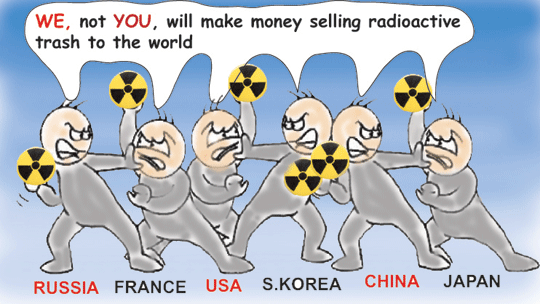
 U.S. Makes Shortlist for Saudi Nuclear-Plant Deal, One stumbling block: Negotiations over restrictions meant to prevent spread of weapons. WSJ By Timothy Puko, Sept. 26, 2018
The kingdom has been hearing offers from several countries, including Russia, South Korea and China, for what could be the biggest new market for nuclear power. Mr. Perry told reporters Wednesday the kingdom recently made a decision that keeps U.S. businesses— foremost Westinghouse… (subscribers only) https://www.wsj.com/articles/u-s-makes-shortlist-for-saudi-nuclear-plant-deal-1538006144
Theresa May: Iran continues to uphold commitment to nuclear pact
The Hill, BY BRETT SAMUELS – 09/23/18 British Prime Minister Theresa May said Iran is holding up its end of the nuclear pact that the U.S. withdrew from earlier this year.
“We believe that that should stay in place, and others involved in putting that deal together believe that it should stay in place,” May said in an interview aired Sunday on CBS’s “Face the Nation.”……..
Tensions between the U.S. and Iran have been heightened in the months since the Trump administration withdrew from the Obama-era Iran nuclear deal, which offered Tehran sanctions relief in exchange for abandoning its nuclear program. Trump had decried the pact as the “worst deal ever.”
The U.S. has since reimposed some of the sanctions lifted in the deal, potentially crippling the Iranian economy.
Other signatories of the 2015 agreement — including the United Kingdom, France, Germany, the European Union, Russia and Iran — have pledged to remain committed to the deal.
The U.S. has suggested countries that continue to do business with Iran, such as the United Kingdom, could face sanctions. https://thehill.com/homenews/sunday-talk-shows/407978-theresa-may-iran-continues-to-uphold-commitment-to-nuclear-pact
In spite of Donald Trump, Iran is keeping its nuclear commitments
 Iran is keeping its nuclear commitments — despite Trump, MEHR, President Rouhani 24 Sept 18:
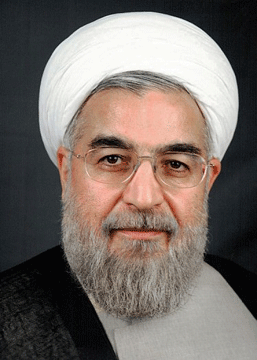
‘It has now become crystal clear that most countries in the world oppose US unilateralism and abhor being bullied. Even if in the short term we face difficulties in our economic relations, we, along with our partners, will try to resolve those problems, and these days will pass,’ Washington Post quoted Hassan Rouhani as saying on Friday.
The full text of Rouhani’s article that originally appeared in Washingtonpost.com is as follows:
I faced two options on May 8, when President Trump announced the United States’ official withdrawal from the nuclear agreement with Iran, officially known as the Joint Comprehensive Plan of Action (JCPOA). I could have reciprocated and announced Iran’s withdrawal, which was certain to throw the region into further insecurity and instability. Or I could have considered a short grace period for the remaining parties to compensate for the adverse effects of the United States’ decision on the valuable accord that had been achieved after 12 years of tough, intensive negotiations. In keeping with our tradition of respect for the rule of law and norms of international law, and to safeguard peace and security in the region, I opted for the latter………
Current US foreign policy toward Iran is out of step with the realities on the ground — in Iran, in the region and around the world. I would argue that it is not even in line with US national interests. Fed by disinformation and fake analysis from terrorist groups and Israel, the US administration is under the illusion that resorting to sanctions will lead to concessions from Iran. Iranians, though, are known to close ranks and put up stiff resistance in the face of external pressure. The United States, through its pervasive sanctions regime, failed to force Iranians to yield during the pre-JCPOA period. It was the United States that changed tack and opted for negotiations. ………
We are committed to talks and dialogue — that’s why we entered the negotiations on the nuclear issue in the first place, and ultimately arrived at a solid and mutually beneficial deal. The proof of good intentions on the part of all parties to the deal, particularly the United States, lies in the honest and full compliance with its provisions. It is on the record that during the negotiations on the nuclear dossier, our supreme leader said that the other side’s honesty would pave the way for further talks on issues of mutual interest. Washington’s insincere approach toward the implementation of the deal, from day one all the way through its ultimate illegal exit, is indicative of the lack of honesty in the implementation of its international obligations.
Modern history attests to the fact that Iran has not engaged in any external aggression during the past 250 years. It has, however, fiercely resisted foreign aggression and intervention. Peace is our arsenal, and we are committed to reciprocate each and every genuine and honest peaceful gesture and measure. On this we are resolute and steadfast.
This article was originally published by The Washington Post. http://en.mehrnews.com/news/137942/Iran-is-keeping-its-nuclear-commitments-despite-Trump
UN is being pressed by Iran and Israel – each wanting action against the other

 Iran and Israel call each other nuclear threats, ask U.N. to take action, Bozorgmehr Sharafedin, Dan WilliamsLONDON/JERUSALEM (Reuters) 21 Sept 18, – Iran asked the United Nations to condemn what it described as Israeli nuclear threats against it on Thursday, while Israel said it was stepping up security around its atomic sites as a precaution against threats from Tehran and its regional allies.
Israeli Prime Minister Benjamin Netanyahu used a visit to a secretive Israeli atomic reactor in August to warn the country’s enemies that it has the means to destroy them, in what appeared to be a reference to its assumed nuclear arsenal.
“The United Nations’ members should not turn a blind eye to these threats and must take firms actions to eliminate all Israeli nuclear weapons,” Iran’s ambassador to the United Nations, Gholamali Khoshrou said in letters to the U.N. secretary general and the security council, was quoted as saying by Fars news agency. Khoshrou asked the United Nations to force Israel to join the Nuclear Non-Proliferation Treaty (NPT) and bring its nuclear program under supervision of the International Atomic Energy Agency (IAEA), a U.N. atomic watchdog.
The director general of Israel’s Atomic Energy Commission said on Tuesday that Iran and Syria posed significant proliferation threats to the region and called for U.N. action at the 62nd General Conference of the International Atomic Energy Agency now taking place in Vienna.
………Israel, which is outside the NPT, neither confirms nor denies having a nuclear arsenal, a decades-old “ambiguity” policy. It is trying to lobby world powers to follow the United States in withdrawing from the 2015 deal with Iran that capped the Islamic Republic’s nuclear capabilities in return for lifting of sanctions. The Israelis say the agreement does not do enough to denying their arch-foe the means to eventually build a bomb. Tehran, which is a signatory to the 1970 nuclear Non-Proliferation Treaty (NPT), denies wanting to so…….. https://www.reuters.com/article/us-iran-nuclear-israel/iran-and-israel-call-each-other-nuclear-threats-ask-u-n-to-take-action-idUSKCN1M00ML
1
Iran Says Israel Must Be Forced to Join Nuclear Non-Proliferation Treaty (NPT)
Reacting to Nuclear Violation Claim, Iran Says Israel Must Be Forced to Join NPT, Sputnuk News, 21 Sept 18 Iran’s permanent representative to the International Atomic Energy Agency (IAEA) issued a biting response to his Israeli counterpart’s claim that Iran and Syria posed “significant proliferation threats” to the Middle East and the world.
Iranian IAEA Ambassador Kazem Gharibabadi urged the international community to pressure Israel to sign onto Nuclear Non-Proliferation Treaty (NPT), saying that doing so would be the only way to bring peace to the Middle East.
Speaking at the 62nd Annual Session of the ongoing IAEA General Conference in Vienna, Gharibabadi charged Israel with threatening its neighbors, pointed to its possession of nuclear weapons, and chastised the IAEA for giving in to Israeli pressure and not following up on what he said were the country’s “dangerous” nuclear activities.
According to the ambassador, little progress has been made on nuclear disarmament, one of the NPT’s major stated objectives, in the fifty years since the treaty was signed. Gharibabadi also pointed to the Middle East Nuclear Weapon Freeze Zone idea, a UN project dating back to 1970s aimed at prohibiting nuclear weapons in the region, and how this proposal too has suffered from a “lack of political will.”
Gharibabadi’s remarks came on the heels of comments at the conference by Israel Atomic Energy Commission chairman Ze’ev Snir, who also called on the international community to take action against alleged Iranian and Syrian nuclear activities……..
srael, which has a policy of neither admitting or denying the existence of a nuclear weapons program, is presently believed to be the only country in the Middle East to possess nuclear weapons, with estimates that it has anywhere between 80 and 400 warheads deliverable by a variety of air, sub and missile platforms.
Iran, an NPT signatory under observance by the IAEA over compliance with the Joint Comprehensive Plan of Action (JCPOA) nuclear deal, is barred from the creation of nuclear weapons. The fate of the 2015 deal, which was signed by the Iran, the United States, Russia, China, and several European countries, was put into question after Washington withdrew from the deal in May 2018 and vowed to impose unilateral sanctions against the Islamic Republic…….. https://sputniknews.com/middleeast/201809211068234829-iran-responds-to-israeli-nuclear-claims/
Trump keen to have Crown Prince Mohammad bin Salman of Saudi Arabia to speak at UN nuclear meeting
Trump mulls inviting Saudi Crown Prince Mohammad bin Salman to UN nuclear meeting, CBS News, By CBS NEWS September 20, 2018, In a show of President Trump’s staunch support of Saudi Arabia, his administration is mulling the possibility of having that nation’s young leader, Crown Prince Mohammad bin Salman, speak at the U.S.-hosted UN Security Council meeting next week, according to sources familiar with its planning.But now that the U.S. agenda has shifted away from a narrow focus on Iran, pulling off this diplomatic showcase will be hard to finagle.
Nikki Haley, the U.S. Ambassador to the UN, initially declared that Mr. Trump would host a UN Security Council meeting on “to address Iran’s violations of international law” and its actions to sow instability in the region. But that meeting has since changed to focus more broadly on counter-proliferation……
The Trump administration holds the reins on the agenda for the meeting because the U.S. is chairing the Council this month. …..
If Iran had remained the focus, the country would have been offered a seat, and a voice, at the table. But now they will not, as administration officials wanted to avoid a possible confrontation between Mr. Trump and his Iranian counterpart, Hassan Rouhani. Now they say Mr. Trump will have more breathing room and, in theory, avoid getting bashed on the world stage for exiting the Iran deal. ….
moving away from Iran as the meeting’s focus also makes it logistically more complicated to secure a role for Saudi Arabia, which is not a member of the Security Council……
As of now, Saudi Arabia has not been invited to partake in the discussion. When asked about the possibility of inviting another country to speak at the meeting, a Security Council diplomat explained that “in theory” it could happen, but was not certain it would. ….
But even after avoiding an embarrassing barrage of criticism for exiting the Iran deal, some experts say that putting Mr. Trump at the helm is still risky. … https://www.cbsnews.com/news/trump-mulls-inviting-saudi-crown-prince-mohammad-bin-salman-to-un-nuclear-meeting/
 |
ReplyForward
|
U.S. Navy Conducts Military Exercises in Gulf Amid Iran Tension
Bloomberg By Zainab Fattah, September 9, 2018,
Exercises to ensure free movement in Gulf, Red Sea chokepoints
- Iran said it’ll halt exports from Hormuz if it’s oil barred
The U.S. Navy is conducting exercises this month to ensure its readiness to guarantee freedom of movement through Persian Gulf and Red Sea waterways amid escalating threats from Iran to disrupt shipping across important choke points.
The exercises, with regional and global allies, are part of the U.S. 5th Fleet Theater Counter Mine and Maritime Security Exercise, Commander Scott A. Stearney told reporters from NAVCENT headquarters in Manama. One exercise is taking place in Djibouti, which sits on one side of the Bab Al Mandab strait, a crucial pinch point for global shipping at the south end of the Red Sea……. https://www.bloomberg.com/news/articles/2018-09-09/u-s-navy-conducts-military-exercises-in-gulf-amid-iran-tension
United Arab Emirates sets up new police department, in readiness for nuclear emergencies
The new unit will cooperate with local and federal departments to review emergency nuclear response plans, coordinate with local and foreign partners to conduct training and exercises to upgrade readiness for emergencies.
Abu Dhabi Police has established a new unit to respond to nuclear emergencies ahead of the launch of the UAE’s first nuclear power reactor.
Located at Ruwais Police Station of the Dhafra Police Directorate (Criminal Security Sector), the new unit’s terms of reference include preparation and review of response nuclear security plans, establishment of nuclear and radioactive risks registry and provision of material and human resources to run the unit, state news agency WAM reported…..https://www.utilities-me.com/news/11708-new-uae-police-unit-will-cater-to-nuclear-emergencies
Saudi Arabia’s plans to make Qatar a nuclear waste dump island
 Saudi Official Pushes Plans to Make Qatar an Island, Dump Nuclear Waste There,
 Sputnik News, 30 Sep 18 No man is an island – but the peninsular nation of Qatar just might become one, as it looks increasingly likely that Saudi Arabia will move ahead with plans to build a canal across the peninsula, cutting the nation off from the mainland.
Reports have steadily emerged since April that the Saudi government was considering a canal across the Qatari peninsula roughly half a mile from the border. A Friday tweet by a prominent government official seems to further signal that the plans could be legitimate and not simply a public relations stunt or attempt at intimidation.
As a citizen, I am impatiently waiting for the details of the implementation of the East Salwa island project. This great and historic project will change the region’s geography,” Saud al-Qahtani, a senior adviser to Saudi Crown Prince Mohammed bin Salman, tweeted on Friday, according to Reuters. The news agency noted that Qahtani has mentioned the canal several times on Twitter over the past few months.
And if that wasn’t petty enough, the half-mile gap between the canal and the Qatar border would be turned into a nuclear waste dump, Press TV reported Friday. The waste would come from the 16 nuclear reactors the monarchy plans to open in the next 25 years.
The South China Morning Post noted in April that the United Arab Emirates would be building a nuclear waste dump at the part of its country closest to Qatar, too.
The Salwa Marine Canal Project would be roughly 37 miles long, 650 feet wide and 65 feet deep and would service a military base and tourist resort in addition to the nuclear waste dump, exiting to the Persian Gulf at the Saudi cities of Salwa and Khor al-Adeed, Gulf News reported in June when the Saudi government closed construction applications by interested companies.
The proposed canal would cost roughly 2.8 billion Saudi riyals ($745 million)……..https://sputniknews.com/middleeast/201808311067651290-Saudi-Official-Pushes-Canal-Qatar-Island/
Russian official threatens use of nuclear weapons in Syria
Among such measures, the official said the deployment of Russian tactical nukes in countries such as Syria, the use of gold-linked cryptocurrencies for Russian arms exports and the suspension of a number of treaties with the US – such as non-proliferation of missile technologies.
Mr Gutenev said: “I believe that now Russia has to draw its own ‘red lines.’ “The time has come to ponder on variants of asymmetric response to the US, which are now being suggested by experts and are intended not only to offset their sanctions but also to do some retaliatory damage.
Among such measures, the official said the deployment of Russian tactical nukes in countries such as Syria, the use of gold-linked cryptocurrencies for Russian arms exports and the suspension of a number of treaties with the US – such as non-proliferation of missile technologies.
Mr Gutenev said: “I believe that now Russia has to draw its own ‘red lines.’
“It’s no secret that serious pressure is being put on Russia, and it will only get worse.
“It is intended to deal a blow to defence cooperation, including defence exports.”
The minister added that Russia should follow the advice of “experts” and follow the US’ example of deploying nuclear weapons in other countries.
He added: “We should follow the advice of certain experts, who say that Russia should possibly suspend the implementation of treaties on non-proliferation of missile technologies, and also follow the US example and start deploying our tactical nuclear weapons in foreign countries.
“It is possible that Syria, where we have a well-protected airbase, may become one of those countries.”……….https://www.express.co.uk/news/world/1008474/world-war-3-russia-nuclear-weapon-syria-us-sanctions
Russia -Iran negotiations on building new nuclear power plant
Iran resumes talks with Russia to build new nuclear power plant Reuters Staff (Reuters) 26 Aug 18 – Iran has resumed talks with Russia to build a new nuclear power plant capable of generating up to 3,000 megawatts of electricity, energy minister Reza Ardakanian said Saturday, according to the Tasnim news agency.
The Islamic Republic currently has the capacity to produce 1,000 megawatts of nuclear electricity, Tasnim reported.
Iran already runs one Russian-built nuclear reactor at Bushehr, its first. Russia signed a deal with Iran in 2014 to build up to eight more reactors in the country.
The United States in May pulled out of a deal between Tehran and major powers to limit Iran’s nuclear ambitions, and Washington imposed new sanctions on Tehran in August.
Reporting By Babak Dehghanpisheh in Geneva; Editing by Ros Russell
Britain is now contributing to upgrade of Iran’s Arak nuclear reactor
Middle East Monitor 23rd Aug 2018 , Iran announced on Wednesday that Britain would contribute in upgrading the
Arak nuclear reactor after the United States withdrew from the nuclear
deal. “Experts from Britain will replace their US counterparts during
reactor redesign process,” said Ali Akbar Salehi, head of Iran’s Atomic
Energy Organization.
Under the nuclear deal, experts from both the United
States and China were redesigning the Arak heavy water reactor to reduce
the amount of plutonium produced by the reactor as a by-product. In the
same vein, Iranian officials said that the choice of Britain as a partner
of China was not their call, according to media reports.
https://www.middleeastmonitor.com/20180823-tehran-britain-will-help-upgrade-arak-nuclear-reactor/
1 This Month
26 September – International Day for the Total Elimination of Nuclear Weapons





PLEASE OPPOSE HR 8255 AND S.3639 – bills would accelerate satellite deployment, with no environmental review or safeguards – https://ncstd5li.quorum.us/campaign/169331/
To see nuclear-related stories in greater depth and intensity – go to https://nuclearinformation.wordpress.com
-
Archives
- September 2026 (313)
- August 2026 (330)
- July 2026 (355)
- June 2026 (287)
- May 2026 (306)
- April 2026 (356)
- March 2026 (251)
- February 2026 (267)
- January 2026 (308)
- December 2025 (358)
- November 2025 (359)
- October 2025 (375)
-
Categories
- 1
- 1 NUCLEAR ISSUES
- business and costs
- climate change
- culture and arts
- ENERGY
- environment
- health
- history
- indigenous issues
- Legal
- marketing of nuclear
- media
- opposition to nuclear
- PERSONAL STORIES
- politics
- politics international
- Religion and ethics
- safety
- secrets,lies and civil liberties
- spinbuster
- technology
- Uranium
- wastes
- weapons and war
- Women
- 2 WORLD
- ACTION
- AFRICA
- Atrocities
- AUSTRALIA
- Christina's notes
- Christina's themes
- culture and arts
- Events
- Fuk 2022
- Fuk 2023
- Fukushima 2017
- Fukushima 2018
- fukushima 2019
- Fukushima 2020
- Fukushima 2021
- general
- global warming
- Humour (God we need it)
- Nuclear
- RARE EARTHS
- Reference
- resources – print
- Resources -audiovicual
- Weekly Newsletter
- World
- World Nuclear
- YouTube
-
RSS
Entries RSS
Comments RSS

