Donald Trump ready to reimpose all nuclear sanctions on Iran
 Trump set to reimpose all nuclear sanctions on Iran The Hill, BY REBECCA KHEEL – 11/02/18 The Trump administration plans to reimpose the last set of sanctions lifted under the Iran nuclear deal early next week, administration officials announced Friday.
Secretary of State Mike Pompeo confirmed in a call with reporters that the administration will grant waivers to eight “jurisdictions” when it reimposes oil and gas sanctions on Monday.
“This part of the campaign about which we’re speaking today is simple: It is aimed at depriving the regime of the revenues that it uses to spread death and destruction around the world,” Pompeo said.
“We expect to issue some temporary allotments to eight jurisdictions, but only because they have demonstrated significant reductions in crude oil and cooperation on many other fronts and have made important moves toward getting to zero crude oil importation.”
Pompeo did not specify which eight jurisdictions are getting waivers, saying a list would be released Monday. Asked if the use of the word “jurisdiction” meant that the European Union, a group of 28 countries, is getting waiver, Pompeo said the E.U. is not being granted a waiver.
In May, Trump announced that he was withdrawing the United States from what he once called the “worst deal ever negotiated.”…………
Friday’s announcement drew immediate condemnation from those who supported the nuclear deal.
“These sanctions are a slap in the face to the Iranian people who have been squeezed between the repression of their government and the pressure of international sanctions for decades,” Jamal Abdi, president of the National Iranian American Council, said in a statement. “Impoverishing ordinary Iranians will not hurt the regime or achieve any of America’s security interests, but it will set back the Iranian people’s aspirations for years to come.” https://thehill.com/policy/defense/414526-trump-set-to-reimpose-all-nuclear-sanctions-on-iran
End nuclear energy talks with Saudi Arbai – 5 Republican senators tell Trump

 Republican senators ask Trump to end nuclear energy talks with Saudi Arabia https://www.washingtonpost.com/powerpost/republican-senators-ask-trump-to-end-nuclear-energy-talks-with-saudi-arabia/2018/10/31/71fdbb60-dd20-11e8-b3f0-62607289efee_story.html?utm_term=.eb0c6524a937 By Karoun Demirjian October 31
Five Republican senators sent a letter to President Trump on Wednesday imploring him to end ongoing discussions with Saudi Arabia on nuclear energy cooperation in the wake of Washington Post contributor Jamal Khashoggi’s killing at the Saudi Consulate in Istanbul.
The senators also threatened in the letter to file legislation to block any civil nuclear agreements with Saudi Arabia if Trump will not agree to suspend negotiations “for the foreseeable future.”
“We already held serious reservations about negotiations for such an agreement,” Sens. Marco Rubio (R-Fla.), Todd C. Young (R-Ind.), Cory Gardner (R-Colo.), Rand Paul (R-Ky.) and Dean Heller (R-Nev.) wrote in the letter, first reported by NBC.
“The ongoing revelations about the murder of Saudi journalist Jamal Khashoggi, as well as certain Saudi actions related to Yemen and Lebanon, have raised further serious concerns about the transparency, accountability, and judgment of current decision-makers in Saudi Arabia.”
Congressional dissatisfaction with the U.S.-Saudi relationship was on a slow ascent before the prominent journalist’s disappearance earlier this month. But his apparent murder — which most lawmakers believe occurred at the behest of Saudi leaders, including Crown Prince Mohammed bin Salman — has precipitated unprecedented calls for consequences, from sanctions to an end to arms sales and military support for the Saudi kingdom in its controversial regional engagements, particularly in Yemen’s civil war.
Saudi officials have acknowledged that Khashoggi, a self-exiled critic of the Saudi government, was killed in the consulate, but deny that the action had their authorization.
[Turkish prosecutor says Khashoggi was strangled and dismembered in Saudi Consulate]
The senators’ letter indicates yet another layer of distrust in Saudi leaders: concern that the kingdom may try to adapt nuclear technologies acquired in a civil-use deal for weapon-making purposes.
Saudi Arabia has never agreed to terms that would prohibit it from turning a civil nuclear program dedicated for energy production into a tool to enrich uranium, reprocess plutonium and pursue other weapons-grade uses “that can bring a nation within weeks of producing a nuclear weapon,” they wrote, pointing out that the United Arab Emirates did accept such terms for a similar deal.
The senators suggested that it would be hypocritical and dangerous for the United States to accept anything less than a Saudi pledge to abide by terms of an Emirates-style deal — terms known as the “Gold Standard” — especially when the administration is demanding such behavior from Iran.
“Given your Administration’s ongoing efforts to press the Iranian regime — in the words of Secretary of State Mike Pompeo — to ‘stop enrichment and never pursue plutonium reprocessing,’ we have long believed that it is therefore critical and necessary for the Kingdom of Saudi Arabia to accept and uphold this ‘Gold Standard’ for responsible nuclear behavior,” the senators wrote.
America shouldn’t trust Saudi Arabia with nuclear technology
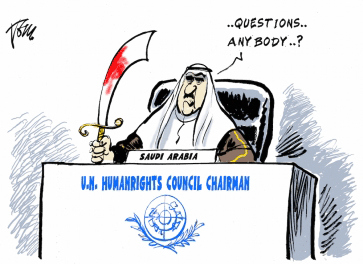 Khashoggi’s Killing Should Be a Nuclear Red Flag, The Khashoggi’s Killing Should Be a Nuclear Red Flag, The Saudis can’t be trusted to enrich uranium and reprocess spent fuel. WSJ, By Jamie Fly and Henry Sokolski,Oct. 28, 2018 If the Saudi government’s prevarications about Jamal Khashoggi’s murder teach us anything, it should be that there are limits to how far the U.S. can trust Riyadh. In particular, America shouldn’t trust Saudi Arabia with nuclear technology………. Saudis can’t be trusted to enrich uranium and reprocess spent fuel. WSJ, By Jamie Fly and Henry Sokolski,Oct. 28, 2018 If the Saudi government’s prevarications about Jamal Khashoggi’s murder teach us anything, it should be that there are limits to how far the U.S. can trust Riyadh. In particular, America shouldn’t trust Saudi Arabia with nuclear technology……….
the risk of regime change if there is nuclear power in Saudi Arabia. Nuclear reactors operate for 40 years or more and are far more dangerous than any conventional arms sales. In the 1970s, the U.S. considered selling the shah of Iran 23 reactors. That would have been a colossal mistake. Saudi officials, including Crown Prince Mohammed bin Salman, have publicly threatened to violate the Kingdom’s Nuclear Nonproliferation Treaty commitment not to acquire nuclear weapons if they believe Iran is acquiring them. The U.S. has never negotiated a nuclear cooperation agreement with a country threatening to get nuclear weapons. The United Arab Emirates, a Saudi neighbor and ally, agreed to allow intrusive international nuclear inspections and to forgo enriching uranium and reprocessing spent fuel as part of its 2009 nuclear cooperation agreement with Washington. Riyadh has refused to make such pledges. Enriching and reprocessing could bring Riyadh within weeks of making bombs. It is unclear if the administration is intent on pressing the Saudis on this point…….. After Saudi Arabia’s kidnapping last year of Lebanese Prime Minister Saad Hariri, its bungling of the war in Yemen, its erratic diplomatic moves against Canada, its continued jailing of human-rights activists, and now the killing of Khashoggi, Washington must demand more. This regime can’t be trusted with nuclear technology. Concluding a nuclear cooperation agreement to Riyadh’s liking would undermine the Trump administration’s effort to reverse the nuclear concessions President Obama made to Iran and set a dangerous precedent in the region. Any negotiations regarding a U.S.-Saudi nuclear cooperation agreement should be halted. If the Trump administration refuses to do this, Congress should make clear, as part of its broader response to the Khashoggi killing, that any agreement submitted for review will be blocked. This episode should serve as a reminder that unreliable proxies are no substitute for American leadership. A Reaganesque approach to Iran requires the fortitude to stand up for what is right, be it on nonproliferation or human rights, whether it involves friend or foe. Mr. Fly is a senior fellow of the German Marshall Fund of the United States. Mr. Sokolski is executive director of the Nonproliferation Policy Education Center and author of “Underestimated: Our Not So Peaceful Nuclear Future.” https://www.wsj.com/articles/khashoggis-killing-should-be-a-nuclear-red-flag-1540753005
|
Egypt’s renewable energy project – going for the green economy

Image processed by CodeCarvings Piczard ### FREE Community Edition ### on 2017-10-20 17:00:50Z | http://piczard.com | http://codecarvings.com
largest solar power plant in the world early this year, RT reported on Friday. Reporting the remarks of Egyptian official Hassan Abaza, RT said that the superpower plant was built in the city of Aswan, southern Egypt.
economy” is a mechanism to achieve sustainable development. https://www.middleeastmonitor.com/20181027-egypt-builds-largest-solar-power-plant-in-the-world/
Nuclear power lobbyists for Saudi Arabia finding it (a bit) tough following Jamal Khashoggi ‘s murder
 Saudi’s Lobbyists Feel Heat of Khashoggi Murder, Bloomberg By Kathleen Hunter, October 26, 2018 It’s not just Donald Trump who has cultivated a cozy relationship with Riyadh. Saudi Arabia has been a cash cow for Washington’s influence industry.
Over the past decade, D.C.’s lobbyists have raked in $76.9 million advocating for the Saudis on everything from nuclear power to fending off legislation that would leave the kingdom liable in lawsuits filed by family members of victims in the Sept. 11 terrorist attacks, Ben Brody, Naomi Nix and Bill Allison report.
That lucrative business is now facing its biggest test in years as the killing of U.S.-based journalist Jamal Khashoggi inside the Saudi consulate in Istanbul draws worldwide criticism. ….https://www.bloomberg.com/news/articles/2018-10-26/saudi-lobbyists-feel-heat-of-khashoggi-murder-balance-of-power?
Turkish President Recep Tayyip Erdogan to reveal evidence of Khashoggi murder “in all its nakedness.”
 World Awaits ‘Naked’ Truth on Saudi Killing https://www.bloomberg.com/news/articles/2018-10-22/world-awaits-naked-truth-on-saudi-killing, By Glen Carey, October 22, 2018, If Saudi leaders expected a reprieve from their account of how journalist and critic Jamal Khashoggi was killed in their Istanbul consulate, they’re likely to be sorely disappointed.
While President Donald Trump, a steadfast Saudi ally, defended de facto ruler Crown Prince Mohammed bin Salman, he said the explanation had been marked by “deception and lies.’’ Bipartisan members of the U.S. Congress said it lacked credibility. France demanded more information, while Germany suspended arms sales.
Even Saudi Foreign Minister Adel al-Jubeir called Riyadh’s attempt to cover up the murder “a tremendous mistake,” though he stuck to the government’s line that Khashoggi, a Washington Post columnist, died after “discussions” turned violent.
Western leaders are balancing concerns about his death with their strategic interests. Treasury Secretary Steven Mnuchin said the U.S. will continue its relationship with the world’s largest oil supplier, a major weapons buyer, while trying to “get to the bottom of what the facts are.”
Now the focus shifts to Turkish President Recep Tayyip Erdogan, who’s promised to reveal tomorrow what happened to Khashoggi “in all its nakedness.” If he provides credible evidence that differs from the kingdom’s description, pressure to hold Saudi Arabia’s senior leadership accountable will intensify.
Jobs Are No Excuse for Arming a Murderous Regime
 Portside, October 16, 2018 LOBE LOG Regardless of what ultimately happened to Khashoggi, continuing U.S. arms sales and military support to Saudi Arabia under current circumstances is immoral. Jobs should not be an excuse to arm a murderous regime. If indeed the Saudi government is indeed behind the murder of journalist Jamal Khashoggi there should be consequences—political, military, economic, and reputational.
Unfortunately, President Trump begs to differ. His reaction to questions about whether the United States would cut off arms sales to Saudi Arabia if Riyadh is proven to be behind the killing of Khashoggi has been to say that he does not want to jeopardize the alleged $110 billion in arms deals his administration has struck with the Saudi regime, and the U.S. jobs that come with them.
In his recent interview with CBS 60 Minutes, Trump specifically cites the needs of U.S. weapons manufacturers as reasons to keep U.S. arms flowing to the Saudi regime, even if it ends up being responsible for the murder of Khashoggi:
They are ordering military equipment. Everybody in the world wanted that order. Russia wanted it, China wanted it, we wanted it…I tell you what I don’t wanna do. Boeing, Lockheed, Raytheon, all these [companies]…I don’t wanna hurt jobs. I don’t wanna lose an order like that.
Trump tells CBS’s Leslie Stahl that “there are other ways of punishing” Saudi Arabia without cutting of U.S. arms sales, but he fails to specify what those might be.
Regardless of what ultimately happened to Khashoggi, continuing U.S. arms sales and military support to Saudi Arabia under current circumstances is immoral. Jobs should not be an excuse to arm a murderous regime that not only may be behind the assassination of a U.S. resident and respected commentator but is responsible for thousands of civilian casualties in its three-and-one-half-year military intervention in Yemen—the majority killed with U.S-supplied bombs and combat aircraft and U.S. refueling and targeting assistance.
The Khashoggi case merely underscores the approach of Saudi Crown Prince Mohammed bin Salman, the power behind the throne in Riyadh who is the most ruthless and reckless leader in Saudi history……https://portside.org/2018-10-16/jobs-are-no-excuse-arming-murderous-regime,
Trump’s financial benefit from Saudi Arabia – shaping USA’s foreign policy
Saudi Arabia is putting money in Trump’s pocket. Is that shaping U.S. policy? https://www.washingtonpost.com/blogs/plum-line/wp/2018/10/16/saudi-arabia-is-putting-money-in-trumps-pocket-is-that-shaping-u-s-policy/?noredirect=on&utm_term=.434cc7237930, By Paul Waldman,October 16
As hard as it is to resist writing about the fact that on Tuesday the president of the United States called the adult film actress to whom he paid hush money “Horseface,” I want to focus on a different aspect of this presidency that we’re seeing play out right now.
.As the apparent murder of Saudi journalist and Post contributor Jamal Khashoggi complicates our relations with Saudi Arabia, we have to ask what the implications are of having a fully transactional presidency, one not just built on “deals” but where policy is determined by what is financially beneficial to the president.
We should begin by reminding ourselves that as awful as Khashoggi’s apparent murder is, it’s only the latest in a long list of Saudi abuses that administrations both Democratic and Republican have chosen to overlook for decades. The country is a cruel dictatorship that embodies none of the values we as a nation hold dear, such as democracy, freedom of expression, freedom of the press and freedom of religion. But we decided long ago that since the Saudis have a great deal of oil and they provide us with a strategic ally in the Middle East, we’ll overlook all that.
There is something unsettling about the fact that Saudi intervention in Yemen’s civil war, in which they have reportedly killed thousands of civilians, has received steady U.S. support, while the murder of a single journalist threatens to upend the relationship between the two countries.
Or so you might think. But here’s the reality: This will blow over, not only because of the complex relationship between the two countries, but also because everything in foreign policy is personal with President Trump, and he likes the Saudis.
And why does he like them so much? Because they pay him.
This is not something Trump has been shy about saying. “Saudi Arabia, I get along with all of them. They buy apartments from me. They spend $40 million, $50 million,” he said at a rally in Alabama in 2015. “Am I supposed to dislike them? I like them very much.”
Trump says so many shocking things that it’s sometimes easy to slide right past the most appalling ones, but read that again. Here you have a candidate for president of the United States saying that he is favorably disposed toward a foreign country because they have given him millions of dollars, and all but promising to shape American foreign policy in their favor for that very reason.
“Am I supposed to dislike them?” he asks. How could I possibly dislike them when they pay me?
We should note that it’s more than just apartments. Trump has sold many properties to Saudis, and Saudis have invested in Trump projects. And as David Fahrenthold and Jonathan O’Connell report:
Business from Saudi-connected customers continued to be important after Trump won the presidency. Saudi lobbyists spent $270,000 last year to reserve rooms at Trump’s hotel in Washington. Just this year, Trump’s hotels in New York and Chicago reported significant upticks in bookings from Saudi visitors.
This is precisely the reason the framers of the Constitution added a provision saying that neither the president nor other officials could “accept of any present, Emolument, Office, or Title, of any kind whatever, from any King, Prince, or foreign State.” If a foreign country is putting money in the president’s pocket on an ongoing basis, how in the world can we trust that the decisions he makes will be based on the best interests of the United States and not on his bank account?
This is of more concern with Trump than with any other president in American history. His entire life has been devoted to the accumulation of wealth, as though there were no other goal anyone should consider seeking (“My whole life I’ve been greedy, greedy, greedy. I’ve grabbed all the money I could get. I’m so greedy,” he has said). He made sure that upon assuming office his businesses would continue to operate and continue to provide avenues for those wishing to further enrich him to do so. And he refuses to release his tax returns, so we have no idea exactly how much money he’s getting and from whom.
But Tuesday, Trump tweeted this:
For the record, I have no financial interests in Saudi Arabia (or Russia, for that matter). Any suggestion that I have is just more FAKE NEWS (of which there is plenty)!
This is the same claim Trump has made with regard to Russia, and it’s the same dodge. The point isn’t whether Trump has interests in Saudi Arabia, it’s whether Saudi Arabia has interests in him. And just as is the case with Russia, they do.
If you’re the Saudis, the nice thing about Trump is that he lacks any subtlety whatsoever, so you don’t have to wonder how to approach him. He has said explicitly that the way to win his favor is to give him money. He has established means for you to do so — buying Trump properties and staying in Trump hotels. And with his combination of narcissism and insecurity, if you invite him to your country and give him a gold medal, he’ll forever be your friend.
Every president has to balance the desire to honor U.S. values with more crass interests such as whether a country will buy weapons from us, which Trump also cited as a reason we shouldn’t punish Saudi Arabia for Jamal Khashoggi’s murder (even though they aren’t actually buying what Trump claims). But only Trump apparently gets direct and significant payoffs from other countries, and only Trump is so clear that if you pay him he’ll do what you want. That may not have changed the American stance toward Saudi Arabia too much yet, but we have no idea what’s to come.
Trump and Kushner – naive, ill-informed and craven as they obsess over Saudi money
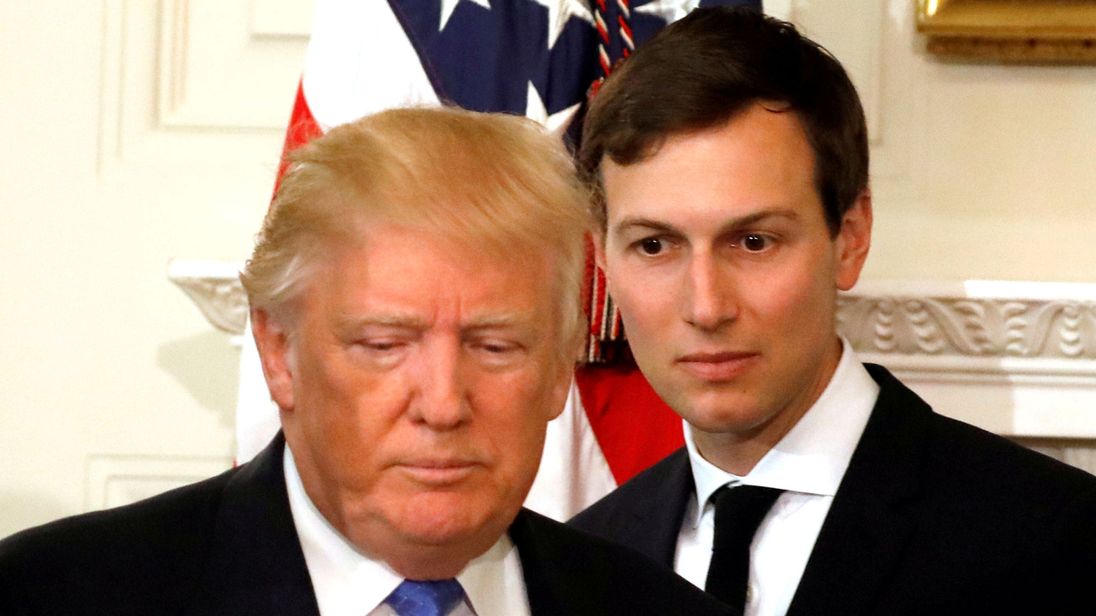 Trump and Kushner Put Saudi’s Money First https://www.bloomberg.com/view/articles/2018-10-17/trump-and-kushner-put-saudi-arabia-s-money-ahead-of-khashoggi
Jamal Khashoggi’s death has exposed the White House and two of its most powerful figures as naive, ill-informed and craven. What comes next?, By Timothy L. O’Brien, October 17, 2018, The Trump team is standing by Saudi Arabia and Crown Prince Mohammed bin Salman as the investigation and controversy surrounding the disappearance of journalist Jamal Khashoggi deepens.
On Tuesday, Secretary of State Mike Pompeo visited Riyadh for a photo op with the prince. In a press release, he praised the Saudi leadership for “supporting a thorough, transparent and timely” investigation into the Khashoggi affair, a full two weeks after the dissident first went missing.
Pompeo also said that Saudi leaders denied any involvement in Khashoggi’s disappearance, something his boss, President Donald Trump, let the world know on Twitter as well.
By Tuesday evening, that line became more complex to defend after the New York Times reported that at least four suspects in Khashoggi’s disappearance had ties to the crown prince. A fifth was “of such stature that he could be directed only by a high-ranking Saudi authority,” the newspaper said.
Complexity has never deterred the president, however. In an interview with the Associated Press on Tuesday, he blamed critics of Saudi Arabia for holding it “guilty until proven innocent.” Lest anyone doubt his motives, Trump took to Twitter to talk about his finances:
“For the record, I have no financial interests in Saudi Arabia (or Russia, for that matter). Any suggestion that I have is just more FAKE NEWS (of which there is plenty)!”
That statement would be easier to digest if Trump hadn’t bragged publicly in the past about how much Saudis have spent buying his condominiums – and if he wasn’t the steward of the most financially conflicted presidency of the post World War II era.
Trump is playing word games, of course. He says he has no investments in Saudi Arabia or Russia. But that doesn’t mean money from those countries hasn’t flowed into his coffers. In Saudi Arabia’s case, that has meant very different things over the years.
In the early 1990s, Saudi billionaire Prince Alwaleed bin Talal bought Trump’s prized yacht on the cheap from the property developer’s creditors when he was on the cusp of personal bankruptcy. A few years later, one of Trump’s lenders forced him to sell the Plaza Hotel, a New York City landmark also mired in debt, to Alwaleed. As David Fahrenthold and Jonathan O’Connell noted in the Washington Post recently, this was a period when Trump was trying to dig himself out of $3.4 billion of debt, about $900 million of which he had guaranteed personally. But Alwaleed was a bargain-hunter at the time, not someone trying to ensnare a failed developer on the unlikely chance that he might someday become president.
Still, Alwaleed, who once described Trump on Twitter as a “disgrace not only to the GOP but to all America,” kept those early deals in mind. When Trump made fun of him on Twitter two years ago, Alwaleed responded by tweeting, “I bailed you out twice; a 3rd time, maybe?”
As Trump climbed out of his debt hole in the late 1990s and early 2000s, he courted Saudi condo buyers. The Saudi Arabian government bought the entire 45th floor of the Trump World Tower in 2001, and, before running for president, Trump was apparently contemplating doing business in Saudi Arabia – he incorporated eight limited-liability companies with names suggesting he planned to do business there (they were later dissolved).
After becoming president, Trump flouted tradition by declining to authentically separate himself from the Trump Organization and its hotel and golf properties. The Trump International Hotel in Washington has been a favorite venue for Saudi diplomats who have spent lavishly there, as well as at other Trump hotels.
The president and his son-in-law, Jared Kushner, also decided to make Saudi Arabia a linchpin of their policy in the Middle East. Kushner, lacking full security clearance and any diplomatic experience, lobbied the crown prince directly in early 2017 to secure what was fancifully and inaccurately touted as a $110 billion arms sale – most of which had been agreed a year earlier, and the bulk of which still hasn’t been completed.
Shortly after that transaction was arranged, Trump visited Saudi Arabia. And soon after that, the Saudis announced they would invest $20 billion in an infrastructure fund managed by Blackstone Group LP. The New York-based firm had financed several of the Kushner family’s deals and its chairman, Stephen Schwarzman, sat on the president’s business-advisory council. The private equity firm told Bloomberg News that the Saudi investment had been contemplated long before Trump was even the Republican nominee.
Kushner’s forays alarmed members of the intelligence and national security communities, as Bob Woodward outlined in his book, “Fear.” At the very moment Kushner was throwing himself into these diplomatic adventures, he was coming under scrutiny for his own financial conflicts – in particular, his efforts to secure funding for 666 Fifth Avenue, a troubled Manhattan skyscraper his family owned.
Although the family has since sold off the property, Kushner had tried unsuccessfully to secure funding for it from a Chinese investor. His intersection with a prominent banker and diplomats from Moscow during the Trump campaign’s transition into the White House raised questions about whether he was courting Russian investors (which he denied). Inevitably, the Kushner family also courted a prominent Saudi investor to bail them out of 666 Fifth, as detailed by my Bloomberg News colleagues David Kocieniewski and Caleb Melby.
Late last year, Kushner made another secretive trip alone to Riyadh. He later described the visit as an effort to “brainstorm” Middle East strategies with Mohammed bin Salman. Not long afterward, the crown prince placed dozens of prominent businessmen and political rivals under house arrest in what was described as an anti-corruption drive. Among them was Alwaleed, the man who once snatched the Plaza Hotel and yacht from Kushner’s father-in-law.
Earlier this year, leaked intelligence reports revealed that diplomats in Mexico, Israel, China and the United Arab Emirates had decided to target Kushner because they believed he could be easily manipulated due to “his complex business arrangements, financial difficulties and lack of foreign policy experience.”
For his part, Kushner just plowed ahead, continuing to rest the White House’s plans for the Middle East on the shoulders of an equally young and untested man, Saudi Arabia’s crown prince. The disappearance of a single journalist, a one-time ally of the royal family turned critic, may ultimately cause Kushner’s plans to unravel – and expose his machinations in Saudi Arabia to more revealing and unwanted scrutiny.
If it doesn’t, it may well be because the president – putting the lie to his dissembling about his family’s financial ties to Saudi Arabia – will openly and stubbornly put money ahead of the moral and diplomatic issues at play in Khashoggi’s disappearance.
As he told Fox News in an interview on Tuesday night: “I don’t want to give up a $100 billion order or whatever it is.”
U.S. Military Leaders silent on Saudin Arabia political situation
US Military Leaders Keep Quiet on Saudi Arabia Amid Khashoggi Outrage, Defense One 16 Oct 18 Defense Secretary Jim Mattis and Joint Chiefs Chairman Gen. Joseph Dunford this week have declined to say much on Saudi Arabia. Both leaders, in previously scheduled meetings with reporters, were asked about the kingdom and what effect the killing of Khashoggi may have on U.S.-Saudi relations. Both men deferred to Secretary of State Mike Pompeo and said they were waiting for him to return to the U.S. with more “facts.” And they both implied that any related changes to Trump administration foreign policy would be given to them, not made by them. …….
Speaking to reporters traveling with him in Brussels, Pompeo said: “I do think it’s important that everyone keep in their mind that we have lots of important relationships – financial relationships between U.S. and Saudi companies, governmental relationships, things we work on together all across the world – efforts to reduce the risk to the United States of America from the world’s largest state sponsor of terror, Iran. The Saudis have been great partners in working alongside us on those issues. I could go on about places where the Saudis and the Americans are working together. Those are important elements of the U.S. national policy that are for – are in Americans’ best interests. We just need to make sure that we are mindful of that as we approach decisions that the United States Government will take when we learn all of the facts associated with whatever may have taken place.”
Is the Saudi partnership still a matter of necessity? Should it be? That’s not likely the question Mattis and Dunford are asking for the near term. For them, the answer is yes. But for the long term, it’s a question for them, Pompeo,and Trump. It’s a question of whether “Saudi interests” under bin Salman still align with American interests, or just with American military and intelligence interests.
Trump’s ever riskier bet on Saudi Arabia
|
Analysis: Trump’s Saudi bet has become much riskier, By MATTHEW LEE, 17 Oct, WASHINGTON (AP) — President Donald Trump put a big and risky bet on Saudi Arabia and its 33-year-old crown prince. It’s now become much riskier.
From the early days of his presidency, Trump and his foreign policy team embraced the kingdom and Mohammed bin Salman as the anchors of their entire Middle East strategy. From Iran and Iraq to Syria, Yemen and the Israeli-Palestinian conflict, the administration gambled that Saudi Arabia, effectively run by the prince, could credibly lead, and willingly pay for, a “Pax Arabica” in a part of the world from which Trump is keen to disengage. For nearly two years, through an ongoing crisis with Qatar and international outrage over civilian casualties in the Saudi-led campaign against Yemeni rebels, the prince has managed to keep Washington’s confidence. But now, the tide is turning amid growing outrage over the disappearance and likely death of a U.S.-based journalist inside a Saudi Consulate in Turkey, and that confidence appears to be waning. The Trump administration’s grand strategy may be upended with far-reaching ramifications that extend well outside the region. Even if an investigation into what happened to Washington Post contributor Jamal Khashoggi in Istanbul exonerates the prince and the top Saudi leadership, the administration’s deep reliance on him will be severely tested not least because of broad bipartisan revulsion in Congress to as-yet unconfirmed accounts of Khashoggi’s fate. Already, prominent lawmakers from both parties are questioning his fitness to lead the country and suggesting it might be time to re-think U.S.-Saudi relations and sharply curb arms sales. Trump ally Sen. Lindsey Graham, R-S.C., and other influential politicians warned of dire consequences on Tuesday, saying the prince, often known as MBS for short, should be removed from his post………. The impact of a U.S.-Saudi rift, however remote the possibility, could send shockwaves around the world, destabilizing oil markets and the global investment climate, not to mention dealing a blow to the Trump administration’s own plans in the Middle East. Trump’s son-in-law and senior adviser Jared Kushner has made Saudi Arabia a centerpiece of his yet to be revealed Israeli-Palestinian peace plan, which is expected to call for massive Saudi and Gulf Arab contributions to fund reconstruction and development projects in the West Bank and Gaza. Saudi support will also be key to the political elements of the plan that Israel insists put its security on par with Palestinian statehood. That means that Israel will likely seek assurances that any deal with the Palestinians be followed by a broader agreement that normalizes its relations with the rest of the Arab world, particularly Saudi Arabia. In Syria, the administration relied almost entirely on Saudi Arabia, along with the closely allied United Arab Emirates, to make up for steep cuts in U.S. stabilization assistance to areas liberated from Islamic militants. Next door in Iraq, the current secretary of state, Mike Pompeo, and his predecessor, Rex Tillerson, have leaned heavily on the Saudis to make large financial pledges for reconstruction of war-shattered communities. But it is the administration’s policy of isolating Iran that may suffer the most from Saudi-U.S. estrangement. Trump is counting on the Saudis to shore up and complement its Iran policy on several fronts………https://www.apnews.com/5f0516d3358b4acab27ca4ec56dd711e |
The very bad decisions of Saudi Crown Prince Mohammed bin Salman
Trump Enables a Saudi Lie The case of Jamal Khashoggi is part of a larger and more disturbing pattern. Bloomberg, By Eli Lake October 17, 2018, The Saudi narrative about the disappearance and likely murder of Jamal Khashoggi is shifting. Last week it was a blanket denial. Now there are hints of the O.J. Simpson defense: Crown Prince Mohammed bin Salman is determined to find the real killers. He’s launched an investigation. Perhaps, as President Donald Trump said, this is the work of “rogue killers.”
Needless to say, this smells like the prelude to a big lie.
In the words of Senator Lindsey Graham, who has defended the U.S.-Saudi relationship for years: “Nothing happens in Saudi Arabia without MBS knowing it.” MBS, as the crown prince is known, was assuring Secretary of State Mike Pompeo that he would investigate even as his government was sending a cleaning crew to its consulate in Istanbul, which Turkish authorities say is a crime scene………
The stakes are high in the Middle East. Saudi Arabia is an important ally against Iran, and the Trump administration is planning next month to implement sanctions on Iranian oil exports. Embarrassing the crown prince now could upend that strategy and undermine the U.S.-Saudi alliance. So it’s tempting to encourage the Saudis to find a scapegoat and go along with the cover story……….
It won’t work, though. Not only is the rogue killer theory implausible, it fails to address a far more serious impediment to the U.S.-Saudi relationship: the crown prince himself. There is “a whole litany of things where he appears to have taken very bad decisions,” notes Simon Henderson, a Saudi specialist at the Washington Institute for Near East Policy. In the last year, Crown Prince Mohammed has had the Canadian ambassador expelled over criticism of the arrest of women’s rights activists. He had the Lebanese prime minister detained and forced him to resign his post.
These are not the decisions of a steady-handed leader. Before Crown Prince Mohammed consolidated power and purged his rivals, there were restraints against his impulses. No longer. For all intents and purposes, MBS is now the Saudi state. And that is a problem a convenient story about rogue killers will not fix. https://www.bloomberg.com/view/articles/2018-10-17/jamal-khashoggi-disappearance-trump-enables-a-saudi-lie
Council of Europe concerned at construction of the Akkuyu nuclear power plant in an earthquake-prone region

 Council of Europe requests Turkey to consult neighbours for Akkuyu nuclear plant https://ahvalnews.com/council-europe/council-europe-requests-turkey-consult-neighbours-akkuyu-nuclear-plant
The Parliamentary Assembly of the Council of Europe (PACE) expressed on Thursday deep concern at the construction of the Akkuyu nuclear power plant in an earthquake-prone region of Turkey only 85 kilometres from the border with Cyprus.
In a resolution it adopted, the assembly said that Turkey’s first nuclear plant being constructed as a joint Turkish-Russian project is in very close proximity to the other neighbouring countries.
The assembly asked Turkey to join the UN Convention on Environmental Impact Assessment in a Transboundary Context, also known as the Espoo Convention, and to take into account all concerns expressed, including those expressed by Turkish citizens.
The Espoo Convention , adopted in 1991, sets out the obligations of parties to assess the environmental impact of certain activities at an early stage of planning. It also lays down the general obligation of states to notify and consult each other on all major projects under consideration that are likely to have a significant adverse environmental impact across boundaries
The assembly also requested from the Turkish government to consult with neighbouring countries on the construction of the nuclear plant according to the International Convention on Nuclear Safety.
The construction of the Akkuyu nuclear plant located in the southern province of Mersin was kicked off by President Recep Tayyip Erdoğan and his Russian counterpart Vladimir Putin on Apr. 3.
The nuclear plant “raises concerns for a possible impact in terms of safety because such a power plant in this area affects our country much more than the largest part of the Turkish territory,” said the Cypriot government’s spokesman Prodromos Prodromou, following the groundbreaking ceremony in Mersin.
“Turkey did not take into account the grave reservations expressed by various quarters, nor did it heed the European Parliament’s call to terminate the construction plans since this is a seismologically vulnerable area,” he said.
Environmentalists in Turkey are also concerned about the potentially destructive ecological consequences of the Akkuyu nuclear power plant and several organisations form Mersin filed a lawsuit to stop its construction
Donald Trump’s priority is profit from weapons sales to Saudi Arabia: murder of Washington Post journalist is irrelevant
|
America deserves to know how much money Trump is getting from the Saudi government, His corruption is a national security issue. VOX, By A foreign government — an American ally, no less — can’t just murder a US resident with impunity while he’s on the soil of a NATO member state because they didn’t like his newspaper columns.
And yet that seems to be exactly what President Donald Trump wants to let Saudi officials do, explaining to reporters on Thursday that he does not want to respond to the murder of Washington Post columnist Jamal Khashoggi because “I don’t like stopping massive amounts of money coming into our country” and “I don’t like stopping an investment of $110 billion in the United States.”………. Why is Trump so willing to let the Saudis slide? Is Trump getting paid by Saudi Crown Prince Mohammed bin Salman, a.k.a. MBS, and the Saudis? Is his son-in-law, Jared Kushner? Normally, these would be absurd questions to raise about a president. But they are serious. Trump has commented before on his business ties to Saudi Arabia, bragging at a campaign rally in Alabama about how much business he did with Saudi interests. And he’s never fully aired the extent of his vast business and financial ties. Now, as the White House is preparing to make policy (or not) in a crucial moment, how can the public have any confidence that the president isn’t just looking out for his own interests and not the country’s?………..https://www.vox.com/policy-and-politics/2018/10/12/17964884/trump-saudi-money-khashoggi |
|
Trump administration’s unreasonable tolerance for Saudi Arabia’s war crimes in Yemen
|
In Yemen, Trump Is Taking Tolerance for War Crimes to a New Level, Truthout, BY Khury Petersen-Smith
Truthout, October 11, 2018 Twenty days after Saudi Arabia and the United Arab Emirates (UAE) bombed a school bus full of children in Yemen this August, Defense Secretary James N. Mattis hosted officials from the two US allies at the Pentagon. They were all gathered as part of a meeting of representatives from the Gulf Cooperation Council, at which Mattis thanked them for their “regional leadership and years of close cooperation with the United States.”…….. In this war, the Saudi and Emirati militaries are dropping the bombs, and the United States plays a critical role in every step of the operations. The coalition’s munitions are made in the US, as are the planes dropping them — all of which were sold to Saudi Arabia and the UAE in deals brokered by the US government. ……..
It is remarkable that — despite the international spotlight on the war in Yemen resulting from the highly publicized school bus bombing — Trump administration officials continue to embrace Saudi Arabia, the United Arab Emirates, and their operations. The killing of dozens of children and wounding of dozens more in the bombing was not itself an aberration from the daily operations of the war — which have involved the coalition targeting weddings, funerals and markets with alarming regularity. What stood out about the attack however, was the level of attention that it received in the US. Both The Washington Post and The New York Times editorialized against US involvement in the war. In a move that may be unprecedented, CNN not only covered the atrocity extensively, but also reported on the US weapons manufacturers who made the bombs for that and other attacks. …….. The United States has long flouted international law. But Trump is taking its defiance of any notions of accountability whatsoever, and its tolerance for blatant war crimes, to a new level. It is openly assisting those crimes in Yemen. After all, the US is enthusiastically supplying weapons to countries that demonstrate a clear pattern of targeting civilians. The coalition has also committed the crime of targeting medical facilities and civilian infrastructure, and has only received affirmation, weapons and other support from the United States. ……..https://truthout.org/articles/in-yemen-trump-is-taking-tolerance-for-war-crimes-to-a-new-level/
|
|
|
1 This Month
26 September – International Day for the Total Elimination of Nuclear Weapons





PLEASE OPPOSE HR 8255 AND S.3639 – bills would accelerate satellite deployment, with no environmental review or safeguards – https://ncstd5li.quorum.us/campaign/169331/
To see nuclear-related stories in greater depth and intensity – go to https://nuclearinformation.wordpress.com
-
Archives
- September 2026 (313)
- August 2026 (330)
- July 2026 (355)
- June 2026 (287)
- May 2026 (306)
- April 2026 (356)
- March 2026 (251)
- February 2026 (267)
- January 2026 (308)
- December 2025 (358)
- November 2025 (359)
- October 2025 (375)
-
Categories
- 1
- 1 NUCLEAR ISSUES
- business and costs
- climate change
- culture and arts
- ENERGY
- environment
- health
- history
- indigenous issues
- Legal
- marketing of nuclear
- media
- opposition to nuclear
- PERSONAL STORIES
- politics
- politics international
- Religion and ethics
- safety
- secrets,lies and civil liberties
- spinbuster
- technology
- Uranium
- wastes
- weapons and war
- Women
- 2 WORLD
- ACTION
- AFRICA
- Atrocities
- AUSTRALIA
- Christina's notes
- Christina's themes
- culture and arts
- Events
- Fuk 2022
- Fuk 2023
- Fukushima 2017
- Fukushima 2018
- fukushima 2019
- Fukushima 2020
- Fukushima 2021
- general
- global warming
- Humour (God we need it)
- Nuclear
- RARE EARTHS
- Reference
- resources – print
- Resources -audiovicual
- Weekly Newsletter
- World
- World Nuclear
- YouTube
-
RSS
Entries RSS
Comments RSS

