Iran categorically opposes nuclear weapons – Foreign Minister Mohammad Javad Zarif
Zarif: Iran categorically opposes nuclear arms, Islamic Republic News Agency Tehran, Oct 12, IRNA – Iranian Foreign Minister Mohammad Javad Zarif in a message referred to Iranian Supreme Leader Ayatollah Seyyed Ali Khamenei’s remarks that nuclear weapons are immoral, saying Iran categorically opposes such weapons.
“#Iran’s Leader has long made it abundantly clear that nuclear weapons are immoral & contravene Islamic principles,” Zarif wrote on his Twitter account on Saturday.
“Their development, acquisition, stockpiling & use is thus forbidden,” he added.
Zarif noted: “We’re categorically opposed to nuclear arms as a religious/moral duty & strategic imperative.”
On Wednesday, Ayatollah Khamenei emphasized that making, keeping and utilizing nuclear weapons are banned according to the Islamic law, …….. https://en.irna.ir/news/83514156/Zarif-Iran-categorically-opposes-nuclear-arms
Submarine launched missiles in Israel’s probably 300 Nuclear Weapons
Israel May Have 300 Nuclear Weapons (Including Submarine-Launched Missiles) National Interest Sébastien Roblin 11 Oct 19, Israel has never officially admitted to possessing nuclear weapons.
Unofficially, Tel Aviv wants everyone to know it has them, and doesn’t hesitate to make thinly-veiled references to its willingness to use them if confronted by an existential threat. Estimates on the size of Tel Aviv’s nuclear stockpile range from 80 to 300 nuclear weapons, the latter number exceeding China’s arsenal.
To forestall such a strategy, Israeli has aggressively targeted missile and nuclear technology programs in Iraq, Syria and Iran with air raids, sabotage and assassination campaigns. However, it also has developed a second-strike capability—that is, a survivable weapon which promises certain nuclear retaliation no matter how effective an enemy’s first strike.
International Atomic Energy Agency reports improved cooperation with Iran
|
Nuclear watchdog reports improved cooperation with Iran https://thehill.com/policy/international/464352-nuclear-watchdog-reports-improved-cooperation-with-iran
BY JOHN BOWDEN – 10/04/19, The International Atomic Energy Agency (IAEA) on Friday said Iranian officials have increased their cooperation with the United Nations agency after the organization raised questions reportedly related to traces of uranium found at an undeclared site.Reuters reported that the IAEA’s acting chief said progress being made between Iran’s government and U.N. officials was a “step in the right direction.” “Some engagement is ongoing, and this engagement is currently taking place,” acting IAEA chief Cornel Feruta said, adding, “This is an ongoing process … I cannot prejudge how this is going to end. The engagement doesn’t mean that the issues are completely addressed, but it’s a step in the right direction.” The IAEA is responsible for judging whether a facility Iran’s government claims was used for carpet-cleaning was actually a secret nuclear facility as alleged by Israel’s prime minister, Benjamin Netanyahu. Iran’s government has also been accused for weeks of stonewalling IAEA inspectors attempting to examine environmental samples of the facility. The status of Iran’s nuclear program is a controversial topic and led to the Trump administration abandoning a 2015 nuclear agreement signed by the U.S. and Iran, claiming that the Iranian government had forsaken the spirit and letter of the agreement. Iran has denied that it violated the agreement prior to the U.S.’s exit, and has refused to negotiate with the Trump administration following the president’s decision. Its government has also warned European nations still bound to the deal that Iran will abandon the agreement and ramp up uranium enrichment if Iran is not allowed access to the global economy. The U.S. and Iran, meanwhile, have seen significantly increased tensions for weeks following the destruction of a U.S. surveillance drone and other attacks in the region blamed on Iranian forces, including the destruction of oil tankers and Saudi oil facilities. |
|
Iran prepared to make a new nuclear agreement with Trump
 Iran’s Zarif raises the prospect of a new nuclear agreement with Trump https://edition.cnn.com/2019/09/23/middleeast/zarif-us-talks-intl/index.html, By Tamara Qiblawi, September 23, 2019 Iran’s foreign minister outlines proposal for a new deal. New York (CNN)Iran’s foreign minister has raised the prospect of a new agreement with the United States that would see permanent sanctions relief exchanged for Tehran’s permanent denuclearization.
Israel’s duplicity about its nuclear weapons
Israel wants to keep leaders in Washington distracted and always a little off-balance, so they will end up without the bandwidth and the stamina needed to confront Israel over the continuation of colonial expansion in the lands occupied in 1967.byHelena Cobban
How is it still possible to write a lengthy article about the military/strategic dynamic among the triad of Israel, Iran, and the United States while making zero mention of Israel’s robust nuclear-weapons capability? New York Times staffers Ronen Bergman and Mark Mazzetti, and their editors at the Times magazine clearly think this is quite okay. In their recent lengthy article, “The Secret History of the Push to Strike Iran,” Bergman and Mazzetti looked at the U.S.-Israeli coalitional aspect of the past 17 years in the project to prepare for launching military or special-ops actions against Iran. They followed in the long tradition within the big corporate media of deliberately ignoring Israel’s nuclear capability, a factor that is central to any understanding of the forces at play in the Middle East and also, crucially, those at play in the U.S.-Israeli relationship.
The authors’ omission of any mention of Israel’s nuclear capabilities—and the ability these capabilities have long given to the country’s leaders to exert strong, continuing nuclear blackmail on Washington—is one serious flaw in their narrative. Another is that they seriously downplay the importance of the fact that Israel’s military is incapable, on its own, of inflicting debilitating damage on Iran’s nuclear program using only “conventional,” that is non-nuclear, weapons. (The two lacunae could perhaps be linked, as we will see below.)
Early in the article, Bergman and Mazzetti set the scene for how they see the strategic dynamic among Israel, Iran, and Washington by citing an analysis provided by Ilan Goldenberg, who was an up-and-coming Pentagon official in the Obama administration………….
A few things about the nuclear dimension of the U.S.-Israel-Iran triangle have been clear to me for a long time. One is that the longstanding refusal of most members of the U.S. political elite (officials, legislators, think-tankers, corporate media, and so on) to even mention the fact of Israel’s own nuclear-weapons capabilities and to take full account of them in public discussions of strategic matters in the Middle East is extremely harmful. Among the harms inflicted by that refusal (and by the general political clout that Israel wields in Washington) is that Israel’s longstanding ability to wield a form of nuclear blackmail against Washington—as I have written about for more than 30 years now—is never mentioned. Nor is the fact that, while Iran has been a full member of the NPT and has submitted to a full range of inspections of its nuclear research facilities for many decades now, Israel is not a member and has never been subjected to any such inspections.
(Another thing that is almost never mentioned is that all journalists based in Israel—as Bergman is—are subject to the country’s rigorous censorship system. This censorship is particularly strict regarding all military issues.)
………… so long as Iran does not break out of the NPT, Israel can quietly, behind the veil of its longstanding policy of “nuclear ambiguity”, continue to exert a form of “extreme-case” nuclear deterrence against Iran. (And to use the threat of a potential unveiling as a potent means of leverage against decision-makers in Washington.)
So why, then, do we have all the continual hullabaloo and endless navel-scratching in the Western corporate media (and the Western political system, more broadly) about the possibility—not yet anywhere close to a fact, but a possibility, some time in the future—that Iran may start to build a nuclear-weapons capability?
My conclusion is that a good part of this navel-scratching is a deliberate tactic of diversion: a way for the decision-makers in Israel and their supporters to keep leaders in Washington and elsewhere distracted and always a little off-balance, so they will end up without the bandwidth and the stamina needed confront Israel over the continuation of its project of colonial expansion in the lands occupied in 1967.
That colonial project in the West Bank (including East Jerusalem) and in Golan is what all Israeli leaders since 2001 have cared about most deeply. And they all knew that one great way to head off any efforts a U.S. president might make to challenge the project was to raise a hubbub about Iran’s alleged pursuit of nuclear weapons.
“Why do you keep talking to us about human rights or international law issues in the Palestinian territories?” was the essential message such efforts sent to decision-makers in Washington. “Stop worrying about those. We will handle them as we see fit, and you should butt out. But meantime, keep looking at all those shiny objects over there in the Iranian nuclear program! And by the way, keep your aid money flowing to our military. Otherwise, just imagine what havoc we could create for you in the Gulf…”
Turkey’s Foreign Minister explains hurdles in Turkey’s path to nuclear weapons
|
Many obstacles in Turkey’s path to nuclear weapons – Yakış, Ahval 16 Sept 19,
Several hurdles stand in the way of Turkish President Recep Tayyip Erdoğan achieving his vision of acquiring nuclear weapons, former Foreign Minister Yaşar Yakış wrote in an article for the Arab News website. Addressing businessmen earlier this month, Erdoğan said it was unacceptable for other countries to have nuclear weapons while Turkey had none, spurring observers to consider the possibility. ……. Turkey is a signatory to the nuclear Non-Proliferation Treaty, which means it has sworn not to pursue nuclear weapons. Turkey has also committed to the Nuclear Test Ban Treaty of 1996, the Missile Technology Control Regime that bars the proliferation of chemical, biological and nuclear-tipped ballistic missiles, and the Hague Code of Conduct against ballistic missile proliferation of 2002, Yakış said. “If Turkey is determined to acquire nuclear warheads, it would first have to withdraw from all these international instruments. If it acquires nuclear warheads without withdrawing from them, it will face sanctions,” said Yakış . Meanwhile, Turkey’s withdrawal from these international treaties would not entitle it to acquire nuclear warheads; it would still need to find a nuclear state willing to cooperate, according to Yakış. Additionally, Turkey has no missile capable of delivering a nuclear payload, so would either have to develop its own or find a country willing to supply one, he added. “It is still unclear whether the establishment in Turkey will follow Erdoğan’s abrupt move,” said Yakış. “But, in the long term, Erdoğan’s idea may gain traction with the public.” https://ahvalnews.com/nuclear-treaty/many-obstacles-turkeys-path-nuclear-weapons-yakis |
|
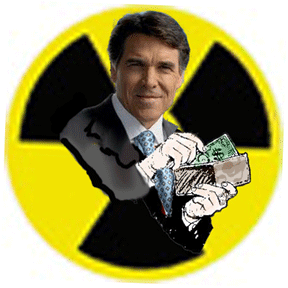
Rick Perry to Discuss Nuclear Sharing Agreement With Saudi Arabia
|
Rick Perry to Discuss Nuclear Sharing Agreement With Saudi Arabia, September 14, 2019,By
and
Energy Secretary Rick Perry said he plans to meet with Saudi Arabia’s new energy minister Monday as the U.S. remains in talks with the kingdom for a deal to construct nuclear reactors there that could help the flagging U.S. domestic nuclear industry. The Trump administration has been in talks with Saudi Arabia to forge a nuclear sharing agreement since 2017, but it has been met with increasing alarm from Congress and others concerned they could forge a deal that doesn’t prohibit the kingdom from enriching uranium….. (subscribers only) https://www.bloomberg.com/news/articles/2019-09-13/perry-to-discuss-nuclear-sharing-agreement-with-saudis-on-monday |
|
|
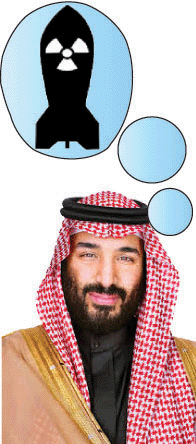
Saudi Arabia Plans To Enrich Uranium
Saudi Arabia Plans To Enrich Uranium For Its Nuclear Power Reactors, Isabel Togoh, Forbes Staff, 8 Sept 19
Saudi Arabia new energy minister Prince Abdulaziz bin Salman has announced the kingdom plans to enrich uranium for its future civilian nuclear power program. The move could mark the start of a race for nuclear weapons in the Gulf as attempts by the United States and European Union to strike a new deal with Iran on its nuclear plan falter. ……
Saudi’s former energy minister said in April that Riyadh’s use of the reactors would be peaceful and in compliance with “international framework governing … nuclear energy and its peaceful use.” However, the kingdom previously said it would not sign any deal that would restrict its nuclear program. The same technology used to enrich uranium for civilian reactors can also be used to produce fuel for nuclear weapons …… https://www.forbes.com/sites/isabeltogoh/2019/09/09/saudi-arabia-plans-to-enrich-uranium-for-its-nuclear-power-reactors/#5450c3415e2f
UN urges Iran to co-operate with UN regulatory agency
Time is of the essence’ in Iran co-operation: UN nuclear watchdog Channel News Asia, 8 Sept 19,
VIENNA: The acting head of the UN nuclear watchdog on Monday (Sep 9) called on Iran to “respond promptly” to the agency’s questions regarding Tehran’s nuclear programme.
Cornel Feruta was addressing the quarterly board meeting of the International Atomic Energy Agency (IAEA) a day after meeting high-level Iranian officials in Tehran.
He said that in his meetings he “stressed the need for Iran to respond promptly to Agency questions related to the completeness of Iran’s safeguards declarations”, adding: “Time is of the essence.”
Earlier Monday, the IAEA confirmed that Iran was installing advanced centrifuges, a move that puts further pressure on the troubled 2015 nuclear deal with world powers.
The IAEA’s latest statements come a day after Tehran hit out at European powers, saying they had left Iran little option but to scale back its commitments under the 2015 Joint Comprehensive Plan of Action (JCPOA)…….
Iran has said that notwithstanding its reduction of commitments under the JCPOA, it will continue to allow access to IAEA inspectors who monitor its nuclear programme……. https://www.channelnewsasia.com/news/world/-time-is-of-the-essence–in-iran-co-operation–un-nuclear-watchdog-11888270
Iraqui children contaminated by thorium – birth defects

“The destruction of a society”: First the U.S. invaded Iraq — then we left it poisoned Scientist: Bombs, bullets and military hardware abandoned by U.S. forces have left Iraq “toxic for millennia”, Salon.com DAVID MASCIOTRA 7 Sept 19 “………In your groundbreaking new research, you discover that the teeth of Iraqi children have 28 times more thorium if they live near a U.S. military base. What is the significance of that conclusion, and what does the presence of thorium indicate about a child’s health? What kinds of abnormalities and health problems will they experience?
The Iraqi population is potentially contaminated with depleted uranium decay products. Baby teeth are highly sensitive to environmental exposures. Such high levels of thorium simply suggest high exposure at an early age and potentially in utero.
We found uranium and thorium in these children’s teeth and hair. Uranium and thorium were also in the bone marrow of children, all of whom had severe birth defects. The magnitude of public contamination caused by these alpha-emitting radioactive compounds is a serious question to be answered. Our bone marrow data is still unpublished, but we hope to publish it separately.
Thorium is an alpha emitter and, once in the body, it can cause cancer and other anomalies. Impacts can vary depending on the timing and amount of exposure. Childhood leukemia, which has been rising in southern Iraq, is a verified outcome of thorium exposure.
In our study, children with high levels of thorium had multiple birth defects. Our studies show that, across Iraq, children exposed to U.S. war contamination suffer primarily from congenital heart defects and neural tube defects……. https://www.salon.com/2019/09/07/the-destruction-of-a-society-first-the-u-s-invaded-iraq-then-we-left-it-poisoned/
The radiation poisoning of Iraq lingers on
 “The destruction of a society”: First the U.S. invaded Iraq — then we left it poisoned Scientist: Bombs, bullets and military hardware abandoned by U.S. forces have left Iraq “toxic for millennia”, Salon.com DAVID MASCIOTRA 7 Sept 19
The political and moral culture of the United States allows for bipartisan cooperation to destroy an entire country, killing hundreds of thousands of people in the process, without even the flimsiest of justification. Then, only a few years later, everyone can act as if it never happened.
In 2011, the U.S. withdrew most of its military personnel from Iraq, leaving the country in ruins. Estimates of the number of civilians who died during the war in Iraq range from 151,000 to 655,000. An additional 4,491 American military personnel perished in the war. Because the bombs have stopped falling from the sky and the invasion and occupation of Iraq no longer makes headlines, Americans likely devote no thought to the devastation that occurred in their name.
With the exception of Rep. Tulsi Gabbard of Hawaii, who is currently polling at or below 2 percent, no candidate for the Democratic presidential nomination has consistently addressed the criminality, cruelty and cavalier wastefulness of American foreign policy. Joe Biden, the frontrunner in the race, not only supported the war in Iraq — despite his recent incoherent claims to the contrary — but as chair of the Senate Foreign Relations Committee acted as its most effective and influential salesman in the Democratic Party.
The blasé attitude of America toward the death and destruction it creates, all while boasting of its benevolence, cannot withstand the scrutiny of science. Dr. Mozhgan Savabieasfahani, an environmental toxicologist at the University of Michigan and recipient of the Rachel Carson Prize, has led several investigative expeditions in Iraq to determine how the pollutants and toxic chemicals from the U.S.-led war are poisoning Iraq’s people and environment. The health effects are catastrophic, and will remain so long after the war reached its official end.
I previously interviewed Savabieasfahani about her initial research, and recently acquired an update regarding her team’s latest discovery that there is a close correlation between proximity to a U.S. military base and birth defects in Iraqi children.
Average Americans, even many who opposed the war in Iraq, seem to believe that once the military campaign is over the casualties of war stop accumulating. What is the purpose of your general research regarding the toxicity of the Iraqi environment resulting from American bombs, munitions and other materials? How does the American invasion and occupation continue to adversely affect the health of Iraqis?
Bombs and bullets have been used on an extreme scale in Iraq. Dropping tons of bombs and releasing millions of bullets leaves toxic residues the in air, water and soil of the targeted population. These pollutants continue to poison those populations years after the bombing stops
What’s more, the United States imported thousands of tons of military equipment into Iraq to use in their occupation. They include, tanks, trucks, bombers, armored vehicles, infantry weapons, antiaircraft systems, artillery and mortars — some of which are coated with depleted uranium, and much more. These eventually find their way into U.S. military junkyards which remain across Iraq.
There are unknown numbers of military junkyards scattered across the Iraqi landscape.
Fluctuations in temperature facilitates the rusting and weathering of military junk, releasing toxic pollutants [including radioactive uranium compounds, neurotoxic lead and mercury, etc.] into the Iraqi environment.
Uranium and its related compounds remain toxic for millennia and poison local populations through food, air and water contamination.
The exposure of pregnant mothers to the pollutions of war, including uranium and thorium, irreversibly damages their unborn children. We found thorium, a product of depleted uranium decay, in the hair of Iraqi children with birth defects who lived in Nasiriyah and Ur City, near a U.S. military base.
The destruction of a society does not stop after U.S. bombs stop falling. Environmental contamination which the U.S. leaves behind continues to destroy our environment and poison our people decades after the bombs have stopped falling. The U.S. has a long history of irreversibly destroying human habitats. That must end…….
Forty-four years after U.S. forces left Vietnam, there are still Vietnamese babies born with birth defects from the American military’s use of Agent Orange. How long do you believe Iraqis will continue to suffer from the American-led war?
If left unmitigated, the population will be permanently exposed to elevated toxic exposures which can impact the Iraqi gene pool.
Through the use of the scientific method, you are gaining the ability to identify a severe problem in Iraq. Considering that the problem is a result of the U.S. invasion, what could the U.S. do to solve or at least mitigate the problem?
The U.S. must be held responsible and forced to clean up all the sites which it has polluted. Technology exists for the cleanup of radiation contamination. The removal and disposal of U.S.-created military junkyards would go a long way towards cleaning toxic releases out of the Iraqi environment.
You are a scientist, not a political analyst, but you must have some thoughts regarding the political implications of your work. How do you react to the lack of substantive conversation about the consequences of war in American politics and the press, and the American establishment’s evasion of responsibility on this issue?
I expect nothing from the American political establishment or their propaganda machines which masquerade as “news media” and feed uncritically off State Department press briefings.
Fortunately, there is a movement to criminalize environmental contamination caused by war. Damage to nature and the human environment must be considered a war crime.
Scientists are currently asking international lawmakers to adopt a fifth Geneva Convention which would recognize damage to nature as a war crime, alongside other war crimes. I hope that will make a difference in our ability to protect human lives and our environment. …… https://www.salon.com/2019/09/07/the-destruction-of-a-society-first-the-u-s-invaded-iraq-then-we-left-it-poisoned/
France pledges to press Iran to comply with nuclear deal
France pledges to press Iran to comply with nuclear deal https://nypost.com/2019/09/07/france-pledges-to-press-iran-to-comply-with-nuclear-deal/ By Sara Dorn, France will continue pressuring Iran to comply with the 2015 nuclear deal, a top official said Saturday.“We must do everything we can to contribute to ease tensions with Iran and to ensure navigation safety,” French defense minister Florence Parly said during a joint press conference with U.S. Defense Secretary Mark Esper in Paris.
“We can only confirm our goal, which is to bring Iran to fully respect the Vienna deal,” Parly said.
Meanwhile, Iranian officials said Saturday the country has begun using centrifuges to enrich uranium, a key ingredient for nuclear weapons.
Iran ramped up its nuclear activity in July in response to President Trump’s reinstatement of sanctions that were nixed during the nuclear deal made with Iran and world leaders in Vienna in 2015.
Iran has said it would come back into compliance with the pact if Europe helps the country work around the US sanctions to sell crude oil on the international marketplace.
Iranian Foreign Minister Zarif visits G-7 Summit
- Iranian Foreign Minister Mohammad Javad Zarif, who is under U.S. sanctions, was invited to the gathering by France’s foreign minister. SYLVIE CORBET, LORI HINNANT and DARLENE SUPERVILLE BIARRITZ, France (AP) 25 Aug 19, — A top Iranian official paid an unannounced visit Sunday to the G-7 summit and headed straight to the buildings where leaders of the world’s major democracies have been debating how to handle the country’s nuclear ambitions.
Iran working productively with France, to save nuclear deal
|
Iran’s Zarif: Nuclear talks with Macron were ‘productive’ Mohammad Javad Zarif says they could work with new French proposals, to save nuclear deal. https://www.aljazeera.com/news/2019/08/irans-zarif-nuclear-talks-macron-productive-190823161529602.html Iran’s foreign minister has hailed “positive” talks with French President Emmanuel Macron, on salvaging the 2015 nuclear deal.Mohammad Javad Zarif says they could work with new French proposals, to save the nuclear deal. Speaking to reporters after meeting Macron, Zarif says both countries have made suggestions on how to move forward after the United States pulled out of the nuclear deal last year. Macron has previously said he will either try to soften the effect of the US sanctions or come up with a way to compensate the Iranian people. |
|
Trumped Up: Wiki cables show Australia thinks Iran is not the aggressor,
Trumped Up: Wiki cables show Australia thinks Iran is not the aggressor, Michael West, by Prof. Clinton Fernandes — 23 August 2019 Wikileaks cables reveal Iran presents no threat to Australia and little threat to the US. Instead, clear intelligence from the US, Australia and Iran confirms Iran, although portrayed as aggressive, has pursued a defensive military strategy. Clinton Fernandez reports.
1 This Month
26 September – International Day for the Total Elimination of Nuclear Weapons





PLEASE OPPOSE HR 8255 AND S.3639 – bills would accelerate satellite deployment, with no environmental review or safeguards – https://ncstd5li.quorum.us/campaign/169331/
To see nuclear-related stories in greater depth and intensity – go to https://nuclearinformation.wordpress.com
-
Archives
- September 2026 (305)
- August 2026 (330)
- July 2026 (355)
- June 2026 (287)
- May 2026 (306)
- April 2026 (356)
- March 2026 (251)
- February 2026 (267)
- January 2026 (308)
- December 2025 (358)
- November 2025 (359)
- October 2025 (375)
-
Categories
- 1
- 1 NUCLEAR ISSUES
- business and costs
- climate change
- culture and arts
- ENERGY
- environment
- health
- history
- indigenous issues
- Legal
- marketing of nuclear
- media
- opposition to nuclear
- PERSONAL STORIES
- politics
- politics international
- Religion and ethics
- safety
- secrets,lies and civil liberties
- spinbuster
- technology
- Uranium
- wastes
- weapons and war
- Women
- 2 WORLD
- ACTION
- AFRICA
- Atrocities
- AUSTRALIA
- Christina's notes
- Christina's themes
- culture and arts
- Events
- Fuk 2022
- Fuk 2023
- Fukushima 2017
- Fukushima 2018
- fukushima 2019
- Fukushima 2020
- Fukushima 2021
- general
- global warming
- Humour (God we need it)
- Nuclear
- RARE EARTHS
- Reference
- resources – print
- Resources -audiovicual
- Weekly Newsletter
- World
- World Nuclear
- YouTube
-
RSS
Entries RSS
Comments RSS

