Iran continues to provide international inspectors access to its nuclear facilities
“The agency has not observed any changes to Iran’s implementation of its nuclear-related commitments under the JCPOA in connection with this announcement, or in the level of cooperation by Iran in relation to agency verification and monitoring activities under the JCPOA,” Grossi said in prepared remarks……..
The JCPOA promised Iran economic incentives in return for the curbs on its nuclear program, but since President Donald Trump pulled the U.S. out of the deal unilaterally in 2018 and imposed new sanctions, the country’s economy has been struggling.
Its violations of the pact are intended to pressure the other nations involved to increase economic incentives to make up for the American sanctions. So far, attempts by the other members of the JCPOA have fallen short of Iran’s demands.
In a separate report to members last week, the IAEA said it had identified three locations in Iran where the country possibly stored undeclared nuclear material or undertook nuclear-related activities without declaring it to international observers.
The activities at those locations are believed to have dated from the early 2000s, before the nuclear deal, and Iran responded to the report by suggesting that the IAEA had no legal basis to inspect those sites.
In his speech to the board members, Grossi called on “Iran to cooperate immediately and fully with the agency, including by providing prompt access to the locations specified by the agency.”
“The agency has identified a number of questions related to possible undeclared nuclear material and nuclear-related activities at three locations that have not been declared by Iran,” Grossi said, according to his prepared remarks. “The agency sought access to two of the locations. Iran has not provided access to these locations and has not engaged in substantive discussions to clarify the agency’s questions.” https://www.japantimes.co.jp/news/2020/03/09/world/u-n-atomic-watchdog-says-iran-still-providing-nuclear-access/#.XmbVIagzbIU
Middle East nuclear arms race to begin, as United Arab Emirates to open world’s largest nuclear reactor?
State-run Korea Electric Power Corporation of South Korea is finishing work on four nuclear reactors in the Al Dhafra region of Abu Dhabi. Known as Barakah and owned by Emirates Nuclear Energy Corporation, the plant is scheduled to go online later this month with a capacity of 5.6 gigawatts.
Barakah is likely to fuel fears in the already tense region, given the uncertainty over the Joint Comprehensive Plan of Action, or Iran nuclear deal, and Israel’s lack of transparency over its nuclear program. Experts warn about more nuclear plants, increased uranium enrichment, and a possible nuclear arms race in what is arguably the most volatile region in the world……
the UAE’s neighbors are far from comfortable with the new plant.
Qatar expressed concern in a letter to the International Atomic Energy Agency, stating that an accidental discharge of radioactive material from Barakah could reach the capital of Doha in under 13 hours.
There are also concerns that the facility could be attacked. Paul Dorfman, researcher at University College London, told Nikkei that the risk of a missile attack on a nuclear facility is not to be discounted. Yemeni rebels claimed responsibility for just such an attack that targeted Barakah while still under construction in 2017. ……
Egypt and Jordan have also jumped on board the nuclear bandwagon. Egypt is set to build four nuclear reactors this year in collaboration with Russia in the El Dabaa region west of Cairo. Lawmaker Ahmed al Tantawi is wary of his country’s nuclear program, stating that Egypt already has a surplus of electricity.
Jordan’s nuclear program, however, faces problems such as financing and how to mitigate potential terrorist attacks. There is also a shortage of water needed to cool reactors, as it is one of the world’s most arid countries.
Iran’s nuclear ambitions are the most alarming. The country already has one nuclear power reactor at the Bushehr power plant and has two other Russian-designed reactors in the works. Construction on one began in November 2019 and is scheduled to finish in 2023. Another is still in the planning stage.
Tehran had curtailed enrichment under the nuclear deal, from which the U.S. withdrew in 2018. But the situation drastically changed in January after the U.S. drone assassination of Iranian Gen. Qassim Soleimani.
“Iran is still adhering to some of its duties under the JCPOA, such as International Atomic Energy Agency oversight,” Mohammed Marandi, political analyst at the University of Tehran, told Nikkei. “But with regards to research and development, the Iranians will no longer accept limitations due to the Europeans and Japanese [not cooperating],” he added.
The European Union tried to save the Iran Nuclear Deal after the administration of U.S. President Donald Trump withdrew. Later, however, the U.K., France and Germany invoked the dispute settlement framework in the deal after Iran increased enrichment activities on the heels of Soleimani’s assassination. Even Japan tried to help by mediating between Tehran and Washington but ultimately failed to ease tensions.
Israel, which is notably not a signatory to the Treaty on the Non-Proliferation of Nuclear Weapons, has a highly advanced military. The Nuclear Threat Initiative, a U.S. nuclear research entity, warns that Israel possesses nuclear weapons along with a large supply of ballistic and cruise missiles to deliver them. And there is no open consensus among experts as to the extent of Israel’s nuclear program.
Analysts say that U.S. policy is encouraging a Middle East nuclear arms race in two ways. First, the U.S. defense and nuclear industries view the region as a lucrative market, with Saudi Arabia being a key buyer. Second, the inaction of Europe, Russia and China to counter U.S. sanctions against Iran do not encourage Tehran to remain a party to the nuclear deal. https://asia.nikkei.com/Politics/International-relations/UAE-s-nuclear-plant-fuels-fears-of-Middle-East-arms-race
Nuclear power not economic, nor safe, but it bolsters a secretive autocratic regime, United Arab Emirates
|
In February, the UAE government in Abu Dhabi licensed the first of four 1.4 gigawatt nuclear reactors after 12 years of construction on the Persian Gulf coast at Barakah, just east of the UAE border with Saudi Arabia. When the remaining three reactors at the $25 billion plant are completed, Barakah will reach its total nameplate capacity of 5.6 gigawatts. As the South Korea-led consortium loads fuel rods and tests the reactor’s output, the UAE will finally have a major source of zero-carbon [?] electricity on a power grid that relies upon fossil fuels—mainly natural gas—for 97 percent of its electric power generation, a much higher percentage than that of other countries where consumption is high. …… The UAE is now the third nuclear-competent state in the Middle East. Israel, with its stockpiles of nuclear weapons, was the first. Iran, with its single one-gigawatt nuclear power plant at Bushehr (just across the Gulf from the UAE’s) was second. Iran’s uranium enrichment program has extended to levels beyond that needed for electricity production, suggesting that it might follow the secretive Israeli path toward weaponization. The UAE is leveraging nuclear power in a different way. It has committed to the nuclear Non-Proliferation Treaty and the International Atomic Energy Agency’s Convention on Nuclear Safety to secure international cooperation. The UAE’s 2009 agreement with the United States explicitly bans the Gulf country from developing technologies needed to enrich uranium and reprocess spent reactor fuel. Advocates tout the “Abu Dhabi model” as a path to climate-friendly electricity while safeguarding against proliferation and the potential for development of a breakout nuclear weapons capability. The drawbacks. Abu Dhabi’s experience with nuclear power has been difficult, and the country’s National Energy Strategy 2050 suggests that no further nuclear development is in the cards. Cost thresholds and completion deadlines fell by the wayside years prior to completion of the first reactor. The complexity, toxicity, and strategic sensitivity of nuclear power make it an uncompetitive choice based solely on competitive cost calculations. Abu Dhabi’s difficulties with Barakah began at launch in 2008 with the over-ambitious nine-year start-up deadline, then set for 2017. Unrealistic expectations were undermined during construction by revelations that the main South Korean contractor KEPCO justified its low bid for the plant by dropping post-Chernobyl safety features, including an extra wall in the reactor containment building. KEPCO was also said to have built Barakah’s prototype reactor in South Korea using counterfeit cables and other parts procured using forged safety documents. Retrofitting of the Korean plant delayed the training of the team of UAE operators. Some counterfeit Korean parts were apparently installed in the Barakah plant as well, but few details have emerged about whether they have been replaced. Separately, inspectors were said to have found that all four reactor containment buildings suffered cracks in concrete walls that required repair. These issues contributed to the three-year delay in bringing the all four Barakah rectors online. The project has been subject to criticism by analysts who argue that the plant’s reduced safety features and other deficiencies render it more susceptible to a radiation release, including in the event of a military strike. The latter is not a remote possibility; in 2017, Houthi rebels battling UAE forces inside Yemen claimed to have targeted the Barakah plant in an apparently unsuccessful cruise missile strike…….. From the perspective of an autocratic regime like that in Abu Dhabi, there are further political benefits from civil nuclear power. Nuclearization tends to involve measures that bolster the strength and control of the state through increased internal security and enhanced coercive apparatus, justified by the technology’s inherent hazards. Vulnerabilities in nuclear systems also create new requirements for secrecy and surveillance, and less tolerance for dissent. In these ways, protecting the fuel cycle does double duty in bolstering regime security and vigilance..….. https://thebulletin.org/2020/03/for-uae-the-political-perks-of-nuclear-power-eclipse-economics/# |
|

Egypt going into $25 billion debt to Russia, to buy nuclear reactors
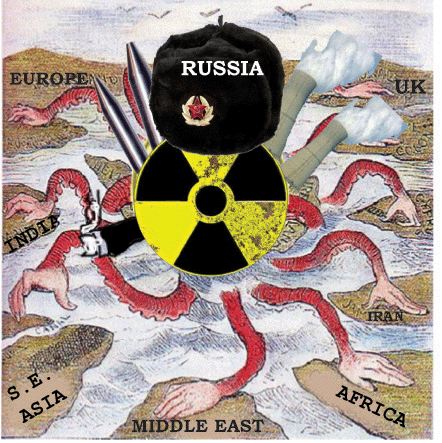
Russia lends Egypt $25 billion for Dabaa nuclear power plant, AL-Monitor, 26 Feb 20, CAIRO — Atomstroyexport, a subsidiary of Russia’s State Atomic Energy Corporation, or Rosatom, announced Feb. 17 that three Egyptian companies were awarded a tender offer for constructing the first phase of Egypt’s Dabaa nuclear power plant.
The three Egyptian companies, competing among 10 others, are Petrojet, Hassan Allam and the Arab Contractors.
The Egyptian government intends to start negotiations within the next few days with the Egyptian Nuclear and Radiological Regulatory Authority to obtain permission to start implementing the Dabaa nuclear plant project. The plant will be constructed in the Dabaa area of Marsa Matrouh governorate in the west of the country.
The Dabaa plant is the first nuclear plant for peaceful uses, with a total capacity of 4.8 gigawatts. The project is financially supported by Rosatom through a Russian loan amounting to $25 billion………….
Yemen al-Hamaki, a professor of economics at Ain Shams University said that under this agreement Egypt will use the loan to finance 85% of the total value of the building, construction, insurance and all other related works. Egypt would bear the remaining 15% in the form of installments. The loan is for 13 years at a 3% annual interest rate. If Egypt fails to repay any of the annual interest within 10 working days, it shall be subject to arrears of 150% of the interest rate calculated on a daily basis
Hamaki also warned that this massive Russian loan of $25 billion could blow up Egypt’s foreign debts. “This loan is a great risk to the future because it burdens the state and should be settled from the wealth and economic assets of the future generations,” she said, adding, “Egypt’s resorting to many loans foretells its inability to attract foreign investments, while tourism revenues continue to decline.” ….. https://www.al-monitor.com/pulse/originals/2020/02/power-plant-nuclear-egypt-russia-loan.html#ixzz6F5iQcolQ
Iran Nuclear Accord Parties Meet to Try to Salvage Deal
|
Iran Nuclear Accord Parties Meet to Try to Salvage Deal https://www.voanews.com/middle-east/voa-news-iran/iran-nuclear-accord-parties-meet-try-salvage-deal By RFE/RL, February 26, 2020 The remaining members of the floundering Iran nuclear deal are set to meet in Vienna Wednesday for the first time since Germany, France, and Britain initiated dispute procedures that could reimpose U.N. sanctions on Tehran.
The talks come as the signatories try to rescue the landmark 2015 accord, which has been faltering since U.S. President Donald Trump unilaterally withdrew from it in 2018 and enforced crippling sanctions on Iran. It will be attended by senior diplomats from Iran, Britain, France, Germany, China, Russia, and the EU. They have promised to uphold the deal that saw Iran agree to reduce its program of developing nuclear weapons in exchange for an easing of sanctions, even without Washington’s support. However, since the U.S. withdrawal, Iran has stepped up its program in defiance of Washington’s “maximum pressure” campaign.“ This is a chance — though not of 100 percent — to stop escalation before it’s too late,” Russian Foreign Minister Sergei Lavrov was cited as saying by the Russian Embassy in Vienna on Twitter. Why EU Powers Rejected Trump’s Call to Leave Iran Nuclear Deal
EU foreign policy chief Josep Borrell said Friday the 28-nation bloc will keep trying to save the Iran nuclear deal despite Trump’s call on EU to join US in breaking away from it
This is a chance — though not of 100 percent — to stop escalation before it’s too late,” Russian Foreign Minister Sergei Lavrov was cited as saying by the Russian Embassy in Vienna on Twitter. Iran has since breached its main limitations, exceeding the stockpiles of heavy water and uranium allowed, the number and types of centrifuges it can operate to enrich uranium, and the purity of uranium. As a result, in mid-January, the three European countries said they had “no choice” but to trigger a dispute mechanism in the accord, citing reduced compliance. The process for ultimately reimposing U.N. sanctions consists of several steps, the final one of which is to notify the U.N. Security Council. The restrictive measures would then automatically be reinstated after 30 days unless the Security Council voted to keep them lifted. Trump has called the deal “fatally flawed,” in part because it did not restrict Tehran’s ballistic-missile program or address its support for terrorist groups in the Middle East. Iran insists its nuclear program is for civilian purposes only and that the Joint Comprehensive Plan of Action (JCPOA) allows the country to run reactors to generate power. |
Secretary of State Mike Pompeo explains Trump’s plan to kill off the Iran nuclear agreement
|
Pompeo Reveals Trump Admin’s Wide-Ranging Plan to Combat Iran, Deal Death Blow to Nuclear Deal, Washington Free Beacon,
In discussion with Free Beacon, secretary of state explains how he is galvanizing the globe against the Islamic Republic Republic, Adam Kredo – FEBRUARY 23, 2020, RIYADH, Saudi Arabia—The Trump administration is waging a multi-pronged effort to thwart Iran’s expansion across the Middle East, including efforts at the United Nations to ensure global sanctions come back into effect in what would mark a final death blow for the landmark nuclear deal, Secretary of State Mike Pompeo told the Washington Free Beacon in an exclusive and wide-ranging interview. In a one-on-one talk with the Free Beacon on Friday following high-level meetings with the Saudi royal family in Riyadh, Pompeo pulled the curtain back on the Trump administration’s years-long effort to combat Iran militarily and diplomatically…….. In the coming months, Pompeo said, he and the president will make a major decision about whether to petition the U.N. to invoke what is known as “snapback” on a set of international sanctions on Iran that were lifted as part of the Obama administration’s nuclear accord. Iran hawks in Congress have been pressing Pompeo and the administration to pursue this course of action for months, a message the secretary says he has received and is digging into. Such a move would deal a deathblow to the nuclear deal. …….. In the coming months, Pompeo said, he and the president will make a major decision about whether to petition the U.N. to invoke what is known as “snapback” on a set of international sanctions on Iran that were lifted as part of the Obama administration’s nuclear accord. Iran hawks in Congress have been pressing Pompeo and the administration to pursue this course of action for months, a message the secretary says he has received and is digging into. Such a move would deal a deathblow to the nuclear deal……… When asked about that “special” relationship—a term typically applied to the U.S.-Israel alliance—Pompeo acknowledged that the two countries are on better footing than ever, particularly when it comes to Iran……… https://freebeacon.com/national-security/exclusive-pompeo-reveals-trump-admins-wide-ranging-plan-to-combat-iran-deal-death-blow-to-nuclear-deal/ |
|
Iran would return to 2015 nuclear agreement if Europe would provides “meaningful” economic benefits
 Zarif Says Iran Could Reverse Nuclear Breaches If Europe Acts, Sunday, 16 February, 2020 Munich- Asharq Al-Awsat Zarif Says Iran Could Reverse Nuclear Breaches If Europe Acts, Sunday, 16 February, 2020 Munich- Asharq Al-Awsat
Iran would be willing to move back towards the 2015 nuclear deal (JCPOA) if Europe provides “meaningful” economic benefits, announced Iranian Foreign Minister Mohammed Javad Zarif on the sidelines of Munich Security Conference (MSC).
Zarif met with members of the European Council on Foreign Relations (ECFR) in Munich where they discussed the nuclear deal, Europe’s obligations under the deal, and regional and international issues. He pointed out that Iran is ready to return from reducing its nuclear obligations if Europe abides by its obligations and takes practical steps in this field…… https://aawsat.com/english/home/article/2134461/zarif-says-iran-could-reverse-nuclear-breaches-if-europe-acts |
|
Saugeen Ojibway Nation vote ends company’s plans to store nuclear waste near Lake Huron
The decision came following years of Michigan lawmakers asking Ontario Power Generation to reconsider. It took the vote of the Saugeen Ojibway Nation of Ontario Friday to shift the discussions away from the lake. Of 1,232 ballots cast, 1,058 were against the site and 170 in favor.
We were not consulted when the nuclear industry was established in our Territory,” said a news release on the vote. “Over the past forty years, nuclear power generation in Anishnaabekiing has had many impacts on our Communities, and our Land and Waters, including the production and accumulation of nuclear waste.”
The release said that SON leaders will work with Ontario Power Generation “to find an acceptable solution for the waste.
“We will continue to work with OPG and others in the nuclear industry on developing new solutions for nuclear waste in our Territory,” said Chief Greg Nadjiwon of the Chippewas of Nawash Unceded First Nation. “We know that the waste currently held in above-ground storage at the Bruce site will not go away. SON is committed to developing these solutions with our communities and ensuring Mother Earth is protected for future generations. We will continue to ensure that our People will lead these processes and discussions.” ……….
Site had been sought since 2010
On Jan. 24, the Nuclear Waste Management Organization announced it had signed agreements with landowners east of Lake Huron in South Bruce, Ontario, which would allow land access for studies for the site. …….
In January, southeast Michigan state representatives Gary Howell, R-Lapeer, and Shane Hernandez, R-Port Huron, issued statements against locations near Kincardine and Lake Huron. They said the Kincardine locations are too close to Lake Huron, and expressed concerns about drinking water and public health if something went wrong at the site.
They called on the United States Congress to do everything in its power to stop the development. https://www.thetimesherald.com/story/news/2020/02/03/plans-store-nuclear-waster-near-lake-huron-halted/4587366002/
Top EU diplomat to visit Tehran amid nuclear tensions
|
France 24, 2 Feb 2029, Top EU diplomat Josep Borrell was Monday due to visit Iran, said officials in Tehran and Brussels, on his first trip there since taking office, aiming to reduce rising tensions over the Islamic republic’s nuclear programme.
Borrel was set to meet President Hassan Rouhani, Foreign Minister Javad Zarif and parliamentary speaker Ali Larijani on the two-day trip, his office said in a statement. The 2015 nuclear deal between Tehran and a group of world powers has been crumbling since US President Donald Trump withdrew from it in 2018, and Washington has since stepped up sanctions and a campaign of “maximum pressure” against Iran. Borrell’s mission aims “to de-escalate tensions and seek opportunities for political solutions to the current crisis,” said the office of the EU’s high representative for foreign affairs and security policy. The visit will allow Borrell “to convey the EU’s strong commitment to preserve” the nuclear deal, known as the Joint Comprehensive Plan of Action, and to discuss cooperation between the EU and Iran, his office said……… https://www.france24.com/en/20200202-top-eu-diplomat-to-visit-tehran-amid-nuclear-tensions |
|
Qatar says UAE`s power plant activities are a threat to Gulf stability and the environment
|
UAE nuclear reactor ready; Qatar views it as a threat https://www.middleeastmonitor.com/20200130-uae-nuclear-reactor-ready-qatar-views-it-as-a-threat/ January 30, 2020, The United Arab Emirates Barakah nuclear power plant is ready to operate, the UAE’s state-run Emirates News Agency (WAM) reported on Tuesday.Nawah Energy Company, the operator of the power plant, is concluding the final requirements,” WAM said.
Barakah will be the UAE’s first nuclear plant and the world’s largest when completed, with four reactors and 5,600 megawatts (MW) of capacity, Reuters reported. Sultan bin Ahmad Sultan Al Jaber, a minister of state in the UAE government and also chief executive of Abu Dhabi National Oil Company (Adnoc), drew attention to the nuclear power plants that will start supplying the country’s electricity grid for the first time later this year, WAM reported two weeks ago. Underlining the myriad risks inherent in Barakah’s design, Qatar says UAE`s power plant activities are a threat to Gulf stability and the environment. Last year, in a letter to the International Atomic Energy Agency (IAEA), a Vienna based international organisation founded to promote the peaceful use of nuclear energy, Qatar urged them to create a framework for regional nuclear security, Al Jazeera reported. |
|
Danger of Armenian nuclear plant to neighbouring Turkey
|
‘Armenian nuclear plant poses threat to Turkey’ https://www.yenisafak.com/en/news/armenian-nuclear-plant-poses-threat-to-turkey-3510952Turkish opposition lawmaker warns of risk posed by Armenia’s Metsamor Nuclear Power Plant, 16 km from shared border
January 31, 2020 A nuclear power plant in neighboring Armenia poses a threat to Turkey, said a Turkish opposition party on Friday.”The Metsamor Nuclear Power Plant jeopardizes the lives of people in this region,” Habib Eksik, a Peoples’ Democratic Party (HDP) lawmaker from the eastern Igdir province, told journalists in parliament.
He said the plant is in close proximity to Igdir and has many flaws in its design. “The plant has been constructed with primitive technology and it lacks adequate security measures,” said Eksik. Metsamor, first launched in 1976, is just 16 kilometers (10 miles) from Turkey’s eastern border with Armenia, and produces about 40% of the country’s electricity. Both Turkey and Azerbaijan have repeatedly raised objections to the project as they believe it does not meet international safety standards. Metsamor continues to draw criticism from Turkish officials as Armenia has decided to extend its operations until 2026. |
|
U.S. sanctions Iran’s atomic power chief for nuclear violations
|
U.S. sanctions Iran’s atomic power chief for nuclear violations
By Don Jacobson Jan. 31 (UPI) — The U.S. Treasury has imposed fiscal sanctions against Iran’s nuclear energy chief and ordered his U.S.-linked assets frozen, amid ongoing tensions between the Washington, D.C., and Tehran.The Treasury on Thursday sanctioned Ali Akbar Salehi, the head of the Atomic Energy Organization of Iran, saying the agency has played a significant role in Tehran violating nuclear regulations……. https://www.upi.com/Top_News/US/2020/01/31/US-sanctions-Irans-atomic-power-chief-for-nuclear-violations/3251580482287/
|
|
Donald Trump tweets that US will not lift sanctions to secure nuclear deal with Iran
 US will not lift sanctions to secure nuclear deal with Iran , https://www.sbs.com.au/news/us-will-not-lift-sanctions-to-secure-nuclear-deal-with-iran 26 Jan 2020, Donald Trump has tweeted that the US will not lift sanctions on Iran in order to negotiate a new nuclear deal.
The United States will not lift sanctions on Iran in order to negotiate, US President Donald Trump has tweeted, seemingly in response to a Der Spiegel interview with Iran’s foreign minister.
“Iranian Foreign Minister says Iran wants to negotiate with The United States, but wants sanctions removed. @FoxNews @OANN No Thanks!” Trump tweeted in English on Saturday and later in Farsi.
Iran’s Foreign Minister Mohammad Javad Zarif responded on Sunday by tweeting an excerpt from the interview with Der Spiegel published on Friday, where he said Iran is still open to negotiations with America if sanctions are lifted.
“@realdonaldtrump is better advised to base his foreign policy comments & decisions on facts, rather than @FoxNews headlines or his Farsi translators,” Zarif said in the tweet with the interview excerpt.
Tensions between Iran and the United States have reached the highest levels in decades after the US killed top Iranian General Qassem Soleimani in a drone strike in Baghdad on January 3, prompting Iran to fire missiles days later at bases in Iraq where US troops are stationed.
Tensions between the two have been increasing steadily since Trump pulled the United States out of Iran’s nuclear pact with world powers in 2018 and reimposed sanctions that have driven down Iran’s oil exports and hammered its economy.
Despite years of negotiations, we came once again to the brink of conflict with Iran.
Reporting on the Iran nuclear deal: ‘nothing happens until everything happens’Our world affairs editor reflects on how, despite years of negotiations, we came once again to the brink of conflict. Guardian, Julian Borger Sun 26 Jan 2020, Countries tend to go to war when diplomacy fails. But Washington and Tehran are now facing off because it succeeded. It was because the 2015 nuclear deal was Barack Obama’s proudest foreign policy achievement that Donald Trump was so determined to destroy it.
The US and Iran are sliding back towards the brink of conflict. If a missile had landed a little bit differently in the course of the latest exchange of hostilities, they would probably be at war by now.
As the pendulum has swung one way and then the other, the Guardian has tried to cover the diplomacy with the same depth and emphasis as the military manoeuvres, even when it seems slow-moving and complex.
When formal talks began between the Obama administration and the new government of Hassan Rouhani in September 2013, our foreign editor, Jamie Wilson, decided we should cover the whole process in detail because of the potentially historic nature of success, and the very high price of failure.
. When formal talks began between the Obama administration and the new government of Hassan Rouhani in September 2013, our foreign editor, Jamie Wilson, decided we should cover the whole process in detail because of the potentially historic nature of success, and the very high price of failure.
……… For Rezaian – now a Washington columnist – and many of those who saw the worst side of the Islamic Republic, its cruelties are all the more reason to prevent it developing nuclear weapons, and bind it into an international agreement. For others, particularly on the American right, any deal that eased the pressure on Iran’s economy would make the west complicit in Iran’s oppression at home and aggression abroad.
In the end, all those years of diplomacy and all the delicate compromises of the JCPOA, by which the Iranians accepted nuclear limits for sanctions relief, came to naught. Tehran’s nuclear programme is expanding again, and the US and Iran are back on the brink of conflict.
It is a chilling thought that no one in the US chain of command has the authority to stop Trump if he were to pick up the verification codes on the small plastic card (for some reason called the nuclear “biscuit”) that a US president always has close by, and order up Armageddon.
With that other extinction-level threat, the climate emergency, there is so much happening that it is impossible to keep up. But the nuclear threat is different: nothing happens until everything happens. By the time there is something substantial to report on, it could be far too late.https://www.theguardian.com/membership/2020/jan/25/iran-nuclear-deal-us-reporting
Iran will never seek nuclear weapons – P.M Rouhani
|
Iran’s Rouhani: nation ‘will never seek nuclear weapons’, with or without 2015 deal in place, https://www.france24.com/en/20200122-iran-s-rouhani-nation-will-never-seek-nuclear-weapons-2015-nuclear-deal-europe-washington Iran will never seek nuclear weapons with or without a nuclear deal, Iranian President Hassan Rouhani said on Wednesday, calling on the European powers to avoid Washington’s mistake of violating Tehran’s 2015 nuclear deal with major powers.
We have never sought nuclear weapons … With or without the nuclear deal we will never seek nuclear weapons … The European powers will be responsible for the consequences of violating the pact,” said Rouhani, according to his website President.Ir. In reaction to Washington’s withdrawal from the deal in 2018 and the reimposition of sanctions, Iran has gradually rolled back on its commitments. Rouhani said Iran remained committed to the deal and could reverse its steps away from compliance if other parties fulfilled their obligations. |
|
1 This Month
22 June – Virtual Event –Climate Change: New Data, New Debate

Monday, June 22, 2026 2:30 p.m. – 3:15 p.m. CT
YouTube. Register here
Protect Sazan Island from the Trump family! https://secure.avaaz.org/campaign/en/protect_sazan_island_from_the_trump_family_loc/?bqFCVab&v=174511&cl=22707147157&_checksum=5e9dde668860e8231c33699735e16a1fbf22ab2cb01da50c999fe8732b9775ef&utm_source=email&utm_medium=blast_email&utm_campaign=174511
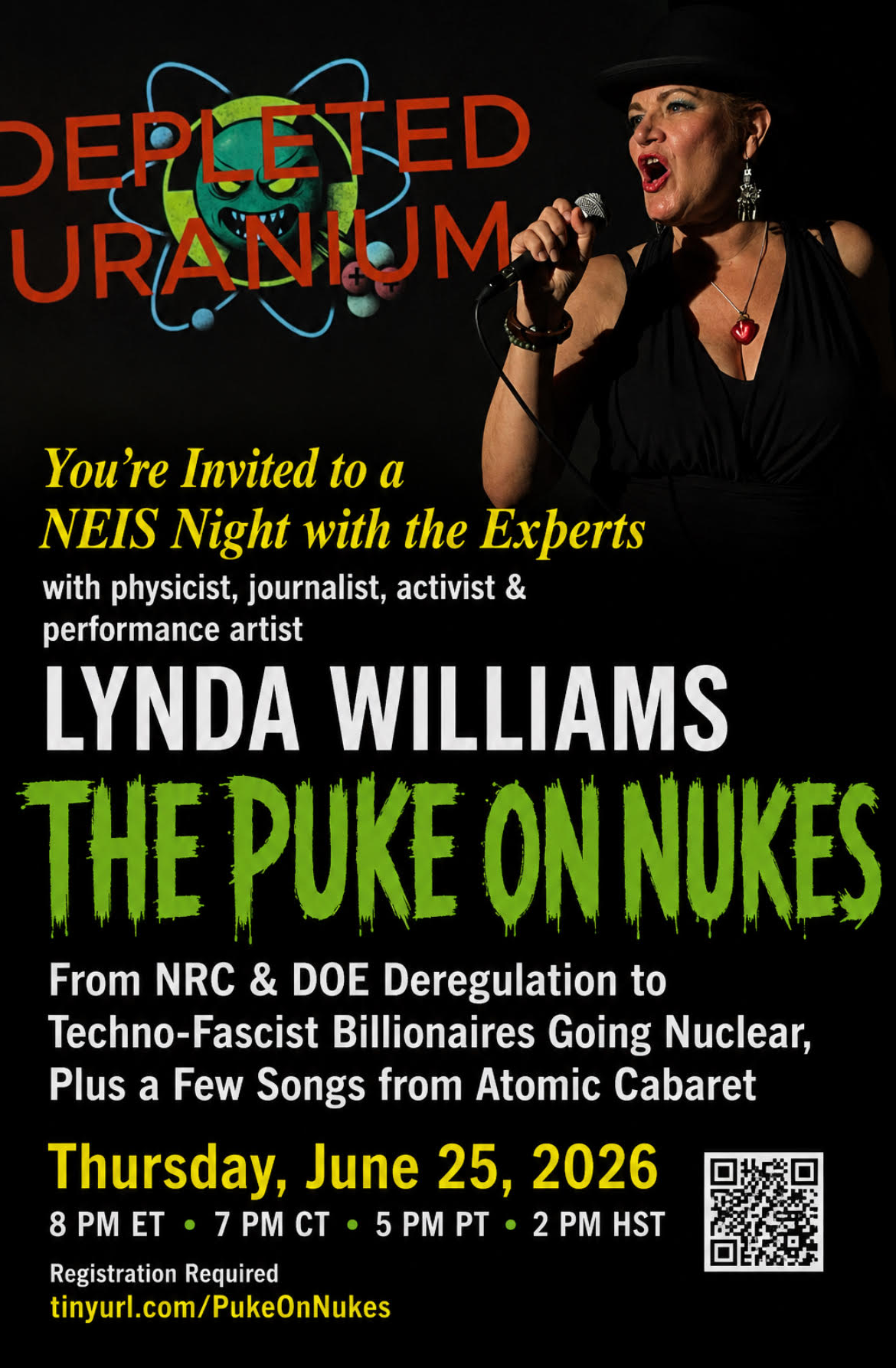
25 June- THE PUKE ON NUKES
Thursday, June 25, 2026
7pm Central Time (8pm ET, 6pm MT, 5pm PT) UTC – 5
From NRC & DOE Deregulation to Techno-Fascist Billionaires Going Nuclear, Plus a Few Songs from Atomic Cabaret REGISTER
26 June – Radiation Trainwreck at the NRC / Join the Protect Better Campaign – https://us02web.zoom.us/meeting/register/4ZlZ5_qLSHGiLSCg8FF6Bg#/registration


Cuba Is Not a Failed State – It Is a Besieged State
PETITION: “Global Appeal to Endorse Palestinian Right of Return of Refugees”
To see nuclear-related stories in greater depth and intensity – go to https://nuclearinformation.wordpress.com
-
Archives
- June 2026 (182)
- May 2026 (306)
- April 2026 (356)
- March 2026 (251)
- February 2026 (268)
- January 2026 (308)
- December 2025 (358)
- November 2025 (359)
- October 2025 (376)
- September 2025 (257)
- August 2025 (319)
- July 2025 (230)
-
Categories
- 1
- 1 NUCLEAR ISSUES
- business and costs
- climate change
- culture and arts
- ENERGY
- environment
- health
- history
- indigenous issues
- Legal
- marketing of nuclear
- media
- opposition to nuclear
- PERSONAL STORIES
- politics
- politics international
- Religion and ethics
- safety
- secrets,lies and civil liberties
- spinbuster
- technology
- Uranium
- wastes
- weapons and war
- Women
- 2 WORLD
- ACTION
- AFRICA
- Atrocities
- AUSTRALIA
- Christina's notes
- Christina's themes
- culture and arts
- Events
- Fuk 2022
- Fuk 2023
- Fukushima 2017
- Fukushima 2018
- fukushima 2019
- Fukushima 2020
- Fukushima 2021
- general
- global warming
- Humour (God we need it)
- Nuclear
- RARE EARTHS
- Reference
- resources – print
- Resources -audiovicual
- Weekly Newsletter
- World
- World Nuclear
- YouTube
-
RSS
Entries RSS
Comments RSS
 nuclear-news