UN nuclear watchdog inspects second Iran site
|
UN nuclear watchdog inspects second Iran site, Aljazeera, 30 Sept 20,
IAEA says it gained access to the second site in Iran where nuclear activity may have taken place in the early 2000s. The United Nations nuclear watchdog inspected the second of two suspected former secret atomic sites in Iran as agreed with Tehran last month in a deal that ended a standoff over access, the agency said on Wednesday.The International Atomic Energy Agency (IAEA) has not named either of the two undeclared sites, but it has described activities it suspects took place there in 2003, the year it and US intelligence services believe Iran halted a secret and coordinated nuclear weapons programme. ………The spokesman of Iran’s Atomic Energy Agency, Behrouz Kamalvandi, confirmed the news of the inspection, saying he hopes it will stop the United States from taking advantage of the issue. ……..The Kamalvandi said he hopes the move will prevent the US and other countries that wish to politicise Iran’s case and “drag it to the UN Security Council” from further pressuring the IAEA…….https://www.aljazeera.com/news/2020/9/30/un-nuclear-watchdog-inspects-second-iran-site |
|
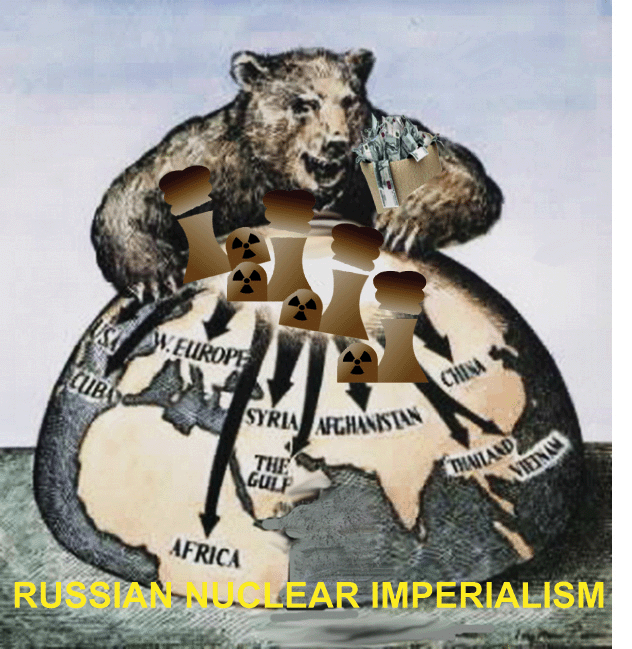
Power hungry Russia foisting nuclear power on Egypt – Africa – where it is not needed
|
Why Russia Is Pushing Unneeded Nuclear Power Plants On Egypt, Oil Price, By Haley Zaremba – Sep 22, 2020, In recent years, Russia and China have been facing off to spread their nuclear power dominion to a new, huge, and vastly untapped market: Africa. The two nuclear power giants have been in competition to corner the market, with Russia aiming to grow its position in a sector that China has historically dominated. Earlier this summer, German media company DW News reported on a new Russian-funded and -controlled nuclear center being developed in Kigali: “The Center of Nuclear Science and Technologies, planned for completion by 2024, will include nuclear research labs as well as a small research reactor with up to 10 MW capacity.” And the Rwandan plant is just the beginning. “Ethiopia, Nigeria and Zambia have signed similar deals with Rosatom, while countries such as Ghana, Uganda, Sudan, and DRC have less expansive cooperation agreements.”Now, there is a new forum for nuclear takeover in Africa: Egypt. As reported by AllAfrica this week, “Egypt’s venture into nuclear power has been planned from the top-down, with environmental groups and rights organizations expressing reservations, energy analysts questioning the need for the country’s first nuclear plant, and many details of agreements with Russia remaining murky.” ……….. The main issue at play here is water. In Egypt, most areas receive less than eighty millimeters of precipitation per year. Water, therefore, is an especially precious commodity. The top complaint, therefore, is about the massive quantities of water needed to keep nuclear reactors cool to avoid meltdown. Any concerns about public health due to radiation and high costs of construction are secondary to the issue of water usage.
Another common complaint is that nuclear is not really needed in Egypt, where considerable deposits of natural gas have been discovered off the coast – enough to account for an energy surplus. This raises questions about the purpose of the project – is it really to create more and greener energy, or is it ultimately about power relations and geopolitical attachments between the infamously opaque Egyptian Nuclear and Radiological Regulatory Authority and the infamously power-hungry Russian government? https://oilprice.com/Energy/Energy-General/Why-Russia-Is-Pushing-Unneeded-Nuclear-Power-Plants-On-Egypt.html |
|
Iran will not renegotiate nuclear deal if Biden wins US presidency, Zarif says
|
Iran will not renegotiate nuclear deal if Biden wins US presidency, Zarif says
Iranian foreign minister said returning to the terms of the accord should happen ‘without conditions’ Middle East Eye, By MEE staff, Washington: 21 September 2020
Iranian Foreign Minister Mohammad Javad Zarif said on Monday that Tehran has no plans of renegotiating the 2015 nuclear deal, stressing that Washington must return to the accord “without condition”.
Speaking to the Council on Foreign Relations in a virtual interview, Zarif discussed a broad range of topics including the prospect of reviving the nucler agreement that Donald Trump nixed in 2008. Asked how Iran would react if Joe Biden wins the US presidency in the upcoming November election, Zarif said Tehran is concerned with Washington’s policies, not internal US politics. ……. https://www.middleeasteye.net/news/iran-zarif-nuclear-deal-biden-us-presidency |
|
Iran a most transparent country for IAEA inspections
Tehran’s Nuclear Program Most Transparent Among IAEA Members, https://financialtribune.com/articles/national/105333/tehran-s-nuclear-program-most-transparent-among-iaea-members , 18 Sept 20, Iran’s permanent representative to Vienna-based international organizations said the Islamic Republic has the most transparent nuclear program among member states of the International Atomic Energy Agency, as proven through numerous inspections of the country’s nuclear sites by the UN agency.
“The fact that 22% of all global inspections done by the IAEA have been carried out in Iran proves that Iran enjoys the most transparent peaceful nuclear program among the member states of the agency,” Kazem Gharibabadi said in an address to the IAEA Board of Governors on Thursday, IRNA reported.
The envoy reminded that the high level of cooperation between Tehran and the agency had not come by easily to be “easily weakened as a result of a few parties’ myopic political interests”.
He was referring to the United States and the Israeli regime’s immense pressure on the agency to try and find fault with Tehran’s nuclear work.
Under pressure from Israel, the US’ most prominent regional ally, Washington quit a historic 2015 nuclear accord with Tehran and world powers two years ago. The US then returned sanctions that the deal, formally known as the Joint Comprehensive Plan of Action, had lifted, not even bothering to exempt food items and medicines from the illegal bans.
Still under Israeli pressure, the agency cited “concerns” earlier this year about two Iran-based sites. Iran first refused access to the sites, arguing that the alleged information provided to the IAEA had been cooked up by Israel’s spy agencies.
Tehran, however, later allowed access to the sites on a purely voluntary basis and only to honor its cooperation with the IAEA.
“In order for the agency’s integrity to be preserved, its members should seriously avoid exerting any pressure on it,” Gharibabadi said.
JCPOA’s “handful of enemies” came up with “baseless and unfounded” allegations about the Iranian sites after falling short of all pretexts to destroy the international agreement, he said, urging the agency and its board to avoid falling for their plots.
Double StandardsThe Iranian official also criticized the double standards applied by the agency’s members toward the Israeli regime and its nuclear activities. He pointed out two instances of singularity concerning Israel, the regime’s being the only Middle Eastern party that has refused to sign up to the nuclear Non-Proliferation Treaty and is the exclusive owner of nuclear weapons in the region. “Still thanks to the double-standard approaches adopted by some IAEA members, the regime has snubbed the entire international community and IAEA’s requests to fall in line with the agency’s safeguards and allow inspections by its experts,” the Iranian diplomat said. “Israel remains the biggest source of concern for regional security,” Iran’s ambassador stressed, noting that the regime possesses various types of weapons of mass destruction, evaded similar treaties addressing these weapons and has recurrently threatened and attacked neighboring countries. |
|
While other nations seek conciliation, agreement, the U.S. will declare that all international sanctions are back in force
 US to declare nuclear sanctions on Iran are restored, Rome Sentinel, September 17, 2020 US to declare nuclear sanctions on Iran are restored, Rome Sentinel, September 17, 2020WASHINGTON — In defiance of overwhelming opposition, the United States is preparing to declare that all international sanctions against Iran have been restored. Few countries believe the move is legal, and such action could provoke conflict at the United Nations. Despite an agreement brokered during the Obama administration, Iran still pursues nuclear enrichment necessary to produce nuclear weapons. The Associated Press story did not mention that an explosion two months ago at Natanz, Iran, destroyed a key facility likely used to manufacture high quality centrifuges essential for refining uranium for such weapons. President Donald Trump’s administration will announce on Saturday that U.N. sanctions on Iran eased under the 2015 nuclear deal are back in force. Other members of the U.N. Security Council, including U.S. allies, disagree and have vowed to ignore the step. The Trump administration already has slapped extensive sanctions on Iran, but could impose penalties on countries that don’t enforce the U.N. sanctions it claims to have reimposed. Trump plans to address Iran in a speech to the General Assembly on Tuesday. ……. https://romesentinel.com/stories/us-to-declare-nuclear-sanctions-on-iran-are-restored,103958 |
|
IAEA and China helping Saudi Arabia with its nuclear ambitions
China and IAEA are helping Saudi Arabia achieve its nuclear ambitionsAlthough Saudi Arabia has pledged that its nuclear program is strictly peaceful, Crown Prince Mohammed Bin Salman said the kingdom would develop a bomb if Iran did so. The Print JONATHAN TIRONE 16 September, 2020 Vienna: The United Nations nuclear watchdog has been working in parallel with Chinese officials to help Saudi Arabia exploit uranium — the key ingredient for nuclear power and weapons — despite its inspectors being frozen out of the kingdom.
The International Atomic Energy Agency published a document ahead of its annual conference next week showing the Vienna-based organization assisting Saudi efforts to make nuclear fuel. An institute in Beijing affiliated with the IAEA has been prospecting for uranium in Saudi Arabia……..
The Saudis have stepped up their pursuit of nuclear technologies in recent years, piquing the interest of companies from South Korea to Russia and the U.S. The kingdom is nearing completion of its first reactor, a low-powered research unit being built with Argentina’s state-owned INVAP SE. It has repeatedly pledged that its nuclear program is strictly for peaceful purposes, but Crown Prince Mohammed Bin Salman said the kingdom would develop a bomb if its regional rival Iran did so.
Nuclear non-proliferation experts have long warned that without adequate safeguards, IAEA technical cooperation can unwittingly help countries develop weapons capabilities………
While Saudi Arabia has been open about its ambitions to generate nuclear power, less is known about the kinds of monitoring the kingdom intends to put in place. President Donald Trump’s administration sent a letter to Saudi Arabia a year ago setting requirements to access U.S. atomic technology. The baseline for any agreement is tougher IAEA inspections that include a so-called Additional Protocol — the same monitoring standard applied in Iran and more than 130 other nations, which allows inspectors wider access to sites including uranium mines.
The kingdom is among only 31 countries worldwide that still applies an old set of IAEA regulations that don’t allow inspections. On Monday, the agency said it was beginning a new initiative to roll back those rules because they can’t provide adequate assurance that all activity is for exclusively peaceful purposes.
“I’m approaching them, telling them that in 2020 this is no longer adequate,” Grossi said. “We have to be up to a minimum standard.”
The IAEA provided financial and technical aid to develop Pakistan’s uranium mines and improve plutonium-producing reactors even after the country tested a nuclear weapon in 1998 in defiance of a non-proliferation treaty. While that aid was intended for civilian nuclear power, scientists involved in those projects said Pakistan used uranium mined with agency help for weapons.
The IAEA similarly helped North Korea develop its uranium mines before it kicked inspectors out in 2003. Syria, under investigation since 2007 for allegedly building a secret atomic-weapons reactor, used an IAEA-built lab to produce uranium ……..https://theprint.in/world/china-and-iaea-are-helping-saudi-arabia-achieve-its-nuclear-ambitions/503674/#:~:text=The%20International%20Atomic%20Energy%20Agency,for%20uranium%20in%20Saudi%20Arabia.
Egypt supports Bamako Convention banning import of hazardous waste, especially radioactive, into Africa
Egypt supports Bamako Convention banning import of hazardous waste into Africa: Minister. https://www.egypttoday.com/Article/1/91884/Egypt-supports-Bamako-Convention-banning-import-of-hazardous-waste-into Egypt Today, CAIRO – 12 September 2020: Environment Minister Yasmine Fouad has asserted Egypt’s support to the Bamako convention and called for cooperation among African countries to face the coronavirus pandemic without affecting the environment.
This came during her speech at a virtual meeting of the Bureau of the Bamako Convention on Saturday.
The minister also asserted that hazardous materials and waste were banned from being imported into Africa, noting the importance of controlling their trans-boundary movement.
She also underlined the importance of finding new measures to build African capabilities to deal with such hazardous materials and waste.
The Bamako Convention is a treaty of African nations prohibiting the import into Africa of any hazardous (including radioactive) waste.
The convention was adopted in 1991 and came into force in 1998 with the aim of protecting human and environmental health.
IAEA and SAudi Arabia in discussions on nuclear security checks
|
IAEA in wide-ranging talks with Saudi Arabia on tougher nuclear checks, By Reuters Staff. 14 Sept 20
VIENNA(Reuters) – The U.N. nuclear watchdog is in wide-ranging talks with Saudi Arabia about tougher supervision of the kingdom’s nuclear activities, the agency said on Monday, part of a wider effort to eliminate a “weakness” in the global inspections regime.
Saudi Arabia has a nascent nuclear programme that it wants to expand to eventually include proliferation-sensitive uranium enrichment. It is unclear where its ambitions end, since Crown Prince Mohammed bin Salman said in 2018 it would develop nuclear weapons if regional rival Iran did. Riyadh has yet to fire up its first nuclear reactor, allowing its programme to still be monitored under the Small Quantities Protocol (SQP), an agreement with the International Atomic Energy Agency that exempts less advanced states from many reporting obligations and inspections. “We are in conversation with them. They are interested in developing nuclear energy, for peaceful purposes of course,” IAEA chief Rafael Grossi said when asked about verification in Saudi Arabia………. https://uk.reuters.com/article/uk-saudi-nuclear-iaea-idUKKBN2652OW |
|
Iran has halted numerous cyber-attacks on its nuclear plants
Iran announced that it had stopped a large number of cyber-attacks targeting its nuclear facilities, spokesman of the Atomic Energy Organisation of Iran (AEOI), Behrouz Kamalvandi, announced yesterday.
In a press release reported by news agencies, Kamalvandi said that the explosion which hit Natanz nuclear facility a few months ago was a result of a terrorist attack.
Kamalvandi added: “The details of the terror attack on Natanz are still at the hands of the security services. We cannot reveal them now.”……. https://www.middleeastmonitor.com/20200907-iran-halts-numerous-cyber-attacks-on-nuclear-plants/
IAEA Providing Support for Saudi Arabia as It Plans to Adopt Nuclear Energy
|
IAEA Providing Support for Saudi Arabia as It Plans to Adopt Nuclear Energy: Saudi TV, By Reuters, Sept. 7, 2020, https://www.nytimes.com/reuters/2020/09/07/world/middleeast/07reuters-saudi-arabia-nuclearpower-iaea.html?auth=login-facebookDUBAI — The International Atomic Energy Agency (IAEA) director general Rafael Grossi was quoted on Monday as saying that Saudi Arabia was preparing to adopt nuclear energy and the agency was providing support, Saudi state TV Al-Ekhbariya reported. “Saudi Arabia is interested in nuclear energy and we are working on providing it with the necessary support,” Al-Ekhbariya quoted Grossi as saying. The kingdom has said it wants to tap nuclear technology for peaceful purposes and use nuclear power to diversify its energy mix. (Reporting by Dahlia Nehme; Editing by Rania El Gamal and Susan Fenton) |
|
Iran claims it’s identified saboteurs behind blast at nuclear site
this year and knows their motives for attacking the facility, an Iranian official said on Sunday.Atomic Energy Organization of Iran spokesman Behrouz Kamalvandi said during a television interview that the July incident at the Natanz facility was “an act of sabotage” and the investigation is still ongoing.
“As far as we know, they have identified the culprits and know their incentives and methods and actually, they have full knowledge over the issue,” Kamalvandi said, according to an English-language report on his remarks by the semi-official Fars News Agency. ……
Under the nuclear accord officially known as the Joint Comprehensive Plan of Action, Iran committed to limiting its nuclear program in exchange for sanctions relief.
But the JCPOA has been on life-support since the US withdrew from it and reimposed unilateral sanctions in 2018.
Iran has since taken small but escalatory steps away from compliance with the agreement, as it presses for the sanctions relief it was promised. Some of those steps are believed to have been at the Natanz nuclear site.
The US is currently engaged in a likely doomed bid to renew international sanctions against Iran at the UN, despite Trump’s withdrawal from the accord.https://www.timesofisrael.com/iran-claims-its-identified-saboteurs-behind-blast-at-nuclear-site/
The hazards of nuclear reactors in the Gulf region, and Saudi Arabia’s ambiguous energy program
 Why US wants Saudis to follow UAE’s path to nuclear energy, Christian Science Monitor , 4 Sept 20, Why US wants Saudis to follow UAE’s path to nuclear energy, Christian Science Monitor , 4 Sept 20, ” …… the Saudi energy program is shrouded in ambiguity, even confusion. Saudi rulers have shuffled the program between various government and royal agencies as it has stumbled to get off the ground, with few technical advancements.Concerned observers and veteran diplomats point to statements made by the crown prince during his visit to the U.S. in March 2018 that left no room for similar ambiguity over Saudi intentions should Iran pursue a nuclear weapon. “Without a doubt, if Iran ever developed a nuclear bomb, we would follow suit as soon as possible,” Crown Prince Mohammed told CBS in an interview. “Given Mohammed bin Salman’s statements and [Saudi Arabia’s] refusal to sign protocols on uranium enrichment, we cannot rule out the program being used for military reasons,” says Antonino Occhiuto, analyst at the U.S.-based Gulf States Analytics……… Regional hazardsThe mere presence of nuclear reactors in a Gulf region wracked with tensions, divisions, and asymmetrical warfare could be a security threat. The UAE will be shipping enriched uranium fuel and radioactive waste through the waters of the Persian Gulf and the Strait of Hormuz, narrow shipping lanes between Gulf states and Iran that have recently witnessed acts of sabotage and are a flashpoint of U.S.-Iran tensions. And just last year, a series of crude drones struck at the heart of Saudi Arabia’s ARAMCO oil processing facilities, causing immense damage and bringing Saudi oil production offline. Missiles from neighboring Yemen fall onto Saudi territory on a regular basis, even striking the capital, Riyadh. Iran-backed proxies across Yemen and even Iraq have entrenched ballistic missiles pointed at Gulf cities and sites as a defensive line should Tehran feel threatened……. https://www.csmonitor.com/World/Middle-East/2020/0903/Why-US-wants-Saudis-to-follow-UAE-s-path-to-nuclear-energy?cmpid=shared-email&cmpid=shared-twitter |
|
IAEA inspectors gain access to one of two Iran nuclear sites
“Iran provided Agency inspectors access to the location to take environmental samples,” an International Atomic Energy Agency (IAEA) report seen by AFP said.
“The samples will be analysed by laboratories that are part of the Agency’s network,” it added.
An inspection at the second site will take place “later in September 2020,” the report said.
Iran had denied the agency access earlier this year, prompting the IAEA’s board of governors to pass a resolution in June urging Tehran to comply with its requests.
Tehran announced last week it would allow the IAEA access to the two sites, following a visit by IAEA Director General Rafael Grossi…….
The UN’s nuclear watchdog said Friday that Iran had granted its inspectors access to one of two sites where undeclared nuclear activity may have taken place in the early 2000s.
“Iran provided Agency inspectors access to the location to take environmental samples,” an International Atomic Energy Agency (IAEA) report seen by AFP said.
“The samples will be analysed by laboratories that are part of the Agency’s network,” it added.
An inspection at the second site will take place “later in September 2020,” the report said.
Iran had denied the agency access earlier this year, prompting the IAEA’s board of governors to pass a resolution in June urging Tehran to comply with its requests.
Tehran announced last week it would allow the IAEA access to the two sites, following a visit by IAEA Director General Rafael Grossi. https://today.rtl.lu/news/world/a/1575108.html
Iran Nuclear Deal Parties ‘United in Resolve’ to Preserve Agreement
 Iran Nuclear Deal Parties ‘United in Resolve’ to Preserve Agreement https://www.voanews.com/middle-east/voa-news-iran/iran-nuclear-deal-parties-united-resolve-preserve-agreement, By VOA News, September 02, 2020 A European Union official leading talks among Iran and a group of five world powers Tuesday said the participants are committed to keeping alive the 2015 nuclear deal that restricted Iran’s nuclear program in exchange for sanctions relief. Iran Nuclear Deal Parties ‘United in Resolve’ to Preserve Agreement https://www.voanews.com/middle-east/voa-news-iran/iran-nuclear-deal-parties-united-resolve-preserve-agreement, By VOA News, September 02, 2020 A European Union official leading talks among Iran and a group of five world powers Tuesday said the participants are committed to keeping alive the 2015 nuclear deal that restricted Iran’s nuclear program in exchange for sanctions relief.
Helga Schmid tweeted after the meeting in Vienna that “participants are united in resolve to preserve the #IranDeal and find a way to ensure full implementation of the agreement despite current challenges.” “All participants reaffirmed the importance of preserving the agreement recalling that it is a key element of the global nuclear non-proliferation architecture, as endorsed by United Nations Security Council Resolution 2231,” Schmid said in a later statement. The deal came under stress last year when Iran announced would take steps to walk away from its commitments, complaining it was not getting the promised economic relief after the United States imposed fresh sanctions. Those sanctions came after the Trump administration withdrew from the agreement in 2018, arguing it did too little to prevent Iran from developing nuclear weapons while giving the country too much in sanctions relief. Iran has denied it worked to build nuclear arms, and says it is able and prepared to reverse the actions it has taken to back away from the deal. Tehran has surpassed limits on the amount of enriched uranium it can hold at one time as well as the level to which it is allowed to enrich the material and has installed more advanced centrifuges. Representatives from Britain, China, France, Russia and Germany all took part in Tuesday’s talks, the latest in their efforts to salvage the agreement. Speaking with reporters after the meeting, Chinese representative Fu Cong called on Iran to return to full compliance with its requirements, but also said “the economic benefit that is due to Iran needs to be provided.” The U.N. Security Council resolution that enshrined the nuclear agreement includes mechanisms for participants to address non-compliance, and last month the United States sought to reinstate U.N. sanctions based on Iran’s violations of its requirements. The other signatories have rejected the U.S. move, something they reaffirmed at Tuesday’s talks. Schmid’s statement said that because the United States announced it was halting its participation in the nuclear deal and had not participated in any related activities since that time in May 2018, all of the remaining signatories agree it “therefore could not be considered as a participant state,” and thus “cannot initiate the process of reinstating U.N. sanctions.” The United States has argued that because it was an original member of the agreement, it retains the right to seek the snapback sanctions. The representatives at Tuesday’s talks also welcomed Iran’s decision last week to allow the U.N. atomic energy agency to inspect two sites where Iran is suspected of having stored or used undeclared nuclear material in the early 2000s. |
Expansion of nuclear power in the troubled Middle East – not a good idea
Will the UAE’s Barakah project launch new era of peaceful nuclear power in the Middle East? Al-Monitor
Ali Ahmad @Ali_Ahmad_Not 28 Aug 20, “……. Despite the UAE’s commitment and thorough planning, arguably supported by the best experts and consultants, Barakah’s first unit took more than eight years in construction and testing. It is, therefore, safe to assume that other countries in the region will need at least that much time to bring their own projects to completion. Considering such a long time frame, and the emerging energy revolution in the region that is powered by cheap renewables and natural gas, it would be very hard to sell a nuclear project anywhere in the region based on economic rationales………….
Of course, financing was never an issue for the UAE. One of the most daunting challenges for Middle Eastern countries — or indeed any country — with nuclear aspirations has been the substantial financing needed for nuclear power projects. In contrast to the UAE, an oil-rich country with readily available financial resources and a high credit rating of AA2, based on latest data by Moody’s, many other countries in the region are struggling with strained economies and mounting public debt.
The coronavirus pandemic further weakened regional economies, including oil-rich states such as Saudi Arabia, which also suffered from the collapse of oil prices. Meanwhile, the majority of the UAE’s nuclear investments were made well before the pandemic as the project started in 2012……
…..the expansion of nuclear power in the Middle East introduces more challenges than opportunities in a region swept by conflicts, fragility and economic hardship. https://www.al-monitor.com/pulse/originals/2020/08/uae-power-plant-middle-east-nuclear-race.html#ixzz6WSB4zMqe
1 This Month
22 June – Virtual Event –Climate Change: New Data, New Debate

Monday, June 22, 2026 2:30 p.m. – 3:15 p.m. CT
YouTube. Register here
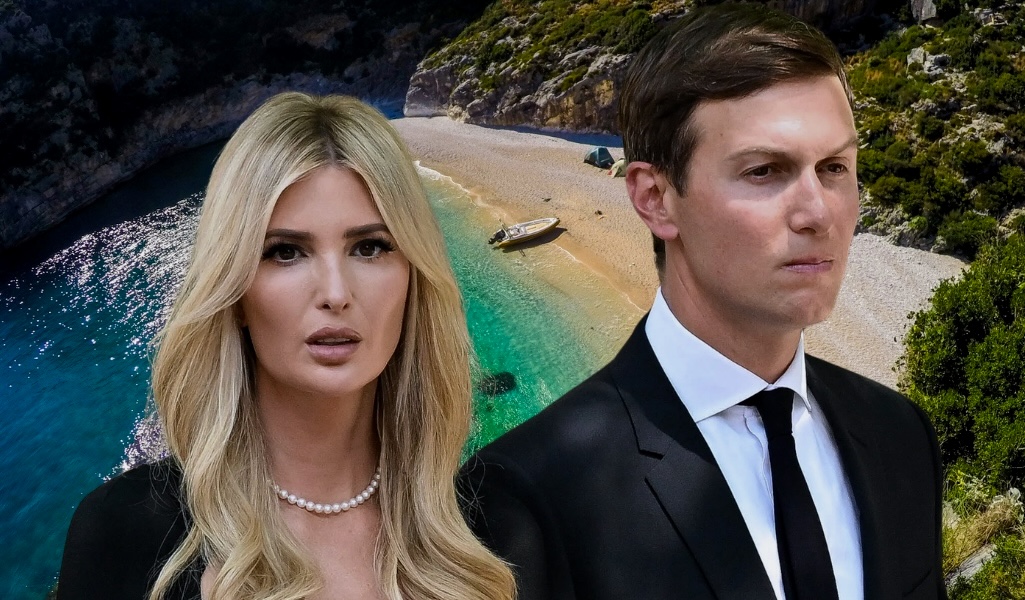
Protect Sazan Island from the Trump family! https://secure.avaaz.org/campaign/en/protect_sazan_island_from_the_trump_family_loc/?bqFCVab&v=174511&cl=22707147157&_checksum=5e9dde668860e8231c33699735e16a1fbf22ab2cb01da50c999fe8732b9775ef&utm_source=email&utm_medium=blast_email&utm_campaign=174511
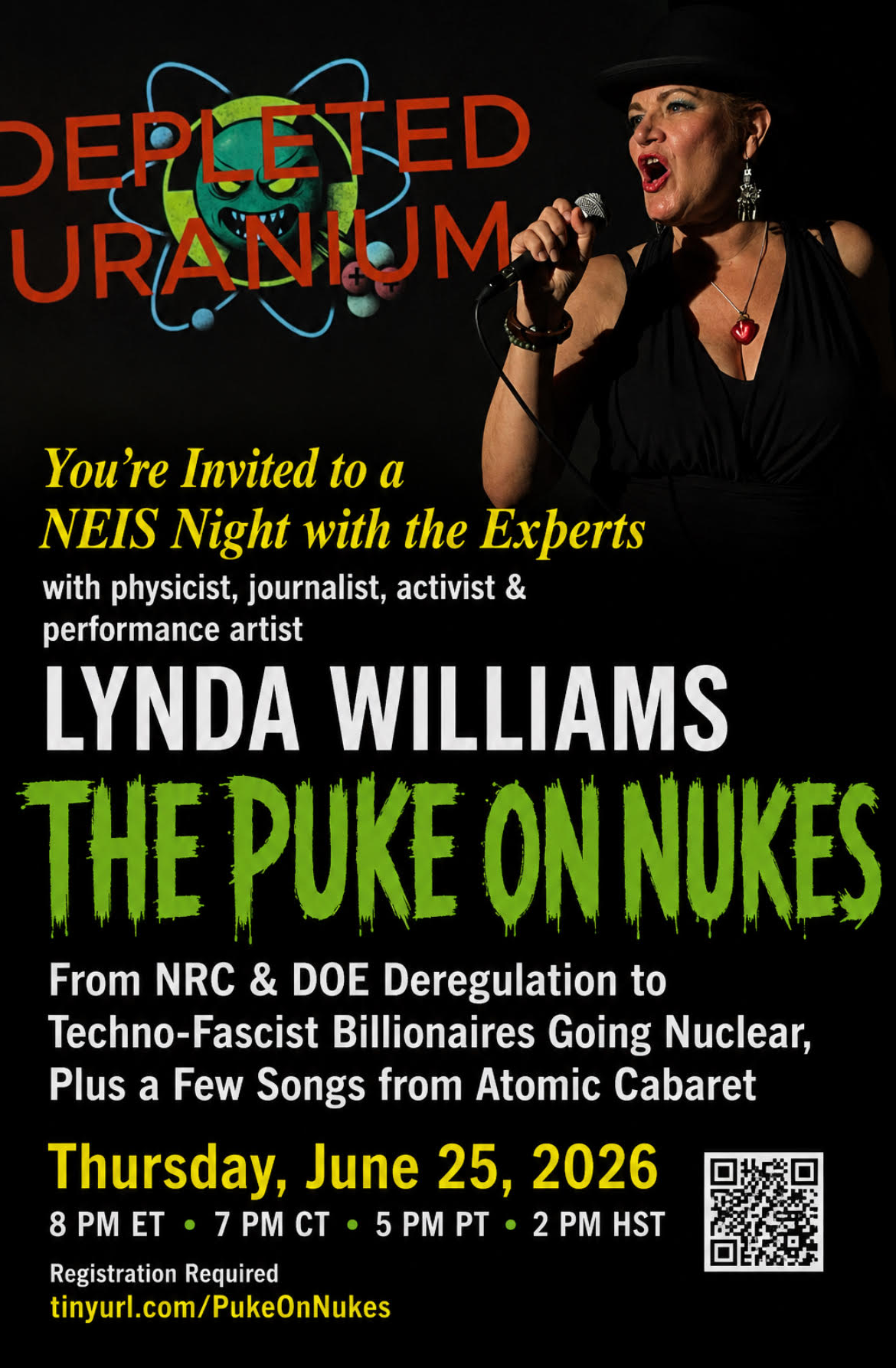
25 June- THE PUKE ON NUKES
Thursday, June 25, 2026
7pm Central Time (8pm ET, 6pm MT, 5pm PT) UTC – 5
From NRC & DOE Deregulation to Techno-Fascist Billionaires Going Nuclear, Plus a Few Songs from Atomic Cabaret REGISTER
26 June – Radiation Trainwreck at the NRC / Join the Protect Better Campaign – https://us02web.zoom.us/meeting/register/4ZlZ5_qLSHGiLSCg8FF6Bg#/registration

Cuba Is Not a Failed State – It Is a Besieged State
PETITION: “Global Appeal to Endorse Palestinian Right of Return of Refugees”
To see nuclear-related stories in greater depth and intensity – go to https://nuclearinformation.wordpress.com
-
Archives
- June 2026 (182)
- May 2026 (306)
- April 2026 (356)
- March 2026 (251)
- February 2026 (268)
- January 2026 (308)
- December 2025 (358)
- November 2025 (359)
- October 2025 (376)
- September 2025 (257)
- August 2025 (319)
- July 2025 (230)
-
Categories
- 1
- 1 NUCLEAR ISSUES
- business and costs
- climate change
- culture and arts
- ENERGY
- environment
- health
- history
- indigenous issues
- Legal
- marketing of nuclear
- media
- opposition to nuclear
- PERSONAL STORIES
- politics
- politics international
- Religion and ethics
- safety
- secrets,lies and civil liberties
- spinbuster
- technology
- Uranium
- wastes
- weapons and war
- Women
- 2 WORLD
- ACTION
- AFRICA
- Atrocities
- AUSTRALIA
- Christina's notes
- Christina's themes
- culture and arts
- Events
- Fuk 2022
- Fuk 2023
- Fukushima 2017
- Fukushima 2018
- fukushima 2019
- Fukushima 2020
- Fukushima 2021
- general
- global warming
- Humour (God we need it)
- Nuclear
- RARE EARTHS
- Reference
- resources – print
- Resources -audiovicual
- Weekly Newsletter
- World
- World Nuclear
- YouTube
-
RSS
Entries RSS
Comments RSS
 nuclear-news