Nuclear deal between USA and Saudi Arabia sneaked in under the guise of “clean energy”

Saudi-US partnership to develop clean and nuclear [i.e. dirty] energy
The partnership framework for Clean Energy Development between the two countries has identified the cooperation fields in which Kingdom of Saudi Arabia and the US will work to enhance, in order to achieve their ambitions in spreading clean energy and climate action.
Staff Writer, Saudi Gazett, January 15, 2023
RIYADH – The governments of Saudi Arabia and the United States intend to enhance cooperation between the two countries, in accordance with their respective national laws, through the Partnership Framework for Clean Energy Development.
The partnership framework for Clean Energy Development between the two countries has identified the cooperation fields in which KSA and the US will work to enhance, in order to achieve their ambitions in spreading clean energy and climate action.
The Umm Al-Qura newspaper has published the details of partnership framework and the potential cooperation fields.
…….. This cooperation would strengthen the common interests and strategic goals of each participant, and also to organize cooperation in clean energy field to study innovation, development, financing, and establishing infrastructure for clean energy in KSA and the US.
The partnership has identified several potential cooperation fields between the two countries in terms of civil nuclear energy and uranium, of which are the cooperation in basic researches, and development in the field of civil nuclear energy.
The cooperation fields include the exchange of experiences in various aspects, such as the field of developing advanced reactor technologies……. https://www.zawya.com/en/economy/gcc/saudi-us-partnership-to-develop-clean-and-nuclear-energy-v2ji0cu4
US Says ‘All Options’ On Table As Iran Nuclear Talks Remain Deadlocked.
US State Department said Tuesday that nuclear talks with Iran remain dormant and although diplomacy is the preferred approach, other options remain on the table.
Iran International Newsroom 4 Jan 23
Spokesperson Ned Price said the United States has not observed any change from the Iranian side to warrant a resumption of negotiations to revive the 2015 nuclear accord known as the JCPOA. The Biden administration’s 18-month-long diplomatic effort to reach agreement with Tehran arrived at a deadlock in early September.
“We continue to believe that diplomacy is the best way to achieve that goal, but we’ve always been clear we’re not going to remove options from the table, and we’re going to discuss all options with our partners, including, of course, Israel,” Price asserted.
Israeli leaders have repeatedly said that they will use any means for stopping Iran from obtaining nuclear weapons…………………..
The Biden administration has been quick in starting discussion with the new Israeli right-wing government headed by Benjamin Netanyahu, a staunch opponent of the JCPOA. Secretary of State Antony Blinken held discussion with the new Israeli foreign minister Elie Cohen in recent days. He told new Israeli Foreign Minister Eli Cohen in a 40-minute phone-call that the JCPOA was finished, and that the US wanted the European Union to step up sanctions against Iran.
Blinken’s reported statement about JCPOA being “finished” echoed President Joe Biden’s remark during an election stomp in early November, when he was heard in a video saying the JCPOA “is dead.”……………….. more https://www.iranintl.com/en/202301049694
Comments on a Jerusalem Post article that praised Ukraine’s Nazi Azov battalion.
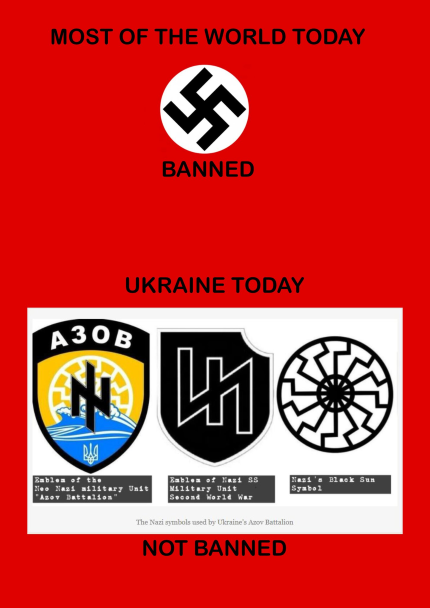

The AZOV regiment is visiting Israel. But not all Jews are taken in by this whitewashing of the Nazi history and influence in Ukraine. Below are some of the comments on the rather fawning Jerusalem Post article.
george130556, 21 December, 2022 Eternal shame on Israel for receiving these modern-day Nazis, who worship the murderers of tens of thousands of Jews in Ukraine during WWII.
Maurits2307 21 December, 2022 – “associated with neo-Nazi and far-right symbolism and ideologies, the Azov Regiment today insists that it has largely purged those sentiments from the regiment.” Russia is doing the purging. In the field, Ukranians still act like Nazis with multiple recorded war crimes. They wear Nazi insignia on their uniforms. Their vehicles have Nazi military insignia. If it looks like a Nazi, acts like a Nazi. It´s a Nazi.
Boris_SF 21 December, 2022, It is the Ukrainian establishment that glorify monsters like Chmelnitcki, Petliura, Bandera, Shukhevych and many officers of the Ukrainian SS Galicia Division on streets, squares and statues, all over Ukraine. It is true.
Jack, 20 December, 2022 Ukraine has this weird fixation with Israel
Israel should not be getting involved, Ukraine is soaked in Jewish blood, how Jews can want to help them defies belief.
Maybe read some history re pogroms and ww2, before you fall all over yourself to help them.
bjashka, 20 December, 2022 Don’t understand why we are welcoming Ukraine nationalist of contraversal Azov battalion. Part of the battalion members are public n@zis and were banned in US and Europe for this.
Baruch Baruch 20 December, 2022 As a Jew, an Israeli and a human being I am shocked that we are befriending these guys. I dont care about their battles with Russians. Their history, imagery and ideology as well as themed youth and adult training camps speaks for itself. Disgraceful to host these Na…. fascists
Jossef Perl, 20 December, 2022 Zelensky, his foreign minister and his ambassador to Israel have been putting a lot of outlandish demands on Israel (more than on many other European countries), yet at the same time Ukraine has continued to vote against Israel in the UN. Outrageous!
Adam Burman, 20 December, 2022 Over 230 missiles fired by the Ukraine armed forces at Donetsk peoples republic yesterday, hitting 20 residential buildings, 6 civil infrastructure facilities, and Kalinin hospital.
but hey, keep cheerleading your pet Ukronutsis, right?
PS: That hospital was bombed by the Ukronazis using Swedish Howitzers.
“…………….. The visit was initiated by the Israeli Friends of Ukraine organization and with the support of the Ukrainian Embassy in Israel and the Nadav Foundation.
T. Hoekstra, 20 December, 2022 This reeks of a whitewashing of Azov from their neonaughty brand.
Neonoughties however generally are not just anti-semites but white supremacist.
Also Masada was the place the defenders got into cannbalism or suicide.
Not really heroic, but tragic.
When it comes to Mariupol just look for how they arrived in Mariupol.
And how they took care of the protesting local population.
Any Pro Maidan apologist should get sick of these Azov guys.
Chikwa, 21 December, 2022 Terribly sad that Israelis ignoring their history. Those who do so are doomed to repeat it. We witnessed on TV how the Ukrainian soldiers discriminated vs African and Asian students trying to leave the Country as the Fled Putins army. Annti Semitismbis on the rise in EU and America. Liberal Jews turn a blind eye !
Miroslav Iliaš, 21 December, 2022 Half of the article is about how Azov Regiment distances itself from its neonazi past. We will see at the end of the bloody day – when the war finishes, how the Ukrainian society will deal with its dark past.
Ghost of kiev, 20 December, 2022 Well done JPost, just whitewash the azov n@zis.
democritique21 December, 2022, I can’t seem to quite get this! We allow a self-proclaimed natsi battalion to enter Eretz Israel and complain about the NYT’s natsi symbol stylized crossword???
maria992, 21 December, 2022 Total ignorance in history and secondary no comparison to Masada as Ukrainian are of Russian origin.
Adam Burman, 20 December, 2022 Ha Ha Ha! Jpost is actually running hasbara for Ukronazis.
National Socialists of the world Unite, I suppose, huh…
pizzaparty2579, 21 December, 2022 Is Israel a Jewish state? If so, how could Israel let these monsters in? Guess they are here to beg for money and we are the masochists.
ErastF , 21 December, 2022, I’m baffled. How was decided that just the Azov people will represent the Ukrainian interests in Israel? I don’t expect anything from the Ukrainian ambassador but didn’t the Israel friends of Ukraina hear something about the Azov regiment?
george130556, 21 December, 2022, Israel welcomes mass murderers, who carried out the massacres of civilians in Mariupol, Kramatorsk, Bucha, and Izyum.
wolfsonia, 21 December, 2022 , If Israel wants to stay or at least look neutral then hosting Azov is a stupid idea.
TCohen 19 Dec 22, The Azov Battalion ARE Nazis, so Israel’s allowance of entry IS UNACCEPTABLE and DEAD WRONG!
Yrraf, 21 December, 2022 Yes, every picture of the regiment shows how “distanced” they are from nazi ideology. For all people in the comment section go to the army recognition site and check for news that Ukrainian soldiers captured enough Russian BMP-3 IFVs to equip one battalion. Not a Rusian source, and without any hesitation, they are showing captured Rusian IFV with Wehrmacht insignia in Azov service. That’s how modern “journalists” in Izrael respect dead ancestors slaughtered by that same sick ideology.
MJandecka, 21 December, 2022 Azov? Neo Nazis.
************************************************************
Ukraine’s Azov Regiment visits Israel: ‘Mariupol is our Masada’, Azov officer Ilya Samoilenko, one of the defenders of the Azovstal steelworks in Mariupol, led the delegation to Israel. Jerusalem Post, By TZVI JOFFRE DECEMBER 20, 2022 https://www.jpost.com/international/article-725351
Iran after a region free of nuclear weapons, Kharrazi says
TEHRAN, Dec. 19 (MNA) – Expressing Iran’s readiness to return to its JCPOA obligations, the head of Iran’s Foreign Policy Strategic Council said that for decades, Iran has been after a region free of nuclear weapons……………………………..
Iran ready to return to its JCPOA obligations
He also referred to IAEA technical team’s visit to Tehran, saying, “Now Iran is ready to return to its JCPOA obligations. Many problems have been solved so far except for the safeguard issues, and we hope that these issues will be resolved during this visit.”
For decades, Iran has been after a region free of nuclear weapons, he said, stressing that Israel’s nuclear weapons should also be destroyed and it should join safeguard.
Today, Iran has the necessary nuclear capability, but the country has no intention to build nuclear weapons, he underlined. https://en.mehrnews.com/news/195126/Iran-after-a-region-free-of-nuclear-weapons-Kharrazi-says
Iran says Jordan summit ‘good opportunity’ for nuclear talks
Al-Monitor. Agence France-Presse, December 19, 2022 — Tehran (AFP)
Iran’s foreign minister said Monday that a summit to take place this week in Jordan will be a “good opportunity” for negotiations aimed at restoring the 2015 nuclear accord.
On-off talks to revive the deal, formally known as the Joint Comprehensive Plan of Action (JCPOA), started in April last year directly between Iran and Britain, China, France, Germany and Russia, and indirectly with the United States.
But the indirect talks between the Washington and Tehran, mediated by the European Union, have stalled for several months with Iran facing protests over the September 16 death in custody of Mahsa Amini, a 22-year-old Iranian of Kurdish origin.
………………………………
Meanwhile, a UN nuclear watchdog team led by deputy director-general Massimo Aparo left Iran on Monday, after a one-day visit aimed at resolving a years-long impasse over an enquiry into undeclared uranium particles found in the country, ISNA news agency reported.
The International Atomic Energy Agency team met with Iranian officials including Mohammad Eslami, the head of the Atomic Energy Organisation of Iran, ISNA said.
The IAEA has for years been calling on Iran to explain the presence of undeclared man-made uranium found at three sites, requesting access and the collection of samples.
The two parties discussed “future cooperation” among other issues, ISNA said……………………….more: https://www.al-monitor.com/originals/2022/12/iran-says-jordan-summit-good-opportunity-nuclear-talks#ixzz7nxK78WmI
Iran increasing its nuclear power
Iran on Saturday began construction on a new nuclear power plant in the
country’s southwest, Iranian state TV announced, amid tensions with the
U.S. over sweeping sanctions imposed after Washington pulled out of the
Islamic Republic’s nuclear deal with world powers.
The new 300-megawatt plant, known as Karoon, will take eight years to build and cost around $2
billion, the country’s state television and radio agency reported. The
plant will be located in Iran’s oil-rich Khuzestan province, near its
western border with Iraq, it said.
Iran has one nuclear power plant at its
southern port of Bushehr that went online in 2011 with help from Russia,
but also several underground nuclear facilities. The announcement of
Karoon’s construction came less than two weeks after Iran said it had
begun producing enriched uranium at 60% purity at the country’s
underground Fordo nuclear facility. The move is seen as a significant
addition to the country’s nuclear program.
PBS 3rd Dec 2022
https://www.pbs.org/newshour/world/iran-announces-start-of-construction-on-new-nuclear-power-plant
‘Deliberate ambiguity’: Israel’s nuclear weapons are greatest threat to Middle East
https://peoplesworld.org/article/deliberate-ambiguity-israels-nuclear-weapons-are-greatest-threat-to-middle-east/ December 2, 2022 11:06 AM CST BY RAMZY BAROUD
As Western countries are floating the theory that Russia could escalate its conflict with Ukraine to a nuclear war, many of those governments continue to turn a blind eye to Israel’s nuclear weapons capabilities. Luckily, many other countries around the world do not subscribe to this endemic hypocrisy.
The Conference on the Establishment of a Middle East Zone Free of Nuclear Weapons and Other Weapons of Mass Destruction was held between Nov. 14-18, with the sole purpose of creating new standards of accountability that, as should always have been the case, would apply equally to all Middle Eastern countries.
The debate regarding nuclear weapons in the Middle East could not possibly be any more pertinent or urgent. International observers rightly note that the period following the Russia-Ukraine war is likely to accelerate the quest for nuclear weapons throughout the world. Considering the seemingly perpetual state of conflict in the Middle East, the region is likely to witness nuclear rivalry as well.
For years, Arab and other countries attempted to raise the issue that accountability regarding the development and acquisition of nuclear weapons cannot be confined to states that are perceived to be enemies of Israel and the West.
The latest of these efforts was a United Nations resolution that called on Israel to dispose of its nuclear weapons, and to place its nuclear facilities under the monitoring of the International Atomic Energy Agency (IAEA). Resolution number A/C.1/77/L.2, which was drafted by Egypt with the support of other Arab countries, passed with an initial vote of 152-5. Unsurprisingly, among the five countries that voted against the draft were the United States, Canada and, of course, Israel itself.
U.S. and Canadian blind support of Israel notwithstanding, what compels Washington and Ottawa to vote against a draft entitled “The risk of nuclear proliferation in the Middle East?” Keeping in mind the successive right-wing extremist governments that have ruled over Israel for many years, Washington must understand that the risk of using nuclear weapons under the guise of fending off an “existential threat” is a real possibility.
Since its inception, Israel has resorted to, and utilized the phrase “existential threat” countless times. Various Arab governments, later Iran and even individual Palestinian resistance movements, were accused of endangering Israel’s existence per se. Even the non-violent Palestinian civil society-led Boycott, Divestment and Sanctions (BDS) Movement was accused by then-Prime Minister Benjamin Netanyahu in 2015 of being an existential threat to Israel. Netanyahu claimed that the boycott movement was “not connected to our actions; it is connected to our very existence.”
This should worry everyone, not just in the Middle East, but the whole world. A country with such hyped sensitivity about imagined “existential threats” should not be allowed to acquire the kinds of weapons that could destroy the entire Middle East several times over.
Some may argue that Israel’s nuclear arsenal was intrinsically linked to real fears resulting from its historical conflict with the Arabs. However, this is not the case. As soon as Israel completed Stage 1 of its ethnic cleansing of Palestinians from their historic homeland, and long before any serious Arab or Palestinian resistance was carried out in response, Israel was already on the lookout for nuclear weapons.
As early as 1949, the Israeli army had found uranium deposits in the Negev Desert, leading to the establishment, in 1952, of the highly secretive Israel Atomic Energy Commission (IAEC).
In 1955, the U.S. government sold Israel a nuclear research reactor. But that was not enough. Eager to become a full nuclear power, Tel Aviv resorted to Paris in 1957. The latter became a major partner in Israel’s secretive nuclear activities when it helped the Israeli government construct a clandestine nuclear reactor near Dimona in the Negev Desert.
The father of the Israeli nuclear program at the time was none other than Shimon Peres who, ironically, was awarded the Nobel Peace Prize in 1994. The Dimona Nuclear Reactor is now named “Shimon Peres Nuclear Research Center-Negev.”
With no international monitoring whatsoever, thus with zero legal accountability, Israel’s nuclear quest continues to this day. In 1963, Israel purchased 100 tons of uranium ore from Argentina, and it is strongly believed that during the October 1973 Israel-Arab war, Israel “came close to making a nuclear preemptive strike,” according to Richard Sale, writing for United Press International (UPI).
Currently, Israel is believed to have “enough fissionable material to fabricate 60-300 nuclear weapons,” according to former U.S. Army Officer Edwin S. Cochran.
Estimates vary, but the facts about Israel’s weapons of mass destruction (WMDs) are hardly contested. Israel itself practices what is known as “deliberate ambiguity,” so as to send a message of its lethal power to its enemies, without revealing anything that may hold it accountable to international inspection.
shows what now is known as the Shimon Peres Negev Nuclear Research Center near the city of Dimona, Israel. A long-secretive Israeli nuclear facility that gave birth to its undeclared atomic weapons program appeared to be undergoing its biggest construction project in decades recently, according to newly taken satellite photos analyzed by The Associated Press. | U.S. Center for Earth Resources Observation and Science / U.S. Geological Survey | via AP
Estimates vary, but the facts about Israel’s weapons of mass destruction (WMDs) are hardly contested. Israel itself practices what is known as “deliberate ambiguity,” so as to send a message of its lethal power to its enemies, without revealing anything that may hold it accountable to international inspection.
What we know about Israel’s nuclear weapons has been made possible partly because of the bravery of former Israeli nuclear technician Mordechai Vanunu, a whistleblower who was held in solitary confinement for a decade due to his courage in exposing Israel’s darkest secrets.
Still, Israel refuses to sign the Treaty on the Non-Proliferation of Nuclear Weapons (NPT), endorsed by 191 countries.
Israeli leaders adhere to what is known as the “Begin Doctrine,” in reference to Menachem Begin, the rightwing Israeli prime minister who invaded Lebanon in 1982, resulting in the killing of thousands. The doctrine is formulated around the idea that, while Israel gives itself the right to own nuclear weapons, its enemies in the Middle East must not. This belief continues to direct Israeli actions to this day.
U.S. support for Israel is not confined to ensuring the latter has “military edge” over its neighbors in terms of traditional weapons, but also to ensure Israel remains the region’s only superpower, even if that entails escaping international accountability for the development of WMDs.
The collective efforts by Arab and other countries at the UN General Assembly to create a Middle East Zone Free of Nuclear Weapons are welcomed initiatives. It behooves everyone, Washington included, to join the rest of the world in finally forcing Israel to join the Non-Proliferation Treaty, a first but critical step toward long delayed accountability.
‘Deliberate ambiguity’: Israel’s nuclear weapons are greatest threat to Middle East
Middle East Monitor Dr Ramzy Baroud, November 28, 2022 ,
As western countries are floating the theory that Russia could escalate its conflict with Ukraine to a nuclear war, many western governments continue to turn a blind eye to Israel’s own nuclear weapons capabilities. Luckily, many countries around the world do not subscribe to this endemic western hypocrisy.
‘The Conference on the Establishment of a Middle East Zone Free of Nuclear Weapons and Other Weapons of Mass Destruction’ was held between November 14-18, with the sole purpose of creating new standards of accountability that, as should have always been the case, be applied equally to all Middle Eastern countries.
The debate regarding nuclear weapons in the Middle East could not possibly be any more pertinent or urgent. International observers rightly note that the period following the Russia-Ukraine war is likely to accelerate the quest for nuclear weapons throughout the world. Considering the seemingly perpetual state of conflict in the Middle East, the region is likely to witness nuclear rivalry as well.
For years, Arab and other countries attempted to raise the issue that accountability regarding the development and acquisition of nuclear weapons cannot be confined to states that are perceived to be enemies of Israel and the West.
The latest of these efforts was a United Nations resolution that called on Israel to dispose of its nuclear weapons, and to place its nuclear facilities under the monitoring of the International Atomic Energy Agency (IAEA). Resolution number A/C.1/77/L.2, which was drafted by Egypt with the support of other Arab countries, passed with an initial vote of 152-5. Unsurprisingly, among the five countries that voted against the draft were the United States, Canada and, of course, Israel itself.
US and Canadian blind support of Tel Aviv notwithstanding, what compels Washington and Ottawa to vote against a draft entitled: “The risk of nuclear proliferation in the Middle East”? Keeping in mind the successive right-wing extremist governments that have ruled over Israel for many years, Washington must understand that the risk of using nuclear weapons under the guise of fending off an ‘existential threat’ is a real possibility.
Since its inception, Israel has resorted to, and utilised the phrase ‘existential threat’ countless times. Various Arab governments, later Iran and even individual Palestinian resistance movements were accused of endangering Israel’s very existence. Even the non-violent Palestinian civil society-led Boycott, Divestment and Sanctions (BDS) Movement was accused by then-Prime Minister Benjamin Netanyahu in 2015 of being an existential threat to Israel. Netanyahu claimed that the boycott movement was “not connected to our actions; it is connected to our very existence.”
This should worry everyone, not just in the Middle East, but the whole world. A country with such hyped sensitivity about imagined ‘existential threats’ should not be allowed to acquire the kind of weapons that could destroy the entire Middle East, several times over.
Some may argue that Israel’s nuclear arsenal was intrinsically linked to real fears resulting from its historical conflict with the Arabs. However, this is not the case. As soon as Israel finalised its ethnic cleansing of Palestinians from their historic homeland, and long before any serious Arab or Palestinian resistance was carried out in response, Israel was already on the lookout for nuclear weapons…………………..
With no international monitoring whatsoever, thus with zero legal accountability, Israel’s nuclear quest continues until this day. In 1963, Israel purchased 100 tons of uranium ore from Argentina, and it is strongly believed that, during the October 1973 Israel-Arab war, Israel “came close to making a nuclear preemptive strike”, according to Richard Sale, writing in United Press International (UPI).
Currently, Israel is believed to have “enough fissionable material to fabricate 60-300 nuclear weapons,” according to former US Army Officer, Edwin S. Cochran.
Estimates vary, but the facts about Israel’s weapons of mass destruction (WMDs) are hardly contested. Israel itself practices what is known as ‘deliberate ambiguity’, as to send a message to its enemies of its lethal power, without revealing anything that may hold it accountable to international inspection.
What we know about Israel’s nuclear weapons has been made possible partly because of the bravery of a former Israeli nuclear technician, Mordechai Vanunu, a whistleblower who was held in solitary confinement for a decade due to his courage in exposing Israel’s darkest secrets.
Still, Israel refuses to sign the Treaty on the Non-Proliferation of Nuclear Weapons (NPT), endorsed by 191 countries…………..
The US support for Israel is not confined to ensuring the latter has ‘military edge’ over its neighbours in terms of traditional weapons, but to also ensure Israel remains the region’s only superpower, even if that entails escaping international accountability for the development of WMDs.
The collective efforts by Arab and other countries at the UNGA to create a Middle East Zone Free of Nuclear Weapons are welcomed initiatives. It behoves everyone, Washington included, to join the rest of the world in finally forcing Israel to join the Non-Proliferation Treaty, a first but critical step towards long-delayed accountability. https://www.middleeastmonitor.com/20221128-deliberate-ambiguity-israels-nuclear-weapons-are-greatest-threat-to-middle-east/
Iran ‘not optimistic’ about nuclear deal revival talks
Argus, By Nader Itayim, 28 November 2022,
Iran’s foreign ministry said today the country is committed to finding a diplomatic solution to its nuclear dispute with the US and European countries, but said it is “not optimistic” the negotiations with Washington to restore the 2015 nuclear agreement will bear fruit.
Tehran and Washington began talks in Vienna in April 2021 aimed at reviving the deal, known formally as the Joint Comprehensive Plan of Action (JCPOA), which former US President Donald Trump reneged on in 2018 before he reimposed sanctions on Iran’s banking and energy sectors. After good signs of progress earlier this year, the negotiations stalled some months ago over several points of contention primarily concerning the extent of US sanctions relief for Iran should the deal be revived…………………….
Last week Iran said it had begun enriching uranium to 60pc purity at its Fordow nuclear site, in response to a resolution passed by the International Atomic Energy Agency’s (IAEA) board of governors urging Tehran to co-operate with a long-standing investigation into uranium traces it found at three undeclared Iranian nuclear sites. This is the first time enrichment would reach such a level at Fordow, although enrichment to 60pc purity has been happening at Iran’s other site, Natanz, since the first half of 2021.
The US, EU, and UK, meanwhile, have been imposing new sanctions on a host of Iranian individuals and entities for their involvement in the production and supply of drones to Russia for use against Ukraine……… https://www.argusmedia.com/en/news/2395141-iran-not-optimistic-about-nuclear-deal-revival-talks
Iran Media Looks Beyond Nuclear Deal As Negotiations ‘Fail’
https://www.iranintl.com/en/202211243491 Iran International Newsroom, 24 Nov 22
With nuclear talks frozen and the US and Europe levying further sanctions, Iranian commentators are looking at life under permanent US ‘maximum pressure.’
IRNA, the official news agency, November 24 portrayed Iran’s acceleration of its nuclear program since 2019 as a series of responses to United States, Israeli or European actions – beginning 2018 with the US “covenant-breaking” in leaving the 2015 Iran nuclear agreement, the JCPOA (Joint Comprehensive Plan of Action), and imposing ‘maximum pressure’ sanctions.
Iran’s announcement Tuesday that it was enriching uranium to 60 percent at the Fordow site was yet another “reaction to the excesses of the West,” IRNA argued, just as enrichment to 60 percent at Natanz, another nuclear site, in April came in response to “sabotage actions” at the site attributed to Israel.
In fact, Iran decided to start 60-percent enrichment in early 2021 just as the new US administration had announced its readiness to return to the JCPOA and talks in Vienna were about to begin.
Tehran announced the latest move as a reply to a resolution raised by France, Germany, the United Kingdom, and the United States passed November 17 at the board of the 37-member board of the International Atomic Energy Agency (IAEA). The US and ‘E3’ had “tied a technical and legal case…to events inside the country and protests turned into riots,” IRNA argued. “The troika of Europe and the United States stopped the nuclear talks under the pretext of unrest inside Iran.”
Casting further doubts on talks, IRNA argued, was the looming return to power of Benjamin Netanyahu, which it suggested would “definitely intensify…the Zionist regime’s delusional claims against the Islamic Republic of Iran.”
‘Impasse’ in diplomacy
Separately, Fararu, a privately owned news agency, carried a discussion with Hosseini Kanani-Moghadam, head of Iran’s conservatively-inclined Green Party, and Fereydoun Majlesi, a former diplomat who has for some time been pessimistic over the JCPOA.
Majlesi argued that “the West” had long given up hope of negotiating with Iran and sought to re-use tactics that had undermined the Soviet Union. “Western countries,” he said, had judged that President Ebrahim Raisi’s government, which took office in 2021, inclined against the JCPOA with ministers asking why Iran accepted nuclear restrictions while gaining nothing from the agreement.
The result was an “impasse” in diplomatic efforts to restore the JCPOA – an impression confirmed, Majlesi said, by the French president and Canadian prime minister recently meeting “supporters of subversion in our country,” a reference to exiled activists and social-media ‘influencers.’ This accelerated an “agenda against Iran” over “recent years” that had “led to significant economic pressures” aimed at “impoverishing Iran.”
Kanani-Moghadam argued that Iran retained political levers “in the event of the escalation of hostile policies,” including “complete withdrawal from the JCPOA” (presumably ending all nuclear restrictions but staying within the Nuclear Non-Proliferation Treaty), or even leaving the NPT.
Bagheri-Kani in India: Focus on economy
Post-JCPOA thinking were also evident in discussions during the visit to India of Ali Bagheri-Kani, deputy Iranian foreign minister and leading nuclear negotiator. While IRNA Thursday reported Bagheri-Kani attacking “the atmosphere created by some western media regarding the developments in Iran,” its focus was business.
While Bagheri-Kani’s brief as one of five deputy ministers is politics, his interview with Asia International News Agency(ANI) also focused on economics, and how commerce might continue should US ‘maximum pressure’ last. ANI noted that bilateral trade had risen 46 percent between 2011-12 and 2019-20.
While criticizing the US for disrupting world energy security with sanctions against Iran, Russia, and Venezuela, Bagheri-Kani highlighted potential for Iran to help India over energy in return for food exports, presumably through barter or non-dollar arrangements. He also stressed that India’s project for developing Chabahar port, in Sistan-Baluchistan province, was continuing.
New Delhi has been slow to develop the port in fear of US punitive action under ‘maximum pressure.’ Once a major buyer of Iranian oil, India has grown increasingly frustrated at Washington’s approach. It abstained, along with Pakistan, at the recent vote condemning Iran at the IAEA board.
U.N. Supplied Qatar With Tech to ‘Prevent Nuclear Security Incident’ at 2022 World Cup
Washington Free Beacon, Adam Kredo • November 21, 2022,
The United Nations provided Qatar with equipment and training to prevent “a nuclear security incident” from occurring during the 2022 World Cup, according to the U.N.’s nuclear watchdog group.
The International Atomic Energy Agency (IAEA), which works on proliferation issues across the globe, says it has worked with Qatar’s National Committee for the Prohibition of Weapons for the past year “to thwart any attack involving nuclear or other radioactive material.” The announcement comes as jihadist groups like al Qaeda urge its militant followers “wage jihad” against the tournament as Westerners pour into the country……………
The IAEA says that in the lead up to the games, the organization helped Qatar integrate its nuclear security measures into larger plans that could help disrupt a nuclear or radiological attack. This included providing “comprehensive training to national counterparts on developing and implementing nuclear security measures and on responding to nuclear security events and related emergencies.”
The nuclear watchdog lent Qatar more than 120 radiation detecting devices, including personal radiation detectors, portable backpack detectors, and other instruments that can spot things like a dirty bomb, a crude explosive device that includes radioactive materials.
This is “the first time” the IAEA’s Malaysia-based security center provided such equipment to a country hosting a major public event, according to the IAEA………………………. https://freebeacon.com/national-security/un-supplied-qatar-with-tech-to-prevent-nuclear-security-incident-at-2022-world-cup/
Fears that oil exporters will control the next COP climate summit

Fears are growing among climate experts and campaigners over the influence
of fossil fuel producers on global climate talks, as a key Gulf petro-state
gears up to take control of the negotiations. The United Arab Emirates, one
of the world’s biggest oil exporters, will hold the presidency of Cop28,
the next round of UN climate talks that will begin in late November next
year. Decisions taken at the Cop27 climate summit in Egypt, which finished
on Sunday, showed the clear imprint of fossil fuel influence, according to
people inside the negotiations. They said Saudi Arabia – an ally of Egypt
outside the talks – played a key role in preventing a strong commitment
to limiting temperature increases to 1.5C above pre-industrial levels. Many
countries, including the UK and the EU, were bitterly disappointed. Alok
Sharma, the UK president of last year’s Cop26 summit, said in visible
anger at the conclusion of Cop27 on Sunday morning: “Those of us who came
to Egypt to keep 1.5C alive, and to respect what every single one of us
agreed to in Glasgow, have had to fight relentlessly to hold the line.”
Guardian 22nd Nov 2022
“Everywhere you look at Egypt’s COP27 you can see and hear the influence of the fossil fuel industry” – Greenpeace .
Yeb Saño, Executive Director, Greenpeace Southeast Asia and Head of the
Greenpeace delegation attending the COP said: “While this is merely a
skeleton of the Egyptian Presidency’s draft of a COP cover note
Greenpeace is shocked that it has no backbone. It is scarcely credible that
they have forgotten all about fossil fuels especially with the level of
carbon cartel capture present here in Sharm el-Sheikh.”
“Everywhere you
look in Sharm el-Sheikh you can see and hear the influence of the fossil
fuel industry. They have shown up in record numbers to try and decouple
climate action from a fossil fuel phase out.”
“India clearly put all
fossil fuels on the phase down negotiating table. The EU could not have
been simpler in calling for a phase out. And, Tuvalu powerfully connected
transitioning away from fossil fuels with staying below 1.5C as a human
right. T
The ever present COP chroniclers of the Egyptian Presidency somehow
seem to have failed to record any of it.” The cover note must make it
clear that limiting temperature rise to 1.5C by 2100 is the only acceptable
interpretation of the Paris Agreement and acknowledge the 1.5°C aligned
global phase out dates for the production and consumption of coal, gas and
oil.”
Greenpeace International 15th Nov 2022
Israeli nuclear arsenal condemned by world’s govts in overwhelming UN vote
https://morningstaronline.co.uk/article/f/global-majority-leads-way-nuclear-disarmament-time-reflect-reality-here, Sameena Rahman,November 9, 2022,
In an overwhelming vote, the United Nations General Assembly declared last week that apartheid Israel must immediately cease operations of all its nuclear weapons, get rid of the ones that exist, and place all its nuclear sites under the supervision of the International Atomic Energy Agency.
These stipulations against Israel were outlined in a resolution submitted by Egypt on behalf of the UN-member countries that are also a part of the Arab League, including the Palestinian Authority, Bahrain, Jordan, Saudi Arabia and United Arab Emirates.
The resolution was approved by 152 countries — 79% of UN member states — with five votes against, unsurprisingly the United States and Israel, and also Canada, Micronesia and Palau. Some 24 abstentions were composed of European Union members, NATO allies and India.
Resolution calling for an end to Israel’s illegal nuclear stockpile
The resolution, titled “The risk of nuclear proliferation in the Middle East,” highlighted the risks of unsafeguarded nuclear facilities in the Middle East and demanded that Israel follow the principles of universal adherence to the Treaty on the Non-Proliferation of Nuclear Weapons, adopted in the region in 1995. Since then, Israel has been the only entity in the region that has repeatedly refused to sign the treaty and has spent the last few decades hypocritically denying the existence of its nuclear weapons.
A recent United Kingdom Parliamentary report states “that Israel possesses a nuclear weapons capability, outside of the framework of the NPT,” after specific details were revealed by whistleblower Mordechai Vanunu in 1988. Israel is believed to have at least 90 nuclear warheads, according to the report, and continues to produce weapons-grade plutonium.
Israel, hiding behind its imperial backer, the United States, continues its stockpiling of nuclear weapons in an extensive threat to the geopolitical stability in the Middle East. Documents from the early 1960’s, revealed in 2014, show that Washington played a key role in building Israel’s nuclear arsenal in secret while publicly denying any knowledge and adopting a line of ambiguity on nuclear power and weapons. Numerous reports since then established that the United States knew of and supported Israel’s nuclear capabilities in gross violation of international law and while punishing countries like Iran and North Korea for having or developing defensive weapons.
U.S. and Israel’s hypocritically label Iran as a nuclear threat
In the last few decades, the United States and Israel consistently labeled Iran as a nuclear threat to peace and stability in the Middle East despite Israel itself invading all bordering countries. Of note, Iran has no nuclear weapons, and signed on to the NPT as well as the Joint Comprehensive Plan of Action, which the United States pulled out of. Meanwhile, Israel remained in flagrant violation of international law.
Israel violated international law on numerous occasions by blatantly attacking Iran’s nuclear power plants used to generate energy, plunging the many areas of the country already suffocated by sanctions into darkness. In April last year, senior Israeli officials hinted at Mossad’s culpability for an attack on Iran’s key nuclear site Natanz, a heinous act of nuclear terrorism. Israel has also carried out the targeted assassination of Iranian nuclear scientist Mohsen Fakhrizadh and other Iranian scientists. Israel also admitted to attacking what it called “suspected” nuclear reactors in other neighboring countries, like Syria in Operation Outside the Box.
Nasser Kanaani, spokesperson for the Iranian Foreign ministry, said in a social media post, “The advanced nuclear military program of the apartheid regime of Israel and the regime’s continued reluctance to put its nuclear facilities under comprehensive safeguards and not to join the non-proliferation treaty is a serious threat to international security and the non-proliferation regime.”
Environmental fallout in Palestinian Occupied Territory
Israel’s criminal behavior is also significantly harming Palestinians in the West Bank. In 2021, Palestinian Prime Minister Mohammad Shtayyeh accused Israel of storing lethal radioactive waste in the West Bank and sickening Palestinians living in the area. He also linked high cancer rates in Hebron to the nearby Israeli Negev nuclear reactor, Dimona. Palestine currently suffers from major climate issues due to Israel’s seven-decade long occupation and the fallout from Israel’s military proliferation.
U.S. corporate media silence
While the UN and the international community have repeatedly pointed to and labeled Israel as a major threat to geopolitical stability in the Middle East, there has been a critical lack of coverage by the western mainstream corporate media. It is clear that the fog of fear of the United States and Israel is lifting in the international community as governments are more empowered to label Israel for what it is: an apartheid state and a gross violator of human rights in Palestine and elsewhere. The recent vote is an important recognition that Israel is the major threat to peace and stability in the Middle East.
Tale Of Two Broken Accords: Oslo And Minsk
Ukraine’s President Zelensky was elected on a platform promising to implement Minsk and end the death toll. Then the neo-Nazis enabled by the U.S. and NATO got to him. I suspect he was threatened with assasination unless he signed on to his country serving as the killing grounds for proxy war to weaken Russia.
https://went2thebridge.org/2022/11/07/tale-of-two-broken-accords-oslo-and-minsk/—
Many people understand that war is hell. That’s why they clamor for negotiated settlements that move belligerents back from the battlefield and set them on a path to reconciliation.
The Oslo Accords established a two-state solution to Israel’s violent occupation of Palestinian homelands and at the time was hailed as a major achievement.
Then came facts on the ground for the last several decades.
It would by now be virtually impossible to create a State of Palestine that was not hopelessly Balkanized into tiny, unconnected territories. At the time of Oslo, many expressed doubt and believed that only a truly democratic one-state solution could work. (Full disclosure: I’m in that camp.)
The insanely belligerent and corrupt Israeli PM Netanyahu has won the recent elections and stands poised to bring even more violence and suffering to the long-occupied Palestinians. And Israel is a nuclear weapons nation. With lots of nuclear threats and innuendoes being thrown around these days, it’s important to keep that in mind.
So we can expect to see a continuation of Israel’s attacks on Palestinians in blockaded Gaza
The Minsk II agreement established a game plan for resolving civil war in Ukraine.
Tens of thousands of civilians and combatants had been killed by missile strikes and more hands-on violence from militias operating freely in the Donbas border region with Russia following a 2014 CIA-sponsored coup in Kyiv. Years later, Ukraine’s President Zelensky was elected on a platform promising to implement Minsk and end the death toll. Then the neo-Nazis enabled by the U.S. and NATO got to him. I suspect he was threatened with assasination unless he signed on to his country serving as the killing grounds for proxy war to weaken Russia.
One wonders why nations sign on to accords and then immediately show no intention of fulfilling them?
It could be a stalling tactic to temporarily reduce international pressure to de-escalate.
Or it could be a case where those who signed on are ousted either by coup or elections, and succeeded by those with a lust for war.
Or maybe diplomatic efforts like accords are doomed in the face of the profit motive provided by modern industrialized killing?
Workers hold the key to stopping wars no matter what the motives of those waging them.
An international general strike would make wars literally impossible.
I pray we are seeing signs of this developing, especially in Europe where the economic impact of the war on Russia via Ukraine has been most intense. Certainly we are seeing signs of alarm from rulers enacting laws that actually criminalize gathering
1 This Month
26 September – International Day for the Total Elimination of Nuclear Weapons





PLEASE OPPOSE HR 8255 AND S.3639 – bills would accelerate satellite deployment, with no environmental review or safeguards – https://ncstd5li.quorum.us/campaign/169331/
To see nuclear-related stories in greater depth and intensity – go to https://nuclearinformation.wordpress.com
-
Archives
- September 2026 (291)
- August 2026 (330)
- July 2026 (355)
- June 2026 (287)
- May 2026 (306)
- April 2026 (356)
- March 2026 (251)
- February 2026 (267)
- January 2026 (308)
- December 2025 (358)
- November 2025 (359)
- October 2025 (375)
-
Categories
- 1
- 1 NUCLEAR ISSUES
- business and costs
- climate change
- culture and arts
- ENERGY
- environment
- health
- history
- indigenous issues
- Legal
- marketing of nuclear
- media
- opposition to nuclear
- PERSONAL STORIES
- politics
- politics international
- Religion and ethics
- safety
- secrets,lies and civil liberties
- spinbuster
- technology
- Uranium
- wastes
- weapons and war
- Women
- 2 WORLD
- ACTION
- AFRICA
- Atrocities
- AUSTRALIA
- Christina's notes
- Christina's themes
- culture and arts
- Events
- Fuk 2022
- Fuk 2023
- Fukushima 2017
- Fukushima 2018
- fukushima 2019
- Fukushima 2020
- Fukushima 2021
- general
- global warming
- Humour (God we need it)
- Nuclear
- RARE EARTHS
- Reference
- resources – print
- Resources -audiovicual
- Weekly Newsletter
- World
- World Nuclear
- YouTube
-
RSS
Entries RSS
Comments RSS

