Oman facilitating Iran-US talks to replace 2015 nuclear accord
MUSCAT DAILY, 12 JUN 2023
Tehran, Iran – Iran on Monday said it has continued indirect negotiations with the Unites States through the Sultanate of Oman over its nuclear deal and a possible prisoner swap.
Iran’s nuclear programme has long been the subject of scrutiny from Western powers, resulting in sanctions that have crippled the country’s economy.
A 2015 deal granted Tehran much-needed relief from sanctions in exchange for curbs on its nuclear programme before it was torpedoed by the United States’ unilateral pullout in 2018.
In recent days, the two capitals have denied media reports that they were close to reaching an interim deal to replace the 2015 accord.
“We welcome the efforts of Omani officials and we exchanged messages with the other party through this mediator” over the lifting of US sanctions, Iran’s Foreign Ministry spokesman Nasser Kanaani said on Monday.
“We have never stopped the diplomatic processes,” he added during his weekly press conference, emphasising that the talks “were not secret”.
Diplomatic ties between Tehran and Washington soured following the 1979 revolution led by Iran’s first supreme leader Ayatollah Ruhollah Khomeini.
Efforts to revive the 2015 nuclear deal have so far failed to yield results.
Iran’s Supreme Leader Ayatollah Ali Khamenei on Sunday reiterated the denial of moves towards acquiring a nuclear weapon. He also said deals could be reached, provided they do not change “the existing infrastructure of the nuclear industry”……………………………………………..more https://www.muscatdaily.com/2023/06/12/oman-facilitating-iran-us-talks-to-replace-2015-nuclear-accord/
Amid Blinken visit, top Saudi diplomat says kingdom seeks U.S. nuclear aid

PBS. Jun 8, 2023
DUBAI, United Arab Emirates (AP) — Saudi Arabia’s foreign minister said after meeting with the visiting U.S. secretary of state on Thursday that while the kingdom would welcome U.S. aid in building its civilian nuclear program, “there are others that are bidding.”
Foreign Minister Prince Faisal bin Farhan was responding to a question about recent news reports that Saudi Arabia is asking for U.S. aid in building its own nuclear program in exchange for establishing diplomatic relations with Israel.
“It’s no secret that we are developing our domestic civilian nuclear program and we would very much prefer to be able to have the U.S. as one of the bidders,” he said. “Obviously we would like to build our program with the best technology in the world.”
Prince Faisal went on to say that normalization with Israel would have “limited benefits” without “finding a pathway to peace for the Palestinian people.” He did not say whether the nuclear issue is linked to normalization.
The exchange came at the end of a two-day visit to the kingdom in which U.S. Secretary of State Antony Blinken met with senior Saudi officials, including the country’s de facto leader, Crown Prince Mohammed bin Salman, and co-hosted a meeting of the global coalition fighting the Islamic State group………………………………………………………………………………………….
Critics say Saudi Arabia’s diplomatic efforts and its push into international sports are aimed at repairing the kingdom’s image after the 2018 killing and dismemberment of Jamal Khashoggi, a prominent Saudi dissident and Washington Post columnist. U.S. intelligence concluded that Prince Mohammed likely approved the operation carried out by Saudi agents — allegations he denies.
Critics also point to an unprecedented crackdown on dissent in recent years, with authorities jailing everyone from liberal women’s rights activists to ultra-conservative Islamists, and even targeting Saudis living in the United States.
Blinken said “human rights are always on the agenda” and that he had raised “specific cases,” but did not say whether any progress had been made on the release of detainees or the lifting of travel bans on prominent activists…… https://www.pbs.org/newshour/world/amid-blinken-visit-top-saudi-diplomat-says-kingdom-seeks-u-s-nuclear-aid
Major Progress Made in Nuclear Talks Between U.S. and Iran in Preparation for a New Agreement
Amos Harel Haaretz 7 June 23
Israel expects an agreement to be reached within a few weeks, with the understandings expected to include an Iranian agreement to stop uranium enrichment at high levels in return for easing sanctions.
In an effort to reach an agreement on a nuclear deal, the contacts between the United States and Iran have made major progress in the past few days. Israeli defense officials say the talks are moving forward more rapidly than expected, with the possibility that the two sides will reach an agreement within weeks………. (Subscribers only) https://www.haaretz.com/israel-news/2023-06-07/ty-article/.premium/major-progress-made-in-nuclear-talks-between-u-s-and-iran/00000188-94bd-df21-a1b8-b7bd413d0000
UN nuclear chief, facing Israeli criticism on Iran, says his agency ‘very fair but firm’

Israel considers Iran to be its greatest enemy, and Netanyahu has repeatedly said that he wouldn’t allow Iran to develop a nuclear weapon. He has said international diplomacy should be accompanied by a serious military option, and hinted that Israel would be prepared to strike Iran on its own if necessary
STEPHANIE LIECHTENSTEIN, Tue, June 6, 2023
VIENNA (AP) — The International Atomic Energy Agency will “never politicize” its work in Iran, the head of the U.N. nuclear watchdog said Monday, insisting after Israel’s prime minister accused it of capitulating to Iranian pressure that his agency has been “very fair but firm.”
STEPHANIE LIECHTENSTEIN
Tue, June 6, 2023 at 12:15 AM GMT+10·3 min read
In this article:
Benjamin NetanyahuPrime Minister of Israel
- Rafael GrossiArgentine diplomat
VIENNA (AP) — The International Atomic Energy Agency will “never politicize” its work in Iran, the head of the U.N. nuclear watchdog said Monday, insisting after Israel’s prime minister accused it of capitulating to Iranian pressure that his agency has been “very fair but firm.”
Israeli Prime Minister Benjamin Netanyahu’s comments came after a confidential report from the IAEA last week said that its investigators had closed off their investigation of traces of man-made uranium found at Marivan, near the city of Abadeh, about 525 kilometers (325 miles) southeast of Tehran……………………………………
STEPHANIE LIECHTENSTEIN
Tue, June 6, 2023 at 12:15 AM GMT+10·3 min read
In this article:
- Rafael GrossiArgentine diplomat
VIENNA (AP) — The International Atomic Energy Agency will “never politicize” its work in Iran, the head of the U.N. nuclear watchdog said Monday, insisting after Israel’s prime minister accused it of capitulating to Iranian pressure that his agency has been “very fair but firm.”
Israeli Prime Minister Benjamin Netanyahu’s comments came after a confidential report from the IAEA last week said that its investigators had closed off their investigation of traces of man-made uranium found at Marivan, near the city of Abadeh, about 525 kilometers (325 miles) southeast of Tehran.
Analysts had repeatedly linked Marivan to a possible secret Iranian military nuclear program and accused Iran of conducting high-explosives tests there in the early 2000s.
“Iran is continuing to lie to the International Atomic Energy Agency. The agency’s capitulation to Iranian pressure is a black stain on its record,” Netanyahu told his Cabinet in televised remarks on Sunday.
“If the IAEA becomes a political organization, then its oversight activity in Iran is without significance, as will be its reports on Iran’s nuclear activity,” Netanyahu said.
Asked on Monday about that criticism, IAEA Director-General Rafael Mariano Grossi said that his agency’s work is “neutral, it is impartial, it is technical.”
“We will always say things as they are,” Grossi told reporters on the first day of a regular meeting in Vienna of the IAEA board of governors.
Grossi added that he would “never enter into a polemic” with the head of government of a member of the IAEA. “We never politicize. We have our standards and apply them always,” he said.
“The politicization is in the eye of the beholder,” Grossi added.
Israel considers Iran to be its greatest enemy, and Netanyahu has repeatedly said that he wouldn’t allow Iran to develop a nuclear weapon. He has said international diplomacy should be accompanied by a serious military option, and hinted that Israel would be prepared to strike Iran on its own if necessary………………………….
Tehran has long denied ever seeking nuclear weapons and continues to insist that its nuclear program is entirely for peaceful purposes. https://news.yahoo.com/un-nuclear-chief-facing-israeli-141550211.html?guccounter=1&guce_referrer=aHR0cHM6Ly9uZXdzLmdvb2dsZS5jb20v&guce_referrer_sig=AQAAADJqdcGm_qX6CdNLQ8_g7p81OistELVP4KvAUR1PfQl-0Q2SBtdSRa8GwdKyTIcwvX8aofXxou_a1DmL9axGTUu9S4o5f35bRYrwMTXGG5ZaoooE2PgjQaFWi5uLyJbf3gg8EShjtVi5A26UqvyJcSYMPWp9GQCX2T9NlsjflzJW
Israeli Minister says US should deny Saudi Arabia nuclear reactor
National Infrastructure, Energy, and Water Minister Israel Katz says Israel is opposed to uranium enrichment facility for the Saudis in exchange for normalization – a civilian nuclear program would be cover for producing a nuclear bomb.
National Infrastructure, Energy and Water Minister Israel Katz said Monday that the United States might acquiesce to Saudi Arabia’s demand to establish a uranium enrichment facility on its territory as part of a normalization deal with Israel.
Speaking to Ynet, Katz said that “as a matter of fact, Israel does not encourage such things. I don’t think Israel should agree to such a thing, but there are ongoing talks on that matter.” However, he noted that “normalization with Saudi Arabia is important, and I hope there will also be a peace agreement.”
The New York Times reported in March that the approval and establishment of a civilian nuclear program are among the requirements Riyadh set for the anticipated normalization deal, but official elements in Saudi Arabia and the United States did not confirm it.
However, Israel’s concern is that Saudi Arabia, or one of its other neighbors in the Middle East, would use a civilian nuclear program as the cover for producing a nuclear bomb.
Another demand by Riyadh is an arms deal that would provide Saudi Arabia with the most advanced weapons available in the American weapons arsenal, everything that former President Donald Trump promised to Mohamed bin Zayed, the de facto ruler of the Emirates, and much more, as F-35 fighter jets and bunker busters are part of the deal…………………………….
Jerusalem believes that United States’ move toward an agreement with Iran is the main reason for the Israeli leadership to press hard on preparations for a military strike against Iran’s nuclear facilities. In other words, the latest military exercise simulating a multi-front war, including an attack on Iran, is considered an unprecedented exercise in terms of forces and involvement of state officials.
“Our policy is clear – we will not allow Iran to possess nuclear weapons,” Katz said. He noted that the operation is an “intensive two-week exercise lead by the IDF, in which all systems are realistically trained for multi-front combat, including Iran and all its proxies and affiliated organizations.”………………………….. more https://www.ynetnews.com/article/bksbp4jl3
Israel simulates Iran war after Tehran cleared of nuclear allegations
The drill is a response to the IAEA recently ruling that near-weapons grade uranium found in Iran cannot be used to build a nuclear weapon
The Cradle, By News Desk- June 05 2023
Israeli Prime Minister Benjamin Netanyahu renewed his threats of military action against Iran and its nuclear facilities on 4 June while holding an underground mock assessment with the security cabinet in coordination with Israel’s ongoing military drill, dubbed Firm Hand.
The security cabinet meeting, held in a military command bunker in Tel Aviv, aims to “simulate decision-making by the political echelon during a potential multi-front war,” Times of Israel reported.
“We are committed to acting against Iran’s nuclear program, against missile attacks on Israel, and the possibility of these fronts joining up,” Netanyahu said in a video statement from the bunker.
“The reality in our region is changing rapidly. We are not stagnating. We are adjusting our war doctrine and our options of action in accordance with these changes, in accordance with our goals which do not change,” the prime minister said.
He went on to say that Israel is confident that “we can handle any threat on our own,” slamming efforts to revive the 2015 nuclear deal under the Joint Comprehensive Plan of Action (JCPOA).
Netanyahu’s comments come just days after the International Atomic Energy Agency (IAEA) decided to shut down one of its major probes into Iran’s nuclear program, ruling that near-weapons grade uranium found in Iran was merely residual and cannot be used to build a nuclear bomb………………………….. https://thecradle.co/article-view/25605/israel-simulates-iran-war-after-tehran-cleared-of-nuclear-allegations
—
Netanyahu convenes Iran war drill, scorns UN nuclear watchdog
Yahoo! News, Dan Williams, Sun, 4 June 2023
JERUSALEM (Reuters) -Israeli Prime Minister Benjamin Netanyahu ramped up threats to attack Iranian nuclear facilities on Sunday, convening a rare cabinet war drill after he accused U.N. inspectors of failing to confront Tehran.
With Iran having enriched enough uranium to 60% fissile purity for two nuclear bombs, if refined further – something it denies wanting or planning – Israel has redoubled threats to launch preemptive military strikes if international diplomacy fails. Israel has long maintained that for diplomacy to succeed, Iran must be faced with a credible military threat.
We are committed to acting against Iran’s nuclear (drive), against missile attacks on Israel and the possibility of these fronts joining up,” Netanyahu said in a video statement from Israel’s underground command bunker at its military headquarters in Tel Aviv.
The possibility of multiple fronts, Netanyahu said while surrounded by security cabinet ministers and defence chiefs, requires Israel’s leadership “consider, if possible consider ahead of time,” its major decisions.
Netanyahu’s office issued footage of the drill. The publicity around the preparations appeared to depart from Israel’s 1981 strike on an Iraqi nuclear reactor and a similar sortie in Syria in 2007, carried out without forewarning.
UN WATCHDOG SAID IRAN PROVIDED SATISFACTORY ANSWER
Earlier, Netanyahu levelled sharp criticism of the International Atomic Energy Agency (IAEA), following a report last week by the U.N. watchdog that Iran had provided a satisfactory answer on one case of suspect uranium particles and re-installed some monitoring equipment originally put in place under a now-defunct 2015 nuclear deal……….
The IAEA declined to comment.
On Wednesday, the agency reported that after years of investigation and lack of progress, Iran had given a satisfactory answer to explain one of three sites at which uranium particles had been detected.
Those particles could be explained by the presence of a onetime Soviet-operated mine and lab there and the IAEA had no further questions, a senior diplomat in Vienna said.
In an apparent reference to this, Netanyahu said Iran’s explanations were “technically impossible.”………………………more https://au.news.yahoo.com/israel-accuses-u-n-nuclear-125127358.html
Iran increasing enriched uranium stocks, holding 23 times the limit, says nuclear watchdog
ABC News 1 June 23
Iran has significantly increased its stockpile of enriched uranium in recent months, continuing its nuclear escalation, a confidential report by the UN nuclear watchdog said.
Key points:
- Iran has enough uranium enriched to up to 60 per cent for two bombs
- The IAEA estimates Iran’s stockpile is now 23 times the 202.8-kg limit imposed by the 2015 deal
- The reports said Iran had given a satisfactory answer explaining the presence of uranium particles at one site
The agency, however, noted progress in its cooperation with Iran in a separate report saying it has decided to close the file on nuclear material at an undeclared site, an issue which has long exacerbated relations between the two parties.
The two confidential reports come days before the board of governors of the International Atomic Energy Agency (IAEA) is due to meet to review progress in addressing the watchdog’s remaining concerns…………………………………………………………….. more https://www.abc.net.au/news/2023-06-01/iran-nuclear-monitoring-equipment-iaea/102418980
West considers renewed engagement on Iran nuclear crisis
Diplomatic shift comes amid fears Tehran’s expansive programme risks regional war
Ft.com Andrew England in London, Felicia Schwartz in Washington and Najmeh Bozorgmehr in Tehran 2 June 23
US and European powers have resumed discussions on how to engage with Iran over its nuclear activity as fears mount that the Islamic republic’s aggressive expansion of its programme risks triggering a regional war.
The move marks a shift in western thinking and underscores concerns about an escalating crisis, as Tehran has enriched uranium to such levels that US officials have warned in recent months that it could produce sufficient material for a nuclear weapon in less than two weeks.
“There is recognition that we need an active diplomatic plan to tackle Iran’s nuclear programme, rather than allowing it to drift,” said a western diplomat. “The thing that worries me is that Iran’s decision-making is quite chaotic and it could stumble its way into war with Israel.”
……………………………………………………………..there has been contact with Iranian officials in recent months, including a meeting in Oslo in March between officials from the so-called E3 — France, Germany and the UK — and Ali Bagheri Kani, Iran’s nuclear negotiator.
……………………… Diplomats and analysts say potential options include some form of interim deal, or a de-escalatory move by both sides under which Iran reduces its enrichment levels in return for some sanctions relief.
…………………….Israel’s officials have warned the Jewish state would do whatever it needs to prevent Iran developing a nuclear weapon…………………………. https://www.ft.com/content/9139fda2-ad65-4713-847e-58ec62a05bde
Israel’s New Minister for Nuclear Absurdity
Yossi Melman, HAARETZ, 28 May 23
Shortly after the cabinet approves David Amsalem’s appointment as minister in charge of the Israel Atomic Energy Commission, which will happen soon, he’ll head south to visit the Shimon Peres Negev Nuclear Research Center in Dimona.
Amsalem will be accompanied by Dr. Gil Dagan, the research center’s director, and Moshe Edri, the IAEC’s director general. They will go down a few floors, to an underground level, and arrive at the “Golda Balcony.”
Based on what nuclear whistleblower Mordechai Vanunu told the Sunday Times in 1986, this balcony is located two floors below ground level, in the research center’s Building 2. From it, senior Israeli officials can observe the center’s production facilities, which are commonly known as the Dimona nuclear reactor. Ever since Prime Minister Golda Meir visited the reactor roughly half a century ago, reactor workers have called this observation platform the Golda Balcony.
Last week, Prime Minister Benjamin Netanyahu decided to appease and flatter Amsalem, who is constantly angry and bitter, by appointing him as minister in charge of the Holy of Holies of Israeli security.
………………………………….. It’s impossible to understand Netanyahu’s decision to appoint one of his most loquacious, loudmouthed and irritable ministers to Israel’s most sensitive position, thereby making him privy to the country’s most classified secrets. Dealing with Israel’s nuclear program requires someone with very fine tuning, who walks on tiptoe and scrupulously maintains maximum secrecy. All these are traits seemingly far beyond Amsalem’s ability. He acts like a bull in a china shop.
………………..Way back in 1952, Ben-Gurion set up the IAEC and put chemistry professor Ernst David Bergmann in charge of it. Bergmann is considered the father of Israel’s nuclear program, which, according to foreign reports, is primarily a military nuclear program.
………………..According to foreign reports, in 1966, Israel became the sixth country in the world to acquire nuclear weapons, following the five big powers. It did so thanks to France, which provided it with a nuclear reactor, the equipment needed to run it and the uranium needed to fuel it between 1958 and 1962.
According to those reports, Israel has at least several dozen nuclear bombs based on both uranium and plutonium, as well as planes, missiles and submarines capable of launching them. Israel, which initially agreed to sign the Nuclear Non-Proliferation Treaty but later backtracked on this promise, also refuses to allow international supervision of the Dimona reactor.
………………… Other agencies include the air force, whose planes, according to foreign reports, are supposed to carry the bombs, and the navy, whose submarines can also be armed with missiles carrying nuclear warheads.
Foreign reports about Israel’s nuclear program also describe a facility called Kanaf 2, located west of Beit Shemesh, where Jericho surface-to-surface missiles armed with nuclear warheads are stored deep underground.
Amsalem, in his usual offensive language, called demonstrators against the government’s planned legal overhaul “anarchists.” These “anarchists” include reservist pilots and submariners, reservists from the air force’s special operations unit, and scientists from Rafael and the Dimona reactor who are responsible for Israel’s nuclear program. Now, when there’s no limit to absurdity, at least the official kind, he will be the minister in charge of them.
Clearly, ultimate responsibility was and remains in Netanyahu’s hands, and the powers he has granted his irascible minister are limited. Netanyahu, Defense Minister Yoav Gallant, Israel Defense Forces Chief of Staff Herzl Halevi and everyone else privy to the secrets of Israel’s nuclear program will continue running it in practice.
Nevertheless, Amsalem’s addition to the elite circle of people in the know sends a symbolic message:…………………. https://www.haaretz.com/opinion/2023-05-28/ty-article-opinion/.premium/this-is-israels-new-minister-for-atomic-absurdity/00000188-638e-dde3-abf9-fb8fa1570000
After AP report, Iran’s nuclear chief says Tehran to cooperate with inspectors on ‘new activities’
The head of Iran’s nuclear program is insisting that his nation will cooperate with international inspectors on any “new activities” regarding its nuclear sector
abc news, ByJON GAMBRELL Associated Press, May 24, 2023
DUBAI, United Arab Emirates — The head of Iran’s nuclear program insisted Wednesday that his government would cooperate with international inspectors on any “new activities.” His statement followed an exclusive Associated Press report about Tehran’s new underground tunnel system near a nuclear enrichment facility.
The AP outlined this week how deep inside a mountain, the new tunnels near the Natanz facility are likely beyond the range of a last-ditch U.S. weapon designed to destroy such sites…………………. more https://abcnews.go.com/Technology/wireStory/after-ap-report-irans-nuclear-chief-tehran-cooperate-99562281
The US silence on Israeli nuclear weapons and the right-wing Israeli government
While the US government tiptoes around the issue, Israel brags about its nuclear force.
Who would have imagined that, just as we have been worrying about Pakistani weapons falling into the hands of Islamic fanatics, we would come to the point where we have to fear Israel’s nuclear weapons falling into the hands of Israeli fanatics, who, as Ehud Barak explained, are “determined to attack Islam.” Our government cannot deal with these issues if it ignores the existence of Israeli nuclear weapons.
By Victor Gilinsky | May 4, 2023, Victor Gilinsky is a physicist and was a commissioner of the US Nuclear Regulatory Commission during the Ford, Carter, and Reagan administrations https://thebulletin.org/2023/05/the-us-silence-on-israeli-nuclear-weapons-and-the-right-wing-israeli-government/?utm_source=Newsletter&utm_medium=Email&utm_campaign=MondayNewsletter05042023&utm_content=NuclearRisk_IsraeliNukes_05042023
The Israeli protests against its new right-wing government have now touched on Israel’s nuclear weapons. To underline what is at stake, former Israeli prime minister Ehud Barak cast aside Israeli ambiguity over whether it possesses nuclear weapons to warn his compatriots that Western diplomats are worried that a Jewish messianic dictatorship could gain control over Israel’s nuclear weapons.
One thing we can be sure of is that the United States was not officially represented among those Western diplomats. American diplomats—in fact all US government employees—are forced to pretend they know nothing about Israeli nuclear weapons. Since everyone knows it’s not true, the pretense hobbles America’s policy on restraining the spread of nuclear weapons in the Middle East. Barak’s acknowledgment of Israel’s weapons, backhanded as it was, should free the United States from this outdated omerta.
The popular explanation of the US gag on Israeli nuclear weapons is that it is required by a September 1969 deal between Richard Nixon and Israel’s then-prime minister Golda Meir in which America would accept a nuclear-armed Israel and both would keep Israel’s nuclear weapons secret. US policy toward Israeli nuclear weapons was indeed eased after their meeting, but judging by Nixon’s memoirs, it was because he didn’t care much whether Israeli had them. His main interest was to gain Israeli support in the Cold War.
They spoke alone, kept no notes, and told no one what they talked about. A memorandum days later to the president from Henry Kissinger, then his national security advisor, shows even he knew little about the conversation. As to maintaining secrecy, they didn’t need a formal agreement. Nixon and Meir both understood a declared Israeli nuclear arsenal would have led to pressure on Moscow to provide their Arab allies with nuclear weapons.
The US bureaucracy and academics later created a myth about a nuclear deal, turning a convenient accommodation into a perpetual obligation, and subsequent presidents fell in line. But an international deal of which there is no record is no deal at all.
Nevertheless, US presidents since Bill Clinton are said to have signed a secret letter that they will not interfere with Israel’s nuclear weapons, and Israel acted as if it was entitled to such a commitment from every incoming US president. It got the commitment. When President Obama took office in 2009, the first question at his first televised press conference, from veteran reporter Helen Thomas, was: “Do you know of any country in the Middle East that has nuclear weapons?” The president’s slippery reply was: “I don’t want to speculate.” Helen Thomas got fired soon after, and while this was for her anti-Israeli remarks on a different occasion, no reporter has asked the question since. In February 2017 Israeli ambassador Ron Dermer managed to infuriate even the newly arrived Trump White House staff, sympathetic to Israel, with his heavy-handed demands the new president sign “the letter.” Still, it worked.
A change won’t come easily. A realistic US government assessment of Israel’s nuclear weapons will have to overcome not only Israeli intervention for its own reasons, but also State Department and White House resistance, in part because of the embarrassment of such an admission after years of denial, but also because such an admission could lead to complications under US law.
There is persuasive evidence that Israel detonated at least one test nuclear explosion on September 22, 1979, about a thousand miles south of South Africa. The signal, detected by a US Vela satellite, with corroborating evidence, was widely interpreted by the US intelligence community and most analysts as coming from an Israeli nuclear test explosion.
While the Carter White House publicly argued otherwise, months after the event Carter wrote in his diary: “We have a growing belief among our scientists that the Israelis did indeed conduct a nuclear test explosion in the ocean near the southern end of Africa.” Such an explosion was a violation of the 1963 Limited Test Ban Treaty, to which Israel was a party.
Confirmation of such a test would also trigger the 1977 Glenn Amendment to the Arms Export Control Act, which imposes tough economic and military sanctions on any state, other than the five nuclear powers authorized under the Non-Proliferation Treaty, that detonates a bomb post-1977. The president can waive the penalty, but not without political embarrassment.
While the US government tiptoes around the issue, Israel brags about its nuclear force. At the 2016 ceremony for the arrival of the fifth German-built submarine which Israel outfits with long range nuclear-tipped missiles, Netanyahu said: “Our submarine fleet is used first and foremost to deter our enemies who strive to extinguish us. They must know that Israel is capable of hitting back hard against anyone who seeks to hurt us …” No mention of “nuclear,” but the message was unmistakable.
Who would have imagined that, just as we have been worrying about Pakistani weapons falling into the hands of Islamic fanatics, we would come to the point where we have to fear Israel’s nuclear weapons falling into the hands of Israeli fanatics, who, as Ehud Barak explained, are “determined to attack Islam.” Our government cannot deal with these issues if it ignores the existence of Israeli nuclear weapons.
In his book on Israeli spy Jonathan Pollard, Wolf Blitzer wrote there is “a widely held attitude among Israeli officials that Israel can get away with the most outrageous things. There is a notion among many Israelis that their American counterparts are not too bright, that they can be ‘handled’.” We should not any longer put up with that. The Cold War reasons for America to stay mum about Israeli nuclear weapons evaporated decades ago. What the Israeli government says about its nuclear weapons is its business—but what our government says about it is American business.
Five years after Trump’s exit, no return to the Iran nuclear deal
Trump’s slew of sanctions and a changing political climate have contributed to JCPOA remaining in limbo.
Aljjazeera On 8 May 20238 May 2023
Tehran, Iran – Five years ago today, President Donald Trump held up a signed executive order for the cameras at the White House, announcing a unilateral withdrawal from a nuclear deal the United States had signed in 2015 with Iran and world powers.
Despite years of efforts, and after many ups and downs, the landmark accord known formally as the Joint Comprehensive Plan of Action (JCPOA), has not been restored, contributing to rising tensions across the region.
The Trump administration’s many designations of Iranian entities and institutions, specifically aimed at making it difficult for his successor Joe Biden to undo his damage, worked in tandem with a changing political climate to prevent a restored JCPOA.
The then-US president had argued that the deal was not doing enough to permanently keep Tehran from acquiring a nuclear weapon, and Trump rejoiced as he undid one of the most important foreign policy achievements of his predecessor Barack Obama.
His administration set out a dozen conditions to renegotiate a deal more favourable to Washington with Tehran, which would effectively amount to a total political capitulation by Iran…………………………
Iranian leaders, however, have not surrendered their doctrine of defying the US, and attacks by pro-Iran groups on US interests across the region have only multiplied in recent years, according to Washington.
The US assassination of Iran’s top general Qassem Soleimani in Iraq in early 2020 took tensions to new heights, with Tehran and Washington teetering on the edge of war…………………………………………………………..
JCPOA in the region
Since its inception, Israel has been the JCPOA’s biggest foe, incessantly lobbying Washington to declare the deal dead.
Prime Minister Benjamin Netanyahu praised Trump after his reneging on the deal, and Tel Aviv has repeatedly pushed against efforts by other signatories – namely China, Russia, France, Germany and the United Kingdom – to restore the accord through now-stalled talks that began in 2021.
Israel has also warned it will attack Iran to stop it from acquiring a bomb, and Biden’s national security adviser, Jake Sullivan, last week said the US president is willing to recognise “Israel’s freedom of action” if necessary.
The comment drew ire in Tehran, prompting security chief Ali Shamkhani to deem it a US admission of responsibility for Israeli attacks on Iranian facilities and nuclear scientists.
Elsewhere in the Middle East, many Arab states, led by Saudi Arabia, also cheered for Trump as they expressed concern over Tehran’s nuclear programme – which it maintains is strictly peaceful – and its support for proxies across the region.
But as Tehran also ramped up the pressure, and the US gradually saw its role in the region diminished, Arab leaders recognised a need for change.
The 2019 attack on Saudi oil facilities by the Iran-aligned Houthis in Yemen, and the subsequent non-response from Washington, appeared to be a turning point for Arab nations.
After two years of direct talks, Iran and Saudi Arabia agreed in March to restore diplomatic relations in a deal mediated by China, and embassies are expected to be reopened this week.
More challenges ahead
At least for now, JCPOA stakeholders appear to be content with maintaining the status quo while managing tensions.
The passing of two Western-introduced resolutions last year at the board of the International Atomic Energy Agency (IAEA) that censured Iran – and Tehran’s response – and a deadlock in talks since September have not prompted any side to declare the JCPOA dead in the absence of a better alternative for the accord.
The deal’s fate, however, promises to produce more confrontations between Tehran and the West in the coming months.
The Western parties have already reportedly warned Iran that if it further increases its enrichment of uranium to levels that could be potentially used to produce a bomb, it will prompt them to activate the deal’s so-called “snapback” mechanism that will automatically reinstate the United Nations sanctions on Iran.
Iran and the IAEA reached an agreement in Tehran in March to increase cooperation, which could potentially prevent another resolution at the upcoming board meeting of the nuclear watchdog in June.
Another major deadline arrives in October when the JCPOA is set to lift a number of restrictions on Iran’s research, development and production of long-range missiles and drones.
With Israel also pushing for snapback and the West accusing Tehran of selling armed drones to Russia for the war in Ukraine, stakeholders will have their work cut out for them in managing tensions during the coming months. https://www.aljazeera.com/news/2023/5/8/five-years-after-trumps-exit-no-return-to-the-iran-nuclear-deal
UK courts Bahrain and the United Arab Emirates for investments to salvage the nuclear dream
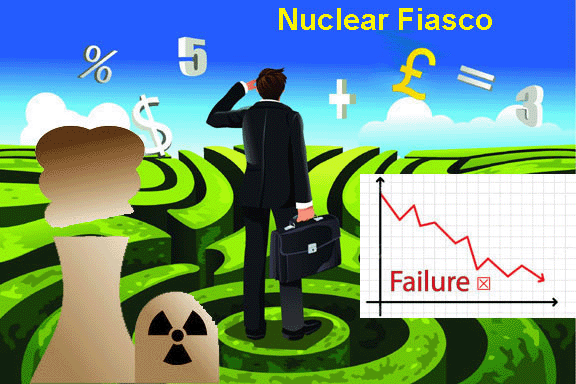
Gulf states poised to bail Britain out of energy crisis
Bahrain and the UAE courted by energy secretary Grant Shapps for fresh nuclear investment
By Rachel Millard, 30 April 2023
Gulf states are poised to help bankroll Britain’s efforts to build new
nuclear power stations to keep the lights on, the energy security secretary
has indicated. Grant Shapps visited the region in January and said he
remains “in constant contact” with investors in the region who are
“very interested” in the nuclear sector. Countries such as the UAE and
Bahrain have built up vast sovereign wealth funds which are now pushing
into clean energy amid global efforts to cut fossil fuel use.
Jeremy Hunt, the chancellor, met with the UAE’s Mubadala, a sovereign investment firm,
in February, and has abandoned plans to toughen tax rules for sovereign
wealth funds. Mr Shapps said: “I was in the Gulf states [this year] and
I’m in constant contact with our friends and colleagues over there. “They
have already been investing massive amounts in renewable energy – and
they’re very interested in nuclear power as well. The scale of their
ambitions are pretty big – watch this space.”
Ministers are trying to drum up investment for EDF’s planned £20bn power plant in Suffolk as well as other nuclear projects as part of a push on the carbon-free [?] power
source. Legal & General, Britain’s biggest money manager with £1.3 trillion
of assets, has said it is focused on supporting other “viable, and
cost-effective” {?] clean [?] energy solutions.
French state energy giant EDF
owns Britain’s nuclear fleet but will need outside investors to build its
planned Sizewell C project in Suffolk. The Government and EDF have pushed
China’s CGN out of the project amid concern about China’s involvement in
critical national infrastructure.
Telegraph 30th April 2023
Libya lost, then found, 2.5 tonnes of uranium – a red flag for nuclear safety

The Conversation Olamide Samuel.Track II Diplomat and Expert in Nuclear Politics, University of Leicester 1 May 23
Earlier this year the International Atomic Energy Agency Director General Rafael Grossi reported that about 2.5 tonnes of uranium ore concentrate had gone missing from a site in Libya. This was arguably one of the largest quantity of uranium ore concentrate that had ever been misplaced.
Barely a day after the IAEA’s announcement, General Khaled Mahjoub of the self-styled Libyan National Army said the uranium ore had been found about 5km from the warehouse where it had been stored. A week later, the IAEA, which had been monitoring the stockpile occasionally, confirmed that most of the uranium ore concentrate had been found.
Uranium ore concentrate, popularly known as ‘yellowcake’, is a type of uranium concentrate powder obtained after uranium ore has been milled and chemically processed. Yellowcake has very low radioactivity, equivalent to the radioactivity of uranium ore found in nature, and it is produced by all countries where uranium ore is mined.
Yellow cake is further processed to become enriched uranium, which is used to manufacture the fuel for nuclear reactors. However, enriched uranium can also be used to manufacture nuclear weapons. If the technology were available, the 2.5 tons of missing yellowcake would have been half the amount required for a nuclear bomb.
Nuclear material experts had said the Libyan uranium ore concentrate in case posed “no significant security risk” as it required prohibitively sophisticated processing capabilities before it can be suitable for civil or weapons use.
Nevertheless, the news of missing Libyan uranium ore concentrate did highlight serious problems with the national and global governance structures for managing uranium.
Based on my experience in nuclear non-proliferation and politics, I believe that the missing Libyan uranium debacle illustrates two things.
Firstly, it illustrates the dangers of a IAEA that doesn’t have enough resources to monitor uranium ore stockpiles, especially in countries with unstable regimes. And faced with more pressing issues such as the safety and security of nuclear power plants in Ukraine, the IAEA won’t prioritise yellowcake storage.
Secondly, many African countries still struggle to implement nuclear safety and security governance provisions.
A regional destabiliser
Libya has been unstable since the fall of Muammar Gaddafi’s regime in 2011. This plunged the country into a civil war that has destabilised the North African and the Sahel regions, as Libya lost control of the largest and most diverse military arsenals in the region.
Much of this arsenal eventually fell into the hands of various non-state actors. Among them were Boko-Haram which mounted a reign of terror in northern Nigeria, and Ansar Al-Sharia in Tunisia.
Gaddafi had amassed stockpiles of nuclear material and technology as he sought to develop nuclear weapons. He had help from Abdul Qadeer Khan, who had been identified as a key facilitator for the global smuggling of nuclear material and technology.
Gaddafi eventually abandoned the weapons program in 2003, after months of secret disarmament negotiations with the US and British.
Following this deal, the US airlifted about 25 metric tonnes of Libya’s nuclear weapon programme components and documents. The last of Libya’s enriched uranium was removed in 2009. But there remained in Sabha, the southern Libyan city, about 6400 barrels of uranium ore concentrate. It’s this material that was under the control of an army battalion.
Olli Heinonen, a former Deputy Director of the IAEA, has since explained that it would have been very costly to airlift the remaining concentrate. He also said there were incentives for Libyans to holding onto the concentrate until the spot price of uranium was high enough for profitable export.
More questions than answers
Though the missing 2.5 tonnes of uranium have been recovered, questions remain: Why did 2.5 tonnes go missing in the first place? Who would have wanted to acquire it?
…………………………….. more https://theconversation.com/libya-lost-then-found-2-5-tonnes-of-uranium-a-red-flag-for-nuclear-safety-203775
1 This Month
26 September – International Day for the Total Elimination of Nuclear Weapons





PLEASE OPPOSE HR 8255 AND S.3639 – bills would accelerate satellite deployment, with no environmental review or safeguards – https://ncstd5li.quorum.us/campaign/169331/
To see nuclear-related stories in greater depth and intensity – go to https://nuclearinformation.wordpress.com
-
Archives
- September 2026 (291)
- August 2026 (330)
- July 2026 (355)
- June 2026 (287)
- May 2026 (306)
- April 2026 (356)
- March 2026 (251)
- February 2026 (267)
- January 2026 (308)
- December 2025 (358)
- November 2025 (359)
- October 2025 (375)
-
Categories
- 1
- 1 NUCLEAR ISSUES
- business and costs
- climate change
- culture and arts
- ENERGY
- environment
- health
- history
- indigenous issues
- Legal
- marketing of nuclear
- media
- opposition to nuclear
- PERSONAL STORIES
- politics
- politics international
- Religion and ethics
- safety
- secrets,lies and civil liberties
- spinbuster
- technology
- Uranium
- wastes
- weapons and war
- Women
- 2 WORLD
- ACTION
- AFRICA
- Atrocities
- AUSTRALIA
- Christina's notes
- Christina's themes
- culture and arts
- Events
- Fuk 2022
- Fuk 2023
- Fukushima 2017
- Fukushima 2018
- fukushima 2019
- Fukushima 2020
- Fukushima 2021
- general
- global warming
- Humour (God we need it)
- Nuclear
- RARE EARTHS
- Reference
- resources – print
- Resources -audiovicual
- Weekly Newsletter
- World
- World Nuclear
- YouTube
-
RSS
Entries RSS
Comments RSS

