A compelling argument against stopping Iran’s nuclear research
proliferation has proven to be historically rare, with the number of nuclear weapons states expanding only slightly from five in 1964 to nine in 2006 following North Korea’s nuclear test.
Ironically, the Middle East itself offers further evidence that nuclear proliferation is not inevitable. …….. Israel acquired nuclear weapons in the late 1960s and over four decades later still remains the only nuclear power in the region
 One Of The Biggest Arguments For Stopping Iran’s Nuclear Research Is Just Plain Wrong
Christopher Hobbs and Matthew Moran, The Guardian | Dec. 19, 2012, Much of 2012 has seen a steady rise in tensions with regard to Iran’s nuclear programme and its possible military dimensions. Iran has continued to increase its stockpile of 20%-enriched uranium, moving closer to Israel’s red line for military action
Successive rounds of negotiations between Tehran, the P5+1 and the International Atomic Energy Authority (IAEA) have failed to yield tangible results and economic sanctions are now crippling the Iranian economy. Yet the country’s nuclear programme marches on, stoking fears that Iran may indeed be seeking to cross the nuclear weapons threshold.
The regime in Tehran has consistently stressed Iran’s opposition to the acquisition of nuclear weapons, primarily on religious grounds – Supreme Leader Khamenei’s fatwa prohibiting the use of nuclear weapons is held up as evidence of this position.
However, there is widespread agreement that Iran’s nuclear activities extend well beyond what is necessary to meet their civil nuclear needs.
Inevitably, Iran’s nuclear defiance has provided ammunition for the war-mongerers advocating a pre-emptive attack on Iran. Prominent commentators such as Matthew Kroenig, claim that, at the very least, a nuclear-armed Iran would prompt a ‘proliferation cascade’ in the Middle East.
If Iran acquires nuclear weapons – whatever form that scenario may take — its regional rivals will follow suit. The argument here is seductive; it is easier to assume the worst than to hope for the best. The problem is, we find that the counter-argument is more compelling……. Continue reading
IAEA and Iran will clinch a deal next month
 IAEA confident of nuclear deal with Iran http://www.theaustralian.com.au/news/breaking-news/iaea-confident-of-nuclear-deal-with-iran/story-fn3dxix6-1226537224857 BY: SIMON STURDEE AAP December 14, 2012 THE UN nuclear agency has expressed confidence that it will clinch a deal with Iran next month under which Tehran will at last answer “credible” evidence that it has conducted atomic weapons research. Continue reading
Iran warns on leaving Nuclear Non Proliferation Treaty, if attacked
Iran may quit anti-nuclear arms pact if attacked: envoy By Fredrik Dahl
VIENNA | Fri Nov 30, 2012 (Reuters) – Any attack on Iran’s nuclear facilities may lead to it
withdrawing from the Non-Proliferation Treaty (NPT), a pact aimed at
preventing the spread of nuclear arms, a senior Iranian official said on Friday.

Ali Asghar Soltanieh, Iran’s ambassador to the International Atomic
Energy Agency, also suggested Iran in such a case could kick out IAEA
inspectors and install its uranium enrichment centrifuges in “more secure” places.
His comments may strengthen concerns among many Western nuclear
experts that military action against Iran aimed at preventing it from
developing nuclear weapons may backfire and only drive its entire
nuclear program underground.
Iran may quit anti-nuclear arms pact if attacked: envoy By Fredrik Dahl
VIENNA | Fri Nov 30, 2012 10:31am EST
(Reuters) – Any attack on Iran’s nuclear facilities may lead to it
withdrawing from the Non-Proliferation Treaty (NPT), a pact aimed at
preventing the spread of nuclear arms, a senior Iranian official said on Friday.
Ali Asghar Soltanieh, Iran’s ambassador to the International Atomic
Energy Agency, also suggested Iran in such a case could kick out IAEA
inspectors and install its uranium enrichment centrifuges in “more secure” places.
His comments may strengthen concerns among many Western nuclear
experts that military action against Iran aimed at preventing it from
developing nuclear weapons may backfire and only drive its entire nuclear program underground.
Still time for a diplomacy solution to nuclear power problem in Ira
 Window for nuclear diplomacy on Iran is now open but not for
 long, guardian UK Julian Borger, 23 Nov 12 IAEA inspectors say Iran may soon speed up its uranium enrichment, making the search for a deal even more urgent Having delivered its latest quarterly report on Iran’s nuclear programme to its board, the nuclear safeguards department of the International Atomic Energy Agency (IAEA) gave a technical briefing on Wednesday to an audience of ambassadors in Vienna about the same material but with some pictures to make the whole thing clearer. At such briefings, ambassadors can also ask questions to sound out the head of safeguards, Herman Nackaerts, on his impressions.
On this occasion, the main message western ambassadors came away with was that Iran appears to be just days away from starting feeding uranium hexafluoride gas into four new cascades of centrifuges at its underground enrichment site at Fordow. Continue reading
Iran continuing with uranium enrichment program
Iran nuclear work at constant pace despite sanctions -IAEA
* Iran stockpiling enriched uranium despite economic isolation
* U.N. nuclear chief sees “quite constant” enrichment pace
* Six world powers to discuss strategy towards Iran in Brussels
* New meeting may take place before end-year – Western official
By Alexandria Sage and Fredrik Dahl
PARIS/VIENNA, Nov 20 (Reuters) – Iran is enriching uranium at a
constant pace and international sanctions aimed at making Tehran
suspend the activity are having no visible impact, the U.N. nuclear
watchdog chief said in unusually blunt remarks on Tuesday.
The point made by Yukiya Amano, director-general of the International
Atomic Energy Agency, reinforced the view of many analysts that
increased Western economic pressure on Iran has failed to make it
change its nuclear course.
He spoke a day before senior officials from six world powers were to
meet in Brussels to weigh strategy towards Iran amid signs of a
renewed push to resolve the dispute diplomatically after U.S.
President Barack Obama’s re-election.
World powers, which first ushered in U.N. sanctions on Iran back in
2006, are concerned Israel may try to bomb Iranian nuclear sites
without a peaceful resolution to the row soon…..
http://www.reuters.com/article/2012/11/20/nuclear-iran-idUSL5E8MKA6720121120
New diplomacy push for relations between Iran and the West
Iran, UN nuclear agency plan December talks Jerusalem Post, By REUTERS11/09/2012 IAEA announces plans to hold nuke talks with Iran; diplomatic mission to be headed by Nackaerts, chief UN nuclear inspector. Iran will return to talks with the International Atomic
Energy Agency next month, the UN nuclear watchdog said on Friday, the latest push to seek a peaceful end to a dispute that has raised fears of a new Middle East war.
The IAEA announcement came days after US President Barack Obama’s re-election, which some analysts say may give fresh impetus to diplomatic efforts to end to a decade-old standoff with a country the West accuses of working towards nuclear weapons capability…..
http://www.jpost.com/IranianThreat/News/Article.aspx?id=291163
Changing nature of Israel – Iran nuclear standoff
The Drone in the Desert http://isnblog.ethz.ch/ Itamar Rabinovich, 8 November 2012 TEL AVIV – A drone recently penetrated Israel’s airspace from the Mediterranean. It was allowed to fly for about half an hour over southern Israel before being shot down by the Israeli air force over a sparsely populated area.
It is still not known who dispatched the drone and from where, but it is now assumed that it was launched from Lebanon, either by Hezbollah, acting in Iran’s service, or by forces of the Iranian regime itself.
If that is indeed the case, the episode should not be regarded as yet another incident in a region fraught by conflict and violence. On the contrary, it is a significant window into the arena in which the conflict over the future of Iran’s nuclear program is being waged.
Several developments and forces are now shaping this arena. One is by Israeli Prime Minister Binyamin Netanyahu’s decision, announced in his
speech to the United Nations General Assembly last month, to suspend his threat to launch unilateral military action against Iran’s nuclear installations. He has said that Israel will give the US and the rest of the international community an opportunity to stop Iran’s progress through other means by the spring or early summer of 2013. (more…)
Iran’s Supreme Leader adopting a cautious path, about nuclear weapons
Instead of treading a straight Roman Road to a nuclear weapon, he has twice veered off course.
Could Iran’s Supreme Leader be more cautious than we think?
Telegraph, By David Blair November 1st, 2012 My interview with Ehud Barak in London on Tuesday attracted a good deal of attention and comment. The Israeli defence minister’s most striking statement concerned Iran’s decision to convert much of its stockpile of 20 per cent enriched uranium into harmless fuel rods. Without that event, Barak confirmed that the crisis over Iran’s nuclear ambitions would “probably” have peaked about now. Instead, Iran’s decision “allows contemplating delaying the moment of truth by eight to ten months”. Continue reading
Iran and Israel – moderate responses on nuclear issue

 Could Iran’s Supreme Leader be more cautious than we think?
The Telegraph, By David Blair World November 1st, 2012 My interview with Ehud Barak in London on Tuesday attracted a good deal of attention and comment. The Israeli defence minister’s most striking statement concerned Iran’s decision to convert much of its stockpile of 20 per cent enriched uranium into harmless fuel rods. Without that event, Barak confirmed that the crisis over Iran’s nuclear ambitions would “probably” have peaked about now. Instead, Iran’s decision “allows contemplating delaying the moment of truth by eight to ten months”.
In his speech before the UN General Assembly in September, Benjamin Netanyahu softened Israel’s position on the possibility of an imminent military strike, saying that the critical moment would arrive next spring or summer. Barak told me that Iran’s move was “in the background of our decision”.
So the figures tucked away on page 8 of the last IAEA report on Iran’s nuclear programme turned out to be of vital importance. They showed that Iran took 71.25 kg of its stockpile of 20 per cent enriched uranium and converted it into fuel rods for the Tehran Research Reactor, a civilian facility. The uranium enriched to 20 per cent purity is the material that is closest to weapons-grade. Out of a total holding of 189.4 kg, Iran has devoted 37.6 per cent to a peaceful purpose…..
In 2003, we know that Iran suspended its research on how to build a nuclear warhead (although the evidence suggests that some work was restarted later). Now we know that during the course of this year, Iran took a big chunk of the uranium that was closest to weapons-grade and used it for a harmless purpose. Thanks to Barak’s candour, we also know that this decision probably averted a crisis.
Could Ayatollah Ali Khamenei, the Supreme Leader of Iran, be more cautious than we think? Instead of treading a straight Roman Road to a nuclear weapon, he has twice veered off course. To me, that suggests that he is nervous and feeling the pressure. Is the ultimate destination of Iran’s nuclear programme still an open question? http://blogs.telegraph.co.uk/news/davidblair/100187473/could-irans-supreme-leader-be-more-cautious-than-we-think/
Iran seeking compromise over the nuclear issue?
Senior Iranian figures push for compromise over nuclear issue Telegraph, 27 Oct 12, Senior figures inside Iran’s regime have “succumbed” to the pressure imposed by sanctions and favour compromise over the nuclear issue, according to the public comments of their colleagues. By David Blair, Chief Foreign Correspondent Continue reading
Iran’s plan for defusing the nuclear crisis
Iran Offers Plan, Dismissed by U.S., on Nuclear Crisis NYT, By DAVID E. SANGER October 4, 2012 WASHINGTON — With harsh economic sanctions contributing to the first major protests in Iran in three years, Iranian officials have begun to describe what they call a “nine-step plan” to defuse the nuclear crisis with the West by gradually suspending the production of the uranium that would be easiest for them to convert into a nuclear weapon Continue reading
Iran is not close to developing a nuclear weapon
Iran Nuclear Weapons: Development Of Armed Missile Not In Works Now, Study Finds HUFFINGTON POST 10/02/2012 1 By Fredrik Dahl VIENNA, – Iran already has enough low-enriched uranium for several atomic bombs if refined to a high degree but it may still be a few years away from being able to build a nuclear-armed missile if it decided to go down that path. Continue reading
US Senator: Senate Resolution against Iran Amounts to Preemptive War TEHRAN (FNA) 23 Sept 12, – The US Senate voted 90-1 early Saturday on a non-binding resolution to impede Iran’s advancement in nuclear technology. Voting against the resolution was Sen. Rand Paul, arguing that the bill was a de-facto declaration of war. Continue reading
History of the West’s encouragement of Iran’s nuclear programme
Hypocritical Threats Against Iran On a Pedestal of Nuclear Immorality by SAUL LANDAU, CounterPunch 21 Sept 12, The U.S. government gave U.S. nuclear-energy companies a green light to sell their knowledge and technical support to Iran. With their blessings, the Shah also established close ties to European companies, who hustled to Teheran to do business. Continue reading
USA and Israel’s demonisation of Iran
On a Pedestal of Nuclear Immorality, Counter Punch by SAUL LANDAU, 21 Sept 12, “…….Western leaders did not predict, however, the political turnaround that occurred with the Iranian revolution. The fiercely pro western orientation of the Shah quickly turned as millions of Iranians backed a nationalist and anti American ideology in which the country’s leaders rejected both western ideology and the legitimacy of its regional representative, Israel.
Teheran denounced the very idea of a Jewish state and began to refurbish the old plans to produce nuclear power, which the U.S. and Israel now claim is a cover for a nuclear weapons program. The Ayatollah Khamenei, however, has condemned nuclear weapons and denies nuclear weapon ambitions. Continue reading
1 This Month
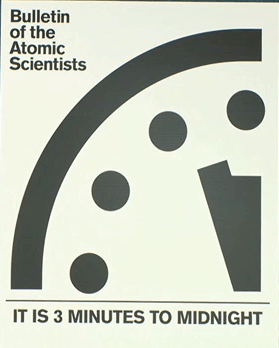
Watch the 2026 Doomsday Clock unveiling live here on January 27 at 10 a.m. EST
To see nuclear-related stories in greater depth and intensity – go to https://nuclearinformation.wordpress.com/

29 Jan. Thursday 7-8 p.m. Webinar – World’s Largest Nuclear Station in Port Hope, ON?


31st January – Challenging the War Machine – a DECLASSIFIED UK SUMMIT


Website of the Week
Now until to February 10, 2026 Radioactive waste storage in France: the debate is finally open! How to participate?
-
Archives
- January 2026 (277)
- December 2025 (358)
- November 2025 (359)
- October 2025 (376)
- September 2025 (258)
- August 2025 (319)
- July 2025 (230)
- June 2025 (348)
- May 2025 (261)
- April 2025 (305)
- March 2025 (319)
- February 2025 (234)
-
Categories
- 1
- 1 NUCLEAR ISSUES
- business and costs
- climate change
- culture and arts
- ENERGY
- environment
- health
- history
- indigenous issues
- Legal
- marketing of nuclear
- media
- opposition to nuclear
- PERSONAL STORIES
- politics
- politics international
- Religion and ethics
- safety
- secrets,lies and civil liberties
- spinbuster
- technology
- Uranium
- wastes
- weapons and war
- Women
- 2 WORLD
- ACTION
- AFRICA
- Atrocities
- AUSTRALIA
- Christina's notes
- Christina's themes
- culture and arts
- Events
- Fuk 2022
- Fuk 2023
- Fukushima 2017
- Fukushima 2018
- fukushima 2019
- Fukushima 2020
- Fukushima 2021
- general
- global warming
- Humour (God we need it)
- Nuclear
- RARE EARTHS
- Reference
- resources – print
- Resources -audiovicual
- Weekly Newsletter
- World
- World Nuclear
- YouTube
-
RSS
Entries RSS
Comments RSS
 nuclear-news