The Stakes of Donald Trump’s Negotiations with the Islamic Republic of Iran.
First, the United States, faithful to Trump’s Art of the Deal technique, threatened Iran while trying to placate it. International relations are not governed by the same rules as business. Giving in to threats is a sign of weakness that the Iranians could not accept in these negotiations.
by Thierry Meyssan, Voltaire Network | Paris (France) | 29 April 2025
The general public is completely unaware of the real stakes in the negotiations between Washington and Tehran. This article presents a situation in which lies have been piling up over three decades, making any progress particularly difficult. Contrary to popular belief, the nuclear issue in Iran is not whether Tehran will acquire an atomic bomb, but whether it will be able to help Palestine without resorting to weapons.
month and a half ago, I announced that even before concluding peace in Ukraine, President Donald Trump would open negotiations with Iran [1]. As usual, commentators steeped in Joe Biden’s ideology showered me with sarcasm, while my colleagues, specialists in international affairs, noted my observations [2].
The difference between the two lay in their understanding of the negotiations in Ukraine. For the former, it was Donald Trump’s revenge against Volodymyr Zelensky, or a genuflection before Vladimir Putin. For the latter, it was, on the contrary, a desire for peace with Russia in order to devote US resources to its economic recovery.
It follows that the two sides approach the Iranian issue differently. For the former, it is a matter of continuing the chaos that began during the first term with the withdrawal from the nuclear agreement (JCPOA). Conversely, for the latter, it is a desire for peace with Iran, given that it is the only regional power that supports the resistance to Israel.
In early March 2024, President Donald Trump sent a letter to the leader of the Revolution, Ayatollah Ali Khamenei. The existence of this document was mentioned by the author himself during his speech to Congress on March 4, and then debated in the press. According to Sky News Arabia, which read this document, Donald Trump called for negotiations, while specifying: “If you reject the outstretched hand and choose the path of escalation and support for terrorist organizations, I warn you of a swift and determined response […] I am writing this letter with the aim of opening new horizons for our relations, away from the years of conflict, misunderstandings and unnecessary confrontations that we have witnessed in recent decades […] The time has come to leave hostility behind and open a new page of cooperation and mutual respect.” A historic opportunity presents itself to us today […] We will not stand idly by in the face of your regime’s threats against our people or our allies […] If you are willing to negotiate, so are we. But if you continue to ignore the world’s demands, history will testify that you missed a great opportunity.”
Simultaneously, the United States and the United Kingdom launched several attacks against Ansar Allah in Yemen. Unlike previous attacks, these did not target hidden military targets, but rather political targets scattered among the civilian population. They therefore killed leaders of the movement and many other collateral victims, which constitutes war crimes.
It should be recalled that Ansar Allah, pejoratively referred to by Westerners as the “Houthi family gang” or “the Houthis,” attacks Israeli ships in the Red Sea in order to force Tel Aviv to agree to allow humanitarian aid to pass through to Gaza.
Washington and London, believing that this was hampering international trade, and having failed to obtain approval from the Security Council, resumed the war. They initially targeted military objectives and quickly realized that these, buried deep within the country, could not be significantly affected.
Donald Trump’s letter only arrived in Tehran on March 12, and the Iranian response was slow in coming. It is important to understand that while Tehran was flattered by Washington’s secret handwritten approach, it could not accept several aspects of its behavior.
• First, the United States, faithful to Trump’s Art of the Deal technique, threatened Iran while trying to placate it. International relations are not governed by the same rules as business. Giving in to threats is a sign of weakness that the Iranians could not accept in these negotiations. Ayatollah Ali Khamenei commented on March 28: “The enmity of the United States and Israel has always existed. They threaten to attack us, which we believe is not very likely, but if they commit a misdeed, they will certainly receive a strong blow in return.” If the enemies think they can instigate sedition in the country, the Iranian nation itself will respond to them.” President Donald Trump further emphasized this on March 30, telling NBC News: “If they don’t reach an agreement, there will be bombing. It will be bombing like they’ve never seen before.”
According to the United Nations Charter (Article 2, paragraph 4), “members of the Organization shall refrain in their international relations from the threat or use of force against the territorial integrity or political independence of any state.”
The negotiations were therefore compromised before they even began.
• Moreover, massacring the leaders of Ansar Allah was a gratuitous war crime: General Qassem Soleimani, by reorganizing the “Axis of Resistance,” had given Iran’s former proxies their complete freedom. Tehran currently has no influence, other than ideological, over Ansar Allah. Ambassador Amir Saeid Iravani therefore raised these points at the United Nations [3].
• Finally, and most importantly, Donald Trump, by accumulating contradictory signals, did not allow the Iranians to assess his relations with Israel. Does he support the project of a binational state in Palestine (the one promoted by the United Nations)? Or of a Jewish state in Palestine (“Zionism”)? Or that of a “Greater Israel” (“Revisionist Zionism”)? No one knows for sure.
Ultimately, Iran sent a secret response to the secret letter from the United States, and negotiations were able to begin, but only indirectly. That is, the two delegations did not speak directly to each other, but only through a mediator. In this way, Tehran responded to the invitation, but expressed its disapproval of the manner in which it was convened.
ntervening directly, France and the United Kingdom convened a closed-door meeting of the Security Council. Paris and London wished to address several outstanding issues. As nothing has been leaked, it is unclear whether President Emmanuel Macron and Prime Minister Keir Starmer wanted to clarify what had caused all other attempts at negotiations to fail or, on the contrary, to obscure what could have been further obscured…………………………………………………………………………………………………………………………………….. https://www.voltairenet.org/article222165.html
Six in 10 Americans Support US Participation in a Nuclear Agreement with Iran.
Chicago Council on Global Affairs, 30 Apr 25
Majorities of Democrats and Independents support a potential deal similar to the 2015 Joint Comprehensive Plan of Action, but only a minority of Republicans agree.
For the first time since the United States withdrew from the 2015 Joint Comprehensive Plan of Action (JCPOA), American and Iranian officials held direct talks to negotiate a new nuclear deal. These talks come amid reports of Iran’s rapid production of enriched uranium and acceleration of its nuclear weapons program.
A recent Chicago Council on Global Affairs-Ipsos survey, fielded April 18–20, 2025, finds a majority of Americans consider a nuclearized Iran unacceptable and believe the United States should negotiate a deal with Tehran to limit its development. While Democrats and Independents support a deal that would trade sanctions relief for limitations on Iranian nuclear enrichment, Republicans oppose such a tradeoff. However, they may end up following US President Donald Trump’s lead if current negotiations bear fruit.
Key Findings
- Eight in 10 Americans oppose Iran obtaining nuclear weapons (79%) and favor taking diplomatic steps (83%) or tightening economic sanctions (80%) to limit further nuclear enrichment.
- A smaller majority of Americans believe the United States should participate in an agreement that lifts some international economic sanctions against Iran in exchange for strict limits on its nuclear program (61%).
- Partisan differences on a nuclear agreement are striking: 78 percent of Democrats and 62 percent of Independents support US participation in a deal with Iran compared to just 40 percent of Republicans.
- If diplomacy or economic sanctions fail, many Americans are willing to take more forceful approaches: Six in 10 support the United States conducting cyberattacks against Iranian computer systems (59%), and half support conducting airstrikes against Iran’s nuclear facilities (48%).
- A majority oppose sending US troops to destroy Iran’s nuclear facilities (60%).
Americans Favor Diplomatic Approach to Iranian Nuclear Development
The 2015 JCPOA, or the Iran Deal, was a landmark agreement reached between Iran and the P5+1 (China, France, Russia, the United Kingdom, the United States, and Germany) that limited Iranian nuclear enrichment in exchange for sanctions relief and other provisions. While it was initially successful in limiting Iran’s stockpile of enriched uranium, the United States withdrew from the deal in 2018, as the first Trump administration considered it insufficient in curbing Iran’s ballistic missile program and protecting American regional interests. Upon the US withdrawal from the agreement, Iran promptly lifted the cap on its stockpile of uranium and increased its enrichment activities; it has since reached weapons-grade levels of enriched uranium.
…………………………………………………………………………………………………………………………………………………………………… Conclusion
Although US President Donald Trump has not ruled out using military action to stop Iran from obtaining a nuclear weapon, he said he favors a diplomatic agreement to address this issue. Recently, Trump administration officials have given contradictory remarks about current talks, and they have yet to specify how renewed negotiations will produce an agreement more stringent and impactful than its predecessor.
The pressure is on American diplomats to secure a deal that would limit Tehran’s nuclear enrichment without providing the sanctions relief that could potentially fund Iran’s efforts to further destabilize the Middle East or threaten the United States’ regional allies, including Israel. While the outcome of these negotiations remains to be seen, the public continues to express a preference for using diplomatic or economic coercion than direct military action. https://globalaffairs.org/research/public-opinion-survey/six-10-americans-support-us-participation-nuclear-agreement-iran?fbclid=IwY2xjawKA64xleHRuA2FlbQIxMQBicmlkETFISGV5ZEdSZW16a2ZnQzh3AR7iwwVkEnczI_DJHzOGHWvNWeSlg2xdd9YJCsBz0_OiQmJcM48Ujd0ZNX8ZNQ_aem_5kroZ8t3KQ5RgYf4EfYdDA
Trump’s transactional instincts could help forge a new Iran nuclear deal
Mohamad Bazzi, 265 Apr https://www.theguardian.com/commentisfree/2025/apr/25/trump-iran-nuclear-deal
The president has a chance to make good on his reputation as a dealmaker as Iran moves closer to a nuclear weapon.
In May 2018, Donald Trump unilaterally withdrew the US from the Iran nuclear deal and reimposed American sanctions that crippled the Iranian economy. Trump tore up the 2015 agreement, which had taken years for Iran to negotiate with six world powers, under which Tehran limited its nuclear program in exchange for relief from international sanctions. Trump insisted he would be able to negotiate a better pact than the one reached by Barack Obama’s administration.
Today, in his second term as president, Trump is eager to fix the Iran deal he broke nearly seven years ago.
While Trump’s overall foreign policy has been chaotic and has alienated traditional US allies in Europe and elsewhere, he has an opportunity to reach an agreement with Iran that eluded Joe Biden. Since Trump walked away from the original deal, Iran has moved closer to having a nuclear weapon than it has ever been. It has enriched enough uranium close to weapons-grade quality to make six nuclear bombs, according to the International Atomic Energy Agency (IAEA). But analysts believe that even after enriching enough uranium for a bomb, Iran would still need up to a year to develop an actual nuclear warhead that could be deployed on a ballistic missile.
Last month, Trump sent a letter to Iran’s supreme leader, the 86-year-old Ayatollah Ali Khamenei, saying the US wanted to negotiate a new deal. Trump followed up with a public threat, saying if Iran’s leaders did not agree to renewed talks, they would be subjected to “bombing the likes of which they have never seen before”. After Trump’s threats and a buildup of US forces in the Middle East, Iran’s military said it would respond to any attack by targeting US bases in the region, which house thousands of American troops.
But Iranian leaders also agreed to indirect negotiations, rather than the direct talks Trump had proposed. Trump dispatched his special envoy, the real estate developer Steve Witkoff, to lead a team of US negotiators to meet indirectly with top Iranian officials, including the foreign minister, Abbas Araghchi. The two sides held two rounds of productive talks so far this month, under the mediation of Oman. And the US and Iranian teams are due to meet again this weekend in Muscat, the capital of Oman, where they will start talks on technical details of a potential agreement.
While Trump and Iran’s leaders both changed their tones in recent weeks, there are many obstacles before a deal can be reached, including hardliners in Iran and Washington, as well as opposition from Israel’s rightwing government, led by Benjamin Netanyahu, who has spent years working to undermine negotiations between the US and Iran. The main barrier will be whether the Trump administration insists on a total dismantling of Iran’s nuclear program – the so-called “Libya model”, named after the late Libyan dictator Muammar Gaddafi, who decided to eliminate his country’s nuclear weapons program in 2003 under pressure from the US. But that decision deprived Gaddafi of a major lever to stave off western military intervention after the Arab Spring uprisings in 2011, which led to his regime’s fall and his killing by Libyan rebels.
Some foreign policy hawks in Washington, including Trump’s national security adviser, Michael Waltz, and the secretary of state, Marco Rubio, insist on this maximalist strategy, which echoes Netanyahu’s demand that Iran must completely dismantle its nuclear enrichment activity and infrastructure as part of any deal with the US. If Trump takes a similar approach, negotiations would probably break down and Trump could follow through on his threat to carry out military strikes.
Iran has made clear that it will not agree to the total end of its nuclear program, but would accept a verification-based approach, as it did under the 2015 deal negotiated by the Obama administration along with China, France, Russia, the UK and Germany, together with the European Union. That type of agreement would place strict limits on Iran’s ability to enrich uranium and impose an inspections regime involving international monitors. Several of Trump’s advisers, including Witkoff and the vice-president, JD Vance, seem to favor this solution.
“I think he wants to deal with Iran with respect,” Witkoff said of Trump’s outreach to the Iranian regime, in a long interview last month with Tucker Carlson, the rightwing media host who has been highly critical of Republican hawks agitating for war with Iran. “He wants to build trust with them, if it’s possible.”
Iran’s leaders apparently got that message – and have tried to stroke Trump’s ego and convey that they respect him in ways they never respected Biden. In a Washington Post op-ed published on 8 April, Iran’s foreign minister seemed to be speaking to Trump directly when he blamed the failure of earlier negotiations on a “lack of real determination by the Biden administration”. Araghchi also played to Trump’s oft-repeated desire to be a peacemaker who ends America’s legacy of forever wars, writing: “We cannot imagine President Trump wanting to become another US president mired in a catastrophic war in the Middle East.”
And the minister appealed to Trump’s reputation as a deal-maker, citing the “trillion-dollar opportunity” that would benefit US companies if they could gain access to Iran after a diplomatic agreement. Iran’s leaders evidently understand that Trump loves to frame his foreign policy as being guided by his desire to secure economic deals and benefits for American businesses.
In this case, Trump’s transactional instincts and bulldozer style of negotiations could lead to a positive outcome, avoiding war with Iran and undermining the hardliners in Washington, Iran and Israel. Trump has already adopted a significant shift toward Tehran from his first term, when he had insisted that Iran was the world’s leading state sponsor of terrorism and the greatest threat to US interests in the Middle East.
After he took office in 2017, Trump wanted to tear up the Iran deal partly because it was one of Obama’s major foreign policy accomplishments. Trump also surrounded himself with hawkish advisers who reinforced the danger of an Iranian threat, including HR McMaster, who served as national security adviser, and James Mattis, who was defense secretary. Both men commanded US troops during the occupation of Iraq, and they fought Iraqi militias funded by Iran. Trump later appointed John Bolton, another neoconservative and advocate of the 2003 US invasion of Iraq, as his national security adviser.
In his second term, Trump has banished most of the neocons from his administration. Trump also seems to realize that Netanyahu could become one of the biggest obstacles to an Iran deal, as he was during the Obama and Biden administrations. It was no accident that the president announced his plan for renewed talks with Iran while Netanyahu sat beside him at an Oval Office meeting on 7 April. Netanyahu had arranged a hasty visit to Washington to seek an exemption from Trump on new tariffs on Israeli exports. But he left empty-handed and embarrassed by Trump’s Iran announcement. That meeting was a signal to Iran’s leaders: that Trump would not allow Netanyahu to steamroll him, as the Israeli premier had done with other US presidents.
If Trump continues to resist Netanyahu, along with hawkish Republicans and some of his own advisers, he might well be able to negotiate a dramatic deal with Iran – and repair the nuclear crisis he unleashed years ago.
- Mohamad Bazzi is the director of the Hagop Kevorkian Center for Near Eastern studies and a journalism professor at New York University.
Iran opens door to restoring nuclear surveillance, UN watchdog says

Iran has agreed to allow a technical team from the International Atomic
Energy Agency (IAEA) to discuss restoring camera surveillance in Iranian
nuclear facilities, the head of the UN nuclear watchdog said on Wednesday.
IAEA Director General Rafael Grossi confirmed the agency would send a
technical team to Iran following his visit to Tehran this month. Grossi
said his impression is that the Islamic Republic’s leaders are “seriously
engaged in discussions… with a sense of trying to get to an agreement.”
The UN body would be the party responsible for verifying Iran’s compliance
with a deal, Grossi said. “This will have to be verified by the IAEA.”
Iran International 23rd April 2025 https://www.iranintl.com/en/202504237179
Iran-US talks wrap up in Rome with agreement to establish framework for potential nuclear deal
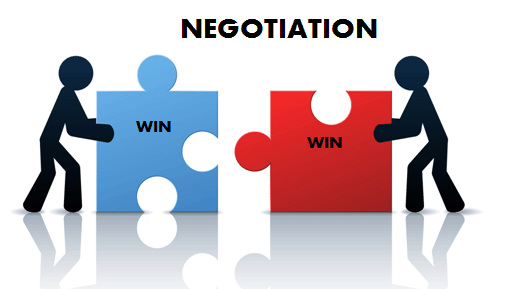
Omani officials stated that the indirect talks are ‘gaining momentum’ after Tehran and Washington agreed to establish technical delegations to draft a potential replacement for the Obama-era JCPOA
The second round of indirect talks between Iranian and US officials concluded in the Italian capital, Rome, on 19 April, with both sides agreeing to establish working groups to draft a “general framework” for a potential new nuclear deal.
“In this round of talks, senior Iranian and US negotiators outlined the general framework for the talks and exchanged views on some important issues in the areas of sanctions relief and the nuclear issue. The two sides agreed to continue the next round of indirect talks next Saturday in Muscat,” the Iranian Foreign Ministry said in a statement.
Tehran also stated that talks to limit the country’s uranium enrichment program in exchange for sanctions relief “require more detailed discussion and examination at the expert level.” As such, the two sides agreed to send technical delegations to the Omani capital next Wednesday for detailed discussions.
Following Saturday’s talks, Iranian Foreign Minister Abbas Araghchi described the atmosphere as “positive” and said that officials “made clear how many in Iran believe that the [2015 Joint Comprehensive Plan of Action] is no longer good enough for us.”
“For now, optimism may be warranted but only with a great deal of caution,” he told reporters.
The Omani Foreign Ministry said the second round of talks “led to the parties agreeing to move to the next phase of targeted negotiations to achieve a fair, permanent, and binding agreement that ensures Iran is free from nuclear weapons and the full lifting of sanctions while preserving the country’s right to develop nuclear energy for peaceful uses and purposes.”
“Dialogue and clear communication are the only way to achieve a credible and reliable understanding that will benefit all parties in the regional and international context,” Omani officials said.
There was no immediate comment from the US side following the talks.
Nevertheless, soon after Saturday’s talks ended, Israeli TV broadcast a pre-recorded address by Prime Minister Benjamin Netanyahu, in which he reiterated his commitment to preventing Iran from developing a nuclear weapon.
“I am committed to preventing Iran from attaining nuclear weapons. I won’t give on this, I won’t let up on this, and I won’t withdraw from this — not a millimeter,” Netanyahu said.
Earlier in the day, Reuters reported that Tel Aviv “has not ruled out” launching an attack on Iran’s nuclear facilities in the near future without US involvement.
Iran to brief China as it accuses Israel of ‘undermining’ US nuclear talks
Tehran official’s Beijing trip comes before third round of talks with the US and follows consultations with Russia.
Iran says it will brief China this week in advance of a third round of talks with the United States on its nuclear programme, as Iranian officials separately accused Israel of seeking to “undermine and disrupt the diplomatic process”.
Iranian Foreign Minister Abbas Araghchi will visit Beijing on Tuesday to discuss the latest talks with the administration of US President Donald Trump on the country’s nuclear programme, spokesman Esmaeil Baqaei said on Monday.
The trip echoes “consultations” Iran held with Russia last week, before the second round of direct US-Iran talks was held over the weekend. A third round of talks between Araghchi and US envoy Steve Witkoff is scheduled to take place in Oman on Saturday.
Araghchi has previously said Tehran always closely consults with its allies, Russia and China, over the nuclear issue.
“It is natural that we will consult and brief China over the latest developments in Iran-US indirect talks,” Baqaei said.
Russia and China, both nuclear-armed powers, were signatories to a now-defunct 2015 deal between Iran, the US and several Western countries intended to defuse tensions around Tehran’s nuclear programme.
The 2015 deal, known as the Joint Comprehensive Plan of Action (JCPOA), from which Trump withdrew in 2018, saw Tehran curtail its nuclear programme in exchange for sanctions relief.
The US and Israel have accused Iran of seeking to use the programme to develop nuclear weapons. Tehran has staunchly denied the claim, saying the programme is for civilian purposes.
On Monday, the Chinese Ministry of Foreign Affairs stressed close ties between Beijing and Tehran, but did not confirm the Iranian minister’s planned visit.
“China and Iran have maintained exchanges and contacts at all levels and in various fields. With regard to the specific visit mentioned, I have no information to offer at the moment,” Guo Jiakun, spokesperson for the ministry, said.
Strengthened alliance
Israel’s war in Gaza has seen Iran pull closer to Russia and China. Recent diplomatic moves surrounding the US-Iran talks have further underscored the strengthened ties.
Araghchi met his Russian counterpart, Sergey Lavrov, last week, just before his second round of negotiations with Witkoff.
On Monday, Russian President Vladimir Putin signed off on a 20-year strategic partnership treaty agreed earlier this year with his Iranian counterpart, Masoud Pezeshkian.
Meanwhile, Iran’s already fraught relations with Israel and its “ironclad” ally, the US, have nosedived amid the war. Since taking office, Trump has reinstated a “maximum pressure” sanctions campaign against Tehran, while repeatedly threatening military action if a new nuclear deal is not reached.
Speaking on Monday, Foreign Ministry spokesman Baqaei accused Israel of trying to disrupt the nascent negotiations to open the way for military action.
In comments carried by the AFP news agency, he declared that Israel is behind efforts from a “kind of coalition” to “undermine and disrupt the diplomatic process”.
“Alongside it are a series of warmongering currents in the United States and figures from different factions,” the spokesman said.
Last week, Prime Minister Benjamin Netanyahu reiterated that Israel would not allow Iran to acquire nuclear weapons.
His statement came a day after The New York Times reported that Trump had dissuaded Israel from striking Iran’s nuclear sites in the short term, saying Washington wanted to prioritise diplomatic talks.
‘Consultations must continue’
Baqaei added that “consultations must continue” with countries that were party to the JCPOA.
Iran has gradually breached the terms of the treaty since Trump abandoned it, most notably by enriching uranium to levels higher than those laid out in the deal.
The International Atomic Energy Agency says Iran has enriched uranium to 60 percent, close to the 90 percent level needed to manufacture weapons. The JCPOA had restricted it to 3.67 percent, the level of enrichment needed for civilian power.
Speaking last week, Witkoff sent mixed messages on what level Washington is seeking. He initially said in an interview that Tehran needed to reduce its uranium enrichment to the 3.67 percent limit, but later clarified that the US wants Iran to end its enrichment programme.
Iranian minister says nuclear deal possible if US does not make ‘unrealistic demands’
Guardian, 19 Apr 25
Iran’s foreign minister, Abbas Araqchi, and US Middle East envoy Steve Witkoff will resume talks in Rome on Saturday
Iran’s top negotiator believes reaching an agreement on its nuclear programme with the US is possible as long as Washington is realistic, as the two sides prepare to resume talks in Rome on Saturday.
Iran’s foreign minister, Abbas Araqchi, and the US Middle East envoy, Steve Witkoff, will begin indirect negotiations through mediators from Oman, after their first round in Muscat, which both sides described as constructive.
“If they demonstrate seriousness of intent and do not make unrealistic demands, reaching agreements is possible,” Araqchi told a news conference in Moscow on Friday after talks with Russia’s foreign minister, Sergei Lavrov.
Tehran has, however, sought to tamp down expectations of a quick deal. The supreme leader, Ayatollah Ali Khamenei, said this week he was “neither overly optimistic nor pessimistic”.
The talks take place under the shadow of Donald Trump’s threat to attack Iran if it does not reach a deal with the US over its nuclear programme.
The US president told reporters on Friday: “I’m for stopping Iran, very simply, from having a nuclear weapon. They can’t have a nuclear weapon. I want Iran to be great and prosperous and terrific.”
Trump, who ditched a 2015 nuclear pact between Iran and six powers during his first term in 2018 and reimposed crippling sanctions on Tehran, has revived his “maximum pressure” campaign on Iran since returning to the White House in January.
Washington wants Iran to halt production of highly enriched uranium, which it believes is aimed at building an atomic bomb.
Tehran, which has always said its nuclear programme is peaceful, says it is willing to negotiate some curbs in return for the lifting of sanctions, but wants watertight guarantees that Washington will not renege again as Trump did in 2018.
Araghchi said Iran’s right to enrich uranium was “non-negotiable”, after Witkoff called for its complete halt…………………………..https://www.theguardian.com/world/2025/apr/19/irans-minister-says-nuclear-deal-possible-if-us-does-not-make-unrealistic-demands
Would military strikes kill Iran’s nuclear programme? Probably not.
Reuters By Francois Murphy and John Irish, April 16, 2025, Editing by William Maclean
- Summary
- Israel, US have threatened to take out nuclear sites
- Most hardened ones require firepower Israel seems to lack
- Can’t destroy enrichment know-how Iran already has
- Attack could drive programme underground, end inspections
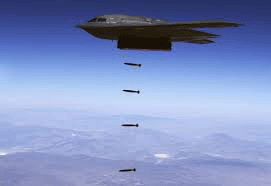
VIENNA, April 15 (Reuters) – The recent U.S. deployment of B-2 bombers, the only planes able to launch the most powerful bunker-busting bombs, to within range of Iran is a potent signal to Tehran of what could happen to its nuclear programme if no deal is reached to rein it in.
But military and nuclear experts say that even with such massive firepower, U.S.-Israeli military action would probably only temporarily set back a programme the West fears is already aimed at producing atom bombs one day, although Iran denies it.
Worse, an attack could prompt Iran to kick out United Nations nuclear inspectors, drive the already partly buried programme fully underground and race towards becoming a nuclear-armed state, both ensuring and hastening that feared outcome.
“Ultimately, short of regime change or occupation, it’s pretty difficult to see how military strikes could destroy Iran’s path to a nuclear weapon,” said Justin Bronk, senior research fellow for airpower and technology at the Royal United Services Institute, a British defence think-tank.
“It would be a case of essentially trying to reimpose a measure of military deterrence, impose cost and push back breakout times back to where we were a few years ago.”
Breakout time refers to how long it would take to produce enough fissile material for a nuclear bomb, currently days or weeks for Iran. Actually making a bomb, should Iran decide to, would take longer.
The landmark 2015 nuclear deal between Iran and major powers placed tough restrictions on Iran’s nuclear activities that increased its breakout time to at least a year. After President Donald Trump pulled the United States out of the deal in 2018 it then unravelled, and Iran pushed far beyond its limits.
Now Trump wants to negotiate new nuclear restrictions in talks that began last weekend. He also said two weeks ago: “If they don’t make a deal, there will be bombing.”
Israel has made similar threats. Its Defence Minister Israel Katz said after taking office in November: “Iran is more exposed than ever to strikes on its nuclear facilities. We have the opportunity to achieve our most important goal – to thwart and eliminate the existential threat to the State of Israel.”
BIG, RISKY
Iran’s nuclear programme is spread over many sites, and an attack would likely have to hit most or all of them. Even the International Atomic Energy Agency, the U.N. nuclear watchdog, does not know where Iran keeps some vital equipment, like parts for centrifuges, the machines that enrich uranium.
Israel could take out most of those sites by itself, military experts say, but it would be a risky operation involving repeated attacks and would have to deal with Russian-supplied anti-aircraft systems – although it managed to do so in far more limited strikes on Iran last year.
Uranium enrichment is at the heart of Iran’s nuclear programme, and its two biggest enrichment sites are the Fuel Enrichment Plant at Natanz, located about three floors underground, apparently to protect it from bombardment, and Fordow, dug far deeper into a mountain………………………………………………………………… https://www.reuters.com/world/middle-east/would-military-strikes-kill-irans-nuclear-programme-probably-not-2025-04-15/
Iran has ‘doubts’ about US intentions ahead of nuclear talks
Iran’s FM expresses concern about US motivations but says second round of negotiations will take place in Rome this weekend.
18 Apr 2025, https://www.aljazeera.com/news/2025/4/18/iran-has-doubts-about-us-intentions-ahead-of-nuclear-talks
Iran’s Foreign Minister Abbas Araghchi has cast doubt over the intentions of the United States a day before a second round of nuclear talks is set to take place with Washington.
The new round will come a week after the two countries held their highest-level negotiations since US President Donald Trump unilaterally abandoned a 2015 landmark nuclear deal three years later. Iran has since abandoned all limits on its nuclear programme, and enriches uranium to up to 60 percent purity – near weapons-grade levels of 90 percent.
“Although we have serious doubts about the intentions and motivations of the American side, in any case, we will participate in tomorrow’s negotiations,” Araghchi said on Friday during a news conference in Moscow with his Russian counterpart, Sergey Lavrov.
Araghchi will set off on Saturday for Rome for a new round of Omani-mediated talks with US Middle East envoy Steve Witkoff.
“We are fully prepared to pursue a peaceful resolution for Iran’s peaceful nuclear programme,” Araghchi said.
Lavrov said Moscow was ready “to play any role that will be useful from Iran’s point of view and that will be acceptable to the United States”.
Russia, which commands the world’s largest confirmed arsenal of nuclear weapons, has deepened its military ties with Iran since it launched its offensive on Ukraine in February 2022, and has played a role in Iran’s nuclear negotiations in the past as a veto-wielding United Nations Security Council member.
Western countries, including the US, have long accused Iran of seeking to acquire nuclear weapons – an allegation Tehran has consistently denied, insisting that its programme is for peaceful civilian purposes.
Al Jazeera’s Tohid Asadi, reporting from Tehran, said there is “a cloud of mistrust in the air” despite statements made by Araghchi.
“With the talks ahead, there is a perception among Iranians that there is this mistrust that exists pertaining to the United States, but going back to the statement that were heard today … we saw a mix of doubt and hope at the same time,” Asadi said.
“Iran is saying it is not interested in putting other issues … [such as] defence capabilities … on the table of negotiations,” he added.
‘Unrealistic demands’
US President Donald Trump has threatened to attack Iran if it does not agree to a deal with the US.
On Tuesday, Iran’s Islamic Revolutionary Guard Corps said the country’s military capabilities were off limits in the discussions.
The official IRNA news agency reported Iran’s regional influence and its missile capabilities, long criticised by Western governments, were among its “red lines” in the talks.
On Wednesday, the Iranian foreign minister said Iran’s enrichment of uranium was not up for discussion, after Witkoff called for it to end.
“If there is similar willingness on the other side, and they refrain from making unreasonable and unrealistic demands, I believe reaching an agreement is likely,” Araghchi said during Friday’s news conference.
Lavrov emphasised that any potential agreement should only pertain to the nuclear issue.
“This is a fundamental point that must be taken into account by those who try to burden the negotiations with non-nuclear issues and thus create a very risky situation,” he said.
Iran told the US during last week’s talks it was ready to accept some limits on its uranium enrichment, but needed watertight guarantees Trump would not again ditch the pact, an Iranian official told the Reuters news agency on Friday, speaking on condition of anonymity.
The official said Tehran’s red lines “mandated by Supreme Leader Ayatollah Ali Khamenei” could not be compromised in the talks, adding that those red lines meant Iran would never agree to dismantle its centrifuges for enriching uranium, halt enrichment altogether, or reduce the amount of enriched uranium it stores to a level below the level it agreed in the 2015 deal.
It would also not negotiate over its missile programme, which Tehran views as outside the scope of any nuclear deal, Reuters reported.
US Secretary of State Marco Rubio said earlier on Friday that the US administration is looking for a peaceful solution with Iran but will never tolerate the country developing a nuclear weapon.
Rubio met with British, French and German officials in Paris and pressed them to maintain sanctions against Iran instead of allowing them to run out.
Israel also reiterated its unwavering commitment to preventing Iran from obtaining nuclear weapons, saying it had a “clear course of action” to prevent this.
“Prime Minister Benjamin Netanyahu and I, along with all relevant bodies, are committed to leading a clear course of action that will prevent Iran from acquiring nuclear weapons,” Defence Minister Israel Katz said on Friday.
Hopes for Iran nuclear talks tempered by threats and mixed messages
Parham Ghobadi, BBC Persian, BBC, 18 Apr 25
As Iran and the United States prepare to hold a second round of high-stakes nuclear talks in Rome, hopes for de-escalation are being tempered by mounting military threats and mixed messages.
US President Donald Trump reminds Tehran nearly every day of its options: a deal or war.
He has previously said Israel would lead a military response if the talks failed.
On Wednesday, the New York Times reported that Trump had “waved off” an Israeli plan to strike Iranian nuclear sites as early as next month.
“I wouldn’t say waved off. I’m not in a rush to do it,” Trump told reporters in response to the article on Thursday, adding that he preferred to give diplomacy a chance.
“I think that Iran has a chance to have a great country and to live happily without death… That’s my first option. If there’s a second option, I think it would be very bad for Iran.”
After both sides described the first round of talks in Oman last weekend as constructive, Trump had said he would be “making a decision on Iran very quickly”………………………………………………………………………………………………………………………………………………………………………..
Atmosphere of distrust
Since Trump returned to office this year, Ayatollah Khamenei has consistently denounced negotiations with Washington.
“Negotiating with this administration is not logical, not wise, nor honourable,” he said in a February speech, just two months before agreeing to the current round of talks.
The supreme leader’s distrust stems from Trump’s withdrawal from the nuclear deal, the “maximum pressure” campaign that followed, and the assassination of General Qassem Soleimani in a US strike in Iraq in 2020.
Ayatollah Khamenei expressed satisfaction with the first round of talks, saying it was “implemented well”.
But he cautioned that he was “neither overly optimistic nor overly pessimistic”……………………………………………………. https://www.bbc.com/news/articles/cwy7n905jqdo
Israel still eyeing a limited attack on Iran’s nuclear facilities.
AFR, Erin Banco, Apr 19, 2025
New York | Israel has not ruled out an attack on Iran’s nuclear facilities in the coming months despite President Donald Trump telling Israeli Prime Minister Benjamin Netanyahu that the US was, for now, unwilling to support such a move, according to an Israeli official and two other people familiar with the matter.
Israeli officials have vowed to prevent Tehran from acquiring a nuclear weapon and Netanyahu has insisted that any negotiation with Iran must lead to the complete dismantling of its nuclear program.
US and Iranian negotiators are set for a second round of preliminary nuclear talks in Rome on Saturday.
Over the past months, Israel has proposed to the Trump administration a series of options to attack Iran’s facilities, including some with late spring and summer timelines, the sources said. The plans include a mix of airstrikes and commando operations that vary in severity and could set back Tehran’s ability to weaponise its nuclear program by just months or a year or more, the sources said.
The New York Times reported on Wednesday that Trump told Netanyahu in a White House meeting earlier this month that Washington wanted to prioritise diplomatic talks with Tehran and that he was unwilling to support a strike on the country’s nuclear facilities in the short term.
But Israeli officials now believe that their military could instead launch a limited strike on Iran that would require less US support. Such an attack would be significantly smaller than those Israel initially proposed.
It is unclear if or when Israel would move forward with such a strike, especially with talks on a nuclear deal getting started. Such a move would likely alienate Trump and could risk broader US support for Israel.
Parts of the plans were previously presented last year to the Biden administration, two former senior Biden administration officials told Reuters. Almost all required significant US support via direct military intervention or intelligence sharing. Israel has also requested that Washington help Israel defend itself should Iran retaliate.
In response to a request for comment, the US National Security Council referred Reuters to comments Trump made on Thursday, when he told reporters he has not waved Israel off an attack but that he was not “in a rush” to support military action against Tehran…………………………………………..
While the more limited military strike Israel is considering would require less direct assistance – particularly in the form of US bombers dropping bunker-busting munitions that can reach deeply buried facilities – Israel would still need a promise from Washington that it would help Israel defend itself if attacked by Tehran in the aftermath, the sources said.
Any attack would carry risks. Military and nuclear experts say that even with massive firepower, a strike would probably only temporarily set back a program the West says aims to eventually produce a nuclear bomb, although Iran denies it.
Israeli officials have told Washington in recent weeks that they do not believe US talks with Iran should move forward to the deal-making stage without a guarantee that Tehran will not have the ability to create a nuclear weapon.
“This can be done by agreement, but only if this agreement is Libyan style: They go in, blow up the installations, dismantle all of the equipment, under American supervision,” Netanyahu said following his talks with Trump. “The second possibility is … that they [Iran] drag out the talks and then there is the military option.”
From Israel’s perspective, this may be a good moment for a strike against Iran’s nuclear facilities.
Iran allies Hamas in Gaza and Hezbollah in Lebanon have been hammered by Israel since the Gaza war began, while the Houthi movement in Yemen has been targeted by US airstrikes. Israel also severely damaged Iran’s air defence systems in an exchange of fire in October 2024.
A top Israeli official, speaking with reporters earlier this month, recognised there was some urgency if the goal was to launch a strike before Iran rebuilds its air defences. But the senior official refused to state any timeline for possible Israeli action and said discussing this would be “pointless”. https://www.afr.com/world/middle-east/israel-still-eyeing-a-limited-attack-on-iran-s-nuclear-facilities-20250419-p5lswv
Unprecedented number of B-2 bombers amassed for Iran strike
Ken Klippenstein, Apr 08, 2025
In the largest single deployment of stealth bombers in U.S. history, the Pentagon has sent six B-2 “Spirit” aircraft to Diego Garcia in the Indian Ocean.
The long-range bombers, which are uniquely suited to evade Iranian air defenses and can carry America’s most potent bunker busting weapons, flew in from Missouri last week in a little noticed operation.
The B-2s carry not just bombs, but a message for Iran: “do you see our sword?,” as one retired general told Newsmax this week.
President Donald Trump hasn’t been shy in threatening Iran, saying that if Tehran doesn’t close the door on a nuclear capability they will experience “bombing the likes of which they haven’t seen.”
“Hell” will “rain down” on the country, Trump has also said. Just today, amidst the stock market meltdown Trump again reiterated his threat, saying that “doing a deal would be preferable to doing the obvious” — which to the president is undertaking a massive strike.
Blatant as the threat is, the U.S. government has not otherwise publicly acknowledged the bomber buildup. Though B-2 bombers were used to carry out strikes on underground Houthi facilities in Yemen (both under the Biden and Trump administration), the forward deployment of the bombers to the island of Diego Garcia was only reported when commercial satellite images of the airbase there revealed the six on the runway.
“To my knowledge, this is the largest B-2 deployment to a forward location,” Hans Kristensen, director of the Nuclear Information Project at the Federation of American Scientists told me. Kristensen is the world’s leading tracker of nuclear comings and goings.
“All the bombers, they’re not in hangers, they’re underneath satellites where they can be photographed and seen; and the idea is, do you see our sword?” retired Air Force Brig. Gen. Blaine Holt, who served as Deputy U.S. Military Representative to NATO, said in an interview with Newsmax last week. Holt also said that the B-2 deployment “gives the president a military option that he can actually use these weapons against Iran if needed.”
This is a highly visible threat to Tehran, but at least one party isn’t supposed to notice: the American people.
The Pentagon refuses to acknowledge that the deployment is even happening. Trump’s new Pentagon Press Secretary Sean Parnell has only vaguely alluded to “other air assets” being deployed it has announced that two aircraft carriers will stay in the region, the result of a delay in sending one home after its current deployment.
According to Google Trends, searches for terms like “B-2” and “war with Iran” have only modestly increased, indicating that public curiosity has been suppressed despite Donald Trump’s many threats to attack his enemies.
Why B-2s?
The B-2 was first designed during the Cold War to penetrate deep into Russian territory for a nuclear attack. The aircraft’s stealth features (making it all but “invisible” to conventional radar) allow it to evade even the most sophisticated air defenses. Subsequent to its deployment, the bomber was modified so that it could take on unique conventional roles as well, especially in attacking underground facilities.
Though the U.S. has a variety of long-range fighters in the region — F-16s, F/A-18s, F-15Es, and F-35s — deployed on aircraft carriers and based in countries like Jordan and the UAE, the B-2s also allow the Trump administration to carry out unilateral strikes. That is, without the permission or involvement of any other Middle East countries. (Diego Garcia continues to be militarily controlled by the U.K.)……………………………………………………………………………………………https://www.kenklippenstein.com/p/pentagon-prepares-for-trump-to-go?utm_source=post-email-title&publication_id=7677&post_id=160827397&utm_campaign=email-post-title&isFreemail=true&r=191n6&triedRedirect=true&utm_medium=email
US envoy calls for Iran to ‘eliminate’ nuclear programme
US envoy Steve Witkoff said on Tuesday that Iran “must stop and
eliminate” its nuclear enrichment programme to secure a deal with Donald
Trump after previously hinting that Washington might be willing to soften
its stance. “A deal with Iran will only be completed if it is a Trump
deal,” Witkoff said on social media platform X as he appeared to
backtrack on his previous comments. “It is imperative for the world that
we create a tough, fair deal that will endure.”
FT 15th April 2025, https://www.ft.com/content/5fa3707d-7952-464f-a67c-37ddfc061ed5
Trump envoy demands Iran eliminate nuclear programme in apparent U-turn
Steve Witkoff’s switch from saying low-level production could continue seen as example of chaotic US foreign policy
Guardian, Patrick Wintour, 16 Apr 25
Donald Trump’s special envoy, Steve Witkoff, has announced Iran must totally eliminate its nuclear programme, seeming to reverse the policy he had articulated on Fox News only 12 hours earlier that would have allowed Iran to enrich uranium at a low level for civilian use.
The switch to a more hardline policy is likely to make it much harder for the US to reach a negotiated agreement with Tehran, bringing back the threat of an attack on Iran’s nuclear sites.
In a further switch, it was agreed that the next round of indirect US-Iran talks, due to start on Saturday, will continue to be in Oman and the venue would not switch to Italy as proposed by the US.
In a statement posted to social media on Tuesday Witkoff said: “A deal with Iran will only be completed if it is a Trump deal. Any final arrangement must set in place a framework for peace, stability and prosperity in the Middle East – meaning that Iran must stop and eliminate its nuclear enrichment and weaponisation program. It is imperative for the world that we create a tough fair deal that will endure, and that is what President Trump has asked me to do.”……………………………….
Witkoff’s two positions are hard to reconcile – unless he is trying to distinguish between an interim deal that reduces Iranian uranium enrichment to civilian levels and a final agreement that eliminates its nuclear programme entirely.
It also possible Trump has faced a backlash from Iran hawks who warned that Witkoff’s negotiating stance was largely re-establishing the nuclear deal Barack Obama had agreed with Iran in 2015, from which Trump withdrew the US in 2018 saying it was unenforceable.
Witkoff’s apparent volte face may also be seen as another example of chaotic foreign policymaking, in which the administration battles behind the president’s back and he either does not focus on the policy details or does not understand the choices he is allowing to be made on his behalf.
Witkoff, a man with no diplomatic experience and charged with producing diplomatic breakthroughs in Gaza, Ukraine and Iran, has never tried to portray himself as anything than Trump’s messenger. He would have thought the proposals he aired in the weekend talks in Oman and on Fox News were those of the president.
Iran has repeatedly demanded the right to maintain a civil nuclear programme, meaning the latest iteration of US thinking will cause consternation in Tehran and could strengthen hardliners, who maintain the US cannot be trusted.
A rare consensus had broken out in Tehran that the talks between Witkoff and the Iranian foreign minister, Abbas Araghchi, could result in some US sanctions being lifted as part of the most positive development in relations between Iran and the US in a decade.
The head of the UN nuclear inspectorate, Rafael Grossi, is due to visit Iran this week to see if progress can be made on improving his inspectors’ access to Iran’s nuclear sites. https://www.theguardian.com/world/2025/apr/15/trump-envoy-steve-witkoff-demands-iran-eliminate-nuclear-programme
Trump’s Iran talks can succeed if the administration embraces reality rather than myth

What is routinely absent from the conversation is that one of the people who agrees, at least for the moment, that Iran must not have a nuclear weapon is Ayatollah Ali Khamenei. The fatwa (ruling under Islamic law) he issued dates back to at least 2003 and as much as a decade before that.
The talks between Iran and the U.S. set to begin today have a chance to succeed if the Trump administration grounds its policy in the realities of Iran’s nuclear program, not fearmongering promoted by Israel and its allies.
By Mitchell Plitnick April 12, 2025, Mitchell Plitnick, https://mondoweiss.net/2025/04/trumps-iran-talks-can-succeed-if-the-administration-embraces-reality-rather-than-myth/
Mitchell Plitnick is the president of ReThinking Foreign Policy. He is the co-author, with Marc Lamont Hill, of Except for Palestine: The Limits of Progressive Politics. Mitchell’s previous positions include vice president at the Foundation for Middle East Peace, Director of the US Office of B’Tselem, and Co-Director of Jewish Voice for Peace. You can find him on Twitter @MJPlitnick.
Iran and the United States are set to meet indirectly on today in Oman, in the hopes of finding a way to resolve their confrontations over Iran’s nuclear program without a resort to an “Israeli-led” attack on Iran.
There are a lot of details to parse if these discussions are to bear fruit. It will be important to see whether each side—though most of the concern here really lays with the American side—is willing, at least in the context of these talks, to deal with realities over propaganda and pragmatism over sloganeering.
These talks are different from earlier ones. High-level officials from Donald Trump’s administration are leading these talks. Trump’s schizophrenic approach to policy makes negotiations volatile but also leaves open possibilities for breakthroughs.
Netanyahu sidelined
Israeli Prime Minister Benjamin Netanyahu’s visit to Washington earlier this week clearly indicated the potential here.
Netanyahu came with the proper fealty to Trump, kissing the proverbial ring. He desperately needed a boost from Trump as protests and scandals swirled around him in Israel. He also needed Trump to back his aggressive stance against Iran, a crucial point in ensuring the perpetual state of active war that Netanyahu needs to forestall elections next year and to continue to delay his trials in court and investigations of his administration’s failures.
He got none of it. Only hours before Netanyahu was to meet with Trump, he was told that Trump was going to hold talks with Iran to avert war. The large press conference that was scheduled for the two leaders was quickly reduced to a small group of hand-picked “journalists.”
At that mini-conference, Netanyahu was clearly discomfited by Trump’s mention of negotiations with Iran. It got worse for him as Trump mildly rebuked Netanyahu on his reluctance to engage with Türkiye over both countries (illegal) presences in Syria. It’s worth noting how quickly Israel and Türkiye started productive talks after that.
There was a clear message that Trump was sending, although he didn’t use the same kind of language that got one of his negotiators into trouble a few weeks ago: Israel is not going to drive this process. The United States is.
More precisely, Netanyahu is not going to drive the process; Trump is. Trump later clarified Israel’s role. After saying that the U.S. will use a military option against Iran if necessary, Trump said, “Israel will obviously be very much involved in that — it’ll be the leader of that. But nobody leads us. We do what we want to do.”
Trump will allow the Israeli military to take the lead, and the risks, while he expects that the U.S. will be a full partner in the planning and strategizing of an attack, and offer the needed support while not risking backlash from Trump’s own base should American military personnel be injured or killed in another “foreign war.”
So Netanyahu is now reduced to trying to sabotage a diplomatic process that is out of his hands in the hope of provoking a military confrontation that he will not be able to drive but merely partner in. After four years of Joe Biden needlessly acquiescing to every Israeli desire, this is an unwelcome change for Netanyahu.
It is ironic that the Democratic administration, which claimed to defend the “rules-based order,” and claimed to respect established political traditions domestically, routinely broke U.S. law and quite possibly delivered the death blow to both the “rules-based” post-Cold War order and to the international legal system; while Trump’s Republican administration, which has openly defied the rule of law, has moved quickly and decisively into brutal authoritarianism and blatant racism, is restraining Israels’ relentless push for a regional war, at least for the moment.
A fictional crisis
Yet, on the whole, and in their effects on the ground, Trump’s policies have not been much different materially in Gaza, or even with Iran, from Biden’s. And one of those similarities is the ongoing denial of the fictional basis of the Iranian “nuclear threat.”
That “Iran must not be allowed to obtain a nuclear weapon” is a mantra we hear every day, and also a point that most people agree with, even if, for some of us, it is not so much about “allowing” Iran a nuke, as it is that no one should have these awful weapons and the last thing we need is another country, friend or foe, possessing them.
What is routinely absent from the conversation is that one of the people who agrees, at least for the moment, that Iran must not have a nuclear weapon is Ayatollah Ali Khamenei. The fatwa (ruling under Islamic law) he issued dates back to at least 2003 and as much as a decade before that.
There are, of course, those who think the fatwa is just words and others who believe it to be deception. So, if further proof is needed, the United States has provided it.
The United States intelligence services confirmed in 2007 that Iran had formally abandoned the pursuit of nuclear weapons technology in 2003.
That intelligence assessment has been repeatedly confirmed ever since, most recently by Trump’s own Director of National Intelligence Tulsi Gabbard in testimony before Congress. “The IC (Intelligence Community) continues to assess that Iran is not building a nuclear weapon and Supreme Leader Khamenei has not authorized the nuclear weapons program he suspended in 2003,” she said.
It can’t be any clearer. Gabbard is here representing eighteen different American intelligence agencies. There has been no pushback from that entire community on her statement.
Of course, there is no shortage of bad faith actors who will say that all of this doesn’t matter because Iran is evil and so every bad thing anyone thinks about them must be true.
Those forces feed off the fact that Iran has enriched uranium to near-weapons grade and always, without fail, decline to mention that they have only done that because the United States abrogated the 2015 Iran nuclear deal (called the JCPOA) and reinstated crippling sanctions and that Iran’s only way to retaliate at all was to also take the steps that were denied it by the JCPOA.3
Again, we need to recall that it was Donald Trump who, for no reason other than his wish to reverse any positive step by his then-immediate predecessor Barack Obama, tore up the JCPOA. He did this despite the statement by his own top aides, such as then-Defense Secretary Jim Mattis, who told a House of Representatives hearing, “I believe that they fundamentally are (in compliance). There have been certainly some areas where they were not temporarily in that regard, but overall our intelligence community believes that they have been compliant, and the IAEA also says so.”
Six months later, Mattis said it again, even while Trump was getting ready to scrap the deal. He told a Senate Armed Services Committee hearing, “I’ve read (the JCPOA) now three times … and I will say that it is written almost with an assumption that Iran would try to cheat…So the verification, what is in there, is actually pretty robust as far as our intrusive ability” to inspect and supervise the Iranian nuclear facilities and program.
This isn’t just about getting history right. This is the perspective that Iran is bringing to the talks, one that is confirmed by Trump’s own people when they are forced to speak the truth rather than just say whatever their boss wants them to say.
This perspective was never brought to the Biden administration’s dealings with Iran, despite Biden having been fully immersed in the JCPOA talks as Obama’s vice president.
If Trump wants to avoid the military conflict that he has already primed American military forces in the region for, his negotiators need to appreciate the reality that the only steps Iran has taken toward a nuclear weapon since 2003 are entirely due to the U.S.’ refusal to live up to the deal it pushed for and got in 2015.
Netanyahu’s Libya option
Another reality Trump needs to recognize is the message that has been sent to countries that surrender their nuclear deterrent.
Ukraine is an obvious current example. Of the many ways the West betrayed Ukraine’s trust after the collapse of the Soviet Union, a big one is the neglect of Ukrainian security, particularly between 1995 and 2014, that was promised to Kyiv in exchange for their agreement to give up the Soviet nuclear weapons they possessed.
That didn’t work out well for Gaddafi or Libya, and the state itself remains divided and unstable to this day.
This explains some of what Gabbard was talking about when, later in her recent testimony, she said, “In the past year, we have seen an erosion of a decades-long taboo in Iran on discussing nuclear weapons in public, likely emboldening nuclear weapons advocates within Iran’s decision-making apparatus.”
If Iran should agree, as it did in 2015, to surrender its entire nuclear weapons program, does the same fate await it as those of Libya and Ukraine? Given that its enemies, the U.S. and Israel, both have nuclear arsenals as well as massive stores of both conventional weapons and WMDs and have wreaked unimaginable destruction around the world and in the Middle East specifically, it is a real concern, and one that the country, both in the public and governmental discourses, would be irresponsible not to discuss and consider.
This must inform the American approach to the talks in Oman. Benjamin Netanyahu is one person who knows that.
To save face, and to give the impression that what he says is going to matter to Trump, Netanyahu spoke to the issue of U.S.-Iran talks after he left Washington. He said, “Iran will not have nuclear weapons. This can be done by agreement, but only if the agreement is a Libya-style agreement (where international and American agencies) go in, blow up the facilities, dismantle all the equipment, under American supervision with American execution. That is good.”
Netanyahu wants Iran’s entire nuclear program destroyed, including the civilian aspect. That’s a non-starter for Iran. While nuclear power accounts for only a small portion of Iran’s electricity use, it is expected to grow in coming years as even more of its oil will be exported in an attempt to rebuild its shattered economy.
Anti-Iran hawks are going to push the “Libya option.” Iran, for its part, will need to find the space to agree to the sort of intrusive inspections it allowed in 2015, at least, and probably some other concessions for Trump to show off. They very likely know that. And if the U.S. wants that agreement, it will need to commit to ending sanctions more reliably than it did in 2015.
That path is reasonable, it is a win for Iran, and Trump can sell it as a triumph. It’s there for the taking, but only if Trump does something well outside of both his and, for the most part, the U.S.’s comfort zone: act in good faith and grounded in reality rather than myth.
1 This Month

To see nuclear-related stories in greater depth and intensity – go to https://nuclearinformation.wordpress.com
-
Archives
- September 2026 (194)
- August 2026 (330)
- July 2026 (355)
- June 2026 (287)
- May 2026 (306)
- April 2026 (356)
- March 2026 (251)
- February 2026 (267)
- January 2026 (308)
- December 2025 (358)
- November 2025 (359)
- October 2025 (375)
-
Categories
- 1
- 1 NUCLEAR ISSUES
- business and costs
- climate change
- culture and arts
- ENERGY
- environment
- health
- history
- indigenous issues
- Legal
- marketing of nuclear
- media
- opposition to nuclear
- PERSONAL STORIES
- politics
- politics international
- Religion and ethics
- safety
- secrets,lies and civil liberties
- spinbuster
- technology
- Uranium
- wastes
- weapons and war
- Women
- 2 WORLD
- ACTION
- AFRICA
- Atrocities
- AUSTRALIA
- Christina's notes
- Christina's themes
- culture and arts
- Events
- Fuk 2022
- Fuk 2023
- Fukushima 2017
- Fukushima 2018
- fukushima 2019
- Fukushima 2020
- Fukushima 2021
- general
- global warming
- Humour (God we need it)
- Nuclear
- RARE EARTHS
- Reference
- resources – print
- Resources -audiovicual
- Weekly Newsletter
- World
- World Nuclear
- YouTube
-
RSS
Entries RSS
Comments RSS
 nuclear-news