US seeks full dismantling of Iran’s nuclear program, Trump’s advisor says
Iran International 23rd March 2025,
https://www.iranintl.com/en/202503231237
The Trump administration is seeking full dismantlement of Iranian nuclear program in a way that the entire world can see, White House National Security Advisor Michael Waltz told CBS News on Sunday.
“It is time for Iran to walk away completely from its desire to have a nuclear weapon. And they will not, and cannot be allowed to have a nuclear weapons program, that’s enrichment, weaponization, and its strategic missile program,” Waltz said.
“The President has all options on the table. But we want to be clear, this isn’t some kind of, you know, kind of tit for tat that we had under the Obama administration, or Biden. This is the full program. Give it up, or there will be consequences,” he added.
His comments came in contrast to the much more conciliatory tone of Trump’s Middle East envoy, Steve Witkoff, who spoke of the US president’s intention to resolve Iran’s nuclear dispute diplomatically.
Earlier this month, Trump wrote a letter to Iran’s Supreme Leader Ali Khamenei in an attempt to explore a new nuclear agreement and prevent military escalation, Witkoff told Fox News on Sunday.
“We don’t need to solve everything militarily,” Witkoff said.
He emphasized that Iran cannot have a nuclear bomb, saying, “It cannot happen and it will not happen.”
“Our signal to Iran is let’s sit down and see if we can, through dialogue, through diplomacy, get to the right place. If we can, we are prepared to do that. And if we can’t, the alternative is not a great alternative.”
On Friday, Witkoff told the Tucker Carlson show, “We should talk. We should clear up the misconceptions. We should create a verification program so that nobody worries about weaponization of your nuclear material.”
He also said Trump believes the issue “has a real possibility of being solved diplomatically” and “acknowledged that he’s open to an opportunity to clean it all up with Iran.”
His remarks raised questions about the Trump’s administration’s approach toward Iran, as Trump’s Secretary of State, Marco Rubio, and National Security Advisor, Michael Waltz, have taken a much tougher stance, insisting over the past few weeks that Iran’s nuclear program must be dismantled and that Iran will face military action unless it complies with US demands.
Trump’s threats reignite talk of nuclear bombs in Iran
Trump is still met with defiance from the leadership in Tehran as he threatens military strikes against Iran.
Aljazeera, By Maziar Motamedi, 19 Mar 2025
Tehran, Iran – The latest threats of military action against Iran by United States President Donald Trump have prompted more discussions about the possibility of Iran abandoning nuclear non-proliferation.
Senior White House officials have again said Iran must do away with its nuclear programme entirely, leaving all uranium enrichment activity, even at low levels.
Amid intense US air strikes on Yemen, Trump has also said the US will hold Tehran responsible for any attacks by Yemen’s Houthis, dismissing Iran’s insistence that the group operates independently.
This has only led to more calls from within Iran to abandon its officially stated policy that it will never pursue nuclear weapons.
‘Nuclear year’
On Tuesday, Vatan-e Emrooz, a top daily newspaper run by ultraconservatives, marked the upcoming end of the Iranian year on March 20 by saying more countries will ponder nuclear bombs for their security as a result of Trump’s policies.
“Nuclear year”, read its headline, complete with an image of a massive nuclear explosion.
Nournews, an outlet affiliated with Iran’s Supreme National Security Council, said there will be “no guarantees” Iran will not abandon the Non-Proliferation Treaty (NPT) if Trump and his team keep threatening.
Ahmad Naderi, a member of the presiding board of the Iranian parliament, told a public session of the assembly last week that “perhaps it is time for us to rethink our nuclear, military and security doctrine”.
The Tehran lawmaker has also previously backed testing intercontinental ballistic missiles capable of carrying nuclear warheads, claiming “there will be no balance in the region” unless Iran possesses a bomb
Such calls have increasingly gained favour among hardline factions in Iran, echoing a sentiment that the establishment is prepared to dash for a bomb if its existence is threatened.
Last week, Supreme Leader Ayatollah Ali Khamenei, whose religious ruling currently bars Iran from seeking weapons of mass destruction, also commented.
“If we wanted to make nuclear weapons, America could not stop us. If we do not have nuclear weapons and are not pursuing them, it is because we do not want it,” Khamenei said.
According to the International Atomic Energy Agency (IAEA), which carries out inspections of Iranian nuclear sites, Iran has amassed enough fissile material for multiple bombs but has made no effort to build one.
On the same page with China, Russia
In the years since Trump’s 2018 unilateral withdrawal from Iran’s nuclear deal with world powers, Washington’s European allies have become increasingly hawkish on the Iranian nuclear programme.
They have pushed Iran to curb its nuclear advances despite no prospects of lifting sanctions, introduced censure resolutions at the board of the global nuclear watchdog, and demanded more answers over several nuclear-related cases – some dating back two decades.
Years of escalation over Tehran’s cooperation with the IAEA, in addition to European anger over Iran’s closer ties with Moscow in light of the Ukraine war, have prompted Iran to maintain closer coordination with China and Russia.
The three countries have been holding talks in Beijing to present a more unified approach on the Iranian nuclear issue, especially over sanctions.
France, Germany and the United Kingdom, the European powers still party to the Iranian nuclear accord of 2015, continue to threaten to activate its “snapback” mechanism to reinstate all United Nations sanctions against Iran.
China and Russia oppose the move.
The E3 have said they are pursuing the snapback because they are concerned about the use of advanced centrifuges to enrich high-purity uranium, alleged non-compliance with the nuclear accord, and alleged provision of ballistic missiles by Iran to Russia.
Iran has strongly rejected that it delivered missiles to Russia, and has maintained that it only sent some drones to Russia months before the start of the war.
Iranian officials also held talks with IAEA chief Rafael Grossi this week, and the country objected to what it called “an unwarranted interference” in its engagements with the IAEA after the United Nations Security Council held a meeting over its nuclear programme.
The closed-door meeting prompted Iran’s foreign ministry to summon the E3 ambassadors to protest against “misuse” of the UNSC mechanism.
The White House said on Tuesday that Trump and Russian President Vladimir Putin agreed during a phone call that “Iran should never be in a position to destroy Israel”
Trump letter, threats
The US president’s threat that “every shot” fired by the Houthis in Yemen will be viewed as an attack from Iran has escalated tensions.
In a post on his Truth Social platform, Trump said Iran provides “so-called intelligence” to the Houthis, which has been viewed in Iranian media and online as a potential military threat against Iran’s Zagros warship, inaugurated in January.
The Iranian army in a statement on Tuesday rejected speculation that had circulated online claiming that the Zagros was hit with any projectiles, and said the warship was safely anchored at Bandar Abbas in Iran’s southern waters…………………..more https://www.aljazeera.com/news/2025/3/19/trumps-threats-reignite-talk-of-nuclear-bombs-in-iran
China, Russia back Iran as Trump presses Tehran for nuclear talks

By Ryan Woo, Xiuhao Chen and Laurie Chen, March 14, 2025,
- Summary
- China, Russia, Iran say talks should be based on mutual respect
- They say ‘unlawful’ unilateral sanctions should be lifted
- China, Russia urge respect for Iran’s right to peaceful uses of nuclear energy
BEIJING, March 14 (Reuters) – China and Russia stood by Iran on Friday after the United States demanded nuclear talks with Tehran, with senior Chinese and Russian diplomats saying dialogue should only resume based on “mutual respect” and all sanctions ought to be lifted.
In a joint statement issued after talks with Iran in Beijing, China and Russia also said they welcomed Iran’s reiteration that its nuclear programme was exclusively for peaceful purposes, and that Tehran’s right to peaceful uses of nuclear energy should be “fully” respected………………………………………………… https://www.reuters.com/world/asia-pacific/china-iran-russia-kick-off-talks-beijing-over-irans-nuclear-issues-2025-03-14/
Dialogue only viable option to solve Iranian nuclear issue

Diplomacy must remain the primary tool for resolving disputes and crises, and not be used only as a last resort after aggressive policies have failed
Xinhua, Editor: huaxia, 2025-03-15 more https://english.news.cn/20250315/0e246e2703d64d58a08113de887e3932/c.html
The Iranian nuclear issue is not just about Iran — it is a test of whether global governance will be defined by cooperation or coercion.
BEIJING, March 15 (Xinhua) — In a world fraught with geopolitical tensions, the Iranian nuclear issue is a critical test of the international community’s commitment to peace, diplomacy and multilateralism.
Whether diplomacy prevails or “maximum pressure” tactics take center stage will shape the region’s stability and set a precedent for global non-proliferation efforts.
The joint statement issued by China, Russia and Iran on Friday after a trilateral meeting in Beijing reaffirms a shared conviction: political and diplomatic engagement and dialogue are not merely preferable but the only viable and practical option to address this complex challenge.
At the heart of the discussions was a shared commitment to rejecting unilateral sanctions and coercive measures. Diplomacy must remain the primary tool for resolving disputes and crises, and not be used only as a last resort after aggressive policies have failed.
In an increasingly complex and fragile international environment, relying on sanctions and military posturing is not only counterproductive but also dangerously short-sighted, promoting instability rather than fostering meaningful engagement.
A sustainable resolution requires a holistic approach, one that balances nuclear non-proliferation with the legitimate right to peaceful nuclear energy. While Iran must continue to uphold its commitment not to develop nuclear weapons, all parties must also fully respect its right to civilian nuclear programs, as recognized under international law.
The 2015 Joint Comprehensive Plan of Action (JCPOA) once demonstrated the power of dialogue, proving that even the most entrenched disputes can yield to diplomacy when all parties engage in good faith.
However, the unilateral withdrawal of the United States from the agreement and its subsequent “maximum pressure” campaign have left the JCPOA in jeopardy.
Xinhua Commentary: Dialogue only viable option to solve Iranian nuclear issue
Source: Xinhua
Editor: huaxia
2025-03-15 09:43:15
The Iranian nuclear issue is not just about Iran — it is a test of whether global governance will be defined by cooperation or coercion.
BEIJING, March 15 (Xinhua) — In a world fraught with geopolitical tensions, the Iranian nuclear issue is a critical test of the international community’s commitment to peace, diplomacy and multilateralism.
Whether diplomacy prevails or “maximum pressure” tactics take center stage will shape the region’s stability and set a precedent for global non-proliferation efforts.
The joint statement issued by China, Russia and Iran on Friday after a trilateral meeting in Beijing reaffirms a shared conviction: political and diplomatic engagement and dialogue are not merely preferable but the only viable and practical option to address this complex challenge.
At the heart of the discussions was a shared commitment to rejecting unilateral sanctions and coercive measures. Diplomacy must remain the primary tool for resolving disputes and crises, and not be used only as a last resort after aggressive policies have failed.
In an increasingly complex and fragile international environment, relying on sanctions and military posturing is not only counterproductive but also dangerously short-sighted, promoting instability rather than fostering meaningful engagement.
A sustainable resolution requires a holistic approach, one that balances nuclear non-proliferation with the legitimate right to peaceful nuclear energy. While Iran must continue to uphold its commitment not to develop nuclear weapons, all parties must also fully respect its right to civilian nuclear programs, as recognized under international law.
The 2015 Joint Comprehensive Plan of Action (JCPOA) once demonstrated the power of dialogue, proving that even the most entrenched disputes can yield to diplomacy when all parties engage in good faith.
However, the unilateral withdrawal of the United States from the agreement and its subsequent “maximum pressure” campaign have left the JCPOA in jeopardy.
Against this backdrop, China’s call to uphold the JCPOA as the foundation for renewed consensus is both practical and visionary. The agreement remains a rare diplomatic achievement that balances Iran’s right to peaceful nuclear energy with non-proliferation imperatives — a balance that must guide future diplomatic efforts.
By advocating for a process rooted in respect rather than ultimatums, China seeks to bridge divides and restore the JCPOA’s original spirit.
The trilateral meeting came after six of the United Nations (UN) Security Council’s 15 members — the United States, France, Greece, Panama, South Korea and Britain — met behind closed doors on the Iranian nuclear issue.
This exclusive gathering raises concerns about the politicization of the issue. What is needed now is dialogue and cooperation, rather than an imposed intervention by the Security Council.
Under the current circumstances, a hasty intervention by the Security Council will not help build trust or bridge differences. Meanwhile, triggering a snap-back of sanctions would undo years of diplomatic efforts.
A step-by-step and reciprocal approach is urgently needed. Instead of escalating tensions through unilateral measures, major countries should focus on restoring trust and ensuring compliance through engagement.
The Iranian nuclear issue is not just about Iran — it is a test of whether global governance will be defined by cooperation or coercion.
High stakes as Iran nuclear issue reaches crunch moment
Caroline Hawley, BBC diplomatic correspondent, BBC 14th March 2025
Almost a decade since world powers sealed a historic deal to limit the Iranian nuclear programme, this is a crunch moment for Iran and the international community.
The country is now closer than ever to being able to make a nuclear bomb.
And the agreement – designed to prevent Iran developing a nuclear weapon – expires later this year.
“It’s a real fork in the road moment,” says Dr Sanam Vakil of the London-based think tank Chatham House. “Without meaningful and successful diplomacy we could see Iran weaponise or we could see a military strike against the Islamic Republic.”
The deal, painstakingly negotiated over nearly two years under Barack Obama’s presidency, imposed restrictions on Iran’s nuclear activities in return for relief from sanctions that crippled the country’s economy.
But after Donald Trump pulled out of the agreement in 2018 during his first presidency and reinstated US sanctions, Iran gradually stopped complying with its commitments.
It has accelerated its enrichment of uranium – used to make reactor fuel but also potentially nuclear bombs – to close to weapons-grade.
Experts say it would now take Iran less than a week to enrich enough material to make a single nuclear weapon.
Hence a flurry of urgent diplomatic activity by the US and the five other parties to the deal – the UK, China, France, Germany and Russia.
A closed-door meeting of the UN Security Council discussed Iran’s nuclear programme on Wednesday.
And China is hosting talks with Iran and Russia on Friday in search of a “diplomatic” resolution.
“In the current situation, we believe that all parties should maintain calm and restraint to avoid escalating the Iran nuclear situation, or even walking towards confrontation and conflict,” Chinese foreign ministry spokeswoman Mao Ning said this week.
On Wednesday, a letter from President Trump was delivered in Tehran by a senior diplomat from the United Arab Emirates.
The contents have not been made public.
But President Trump, after imposing new sanctions on Iran as part of a “maximum pressure” campaign, last week issued a televised ultimatum to Iran: make a deal or else.
“I’ve written them a letter saying, ‘I hope you’re going to negotiate because if we have to go in militarily, it’s going to be a terrible thing,'” he said.
Iran’s Supreme Leader, Ayatollah Ali Khamenei, appeared to reject the idea of talks with a “bullying” US.
So too – publicly – has President Masoud Pezeshkian, who had previously supported a resurrection of the nuclear deal, in return for an end to sanctions.
But the country has been sending out mixed messages.
“There are camps inside the country that favour negotiations,” says Dr Vakil. “And there are camps that see weaponisation as the best opportunity for Iran to manage its security.”
Trust in the Trump administration is in very short supply.
“They have seen his erratic, very bullying approach to [Ukraine’s President Volodymyr] Zelensky. And his outlandish proposals on Gaza and they don’t want to be put in that position,” Dr Vakil adds.
Iran hates the humiliation of having a gun held to its head. But it is currently vulnerable – weakened militarily by Israeli air strikes last year, which are believed to have destroyed most of the air defences protecting its nuclear programme.
Israel has long wanted to take the facilities out.
Iranian authorities continue to insist the country’s nuclear programme is for peaceful purposes.
But concern in the international community is becoming increasingly acute……………………………………………………… https://www.bbc.co.uk/news/articles/c86pvyd2qeno
US Threatens Possible Military Response After Tehran Rejects Nuclear Outreach
The White House again warned Tehran that it can be dealt with either through military means or by reaching a deal over its nuclear program, remarks that came hours after Iran’s Supreme Leader Ayatollah Ali Khamenei rejected a US proposal for negotiations between the two bitter rivals.
“We hope the Iran Regime puts its people and best interests ahead of terror,” White House National Security Council spokesman Brian Hughes said in a statement on March 9 while reiterating remarks by President Donald Trump that “if we have to go in militarily, it’s going to be a terrible thing.”
In an interview with Fox Business recorded on March 6, Trump said, “There are two ways Iran can be handled: militarily, or you make a deal” to prevent Tehran from acquiring nuclear weapons.
“I’ve written them a letter saying, ‘I hope you’re going to negotiate because if we have to go in militarily, it’s going to be a terrible thing,'” Trump said.
“I would rather negotiate a deal. I’m not sure that everybody agrees with me, but we can make a deal that would be just as good as if you won militarily,” Trump added.
“But the time is happening now. The time is coming up. Something’s going to happen one way or the other.”
Snippets of the interview were aired on March 7, but the full sit-down will be broadcast on March 9, Fox said.
In separate comments to reporters, Trump said: “We have a situation with Iran that, something’s going to happen very soon. Very, very soon.”
Ali Khamenei, speaking on March 8 to a group of Iranian officials — without specifically mentioning Trump or the United States — said, “Their talks are not aimed at solving problems.”
“It is for…’Let’s talk to impose what we want on the other party that is sitting on the opposite side of the table.'”
“The insistence of some bullying governments on negotiations is not to resolve issues…. Talks for them is a pathway to have new demands; it is not only about Iran’s nuclear issue…. Iran will definitely not accept their expectations,” Khamenei was quoted by state media as saying.
Iranian Foreign Minister Abbas Araghchi on March 8 said Tehran had not yet received a letter from Trump……………………………… more https://www.rferl.org/a/iran-trump-nuclear-khamenei-negotiations/33341412.html
Israel seen as likely to attack Iran’s nuclear programme by midyear
Reuters, February 13, 2025, https://www.theglobeandmail.com/world/article-israel-seen-as-likely-to-attack-iran-by-midyear/?fbclid=IwY2xjawIweXtleHRuA2FlbQIxMQABHTyVoerHeMoOkbmz2sR-4a0lveMK8ur9BHOtpEZn2L3SWnF0gbx4LTMdwQ_aem_FR1Zy_kD1oyRJKFZoi095Q
U.S. intelligence warns that Israel is likely to launch a pre-emptive attack on Iran’s nuclear program by midyear, the Washington Post reported on Wednesday, citing multiple intelligence reports.
Such an attack would set back Iran’s nuclear program by weeks or months while escalating tension in the region and risking a wider conflict, according to multiple intelligence reports from the end of the Biden administration and start of the Trump administration, the newspaper reported.
Reuters could not immediately confirm the report. The White House declined to comment. The Post said the Israeli government, CIA, Defense Intelligence Agency and Office of the Director of National Intelligence declined to comment.
Brian Hughes, a spokesman for the White House National Security Council, told the Post that President Donald Trump “will not permit Iran to get a nuclear weapon.”
“While he prefers negotiating a resolution to American’s long-standing issues with the Iranian regime peacefully, he will not wait indefinitely if Iran isn’t willing to deal, and soon,” Hughes told The Post.
The most comprehensive of the intelligence reports came in early January and was produced by the intelligence directorate of the Joint Chiefs of Staff and the Defense Intelligence Agency, the Post said.
It warned that Israel was likely to attempt an attack on Iran’s Fordow and Natanz nuclear facilities.
Current and former U.S. officials familiar with the intelligence said Israel has determined its bombing of Iran in October degraded Iran’s air defences and left the country exposed to a follow-on assault, said the Post, which did not name the officials.
Iran and Israel engaged in tit-for-tat strikes last year amid wider tensions over Israel’s war in Gaza.
The intelligence reports envisioned two potential strike options that each would involve the United States providing aerial refuelling support and intelligence, the Post said.
Trump told Fox News in an interview that aired on Monday he would prefer to make a deal with Iran to prevent it from obtaining a nuclear weapon, saying he also believed Iran would prefer a deal over an armed conflict.
“Everyone thinks Israel, with our help or our approval, will go in and bomb the hell out of them. I would prefer that not happen,” Trump said.
The United States under President Barack Obama and European allies negotiated an agreement with Iran to halt its nuclear program, but Trump in his first term in office, encouraged by Israeli Prime Minister Benjamin Netanyahu, withdrew the United States from the landmark accord and ordered sanctions reimposed on Tehran in 2018.
Iran has since restarted its nuclear program and is enriching uranium, according to the U.N. International Atomic Energy Agency.
Iran, Britain, France and Germany have met in Geneva to search for a way to resume nuclear talks, Iran Foreign Minister Abbas Araqchi told Iran’s state TV in January.
Iran on ‘high alert’ amid fears of attack on nuclear sites
Officials say measures are in response to growing concerns of potential joint military action by Israel and US
Iran has put its defence systems around its nuclear sites on high alert amid fears of an attack by Israel and the US, The Telegraph has learnt…
According to two high-level government sources, the Islamic Republic has
also been bolstering defences around key nuclear and missile sites, which
include the deployment of additional air defence system launchers.
Officials say the measures are in response to growing concerns of potential
joint military action by Israel and the United States.
Telegraph 25th Feb 2025, https://www.telegraph.co.uk/world-news/2025/02/25/iran-missile-defences-high-alert-attack-fears-us-israel/
Netanyahu’s Quest to Attack Iran’s nuclear facilities with the ‘Mother of all Bombs’
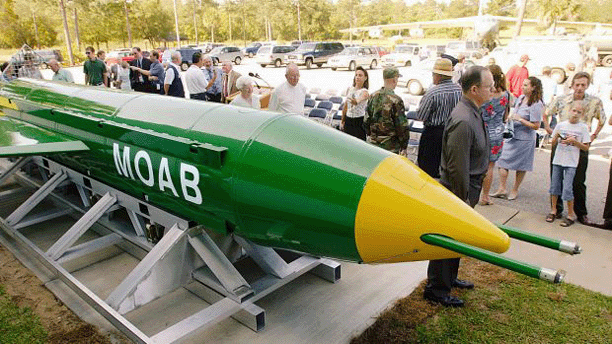
“Mother of all Bombs” into nuclear facilities?
Until recently, Israel lacked “bunker buster” bombs and the capacity to mount
a sustained air attack that would destroy Iran’s entire nuclear program. But
perhaps not anymore.
In January, US military intelligence already assessed that, absent an
agreement, Israel would probably strike Iran’s nuclear facilities, most likely the
Fordow enrichment plant, an Iranian underground uranium enrichment facility
20 miles (32 km) from the city of Qom, in the first half of 2025.
By Dan Steinbock, https://www.juancole.com/2025/02/netanyahus-attack-mother.html
The emboldened Netanyahu cabinet is in a war path, again. It is mobilizing to attack Iran and lobbying President Trump into a plan that presumably would use the ‘Mother of All Bombs.
In a press conference with US Secretary of State Marco Rubio, Israeli Prime
Minister Benjamin Netanyahu vowed to “finish the job” against Iran with the
support of President Trump.
Ever since his rise to power in the late 1990s, Israeli Prime Minister Benjamin
Netanyahu has worked toward a war with Iran, presumably to demolish
Tehran’s nuclear facilities but also to ensure its power projection in the region.
Now the emboldened Netanyahu wants to finish the job, decimate Iran’s
nascent nuclear capabilities, undermine Tehran’s future and overthrow its
rulers. After the misguided wars in Iraq and Afghanistan, Washington’s
neoconservative empire-builders are also back, pushing still another forever
war for a “paradigm shift in the Middle East.”
The Israel-Iran scenarios
Israeli Prime Minister Benjamin Netanyahu has discussed with Trump several
possible levels of American backing. According to Israeli observers, there are
now four viable scenarios for an Israeli attack against Iran’s nuclear facilities,
as seen in the light of US-Israeli relations. Let’s name them.
In the cooperative scenario, the US and Israel cooperate in an attack against
Iran’s nuclear sites, which will be followed by Trump’s ultimatum that Iran must
entirely dismantle its military nuclear program.
In the clash scenario, the Trump administration would build on diplomacy to
seal a nuclear deal. Yet, Israel would attack on its own and thereby undermine
Trump’s efforts causing a bilateral drift between the two countries.
In the investment scenario, Saudi Arabia would offer the US hundreds of
billions of dollars in investment, to avoid a destabilization in the region that
could undermine Riyadh’s 2030 modernization program.
In the solo scenario, Israel attacks Israel’s nuclear facilities without direct US
cooperation, but with the tacit consent of the White House. This would happen
after the Trump administration’s threats and coercive diplomacy against Iran.
Ultimately, US priorities will matter the most. But these can be elusive and
contradictory. Some in the Congress have called for more US military action,
including direct attacks against Iran. Others have echoed the Biden
Administration’s calls for restraint and de-escalation.
Here’s the problem: any escalation with Iran, whether by the US, Israel or
both would likely regionalize the Gaza devastation, which is mis-aligned with
Trumps’ economic and geopolitical goals in the Middle East.
Targeting Iran
Ever since the Islamic Revolution in 1979, when President Carter froze
billions of dollars in Iranian assets, Washington has sought to restore the
status quo ante of the Shah that had made Iran safe to American capitalism.
In the 1980s, US intelligence and logistics played a vital role in arming
Baghdad in the Iran-Iraq War, perhaps the most lethal conventional war
between developing countries yet, with total casualty estimates up to 1 to 2
million. In 1988, the US launched an attack against Iran, presumably in
retaliation for Iran’s laying mines in areas in the Gulf. In the mid-90s, the
Clinton administration declared a total embargo on dealings with Iran.
In 2002, President Bush included Iran in his “Axis of evil” speech.
Subsequently, US and Israel cooperated in training secessionist forces in
Iran’s Kurdistan province. In 2007, US reportedly vetoed an Israeli plan to
bomb Iranian nuclear facilities. Instead, during the next three years, the US
and Israel deployed the Stuxnet virus, the world’s first offensive cyber
weapon, to destroy almost a fifth of Iran’s nuclear centrifuges.
In 2015, years of challenging talks resulted in a nuclear deal (Joint
Comprehensive Plan of Action, JCPOA) between Iran, the US and a set of
world powers. Despite Iran’s adherence to it, the Trump administration pulled
the US out of the deal in 2018. As tensions escalated, the Trump
administration assassinated Iran’s most important general, Qasem Soleimani,
in a deadly drone strike in January 2020.
The longstanding quest for Iran War
While the covert war in the shadows has prevailed since the Islamic
Revolution, US regime change efforts moved to a new stage during the Bush
administration. Since 2003, US Army has conducted an analysis called
TIRANNT (Theater Iran Near-Term) for a full-scale war with Iran. Reportedly,
this plan (CONPLAN 8022) would be activated in the eventuality of a Second
9/11, on the presumption that Iran would be behind such a pivotal operation.
That may be one reason why Israeli UN ambassador Gilad Erdan and PM
Netanyahu explicitly compared Hamas’s October 7 offensive to the 9/11 terror
attacks, which sparked the US. global war on terror. Concurrently, many in
Washington sought a pretext for a link with Iran, to legitimize a major regional
conflict. In contrast, the U.S. Directorate of National Intelligence assessed that
Iran had no foreknowledge of or involvement in the October 7 attacks.
For its part, Netanyahu’s government calculated that an Iran conflict could
divert mounting negative public attention from atrocities in Gaza and the West
Bank.
There were precedents. In 2011 Netanyahu had ordered the Mossad and IDF
to prepare for an attack on Iran within 15 days. Yet, Mossad’s chief Tamir
Pardo and chief of staff Benny Gantz, the opposition’s key member in
Netanyahu’s war cabinet, questioned the PM’s legal authority to give such an
order without the cabinet’s approval. Netanyahu had backed off.
A month after the Hamas offensive, Netanyahu’s Mossad chief David Barnea
stated Iran had stepped up terror worldwide.” If Israelis or Jews are harmed,
he added, Israel’s response would go to Tehran’s “highest echelon.”
Using October 7 against Iran
In April 2024, Israel bombed Iranian embassy in Damascus in which 16
people were killed, including the targets, half a dozen high-level officers of the
Islamic Revolutionary Guard Corps (IRGC).
The IRGC launched a broad retaliatory attack against Israel and the Israeli-
occupied Golan Heights with successive waves of drones, cruise missiles,
and ballistic missiles. Giving full public notice that its response was on the
way, Tehran designed it carefully as a show of force that would not trigger a
wave of escalation. It caused minimal damage in Israel. However, as Israel
would later acknowledge, despite containment efforts by the US, the UK,
France and Jordan, some of Iran’s ballistic missiles penetrated Israel’s
defenses, hitting the Nevatim Airbase in southern Israel.
Iran’s attack targeted Israeli territory as a warning shot. It demonstrated
Tehran’s ability to counteract Israel’s huge air superiority, though lacking a
modern air force of its own. It also highlighted Israel’s dependency on major
Western powers to protect itself and the inadequacy of that protection.
So, how would Israel respond to a conventional “existential crisis” with Iran?
In late 2023, the hypothesis was tested in a high-level US war game.
Intriguingly, initially the US participants presumed that self-restraint would
prevail in this high-level war game. Yet, the simulation’s cold logic compelled
them into a sequence of steps that quickly went nuclear.
“Mother of all Bombs” into nuclear facilities?
Until recently, Israel lacked “bunker buster” bombs and the capacity to mount
a sustained air attack that would destroy Iran’s entire nuclear program. But
perhaps not anymore.
Recently, German newspaper “Bild” revealed that the US envoy to the Middle
East, Steve Witkoff, announced Washington’s intention to deliver one of the
most powerful non-nuclear weapons systems to Israel, known as the “Mother
of All Bombs.” Reportedly, Pentagon denies the story.
Weighing almost 10,000 kg, the GBU-43/B Massive Ordnance Air Blast
(MOAB) bomb can destroy deep underground bunkers. The explosive yield is
comparable to that of small tactical nuclear weapons.
In January, US military intelligence already assessed that, absent an
agreement, Israel would probably strike Iran’s nuclear facilities, most likely the
Fordow enrichment plant, an Iranian underground uranium enrichment facility
20 miles (32 km) from the city of Qom, in the first half of 2025.
First tested in 2003, the “Mother of All Bombs,” a 30,000-pound (14,000-
kilogram) monster was used for the first time in combat in 2017 in Afghanistan
by the Trump administration, despite the dire collateral damage.
Whether such use of the MOAB would spark a regional war or trigger waves
of new terror and insurgencies in the Middle East is a matter of debate. But it
would mean a potentially catastrophic escalation in the region and reshape
geopolitical landscape in the early 21 st century.
The author of The Fall of Israel (2025), Dr Dan Steinbock is the founder of
Difference Group and has served at the India, China and America Institute
(US), Shanghai Institute for International Studies (China) and the EU Center
(Singapore). For more, see https://www.differencegroup.net/
Trump, Who Tore Up Iran Nuclear Deal, Calls for Iran Nuclear Deal
The president has some grand, delusional ambitions for the Middle East
Rolling Stone, By Ryan Bort, February 5, 2025
“I want Iran to be a great and successful Country, but one that cannot have a Nuclear Weapon,” he wrote in a Truth Social post. “Reports that the United States, working in conjunction with Israel, is going to blow Iran into smithereens,’ ARE GREATLY EXAGGERATED. I would much prefer a Verified Nuclear Peace Agreement, which will let Iran peacefully grow and prosper. We should start working on it immediately, and have a big Middle East Celebration when it is signed and completed. God Bless the Middle East!”
The prospects for such a deal are slim given Trump’s zero-sum approach to foreign policy, not to mention how difficult it was to reach the initial agreement the president trashed in 2018. Trump signing a memorandum on Tuesday tightening sanctions against Iran didn’t seem to help. “The maximum pressure [policy] is a failed experience, and trying it again will lead to another failure,” Iran Foreign Minister Abbas Araghchi said in response according to the state-run Islamic Republic News Agency.
Trump’s recent Middle East wishcasting includes not only Iran capitulating to his demands, but the U.S. somehow taking ownership of the Gaza Strip, ridding it of Palestinians, and developing it into, as he put it Tuesday evening, the “Riviera of the Middle East.”
“The U.S. will take over the Gaza Strip,” Trump said during a press conference alongside Israeli Prime Minister Benjamin Netanyahu. “We’ll do a job with it, too. We’ll own it.”……… Subscribers only – more https://www.rollingstone.com/politics/politics-news/trump-iran-nuclear-deal-sanctions-1235257693/y
Trump says he wants new nuclear deal letting Iran ‘prosper’
AFR, Arsalan Shahla, Feb 6, 2025
Washington | US President Donald Trump said he was willing to immediately start working on a new nuclear deal with Iran that allows the country to “peacefully grow and prosper”, seemingly softening his stance on the Islamic Republic.
“Reports that the United States, working in conjunction with Israel, is going to blow Iran into smithereens, ARE GREATLY EXAGGERATED,” Mr Trump said in a post on his social networking site Truth Social on Wednesday (Thursday AEDT).
He didn’t give details on what such an agreement would entail, and Iranian officials haven’t yet responded to the post.
The US has long accused Tehran of using a decades-old civilian nuclear program to disguise ambitions to develop weapons, a claim repeatedly denied by Iran. The latest comments contrast with Mr Trump’s attitude in his first term, when he ordered a fatal strike on Iran’s most senior military general and prompted fears that the US would be drawn into war.
Mr Trump posted the Truth Social statement hours after signing a directive that calls for tough enforcement of existing sanctions. The move effectively revives his first-term “maximum pressure” strategy, including unilaterally quitting a landmark 2015 agreement that limited Iran’s nuclear program in exchange for sanctions relief.
Those measures weakened Iran’s economy but failed to thwart the country’s regional ambitions and instead triggered a security crisis in the oil-rich Persian Gulf that embroiled neighbouring Saudi Arabia and sent jitters through global energy markets.
Earlier, Iranian Foreign Minister Abbas Araghchi said Mr Trump’s maximum pressure strategy would continue to fail. “If the main issue is ensuring that Iran doesn’t pursue nuclear weapons, that’s already a firm commitment, Iran’s position is clear,” Mr Araghchi said in comments aired on state TV.
Oil prices fell as traders weighed concerns that a trade war between the US and China will hurt global growth against the possibility of further economic pressure on OPEC member Iran.
Withstanding the pressure
Mr Araghchi said Iran was already party to the treaty on the non-proliferation of nuclear weapons – a post-war international agreement seeking to prevent the spread of atomic bombs – and the country’s supreme leader, Ayatollah Ali Khamenei, had years earlier issued an Islamic ruling forbidding them.
However, the world’s top nuclear regulator said last month Iran’s stockpile of near-bomb-grade enriched uranium continued to grow. France, Germany and the UK asked inspectors with the International Atomic Energy Agency to prepare a special report in the first half of 2025 about Iran’s nuclear activities.
During Mr Trump’s initial term, the “maximum pressure” regime translated into strong sanctions and tough enforcement, including chasing Iranian oil cargoes on the high seas and killing the country’s most powerful military figure in a targeted drone strike……. https://www.afr.com/world/north-america/trump-says-he-wants-new-nuclear-deal-letting-iran-prosper-20250206-p5l9y6
Iran warns that any attack on its nuclear sites would trigger ‘all-out war’.
Foreign Minister Abbas Araghchi tells Al Jazeera that Iran would ‘immediately and decisively’ to an US or Israeli attack.
By Al Jazeera Staff, 31 Jan 202531 Jan 2025
Iranian Foreign Minister Abbas Araghchi has told Al Jazeera that any attack by Israel or the United States on Iran’s nuclear facilities would plunge the region into an “all-out war”.
In an interview with Al Jazeera Arabic during a visit to Qatar, Araghchi warned that launching a military attack on Iranian nuclear facilities would be “one of the biggest historical mistakes the US could make”.
He said Iran would respond “immediately and decisively” to any attack and that it would lead to an “all-out war in the region”.
Concerns have grown in Iran that US President Donald Trump might empower Israeli Prime Minister Benjamin Netanyahu to attack Iran’s nuclear sites while further tightening US sanctions during his second term in office.
Araghchi said he met Qatar’s Prime Minister and Foreign Minister Sheikh Mohammed bin Abdulrahman bin Jassim Al Thani in Doha to discuss key regional issues.
“We highly commend Qatar’s mediation role in reaching the ceasefire in Gaza,” Araghchi said in an interview broadcast on Friday. “I hope all other issues will be ironed out.”………………………… more https://www.aljazeera.com/news/2025/1/31/iran-fm-abbas-araghchi-attack-nuclear-sites-war-us-israel-gaza
Outgoing CIA director says ‘no sign’ Iran developing nuclear weapons
William Burns stated that the Islamic Republic made a decision in 2003 not to pursure nuclear weapons and has not changed its policy
The Cradle, News Desk, JAN 12, 2025
Outgoing CIA director William Burns stated in an interview on 10 January that Iran does not have a nuclear weapons program, following a decision it made in 2003, and that the US is concerned about the revival of ISIS.
In an interview with state broadcaster National Public Radio (NPR) to discuss his time as director of the notorious spy agency under President Joe Biden, Burns was asked whether Iran may accelerate its efforts to obtain nuclear weapons given the setbacks the Islamic Republic and its allies in the regional Axis of Resistance have sustained over the past year.
Burns answered that “the Iranian regime could decide in the face of that weakness that it needs to restore its deterrence as it sees it and, you know, reverse the decision made at the end of 2003 (an oral fatwa issued by Supreme Leader Ali Khamenei) to suspend their weaponization program.”
However, Burns clarified, “We do not see any sign today that any such decision has been made, but we obviously watch it intently. “
He added that Iran’s weakness could instead lead to negotiations for a nuclear deal similar to the one signed by Iran and the United States under President Obama in 2014. President Trump later withdrew from the deal following intense lobbying by Israeli Prime Minister Benjamin Netanyahu.
“You know that that sense of weakness could also theoretically create a possibility for serious negotiations, too. And, you know, that’s something the new administration is going to have to sort through. I mean, it’s something I have a lot of experience in with the secret talks a decade ago, a little more than a decade ago with the Iranians. So, you know, that’s that’s also a possibility,” Burns stated.
Regarding the negotiations for a possible ceasefire and prisoner exchange between Israel and Hamas in Gaza, Burns said he believes there is a chance for an agreement.
“I think the gaps between the parties have narrowed. There’s an Israeli delegation in Doha right now working through proximity talks managed by the Qataris, with the support of the Egyptians and with our support. So, I think there’s a chance.”……………………………………………………. https://thecradle.co/articles/outgoing-cia-director-says-no-sign-iran-developing-nuclear-weapons
Outgoing CIA director says ‘no sign’ Iran developing nuclear weapons
William Burns stated that the Islamic Republic made a decision in 2003 not to pursure nuclear weapons and has not changed its policy
The Cradle News Desk, JAN 12, 2025
Outgoing CIA director William Burns stated in an interview on 10 January that Iran does not have a nuclear weapons program, following a decision it made in 2003, and that the US is concerned about the revival of ISIS.
In an interview with state broadcaster National Public Radio (NPR) to discuss his time as director of the notorious spy agency under President Joe Biden, Burns was asked whether Iran may accelerate its efforts to obtain nuclear weapons given the setbacks the Islamic Republic and its allies in the regional Axis of Resistance have sustained over the past year.
Burns answered that “the Iranian regime could decide in the face of that weakness that it needs to restore its deterrence as it sees it and, you know, reverse the decision made at the end of 2003 (an oral fatwa issued by Supreme Leader Ali Khamenei) to suspend their weaponization program.”
However, Burns clarified, “We do not see any sign today that any such decision has been made, but we obviously watch it intently. “
He added that Iran’s weakness could instead lead to negotiations for a nuclear deal similar to the one signed by Iran and the United States under President Obama in 2014. President Trump later withdrew from the deal following intense lobbying by Israeli Prime Minister Benjamin Netanyahu.
“You know that that sense of weakness could also theoretically create a possibility for serious negotiations, too. And, you know, that’s something the new administration is going to have to sort through. I mean, it’s something I have a lot of experience in with the secret talks a decade ago, a little more than a decade ago with the Iranians. So, you know, that’s that’s also a possibility,” Burns stated………………………………………………………………………………………. more https://thecradle.co/articles-id/28431
Iran has absolutely no intention to build nuclear weapons, president says
Jan 7, 2025 https://www.iranintl.com/en/202501076906
Tehran has no plan to acquire a nuclear bomb since Iran’s Supreme Leader Ali Khamenei has forbidden it on religious grounds, Iran’s president said on Tuesday.
“The Islamic Republic has absolutely no intention of utilizing its nuclear capabilities for military purposes based on its ideological beliefs and a fatwa by Supreme Leader Ali Khamenei,” Masoud Pezeshkian said in a meeting with Britain’s new ambassador to Tehran.
For two decades, the Supreme Leader’s so-called nuclear fatwa has been repeatedly cited by senior officials as proof of Iran’s peaceful intentions. But even supporters of that view say the decree could be amended.
The nuclear engineer went on to say that if Khamenei’s opinion changed, Iran would have the capacity to build a nuclear weapon.
Tehran ready for return to JCPOA
Pezeshkian’s comments came one day after French President Emmanuel Macron warned Tehran’s nuclear program is nearing the point of no return.
Iran says its uranium enrichment program is for peaceful purposes but has accelerated activity since US President-elect Donald Trump withdrew from the 2015 nuclear deal – officially known as the Joint Comprehensive Plan of Action (JCPOA) – during his first term and reimposed sanctions on Tehran.
“The Islamic Republic is fully prepared for all parties to return to the 2015 agreement and fulfill their mutual commitments,” Pezeshkian added on Tuesday.
Last month, European powers France, Germany, and Britain warned that Iran’s actions had further eroded the agreement, noting that Tehran’s stockpile of highly enriched uranium has no credible civilian justification.
In December, the head of the UN nuclear watchdog reported that Iran was dramatically advancing enrichment close to the 90% purity needed only for weapons-grade material.
The three European nations, co-signatories of the 2015 accord, had brokered the deal under which Iran agreed to limit enrichment in exchange for the lifting sanctions.
“According to the Leader’s opinion, going in this direction is now forbidden, because he is a religious authority; (but) maybe he will change his opinion tomorrow,” Shahid Beheshti University President Mahmood-Reza Aghamiri said recently in an interview.
1 This Month

of the week – Shut Down Drone Warfare!


Tell the Ukrainian Government to Drop Prosecution of Peace Activist Yurii Sheliazhenko

Petition to revoke the licensing of the Near Surface Nuclear Disposal Facility (NSDF) at Chalk River. https://www.ourcommons.ca/petitions/en/Petition/Details?Petition=e-7247
To see nuclear-related stories in greater depth and intensity – go to https://nuclearinformation.wordpress.com
-
Archives
- April 2026 (103)
- March 2026 (251)
- February 2026 (268)
- January 2026 (308)
- December 2025 (358)
- November 2025 (359)
- October 2025 (376)
- September 2025 (257)
- August 2025 (319)
- July 2025 (230)
- June 2025 (348)
- May 2025 (261)
-
Categories
- 1
- 1 NUCLEAR ISSUES
- business and costs
- climate change
- culture and arts
- ENERGY
- environment
- health
- history
- indigenous issues
- Legal
- marketing of nuclear
- media
- opposition to nuclear
- PERSONAL STORIES
- politics
- politics international
- Religion and ethics
- safety
- secrets,lies and civil liberties
- spinbuster
- technology
- Uranium
- wastes
- weapons and war
- Women
- 2 WORLD
- ACTION
- AFRICA
- Atrocities
- AUSTRALIA
- Christina's notes
- Christina's themes
- culture and arts
- Events
- Fuk 2022
- Fuk 2023
- Fukushima 2017
- Fukushima 2018
- fukushima 2019
- Fukushima 2020
- Fukushima 2021
- general
- global warming
- Humour (God we need it)
- Nuclear
- RARE EARTHS
- Reference
- resources – print
- Resources -audiovicual
- Weekly Newsletter
- World
- World Nuclear
- YouTube
-
RSS
Entries RSS
Comments RSS
 nuclear-news