Trump Claims Iran Nuclear Sites ‘Totally Destroyed’—But That Clashes With Vance And Experts
By Ty Roush, Forbes Staff. https://www.forbes.com/sites/tylerroush/2025/06/23/did-the-us-destroy-irans-uranium-supply-or-not-vance-experts-clash-with-trumps-claims/
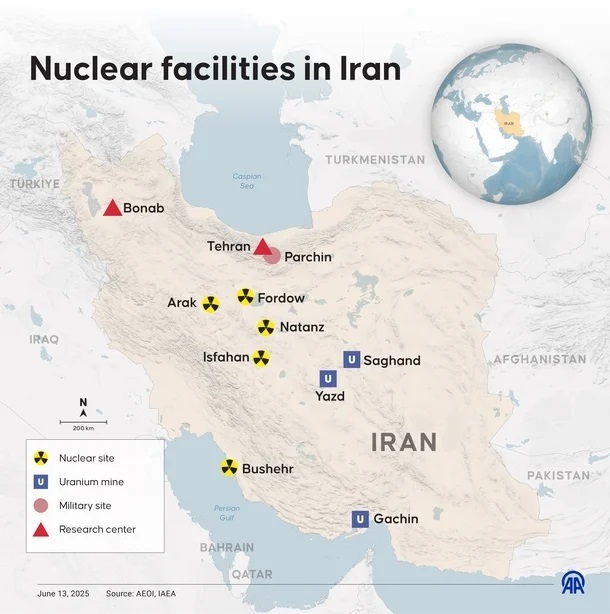
President Donald Trump on Monday said U.S. strikes “totally destroyed” nuclear facilities in Iran and criticized “sleazebags” in the media for suggesting otherwise—but comments from Vice President JD Vance, military officials and nuclear watchdogs all suggest the damage to Iran’s nuclear program remains unconfirmed.
Key Facts
“The sites we hit in Iran were totally destroyed, and everyone knows it,” Trump wrote on Truth Social, disputing “Fake News” he claims “would say anything different in order to try and demean, as much as possible—and even they say they were ‘pretty well destroyed!’”
White House press secretary Karoline Leavitt told ABC on Monday the U.S. is “confident” Iran’s nuclear program was “completely and totally obliterated,” noting there is a “high degree of confidence” the locations the U.S. strikes took place is where Iran stored its enriched uranium and that Iran “no longer [has] the capability … to threaten the world.”
International Atomic Energy Agency chief Rafael Grossi appeared to dispute Trump’s claims in a statement earlier Monday by suggesting the agency would need to verify damage to Iran’s underground Fordow facility, including whether the site’s uranium enrichment halls were impacted, though he noted the U.S. strikes likely caused “very significant” damage.
On Sunday, Defense Secretary Pete Hegseth and Chairman of the Joint Chiefs of Staff Gen. Dan Caine said an assessment on damage to Iran’s nuclear sites was “still pending,” and Caine claimed it was “way too early for me to comment on what may or may not still be there.”
Vance, in an interview with ABC on Sunday, suggested the U.S. strikes only set back Iran’s potential to weaponize its uranium stockpile and said the U.S. was “going to work in the coming weeks to ensure that we do something with that fuel.”
Jeffrey Lewis, a professor of nonproliferation at the Middlebury Institute of International Studies at Monterey, wrote on X he was “unimpressed” by the U.S. strikes while citing satellite images of the attacks, claiming the U.S. “failed to target significant elements of Iran’s nuclear materials and production infrastructure.”
How Large Is Iran’s Uranium Stockpile?
Iran stored about 400 kilograms (about 881 pounds) of uranium enriched to 60%, near weapons-grade enrichment of 90%, according to Grossi. It’s unclear whether Iran’s uranium stockpile is still this large, Grossi noted, adding IAEA’s inspectors last verified Iran’s stockpile a “few days” before Iran’s conflict with Israel began earlier this month.
Could Iran Rebuild Its Uranium Stockpile?
It’s possible Iran could rebuild its nuclear program, but a timeline for development would depend on how much damage was done to Iran’s nuclear sites, according to the Centers for Strategic and International Studies, a U.S.-based think tank. Recent U.S. strikes would make Iran “more motivated than ever” to obtain nuclear weapons, Rosemary Kelanic, a director at the U.S.-based think tank Defense Priorities, told the New York Times. Some American officials estimated an attack on Fordow set back Iran’s nuclear program by as much as five years, the Times reported.
Iran Fires Missiles at US Base in Qatar
Qatar’s Foreign Ministry said the missiles were intercepted and that there were no casualties
by Dave DeCamp | Jun 23, 2025, https://news.antiwar.com/2025/06/23/iran-fires-missiles-at-us-base-in-qatar/
The Iranian military announced on Monday that it launched an attack on the US’s Al Udeid base in Qatar in response to the US bombing of Iran’s nuclear facilities.
The attack was first reported by Axios reporter Barak Ravid, who cited Israeli sources that said Iran fired at least 10 missiles at the US base. Initial reports said that another missile targeted a US base in Iraq, but US officials later said the attack targeted only a base in Qatar.
“This base is the headquarters of the Air Force and the largest strategic asset of the US terrorist army in the West Asia region,” Iran’s Islamic Revolutionary Guard Corps (IRGC) said of the US base in Qatar.
The IRGC said Iran would not “leave any attack on its territorial integrity, sovereignty, and national security unanswered under any circumstances.”
The Qatari Foreign Ministry issued a statement that said Qatar’s air defenses “successfully thwarted the attack and intercepted the Iranian missiles” and that there were no injuries or deaths caused by the attack.
The reported missile launch comes after Fox News and other outlets said that an Iranian attack on US assets in the region was “imminent” and Qatar announced that it was closing its airspace, signaling the US has at least a few hours’ notice that the barrage was coming.
The New York Times reported that Iran had notified Qatar of its plans to attack in order to minimize casualties, signaling Tehran is seeking de-escalation with the US. In 2020, after the US assassinated Iranian Gen. Qassem Soleimani, Iran launched a similar attack on a US base in Iraq, which the US didn’t respond to.
A White House official told CNN that the US was expecting an Iranian response and claimed President Trump didn’t want more military engagement in the region. “We knew they’d retaliate. They had a similar response after Soleimani,” the official said.
How effective was the US attack on Iran’s nuclear sites? A visual guide
At odds with Trump’s claim of “complete obliteration”, two Israeli officials who spoke to the New York Times described serious damage at Fordow but said the site had not been completely destroyed.
The head of the International Atomic Energy Agency (IAEA), Rafael Grossi, added: “As for the assessment of the degree of damage underground, on this we cannot pronounce ourselves. It could be important; it could be significant, but no one … neither us nor anybody else could be able to tell you how much it has been damaged.”
Peter Beaumont, Guardian23 June 25 [EXCELLENT PICTURES ON ORIGINAL]
Trump claims the assault ‘totally obliterated’ the key facilities, but what do we know about its impact?
Donald Trump was quick to claim that US strikes on Iran’s nuclear facilities had “completely and totally obliterated” them. Still, it remains unclear how much physical damage has been done or what the longer-term impact might be on Iran’s nuclear programme.
What was the target?
The Atomic Energy Organization of Iran (AEOI) confirmed that attacks took place on its Fordow, Isfahan and Natanz sites, but insisted its nuclear programme would not be stopped. Iran and the UN nuclear watchdog said there were no immediate signs of radioactive contamination around the three locations after the strikes.
The Iranian Red Crescent Society reported no deaths from the US strikes, appearing to confirm Iranian claims they had been largely evacuated in advance. The health ministry said those who were injured showed no evidence of nuclear contamination. In the immediate aftermath, US military officials said the three sites had suffered “severe damage” after an operation that had been planned for weeks, suggesting it was coordinated with Israel.
The Pentagon said a battle damage assessment was still being conducted.
What do we know about the strike on Fordow?
Long regarded as the most difficult military target among Iran’s nuclear sites, the uranium enrichment facilities at Fordow – the primary target of the operation – are buried beneath the Zagros mountains. Reports have suggested that the site was constructed beneath 45-90 metres of bedrock, largely limestone and dolomite.
Some experts have suggested the layering of the sedimentary rocks, including faults, would also make it more difficult to strike the centrifuge array, providing a kind of geological cushioning against a blast wave.
The attack – codenamed Operation Midnight Hammer – was carried out by seven B-2 Spirit stealth bombers flying from the US, after a deception flight by other B-2s into the Pacific. Tomahawk missiles were fired from US ships in waters south of Iran.
The site was hit by a dozen 13,600kg massive ordnance penetrators – known as bunker busters – at approximately 2.10am Iranian time. It was the weapon’s first operational use. The number used suggests a lack of confidence that a smaller strike could penetrate through to the target.
The result to a large extent depends on the kind of concrete inside the facility. Estimates of the bunker busters’ penetration are based largely on reinforced concrete resistant to 5,000psi. Iran is believed to have used more resistant concrete.
While video from the site showed evidence of a fire in the immediate aftermath, satellite images published on Sunday were suggestive but far from conclusive.
The main support building at the site appeared to be undamaged, but the topography of a prominent area of ridge line appeared to have altered and been flattened out, with some evidence of rock scarring close to two clusters of bomb craters around the ridge.
Analysts had suggested that a strike could hit the main entrance tunnel to the site, but the main effort appears to have been in a different location.
At odds with Trump’s claim of “complete obliteration”, two Israeli officials who spoke to the New York Times described serious damage at Fordow but said the site had not been completely destroyed.
The head of the International Atomic Energy Agency (IAEA), Rafael Grossi, added: “As for the assessment of the degree of damage underground, on this we cannot pronounce ourselves. It could be important; it could be significant, but no one … neither us nor anybody else could be able to tell you how much it has been damaged.”
What was the impact at Isfahan?………………………………………
………. facilities targeted at Isfahan either contained no nuclear material or small quantities of natural or low-enriched uranium.
What was hit at Natanz?………
……….It appears that Natanz’s underground enrichment hall was targeted. Enhancement of satellite images from the site on Sunday showed fresh damage to overground buildings and new cratering in the centre of the site…….
Was Iran’s nuclear programme obliterated?
…………………………..“The enriched uranium reserves had been transferred from the nuclear centres and there are no materials left there that, if targeted, would cause radiation and be harmful to our compatriots,”
Three days before the US attacks, 16 cargo trucks were seen near the Fordow entrance tunnel.
The head of the AEOI, Mohammad Eslami, claimed this month that Iran had another enrichment site “in a secure and invulnerable location” that could house centrifuges.
Analysts have long argued that while it is possible to disrupt the physical function of a nuclear facility and limit the scope of a programme through, for example, the killing of scientists, the breadth of technical knowledge acquired during the decades-long programme is impossible to destroy.
Ultimately, the question is whether the US-Israeli attacks are seen as sufficient for Iran to capitulate, or whether they instead encourage the regime to accelerate its efforts to produce a viable nuclear weapon. https://www.theguardian.com/world/2025/jun/22/how-effective-was-the-us-attack-on-irans-nuclear-sites-a-visual-guide
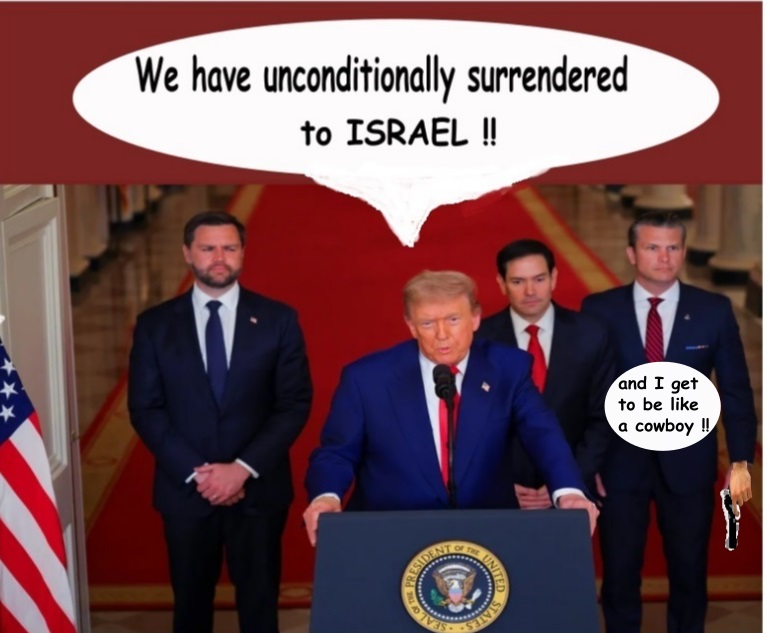
Trump’s attack on Iran is ‘unconditional surrender’ to Israel
Aaron Maté, Jun 22, 2025, https://www.aaronmate.net/p/trumps-attack-on-iran-is-unconditional?utm_source=post-email-title&publication_id=100118&post_id=166521469&utm_campaign=email-post-title&isFreemail=true&r=ln98x&triedRedirect=true&utm_medium=email
Shunning the US intelligence consensus, Trump and top principals rely on Israeli fraud to bomb Iran.
Since his election in 2016, Donald Trump’s political opponents have portrayed him as a dangerous, unstable fabulist doing the bidding of a malign, nuclear-armed foreign power.
Having returned to the White House this year, Trump is proving his detractors correct on all counts but one: the location on the map. The rogue state that he’s colluding with — at great peril to the planet — is not Russia, as his most vocal detractors alleged, but Israel.
Israel’s June 13th attack on Iran sabotaged the then-ongoing talks on a new nuclear deal with the United States, and Trump has gone to unprecedented lengths to support its aggression. Trump undercut his own Secretary of State’s claim that Israel had undertaken “unilateral action” by acknowledging that “we knew everything” in advance of what he called a “very successful attack.” Administration officials then disclosed that Trump had previously authorized giving Israel intelligence support for the bombing. Trump then called on Tehran’s 9.8 million residents to evacuate, mused about killing Iran’s supreme leader, Ayatollah Ali Khamenei, and declared that “we” – meaning Israel – “have complete and total control of the skies over Iran.”
After Iran rejected his demand for “unconditional surrender”, Trump imposed a new deadline of two weeks, only to break it three days later by ordering a US military attack on three Iranian nuclear energy sites, including the deeply buried mountain complex Fordo, which he quickly hailed as a “great success.” Just as with Trump’s diplomacy with Iran, his two-week deadline turns out to have been a ruse whose “goal was to create a situation when everyone wasn’t expecting it,” a senior administration official said.
To wage war on Iran, Trump and his allies have employed the traditional Iraq WMD playbook of ignoring or manipulating the available evidence to fear-monger about a foreign state marked for regime change. Unlike the Iraq war, where the fraudulent case for invading was mostly concocted in-house, Trump has outsourced the job to Israel, while not even pretending to care about public opinion or Congressional approval.
Back in March, the US intelligence community assessed that “Iran is not building a nuclear weapon” and “has not reauthorized the nuclear weapons program… suspended in 2003.” According to US officials who spoke to the New York Times, “[t]hat assessment has not changed.” Moreover, the US has found that “not only was Iran not actively pursuing a nuclear weapon, it was also up to three years away from being able to produce and deliver one,” CNN reports, citing four sources.
Whereas Dick Cheney and company went through the trouble of nudging subordinates to fabricate intelligence, including via torture, Trump does not care about seeking their imprimatur. “[M]y intelligence community is wrong,” Trump told reporters on Friday. White House Press Secretary Karoline Leavitt insisted that “Iran has all that it needs to achieve a nuclear weapon,” and, if authorized by Ayatollah Khamenei, “it would take a couple weeks to complete the production of that weapon.” In White House meetings, CIA chief John Ratcliffe has argued that Iran is close to a nuclear bomb and that claiming otherwise “would be similar to saying football players who have fought their way to the one-yard line don’t want to score a touchdown,” according to one US official who spoke to CBS News. (After the Iraq war, a “Slam dunk” basketball analogy is no longer available).
If Trump’s intelligence community is “wrong,” who does he think is right? As US officials told the New York Times, the claims from Trump and his circle “echoed material provided by Mossad,” Israel’s intelligence agency. And whereas some in the government, undoubtedly those close to Trump, “find the Israeli estimate credible”, others believe that “Israeli assessments have been colored by Prime Minister Benjamin Netanyahu’s desire to gain American support for his military campaign against Iran.” Moreover, according to multiple officials, “[n]one of the new assessments on the timeline to get a bomb are based on newly collected intelligence,” but instead on “new analysis of existing work.” In other words, Trump is sidelining his own intelligence community to trust a “new analysis” that is based on no new information, just the manipulation of a foreign government.
Trump’s disdain for his own agencies is a particular slight to intelligence chief Tulsi Gabbard. “I don’t care what she said,” Trump said this week, referring to Gabbard’s presentation of the US intelligence consensus on Iran in March. “I think they [Iran] were very close to having it.”
Rather than defend the agencies she oversees – and the record she earned challenging previous US-driven regime change deceptions — Gabbard has bent the knee to Trump, and Israel by extension. In a social media post, Gabbard chided “the dishonest media” for taking her March testimony “out of context.” The US, Gabbard now claimed, “has intelligence that Iran is at the point that it can produce a nuclear weapon within weeks to months, if they decide to finalize the assembly.” Gabbard also shared video of that March testimony, without addressing the contradictory fact that it does not include any mention of her newfound claim that Iran has the capability to produce a nuclear bomb “within weeks to months.”
Gabbard is engaging in disingenuous wordplay. If Israel tells America that Iran “can produce a nuclear weapon within weeks”, then yes, American intelligence now “has” that intelligence. That doesn’t mean it is true, or that American intelligence believes it, which it does not. A US official familiar with the available record on Iran tells me that there is no US intelligence assessment concluding that Iran is “weeks” away from building a nuclear weapon. Gabbard is only saying, therefore, that the US intelligence community has received “intelligence” from Israel, without mentioning that the IC does not actually endorse it.
Moreover, pretend for a moment that the Israeli claim is correct. Gabbard’s caveat of “if they decide to finalize” is an acknowledgment that Iran has not decided to build a nuclear weapon. That’s because Iran has said it does not want one, and is willing to commit to that in a binding agreement — the one they were negotiating with the US until Trump and Israel sabotaged it, and not for the first time. In fact, as US intelligence officials have also predicted, Trump’s bombing now increases the likelihood that Iran will pursue the nuclear bomb that it has long foresworn. Iran claims to have moved enriched uranium stockpiles prior to the US bombing, which preserves its capacity to weaponize.
Trump and Israel insisted, in the president’s words, on “unconditional surrender”: capitulation to maximalist US-Israeli demands that Iran end its uranium enrichment program, which it is entitled to have under the Non-Proliferation Treaty; and that it limit its arsenal of missiles. In other words, Trump and Netanyahu demanded that Iran agree to abandon its sovereignty and right to self-defense just as it is under attack from US-backed Israeli aggression; and all while US-backed Israeli mass murder in Gaza and annexation of the West Bank continues unimpeded.
Iranian officials did not surrender. Trump, by contrast, cannot say the same. By enabling its bombing campaign, parroting its deceptions, and now going to war against Iran on its behalf, Trump has already offered an unconditional surrender to Israel — a betrayal that grows more dangerous by the day.
Trump Announces ‘Successful’ Attack On Iranian Nuclear Sites

Trump said Iran must quickly make peace or he will authorize larger attacks
by Kyle Anzalone | Jun 21, 2025, https://news.antiwar.com/2025/06/21/trump-announces-successful-attack-on-iranian-nuclear-sites/
President Donald Trump announced on Saturday that the US has completed an attack on three nuclear sites in Iran.
“We have completed our very successful attack on the three Nuclear sites in Iran, including Fordow, Natanz, and Esfahan. All planes are now outside of Iran air space. A full payload of BOMBS was dropped on the primary site, Fordow,” the President wrote on Truth Social. “All planes are safely on their way home. Congratulations to our great American Warriors. There is not another military in the World that could have done this. NOW IS THE TIME FOR PEACE! Thank you for your attention to this matter.”
In an address to the nation, Trump said that Iran’s three main nuclear enrichment sites had been “completely obliterated.” Trump added that if “peace does not come quickly,” the US would conduct larger attacks soon.
Iranian state media downplayed the success of the strike, saying the personnel and nuclear material were removed from the facilities before the attack.
Fox News reporter Jennifer Griffin spoke with a “well-placed source” who did not believe the Esfahan facility was destroyed. “ There is no way they got in that tunnel It’s deeper than [Fordow]- and harder rock,” they explained.
Axios reporter Barak Ravid said an Israeli official confirmed that Tel Aviv was informed of the strike before the operation. He added that Trump had called him following the attack, with the message, “We had great success tonight. Your Israel is much safer now.”
Ravid is an Israeli who served in an Israeli Army intelligence unit.
Trump also called Israeli Prime Minister Benjamin Netanyahu after the strike.
Netanyahu posted a video message on social media Saturday night praising Trump’s decision to bomb Iran. “Congratulations, President Trump. Your bold decision to target Iran’s nuclear facilities with the awesome and righteous might of the US will change history.” The Israeli leader continued, “In operation Rising Lion, Israel has done truly amazing things. But in tonight’s action against Iran’s nuclear facilities, America has been truly unsurpassed. It has done what no other country on earth could do.”
Reuters reports speaking with a US official who confirmed B-2 bombers were involved in the attack. Earlier on Saturday, six B-2 bombers departed a US airbase in Missouri, with officials saying they were en route to Guam.
B-2s are capable of dropping the GBU-57A/B MOP, a 30,000-pound bunker-busting bomb, that some US officials believed to be capable of destroying Iran’s Fordow nuclear site.
Fox News host Sean Hannity said that six GBU-57s were used to strike Fordow. The nuclear facilities in Natanz and Esfahan were targeted with 30 submarine-launched Tomahawk missiles.
Shortly after announcing the attack, Trump posted an image from the “Open Source Intel” X account that claimed Fordow is gone. The owner of the account says he is based in Israel.
Following the attack, the Pentagon began warning US troops in the region that the stikes likely put them in danger of Iranian retaliatory attacks. Ken Klippenstein reports obtaining a briefing that said strike on Iran “will likely result in counterstrikes on US bases and facilities” in the Middle East, and “likely activate Iran and other foreign terrorist organizations cells abroad including the US to conduct strikes against US persons and facilities.”
In a post on Truth Social, Trump threatened that any Iranian response “WILL BE MET WITH FORCE FAR GREATER THAN WHAT WAS WITNESSED TONIGHT.”
The American strike follows Israeli requests that the US enter the war it started last week with Iran. Over the past week, Trump appeared convinced that Iran was weeks away from building a nuclear weapon, an intelligence assessment that originated with Israel’s intelligence agency, Mossad. That message was amplified in the White House by CIA Director John Ratcliffe.
Officials Concede They Don’t Know the Fate of Iran’s Uranium Stockpile.
Both Vice President JD Vance and Rafael Grossi, the head of the
International Atomic Energy Agency, acknowledged questions about the
whereabouts of Iran’s stockpile of near-bomb-grade nuclear material.
New York Times 22nd June 2025, https://www.nytimes.com/2025/06/22/us/politics/iran-uranium-stockpile-whereabouts.html
Juan Cole: The Current Iran War Will Likely End Soon, But the Arms Race Will Heat Up
Regime change in Iran as a result of the US and Israeli attacks is unlikely. Even Iranians in the opposition are likely to rally around the flag.
America’s credibility as a negotiator and mediator is completely ruined, since Trump hit Iran in the midst of negotiations
It is still not clear to me that the ayatollahs’ longstanding opposition to nuclear weapons will change.
June 23, 2025
Ann Arbor (Informed Comment) – The Al Jazeera bureau chief in Tehran, Abdul Qader Fayez, reports from “informed sources” in Tehran that Iran’s clerical Leader, Ali Khamenei, and his National Security Council have still not decided how to respond to the US attack on Iranian civilian nuclear facilities, though they want the response to be appropriate to the damage done them.
Al Jazeera notes, “Fayez pointed out that this Iranian hesitation suggests a tendency to respond in a carefully considered strategic manner not based on momentary revenge, but rather on a more comprehensive approach that allows Tehran multiple options rather than drawing it into a specific tactical confrontation or a direct, ill-considered reaction.”
Fayez says that the Iranian elite is attempting to distinguish between Washington’s attack and the ongoing Israeli escalation, especially since the US bombardment was unprecedented.
I would add (this is Juan Cole speaking) that Iran is weak. It has lost control of its own skies and so is as helpless as Lebanon and Syria before the Israeli Air Force (and the American). Iran still has some drones and hypersonic missiles that can penetrate Israeli defenses, but although it is able to do some damage to Tel Aviv and Haifa, it isn’t anything the Israelis can’t survive.
The weapons of the weak are guerrilla warfare, covert operations and terrorism. The US and Israel do not have troops on Iranian soil, so a guerrilla war against them is difficult to mount. Moreover, Iran has a return address and so cannot pursue classic guerrilla warfare.
Iran can hit bases in the Middle East that host US troops, as it did in January 2020 after Trump assassinated Iranian General Qasem Soleimani. In that instance, Iranian commanders were careful not to kill the troops, though the latter did get severe concussions from the missile impacts. Such a response would be purely symbolic and for the sake of Iranian domestic politics, with no military significance. US troops in Iraq and Syria are particularly vulnerable to this sort of reprisal.
If Trump is speaking truly and the strikes really were a one-off, then the direct US-Iran engagement could subside quickly. Iran has no reason to want continued direct involvement with the US while it is facing an concerted Israeli campaign. It should be noted that in his first term Trump bombed Syria, then largely ignored the country except for the Obama-initiated defeat of ISIL in Raqqa. He bombed Afghanistan and then more or less surrendered to the Taliban. He bombed an Iranian general at Baghdad International Airport and watched Iran reply, but then went back to using economic sanctions. Trump has a history of splashy one-off bombings with no follow-through, and this episode could be just as transitory.
During the first Trump round of “maximum pressure” sanctions, Iran covertly set fires to petroleum tankers of the United Arab Emirates in the Gulf. But Iran now has good relations with the Arab Gulf states and is unlikely to take the American strikes out on them.
There may, however, be attacks on other oil pipelines or tankers of states with bad relations with Iran. Oil attacks would benefit Iran by raising the price of the petroleum it smuggles to China and by hurting the US and Israeli economies.
Terrorism is a possibility, but there is a danger it would be traced back to Iran, and it is bad for a country’s reputation, foreign relations, and economic affairs.
Regime change in Iran as a result of the US and Israeli attacks is unlikely. Even Iranians in the opposition are likely to rally around the flag. Some disgruntled ethnic minorities may attempt to take advantage of perceived state weakness, but they are small and cannot disrupt the Persian Iranian Plateau, the regime stronghold. If anything, the Israeli and US attacks may have extended the life of an oppressive government that is widely disliked inside the country but which can now claim to stand against powerful external foes dedicated to attacking and destroying the Iranian nation.
……………………………………………………………………………….. The hot war will end, but the Middle East arms race is with us for the foreseeable future, and the opportunities for Russia and China, should they want them, to play a bigger role in the region have expanded.
America’s credibility as a negotiator and mediator is completely ruined, since Trump hit Iran in the midst of negotiations, which a reader reminded me is a violation of the Hague Regulations of 1907 and was held against Japan in the attack on Pearl Harbor.
It is still not clear to me that the ayatollahs’ longstanding opposition to nuclear weapons will change. Many countries throughout the world, however, may now be tempted to go for a nuclear weapon, since the difference between North Korea on the one hand and Iraq and Iran on the other is glaringly clear.
Trump Has Bombed Iran. What Happens Next Is His Fault.
Caitlin Johnstone, Jun 22, 2025,https://www.caitlinjohnst.one/p/trump-has-bombed-iran-what-happens?utm_source=post-email-title&publication_id=82124&post_id=166504460&utm_campaign=email-post-title&isFreemail=true&r=1ise1&triedRedirect=true&utm_medium=email
The US military has bombed multiple Iranian nuclear sites on the orders of President Trump, immediately putting tens of thousands of US military personnel in the region at risk of an Iranian retaliation which can then escalate to full-scale war.
Earlier this month Iran’s Defense Minister Aziz Nasirzadeh explicitly warned the United States that a direct US attack would result in Tehran ordering strikes on US bases in the middle east, saying “all US bases are within our reach and we will boldly target them in host countries.”
In the lead-up to Trump’s act of war on Iran, the president told the press that an attack on American troops will mean a harsh response from the US, saying, “We’ll come down so hard if they do anything to our people. We’ll come down so hard. The gloves are off. I think they know not to touch our troops.”
Trump reiterated this threat to Iran in his announcement of the US attack today.
“There will be either peace, or there will be tragedy for Iran, far greater than we have witnessed over the last eight days,” Trump said. “Remember, there are many targets left. Tonight’s was the most difficult of them all, by far, and perhaps the most lethal. But if peace does not come quickly, we will go after those other targets with precision, speed and skill. Most of them can be taken out in a matter of minutes.”
So you can see how we might already be on our way toward a war of nightmarish proportions as a result of the president’s unprovoked act of aggression. Tehran now has to choose between reestablishing deterrence with extreme aggression or opening the floodgates to a whole host of existential threats from both outside and inside the country. Add to that the possibility of Iran blockading the Strait of Hormuz and the fact that Iran has now been strongly incentivized to actually obtain a nuclear weapon, and it looks very likely that we are plunging into a situation that could unfold in any number of horrific ways.
Right now American political discourse is rife with the narrative that the US has been “dragged” into Israel’s war, which I reject entirely. Every step of the way this entire thing has been signed off on by US leadership. We are at this point because Trump and his regime knowingly chose to take us here.
US troops within reach of Iran’s missiles are reportedly being briefed that they can expect to be on the receiving end of retaliatory strikes in the coming days.
Again, Iran explicitly warned it would attack the US military if the US military did the thing it just did. If and when these retaliatory strikes come, the warmongers will try to argue that this is a valid reason to escalate this war. They will be lying. They chose to make this happen.
Whatever transpires from this point on is the fault of Donald Trump and the unelected thugs he listens to. If US troops are killed, the war sluts in Washington and the Pentagon propagandists in the press will list their names and bandy about their photos and demand that their deaths be avenged with further acts of war — but it will not be Iran’s fault that they died.
It will be Trump’s fault. It will be the fault of everyone whose decisions led up to bombs being dropped on Iranian energy infrastructure, and the fault of everyone who put those soldiers in harm’s way.
None of this needed to happen. Iran was at the negotiating table. The Iran deal was working fine before Trump shredded it to put us on this terrible trajectory. The warmongers artificially manufactured this situation and knowingly inflicted this horror upon our world.
I am really not looking forward to all the melodramatic victim-LARPing if and when Iran kills US military personnel stationed in west Asia. The US is the only nation on earth that can rival Israel in its ability to play the victim when the ball they’ve thrown at the wall bounces back.
US Reportedly Assesses Only a Nuclear Bomb Could Destroy Iran Nuclear Facility
One expert has warned that attacks on nuclear facilities “should never take place” because of the radioactive fallout.
By Sharon Zhang ,
The Pentagon has reportedly assessed that the only weapon that could
destroy a nuclear facility in Iran deemed by war hawks to be a key part of
Iran’s nuclear program is a nuclear bomb — an intensely ironic finding
in a war fought over the pretense of stopping nuclear proliferation.
According to U.S. sources cited by The Guardian, defense officials have
been told that only a “tactical nuclear weapon” could penetrate deep
enough underground to destroy Fordow, a nuclear facility reportedly built
inside a mountain in northwestern Iran.
Truthout 20th June 2025, https://truthout.org/articles/us-reportedly-assesses-only-a-nuclear-bomb-could-destroy-iran-nuclear-facility/
Israel – Iran: The Confrontation

while the Iranian documents seized by the Mossad did not reveal a military nuclear program, [ 18 ] despite the statements of Benyamin Netanyahu, the neutrality of the Argentine Rafael Grossi, director of the International Atomic Energy Agency (IAEA), has been questioned based on the first Israeli documents seized by the Iranian Ministry of Intelligence. They show that he passed on observations of his organization to Israel, even though Israel is not a member. Among the IAEA governors, Russia, China and Burkina Faso opposed this resolution.
Coincidentally, Rafael Grossi has already been grilled about his strange silence during the Russian special operation in Ukraine: during a speech at the Davos Forum in 2022, he revealed that the Ukrainian regime had stored 30,000 kilos of plutonium and 40,000 kilos of enriched uranium at the Zaporijia plant. After that, nothing more, despite Russian objections.
The day after the publication of the documents seized by Iran, Tel Aviv attacked Iran. This is exactly the same behavior as during the 2006 war against Lebanon…………In reality, it attacked to block investigations by the Lebanese police and judiciary into a vast network of Israeli espionage and terrorism in Lebanon
Thierry Meyssan
Voltairenet.org
Tue, 17 Jun 2025 https://www.sott.net/article/500180-Israel-Iran-The-Confrontation
The confrontation between Israel and Iran does not correspond at all to the image presented by the media. Its roots go back to the time before the Islamic Republic and have nothing to do with the production of a nuclear bomb.The current start of the war is intended to cover up the misdeeds of the Argentine Rafael Grossi, director of the International Atomic Energy Agency.
The time has come: the confrontation between Israel and Persia has begun. Its origins lie not in the Islamic Republic, but in everything that preceded it. This war will continue until one of the opponents is exhausted.
To understand what is happening and avoid falling into one of the two official narratives that obscure the reality of the problem, we need to take a few steps back.
Iran’s Enemies in the 20th Century
All demonstrations in Iran against external enemies end with the inevitable “Death to the United Kingdom, Death to the United States, Death to Israel!” It is a cry that comes from the depths of Persian suffering since World War I.
Although we in the West are not aware of it, Iran was the victim of the largest genocide of the First World War in 1917-1919 [ 1 ] . 6 to 8 million people died of hunger out of a population of 18 to 20 million, i.e. between a quarter and a third of Iranians. Iran, although neutral, was crushed by the British armies, against a background of rivalry with the Bolsheviks and the Ottomans. This horror left a traumatic memory that is still very much present in Iran [ 2 ] For an Iranian there is no doubt that the United Kingdom is the first enemy of his country.
The British, who had colonized Iran with the help of one of his officers, Reza Shah (1925-1941), overthrew him to install his son, Mohammad Reza Pahlavi (1941-1979), in power. Behind these guises, they plundered the country’s oil. In 1951, the Shah appointed Mohammad Mossadegh as prime minister. Mossadegh nationalized oil at the expense of London. What followed was a conflict in which the British attacked viciously and organized a color revolution with the help of the Americans. This was “Operation Ajax” [ 3 ] . The new [Persian] regime was no longer led by London, but by Washington. The American embassy, which installed the telephone system, tapped all the ministers’ lines so that they could listen in live, without their knowledge. This system was discovered during the 1978 revolution. So Iranians have no doubt that the United States is their second enemy.
When Mossadegh was ousted, the British appointed General Fazlollah Zahedi in his place. Zahedi was a Nazi they had imprisoned in Cairo, but London was counting on him to restore “order.” So he set up a secret police force modeled on the Gestapo. He recruited former Nazis to train them, and several hundred “revisionist Zionists” were sent by Yitzhak Shamir (then working for the Mossad) to supervise them [ 4 ] . The horrors of the Savak, the most horrific secret police in the world at the time, can still be seen in the museum dedicated to it in Tehran [ 5 ] . So there is no doubt in the Iranian mindset that Israel is their third enemy.
Israel’s Only Enemy in the 20th Century
Contrary to what the Israeli public believes after 25 years of “revisionist Zionist” propaganda, Iran – neither that of the Shah nor that of the Islamic Republic – has never had the goal of destroying the Jewish population of occupied Palestine. As President Mahmoud Ahmadinejad made clear, the goal was to destroy the State of Israel in the same way that Russia had destroyed the USSR [ 6 ] .
No, the only enemy of the State of Israel is the one that has sabotaged every attempt at peace between Jews and Arabs for 80 years: the United Kingdom. As I have often explained, when the Foreign Office drew up its plan, The Future of Palestine, in 1915, it specified that a Jewish state should be established in Mandatory Palestine, but that it should in no way be able to guarantee its own security.
It was not until two years later that the government of David Lloyd George drew up the Balfour Declaration, which announced the establishment of a Jewish National Home, and the government of Woodrow Wilson committed itself to the establishment of an independent state for the Jews of the Ottoman Empire.
The author of this text, Lord Herbert Samuel, became the British High Commissioner in Palestine. True to himself, he preferred the “revisionist Zionists” of Jabotinsky on the one hand and the anti-Semite Mohammed Amin al-Husseini as Grand Mufti of Jerusalem on the other. He was subsequently appointed Under-Secretary of State for the Home Department in the government of Archibald Sinclair.
This policy continues unabated to this day, with the UK still supporting the “revisionist Zionist” Benjamin Netanyahu on one side and the Muslim Brotherhood, of which Hamas is the Palestinian branch, on the other.
The continuation of the conflict between the “revisionist Zionists” and Iran
Continue readingIsraeli and U.S. intelligence differ on status of Iran’s nuclear program.
Israeli Prime Minister Benjamin Netanyahu has argued for decades that Iran
was on the verge of producing a nuclear weapon. And he ordered the attack
on Iran because he believed Tehran was “marching very quickly” toward a
bomb. “The intel we got and we shared with the United States was absolutely
clear, was absolutely clear that they [the Iranians] were working, in a
secret plan, to weaponize the uranium,” Netanyahu said in an interview with
Fox News.
However, the U.S. intelligence community has long had a somewhat
different interpretation. The Americans say Iran suspended its nuclear
weapons program in 2003, shortly after the U.S. invaded Iraq. While Iraq
did not have the weapons of mass destruction the U.S. claimed, the invasion
of a neighboring country appeared to rattle Iran, believing it too could
face a U.S. incursion.
NPR 18th June 2025 https://www.npr.org/2025/06/18/nx-s1-5436758/israel-and-u-s-intelligence-differ-on-status-of-irans-nuclear-program-whos-right
Israel’s Bombing Won’t Stop Iran from Going Nuclear
NPEC – Non Proliferation Policy Education Center, June 17, 2025
Spotlighting Greg Jones‘ latest research on the difficulty of targeting Iran’s nuclear program. Mr. Jones is one of the nation’s top nuclear analysts and has had close ties to NPEC for more than three decades.
Most of the analyses of Israel’s air campaign against Iran’s nuclear program have focused on two questions: Can Israel destroy Iran’s enrichment plants on its own? Or does Israel need Washington’s help to knock them out?
The question too infrequently asked, however, is can any bombing campaign, with or without U.S. assistance, keep Iran from getting a bomb? Greg’s short answer is no.
As he points out, bombing Iran’s enrichment plants may temporarily put them out of commission, but the centrifuges and cascades can be repaired. Tehran, he argues, can remove undamaged centrifuges, build new cascades, and be back in business in four to six months.
Fordow, for now, remains untouched. Conservatively, Fordow could produce a bomb’s worth of nuclear fuel every 2.5 weeks. Again, the centrifuges there can be removed to other locations.
Then, there’s the matter of the 440 kgs. of 60 percent enriched uranium that Iran already has – conservatively, enough to build 12 bombs. This material, Greg points out, is stored in hardy metal cylinders that are extremely difficult to destroy via bombing attacks and can be moved by truck to remote locations. Meanwhile, the International Atomic Energy Agency has determined that Iran has all but developed the nonnuclear components necessary to build a nuclear weapon.
This is why Greg concludes that any quick military fix to prevent Iran from going nuclear is impractical and that the threat of an Iranian nuclear weapon will remain until and unless Iran agrees to relinquish its entire stockpile of enriched uranium and eliminates its centrifuge enrichment program.
You can read Greg’s full, footnoted analysis here.
…………………………………………………………………………………………………… https://npolicy.org/israels-bombing-wont-stop-iran-from-going-nuclear/
‘We now have complete and total control of the skies over Iran’: Trump

June 17, 2025, https://www.middleeastmonitor.com/20250617-we-now-have-complete-and-total-control-of-the-skies-over-iran-trump/
US President Donald Trump claimed to have “complete and total control” of Iranian airspace Tuesday after five days of Israel’s bombing that targeted military and nuclear sites, Anadolu reports.
“We now have complete and total control of the skies over Iran,” Trump said in a social media post. “Iran had good sky trackers and other defensive equipment, and plenty of it, but it doesn’t compare to American made, conceived, and manufactured ‘stuff.’ Nobody does it better than the good ol’ USA.”
The comments come one day after Defense Secretary Pete Hegseth confirmed that the US deployed additional military assets to the Middle East, a move he and other senior Trump administration officials have maintained is “defensive” in nature amid speculation that American forces could join Israel’s military campaign.
A defense official told Anadolu on Monday that Hegseth directed the Nimitz Carrier Strike Group to the CENTCOM area of responsibility to sustain “our defensive posture and safeguard American personnel.”
Regional tensions have escalated since Friday when Israel launched airstrikes on multiple sites across Iran, including military and nuclear facilities, prompting Tehran to launch retaliatory strikes.
Israeli authorities said at least 24 people have been killed and hundreds injured since then in Iranian missile attacks. Iran said at least 224 people have been killed and more than 1,000 wounded in the Israeli assault.
WHAT I HAVE BEEN TOLD IS COMING IN IRAN
The initial battle plan for a new war
Seymour Hersh, Jun 20, 2025, Seymour Hersh Substack
This is a report on what is most likely to happen in Iran, as early as this weekend, according to Israeli insiders and American officials I’ve relied upon for decades. It will entail heavy American bombing. I have vetted this report with a longtime US official in Washington, who told me that all will be “under control” if Iran’s Supreme Leader Ali Khamenei “departs.” Just how that might happen, short of his assassination, is not known. There has been a great deal of talk about American firepower and targets inside Iran, but little practical thinking, as far I can tell, about how to remove a revered religious leader with an enormous following.
I have reported from afar on the nuclear and foreign policy of Israel for decades. My 1991 book The Samson Option told the story of the making of the Israeli nuclear bomb and America’s willingness to keep the project secret. The most important unanswered question about the current situation will be the response of the world, including that of Vladimir Putin, the Russian president who has been an ally of Iran’s leaders.
The United States remains Israel’s most important ally, although many here and around the world abhor Israel’s continuing murderous war in Gaza. The Trump administration is in full support of Israel’s current plan to rid Iran of any trace of a nuclear weapons program while hoping the ayatollah-led government in Tehran will be overthrown………………………………. ………….(Subscribers only) https://seymourhersh.substack.com/p/what-i-have-been-told-is-coming-in?utm_source=post-email-title&publication_id=1377040&post_id=166335210&utm_campaign=email-post-title&isFreemail=true&r=ln98x&triedRedirect=true&utm_medium=email
After Iraq There’s No Excuse For Buying The War Lies About Iran
Caitlin Johnstone, Jun 17, 2025, https://www.caitlinjohnst.one/p/after-iraq-theres-no-excuse-for-buying?utm_source=post-email-title&publication_id=82124&post_id=166146740&utm_campaign=email-post-title&isFreemail=true&r=1ise1&triedRedirect=true&utm_medium=email
There is absolutely no excuse for buying into the war propaganda about Iran after what we all saw with Iraq.
“OMG nuclear weapons!” Shut up, idiot. If you’re a grown adult with internet access still swallowing this load of bull spunk in the year 2025 you’re either stupid or evil.
President Donald Trump is now saying he has no intention of seeking or facilitating a ceasefire with Iran, telling reporters that he’s after a “complete give-up” from Iran instead.
“I’m not too much in a mood to negotiate,” Trump said.
Asked by the press if he’s worried about US troops being targeted by Iran in the coming days, the president said “We’ll come down so hard if they do anything to our people. We’ll come down so hard. The gloves are off. I think they know not to touch our troops.”
This is a stupid, crazy lie. Iran has explicitly said it will strike US bases in the region if the US attacks Iranian territory. If you punch someone, you expect to be punched back.
If Trump orders US forces to bomb Iran, it will be because he wants to start a war and knowingly chose to do so.
One of the dumbest narratives we’re currently being fed about Iran is the claim that Israel is precision-striking high-level targets in Iran while Iran is just bombing civilians all over the place in Israel.
A casual glance at the death tolls shows this is clearly false. As of this writing the current official death count sits at 24 Israelis killed by Iran and 224 Iranians killed by Israel — most of whom are reportedly civilians. On Friday they bombed a residential building and killed 60 people, including 20 kids.
Israeli Defense Minister Israel Katz thumped his chest on Twitter about an IDF strike on an Iranian television station on Monday, saying “The Iranian regime’s propaganda and incitement broadcasting authority was attacked by the IDF after a widespread evacuation of residents in the area.”
I wonder how the western press who are currently deceiving the public to promote Israel’s information interests feel about this new rule that it’s okay to bomb media outlets if someone decides they’re propaganda?
People shouldn’t be so hard on Trump about all this. You’d probably start a war with Iran too if someone was threatening to leak your child molestation video.
The war on Iran isn’t really about nuclear weapons — if it was they would’ve kept the nuclear deal in place, which was working as intended. The Gaza holocaust isn’t really about Hamas or hostages — if it was they would’ve just targeted Hamas or negotiated a hostage deal.
It’s all lies. The war on Iran is about regional hegemony and the genocide in Gaza is about Israel’s longstanding desire to remove all Palestinians from a Palestinian territory. It’s not about self-defense, it’s about land and power, and it always has been.
This is one of the reasons antiwar people have been focusing so hard on Gaza, by the way. It wasn’t just because it’s a horrific genocide happening right in front of us, it was because it always risked blowing up into a regional war involving Israel’s western allies. We’ve been watching it expand into the West Bank, Lebanon, Yemen, Syria, and into Iran for a bit last year, and now it’s blown up into all-out war between Israel and Iran with the US poised to join in.
For 20 months I’ve been getting people asking me why I’ve been so laser-focused on Gaza while paying less attention to this or that conflict or foreign policy issue. This is why. It’s a waking nightmare in and of itself, but it’s also always been a powderkeg that could explode into something much, much worse.
1 This Month

To see nuclear-related stories in greater depth and intensity – go to https://nuclearinformation.wordpress.com
-
Archives
- September 2026 (194)
- August 2026 (330)
- July 2026 (355)
- June 2026 (287)
- May 2026 (306)
- April 2026 (356)
- March 2026 (251)
- February 2026 (267)
- January 2026 (308)
- December 2025 (358)
- November 2025 (359)
- October 2025 (375)
-
Categories
- 1
- 1 NUCLEAR ISSUES
- business and costs
- climate change
- culture and arts
- ENERGY
- environment
- health
- history
- indigenous issues
- Legal
- marketing of nuclear
- media
- opposition to nuclear
- PERSONAL STORIES
- politics
- politics international
- Religion and ethics
- safety
- secrets,lies and civil liberties
- spinbuster
- technology
- Uranium
- wastes
- weapons and war
- Women
- 2 WORLD
- ACTION
- AFRICA
- Atrocities
- AUSTRALIA
- Christina's notes
- Christina's themes
- culture and arts
- Events
- Fuk 2022
- Fuk 2023
- Fukushima 2017
- Fukushima 2018
- fukushima 2019
- Fukushima 2020
- Fukushima 2021
- general
- global warming
- Humour (God we need it)
- Nuclear
- RARE EARTHS
- Reference
- resources – print
- Resources -audiovicual
- Weekly Newsletter
- World
- World Nuclear
- YouTube
-
RSS
Entries RSS
Comments RSS
 nuclear-news